×
Request Free Sample ×

Kindly complete the form below to receive a free sample of this Report

* Please use a valid business email

Leading companies partner with us for data-driven Insights

clients tt-cursor
Hero Background
English
Chinese
French
Japanese
Korean
German
Spanish

Antiperspirants and Deodorants Market Analysis

ID: MRFR/CG/6446-HCR
90 Pages
Pradeep Nandi
October 2025

Antiperspirants and Deodorants Market Size, Share, Industry Trend & Analysis Research Report Information by Form (Spray, Roll-On, Sticks and others), Distribution Channel (Store-Based [Supermarkets and Hypermarkets, Convenience Stores and others] and Non-Store-Based) and Region (North America, Europe, Asia-Pacific and the Rest of the World) - Forecast till 2035

Share:
Download PDF ×

We do not share your information with anyone. However, we may send you emails based on your report interest from time to time. You may contact us at any time to opt-out.

Antiperspirants and Deodorants Market Infographic
×
Antiperspirants and Deodorants Market Infographic Full View
Purchase Options

Market Analysis

In-depth Analysis of Antiperspirants and Deodorants Market Industry Landscape

The market for antiperspirants and deodorants capabilities in a dynamic and cleanliness mindful climate that is impacted by a large number of variables that address buyers' basic prerequisites and individual tendencies. One of the essential elements driving this market is the boundless worry for individual cleanliness and the requirement for effective scent the executives. The persevering interest for antiperspirants and deodorants is credited to people's quest for trustworthy solutions for address sweat and terrible stench. Because of the changed requests of purchasers, the market gives a broad choice of definitions, aromas, and application strategies to take care of unmistakable tendencies and skin responsive qualities.

The impact of buyer inclinations and way of life choices on the antiperspirants and deodorants industry is significant. As the accentuation on dynamic ways of life and the craving for constant newness rises, customers are looking for items that offer tough security against sweat and scent. The market obliges an extensive variety of shopper inclinations by giving things including antiperspirant sticks, fogs, roll-ons, and normal other options. This variety empowers shoppers to choose items that relate to their singular skin responsive qualities and individual preferences.

Monetary elements significantly affect the market for antiperspirants and deodorants. Buyers are progressively disposed to dispense their monetary assets towards premium and marked products that consolidate state of the art credits, including delayed scents, skin-accommodating structures, and further developed sweat obstruction. The consistency of interest for antiperspirants and deodorants, which are viewed as day-to-day necessities, shows the market's flexibility, even notwithstanding financial slumps.

The improvement of plan innovations assumes a huge part in molding the direction of the antiperspirants and deodorants industry. Progressions in dynamic fixings, for example, aluminum intensifies found in antiperspirants intended to direct sweat, expand the viability of such product. Comprising of definitions that battle dampness and smell as well as fulfill purchaser inclinations for regular, sans aluminum, and skin-accommodating options is the aftereffect of the convergence of science and individual consideration.

Changes in allure guidelines and social impacts shape the antiperspirants and deodorants market. In light of advancing cultural view of stench and sweat, brands might alter their product offerings to relate with moving guidelines of magnificence. The comprehensive idea of the market empowers the making of scents that oblige different preferences, including regular and unbiased smells as well as customary aromas, consequently mirroring the shifted needs of buyers.

Maintainability of the climate is getting momentum as a market factor for antiperspirants and deodorants. Considering uplifted ecological cognizance, customers are effectively looking for options that are both savagery free and naturally positive. In light of earth reliable shoppers' inclinations, brands are figuring out items that highlight manageable bundling, regular fixings, and an immovable commitment to moral obtaining rehearses.

Security and fixing norms guidelines altogether affect the antiperspirants and deodorants industry. Guaranteeing consistence with administrative norms ensures that these items fulfill security requirements, offer strong insurance, and stay viable with the skin. Guaranteeing adherence to guidelines, which incorporates practices like straightforward naming and the aversion of unsafe substances, is basic for laying out shopper certainty and market believability.
Author
Pradeep Nandi
Senior Research Analyst

I have a bachelor's degree in mechanical engineering and an MBA. I have more than two years of expertise in the retail, food, and beverage, chemical, and material industries, and hence have developed a sound cross-domain expertise. A firm believer in lifelong learning and sharing of knowledge. Having a proclivity for hatching ideas and trying to absorb as much information as possible in a short amount of time. Introducing corporates to the data and insight, which enables them to move from probability to possibility, has been my key areas of interest. 

Leave a Comment

FAQs

At what CAGR is the Global market projected to grow during the forecast period?

Antiperspirants and deodorants market is projected to grow at a 3.5% CAGR between 2020-2027.

Which region is expected to dominate the antiperspirants and deodorants market?

The Asia Pacific is expected to dominate the antiperspirants and deodorants market.

What will be the value of the antiperspirants and deodorants market during the forecast period?

Antiperspirants and deodorants market is predicted to touch USD 71,750.2 million by 2027.

Which form will lead the Global?

Sticks will lead the antiperspirants and deodorants market.

What are the key factors driving the antiperspirants and deodorants market?

Awareness about personal hygiene and changing lifestyles of consumers are the key factors driving the antiperspirants and deodorants market.

Market Summary

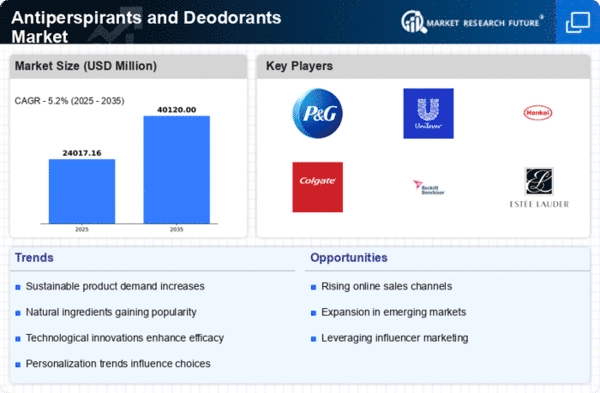
As per MRFR analysis, the Antiperspirants and Deodorants Market Size was estimated at 22830.0 USD Million in 2024. The Antiperspirants and Deodorants industry is projected to grow from 24006.0 in 2025 to 40120.0 by 2035, exhibiting a compound annual growth rate (CAGR) of 5.2 during the forecast period 2025 - 2035.

Key Market Trends & Highlights

The Antiperspirants and Deodorants Market is experiencing a dynamic shift towards natural formulations and innovative delivery systems.

  • The North American market remains the largest, driven by a strong demand for personal care products.
  • Asia-Pacific is identified as the fastest-growing region, with increasing consumer awareness and preference for innovative solutions.
  • The personal care segment dominates the market, while the medical segment is rapidly gaining traction due to rising health concerns.
  • Key market drivers include rising health consciousness and the expanding male grooming segment, which are shaping product offerings.

Market Size & Forecast

2024 Market Size 22830.0 (USD Million)
2035 Market Size 40120.0 (USD Million)
CAGR (2025 - 2035) 5.2%
Largest Regional Market Share in 2024 North America

Major Players

Procter & Gamble (US), Unilever (GB), Henkel (DE), Colgate-Palmolive (US), Reckitt Benckiser (GB), Estée Lauder (US), Coty (US), Beiersdorf (DE), Shiseido (JP)

Market Trends

Antiperspirants and Deodorants

Antiperspirants and Deodorants Market Market Drivers

E-commerce Growth

The rise of e-commerce platforms has transformed the purchasing landscape in the Global antiperspirants and deodorants Market Industry. Consumers increasingly prefer the convenience of online shopping, which offers a wider selection of products and the ability to compare prices easily. This trend has been accelerated by advancements in technology and logistics, making it easier for brands to reach consumers directly. As a result, online sales channels are expected to capture a larger share of the market, contributing to the projected CAGR of 3.58% from 2025 to 2035. The ability to access consumer reviews and product information online further enhances purchasing decisions, driving overall market growth.

Market Growth Projections

The Global Antiperspirants and Deodorants Market Industry is poised for substantial growth, with projections indicating a market value of 63.5 USD Billion in 2024 and an anticipated increase to 93.4 USD Billion by 2035. This growth trajectory reflects a compound annual growth rate (CAGR) of 3.58% from 2025 to 2035. Factors contributing to this expansion include rising consumer awareness, innovative product development, and the increasing demand for natural products. As the market evolves, it is expected that brands will continue to innovate and adapt to consumer preferences, ensuring sustained growth in this competitive landscape.

Rising Consumer Awareness

In the Global Antiperspirants and Deodorants Market Industry, increasing consumer awareness regarding personal hygiene and body odor management plays a pivotal role. As individuals become more informed about the importance of maintaining freshness throughout the day, the demand for effective antiperspirants and deodorants rises. This trend is particularly evident in urban areas, where lifestyles are fast-paced, and the need for reliable products is paramount. The market is projected to reach 63.5 USD Billion in 2024, indicating a robust growth trajectory fueled by this heightened awareness. Brands are responding by innovating formulations that cater to diverse consumer preferences, further driving market expansion.

Changing Lifestyle Patterns

Shifts in lifestyle patterns, particularly among urban populations, are influencing the Global Antiperspirants and Deodorants Market Industry. As more individuals engage in active lifestyles, including fitness and outdoor activities, the demand for effective antiperspirants and deodorants that can withstand physical exertion is increasing. This trend is particularly relevant in regions with warm climates, where perspiration management is crucial. Brands are responding by developing products that cater to these needs, such as sport-specific formulations. This adaptation to changing consumer behaviors is likely to support market growth, as the industry aligns its offerings with the evolving demands of health-conscious consumers.

Innovative Product Development

Innovation in product formulations and packaging is a key driver in the Global Antiperspirants and Deodorants Market Industry. Companies are increasingly investing in research and development to create products that not only provide long-lasting protection but also incorporate natural ingredients and sustainable packaging. For instance, the introduction of aluminum-free deodorants has gained traction among health-conscious consumers. This shift towards innovation is expected to contribute to the market's growth, with projections indicating a rise to 93.4 USD Billion by 2035. As brands strive to differentiate themselves through unique offerings, the competitive landscape becomes more dynamic, attracting a broader consumer base.

Growing Demand for Natural Products

The Global Antiperspirants and Deodorants Market Industry is witnessing a significant shift towards natural and organic products. Consumers are increasingly concerned about the ingredients in their personal care items, leading to a surge in demand for products that are free from synthetic chemicals. This trend is particularly pronounced among younger demographics who prioritize health and environmental sustainability. As a result, brands are reformulating their products to include plant-based ingredients and eco-friendly packaging. This movement is likely to bolster market growth, as consumers are willing to pay a premium for products that align with their values, thereby enhancing brand loyalty and market share.

Market Segment Insights

By Application: Personal Care (Largest) vs. Medical (Fastest-Growing)

The Antiperspirants and Deodorants Market is primarily driven by the personal care application segment, which holds the largest market share. Consumers increasingly prioritize personal hygiene and grooming, leading to a greater demand for deodorants and antiperspirants. This segment is characterized by a wide variety of products tailored for different skin types and preferences, supporting its dominance. The personal care segment not only contributes significantly to revenue but also shapes market trends with innovative products that cater to changing consumer preferences. In contrast, the medical application segment is emerging as the fastest-growing category within the market. This growth is attributed to a rising awareness of the health benefits associated with specialized deodorant products, particularly those formulated for sensitive skin or medical conditions like hyperhidrosis. The increasing focus on health and wellness, combined with product innovations in dermatological solutions, is expected to propel the growth of this segment prominently in the coming years.

Personal Care (Dominant) vs. Medical (Emerging)

The personal care application segment remains the dominant force in the Antiperspirants and Deodorants Market, driven by consumer preference for day-to-day hygiene products. This segment includes a diverse range of offerings, from roll-ons and sprays to sticks and gels, allowing brands to cater to various consumer needs and preferences. As lifestyle trends evolve and consumers seek eco-friendly and natural ingredients, manufacturers are innovating to provide cleaner, more effective options. On the other hand, the medical segment, while still emerging, is attracting attention due to a more focused approach on health solutions. Products in this category are often backed by dermatological research and are targeted toward individuals with specific health-related deodorant needs. This segment’s growth is indicative of a broader trend towards personalized consumer health solutions.

By Product Type: Roll-On (Largest) vs. Spray (Fastest-Growing)

The antiperspirants and deodorants market is segmented into four primary types: Roll-On, Spray, Stick, and Gel. Currently, Roll-On products hold the largest market share due to their easy application and perceived long-lasting effectiveness. In contrast, Spray antiperspirants are rapidly gaining traction, particularly among younger consumers who prefer convenience and quick application, contributing to their status as the fastest-growing segment in this market. The Stick and Gel products continue to maintain significant, though smaller, shares, appealing to niche consumer preferences.

Roll-On (Dominant) vs. Spray (Emerging)

Roll-On antiperspirants are recognized for their reliable performance, providing users with a strong sense of protection against sweat and odor. They are favored for their ease of use and controlled application, which minimizes product wastage. Meanwhile, Spray antiperspirants cater to a different segment of the market, offering a refreshing application method that is particularly appealing to on-the-go consumers. Sprays are known for their quick-drying formulation, which appeals to active individuals seeking an immediate solution. While Roll-Ons dominate in traditional markets, Sprays are emerging rapidly, particularly in urban areas, where lifestyle changes have influenced consumer preferences.

By End Use: Men (Largest) vs. Women (Fastest-Growing)

In the Antiperspirants and Deodorants Market, the distribution among the end-use segments shows that men constitute the largest share, reflecting a solid preference for grooming products specifically designed for their needs. This segment benefits from ongoing marketing campaigns that target male consumers, emphasizing efficacy and performance. On the other hand, the women’s segment, while slightly smaller, exhibits dynamic growth driven by increasing awareness about personal hygiene and a rise in targeted product lines catering to women's diverse preferences. The growth trends tell an interesting story, with the women’s segment emerging as the fastest-growing. Changing societal norms surrounding femininity and personal care are elevating demands for women's deodorants, compelling brands to innovate and introduce more specialized products. Consumers are increasingly looking for options that provide not only effectiveness but also skin sensitivity and scent variety, thus driving the segment's rapid expansion.

Men: Dominant vs. Women: Emerging

The men’s segment in the Antiperspirants and Deodorants Market remains undeniably dominant, characterized by a wide range of products focused on robust performance and longevity. Men tend to prefer strong scents and high-performance formulations that offer sweat and odor protection even during intense physical activities. Brands catering to this segment frequently leverage masculine imagery and advertising to appeal to male consumers. Conversely, the women’s segment is emerging rapidly, evolving from traditional floral scents to more diverse options that appeal to modern preferences. The rise of natural and organic ingredients in women's products is particularly notable, reflecting a growing concern for skin health and environmental impact. As brands tailor their offerings to address these changing preferences, the women’s segment is poised for significant growth.

By Formulation: Natural (Largest) vs. Antibacterial (Fastest-Growing)

In the Antiperspirants and Deodorants Market, the 'Formulation' segment is notably diverse, featuring Natural, Synthetic, Organic, and Antibacterial products. Among these, Natural formulations hold the largest market share due to the increasing consumer preference for clean and eco-friendly products. Synthetic formulations, while historically popular, are gradually being overshadowed by the trend towards natural ingredients. Organic products are also gaining traction as consumers are increasingly aware of the ingredients in their personal care items. The growth trends for the formulation segment are driven primarily by evolving consumer preferences favoring sustainability and health-conscious choices. Antibacterial formulations stand out as the fastest-growing category, propelled by heightened hygiene awareness, especially in the wake of global health events. The demand for effective personal care solutions, combined with the rise of e-commerce platforms, is expected to further enhance the visibility and growth of these products.

Natural (Dominant) vs. Antibacterial (Emerging)

The Natural formulation segment is recognized for its dominance in the Antiperspirants and Deodorants Market, appealing to environmentally conscious consumers seeking products with minimal chemical content. These formulations typically feature ingredients derived from natural sources, such as plant extracts and essential oils, contributing to their allure. On the other hand, Antibacterial formulations are emerging as a significant player, particularly among health-focused consumers. With an emphasis on hygiene and bacterial control, these products often integrate active ingredients like triclosan or alcohol, showcasing their effectiveness in combating odor. Both segments reflect a dynamic shift in consumer preferences, with Natural formulations leading the market while Antibacterial options continue to capture growing interest.

By Distribution Channel: Supermarkets (Largest) vs. Online Retail (Fastest-Growing)

In the Antiperspirants and Deodorants Market, the distribution of sales among channels reveals noteworthy insights. Supermarkets hold the largest share, attributed to their extensive reach and the convenience they offer to consumers. Pharmacies and convenience stores also contribute to the overall market but to a lesser extent. Online retail, however, is gaining traction rapidly, reflecting a shift in consumer purchasing behavior towards e-commerce platforms.

Supermarkets (Dominant) vs. Online Retail (Emerging)

Supermarkets are the dominant distribution channel for antiperspirants and deodorants, providing a wide selection of brands and product types that cater to various consumer preferences. Their physical presence allows for direct customer engagement and promotions, significantly influencing purchase decisions. In contrast, online retail is emerging as a powerful channel, driven by the increasing penetration of smartphones and internet access. Consumers appreciate the convenience and variety offered online, as well as the ease of comparing products. The growth in this segment is fueled by evolving shopping habits, including subscription services and targeted online marketing strategies.

Get more detailed insights about Antiperspirants and Deodorants Market Research Report - Global Forecast till 2027

Regional Insights

North America : Market Leader in Innovation

North America continues to lead the antiperspirants and deodorants market, holding a significant share of 11497.5 million in 2024. The growth is driven by increasing consumer awareness regarding personal hygiene and the rising demand for innovative products. Regulatory support for safe and effective formulations further fuels market expansion, with a focus on sustainability and natural ingredients. The competitive landscape is characterized by major players such as Procter & Gamble, Unilever, and Colgate-Palmolive, who dominate the market with their extensive product lines. The U.S. remains the largest market, while Canada and Mexico also contribute significantly. The presence of established brands and continuous product innovation ensures a robust market environment.

Europe : Emerging Trends in Sustainability

Europe's antiperspirants and deodorants market is valued at 6849.0 million, reflecting a growing trend towards sustainability and eco-friendly products. Regulatory frameworks in the EU promote the use of natural ingredients and limit harmful chemicals, which is driving consumer preference for safer options. The market is also influenced by rising health consciousness among consumers, leading to increased demand for organic and hypoallergenic products. Leading countries in this region include Germany, France, and the UK, where brands like Henkel and Unilever are prominent. The competitive landscape is evolving, with new entrants focusing on niche markets. The emphasis on sustainability and ethical sourcing is reshaping product offerings, making the European market a dynamic space for innovation.

Asia-Pacific : Rapid Growth in Emerging Markets

The Asia-Pacific region, with a market size of 3660.0 million, is witnessing rapid growth in the antiperspirants and deodorants sector. Factors such as urbanization, increasing disposable incomes, and changing lifestyles are driving demand. Additionally, the influence of Western beauty standards and rising awareness of personal grooming are significant catalysts for market expansion in countries like China and India. Key players such as Shiseido and Unilever are actively investing in this region to capture the growing consumer base. The competitive landscape is marked by a mix of local and international brands, with a focus on affordability and accessibility. As the market matures, innovation in product formulations and packaging will be crucial for sustaining growth.

Middle East and Africa : Untapped Potential in Market

The Middle East and Africa region, valued at 823.5 million, presents untapped potential in the antiperspirants and deodorants market. The growth is driven by increasing urbanization, a young population, and rising disposable incomes. Additionally, cultural shifts towards personal grooming and hygiene are contributing to the demand for these products. Regulatory frameworks are gradually evolving to support market growth, focusing on safety and efficacy. Leading countries in this region include South Africa and the UAE, where international brands are gaining traction. The competitive landscape is characterized by a mix of established players and local brands, with a focus on affordability and product accessibility. As consumer preferences shift, there is a growing opportunity for innovation and premium product offerings.

Key Players and Competitive Insights

The Antiperspirants and Deodorants Market is characterized by a dynamic competitive landscape, driven by innovation, sustainability, and consumer preferences for natural ingredients. Major players such as Procter & Gamble (US), Unilever (GB), and Reckitt Benckiser (GB) are at the forefront, each employing distinct strategies to enhance their market positioning. Procter & Gamble (US) focuses on product innovation, particularly in developing eco-friendly formulations, while Unilever (GB) emphasizes sustainability through its commitment to reducing plastic waste. Reckitt Benckiser (GB) is increasingly investing in digital transformation to enhance consumer engagement and streamline operations, indicating a collective shift towards more responsible and consumer-centric practices.The market structure appears moderately fragmented, with a mix of established brands and emerging players. Key tactics such as localizing manufacturing and optimizing supply chains are prevalent among leading companies, allowing them to respond swiftly to regional demands and preferences. This competitive structure fosters a diverse range of offerings, catering to various consumer segments and preferences, thereby enhancing overall market resilience.In November 2025, Unilever (GB) announced a partnership with a leading biotechnology firm to develop a new line of biodegradable deodorants. This strategic move underscores Unilever's commitment to sustainability and innovation, potentially positioning the company as a leader in eco-friendly personal care products. The collaboration is expected to leverage advanced biotechnological processes, which may significantly reduce environmental impact while appealing to environmentally conscious consumers.In October 2025, Procter & Gamble (US) launched a new marketing campaign aimed at promoting its latest line of aluminum-free antiperspirants. This initiative not only highlights the company's focus on health-conscious consumers but also reflects a broader industry trend towards natural and organic products. The campaign is likely to enhance brand loyalty and attract a demographic increasingly concerned with ingredient transparency and safety.In September 2025, Reckitt Benckiser (GB) expanded its product portfolio by acquiring a niche brand specializing in natural deodorants. This acquisition is indicative of Reckitt's strategy to diversify its offerings and tap into the growing demand for natural personal care products. By integrating this brand into its existing portfolio, Reckitt may enhance its competitive edge and appeal to a broader consumer base seeking healthier alternatives.As of December 2025, the competitive trends in the Antiperspirants and Deodorants Market are increasingly defined by digitalization, sustainability, and the integration of artificial intelligence in product development and marketing strategies. Strategic alliances are becoming more prevalent, enabling companies to pool resources and expertise to innovate more effectively. The shift from price-based competition to a focus on innovation, technology, and supply chain reliability is evident, suggesting that future competitive differentiation will hinge on the ability to adapt to evolving consumer preferences and environmental considerations.

Key Companies in the Antiperspirants and Deodorants Market include

Industry Developments

  • Q2 2024: Unilever launches Dove Men+Care Advanced Care antiperspirant in North America Unilever announced the launch of its new Dove Men+Care Advanced Care antiperspirant line in North America, featuring a new formula designed for 72-hour sweat and odor protection and skin care benefits.
  • Q2 2024: Secret and Old Spice debut refillable antiperspirant packaging nationwide Procter & Gamble expanded its sustainable packaging initiative by rolling out refillable antiperspirant sticks for its Secret and Old Spice brands across major U.S. retailers, aiming to reduce single-use plastic waste.
  • Q3 2024: Beiersdorf opens new deodorant production facility in Mexico Beiersdorf inaugurated a new manufacturing plant in Silao, Mexico, dedicated to producing deodorants for the Latin American market, increasing its regional production capacity and supply chain resilience.
  • Q3 2024: L'Oréal acquires natural deodorant brand Corpus L'Oréal announced the acquisition of Corpus, a U.S.-based natural deodorant brand, to strengthen its portfolio in the clean beauty and personal care segment.
  • Q4 2024: Native launches aluminum-free antiperspirant after FDA clearance Native, a Procter & Gamble brand, launched its first aluminum-free antiperspirant following FDA clearance, expanding its product line to meet growing consumer demand for natural alternatives.
  • Q1 2025: Unilever partners with Loop to pilot reusable deodorant packaging in Europe Unilever announced a partnership with Loop to pilot a reusable packaging system for its Rexona and Dove deodorant brands in select European markets, supporting circular economy initiatives.
  • Q1 2025: Schmidt’s Naturals secures $20 million funding to expand deodorant production Schmidt’s Naturals, a leading natural deodorant brand, raised $20 million in a funding round led by private equity investors to scale up manufacturing and accelerate international expansion.
  • Q2 2025: Colgate-Palmolive launches Speed Stick Zero, a fragrance-free antiperspirant Colgate-Palmolive introduced Speed Stick Zero, a new fragrance-free antiperspirant targeting consumers with sensitive skin and allergies, expanding its product offerings in the U.S. market.
  • Q2 2025: Procter & Gamble appoints new CEO for Personal Care division Procter & Gamble announced the appointment of Maria Lopez as CEO of its Personal Care division, which includes the company’s deodorant and antiperspirant brands.
  • Q3 2025: Unilever acquires sustainable deodorant startup Wild Unilever completed the acquisition of Wild, a UK-based sustainable deodorant startup known for its refillable packaging and natural formulations, to strengthen its eco-friendly product portfolio.
  • Q3 2025: Beiersdorf signs supply contract with Walmart for Nivea deodorants Beiersdorf secured a multi-year supply contract with Walmart to distribute its Nivea deodorant products across North American stores, expanding its retail footprint in the region.
  • Q4 2025: L'Oréal opens new R&D center for deodorant innovation in France L'Oréal inaugurated a new research and development center in France focused on deodorant and antiperspirant innovation, aiming to accelerate the development of advanced formulations and sustainable packaging.

Future Outlook

Antiperspirants and Deodorants Market Future Outlook

The Antiperspirants and Deodorants Market is projected to grow at a 5.2% CAGR from 2024 to 2035, driven by increasing consumer awareness and demand for innovative products.

New opportunities lie in:

  • Expansion into eco-friendly packaging solutions
  • Development of personalized scent profiles through AI
  • Introduction of subscription-based delivery services for convenience

By 2035, the market is expected to achieve robust growth, reflecting evolving consumer preferences and innovative product offerings.

Market Segmentation

Antiperspirants and Deodorants Market End Use Outlook

  • Men
  • Women
  • Unisex

Antiperspirants and Deodorants Market Application Outlook

  • Personal Care
  • Cosmetic
  • Medical
  • Household

Antiperspirants and Deodorants Market Formulation Outlook

  • Natural
  • Synthetic
  • Organic
  • Antibacterial

Antiperspirants and Deodorants Market Product Type Outlook

  • Roll-On
  • Spray
  • Stick
  • Gel

Antiperspirants and Deodorants Market Distribution Channel Outlook

  • Supermarkets
  • Online Retail
  • Pharmacies
  • Convenience Stores

Report Scope

MARKET SIZE 202422830.0(USD Million)
MARKET SIZE 202524006.0(USD Million)
MARKET SIZE 203540120.0(USD Million)
COMPOUND ANNUAL GROWTH RATE (CAGR)5.2% (2025 - 2035)
REPORT COVERAGERevenue Forecast, Competitive Landscape, Growth Factors, and Trends
BASE YEAR2024
Market Forecast Period2025 - 2035
Historical Data2019 - 2024
Market Forecast UnitsUSD Million
Key Companies ProfiledProcter & Gamble (US), Unilever (GB), Henkel (DE), Colgate-Palmolive (US), Reckitt Benckiser (GB), Estée Lauder (US), Coty (US), Beiersdorf (DE), Shiseido (JP)
Segments CoveredApplication, Product Type, End Use, Formulation, Distribution Channel
Key Market OpportunitiesGrowing demand for natural and organic formulations in the Antiperspirants and Deodorants Market presents significant opportunities.
Key Market DynamicsRising consumer preference for natural ingredients drives innovation and competition in the antiperspirants and deodorants market.
Countries CoveredNorth America, Europe, APAC, South America, MEA

FAQs

At what CAGR is the Global market projected to grow during the forecast period?

Antiperspirants and deodorants market is projected to grow at a 3.5% CAGR between 2020-2027.

Which region is expected to dominate the antiperspirants and deodorants market?

The Asia Pacific is expected to dominate the antiperspirants and deodorants market.

What will be the value of the antiperspirants and deodorants market during the forecast period?

Antiperspirants and deodorants market is predicted to touch USD 71,750.2 million by 2027.

Which form will lead the Global?

Sticks will lead the antiperspirants and deodorants market.

What are the key factors driving the antiperspirants and deodorants market?

Awareness about personal hygiene and changing lifestyles of consumers are the key factors driving the antiperspirants and deodorants market.

  1. SECTION I: EXECUTIVE SUMMARY AND KEY HIGHLIGHTS
    1. | 1.1 EXECUTIVE SUMMARY
  2. SECTION II: SCOPING, METHODOLOGY AND MARKET STRUCTURE
    1. | 2.1 MARKET INTRODUCTION
    2. | 2.2 RESEARCH METHODOLOGY
  3. SECTION III: QUALITATIVE ANALYSIS
    1. | 3.1 MARKET DYNAMICS
    2. | 3.2 MARKET FACTOR ANALYSIS
  4. SECTION IV: QUANTITATIVE ANALYSIS
    1. | 4.1 Consumer and Retail, BY Application (USD Million)
    2. | 4.2 Consumer and Retail, BY Product Type (USD Million)
    3. | 4.3 Consumer and Retail, BY End Use (USD Million)
    4. | 4.4 Consumer and Retail, BY Formulation (USD Million)
    5. | 4.5 Consumer and Retail, BY Distribution Channel (USD Million)
    6. | 4.6 Consumer and Retail, BY Region (USD Million)
  5. SECTION V: COMPETITIVE ANALYSIS
    1. | 5.1 Competitive Landscape
    2. | 5.2 Company Profiles
    3. | 5.3 Appendix

Antiperspirants and Deodorants Market Segmentation

Market Segmentation Overview

  • Detailed segmentation data will be available in the full report
  • Comprehensive analysis by multiple parameters
  • Regional and country-level breakdowns
  • Market size forecasts by segment
Infographic

Free Sample Request

Kindly complete the form below to receive a free sample of this Report

Get Free Sample

Customer Strories

Compare Licence

×
Features License Type
Single User Multiuser License Enterprise User
Price $4,950 $5,950 $7,250
Maximum User Access Limit 1 User Upto 10 Users Unrestricted Access Throughout the Organization
Free Customization
Direct Access to Analyst
Deliverable Format
Platform Access
Discount on Next Purchase 10% 15% 15%
Printable Versions