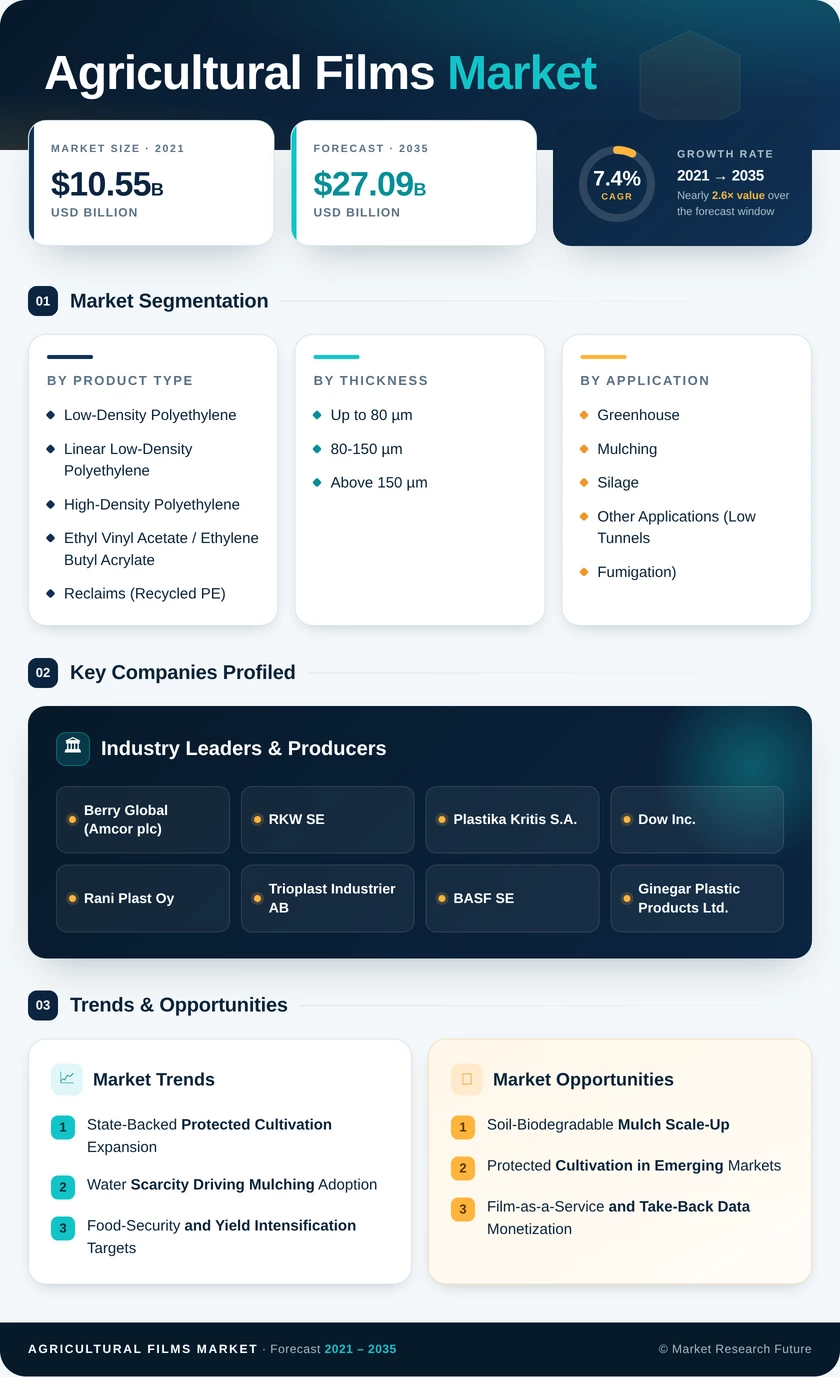
Segmentation Quick Reference
| Dimension | Sub-Segments | Dominant Segment | Fastest Growing Segment |
|---|
| By Product Type | Low-Density Polyethylene; Linear Low-Density Polyethylene; High-Density Polyethylene; Ethyl Vinyl Acetate / Ethylene Butyl Acrylate; Reclaims (Recycled PE); Other Types (Polypropylene Agricultural Films, Polyamide Agricultural Films, Ethylene Vinyl-Alcohol Copolymer Resins, and PVC) | Low-Density Polyethylene (45.4%) | Reclaims (Recycled PE) (8.9% CAGR) |
| By Thickness | Up to 80 µm; 80-150 µm; Above 150 µm | 80-150 µm (59.1%) | Above 150 µm (7.7% CAGR) |
| By Application | Greenhouse; Mulching; Silage; Other Applications (Low Tunnels, Fumigation) | Greenhouse (57.6%) | Mulching (8.0% CAGR) |
| By Region | North America; South America; Europe; Asia-Pacific; Middle East; Africa | Asia-Pacific (48.6%) | Africa (8.6% CAGR) |
Market Segmentation Overview
| Sub-Segment | Key Trend |
|---|
| Low-Density Polyethylene | Remains the default resin for clear, easily extruded covers |
| Linear Low-Density Polyethylene | Gains in silage wrap for puncture resistance |
| High-Density Polyethylene | Serves rigid netting and liner niches |
| Ethyl Vinyl Acetate / Ethylene Butyl Acrylate | Adds thermal retention to premium covers |
| Reclaims (Recycled PE) | Scales with compatibilizer advances and recycled-content demand |
| Other Types (Polypropylene Agricultural Films, Polyamide Agricultural Films, Ethylene Vinyl-Alcohol Copolymer Resins, and PVC) | Address barrier needs in fumigation and specialty uses |
Low-Density Polyethylene leads because its optical clarity and elongation suit wide greenhouse and mulch formats at the lowest processing cost. Reclaims (Recycled PE) grows fastest as converters bury recycled content in core layers while keeping virgin crop-facing skins. Ethyl Vinyl Acetate / Ethylene Butyl Acrylate copolymers win where night-time heat retention justifies a resin premium.
| Sub-Segment | Key Trend |
|---|
| Up to 80 µm | Used for low tunnels and short-cycle mulch; constrained by minimum-thickness rules |
| 80-150 µm | Mainstream gauge for mechanized laying and single-season cycles |
| Above 150 µm | Rising for multi-season covers in wind-exposed greenhouse zones |
The 80-150 µm band leads because it survives mechanized laying and remains retrievable for recycling at a manageable price. Above 150 µm grows fastest as large greenhouse operators prioritize multi-season survivability over upfront cost. Up to 80 µm faces pressure from China's GB 13735-2017 minimum-thickness requirement.
| Sub-Segment | Key Trend |
|---|
| Greenhouse | Shifts toward photoselective, NIR-reflective multilayer covers |
| Mulching | Accelerates with water scarcity and soil-biodegradable options |
| Silage | Adopts oxygen-barrier multilayer wraps and downgauged grades |
| Other Applications (Low Tunnels, Fumigation) | Supports season extension and fumigant containment |
Greenhouse leads on the intensity of vegetable and floriculture production, where light-management covers cut cooling energy. Mulching grows fastest because water tariffs and burning restrictions favor moisture-retaining and soil-degradable sheeting. Silage keeps a steady base as dairy consolidation rewards wraps that preserve feed value.


 Noah Malgeri
Co-Founder

 Peter Groot koerkamp
Account and Business Manager

 Younghwan Choi
Senior Retail Manager

 Mark Irwin
Management Consultant

 Akif Moroglu
Strategy & Business Development Director

 Guilherme Gomes Martins
Product Management Director

 Joseph Aguayo
Sales Operations & Pricing Manager

 La Terria Dodd
Program Support Specialist

 Rob Kooiker
Group Product Manager HVAC & Fire Protection GMA