×
Hero Background
English
Chinese
French
Japanese
Korean
German
Spanish

Aerospace Robotics Market Analysis

ID: MRFR/AD/9462-CR
100 Pages
Sejal Akre
September 2022

Aerospace Robotics Market Research Report Information By Type (Traditional Robots[Articulated, Parallel, Linear/Cartesian, Scara ] Collaborative Robots), By Component (Controller, Sensor, Drive, and End Effector(Welding Guns, Grippers, Robotic Screwdrivers, Sanding & Deburring Tool, Specialty & Hybrid End Effectors ),By Payload (up to 16.00 kg, 16.01–60.00 kg, 60.01–225.00 kg, and more than 225.00 kg), By Application (Drilling & Fastening, Non-Destructive Testing & Inspection, Welding & Soldering, Sealing ,Dispensing) Reg... read more

Share:
Download PDF ×

We do not share your information with anyone. However, we may send you emails based on your report interest from time to time. You may contact us at any time to opt-out.

Aerospace Robotics Market Infographic
Purchase Options

Market Analysis

Aerospace Robotics (Global, 2024)

Introduction

The Aerospace Robotics market is poised to undergo significant transformation as advancements in technology and increasing demand for automation reshape the landscape of the aerospace industry. With the integration of artificial intelligence, machine learning, and advanced materials, aerospace robotics is becoming a critical component in enhancing operational efficiency, safety, and precision in various applications, including manufacturing, maintenance, and exploration. The growing emphasis on reducing human error and improving productivity is driving the adoption of robotic systems in both commercial and military aerospace sectors. As companies strive to innovate and remain competitive, the role of robotics in streamlining processes, optimizing supply chains, and enabling complex tasks in challenging environments is becoming increasingly vital. This report delves into the current trends, challenges, and opportunities within the Aerospace Robotics market, providing a comprehensive analysis of the factors influencing its evolution and the strategic initiatives undertaken by key players in the industry.

PESTLE Analysis

Political
In 2024, the aerospace robotics market is heavily influenced by government policies aimed at enhancing national security and technological advancement. The U.S. government has allocated approximately $1.5 billion for research and development in aerospace technologies, which includes robotics, as part of its defense budget. Additionally, international collaborations, such as the European Union's Horizon Europe program, have earmarked €95 billion for research and innovation, with a focus on sustainable aerospace technologies, further driving political support for the sector.
Economic
The economic landscape for aerospace robotics in 2024 is characterized by increased investment in automation and robotics technologies. The global aerospace sector is projected to spend around $3.2 billion on robotics solutions, reflecting a growing trend towards automation in manufacturing and maintenance processes. Furthermore, the labor market is expected to see a demand for approximately 50,000 skilled workers in robotics and automation within the aerospace industry, highlighting the economic shift towards high-tech job creation.
Social
Social factors are increasingly shaping the aerospace robotics market, particularly in terms of public perception and workforce dynamics. A survey conducted in early 2024 indicated that 68% of respondents believe that robotics will enhance safety and efficiency in air travel. Additionally, educational institutions are responding to this trend, with over 200 universities worldwide offering specialized programs in aerospace robotics, aiming to prepare the next generation of engineers and technicians for this evolving field.
Technological
Technological advancements are at the forefront of the aerospace robotics market in 2024, with significant innovations in artificial intelligence and machine learning. The integration of AI in robotics is expected to improve operational efficiency by up to 30%, particularly in predictive maintenance and autonomous flight systems. Moreover, the development of advanced materials, such as lightweight composites, is projected to reduce the weight of robotic systems by 15%, enhancing their performance and fuel efficiency.
Legal
Legal frameworks governing the aerospace robotics market are becoming more stringent, particularly concerning safety and compliance standards. In 2024, the Federal Aviation Administration (FAA) has implemented new regulations requiring all autonomous drones used in commercial aerospace applications to comply with a set of 12 safety standards. This regulatory environment is designed to ensure the safe integration of robotics into airspace, impacting manufacturers and operators alike.
Environmental
Environmental considerations are increasingly influencing the aerospace robotics market, with a strong emphasis on sustainability. In 2024, the International Air Transport Association (IATA) has set a target for the aviation industry to reduce carbon emissions by 50% by 2050, prompting the adoption of eco-friendly robotic technologies. Additionally, the use of robotics in manufacturing processes is expected to decrease waste by approximately 20%, aligning with global sustainability goals and reducing the environmental footprint of the aerospace sector.

Porter's Five Forces

Threat of New Entrants
Medium - The aerospace robotics market has significant barriers to entry, including high capital requirements, advanced technological expertise, and stringent regulatory standards. However, advancements in technology and increasing interest from startups may lower these barriers slightly, allowing new entrants to emerge.
Bargaining Power of Suppliers
Low - The suppliers in the aerospace robotics market are relatively numerous, and many components can be sourced from multiple vendors. This abundance reduces the bargaining power of suppliers, as manufacturers can switch suppliers without significant cost or disruption.
Bargaining Power of Buyers
High - Buyers in the aerospace sector, including large aerospace manufacturers and government agencies, hold substantial bargaining power due to their size and the volume of purchases. They can negotiate favorable terms and prices, especially as competition among suppliers increases.
Threat of Substitutes
Medium - While there are alternative technologies that can perform similar functions, such as traditional automation and manual processes, the unique capabilities of aerospace robotics, such as precision and efficiency, limit the threat of substitutes. However, advancements in alternative technologies could pose a risk.
Competitive Rivalry
High - The aerospace robotics market is characterized by intense competition among established players and new entrants. Companies are constantly innovating and investing in R&D to gain a competitive edge, leading to a highly dynamic and competitive environment.

SWOT Analysis

Strengths

  • High precision and reliability in manufacturing and maintenance processes.
  • Increased automation leading to reduced labor costs and improved efficiency.
  • Strong investment from both government and private sectors in aerospace technology.
  • Advancements in AI and machine learning enhancing robotic capabilities.

Weaknesses

  • High initial investment costs for robotics integration.
  • Limited availability of skilled workforce to operate and maintain advanced robotics.
  • Potential resistance to change from traditional manufacturing practices.
  • Complexity in integrating robotics with existing aerospace systems.

Opportunities

  • Growing demand for unmanned aerial vehicles (UAVs) and drones in various sectors.
  • Expansion of aerospace markets in emerging economies.
  • Potential for partnerships with tech companies to innovate new robotic solutions.
  • Increased focus on sustainability and eco-friendly technologies in aerospace.

Threats

  • Rapid technological advancements leading to obsolescence of current systems.
  • Intense competition from global players in the aerospace robotics sector.
  • Regulatory challenges and compliance issues in different regions.
  • Economic downturns affecting funding and investment in aerospace projects.

Summary

The Aerospace Robotics Market in 2024 is characterized by significant strengths such as high precision and strong investment, but it also faces challenges like high costs and a skilled labor shortage. Opportunities abound in the growing UAV sector and emerging markets, while threats from competition and regulatory hurdles could impact growth. Strategic partnerships and a focus on innovation will be crucial for companies to navigate this dynamic landscape.


Author
Sejal Akre
Senior Research Analyst

She has over 5 years of rich experience, in market research and consulting providing valuable market insights to client. Hands on expertise in management consulting, and extensive knowledge in domain including ICT, Automotive & Transportation and Aerospace & Defense. She is skilled in Go-to market strategy, industry analysis, market sizing, in depth company profiling, competitive intelligence & benchmarking and value chain amongst others.

Leave a Comment

FAQs

How Aerospace robotics market Is Growing

Aerospace robotics market has been growing rapidly from the past few decades and is expected to grow at a CAGR of 11.7 % during the forecast period.

Who are the key competitors in this market?

Kuka AG, ABB Group, FANUC Corporation, Yaskawa electric corporation, Kawasaki Heavy Industries Ltd, Mtorres, Oliver Crispin Robotics Limited, Gudel AG, Electroimpact Inc., Universal Robots A/S, STÄUBLI, COMAU, FESTO, and BOSTON DYNAMICS are expected to be the major competition in the aerospace robotics market during the projected period.

Which type segment is driving the market?

The Traditional robots segment is expected to drive the market during the forecasted period.

Which region is guiding the achievement of the market?

The Asia Pacific region is expected to be the largest market for aerospace robotics market during the forecast period.

What can limit the expansion of the global market?

Lack of skilled operators slows the growth of the aerospace robotics market during the forecast period.

Market Summary

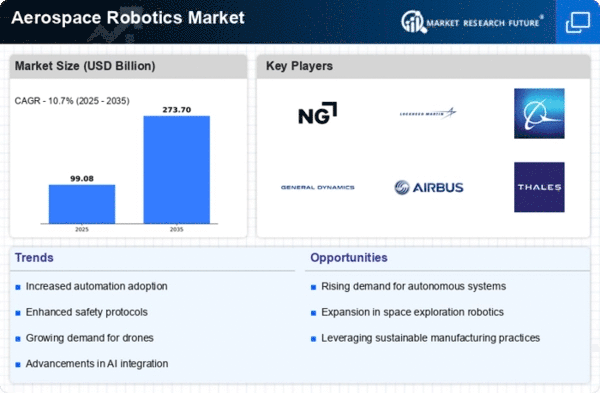
As per MRFR analysis, the Aerospace Robotics Market Size was estimated at 89.5 USD Billion in 2024. The Aerospace Robotics industry is projected to grow from 99.0 in 2025 to 273.7 by 2035, exhibiting a compound annual growth rate (CAGR) of 10.7 during the forecast period 2025 - 2035.

Key Market Trends & Highlights

The Aerospace Robotics Market is poised for substantial growth driven by technological advancements and increasing automation.

  • North America remains the largest market for aerospace robotics, driven by significant investments in manufacturing and R&D.
  • The Asia-Pacific region is emerging as the fastest-growing market, fueled by rapid industrialization and technological adoption.
  • Manufacturing continues to dominate the market, while the inspection segment is witnessing the fastest growth due to rising safety and efficiency standards.
  • Key drivers include advancements in robotics technology and the growing demand for unmanned aerial vehicles (UAVs), which are reshaping the industry landscape.

Market Size & Forecast

2024 Market Size 89.5 (USD Billion)
2035 Market Size 273.7 (USD Billion)
CAGR (2025 - 2035) 10.7%
Largest Regional Market Share in 2024 North America

Major Players

<p>Northrop Grumman (US), Lockheed Martin (US), Boeing (US), General Dynamics (US), Raytheon Technologies (US), Airbus (FR), Thales Group (FR), Leonardo (IT), Kawasaki Heavy Industries (JP), Mitsubishi Heavy Industries (JP)</p>

Market Trends

The Aerospace Robotics Market is currently experiencing a transformative phase characterized by rapid advancements in technology and increasing demand for automation in various aerospace applications. The integration of robotics into manufacturing processes, maintenance, and inspection tasks is reshaping traditional practices, enhancing efficiency, and reducing operational costs. As aerospace companies strive for higher precision and reliability, the adoption of robotic systems appears to be a strategic response to the growing complexity of aircraft design and production. Furthermore, the emphasis on sustainability and environmental considerations is driving innovations in robotic technologies, which may lead to more eco-friendly manufacturing practices. In addition, the Aerospace Robotics Market is witnessing a surge in collaborative robots, or cobots, which are designed to work alongside human operators. This trend suggests a shift towards more flexible and adaptive manufacturing environments, where human expertise and robotic efficiency coexist. The ongoing development of artificial intelligence and machine learning capabilities within robotics is likely to further enhance the functionality and autonomy of these systems. As the market evolves, stakeholders must remain vigilant to emerging trends and technological advancements that could redefine the landscape of aerospace robotics in the coming years.

Increased Automation in Manufacturing

The Aerospace Robotics Market is seeing a notable rise in automation across manufacturing processes. This trend indicates a shift towards utilizing robotic systems for tasks such as assembly, welding, and painting, which traditionally relied heavily on manual labor. Automation not only enhances productivity but also improves precision and consistency in production.

Rise of Collaborative Robotics

Collaborative robots, or cobots, are gaining traction within the Aerospace Robotics Market. These systems are designed to work alongside human operators, facilitating a more integrated approach to manufacturing. This trend suggests a move towards environments where human skills and robotic capabilities complement each other, enhancing overall operational efficiency.

Focus on Sustainability and Eco-Friendly Practices

Sustainability is becoming a central theme in the Aerospace Robotics Market. Companies are increasingly seeking robotic solutions that minimize waste and energy consumption. This trend reflects a broader commitment to environmental responsibility, as stakeholders recognize the importance of adopting practices that align with global sustainability goals.

Aerospace Robotics Market Market Drivers

Global Defense Spending

Global defense spending is a significant driver of the Global Aerospace Robotics Market Industry. With nations increasing their military budgets, there is a heightened demand for advanced aerospace technologies, including robotics. These systems are essential for various defense applications, such as surveillance, reconnaissance, and unmanned aerial vehicles. The growing emphasis on national security and technological superiority is likely to propel investments in aerospace robotics. As a result, the market is expected to experience robust growth, with a projected CAGR of 12.49% from 2025 to 2035. This trend underscores the strategic importance of robotics in modern defense operations.

Market Growth Projections

The Global Aerospace Robotics Market Industry is poised for substantial growth, with projections indicating a market size of 15.0 USD Billion in 2024 and an anticipated increase to 54.9 USD Billion by 2035. This growth trajectory suggests a compound annual growth rate (CAGR) of 12.49% from 2025 to 2035. Such figures reflect the increasing integration of robotics in aerospace applications, driven by technological advancements and rising demand for automation. The market's expansion is likely to be supported by investments in research and development, as well as government initiatives aimed at fostering innovation in aerospace technologies.

Sustainability Initiatives

Sustainability initiatives are increasingly influencing the Global Aerospace Robotics Market Industry. As environmental concerns gain prominence, aerospace companies are seeking ways to reduce their carbon footprint and enhance energy efficiency. Robotics plays a crucial role in this transition by optimizing manufacturing processes and minimizing waste. For example, robotic systems can be programmed to use materials more efficiently, thereby reducing excess and promoting recycling. The emphasis on sustainability is likely to drive innovation in aerospace robotics, aligning with global efforts to achieve greener manufacturing practices. This trend may contribute to sustained growth in the market as companies prioritize eco-friendly solutions.

Technological Advancements

The Global Aerospace Robotics Market Industry is experiencing rapid technological advancements that enhance the capabilities of robotic systems. Innovations in artificial intelligence, machine learning, and sensor technologies are enabling robots to perform complex tasks with greater precision and efficiency. For instance, the integration of AI-driven analytics allows for predictive maintenance, reducing downtime and operational costs. As a result, the market is projected to reach 15.0 USD Billion in 2024, reflecting the growing demand for sophisticated robotic solutions in aerospace manufacturing and maintenance. These advancements not only improve productivity but also contribute to the overall safety and reliability of aerospace operations.

Increased Demand for Automation

The Global Aerospace Robotics Market Industry is witnessing a surge in demand for automation across various aerospace sectors. As manufacturers strive to enhance productivity and reduce labor costs, the adoption of robotic systems becomes increasingly appealing. Automation facilitates faster production cycles and minimizes human error, which is crucial in the highly regulated aerospace environment. This trend is expected to drive the market's growth significantly, with projections indicating a rise to 54.9 USD Billion by 2035. The shift towards automation is further supported by government initiatives promoting advanced manufacturing technologies, thereby fostering a conducive environment for robotics integration.

Regulatory Compliance and Safety Standards

Regulatory compliance and stringent safety standards are pivotal drivers in the Global Aerospace Robotics Market Industry. Aerospace manufacturers are mandated to adhere to rigorous safety protocols, which necessitate the use of advanced robotic systems that can ensure compliance. Robotics not only enhances the accuracy of manufacturing processes but also aids in maintaining high safety standards during assembly and maintenance operations. As the industry evolves, the need for compliance with international regulations is likely to propel the adoption of robotics, thereby contributing to the market's growth. This focus on safety and compliance is expected to be a key factor in the industry's trajectory.

Market Segment Insights

By Application: Manufacturing (Largest) vs. Inspection (Fastest-Growing)

<p>In the Aerospace Robotics Market, the Application segment is categorized into Manufacturing, Inspection, Maintenance, Surveillance, and Transportation. Manufacturing holds the largest share, driven by the increasing demand for automation and precision in the aerospace production processes. Inspection, while smaller in share than Manufacturing, is witnessing rapid growth due to the increasing focus on quality control and safety regulations within the aerospace industry.</p>

<p>Manufacturing (Dominant) vs. Inspection (Emerging)</p>

<p>Manufacturing remains the dominant segment in the Aerospace Robotics market, primarily due to its capability to streamline production and enhance efficiency in aircraft assembly lines. Robotic systems are employed for tasks such as welding, painting, and component assembly, which maximize throughput and minimize human error. Conversely, Inspection is an emerging segment, fueled by stringent safety standards and the need for regular quality assessments. Autonomous drones and robotic arms are increasingly used to conduct inspections, improving accuracy and reducing downtime during maintenance. As the industry advances, the integration of advanced AI and machine learning in these applications will further enhance their capabilities.</p>

By End Use: Commercial Aviation (Largest) vs. Unmanned Aerial Vehicles (Fastest-Growing)

<p>In the Aerospace Robotics Market, the end-use segment is predominantly led by Commercial Aviation, which holds the largest share. This is fueled by the increasing demand for automated solutions to enhance operational efficiency, safety, and passenger experience. In contrast, Unmanned Aerial Vehicles (UAVs) are gaining traction due to their growing applications in various sectors, including surveillance, cargo delivery, and agricultural monitoring, steadily increasing their market share and industry significance. The growth trends within this segment are driven by technological advancements and increasing investments in robotics and automation. Factors such as the rise in passenger and cargo traffic, military investments in advanced defense systems, and expanding interest in space exploration contribute to the growth. UAVs, in particular, are witnessing rapid innovation and regulatory support, positioning them as a vital player in future aerospace endeavors.</p>

<p>Commercial Aviation: Dominant vs. Unmanned Aerial Vehicles: Emerging</p>

<p>Commercial Aviation remains the dominant force in the Aerospace Robotics Market, characterized by its extensive integration of robotic technology aimed at improving safety, efficiency, and operational capabilities. This segment includes advanced robotic systems for aircraft assembly, maintenance, and even passenger services, reflecting a robust demand for innovation in a highly competitive market. On the other hand, Unmanned Aerial Vehicles are an emerging segment, rapidly evolving with advancements in drone technology and their integration into various applications such as military reconnaissance and logistics. Their unique capabilities, such as automated flight and real-time data collection, make them distinct, enabling broader operational scopes. As regulatory frameworks begin to mature, UAVs are anticipated to become significantly more mainstream, thus enhancing their relevance in the aerospace sector.</p>

By Technology: Artificial Intelligence (Largest) vs. Machine Learning (Fastest-Growing)

<p>In the Aerospace Robotics Market, Artificial Intelligence (AI) stands as the largest value, capturing a significant market share due to its extensive application in autonomous systems and decision-making processes within aircraft operations. Following closely is Machine Learning, rapidly gaining traction and being recognized as the fastest-growing segment, driven by advancements in algorithms and data processing capabilities that enhance robotic efficiency and capabilities in aerospace applications. The growth trends within the Technology segment highlight the increasing integration of these technologies into various facets of aerospace operations. Factors such as the push for automation, improved safety protocols, and operational efficiency are propelling AI and Machine Learning adoption. Additionally, rising investments in research and development are set to further augment these segments, solidifying their roles in transforming aerospace robotics landscapes.</p>

<p>Technology: Artificial Intelligence (Dominant) vs. Machine Learning (Emerging)</p>

<p>Artificial Intelligence dominates the Aerospace Robotics Market by offering advanced functionalities such as autonomous navigation, predictive maintenance, and intelligent decision-making. This segment is characterized by its ability to process large datasets and execute complex algorithms, making it indispensable for modern aerospace applications. Conversely, Machine Learning, while still emerging, boasts incredible potential, allowing systems to learn from data and improve over time. This capability is crucial for adaptive robots in dynamic airspace scenarios. Both segments complement each other; while AI provides the overarching architecture, Machine Learning enhances specific tasks, driving innovation and performance improvements within the aerospace sector.</p>

By Component Type: Robotic Arms (Largest) vs. Drones (Fastest-Growing)

<p>In the Aerospace Robotics Market, Robotic Arms hold the largest share due to their extensive application in manufacturing and assembly processes within the aerospace sector. These advanced robotic systems enhance precision and efficiency, making them indispensable for tasks that require high levels of accuracy. Following closely, Drones are emerging as the fastest-growing segment, driven by their increasing usage in surveillance, cargo delivery, and reconnaissance missions. As technology advances, the adaptability and versatility of drones are carving out significant market presence.</p>

<p>Robotic Arms (Dominant) vs. Drones (Emerging)</p>

<p>Robotic Arms are established leaders in the Aerospace Robotics Market, characterized by their capacity to perform repetitive tasks with unmatched precision and reliability. These systems are crucial in streamlining production in aerospace facilities, automating processes that require meticulous attention, thus enhancing overall efficiency. On the other hand, Drones are recognized as the rapidly emerging technology, attracting interest due to their varied applications ranging from maintenance inspections to supply chain logistics. With advancements in AI and sensor technology, drones are quickly adapting and evolving, offering innovative solutions that are beginning to revolutionize traditional aerospace operations.</p>

By System Type: Integrated Systems (Largest) vs. Autonomous Systems (Fastest-Growing)

<p>The Aerospace Robotics Market shows a diverse array of system types, with Integrated Systems leading the market due to their versatility and comprehensive solutions. Collaborative Systems and Standalone Systems also occupy significant portions of the market, appealing to various industry needs. Modular Systems cater to specific applications, while Autonomous Systems have emerged rapidly, showcasing their potential across unmanned aerial vehicles and automated handling processes.</p>

<p>Integrated Systems (Dominant) vs. Autonomous Systems (Emerging)</p>

<p>Integrated Systems dominate the Aerospace Robotics Market, offering seamless integration of robotics into existing aerospace environments, thus facilitating enhanced efficiency and operational performance. These systems are widely adopted across various sectors, including manufacturing and maintenance. On the other hand, Autonomous Systems are rapidly gaining traction as the industry shifts toward autonomous operations in aerospace applications. Their ability to perform without human intervention, powered by advanced AI and sensor technologies, marks them as an emerging force within the segment. This reflects a broader trend towards automation in aerospace, with a growing focus on reducing human error and operational costs.</p>

Get more detailed insights about Aerospace Robotics Market Research Report—Global Forecast till 2035

Regional Insights

North America : Aerospace Innovation Leader

North America leads the aerospace robotics market with a commanding 45.0% share, driven by robust investments in R&D and advanced manufacturing technologies. The region's growth is fueled by increasing demand for automation in aerospace production, alongside regulatory support for innovation and safety standards. Government initiatives are promoting the integration of robotics to enhance efficiency and reduce operational costs. The competitive landscape is dominated by key players such as Northrop Grumman, Lockheed Martin, and Boeing, which are at the forefront of technological advancements. The U.S. remains a global hub for aerospace innovation, with significant contributions from Canada as well. The presence of major defense contractors and a strong supply chain further solidify North America's position in the aerospace robotics sector.

Europe : Emerging Aerospace Robotics Hub

Europe holds a significant 25.0% share of the aerospace robotics market, driven by increasing investments in automation and sustainability initiatives. The region is witnessing a surge in demand for advanced robotics solutions to enhance production efficiency and meet stringent environmental regulations. European governments are actively supporting the aerospace sector through funding and policy frameworks aimed at fostering innovation and competitiveness. Leading countries such as France, Germany, and Italy are home to major players like Airbus and Thales Group, which are pioneering advancements in aerospace robotics. The competitive landscape is characterized by collaboration between industry and academia, fostering innovation. The European market is poised for growth as companies adapt to new technologies and consumer demands, positioning themselves as leaders in the global aerospace robotics arena.

Asia-Pacific : Rapidly Growing Market

Asia-Pacific accounts for a 15.0% share of the aerospace robotics market, with rapid growth driven by increasing investments in aerospace manufacturing and technology. Countries like Japan and China are leading the charge, focusing on automation to enhance production capabilities and meet rising demand for air travel. Government initiatives are promoting the adoption of robotics to improve efficiency and safety in aerospace operations. The competitive landscape features key players such as Kawasaki Heavy Industries and Mitsubishi Heavy Industries, which are investing heavily in R&D to develop cutting-edge robotics solutions. The region's growth is further supported by a burgeoning aerospace sector, with increasing collaborations between local firms and international partners. As the market evolves, Asia-Pacific is set to become a significant player in the global aerospace robotics industry.

Middle East and Africa : Emerging Aerospace Frontier

The Middle East and Africa represent a nascent market in aerospace robotics, with a share of 4.5%. The region is beginning to recognize the potential of robotics in enhancing aerospace manufacturing and maintenance processes. Governments are increasingly investing in the aerospace sector, aiming to diversify economies and improve technological capabilities. Regulatory frameworks are being established to support innovation and attract foreign investment. Countries like the UAE and South Africa are emerging as key players, with initiatives to develop local aerospace industries. The competitive landscape is characterized by partnerships between local firms and international companies, fostering knowledge transfer and technology adoption. As the region continues to develop its aerospace capabilities, the demand for robotics solutions is expected to grow significantly, positioning it as a future hub for aerospace innovation.

Key Players and Competitive Insights

The Aerospace Robotics Market is currently characterized by a dynamic competitive landscape, driven by technological advancements and increasing demand for automation in aerospace applications. Major players such as Northrop Grumman (US), Lockheed Martin (US), and Boeing (US) are at the forefront, each adopting distinct strategies to enhance their market positioning. Northrop Grumman (US) emphasizes innovation through its investment in autonomous systems, while Lockheed Martin (US) focuses on strategic partnerships to bolster its capabilities in robotics. Boeing (US), on the other hand, is actively pursuing digital transformation initiatives to streamline operations and improve efficiency, collectively shaping a competitive environment that prioritizes technological prowess and operational excellence.

Key business tactics within the Aerospace Robotics Market include localizing manufacturing and optimizing supply chains to enhance responsiveness and reduce costs. The market structure appears moderately fragmented, with several key players exerting considerable influence. This fragmentation allows for a diverse range of offerings, yet the collective strategies of major companies create a competitive atmosphere where innovation and efficiency are paramount.

In November 2025, Northrop Grumman (US) announced a partnership with a leading AI firm to develop next-generation autonomous drones. This strategic move is likely to enhance their capabilities in unmanned aerial systems, positioning them favorably against competitors. The integration of AI into their robotics solutions may significantly improve operational efficiency and mission effectiveness, reflecting a broader trend towards automation in aerospace.

In October 2025, Lockheed Martin (US) unveiled a new robotics platform designed for advanced manufacturing processes. This initiative underscores their commitment to leveraging robotics for enhanced production capabilities. By streamlining manufacturing through automation, Lockheed Martin (US) aims to reduce lead times and costs, thereby strengthening its competitive edge in the market.

In September 2025, Boeing (US) launched a new initiative focused on sustainable aviation technologies, incorporating robotics to optimize fuel efficiency in aircraft design. This strategic direction not only aligns with global sustainability goals but also positions Boeing (US) as a leader in environmentally conscious aerospace solutions. The integration of robotics in this context suggests a forward-thinking approach that could redefine industry standards.

As of December 2025, current competitive trends in the Aerospace Robotics Market are heavily influenced by digitalization, sustainability, and AI integration. Strategic alliances are increasingly shaping the landscape, enabling companies to pool resources and expertise. The shift from price-based competition to a focus on innovation, technology, and supply chain reliability is evident, suggesting that future differentiation will hinge on the ability to adapt to these evolving trends.

Key Companies in the Aerospace Robotics Market market include

Industry Developments

Fanuc Corporation aims at increasing its sales with the help of organic and inorganic strategies. The company emphasizes expanding its product portfolio and marketing its services to obtain a competitive advantage. It focuses on acquisitions and mergers to expand its geographic reach and technical expertise. Furthermore, the company also focuses on maintaining a healthy relationship with its channel partners to enhance the accessibility of its product and services to the market. KUKA AG invests heavily in its research & development to supply innovative products and sustainably compete globally.

The company has collaborated with various other technology providers to sustain and expand its market presence. The company is concentrating on expanding its innovative and technological leadership by targeting fast-growing global markets and continuing to work on efficient structures. The company aims to take advantage of regional growth potential, especially in the high-growth countries of Asia and North America.

Aerospace Robotics Market Industry Developments

  • Q2 2024: Airbus inaugurates new robotics-driven assembly line for A320 Family in Toulouse Airbus opened a state-of-the-art assembly line in Toulouse featuring advanced robotics and digital technologies to enhance efficiency and precision in aircraft manufacturing.
  • Q2 2024: Boeing partners with Sarcos Robotics to deploy robotic arms for aircraft inspection Boeing announced a partnership with Sarcos Robotics to integrate robotic arms into its aircraft inspection processes, aiming to improve safety and reduce turnaround times.
  • Q3 2024: Northrop Grumman wins $120M contract to supply robotic systems for U.S. Air Force maintenance Northrop Grumman secured a $120 million contract to deliver advanced robotics for aircraft maintenance, supporting the U.S. Air Force's modernization efforts.
  • Q3 2024: Lockheed Martin launches AI-powered robotic drilling system for fighter jet production Lockheed Martin unveiled a new AI-driven robotic drilling system designed to increase speed and accuracy in the production of F-35 fighter jets.
  • Q4 2024: ABB opens new robotics R&D center focused on aerospace automation in Germany ABB inaugurated a research and development center in Germany dedicated to advancing robotics solutions for aerospace manufacturing and maintenance.
  • Q4 2024: KUKA signs partnership with Rolls-Royce for robotic engine assembly KUKA entered a strategic partnership with Rolls-Royce to deploy collaborative robots in the assembly of aircraft engines, aiming to boost productivity and quality.
  • Q1 2025: Aerospace robotics startup Aerobotix raises $40M Series C to expand autonomous painting systems Aerobotix secured $40 million in Series C funding to scale its autonomous robotic painting solutions for commercial and military aircraft.
  • Q1 2025: GE Aviation deploys robotic inspection platform for jet engine maintenance GE Aviation announced the rollout of a robotic inspection platform to automate jet engine maintenance, improving turnaround times and reducing costs.
  • Q2 2025: Thales acquires French robotics firm Robosoft to boost aerospace automation capabilities Thales completed the acquisition of Robosoft, a French robotics company, to strengthen its portfolio of automation solutions for aerospace manufacturing.
  • Q2 2025: Spirit AeroSystems opens new facility for robotic composite manufacturing in Kansas Spirit AeroSystems launched a new manufacturing facility in Kansas equipped with advanced robotics for composite material production in aerospace applications.
  • Q3 2025: Safran wins contract to supply robotic systems for European Space Agency satellite assembly Safran was awarded a contract to provide robotic assembly systems for the European Space Agency's next-generation satellite program.
  • Q3 2025: Robotic startup SkyRobotics announces partnership with NASA for autonomous spacecraft servicing SkyRobotics revealed a partnership with NASA to develop autonomous robotic systems for in-orbit spacecraft servicing and maintenance.

Future Outlook

Aerospace Robotics Market Future Outlook

<p>The Aerospace Robotics Market is projected to grow at a 10.7% CAGR from 2024 to 2035, driven by advancements in automation, increased demand for efficiency, and enhanced safety protocols.</p>

New opportunities lie in:

  • <p>Development of autonomous drone delivery systems for aerospace logistics.</p>
  • <p>Integration of AI-driven predictive maintenance solutions for aircraft.</p>
  • <p>Expansion of robotic assembly lines in aerospace manufacturing facilities.</p>

<p>By 2035, the Aerospace Robotics Market is expected to be robust, driven by innovation and strategic investments.</p>

Market Segmentation

Aerospace Robotics Market End Use Outlook

  • Commercial Aviation
  • Military Aviation
  • Space Exploration
  • Unmanned Aerial Vehicles
  • Cargo Transport

Aerospace Robotics Market Technology Outlook

  • Artificial Intelligence
  • Machine Learning
  • Computer Vision
  • Sensor Technology
  • Automation

Aerospace Robotics Market Application Outlook

  • Manufacturing
  • Inspection
  • Maintenance
  • Surveillance
  • Transportation

Aerospace Robotics Market System Type Outlook

  • Integrated Systems
  • Standalone Systems
  • Modular Systems
  • Collaborative Systems
  • Autonomous Systems

Aerospace Robotics Market Component Type Outlook

  • Robotic Arms
  • Drones
  • Autonomous Vehicles
  • Control Systems
  • Sensors

Report Scope

MARKET SIZE 202489.5(USD Billion)
MARKET SIZE 202599.0(USD Billion)
MARKET SIZE 2035273.7(USD Billion)
COMPOUND ANNUAL GROWTH RATE (CAGR)10.7% (2024 - 2035)
REPORT COVERAGERevenue Forecast, Competitive Landscape, Growth Factors, and Trends
BASE YEAR2024
Market Forecast Period2025 - 2035
Historical Data2019 - 2024
Market Forecast UnitsUSD Billion
Key Companies ProfiledNorthrop Grumman (US), Lockheed Martin (US), Boeing (US), General Dynamics (US), Raytheon Technologies (US), Airbus (FR), Thales Group (FR), Leonardo (IT), Kawasaki Heavy Industries (JP), Mitsubishi Heavy Industries (JP)
Segments CoveredApplication, End Use, Technology, Component Type, System Type
Key Market OpportunitiesIntegration of artificial intelligence in Aerospace Robotics enhances operational efficiency and safety in aviation.
Key Market DynamicsTechnological advancements drive competitive forces, enhancing efficiency and safety in aerospace robotics applications.
Countries CoveredNorth America, Europe, APAC, South America, MEA

FAQs

How Aerospace robotics market Is Growing

Aerospace robotics market has been growing rapidly from the past few decades and is expected to grow at a CAGR of 11.7 % during the forecast period.

Who are the key competitors in this market?

Kuka AG, ABB Group, FANUC Corporation, Yaskawa electric corporation, Kawasaki Heavy Industries Ltd, Mtorres, Oliver Crispin Robotics Limited, Gudel AG, Electroimpact Inc., Universal Robots A/S, STÄUBLI, COMAU, FESTO, and BOSTON DYNAMICS are expected to be the major competition in the aerospace robotics market during the projected period.

Which type segment is driving the market?

The Traditional robots segment is expected to drive the market during the forecasted period.

Which region is guiding the achievement of the market?

The Asia Pacific region is expected to be the largest market for aerospace robotics market during the forecast period.

What can limit the expansion of the global market?

Lack of skilled operators slows the growth of the aerospace robotics market during the forecast period.

  1. EXECUTIVE SUMMARY 20
  2. MARKET INTRODUCTION 23
    1. DEFINITION 23
    2. SCOPE OF THE STUDY 23
    3. MARKET STRUCTURE 24
  3. RESEARCH METHODOLOGY 25
  4. MARKET DYNAMICS 32
    1. INTRODUCTION 32
    2. DRIVERS 33
      1. INCREASE IN GLOBAL AIRCRAFT DEMAND AND MANUFACTURING
      2. INCREASING USE OF ROBOTS FOR EFFICIENT AIRCRAFT PRODUCTION PROCESSES
      3. DRIVERS: IMPACT ANALYSIS 34
    3. RESTRAINT 34
      1. LACK
      2. RESTRAINT IMPACT ANALYSIS 34
    4. OF SKILLED OPERATORS 34
    5. OPPORTUNITY
      1. HUMAN-ROBOT COLLABORATION 35
    6. IMPACT OF COVID-19 35
      1. IMPACT ON COMPONENT MANUFACTURERS
      2. IMPACT ON DEVICE MANUFACTURERS 36
      3. COVID-19 IMPACT ON SUPPLY
    7. IMPACT ON SEMICONDUCTOR MANUFACTURERS 35
    8. CHAIN DELAYS 36
  5. MARKET FACTOR ANALYSIS 37
    1. VALUE CHAIN ANALYSIS 37
      1. HARDWARE OR COMPONENT MANUFACTURERS 37
      2. SOFTWARE DEVELOPERS 37
      3. SYSTEM INTEGRATORS 37
      4. END USERS 38
      5. THREATS OF NEW
      6. BARGAINING POWER OF SUPPLIERS 39
      7. THREATS OF SUBSTITUTE
      8. BARGAINING POWER OF BUYERS 39
      9. INTENSITY OF RIVALRY 39
    2. ENTRANTS 38
  6. GLOBAL AEROSPACE ROBOTICS MARKET, BY TYPE 40
    1. OVERVIEW 40
  7. GLOBAL AEROSPACE ROBOTICS MARKET, BY TYPE, 2022–2030 (USD MILLION) 41
    1. TRADITIONAL ROBOTS 42
    2. ROBOTS, 2022–2030 (USD MILLION) 42
    3. COLLABORATIVE ROBOTS 43
  8. GLOBAL AEROSPACE ROBOTICS MARKET, BY TRADITIONAL
  9. ARTICULATED 42
  10. PARALLEL
  11. LINEAR/CARTESIAN 42
  12. SCARA 43
  13. OTHERS 43
  14. GLOBAL AEROSPACE ROBOTICS MARKET, BY COMPONENT 44
    1. OVERVIEW 44
      1. GLOBAL AEROSPACE ROBOTICS MARKET, BY COMPONENT, 2022–2030
    2. (USD MILLION) 45
    3. CONTROLLER 45
    4. SENSOR 45
    5. DRIVE 46
    6. END EFFECTOR 46
      1. GLOBAL AEROSPACE ROBOTICS MARKET, BY END EFFECTORS,
      2. WELDING GUNS 46
      3. GRIPPERS
      4. ROBOTIC SCREWDRIVERS 47
      5. SANDING & DEBURRING TOOL 47
      6. SPECIALTY & HYBRID END EFFECTORS 47
      7. OTHERS 47
  15. GLOBAL
  16. AEROSPACE ROBOTICS MARKET, BY PAYLOAD 48
    1. OVERVIEW 48
      1. GLOBAL
  17. AEROSPACE ROBOTICS MARKET, BY PAYLOAD, 2022–2030 (USD MILLION) 49
    1. UP TO 16.00 KG 49
    2. 16.01–60.00 KG 49
    3. 60.01–225.00 KG
    4. MORE THAN 225.00 KG 50
  18. GLOBAL AEROSPACE ROBOTICS MARKET, BY APPLICATION
    1. OVERVIEW 51
      1. GLOBAL AEROSPACE ROBOTICS MARKET, BY APPLICATION,
    2. DRILLING & FASTENING 52
    3. NON-DESTRUCTIVE
    4. TESTING & INSPECTION 52
    5. WELDING & SOLDERING 53
    6. SEALING
    7. & DISPENSING 53
    8. HANDLING 53
    9. ASSEMBLING & DISASSEMBLING
    10. OTHERS 53
  19. GLOBAL AEROSPACE ROBOTICS MARKET, BY REGION 54
    1. OVERVIEW 54
      1. GLOBAL AEROSPACE ROBOTICS MARKET, BY REGION, 2021
      2. GLOBAL AEROSPACE ROBOTICS MARKET, BY REGION,
    2. VS 2030 (USD MILLION) 55
    3. NORTH AMERICA 56
      1. NORTH AMERICA:
  20. AEROSPACE ROBOTICS MARKET, BY COUNTRY, 2022–2030 (USD MILLION) 57
  21. NORTH AMERICA AEROSPACE ROBOTICS MARKET, BY TYPE, 2022–2030 (USD MILLION)
    1. BY COMPONENT, 2022–2030 (USD MILLION) 59
  22. NORTH AMERICA AEROSPACE ROBOTICS MARKET, BY TRADITIONAL ROBOTS,
  23. NORTH AMERICA AEROSPACE ROBOTICS MARKET,
  24. NORTH AMERICA AEROSPACE
  25. ROBOTICS MARKET, BY END EFFECTOR, 2022–2030 (USD MILLION) 60
  26. NORTH
  27. AMERICA AEROSPACE ROBOTICS MARKET, BY PAYLOAD, 2022–2030 (USD MILLION) 60
    1. (USD MILLION) 61
    2. TYPE, 2022–2030 (USD MILLION) 62
    3. BY TRADITIONAL ROBOTS, 2022–2030 (USD MILLION) 62
  28. NORTH AMERICA AEROSPACE ROBOTICS MARKET, BY APPLICATION, 2022–2030
  29. US 62
  30. US AEROSPACE ROBOTICS MARKET, BY
  31. US AEROSPACE ROBOTICS MARKET,
  32. US AEROSPACE
  33. ROBOTICS MARKET, BY COMPONENT, 2022–2030 (USD MILLION) 62
  34. US AEROSPACE ROBOTICS MARKET, BY END EFFECTOR, 2022–2030 (USD MILLION) 63
    1. MILLION) 63
    2. BY TYPE, 2022–2030 (USD MILLION) 64
  35. US AEROSPACE ROBOTICS MARKET, BY PAYLOAD, 2022–2030 (USD MILLION)
  36. US AEROSPACE ROBOTICS MARKET, BY APPLICATION, 2022–2030 (USD
  37. CANADA 64
  38. CANADA AEROSPACE ROBOTICS MARKET,
  39. CANADA AEROSPACE ROBOTICS
  40. MARKET, BY TRADITIONAL ROBOTS, 2022–2030 (USD MILLION) 64
  41. CANADA
  42. AEROSPACE ROBOTICS MARKET, BY COMPONENT, 2022–2030 (USD MILLION) 64
  43. CANADA AEROSPACE ROBOTICS MARKET, BY END EFFECTOR, 2022–2030 (USD MILLION)
    1. MILLION) 65
    2. (USD MILLION) 65
    3. BY TYPE, 2022–2030 (USD MILLION) 66
  44. CANADA AEROSPACE ROBOTICS MARKET, BY PAYLOAD, 2022–2030 (USD
  45. CANADA AEROSPACE ROBOTICS MARKET, BY APPLICATION, 2022–2030
  46. MEXICO 66
  47. MEXICO AEROSPACE ROBOTICS MARKET,
  48. MEXICO AEROSPACE ROBOTICS
  49. MARKET, BY TRADITIONAL ROBOTS, 2022–2030 (USD MILLION) 66
  50. MEXICO
  51. AEROSPACE ROBOTICS MARKET, BY COMPONENT, 2022–2030 (USD MILLION) 66
  52. MEXICO AEROSPACE ROBOTICS MARKET, BY END EFFECTOR, 2022–2030 (USD MILLION)
    1. MILLION) 67
    2. (USD MILLION) 67
    3. BY COUNTRY, 2022–2030 (USD MILLION) 69
  53. MEXICO AEROSPACE ROBOTICS MARKET, BY PAYLOAD, 2022–2030 (USD
  54. MEXICO AEROSPACE ROBOTICS MARKET, BY APPLICATION, 2022–2030
    1. EUROPE 68
      1. EUROPE: AEROSPACE ROBOTICS MARKET,
      2. EUROPE AEROSPACE ROBOTICS
  55. MARKET, BY TYPE, 2022–2030 (USD MILLION) 70
  56. EUROPE AEROSPACE
  57. ROBOTICS MARKET, BY TRADITIONAL ROBOTS, 2022–2030 (USD MILLION) 70
  58. EUROPE AEROSPACE ROBOTICS MARKET, BY COMPONENT, 2022–2030 (USD MILLION) 71
    1. MILLION) 71
    2. (USD MILLION) 72
    3. (USD MILLION) 73
  59. EUROPE AEROSPACE ROBOTICS MARKET, BY END EFFECTOR, 2022–2030 (USD
  60. EUROPE AEROSPACE ROBOTICS MARKET, BY PAYLOAD, 2022–2030
  61. EUROPE AEROSPACE ROBOTICS MARKET, BY APPLICATION, 2022–2030
  62. GERMANY 74
  63. GERMANY AEROSPACE ROBOTICS
  64. MARKET, BY TYPE, 2022–2030 (USD MILLION) 74
  65. GERMANY AEROSPACE
  66. ROBOTICS MARKET, BY TRADITIONAL ROBOTS, 2022–2030 (USD MILLION) 74
  67. GERMANY AEROSPACE ROBOTICS MARKET, BY COMPONENT, 2022–2030 (USD MILLION) 74
    1. (USD MILLION) 75
    2. (USD MILLION) 75
  68. GERMANY AEROSPACE ROBOTICS MARKET, BY END EFFECTOR, 2022–2030
  69. GERMANY AEROSPACE ROBOTICS MARKET, BY PAYLOAD, 2022–2030
  70. GERMANY AEROSPACE ROBOTICS MARKET, BY APPLICATION,
  71. UK 76
  72. UK AEROSPACE ROBOTICS
  73. MARKET, BY TYPE, 2022–2030 (USD MILLION) 76
  74. UK AEROSPACE ROBOTICS
  75. MARKET, BY TRADITIONAL ROBOTS, 2022–2030 (USD MILLION) 76
  76. UK
  77. AEROSPACE ROBOTICS MARKET, BY COMPONENT, 2022–2030 (USD MILLION) 76
  78. UK AEROSPACE ROBOTICS MARKET, BY END EFFECTOR, 2022–2030 (USD MILLION) 77
    1. MILLION) 77
    2. BY TYPE, 2022–2030 (USD MILLION) 78
  79. UK AEROSPACE ROBOTICS MARKET, BY PAYLOAD, 2022–2030 (USD MILLION)
  80. UK AEROSPACE ROBOTICS MARKET, BY APPLICATION, 2022–2030 (USD
  81. FRANCE 78
  82. FRANCE AEROSPACE ROBOTICS MARKET,
  83. FRANCE AEROSPACE ROBOTICS
  84. MARKET, BY TRADITIONAL ROBOTS, 2022–2030 (USD MILLION) 78
  85. FRANCE
  86. AEROSPACE ROBOTICS MARKET, BY COMPONENT, 2022–2030 (USD MILLION) 78
  87. FRANCE AEROSPACE ROBOTICS MARKET, BY END EFFECTOR, 2022–2030 (USD MILLION)
    1. MILLION) 79
    2. (USD MILLION) 79
    3. BY TYPE, 2022–2030 (USD MILLION) 80
  88. FRANCE AEROSPACE ROBOTICS MARKET, BY PAYLOAD, 2022–2030 (USD
  89. FRANCE AEROSPACE ROBOTICS MARKET, BY APPLICATION, 2022–2030
  90. ITALY 80
  91. ITALY AEROSPACE ROBOTICS MARKET,
  92. ITALY AEROSPACE ROBOTICS
  93. MARKET, BY TRADITIONAL ROBOTS, 2022–2030 (USD MILLION) 80
  94. ITALY AEROSPACE ROBOTICS MARKET, BY COMPONENT, 2022–2030 (USD MILLION) 80
    1. MILLION) 81
    2. (USD MILLION) 81
  95. ITALY AEROSPACE ROBOTICS MARKET, BY END EFFECTOR, 2022–2030 (USD
  96. ITALY AEROSPACE ROBOTICS MARKET, BY PAYLOAD, 2022–2030
  97. ITALY AEROSPACE ROBOTICS MARKET, BY APPLICATION,
  98. SPAIN 82
  99. SPAIN AEROSPACE
  100. ROBOTICS MARKET, BY TYPE, 2022–2030 (USD MILLION) 82
  101. SPAIN
  102. AEROSPACE ROBOTICS MARKET, BY TRADITIONAL ROBOTS, 2022–2030 (USD MILLION)
    1. (USD MILLION) 82
    2. BY PAYLOAD, 2022–2030 (USD MILLION) 83
  103. SPAIN AEROSPACE ROBOTICS MARKET, BY COMPONENT, 2022–2030
  104. SPAIN AEROSPACE ROBOTICS MARKET, BY END EFFECTOR,
  105. SPAIN AEROSPACE ROBOTICS MARKET,
  106. SPAIN AEROSPACE ROBOTICS
  107. MARKET, BY APPLICATION, 2022–2030 (USD MILLION) 83
    1. (USD MILLION) 84
    2. ROBOTS,
  108. REST OF EUROPE
  109. REST OF EUROPE AEROSPACE ROBOTICS MARKET, BY TYPE, 2022–2030
  110. REST OF EUROPE AEROSPACE ROBOTICS MARKET, BY TRADITIONAL
  111. REST OF EUROPE AEROSPACE
  112. ROBOTICS MARKET, BY COMPONENT, 2022–2030 (USD MILLION) 84
  113. REST OF EUROPE AEROSPACE ROBOTICS MARKET, BY END EFFECTOR, 2022–2030 (USD
    1. MILLION) 85
  114. REST OF EUROPE AEROSPACE ROBOTICS MARKET, BY PAYLOAD,
  115. REST OF EUROPE AEROSPACE ROBOTICS
  116. MARKET, BY APPLICATION, 2022–2030 (USD MILLION) 86
    1. ASIA-PACIFIC
      1. ASIA-PACIFIC: AEROSPACE ROBOTICS MARKET, BY COUNTRY, 2022–2030
      2. ASIA-PACIFIC AEROSPACE ROBOTICS MARKET, BY TYPE, 2022–2030
      3. ASIA-PACIFIC AEROSPACE ROBOTICS
    2. (USD MILLION) 88
    3. (USD MILLION) 89
    4. ROBOTS, 2022–2030 (USD MILLION) 89
  117. MARKET, BY COMPONENT, 2022–2030 (USD MILLION) 90
  118. ASIA-PACIFIC
  119. AEROSPACE ROBOTICS MARKET, BY END EFFECTOR, 2022–2030 (USD MILLION) 90
    1. MILLION) 91
  120. ASIA-PACIFIC AEROSPACE ROBOTICS MARKET, BY PAYLOAD, 2022–2030 (USD
  121. ASIA-PACIFIC AEROSPACE ROBOTICS MARKET, BY APPLICATION,
  122. CHINA 93
  123. CHINA AEROSPACE
  124. ROBOTICS MARKET, BY TYPE, 2022–2030 (USD MILLION) 93
  125. CHINA
  126. AEROSPACE ROBOTICS MARKET, BY TRADITIONAL ROBOTS, 2022–2030 (USD MILLION)
    1. (USD MILLION) 93
    2. BY PAYLOAD, 2022–2030 (USD MILLION) 94
  127. CHINA AEROSPACE ROBOTICS MARKET, BY COMPONENT, 2022–2030
  128. CHINA AEROSPACE ROBOTICS MARKET, BY END EFFECTOR,
  129. CHINA AEROSPACE ROBOTICS MARKET,
  130. CHINA AEROSPACE ROBOTICS
  131. MARKET, BY APPLICATION, 2022–2030 (USD MILLION) 94
    1. JAPAN 95
    2. (USD MILLION) 95
    3. ROBOTS, 2022–2030 (USD MILLION) 95
  132. JAPAN AEROSPACE ROBOTICS MARKET, BY TYPE, 2022–2030
  133. JAPAN AEROSPACE ROBOTICS MARKET, BY TRADITIONAL
  134. JAPAN AEROSPACE ROBOTICS
  135. MARKET, BY COMPONENT, 2022–2030 (USD MILLION) 95
  136. JAPAN AEROSPACE
  137. ROBOTICS MARKET, BY END EFFECTOR, 2022–2030 (USD MILLION) 96
  138. JAPAN AEROSPACE ROBOTICS MARKET, BY PAYLOAD, 2022–2030 (USD MILLION) 96
    1. MILLION) 96
    2. BY TYPE, 2022–2030 (USD MILLION) 97
  139. JAPAN AEROSPACE ROBOTICS MARKET, BY APPLICATION, 2022–2030 (USD
  140. INDIA 97
  141. INDIA AEROSPACE ROBOTICS MARKET,
  142. INDIA AEROSPACE ROBOTICS
  143. MARKET, BY TRADITIONAL ROBOTS, 2022–2030 (USD MILLION) 97
  144. INDIA
  145. AEROSPACE ROBOTICS MARKET, BY COMPONENT, 2022–2030 (USD MILLION) 97
  146. INDIA AEROSPACE ROBOTICS MARKET, BY END EFFECTOR, 2022–2030 (USD MILLION)
    1. MILLION) 98
    2. (USD MILLION) 98
  147. INDIA AEROSPACE ROBOTICS MARKET, BY PAYLOAD, 2022–2030 (USD
  148. INDIA AEROSPACE ROBOTICS MARKET, BY APPLICATION, 2022–2030
  149. SOUTH KOREA 99
  150. SOUTH KOREA AEROSPACE
  151. ROBOTICS MARKET, BY TYPE, 2022–2030 (USD MILLION) 99
  152. SOUTH
  153. KOREA AEROSPACE ROBOTICS MARKET, BY TRADITIONAL ROBOTS, 2022–2030
    1. (USD
    2. MILLION) 99
    3. (USD MILLION) 99
    4. BY PAYLOAD, 2022–2030 (USD MILLION) 100
  154. SOUTH KOREA AEROSPACE ROBOTICS MARKET, BY COMPONENT, 2022–2030
  155. SOUTH KOREA AEROSPACE ROBOTICS MARKET, BY END EFFECTOR,
  156. SOUTH KOREA AEROSPACE ROBOTICS MARKET,
  157. SOUTH KOREA AEROSPACE
  158. ROBOTICS MARKET, BY APPLICATION, 2022–2030 (USD MILLION) 100
    1. REST OF ASIA-PACIFIC 101
  159. REST OF ASIA-PACIFIC AEROSPACE ROBOTICS
  160. MARKET, BY TYPE, 2022–2030 (USD MILLION) 101
  161. REST OF ASIA-PACIFIC
  162. AEROSPACE ROBOTICS MARKET, BY TRADITIONAL ROBOTS,
  163. REST OF ASIA-PACIFIC AEROSPACE ROBOTICS MARKET, BY COMPONENT,
  164. REST OF ASIA-PACIFIC AEROSPACE
  165. ROBOTICS MARKET, BY END EFFECTOR, 2022–2030
    1. (USD MILLION) 102
  166. REST OF ASIA-PACIFIC AEROSPACE ROBOTICS MARKET, BY PAYLOAD, 2022–2030 (USD
    1. MILLION) 102
  167. REST OF ASIA-PACIFIC AEROSPACE ROBOTICS MARKET, BY APPLICATION,
    1. MIDDLE EAST & AFRICA 103
  168. MIDDLE EAST & AFRICA AEROSPACE ROBOTICS MARKET, BY TYPE, 2022–2030 (USD
    1. MILLION) 104
    2. TRADITIONAL ROBOTS, 2022–
    3. (USD MILLION) 104
  169. MIDDLE EAST & AFRICA AEROSPACE ROBOTICS MARKET, BY
  170. MIDDLE
  171. EAST & AFRICA AEROSPACE ROBOTICS MARKET, BY COMPONENT, 2022–2030 (USD
    1. MILLION) 105
    2. END EFFECTOR, 2022–2030 (USD MILLION) 106
  172. MIDDLE EAST & AFRICA AEROSPACE ROBOTICS MARKET, BY
  173. MIDDLE EAST & AFRICA
  174. AEROSPACE ROBOTICS MARKET, BY PAYLOAD, 2022–2030 (USD MILLION) 106
  175. MIDDLE EAST & AFRICA AEROSPACE ROBOTICS MARKET, BY APPLICATION, 2022–2030
    1. (USD MILLION) 107
    2. SOUTH AMERICA 108
      1. SOUTH AMERICA AEROSPACE
  176. ROBOTICS MARKET, BY TYPE, 2022–2030 (USD MILLION) 108
  177. SOUTH
  178. AMERICA AEROSPACE ROBOTICS MARKET, BY TRADITIONAL ROBOTS, 2022–2030 (USD MILLION)
    1. (USD MILLION) 109
    2. EFFECTOR, 2022–2030 (USD MILLION) 110
  179. SOUTH AMERICA AEROSPACE ROBOTICS MARKET, BY COMPONENT, 2022–2030
  180. SOUTH AMERICA AEROSPACE ROBOTICS MARKET, BY END
  181. SOUTH AMERICA AEROSPACE
  182. ROBOTICS MARKET, BY PAYLOAD, 2022–2030 (USD MILLION) 110
  183. SOUTH
  184. AMERICA AEROSPACE ROBOTICS MARKET, BY APPLICATION, 2022–2030 (USD MILLION)
  185. COMPETITVE LANDSCAPE 112
    1. COMPETITIVE BENCHMARKING 113
    2. VENDOR SHARE ANALYSIS 114
    3. RECENT DEVELOPMENTS 114
      1. PRODUCT
      2. PARTNERSHIPS/AGREEMENTS/CONTRACTS/COLLABORATIONS 116
    4. DEVELOPMENT 114
  186. COMPANY PROFILES 119
    1. KUKA AG 119
      1. COMPANY OVERVIEW 119
      2. FINANCIAL OVERVIEW 120
      3. PRODUCTS/SOLUTIONS/SERVICES OFFERED
      4. KEY DEVELOPMENTS 122
      5. SWOT ANALYSIS 122
      6. KEY
    2. STRATEGIES 123
    3. ABB GROUP 124
      1. COMPANY OVERVIEW 124
      2. PRODUCTS/SOLUTIONS/SERVICES OFFERED 126
      3. SWOT ANALYSIS 127
      4. KEY STRATEGIES 127
    4. FINANCIAL OVERVIEW 125
    5. KEY DEVELOPMENTS 126
    6. FANUC CORPORATION 128
      1. COMPANY OVERVIEW 128
      2. FINANCIAL
      3. PRODUCTS/SOLUTIONS/SERVICES OFFERED 129
      4. KEY
      5. SWOT ANALYSIS 131
      6. KEY STRATEGIES 131
    7. OVERVIEW 129
    8. DEVELOPMENTS 130
    9. YASKAWA ELECTRIC CORPORATION 132
      1. COMPANY OVERVIEW 132
      2. PRODUCTS/SERVICES OFFERED 133
      3. KEY
      4. SWOT ANALYSIS 134
      5. KEY STRATEGIES 135
    10. FINANCIAL OVERVIEW 133
    11. DEVELOPMENTS 134
    12. KAWASAKI HEAVY INDUSTRIES, LTD 136
      1. COMPANY OVERVIEW 136
      2. PRODUCTS/SERVICES OFFERED 137
      3. KEY
      4. SWOT ANALYSIS 140
      5. KEY STRATEGIES 140
    13. FINANCIAL OVERVIEW 137
    14. DEVELOPMENTS 139
    15. MTORRES 141
      1. COMPANY OVERVIEW 141
      2. FINANCIAL OVERVIEW
      3. PRODUCTS/SERVICES OFFERED 141
      4. KEY DEVELOPMENTS 142
    16. OC ROBOTICS 143
      1. COMPANY OVERVIEW 143
      2. FINANCIAL OVERVIEW
      3. PRODUCTS/SERVICES OFFERED 144
      4. KEY DEVELOPMENTS 145
      5. SWOT ANALYSIS 145
      6. KEY STRATEGIES 145
    17. GÜDEL GROUP
      1. COMPANY OVERVIEW 146
      2. FINANCIAL OVERVIEW 146
      3. KEY DEVELOPMENTS 147
    18. AG 146
    19. PRODUCTS/SOLUTIONS/SERVICES OFFERED 146
    20. KEY STRATEGIES 147
    21. ELECTROIMPACT INC. 148
      1. COMPANY
      2. FINANCIAL OVERVIEW 148
      3. PRODUCTS/SOLUTIONS/SERVICES
      4. KEY DEVELOPMENTS 149
    22. OVERVIEW 148
    23. OFFERED 148
    24. UNIVERSAL ROBOTS A/S 150
      1. COMPANY OVERVIEW 150
      2. FINANCIAL OVERVIEW 150
      3. KEY DEVELOPMENTS 150
      4. KEY STRATEGIES 151
    25. PRODUCTS/SOLUTIONS/SERVICES OFFERED 150
    26. SWOT ANALYSIS 151
    27. STÄUBLI 152
      1. COMPANY OVERVIEW 152
      2. FINANCIAL OVERVIEW 152
      3. KEY DEVELOPMENTS 153
    28. PRODUCTS/SOLUTIONS/SERVICES OFFERED 152
    29. KEY STRATEGIES 153
    30. COMAU 154
      1. COMPANY OVERVIEW 154
      2. PRODUCTS/SOLUTIONS/SERVICES OFFERED 154
      3. KEY STRATEGIES 156
    31. FINANCIAL OVERVIEW 154
    32. KEY DEVELOPMENTS 156
    33. FESTO INC. 157
      1. COMPANY OVERVIEW 157
      2. FINANCIAL OVERVIEW 157
      3. KEY DEVELOPMENTS 158
    34. PRODUCTS/SOLUTIONS/SERVICES OFFERED 157
    35. KEY STRATEGIES 158
    36. BOSTON DYNAMICS 159
      1. COMPANY OVERVIEW
      2. FINANCIAL OVERVIEW 160
      3. PRODUCTS/SOLUTIONS/SERVICES
      4. KEY DEVELOPMENTS 161
      5. SWOT ANALYSIS 162
      6. KEY STRATEGIES 162
    37. OFFERED 161
  187. LIST OF TABLES
  188. GLOBAL
  189. AEROSPACE ROBOTICS MARKET, BY TYPE, 2022–2030 (USD MILLION) 41
    1. TABLE
  190. GLOBAL AEROSPACE ROBOTICS MARKET, BY TRADITIONAL ROBOTS, 2022–2030 (USD
    1. MILLION) 42
  191. GLOBAL AEROSPACE ROBOTICS MARKET, BY COMPONENT, 2022–2030
    1. (USD MILLION) 45
  192. GLOBAL AEROSPACE ROBOTICS MARKET, BY END EFFECTORS,
  193. GLOBAL AEROSPACE ROBOTICS MARKET,
    1. BY PAYLOAD, 2022–2030 (USD MILLION) 49
  194. GLOBAL AEROSPACE ROBOTICS
  195. MARKET, BY APPLICATION, 2022–2030 (USD MILLION) 52
  196. GLOBAL AEROSPACE
  197. ROBOTICS MARKET, BY REGION, 2022–2030 (USD MILLION) 55
  198. NORTH
  199. AMERICA AEROSPACE ROBOTICS MARKET, BY COUNTRY, 2022–2030 (USD MILLION) 57
  200. NORTH AMERICA AEROSPACE ROBOTICS MARKET, BY TYPE, 2022–2030 (USD
    1. MILLION) 58
  201. NORTH AMERICA AEROSPACE ROBOTICS MARKET, BY TRADITIONAL
    1. ROBOTS, 2022–2030 (USD MILLION) 58
  202. NORTH AMERICA AEROSPACE ROBOTICS
  203. MARKET, BY COMPONENT, 2022–2030 (USD MILLION) 59
  204. NORTH AMERICA
  205. AEROSPACE ROBOTICS MARKET, BY END EFFECTOR, 2022–2030 (USD MILLION) 60
  206. NORTH AMERICA AEROSPACE ROBOTICS MARKET, BY PAYLOAD, 2022–2030
    1. (USD MILLION) 60
  207. NORTH AMERICA AEROSPACE ROBOTICS MARKET, BY APPLICATION,
  208. US AEROSPACE ROBOTICS MARKET, BY
    1. TYPE, 2022–2030 (USD MILLION) 62
  209. US AEROSPACE ROBOTICS MARKET,
    1. BY TRADITIONAL ROBOTS, 2022–2030 (USD MILLION) 62
  210. US AEROSPACE
  211. ROBOTICS MARKET, BY COMPONENT, 2022–2030 (USD MILLION) 62
  212. US
  213. AEROSPACE ROBOTICS MARKET, BY END EFFECTOR, 2022–2030 (USD MILLION) 63
  214. US AEROSPACE ROBOTICS MARKET, BY PAYLOAD, 2022–2030 (USD MILLION)
  215. US AEROSPACE ROBOTICS MARKET, BY APPLICATION, 2022–2030 (USD
    1. MILLION) 63
  216. CANADA AEROSPACE ROBOTICS MARKET, BY TYPE, 2022–2030
    1. (USD MILLION) 64
  217. CANADA AEROSPACE ROBOTICS MARKET, BY TRADITIONAL
    1. ROBOTS, 2022–2030 (USD MILLION) 64
  218. CANADA AEROSPACE ROBOTICS
  219. MARKET, BY COMPONENT, 2022–2030 (USD MILLION) 64
  220. CANADA AEROSPACE
  221. ROBOTICS MARKET, BY END EFFECTOR, 2022–2030 (USD MILLION) 65
    1. TABLE 25
  222. CANADA AEROSPACE ROBOTICS MARKET, BY PAYLOAD, 2022–2030 (USD MILLION) 65
  223. CANADA AEROSPACE ROBOTICS MARKET, BY APPLICATION, 2022–2030 (USD
    1. MILLION) 65
  224. MEXICO AEROSPACE ROBOTICS MARKET, BY TYPE, 2022–2030
    1. (USD MILLION) 66
  225. MEXICO AEROSPACE ROBOTICS MARKET, BY TRADITIONAL
    1. ROBOTS, 2022–2030 (USD MILLION) 66
  226. MEXICO AEROSPACE ROBOTICS
  227. MARKET, BY COMPONENT, 2022–2030 (USD MILLION) 66
  228. MEXICO AEROSPACE
  229. ROBOTICS MARKET, BY END EFFECTOR, 2022–2030 (USD MILLION) 67
    1. TABLE 31
  230. MEXICO AEROSPACE ROBOTICS MARKET, BY PAYLOAD, 2022–2030 (USD MILLION) 67
  231. MEXICO AEROSPACE ROBOTICS MARKET, BY APPLICATION, 2022–2030 (USD
    1. MILLION) 67
  232. EUROPE AEROSPACE ROBOTICS MARKET, BY COUNTRY, 2022–2030
    1. (USD MILLION) 69
  233. EUROPE AEROSPACE ROBOTICS MARKET, BY TYPE, 2022–2030
    1. (USD MILLION) 70
  234. EUROPE AEROSPACE ROBOTICS MARKET, BY TRADITIONAL
    1. ROBOTS, 2022–2030 (USD MILLION) 70
  235. EUROPE AEROSPACE ROBOTICS
  236. MARKET, BY COMPONENT, 2022–2030 (USD MILLION) 71
  237. EUROPE AEROSPACE
  238. ROBOTICS MARKET, BY END EFFECTOR, 2022–2030 (USD MILLION) 71
    1. TABLE 38
  239. EUROPE AEROSPACE ROBOTICS MARKET, BY PAYLOAD, 2022–2030 (USD MILLION) 72
  240. EUROPE AEROSPACE ROBOTICS MARKET, BY APPLICATION, 2022–2030 (USD
    1. MILLION) 73
  241. GERMANY AEROSPACE ROBOTICS MARKET, BY TYPE, 2022–2030
    1. (USD MILLION) 74
  242. GERMANY AEROSPACE ROBOTICS MARKET, BY TRADITIONAL
    1. ROBOTS, 2022–2030 (USD MILLION) 74
  243. GERMANY AEROSPACE ROBOTICS
  244. MARKET, BY COMPONENT, 2022–2030 (USD MILLION) 74
  245. GERMANY AEROSPACE
  246. ROBOTICS MARKET, BY END EFFECTOR, 2022–2030 (USD MILLION) 75
    1. TABLE 44
  247. GERMANY AEROSPACE ROBOTICS MARKET, BY PAYLOAD, 2022–2030 (USD MILLION) 75
  248. GERMANY AEROSPACE ROBOTICS MARKET, BY APPLICATION, 2022–2030 (USD
    1. MILLION) 75
  249. UK AEROSPACE ROBOTICS MARKET, BY TYPE, 2022–2030
    1. (USD MILLION) 76
  250. UK AEROSPACE ROBOTICS MARKET, BY TRADITIONAL ROBOTS,
  251. UK AEROSPACE ROBOTICS MARKET, BY
    1. COMPONENT, 2022–2030 (USD MILLION) 76
  252. UK AEROSPACE ROBOTICS
  253. MARKET, BY END EFFECTOR, 2022–2030 (USD MILLION) 77
  254. UK AEROSPACE
  255. ROBOTICS MARKET, BY PAYLOAD, 2022–2030 (USD MILLION) 77
  256. UK AEROSPACE
  257. ROBOTICS MARKET, BY APPLICATION, 2022–2030 (USD MILLION) 77
    1. TABLE 52
  258. FRANCE AEROSPACE ROBOTICS MARKET, BY TYPE, 2022–2030 (USD MILLION) 78
    1. TABLE
  259. FRANCE AEROSPACE ROBOTICS MARKET, BY TRADITIONAL ROBOTS, 2022–2030 (USD
    1. MILLION) 78
  260. FRANCE AEROSPACE ROBOTICS MARKET, BY COMPONENT, 2022–2030
    1. (USD MILLION) 78
  261. FRANCE AEROSPACE ROBOTICS MARKET, BY END EFFECTOR,
  262. FRANCE AEROSPACE ROBOTICS MARKET,
    1. BY PAYLOAD, 2022–2030 (USD MILLION) 79
  263. FRANCE AEROSPACE ROBOTICS
  264. MARKET, BY APPLICATION, 2022–2030 (USD MILLION) 79
  265. ITALY AEROSPACE
  266. ROBOTICS MARKET, BY TYPE, 2022–2030 (USD MILLION) 80
  267. ITALY AEROSPACE
  268. ROBOTICS MARKET, BY TRADITIONAL ROBOTS, 2022–2030 (USD MILLION) 80
    1. TABLE
  269. ITALY AEROSPACE ROBOTICS MARKET, BY COMPONENT, 2022–2030 (USD MILLION)
  270. ITALY AEROSPACE ROBOTICS MARKET, BY END EFFECTOR, 2022–2030
    1. (USD MILLION) 81
  271. ITALY AEROSPACE ROBOTICS MARKET, BY PAYLOAD, 2022–2030
    1. (USD MILLION) 81
  272. ITALY AEROSPACE ROBOTICS MARKET, BY APPLICATION,
  273. SPAIN AEROSPACE ROBOTICS MARKET,
    1. BY TYPE, 2022–2030 (USD MILLION) 82
  274. SPAIN AEROSPACE ROBOTICS
  275. MARKET, BY TRADITIONAL ROBOTS, 2022–2030 (USD MILLION) 82
  276. SPAIN
  277. AEROSPACE ROBOTICS MARKET, BY COMPONENT, 2022–2030 (USD MILLION) 82
    1. TABLE
  278. SPAIN AEROSPACE ROBOTICS MARKET, BY END EFFECTOR, 2022–2030 (USD MILLION)
  279. SPAIN AEROSPACE ROBOTICS MARKET, BY PAYLOAD, 2022–2030 (USD
    1. MILLION) 83
  280. SPAIN AEROSPACE ROBOTICS MARKET, BY APPLICATION, 2022–2030
    1. (USD MILLION) 83
  281. REST OF EUROPE AEROSPACE ROBOTICS MARKET, BY TYPE,
  282. REST OF EUROPE AEROSPACE ROBOTICS
  283. MARKET, BY TRADITIONAL ROBOTS, 2022–2030 (USD MILLION) 84
  284. REST
  285. OF EUROPE AEROSPACE ROBOTICS MARKET, BY COMPONENT, 2022–2030 (USD MILLION)
  286. REST OF EUROPE AEROSPACE ROBOTICS MARKET, BY END EFFECTOR, 2022–2030
    1. (USD MILLION) 85
  287. REST OF EUROPE AEROSPACE ROBOTICS MARKET, BY PAYLOAD,
  288. REST OF EUROPE AEROSPACE ROBOTICS
  289. MARKET, BY APPLICATION, 2022–2030 (USD MILLION) 86
  290. ASIA-PACIFIC
  291. AEROSPACE ROBOTICS MARKET, BY COUNTRY, 2022–2030 (USD MILLION) 88
    1. TABLE
  292. ASIA-PACIFIC AEROSPACE ROBOTICS MARKET, BY TYPE, 2022–2030 (USD MILLION)
  293. ASIA-PACIFIC AEROSPACE ROBOTICS MARKET, BY TRADITIONAL ROBOTS,
  294. ASIA-PACIFIC AEROSPACE ROBOTICS MARKET,
    1. BY COMPONENT, 2022–2030 (USD MILLION) 90
  295. ASIA-PACIFIC AEROSPACE
  296. ROBOTICS MARKET, BY END EFFECTOR, 2022–2030 (USD MILLION) 90
    1. TABLE 81
  297. ASIA-PACIFIC AEROSPACE ROBOTICS MARKET, BY PAYLOAD, 2022–2030 (USD MILLION)
  298. ASIA-PACIFIC AEROSPACE ROBOTICS MARKET, BY APPLICATION, 2022–2030
    1. (USD MILLION) 92
  299. CHINA AEROSPACE ROBOTICS MARKET, BY TYPE, 2022–2030
    1. (USD MILLION) 93
  300. CHINA AEROSPACE ROBOTICS MARKET, BY TRADITIONAL ROBOTS,
  301. CHINA AEROSPACE ROBOTICS MARKET,
    1. BY COMPONENT, 2022–2030 (USD MILLION) 93
  302. CHINA AEROSPACE ROBOTICS
  303. MARKET, BY END EFFECTOR, 2022–2030 (USD MILLION) 94
  304. CHINA AEROSPACE
  305. ROBOTICS MARKET, BY PAYLOAD, 2022–2030 (USD MILLION) 94
  306. CHINA
  307. AEROSPACE ROBOTICS MARKET, BY APPLICATION, 2022–2030 (USD MILLION) 94
    1. TABLE
  308. JAPAN AEROSPACE ROBOTICS MARKET, BY TYPE, 2022–2030 (USD MILLION) 95
  309. JAPAN AEROSPACE ROBOTICS MARKET, BY TRADITIONAL ROBOTS, 2022–2030
    1. (USD MILLION) 95
  310. JAPAN AEROSPACE ROBOTICS MARKET, BY COMPONENT, 2022–2030
    1. (USD MILLION) 95
  311. JAPAN AEROSPACE ROBOTICS MARKET, BY END EFFECTOR,
  312. JAPAN AEROSPACE ROBOTICS MARKET,
    1. BY PAYLOAD, 2022–2030 (USD MILLION) 96
  313. JAPAN AEROSPACE ROBOTICS
  314. MARKET, BY APPLICATION, 2022–2030 (USD MILLION) 96
  315. INDIA AEROSPACE
  316. ROBOTICS MARKET, BY TYPE, 2022–2030 (USD MILLION) 97
  317. INDIA AEROSPACE
  318. ROBOTICS MARKET, BY TRADITIONAL ROBOTS, 2022–2030 (USD MILLION) 97
    1. TABLE
  319. INDIA AEROSPACE ROBOTICS MARKET, BY COMPONENT, 2022–2030 (USD MILLION)
  320. INDIA AEROSPACE ROBOTICS MARKET, BY END EFFECTOR, 2022–2030
    1. (USD MILLION) 98
  321. INDIA AEROSPACE ROBOTICS MARKET, BY PAYLOAD, 2022–2030
    1. (USD MILLION) 98
  322. INDIA AEROSPACE ROBOTICS MARKET, BY APPLICATION,
  323. SOUTH KOREA AEROSPACE ROBOTICS MARKET,
    1. BY TYPE, 2022–2030 (USD MILLION) 99
  324. SOUTH KOREA AEROSPACE ROBOTICS
  325. MARKET, BY TRADITIONAL ROBOTS, 2022–2030 (USD MILLION) 99
  326. SOUTH
  327. KOREA AEROSPACE ROBOTICS MARKET, BY COMPONENT, 2022–2030 (USD MILLION) 99
  328. SOUTH KOREA AEROSPACE ROBOTICS MARKET, BY END EFFECTOR, 2022–2030
    1. (USD MILLION) 100
  329. SOUTH KOREA AEROSPACE ROBOTICS MARKET, BY PAYLOAD,
  330. SOUTH KOREA AEROSPACE ROBOTICS
  331. MARKET, BY APPLICATION, 2022–2030 (USD MILLION) 100
  332. REST OF
  333. ASIA-PACIFIC AEROSPACE ROBOTICS MARKET, BY TYPE, 2022–2030 (USD MILLION) 101
  334. REST OF ASIA-PACIFIC AEROSPACE ROBOTICS MARKET, BY TRADITIONAL ROBOTS,
  335. REST OF ASIA-PACIFIC AEROSPACE
  336. ROBOTICS MARKET, BY COMPONENT, 2022–2030 (USD MILLION) 101
    1. TABLE 110
  337. REST OF ASIA-PACIFIC AEROSPACE ROBOTICS MARKET, BY END EFFECTOR, 2022–2030
    1. (USD MILLION) 102
  338. REST OF ASIA-PACIFIC AEROSPACE ROBOTICS MARKET,
    1. BY PAYLOAD, 2022–2030 (USD MILLION) 102
  339. REST OF ASIA-PACIFIC
  340. AEROSPACE ROBOTICS MARKET, BY APPLICATION, 2022–2030 (USD MILLION) 103
  341. MIDDLE EAST & AFRICA AEROSPACE ROBOTICS MARKET, BY TYPE, 2022–2030
    1. (USD MILLION) 104
  342. MIDDLE EAST & AFRICA AEROSPACE ROBOTICS MARKET,
    1. BY TRADITIONAL ROBOTS, 2022–2030 (USD MILLION) 104
  343. MIDDLE EAST
  344. & AFRICA AEROSPACE ROBOTICS MARKET, BY COMPONENT, 2022–2030 (USD MILLION)
  345. MIDDLE EAST & AFRICA AEROSPACE ROBOTICS MARKET, BY END EFFECTOR,
  346. MIDDLE EAST & AFRICA AEROSPACE
  347. ROBOTICS MARKET, BY PAYLOAD, 2022–2030 (USD MILLION) 106
  348. MIDDLE
  349. EAST & AFRICA AEROSPACE ROBOTICS MARKET, BY APPLICATION, 2022–2030 (USD
    1. MILLION) 107
  350. SOUTH AMERICA AEROSPACE ROBOTICS MARKET, BY TYPE, 2022–2030
    1. (USD MILLION) 108
  351. SOUTH AMERICA AEROSPACE ROBOTICS MARKET, BY TRADITIONAL
    1. ROBOTS, 2022–2030 (USD MILLION) 109
  352. SOUTH AMERICA AEROSPACE
  353. ROBOTICS MARKET, BY COMPONENT, 2022–2030 (USD MILLION) 109
    1. TABLE 122
  354. SOUTH AMERICA AEROSPACE ROBOTICS MARKET, BY END EFFECTOR, 2022–2030 (USD MILLION)
  355. SOUTH AMERICA AEROSPACE ROBOTICS MARKET, BY PAYLOAD, 2022–2030
    1. (USD MILLION) 110
  356. SOUTH AMERICA AEROSPACE ROBOTICS MARKET, BY APPLICATION,
  357. PRODUCT DEVELOPMENT 114
    1. TABLE
  358. PARTNERSHIPS/AGREEMENTS/CONTRACTS/COLLABORATIONS 116
  359. KUKA AG:
    1. PRODUCTS/SOLUTIONS/SERVICES OFFERED 121
  360. KUKA AG: KEY DEVELOPMENT
  361. ABB GROUP: PRODUCTS/SOLUTIONS/SERVICES OFFERED 126
    1. TABLE
  362. ABB GROUP: KEY DEVELOPMENTS 126
  363. FANUC CORPORATION: PRODUCTS/SOLUTIONS/SERVICES
    1. OFFERED 129
  364. FANUC CORPORATION: KEY DEVELOPMENTS 130
    1. TABLE 133
    2. YASKAWA ELECTRIC CORPORATION: PRODUCTS/SERVICES OFFERED 133
  365. YASKAWA
    1. ELECTRIC CORPORATION: KEY DEVELOPMENTS 134
  366. KAWASAKI HEAVY INDUSTRIES,
    1. LTD: PRODUCTS/SERVICES OFFERED 137
  367. KAWASAKI HEAVY INDUSTRIES, LTD:
    1. KEY DEVELOPMENTS 139
  368. MTORRES: PRODUCTS/SERVICES OFFERED 141
    1. TABLE
  369. MTORRES: KEY DEVELOPMENTS 142
  370. OC ROBOTICS: PRODUCTS/SERVICES
    1. OFFERED 144
  371. OC ROBOTICS: KEY DEVELOPMENTS 145
  372. GÜDEL
    1. GROUP AG: PRODUCTS/SOLUTIONS/SERVICES OFFERED 146
  373. GÜDEL GROUP
    1. AG: KEY DEVELOPMENT 147
  374. ELECTROIMPACT INC.: PRODUCTS/SOLUTIONS/SERVICES
    1. OFFERED 148
  375. ELECTROIMPACT INC.: KEY DEVELOPMENT 149
    1. TABLE 145
    2. UNIVERSAL ROBOTS: PRODUCTS/SOLUTIONS/SERVICES OFFERED 150
  376. UNIVERSAL
    1. ROBOTS: KEY DEVELOPMENT 150
  377. STÄUBLI: PRODUCTS/SOLUTIONS/SERVICES
    1. OFFERED 152
  378. STÄUBLI: KEY DEVELOPMENT 153
  379. COMAU:
    1. PRODUCTS/SOLUTIONS/SERVICES OFFERED 154
  380. COMAU: KEY DEVELOPMENT 156
  381. FESTO: PRODUCTS/SOLUTIONS/SERVICES OFFERED 157
  382. FESTO:
    1. KEY DEVE

Aerospace Robotics Market Segmentation

Market Segmentation Overview

  • Detailed segmentation data will be available in the full report
  • Comprehensive analysis by multiple parameters
  • Regional and country-level breakdowns
  • Market size forecasts by segment
Infographic

Free Sample Request

Kindly complete the form below to receive a free sample of this Report

Get Free Sample

Customer Strories

Compare Licence

×
Features License Type
Single User Multiuser License Enterprise User
Price $4,950 $5,950 $7,250
Maximum User Access Limit 1 User Upto 10 Users Unrestricted Access Throughout the Organization
Free Customization
Direct Access to Analyst
Deliverable Format
Platform Access
Discount on Next Purchase 10% 15% 15%
Printable Versions