×
Request Free Sample ×

Kindly complete the form below to receive a free sample of this Report

* Please use a valid business email

Leading companies partner with us for data-driven Insights

clients tt-cursor
Hero Background
English
Chinese
French
Japanese
Korean
German
Spanish

Access Control as a Service Market Analysis

ID: MRFR/SEM/1479-HCR
200 Pages
Shubham Munde
October 2025

Access Control as a Service (ACaaS) Market Size, Share and Research Report By Technology (Cloud Based, On-Premises, Hybrid), By Deployment Type (Public Cloud, Private Cloud, Hybrid Cloud), By Authentication Method (Password Based, Biometric, Token Based, Smart Card, Multi-Factor Authentication), By End Use (Commercial, Residential, Industrial, Institutional) and By Regional (North America, Europe, South America, Asia Pacific, Middle East and Africa) - Industry Forecast Till 2035

Share:
Download PDF ×

We do not share your information with anyone. However, we may send you emails based on your report interest from time to time. You may contact us at any time to opt-out.

Access Control as a Service Market Infographic
×
Access Control as a Service Market Infographic Full View
Purchase Options

Market Analysis

In-depth Analysis of Access Control as a Service Market Industry Landscape

The Access Control as a Service (ACaaS) market is characterized by dynamic and developing market dynamics shaped by various factors. One vital driver of market dynamics is the increasing requirement for enhanced security arrangements across different ventures. As organizations and organizations face steadily developing security threats, the demand for current and scalable access control frameworks given by ACaaS keeps on rising. This increased awareness of safety chances impels the market forward, with organizations looking for innovative answers for safeguard their premises and data. The integration of distributed computing, Internet of Things (IoT), and artificial intelligence (AI) into access control frameworks enhances their capabilities and effectiveness. Cloud-based ACaaS arrangements, in particular, offer the advantage of distant management, decreasing the reliance on physical infrastructure. As innovation keeps on developing, ACaaS suppliers need to stay abreast of these advancements to remain cutthroat and meet the developing necessities of their clients. Traditional access control frameworks often present challenges in adapting to changing business prerequisites. ACaaS, then again, operates on a membership model, allowing organizations to scale their access control frameworks up or down based on their particular necessities. This adaptability appeals to organizations of varying sizes, enabling them to execute scalable security arrangements without bringing about excessive expenses. As organizations use a variety of safety arrangements from various sellers, the seamless integration of ACaaS with existing frameworks becomes paramount. ACaaS suppliers should guarantee their solutions are compatible with assorted hardware and software environments, facilitating easy integration and enhancing the overall productivity of the security infrastructure. This interoperability improves on sending as well as positions ACaaS as a strategic decision for organizations looking for integrated and durable security arrangements.
Author
Shubham Munde
Research Analyst Level II

With a technical background in information technology & semiconductors, Shubham has 4.5+ years of experience in market research and analytics with the tasks of data mining, analysis, and project execution. He is the POC for our clients, for their consulting projects running under the ICT/Semiconductor domain. Shubham holds a Bachelor’s in Information and Technology and a Master of Business Administration (MBA). Shubham has executed over 150 research projects for our clients under the brand name Market Research Future in the last 2 years. His core skill is building the research respondent relation for gathering the primary information from industry and market estimation for niche markets. He is having expertise in conducting secondary & primary research, market estimations, market projections, competitive analysis, analysing current market trends and market dynamics, deep-dive analysis on market scenarios, consumer behaviour, technological impact analysis, consulting, analytics, etc. He has worked on fortune 500 companies' syndicate and consulting projects along with several government projects. He has worked on the projects of top tech brands such as IBM, Google, Microsoft, AWS, Meta, Oracle, Cisco Systems, Samsung, Accenture, VMware, Schneider Electric, Dell, HP, Ericsson, and so many others. He has worked on Metaverse, Web 3.0, Zero-Trust security, cyber-security, blockchain, quantum computing, robotics, 5G technology, High-Performance computing, data centers, AI, automation, IT equipment, sensors, semiconductors, consumer electronics and so many tech domain projects.

Leave a Comment

FAQs

What is the expected market size of the Access Control as a Service (ACaaS) Market in 2024?

In 2024, the Access Control as a Service (ACaaS) Market is expected to be valued at 3.08 USD Billion.

What is the projected market size of the Access Control as a Service (ACaaS) Market by 2035?

By 2035, the Access Control as a Service (ACaaS) Market is projected to reach a value of 10.0 USD Billion.

What is the expected CAGR for the Access Control as a Service (ACaaS) Market from 2025 to 2035?

The expected CAGR for the Access Control as a Service (ACaaS) Market from 2025 to 2035 is 11.3%.

Which region is expected to hold the largest market share in the Access Control as a Service (ACaaS) Market in 2024?

In 2024, North America is expected to hold the largest market share, valued at 1.2 USD Billion.

What will be the market size of Europe in the Access Control as a Service (ACaaS) Market in 2035?

By 2035, the market size of Europe in the Access Control as a Service (ACaaS) Market is anticipated to reach 2.5 USD Billion.

What is the expected market size for Cloud Based technology in the Access Control as a Service (ACaaS) Market in 2024?

The Cloud Based technology segment in the Access Control as a Service (ACaaS) Market is expected to be valued at 1.54 USD Billion in 2024.

Which are the major players in the Access Control as a Service (ACaaS) Market?

Major players in the Access Control as a Service (ACaaS) Market include Dormakaba, S2 Security, Brivo, and Gallagher,.

What is the expected market size of the Asia Pacific region within the Access Control as a Service (ACaaS) Market by 2035?

The Asia Pacific region is expected to reach a market size of 2.3 USD Billion within the Access Control as a Service (ACaaS) Market by 2035.

What growth opportunities exist in the Access Control as a Service (ACaaS) Market?

Growth opportunities in the Access Control as a Service (ACaaS) Market arise from increasing demand for cloud-based solutions and enhanced security systems.

What will be the future market value of On-Premises technology in the Access Control as a Service (ACaaS) Market in 2035?

The On-Premises technology segment is projected to reach a market value of 3.0 USD Billion in the Access Control as a Service (ACaaS) Market by 2035.

Market Summary

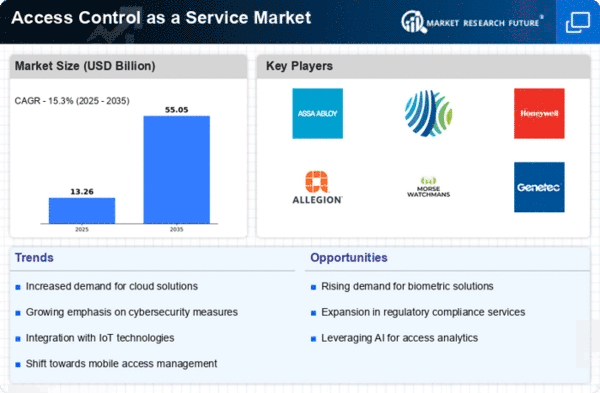
As per MRFR analysis, the Access Control as a Service Market Size was estimated at 11.5 USD Billion in 2024. The Access Control as a Service industry is projected to grow from 13.26 USD Billion in 2025 to 55.05 USD Billion by 2035, exhibiting a compound annual growth rate (CAGR) of 15.3 during the forecast period 2025 - 2035.

Key Market Trends & Highlights

The Access Control as a Service Market is experiencing robust growth driven by technological advancements and increasing security demands.

  • Cloud-based solutions are becoming increasingly prevalent, facilitating easier management and scalability for organizations. Mobile access management is gaining traction, allowing users to control access remotely and enhancing user convenience. The integration of advanced technologies, such as IoT devices, is transforming access control systems, making them more efficient and secure. Rising demand for remote access solutions and enhanced security concerns are key drivers propelling market growth, particularly in North America and the healthcare segment.

Market Size & Forecast

2024 Market Size 11.5 (USD Billion)
2035 Market Size 55.05 (USD Billion)
CAGR (2025 - 2035) 15.3%
Largest Regional Market Share in 2024 North America

Major Players

<p>ASSA ABLOY (SE), Johnson Controls (US), Honeywell (US), Allegion (IE), Morse Watchmans (US), Genetec (CA), Brivo (US), S2 Security (US), AMAG Technology (US)</p>

Market Trends

The Access Control as a Service Market is currently experiencing a notable transformation, driven by the increasing demand for enhanced security solutions across various sectors. Organizations are increasingly adopting cloud-based access control systems, which offer flexibility and scalability. This shift appears to be influenced by the need for remote management capabilities and the growing trend of digital transformation. As businesses seek to protect sensitive information and assets, the integration of advanced technologies such as artificial intelligence and machine learning into access control systems is becoming more prevalent. This integration may enhance the efficiency and effectiveness of security measures, thereby fostering a more secure environment. Moreover, the Access Control as a Service Market is likely to witness a rise in the adoption of mobile access solutions. The convenience of managing access through smartphones and other mobile devices seems to resonate well with users, leading to increased satisfaction and engagement. Additionally, regulatory compliance and the need for robust identity management solutions are driving organizations to invest in sophisticated access control systems. As the market evolves, it is expected that innovations will continue to emerge, further shaping the landscape of access control solutions and addressing the diverse needs of various industries.

Cloud-Based Solutions

The trend towards cloud-based access control solutions is gaining momentum, as organizations seek to leverage the benefits of scalability and flexibility. This approach allows for easier management and integration with existing systems, making it an attractive option for businesses of all sizes.

Mobile Access Management

The increasing reliance on mobile devices for access management is becoming a defining characteristic of the Access Control as a Service Market. Users appreciate the convenience of managing access through smartphones, which enhances user experience and operational efficiency.

Integration of Advanced Technologies

The incorporation of advanced technologies, such as artificial intelligence and machine learning, into access control systems is on the rise. This integration is expected to improve security measures and streamline operations, addressing the evolving challenges faced by organizations.

Access Control as a Service Market Market Drivers

Enhanced Security Concerns

In the context of the Global Access Control as a Service Market (ACaaS) Market Industry, heightened security concerns are driving the adoption of advanced access control systems. Organizations are increasingly aware of the risks associated with unauthorized access and data breaches. This awareness has prompted investments in robust security measures, including biometric authentication and real-time monitoring. As a result, the ACaaS market is expected to expand significantly, with projections indicating a market size of 10 USD Billion by 2035. This growth underscores the critical role of access control in safeguarding sensitive information.

Integration with IoT Devices

The integration of Internet of Things (IoT) devices is emerging as a pivotal driver in the Global Access Control as a Service Market (ACaaS) Market Industry. As smart devices proliferate, organizations are seeking seamless access control solutions that can manage these interconnected systems. This integration enhances operational efficiency and provides real-time monitoring capabilities. The demand for IoT-enabled access control is expected to propel the market forward, aligning with the broader trend of digital transformation across industries. Consequently, the ACaaS market is likely to experience substantial growth as organizations leverage IoT technologies to enhance security.

Regulatory Compliance Requirements

The Global Access Control as a Service Market (ACaaS) Market Industry is significantly influenced by stringent regulatory compliance requirements across various sectors. Organizations must adhere to regulations such as GDPR and HIPAA, which mandate robust access control measures to protect sensitive data. This compliance necessity drives the demand for ACaaS solutions that offer comprehensive audit trails and user access management features. As businesses strive to meet these regulatory standards, the ACaaS market is poised for growth, with a projected CAGR of 11.3% from 2025 to 2035, indicating a robust trajectory for compliance-driven access control solutions.

Growing Demand for Cloud-Based Solutions

The Global Access Control as a Service Market (ACaaS) Market Industry is witnessing a surge in demand for cloud-based security solutions. Organizations are increasingly adopting cloud technologies due to their scalability, flexibility, and cost-effectiveness. This trend is particularly evident in sectors such as retail and healthcare, where the need for secure access management is paramount. As businesses transition to cloud environments, the ACaaS market is projected to reach 3.08 USD Billion in 2024, reflecting a growing preference for remote management capabilities and reduced on-premises infrastructure costs.

User-Friendly Interfaces and Accessibility

User experience plays a crucial role in the Global Access Control as a Service Market (ACaaS) Market Industry. The development of user-friendly interfaces and mobile accessibility features is driving the adoption of ACaaS solutions. Organizations are increasingly prioritizing systems that offer intuitive navigation and easy management of access rights. This focus on usability is particularly relevant in industries with diverse user bases, such as education and hospitality. As a result, the ACaaS market is expected to benefit from enhanced user engagement, leading to increased adoption rates and overall market growth.

Market Segment Insights

By Application: Physical Security (Largest) vs. Identity Management (Fastest-Growing)

<p>In the Access Control as a Service Market, the Application segment is primarily driven by Physical Security, which holds the largest market share due to the increasing importance of securing physical spaces. Physical Security includes solutions that protect assets, facilities, and people from unauthorized access and threats. Following closely is Identity Management, which is witnessing rapid adoption as organizations prioritize securing user identities across digital platforms. Its growth can be attributed to the rising incidences of data breaches and the increasing complexity of managing user access rights across various systems and applications.</p>

<p>Physical Security (Dominant) vs. Identity Management (Emerging)</p>

<p>Physical Security solutions focus on the safeguarding of tangible assets and personnel, making them essential for businesses across various sectors. As the dominant force in the Access Control as a Service Market, Physical Security involves technologies like surveillance, access controls, and alarm systems that ensure maximum protection. On the other hand, Identity Management is emerging as a critical area, aimed at verifying and managing user identities to prevent unauthorized access. With the advent of remote working and cloud solutions, the need for robust Identity Management frameworks is rising, necessitating seamless integration with physical security systems. This dual emphasis on physical and identity protection is shaping the future of the access control landscape.</p>

By End Use: Commercial (Largest) vs. Healthcare (Fastest-Growing)

<p>The Access Control as a Service Market exhibits varied segmentation by end use, where the commercial sector holds the majority share, driven by a rapid increase in businesses seeking enhanced security solutions. The need for efficient, scalable security systems tailored for businesses has led to the commercial segment's dominance, reflecting significant investments and technological advancements in this area. In contrast, the healthcare segment is emerging as the fastest-growing area due to heightened security requirements arising from recent global health events. With increasing sensitivity around patient data and safety, healthcare providers are actively adopting access control solutions to safeguard facilities and ensure compliance with regulations, driving this segment's rapid growth.</p>

<p>Commercial: (Dominant) vs. Healthcare (Emerging)</p>

<p>The commercial segment in the Access Control as a Service Market is characterized by its robust demand for comprehensive security solutions, suitable for various business environments, from retail stores to corporate offices. Its dominant position is a reflection of extensive deployment of advanced technologies like cloud integration and mobile access control systems, appealing to businesses that prioritize convenience and cost-effectiveness. In contrast, the healthcare sector, while still developing, is rapidly emerging as a key player in the market, influenced by the growing necessity to protect sensitive health information and ensure the safety of facilities. The adoption of tailored access control solutions in healthcare is propelled by increasing regulatory requirements and a shift towards patient-centric safety protocols, indicating strong potential for future growth.</p>

By Deployment Model: Cloud-Based (Largest) vs. On-Premises (Fastest-Growing)

<p>The Access Control as a Service Market is predominantly driven by the cloud-based deployment model, which captures the largest share due to its scalability, lower upfront costs, and easy integration into existing IT infrastructures. On-premises solutions, while traditionally favored by industries requiring stringent data control, are increasingly challenged by the rapid adoption of the cloud, which offers superior flexibility and accessibility. As organizations continue to prioritize digital transformation, the hybrid deployment model is emerging as a key growth driver, combining the advantages of both cloud and on-premises solutions. This flexibility enables firms to customize their access control while maintaining compliance with regulatory requirements. Additionally, the increasing need for remote access solutions and enhanced security measures further propels the adoption of cloud and hybrid deployments.</p>

<p>Cloud-Based (Dominant) vs. On-Premises (Emerging)</p>

<p>The cloud-based deployment model leads the Access Control as a Service Market, offering seamless integration, scalability, and cost-efficiency, which aligns with the evolving demands of modern enterprises. Organizations leveraging cloud solutions benefit from reduced maintenance burdens and the latest security updates, thus ensuring they remain competitive. In contrast, the on-premises model is becoming an emerging choice among businesses with stringent data governance requirements, providing greater control and security over sensitive information. However, the rigidity and higher costs associated with on-premises deployments may hinder their growth, especially in industries rapidly moving toward adopting flexible, cloud-based technologies. As a result, the ongoing innovation within hybrid models reflects the desire for a balanced approach in addressing diverse security and operational needs.</p>

By Technology: Biometric Systems (Largest) vs. Mobile Access Control (Fastest-Growing)

<p>The Access Control as a Service market showcases a diverse set of technologies, with Biometric Systems leading the segment, leveraging advanced identification features for enhanced security. Card-Based Systems, while still significant, are gradually losing ground as digital solutions, particularly Mobile Access Control, emerge as a viable alternative for users seeking convenience and flexibility, impacting the overall distribution among these technologies. Furthermore, Cloud-Based Access Control is gaining traction, as organizations increasingly prefer scalable and efficient cloud solutions over traditional on-premises setups.</p>

<p>Technology: Biometric Systems (Dominant) vs. Mobile Access Control (Emerging)</p>

<p>Biometric Systems have established themselves as the dominant technology within the Access Control as a Service market, offering unique features such as fingerprint scanning and facial recognition that ensure high levels of security and user authentication. This system caters primarily to high-security environments requiring stringent access control measures. On the other hand, Mobile Access Control is emerging rapidly, driven by the proliferation of smartphones and the demand for seamless user experiences. This technology allows users to access secured areas via their mobile devices, enhancing flexibility and convenience, thus appealing to a broader audience and setting the stage for substantial growth in the coming years.</p>

By User Type: Small Enterprises (Largest) vs. Large Enterprises (Fastest-Growing)

<p>In the Access Control as a Service market, Small Enterprises hold the largest market share due to their increasing reliance on cost-effective security solutions that are easy to implement. They value simplicity and efficiency in access control systems, leading to a strong preference for cloud-based services that offer scalability and affordability. On the other hand, Large Enterprises, while currently commanding a lesser share, are experiencing rapid growth as they seek advanced and customizable access control solutions to meet their complex organizational needs. This trend is shifting as more large companies recognize the benefits of cloud-based access control systems in enhancing security. Growth trends in the Access Control as a Service market are notably driven by the increasing digital transformation initiatives undertaken by organizations of all sizes. The move towards a more integrated security approach, where physical and digital security converge, is gaining traction. Additionally, as cyber threats grow, both Small and Large Enterprises are investing in robust access control systems. This transition is amplified by the rising demand for remote access solutions, which provide flexibility and security for a mobile workforce. Emerging technologies and innovations are further energizing the market, enabling providers to cater to diverse user needs effectively.</p>

<p>Small Enterprises (Dominant) vs. Medium Enterprises (Emerging)</p>

<p>In the Access Control as a Service market, Small Enterprises act as the dominant segment, characterized by their need for affordable and user-friendly solutions that enhance security without imposing heavy operational costs. They often prefer subscription-based models, allowing them to manage their budgets effectively while ensuring strong security measures are in place. Conversely, Medium Enterprises are emerging as a significant segment, focusing on mid-range solutions that balance cost and features. They tend to require more customized options as they scale but are still wary of overspending on extensive systems. Both segments are crucial to the market dynamics, with Small Enterprises driving volume sales while Medium Enterprises offer growth potential through the adoption of more sophisticated technologies.</p>

Get more detailed insights about Access Control as a Service (ACaaS) Market Research Report - Forecast 2035

Regional Insights

North America : Market Leader in Access Control

North America is poised to maintain its leadership in the Access Control as a Service market, holding a significant market share of 5.75 in 2024. The region's growth is driven by increasing security concerns, technological advancements, and a shift towards cloud-based solutions. Regulatory frameworks supporting cybersecurity and data protection further catalyze demand, making it a fertile ground for innovation and investment. The competitive landscape is robust, with key players like Johnson Controls, Honeywell, and ASSA ABLOY leading the charge. The U.S. stands out as a major contributor, supported by a strong infrastructure and a high adoption rate of advanced security technologies. The presence of established companies and startups alike fosters a dynamic environment, ensuring continuous growth and development in the sector.

Europe : Emerging Market with Growth Potential

Europe is witnessing a burgeoning Access Control as a Service market, with a market size of 3.5 in 2024. The growth is fueled by increasing regulatory requirements for security and privacy, alongside a rising demand for integrated security solutions. Countries are investing in smart technologies and infrastructure, which is expected to drive further adoption of access control systems across various sectors. Leading countries such as Germany, the UK, and France are at the forefront of this growth, with a competitive landscape featuring key players like Allegion and Genetec. The region's focus on innovation and compliance with stringent regulations positions it well for future expansion. As organizations prioritize security, the market is set to flourish, supported by a strong emphasis on technological advancements and user-friendly solutions.

Asia-Pacific : Rapid Growth in Security Solutions

The Asia-Pacific region is emerging as a significant player in the Access Control as a Service market, with a market size of 2.5 in 2024. The growth is driven by rapid urbanization, increasing security threats, and a growing awareness of the importance of access control systems. Governments are also implementing regulations to enhance security measures, further propelling market demand. Countries like China, Japan, and India are leading the charge, with a competitive landscape that includes both local and international players. The presence of companies such as Brivo and S2 Security highlights the region's commitment to adopting advanced security technologies. As the market matures, the focus will shift towards integrating AI and IoT solutions, ensuring a comprehensive approach to security management.

Middle East and Africa : Emerging Market with Untapped Potential

The Middle East and Africa region is gradually developing its Access Control as a Service market, currently valued at 0.75 in 2024. The growth is primarily driven by increasing investments in infrastructure and a rising awareness of security needs across various sectors. Governments are beginning to implement regulations that promote the adoption of advanced security solutions, which is expected to stimulate market growth in the coming years. Leading countries such as the UAE and South Africa are at the forefront of this transformation, with a competitive landscape that includes both local and international players. The presence of key companies is growing, and as the region continues to invest in technology and infrastructure, the demand for access control solutions is anticipated to rise significantly, paving the way for future opportunities.

Key Players and Competitive Insights

The Access Control as a Service Market is currently characterized by a dynamic competitive landscape, driven by technological advancements and an increasing demand for security solutions across various sectors. Key players such as ASSA ABLOY (SE), Johnson Controls (US), and Honeywell (US) are strategically positioning themselves through innovation and partnerships. For instance, ASSA ABLOY (SE) has focused on enhancing its digital offerings, which appears to be a response to the growing trend of remote access management. This collective emphasis on innovation and strategic partnerships among these companies is shaping a competitive environment that is increasingly reliant on technological differentiation.

In terms of business tactics, companies are localizing manufacturing and optimizing supply chains to enhance operational efficiency. The market structure is moderately fragmented, with several players vying for market share. However, the influence of major companies like Johnson Controls (US) and Honeywell (US) is substantial, as they leverage their extensive resources and technological capabilities to maintain a competitive edge. This competitive structure suggests that while there is room for smaller players, the dominance of established firms is likely to shape market dynamics significantly.

In November 2025, Johnson Controls (US) announced a strategic partnership with a leading cloud service provider to enhance its access control solutions. This collaboration is expected to integrate advanced AI capabilities into their offerings, thereby improving user experience and operational efficiency. The strategic importance of this partnership lies in its potential to position Johnson Controls (US) as a frontrunner in the digital transformation of access control systems, aligning with current market demands for smarter security solutions.

Similarly, in October 2025, Honeywell (US) launched a new suite of access control products that incorporate biometric technology. This move is indicative of Honeywell's commitment to innovation and reflects a broader trend towards integrating advanced technologies into security solutions. The introduction of biometric features is likely to enhance security measures, catering to a market increasingly concerned with identity verification and fraud prevention.

In December 2025, Allegion (IE) unveiled a new cloud-based access control platform designed to streamline user management and enhance security protocols. This development underscores Allegion's focus on digitalization and its efforts to meet the evolving needs of customers seeking more efficient and secure access solutions. The strategic importance of this platform lies in its potential to attract a broader customer base, particularly among organizations looking to modernize their security infrastructure.

As of December 2025, the Access Control as a Service Market is witnessing trends such as digitalization, sustainability, and AI integration, which are redefining competitive dynamics. Strategic alliances are increasingly shaping the landscape, allowing companies to pool resources and expertise. Looking ahead, competitive differentiation is likely to evolve from traditional price-based competition to a focus on innovation, technology, and supply chain reliability. This shift suggests that companies that prioritize technological advancements and strategic collaborations will be better positioned to thrive in this rapidly changing market.

Key Companies in the Access Control as a Service Market include

Industry Developments

The Access Control as a Service (ACaaS) Market has seen significant developments recently. As of September 2023, Dormakaba announced an upgrade to its access management capabilities, enhancing security features for its customers. In December 2022, S2 Security and Brivo collaborated to integrate their technologies, aiming for a unified security solution.

Gallagher has reported increased demand in various sectors, indicating a robust market performance, which is expected to drive market growth. Recent mergers include Honeywell acquiring a small cybersecurity firm in August 2023 to strengthen its smart building offerings. Furthermore, Johnson Controls took a major step in June 2023 by acquiring a notable ACaaS solution provider, enhancing its portfolio.

The market has also been positively impacted by a reported growth valuation, driven by a surge in remote work requirements and enhanced focus on security protocols. Companies like HID Global continue to innovate, contributing to a competitive landscape. In the past two years, the market has shifted significantly, particularly during mid-2021, as organizations increasingly prioritize cloud-based solutions amid growing cybersecurity concerns.

Future Outlook

Access Control as a Service Market Future Outlook

<p>The <a href="https://www.marketresearchfuture.com/reports/us-access-control-as-a-service-market-16224">Access Control as a Service Market</a> is projected to grow at a 15.3% CAGR from 2024 to 2035, driven by increasing security concerns, technological advancements, and the shift towards cloud-based solutions.</p>

New opportunities lie in:

  • <p>Integration of AI-driven analytics for enhanced security insights.</p>
  • <p>Development of mobile access control applications for remote management.</p>
  • <p>Expansion into emerging markets with tailored service packages.</p>

<p>By 2035, the market is expected to be robust, reflecting substantial growth and innovation.</p>

Market Segmentation

Access Control as a Service Market End Use Outlook

  • Commercial
  • Residential
  • Government
  • Healthcare
  • Education

Access Control as a Service Market User Type Outlook

  • Small Enterprises
  • Medium Enterprises
  • Large Enterprises

Access Control as a Service Market Technology Outlook

  • Biometric Systems
  • Card-Based Systems
  • Mobile Access Control
  • Cloud-Based Access Control

Access Control as a Service Market Application Outlook

  • Physical Security
  • Identity Management
  • Visitor Management
  • Data Security
  • Remote Access

Access Control as a Service Market Deployment Model Outlook

  • Cloud-Based
  • On-Premises
  • Hybrid

Report Scope

MARKET SIZE 2024 11.5(USD Billion)
MARKET SIZE 2025 13.26(USD Billion)
MARKET SIZE 2035 55.05(USD Billion)
COMPOUND ANNUAL GROWTH RATE (CAGR) 15.3% (2024 - 2035)
REPORT COVERAGE Revenue Forecast, Competitive Landscape, Growth Factors, and Trends
BASE YEAR 2024
Market Forecast Period 2025 - 2035
Historical Data 2019 - 2024
Market Forecast Units USD Billion
Key Companies Profiled ASSA ABLOY (SE), Johnson Controls (US), Honeywell (US), Allegion (IE), Morse Watchmans (US), Genetec (CA), Brivo (US), S2 Security (US), AMAG Technology (US)
Segments Covered Application, End Use, Deployment Model, Technology, User Type
Key Market Opportunities Integration of artificial intelligence enhances security and operational efficiency in the Access Control as a Service Market.
Key Market Dynamics Rising demand for cloud-based security solutions drives innovation and competition in the Access Control as a Service Market.
Countries Covered North America, Europe, APAC, South America, MEA

FAQs

What is the expected market size of the Access Control as a Service (ACaaS) Market in 2024?

In 2024, the Access Control as a Service (ACaaS) Market is expected to be valued at 3.08 USD Billion.

What is the projected market size of the Access Control as a Service (ACaaS) Market by 2035?

By 2035, the Access Control as a Service (ACaaS) Market is projected to reach a value of 10.0 USD Billion.

What is the expected CAGR for the Access Control as a Service (ACaaS) Market from 2025 to 2035?

The expected CAGR for the Access Control as a Service (ACaaS) Market from 2025 to 2035 is 11.3%.

Which region is expected to hold the largest market share in the Access Control as a Service (ACaaS) Market in 2024?

In 2024, North America is expected to hold the largest market share, valued at 1.2 USD Billion.

What will be the market size of Europe in the Access Control as a Service (ACaaS) Market in 2035?

By 2035, the market size of Europe in the Access Control as a Service (ACaaS) Market is anticipated to reach 2.5 USD Billion.

What is the expected market size for Cloud Based technology in the Access Control as a Service (ACaaS) Market in 2024?

The Cloud Based technology segment in the Access Control as a Service (ACaaS) Market is expected to be valued at 1.54 USD Billion in 2024.

Which are the major players in the Access Control as a Service (ACaaS) Market?

Major players in the Access Control as a Service (ACaaS) Market include Dormakaba, S2 Security, Brivo, and Gallagher,.

What is the expected market size of the Asia Pacific region within the Access Control as a Service (ACaaS) Market by 2035?

The Asia Pacific region is expected to reach a market size of 2.3 USD Billion within the Access Control as a Service (ACaaS) Market by 2035.

What growth opportunities exist in the Access Control as a Service (ACaaS) Market?

Growth opportunities in the Access Control as a Service (ACaaS) Market arise from increasing demand for cloud-based solutions and enhanced security systems.

What will be the future market value of On-Premises technology in the Access Control as a Service (ACaaS) Market in 2035?

The On-Premises technology segment is projected to reach a market value of 3.0 USD Billion in the Access Control as a Service (ACaaS) Market by 2035.

  1. SECTION I: EXECUTIVE SUMMARY AND KEY HIGHLIGHTS |
    1. EXECUTIVE SUMMARY 2
  2. SECTION II: SCOPING, METHODOLOGY AND MARKET STRUCTURE |
    1. MARKET INTRODUCTION |
    2. RESEARCH METHODOLOGY 3
  3. SECTION III: QUALITATIVE ANALYSIS |
    1. MARKET DYNAMICS |
    2. MARKET FACTOR ANALYSIS 4
  4. SECTION IV: QUANTITATIVE ANALYSIS |
    1. Semiconductor & Electronics, BY Application (USD Billion) |
    2. Semiconductor & Electronics, BY End Use (USD Billion) |
    3. Semiconductor & Electronics, BY Deployment Model (USD Billion) |
    4. Semiconductor & Electronics, BY Technology (USD Billion) |
    5. Semiconductor & Electronics, BY User Type (USD Billion) |
    6. Semiconductor & Electronics, BY Region (USD Billion) 5
  5. SECTION V: COMPETITIVE ANALYSIS |
    1. Competitive Landscape |
    2. Company Profiles |
    3. Appendix

Access Control as a Service (ACaaS) Market Segmentation

Market Segmentation Overview

  • Detailed segmentation data will be available in the full report
  • Comprehensive analysis by multiple parameters
  • Regional and country-level breakdowns
  • Market size forecasts by segment
Infographic

Free Sample Request

Kindly complete the form below to receive a free sample of this Report

Get Free Sample

Customer Strories

Compare Licence

×
Features License Type
Single User Multiuser License Enterprise User
Price $4,950 $5,950 $7,250
Maximum User Access Limit 1 User Upto 10 Users Unrestricted Access Throughout the Organization
Free Customization
Direct Access to Analyst
Deliverable Format
Platform Access
Discount on Next Purchase 10% 15% 15%
Printable Versions