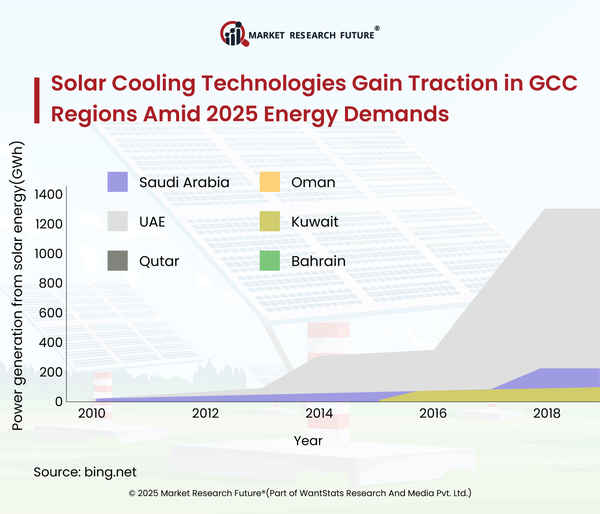
Trend Watch Solar Cooling Technologies Gain Traction in GCC Regions Amid 2025 Energy Demands
Solar cooling technologies are fast acquiring pace among Gulf Cooperation Council (GCC) nations as 2025 unfolds, thereby transforming the Energy & Power Market of the area. Particularly in peak summer, solar-powered cooling is becoming more and more important as demand for HVAC systems rises and temperatures climb. It is also a sustainable substitute for more traditional energy-intensive solutions.
Countries like Saudi Arabia, the United Arab Emirates, and Qatar are seeing an increase in expenditures meant to include solar cooling systems in public infrastructure and commercial buildings in 2025. The International Renewable Energy Agency (IRENA) estimates that during peak hours in the GCC, HVAC systems now account for up to 70 percent of the power usage. Using plenty of solar energy to lower dependency on grid power helps solar cooling solve this problem by thus increasing energy efficiency and lowering carbon footprints.
Pilot projects and alliances between government agencies and technology companies are driving change in the Energy & Power Market in 2025. Under collaboration with international companies like Trane Technologies and Abu Dhabi's Masdar, the UAE's Ministry of Energy and Infrastructure is notably supporting a prototype solar absorption cooling project for district cooling systems in Dubai.
The adoption of hybrid photovoltaic-thermal (PVT) systems and adsorption chillers is also quickened by innovations in these technologies. These technologies capture solar radiation to both create power and run cooling systems, therefore providing improved efficiency. To match its zero-emission goals, Saudi Arabia's NEOM project has promised to install extensive solar cooling infrastructure over residential areas in 2025.
Rising governmental backing, reducing solar panel prices, and pressure to reach sustainability targets will be among the 2025 market drivers. Under the Paris Agreement, the Nationally Determined Contributions (NDCs) from the GCC are driving governments to adopt low-carbon cooling technology, hence further integrating solar cooling into regional energy strategy.
Solar cooling is likely to be especially important in changing HVAC demand all across the GCC as the Energy & Power Market updates in 2025 show the relevance of climate-adaptive technology.