Rivian to Expand Battery Manufacturing Facility in 2025
In 2025, Rivian Automotive significantly boosted its battery production capacity, making it a critical year for the EV Battery production Market. Rivian's investment follows the trend of automakers vertically integrating battery manufacturing to assure supply, reduce prices, and fulfill aggressive electrification objectives in 2025 as demand for electric trucks, SUVs, and commercial delivery vans rises.
Rivian is adding giga-casting lines, cell-assembly automation, and integrated quality-monitoring stations to its Normal, Illinois, battery production facility in 2025. This will increase Rivian's annual battery-pack and module production to support its expanding vehicle portfolio, including the R1T truck, R1S SUV, and Amazon-partnered EDV delivery vans. Automotive market observers say Rivian should secure local battery capacity in 2025 to prevent global supply chain bottlenecks and reliance on third-party cell suppliers as EV sales rise.
Improved battery design and materials processing are key to Rivian's 2025 goal. The enlarged facility has in-line high-speed formation systems, AI-enabled process monitoring, and digital twin quality tracking. These innovations aim to increase cell yield, minimize faults, and boost pack performance, which are crucial for EV companies competing on range, reliability, and cost in 2025.
Rivian's 2025 investment connects with industry and policy factors beyond manufacturing scale. State and federal incentives, such as tax rebates for domestic battery manufacturing and EV assembly, make expanding local plants more economically attractive. Rivian's 2025 expansion creates jobs and enhances regional EV supply chains as governments emphasize industrial competitiveness and energy transition resilience.
Rivian's 2025 battery manufacturing plant expansion increases US battery capacity, boosting EV production and reducing reliance on foreign battery cells. Rivian can optimize performance, reliability, and lifetime efficiency across its electric car range by increasing in-house battery throughput in 2025 and vertically integrating cost and quality control.
In 2025, greater battery output speeds car deliveries and expands model availability, boosting EV adoption. The facility expansion improves supply chain resilience and creates skilled manufacturing jobs, supporting industrial strategy and localization. Rivian's 2025 plan marks a turning point in the EV battery manufacturing industry, reaffirming battery supply as essential to EV competitiveness and the energy transition.
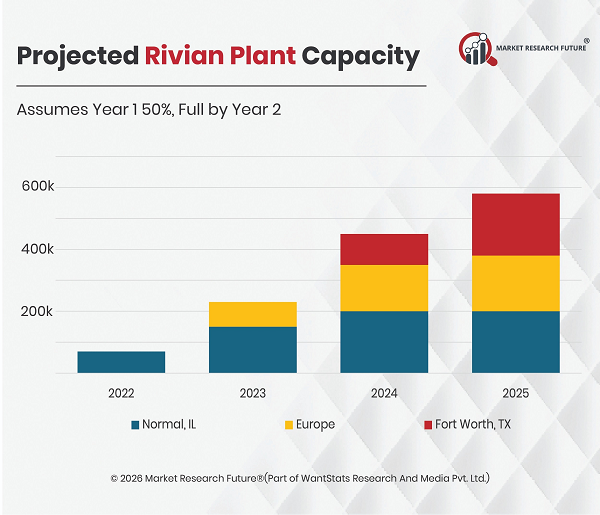
The figure shows projected Rivian Plant capacity in the market from 2022 to 2025: