Mobile Banking Market

모바일 뱅킹 시장 규모, 점유율 및 연구 보고서 유형별 (무선 애플리케이션 프로토콜 (WAP), SMS 뱅킹, 비구조적 보조 서비스 데이터 (USSD), 독립형 모바일 애플리케이션 및 기타), 플랫폼별 (안드로이드, IOS, 기타), 배포 유형별 (클라우드, 온프레미스), 최종 사용자별 (개인, 기업), 지역별 (북미, 유럽, 아시아 태평양 및 기타 지역) – 2035년까지의 산업 예측

ID: MRFR/BS/2130-HCR 200 Pages Aarti Dhapte Last Updated: September 30, 2026
Mobile Banking Market
Market Size
Forecast Period2025 - 2035
CAGR (2025 - 2035)15.6%
2024 Market Size$ 1.34 Billion
2025 Market Size$ 1.55 Billion
2035 Market Size$ 6.6 Billion
Key Players
JPMorgan Chase
Bank of America
Wells Fargo
Citigroup
HSBC
Santander
Opportunities
  • Rising Smartphone Penetration
  • Shift Towards Cashless Transactions
  • Increased Focus on Financial Inclusion

Mobile Banking Market 요약

Market Research Future 분석에 따르면, 모바일 뱅킹 시장 규모는 2024년에 13.4억 달러로 추정됩니다. 모바일 뱅킹 산업은 2025년 15.49억 달러에서 2035년 66.03억 달러로 성장할 것으로 예상되며, 2025 - 2035년 예측 기간 동안 연평균 성장률(CAGR)은 15.6%에 이를 것으로 보입니다.

주요 시장 동향 및 하이라이트

모바일 뱅킹 시장은 기술 발전과 변화하는 소비자 선호에 의해 강력한 성장을 경험하고 있습니다.

  • 디지털 지갑의 채택이 급증하고 있으며, 특히 북미에서 소비자들이 현금 없는 거래를 선호하고 있습니다.
  • 강화된 보안 조치가 중요해지고 있으며, 금융 기관들은 아시아 태평양 지역에서 고객 데이터 보호를 우선시하고 있습니다.
  • AI와 챗봇의 통합이 독립형 모바일 애플리케이션의 고객 서비스를 혁신하고 있으며, 이는 여전히 시장에서 가장 큰 세그먼트입니다.
  • 스마트폰 보급 증가와 현금 없는 거래로의 전환이 SMS 뱅킹, 가장 빠르게 성장하는 세그먼트의 성장을 촉진하는 주요 요인입니다.

시장 규모 및 예측

2024 시장 규모 13.4 (억 달러)
2035 시장 규모 66.03 (억 달러)
CAGR (2025 - 2035) 15.6%

주요 기업

JPMorgan Chase (미국), Bank of America (미국), Wells Fargo (미국), Citigroup (미국), HSBC (영국), Santander (스페인), Barclays (영국), BNP Paribas (프랑스), Deutsche Bank (독일)

Mobile Banking Market Treiber

스마트폰 보급 증가

스마트폰의 확산은 모바일 뱅킹 시장의 중요한 동력이 되어왔습니다. 2025년 10월 현재, 많은 지역에서 스마트폰 보급률이 약 80%에 도달하여 은행 서비스에 대한 접근이 용이해졌습니다. 이 추세는 더 많은 소비자들이 사용자 친화적이고 접근 가능한 모바일 뱅킹 애플리케이션을 이용할 가능성이 높다는 것을 나타냅니다. 모바일 장치를 통해 재정을 관리하는 편리함은 모바일 뱅킹 사용자 수의 급증으로 이어졌으며, 2025년 말까지 모바일 뱅킹 사용자 수가 20억 명을 초과할 것으로 추정됩니다. 이 증가하는 사용자 기반은 모바일 뱅킹 시장 내 혁신과 경쟁을 더욱 자극할 것으로 예상되며, 금융 기관들은 자사 서비스 개선과 고객 경험 향상을 위해 노력하고 있습니다.

현금 없는 거래로의 전환

현금 없는 거래로의 지속적인 전환은 모바일 뱅킹 시장에 상당한 영향을 미치고 있습니다. 소비자들이 점점 더 디지털 결제 방법을 선호함에 따라 모바일 뱅킹 솔루션에 대한 수요가 급증했습니다. 최근 데이터에 따르면, 다양한 시장에서 현금 없는 거래가 30% 이상 증가했으며, 이는 금융 서비스의 디지털화에 대한 광범위한 추세를 반영합니다. 이러한 전환은 소비자 선호에 대한 단순한 반응이 아니라, 금융 기관들이 운영을 간소화하고 현금 처리와 관련된 비용을 줄이기 위한 전략적 움직임이기도 합니다. 결과적으로, 모바일 뱅킹 시장은 은행과 핀테크 기업들이 소비자의 변화하는 요구에 맞춘 원활하고 안전한 모바일 결제 솔루션을 제공하기 위해 혁신함에 따라 강력한 확장을 목격하고 있습니다.

재정 포용에 대한 증가하는 집중

재정 포용을 위한 노력은 모바일 뱅킹 시장을 추진하는 중요한 요소입니다. 많은 서비스가 부족한 인구는 전통적인 은행 서비스에 접근할 수 없으며, 모바일 뱅킹은 이 격차를 해소할 수 있는 실행 가능한 솔루션을 제공합니다. 2025년 10월 현재, 재정 교육과 모바일 뱅킹 서비스 접근을 촉진하기 위한 이니셔티브가 다양한 지역에서 활기를 띠고 있습니다. 이러한 포용에 대한 집중은 사회적 의무일 뿐만 아니라 금융 기관들에게는 비즈니스 기회이기도 합니다. 은행 서비스가 없는 인구와 서비스가 부족한 인구를 대상으로 함으로써, 모바일 뱅킹 시장은 더 많은 개인들이 모바일 플랫폼을 통해 필수 금융 서비스에 접근할 수 있게 됨에 따라 상당한 성장을 할 준비가 되어 있습니다.

디지털 뱅킹에 대한 규제 지원

규제 프레임워크는 모바일 뱅킹 시장의 성장을 지원하기 위해 진화하고 있습니다. 정부와 금융 당국은 재정 포용과 경제 성장을 촉진하는 데 있어 디지털 뱅킹의 중요성을 점점 더 인식하고 있습니다. 2025년 10월 현재, 여러 국가에서는 모바일 뱅킹 서비스의 채택을 장려하는 유리한 규제를 시행하고 있으며, 이는 간소화된 라이센스 프로세스와 강화된 소비자 보호 조치를 포함합니다. 이러한 규제 지원은 혁신을 촉진할 뿐만 아니라 소비자들이 모바일 뱅킹 솔루션에 대한 신뢰를 갖도록 합니다. 모바일 뱅킹 시장은 이러한 발전으로 혜택을 볼 가능성이 높으며, 더 많은 금융 기관들이 모바일 기술에 투자하고 규제 기준을 충족하기 위해 서비스 제공을 확장하도록 장려받고 있습니다.

모바일 뱅킹의 기술 발전

기술 발전은 모바일 뱅킹 시장을 재편하고 있으며, 혁신을 촉진하고 사용자 경험을 향상시키고 있습니다. 블록체인, 인공지능 및 머신러닝과 같은 첨단 기술의 통합은 금융 서비스 제공 방식을 혁신하고 있습니다. 2025년 10월 현재, 많은 은행들이 이러한 기술을 활용하여 보안을 개선하고 운영을 간소화하며 고객에게 개인화된 서비스를 제공하고 있습니다. 예를 들어, AI 기반 분석은 은행들이 고객 행동과 선호를 더 잘 이해할 수 있도록 하여 보다 맞춤화된 서비스를 제공하게 합니다. 이러한 기술적 진화는 더 많은 사용자들이 모바일 뱅킹 플랫폼으로 유입되도록 할 가능성이 높으며, 이는 모바일 뱅킹 시장을 확장하고 금융 서비스 제공자 간의 경쟁 환경을 조성하는 데 기여할 것입니다.

시장 세그먼트 통찰력

유형별: 독립형 모바일 애플리케이션(최대) 대 SMS 뱅킹(가장 빠르게 성장하는)

모바일 뱅킹 시장은 다양한 서비스 유형으로 특징지어지며, 독립형 모바일 애플리케이션이 가장 큰 점유율을 차지하고 있습니다. 이 세그먼트는 사용자에게 모든 뱅킹 요구를 위한 전용 플랫폼을 제공하여 고객 만족도와 충성도를 높입니다. 반면, SMS 뱅킹은 시장 점유율은 작지만 인터넷 연결 없이 간편하고 빠른 뱅킹 서비스 접근을 선호하는 사용자들 사이에서 빠르게 인기를 얻고 있습니다. 모바일 뱅킹 시장 내 성장 추세는 디지털 솔루션에 대한 의존도가 증가하고 있음을 강조합니다. 독립형 모바일 애플리케이션은 기술 발전에 의해 추진되어 생체 인증 및 실시간 알림과 같은 혁신적인 기능을 통합할 수 있게 되었습니다. 반면, SMS 뱅킹은 특히 인터넷 접근이 제한된 지역에서 접근성의 이점으로 인해 급증했습니다. 이 추세는 편리함으로의 전환을 의미하며, 인구 통계 세그먼트 전반에 걸쳐 다양한 사용자 선호를 충족합니다.

독립형 모바일 애플리케이션(우세) 대 SMS 뱅킹(신흥)

독립형 모바일 애플리케이션은 모바일 뱅킹 시장에서 우세한 힘으로, 고객을 직접 뱅킹 서비스에 연결하는 포괄적인 기능을 제공합니다. 사용자 친화적인 인터페이스, 강화된 보안 조치 및 충성도를 높이는 개인화된 경험을 특징으로 합니다. 반면, SMS 뱅킹은 인터넷 접근이 제한된 지역의 사용자에게 주로 매력적인 신흥 대안으로 기능합니다. 그 간편함과 효율성 덕분에 모바일 데이터 없이 빠른 거래를 우선시하는 사람들 사이에서 인기가 높습니다. 이 두 세그먼트는 모바일 뱅킹 시장의 다양한 풍경을 보여주며, 변화하는 소비자 선호와 기술 발전을 반영합니다.

플랫폼별: 안드로이드(최대) 대 iOS(가장 빠르게 성장하는)

모바일 뱅킹 시장에서 플랫폼 간 점유율 분포는 안드로이드가 지배적인 플레이어로, 상당한 다수의 사용자를 확보하고 있음을 보여줍니다. 반면, iOS는 보안과 프리미엄 서비스를 중시하는 인구 통계에 점점 더 매력적으로 성장하고 있습니다. 한편, 기타 플랫폼은 상대적으로 미미하여 시장 분포에 미치는 영향이 적으며, 두 주요 플레이어 간의 경쟁을 강조합니다. 성장 추세 측면에서 안드로이드의 확립된 사용자 기반은 저렴한 기기의 확산에 의해 그 위치를 강화하고 있습니다. 한편, iOS는 향상된 보안 기능과 원활한 사용자 경험에 이끌려 부유한 소비자들 사이에서 온라인 뱅킹 서비스의 채택이 증가함에 따라 빠르게 확장하고 있습니다. 이 역동성은 모바일 뱅킹 세그먼트에서 안정성과 혁신 간의 흥미로운 긴장을 만들어냅니다.

안드로이드(우세) 대 iOS(신흥)

안드로이드 플랫폼은 광범위한 사용자 기반과 다양한 장치 유형에 대한 적응성 덕분에 모바일 뱅킹 시장에서 지배적인 힘으로 자리 잡았습니다. 신흥 시장의 소비자를 포함한 폭넓은 소비자층을 수용할 수 있는 능력 덕분에 상당한 채택률을 기록했습니다. 또한, 다양한 금융 기관 및 서비스와의 호환성은 그 매력을 높입니다. 반면, iOS는 보안과 프리미엄 사용자 경험에 중점을 두고 사용자 수가 빠르게 증가하는 신흥 플랫폼으로 간주됩니다. 이 성장은 디지털 뱅킹에 대한 소비자 인식의 증가와 뱅킹 거래를 용이하게 하는 우수한 모바일 애플리케이션에 대한 수요에 의해 더욱 촉진됩니다. 따라서 iOS는 주목할 만한 중요한 플레이어가 됩니다.

배포 방식별: 클라우드(최대) 대 온프레미스(가장 빠르게 성장하는)

모바일 뱅킹 시장에서 배포 옵션은 클라우드와 온프레미스 솔루션 간의 명확한 이분법을 보여줍니다. 현재 클라우드 기반 배포는 유연성, 확장성 및 낮은 유지 관리 비용 덕분에 지배적인 위치를 차지하고 있습니다. 많은 금융 기관들이 다른 서비스 및 애플리케이션과의 쉬운 통합을 제공하는 클라우드 솔루션으로 이동하고 있으며, 이는 사용자 경험과 운영 효율성을 향상시킵니다. 반면, 온프레미스 솔루션은 데이터와 시스템에 대한 제어를 중시하는 특정 세그먼트를 대상으로 하여 시장에서 주목할 만한 점유율을 유지하고 있습니다.

배포: 클라우드(우세) 대 온프레미스(신흥)

클라우드 배포는 비용 효율성, 확장성 및 소프트웨어 업데이트의 용이성과 같은 수많은 장점 덕분에 모바일 뱅킹 시장 내에서 지배적인 솔루션으로 두드러집니다. 이는 많은 은행 및 금융 기관이 선호하는 선택이 됩니다. 반면, 온프레미스 배포는 편리함보다 데이터 보안과 맞춤화를 우선시하는 조직에 대해 신뢰할 수 있는 대안으로 떠오르고 있습니다. 클라우드 솔루션은 협업 기능과 빠른 배포 능력 덕분에 인기를 얻고 있지만, 온프레미스 시스템은 인프라를 유지하는 것을 선호하는 전통적인 은행들에게 여전히 매력적입니다. 이 역동성은 두 배포 옵션이 서로 다른 우선순위와 고객 요구를 충족하는 경쟁적인 환경을 만들어냅니다.

최종 사용자별: 개인(최대) 대 기업(가장 빠르게 성장하는)

모바일 뱅킹 시장에서 개인 세그먼트는 가장 큰 점유율을 차지하고 있으며, 이는 이동 중에 재정을 관리하는 편리함을 선호하는 소비자들 사이에서 모바일 뱅킹 앱의 채택이 증가하고 있기 때문입니다. 이 세그먼트는 스마트폰 보급의 증가와 디지털 뱅킹 솔루션으로의 전환으로 혜택을 보고 있습니다. 반면, 기업 세그먼트는 모바일 뱅킹 솔루션을 통해 재무 운영을 향상시키려는 기업들이 증가함에 따라 빠른 성장을 경험하고 있습니다.

사용자 경험: 개인(우세) 대 기업(신흥)

개인 세그먼트는 개인 뱅킹 요구를 위한 편리함과 접근성을 우선시하는 사용자 중심 접근 방식으로 특징지어집니다. 쉬운 계좌 관리, 자금 이체 및 예산 도구와 같은 기능은 개인 사용자들을 끌어들여 시장에서 우세한 플레이어가 되게 합니다. 한편, 기업 세그먼트는 기업들이 비즈니스 거래를 최적화하기 위해 모바일 뱅킹 솔루션의 가치를 점점 더 인식함에 따라 신흥하고 있습니다. 기업들은 실시간 거래 모니터링 및 다른 금융 도구와의 통합과 같은 고급 기능으로 혜택을 보며, 빠르게 변화하는 금융 환경에서 경쟁 우위를 확보합니다.

Mobile Banking Market에 대한 더 자세한 통찰력 얻기

지역 통찰력

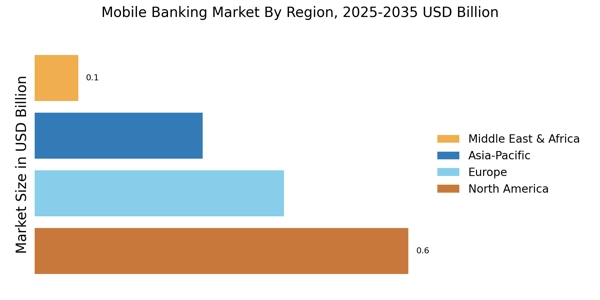
North America : Digital Finance Leader

North America is the largest market for mobile banking, holding approximately 45% of the global share. The region's growth is driven by high smartphone penetration, increasing consumer demand for convenient banking solutions, and robust regulatory frameworks that promote digital finance. The U.S. leads this market, followed closely by Canada, which contributes around 15% to the overall market share. Regulatory support, such as the Consumer Financial Protection Bureau's initiatives, further catalyzes growth in this sector. The competitive landscape is dominated by major players like JPMorgan Chase, Bank of America, and Wells Fargo, which continuously innovate to enhance user experience. The presence of these key players fosters a highly competitive environment, pushing for advancements in security and user interface. Additionally, the integration of AI and machine learning in mobile banking applications is becoming increasingly prevalent, further solidifying North America's position as a leader in the mobile banking market.

Europe : Emerging Digital Banking Hub

Europe is witnessing significant growth in the mobile banking sector, holding approximately 30% of the global market share. The region benefits from a strong regulatory framework, including the European Union's PSD2 directive, which encourages competition and innovation in financial services. Countries like the UK and Germany are at the forefront, with the UK accounting for about 12% of the market. The increasing adoption of digital wallets and contactless payments is also driving demand for mobile banking solutions across Europe. Leading countries in this region include the UK, Germany, and France, with key players such as HSBC, Santander, and BNP Paribas. The competitive landscape is characterized by a mix of traditional banks and fintech startups, both vying for market share. The rise of neobanks and digital-only banking solutions is reshaping consumer expectations, pushing established banks to enhance their mobile offerings. This dynamic environment is expected to continue fostering innovation and growth in the mobile banking sector.

Asia-Pacific : Rapidly Growing Market

Asia-Pacific is rapidly emerging as a significant player in the mobile banking market, holding around 20% of the global share. The region's growth is fueled by increasing smartphone penetration, a young population, and a shift towards digital financial services. Countries like China and India are leading this trend, with China alone accounting for approximately 10% of the market. The regulatory environment is also evolving, with governments promoting digital banking initiatives to enhance financial inclusion. The competitive landscape is diverse, featuring both established banks and a plethora of fintech companies. Key players include major banks like Deutsche Bank and local fintech firms that are innovating to meet consumer demands. The rise of mobile payment platforms and digital wallets is transforming the banking experience, making it more accessible and user-friendly. As competition intensifies, the focus on customer experience and security will be paramount for success in this dynamic market.

Middle East and Africa : Emerging Financial Frontier

The Middle East and Africa region is an emerging frontier in the mobile banking market, currently holding about 5% of the global share. The growth is primarily driven by increasing smartphone adoption, a young demographic, and a growing middle class seeking convenient banking solutions. Countries like South Africa and Nigeria are leading the charge, with Nigeria showing a remarkable increase in mobile banking usage due to its large unbanked population. Regulatory bodies are also beginning to support digital banking initiatives to enhance financial inclusion. The competitive landscape is characterized by a mix of traditional banks and innovative fintech startups. Key players include local banks and international firms looking to tap into this growing market. The rise of mobile money services, particularly in sub-Saharan Africa, is reshaping the financial landscape, providing essential services to underserved populations. As the market matures, the focus will shift towards enhancing security and user experience to attract more customers.

Mobile Banking Market Regional Image

주요 기업 및 경쟁 통찰력

The Mobile Banking Market is currently characterized by a dynamic competitive landscape, driven by rapid technological advancements and evolving consumer preferences. Major players such as JPMorgan Chase (US), Bank of America (US), and HSBC (GB) are at the forefront, each adopting distinct strategies to enhance their market positioning. JPMorgan Chase (US) emphasizes innovation through its investment in fintech partnerships, aiming to integrate cutting-edge technologies into its mobile banking services. Meanwhile, Bank of America (US) focuses on regional expansion, enhancing its digital offerings to cater to a broader customer base. HSBC (GB) is actively pursuing digital transformation initiatives, seeking to streamline operations and improve customer engagement through advanced mobile solutions. Collectively, these strategies contribute to a competitive environment that is increasingly centered around technological innovation and customer-centric services.In terms of business tactics, companies are increasingly localizing their services to better meet regional demands, which appears to be a response to the diverse needs of global consumers. The market structure is moderately fragmented, with a mix of established banks and emerging fintech firms vying for market share. This fragmentation allows for a variety of service offerings, yet the influence of key players remains substantial, as they set benchmarks for service quality and technological integration.
In August JPMorgan Chase (US) announced a strategic partnership with a leading fintech firm to enhance its mobile payment solutions. This collaboration is expected to leverage advanced AI technologies, thereby improving transaction security and user experience. Such a move not only strengthens JPMorgan's competitive edge but also reflects a broader trend within the industry towards integrating AI to enhance operational efficiency and customer satisfaction.
In September Bank of America (US) launched a new feature within its mobile banking app that utilizes machine learning to provide personalized financial advice. This initiative is indicative of the bank's commitment to harnessing technology to foster deeper customer relationships. By offering tailored insights, Bank of America (US) positions itself as a leader in customer engagement, potentially attracting a younger demographic that values personalized services.
In October HSBC (GB) unveiled a new sustainability initiative aimed at promoting eco-friendly banking practices through its mobile platform. This initiative not only aligns with global sustainability trends but also enhances HSBC's brand image as a socially responsible institution. By integrating sustainability into its mobile banking services, HSBC (GB) is likely to appeal to environmentally conscious consumers, thereby differentiating itself in a competitive market.
As of October the Mobile Banking Market is witnessing significant trends such as digitalization, sustainability, and the integration of artificial intelligence. Strategic alliances are increasingly shaping the competitive landscape, as companies recognize the value of collaboration in enhancing service offerings. Looking ahead, competitive differentiation is expected to evolve, with a shift from traditional price-based competition towards innovation, technological advancement, and supply chain reliability. This transition underscores the importance of agility and responsiveness in meeting the ever-changing demands of consumers.

Mobile Banking Market 시장의 주요 기업은 다음과 같습니다

Recent Industry Developments

Q3 2026: Wells Fargo (US): Wells Fargo launched ExpressSend Mobile, a dedicated remittance service within its mobile app enabling customers to send funds to 12 countries with real-time tracking and alerts.

Q3 2026: Citigroup (US): Citi launched Mastercard Smart Subscriptions in the UAE, integrating subscription management directly into its mobile banking platform to provide cardholders greater transaction transparency and control.

Q3 2026: BNP Paribas (FR): BNP Paribas Bank Polska partnered with Snowdrop Solutions to integrate merchant logos into its GOmobile app, replacing technical identifiers with verified logos to improve transaction clarity and support fraud prevention.

Q2 2026: Bank of America (US): The CashPro App achieved 20% year-over-year growth in sign-ins, with corporate clients approving $1.2 trillion in payment value through mobile, demonstrating the app's expanding role in real-time commercial treasury decision-making.

As part of its continuing Project WAVE, a programme for the state-run bank's digital transformation, Indian Bank has incorporated new digital chapters as of 2023.According to a statement made here on Saturday, the digital chapters are designed to increase existing and potential clients' access to convenient and secure banking. The bank launched an online facility to apply for Kisan Credit Card (KCC) loans up to Rs 1.6 lakh through 'IND DIGI KCC' and renew an agro jewel loan up to Rs 4 lakh with a practical re-pledging procedure. This brought digital convenience to agri lending.

To promote financial inclusion, Mastercard, a leading global technology corporation, and Algoan announced a new Open Banking service in Europe in 2023. After this announcement, the new Account Owner Verification solution will give companies and partners the chance to give their customers a frictionless experience by instantaneously verifying the identity of the people. Through the use of Open Banking technology, the solution automates the process of confirming the customer's ownership of their bank account.

Vert, a comprehensive provider of banking and payment acceptance services to small and medium-sized businesses (SMEs), was introduced in 2022 by Deutsche Bank and Fiserv, a world leader in payments and financial services technology. Vert is the only German provider that combines traditional banking solutions with payment acceptance and processing, satisfying market demand for an integrated offering and facilitating access to cutting-edge goods for businesses of all sizes.

The MX platform will be strengthened by record-breaking improvements in financial data connectivity, new product innovation, and new implementation partners that will be generally available in 2022, according to the MONEY EXPERIENCE SUMMIT -- MX, a leader in open finance. MX enables the best fintechs and financial institutions in the world to access financial data and take appropriate action in order to provide tailored money experiences for their users, accelerate innovation, and foster industry cooperation. MX announced product enhancements for mobile banking, data-driven insights, and connectivity.

February 2023: National Bank of Kuwait launched its new mobile banking application. The application offers more personalized experience by providing smart design and experience changes resulting in a host of benefits for customers

January 2023: Yes Bank as entered into partnership agreement with Microsoft to develop next generation mobile application with a view to provide customers with personalized banking experience. The app the app which will offer customers services such as shopping, online payments, rewards, and customized dashboards along with traditional banking functions.

October 2022: BCB Bancorp, Inc. selected Q2 Holdings, Inc. a provider of digital transformation solutions for lending and banking to offer a seamless, modernized digital experience to its consumer and commercial banking customers by using Q2’s digital banking platform.

향후 전망

Mobile Banking Market 향후 전망

모바일 뱅킹 시장은 2025년부터 2035년까지 15.6%의 CAGR로 성장할 것으로 예상되며, 이는 기술 발전, 스마트폰 보급 증가 및 변화하는 소비자 선호에 의해 추진됩니다.

2035년까지 모바일 뱅킹 시장은 강력할 것으로 예상되며, 상당한 성장과 혁신을 반영합니다.

시장 세분화

모바일 뱅킹 시장 유형 전망

  • 무선 애플리케이션 프로토콜 (WAP)
  • SMS 뱅킹
  • 비구조적 보조 서비스 데이터 (USSD)
  • 독립형 모바일 애플리케이션
  • 기타

모바일 뱅킹 시장 최종 사용자 전망

  • 개인
  • 기업

모바일 뱅킹 시장 플랫폼 전망

  • 안드로이드
  • IOS
  • 기타

모바일 뱅킹 시장 배포 전망

  • 클라우드
  • 온프레미스

보고서 범위

MARKET SIZE 2024 1.34(USD Billion)
MARKET SIZE 2025 1.549(USD Billion)
MARKET SIZE 2035 6.603(USD Billion)
COMPOUND ANNUAL GROWTH RATE (CAGR) 15.6% (2025 - 2035)
REPORT COVERAGE Revenue Forecast, Competitive Landscape, Growth Factors, and Trends
BASE YEAR 2024
Market Forecast Period 2025 - 2035
Historical Data 2019 - 2024
Market Forecast Units USD Billion
Key Companies Profiled JPMorgan Chase (US), Bank of America (US), Wells Fargo (US), Citigroup (US), HSBC (GB), Santander (ES), Barclays (GB), BNP Paribas (FR), Deutsche Bank (DE)
Segments Covered Type, Platform, Deployment Type, End User, Region
Key Market Opportunities Integration of artificial intelligence and machine learning enhances customer experience in the Mobile Banking Market.
Key Market Dynamics Rising consumer demand for seamless digital experiences drives innovation in mobile banking services and competitive differentiation.
Countries Covered North America, Europe, APAC, South America, MEA

Frequently Asked Questions

2035년까지 모바일 뱅킹 시장의 예상 시장 가치는 얼마입니까?

모바일 뱅킹 시장은 2035년까지 66.03억 달러의 가치를 가질 것으로 예상됩니다.

2024년 모바일 뱅킹 시장의 시장 가치는 얼마였습니까?

2024년 모바일 뱅킹 시장은 13.4억 달러의 가치를 가졌습니다.

2025년부터 2035년까지의 예측 기간 동안 모바일 뱅킹 시장의 예상 CAGR은 얼마입니까?

2025년부터 2035년까지의 예측 기간 동안 모바일 뱅킹 시장의 예상 CAGR은 15.6%입니다.

모바일 뱅킹 시장의 주요 기업은 어디입니까?

모바일 뱅킹 시장의 주요 기업으로는 JPMorgan Chase, Bank of America, Wells Fargo, Citigroup, HSBC, Santander, Barclays, BNP Paribas, Deutsche Bank가 있습니다.

모바일 뱅킹 세그먼트의 종류와 그 가치에는 어떤 것들이 있습니까?

모바일 뱅킹 세그먼트에는 30억 달러의 가치를 가진 독립형 모바일 애플리케이션과 7.5억 달러의 가치를 가진 SMS 뱅킹이 포함됩니다.

모바일 뱅킹 시장에서 Android와 iOS 플랫폼의 가치는 어떻게 비교됩니까?

모바일 뱅킹 시장에서 Android 플랫폼의 가치는 25억 달러이며, iOS 플랫폼의 가치는 20억 달러입니다.

모바일 뱅킹 시장에서 클라우드 배포의 가치는 얼마입니까?
모바일 뱅킹 시장의 클라우드 배포 세그먼트는 33억 달러의 가치가 있습니다.
모바일 뱅킹 시장에서 개인 최종 사용자의 시장 가치는 얼마입니까?
모바일 뱅킹 시장에서 개인 최종 사용자의 시장 가치는 33억 달러입니다.
모바일 뱅킹 시장에서 비구조적 보조 서비스 데이터(USSD)의 가치 범위는 얼마입니까?
모바일 뱅킹 시장에서 비구조적 보조 서비스 데이터(USSD)의 가치 범위는 2억 달러에서 10억 달러 사이입니다.
모바일 뱅킹 시장의 성장 추세는 향후 투자에 대해 무엇을 나타냅니까?
2035년까지 66.03억 달러로 증가할 것으로 예상되는 모바일 뱅킹 시장의 성장 추세는 향후 투자에 대한 강력한 잠재력을 나타냅니다.
저자
Author Author Profile Aarti Dhapte LinkedIn AVP - Research
A consulting professional focused on helping businesses navigate complex markets through structured research and strategic insights. I partner with clients to solve high-impact business problems across market entry strategy, competitive intelligence, and opportunity assessment. Over the course of my experience, I have led and contributed to 100+ market research and consulting engagements, delivering insights across multiple industries and geographies, and supporting strategic decisions linked to $500M+ market opportunities. My core expertise lies in building robust market sizing, forecasting, and commercial models (top-down and bottom-up), alongside deep-dive competitive and industry analysis. I have played a key role in shaping go-to-market strategies, investment cases, and growth roadmaps, enabling clients to make confident, data-backed decisions in dynamic markets.

Research Approach


Secondary Research

The secondary research process involved comprehensive analysis of regulatory databases, financial technology publications, banking industry reports, and authoritative economic organizations. Key sources included:

Table

Copy

Regulatory & Government Sources Financial & Industry Bodies Technology & Academic Sources

US Federal Reserve (Fed) – Payments System Research Consumer Bankers Association (CBA) IEEE Computer Society

European Central Bank (ECB) – Payment Statistics American Bankers Association (ABA) Association for Computing Machinery (ACM)

Bank for International Settlements (BIS) – Committee on Payments and Market Infrastructures (CPMI) European Banking Federation (EBF) MIT Technology Review

UK Financial Conduct Authority (FCA) Asia-Pacific Economic Cooperation (APEC) Financial Regulators Group Stanford Financial Technology Research

Monetary Authority of Singapore (MAS) – Digital Banking Framework International Monetary Fund (IMF) Financial Access Survey Harvard Business School – Digital Finance Case Studies

Reserve Bank of India (RBI) – Payment and Settlement Systems Division World Bank Group – Global Findex Database NCBI/PubMed – Financial Inclusion Health Studies

China Banking and Insurance Regulatory Commission (CBIRC) Bank for International Settlements (BIS) National Bureau of Economic Research (NBER)

Consumer Financial Protection Bureau (CFPB) – Consumer Complaint Database The Clearing House (TCH) – Real-Time Payments IDC Financial Insights

European Banking Authority (EBA) Guidelines SWIFT Institute MRFR Research – Banking & Investment Services

Financial Stability Board (FSB) – Global Monitoring Report International Finance Corporation (IFC) – Digital Financial Services MRFR Global Institute – Digital Finance Reports

US Department of the Treasury – Office of Financial Research GSM Association (GSMA) – Mobile Money Programme MRFR – Digital Banking Statistics

Bank of England – FinTech Hub Financial Data and Technology Association (FDATA) MRFR Market Intelligence

Japan Financial Services Agency (JFSA) – FinTech Policies International Telecommunication Union (ITU) – Digital Financial Inclusion CB Insights – FinTech & Banking Research

These sources were used to collect mobile banking adoption statistics, regulatory frameworks (PSD2, Open Banking standards), transaction volume data, security compliance requirements (PCI DSS, GDPR), consumer behavior studies, competitive landscape analysis, and technological advancement tracking across retail banking, corporate banking, and payment solutions.


Primary Research

In the primary research process, supply-side and demand-side stakeholders were interviewed to obtain qualitative and quantitative insights.

Supply-side sources included:

Banking Institutions: CEOs, Chief Digital Officers (CDOs), Heads of Mobile Banking Strategy, Chief Information Officers (CIOs), and Heads of Digital Transformation

FinTech Companies: Founders/CEOs, CTOs, VP of Product Development, and Heads of User Experience Design

Technology Providers: EVPs of Financial Services Solutions, Cloud Infrastructure Leads, and AI/ML Implementation Directors

Payment Networks: Business Development Directors, Strategic Partnership Leads, and Innovation Heads

Demand-side sources comprised:

Enterprise Banking Clients: CFOs, Treasurers, and Heads of Corporate Banking at Fortune 500 companies

Small & Medium Enterprises (SMEs): Business Owners and Finance Managers utilizing mobile banking solutions

Individual Consumers: High-net-worth individuals, millennials/Gen Z users, and underbanked population representatives

Channel Partners: System integrators, value-added resellers (VARs), and mobile banking solution consultants

Primary research validated market segmentation across transaction types (consumer-to-business, peer-to-peer, account management), confirmed digital roadmap timelines, gathered insights on user experience expectations, security concerns, adoption barriers, and competitive feature benchmarking (biometric authentication, AI-powered personalization, real-time payments).

Primary Respondent Breakdown:

Table

Copy

Category Segment Percentage

By Company Tier Tier 1 (>USD 50B market cap) 38%

Tier 2 (USD 5B–50B market cap) 35%

By Designation C-level Primaries (CEO, CFO, CDO, CIO) 40%

Director Level (VP, Director, Head of Department) 32%

Others (Managers, Specialists, Consultants) 28%

By Region North America 32%

Europe 25%

Asia-Pacific 35%

Rest of World (Latin America, MEA) 8%

By Stakeholder Type Banking Institutions (Traditional & Neo-banks) 45%

FinTech Companies 30%

Technology Providers (Software, Cloud, Security) 18%

End-Users (Corporate & Individual) 7%

[Note: Tier classifications based on 2024 market capitalization and annual revenue reported in financial statements]

 

Market Size Estimation

Global market valuation was derived through revenue mapping and transaction volume analysis. The methodology included:

Market Coverage: Identification of 60+ key mobile banking solution providers across North America, Europe, Asia-Pacific, Latin America, and Middle East & Africa

Solution Mapping: Product categorization across mobile banking platforms, mobile wallets, peer-to-peer payment apps, personal financial management (PFM) tools, and corporate mobile banking solutions

Revenue Analysis: Analysis of reported and modeled annual revenues specific to mobile banking software, services, and transaction-based fees

Market Penetration: Coverage of providers representing 75-80% of global mobile banking market share in 2024

Validation Approaches:

Bottom-up: Active mobile banking users × Average Revenue Per User (ARPU) by country/region, segmented by transaction volume and service tiers

Top-down: Validation through banking IT spending allocations, digital transformation budgets, and published financial services technology investments

Growth Modeling: Integration of smartphone penetration rates, internet connectivity expansion, regulatory enablement (Open Banking APIs), and generational banking behavior shifts

Segment-Specific Data Collection Focus

Table

Copy

Segment Key Data Points

By Platform iOS vs. Android deployment statistics, native app vs. web-based usage trends

By Transaction Type Funds transfer volumes, bill payment frequencies, mobile check deposit adoption, P2P transaction growth

By Deployment Model Cloud-based vs. on-premise infrastructure, SaaS banking platform subscriptions

By End-User Retail banking (personal finance, savings, lending) vs. corporate banking (treasury management, payroll, trade finance)

By Technology AI/ML adoption for fraud detection, blockchain integration, biometric authentication implementation rates

This methodology ensures comprehensive coverage of the mobile banking ecosystem while maintaining statistical rigor through diversified source validation and robust primary research sampling.

무료 샘플 다운로드

이 보고서의 무료 샘플을 받으려면 아래 양식을 작성하십시오

Download PDF ×

We do not share your information with anyone. However, we may send you emails based on your report interest from time to time. You may contact us at any time to opt-out.