PVCパイプ市場

PVCパイプ市場調査レポート情報 タイプ別(ポストクロロ化、プラスチック化、非プラスチック化)、用途別(下水道、配管、水供給、石油・ガス、灌漑、その他)、エンドユーザー別(農業、建設、通信、その他)、地域別(北米、ヨーロッパ、アジア太平洋、その他の地域) – 2035年までの市場予測。
ID: MRFR/PCM/1951-CR 180 Pages Snehal Singh Last Updated: November 06, 2026
PVC Pipes Market
Market Size
Forecast Period2025 - 2035
CAGR (2025 - 2035)5.8%
2024 Market Size$ 48.2 Billion
2025 Market Size$ 51 Billion
2035 Market Size$ 89.64 Billion
Key Players
JM Eagle
Charlotte Pipe and Foundry
Georg Fischer
Wavin
Sekisui Chemical
North American Pipe Corporation
Opportunities
  • Water Management Initiatives
  • Growth in Agricultural Applications
  • Rising Demand in Construction Sector

PVCパイプ市場 概要

MRFRの分析によると、PVCパイプ市場の規模は2024年に482億米ドルと推定されています。PVCパイプ業界は、2025年に510億米ドルから2035年には896.4億米ドルに成長する見込みで、2025年から2035年の予測期間中に年平均成長率(CAGR)は5.8%となる見込みです。

主要な市場動向とハイライト

PVCパイプ市場は、持続可能性と技術の進歩によって堅調な成長を遂げています。

  • "北米はPVCパイプの最大市場であり、広範なインフラ開発によって推進されています。
  • アジア太平洋地域は最も成長が早く、都市化と建設活動の増加を反映しています。
  • 配管セグメントが最大のシェアを占めており、水供給セグメントは急速に成長しています。
  • 建設セクターでの需要の高まりと持続可能な材料に対する規制の支援が市場拡大の主要な要因です。"

市場規模と予測

2024 Market Size 48.2 (USD十億)
2035 Market Size 89.64 (USD十億)
CAGR (2025 - 2035) 5.8%

主要なプレーヤー

JMイーグル(米国)、シャーロットパイプ&ファウンドリー(米国)、ジョージフィッシャー(スイス)、ウェイビン(オランダ)、セキスイケミカル(日本)、北米パイプコーポレーション(米国)、フィノレックスインダストリーズ(インド)、アストラルポリテクニック(インド)、ポリパイプ(イギリス)

PVCパイプ市場 推進要因

水管理イニシアチブ

水不足と管理の問題は緊急の懸念事項となっており、水インフラへの投資が増加しています。PVCパイプ市場はこれらのイニシアチブから恩恵を受ける見込みであり、PVCパイプは水供給および灌漑システムで広く使用されています。2025年には、PVCパイプ市場は7000億USDを超える評価に達することが予想されており、その大部分が配管ソリューションに割り当てられます。PVCパイプは高圧に耐える能力と耐久性があるため、頻繁な交換の必要性を減らすことができるため、好まれています。政府や組織が持続可能な水管理の実践を優先する中で、PVCパイプの需要は高まる可能性があり、PVCパイプ市場の成長をさらに促進するでしょう。

農業用途の成長

農業部門は灌漑および排水システムのためにPVCパイプをますます採用しており、これがPVCパイプ市場の成長を促進しています。気候条件の変化により効率的な水の使用がますます重要になる中で、PVCパイプは軽量で耐腐食性の特性から好まれています。2025年には、農業灌漑市場は1000億USDを超える価値に達することが期待されており、PVCパイプはこの市場の重要なシェアを占めています。PVCパイプの多様性は、作物の収穫量を最大化するために不可欠な点滴灌漑システムやスプリンクラー灌漑システムなど、さまざまな用途を可能にします。この傾向は、農業慣行が進化する中でPVCパイプ市場の強力な未来を示しています。

建設セクターにおける需要の高まり

PVCパイプ市場は、主に建設セクターによって需要が著しく増加しています。都市化が加速する中で、効率的な配管および排水システムの必要性がますます重要になっています。2025年には、建設業界は年間約5.5%の成長率で成長すると予測されており、これがPVCパイプの消費に直接影響を与えます。これらのパイプは軽量で耐久性があり、腐食に強いため、さまざまな用途に理想的です。さらに、持続可能な建築慣行への傾向は、PVCパイプの採用を促進する可能性が高く、リサイクル可能であり、建物のエネルギー効率に寄与します。この建設セクターでの需要の高まりは、今後数年でPVCパイプ市場を大いに強化することが期待されています。

製造における技術革新

PVCパイプの製造プロセスにおける技術的進歩は、PVCパイプ市場に大きな影響を与えています。改良された押出技術や先進的な配合の開発などの革新が、PVCパイプの性能特性を向上させています。これらの革新は、生産の効率を高めるだけでなく、最終製品の品質と耐久性を向上させます。2025年には、先進的なPVCパイプの市場が約6%成長すると推定されており、これらの技術的改善によって推進されます。さらに、監視とメンテナンスのためのセンサーを組み込んだスマート配管ソリューションの導入は、新たな投資や用途を引き付ける可能性が高く、PVCパイプ市場を拡大させるでしょう。

持続可能な材料に対する規制の支援

PVCパイプ市場は、持続可能な材料を促進することを目的とした規制の支援の増加から恩恵を受けています。政府は、リサイクル可能であり、代替品に比べて環境への影響が少ないことで知られるPVCパイプを含む環境に優しい製品の使用を奨励する政策を実施しています。2025年には、持続可能な建材の市場が5000億USDを超えると予測されており、PVCパイプはこの移行において重要な役割を果たします。この規制環境は、製造業者が新しい基準に準拠し、持続可能なソリューションへの需要の高まりを活用しようとする中で、PVCパイプ市場における革新と投資を促進する可能性が高いです。

市場セグメントの洞察

In the PVC pipes market, the segment is characterized by three key types: post-chlorinated, plasticized, and unplasticized. Post-chlorinated PVC dominates the market share, thanks to its broad application across various sectors, including construction and plumbing. Plasticized PVC holds a significant portion of the market, primarily utilized in flexible applications. Unplasticized PVC, while smaller in share, is gaining traction due to its rigidity and durability, making it increasingly favored in applications demanding strength and reliability. As the construction industry continues to evolve, the demand for versatile and robust materials is driving growth in the PVC pipes market. Post-chlorinated type remains the cornerstone, supported by its established presence in traditional markets. Conversely, unplasticized PVC is emerging as a key player, capitalizing on trends favoring sustainable and durable materials. The growth in infrastructure projects worldwide provides a significant boost to these PVC pipe segments, pushing unplasticized options to the forefront as customers increasingly seek high-performance solutions.

Post-chlorinated PVC pipes are renowned for their robustness and are predominantly used in high-performance applications, including plumbing and industrial sectors. Their resistance to chemicals and temperature fluctuations renders them suitable for a wide range of environments. As a dominant force, they command a significant share of the market due to their extensive use in construction and infrastructure projects. On the other hand, plasticized PVC pipes are evolving as an emerging choice, particularly in sectors where flexibility and lighter weight are essential. These pipes are preferred for household applications and in structures requiring pliable solutions. The shift towards lightweight materials that do not compromise on strength is propelling growth for plasticized options in the PVC pipes market.

PVCパイプ市場に関する詳細な洞察を得る

地域の洞察

North America : Market Leader in PVC Pipes Market

North America is the largest market for PVC pipes, holding approximately 40% of the global share. The growth is driven by increasing construction activities, infrastructure development, and stringent regulations promoting the use of durable materials. The U.S. is the primary contributor, followed by Canada, which is experiencing a surge in demand for sustainable plumbing solutions. Regulatory support for green building initiatives further fuels this growth. The competitive landscape is dominated by key players such as JM Eagle, Charlotte Pipe and Foundry, and North American Pipe Corporation. These companies are investing in innovative technologies to enhance product performance and sustainability. The presence of established manufacturers and a robust distribution network ensures a steady supply of PVC pipes, catering to various sectors including residential, commercial, and industrial applications.

Europe : Sustainable Growth and Innovation

Europe is the second-largest market for PVC pipes, accounting for approximately 30% of the global market share. The region's growth is propelled by increasing investments in infrastructure, water management systems, and stringent environmental regulations. Countries like Germany and France are leading the market, focusing on sustainable construction practices and the adoption of eco-friendly materials, which are crucial for meeting EU regulations on waste and recycling. The competitive landscape features prominent players such as Wavin and Georg Fischer, who are at the forefront of innovation in PVC pipe technology. The presence of a well-established supply chain and a focus on R&D for sustainable solutions are key factors driving market growth. Additionally, the European market is witnessing a shift towards smart water management systems, further enhancing the demand for advanced PVC piping solutions.

Asia-Pacific : Emerging Market with High Potential

Asia-Pacific is witnessing rapid growth in the PVC pipes market, holding approximately 25% of the global share. The region's growth is primarily driven by urbanization, increasing population, and rising investments in infrastructure development. Countries like China and India are leading the market, with significant government initiatives aimed at improving water supply and sanitation systems, which are crucial for urban development and public health. The competitive landscape is characterized by the presence of key players such as Finolex Industries and Astral Poly Technik. These companies are focusing on expanding their production capacities and enhancing product quality to meet the growing demand. The region is also seeing a rise in local manufacturers, which is intensifying competition and driving innovation in PVC pipe technology, catering to various applications across residential, commercial, and industrial sectors.

Middle East and Africa : Resource-Rich Market Opportunities

The Middle East and Africa region is emerging as a significant market for PVC pipes, accounting for approximately 5% of the global share. The growth is driven by increasing investments in infrastructure projects, particularly in the construction and oil and gas sectors. Countries like the UAE and South Africa are leading the market, with government initiatives aimed at improving water supply and sanitation systems, which are critical for economic development and public health. The competitive landscape includes key players such as Polypipe and local manufacturers who are focusing on expanding their product offerings to meet the diverse needs of the market. The region's unique challenges, such as water scarcity, are driving innovation in PVC pipe solutions, making them essential for sustainable development in various sectors, including agriculture and construction.
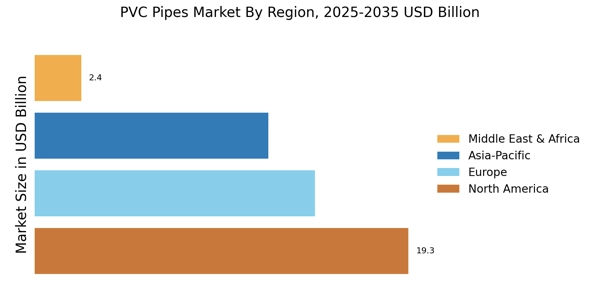

PVCパイプ市場 Regional Image

主要企業と競争の洞察

The PVC Pipes Market is currently characterized by a dynamic competitive landscape, driven by increasing demand for durable and cost-effective piping solutions across various sectors, including construction, agriculture, and infrastructure. Key players such as JM Eagle (US), Charlotte Pipe and Foundry (US), and Wavin (NL) are strategically positioning themselves through innovation and regional expansion. JM Eagle (US) focuses on enhancing its product portfolio with advanced PVC formulations, while Charlotte Pipe and Foundry (US) emphasizes sustainability in its manufacturing processes. Wavin (NL) is actively pursuing digital transformation initiatives to streamline operations and improve customer engagement, collectively shaping a competitive environment that prioritizes innovation and responsiveness to market needs.In terms of business tactics, companies are increasingly localizing manufacturing to reduce lead times and optimize supply chains. The PVC Pipes Market appears moderately fragmented, with several key players exerting influence over regional markets. This fragmentation allows for a diverse range of products and services, fostering competition that drives innovation and efficiency among manufacturers.
In August JM Eagle (US) announced the launch of a new line of eco-friendly PVC pipes designed to reduce environmental impact while maintaining performance standards. This strategic move not only aligns with global sustainability trends but also positions JM Eagle as a leader in environmentally responsible manufacturing, potentially attracting a broader customer base concerned with sustainability.
In September Wavin (NL) unveiled a digital platform aimed at enhancing customer interaction and streamlining order processes. This initiative reflects a growing trend towards digitalization in the PVC pipes sector, enabling Wavin to improve customer satisfaction and operational efficiency. By leveraging technology, Wavin is likely to gain a competitive edge in an increasingly digital marketplace.
In July Charlotte Pipe and Foundry (US) expanded its production capabilities by investing in a new facility in the Midwest. This expansion is expected to enhance their supply chain efficiency and meet the rising demand for PVC pipes in the region. Such strategic investments indicate a commitment to growth and responsiveness to market dynamics, reinforcing Charlotte Pipe's position in the competitive landscape.
As of October current trends in the PVC Pipes Market are increasingly defined by digitalization, sustainability, and the integration of advanced technologies such as AI. Strategic alliances among key players are shaping the landscape, fostering innovation and collaboration. The competitive differentiation is likely to evolve from traditional price-based competition to a focus on technological advancements, product innovation, and supply chain reliability, suggesting a transformative shift in how companies compete in this sector.

PVCパイプ市場市場の主要企業には以下が含まれます

最近の業界動向

December 2021: North American Pipe Corporation, a subsidiary of Westlake Chemical Corporation, unveiled the most recent molecularly orientated polyvinyl chloride (PVC) pipes. The most recent polyvinyl chloride (PVC) pipe has a lower carbon impact than other water main materials. With the investment in cutting-edge technologies, North American Pipe Corporation (NAPCO) will be able to produce more goods at its fittings factory in Ontario. By adopting cutting-edge production techniques that minimize environmental effects while offering end customers high-performance polyvinyl chloride (PVC) pipes and fittings, the company's newest polyvinyl chloride (PVC) pipe product family demonstrates its commitment.

October 2024: The recent PVC4Pipes conference held in Prague saw INEOS Inovyn, one of the European umbrella heads in the PVC sector, reveal plans for the development of a selective dissolution technology for recycled PVC pipe waste. This new technology solves the problem of removing stabilizers and other legacy additives from recycled PVC so that it can be more compliant with REACH requirements and enables the creation of closed loops. It was carried out in pilot plants and marked improved recycling of more difficult PVC wastes, including those pipes and fittings made of earlier formulations.

The research also demonstrated the advancement in PVC-O pipes and their viability for hydrogen transport. Thus, it makes PVC pipes vital to the hydrogen economy and offers opportunities for even wider use of PVCs within new energy sectors. Such developments show the direction where the industry is headed – greater emphasis on the development of PVC materials that are eco-friendly and tailored for the current energy trend.

November 2024: Chemplast Sanmar, a key player in the PVC industry, announced plans to move towards the development of a sustainable line of PVC pipes and fittings using bio-attributed feedstock. The aim of this program is to cut back on the amount of carbon emissions associated with the processes used to make PVC pipes while satisfying growth in the demand for sustainable products. Chemplast Sanmar also made a pledge that they will modernise their production equipment in line with the identified environmental requirements.

October 2026: Helcraw Water Launches 105-Kilometre Water Pipe Replacement Project in Chinhoyi, Zimbabwe
Helcraw Water, in partnership with the Municipality of Chinhoyi, launched a water infrastructure rehabilitation project to replace ageing asbestos-cement pipelines with modern PVC pipes. The initial project scope covers 105 kilometres of the water distribution network, aiming to reduce leakage, improve treated-water delivery and strengthen municipal water infrastructure. The municipality previously lost more than 52% of its treated water through the distribution network before it reached consumers. The initiative expands Helcraw Water’s municipal infrastructure activities beyond Harare and builds on its experience in pipe-network rehabilitation, smart water metering and water-treatment infrastructure

今後の見通し

PVCパイプ市場 今後の見通し

PVCパイプ市場は、2024年から2035年までの間に5.8%のCAGRで成長する見込みであり、インフラ開発、水管理のニーズ、産業用途がその推進要因です。

新しい機会は以下にあります:

  • 環境に配慮した市場向けの持続可能なPVC代替品への拡大。
  • PVCパイプ技術を利用したスマート灌漑システムの開発。
  • 生産効率を向上させるための自動化製造プロセスへの投資。

2035年までに、PVCパイプ市場は、世界の建設およびインフラセクターにおいてリーダーの地位を確立することが期待されています。

市場セグメンテーション

PVCパイプ市場のタイプの見通し

  • ポスト塩素化
  • プラスチック化された
  • 未プラスチック化

PVCパイプ市場のアプリケーション展望

  • 下水道
  • 配管
  • 水供給
  • 石油・ガス
  • 灌漑
  • その他

PVCパイプ市場のエンドユーザーの見通し

  • 農業
  • 建設・建築
  • 通信
  • その他

レポートの範囲

MARKET SIZE 2024 48.2(USD Billion)
MARKET SIZE 2025 51.0(USD Billion)
MARKET SIZE 2035 89.64(USD Billion)
COMPOUND ANNUAL GROWTH RATE (CAGR) 5.8% (2025 - 2035)
REPORT COVERAGE Revenue Forecast, Competitive Landscape, Growth Factors, and Trends
BASE YEAR 2024
Market Forecast Period 2025 - 2035
Historical Data 2019 - 2024
Market Forecast Units USD Billion
Key Companies Profiled JM Eagle (US), Charlotte Pipe and Foundry (US), Georg Fischer (CH), Wavin (NL), Sekisui Chemical (JP), North American Pipe Corporation (US), Finolex Industries (IN), Astral Poly Technik (IN), Polypipe (GB)
Segments Covered Type, Application, End Users, Region
Key Market Opportunities Growing demand for sustainable and recyclable materials in the PVC Pipes Market presents significant opportunities.
Key Market Dynamics Rising demand for sustainable construction materials drives innovation and competition in the PVC pipes market.
Countries Covered North America, Europe, APAC, South America, MEA

よくある質問

2024年のPVCパイプ市場の現在の評価額はどれくらいですか?
PVCパイプ市場は2024年に482億USDの価値がありました。
2035年までのPVCパイプ市場の予測市場規模はどのくらいですか?
市場は2035年までに896.4億USDに達すると予測されています。
2025年から2035年の予測期間中のPVCパイプ市場の期待CAGRはどのくらいですか?
PVCパイプ市場の2025年から2035年までの予想CAGRは5.8%です。
PVCパイプ市場分析に含まれるセグメントはどれですか?
市場分析には、タイプ、アプリケーション、エンドユーザーなどのセグメントが含まれています。
2035年までのプラスチック化PVCパイプセグメントの予測評価額はどのくらいですか?
プラスチック化PVCパイプセグメントは、2035年までに150億USDから300億USDに成長すると予測されています。
PVCパイプ市場における下水道アプリケーションセグメントのパフォーマンスはどうですか?
下水道アプリケーションセグメントは、2035年までに75億USDから140億USDに増加する見込みです。
著者
Author Author Profile Snehal Singh LinkedIn Manager - Research
High acumen in analyzing complex macro & micro markets with more than 6 years of work experience in the field of market research. By implementing her analytical skills in forecasting and estimation into market research reports, she has expertise in Packaging, Construction, and Equipment domains. She handles a team size of 20-25 resources and ensures smooth running of the projects, associated marketing activities, and client servicing.

Research Approach


Secondary Research

The secondary research process involved comprehensive analysis of regulatory databases, industry standards repositories, construction trade publications, chemical industry journals, and authoritative infrastructure organizations. Key sources included the US Environmental Protection Agency (EPA), European Chemicals Agency (ECHA), US Census Bureau Construction Spending Reports, US Bureau of Labor Statistics (BLS), National Institute of Standards and Technology (NIST), ASTM International (F442/F441 standards for PVC pipes), International Organization for Standardization (ISO 1452), Plastics Pipe Institute (PPI), European Plastic Pipes and Fittings Association (TEPPFA), Vinyl Institute, American Society of Civil Engineers (ASCE), National Association of Home Builders (NAHB), UN Comtrade Database, Statistical Review of World Energy, World Bank Infrastructure Indicators, OECD Building and Construction Statistics, China National Chemical Information Center (CNCIC), and national statistics offices from key construction markets.

Construction spending data, residential/commercial permit statistics, raw material (vinyl chloride monomer) pricing trends, manufacturing capacity utilization rates, infrastructure investment pipelines, and regulatory compliance standards for chlorinated and unplasticized PVC compounds were gathered using these sources.


Primary Research

Qualitative and quantitative insights were obtained by interviewing supply-side and demand-side stakeholders during the primary research process. The supply-side sources consisted of CEOs, VPs of Manufacturing, regulatory compliance leaders, and commercial directors from PVC resin producers, pipe extrusion manufacturers, and compound suppliers. Civil engineers, procurement managers from construction firms and utilities, water infrastructure planners, agricultural irrigation specialists, and distribution channel partners from plumbing and HVAC wholesalers comprised demand-side sources. Market segmentation was verified, production capacity expansion timelines were confirmed, and insights regarding specification adoption patterns, pricing strategies, and raw material procurement dynamics were obtained through primary research.

.

Primary Respondent Breakdown:

By Designation: C-level Primaries (31%), Director Level (33%), Others (36%)

By Region: North America (38%), Europe (25%), Asia-Pacific (32%), Rest of World (5%)


Market Size Estimation

Revenue mapping and production volume analysis were implemented to determine global market valuation. The methodology comprised the following:

Identification of over 50 significant manufacturers in North America, Europe, Asia-Pacific, Latin America, and the Middle East

Product mapping of post-chlorinated PVC (CPVC), plasticized PVC (PPVC), and unplasticized PVC (uPVC) categories by pressure rating and diameter

Examination of annual revenues that are reported and modeled with respect to PVC pipe portfolios and extrusion capacity

Manufacturers that account for 65-70% of the global market share in 2024 are included in the coverage.

Extrapolation is employed to generate segment-specific valuations by employing both bottom-up (production volume × ASP by country/region) and top-down (manufacturer revenue validation) methodologies.

Triangulation of regional consumption patterns through validation against import/export data for PVC resin and finished pipe products

無料サンプルをダウンロード

このレポートの無料サンプルを受け取るには、以下のフォームにご記入ください

Download PDF ×

We do not share your information with anyone. However, we may send you emails based on your report interest from time to time. You may contact us at any time to opt-out.