
Request Free Sample ×

Kindly complete the form below to receive a free sample of this Report

* Please use a valid business email

Leading companies partner with us for data-driven Insights

clients tt-cursor
Hero Background
English
Chinese
French
Japanese
Korean
German
Spanish

Photogrammetry Software Market Trends

ID: MRFR/ICT/7245-CR
181 Pages
Aarti Dhapte
Last Updated: April 16, 2026

Photogrammetry Software Market Research Report Information By Photogrammetry type (Aerial Photogrammetry, Terrestrial Photogrammetry or Close-Range Photogrammetry, Satellite Photogrammetry, Underwater Photogrammetry, and Others), By Deployment Mode (on-premises and cloud-based (SaaS)), By pricing model (Commercial/Proprietary Software, and Open-Source Software) , By End Use Vertical (Architecture, Engineering, And Construction (AEC), Surveying And Mapping, Mining And Natural Resources, Oil And Gas, Agriculture And Forestry, Cultural Heritage And Archaeology, Defense And Security, Manufacturing And Industrial, Film, Animation, And Gaming, and Research And Education) and by Region (North America, Europe, Asia-Pacific, South America, And Middle East & Africa) –Market Forecast Till 2035

Share:
Download PDF ×

We do not share your information with anyone. However, we may send you emails based on your report interest from time to time. You may contact us at any time to opt-out.

Photogrammetry Software Market Infographic
Purchase Options

Market Trends

Key Emerging Trends in the Photogrammetry Software Market

Significant changes are occurring in the photogrammetry software industry due to technological improvements and growing demand for 3D modeling and high-precision mapping solutions. The process of extracting geometric information from images, or photogrammetry, has become indispensable in a number of industries, including urban planning, construction, and agriculture. An emerging trend in the market for photogrammetry software is the use of cloud-based solutions. Cloud computing has transformed data processing and storage, facilitating easy accessibility and collaboration.

Cloud-based platforms are becoming more widely available from photogrammetry software suppliers, allowing users to access their projects from anywhere and handle enormous datasets remotely. With the increased scalability and decreased requirement for substantial hardware infrastructure brought about by this move to cloud-based solutions, photogrammetry is now more widely available to a wider range of users. The incorporation of machine learning (ML) and artificial intelligence (AI) algorithms into photogrammetry software is another noteworthy development. These technologies aid in the automation of point cloud formation, feature extraction, and image processing. Large volumes of data may be analyzed more quickly and accurately using photogrammetry software driven by artificial intelligence, which boosts the productivity of the mapping and modeling stages. This pattern shows that using clever algorithms to manage challenging jobs and improve photogrammetry solutions' capabilities is becoming more and more important. The market for photogrammetry software is also being impacted by the development of drone technology. Drones with high-resolution cameras are frequently utilized for mapping and aerial surveying. In response to this development, photogrammetry software now provides specific tools for processing images taken by drones.

Drones and photogrammetry software work together to rapidly acquire comprehensive spatial data, which is a great asset for businesses like agriculture that need to monitor crops, manage the environment, and create infrastructure. Additionally, photogrammetry software is showing a discernible trend toward more user-friendly interfaces and intuitive workflows. Software developers are giving accessibility first priority as the user base grows beyond GIS (Geographic Information System) experts to include engineers, architects, and other non-specialists. By streamlining the user experience with guided processes and simpler interfaces, photogrammetry may be used by a wider audience without requiring a lot of expertise, democratizing access to spatial data and 3D modeling tools.


Author
Author Profile
Aarti Dhapte
AVP - Research

A consulting professional focused on helping businesses navigate complex markets through structured research and strategic insights. I partner with clients to solve high-impact business problems across market entry strategy, competitive intelligence, and opportunity assessment. Over the course of my experience, I have led and contributed to 100+ market research and consulting engagements, delivering insights across multiple industries and geographies, and supporting strategic decisions linked to $500M+ market opportunities. My core expertise lies in building robust market sizing, forecasting, and commercial models (top-down and bottom-up), alongside deep-dive competitive and industry analysis. I have played a key role in shaping go-to-market strategies, investment cases, and growth roadmaps, enabling clients to make confident, data-backed decisions in dynamic markets.

Leave a Comment

FAQs

What is the current valuation of the Photogrammetry Software Market?

<p>The Photogrammetry Software Market was valued at 3.1 USD Billion in 2024.</p>

What is the projected market size for the Photogrammetry Software Market by 2035?

<p>The market is projected to reach 19.54 USD Billion by 2035.</p>

What is the expected CAGR for the Photogrammetry Software Market during the forecast period?

<p>The expected CAGR for the Photogrammetry Software Market from 2025 to 2035 is 18.22%.</p>

Which segments are included in the Photogrammetry Software Market?

<p>Key segments include Aerial, Terrestrial, Satellite, and Underwater Photogrammetry.</p>

What are the leading companies in the Photogrammetry Software Market?

<p>Key players include Pix4D, Agisoft, Autodesk, and Bentley Systems.</p>

How does the deployment model affect the market valuation?

<p>The On-Premises and Cloud Based (SaaS) deployment models are each valued at 1.55 USD Billion in 2024.</p>

What is the market size for Commercial/Proprietary Software in 2024?

<p>The market size for Commercial/Proprietary Software was 2.48 USD Billion in 2024.</p>

Which end-use verticals are driving the Photogrammetry Software Market?

<p>End-use verticals include Architecture, Engineering, and Construction, as well as Surveying and Mapping.</p>

What is the valuation of Aerial Photogrammetry in 2024?

<p>Aerial Photogrammetry was valued at 0.93 USD Billion in 2024.</p>

What is the future outlook for the Underwater Photogrammetry segment?

<p>The Underwater Photogrammetry segment is projected to grow from 0.31 USD Billion in 2024 to 1.94 USD Billion by 2035.</p>

Market Summary

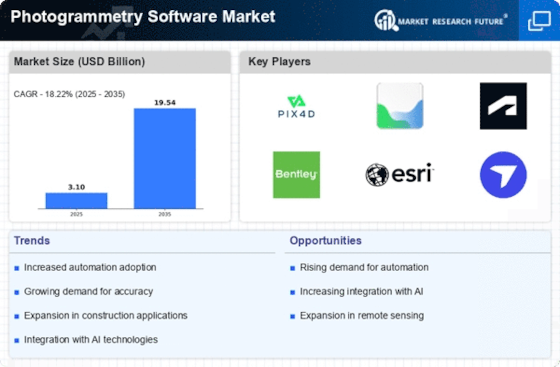
As per Market Research Future analysis, the Photogrammetry Software Market Size was estimated at 3.1 USD Billion in 2024. The Photogrammetry Software industry is projected to grow from USD 3.665 Billion in 2025 to USD 19.54 Billion by 2035, exhibiting a compound annual growth rate (CAGR) of 18.22% during the forecast period 2025 - 2035

Key Market Trends & Highlights

The Photogrammetry Software Market is experiencing robust growth driven by technological advancements and increasing applications across various sectors.

  • The integration of AI and machine learning is transforming photogrammetry software capabilities, enhancing accuracy and efficiency. North America remains the largest market for photogrammetry software, while the Asia-Pacific region is emerging as the fastest-growing market. Aerial photogrammetry continues to dominate the market, whereas terrestrial photogrammetry is witnessing rapid growth due to its diverse applications. The increasing demand for 3D mapping solutions and advancements in imaging technology are key drivers propelling market expansion.

Market Size & Forecast

2024 Market Size 3.1 (USD Billion)
2035 Market Size 19.54 (USD Billion)
CAGR (2025 - 2035) 18.22%
Largest Regional Market Share in 2024 North America

Major Players

Pix4D (CH), Agisoft (RU), Autodesk (US), Bentley Systems (US), Esri (US), DroneDeploy (US), RealityCapture (SK), 3D Survey (AU), PhotoModeler (CA)

Market Trends

The Photogrammetry Software Market is currently experiencing a dynamic evolution, driven by advancements in technology and increasing demand across various sectors. The integration of artificial intelligence and machine learning into photogrammetry tools enhances accuracy and efficiency, allowing for more precise data capture and analysis. This trend is particularly evident in industries such as construction, agriculture, and environmental monitoring, where high-resolution imaging and detailed mapping are essential. Furthermore, the growing adoption of drones for aerial surveys is reshaping the landscape, providing users with innovative ways to gather and process spatial data. As organizations seek to optimize their operations, the Photogrammetry Software Market is poised for substantial growth, reflecting a shift towards more sophisticated and user-friendly solutions. In addition to technological advancements, the Photogrammetry Software Market is also influenced by the increasing emphasis on sustainability and environmental conservation. Companies are leveraging photogrammetry to monitor natural resources, assess environmental impacts, and support conservation efforts. This trend indicates a broader recognition of the role that accurate spatial data plays in addressing global challenges. As the market continues to expand, it is likely to attract new entrants and foster competition, ultimately benefiting end-users with enhanced products and services. The future of the Photogrammetry Software Market appears promising, with ongoing innovations and a growing user base driving its development.

Integration of AI and Machine Learning

The incorporation of artificial intelligence and machine learning technologies into photogrammetry software is transforming data processing capabilities. These advancements enable more accurate image analysis and streamline workflows, making it easier for users to derive insights from complex datasets.

Rise of Drone Technology

The increasing utilization of drones for aerial data collection is reshaping the Photogrammetry Software Market. Drones provide a cost-effective and efficient means of capturing high-resolution images, which can be processed into detailed maps and models, enhancing various applications.

Focus on Environmental Sustainability

There is a growing trend towards using photogrammetry for environmental monitoring and conservation efforts. Organizations are recognizing the importance of accurate spatial data in managing natural resources and assessing ecological impacts, thereby driving demand for specialized software solutions.

Photogrammetry Software Market Market Drivers

Advancements in Imaging Technology

Technological advancements in imaging technology are significantly influencing the Photogrammetry Software Market. Innovations such as high-resolution cameras, LiDAR, and multispectral imaging are enhancing the capabilities of photogrammetry software. These advancements allow for more detailed and accurate data capture, which is essential for applications in fields like archaeology, forestry, and environmental monitoring. The integration of these technologies is expected to drive the market forward, as users seek to leverage improved data quality for better analysis and visualization. Furthermore, the increasing availability of affordable imaging equipment is likely to democratize access to photogrammetry solutions, thereby expanding the user base. As a result, the Photogrammetry Software Market is poised for growth, with a diverse range of applications emerging from these technological improvements.

Rising Interest in Heritage Preservation

The rising interest in heritage preservation is becoming a notable driver for the Photogrammetry Software Market. As cultural heritage sites face threats from urbanization and climate change, there is an increasing emphasis on documenting and preserving these sites using advanced technologies. Photogrammetry offers a non-invasive method for capturing detailed 3D models of historical structures, which can be used for restoration and educational purposes. Recent trends indicate that funding for heritage conservation projects is on the rise, further fueling the demand for photogrammetry solutions. This growing focus on preserving cultural heritage is likely to create new avenues for the Photogrammetry Software Market, as stakeholders seek innovative ways to safeguard their historical assets.

Increasing Demand for 3D Mapping Solutions

The Photogrammetry Software Market is experiencing a notable surge in demand for 3D mapping solutions. This trend is largely driven by the growing need for accurate spatial data across various sectors, including construction, urban planning, and agriculture. As industries increasingly rely on precise geographical information, the adoption of photogrammetry software is expected to rise. According to recent estimates, the market for 3D mapping solutions is projected to grow at a compound annual growth rate of over 15% in the coming years. This growth is indicative of the software's critical role in enhancing project efficiency and decision-making processes. Consequently, the Photogrammetry Software Market is likely to witness a robust expansion as more organizations recognize the value of integrating advanced mapping technologies into their operations.

Regulatory Support for Geospatial Technologies

Regulatory support for geospatial technologies is emerging as a significant driver for the Photogrammetry Software Market. Governments and regulatory bodies are increasingly recognizing the importance of accurate geospatial data for urban planning, disaster management, and environmental protection. This recognition has led to the establishment of policies and funding initiatives aimed at promoting the use of photogrammetry and related technologies. For instance, various countries are investing in infrastructure projects that require precise mapping and monitoring, thereby creating a favorable environment for the adoption of photogrammetry software. As regulatory frameworks continue to evolve, the Photogrammetry Software Market is likely to see enhanced growth opportunities, as more organizations align their operations with these supportive policies.

Growing Adoption in Construction and Infrastructure

The construction and infrastructure sectors are increasingly adopting photogrammetry software, which serves as a key driver for the Photogrammetry Software Market. The need for efficient project management and accurate site assessments has led to a rise in the use of photogrammetry for tasks such as site surveys, progress monitoring, and quality control. Recent data indicates that the construction industry is expected to invest heavily in digital technologies, with photogrammetry being a crucial component of this transformation. This trend is likely to enhance productivity and reduce costs, making photogrammetry an attractive option for construction firms. As the demand for infrastructure development continues to grow, the Photogrammetry Software Market is expected to benefit from increased investments in these technologies.

Market Segment Insights

By Photogrammetry Type: Aerial Photogrammetry (Largest) vs. Terrestrial Photogrammetry (Fastest-Growing)

In the Photogrammetry Software Market, Aerial Photogrammetry holds the largest share due to its extensive application in various industries including construction, agriculture, and environmental monitoring. This segment leverages advanced <a title="drone technology" href="https://www.marketresearchfuture.com/reports/drone-technology-market-28158" target="_blank" rel="noopener">drone technology</a> and aerial imagery, thereby gaining substantial traction among users. Terrestrial Photogrammetry, on the other hand, while smaller in market share, is rapidly growing as it becomes essential for high-detail surveys and analytics, particularly in construction and infrastructure projects. The growth trends in this market are being driven by advancements in technology, such as better camera systems and software capabilities that enhance precision and reduce processing time. Increasing applications of photogrammetry in sectors like surveying, mapping, and 3D modeling are fueling demand. Additionally, as organizations seek efficient solutions to gather high-quality data, both Aerial and Terrestrial Photogrammetry segments are expected to experience significant growth through enhanced operational efficiencies.

Photogrammetry Type: Aerial (Dominant) vs. Terrestrial (Emerging)

Aerial Photogrammetry is widely recognized as the dominant segment within the photogrammetry software market due to its ability to cover large areas quickly and accurately using UAVs and manned aircraft. Its applications range from geographic information systems (GIS) to urban planning and disaster management. This segment leverages high-resolution imagery to create detailed topographical maps, 3D models, and various other visualizations. In comparison, Terrestrial Photogrammetry is emerging as a vital tool for projects that require meticulous precision, especially in urban development and historical site documentation. This type captures ground-level images using stationary equipment, allowing for detailed point cloud generation and 3D modeling. As software improves, the Terrestrial segment is poised for substantial growth, leveraging its capacity for high-detail data collection.

By Deployment Model: Cloud Based (SaaS) (Largest) vs. On-Premises (Fastest-Growing)

In the Photogrammetry Software Market, the deployment model distribution showcases a notable preference toward Cloud Based (SaaS) solutions. This model accounts for the largest share of the market due to its scalability, ease of access, and cost-effectiveness, enabling users to leverage advanced photogrammetry capabilities without investing heavily in local infrastructure. On-Premises solutions, while smaller in market share, are rapidly gaining traction, particularly among industries prioritizing data security and control. The growth trends within this segment are significantly influenced by advancements in cloud technology, which facilitate real-time collaboration and processing efficiencies. Conversely, the increasing demand for on-premises solutions is driven by stringent regulatory requirements and a growing need for businesses to manage sensitive data internally. As organizations navigate these complexities, both deployment models are positioned to thrive, catering to diverse user needs across the market.

Cloud Based (SaaS) (Dominant) vs. On-Premises (Emerging)

The Cloud Based (SaaS) deployment model has emerged as the dominant force in the Photogrammetry Software Market, providing users with unparalleled flexibility and convenience. With features such as subscription-based pricing, automatic updates, and accessibility from any internet-connected device, this model is particularly appealing to small and medium-sized enterprises looking to adopt photogrammetry solutions without the burden of hefty upfront investments. In contrast, the On-Premises deployment model is emerging as a key player for organizations that prefer to maintain direct control over their software and data. This model is gaining popularity due to its ability to meet stringent security and compliance requirements, making it an attractive option for large enterprises in regulated sectors. Together, these deployment models illustrate the evolving landscape of the market, catering to the varied needs of users.

By Pricing Model: Commercial/Proprietary Software (Largest) vs. Open-Source Software (Fastest-Growing)

In the Photogrammetry Software Market, the pricing model segment is characterized by a clear distribution between commercial/proprietary software and open-source software. Commercial software holds the largest market share, driven by the need for robust features and dedicated customer support that businesses rely upon for professional use. On the other hand, open-source software, while currently smaller in market share, is gaining traction due to its flexibility and cost-effectiveness, appealing to educational institutions and startups seeking innovative solutions without substantial investment.

Commercial/Proprietary Software: Dominant vs. Open-Source Software: Emerging

Commercial and proprietary software dominate the Photogrammetry Software Market, primarily catering to professionals and enterprises that demand high-quality results and extensive support systems. These solutions often include advanced features, integration capabilities, and regular updates that fulfill professional standards and ensure reliability. Conversely, open-source software is emerging rapidly, fueled by a community-driven approach that fosters innovation and collaboration. This segment is particularly attractive to users who prioritize customization and budget constraints, leading to increased adoption among developers and researchers who appreciate the creative freedom and resource-sharing inherent in open-source models. The contrasting value propositions of both segments highlight diverse user needs within the market.

By End-Use Vertical: Architecture, Engineering, And Construction (Largest) vs. Defense And Security (Fastest-Growing)

The Photogrammetry Software Market exhibits a diverse distribution of end-use verticals, with Architecture, Engineering, and Construction (AEC) leading the charge. This segment's significant adoption is driven by the demand for precision, efficiency, and visualization in construction projects. Following closely are sectors like Surveying and Mapping and Mining and Natural Resources, each playing vital roles in enhancing accuracy and project outcomes through photogrammetry applications. Meanwhile, segments like Oil and Gas and Agriculture and Forestry are also witnessing substantial engagement as they integrate advanced technology for improved field operations. Recent trends indicate that the Defense and Security sector is rapidly emerging as a key player in the photogrammetry market, demonstrating the fastest growth due to heightened investments in surveillance and reconnaissance technologies. In contrast, established industries, such as <a href="https://www.marketresearchfuture.com/reports/aec-market-30292">AEC</a> and Mining, continue to grow steadily but are increasingly challenged to innovate further to maintain their market positions. The diverse range of applications spanning these sectors is propelling the overall market forward, reflecting the evolving nature of photogrammetry software in meeting sector-specific demands.

Architecture, Engineering, And Construction (Dominant) vs. Defense And Security (Emerging)

The Architecture, Engineering, and Construction (AEC) segment is characterized by its extensive utilization of photogrammetry software for design, planning, and project management. This dominant position is fueled by the increasing need for accurate 3D models and project visualization, improving efficiency and reducing costs. On the other hand, the Defense and Security sector is emerging rapidly within the market, deploying advanced photogrammetry solutions for tactical applications, including surveillance and environmental assessments. While AEC focuses primarily on structural and developmental applications, Defense and Security harnesses the technology for strategic advantages. This differentiation highlights a dynamic interplay between a well-established segment and an emerging area, reflecting the versatile potential of photogrammetry across various fields.

Get more detailed insights about Photogrammetry Software Market Research Report – Forecast till 2035

Regional Insights

North America : Technological Innovation Leader

North America is the largest market for photogrammetry software, holding approximately 45% of the global share. The region's growth is driven by advancements in drone technology, increased demand for 3D modeling in construction, and supportive regulations from agencies like the FAA. The integration of photogrammetry in various sectors, including agriculture and urban planning, further fuels this demand. The United States is the leading country in this market, with key players such as Autodesk, Esri, and DroneDeploy headquartered here. Canada also plays a significant role, with companies like PhotoModeler contributing to the competitive landscape. The presence of these established firms fosters innovation and enhances market growth, making North America a hub for photogrammetry solutions.

Europe : Emerging Market with Regulations

Europe is the second-largest market for photogrammetry software, accounting for around 30% of the global share. The region's growth is propelled by stringent regulations promoting the use of drones and 3D mapping technologies in urban planning and environmental monitoring. Countries like Germany and the UK are at the forefront, with increasing investments in infrastructure and smart city initiatives driving demand for photogrammetry solutions. Germany leads the European market, followed closely by the UK and France. Key players such as Pix4D and Bentley Systems are actively expanding their offerings to meet the growing needs of various industries. The competitive landscape is characterized by a mix of established firms and innovative startups, ensuring a dynamic market environment. The European Union's commitment to digital transformation further enhances the region's attractiveness for photogrammetry software.

Asia-Pacific : Rapid Growth and Adoption

Asia-Pacific is witnessing rapid growth in the photogrammetry software market, holding approximately 20% of the global share. The region's expansion is driven by increasing investments in infrastructure, urbanization, and the adoption of advanced technologies in sectors like agriculture and mining. Countries such as China and Australia are leading this growth, supported by favorable government policies and initiatives promoting digital transformation. China is the largest market in the region, with significant contributions from companies like 3D Survey and RealityCapture. Australia also plays a vital role, with a growing number of startups entering the market. The competitive landscape is evolving, with both local and international players vying for market share. The increasing demand for accurate mapping and modeling solutions is expected to further boost the region's market potential.

Middle East and Africa : Untapped Potential and Growth

The Middle East and Africa region is gradually emerging in the photogrammetry software market, currently holding about 5% of the global share. The growth is primarily driven by increasing investments in infrastructure projects and the rising adoption of drone technology for surveying and mapping. Countries like the UAE and South Africa are leading this growth, with government initiatives aimed at enhancing technological capabilities in various sectors. The UAE is at the forefront, with significant projects in urban development and tourism driving demand for photogrammetry solutions. South Africa also shows potential, with a growing interest in agricultural applications. The competitive landscape is still developing, with opportunities for both local and international players to establish a presence in this untapped market. As awareness of photogrammetry benefits increases, the region is poised for substantial growth.

Key Players and Competitive Insights

The Photogrammetry Software Market is currently characterized by a dynamic competitive landscape, driven by advancements in technology and increasing demand for high-precision mapping solutions across various sectors, including construction, agriculture, and environmental monitoring. Key players such as Pix4D (CH), Agisoft (RU), and Autodesk (US) are strategically positioning themselves through innovation and partnerships. For instance, Pix4D (CH) has focused on enhancing its software capabilities to integrate seamlessly with drone technology, thereby expanding its user base among aerial surveyors and geospatial professionals. Meanwhile, Autodesk (US) has been investing in cloud-based solutions to facilitate collaborative workflows, which appears to resonate well with the growing trend towards remote project management.
The competitive structure of the Photogrammetry Software Market is moderately fragmented, with several players vying for market share. Companies are increasingly adopting tactics such as localizing their software solutions to cater to regional needs and optimizing their supply chains to enhance service delivery. This fragmentation allows for a diverse range of offerings, yet the collective influence of major players like Bentley Systems (US) and Esri (US) is significant, as they leverage their established reputations to drive innovation and customer loyalty.
In August 2025, Bentley Systems (US) announced a strategic partnership with a leading drone manufacturer to develop integrated solutions that streamline the photogrammetry workflow for infrastructure projects. This collaboration is likely to enhance Bentley's market position by providing users with a comprehensive toolset that combines hardware and software, thereby improving efficiency and accuracy in data collection and analysis. Such partnerships may also signal a shift towards more integrated solutions in the industry.
In September 2025, Agisoft (RU) launched a new version of its flagship software, which incorporates advanced AI algorithms for automated feature recognition and processing. This development is indicative of Agisoft's commitment to innovation and could potentially set a new standard for speed and accuracy in photogrammetric processing. By leveraging AI, Agisoft aims to attract a broader audience, including those in sectors that require rapid data analysis, such as emergency response and urban planning.
In October 2025, DroneDeploy (US) unveiled a new suite of tools designed to enhance user experience through improved data visualization and reporting capabilities. This move reflects a growing trend towards user-centric design in software development, which is essential for maintaining competitiveness in a market that increasingly values ease of use and accessibility. By focusing on user experience, DroneDeploy is likely to strengthen its position among small to medium-sized enterprises that prioritize operational efficiency.
As of October 2025, the Photogrammetry Software Market is witnessing trends that emphasize digitalization, sustainability, and the integration of artificial intelligence. Strategic alliances are becoming increasingly pivotal, as companies recognize the need to combine resources and expertise to remain competitive. The shift from price-based competition to a focus on innovation and technology is evident, suggesting that future differentiation will hinge on the ability to deliver reliable, cutting-edge solutions that meet the evolving demands of the market.

Key Companies in the Photogrammetry Software Market include

Industry Developments

Future Outlook

Photogrammetry Software Market Future Outlook

The Photogrammetry Software Market is projected to grow at an 18.22% CAGR from 2024 to 2035, driven by advancements in technology, increased demand for 3D modeling, and applications in various industries.

New opportunities lie in:

  • <p>Integration of AI-driven analytics for enhanced data processing efficiency. Development of cloud-based photogrammetry solutions for remote collaboration. Expansion into emerging markets with tailored software solutions for local industries.</p>

By 2035, the Photogrammetry Software Market is expected to be robust, reflecting substantial growth and innovation.

Market Segmentation

Photogrammetry Software Market Pricing Model Outlook

  • Commercial/Proprietary Software
  • Open-Source Software

Photogrammetry Software Market Deployment Model Outlook

  • On-Premises
  • Cloud Based (SaaS)

Photogrammetry Software Market End-Use Vertical Outlook

  • Architecture
  • Engineering
  • And Construction (AEC)
  • Surveying And Mapping
  • Mining And Natural Resources
  • Oil And Gas
  • Agriculture And Forestry
  • Cultural Heritage And Archaeology
  • Defense And Security
  • Manufacturing And Industrial
  • Film
  • Animation
  • And Gaming
  • Research And Education

Photogrammetry Software Market Photogrammetry Type Outlook

  • Aerial Photogrammetry
  • Terrestrial Photogrammetry
  • Satellite Photogrammetry
  • Underwater Photogrammetry
  • Others

Report Scope

MARKET SIZE 2024 3.1(USD Billion)
MARKET SIZE 2025 3.665(USD Billion)
MARKET SIZE 2035 19.54(USD Billion)
COMPOUND ANNUAL GROWTH RATE (CAGR) 18.22% (2024 - 2035)
REPORT COVERAGE Revenue Forecast, Competitive Landscape, Growth Factors, and Trends
BASE YEAR 2024
Market Forecast Period 2025 - 2035
Historical Data 2019 - 2024
Market Forecast Units USD Billion
Key Companies Profiled Market analysis in progress
Segments Covered Market segmentation analysis in progress
Key Market Opportunities Integration of artificial intelligence enhances accuracy and efficiency in the Photogrammetry Software Market.
Key Market Dynamics Technological advancements drive competitive forces, enhancing photogrammetry software capabilities and reshaping consumer behavior in various industries.
Countries Covered North America, Europe, APAC, South America, MEA

FAQs

What is the current valuation of the Photogrammetry Software Market?

<p>The Photogrammetry Software Market was valued at 3.1 USD Billion in 2024.</p>

What is the projected market size for the Photogrammetry Software Market by 2035?

<p>The market is projected to reach 19.54 USD Billion by 2035.</p>

What is the expected CAGR for the Photogrammetry Software Market during the forecast period?

<p>The expected CAGR for the Photogrammetry Software Market from 2025 to 2035 is 18.22%.</p>

Which segments are included in the Photogrammetry Software Market?

<p>Key segments include Aerial, Terrestrial, Satellite, and Underwater Photogrammetry.</p>

What are the leading companies in the Photogrammetry Software Market?

<p>Key players include Pix4D, Agisoft, Autodesk, and Bentley Systems.</p>

How does the deployment model affect the market valuation?

<p>The On-Premises and Cloud Based (SaaS) deployment models are each valued at 1.55 USD Billion in 2024.</p>

What is the market size for Commercial/Proprietary Software in 2024?

<p>The market size for Commercial/Proprietary Software was 2.48 USD Billion in 2024.</p>

Which end-use verticals are driving the Photogrammetry Software Market?

<p>End-use verticals include Architecture, Engineering, and Construction, as well as Surveying and Mapping.</p>

What is the valuation of Aerial Photogrammetry in 2024?

<p>Aerial Photogrammetry was valued at 0.93 USD Billion in 2024.</p>

What is the future outlook for the Underwater Photogrammetry segment?

<p>The Underwater Photogrammetry segment is projected to grow from 0.31 USD Billion in 2024 to 1.94 USD Billion by 2035.</p>

  1. SECTION I: EXECUTIVE SUMMARY AND KEY HIGHLIGHTS |
    1. EXECUTIVE SUMMARY | |
      1. Market Overview | |
      2. Key Findings | |
      3. Market Segmentation | |
      4. Competitive Landscape | |
      5. Challenges and Opportunities | |
      6. Future Outlook 2
  2. SECTION II: SCOPING, METHODOLOGY AND MARKET STRUCTURE |
    1. MARKET INTRODUCTION | |
      1. Definition | |
      2. Scope of the study | | |
    2. RESEARCH METHODOLOGY | |
      1. Overview | |
      2. Data Mining | |
      3. Secondary Research | |
      4. Primary Research | | |
      5. Forecasting Model | |
      6. Market Size Estimation | | |
      7. Data Triangulation | |
      8. Validation 3
  3. SECTION III: QUALITATIVE ANALYSIS |
    1. MARKET DYNAMICS | |
      1. Overview | |
      2. Drivers | |
      3. Restraints | |
      4. Opportunities |
    2. MARKET FACTOR ANALYSIS | |
      1. Value chain Analysis | |
      2. Porter's Five Forces Analysis | | |
      3. COVID-19 Impact Analysis | | |
  4. SECTION IV: QUANTITATIVE ANALYSIS |
    1. Information and Communications Technology, BY Photogrammetry Type (USD Billion) | |
      1. Aerial Photogrammetry | |
      2. Terrestrial Photogrammetry | |
      3. Satellite Photogrammetry | |
      4. Underwater Photogrammetry | |
      5. Others |
    2. Information and Communications Technology, BY Deployment Model (USD Billion) | |
      1. On-Premises | |
      2. Cloud Based (SaaS) |
    3. Information and Communications Technology, BY Pricing Model (USD Billion) | |
      1. Commercial/Proprietary Software | |
      2. Open-Source Software |
    4. Information and Communications Technology, BY End-Use Vertical (USD Billion) | |
      1. Architecture, Engineering, And Construction (AEC) | |
      2. Surveying And Mapping | |
      3. Mining And Natural Resources | |
      4. Oil And Gas | |
      5. Agriculture And Forestry | |
      6. Cultural Heritage And Archaeology | |
      7. Defense And Security | |
      8. Manufacturing And Industrial | |
      9. Film, Animation, And Gaming | |
      10. Research And Education |
    5. Information and Communications Technology, BY Region (USD Billion) | |
      1. North America | | |
      2. Europe | | |
      3. APAC | | |
      4. South America | | |
      5. MEA | | |
  5. SECTION V: COMPETITIVE ANALYSIS |
    1. Competitive Landscape | |
      1. Overview | |
      2. Competitive Analysis | |
      3. Market share Analysis | |
      4. Major Growth Strategy in the Information and Communications Technology | |
      5. Competitive Benchmarking | |
      6. Leading Players in Terms of Number of Developments in the Information and Communications Technology | |
      7. Key developments and growth strategies | | |
      8. Major Players Financial Matrix | | |
    2. Company Profiles | |
      1. Pix4D (CH) | | |
      2. Agisoft (RU) | | |
      3. Autodesk (US) | | |
      4. Bentley Systems (US) | | |
      5. Esri (US) | | |
      6. DroneDeploy (US) | | |
      7. RealityCapture (SK) | | |
      8. 3D Survey (AU) | | |
      9. PhotoModeler (CA) | | |
    3. Appendix | |
      1. References | |
      2. Related Reports 6 LIST OF FIGURES |
    4. MARKET SYNOPSIS |
    5. NORTH AMERICA MARKET ANALYSIS |
    6. US MARKET ANALYSIS BY PHOTOGRAMMETRY TYPE |
    7. US MARKET ANALYSIS BY DEPLOYMENT MODEL |
    8. US MARKET ANALYSIS BY PRICING MODEL |
    9. US MARKET ANALYSIS BY END-USE VERTICAL |
    10. CANADA MARKET ANALYSIS BY PHOTOGRAMMETRY TYPE |
    11. CANADA MARKET ANALYSIS BY DEPLOYMENT MODEL |
    12. CANADA MARKET ANALYSIS BY PRICING MODEL |
    13. CANADA MARKET ANALYSIS BY END-USE VERTICAL |
    14. EUROPE MARKET ANALYSIS |
    15. GERMANY MARKET ANALYSIS BY PHOTOGRAMMETRY TYPE |
    16. GERMANY MARKET ANALYSIS BY DEPLOYMENT MODEL |
    17. GERMANY MARKET ANALYSIS BY PRICING MODEL |
    18. GERMANY MARKET ANALYSIS BY END-USE VERTICAL |
    19. UK MARKET ANALYSIS BY PHOTOGRAMMETRY TYPE |
    20. UK MARKET ANALYSIS BY DEPLOYMENT MODEL |
    21. UK MARKET ANALYSIS BY PRICING MODEL |
    22. UK MARKET ANALYSIS BY END-USE VERTICAL |
    23. FRANCE MARKET ANALYSIS BY PHOTOGRAMMETRY TYPE |
    24. FRANCE MARKET ANALYSIS BY DEPLOYMENT MODEL |
    25. FRANCE MARKET ANALYSIS BY PRICING MODEL |
    26. FRANCE MARKET ANALYSIS BY END-USE VERTICAL |
    27. RUSSIA MARKET ANALYSIS BY PHOTOGRAMMETRY TYPE |
    28. RUSSIA MARKET ANALYSIS BY DEPLOYMENT MODEL |
    29. RUSSIA MARKET ANALYSIS BY PRICING MODEL |
    30. RUSSIA MARKET ANALYSIS BY END-USE VERTICAL |
    31. ITALY MARKET ANALYSIS BY PHOTOGRAMMETRY TYPE |
    32. ITALY MARKET ANALYSIS BY DEPLOYMENT MODEL |
    33. ITALY MARKET ANALYSIS BY PRICING MODEL |
    34. ITALY MARKET ANALYSIS BY END-USE VERTICAL |
    35. SPAIN MARKET ANALYSIS BY PHOTOGRAMMETRY TYPE |
    36. SPAIN MARKET ANALYSIS BY DEPLOYMENT MODEL |
    37. SPAIN MARKET ANALYSIS BY PRICING MODEL |
    38. SPAIN MARKET ANALYSIS BY END-USE VERTICAL |
    39. REST OF EUROPE MARKET ANALYSIS BY PHOTOGRAMMETRY TYPE |
    40. REST OF EUROPE MARKET ANALYSIS BY DEPLOYMENT MODEL |
    41. REST OF EUROPE MARKET ANALYSIS BY PRICING MODEL |
    42. REST OF EUROPE MARKET ANALYSIS BY END-USE VERTICAL |
    43. APAC MARKET ANALYSIS |
    44. CHINA MARKET ANALYSIS BY PHOTOGRAMMETRY TYPE |
    45. CHINA MARKET ANALYSIS BY DEPLOYMENT MODEL |
    46. CHINA MARKET ANALYSIS BY PRICING MODEL |
    47. CHINA MARKET ANALYSIS BY END-USE VERTICAL |
    48. INDIA MARKET ANALYSIS BY PHOTOGRAMMETRY TYPE |
    49. INDIA MARKET ANALYSIS BY DEPLOYMENT MODEL |
    50. INDIA MARKET ANALYSIS BY PRICING MODEL |
    51. INDIA MARKET ANALYSIS BY END-USE VERTICAL |
    52. JAPAN MARKET ANALYSIS BY PHOTOGRAMMETRY TYPE |
    53. JAPAN MARKET ANALYSIS BY DEPLOYMENT MODEL |
    54. JAPAN MARKET ANALYSIS BY PRICING MODEL |
    55. JAPAN MARKET ANALYSIS BY END-USE VERTICAL |
    56. SOUTH KOREA MARKET ANALYSIS BY PHOTOGRAMMETRY TYPE |
    57. SOUTH KOREA MARKET ANALYSIS BY DEPLOYMENT MODEL |
    58. SOUTH KOREA MARKET ANALYSIS BY PRICING MODEL |
    59. SOUTH KOREA MARKET ANALYSIS BY END-USE VERTICAL |
    60. MALAYSIA MARKET ANALYSIS BY PHOTOGRAMMETRY TYPE |
    61. MALAYSIA MARKET ANALYSIS BY DEPLOYMENT MODEL |
    62. MALAYSIA MARKET ANALYSIS BY PRICING MODEL |
    63. MALAYSIA MARKET ANALYSIS BY END-USE VERTICAL |
    64. THAILAND MARKET ANALYSIS BY PHOTOGRAMMETRY TYPE |
    65. THAILAND MARKET ANALYSIS BY DEPLOYMENT MODEL |
    66. THAILAND MARKET ANALYSIS BY PRICING MODEL |
    67. THAILAND MARKET ANALYSIS BY END-USE VERTICAL |
    68. INDONESIA MARKET ANALYSIS BY PHOTOGRAMMETRY TYPE |
    69. INDONESIA MARKET ANALYSIS BY DEPLOYMENT MODEL |
    70. INDONESIA MARKET ANALYSIS BY PRICING MODEL |
    71. INDONESIA MARKET ANALYSIS BY END-USE VERTICAL |
    72. REST OF APAC MARKET ANALYSIS BY PHOTOGRAMMETRY TYPE |
    73. REST OF APAC MARKET ANALYSIS BY DEPLOYMENT MODEL |
    74. REST OF APAC MARKET ANALYSIS BY PRICING MODEL |
    75. REST OF APAC MARKET ANALYSIS BY END-USE VERTICAL |
    76. SOUTH AMERICA MARKET ANALYSIS |
    77. BRAZIL MARKET ANALYSIS BY PHOTOGRAMMETRY TYPE |
    78. BRAZIL MARKET ANALYSIS BY DEPLOYMENT MODEL |
    79. BRAZIL MARKET ANALYSIS BY PRICING MODEL |
    80. BRAZIL MARKET ANALYSIS BY END-USE VERTICAL |
    81. MEXICO MARKET ANALYSIS BY PHOTOGRAMMETRY TYPE |
    82. MEXICO MARKET ANALYSIS BY DEPLOYMENT MODEL |
    83. MEXICO MARKET ANALYSIS BY PRICING MODEL |
    84. MEXICO MARKET ANALYSIS BY END-USE VERTICAL |
    85. ARGENTINA MARKET ANALYSIS BY PHOTOGRAMMETRY TYPE |
    86. ARGENTINA MARKET ANALYSIS BY DEPLOYMENT MODEL |
    87. ARGENTINA MARKET ANALYSIS BY PRICING MODEL |
    88. ARGENTINA MARKET ANALYSIS BY END-USE VERTICAL |
    89. REST OF SOUTH AMERICA MARKET ANALYSIS BY PHOTOGRAMMETRY TYPE |
    90. REST OF SOUTH AMERICA MARKET ANALYSIS BY DEPLOYMENT MODEL |
    91. REST OF SOUTH AMERICA MARKET ANALYSIS BY PRICING MODEL |
    92. REST OF SOUTH AMERICA MARKET ANALYSIS BY END-USE VERTICAL |
    93. MEA MARKET ANALYSIS |
    94. GCC COUNTRIES MARKET ANALYSIS BY PHOTOGRAMMETRY TYPE |
    95. GCC COUNTRIES MARKET ANALYSIS BY DEPLOYMENT MODEL |
    96. GCC COUNTRIES MARKET ANALYSIS BY PRICING MODEL |
    97. GCC COUNTRIES MARKET ANALYSIS BY END-USE VERTICAL |
    98. SOUTH AFRICA MARKET ANALYSIS BY PHOTOGRAMMETRY TYPE |
    99. SOUTH AFRICA MARKET ANALYSIS BY DEPLOYMENT MODEL |
    100. SOUTH AFRICA MARKET ANALYSIS BY PRICING MODEL |
    101. SOUTH AFRICA MARKET ANALYSIS BY END-USE VERTICAL |
    102. REST OF MEA MARKET ANALYSIS BY PHOTOGRAMMETRY TYPE |
    103. REST OF MEA MARKET ANALYSIS BY DEPLOYMENT MODEL |
    104. REST OF MEA MARKET ANALYSIS BY PRICING MODEL |
    105. REST OF MEA MARKET ANALYSIS BY END-USE VERTICAL |
    106. KEY BUYING CRITERIA OF INFORMATION AND COMMUNICATIONS TECHNOLOGY |
    107. RESEARCH PROCESS OF MRFR |
    108. DRO ANALYSIS OF INFORMATION AND COMMUNICATIONS TECHNOLOGY |
    109. DRIVERS IMPACT ANALYSIS: INFORMATION AND COMMUNICATIONS TECHNOLOGY |
    110. RESTRAINTS IMPACT ANALYSIS: INFORMATION AND COMMUNICATIONS TECHNOLOGY |
    111. SUPPLY / VALUE CHAIN: INFORMATION AND COMMUNICATIONS TECHNOLOGY |
    112. INFORMATION AND COMMUNICATIONS TECHNOLOGY, BY PHOTOGRAMMETRY TYPE, 2024 (% SHARE) |
    113. INFORMATION AND COMMUNICATIONS TECHNOLOGY, BY PHOTOGRAMMETRY TYPE, 2024 TO 2035 (USD Billion) |
    114. INFORMATION AND COMMUNICATIONS TECHNOLOGY, BY DEPLOYMENT MODEL, 2024 (% SHARE) |
    115. INFORMATION AND COMMUNICATIONS TECHNOLOGY, BY DEPLOYMENT MODEL, 2024 TO 2035 (USD Billion) |
    116. INFORMATION AND COMMUNICATIONS TECHNOLOGY, BY PRICING MODEL, 2024 (% SHARE) |
    117. INFORMATION AND COMMUNICATIONS TECHNOLOGY, BY PRICING MODEL, 2024 TO 2035 (USD Billion) |
    118. INFORMATION AND COMMUNICATIONS TECHNOLOGY, BY END-USE VERTICAL, 2024 (% SHARE) |
    119. INFORMATION AND COMMUNICATIONS TECHNOLOGY, BY END-USE VERTICAL, 2024 TO 2035 (USD Billion) |
    120. BENCHMARKING OF MAJOR COMPETITORS 7 LIST OF TABLES |
    121. LIST OF ASSUMPTIONS | |
      1. |
    122. North America MARKET SIZE ESTIMATES; FORECAST | |
      1. BY PHOTOGRAMMETRY TYPE, 2025-2035 (USD Billion) | |
      2. BY DEPLOYMENT MODEL, 2025-2035 (USD Billion) | |
      3. BY PRICING MODEL, 2025-2035 (USD Billion) | |
      4. BY END-USE VERTICAL, 2025-2035 (USD Billion) |
    123. US MARKET SIZE ESTIMATES; FORECAST | |
      1. BY PHOTOGRAMMETRY TYPE, 2025-2035 (USD Billion) | |
      2. BY DEPLOYMENT MODEL, 2025-2035 (USD Billion) | |
      3. BY PRICING MODEL, 2025-2035 (USD Billion) | |
      4. BY END-USE VERTICAL, 2025-2035 (USD Billion) |
    124. Canada MARKET SIZE ESTIMATES; FORECAST | |
      1. BY PHOTOGRAMMETRY TYPE, 2025-2035 (USD Billion) | |
      2. BY DEPLOYMENT MODEL, 2025-2035 (USD Billion) | |
      3. BY PRICING MODEL, 2025-2035 (USD Billion) | |
      4. BY END-USE VERTICAL, 2025-2035 (USD Billion) |
    125. Europe MARKET SIZE ESTIMATES; FORECAST | |
      1. BY PHOTOGRAMMETRY TYPE, 2025-2035 (USD Billion) | |
      2. BY DEPLOYMENT MODEL, 2025-2035 (USD Billion) | |
      3. BY PRICING MODEL, 2025-2035 (USD Billion) | |
      4. BY END-USE VERTICAL, 2025-2035 (USD Billion) |
    126. Germany MARKET SIZE ESTIMATES; FORECAST | |
      1. BY PHOTOGRAMMETRY TYPE, 2025-2035 (USD Billion) | |
      2. BY DEPLOYMENT MODEL, 2025-2035 (USD Billion) | |
      3. BY PRICING MODEL, 2025-2035 (USD Billion) | |
      4. BY END-USE VERTICAL, 2025-2035 (USD Billion) |
    127. UK MARKET SIZE ESTIMATES; FORECAST | |
      1. BY PHOTOGRAMMETRY TYPE, 2025-2035 (USD Billion) | |
      2. BY DEPLOYMENT MODEL, 2025-2035 (USD Billion) | |
      3. BY PRICING MODEL, 2025-2035 (USD Billion) | |
      4. BY END-USE VERTICAL, 2025-2035 (USD Billion) |
    128. France MARKET SIZE ESTIMATES; FORECAST | |
      1. BY PHOTOGRAMMETRY TYPE, 2025-2035 (USD Billion) | |
      2. BY DEPLOYMENT MODEL, 2025-2035 (USD Billion) | |
      3. BY PRICING MODEL, 2025-2035 (USD Billion) | |
      4. BY END-USE VERTICAL, 2025-2035 (USD Billion) |
    129. Russia MARKET SIZE ESTIMATES; FORECAST | |
      1. BY PHOTOGRAMMETRY TYPE, 2025-2035 (USD Billion) | |
      2. BY DEPLOYMENT MODEL, 2025-2035 (USD Billion) | |
      3. BY PRICING MODEL, 2025-2035 (USD Billion) | |
      4. BY END-USE VERTICAL, 2025-2035 (USD Billion) |
    130. Italy MARKET SIZE ESTIMATES; FORECAST | |
      1. BY PHOTOGRAMMETRY TYPE, 2025-2035 (USD Billion) | |
      2. BY DEPLOYMENT MODEL, 2025-2035 (USD Billion) | |
      3. BY PRICING MODEL, 2025-2035 (USD Billion) | |
      4. BY END-USE VERTICAL, 2025-2035 (USD Billion) |
    131. Spain MARKET SIZE ESTIMATES; FORECAST | |
      1. BY PHOTOGRAMMETRY TYPE, 2025-2035 (USD Billion) | |
      2. BY DEPLOYMENT MODEL, 2025-2035 (USD Billion) | |
      3. BY PRICING MODEL, 2025-2035 (USD Billion) | |
      4. BY END-USE VERTICAL, 2025-2035 (USD Billion) |
    132. Rest of Europe MARKET SIZE ESTIMATES; FORECAST | |
      1. BY PHOTOGRAMMETRY TYPE, 2025-2035 (USD Billion) | |
      2. BY DEPLOYMENT MODEL, 2025-2035 (USD Billion) | |
      3. BY PRICING MODEL, 2025-2035 (USD Billion) | |
      4. BY END-USE VERTICAL, 2025-2035 (USD Billion) |
    133. APAC MARKET SIZE ESTIMATES; FORECAST | |
      1. BY PHOTOGRAMMETRY TYPE, 2025-2035 (USD Billion) | |
      2. BY DEPLOYMENT MODEL, 2025-2035 (USD Billion) | |
      3. BY PRICING MODEL, 2025-2035 (USD Billion) | |
      4. BY END-USE VERTICAL, 2025-2035 (USD Billion) |
    134. China MARKET SIZE ESTIMATES; FORECAST | |
      1. BY PHOTOGRAMMETRY TYPE, 2025-2035 (USD Billion) | |
      2. BY DEPLOYMENT MODEL, 2025-2035 (USD Billion) | |
      3. BY PRICING MODEL, 2025-2035 (USD Billion) | |
      4. BY END-USE VERTICAL, 2025-2035 (USD Billion) |
    135. India MARKET SIZE ESTIMATES; FORECAST | |
      1. BY PHOTOGRAMMETRY TYPE, 2025-2035 (USD Billion) | |
      2. BY DEPLOYMENT MODEL, 2025-2035 (USD Billion) | |
      3. BY PRICING MODEL, 2025-2035 (USD Billion) | |
      4. BY END-USE VERTICAL, 2025-2035 (USD Billion) |
    136. Japan MARKET SIZE ESTIMATES; FORECAST | |
      1. BY PHOTOGRAMMETRY TYPE, 2025-2035 (USD Billion) | |
      2. BY DEPLOYMENT MODEL, 2025-2035 (USD Billion) | |
      3. BY PRICING MODEL, 2025-2035 (USD Billion) | |
      4. BY END-USE VERTICAL, 2025-2035 (USD Billion) |
    137. South Korea MARKET SIZE ESTIMATES; FORECAST | |
      1. BY PHOTOGRAMMETRY TYPE, 2025-2035 (USD Billion) | |
      2. BY DEPLOYMENT MODEL, 2025-2035 (USD Billion) | |
      3. BY PRICING MODEL, 2025-2035 (USD Billion) | |
      4. BY END-USE VERTICAL, 2025-2035 (USD Billion) |
    138. Malaysia MARKET SIZE ESTIMATES; FORECAST | |
      1. BY PHOTOGRAMMETRY TYPE, 2025-2035 (USD Billion) | |
      2. BY DEPLOYMENT MODEL, 2025-2035 (USD Billion) | |
      3. BY PRICING MODEL, 2025-2035 (USD Billion) | |
      4. BY END-USE VERTICAL, 2025-2035 (USD Billion) |
    139. Thailand MARKET SIZE ESTIMATES; FORECAST | |
      1. BY PHOTOGRAMMETRY TYPE, 2025-2035 (USD Billion) | |
      2. BY DEPLOYMENT MODEL, 2025-2035 (USD Billion) | |
      3. BY PRICING MODEL, 2025-2035 (USD Billion) | |
      4. BY END-USE VERTICAL, 2025-2035 (USD Billion) |
    140. Indonesia MARKET SIZE ESTIMATES; FORECAST | |
      1. BY PHOTOGRAMMETRY TYPE, 2025-2035 (USD Billion) | |
      2. BY DEPLOYMENT MODEL, 2025-2035 (USD Billion) | |
      3. BY PRICING MODEL, 2025-2035 (USD Billion) | |
      4. BY END-USE VERTICAL, 2025-2035 (USD Billion) |
    141. Rest of APAC MARKET SIZE ESTIMATES; FORECAST | |
      1. BY PHOTOGRAMMETRY TYPE, 2025-2035 (USD Billion) | |
      2. BY DEPLOYMENT MODEL, 2025-2035 (USD Billion) | |
      3. BY PRICING MODEL, 2025-2035 (USD Billion) | |
      4. BY END-USE VERTICAL, 2025-2035 (USD Billion) |
    142. South America MARKET SIZE ESTIMATES; FORECAST | |
      1. BY PHOTOGRAMMETRY TYPE, 2025-2035 (USD Billion) | |
      2. BY DEPLOYMENT MODEL, 2025-2035 (USD Billion) | |
      3. BY PRICING MODEL, 2025-2035 (USD Billion) | |
      4. BY END-USE VERTICAL, 2025-2035 (USD Billion) |
    143. Brazil MARKET SIZE ESTIMATES; FORECAST | |
      1. BY PHOTOGRAMMETRY TYPE, 2025-2035 (USD Billion) | |
      2. BY DEPLOYMENT MODEL, 2025-2035 (USD Billion) | |
      3. BY PRICING MODEL, 2025-2035 (USD Billion) | |
      4. BY END-USE VERTICAL, 2025-2035 (USD Billion) |
    144. Mexico MARKET SIZE ESTIMATES; FORECAST | |
      1. BY PHOTOGRAMMETRY TYPE, 2025-2035 (USD Billion) | |
      2. BY DEPLOYMENT MODEL, 2025-2035 (USD Billion) | |
      3. BY PRICING MODEL, 2025-2035 (USD Billion) | |
      4. BY END-USE VERTICAL, 2025-2035 (USD Billion) |
    145. Argentina MARKET SIZE ESTIMATES; FORECAST | |
      1. BY PHOTOGRAMMETRY TYPE, 2025-2035 (USD Billion) | |
      2. BY DEPLOYMENT MODEL, 2025-2035 (USD Billion) | |
      3. BY PRICING MODEL, 2025-2035 (USD Billion) | |
      4. BY END-USE VERTICAL, 2025-2035 (USD Billion) |
    146. Rest of South America MARKET SIZE ESTIMATES; FORECAST | |
      1. BY PHOTOGRAMMETRY TYPE, 2025-2035 (USD Billion) | |
      2. BY DEPLOYMENT MODEL, 2025-2035 (USD Billion) | |
      3. BY PRICING MODEL, 2025-2035 (USD Billion) | |
      4. BY END-USE VERTICAL, 2025-2035 (USD Billion) |
    147. MEA MARKET SIZE ESTIMATES; FORECAST | |
      1. BY PHOTOGRAMMETRY TYPE, 2025-2035 (USD Billion) | |
      2. BY DEPLOYMENT MODEL, 2025-2035 (USD Billion) | |
      3. BY PRICING MODEL, 2025-2035 (USD Billion) | |
      4. BY END-USE VERTICAL, 2025-2035 (USD Billion) |
    148. GCC Countries MARKET SIZE ESTIMATES; FORECAST | |
      1. BY PHOTOGRAMMETRY TYPE, 2025-2035 (USD Billion) | |
      2. BY DEPLOYMENT MODEL, 2025-2035 (USD Billion) | |
      3. BY PRICING MODEL, 2025-2035 (USD Billion) | |
      4. BY END-USE VERTICAL, 2025-2035 (USD Billion) |
    149. South Africa MARKET SIZE ESTIMATES; FORECAST | |
      1. BY PHOTOGRAMMETRY TYPE, 2025-2035 (USD Billion) | |
      2. BY DEPLOYMENT MODEL, 2025-2035 (USD Billion) | |
      3. BY PRICING MODEL, 2025-2035 (USD Billion) | |
      4. BY END-USE VERTICAL, 2025-2035 (USD Billion) |
    150. Rest of MEA MARKET SIZE ESTIMATES; FORECAST | |
      1. BY PHOTOGRAMMETRY TYPE, 2025-2035 (USD Billion) | |
      2. BY DEPLOYMENT MODEL, 2025-2035 (USD Billion) | |
      3. BY PRICING MODEL, 2025-2035 (USD Billion) | |
      4. BY END-USE VERTICAL, 2025-2035 (USD Billion) |
    151. PRODUCT LAUNCH/PRODUCT DEVELOPMENT/APPROVAL | |
      1. |
    152. ACQUISITION/PARTNERSHIP | |

Information and Communications Technology Market Segmentation

Information and Communications Technology By Photogrammetry Type (USD Billion, 2025-2035)

  • Aerial Photogrammetry
  • Terrestrial Photogrammetry
  • Satellite Photogrammetry
  • Underwater Photogrammetry
  • Others

Information and Communications Technology By Deployment Model (USD Billion, 2025-2035)

  • On-Premises
  • Cloud Based (SaaS)

Information and Communications Technology By Pricing Model (USD Billion, 2025-2035)

  • Commercial/Proprietary Software
  • Open-Source Software

Information and Communications Technology By End-Use Vertical (USD Billion, 2025-2035)

  • Architecture, Engineering, And Construction (AEC)
  • Surveying And Mapping
  • Mining And Natural Resources
  • Oil And Gas
  • Agriculture And Forestry
  • Cultural Heritage And Archaeology
  • Defense And Security
  • Manufacturing And Industrial
  • Film, Animation, And Gaming
  • Research And Education
Infographic

Free Sample Request

Kindly complete the form below to receive a free sample of this Report

Get Free Sample

Customer Strories

Compare Licence

×
Features License Type
Single User Multiuser License Enterprise User
Price $4,950 $5,950 $7,250
Maximum User Access Limit 1 User Upto 10 Users Unrestricted Access Throughout the Organization
Free Customization
Direct Access to Analyst
Deliverable Format
Platform Access
Discount on Next Purchase 10% 15% 15%
Printable Versions