Voice Assistant Market Overview
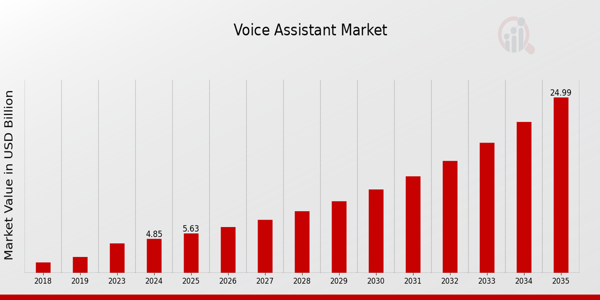
As per MRFR analysis, the Voice Assistant Market Size was estimated at 4.18 (USD Billion) in 2024. The Voice Assistant Market Industry is expected to grow from 4.85(USD Billion) in 2025 to 25 (USD Billion) by 2035. The Voice Assistant Market CAGR (growth rate) is expected to be around 16.08% during the forecast period (2025 - 2035).
Key Voice Assistant Market Trends Highlighted
The Voice Assistant Market is witnessing significant growth driven by increased consumer demand for smart home automation, enhanced user experience, and advancements in artificial intelligence technologies. Technological innovations have led to the development of more sophisticated voice recognition systems, enabling voice assistants to understand and respond to natural language more effectively. This enhancement in capabilities supports a wider range of applications in various sectors, including healthcare, automotive, and customer service, fostering widespread adoption.
Opportunities to be explored include the integration of voice assistants with emerging technologies like the Internet of Things (IoT) and machine learning, which may offer enhanced services like personalized recommendations and improved interaction. Businesses that can leverage these integrations can create unique user experiences, setting themselves apart in a competitive landscape. Additionally, as internet accessibility improves globally, particularly in developing regions, there is potential for voice assistants to penetrate new markets, catering to users with different languages and dialects. Recent trends indicate a growing focus on privacy and security as users become more conscious of data protection.
Developers are increasingly tasked with ensuring that voice assistants handle sensitive information securely and transparently. Furthermore, the increasing popularity of voice commerce reflects a shift in consumer shopping behavior, with more users preferring to make purchases through voice commands.This development signals significant potential for businesses to tap into new revenue streams through voice-activated transactions. The combined influence of these trends highlights a dynamic environment for the Voice Assistant Market as it adapts to technological advancements and changing consumer preferences.
Voice Assistant Market Drivers
Rising Adoption of Smart Home Devices
The Voice Assistant Market Industry is witnessing a significant surge driven by the increasing adoption of smart home devices. According to a report from the International Energy Agency, smart home technology penetration is expected to reach 25% of households globally by 2030. As more consumers embrace smart appliances and IoT (Internet of Things) integrations, the demand for voice assistants, which enable seamless control and automation, rises.Companies like Amazon and Google have been instrumental in this growth, with their voice-activated products like Amazon Alexa and Google Assistant becoming household names.
With the combined growth in voice-enabled smart devices and the projected increase in household adoption rates, the Voice Assistant Market Industry is poised for substantial expansion, responding to consumer demand for convenience and enhanced functionality in home automation.
Enhanced Natural Language Processing Capabilities
Advancements in Natural Language Processing (NLP) technologies play a crucial role in the growth of the Voice Assistant Market Industry. Research from the European Commission indicates that advancements in artificial intelligence algorithms, specifically for NLP, have improved voice recognition accuracy by over 95%, making voice assistants much more user-friendly. Major players such as Microsoft and IBM have focused heavily on enhancing their NLP capabilities through substantial investments in Research and Development, leading to improved voice assistant performance.The proliferation of superior NLP technologies enhances user experience and accelerates adoption rates across diverse sectors, including customer service and healthcare.
Growing Demand in the Healthcare Sector
The Voice Assistant Market Industry is also being driven by growing demand in the healthcare sector, where voice technology can streamline operations and enhance patient interaction. The World Health Organization indicates that telehealth services have surged by over 200% globally since 2020 due to the COVID-19 pandemic, creating a burgeoning need for voice interfaces to improve patient engagement and reduce operational burdens on healthcare professionals.
Companies such as Philips and Cerner are exploring voice assistant technologies for applications like medication reminders and patient inquiries, which facilitate better service delivery and operational efficiency. As healthcare organizations recognize the potential of voice assistants to alleviate pressure on staff and improve patient care, demand within the Voice Assistant Market Industry is expected to rise significantly.
Voice Assistant Market Segment Insights
Voice Assistant Market Application Insights
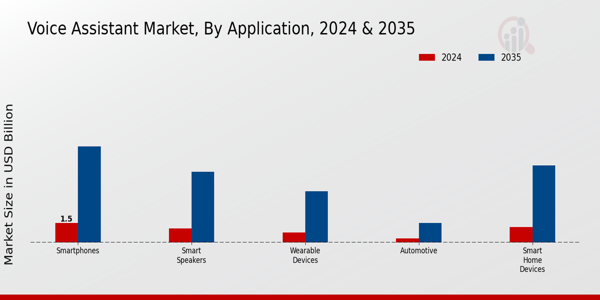
The Voice Assistant Market has exhibited notable growth, particularly in the Application segment, which encompasses various devices that leverage voice assistant technology. By 2024, the market valued at 4.85 USD Billion, indicating the increasing integration of voice assistants across multiple platforms. Within this segment, Smart Speakers stand out with a valuation of 1.1 USD Billion in 2024, expected to rise to 5.5 USD Billion by 2035. This growth is driven by their ability to deliver hands-free convenience and seamless smart home integration, making Smart Speakers a dominant force in the Voice Assistant Market revenue landscape.
Similarly, Smartphones, valued at 1.5 USD Billion in 2024, are projected to grow to 7.5 USD Billion by 2035, demonstrating their critical role as the primary interface for voice assistants, enabling users to perform numerous tasks through voice commands while on the go. Wearable Devices, although smaller in scale, are also carving out their niche with a valuation of 0.75 USD Billion in 2024, predicted to reach 4.0 USD Billion by 2035; this reflects a growing trend towards health-focused applications where voice assistants assist users in tracking fitness goals and managing schedules.
The Smart Home Devices category, valued at 1.2 USD Billion in 2024 with a forecast of 6.0 USD Billion by 2035, signifies a rising interest in home automation, allowing users to control their home environments effectively and enhance security and energy efficiency. Automotive applications currently hold a smaller market share, valued at 0.3 USD Billion in 2024 and projected to grow to 1.5 USD Billion by 2035; however, this sector represents a significant opportunity as voice technology enhances driver safety and convenience.
Overall, the segmentation in the Voice Assistant Market reveals varied applications that indicate substantial growth potential, driven by increasing consumer preference for hands-free and voice-activated technologies across multiple platforms.
Factors such as technological advancements, increasing adoption of smart home ecosystems, and demand for enhanced user experiences serve as major drivers propelling market growth in these applications, while challenges include privacy concerns and the need for improved reliability and user engagement. Insights from the Voice Assistant Market data showcase an upward trajectory, reflecting robust statistics in a rapidly evolving industry that promises to redefine interactions between people and technology.
Voice Assistant Market Technology Insights
The Voice Assistant Market is anticipated to reach a valuation within this expansive market, various technologies play pivotal roles in shaping user experiences. Natural Language Processing (NLP) is essential for enhancing communication between humans and machines, facilitating smooth interactions by enabling voice assistants to understand and process human languages effectively. Machine Learning (ML) significantly contributes by allowing voice assistants to learn from user interactions and improve their performance over time, thus offering personalized experiences.Speech Recognition technology empowers devices to accurately interpret and execute spoken commands, underscoring its importance in automating tasks and enhancing user convenience.
Text-to-speech systems then convert written text into spoken words, expanding accessibility and enabling users to engage with devices in varied settings.
Finally, Voice Recognition remains a cornerstone of user authentication and security, ensuring that interactions with voice assistants are safe and personalized. As digital transformation continues to reshape industries globally, the integration of these technologies is crucial for driving market growth and meeting increasing consumer expectations.The overall landscape is characterized by innovation and competition, setting the stage for substantial advancements in the coming years.
Voice Assistant Market Deployment Model Insights
The Deployment Model segment of the Voice Assistant Market encompasses both Cloud-Based and On-Premise solutions, which are crucial for enhancing user experience and improving operational efficiency across various industriesThe Cloud-Based deployment model dominates this segment due to its flexibility, scalability, and ease of integration, allowing businesses to leverage vast computing power without extensive hardware investments. Conversely, the On-Premise model caters to organizations with stringent data security requirements, providing them with complete control over their infrastructure and applications.
Both deployment methods play significant roles in shaping the Voice Assistant Market statistics, as they allow organizations to adopt voice assistant technologies tailored to their specific needs. The increasing adoption of smart devices, coupled with advancements in artificial intelligence and natural language processing, further propels the expansion of this segment, creating numerous opportunities for innovation and growth in the Voice Assistant Market industry. Nevertheless, challenges such as data privacy concerns and integration complexities may hinder market growth. Overall, the Deployment Model segment remains a vital area of focus within the Voice Assistant Market.
Voice Assistant Market Use Insights
Focusing on the End Use segment, this market can be categorized into Personal, Commercial, and Industrial applications, each showing unique importance. The Personal segment holds substantial relevance due to the rising adoption of smart home devices and personal assistants, enhancing user convenience and engagement. In the Commercial sector, businesses are leveraging voice assistants for improved customer service and operational efficiency, becoming an essential tool for modern enterprises. The Industrial application is gaining traction as organizations adopt voice technologies to streamline workflows and enhance productivity.
Collectively, these segments are driven by increasing consumer demand for seamless, hands-free experiences and advancements in Artificial Intelligence. Market growth is influenced by innovations in voice recognition technology and user interface design, creating opportunities for new applications across various industries. However, challenges such as privacy concerns and technological limitations need to be addressed to fully capitalize on the market potential. Overall, the Voice Assistant Market data showcases a dynamic landscape with substantial growth opportunities across its diverse end-use applications.
Voice Assistant Market Regional Insights
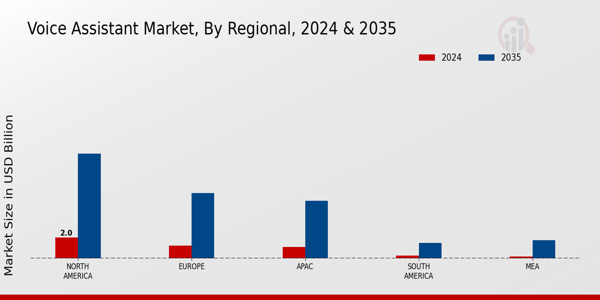
The Voice Assistant Market is experiencing notable growth across various regions, reflecting the increasing adoption of smart technologies. In 2024, North America holds a significant share with a market valuation of 2.0 USD Billion, expected to rise to 10.0 USD Billion by 2035, making it a dominant player in the Voice Assistant Market segmentation.
Meanwhile, Europe shows a strong position as well, with a value of 1.25 USD Billion in 2024, anticipated to grow to 6.25 USD Billion over the same period.
The APAC region, valued at 1.1 USD Billion in 2024 and projected to reach 5.5 USD Billion, is gaining traction due to rapid technological advancements and a youthful population embracing voice-activated solutions.In contrast, South America, with a valuation of 0.3 USD Billion, and the MEA region at 0.2 USD Billion in 2024, represent smaller but emerging segments, expected to grow to 1.5 USD Billion and 1.75 USD Billion respectively by 2035, driven by increasing connectivity and digitalization.
The significant market growth within these regions is attributed to factors such as rising consumer demand for automation, ease of use, and enhanced user experiences. As deploying voice assistant technology becomes integral to daily life, these regions collectively fuel the Voice Assistant Market revenue, highlighting varied growth opportunities and potential challenges in broadening market presence.
Voice Assistant Market Key Players and Competitive Insights
The Voice Assistant Market has witnessed rapid growth and innovation, reflecting the increasing adoption of artificial intelligence and natural language processing technologies across various sectors. As businesses and consumers alike gravitate towards enhanced user experiences, companies in this market are continually striving to deliver more sophisticated voice-activated solutions. Competitive insights reveal a landscape that is characterized by several key players who are actively working to differentiate their offerings, enhance functionality, and improve integration capabilities with other technologies.
Market participants are focusing on user engagement, recognition accuracy, and multilingual support while managing to create ecosystems that allow third-party developers to add more value through compatibility with voice-enabled devices.
Amazon stands out in the Voice Assistant Market due to its significant presence and the robust capabilities of its voice assistant technology. The company has successfully integrated its voice assistant within a wide array of smart devices, making it a household name. Amazon's strengths lie in its exceptional ability to leverage cloud technologies, facilitating the seamless functioning of voice-based services coupled with an extensive content library. Consumers benefit from various skills and functionalities offered through the platform, which creates a loyal user base.
Amazon’s strategic partnerships, voice recognition algorithms, and continuous improvements in machine learning contribute to its competitive edge, ensuring that it remains a front-runner in the global voice assistant landscape.
On the other hand, IBM's position in the Voice Assistant Market is marked by its diverse offerings that harness artificial intelligence to create innovative voice solutions. The company focuses on enhancing enterprise-level capabilities through products like Watson Assistant, which offers a comprehensive set of tools for developing conversational interfaces. IBM's strength lies in its robust infrastructure and analytics capabilities, enabling businesses to deploy customized solutions tailored to their specific needs. The company has also made strides in fostering collaborations through mergers and acquisitions to bolster its technology portfolio and improve market reach.
IBM's emphasis on security and compliance, alongside its commitment to innovation, allows it to cater to various industries globally, setting it apart in the competitive voice assistant landscape.
Key Companies in the Voice Assistant Market Include
- Amazon
- IBM
- Baidu
- Cortana
- Mycroft AI
- SoundHound
- Google
- Apple
- Nuance Communications
- Microsoft
- Samsung
- Facebook
- Alibaba
- Rasa
- Oracle
Voice Assistant Industry Developments
-
Q2 2024: Apple unveils new Siri with generative AI at WWDC 2024 Apple announced a major overhaul of its Siri voice assistant, integrating generative AI capabilities to enable more natural conversations and complex task handling, marking the company's most significant update to Siri since its launch.
-
Q2 2024: Amazon and BMW announce partnership to bring Alexa Custom Assistant to next-gen vehicles Amazon and BMW revealed a strategic partnership to integrate Amazon’s Alexa Custom Assistant into BMW’s upcoming vehicle lineup, allowing for a more personalized and branded in-car voice experience.
-
Q2 2024: Microsoft launches Copilot Voice for Windows 11 Microsoft introduced Copilot Voice, a new voice assistant feature for Windows 11, enabling users to control their PCs and access generative AI-powered assistance through natural language commands.
-
Q3 2024: Google launches Gemini-powered voice assistant for Android devices Google rolled out a new voice assistant for Android, powered by its Gemini AI model, offering enhanced conversational abilities and deeper integration with Google services.
-
Q2 2024: SoundHound AI raises $125 million in funding round led by Nvidia SoundHound AI, a leading voice AI platform, secured $125 million in new funding to accelerate development of its conversational voice assistant technology, with Nvidia as the lead investor.
-
Q3 2024: Samsung debuts Bixby 3.0 with on-device generative AI at Galaxy Unpacked Samsung introduced Bixby 3.0, featuring on-device generative AI for faster, more private voice interactions, during its Galaxy Unpacked event.
-
Q2 2024: Cerence wins $50 million contract to provide voice assistant tech for major automaker Cerence announced it has secured a $50 million contract to supply its automotive voice assistant platform to a leading global car manufacturer, expanding its presence in the connected vehicle market.
-
Q1 2025: OpenAI launches ChatGPT Voice for enterprise customers OpenAI released ChatGPT Voice, a voice-enabled version of its AI assistant, for enterprise clients, enabling businesses to deploy advanced conversational AI in customer service and productivity applications.
-
Q2 2025: Sonos acquires Snips to bolster on-device voice assistant capabilities Sonos completed the acquisition of Snips, a French voice AI startup, to enhance its on-device voice assistant technology and reduce reliance on cloud-based solutions.
-
Q2 2025: Nuance Communications partners with UnitedHealth Group to deploy voice AI in healthcare Nuance Communications announced a partnership with UnitedHealth Group to implement its voice AI assistant across UnitedHealth’s call centers, aiming to improve patient engagement and operational efficiency.
-
Q3 2025: Alibaba Cloud launches Tongyi Voice Assistant for enterprise clients Alibaba Cloud introduced Tongyi Voice Assistant, a new AI-powered voice platform designed for enterprise applications in China and Southeast Asia.
-
Q2 2025: Apple appoints new VP of AI to lead Siri and voice assistant strategy Apple named a new Vice President of AI, tasking them with overseeing the development and strategic direction of Siri and the company’s broader voice assistant initiatives.
Voice Assistant Market Segmentation Insights
-
Voice Assistant Market Application Outlook
- Smart Speakers
- Smartphones
- Wearable Devices
- Smart Home Devices
- Automotive
-
Voice Assistant Market Technology Outlook
- Natural Language Processing
- Machine Learning
- Speech Recognition
- Text-to-Speech
- Voice Recognition
-
Voice Assistant Market Deployment Model Outlook
-
Voice Assistant Market End Use Outlook
- Personal
- Commercial
- Industrial
-
Voice Assistant Market Regional Outlook
- North America
- Europe
- South America
- Asia Pacific
- Middle East and Africa
Sprachassistentenmarkt Marktzusammenfassung
Der Markt für Sprachassistenten wurde 2025 auf 8,10 Milliarden USD geschätzt und soll 2026 9,50 Milliarden USD erreichen, bis 2035 auf 31,82 Milliarden USD steigen, mit einer jährlichen Wachstumsrate (CAGR) von 14,4% von 2026 bis 2035. Zwei Katalysatoren stützen die Prognose.
Amazon hat den Übergang seiner installierten Basis von über 600 Millionen Alexa-Geräten zu einem generativen Assistenten eingeleitet, der für Nicht-Prime-Nutzer mit 19,99 USD pro Monat bepreist ist [1]. Darüber hinaus hat Indiens IndiaAI-Mission etwa 10.372 Crore INR für souveräne KI-Kapazitäten bereitgestellt, die lokale Sprachwerkzeuge umfassen [15].
Große Sprachmodellstacks, die den Kontext über Gesprächswechsel hinweg aufrechterhalten, externe Werkzeuge aufrufen und nahezu in Echtzeit reagieren, ersetzen regelbasierte Assistenten, die auf Skriptdialogbäumen und festen Absichten basieren. OpenAI's GPT-4o hat einen öffentlichen Benchmark mit einer durchschnittlichen Audio-Antwortzeit von etwa 320 Millisekunden etabliert [4]. Die Private Cloud Compute-Architektur von Apple hat die Fähigkeit demonstriert, sensible Anfragen zwischen dem Handgerät und gesicherten Servern zu teilen [3]. Unternehmenskäufer ersetzen derzeit IVR-Menüs und Keyword-Spotting-Systeme durch Assistenten, die Aufgaben lösen, anstatt Anrufe weiterzuleiten.
Hyperscaler-Plattformen, die Nachfrage nach Dokumentation im Gesundheitswesen und Kontaktzentren sind die Haupttreiber des Umsatzanteils von 38,6% in Nordamerika. Mehrsprachige Smartphone-Nutzer und staatliche KI-Programme in China, Indien und Südkorea sind die Hauptfaktoren, die das schnelle Wachstum des asiatisch-pazifischen Raums mit einer jährlichen Wachstumsrate (CAGR) von 16,9% antreiben. Das KI-Gesetz beeinflusst die Beschaffung in Europa, um prüfbare, datenschutzorientierte Implementierungen zu priorisieren, mit einem zweitgrößten Anteil von 25,8%. Der Wettbewerbsvorteil wird sich im nächsten Jahrzehnt von der Reichweite des Aktivierungsworts auf die Zuverlässigkeit verschieben, mit der ein Assistent mehrstufige Aufgaben abschließt.
Wichtige Erkenntnisse des Berichts
• Nach Komponenten
- Die Lösungen hielten 2025 einen Anteil von 57,6% am Markt für Sprachassistenten, was die Einnahmen aus Plattformlizenzen und SDK widerspiegelt.
- Die Dienstleistungen werden voraussichtlich mit einer CAGR von 16,2% wachsen, da Unternehmen das Design von Absichten, das Tuning und Compliance-Prüfungen auslagern.
• Nach Technologie
- Die Spracherkennung machte 2025 43,8% der Ausgaben aus, da jede Sprachpipeline mit der Audio-zu-Text-Umwandlung beginnt.
- Edge Computing wird voraussichtlich eine CAGR von 15,9% erreichen, da Aktivierungswörter und Routinebefehle auf die Gerätesilizium übergehen.
• Nach Bereitstellung
- Die Cloud-Bereitstellung erfasste einen Anteil von 55,9% aufgrund der Elastizität von Hyperscalern und schnellen Modellaktualisierungszyklen.
- Hybride Architekturen werden mit einer CAGR von 14,8% wachsen, da regulierte Sektoren sensible Audiodaten lokal halten.
• Nach Unternehmensgröße
- Große Unternehmen trugen einen Anteil von 64,2%, angeführt von Rollouts in Kontaktzentren und Mitarbeiterassistenten.
- Kleine und mittlere Unternehmen (KMU) werden voraussichtlich mit einer CAGR von 15,6% durch abonnementbasierte, codefreie Builder wachsen.
• Nach Endnutzungsvertikale
- IT und Telekommunikation repräsentierten einen Anteil von 20,8% am Markt für Sprachassistenten, der größte aller Vertikalen.
- Das Gesundheitswesen ist die am schnellsten wachsende Vertikale mit einer CAGR von 17,1%, unterstützt durch ambientale klinische Notizen.
- BFSI generierte 2025 1,26 Milliarden USD aus Voice Banking und Authentifizierungsanwendungen.
• Nach Region
- Nordamerika führt den Markt für Sprachassistenten mit einem Anteil von 38,6% an.
- Der asiatisch-pazifische Raum wird die höchste regionale CAGR von 16,9% verzeichnen.
- Europa belegt mit einem Anteil von 25,8% den zweiten Platz bei der beschaffungsorientierten Ausrichtung auf das KI-Gesetz.
Marktgröße und Prognose (2021–2035)
Market Research Future hat den Markt für Sprachassistenten durch einen Bottom-up-Aufbau der Einnahmen von Anbietern über Plattformen, Lizenzen, professionelle Dienstleistungen und verwaltete Dienstleistungen ermittelt, die top-down gegen Geräteauslieferungen, Unternehmens-IT-Budgets und Sitzplatzzahlen in Kontaktzentren validiert wurden. Historische Werte für 2021–2024 basieren auf Unternehmensberichten und offengelegten Vertragswerten, während Prognosen Szenariogewichte auf Adoption, Preisgestaltung und regulatorische Variablen anwenden.
Our Impact
Enabled $4.3B Revenue Impact for Fortune 500 and Leading Multinationals
Partnering with 2000+ Global Organizations Each Year
30K+ Citations by Top-Tier Firms in the Industry
Sprachassistentenmarkt Chancen
Lokale Sprachassistenten in Schwellenländern
Laut dem Bericht über Fakten und Zahlen der Internationalen Fernmeldeunion (ITU) erreichte die globale Internetkonnektivität 5,5 Milliarden Menschen, was 68 % der Weltbevölkerung entspricht. Dennoch bedienen große globale Plattformen weiterhin regionalen und volkstümlichen Sprachen unzureichend. Anbieter, die lokalisierte Modelle für wachstumsstarke Sprachen wie Hindi, Bahasa, Swahili und regionale arabische Dialekte trainieren, gewinnen frühzeitig neue Nutzer. Staatlich unterstützte Initiativen wie Indiens IndiaAI-Mission und Brasiliens nationale KI-Pläne gleichen die Kosten für die Korpusbildung und die Dateninfrastruktur erheblich aus.
Abonnement- und agentische Handelsmodelle
Bezahlte Assistentenstufen und Transaktionsgebühren eröffnen Einnahmequellen über Hardware hinaus. Alexa+ verknüpft Einkäufe, Buchungen und Dienstleister in einem Dialog [1] und schafft eine Vorlage für den Sprachhandel, in der Anbieter Empfehlungs- oder Transaktionsgebühren erhalten. Anonymisierte Interaktionsanalysen, die an Unternehmensklienten verkauft werden, bilden einen zweiten Einnahmefluss.
Ambient Clinical und Field-Service-Assistenten
Die Dokumentation im Gesundheitswesen und industrielle Außendienstleistungen erfordern domänenspezifische Sprachverarbeitungsschichten. Die Weltgesundheitsorganisation berichtet, dass mindestens 25 % der Gesundheits- und Pflegekräfte Symptome von beruflichem Burnout erleben, die stark durch administrative Aufzeichnungen bedingt sind. Anbieter trainieren Modelle im Voraus mit medizinischem und technischem Vokabular und halten dabei strenge Sicherheitsvorgaben ein – wie die HIPAA-Standards – und sichern sich mehrjährige Unternehmensverträge, während Krankenhäuser systematisch die klinische Notizenerfassung automatisieren.
Automotive Software-definierte Cockpits
Software-definierte Fahrzeuge ermöglichen Over-the-Air-Updates der Assistentenfunktionen, sodass OEMs nach dem Kauf Funktionsabonnements verkaufen können. Anbieter, die Navigation, Fahrzeugsteuerung und Drittanbieter-Apps in einer Sprachschicht bündeln, können wiederkehrende Lizenzgebühren über Flotten hinweg einnehmen.
Edge-First-Assistenten für regulierte Unternehmen
Rohdatenübertragungen zu externen öffentlichen Clouds sind aufgrund strenger Compliance-Hindernisse für regulierte Institutionen, wie kommerzielle Banken, Verteidigungsbehörden und fortschrittliche Fertigungsanlagen, verboten. Unternehmensanbieter können jetzt sichere sprachgesteuerte Automatisierungstools direkt in luftdicht abgeschotteten, hochsicheren lokalen Umgebungen bereitstellen, dank Fortschritten in der neuronalen Verarbeitung auf Geräten, wie Chipsätzen, die die lokale Ausführung kompakter Sprachmodelle mit bis zu 10 Milliarden Parametern unterstützen.
Sprachassistentenmarkt Marktberichtsumfang
| MARKTGRÖSSE 2024 |
4,85 (Milliarden USD) |
| MARKTGRÖSSE 2025 |
5,63 (Milliarden USD) |
| MARKTGRÖSSE 2035 |
25,01 (Milliarden USD) |
| JÄHRLICHE WACHSTUMSRATE (CAGR) |
16,08 % (2025 - 2035) |
| BERICHTSABDECKUNG |
Umsatzprognose, Wettbewerbslandschaft, Wachstumsfaktoren und Trends |
| BASISJAHR |
2024 |
| Marktprognosezeitraum |
2025 - 2035 |
| Historische Daten |
2019 - 2024 |
| Marktprognoseeinheiten |
Milliarden USD |
| Wichtige Unternehmen profiliert |
Amazon (US), Google (US), Apple (US), Microsoft (US), Samsung (KR), Baidu (CN), Alibaba (CN), Sonos (US), Facebook (US), Xiaomi (CN) |
| Abgedeckte Segmente |
Anwendung, Technologie, Bereitstellungsmodell, Endnutzung, regional |
| Wichtige Marktchancen |
Integration von künstlicher Intelligenz verbessert die Personalisierung im Sprachassistentenmarkt. |
| Wichtige Marktdynamiken |
Steigende Verbrauchernachfrage nach nahtloser Integration treibt Innovation und Wettbewerb im Sprachassistentenmarkt voran. |
| Abgedeckte Länder |
Nordamerika, Europa, APAC, Südamerika, MEA |
Markt-Highlights
FAQs
Der Markt für Sprachassistenten wird im Jahr 2024 auf etwa 4,85 Milliarden USD geschätzt, und es wird erwartet, dass er in den kommenden Jahren erheblich wachsen wird.
Der Markt wird voraussichtlich bis 2035 etwa 25,01 Milliarden USD erreichen, was auf ein erhebliches Wachstum hinweist.
Die erwartete CAGR für den Markt für Sprachassistenten im Prognosezeitraum 2025 - 2035 beträgt 16,08 %.
Zu den Hauptakteuren im Markt für Sprachassistenten gehören Amazon, Google, Apple, Microsoft, Samsung, Baidu, Alibaba, Sonos, Facebook und Xiaomi.
Die wichtigsten Anwendungssegmente umfassen Smart Speaker, Smartphones, tragbare Geräte, Smart Home-Geräte und Automotive, mit Bewertungen von 0,5 bis 7,5 Milliarden USD.
Das Technologiesegment, das natürliche Sprachverarbeitung, maschinelles Lernen, Spracherkennung, Text-to-Speech und Sprachidentifikation umfasst, zeigt Bewertungen von 0,8 bis 6,0 Milliarden USD.
Der Markt für Sprachassistenten verwendet Cloud-basierte und lokale Bereitstellungsmodelle, wobei erwartet wird, dass Cloud-basierte bis 2035 15,0 Milliarden USD erreichen.
Die Endnutzungssegmente umfassen persönliche, kommerzielle und industrielle Anwendungen, mit Bewertungen von 1,3 bis 10,25 Milliarden USD.
Smart Speaker haben eine Bewertungssteigerung von 1,5 Milliarden USD im Jahr 2024 auf voraussichtlich 7,5 Milliarden USD bis 2035 gezeigt.
Trends wie Fortschritte in der KI, zunehmende Akzeptanz von Smart Devices und wachsende Verbrauchernachfrage nach Automatisierung treiben voraussichtlich das Wachstum des Marktes voran.
Autor
Autor
A consulting professional focused on helping businesses navigate complex markets through structured research and strategic insights.
I partner with clients to solve high-impact business problems across market entry strategy, competitive intelligence, and opportunity assessment. Over the course of my experience, I have led and contributed to 100+ market research and consulting engagements, delivering insights across multiple industries and geographies, and supporting strategic decisions linked to $500M+ market opportunities.
My core expertise lies in building robust market sizing, forecasting, and commercial models (top-down and bottom-up), alongside deep-dive competitive and industry analysis. I have played a key role in shaping go-to-market strategies, investment cases, and growth roadmaps, enabling clients to make confident, data-backed decisions in dynamic markets.
read more





 Noah Malgeri
Co-Founder

 Peter Groot koerkamp
Account and Business Manager

 Younghwan Choi
Senior Retail Manager

 Mark Irwin
Management Consultant

 Akif Moroglu
Strategy & Business Development Director

 Guilherme Gomes Martins
Product Management Director

 Joseph Aguayo
Sales Operations & Pricing Manager

 La Terria Dodd
Program Support Specialist

 Rob Kooiker
Group Product Manager HVAC & Fire Protection GMA