Virtual Kitchen Market 摘要
主要市场趋势和亮点
市场规模与预测
| CAGR (2025 - 2035) | 10.95% |
| CAGR (2025 - 2035) | 10.95% |
The Virtual Kitchen Market is currently experiencing a transformative phase, driven by evolving consumer preferences and technological advancements. As dining habits shift towards convenience and efficiency, the demand for virtual kitchens, which operate without a traditional storefront, appears to be on the rise. This model allows food businesses to optimize their operations by focusing solely on food preparation and delivery, thereby reducing overhead costs associated with physical locations. Moreover, the integration of advanced technologies, such as artificial intelligence and data analytics, seems to enhance operational efficiency and customer engagement, further propelling market growth. In addition, the increasing popularity of food delivery services is reshaping the landscape of the Virtual Kitchen Market. Consumers are increasingly seeking diverse culinary options that can be accessed from the comfort of their homes. This trend suggests that virtual kitchens are not merely a temporary solution but rather a sustainable model that could redefine the future of food service. As the market continues to evolve, stakeholders must remain agile and responsive to changing consumer demands and technological innovations to capitalize on emerging opportunities.
The emergence of delivery-only kitchen models is reshaping the food service industry. These establishments focus exclusively on preparing meals for delivery, eliminating the need for dine-in facilities. This trend allows businesses to cater to a broader audience while minimizing operational costs.
The incorporation of technology in virtual kitchens is becoming increasingly prevalent. From advanced kitchen equipment to sophisticated order management systems, technology enhances efficiency and streamlines operations, enabling businesses to respond swiftly to consumer demands.
Sustainability is gaining traction within the Virtual Kitchen Market. Many operators are adopting eco-friendly practices, such as sourcing local ingredients and minimizing food waste, to appeal to environmentally conscious consumers. This trend indicates a shift towards more responsible food service operations.
The expansion of delivery services is a crucial driver for the Virtual Kitchen Market. As consumers increasingly prefer dining at home, the demand for efficient and reliable food delivery options has surged. Partnerships with third-party delivery platforms have become commonplace, allowing virtual kitchens to reach a wider audience without the need for extensive marketing. This trend is supported by data indicating that food delivery services have grown by over 25% in recent years. The convenience of having meals delivered directly to consumers' doorsteps enhances the appeal of virtual kitchens, positioning them as a viable alternative to traditional dining experiences. As delivery services continue to expand, the Virtual Kitchen Market is likely to see sustained growth and innovation.
In the virtual kitchen market, hardware remains the dominant segment, particularly in the form of appliances that integrate with smart technologies. These appliances, ranging from smart ovens to connected refrigerators, are designed to streamline the cooking process and offer enhanced functionalities. Their reliability and physical presence are crucial for consumers, establishing strong brand loyalty and continuous demand. In contrast, software applications are becoming an emerging component, providing users with innovative solutions for meal planning, recipe management, and cooking assistance. These applications not only enhance user experience by offering personalized culinary experiences but also promote energy efficiency and better kitchen management. As the market evolves, the interplay between hardware and software will shape the future landscape of virtual kitchens.
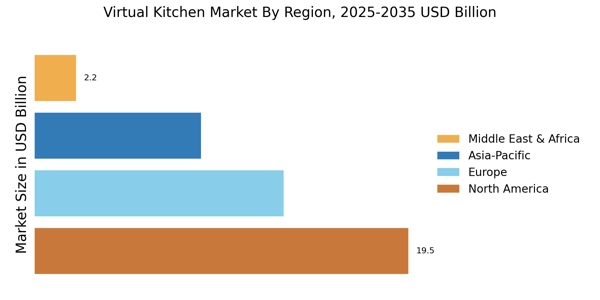
North America leads the virtual kitchen market, holding approximately 45% of the global share, driven by increasing demand for food delivery services and the rise of online ordering. Regulatory support for food safety and delivery logistics further catalyzes growth. The U.S. is the largest market, followed closely by Canada, which contributes around 15% to the market share. The region's tech-savvy population and urbanization trends are significant growth drivers. The competitive landscape is robust, featuring key players like CloudKitchens, Kitchen United, and Ghost Kitchen Brands. These companies leverage technology to optimize operations and enhance customer experience. The presence of established food delivery platforms and a growing number of startups in the sector fosters innovation. As consumer preferences shift towards convenience, the market is expected to expand further, with North America remaining at the forefront of virtual kitchen developments.
Europe is witnessing a rapid expansion in the virtual kitchen market, accounting for approximately 30% of the global share. The growth is fueled by changing consumer habits, increased demand for delivery services, and supportive regulations promoting food safety and innovation. The UK and Germany are the largest markets, with the UK holding about 12% of the market share, driven by a strong food delivery culture and urban population density. Leading countries in Europe are embracing the virtual kitchen model, with players like Tribe Kitchen and Keatz making significant inroads. The competitive landscape is characterized by a mix of established brands and new entrants, all vying for market share. The region's focus on sustainability and quality food options is shaping the offerings in the virtual kitchen space, making it a dynamic and competitive environment.
Asia-Pacific is emerging as a powerhouse in the virtual kitchen market, holding around 20% of the global share. The region's growth is driven by urbanization, increasing disposable incomes, and a burgeoning food delivery culture. India and China are the largest markets, with India contributing approximately 10% to the market share, fueled by a young population and rising smartphone penetration, which enhances online ordering capabilities. The competitive landscape is vibrant, with key players like Rebel Foods and Zomato leading the charge. The presence of numerous startups and local brands is fostering innovation and competition. As consumer preferences shift towards convenience and variety, the virtual kitchen model is gaining traction, making Asia-Pacific a critical region for future growth in this sector.
The Middle East and Africa region is gradually embracing the virtual kitchen concept, currently holding about 5% of the global market share. The growth is driven by increasing urbanization, a young population, and a rising demand for food delivery services. Countries like the UAE and South Africa are leading the charge, with the UAE accounting for approximately 3% of the market share, supported by a strong tourism sector and a diverse culinary landscape. The competitive landscape is evolving, with local players and international brands entering the market. The presence of key players is still developing, but the potential for growth is significant. As the region's infrastructure improves and consumer preferences shift towards convenience, the virtual kitchen market is expected to expand, presenting numerous opportunities for investment and innovation.
The Virtual Kitchen Market is currently characterized by a dynamic competitive landscape, driven by the increasing demand for food delivery services and the growing trend of online ordering. Key players such as CloudKitchens (US), Rebel Foods (IN), and Kitchen United (US) are strategically positioning themselves to capitalize on these trends. CloudKitchens (US) focuses on leveraging technology to optimize kitchen operations and enhance delivery efficiency, while Rebel Foods (IN) emphasizes a diverse brand portfolio to cater to various consumer preferences. Kitchen United (US) adopts a hybrid model that combines physical kitchen spaces with digital ordering platforms, thereby enhancing customer accessibility and operational flexibility. Collectively, these strategies contribute to a competitive environment that is increasingly reliant on technological innovation and consumer-centric approaches.In terms of business tactics, companies in the Virtual Kitchen Market are increasingly localizing their operations to better serve regional tastes and preferences. This localization, coupled with supply chain optimization, allows for more efficient service delivery and reduced operational costs. The market structure appears moderately fragmented, with numerous players vying for market share, yet the influence of major companies is palpable. Their collective strategies not only shape market dynamics but also set benchmarks for emerging players.
In September CloudKitchens (US) announced a partnership with a leading logistics provider to enhance its delivery capabilities. This strategic move is likely to streamline operations and improve customer satisfaction by ensuring faster delivery times. Such partnerships may also enable CloudKitchens to expand its reach into new markets, thereby solidifying its competitive position.
In August Rebel Foods (IN) launched a new brand focused on health-conscious meals, responding to the growing consumer demand for healthier food options. This initiative not only diversifies Rebel Foods' offerings but also aligns with current health trends, potentially attracting a new customer segment. The strategic importance of this move lies in its ability to differentiate Rebel Foods in a crowded market, thereby enhancing brand loyalty and customer retention.
In July Kitchen United (US) expanded its operations by opening new kitchen facilities in key urban areas. This expansion is indicative of Kitchen United's strategy to increase its footprint in high-demand locations, thereby improving service delivery and operational efficiency. The significance of this expansion is underscored by the potential for increased revenue streams and enhanced market presence in competitive urban environments.
As of October the Virtual Kitchen Market is witnessing trends such as digitalization, sustainability, and the integration of artificial intelligence in operations. These trends are reshaping competitive dynamics, with companies increasingly forming strategic alliances to enhance their technological capabilities and operational efficiencies. The shift from price-based competition to a focus on innovation, technology, and supply chain reliability is becoming evident. As the market evolves, differentiation through unique offerings and advanced operational strategies will likely define future competitive success.






Q3 2026: Zomato (IN): Zomato expanded its Plastic-Free Future initiative through PackSwitch, noting that participating restaurants had delivered more than 100 million low-plastic-packaging orders by March 31, 2026, supporting sustainability in delivery-focused food operations.
Q2 2026: Zomato (IN): Zomato open-sourced Pulse-MQTT, an Android library running across its Delivery Partner, Consumer, and Hyperpure apps, improving reliable real-time communication for mobile food-order tracking and delivery operations.
March 2023: - Kitchens@ Acquires Swiggy's Cloud Kitchen Arm 'Swiggy Access'. Swiggy sold its business at an undisclosed amount with all equity deal.
February 2022 - Curefoods Pvt Ltd, a cloud kitchen startup floated by Cure.fit, which houses brands like EatFit, CakeZone, and Aligarh House, bought Accel-backed Maverix Platforms Pvt Ltd, which runs ready-to-cook food brand Fingerlix, for an undisclosed amount.
虚拟厨房市场预计将在2025年至2035年期间以10.95%的年均增长率增长,推动因素包括对配送服务的需求增加和技术进步。
到2035年,市场预计将强劲,反映出显著的增长和创新。
| MARKET SIZE 2024 | 43.38(USD Billion) |
| MARKET SIZE 2025 | 48.13(USD Billion) |
| MARKET SIZE 2035 | 136.05(USD Billion) |
| COMPOUND ANNUAL GROWTH RATE (CAGR) | 10.95% (2025 - 2035) |
| REPORT COVERAGE | Revenue Forecast, Competitive Landscape, Growth Factors, and Trends |
| BASE YEAR | 2024 |
| Market Forecast Period | 2025 - 2035 |
| Historical Data | 2019 - 2024 |
| Market Forecast Units | USD Billion |
| Key Companies Profiled | CloudKitchens (US), Rebel Foods (IN), Kitchen United (US), Ghost Kitchen Brands (CA), Tribe Kitchen (GB), Virtual Kitchen Co. (US), Keatz (DE), Zomato (IN) |
| Segments Covered | Component Type, Region |
| Key Market Opportunities | Integration of advanced technology enhances efficiency and consumer engagement in the Virtual Kitchen Market. |
| Key Market Dynamics | Rising consumer demand for convenience drives innovation and competition in the Virtual Kitchen Market. |
| Countries Covered | North America, Europe, APAC, South America, MEA |
虚拟厨房市场在2024年的估值为433.8亿美元。
预计到2035年,市场将达到1360.5亿美元。
2025年至2035年期间,虚拟厨房市场的预期年均增长率为10.95%。
关键参与者包括CloudKitchens、Rebel Foods、Kitchen United、Ghost Kitchen Brands、Tribe Kitchen、Virtual Kitchen Co.、Keatz和Zomato。
主要组成部分是硬件、软件和服务,估值范围从100亿美元到610.5亿美元。
市场按最终用户类型细分为商业空间、住宅和酒店,估值范围从100亿美元到600.5亿美元。
虚拟厨房市场中硬件的估值范围从100亿美元到300亿美元。
虚拟厨房市场中软件的估值范围从150亿美元到450亿美元。
虚拟厨房市场中服务的估值范围从183.8亿美元到610.5亿美元。
增长前景看起来强劲,预计到2035年将增加到1360.5亿美元。
 Apoorva Priyadarshi

 Shubham Munde
Research Methodology on Virtual Kitchen Market
The research strategy adopted by this study is based on a qualitative and quantitative methodology. This study adopts the inductive approach which is the basic form of research methodology used to investigate a complicated phenomenon or problem. The initial phase of the research process involves getting to the root cause of the problem and understanding the challenges and complexities associated with it. Through a mix of secondary research and primary research, relevant data and information are collated to identify the virtual kitchen market trends, challenges, drivers, and players.
Secondary Research
Detailed secondary research is conducted to identify and collect information for this study. The secondary sources that are referred to include professional and technical journals, annual reports, white papers, government publications, virtual kitchen market reports, press releases, industry publications, select corporate filings, and various other databases.
The virtual kitchen market data and information gathered through secondary research were validated by carrying out primary research. Various industry experts were contacted and their opinions were sought to provide an unbiased and accurate market outlook. The expert Interviews provided valuable insights into the key market trends and strategies being undertaken by the virtual kitchen players.
Primary Research
Primary research includes conversations with a variety of industry stakeholders, subject matter experts, and consultants. The primary research process is conducted during multiple stages/phases – problem identification and a fact-finding mission, collection of data, understanding the virtual kitchen market dynamics and associated trends, and gathering opinions for market forecast. The primary research process also involves collecting information from a variety of industry databases, journals, whitepapers, and industry portals. Qualitative and quantitative research analyses are done based on this information.
Data Collection
Data is collected from various sources such as primary customer surveys and interviews, industry experts, relevant documents and electronic databases. The collected data and information was verified and validated in order to ensure accuracy and reliability.
Data Analysis
The collected data is analyzed to identify the virtual kitchen market trends and forces. To understand the market share, size, and penetration, an array of statistical and graphical tools were used. Prescriptive and predictive analytics were used to analyze the current and future prospects of the virtual kitchen market.
Forecasting
Forecasting is done based on the collected data from both primary and secondary sources. Various forecasting tools such as time series analysis, scenario analysis and trend analysis were used to estimate the market size. The forecasts rendered were then validated by industry experts and stakeholders.
请填写以下表格以获取本报告的免费样本


“This is really good guys. Excellent work on a tight deadline. I will continue to use you going forward and recommend you to others. Nice job”
 Noah Malgeri
Co-Founder

“Thanks for sending the report it gives us a good global view of the Betaïne market.”
 Peter Groot koerkamp
Account and Business Manager

“We found the report very insightful! we found your research firm very helpful. I'm sending this email to secure our future business.”
 Younghwan Choi
Senior Retail Manager

“I am very pleased with how market segments have been defined in a relevant way for my purposes (such as "Portable Freezers & refrigerators" and "last-mile"). In general the report is well structured. Thanks very much for your efforts.”
 Mark Irwin
Management Consultant

“We got the report in time, we really thank you for your support in this process. I also thank to all of your team as they did a great job.”
 Akif Moroglu
Strategy & Business Development Director

“The Automotive 48V ECU Components Procurement Intelligence Study” was a complex project, but the Market Research Future (MRFR) team handled it with quality, agility, and customer-centricity. They delivered all requested data on time and within the agreed scope. The team, including Shubhendra Anand and Rahul Gotadki, was always readily available to clarify questions and swiftly implement necessary adjustments, driving the project to a successful conclusion within a very demanding timeframe.
I would also like to specifically commend Akshay Agarwal for his responsiveness and support at every stage—from our initial inquiry on May 6th through to final delivery on June 18th. His dedication made the entire process seamless.”
 Guilherme Gomes Martins
Product Management Director

“Thanks. It’s been a pleasure working with you, please use me as reference with any other Intel employees.”
 Joseph Aguayo
Sales Operations & Pricing Manager

“Thank you, this will be very helpful for OQS.”
 La Terria Dodd
Program Support Specialist

“I have been reading the first document or the study, ,the Global HVAC and FP market report 2021 till 2026. Must say, good info! I have not gone in depth at all parts, but got a good indication of the data inside!”
 Rob Kooiker
Group Product Manager HVAC & Fire Protection GMA


