Request Free Sample ×

Kindly complete the form below to receive a free sample of this Report

* Please use a valid business email

Leading companies partner with us for data-driven Insights

clients tt-cursor
Hero Background

Ink Resins Market

ID: MRFR/CnM/3657-HCR
111 Pages
Chitranshi Jaiswal
March 2026

Ink Resins Market Research Report Information by Type (Modified Resin, Acrylic, Cellulose, Polyamide, Polyurethane, Hydrocarbon, and Others), by Printing Process (Lithographic, Flexographic, Gravure, Letterpress, and Digital), by Application (Printing & Publication, Corrugated Boards, Flexible Packaging, and Others), And By Region (North America, Europe, Asia-Pacific, And Rest Of The World) –Market Forecast Till 2035

Share:
Download PDF ×

We do not share your information with anyone. However, we may send you emails based on your report interest from time to time. You may contact us at any time to opt-out.

Ink Resins Market Infographic
Purchase Options
⚠ CRITICAL SUPPLY CHAIN & PRICE VOLATILITY ALERT
Middle East Conflict Disrupts Chemical Feedstock Flows & Triggers Price Volatility Across Naphtha, LPG, Natural Gas Derivatives, Steel Feedstocks & Fertilizers — 20% of Global LNG Exports at Risk, Supply Chains Rerouting | Get Real-Time Impact Analysis, Pricing Scenarios & Alternative Sourcing Strategies

Ink Resins Market Summary

As per Market Research Future analysis, the Ink Resins Market Size was estimated at 3.8 USD Billion in 2024. The Ink Resins industry is projected to grow from USD 3.941 Billion in 2025 to USD 5.674 Billion by 2035, exhibiting a compound annual growth rate (CAGR) of 3.71% during the forecast period 2025 - 2035

Key Market Trends & Highlights

The Ink Resins Market is poised for growth driven by sustainability and technological advancements.

  • The market is increasingly influenced by sustainability initiatives, reflecting a broader environmental consciousness.
  • Technological innovations are enhancing the performance and application of ink resins, particularly in digital printing.
  • North America remains the largest market, while Asia-Pacific is emerging as the fastest-growing region in this sector.
  • The growth in the packaging sector and rising demand for digital printing are key drivers propelling market expansion.

Market Size & Forecast

2024 Market Size 3.8 (USD Billion)
2035 Market Size 5.674 (USD Billion)
CAGR (2025 - 2035) 3.71%

Major Players

BASF SE (DE), Evonik Industries AG (DE), Mitsubishi Chemical Corporation (JP), Dow Inc. (US), Hexion Inc. (US), SABIC (SA), Kraton Corporation (US), Eastman Chemical Company (US), Royal DSM (NL)
Our Impact
Enabled $4.3B Revenue Impact for Fortune 500 and Leading Multinationals
Partnering with 2000+ Global Organizations Each Year
30K+ Citations by Top-Tier Firms in the Industry

Ink Resins Market Trends

The Ink Resins Market is currently experiencing a dynamic evolution, driven by various factors that influence demand and supply. The increasing adoption of eco-friendly inks and coatings is reshaping the landscape, as manufacturers seek sustainable alternatives to traditional materials. This shift not only aligns with global environmental initiatives but also caters to the growing consumer preference for greener products. Furthermore, advancements in technology are enhancing the performance characteristics of ink resins, leading to improved adhesion, durability, and color vibrancy. As a result, the market is witnessing a surge in innovation, with companies investing in research and development to create high-performance resins that meet diverse application needs. In addition to sustainability and technological advancements, the Ink Resins Market is also influenced by the expansion of the packaging industry. The demand for high-quality printing in packaging applications is on the rise, prompting manufacturers to explore new resin formulations that can withstand various environmental conditions. This trend indicates a potential for growth, as businesses strive to enhance their product offerings and meet consumer expectations. Overall, the Ink Resins Market appears poised for continued development, with a focus on sustainability, innovation, and adaptability to changing market dynamics.

Sustainability Focus

The Ink Resins Market is increasingly prioritizing sustainable practices, as manufacturers seek to reduce their environmental footprint. This trend is evident in the growing demand for bio-based and recyclable resins, which align with global sustainability goals. Companies are investing in eco-friendly formulations that not only meet regulatory standards but also appeal to environmentally conscious consumers.

Technological Advancements

Innovations in technology are significantly impacting the Ink Resins Market, leading to the development of high-performance resins. Enhanced properties such as improved adhesion, durability, and color vibrancy are becoming essential for various applications. This trend suggests that ongoing research and development efforts will continue to drive market growth and product differentiation.

Packaging Industry Expansion

The expansion of the packaging sector is a key driver for the Ink Resins Market, as demand for high-quality printing solutions increases. Manufacturers are exploring new resin formulations to meet the specific requirements of packaging applications, which often involve exposure to diverse environmental conditions. This trend indicates a robust potential for growth within the market.

Ink Resins Market Drivers

Technological Innovations

Technological innovations play a pivotal role in shaping the Ink Resins Market. Advancements in formulation technologies have led to the development of high-performance resins that enhance print quality and durability. For instance, the introduction of water-based and UV-curable resins has transformed the market landscape. In 2025, the market for UV-curable ink resins is expected to account for over 30% of total sales, driven by their rapid curing capabilities and reduced environmental impact. These innovations not only improve product performance but also cater to the evolving needs of end-users, thereby propelling the Ink Resins Market forward.

Growth in Packaging Sector

The Ink Resins Market is significantly bolstered by the expansion of the packaging sector. As consumer preferences shift towards attractive and functional packaging, the demand for high-quality inks and resins surges. In 2025, the packaging segment is anticipated to represent nearly 50% of the total ink resins market share. This growth is fueled by the increasing use of flexible packaging materials, which require specialized ink formulations. Consequently, manufacturers are focusing on developing resins that offer superior adhesion and printability, thereby enhancing the overall quality of packaging solutions in the Ink Resins Market.

Sustainability Initiatives

The Ink Resins Market is increasingly influenced by sustainability initiatives. As environmental concerns rise, manufacturers are compelled to adopt eco-friendly practices. This shift is evident in the growing demand for bio-based and recyclable ink resins. In 2025, the market for sustainable ink resins is projected to reach approximately 1.5 billion USD, reflecting a compound annual growth rate of around 8%. Companies are investing in research and development to create resins that minimize environmental impact while maintaining performance. This trend not only aligns with consumer preferences but also meets regulatory requirements, thereby driving growth in the Ink Resins Market.

Rising Demand for Digital Printing

The Ink Resins Market is experiencing a notable shift towards digital printing technologies. As businesses seek faster and more efficient printing solutions, the demand for digital inks and resins is on the rise. In 2025, the digital printing segment is projected to grow at a rate of 10%, driven by advancements in printing technology and the need for customization. This trend encourages manufacturers to innovate and develop specialized resins that cater to digital applications, thereby expanding their product offerings. The increasing adoption of digital printing is likely to reshape the Ink Resins Market, presenting new opportunities for growth.

Regulatory Compliance and Standards

Regulatory compliance and standards are becoming increasingly critical in the Ink Resins Market. Governments worldwide are implementing stringent regulations regarding the use of hazardous materials in inks and coatings. This has prompted manufacturers to reformulate their products to meet safety and environmental standards. In 2025, it is estimated that compliance-related costs will account for approximately 15% of total production expenses in the ink resins sector. As a result, companies are investing in cleaner technologies and alternative materials, which not only ensure compliance but also enhance their market competitiveness. This focus on regulatory adherence is likely to drive innovation and growth within the Ink Resins Market.

Market Segment Insights

By Type: Acrylic (Largest) vs. Polyamide (Fastest-Growing)

In the Ink Resins Market, the segment distribution shows that Acrylic resins hold the largest market share due to their versatility and wide range of applications in the ink industry. Modified Resins and Polyamide also represent significant portions, catering to specific demands in printing technologies. Cellulose and Polyurethane resins are gaining traction, while Hydrocarbon and Others segment continue to serve niche market needs.

Acrylic (Dominant) vs. Polyamide (Emerging)

Acrylic resins are known for their strong performance in terms of adhesion and clarity, making them the dominant choice for a variety of inks, particularly in digital and water-based printing. Their proven reliability and compatibility with various substrates contribute to their large market share. Conversely, Polyamide resins are emerging as a fast-growing segment due to their exceptional heat resistance and durability. This makes them suitable for high-performance applications where longevity is crucial. As technology advances, both segment values are likely to further influence trends in the ink resins market.

By Printing Process: Lithographic (Largest) vs. Digital (Fastest-Growing)

In the Ink Resins Market, lithographic printing processes hold the largest market share, favored for their efficiency and quality. Following closely behind are flexographic and gravure processes, which cater to packaging and label printing applications. Digital printing is rapidly gaining traction, although it represents a smaller portion of the overall market. These segments reflect a dynamic landscape in which traditional methods are challenged by evolving technological advancements. Growth trends in the Ink Resins Market are primarily fueled by increasing demand for high-quality printing in various industries such as packaging, publishing, and advertising. Additionally, the shift towards eco-friendly and sustainable inks is driving innovation in resin formulations, particularly within the digital printing segment, which is expected to see the fastest growth owing to the rise in online printing services and customization trends.

Lithographic (Dominant) vs. Digital (Emerging)

Lithographic printing is established as the dominant printing process in the Ink Resins Market due to its superior print quality and cost-effectiveness for high-volume runs. This method leverages a fixed image plate, ensuring consistency and speed, making it ideal for commercial printing applications. Conversely, digital printing represents an emerging process that is rapidly gaining ground due to its flexibility, ability to print on demand, and reduced waste. The rise of e-commerce and personalized printing jobs have significantly increased the adoption of digital technologies, positioning it as an innovative alternative that appeals to modern consumer needs. As both segments evolve, they showcase distinct advantages that cater to different market demands.

By Applications: Printing & Publication (Largest) vs. Flexible Packaging (Fastest-Growing)

The Ink Resins Market is significantly influenced by diverse applications, with Printing & Publication commanding the largest share. This segment consists of various printing applications ranging from newspapers to packaging designs, making it integral to the ink resins value chain. On the other hand, Flexible Packaging is witnessing substantial growth. As consumer demand for convenience and sustainability rises, flexible packaging solutions are increasingly favored for their versatility and print quality, reflecting the shifting market dynamics.

Printing & Publication (Dominant) vs. Flexible Packaging (Emerging)

The Printing & Publication segment remains dominant within the Ink Resins Market due to established applications in traditional printing. This segment is characterized by a variety of ink types, which offer a broad spectrum of color and durability, appealing to industries like publishing and promotional materials. Conversely, Flexible Packaging is an emerging player, rapidly gaining traction among manufacturers looking for innovative packaging solutions. This segment focuses on lightweight materials that reduce resource consumption while enhancing brand visibility through vibrant printing capabilities. The ongoing evolution in materials and processes within this space is driving its attractiveness to both consumers and businesses.

Get more detailed insights about Ink Resins Market

Regional Insights

North America : Innovation and Demand Surge

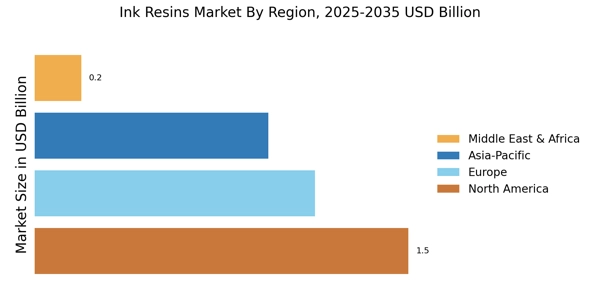
North America is the largest market for ink resins, holding approximately 40% of the global share. The region's growth is driven by increasing demand from the packaging and printing industries, alongside stringent environmental regulations promoting sustainable materials. The shift towards eco-friendly inks is a significant catalyst, supported by government initiatives aimed at reducing VOC emissions. The United States and Canada are the leading countries in this market, with major players like Dow Inc. and Eastman Chemical Company dominating the landscape. The competitive environment is characterized by innovation and strategic partnerships, as companies invest in R&D to develop advanced resin formulations that meet evolving consumer preferences and regulatory standards.

Europe : Sustainability and Innovation Focus

Europe is the second-largest market for ink resins, accounting for about 30% of the global market share. The region's growth is significantly influenced by stringent regulations aimed at reducing environmental impact, such as the REACH regulation. This regulatory framework encourages the development of sustainable ink solutions, driving demand for bio-based and low-VOC resins in the printing and packaging sectors. Germany, France, and the UK are the leading countries in this market, with key players like BASF SE and Evonik Industries AG at the forefront. The competitive landscape is marked by a strong emphasis on innovation, as companies strive to meet regulatory requirements while catering to the growing consumer demand for eco-friendly products. This focus on sustainability is reshaping the market dynamics in Europe.

Asia-Pacific : Emerging Market Potential

Asia-Pacific is witnessing rapid growth in the ink resins market, holding approximately 25% of the global share. The region's expansion is driven by increasing industrialization, urbanization, and a booming packaging sector, particularly in countries like China and India. Government initiatives to boost manufacturing and exports further catalyze demand for high-quality ink resins, aligning with global sustainability trends. China and India are the leading countries in this market, with a competitive landscape featuring both local and international players. Companies like Mitsubishi Chemical Corporation and Kraton Corporation are investing in capacity expansion and innovation to meet the rising demand. The focus on developing advanced resin technologies is crucial for maintaining competitiveness in this dynamic market.

Middle East and Africa : Resource-Rich Market Dynamics

The Middle East and Africa region is gradually emerging in the ink resins market, holding about 5% of the global share. The growth is primarily driven by increasing demand from the packaging and printing industries, alongside a growing focus on local manufacturing capabilities. Government initiatives aimed at diversifying economies and reducing reliance on oil are also contributing to market expansion. Countries like South Africa and the UAE are leading the market, with a competitive landscape that includes both regional and international players. Companies are increasingly focusing on establishing local production facilities to cater to the growing demand. The presence of key players like SABIC and Hexion Inc. is vital for driving innovation and meeting the specific needs of the regional market.

Ink Resins Market Regional Image

Key Players and Competitive Insights

Leading market players are investing heavily in research and development in order to expand their product lines, which will help the ink resins market grow even more. Market participants are also undertaking various strategic activities to expand their footprint, with important market developments including new product launches, contractual agreements, mergers and acquisitions, higher investments, and collaboration with other organizations. To expand and survive in a more competitive and rising market climate, the ink resins industry must offer cost-effective items. Manufacturing locally to minimize operational costs is one of the key business tactics manufacturers use in the ink resins industry to benefit clients and increase the market sector. In recent years, the ink resins industry has offered some of the most significant advantages to medicine. Major players in the ink resins market, including Lawter (US), BASF SE (Germany), Royal DSM NV (Netherlands), DowDuPont Inc (US), Evonik Industries AG (Germany), Hydrite Chemical (US), Arizona Chemical Company, LLC (US), Arakawa Chemical Industries, Ltd (Japan), Indulor Chemie GmbH (Germany), IGM Resins, Inc. (The Netherlands), KRATON CORPORATION (US), and US-Polymers-Accurez LLC (US) and others, are attempting to increase market demand by investing in research and development operations. BASF SE (Germany), At BASF, people are the key to long-term success, and everyone has talent. They give their employees the resources, direction, and chances they need to advance and succeed professionally and personally. BASF creates chemistry by giving the customer the assistance required to perform at their peak and achieve their goals. After all, customer success is correlated with BASF. Whatever career path customers want, BASF is a fantastic place to start. DowDuPont Inc (US), Often abbreviated as DuPont, the French-American industrialist and chemist Éleuthère Irénée du Pont de Nemours founded the multinational chemical company in 1802. The business began as a significant supplier of gunpowder and later played a significant role in the growth of Delaware. In the 20th century, DuPont produced a variety of polymers, including Vespel, neoprene, nylon, Corian, Teflon, Mylar, Kapton, Kevlar, Zemdrain, M5 fiber, Nomex, Tyvek, Sorona, Corfam, and Lycra. Its scientists also produced a variety of chemicals, most notably Freon (chlorofluorocarbons), for the refrigerant. Additionally, it produced synthetic paints and pigments like ChromaFlair.

Key Companies in the Ink Resins Market include

Industry Developments

March 2022: Major technologies involved are oil-based, solvent-based, water-based, and UV-curable-based. It has several printing processes: lithography, gravure, flexography, and other.

Future Outlook

Ink Resins Market Future Outlook

The Ink Resins Market is projected to grow at a 3.71% CAGR from 2025 to 2035, driven by increasing demand for eco-friendly inks and advancements in printing technologies.

New opportunities lie in:

  • Development of bio-based ink resins for sustainable printing solutions.
  • Expansion into emerging markets with tailored product offerings.
  • Investment in R&D for high-performance resin formulations to enhance print quality.

By 2035, the Ink Resins Market is expected to achieve robust growth, driven by innovation and sustainability.

Market Segmentation

Ink Resins Market Type Outlook

  • Modified Resin
  • Acrylic
  • Cellulose
  • Polyamide
  • Polyurethane
  • Hydrocarbon
  • Others

Ink Resins Market Applications Outlook

  • Printing & Publication
  • Corrugated Boards
  • Flexible Packaging
  • Others

Ink Resins Market Printing Process Outlook

  • Lithographic
  • Flexographic
  • Gravure
  • Letterpress
  • Digital

Report Scope

MARKET SIZE 2024 3.8(USD Billion)
MARKET SIZE 2025 3.941(USD Billion)
MARKET SIZE 2035 5.674(USD Billion)
COMPOUND ANNUAL GROWTH RATE (CAGR) 3.71% (2025 - 2035)
REPORT COVERAGE Revenue Forecast, Competitive Landscape, Growth Factors, and Trends
BASE YEAR 2024
Market Forecast Period 2025 - 2035
Historical Data 2019 - 2024
Market Forecast Units USD Billion
Key Companies Profiled BASF SE (DE), Evonik Industries AG (DE), Mitsubishi Chemical Corporation (JP), Dow Inc. (US), Hexion Inc. (US), SABIC (SA), Kraton Corporation (US), Eastman Chemical Company (US), Royal DSM (NL)
Segments Covered Type, Printing Process, Application, Region
Key Market Opportunities Growing demand for eco-friendly ink resins driven by sustainability trends and regulatory changes.
Key Market Dynamics Rising demand for eco-friendly ink resins drives innovation and competition among manufacturers in the market.
Countries Covered North America, Europe, APAC, South America, MEA

Market Highlights

Author
Author
Author Profile
Chitranshi Jaiswal LinkedIn
Team Lead - Research
Chitranshi is a Team Leader in the Chemicals & Materials (CnM) and Energy & Power (EnP) domains, with 6+ years of experience in market research. She leads and mentors teams to deliver cross-domain projects that equip clients with actionable insights and growth strategies. She is skilled in market estimation, forecasting, competitive benchmarking, and both primary & secondary research, enabling her to turn complex data into decision-ready insights. An engineer and MBA professional, she combines technical expertise with strategic acumen to solve dynamic market challenges. Chitranshi has successfully managed projects that support market entry, investment planning, and competitive positioning, while building strong client relationships. Certified in Advanced Excel & Power BI she leverages data-driven approaches to ensure accuracy, clarity, and impactful outcomes.
Leave a Comment

FAQs

What is the projected market valuation of the Ink Resins Market by 2035?

<p>The Ink Resins Market is projected to reach a valuation of 5.674 USD Billion by 2035.</p>

What was the market valuation of the Ink Resins Market in 2024?

<p>In 2024, the overall market valuation of the Ink Resins Market was 3.8 USD Billion.</p>

What is the expected CAGR for the Ink Resins Market during the forecast period 2025 - 2035?

<p>The expected CAGR for the Ink Resins Market during the forecast period 2025 - 2035 is 3.71%.</p>

Which companies are considered key players in the Ink Resins Market?

<p>Key players in the Ink Resins Market include BASF SE, Evonik Industries AG, Mitsubishi Chemical Corporation, and Dow Inc.</p>

What are the projected valuations for different types of ink resins by 2035?

<p>By 2035, projected valuations for ink resins include Modified Resin at 1.1 USD Billion and Acrylic at 1.4 USD Billion.</p>

How does the valuation of flexible packaging compare to other applications in the Ink Resins Market?

<p>Flexible packaging is projected to reach 2.25 USD Billion by 2035, making it a leading application compared to others.</p>

What is the projected growth for lithographic printing processes in the Ink Resins Market?

Lithographic printing processes are expected to grow to 1.8 USD Billion by 2035.

What are the expected valuations for hydrocarbon ink resins by 2035?

Hydrocarbon ink resins are projected to reach a valuation of 0.8 USD Billion by 2035.

What is the anticipated market trend for cellulose ink resins in the coming years?

Cellulose ink resins are expected to grow to 0.7 USD Billion by 2035, indicating a positive trend.

How do the projected valuations for digital printing processes compare to other printing methods?

Digital printing processes are projected to reach 0.5 USD Billion by 2035, which is lower than lithographic and flexographic methods.

Download Free Sample

Kindly complete the form below to receive a free sample of this Report

Compare Licence

×
Features License Type
Single User Multiuser License Enterprise User
Price $4,950 $5,950 $7,250
Maximum User Access Limit 1 User Upto 10 Users Unrestricted Access Throughout the Organization
Free Customization
Direct Access to Analyst
Deliverable Format
Platform Access
Discount on Next Purchase 10% 15% 15%
Printable Versions
%>