×
Request Free Sample ×

Kindly complete the form below to receive a free sample of this Report

Leading companies partner with us for data-driven Insights

clients tt-cursor
Hero Background

Wireless Device Market

ID: MRFR/ICT/24943-HCR
128 Pages
Aarti Dhapte
October 2025

Wireless Device Market Research Report: By Device Type (Smartphones, Feature Phones, IoT Devices (Cellular Connected), Tablets, Wearable Devices), By Technology (4G, 5G, Wi-Fi, Bluetooth, NFC), By Form Factor (Clamshell, Bar, Full-touch, Flip, Foldable), By Operating System (Android, iOS, Windows Mobile, KaiOS, Other OS) and By Regional (North America, Europe, South America, Asia Pacific, Middle East and Africa) - Forecast to 2035

Share:
Download PDF ×

We do not share your information with anyone. However, we may send you emails based on your report interest from time to time. You may contact us at any time to opt-out.

Wireless Device Market Infographic
Purchase Options

Wireless Device Market Summary

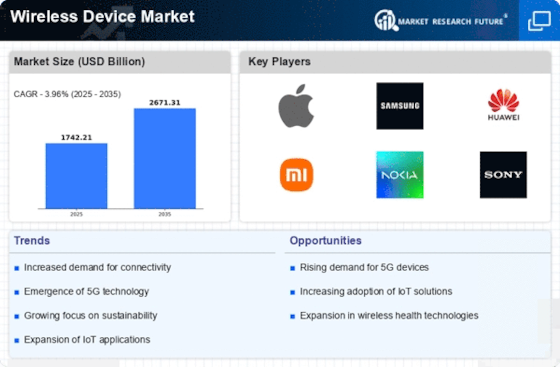
As per MRFR analysis, the Wireless Device Market Size was estimated at 1742.21 USD Billion in 2024. The Wireless Device industry is projected to grow from 1811.24 USD Billion in 2025 to 2671.31 USD Billion by 2035, exhibiting a compound annual growth rate (CAGR) of 3.96 during the forecast period 2025 - 2035.

Key Market Trends & Highlights

The Wireless Device Market is experiencing robust growth driven by technological advancements and evolving consumer preferences.

  • The integration of Artificial Intelligence is enhancing user experiences across various wireless devices.
  • Sustainability initiatives are becoming increasingly important in the design and production of wireless technologies.
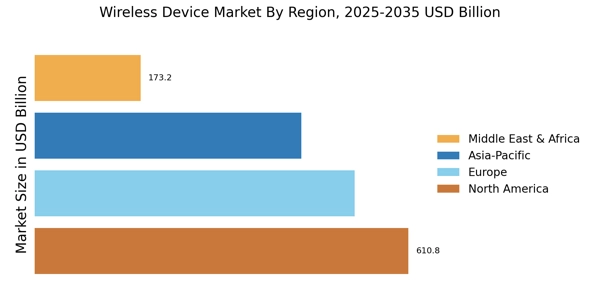
  • North America remains the largest market, while the Asia-Pacific region is emerging as the fastest-growing area for wireless devices.
  • Rising demand for mobile connectivity and advancements in wireless technology are key drivers propelling the market forward.

Market Size & Forecast

2024 Market Size 1742.21 (USD Billion)
2035 Market Size 2671.31 (USD Billion)
CAGR (2025 - 2035) 3.96%

Major Players

Apple (US), Samsung (KR), Huawei (CN), Xiaomi (CN), Nokia (FI), Sony (JP), LG (KR), Motorola (US), OnePlus (CN)

Wireless Device Market Trends

The Wireless Device Market is currently experiencing a dynamic evolution, driven by rapid technological advancements and shifting consumer preferences. As connectivity becomes increasingly integral to daily life, the demand for innovative wireless devices continues to surge. This market encompasses a diverse range of products, including smartphones, tablets, wearables, and IoT devices, each contributing to a complex ecosystem that enhances user experience. Manufacturers are focusing on integrating advanced features such as artificial intelligence, augmented reality, and enhanced security measures, which appear to resonate well with consumers seeking more functionality and convenience in their devices. Moreover, the Wireless Device Market is witnessing a notable trend towards sustainability and eco-friendliness. Companies are increasingly prioritizing environmentally responsible practices, from sourcing materials to product design and end-of-life recycling. This shift not only aligns with global sustainability goals but also appeals to a growing segment of environmentally conscious consumers. As the market continues to evolve, it seems likely that these trends will shape the future landscape, fostering innovation while addressing the pressing need for sustainable solutions in technology.

Integration of Artificial Intelligence

The Wireless Device Market is seeing a marked increase in the integration of artificial intelligence across various devices. This trend enhances user interaction, enabling smarter functionalities such as voice recognition, personalized recommendations, and predictive analytics. As consumers seek more intuitive experiences, manufacturers are likely to invest heavily in AI capabilities.

Focus on Sustainability

Sustainability is becoming a central theme within the Wireless Device Market. Companies are adopting eco-friendly practices, from utilizing recyclable materials to implementing energy-efficient technologies. This trend reflects a broader societal shift towards environmental responsibility, appealing to consumers who prioritize sustainable products.

Expansion of IoT Connectivity

The expansion of Internet of Things (IoT) connectivity is reshaping the Wireless Device Market. As more devices become interconnected, the demand for seamless communication and interoperability increases. This trend suggests a future where smart homes and cities become commonplace, driven by enhanced wireless technologies.

Wireless Device Market Drivers

Advancements in Wireless Technology

Technological advancements play a pivotal role in shaping the Wireless Device Market. Innovations such as 5G technology and Wi-Fi 6 are revolutionizing the way devices connect and communicate. The introduction of 5G networks, with their enhanced speed and lower latency, is expected to transform various sectors, including healthcare, automotive, and entertainment. According to industry forecasts, the number of 5G connections is anticipated to reach over 1.5 billion by 2025, indicating a significant shift in consumer preferences towards faster and more reliable wireless solutions. Furthermore, the Wireless Device Market is witnessing the emergence of new wireless standards that enhance device interoperability and performance. These advancements not only improve user experiences but also create new opportunities for businesses to develop innovative applications and services. As technology continues to evolve, the Wireless Device Market is likely to experience sustained growth driven by these advancements.

Growing Focus on Health and Fitness

The Wireless Device Market is witnessing a growing focus on health and fitness, particularly through the adoption of wearable technology. Devices such as fitness trackers and smartwatches are becoming increasingly popular as consumers prioritize health monitoring and wellness. Recent surveys indicate that nearly 50% of consumers express interest in using wearable devices to track their health metrics. This trend is further supported by advancements in sensor technology and data analytics, which enhance the functionality of these devices. As health-conscious individuals seek to monitor their physical activity, heart rate, and sleep patterns, the demand for wireless health devices is expected to rise. Consequently, the Wireless Device Market is likely to see an influx of innovative products designed to cater to this health-centric consumer base, driving growth and diversification within the market.

Increased Adoption of Smart Devices

The Wireless Device Market is significantly influenced by the rising adoption of smart devices across various demographics. Consumers are increasingly integrating smart technology into their daily lives, with devices such as smart speakers, wearables, and home automation systems gaining popularity. Recent statistics indicate that the number of connected devices is expected to surpass 30 billion by 2025, highlighting the growing trend towards smart living. This proliferation of smart devices necessitates robust wireless connectivity solutions, thereby driving demand within the Wireless Device Market. Manufacturers are responding by developing devices that not only offer enhanced functionality but also prioritize energy efficiency and user-friendly interfaces. As consumers seek seamless integration of smart devices into their lifestyles, the Wireless Device Market is likely to benefit from this trend, fostering innovation and competition among manufacturers.

Rising Demand for Mobile Connectivity

The Wireless Device Market experiences a notable surge in demand for mobile connectivity solutions. As individuals increasingly rely on smartphones and tablets for daily activities, the need for seamless internet access becomes paramount. Recent data indicates that mobile data traffic is projected to grow exponentially, with estimates suggesting a compound annual growth rate of over 25% in the coming years. This trend is driven by the proliferation of mobile applications and services that require constant connectivity. Consequently, manufacturers in the Wireless Device Market are compelled to innovate and enhance their offerings to meet consumer expectations for speed and reliability. The integration of advanced technologies, such as 5G, further fuels this demand, enabling faster data transfer and improved user experiences. As a result, the Wireless Device Market is poised for substantial growth, driven by the insatiable appetite for mobile connectivity.

Expansion of E-commerce and Remote Work

The Wireless Device Market is significantly impacted by the expansion of e-commerce and the increasing prevalence of remote work. As businesses and consumers alike embrace digital solutions, the demand for wireless devices that facilitate online transactions and communication is on the rise. Recent data suggests that e-commerce sales are projected to reach trillions of dollars, underscoring the need for reliable wireless connectivity. Additionally, the shift towards remote work has led to a surge in demand for devices that support virtual collaboration and productivity. This trend is prompting manufacturers in the Wireless Device Market to innovate and enhance their product offerings, ensuring compatibility with various online platforms and applications. As the landscape of work and commerce continues to evolve, the Wireless Device Market is likely to experience sustained growth driven by these transformative trends.


Market Segment Insights

By Device Type: Smartphones (Largest) vs. IoT Devices (Fastest-Growing)

In the Wireless Device Market, smartphones hold the largest market share due to their widespread adoption and versatility. Feature phones, while still present, have considerably reduced market share as consumers shift towards smartphones, driven by advancements in technology and the demand for connectivity. IoT devices are gaining traction, reflecting the market's growing focus on smart technology integration. The growth trend within this segment signifies a shift towards more connected and intelligent devices. IoT devices are emerging as the fastest-growing segment, fueled by increasing consumer interest in automation and smart home solutions. Wearable devices are also growing rapidly as health and fitness tracking gains popularity. Tablets continue to maintain a steady market presence, but smartphones remain the cornerstone of consumer choice.

Smartphones (Dominant) vs. Wearable Devices (Emerging)

Smartphones are characterized by their multifunctionality, acting as communication tools and personal assistants while integrating a variety of applications that cater to diverse consumer needs. Their establishment as the dominant device in the Wireless Device Market is attributed to continuous innovation and improvements in user experience. In contrast, wearable devices are emerging, focusing on health tracking, fitness monitoring, and seamless connectivity with smartphones. As health consciousness rises, the appeal of wearables grows, positioning them as a secondary yet rapidly evolving segment. Consumers are increasingly adopting these devices for their ability to enhance lifestyle choices and provide real-time data. As technology advances, wearables are expected to integrate more features, driving further market growth.

By Technology: 5G (Largest) vs. Bluetooth (Fastest-Growing)

In the Wireless Device Market, the technology segment is primarily dominated by 5G technology, which holds a significant market share due to its advanced capabilities and widespread adoption across various applications. Following 5G, other technologies such as Wi-Fi and 4G serve critical roles but lag in market share compared to the massive growth seen from 5G. Bluetooth and NFC also contribute to this ecosystem, though they occupy niche areas within the wireless technology framework. As the demand for higher data speeds and improved connectivity rises, 5G continues to thrive, supported by ongoing investments from telecom companies and the increasing deployment of 5G infrastructure. Meanwhile, Bluetooth is emerging rapidly due to the growing trends of IoT and smart devices, highlighting an increasing preference for wireless connectivity in consumer electronics. This trend indicates a shift towards greater integration of wireless technologies into everyday life, showcasing both opportunities and challenges for traditional wireless technologies.

5G (Dominant) vs. Bluetooth (Emerging)

5G technology has established itself as the dominant force in the Wireless Device Market, offering unparalleled speed, low latency, and support for a vast number of connected devices. Its infrastructure is rapidly expanding globally, leading to significant adoption across various industries. As more consumers and businesses leverage 5G capabilities, applications ranging from enhanced mobile broadband to massive machine-type communications are transforming the landscape. On the other hand, Bluetooth stands out as an emerging technology within this segment, driven by the rise of IoT devices and wearables. Its ease of use and low power consumption make it ideal for personal and household devices, positioning it as an integral part of the wireless ecosystem. This growing adoption demonstrates Bluetooth's valuable role in complementing faster technologies like 5G, essential for creating a comprehensive wireless experience.

By Form Factor: Full-touch (Largest) vs. Foldable (Fastest-Growing)

In the Wireless Device Market, the form factor segment is primarily dominated by full-touch devices, commanding a significant share due to their versatility and user-friendly interfaces. Clamshell and bar designs maintain a presence, particularly in specific niche markets and demographics, while flip phones continue to attract attention among consumers seeking simplicity and nostalgia. The foldable segment, although still emerging, is rapidly gaining momentum as technology advances, allowing for innovative designs that cater to diverse consumer needs.

Full-touch (Dominant) vs. Foldable (Emerging)

Full-touch devices represent a dominant force in the wireless device market, characterized by large displays, touch interfaces, and seamless integration with apps and services. This design facilitates a more interactive user experience, appealing to both consumers and businesses. On the other hand, foldable devices are making waves as an emerging category. They offer innovative solutions for multitasking and portability, appealing to tech-savvy consumers looking for cutting-edge features. As advancements in hinge technology and flexible displays continue, foldable devices are expected to carve out a significant niche in the market, driven by a growing demand for multifunctional devices.

By Operating System: Android (Largest) vs. iOS (Fastest-Growing)

In the Wireless Device Market, Android has established itself as the largest operating system, holding a significant market share compared to its competitors. iOS follows, having a strong presence especially in premium devices. On the other hand, Windows Mobile and KaiOS cater to niche markets, primarily focusing on budget and low-end devices, whereas 'Other OS' encompasses a variety of smaller platforms with limited impact on the overall dynamics of the market. Overall, Android and iOS dominate the landscape, leaving minimal space for the remaining segments.

Operating Systems: Android (Dominant) vs. KaiOS (Emerging)

Android remains the dominant operating system in the Wireless Device Market due to its extensive app ecosystem and compatibility with a wide range of devices. It caters to diverse user needs across various price segments, making it a favored choice among manufacturers. Conversely, KaiOS is gaining traction as an emerging player targeting the feature phone market, especially in developing countries. It offers essential smartphone functionalities at a fraction of the cost, appealing to users who prioritize affordability over extensive features. KaiOS is rapidly expanding its market share, driven by rising smartphone adoption rates in emerging economies.

Get more detailed insights about Wireless Device Market

Regional Insights

North America : Tech Innovation Leader

North America remains the largest market for wireless devices, holding approximately 35% of the global share. The region's growth is driven by high consumer demand for advanced technology, increased internet penetration, and robust infrastructure. Regulatory support for innovation and competition further fuels market expansion, with significant investments in 5G technology and IoT applications. The United States leads the market, followed by Canada, with major players like Apple and Motorola dominating the landscape. The competitive environment is characterized by rapid technological advancements and a focus on user experience. Companies are continuously innovating to meet consumer expectations, ensuring North America retains its position as a leader in the wireless device market.

Europe : Emerging Regulatory Framework

Europe is the second-largest market for wireless devices, accounting for around 30% of the global market share. The region's growth is propelled by increasing consumer awareness, a shift towards smart devices, and supportive regulatory frameworks aimed at enhancing connectivity. The European Union's initiatives to promote digital transformation and sustainability are key drivers of market expansion. Leading countries include Germany, the UK, and France, where major players like Nokia and Samsung are actively competing. The competitive landscape is marked by a focus on innovation and compliance with stringent regulations. Companies are investing in R&D to develop eco-friendly devices, aligning with the EU's sustainability goals.

Asia-Pacific : Rapid Growth Region

Asia-Pacific is witnessing rapid growth in the wireless device market, holding approximately 25% of the global share. The region's expansion is driven by increasing smartphone penetration, a growing middle class, and advancements in mobile technology. Countries like China and India are at the forefront, with government initiatives promoting digital infrastructure and connectivity playing a crucial role in market growth. China is the largest market, followed by India, with key players like Huawei and Xiaomi leading the charge. The competitive landscape is intense, characterized by aggressive pricing strategies and a focus on innovation. Companies are continuously launching new models to capture the growing consumer base, making Asia-Pacific a dynamic market for wireless devices.

Middle East and Africa : Emerging Market Potential

The Middle East and Africa region is emerging as a significant player in the wireless device market, accounting for about 10% of the global share. The growth is driven by increasing mobile connectivity, urbanization, and a young population eager for technology. Government initiatives aimed at enhancing digital infrastructure are also contributing to market expansion, creating new opportunities for wireless device adoption. Leading countries include South Africa and the UAE, where companies like Samsung and LG are establishing a strong presence. The competitive landscape is evolving, with local players entering the market and focusing on affordable devices. This region presents unique growth opportunities as demand for wireless technology continues to rise.

Wireless Device Market Regional Image

Key Players and Competitive Insights

Major players in Wireless Device Market industry are constantly striving to gain competitive advantage by offering innovative products and services, expanding their distribution channels, and engaging in strategic partnerships and acquisitions. Leading Wireless Device Market players invest heavily in research and development to stay ahead of the competition and meet the evolving demands of consumers. The Wireless Device Market Competitive Landscape is characterized by a mix of established players and emerging challengers, each with its own strengths and weaknesses.

The industry is also subject to regulatory changes and technological advancements, which can impact the competitive dynamics and market share of individual players.A leading player in the Wireless Device Market, , has established a strong brand reputation and a loyal customer base through its commitment to innovation and customer satisfaction. The company offers a wide range of wireless devices, including smartphones, tablets, and wearables, and is known for its sleek designs and feature-rich products. 's distribution network spans multiple channels, including online marketplaces, retail stores, and carrier partnerships, ensuring that its products are accessible to a global audience.

The company has also formed strategic partnerships with key players in the industry to expand its reach and enhance its product offerings. A competitor company in the Wireless Device Market, , is known for its focus on affordability and value. The company offers a range of budget-friendly wireless devices that cater to the needs of price-conscious consumers. 's products are typically less feature-rich than those of premium brands, but they offer reliable performance and meet the basic communication and entertainment needs of users.

The company has a strong presence in emerging markets and has been successful in gaining market share by targeting price-sensitive consumers. Its distribution network primarily consists of online marketplaces and budget-friendly retail stores, allowing it to reach a wide audience while keeping costs low.

Key Companies in the Wireless Device Market market include

Industry Developments

The global wireless device market is projected to reach USD 2,287.0 billion by 2032, exhibiting a CAGR of 3.96% from 2024 to 2032. The growth is attributed to increasing smartphone penetration, rising demand for connected devices, and advancements in wireless technologies such as 5G and Wi-Fi 6. Emerging markets, such as Asia-Pacific, are expected to drive growth due to increasing disposable income and urbanization. Key players in the market include Apple, Samsung, Huawei, and Xiaomi. Recent developments include the launch of foldable smartphones, the growing adoption of eSIM technology, and the integration of artificial intelligence (AI) into wireless devices.

The market is expected to face challenges such as supply chain disruptions and competition from emerging technologies like satellite communication.

Future Outlook

Wireless Device Market Future Outlook

The Wireless Device Market is projected to grow at 3.96% CAGR from 2024 to 2035, driven by technological advancements, increased connectivity, and rising consumer demand.

New opportunities lie in:

  • Expansion into IoT-enabled devices for smart homes
  • Development of 5G-compatible wireless accessories
  • Strategic partnerships with telecom providers for bundled services

By 2035, the market is expected to achieve robust growth, reflecting evolving consumer needs and technological innovations.

Market Segmentation

Wireless Device Market Technology Outlook

  • 4G
  • 5G
  • Wi-Fi
  • Bluetooth
  • NFC

Wireless Device Market Device Type Outlook

  • Smartphones
  • Feature Phones
  • IoT Devices
  • Tablets
  • Wearable Devices

Wireless Device Market Form Factor Outlook

  • Clamshell
  • Bar
  • Full-touch
  • Flip
  • Foldable

Wireless Device Market Operating System Outlook

  • Android
  • iOS
  • Windows Mobile
  • KaiOS
  • Other OS

Report Scope

MARKET SIZE 20241742.21(USD Billion)
MARKET SIZE 20251811.24(USD Billion)
MARKET SIZE 20352671.31(USD Billion)
COMPOUND ANNUAL GROWTH RATE (CAGR)3.96% (2024 - 2035)
REPORT COVERAGERevenue Forecast, Competitive Landscape, Growth Factors, and Trends
BASE YEAR2024
Market Forecast Period2025 - 2035
Historical Data2019 - 2024
Market Forecast UnitsUSD Billion
Key Companies ProfiledMarket analysis in progress
Segments CoveredMarket segmentation analysis in progress
Key Market OpportunitiesIntegration of advanced artificial intelligence in Wireless Device Market enhances user experience and operational efficiency.
Key Market DynamicsRising consumer demand for advanced wireless technologies drives intense competition and rapid innovation in the market.
Countries CoveredNorth America, Europe, APAC, South America, MEA

Leave a Comment

FAQs

What is the current valuation of the Wireless Device Market in 2025?

The Wireless Device Market is valued at approximately 1742.21 USD Billion in 2024.

What is the projected market valuation for the Wireless Device Market by 2035?

The market is expected to reach a valuation of 2671.31 USD Billion by 2035.

What is the expected CAGR for the Wireless Device Market during the forecast period 2025 - 2035?

The anticipated CAGR for the Wireless Device Market during 2025 - 2035 is 3.96%.

Which companies are considered key players in the Wireless Device Market?

Key players include Apple, Samsung, Huawei, Xiaomi, Nokia, Sony, LG, Motorola, and OnePlus.

What are the primary segments of the Wireless Device Market?

The primary segments include Device Type, Technology, Form Factor, and Operating System.

How do smartphones perform in the Wireless Device Market?

Smartphones are projected to generate revenues between 800.0 and 1200.0 USD Billion.

What is the revenue range for IoT devices in the Wireless Device Market?

IoT devices are expected to generate revenues between 300.0 and 600.0 USD Billion.

What is the revenue projection for 5G technology in the Wireless Device Market?

5G technology is anticipated to generate revenues ranging from 400.0 to 800.0 USD Billion.

What is the expected revenue for Android operating systems in the Wireless Device Market?

Android operating systems are projected to generate revenues between 800.0 and 1200.0 USD Billion.

What are the revenue expectations for wearable devices in the Wireless Device Market?

Wearable devices are expected to generate revenues between 171.31 and 192.21 USD Billion.

Download Free Sample

Kindly complete the form below to receive a free sample of this Report

Compare Licence

×
Features License Type
Single User Multiuser License Enterprise User
Price $4,950 $5,950 $7,250
Maximum User Access Limit 1 User Upto 10 Users Unrestricted Access Throughout the Organization
Free Customization
Direct Access to Analyst
Deliverable Format
Platform Access
Discount on Next Purchase 10% 15% 15%
Printable Versions