
Request Free Sample ×

Kindly complete the form below to receive a free sample of this Report

* Please use a valid business email

Leading companies partner with us for data-driven Insights

clients tt-cursor
Hero Background
English
Chinese
French
Japanese
Korean
German
Spanish

Weight Loss Ingredients Market Size

ID: MRFR/FnB/3346-HCR
128 Pages
Pradeep Nandi
Last Updated: April 06, 2026

Weight Loss Products Market Size, Share, Industry Trend & Analysis Research Report By Product Type (Dietary Supplements, Meal Replacement Products, Fitness Equipment, Weight Loss Programs), By Distribution Channel (Online Retail, Offline Retail, Pharmacies, Health and Wellness Stores), By Formulation (Powder, Capsule, Liquid, Bar), By Target Consumer (Adults, Teens, Seniors, Athletes) and By Regional (North America, Europe, South America, Asia Pacific, Middle East and Africa) - Forecast to 2035

Share:
Download PDF ×

We do not share your information with anyone. However, we may send you emails based on your report interest from time to time. You may contact us at any time to opt-out.

Weight Loss Ingredients Market Infographic
Purchase Options

Weight Loss Ingredients Size

Weight Loss Ingredients Market Growth Projections and Opportunities

The weight loss products market is shaped by a multitude of factors that collectively influence consumer choices, industry dynamics, and overall market growth. A key driver in this market is the growing global concern over obesity and the associated health risks. As lifestyles become more sedentary and dietary habits shift towards processed and calorie-dense foods, consumers are increasingly seeking weight management solutions. This heightened awareness of health risks and the desire for a healthier lifestyle contribute to the demand for weight loss products, including supplements, meal replacements, and fitness equipment. Consumer trends and preferences significantly impact the weight loss products market. With an increasing focus on aesthetics, fitness, and overall well-being, consumers are actively seeking products that align with their weight management goals. The market responds to these trends by offering a diverse range of products, including dietary supplements, meal plans, and fitness gadgets, catering to different consumer preferences and lifestyles. The role of social and cultural factors in shaping the weight loss products market cannot be understated. Societal norms and beauty standards often influence individuals' perceptions of body image, driving the demand for products that promise quick and effective weight loss. Social media, in particular, plays a significant role in disseminating information about weight loss trends, diets, and success stories, influencing consumer choices and contributing to market dynamics. Scientific advancements and research in the fields of nutrition and exercise physiology contribute to the development of innovative weight loss products. Consumers are drawn to products backed by scientific evidence, and the market is influenced by the continuous pursuit of effective and safe solutions. This includes the formulation of dietary supplements with ingredients believed to aid in weight loss, such as green tea extract, Garcinia Cambogia, and conjugated linoleic acid. Economic factors also play a role in the weight loss products market. Economic stability, income levels, and disposable income influence consumers' ability to invest in weight loss solutions, including gym memberships, specialty foods, and dietary supplements. Conversely, economic downturns may impact consumer spending habits, leading to shifts in purchasing priorities and preferences within the weight loss products market. Government regulations and health policies contribute to shaping the market factors of weight loss products. Regulatory frameworks related to the safety, labeling, and marketing claims of weight loss products influence consumer trust and market dynamics. Government initiatives promoting healthy lifestyles, nutrition education, and public awareness campaigns impact consumer behavior and contribute to shaping the overall market landscape. The prevalence of digitalization and e-commerce has transformed the weight loss products market. Online platforms provide consumers with easy access to a wide range of products, information, and reviews. This digital landscape enables both established brands and emerging players to reach a broader audience, shaping consumer perceptions and purchasing patterns. Cultural attitudes towards health, fitness, and body image vary globally, influencing the weight loss products market in different regions. While some cultures may prioritize traditional dietary practices and physical activities, others may embrace modern weight loss trends and products. The market adapts to these cultural nuances, offering products that resonate with diverse consumer preferences and beliefs.

Weight Loss Ingredients Market Size Graph
Author
Author Profile
Pradeep Nandi
Senior Research Analyst

I have a bachelor's degree in mechanical engineering and an MBA. I have more than two years of expertise in the retail, food, and beverage, chemical, and material industries, and hence have developed a sound cross-domain expertise. A firm believer in lifelong learning and sharing of knowledge. Having a proclivity for hatching ideas and trying to absorb as much information as possible in a short amount of time. Introducing corporates to the data and insight, which enables them to move from probability to possibility, has been my key areas of interest. 

Leave a Comment

FAQs

What is the current valuation of the Weight Loss Products Market as of 2024?

<p>The Weight Loss Products Market was valued at 228.63 USD Billion in 2024.</p>

What is the projected market valuation for the Weight Loss Products Market in 2035?

<p>The market is projected to reach 349.74 USD Billion by 2035.</p>

What is the expected CAGR for the Weight Loss Products Market during the forecast period 2025 - 2035?

<p>The expected CAGR for the Weight Loss Products Market during 2025 - 2035 is 3.94%.</p>

Which segment of the Weight Loss Products Market had the highest valuation in 2024?

<p>In 2024, the Weight Loss Programs segment had the highest valuation at 113.63 USD Billion.</p>

How do dietary supplements compare to meal replacement products in market valuation?

<p>Dietary Supplements were valued at 45.0 USD Billion, while Meal Replacement Products were valued at 40.0 USD Billion in 2024.</p>

What distribution channel is expected to show significant growth in the Weight Loss Products Market?

<p>The Health and Wellness Stores segment, valued at 83.63 USD Billion in 2024, is expected to show significant growth.</p>

Which formulation type is projected to have the highest market valuation by 2035?

<p>The Bar formulation type, valued at 73.63 USD Billion in 2024, is projected to have the highest valuation by 2035.</p>

What target consumer segment is anticipated to grow the most in the Weight Loss Products Market?

<p>The Adults segment, valued at 114.31 USD Billion in 2024, is anticipated to grow the most by 2035.</p>

Who are the key players in the Weight Loss Products Market?

<p>Key players include Weight Watchers, Nutrisystem, Herbalife, Jenny Craig, SlimFast, Medifast, Noom, Atkins Nutritionals, and BistroMD.</p>

What is the market valuation range for fitness equipment in the Weight Loss Products Market?

<p>Fitness Equipment was valued between 30.0 and 50.0 USD Billion in 2024.</p>

Market Summary

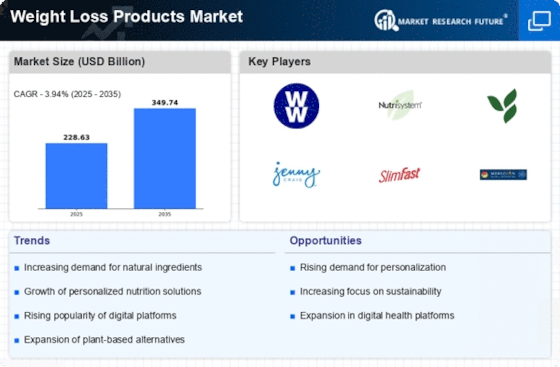
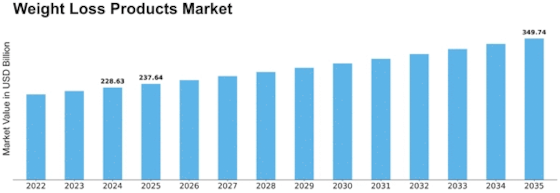
As per Market Research Future analysis, the Weight Loss Products Market was estimated at 228.63 USD Billion in 2024. The Weight Loss Products industry is projected to grow from 237.64 USD Billion in 2025 to 349.74 USD Billion by 2035, exhibiting a compound annual growth rate (CAGR) of 3.94% during the forecast period 2025 - 2035

Key Market Trends & Highlights

The Weight Loss Products Market is experiencing a dynamic shift towards personalized and technology-driven solutions.

  • The rise of personalized nutrition is reshaping consumer preferences in the weight loss sector. Integration of technology, such as apps and wearables, is enhancing user engagement and tracking. Sustainable practices are becoming increasingly important, reflecting a broader consumer trend towards environmental responsibility. The increasing obesity rates and rising health consciousness are driving demand for dietary supplements and meal replacement products, particularly in North America and Asia-Pacific.

Market Size & Forecast

2024 Market Size 228.63 (USD Billion)
2035 Market Size 349.74 (USD Billion)
CAGR (2025 - 2035) 3.94%
Largest Regional Market Share in 2024 North America

Major Players

<a href="https://www.weightwatchers.com/us">Weight Watchers (US)</a>, Nutrisystem (US), Herbalife (US), Jenny Craig (US), SlimFast (US), Medifast (US), Noom (US), Atkins Nutritionals (US), BistroMD (US)

Market Trends

The Weight Loss Products Market is currently experiencing a dynamic evolution, driven by a confluence of consumer preferences and technological advancements. As individuals increasingly prioritize health and wellness, there is a noticeable shift towards products that not only promote weight loss but also enhance overall well-being. This market encompasses a diverse array of offerings, including dietary supplements, meal replacements, and fitness programs, each tailored to meet the unique needs of consumers. Furthermore, the rise of digital platforms has facilitated greater access to information and resources, enabling individuals to make informed choices regarding their weight management journeys. In addition to the growing emphasis on health, the Weight Loss Products Market is witnessing a surge in demand for natural and organic solutions. Consumers appear to be gravitating towards products that are perceived as safe and effective, often seeking alternatives to synthetic ingredients. This trend suggests a broader movement towards holistic health approaches, where individuals are not merely focused on losing weight but are also concerned with the quality and source of the products they consume. As the market continues to evolve, it is likely that innovation and consumer education will play pivotal roles in shaping future developments.

Rise of Personalized Nutrition

The Weight Loss Products Market is increasingly leaning towards personalized nutrition solutions. Consumers are seeking products tailored to their specific dietary needs and preferences, which may enhance their weight loss efforts. This trend indicates a shift from one-size-fits-all approaches to more individualized strategies, potentially improving consumer satisfaction and outcomes.

Integration of Technology

Technological advancements are becoming integral to the Weight Loss Products Market. The incorporation of mobile applications, wearable devices, and online platforms is facilitating more interactive and engaging weight management experiences. This trend suggests that consumers are looking for tools that not only assist in tracking progress but also provide motivation and support.

Focus on Sustainable Practices

Sustainability is emerging as a key consideration within the Weight Loss Products Market. Consumers are increasingly aware of the environmental impact of their choices, leading to a demand for products that are produced through eco-friendly practices. This trend reflects a broader societal shift towards responsible consumption, where individuals seek to align their health goals with environmental stewardship.

Weight Loss Ingredients Market Market Drivers

Increasing Obesity Rates

The prevalence of obesity continues to rise, prompting a heightened demand for effective weight loss solutions. According to recent statistics, approximately 36% of adults are classified as obese, which has led to a surge in the Weight Loss Products Market. This alarming trend is likely to drive consumers towards various weight loss products, including supplements, meal replacements, and fitness programs. As individuals seek to combat obesity-related health issues, the market is expected to expand significantly. The increasing awareness of the health risks associated with obesity, such as diabetes and cardiovascular diseases, further fuels the demand for weight loss products. Consequently, companies within the Weight Loss Products Market are innovating to offer diverse solutions tailored to meet the needs of this growing consumer base.

Rising Health Consciousness

There is a notable shift towards health consciousness among consumers, which is influencing their purchasing decisions. As individuals become more aware of the importance of maintaining a healthy lifestyle, the Weight Loss Products Market is experiencing a corresponding increase in demand. This trend is reflected in the growing popularity of organic and natural weight loss products, as consumers seek alternatives that align with their health goals. Market data indicates that the demand for plant-based supplements and low-calorie meal options is on the rise, suggesting a shift in consumer preferences. This heightened focus on health and wellness is likely to drive innovation within the Weight Loss Products Market, as companies strive to develop products that cater to the evolving needs of health-conscious consumers.

Growing Demand for Convenience

The fast-paced lifestyle of modern consumers is driving a growing demand for convenient weight loss solutions. Busy schedules often leave little time for meal preparation and exercise, leading individuals to seek out products that fit seamlessly into their lives. The Weight Loss Products Market is responding to this trend by offering ready-to-eat meals, meal replacement shakes, and on-the-go snacks that cater to the needs of time-strapped consumers. Market data suggests that the convenience food segment is expanding rapidly, with a significant portion of consumers willing to invest in products that save time while supporting their weight loss goals. This shift towards convenience is likely to shape the future of the Weight Loss Products Market, as companies innovate to provide solutions that align with consumer lifestyles.

Technological Advancements in Weight Loss Solutions

The integration of technology into weight loss solutions is transforming the Weight Loss Products Market. Innovations such as mobile applications, wearable fitness trackers, and online coaching platforms are becoming increasingly popular among consumers. These technological advancements provide users with personalized insights and support, enhancing their weight loss journeys. Market Research Future indicates that the use of fitness apps has surged, with millions of downloads worldwide, indicating a strong consumer interest in tech-driven weight loss solutions. This trend suggests that companies within the Weight Loss Products Market must adapt to the digital landscape to remain competitive. By leveraging technology, businesses can offer more effective and engaging products, potentially leading to increased customer satisfaction and loyalty.

Influence of Social Media and Celebrity Endorsements

Social media platforms and celebrity endorsements play a pivotal role in shaping consumer perceptions and driving trends within the Weight Loss Products Market. The rise of influencers promoting weight loss products has created a powerful marketing channel, reaching millions of potential customers. This phenomenon appears to have a significant impact on consumer behavior, as individuals often look to social media for inspiration and guidance on their weight loss journeys. Market analysis indicates that products endorsed by celebrities tend to experience a surge in popularity, suggesting that effective marketing strategies can greatly influence sales. As social media continues to evolve, its influence on the Weight Loss Products Market is likely to grow, prompting companies to invest in digital marketing strategies to capitalize on this trend.

Market Segment Insights

By Type: Dietary Supplements (Largest) vs. Meal Replacement Products (Fastest-Growing)

In the Weight Loss Products Market, the distribution of market share among the various types reveals that <a href="https://www.marketresearchfuture.com/reports/dietary-supplements-market-1134" target="_blank" rel="noopener">dietary supplements</a> hold the largest portion, thanks to their wide acceptance and effectiveness in supporting weight management efforts. <a href="https://www.marketresearchfuture.com/reports/meal-replacement-market-38385" target="_blank" rel="noopener">meal replacement</a> Products follow as a significant segment, increasingly popular for their convenience and nutritional balance, catering to busy lifestyles.

Fitness Equipment (Dominant) vs. Weight Loss Programs (Emerging)

Fitness Equipment continues to dominate in the Weight Loss Products Market, frequently purchased by those committed to maintaining an active lifestyle and achieving their weight goals at home. This segment benefits from innovations in technology, offering smart and connected devices that enhance user experience. In contrast, Weight Loss Programs are emerging as a viable option for consumers seeking structured guidance and accountability. As more consumers turn to comprehensive solutions that incorporate diet, exercise, and behavior change, the demand for these programs is rapidly growing, making them a vital part of the weight loss solution ecosystem.

By Distribution Channel: Online Retail (Largest) vs. Pharmacies (Fastest-Growing)

In the Weight Loss Products Market, the distribution channels show significant variation, with Online Retail holding the largest share. As consumers increasingly turn to online shopping for convenience, brands are prioritizing digital platforms to reach a broader audience. Offline Retail, while still relevant, is seeing a decrease in market presence as more businesses adapt to e-commerce models. Pharmacies and Health and Wellness Stores are also crucial players, specifically catering to health-conscious consumers seeking reliable products. Growth trends reveal a strong shift towards Online Retail, driven by rising internet penetration and the growing popularity of e-commerce among consumers. Pharmacies are emerging as the fastest-growing channel due to their trusted reputation and personalized services that cater to health needs. Health and Wellness Stores maintain a steady customer base, focusing on specialized products but face challenges in competing with the convenience and diversity offered by online platforms.

Online Retail (Dominant) vs. Pharmacies (Emerging)

Online Retail continues to dominate the Weight Loss Products Market, providing consumers with unparalleled convenience and access to an extensive range of products. This channel appeals to tech-savvy shoppers who value the ability to shop from the comfort of their homes, compare prices, and read reviews before making a purchase decision. Brands capitalize on social media marketing and influencer partnerships to engage directly with potential customers. On the other hand, Pharmacies represent an emerging segment, leveraging consumer trust and access to health professionals to promote weight loss products. Their growing popularity is attributed to the personalized care offered, assisting consumers in making informed decisions about their purchases. Pharmacies often provide a curated selection of products, enhancing consumer confidence in their choices. As these channels evolve, the interplay between them will shape the future landscape of the weight loss products market.

By Formulation: Powder (Largest) vs. Liquid (Fastest-Growing)

The formulation segment of the weight loss products market showcases a diverse distribution among various forms, including powders, capsules, liquids, and bars. Powders currently hold the largest share, appealing to consumers for their versatility and ease of use. Meanwhile, liquids, although smaller in market presence, are emerging rapidly due to growing consumer preferences for ready-to-drink options, supported by convenience and on-the-go consumption trends.

Powder (Dominant) vs. Liquid (Emerging)

Powder formulations have dominated the weight loss products market for years, largely due to their ability to integrate seamlessly into a range of diets and lifestyles. They are often well-received for their flexibility in preparation and dosage, making them a go-to choice for consumers looking to control their intake. Conversely, liquid formulations are gaining traction as the fastest-growing segment. Their appeal lies in the convenience and quick consumption they offer, attracting a younger demographic that favors instant solutions and portability. As innovations continue, liquid formulations are expected to adapt and thrive, potentially overtaking more traditional forms.

By Target Consumer: Adults (Largest) vs. Teens (Fastest-Growing)

In the Weight Loss Products Market, adults hold the largest share, reflecting mature consumption patterns driven by health consciousness and obesity concerns. They are the primary consumers of various weight loss products, including supplements, meals, and activity trackers. Teens, on the other hand, represent the fastest-growing segment, as they increasingly prioritize fitness and body image, influenced by social media and peer pressure, leading to a surge in demand for age-appropriate weight loss solutions.

Adults (Dominant) vs. Teens (Emerging)

Adults dominate the Weight Loss Products Market due to their significant purchasing power and focus on long-term weight management solutions. This segment typically engages in comprehensive fitness and dietary regimens, leading to sustained demand for diverse products ranging from meal replacements to exercise programs. Conversely, teens emerge as a dynamic segment, characterized by their enthusiasm for trendy diets and fitness fads. They are attuned to digital marketing strategies, often seeking products that promise quick results and align with their evolving identities. As a result, the youth segment drives innovation, prompting brands to tailor their offerings specifically for younger demographics.

Get more detailed insights about Weight Loss Products Market Research Report - Forecast till 2035

Regional Insights

The Weight Loss Products Market is poised for substantial growth across various regions, with North America leading as a significant market, valued at 80.0 USD Billion in 2024 and projected to reach 120.0 USD Billion by 2035, reflecting its majority holding within the global landscape. Europe follows closely, with a valuation of 60.0 USD billion in 2024 and an anticipated increase to 90.0 USD billion by 2035, driven by rising health awareness and fitness trends.

In South America, the market starts at 20.0 USD billion in 2024, expected to grow to 30.0 USD billion, highlighting a developing interest in weight management.The Asia Pacific region captures attention with a valuation of 50.0 USD billion in 2024, projected to rise to 78.0 USD billion by 2035, attributed to a large population increasingly focused on health and wellness. Finally, the Middle East and Africa exhibit growth potential, starting at 18.63 USD Billion and increasing to 30.5 USD Billion, as lifestyle changes drive demand for weight loss solutions.

Collectively, these regions contribute to the overall Weight Loss Products Market revenue, showcasing a diverse landscape of opportunities and challenges.

Key Players and Competitive Insights

The Weight Loss Products Market is a dynamic and rapidly evolving sector characterized by intense competition among numerous players striving to capture market share. This market encompasses a wide range of products, including diet supplements, meal replacement shakes, weight loss programs, and fitness-related services, catering to an increasingly health-conscious consumer base. As the prevalence of obesity and lifestyle-related diseases rises worldwide, more individuals are turning to weight loss solutions, driving innovation and growth within the industry.Competitive insights reveal that companies are focusing on differentiating their offerings through technology, personalized experiences, and comprehensive support systems to enhance customer engagement and retention.Noom has established a significant presence in the Weight Loss Products Market, leveraging technology to provide a unique weight loss experience. With its intuitive app designed to promote weight management through behavior change, Noom effectively combines nutritional guidance with psychological support, enabling users to develop healthier habits. The company's utilization of data and analytics allows it to personalize user experiences, which is a major strength in attracting and retaining customers.Noom's community-driven approach fosters a supportive environment where users can connect, share their progress, and motivate each other, further reinforcing its market position. The brand's emphasis on scientific research and user-friendly technology sets it apart from traditional weight loss programs, making it a leading choice for those seeking sustainable weight loss solutions.Yoli has carved out a niche in the Weight Loss Products Market by offering a range of health and wellness products designed to support weight management and enhance overall well-being.The company emphasizes holistic health and often incorporates plant-based ingredients into its formulations, appealing to a growing demographic interested in natural and clean products. Yoli's key offerings include meal replacement shakes, supplements, and detox products that cater to diverse dietary preferences. Strengthening its market presence, Yoli has implemented strategic partnerships and initiatives that enhance its distribution channels and expand brand visibility. Recent mergers and acquisitions within the wellness sector have further bolstered Yoli's portfolio, allowing it to introduce innovative products and enter new markets.This adaptability and focus on quality position Yoli as a competitive player in the ever-growing weight loss industry on a global scale.

Key Companies in the Weight Loss Ingredients Market include

Industry Developments

  • Q2 2024: Eli Lilly to invest $5.3 billion to boost production of weight-loss drug Zepbound Eli Lilly announced a $5.3 billion investment to expand its manufacturing facility in Indiana, aiming to increase production capacity for its weight-loss drug Zepbound, reflecting surging demand for GLP-1 medications.
  • Q2 2024: Novo Nordisk to acquire Cardior Pharmaceuticals for up to $1.1 billion Novo Nordisk agreed to acquire Germany-based Cardior Pharmaceuticals, a biotech firm focused on RNA-based therapies, as part of its strategy to expand its pipeline in obesity and cardiovascular disease treatments.
  • Q2 2024: Nestlé launches new GLP-1-friendly meal replacement line for weight management Nestlé introduced a new range of meal replacement products in the U.S. designed to complement GLP-1 weight-loss medications, targeting consumers seeking convenient, nutritionally balanced options.
  • Q2 2024: WeightWatchers completes acquisition of Sequence, a telehealth platform for weight loss prescriptions WeightWatchers finalized its acquisition of Sequence, a telehealth company specializing in the prescription of GLP-1 weight-loss drugs, expanding its digital health offerings.
  • Q3 2024: FDA approves Pfizer’s oral GLP-1 weight-loss drug danuglipron for obesity treatment The U.S. Food and Drug Administration approved Pfizer’s oral GLP-1 receptor agonist, danuglipron, for the treatment of obesity, marking a significant addition to the competitive weight-loss drug market.
  • Q3 2024: GSK announces $400 million investment in new weight-loss drug manufacturing facility in North Carolina GSK revealed plans to build a new manufacturing facility in North Carolina dedicated to the production of its pipeline weight-loss medications, aiming to meet growing global demand.
  • Q3 2024: Herbalife launches new plant-based weight management shake in North America Herbalife introduced a new plant-based meal replacement shake in North America, expanding its portfolio of weight management products to cater to consumers seeking vegan and allergen-friendly options.
  • Q4 2024: Eli Lilly acquires rights to anti-obesity drug from China’s Innovent Biologics in $1 billion deal Eli Lilly secured exclusive rights to develop and commercialize Innovent Biologics’ novel anti-obesity drug outside China, strengthening its position in the global weight-loss therapeutics market.
  • Q4 2024: Nestlé Health Science partners with Noom to develop personalized weight management programs Nestlé Health Science entered a partnership with digital health company Noom to co-develop personalized nutrition and weight management programs, integrating digital coaching with meal solutions.
  • Q1 2025: Novo Nordisk opens new obesity drug research center in Boston Novo Nordisk inaugurated a new research center in Boston focused on obesity drug discovery and development, aiming to accelerate innovation in the weight-loss therapeutics sector.
  • Q1 2025: Simply Good Foods acquires protein snack brand for $350 million to expand weight management portfolio Simply Good Foods completed the acquisition of a leading protein snack company, broadening its range of products aimed at consumers seeking convenient weight management solutions.
  • Q2 2025: FDA grants breakthrough designation to Amgen’s experimental obesity drug AMG 133 The FDA granted breakthrough therapy designation to Amgen’s investigational obesity drug AMG 133, expediting its development and review process due to promising early clinical results.


Future Outlook

Weight Loss Ingredients Market Future Outlook

The Weight Loss Products Market is projected to grow at a 3.94% CAGR from 2025 to 2035, driven by increasing health awareness, technological advancements, and evolving consumer preferences.

New opportunities lie in:

  • <p>Development of personalized nutrition plans leveraging AI technology. Expansion of subscription-based meal delivery services targeting weight loss. Integration of wearable fitness technology with weight loss programs.</p>

By 2035, the market is expected to be robust, reflecting evolving consumer demands and innovative solutions.

Market Segmentation

Weight Loss Ingredients Market Type Outlook

  • Dietary Supplements
  • Meal Replacement Products
  • Fitness Equipment
  • Weight Loss Programs

Weight Loss Ingredients Market Formulation Outlook

  • Powder
  • Capsule
  • Liquid
  • Bar

Weight Loss Ingredients Market Target Consumer Outlook

  • Adults
  • Teens
  • Seniors
  • Athletes

Weight Loss Ingredients Market Distribution Channel Outlook

  • Online Retail
  • Offline Retail
  • Pharmacies
  • Health and Wellness Stores

Report Scope

MARKET SIZE 2024 228.63(USD Billion)
MARKET SIZE 2025 237.64(USD Billion)
MARKET SIZE 2035 349.74(USD Billion)
COMPOUND ANNUAL GROWTH RATE (CAGR) 3.94% (2025 - 2035)
REPORT COVERAGE Revenue Forecast, Competitive Landscape, Growth Factors, and Trends
BASE YEAR 2024
Market Forecast Period 2025 - 2035
Historical Data 2019 - 2024
Market Forecast Units USD Billion
Key Companies Profiled Weight Watchers (US), Nutrisystem (US), Herbalife (US), Jenny Craig (US), SlimFast (US), Medifast (US), Noom (US), Atkins Nutritionals (US), BistroMD (US)
Segments Covered Product Type, Distribution Channel, Formulation, Target Consumer, Regional
Key Market Opportunities Integration of personalized nutrition and technology in the Weight Loss Products Market.
Key Market Dynamics Rising consumer demand for natural ingredients drives innovation and competition in the weight loss products market.
Countries Covered North America, Europe, APAC, South America, MEA

FAQs

What is the current valuation of the Weight Loss Products Market as of 2024?

<p>The Weight Loss Products Market was valued at 228.63 USD Billion in 2024.</p>

What is the projected market valuation for the Weight Loss Products Market in 2035?

<p>The market is projected to reach 349.74 USD Billion by 2035.</p>

What is the expected CAGR for the Weight Loss Products Market during the forecast period 2025 - 2035?

<p>The expected CAGR for the Weight Loss Products Market during 2025 - 2035 is 3.94%.</p>

Which segment of the Weight Loss Products Market had the highest valuation in 2024?

<p>In 2024, the Weight Loss Programs segment had the highest valuation at 113.63 USD Billion.</p>

How do dietary supplements compare to meal replacement products in market valuation?

<p>Dietary Supplements were valued at 45.0 USD Billion, while Meal Replacement Products were valued at 40.0 USD Billion in 2024.</p>

What distribution channel is expected to show significant growth in the Weight Loss Products Market?

<p>The Health and Wellness Stores segment, valued at 83.63 USD Billion in 2024, is expected to show significant growth.</p>

Which formulation type is projected to have the highest market valuation by 2035?

<p>The Bar formulation type, valued at 73.63 USD Billion in 2024, is projected to have the highest valuation by 2035.</p>

What target consumer segment is anticipated to grow the most in the Weight Loss Products Market?

<p>The Adults segment, valued at 114.31 USD Billion in 2024, is anticipated to grow the most by 2035.</p>

Who are the key players in the Weight Loss Products Market?

<p>Key players include Weight Watchers, Nutrisystem, Herbalife, Jenny Craig, SlimFast, Medifast, Noom, Atkins Nutritionals, and BistroMD.</p>

What is the market valuation range for fitness equipment in the Weight Loss Products Market?

<p>Fitness Equipment was valued between 30.0 and 50.0 USD Billion in 2024.</p>

  1. SECTION I: EXECUTIVE SUMMARY AND KEY HIGHLIGHTS
    1. | 1.1 EXECUTIVE SUMMARY
    2. | | 1.1.1 Market Overview
    3. | | 1.1.2 Key Findings
    4. | | 1.1.3 Market Segmentation
    5. | | 1.1.4 Competitive Landscape
    6. | | 1.1.5 Challenges and Opportunities
    7. | | 1.1.6 Future Outlook
  2. SECTION II: SCOPING, METHODOLOGY AND MARKET STRUCTURE
    1. | 2.1 MARKET INTRODUCTION
    2. | | 2.1.1 Definition
    3. | | 2.1.2 Scope of the study
    4. | | | 2.1.2.1 Research Objective
    5. | | | 2.1.2.2 Assumption
    6. | | | 2.1.2.3 Limitations
    7. | 2.2 RESEARCH METHODOLOGY
    8. | | 2.2.1 Overview
    9. | | 2.2.2 Data Mining
    10. | | 2.2.3 Secondary Research
    11. | | 2.2.4 Primary Research
    12. | | | 2.2.4.1 Primary Interviews and Information Gathering Process
    13. | | | 2.2.4.2 Breakdown of Primary Respondents
    14. | | 2.2.5 Forecasting Model
    15. | | 2.2.6 Market Size Estimation
    16. | | | 2.2.6.1 Bottom-Up Approach
    17. | | | 2.2.6.2 Top-Down Approach
    18. | | 2.2.7 Data Triangulation
    19. | | 2.2.8 Validation
  3. SECTION III: QUALITATIVE ANALYSIS
    1. | 3.1 MARKET DYNAMICS
    2. | | 3.1.1 Overview
    3. | | 3.1.2 Drivers
    4. | | 3.1.3 Restraints
    5. | | 3.1.4 Opportunities
    6. | 3.2 MARKET FACTOR ANALYSIS
    7. | | 3.2.1 Value chain Analysis
    8. | | 3.2.2 Porter's Five Forces Analysis
    9. | | | 3.2.2.1 Bargaining Power of Suppliers
    10. | | | 3.2.2.2 Bargaining Power of Buyers
    11. | | | 3.2.2.3 Threat of New Entrants
    12. | | | 3.2.2.4 Threat of Substitutes
    13. | | | 3.2.2.5 Intensity of Rivalry
    14. | | 3.2.3 COVID-19 Impact Analysis
    15. | | | 3.2.3.1 Market Impact Analysis
    16. | | | 3.2.3.2 Regional Impact
    17. | | | 3.2.3.3 Opportunity and Threat Analysis
  4. SECTION IV: QUANTITATIVE ANALYSIS
    1. | 4.1 Food, Beverages & Nutrition, BY Type (USD Billion)
    2. | | 4.1.1 Dietary Supplements
    3. | | 4.1.2 Meal Replacement Products
    4. | | 4.1.3 Fitness Equipment
    5. | | 4.1.4 Weight Loss Programs
    6. | 4.2 Food, Beverages & Nutrition, BY Distribution Channel (USD Billion)
    7. | | 4.2.1 Online Retail
    8. | | 4.2.2 Offline Retail
    9. | | 4.2.3 Pharmacies
    10. | | 4.2.4 Health and Wellness Stores
    11. | 4.3 Food, Beverages & Nutrition, BY Formulation (USD Billion)
    12. | | 4.3.1 Powder
    13. | | 4.3.2 Capsule
    14. | | 4.3.3 Liquid
    15. | | 4.3.4 Bar
    16. | 4.4 Food, Beverages & Nutrition, BY Target Consumer (USD Billion)
    17. | | 4.4.1 Adults
    18. | | 4.4.2 Teens
    19. | | 4.4.3 Seniors
    20. | | 4.4.4 Athletes
    21. | 4.5 Food, Beverages & Nutrition, BY Region (USD Billion)
    22. | | 4.5.1 North America
    23. | | | 4.5.1.1 US
    24. | | | 4.5.1.2 Canada
    25. | | 4.5.2 Europe
    26. | | | 4.5.2.1 Germany
    27. | | | 4.5.2.2 UK
    28. | | | 4.5.2.3 France
    29. | | | 4.5.2.4 Russia
    30. | | | 4.5.2.5 Italy
    31. | | | 4.5.2.6 Spain
    32. | | | 4.5.2.7 Rest of Europe
    33. | | 4.5.3 APAC
    34. | | | 4.5.3.1 China
    35. | | | 4.5.3.2 India
    36. | | | 4.5.3.3 Japan
    37. | | | 4.5.3.4 South Korea
    38. | | | 4.5.3.5 Malaysia
    39. | | | 4.5.3.6 Thailand
    40. | | | 4.5.3.7 Indonesia
    41. | | | 4.5.3.8 Rest of APAC
    42. | | 4.5.4 South America
    43. | | | 4.5.4.1 Brazil
    44. | | | 4.5.4.2 Mexico
    45. | | | 4.5.4.3 Argentina
    46. | | | 4.5.4.4 Rest of South America
    47. | | 4.5.5 MEA
    48. | | | 4.5.5.1 GCC Countries
    49. | | | 4.5.5.2 South Africa
    50. | | | 4.5.5.3 Rest of MEA
  5. SECTION V: COMPETITIVE ANALYSIS
    1. | 5.1 Competitive Landscape
    2. | | 5.1.1 Overview
    3. | | 5.1.2 Competitive Analysis
    4. | | 5.1.3 Market share Analysis
    5. | | 5.1.4 Major Growth Strategy in the Food, Beverages & Nutrition
    6. | | 5.1.5 Competitive Benchmarking
    7. | | 5.1.6 Leading Players in Terms of Number of Developments in the Food, Beverages & Nutrition
    8. | | 5.1.7 Key developments and growth strategies
    9. | | | 5.1.7.1 New Product Launch/Service Deployment
    10. | | | 5.1.7.2 Merger & Acquisitions
    11. | | | 5.1.7.3 Joint Ventures
    12. | | 5.1.8 Major Players Financial Matrix
    13. | | | 5.1.8.1 Sales and Operating Income
    14. | | | 5.1.8.2 Major Players R&D Expenditure. 2023
    15. | 5.2 Company Profiles
    16. | | 5.2.1 Weight Watchers (US)
    17. | | | 5.2.1.1 Financial Overview
    18. | | | 5.2.1.2 Products Offered
    19. | | | 5.2.1.3 Key Developments
    20. | | | 5.2.1.4 SWOT Analysis
    21. | | | 5.2.1.5 Key Strategies
    22. | | 5.2.2 Nutrisystem (US)
    23. | | | 5.2.2.1 Financial Overview
    24. | | | 5.2.2.2 Products Offered
    25. | | | 5.2.2.3 Key Developments
    26. | | | 5.2.2.4 SWOT Analysis
    27. | | | 5.2.2.5 Key Strategies
    28. | | 5.2.3 Herbalife (US)
    29. | | | 5.2.3.1 Financial Overview
    30. | | | 5.2.3.2 Products Offered
    31. | | | 5.2.3.3 Key Developments
    32. | | | 5.2.3.4 SWOT Analysis
    33. | | | 5.2.3.5 Key Strategies
    34. | | 5.2.4 Jenny Craig (US)
    35. | | | 5.2.4.1 Financial Overview
    36. | | | 5.2.4.2 Products Offered
    37. | | | 5.2.4.3 Key Developments
    38. | | | 5.2.4.4 SWOT Analysis
    39. | | | 5.2.4.5 Key Strategies
    40. | | 5.2.5 SlimFast (US)
    41. | | | 5.2.5.1 Financial Overview
    42. | | | 5.2.5.2 Products Offered
    43. | | | 5.2.5.3 Key Developments
    44. | | | 5.2.5.4 SWOT Analysis
    45. | | | 5.2.5.5 Key Strategies
    46. | | 5.2.6 Medifast (US)
    47. | | | 5.2.6.1 Financial Overview
    48. | | | 5.2.6.2 Products Offered
    49. | | | 5.2.6.3 Key Developments
    50. | | | 5.2.6.4 SWOT Analysis
    51. | | | 5.2.6.5 Key Strategies
    52. | | 5.2.7 Noom (US)
    53. | | | 5.2.7.1 Financial Overview
    54. | | | 5.2.7.2 Products Offered
    55. | | | 5.2.7.3 Key Developments
    56. | | | 5.2.7.4 SWOT Analysis
    57. | | | 5.2.7.5 Key Strategies
    58. | | 5.2.8 Atkins Nutritionals (US)
    59. | | | 5.2.8.1 Financial Overview
    60. | | | 5.2.8.2 Products Offered
    61. | | | 5.2.8.3 Key Developments
    62. | | | 5.2.8.4 SWOT Analysis
    63. | | | 5.2.8.5 Key Strategies
    64. | | 5.2.9 BistroMD (US)
    65. | | | 5.2.9.1 Financial Overview
    66. | | | 5.2.9.2 Products Offered
    67. | | | 5.2.9.3 Key Developments
    68. | | | 5.2.9.4 SWOT Analysis
    69. | | | 5.2.9.5 Key Strategies
    70. | 5.3 Appendix
    71. | | 5.3.1 References
    72. | | 5.3.2 Related Reports
  6. LIST OF FIGURES
    1. | 6.1 MARKET SYNOPSIS
    2. | 6.2 NORTH AMERICA MARKET ANALYSIS
    3. | 6.3 US MARKET ANALYSIS BY TYPE
    4. | 6.4 US MARKET ANALYSIS BY DISTRIBUTION CHANNEL
    5. | 6.5 US MARKET ANALYSIS BY FORMULATION
    6. | 6.6 US MARKET ANALYSIS BY TARGET CONSUMER
    7. | 6.7 CANADA MARKET ANALYSIS BY TYPE
    8. | 6.8 CANADA MARKET ANALYSIS BY DISTRIBUTION CHANNEL
    9. | 6.9 CANADA MARKET ANALYSIS BY FORMULATION
    10. | 6.10 CANADA MARKET ANALYSIS BY TARGET CONSUMER
    11. | 6.11 EUROPE MARKET ANALYSIS
    12. | 6.12 GERMANY MARKET ANALYSIS BY TYPE
    13. | 6.13 GERMANY MARKET ANALYSIS BY DISTRIBUTION CHANNEL
    14. | 6.14 GERMANY MARKET ANALYSIS BY FORMULATION
    15. | 6.15 GERMANY MARKET ANALYSIS BY TARGET CONSUMER
    16. | 6.16 UK MARKET ANALYSIS BY TYPE
    17. | 6.17 UK MARKET ANALYSIS BY DISTRIBUTION CHANNEL
    18. | 6.18 UK MARKET ANALYSIS BY FORMULATION
    19. | 6.19 UK MARKET ANALYSIS BY TARGET CONSUMER
    20. | 6.20 FRANCE MARKET ANALYSIS BY TYPE
    21. | 6.21 FRANCE MARKET ANALYSIS BY DISTRIBUTION CHANNEL
    22. | 6.22 FRANCE MARKET ANALYSIS BY FORMULATION
    23. | 6.23 FRANCE MARKET ANALYSIS BY TARGET CONSUMER
    24. | 6.24 RUSSIA MARKET ANALYSIS BY TYPE
    25. | 6.25 RUSSIA MARKET ANALYSIS BY DISTRIBUTION CHANNEL
    26. | 6.26 RUSSIA MARKET ANALYSIS BY FORMULATION
    27. | 6.27 RUSSIA MARKET ANALYSIS BY TARGET CONSUMER
    28. | 6.28 ITALY MARKET ANALYSIS BY TYPE
    29. | 6.29 ITALY MARKET ANALYSIS BY DISTRIBUTION CHANNEL
    30. | 6.30 ITALY MARKET ANALYSIS BY FORMULATION
    31. | 6.31 ITALY MARKET ANALYSIS BY TARGET CONSUMER
    32. | 6.32 SPAIN MARKET ANALYSIS BY TYPE
    33. | 6.33 SPAIN MARKET ANALYSIS BY DISTRIBUTION CHANNEL
    34. | 6.34 SPAIN MARKET ANALYSIS BY FORMULATION
    35. | 6.35 SPAIN MARKET ANALYSIS BY TARGET CONSUMER
    36. | 6.36 REST OF EUROPE MARKET ANALYSIS BY TYPE
    37. | 6.37 REST OF EUROPE MARKET ANALYSIS BY DISTRIBUTION CHANNEL
    38. | 6.38 REST OF EUROPE MARKET ANALYSIS BY FORMULATION
    39. | 6.39 REST OF EUROPE MARKET ANALYSIS BY TARGET CONSUMER
    40. | 6.40 APAC MARKET ANALYSIS
    41. | 6.41 CHINA MARKET ANALYSIS BY TYPE
    42. | 6.42 CHINA MARKET ANALYSIS BY DISTRIBUTION CHANNEL
    43. | 6.43 CHINA MARKET ANALYSIS BY FORMULATION
    44. | 6.44 CHINA MARKET ANALYSIS BY TARGET CONSUMER
    45. | 6.45 INDIA MARKET ANALYSIS BY TYPE
    46. | 6.46 INDIA MARKET ANALYSIS BY DISTRIBUTION CHANNEL
    47. | 6.47 INDIA MARKET ANALYSIS BY FORMULATION
    48. | 6.48 INDIA MARKET ANALYSIS BY TARGET CONSUMER
    49. | 6.49 JAPAN MARKET ANALYSIS BY TYPE
    50. | 6.50 JAPAN MARKET ANALYSIS BY DISTRIBUTION CHANNEL
    51. | 6.51 JAPAN MARKET ANALYSIS BY FORMULATION
    52. | 6.52 JAPAN MARKET ANALYSIS BY TARGET CONSUMER
    53. | 6.53 SOUTH KOREA MARKET ANALYSIS BY TYPE
    54. | 6.54 SOUTH KOREA MARKET ANALYSIS BY DISTRIBUTION CHANNEL
    55. | 6.55 SOUTH KOREA MARKET ANALYSIS BY FORMULATION
    56. | 6.56 SOUTH KOREA MARKET ANALYSIS BY TARGET CONSUMER
    57. | 6.57 MALAYSIA MARKET ANALYSIS BY TYPE
    58. | 6.58 MALAYSIA MARKET ANALYSIS BY DISTRIBUTION CHANNEL
    59. | 6.59 MALAYSIA MARKET ANALYSIS BY FORMULATION
    60. | 6.60 MALAYSIA MARKET ANALYSIS BY TARGET CONSUMER
    61. | 6.61 THAILAND MARKET ANALYSIS BY TYPE
    62. | 6.62 THAILAND MARKET ANALYSIS BY DISTRIBUTION CHANNEL
    63. | 6.63 THAILAND MARKET ANALYSIS BY FORMULATION
    64. | 6.64 THAILAND MARKET ANALYSIS BY TARGET CONSUMER
    65. | 6.65 INDONESIA MARKET ANALYSIS BY TYPE
    66. | 6.66 INDONESIA MARKET ANALYSIS BY DISTRIBUTION CHANNEL
    67. | 6.67 INDONESIA MARKET ANALYSIS BY FORMULATION
    68. | 6.68 INDONESIA MARKET ANALYSIS BY TARGET CONSUMER
    69. | 6.69 REST OF APAC MARKET ANALYSIS BY TYPE
    70. | 6.70 REST OF APAC MARKET ANALYSIS BY DISTRIBUTION CHANNEL
    71. | 6.71 REST OF APAC MARKET ANALYSIS BY FORMULATION
    72. | 6.72 REST OF APAC MARKET ANALYSIS BY TARGET CONSUMER
    73. | 6.73 SOUTH AMERICA MARKET ANALYSIS
    74. | 6.74 BRAZIL MARKET ANALYSIS BY TYPE
    75. | 6.75 BRAZIL MARKET ANALYSIS BY DISTRIBUTION CHANNEL
    76. | 6.76 BRAZIL MARKET ANALYSIS BY FORMULATION
    77. | 6.77 BRAZIL MARKET ANALYSIS BY TARGET CONSUMER
    78. | 6.78 MEXICO MARKET ANALYSIS BY TYPE
    79. | 6.79 MEXICO MARKET ANALYSIS BY DISTRIBUTION CHANNEL
    80. | 6.80 MEXICO MARKET ANALYSIS BY FORMULATION
    81. | 6.81 MEXICO MARKET ANALYSIS BY TARGET CONSUMER
    82. | 6.82 ARGENTINA MARKET ANALYSIS BY TYPE
    83. | 6.83 ARGENTINA MARKET ANALYSIS BY DISTRIBUTION CHANNEL
    84. | 6.84 ARGENTINA MARKET ANALYSIS BY FORMULATION
    85. | 6.85 ARGENTINA MARKET ANALYSIS BY TARGET CONSUMER
    86. | 6.86 REST OF SOUTH AMERICA MARKET ANALYSIS BY TYPE
    87. | 6.87 REST OF SOUTH AMERICA MARKET ANALYSIS BY DISTRIBUTION CHANNEL
    88. | 6.88 REST OF SOUTH AMERICA MARKET ANALYSIS BY FORMULATION
    89. | 6.89 REST OF SOUTH AMERICA MARKET ANALYSIS BY TARGET CONSUMER
    90. | 6.90 MEA MARKET ANALYSIS
    91. | 6.91 GCC COUNTRIES MARKET ANALYSIS BY TYPE
    92. | 6.92 GCC COUNTRIES MARKET ANALYSIS BY DISTRIBUTION CHANNEL
    93. | 6.93 GCC COUNTRIES MARKET ANALYSIS BY FORMULATION
    94. | 6.94 GCC COUNTRIES MARKET ANALYSIS BY TARGET CONSUMER
    95. | 6.95 SOUTH AFRICA MARKET ANALYSIS BY TYPE
    96. | 6.96 SOUTH AFRICA MARKET ANALYSIS BY DISTRIBUTION CHANNEL
    97. | 6.97 SOUTH AFRICA MARKET ANALYSIS BY FORMULATION
    98. | 6.98 SOUTH AFRICA MARKET ANALYSIS BY TARGET CONSUMER
    99. | 6.99 REST OF MEA MARKET ANALYSIS BY TYPE
    100. | 6.100 REST OF MEA MARKET ANALYSIS BY DISTRIBUTION CHANNEL
    101. | 6.101 REST OF MEA MARKET ANALYSIS BY FORMULATION
    102. | 6.102 REST OF MEA MARKET ANALYSIS BY TARGET CONSUMER
    103. | 6.103 KEY BUYING CRITERIA OF FOOD, BEVERAGES & NUTRITION
    104. | 6.104 RESEARCH PROCESS OF MRFR
    105. | 6.105 DRO ANALYSIS OF FOOD, BEVERAGES & NUTRITION
    106. | 6.106 DRIVERS IMPACT ANALYSIS: FOOD, BEVERAGES & NUTRITION
    107. | 6.107 RESTRAINTS IMPACT ANALYSIS: FOOD, BEVERAGES & NUTRITION
    108. | 6.108 SUPPLY / VALUE CHAIN: FOOD, BEVERAGES & NUTRITION
    109. | 6.109 FOOD, BEVERAGES & NUTRITION, BY TYPE, 2024 (% SHARE)
    110. | 6.110 FOOD, BEVERAGES & NUTRITION, BY TYPE, 2024 TO 2035 (USD Billion)
    111. | 6.111 FOOD, BEVERAGES & NUTRITION, BY DISTRIBUTION CHANNEL, 2024 (% SHARE)
    112. | 6.112 FOOD, BEVERAGES & NUTRITION, BY DISTRIBUTION CHANNEL, 2024 TO 2035 (USD Billion)
    113. | 6.113 FOOD, BEVERAGES & NUTRITION, BY FORMULATION, 2024 (% SHARE)
    114. | 6.114 FOOD, BEVERAGES & NUTRITION, BY FORMULATION, 2024 TO 2035 (USD Billion)
    115. | 6.115 FOOD, BEVERAGES & NUTRITION, BY TARGET CONSUMER, 2024 (% SHARE)
    116. | 6.116 FOOD, BEVERAGES & NUTRITION, BY TARGET CONSUMER, 2024 TO 2035 (USD Billion)
    117. | 6.117 BENCHMARKING OF MAJOR COMPETITORS
  7. LIST OF TABLES
    1. | 7.1 LIST OF ASSUMPTIONS
    2. | | 7.1.1
    3. | 7.2 North America MARKET SIZE ESTIMATES; FORECAST
    4. | | 7.2.1 BY TYPE, 2025-2035 (USD Billion)
    5. | | 7.2.2 BY DISTRIBUTION CHANNEL, 2025-2035 (USD Billion)
    6. | | 7.2.3 BY FORMULATION, 2025-2035 (USD Billion)
    7. | | 7.2.4 BY TARGET CONSUMER, 2025-2035 (USD Billion)
    8. | 7.3 US MARKET SIZE ESTIMATES; FORECAST
    9. | | 7.3.1 BY TYPE, 2025-2035 (USD Billion)
    10. | | 7.3.2 BY DISTRIBUTION CHANNEL, 2025-2035 (USD Billion)
    11. | | 7.3.3 BY FORMULATION, 2025-2035 (USD Billion)
    12. | | 7.3.4 BY TARGET CONSUMER, 2025-2035 (USD Billion)
    13. | 7.4 Canada MARKET SIZE ESTIMATES; FORECAST
    14. | | 7.4.1 BY TYPE, 2025-2035 (USD Billion)
    15. | | 7.4.2 BY DISTRIBUTION CHANNEL, 2025-2035 (USD Billion)
    16. | | 7.4.3 BY FORMULATION, 2025-2035 (USD Billion)
    17. | | 7.4.4 BY TARGET CONSUMER, 2025-2035 (USD Billion)
    18. | 7.5 Europe MARKET SIZE ESTIMATES; FORECAST
    19. | | 7.5.1 BY TYPE, 2025-2035 (USD Billion)
    20. | | 7.5.2 BY DISTRIBUTION CHANNEL, 2025-2035 (USD Billion)
    21. | | 7.5.3 BY FORMULATION, 2025-2035 (USD Billion)
    22. | | 7.5.4 BY TARGET CONSUMER, 2025-2035 (USD Billion)
    23. | 7.6 Germany MARKET SIZE ESTIMATES; FORECAST
    24. | | 7.6.1 BY TYPE, 2025-2035 (USD Billion)
    25. | | 7.6.2 BY DISTRIBUTION CHANNEL, 2025-2035 (USD Billion)
    26. | | 7.6.3 BY FORMULATION, 2025-2035 (USD Billion)
    27. | | 7.6.4 BY TARGET CONSUMER, 2025-2035 (USD Billion)
    28. | 7.7 UK MARKET SIZE ESTIMATES; FORECAST
    29. | | 7.7.1 BY TYPE, 2025-2035 (USD Billion)
    30. | | 7.7.2 BY DISTRIBUTION CHANNEL, 2025-2035 (USD Billion)
    31. | | 7.7.3 BY FORMULATION, 2025-2035 (USD Billion)
    32. | | 7.7.4 BY TARGET CONSUMER, 2025-2035 (USD Billion)
    33. | 7.8 France MARKET SIZE ESTIMATES; FORECAST
    34. | | 7.8.1 BY TYPE, 2025-2035 (USD Billion)
    35. | | 7.8.2 BY DISTRIBUTION CHANNEL, 2025-2035 (USD Billion)
    36. | | 7.8.3 BY FORMULATION, 2025-2035 (USD Billion)
    37. | | 7.8.4 BY TARGET CONSUMER, 2025-2035 (USD Billion)
    38. | 7.9 Russia MARKET SIZE ESTIMATES; FORECAST
    39. | | 7.9.1 BY TYPE, 2025-2035 (USD Billion)
    40. | | 7.9.2 BY DISTRIBUTION CHANNEL, 2025-2035 (USD Billion)
    41. | | 7.9.3 BY FORMULATION, 2025-2035 (USD Billion)
    42. | | 7.9.4 BY TARGET CONSUMER, 2025-2035 (USD Billion)
    43. | 7.10 Italy MARKET SIZE ESTIMATES; FORECAST
    44. | | 7.10.1 BY TYPE, 2025-2035 (USD Billion)
    45. | | 7.10.2 BY DISTRIBUTION CHANNEL, 2025-2035 (USD Billion)
    46. | | 7.10.3 BY FORMULATION, 2025-2035 (USD Billion)
    47. | | 7.10.4 BY TARGET CONSUMER, 2025-2035 (USD Billion)
    48. | 7.11 Spain MARKET SIZE ESTIMATES; FORECAST
    49. | | 7.11.1 BY TYPE, 2025-2035 (USD Billion)
    50. | | 7.11.2 BY DISTRIBUTION CHANNEL, 2025-2035 (USD Billion)
    51. | | 7.11.3 BY FORMULATION, 2025-2035 (USD Billion)
    52. | | 7.11.4 BY TARGET CONSUMER, 2025-2035 (USD Billion)
    53. | 7.12 Rest of Europe MARKET SIZE ESTIMATES; FORECAST
    54. | | 7.12.1 BY TYPE, 2025-2035 (USD Billion)
    55. | | 7.12.2 BY DISTRIBUTION CHANNEL, 2025-2035 (USD Billion)
    56. | | 7.12.3 BY FORMULATION, 2025-2035 (USD Billion)
    57. | | 7.12.4 BY TARGET CONSUMER, 2025-2035 (USD Billion)
    58. | 7.13 APAC MARKET SIZE ESTIMATES; FORECAST
    59. | | 7.13.1 BY TYPE, 2025-2035 (USD Billion)
    60. | | 7.13.2 BY DISTRIBUTION CHANNEL, 2025-2035 (USD Billion)
    61. | | 7.13.3 BY FORMULATION, 2025-2035 (USD Billion)
    62. | | 7.13.4 BY TARGET CONSUMER, 2025-2035 (USD Billion)
    63. | 7.14 China MARKET SIZE ESTIMATES; FORECAST
    64. | | 7.14.1 BY TYPE, 2025-2035 (USD Billion)
    65. | | 7.14.2 BY DISTRIBUTION CHANNEL, 2025-2035 (USD Billion)
    66. | | 7.14.3 BY FORMULATION, 2025-2035 (USD Billion)
    67. | | 7.14.4 BY TARGET CONSUMER, 2025-2035 (USD Billion)
    68. | 7.15 India MARKET SIZE ESTIMATES; FORECAST
    69. | | 7.15.1 BY TYPE, 2025-2035 (USD Billion)
    70. | | 7.15.2 BY DISTRIBUTION CHANNEL, 2025-2035 (USD Billion)
    71. | | 7.15.3 BY FORMULATION, 2025-2035 (USD Billion)
    72. | | 7.15.4 BY TARGET CONSUMER, 2025-2035 (USD Billion)
    73. | 7.16 Japan MARKET SIZE ESTIMATES; FORECAST
    74. | | 7.16.1 BY TYPE, 2025-2035 (USD Billion)
    75. | | 7.16.2 BY DISTRIBUTION CHANNEL, 2025-2035 (USD Billion)
    76. | | 7.16.3 BY FORMULATION, 2025-2035 (USD Billion)
    77. | | 7.16.4 BY TARGET CONSUMER, 2025-2035 (USD Billion)
    78. | 7.17 South Korea MARKET SIZE ESTIMATES; FORECAST
    79. | | 7.17.1 BY TYPE, 2025-2035 (USD Billion)
    80. | | 7.17.2 BY DISTRIBUTION CHANNEL, 2025-2035 (USD Billion)
    81. | | 7.17.3 BY FORMULATION, 2025-2035 (USD Billion)
    82. | | 7.17.4 BY TARGET CONSUMER, 2025-2035 (USD Billion)
    83. | 7.18 Malaysia MARKET SIZE ESTIMATES; FORECAST
    84. | | 7.18.1 BY TYPE, 2025-2035 (USD Billion)
    85. | | 7.18.2 BY DISTRIBUTION CHANNEL, 2025-2035 (USD Billion)
    86. | | 7.18.3 BY FORMULATION, 2025-2035 (USD Billion)
    87. | | 7.18.4 BY TARGET CONSUMER, 2025-2035 (USD Billion)
    88. | 7.19 Thailand MARKET SIZE ESTIMATES; FORECAST
    89. | | 7.19.1 BY TYPE, 2025-2035 (USD Billion)
    90. | | 7.19.2 BY DISTRIBUTION CHANNEL, 2025-2035 (USD Billion)
    91. | | 7.19.3 BY FORMULATION, 2025-2035 (USD Billion)
    92. | | 7.19.4 BY TARGET CONSUMER, 2025-2035 (USD Billion)
    93. | 7.20 Indonesia MARKET SIZE ESTIMATES; FORECAST
    94. | | 7.20.1 BY TYPE, 2025-2035 (USD Billion)
    95. | | 7.20.2 BY DISTRIBUTION CHANNEL, 2025-2035 (USD Billion)
    96. | | 7.20.3 BY FORMULATION, 2025-2035 (USD Billion)
    97. | | 7.20.4 BY TARGET CONSUMER, 2025-2035 (USD Billion)
    98. | 7.21 Rest of APAC MARKET SIZE ESTIMATES; FORECAST
    99. | | 7.21.1 BY TYPE, 2025-2035 (USD Billion)
    100. | | 7.21.2 BY DISTRIBUTION CHANNEL, 2025-2035 (USD Billion)
    101. | | 7.21.3 BY FORMULATION, 2025-2035 (USD Billion)
    102. | | 7.21.4 BY TARGET CONSUMER, 2025-2035 (USD Billion)
    103. | 7.22 South America MARKET SIZE ESTIMATES; FORECAST
    104. | | 7.22.1 BY TYPE, 2025-2035 (USD Billion)
    105. | | 7.22.2 BY DISTRIBUTION CHANNEL, 2025-2035 (USD Billion)
    106. | | 7.22.3 BY FORMULATION, 2025-2035 (USD Billion)
    107. | | 7.22.4 BY TARGET CONSUMER, 2025-2035 (USD Billion)
    108. | 7.23 Brazil MARKET SIZE ESTIMATES; FORECAST
    109. | | 7.23.1 BY TYPE, 2025-2035 (USD Billion)
    110. | | 7.23.2 BY DISTRIBUTION CHANNEL, 2025-2035 (USD Billion)
    111. | | 7.23.3 BY FORMULATION, 2025-2035 (USD Billion)
    112. | | 7.23.4 BY TARGET CONSUMER, 2025-2035 (USD Billion)
    113. | 7.24 Mexico MARKET SIZE ESTIMATES; FORECAST
    114. | | 7.24.1 BY TYPE, 2025-2035 (USD Billion)
    115. | | 7.24.2 BY DISTRIBUTION CHANNEL, 2025-2035 (USD Billion)
    116. | | 7.24.3 BY FORMULATION, 2025-2035 (USD Billion)
    117. | | 7.24.4 BY TARGET CONSUMER, 2025-2035 (USD Billion)
    118. | 7.25 Argentina MARKET SIZE ESTIMATES; FORECAST
    119. | | 7.25.1 BY TYPE, 2025-2035 (USD Billion)
    120. | | 7.25.2 BY DISTRIBUTION CHANNEL, 2025-2035 (USD Billion)
    121. | | 7.25.3 BY FORMULATION, 2025-2035 (USD Billion)
    122. | | 7.25.4 BY TARGET CONSUMER, 2025-2035 (USD Billion)
    123. | 7.26 Rest of South America MARKET SIZE ESTIMATES; FORECAST
    124. | | 7.26.1 BY TYPE, 2025-2035 (USD Billion)
    125. | | 7.26.2 BY DISTRIBUTION CHANNEL, 2025-2035 (USD Billion)
    126. | | 7.26.3 BY FORMULATION, 2025-2035 (USD Billion)
    127. | | 7.26.4 BY TARGET CONSUMER, 2025-2035 (USD Billion)
    128. | 7.27 MEA MARKET SIZE ESTIMATES; FORECAST
    129. | | 7.27.1 BY TYPE, 2025-2035 (USD Billion)
    130. | | 7.27.2 BY DISTRIBUTION CHANNEL, 2025-2035 (USD Billion)
    131. | | 7.27.3 BY FORMULATION, 2025-2035 (USD Billion)
    132. | | 7.27.4 BY TARGET CONSUMER, 2025-2035 (USD Billion)
    133. | 7.28 GCC Countries MARKET SIZE ESTIMATES; FORECAST
    134. | | 7.28.1 BY TYPE, 2025-2035 (USD Billion)
    135. | | 7.28.2 BY DISTRIBUTION CHANNEL, 2025-2035 (USD Billion)
    136. | | 7.28.3 BY FORMULATION, 2025-2035 (USD Billion)
    137. | | 7.28.4 BY TARGET CONSUMER, 2025-2035 (USD Billion)
    138. | 7.29 South Africa MARKET SIZE ESTIMATES; FORECAST
    139. | | 7.29.1 BY TYPE, 2025-2035 (USD Billion)
    140. | | 7.29.2 BY DISTRIBUTION CHANNEL, 2025-2035 (USD Billion)
    141. | | 7.29.3 BY FORMULATION, 2025-2035 (USD Billion)
    142. | | 7.29.4 BY TARGET CONSUMER, 2025-2035 (USD Billion)
    143. | 7.30 Rest of MEA MARKET SIZE ESTIMATES; FORECAST
    144. | | 7.30.1 BY TYPE, 2025-2035 (USD Billion)
    145. | | 7.30.2 BY DISTRIBUTION CHANNEL, 2025-2035 (USD Billion)
    146. | | 7.30.3 BY FORMULATION, 2025-2035 (USD Billion)
    147. | | 7.30.4 BY TARGET CONSUMER, 2025-2035 (USD Billion)
    148. | 7.31 PRODUCT LAUNCH/PRODUCT DEVELOPMENT/APPROVAL
    149. | | 7.31.1
    150. | 7.32 ACQUISITION/PARTNERSHIP
    151. | | 7.32.1

Food, Beverages & Nutrition Market Segmentation

Food, Beverages & Nutrition By Type (USD Billion, 2025-2035)

  • Dietary Supplements
  • Meal Replacement Products
  • Fitness Equipment
  • Weight Loss Programs

Food, Beverages & Nutrition By Distribution Channel (USD Billion, 2025-2035)

  • Online Retail
  • Offline Retail
  • Pharmacies
  • Health and Wellness Stores

Food, Beverages & Nutrition By Formulation (USD Billion, 2025-2035)

  • Powder
  • Capsule
  • Liquid
  • Bar

Food, Beverages & Nutrition By Target Consumer (USD Billion, 2025-2035)

  • Adults
  • Teens
  • Seniors
  • Athletes
Infographic

Free Sample Request

Kindly complete the form below to receive a free sample of this Report

Get Free Sample

Customer Strories

Compare Licence

×
Features License Type
Single User Multiuser License Enterprise User
Price $4,950 $5,950 $7,250
Maximum User Access Limit 1 User Upto 10 Users Unrestricted Access Throughout the Organization
Free Customization
Direct Access to Analyst
Deliverable Format
Platform Access
Discount on Next Purchase 10% 15% 15%
Printable Versions