×
Request Free Sample ×

Kindly complete the form below to receive a free sample of this Report

* Please use a valid business email

Leading companies partner with us for data-driven Insights

clients tt-cursor
Hero Background

US Electric Bike Market

ID: MRFR/AT/16537-HCR
100 Pages
MRFR Team
February 2026

US Southeast Asia Electric Bike Market

Share:
Download PDF ×

We do not share your information with anyone. However, we may send you emails based on your report interest from time to time. You may contact us at any time to opt-out.

US Electric Bike Market Infographic
Purchase Options

US Electric Bike Market Summary

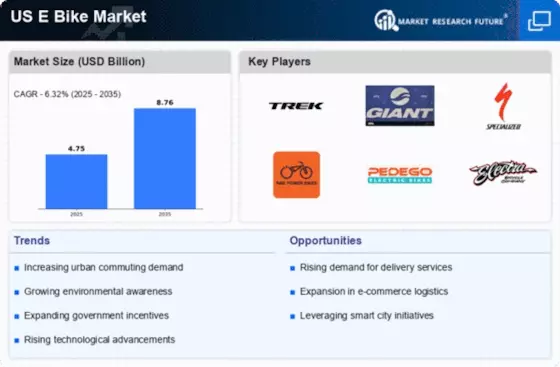
As per analysis, the US E Bike Market is projected to grow from USD 4.78 Billion in 2025 to USD 8.76 Billion by 2035, exhibiting a compound annual growth rate (CAGR) of 6.32% during the forecast period (2025 - 2035).

Key Market Trends & Highlights

The US E Bike Market is experiencing robust growth driven by evolving consumer preferences and technological innovations.

  • The largest segment in the US E Bike Market is commuting, reflecting a shift towards sustainable transportation solutions.
  • Delivery E Bikes represent the fastest-growing segment, catering to the increasing demand for efficient logistics and last-mile delivery.
  • Lithium-ion batteries dominate the market, while lead-acid batteries are emerging as the fastest-growing technology due to their cost-effectiveness.
  • Key market drivers include growing environmental awareness and urbanization, which are propelling the adoption of E Bikes across various demographics.

Market Size & Forecast

2024 Market Size 4.47 (USD Billion)
2035 Market Size 8.76 (USD Billion)
CAGR (2025 - 2035) 6.32%

Major Players

Trek Bicycle Corporation (US), Giant Manufacturing Co. Ltd. (TW), Specialized Bicycle Components (US), Rad Power Bikes (US), Pedego Electric Bikes (US), Electra Bicycle Company (US), Yamaha Motor Co. Ltd. (JP), Brompton Bicycle Ltd. (GB), Riese & Müller GmbH (DE)

Our Impact
Enabled $4.3B Revenue Impact for Fortune 500 and Leading Multinationals
Partnering with 2000+ Global Organizations Each Year
30K+ Citations by Top-Tier Firms in the Industry

US Electric Bike Market Trends

The US E Bike Market is currently experiencing a notable transformation, driven by a confluence of factors including environmental awareness, urbanization, and advancements in technology. As consumers increasingly seek sustainable transportation options, electric bicycles have emerged as a viable alternative to traditional vehicles. This shift is further supported by government initiatives aimed at promoting clean energy and reducing carbon emissions. Consequently, the market is witnessing a surge in demand, with various stakeholders, including manufacturers and retailers, adapting their strategies to cater to this evolving landscape. Moreover, the US E Bike Market is characterized by a diverse range of products, appealing to different consumer segments. From commuter bikes designed for urban travel to high-performance models for recreational use, the variety available is expanding. This diversification is likely to attract a broader audience, including younger demographics and those seeking eco-friendly alternatives. As infrastructure for cycling continues to improve, the potential for growth in this sector appears promising, suggesting a robust future for electric bicycles in the United States.

Increased Adoption of E Bikes for Commuting

The trend of utilizing electric bicycles for daily commuting is gaining traction among urban dwellers. This shift is influenced by rising fuel costs and a growing emphasis on reducing traffic congestion. As cities enhance cycling infrastructure, more individuals are likely to consider e bikes as a practical solution for their transportation needs.

Technological Advancements in E Bike Design

Innovations in battery technology and motor efficiency are significantly enhancing the performance of electric bicycles. These advancements not only improve the riding experience but also extend the range and durability of e bikes. As manufacturers continue to invest in research and development, consumers can expect increasingly sophisticated models.

Government Incentives for E Bike Purchases

Various state and local governments are implementing incentive programs to encourage the adoption of electric bicycles. These initiatives may include tax credits, rebates, or grants aimed at reducing the financial burden on consumers. Such support is likely to stimulate interest and increase sales within the US E Bike Market.

US Electric Bike Market Drivers

Health and Fitness Trends

The growing emphasis on health and fitness in the United States is another driver propelling the US E Bike Market. Many consumers are becoming more health-conscious and are seeking ways to incorporate physical activity into their daily routines. E bikes provide an appealing option, as they allow riders to engage in exercise while still enjoying the convenience of electric assistance. Recent surveys indicate that a significant percentage of e bike users report improved physical fitness and overall well-being. This trend suggests that e bikes are not merely a mode of transportation but also a tool for promoting a healthier lifestyle. As health and fitness trends continue to gain traction, the US E Bike Market is likely to see sustained growth.

Growing Environmental Awareness

The US E Bike Market appears to be significantly influenced by the increasing environmental consciousness among consumers. As awareness of climate change and pollution rises, many individuals are seeking sustainable transportation alternatives. E bikes, which produce zero emissions during operation, are becoming a preferred choice for eco-conscious consumers. According to recent data, the demand for electric bicycles has surged, with sales increasing by over 30% in the past year alone. This trend suggests that consumers are not only looking for efficient commuting options but also for ways to reduce their carbon footprint. The US E Bike Market is likely to continue benefiting from this growing environmental awareness, as more people recognize the advantages of e bikes in promoting a cleaner, greener lifestyle.

Advancements in Battery Technology

Technological advancements in battery technology are playing a crucial role in the evolution of the US E Bike Market. Improved battery efficiency and longevity are enhancing the overall performance of e bikes, making them more appealing to consumers. Recent innovations have led to lighter, more powerful batteries that can support longer rides and faster charging times. This progress is likely to address one of the primary concerns of potential e bike buyers: range anxiety. As battery technology continues to advance, it is expected that the US E Bike Market will attract a broader audience, including those who may have previously been hesitant to adopt e bikes due to concerns about battery life and performance.

Urbanization and Traffic Congestion

The rapid urbanization in the United States is contributing to the growth of the US E Bike Market. As cities expand and populations increase, traffic congestion has become a pressing issue. E bikes offer a practical solution to this problem, allowing commuters to navigate through congested urban areas more efficiently. Data indicates that urban areas with high traffic congestion have seen a notable rise in e bike usage, as they provide a faster and more convenient mode of transportation. Furthermore, cities are increasingly investing in bike lanes and infrastructure to accommodate this trend, which may further enhance the appeal of e bikes. The US E Bike Market is thus poised to thrive as urbanization continues to shape transportation preferences.

Expansion of E Bike Retail and Rental Services

The expansion of retail and rental services for e bikes is significantly impacting the US E Bike Market. As more retailers begin to offer e bikes, consumers have greater access to a variety of models and price points. Additionally, the rise of e bike rental services in urban areas is making it easier for individuals to experience e biking without the commitment of a purchase. Data shows that e bike rentals have increased by over 40% in major cities, indicating a growing interest in this mode of transportation. This trend not only introduces more people to e biking but also fosters a culture of cycling in urban environments. The US E Bike Market is likely to benefit from this expansion, as increased accessibility may lead to higher adoption rates.


Market Segment Insights

By Application: Commuting (Largest) vs. Delivery (Fastest-Growing)

In the US E Bike Market, the application segment shows a diverse distribution, with commuting taking the largest share. This reflects the growing trend of urban dwellers seeking efficient alternatives to traditional commuting methods. On the other hand, the delivery segment is making significant strides, as businesses increasingly turn to e-bikes for sustainable and cost-effective delivery solutions. Each application caters to specific user needs, driving a broad spectrum of market engagement.

Commuting (Dominant) vs. Delivery (Emerging)

The commuting segment stands as the dominant force in the US E Bike Market, appealing to a wide range of consumers who prioritize convenience and efficiency in urban settings. It encompasses daily commuters who use e-bikes to navigate congested traffic and reduce dependence on cars. Conversely, the delivery segment is emerging rapidly, propelled by the rise of e-commerce and the demand for last-mile delivery solutions. This segment focuses on businesses utilizing e-bikes for efficient parcel delivery, appealing to eco-conscious customers while optimizing logistics. Both segments showcase distinct characteristics, with commuting anchored in personal transportation and delivery rooted in business logistics.

By Battery Type: Lithium-ion (Largest) vs. Lead-acid (Fastest-Growing)

In the US E Bike Market, the battery type segment showcases a varied distribution among Lithium-ion, Lead-acid, Nickel-metal Hydride, and Lithium Polymer. Lithium-ion batteries have emerged as the largest segment due to their superior energy density, lightweight composition, and longer life cycles, solidifying their dominance in e-bike applications. Meanwhile, Lead-acid batteries, while historically preferred for their lower initial cost, are witnessing a resurgence as advancements in technology enhance their efficiency and performance, leading to an increase in their market share. The growth trends in the battery type segment are significantly influenced by technological advancements and changing consumer preferences. Lithium-ion is favored for high-performance e-bikes, catering to a growing demand for quality and longevity. On the other hand, Lead-acid batteries are experiencing a revival as consumers seek cost-effective and reliable options, particularly in lower-end e-bike models. The evolving landscape suggests that while Lithium-ion remains dominant, Lead-acid batteries are ideally positioned for growth, appealing to budget-conscious consumers and driving their uptake in the market.

Battery Type: Lithium-ion (Dominant) vs. Lead-acid (Emerging)

Lithium-ion batteries are widely recognized as the dominant battery type in the US E Bike Market due to their advantages such as high energy density, lightweight, and long cycle life. These batteries enable e-bikes to achieve longer ranges on a single charge and faster speeds, making them ideal for urban commuters and recreational users seeking performance and efficiency. In contrast, Lead-acid batteries, traditionally associated with lower-cost e-bike models, are emerging as an appealing option for buyers prioritizing affordability. Improvements in the efficiency and technology of Lead-acid batteries have made them more viable, particularly for entry-level e-bikes, thus creating an alternative pathway for consumers looking for budget-friendly solutions without compromising too much on performance.

By Motor Type: Hub Motor (Largest) vs. Mid-drive Motor (Fastest-Growing)

In the US E Bike Market, the distribution of motor types shows that the Hub Motor segment dominates, owing to its widespread adoption and ease of use. This segment appeals to casual riders and is prevalent in lower-cost electric bikes. In contrast, the Mid-drive Motor segment, while currently smaller, is rapidly gaining traction among more performance-oriented consumers who prioritize weight distribution and efficiency. The growth of mid-drive motors is driven by innovations in technology and a surge in consumer interest in more specialized e-biking experiences. As e-bikes become increasingly recognized for both commuting and recreational use, mid-drive motors are favored for their ability to provide smoother acceleration and better hill-climbing capabilities, making them the preferred choice for enthusiasts.

Hub Motor (Dominant) vs. Mid-drive Motor (Emerging)

The Hub Motor remains the dominant player in the US E Bike market due to its simplicity and affordability, making it a popular choice for entry-level e-bikes. These motors, located in the wheel hub, provide a straightforward solution for everyday commuting and recreational rides. However, the Mid-drive Motor is emerging, capturing a segment of consumers seeking premium performance. Positioned at the bike's center, mid-drive motors benefit from the bike's gears for efficiency, providing better handling and ride quality, particularly on hills. As e-bike users become more discerning, the advantages of mid-drive technology could lead to a shift in consumer preference towards this more sophisticated option.

By Price Range: Mid-range (Largest) vs. Premium (Fastest-Growing)

In the US e-bike market, the price range segment is notably diverse, encompassing budget, mid-range, premium, and luxury offerings. Mid-range e-bikes capture the largest market share due to their balanced features, affordability, and appeal to a broad consumer base. Meanwhile, the premium segment, while smaller, is experiencing rapid growth as consumers increasingly seek advanced features and superior build quality, reflecting a shift towards higher-investment options that promise enhanced performance. The growth in these segments is driven by several factors, including an increased awareness of environmental sustainability, the rising demand for personal mobility solutions, and the desire for healthier lifestyle choices. Additionally, advancements in battery technology and design aesthetics are encouraging consumers to invest in higher-priced options. As more individuals recognize the long-term value in premium e-bikes, this segment is expected to expand significantly in the coming years.

Mid-range (Dominant) vs. Premium (Emerging)

The mid-range e-bike segment stands out as the dominant player in the US market, characterized by its appealing balance of features and price. Typically priced between budget and premium models, these e-bikes offer a range of functionalities that cater to everyday commuters and recreational riders alike, making them highly attractive to a diverse population. On the other hand, the premium segment is emerging as a noteworthy competitor, appealing to enthusiasts and dedicated riders who prioritize performance and quality over cost. Premium e-bikes often feature advanced technologies, superior materials, and enhanced ride experiences, thus justifying their higher price points. As consumer preferences evolve, the competition between these two segments is likely to intensify, with each catering to distinct yet overlapping audiences.

By User Demographics: Age Group (Largest) vs. Lifestyle (Fastest-Growing)

In the US E Bike Market, the Age Group segment commands the largest market share, with younger consumers, particularly those aged 18-34, showing a significant preference for e-bikes. This demographic's engagement is driven by the benefits of eco-friendliness and convenience. In contrast, Lifestyle segments like urban commuters and health-conscious individuals are emerging, with rapid growth indicating a shift in consumer behavior towards e-bikes as a viable mode of transportation and exercise.

Age Group: 18-34 (Dominant) vs. Lifestyle: Urban Commuters (Emerging)

The dominant Age Group segment comprises primarily younger riders aged 18-34, characterized by their tech-savviness and inclination towards sustainable alternatives for transportation. This segment is motivated by environmental concerns and an active lifestyle, often relying on e-bikes for commuting and recreational activities. Conversely, the Emerging Lifestyle segment of urban commuters is rapidly growing, as higher city populations and increasing traffic congestion drive the need for efficient and eco-friendly transport solutions. Urban commuters perceive e-bikes not only as a cost-effective alternative to cars but also as a way to navigate urban environments effectively.

Get more detailed insights about US Electric Bike Market

Key Players and Competitive Insights

The E Bike Market in the US is currently characterized by a dynamic competitive landscape, driven by increasing consumer demand for sustainable transportation solutions and advancements in battery technology. Key players such as Trek Bicycle Corporation (US), Rad Power Bikes (US), and Yamaha Motor Co. Ltd. (JP) are strategically positioning themselves through innovation and regional expansion. Trek Bicycle Corporation (US) focuses on enhancing its product offerings with cutting-edge technology, while Rad Power Bikes (US) emphasizes affordability and accessibility, appealing to a broader consumer base. Yamaha Motor Co. Ltd. (JP) leverages its expertise in motor technology to enhance performance, thereby shaping a competitive environment that prioritizes technological advancement and consumer-centric solutions.

In terms of business tactics, companies are increasingly localizing manufacturing to mitigate supply chain disruptions and optimize operational efficiency. The market structure appears moderately fragmented, with several players vying for market share. This fragmentation allows for diverse consumer choices but also intensifies competition among key players, who are compelled to innovate continuously to maintain their market positions.

In December 2025, Trek Bicycle Corporation (US) announced a partnership with a leading battery manufacturer to develop next-generation battery systems aimed at extending the range of their e-bikes. This strategic move is likely to enhance Trek's competitive edge by addressing one of the primary consumer concerns regarding e-bike range anxiety, thereby potentially increasing market penetration.

In November 2025, Rad Power Bikes (US) launched a new line of e-bikes specifically designed for urban commuting, featuring integrated smart technology for navigation and theft prevention. This initiative not only aligns with the growing trend of urbanization but also positions Rad Power Bikes as a forward-thinking player in the market, likely attracting tech-savvy consumers looking for convenience and security in their commuting solutions.

In October 2025, Yamaha Motor Co. Ltd. (JP) unveiled a new lightweight motor system that significantly reduces the overall weight of e-bikes while maintaining high performance. This innovation is crucial as it addresses consumer preferences for lighter, more agile bikes, potentially reshaping the competitive landscape by setting new performance benchmarks that other manufacturers may strive to meet.

As of January 2026, the E Bike Market is witnessing trends such as digitalization, sustainability, and the integration of AI technologies, which are redefining competitive dynamics. Strategic alliances among manufacturers and technology firms are becoming increasingly prevalent, fostering innovation and enhancing product offerings. The competitive differentiation is likely to evolve from traditional price-based competition to a focus on technological innovation, supply chain reliability, and sustainability, as companies seek to meet the growing consumer demand for eco-friendly transportation solutions.

Key Companies in the US Electric Bike Market include

Future Outlook

US Electric Bike Market Future Outlook

The US E Bike Market is projected to grow at a 6.32% CAGR from 2025 to 2035, driven by urbanization, environmental concerns, and technological advancements.

New opportunities lie in:

  • Expansion of subscription-based E bike services for urban commuters.
  • Development of smart E bikes with integrated IoT features.
  • Partnerships with local governments for public E bike sharing programs.

By 2035, the E Bike Market is expected to be robust, reflecting substantial growth and innovation.

Market Segmentation

US Electric Bike Market Motor Type Outlook

  • Hub Motor
  • Mid-drive Motor
  • Geared Motor
  • Belt Drive Motor

US Electric Bike Market Application Outlook

  • Commuting
  • Recreational
  • Delivery
  • Tourism
  • Fitness

US Electric Bike Market Price Range Outlook

  • Budget
  • Mid-range
  • Premium
  • Luxury

US Electric Bike Market Battery Type Outlook

  • Lithium-ion
  • Lead-acid
  • Nickel-metal Hydride
  • Lithium Polymer

US Electric Bike Market User Demographics Outlook

  • Age Group
  • Gender
  • Income Level
  • Lifestyle

Report Scope

MARKET SIZE 20244.47(USD Billion)
MARKET SIZE 20254.78(USD Billion)
MARKET SIZE 20358.76(USD Billion)
COMPOUND ANNUAL GROWTH RATE (CAGR)6.32% (2024 - 2035)
REPORT COVERAGERevenue Forecast, Competitive Landscape, Growth Factors, and Trends
BASE YEAR2024
Market Forecast Period2025 - 2035
Historical Data2019 - 2024
Market Forecast UnitsUSD Billion
Key Companies ProfiledTrek Bicycle Corporation (US), Giant Manufacturing Co. Ltd. (TW), Specialized Bicycle Components (US), Rad Power Bikes (US), Pedego Electric Bikes (US), Electra Bicycle Company (US), Yamaha Motor Co. Ltd. (JP), Brompton Bicycle Ltd. (GB), Riese & Müller GmbH (DE)
Segments CoveredApplication, Battery Type, Motor Type, Price Range, User Demographics
Key Market OpportunitiesGrowing demand for sustainable transportation solutions drives innovation in the US E Bike Market.
Key Market DynamicsRising consumer demand for sustainable transportation drives innovation and competition in the US E Bike Market.
Countries CoveredUS
Leave a Comment

FAQs

What is the current valuation of the US E Bike Market?

As of 2024, the US E Bike Market was valued at 4.47 USD Billion.

What is the projected market valuation for the US E Bike Market in 2035?

The market is projected to reach a valuation of 8.76 USD Billion by 2035.

What is the expected CAGR for the US E Bike Market during the forecast period 2025 - 2035?

The expected CAGR for the US E Bike Market during the forecast period 2025 - 2035 is 6.32%.

Which companies are considered key players in the US E Bike Market?

Key players in the market include Trek Bicycle Corporation, Giant Manufacturing Co. Ltd., and Specialized Bicycle Components.

What are the main applications driving the US E Bike Market?

The main applications include commuting, recreational use, delivery, tourism, and fitness.

How does the market segment by battery type look in terms of valuation?

In 2024, lithium-ion batteries accounted for 2.68 USD Billion, while lead-acid batteries contributed 0.89 USD Billion.

What is the valuation of the US E Bike Market by motor type?

The hub motor segment was valued at 1.34 USD Billion in 2024, with mid-drive motors at 1.78 USD Billion.

What price ranges are available in the US E Bike Market?

The market segments by price range include budget, mid-range, premium, and luxury, with premium bikes valued at 1.78 USD Billion in 2024.

How does user demographics influence the US E Bike Market?

User demographics, including age group, gender, income level, and lifestyle, contributed to a valuation of 1.96 USD Billion in 2024.

What trends are expected in the US E Bike Market by 2035?

By 2035, the market is likely to see substantial growth across all segments, particularly in applications like commuting and recreational use.

Download Free Sample

Kindly complete the form below to receive a free sample of this Report

Compare Licence

×
Features License Type
Single User Multiuser License Enterprise User
Price $4,950 $5,950 $7,250
Maximum User Access Limit 1 User Upto 10 Users Unrestricted Access Throughout the Organization
Free Customization
Direct Access to Analyst
Deliverable Format
Platform Access
Discount on Next Purchase 10% 15% 15%
Printable Versions