×
Request Free Sample ×

Kindly complete the form below to receive a free sample of this Report

* Please use a valid business email

Leading companies partner with us for data-driven Insights

clients tt-cursor
Hero Background
English
Chinese
French
Japanese
Korean
German
Spanish

UPS Battery Market Trends

ID: MRFR/EnP/8981-CR
128 Pages
Chitranshi Jaiswal
December 2024

UPS Battery Market Research Report Information By Rating (5KVA, 5-<50KVA, 50-200KVA, and >200KVA) By Product Type (Off-Line/Standby, Line-Interactive, and Online/Double Conversion) By Battery Type (Lithium-Ion UPS Batteries, Lead-Acid UPS Batteries, Nickel-Cadmium UPS Batteries, and Others) By Application (Telecommunications, Data Centers and IT Infrastructure, Healthcare, Manufacturing and Industrial Processes, Financial Institutions, Military and Defense, and Others) and By Region -Global Forecast to 2035

Share:
Download PDF ×

We do not share your information with anyone. However, we may send you emails based on your report interest from time to time. You may contact us at any time to opt-out.

UPS Battery Market Infographic
Purchase Options

Market Trends

Key Emerging Trends in the UPS Battery Market

The UPS (Uninterruptible Power Supply) battery market is seeing a few striking patterns that are reshaping the business scene. One obvious example is the rising gathering of lithium-molecule batteries in UPS systems. When contrasted with traditional lead-corrosive batteries, lithium-particle batteries offer benefits like a higher energy thickness, a more drawn-out life expectancy, and faster charging times. Hence, associations and individuals are choosing UPS game plans furnished with lithium-molecule batteries to ensure more successful and strong power support.

Another critical pattern is the ascent of measured UPS frameworks. Users can easily scale their power infrastructure by adding or removing individual modules in modular UPS designs. This adaptability not just improves the flexibility of UPS answers for shifting power needs yet additionally works on support and updates. Organizations are progressively going to particular UPS frameworks to address the unique idea of their power prerequisites and to guarantee a savvy and versatile way to deal with power security.

Distributed computing and edge figuring are impacting the UPS battery market, with a developing interest for UPS arrangements custom fitted to the one-of-a-kind necessities of server farms and edge processing offices. These offices require strong power security to guarantee continuous activities, and UPS frameworks intended for high dependability and adaptability are becoming fundamental parts of their foundation. The rising digitalization of administrations and the extension of server farms overall add to the rising interest for UPS batteries advanced for these conditions.

Energy capacity incorporation is arising as a pattern those lines up with the more extensive shift toward environmentally friendly power sources. Users can store excess energy generated from renewable sources and use it during peak demand or power outages by integrating UPS systems with energy storage solutions. This pattern mirrors a more extensive industry accentuation on supportability and the coordination of UPS frameworks into savvy networks and sustainable power environments.

The UPS battery market is being significantly influenced by the Internet of Things (IoT). IoT-empowered UPS frameworks offer constant observing, prescient examination, and far off administration capacities. This upgrades the productivity of the executives as well as empowers proactive support, diminishing the gamble of startling disappointments. The general trend toward digitization and connectivity across a variety of industries is in line with the incorporation of IoT technologies into UPS batteries.

Online protection concerns are impacting the UPS battery market also. With a rising number of associated gadgets and frameworks, there is a developing consciousness of the weaknesses related with digital dangers. In order to safeguard critical infrastructure from potential cyberattacks, enhanced cybersecurity features are currently being designed into UPS systems. This pattern highlights the significance of network safety in the advancing scene of force assurance.

A shift toward UPS solutions that are more energy efficient is also reflected in market trends. As organizations and people focus on manageability and energy protection, there is a developing interest for UPS frameworks that work with high energy proficiency. Producers are answering by creating UPS batteries that limit energy misfortunes and lessen the by and large natural effect, lining up with the worldwide push for green and reasonable innovations.

In outline, the UPS battery market is encountering a few important patterns, including the reception of lithium-particle batteries, the ascent of secluded UPS frameworks, an attention on server farm and edge figuring arrangements, combination with energy capacity, the effect of IoT advancements, network safety contemplations, and a developing accentuation on energy proficiency. These patterns all in all features the powerful idea of the UPS battery market as it develops to meet the changing necessities of enterprises, organizations, and people in an undeniably digitized and interconnected world.

Author
Chitranshi Jaiswal
Research Analyst Level I

In her 3 years of experience in the market research field, she has handled critical cross-domain projects. She has an in-depth knowledge of market estimation & analysis, problem-solving, primary as well as secondary research, and team management.She holds an engineering degree and is an MBA professional from a well-known university, capable of evaluating the market and competitive conditions. An exceptional strategist with excellent communication skills and a passion for delivering cutting-edge & practical insights for the market. Proficient in multi-tasking, and can successfully deal with competing demands, while maintaining complete confidentiality. Generated business through active client and project development, networking, and high-quality responses. Her knowledge and skills have helped in making solid business decisions, securing funding from investors, and avoiding business failures.

Leave a Comment

FAQs

How much is the UPS Battery Market?

US$ 8562.46 Mn

What is the growth rate of the UPS Battery Market?

4.9%

Which region held the largest market share in the UPS Battery Market?

North America

Who are the key players in the UPS Battery Market?

ABB, Makvolt Power, Socomec, KStar Corporation, East Group, Schneider Electric, Emerson Electric, Eaton Corporation, Toshiba Corporation and Siemens

Which Rating had the largest market share in the UPS Battery Market?

5-&lt;50KVA

Which Product Type had the largest market share in the UPS Battery Market?

Off-Line/Standby

Which Battery Type had the largest market share in the UPS Battery Market?

Lead-Acid UPS Batteries

Which Application had the largest market share in the UPS Battery Market?

Data Centers and IT Infrastructure

Market Summary

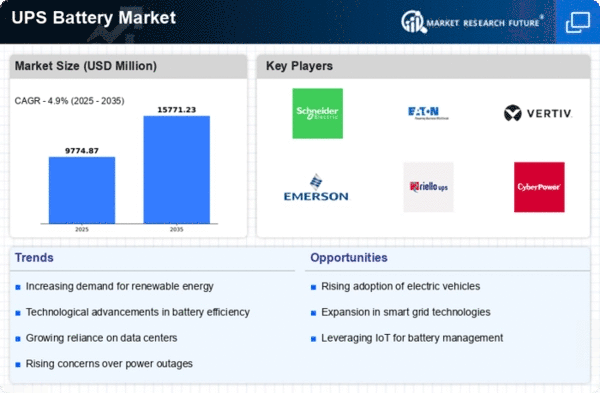
As per MRFR analysis, the UPS Battery Market Size was estimated at 9318.27 USD Million in 2024. The UPS Battery industry is projected to grow from 9774.87 USD Million in 2025 to 15771.23 USD Million by 2035, exhibiting a compound annual growth rate (CAGR) of 4.9% during the forecast period 2025 - 2035.

Key Market Trends & Highlights

The UPS Battery Market is experiencing a transformative shift towards advanced technologies and sustainability.

  • The market is witnessing a notable shift towards lithium-ion batteries, driven by their efficiency and longevity. Integration of smart technologies is enhancing the functionality and monitoring capabilities of UPS systems. Sustainability and energy efficiency are becoming focal points for manufacturers, aligning with global environmental goals. The increasing demand for uninterrupted power supply and regulatory support for energy storage solutions are key drivers propelling market growth.

Market Size & Forecast

2024 Market Size 9318.27 (USD Million)
2035 Market Size 15771.23 (USD Million)
CAGR (2025 - 2035) 4.9%
Largest Regional Market Share in 2024 North America

Major Players

<a href="https://www.se.com/in/en/product-subcategory/8070-ups-replacement-batteries/">Schneider Electric</a> (FR), Eaton (US), Vertiv (US), Emerson Electric (US), Riello UPS (IT), CyberPower Systems (TW), Tripp Lite (US), APC by Schneider Electric (FR), <a href="https://www.numericups.com/products?type=three-phase-ups">Legrand</a> (FR)

Market Trends

The UPS Battery Market is currently experiencing a dynamic evolution, driven by the increasing reliance on uninterrupted power supply systems across various sectors. This market encompasses a diverse range of battery technologies, including lead-acid, lithium-ion, and others, each offering distinct advantages and applications. As industries continue to prioritize energy efficiency and sustainability, the demand for advanced UPS battery solutions appears to be on the rise. Furthermore, the growing integration of renewable energy sources into power systems is likely to influence the development of UPS batteries, as these systems require reliable backup solutions to ensure consistent energy availability. In addition, the UPS Battery Market is witnessing a shift towards smart technologies, which enhance monitoring and management capabilities. This trend suggests that consumers are increasingly seeking solutions that not only provide power backup but also offer intelligent features for performance optimization. The emphasis on reducing carbon footprints and enhancing energy storage capabilities may further propel innovation within this sector. Overall, the UPS Battery Market seems poised for substantial growth, driven by technological advancements and evolving consumer preferences.

Shift Towards Lithium-Ion Batteries

The UPS Battery Market is observing a notable transition from traditional lead-acid batteries to lithium-ion alternatives. This shift is primarily attributed to the superior energy density, longer lifespan, and reduced maintenance requirements of lithium-ion technology. As businesses seek more efficient and reliable power solutions, the adoption of lithium-ion batteries appears to be gaining momentum.

Integration of Smart Technologies

The incorporation of smart technologies into UPS systems is becoming increasingly prevalent. These innovations enable enhanced monitoring, diagnostics, and management of battery performance. As users demand more sophisticated solutions that provide real-time data and analytics, the UPS Battery Market is likely to see a rise in products equipped with these advanced features.

Focus on Sustainability and Energy Efficiency

There is a growing emphasis on sustainability within the UPS Battery Market, as consumers and businesses alike prioritize eco-friendly solutions. This trend indicates a shift towards batteries that not only deliver reliable power but also minimize environmental impact. Manufacturers are increasingly developing products that align with energy efficiency goals, reflecting a broader commitment to sustainable practices.

UPS Battery Market Market Drivers

Rising Demand for Uninterrupted Power Supply

The increasing reliance on electronic devices across various sectors drives the demand for uninterrupted power supply solutions. As businesses and consumers seek to protect their critical systems from power outages, the Global UPS Battery Market Industry is poised for growth. In 2024, the market is valued at 9.32 USD Billion, reflecting a robust need for reliable power solutions. Industries such as healthcare, telecommunications, and data centers are particularly affected, as any disruption can lead to significant financial losses. This trend suggests a sustained investment in UPS systems to ensure operational continuity.

Market Segment Insights

By Application: Data Center (Largest) vs. Telecommunications (Fastest-Growing)

The UPS Battery Market demonstrates diverse application segments, with Data Centers holding the largest share due to their critical reliance on uninterrupted power supply for data management and storage. Telecommunications also plays a vital role, as both sectors demand reliability, although the latter is witnessing rapid growth given the expansion of network infrastructure and the need for backup systems to support increasing data traffic.

Data Center (Dominant) vs. Telecommunications (Emerging)

In the UPS Battery Market, Data Centers are recognized as the dominant application, primarily because of their need for reliable power to support server operations and data integrity. Their infrastructure demands high-capacity, efficient systems to manage power outages effectively. Conversely, the Telecommunications sector is emerging rapidly, propelled by the rise of 5G technologies and the increased reliance on remote communication systems. Telecommunication facilities require dependable battery systems to maintain service continuity, making them a focus for innovation in UPS solutions.

By End Use: Residential (Largest) vs. Industrial (Fastest-Growing)

In the UPS battery market, the end-use segment reflects a diverse landscape with significant variations in market share. The residential sector holds the largest share, driven by increasing adoption of home automation systems and energy storage solutions. Following closely are the commercial and industrial sectors, which are experiencing robust demand due to rising reliance on uninterrupted power supply solutions in business operations. Government and educational sectors also contribute meaningfully but occupy smaller portions of the market.

Residential (Dominant) vs. Industrial (Emerging)

The residential sector is characterized by a growing trend of homeowners seeking reliable <a href="https://www.marketresearchfuture.com/reports/backup-power-market-10749">backup power</a> systems for their homes, particularly amidst rising power outages and the increasing prevalence of smart home technologies. As the dominant segment, it benefits from consumer preferences shifting towards energy resilience. Conversely, the industrial segment is seen as an emerging market, with rapid growth attributed to the expansion of manufacturing and data center operations that require consistent power supply. This segment is leveraging advanced technologies to enhance performance and efficiency, positioning itself strongly within the UPS battery market.

By Battery Type: Lead Acid (Largest) vs. Lithium Ion (Fastest-Growing)

In the UPS battery market, the Lead Acid segment dominates the landscape, accounting for a significant portion of the overall market share. This traditional battery type is favored for its reliability and cost-effectiveness, making it a go-to choice for many applications, particularly in industrial settings. Conversely, the Lithium Ion segment is gaining traction rapidly, benefitting from advancements in technology and a growing demand for energy-efficient solutions in various sectors such as telecommunications and data centers. The growth trends in the UPS battery market are closely linked to the increasing reliance on uninterrupted power supply systems across multiple industries. Factors such as rising energy consumption, the need for backup power during outages, and a shift towards renewable energy sources are propelling the demand for advanced battery solutions. Lithium Ion batteries, in particular, are experiencing robust growth due to their high energy density, longer lifespan, and decreasing costs, positioning them as the preferred choice for new installations and upgrades.

Lead Acid (Dominant) vs. Nickel Cadmium (Emerging)

The <a href="https://www.marketresearchfuture.com/reports/lead-acid-battery-market-5055">Lead Acid battery </a>segment remains dominant in the UPS battery market due to its established presence and widespread acceptance across various industries. Known for its durability and low initial cost, Lead Acid batteries are extensively used in traditional UPS systems. On the other hand, Nickel Cadmium batteries are emerging as a viable alternative, particularly in applications requiring reliable performance in extreme conditions. Their ability to operate efficiently at low temperatures and withstand deep discharges gives them an edge in specific sectors. However, the higher initial cost and environmental concerns regarding cadmium use are challenges that Nickel Cadmium must overcome to capture a larger market share. Despite these challenges, their unique benefits continue to attract interest from niche markets.

By Technology: Online UPS (Largest) vs. Delta Conversion UPS (Fastest-Growing)

In the UPS Battery Market, the segment values exhibit distinct market share distribution. The Online UPS segment stands out as the largest, capturing a significant portion of the market due to its efficiency in providing uninterrupted power supply. Other notable segments include Offline UPS and Line-Interactive UPS, which cater to varied consumer needs, while Modular UPS is gaining traction among businesses seeking scalable solutions.

Technology: Online UPS (Dominant) vs. Delta Conversion UPS (Emerging)

The Online UPS segment is characterized by its ability to provide continuous power and protect against various power disturbances, making it a popular choice in critical applications. Meanwhile, Delta Conversion UPS technology, recognized for its energy efficiency and innovative design, is rapidly gaining popularity as an emerging alternative. This type offers lower operational costs and enhanced performance, catering to the increasing demand for sustainable solutions in modern data centers and commercial environments.

Get more detailed insights about UPS Battery Market Research Report - Global Forecast till 2035

Regional Insights

North America : Market Leader in UPS Batteries

North America is poised to maintain its leadership in the UPS battery market, with a market size of $4650.0 million in 2025. The region's growth is driven by increasing demand for reliable power solutions across various sectors, including IT, healthcare, and manufacturing. Regulatory support for energy efficiency and sustainability initiatives further catalyzes market expansion, ensuring robust growth in the coming years. The competitive landscape is characterized by major players such as Eaton, Vertiv, and Emerson Electric, which are investing heavily in innovation and technology. The U.S. leads the market, supported by a strong infrastructure and a growing focus on renewable energy sources. This competitive environment fosters advancements in UPS technology, enhancing reliability and efficiency for end-users.

Europe : Emerging Market with Growth Potential

Europe's UPS battery market is projected to grow significantly, with a market size of $2900.0 million by 2025. The region is witnessing a surge in demand for uninterrupted power supply systems, driven by increasing digitalization and the need for energy security. Regulatory frameworks promoting renewable energy and energy efficiency are key growth catalysts, encouraging investments in UPS technologies. Leading countries in this market include Germany, France, and the UK, where major players like Schneider Electric and Riello UPS are actively enhancing their product offerings. The competitive landscape is evolving, with a focus on sustainable solutions and smart technologies. As the region transitions towards greener energy, UPS systems are becoming integral to maintaining power reliability in various sectors.

Asia-Pacific : Rapid Growth in Emerging Markets

APAC UPS Battery Market is witnessing rapid growth, with a market size of 1500.0.0. This growth is fueled by increasing industrialization, urbanization, and the rising demand for uninterrupted power supply in countries like China and India. 

Within this landscape, the China UPS Battery market continues to lead in manufacturing and domestic demand due to massive investments in cloud computing, while the India UPS Battery Market is emerging as a critical growth hub driven by government digitalization initiatives and industrial automation.  The competitive landscape is evolving, with local manufacturers also entering the fray, driving innovation and competitive pricing. As the region continues to develop its energy infrastructure, the UPS battery market is expected to grow significantly, catering to diverse sectors from IT to healthcare.

Middle East and Africa : Emerging Market with Unique Challenges

The Middle East and Africa (MEA) UPS battery market is gradually expanding, with a market size of $268.27 million anticipated by 2025. The growth is primarily driven by increasing investments in infrastructure and the rising need for reliable power supply in sectors such as telecommunications and healthcare. Regulatory support for energy efficiency and sustainability initiatives is also fostering market development in this region. Leading countries include South Africa and the UAE, where key players like Legrand are establishing a strong presence. The competitive landscape is characterized by a mix of local and international companies, focusing on tailored solutions to meet regional demands. As the market matures, the emphasis on innovative and efficient UPS systems is expected to grow, addressing the unique challenges faced in the MEA region.

Key Players and Competitive Insights

The UPS Battery Market is currently characterized by a dynamic competitive landscape, driven by increasing demand for reliable power solutions across various sectors, including data centers, healthcare, and telecommunications. Key players such as Schneider Electric (FR), Eaton (US), and Vertiv (US) are strategically positioned to leverage innovation and technological advancements. Schneider Electric (FR) focuses on sustainability and digital transformation, while Eaton (US) emphasizes energy efficiency and smart grid solutions. Vertiv (US) is enhancing its operational focus on critical infrastructure, which collectively shapes a competitive environment that is increasingly reliant on technological differentiation and customer-centric solutions. In terms of business tactics, companies are localizing manufacturing to reduce lead times and optimize supply chains, which is particularly crucial in a market that is moderately fragmented. The competitive structure allows for both established players and emerging companies to coexist, with key players exerting significant influence over market trends and customer preferences. This collective influence fosters an environment where innovation and operational efficiency are paramount. In November 2025, Schneider Electric (FR) announced a partnership with a leading cloud service provider to enhance its UPS solutions with advanced AI capabilities. This strategic move is expected to improve energy management and predictive maintenance, thereby increasing the reliability of power systems. Such initiatives not only bolster Schneider's market position but also align with the growing trend towards smart energy solutions. In October 2025, Eaton (US) launched a new line of modular UPS systems designed for scalability and efficiency. This product introduction is significant as it addresses the evolving needs of data centers that require flexible power solutions. Eaton's focus on modularity reflects a broader industry trend towards customizable solutions that can adapt to varying power demands, thereby enhancing customer satisfaction and operational efficiency. In September 2025, Vertiv (US) expanded its manufacturing capabilities in Asia to meet the rising demand for UPS systems in the region. This expansion is strategically important as it positions Vertiv to capitalize on the growing market in Asia, where infrastructure development is accelerating. By increasing local production, Vertiv aims to reduce costs and improve delivery times, which are critical factors in maintaining a competitive edge. As of December 2025, the UPS Battery Market is witnessing trends such as digitalization, sustainability, and AI integration, which are redefining competitive dynamics. Strategic alliances are becoming increasingly prevalent, allowing companies to pool resources and expertise to enhance their offerings. The competitive differentiation is likely to evolve from traditional price-based competition to a focus on innovation, technology, and supply chain reliability, indicating a shift towards more sophisticated and customer-oriented solutions.

Key Companies in the UPS Battery Market include

Industry Developments

Future Outlook

UPS Battery Market Future Outlook

The UPS Battery Market is projected to grow at a 4.9% CAGR from 2025 to 2035, driven by increasing demand for reliable power solutions and advancements in battery technology.

New opportunities lie in:

  • <p>Expansion into renewable energy storage solutions Development of smart UPS systems with IoT integration Partnerships with data centers for customized battery solutions</p>

By 2035, the UPS Battery Market is expected to be robust, driven by innovation and strategic partnerships.

Market Segmentation

UPS Battery Market End Use Outlook

  • Residential
  • Commercial
  • Industrial
  • Government
  • Educational

UPS Battery Market Technology Outlook

  • Offline UPS
  • Online UPS
  • Line-Interactive UPS
  • Modular UPS
  • Delta Conversion UPS

UPS Battery Market Application Outlook

  • Data Center
  • Telecommunications
  • Industrial
  • Healthcare
  • Consumer Electronics

UPS Battery Market Battery Type Outlook

  • Lead Acid
  • Lithium Ion
  • Nickel Cadmium
  • Nickel Metal Hydride
  • Flow Battery

Report Scope

MARKET SIZE 2024 9318.27(USD Million)
MARKET SIZE 2025 9774.87(USD Million)
MARKET SIZE 2035 15771.23(USD Million)
COMPOUND ANNUAL GROWTH RATE (CAGR) 4.9% (2025 - 2035)
REPORT COVERAGE Revenue Forecast, Competitive Landscape, Growth Factors, and Trends
BASE YEAR 2024
Market Forecast Period 2025 - 2035
Historical Data 2019 - 2024
Market Forecast Units USD Million
Key Companies Profiled Schneider Electric (FR), Eaton (US), Vertiv (US), Emerson Electric (US), Riello UPS (IT), CyberPower Systems (TW), Tripp Lite (US), APC by Schneider Electric (FR), Legrand (FR)
Segments Covered Application, End Use, Battery Type, Technology
Key Market Opportunities Integration of renewable energy sources enhances growth potential in the UPS Battery Market.
Key Market Dynamics Rising demand for uninterrupted power supply drives innovation and competition in the UPS battery sector.
Countries Covered North America, Europe, APAC, South America, MEA

FAQs

How much is the UPS Battery Market?

US$ 8562.46 Mn

What is the growth rate of the UPS Battery Market?

4.9%

Which region held the largest market share in the UPS Battery Market?

North America

Who are the key players in the UPS Battery Market?

ABB, Makvolt Power, Socomec, KStar Corporation, East Group, Schneider Electric, Emerson Electric, Eaton Corporation, Toshiba Corporation and Siemens

Which Rating had the largest market share in the UPS Battery Market?

5-&lt;50KVA

Which Product Type had the largest market share in the UPS Battery Market?

Off-Line/Standby

Which Battery Type had the largest market share in the UPS Battery Market?

Lead-Acid UPS Batteries

Which Application had the largest market share in the UPS Battery Market?

Data Centers and IT Infrastructure

  1. SECTION I: EXECUTIVE SUMMARY AND KEY HIGHLIGHTS |
    1. EXECUTIVE SUMMARY |
      1. Market Overview |
      2. Key Findings |
      3. Market Segmentation |
      4. Competitive Landscape |
      5. Challenges and Opportunities |
      6. Future Outlook 2
  2. SECTION II: SCOPING, METHODOLOGY AND MARKET STRUCTURE |
    1. MARKET INTRODUCTION |
      1. Definition |
      2. Scope of the study |--
    2. RESEARCH METHODOLOGY |
      1. Overview |
      2. Data Mining |
      3. Secondary Research |
      4. Primary Research |--
      5. Forecasting Model |
      6. Market Size Estimation |--
      7. Data Triangulation |
      8. Validation 3
  3. SECTION III: QUALITATIVE ANALYSIS |
    1. MARKET DYNAMICS |
      1. Overview |
      2. Drivers |
      3. Restraints |
      4. Opportunities |
    2. MARKET FACTOR ANALYSIS |
      1. Value chain Analysis |
      2. Porter's Five Forces Analysis |--
      3. COVID-19 Impact Analysis |--
  4. SECTION IV: QUANTITATIVE ANALYSIS |
    1. Energy & Power, BY Application (USD Million) |
      1. Data Center |
      2. Telecommunications |
      3. Industrial |
      4. Healthcare |
      5. Consumer Electronics |
    2. Energy & Power, BY End Use (USD Million) |
      1. Residential |
      2. Commercial |
      3. Industrial |
      4. Government |
      5. Educational |
    3. Energy & Power, BY Battery Type (USD Million) |
      1. Lead Acid |
      2. Lithium Ion |
      3. Nickel Cadmium |
      4. Nickel Metal Hydride |
      5. Flow Battery |
    4. Energy & Power, BY Technology (USD Million) |
      1. Offline UPS |
      2. Online UPS |
      3. Line-Interactive UPS |
      4. Modular UPS |
      5. Delta Conversion UPS |
    5. Energy & Power, BY Region (USD Million) |
      1. North America |--
      2. Europe |--
      3. APAC |--
      4. South America |--
      5. MEA |--
  5. SECTION V: COMPETITIVE ANALYSIS |
    1. Competitive Landscape |
      1. Overview |
      2. Competitive Analysis |
      3. Market share Analysis |
      4. Major Growth Strategy in the Energy & Power |
      5. Competitive Benchmarking |
      6. Leading Players in Terms of Number of Developments in the Energy & Power |
      7. Key developments and growth strategies |--
      8. Major Players Financial Matrix |--
    2. Company Profiles |
      1. Schneider Electric (FR) |--
      2. Eaton (US) |--
      3. Vertiv (US) |--
      4. Emerson Electric (US) |--
      5. Riello UPS (IT) |--
      6. CyberPower Systems (TW) |--
      7. Tripp Lite (US) |--
      8. APC by Schneider Electric (FR) |--
      9. Legrand (FR) |--
    3. Appendix |
      1. References |
      2. Related Reports

Energy & Power Market Segmentation

Energy & Power By Application (USD Million, 2025-2035)

  • Data Center
  • Telecommunications
  • Industrial
  • Healthcare
  • Consumer Electronics

Energy & Power By End Use (USD Million, 2025-2035)

  • Residential
  • Commercial
  • Industrial
  • Government
  • Educational

Energy & Power By Battery Type (USD Million, 2025-2035)

  • Lead Acid
  • Lithium Ion
  • Nickel Cadmium
  • Nickel Metal Hydride
  • Flow Battery

Energy & Power By Technology (USD Million, 2025-2035)

  • Offline UPS
  • Online UPS
  • Line-Interactive UPS
  • Modular UPS
  • Delta Conversion UPS
Infographic

Free Sample Request

Kindly complete the form below to receive a free sample of this Report

Get Free Sample

Customer Strories

Compare Licence

×
Features License Type
Single User Multiuser License Enterprise User
Price $4,950 $5,950 $7,250
Maximum User Access Limit 1 User Upto 10 Users Unrestricted Access Throughout the Organization
Free Customization
Direct Access to Analyst
Deliverable Format
Platform Access
Discount on Next Purchase 10% 15% 15%
Printable Versions