Request Free Sample ×

Kindly complete the form below to receive a free sample of this Report

* Please use a valid business email

Leading companies partner with us for data-driven Insights

clients tt-cursor
Hero Background
English
Chinese
French
Japanese
Korean
German
Spanish

Upcycled Ingredients Market Trends

ID: MRFR/FnB/9969-CR
128 Pages
Garvit Vyas
April 2023

Upcycled Ingredients Market Size, Share, Industry Trend & Analysis Research Report Information By Ingredient Type (Upcycled Starch, Upcycled Proteins / Powder, Upcycled Flour, Upcycled Dietary Fiber, Upcycled Ethanol, Upcycled Oils, Upcycled Vitamins, Upcycled Electrolytes, Upcycled Antioxidants, and Upcycled Minerals), By Source (Plant-based {Seeds, Peels, Flowers, Fruits, and Grains}, Animal-based {Egg Shells, Animal Bones}), By End Use (Food & Beverages, Cosmetics and personal care, Nutraceuticals, And Others), And By - Forecast 2030

Share:
Download PDF ×

We do not share your information with anyone. However, we may send you emails based on your report interest from time to time. You may contact us at any time to opt-out.

Upcycled Ingredients Market Infographic
Purchase Options

Market Trends

Key Emerging Trends in the Upcycled Ingredients Market

The number of people around the world who can't digest lactose, a sugar found in milk, has been going up. When someone is lactose intolerant, it means their body doesn't have enough of the enzyme called lactase in the small intestine. This enzyme is important because it helps break down lactose into simpler sugars. If lactose isn't properly broken down, it can cause problems like bloating, stomach pain, diarrhea, tiredness, sleep issues, vomiting, and other health troubles.

Lactose intolerance can show up as an allergy to dairy products, a lack of disaccharides, or a deficiency in lactase. The rates of lactose intolerance can differ depending on a person's ethnicity. For example, African, American, and Asian ethnicities have a higher rate of 75% to 95% lactose intolerance, while northern Europeans have a lower rate at 18% to 26%.

Because of the widespread issue of lactose intolerance, many people are choosing alternatives to regular milk and dairy products. This has resulted in a higher demand for plant-based milk and its products.

Looking at the comparison table above, you can see the differences in nutrients between cow's milk, soy milk, and oat milk. Even though soy and oat milk are plant-based, they have a similar number of calories as cow's milk. However, cow's milk has much more sugar. The protein content in soy and cow's milk is about the same, but oat milk has the least amount of protein. Oat milk has a good number of calories but with low saturated fat and sugar. So, plant-based milk turns out to be rich in nutrients and a good option for those who can't have dairy milk.

As more people become aware of these alternatives and their benefits, the popularity and sales of plant-based milk and its derivatives are expected to keep growing. This not only addresses the needs of lactose intolerant individuals but also caters to a broader audience seeking healthier and varied dietary options.


Author
Author Profile
Garvit Vyas
Vice President - Operations

Garvit Vyas is a Research Analyst with experience in working across multiple industry domains in the market research sector. Over the past four years, he has been actively involved in analyzing diverse markets, gathering industry insights, and contributing to the development of comprehensive research reports. His work includes studying market trends, evaluating competitive landscapes, and supporting data-driven business insights. In the early phase of his career, Garvit worked on cross-domain research projects, which helped him build a strong foundation in market analysis, data interpretation, and industry intelligence across various sectors. Later, he transitioned into the Quality Control (QC) function, where he focuses on reviewing and refining research reports and marketing collaterals to ensure accuracy, consistency, and high editorial standards. His responsibilities include validating research data, improving report structure, and maintaining the overall quality of published content. Garvit is committed to maintaining strong research integrity and delivering reliable insights that support informed business decision-making.

Leave a Comment

FAQs

What is the current valuation of the upcycled ingredients market as of 2025?

<p>The upcycled ingredients market is valued at 5.2 USD Billion in 2024.</p>

What is the projected market size for upcycled ingredients by 2035?

<p>The market is expected to reach 12.6 USD Billion by 2035.</p>

What is the expected CAGR for the upcycled ingredients market during the forecast period 2025 - 2035?

<p>The anticipated CAGR for the upcycled ingredients market is 8.38% from 2025 to 2035.</p>

Which segments are expected to show significant growth in the upcycled ingredients market?

<p>Segments such as Food and Beverage, Cosmetics and Personal Care, and Animal Feed are projected to grow substantially.</p>

What are the leading companies in the upcycled ingredients market?

<p>Key players include Upcycled Food Co, ReGrained, and Renewal Mill, among others.</p>

How does the Food and Beverage segment perform in terms of market valuation?

<p>The Food and Beverage segment was valued at 1.8 USD Billion in 2024 and is projected to grow to 4.3 USD Billion.</p>

What is the market valuation for the Cosmetics and Personal Care segment?

<p>The Cosmetics and Personal Care segment was valued at 1.0 USD Billion in 2024 and is expected to reach 2.5 USD Billion.</p>

Which processing methods are anticipated to dominate the upcycled ingredients market?

<p>Extraction and Cold Pressing are likely to be dominant processing methods, with valuations projected at 1.5 USD Billion and 1.2 USD Billion respectively.</p>

What is the expected growth for the Fruits and Vegetables source material segment?

<p>The Fruits and Vegetables segment was valued at 1.5 USD Billion in 2024 and is projected to grow to 3.5 USD Billion.</p>

How is the market type segmentation expected to evolve by 2035?

<p>The B2B market type is projected to grow from 1.5 USD Billion in 2024 to 3.5 USD Billion by 2035.</p>

Market Summary

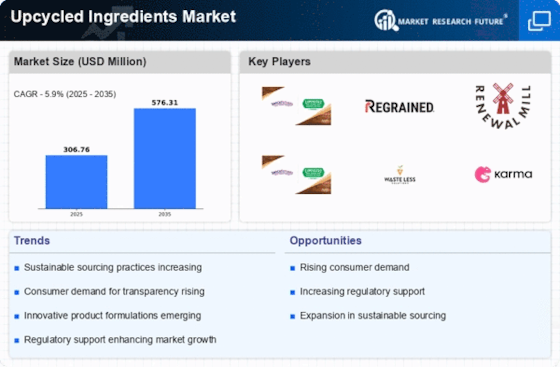
As per Market Research Future analysis, the Upcycled Ingredients Market Size was estimated at 306.76 USD Million in 2024. The Upcycled Ingredients industry is projected to grow from USD 324.86 Million in 2025 to USD 576.31 Million by 2035, exhibiting a compound annual growth rate (CAGR) of 5.9% during the forecast period 2025 - 2035

Key Market Trends & Highlights

The Upcycled Ingredients Market is experiencing robust growth driven by sustainability and innovation.

  • Consumer demand for sustainability is rising, influencing product offerings across various sectors. Innovation in product development is evident, particularly in the upcycled starch segment, which remains the largest. Regulatory support for sustainable practices is fostering growth in the Asia-Pacific region, the fastest-growing market. Rising awareness of food waste and the demand for clean label products are key drivers propelling market expansion.

Market Size & Forecast

2024 Market Size 306.76 (USD Million)
2035 Market Size 576.31 (USD Million)
CAGR (2025 - 2035) 5.9%
Largest Regional Market Share in 2024 North America

Major Players

Upcycled Foods (US), ReGrained (US), Renewal Mill (US), The Upcycled Food Company (US), Wasteless (IL), Karma (SE), FoodLoop (DE), Pulp Pantry (US)

Market Trends

The Upcycled Ingredients Market is currently experiencing a notable transformation, driven by increasing consumer awareness regarding sustainability and waste reduction. This market encompasses a diverse range of products derived from by-products or surplus materials that would otherwise be discarded. As environmental concerns gain traction, businesses are increasingly adopting upcycling practices, which not only contribute to resource conservation but also enhance brand reputation. The integration of upcycled ingredients into various sectors, including food and beverage, cosmetics, and textiles, reflects a broader shift towards circular economy principles. Companies are recognizing the potential of these ingredients to meet consumer demand for innovative and eco-friendly products, thereby fostering a more sustainable future. Moreover, the Upcycled Ingredients Market appears to be influenced by regulatory frameworks that encourage sustainable practices. Governments worldwide are implementing policies aimed at reducing waste and promoting the use of alternative materials. This regulatory support, combined with growing consumer preferences for ethically sourced products, suggests a promising outlook for the market. As more businesses explore the benefits of upcycling, the market is likely to expand, offering new opportunities for innovation and collaboration across industries. The ongoing evolution of consumer behavior and regulatory landscapes indicates that the Upcycled Ingredients Market is poised for continued growth in the coming years.

Rising Consumer Demand for Sustainability

There is an increasing preference among consumers for products that are environmentally friendly. This trend is driving companies to incorporate upcycled ingredients into their offerings, as consumers seek transparency and sustainability in their purchasing decisions.

Innovation in Product Development

The Upcycled Ingredients Market is witnessing a surge in innovative product formulations. Companies are exploring creative ways to utilize by-products, leading to the development of unique and appealing products that cater to diverse consumer needs.

Regulatory Support for Sustainable Practices

Governments are increasingly implementing policies that promote sustainability and waste reduction. This regulatory environment encourages businesses to adopt upcycling practices, thereby enhancing the growth potential of the Upcycled Ingredients Market.

Upcycled Ingredients Market Market Drivers

Rising Awareness of Food Waste

The increasing awareness of food waste among consumers and businesses is a pivotal driver for the Upcycled Ingredients Market. As individuals become more conscious of the environmental impact of food waste, they are actively seeking alternatives that reduce waste and promote sustainability. This shift in consumer behavior is reflected in market data, indicating that approximately 30 to 40% of food produced globally is wasted. Consequently, companies are innovating to create upcycled ingredients from surplus food, thereby addressing this pressing issue. The Upcycled Ingredients Market is likely to benefit from this trend, as brands that incorporate upcycled ingredients into their products can appeal to environmentally conscious consumers, potentially enhancing their market share and brand loyalty.

Support from Food Industry Initiatives

Various initiatives within the food industry are increasingly supporting the adoption of upcycled ingredients, thereby driving the Upcycled Ingredients Market. Organizations and coalitions are emerging to promote sustainable practices, encouraging food manufacturers to utilize by-products and surplus materials. For instance, initiatives aimed at reducing food waste have gained traction, with many companies committing to sustainability goals. Market data suggests that the upcycled food sector could reach a valuation of several billion dollars in the coming years, driven by these initiatives. As more companies align their practices with sustainability goals, the Upcycled Ingredients Market is likely to experience accelerated growth, fostering innovation and collaboration across the supply chain.

Growing Demand for Clean Label Products

The demand for clean label products is surging, significantly influencing the Upcycled Ingredients Market. Consumers are increasingly scrutinizing ingredient lists, favoring products that are transparent and free from artificial additives. This trend is evident in Market Research Future, which shows that over 60% of consumers prefer products with simple, recognizable ingredients. Upcycled ingredients often fit this criterion, as they are derived from natural sources and promote sustainability. As manufacturers respond to this demand by incorporating upcycled ingredients into their offerings, the Upcycled Ingredients Market is poised for growth. This alignment with consumer preferences not only enhances product appeal but also fosters a sense of trust and authenticity between brands and their customers.

Consumer Preference for Healthier Options

The growing consumer preference for healthier food options is a significant driver for the Upcycled Ingredients Market. As health consciousness rises, consumers are increasingly seeking products that not only taste good but also offer nutritional benefits. Upcycled ingredients often provide enhanced nutritional profiles, as they can be rich in fiber, vitamins, and minerals. Market analysis indicates that products featuring upcycled ingredients are gaining traction among health-focused consumers, with many brands highlighting these benefits in their marketing strategies. This trend suggests that the Upcycled Ingredients Market may continue to expand as more consumers prioritize health and wellness in their purchasing decisions, leading to increased demand for innovative, nutritious products.

Technological Advancements in Food Processing

Technological advancements in food processing are playing a crucial role in the evolution of the Upcycled Ingredients Market. Innovations in extraction and processing techniques enable manufacturers to efficiently convert food waste into valuable ingredients. These advancements not only enhance the quality and safety of upcycled ingredients but also improve their marketability. For instance, new methods of dehydration and fermentation are being utilized to create high-quality upcycled products. Market data indicates that the food processing technology sector is expected to grow significantly, which could further bolster the Upcycled Ingredients Market. As technology continues to evolve, it is likely that the efficiency and appeal of upcycled ingredients will increase, attracting more manufacturers and consumers alike.

Market Segment Insights

By Application: Food and Beverage (Largest) vs. Cosmetics and Personal Care (Fastest-Growing)

<p>The upcycled ingredients market is witnessing significant distribution across various applications, with the Food and Beverage sector taking the lead as the largest segment. This sector has embraced the incorporation of upcycled ingredients, appealing to environmentally conscious consumers and enhancing product formulations. Following closely are the Cosmetics and Personal Care segments, which are leveraging upcycled ingredients to promote sustainability and innovative beauty solutions. Animal Feed, Nutraceuticals, and Textiles also contribute to the market, though they hold smaller shares in comparison to the leaders. Growth trends indicate that the demand for upcycled ingredients is on an upward trajectory, particularly in the Cosmetics and Personal Care sector. This segment is driven by the increasing consumer preference for sustainable and ethical products. In contrast, the Food and Beverage sector continues to evolve, adapting to challenges and consumer expectations. Emerging applications in Animal Feed and Nutraceuticals are also expected to grow, fostering a broader acceptance of upcycled ingredients as a viable alternative in various industries.</p>

<p>Food and Beverage: (Dominant) vs. Cosmetics and Personal Care (Emerging)</p>

<p>The Food and Beverage sector stands as the dominant force in the upcycled ingredients market, characterized by its ability to integrate discarded food into new products, thus minimizing waste. This segment enjoys robust consumer backing due to its appeal for sustainability and health-consciousness. On the other hand, the Cosmetics and Personal Care segment is emerging rapidly, leveraging upcycled ingredients to enhance product offerings with innovative and potent formulations. Companies within this sector are focusing on unique selling propositions based on sustainability, which is attracting a segment of consumers increasingly concerned with environmental impact. Together, these segments drive growth and foster innovation, reflecting a larger trend toward eco-friendly and resource-efficient practices across industries.</p>

By Source Material: Fruits and Vegetables (Largest) vs. Meat and Seafood (Fastest-Growing)

<p>In the upcycled ingredients market, the source material segment is primarily dominated by Fruits and Vegetables, which hold the largest share due to their abundant availability and versatility in different applications. The market for grains and legumes also plays a significant role, with dairy products, meat, seafood, and herbs and spices each contributing to a growing niche within the industry, reflecting diverse consumer preferences and innovative product developments. As these source materials are increasingly recognized for their nutritional value and sustainability potential, the market dynamics are shifting towards greater utilization of commonly discarded ingredients.</p>

<p>Fruits and Vegetables: Dominant vs. Meat and Seafood: Emerging</p>

<p>Fruits and Vegetables are the dominant source material in the upcycled ingredients market, leveraging their widespread cultivation and adaptability in various food applications. This category not only encompasses a wide range of products but also benefits from strong consumer awareness regarding food waste reduction. In contrast, Meat and Seafood have emerged as a significant segment driven by innovation in upcycling practices and health trends emphasizing protein sources. As sustainability becomes increasingly crucial, both segments are poised to evolve, with Meat and Seafood presenting unique opportunities for growth through untapped resources and niche markets.</p>

By Processing Method: Fermentation (Largest) vs. Cold Pressing (Fastest-Growing)

<p>In the upcycled ingredients market, processing methods show distinct value in shaping the overall landscape. Fermentation leads as the largest contributor, significantly influencing market dynamics and offering diverse applications across various sectors, such as food and beverages. Meanwhile, Cold Pressing emerges as a rapidly expanding facet due to its rising popularity in health-conscious consumer segments, reflecting a shift towards natural and minimally processed ingredients.</p>

<p>Fermentation (Dominant) vs. Cold Pressing (Emerging)</p>

<p>Fermentation stands out as a dominant processing method in the upcycled ingredients market, leveraging traditional techniques to convert organic materials into high-value products, such as probiotics and flavor enhancers. This method appeals to both manufacturers and consumers focusing on sustainability and functional benefits. Conversely, Cold Pressing, although still emerging, is gaining ground swiftly, driven by consumer preferences for fresh and nutrient-rich options. This method preserves the integrity of ingredients, thus catering to a market increasingly oriented towards health and wellness. Together, these methods reflect the evolving landscape of upcycled ingredients, indicating a blend of traditional practices with modern consumer demands.</p>

By End Use: Food Products (Largest) vs. Textile Products (Fastest-Growing)

<p>The upcycled ingredients market is characterized by distinctive segments, with food products holding the largest market share. This dominance can be attributed to the increasing consumption of sustainable food alternatives, driven by consumer awareness regarding waste reduction and health benefits associated with upcycled ingredients. Following closely are cosmetic products and dietary supplements, which also reflect significant market interests as consumers look for natural and eco-friendly ingredients in their routines. Moreover, the growth trends within this segment are driven by shifting consumer preferences towards sustainability and ethical sourcing. Textile products are emerging as a fast-growing segment, gaining traction through the rising demand for eco-friendly fabrics. Pet food also contributes to market growth, as pet owners increasingly choose sustainable options for their pets, further expanding the reach of upcycled ingredients into everyday products.</p>

<p>Food Products (Dominant) vs. Textile Products (Emerging)</p>

<p>Food products are established as the dominant segment in the upcycled ingredients market, largely due to their widespread acceptance and integration into mainstream diets. The innate value of utilizing surplus food materials to create high-quality ingredients resonates with health-conscious consumers seeking sustainable food alternatives. These ingredients often enhance nutritional profiles and reduce waste in food production. On the other hand, textile products represent an emerging segment that is rapidly gaining popularity. With the fashion industry's growing commitment to sustainability, upcycled textile products are appealing to environmentally conscious consumers. Companies in this segment are innovating by transforming waste materials into desirable fabrics, highlighting the dual benefits of reducing environmental impact while offering unique, sustainable clothing options.</p>

By Market Type: B2B (Largest) vs. E-commerce (Fastest-Growing)

<p>The market for upcycled ingredients is primarily driven by the B2B segment, which takes a significant share due to the increasing collaboration between food manufacturers and suppliers. Businesses use upcycled ingredients to enhance sustainability and improve their product offerings. Conversely, the B2C segment, while substantial, is increasingly being challenged by the growth of e-commerce, which is rapidly expanding its footprint in the upcycled ingredients market. This shift is reflective of changing consumer preferences towards online shopping, resulting in a fragmented but lucrative market landscape.</p>

<p>B2B (Dominant) vs. E-commerce (Emerging)</p>

<p>The B2B segment remains dominant in the upcycled ingredients market, as manufacturers and food service providers seek sustainable alternatives to traditional ingredients. This segment benefits from established relationships and bulk purchasing, allowing for cost efficiencies and product innovation. On the other hand, the e-commerce segment is emerging rapidly, catering to a growing consumer base that prioritizes convenience and sustainability. With the rise of online platforms, smaller companies are able to reach a wider audience, enhancing market dynamics. This duality in market structure signifies a potential shift towards a more consumer-driven approach in the future, urging B2B players to adapt.</p>

Get more detailed insights about Upcycled Ingredients Market Research Report—Global Forecast till 2035

Regional Insights

By Region, the study segments the market into North America, Europe, Asia-Pacific and Rest of the World. North America upcycled ingredients market accounts for the largest market share USD 135 million in 2021 and is expected to exhibit a 5.43% CAGR due to the increasing demand for sustainable and environmentally friendly products. The country has a well-established food industry and a high level of awareness about sustainable practices, which has boosted the demand for upcycled ingredients.

Additionally, the increasing adoption of upcycling in various industries, including food and beverage, cosmetics, and personal care, is expected to drive the growth of the market in North America. Further, the U.S. upcycled ingredients market held the largest market share, and the Canada upcycled ingredients market was the fastest-growing market in the North America region.

Further, the major countries studied are: The U.S, Canada, Germany, France, UK, Italy, Spain, China, Japan, India, Australia, New Zealand, South Korea, and Brazil.

Europe upcycled ingredients market accounts for the second-largest market share driven by an increasing demand for organic and natural products. The region is also home to several key players in the upcycled ingredient market, such as Upcycle, RISE, and Nutravita, among others. Further, the Germany upcycled ingredients market held the largest market share, and the France Upcycled ingredients market was the fastest-growing market in the European region

The Asia-Pacific upcycled ingredients market is expected to grow at a CAGR of 7.33% from 2022 to 2030. The market is driven by the high population density and the increasing adoption of upcycling in various industries, including food and beverage, cosmetics, and personal care. Moreover, China upcycled ingredients market held the largest market share, and the India upcycled ingredients market was the fastest-growing market in the Asia-Pacific region.

For instance, India upcycled ingredients market is the favored destination for market players due to the popularity of Upcycled Ingredients Market greatly growing. The rising acceptance of Upcycled Ingredients Market  is attributed to driving the expansion of this sector. Another element boosting market expansion is the market is highly fragmented, with several startups and established players competing for market share. The increasing investment in research and development activities and the favorable regulatory environment are expected to drive the growth of the upcycled ingredient market in the Asia-Pacific region. Hence, Asia Pacific is expected to develop at the fastest rate between 2022 - 2030.

Key Players and Competitive Insights

Major market players are spending a lot of money on R&D to increase their product lines, which will help the Upcycled Ingredients Market grow even more. Market participants are also taking a range of strategic initiatives to grow their worldwide footprint, including new product launches, contractual agreements, mergers and acquisitions, increased investments, and collaboration with other organizations. Competitors in the upcycled ingredients industry must offer cost-effective items to expand and survive in an increasingly competitive and rising market environment.
One of the primary business strategies adopted by manufacturers in the global upcycled ingredients industry to benefit clients and expand the upcycled ingredients market sector is to manufacture locally to reduce operating costs.

Key Companies in the Upcycled Ingredients Market include

Industry Developments

February 2023: Caldic's partnership with a Danish firm "Reduced" extremely competitive upcycled food ingredients. They have teamed together to create ingredients that decrease food waste while opening the door for further process technology advancement and creativity in the upcycling of waste products from the food sector.

October 2022: Five new ingredients are added to the ingredient portfolio of Upcycled Foods Inc., accelerating the development of nutrient-dense and environmentally friendly products. These ingredients include Upcycled Arabica coffee Leaf, Upcycled Cacao Fruit Syrup, SuperGrain+ Sourdough System, Upcycled Protein Crisp, and SuperGrain+ Multigrain Flakes.

March 2022: The Upcycled Food Association granted the Upcycled Ingredient Certified standard to SunOpta, a large manufacturer of recycled ingredients, for the product OatGold.  

January 2022: ReGrained and Purotos collaborated to provide an upcycled solution for the industrial baking sector.

Future Outlook

Upcycled Ingredients Market Future Outlook

The Upcycled Ingredients Market is projected to grow at a 5.9% CAGR from 2025 to 2035, driven by sustainability trends, consumer demand for waste reduction, and regulatory support.

New opportunities lie in:

  • Develop partnerships with food manufacturers for ingredient sourcing.
  • Invest in technology for efficient waste processing and ingredient extraction.
  • Create branded products highlighting upcycled ingredients for consumer awareness.

By 2035, the Upcycled Ingredients Market is expected to be a robust sector, reflecting strong growth and innovation.

Market Segmentation

Upcycled Ingredients Market Source Outlook

  • Plant-based
  • Animal-based
  • Others

Upcycled Ingredients Market End Use Outlook

  • Food and Beverages
  • Cosmetics and Personal Care
  • Nutraceuticals
  • Animal Feed and Pet Food

Upcycled Ingredients Market Ingredient Type Outlook

  • Upcycled Starch
  • Upcycled Proteins / Powder
  • Upcycled Flour
  • Upcycled Dietary Fiber
  • Upcycled Ethanol
  • Upcycled Oils
  • Upcycled Vitamins
  • Upcycled Electrolytes
  • Upcycled Antioxidants
  • Upcycled Minerals

Report Scope

MARKET SIZE 2024 306.76(USD Million)
MARKET SIZE 2025 324.86(USD Million)
MARKET SIZE 2035 576.31(USD Million)
COMPOUND ANNUAL GROWTH RATE (CAGR) 5.9% (2025 - 2035)
REPORT COVERAGE Revenue Forecast, Competitive Landscape, Growth Factors, and Trends
BASE YEAR 2024
Market Forecast Period 2025 - 2035
Historical Data 2019 - 2024
Market Forecast Units USD Million
Key Companies Profiled Upcycled Foods (US), ReGrained (US), Renewal Mill (US), The Upcycled Food Company (US), Wasteless (IL), Karma (SE), FoodLoop (DE), Pulp Pantry (US)
Segments Covered Ingredient Type, Source, End Use, - Forecast 2030
Key Market Opportunities Growing consumer demand for sustainable products drives innovation in the Upcycled Ingredients Market.
Key Market Dynamics Rising consumer demand for sustainable products drives innovation and competition in the upcycled ingredients market.
Countries Covered North America, Europe, APAC, South America, MEA

FAQs

What is the current valuation of the upcycled ingredients market as of 2025?

<p>The upcycled ingredients market is valued at 5.2 USD Billion in 2024.</p>

What is the projected market size for upcycled ingredients by 2035?

<p>The market is expected to reach 12.6 USD Billion by 2035.</p>

What is the expected CAGR for the upcycled ingredients market during the forecast period 2025 - 2035?

<p>The anticipated CAGR for the upcycled ingredients market is 8.38% from 2025 to 2035.</p>

Which segments are expected to show significant growth in the upcycled ingredients market?

<p>Segments such as Food and Beverage, Cosmetics and Personal Care, and Animal Feed are projected to grow substantially.</p>

What are the leading companies in the upcycled ingredients market?

<p>Key players include Upcycled Food Co, ReGrained, and Renewal Mill, among others.</p>

How does the Food and Beverage segment perform in terms of market valuation?

<p>The Food and Beverage segment was valued at 1.8 USD Billion in 2024 and is projected to grow to 4.3 USD Billion.</p>

What is the market valuation for the Cosmetics and Personal Care segment?

<p>The Cosmetics and Personal Care segment was valued at 1.0 USD Billion in 2024 and is expected to reach 2.5 USD Billion.</p>

Which processing methods are anticipated to dominate the upcycled ingredients market?

<p>Extraction and Cold Pressing are likely to be dominant processing methods, with valuations projected at 1.5 USD Billion and 1.2 USD Billion respectively.</p>

What is the expected growth for the Fruits and Vegetables source material segment?

<p>The Fruits and Vegetables segment was valued at 1.5 USD Billion in 2024 and is projected to grow to 3.5 USD Billion.</p>

How is the market type segmentation expected to evolve by 2035?

<p>The B2B market type is projected to grow from 1.5 USD Billion in 2024 to 3.5 USD Billion by 2035.</p>

  1. SECTION I: EXECUTIVE SUMMARY AND KEY HIGHLIGHTS
    1. | 1.1 EXECUTIVE SUMMARY
    2. | | 1.1.1 Market Overview
    3. | | 1.1.2 Key Findings
    4. | | 1.1.3 Market Segmentation
    5. | | 1.1.4 Competitive Landscape
    6. | | 1.1.5 Challenges and Opportunities
    7. | | 1.1.6 Future Outlook
  2. SECTION II: SCOPING, METHODOLOGY AND MARKET STRUCTURE
    1. | 2.1 MARKET INTRODUCTION
    2. | | 2.1.1 Definition
    3. | | 2.1.2 Scope of the study
    4. | | | 2.1.2.1 Research Objective
    5. | | | 2.1.2.2 Assumption
    6. | | | 2.1.2.3 Limitations
    7. | 2.2 RESEARCH METHODOLOGY
    8. | | 2.2.1 Overview
    9. | | 2.2.2 Data Mining
    10. | | 2.2.3 Secondary Research
    11. | | 2.2.4 Primary Research
    12. | | | 2.2.4.1 Primary Interviews and Information Gathering Process
    13. | | | 2.2.4.2 Breakdown of Primary Respondents
    14. | | 2.2.5 Forecasting Model
    15. | | 2.2.6 Market Size Estimation
    16. | | | 2.2.6.1 Bottom-Up Approach
    17. | | | 2.2.6.2 Top-Down Approach
    18. | | 2.2.7 Data Triangulation
    19. | | 2.2.8 Validation
  3. SECTION III: QUALITATIVE ANALYSIS
    1. | 3.1 MARKET DYNAMICS
    2. | | 3.1.1 Overview
    3. | | 3.1.2 Drivers
    4. | | 3.1.3 Restraints
    5. | | 3.1.4 Opportunities
    6. | 3.2 MARKET FACTOR ANALYSIS
    7. | | 3.2.1 Value chain Analysis
    8. | | 3.2.2 Porter's Five Forces Analysis
    9. | | | 3.2.2.1 Bargaining Power of Suppliers
    10. | | | 3.2.2.2 Bargaining Power of Buyers
    11. | | | 3.2.2.3 Threat of New Entrants
    12. | | | 3.2.2.4 Threat of Substitutes
    13. | | | 3.2.2.5 Intensity of Rivalry
    14. | | 3.2.3 COVID-19 Impact Analysis
    15. | | | 3.2.3.1 Market Impact Analysis
    16. | | | 3.2.3.2 Regional Impact
    17. | | | 3.2.3.3 Opportunity and Threat Analysis
  4. SECTION IV: QUANTITATIVE ANALYSIS
    1. | 4.1 Food, Beverages & Nutrition, BY Application (USD Billion)
    2. | | 4.1.1 Food and Beverage
    3. | | 4.1.2 Cosmetics and Personal Care
    4. | | 4.1.3 Animal Feed
    5. | | 4.1.4 Nutraceuticals
    6. | | 4.1.5 Textiles
    7. | 4.2 Food, Beverages & Nutrition, BY Source Material (USD Billion)
    8. | | 4.2.1 Fruits and Vegetables
    9. | | 4.2.2 Grains and Legumes
    10. | | 4.2.3 Dairy Products
    11. | | 4.2.4 Meat and Seafood
    12. | | 4.2.5 Herbs and Spices
    13. | 4.3 Food, Beverages & Nutrition, BY Processing Method (USD Billion)
    14. | | 4.3.1 Fermentation
    15. | | 4.3.2 Dehydration
    16. | | 4.3.3 Extraction
    17. | | 4.3.4 Hydrolysis
    18. | | 4.3.5 Cold Pressing
    19. | 4.4 Food, Beverages & Nutrition, BY End Use (USD Billion)
    20. | | 4.4.1 Food Products
    21. | | 4.4.2 Cosmetic Products
    22. | | 4.4.3 Dietary Supplements
    23. | | 4.4.4 Pet Food
    24. | | 4.4.5 Textile Products
    25. | 4.5 Food, Beverages & Nutrition, BY Market Type (USD Billion)
    26. | | 4.5.1 B2B
    27. | | 4.5.2 B2C
    28. | | 4.5.3 E-commerce
    29. | | 4.5.4 Retail
    30. | | 4.5.5 Wholesale
    31. | 4.6 Food, Beverages & Nutrition, BY Region (USD Billion)
    32. | | 4.6.1 North America
    33. | | | 4.6.1.1 US
    34. | | | 4.6.1.2 Canada
    35. | | 4.6.2 Europe
    36. | | | 4.6.2.1 Germany
    37. | | | 4.6.2.2 UK
    38. | | | 4.6.2.3 France
    39. | | | 4.6.2.4 Russia
    40. | | | 4.6.2.5 Italy
    41. | | | 4.6.2.6 Spain
    42. | | | 4.6.2.7 Rest of Europe
    43. | | 4.6.3 APAC
    44. | | | 4.6.3.1 China
    45. | | | 4.6.3.2 India
    46. | | | 4.6.3.3 Japan
    47. | | | 4.6.3.4 South Korea
    48. | | | 4.6.3.5 Malaysia
    49. | | | 4.6.3.6 Thailand
    50. | | | 4.6.3.7 Indonesia
    51. | | | 4.6.3.8 Rest of APAC
    52. | | 4.6.4 South America
    53. | | | 4.6.4.1 Brazil
    54. | | | 4.6.4.2 Mexico
    55. | | | 4.6.4.3 Argentina
    56. | | | 4.6.4.4 Rest of South America
    57. | | 4.6.5 MEA
    58. | | | 4.6.5.1 GCC Countries
    59. | | | 4.6.5.2 South Africa
    60. | | | 4.6.5.3 Rest of MEA
  5. SECTION V: COMPETITIVE ANALYSIS
    1. | 5.1 Competitive Landscape
    2. | | 5.1.1 Overview
    3. | | 5.1.2 Competitive Analysis
    4. | | 5.1.3 Market share Analysis
    5. | | 5.1.4 Major Growth Strategy in the Food, Beverages & Nutrition
    6. | | 5.1.5 Competitive Benchmarking
    7. | | 5.1.6 Leading Players in Terms of Number of Developments in the Food, Beverages & Nutrition
    8. | | 5.1.7 Key developments and growth strategies
    9. | | | 5.1.7.1 New Product Launch/Service Deployment
    10. | | | 5.1.7.2 Merger & Acquisitions
    11. | | | 5.1.7.3 Joint Ventures
    12. | | 5.1.8 Major Players Financial Matrix
    13. | | | 5.1.8.1 Sales and Operating Income
    14. | | | 5.1.8.2 Major Players R&D Expenditure. 2023
    15. | 5.2 Company Profiles
    16. | | 5.2.1 Upcycled Food Co (US)
    17. | | | 5.2.1.1 Financial Overview
    18. | | | 5.2.1.2 Products Offered
    19. | | | 5.2.1.3 Key Developments
    20. | | | 5.2.1.4 SWOT Analysis
    21. | | | 5.2.1.5 Key Strategies
    22. | | 5.2.2 ReGrained (US)
    23. | | | 5.2.2.1 Financial Overview
    24. | | | 5.2.2.2 Products Offered
    25. | | | 5.2.2.3 Key Developments
    26. | | | 5.2.2.4 SWOT Analysis
    27. | | | 5.2.2.5 Key Strategies
    28. | | 5.2.3 Renewal Mill (US)
    29. | | | 5.2.3.1 Financial Overview
    30. | | | 5.2.3.2 Products Offered
    31. | | | 5.2.3.3 Key Developments
    32. | | | 5.2.3.4 SWOT Analysis
    33. | | | 5.2.3.5 Key Strategies
    34. | | 5.2.4 The Upcycled Food Association (US)
    35. | | | 5.2.4.1 Financial Overview
    36. | | | 5.2.4.2 Products Offered
    37. | | | 5.2.4.3 Key Developments
    38. | | | 5.2.4.4 SWOT Analysis
    39. | | | 5.2.4.5 Key Strategies
    40. | | 5.2.5 Karma (US)
    41. | | | 5.2.5.1 Financial Overview
    42. | | | 5.2.5.2 Products Offered
    43. | | | 5.2.5.3 Key Developments
    44. | | | 5.2.5.4 SWOT Analysis
    45. | | | 5.2.5.5 Key Strategies
    46. | | 5.2.6 Wasteless (IL)
    47. | | | 5.2.6.1 Financial Overview
    48. | | | 5.2.6.2 Products Offered
    49. | | | 5.2.6.3 Key Developments
    50. | | | 5.2.6.4 SWOT Analysis
    51. | | | 5.2.6.5 Key Strategies
    52. | | 5.2.7 FoodLoop (DE)
    53. | | | 5.2.7.1 Financial Overview
    54. | | | 5.2.7.2 Products Offered
    55. | | | 5.2.7.3 Key Developments
    56. | | | 5.2.7.4 SWOT Analysis
    57. | | | 5.2.7.5 Key Strategies
    58. | | 5.2.8 NutraBloom (US)
    59. | | | 5.2.8.1 Financial Overview
    60. | | | 5.2.8.2 Products Offered
    61. | | | 5.2.8.3 Key Developments
    62. | | | 5.2.8.4 SWOT Analysis
    63. | | | 5.2.8.5 Key Strategies
    64. | | 5.2.9 Pulp Pantry (US)
    65. | | | 5.2.9.1 Financial Overview
    66. | | | 5.2.9.2 Products Offered
    67. | | | 5.2.9.3 Key Developments
    68. | | | 5.2.9.4 SWOT Analysis
    69. | | | 5.2.9.5 Key Strategies
    70. | 5.3 Appendix
    71. | | 5.3.1 References
    72. | | 5.3.2 Related Reports
  6. LIST OF FIGURES
    1. | 6.1 MARKET SYNOPSIS
    2. | 6.2 NORTH AMERICA MARKET ANALYSIS
    3. | 6.3 US MARKET ANALYSIS BY APPLICATION
    4. | 6.4 US MARKET ANALYSIS BY SOURCE MATERIAL
    5. | 6.5 US MARKET ANALYSIS BY PROCESSING METHOD
    6. | 6.6 US MARKET ANALYSIS BY END USE
    7. | 6.7 US MARKET ANALYSIS BY MARKET TYPE
    8. | 6.8 CANADA MARKET ANALYSIS BY APPLICATION
    9. | 6.9 CANADA MARKET ANALYSIS BY SOURCE MATERIAL
    10. | 6.10 CANADA MARKET ANALYSIS BY PROCESSING METHOD
    11. | 6.11 CANADA MARKET ANALYSIS BY END USE
    12. | 6.12 CANADA MARKET ANALYSIS BY MARKET TYPE
    13. | 6.13 EUROPE MARKET ANALYSIS
    14. | 6.14 GERMANY MARKET ANALYSIS BY APPLICATION
    15. | 6.15 GERMANY MARKET ANALYSIS BY SOURCE MATERIAL
    16. | 6.16 GERMANY MARKET ANALYSIS BY PROCESSING METHOD
    17. | 6.17 GERMANY MARKET ANALYSIS BY END USE
    18. | 6.18 GERMANY MARKET ANALYSIS BY MARKET TYPE
    19. | 6.19 UK MARKET ANALYSIS BY APPLICATION
    20. | 6.20 UK MARKET ANALYSIS BY SOURCE MATERIAL
    21. | 6.21 UK MARKET ANALYSIS BY PROCESSING METHOD
    22. | 6.22 UK MARKET ANALYSIS BY END USE
    23. | 6.23 UK MARKET ANALYSIS BY MARKET TYPE
    24. | 6.24 FRANCE MARKET ANALYSIS BY APPLICATION
    25. | 6.25 FRANCE MARKET ANALYSIS BY SOURCE MATERIAL
    26. | 6.26 FRANCE MARKET ANALYSIS BY PROCESSING METHOD
    27. | 6.27 FRANCE MARKET ANALYSIS BY END USE
    28. | 6.28 FRANCE MARKET ANALYSIS BY MARKET TYPE
    29. | 6.29 RUSSIA MARKET ANALYSIS BY APPLICATION
    30. | 6.30 RUSSIA MARKET ANALYSIS BY SOURCE MATERIAL
    31. | 6.31 RUSSIA MARKET ANALYSIS BY PROCESSING METHOD
    32. | 6.32 RUSSIA MARKET ANALYSIS BY END USE
    33. | 6.33 RUSSIA MARKET ANALYSIS BY MARKET TYPE
    34. | 6.34 ITALY MARKET ANALYSIS BY APPLICATION
    35. | 6.35 ITALY MARKET ANALYSIS BY SOURCE MATERIAL
    36. | 6.36 ITALY MARKET ANALYSIS BY PROCESSING METHOD
    37. | 6.37 ITALY MARKET ANALYSIS BY END USE
    38. | 6.38 ITALY MARKET ANALYSIS BY MARKET TYPE
    39. | 6.39 SPAIN MARKET ANALYSIS BY APPLICATION
    40. | 6.40 SPAIN MARKET ANALYSIS BY SOURCE MATERIAL
    41. | 6.41 SPAIN MARKET ANALYSIS BY PROCESSING METHOD
    42. | 6.42 SPAIN MARKET ANALYSIS BY END USE
    43. | 6.43 SPAIN MARKET ANALYSIS BY MARKET TYPE
    44. | 6.44 REST OF EUROPE MARKET ANALYSIS BY APPLICATION
    45. | 6.45 REST OF EUROPE MARKET ANALYSIS BY SOURCE MATERIAL
    46. | 6.46 REST OF EUROPE MARKET ANALYSIS BY PROCESSING METHOD
    47. | 6.47 REST OF EUROPE MARKET ANALYSIS BY END USE
    48. | 6.48 REST OF EUROPE MARKET ANALYSIS BY MARKET TYPE
    49. | 6.49 APAC MARKET ANALYSIS
    50. | 6.50 CHINA MARKET ANALYSIS BY APPLICATION
    51. | 6.51 CHINA MARKET ANALYSIS BY SOURCE MATERIAL
    52. | 6.52 CHINA MARKET ANALYSIS BY PROCESSING METHOD
    53. | 6.53 CHINA MARKET ANALYSIS BY END USE
    54. | 6.54 CHINA MARKET ANALYSIS BY MARKET TYPE
    55. | 6.55 INDIA MARKET ANALYSIS BY APPLICATION
    56. | 6.56 INDIA MARKET ANALYSIS BY SOURCE MATERIAL
    57. | 6.57 INDIA MARKET ANALYSIS BY PROCESSING METHOD
    58. | 6.58 INDIA MARKET ANALYSIS BY END USE
    59. | 6.59 INDIA MARKET ANALYSIS BY MARKET TYPE
    60. | 6.60 JAPAN MARKET ANALYSIS BY APPLICATION
    61. | 6.61 JAPAN MARKET ANALYSIS BY SOURCE MATERIAL
    62. | 6.62 JAPAN MARKET ANALYSIS BY PROCESSING METHOD
    63. | 6.63 JAPAN MARKET ANALYSIS BY END USE
    64. | 6.64 JAPAN MARKET ANALYSIS BY MARKET TYPE
    65. | 6.65 SOUTH KOREA MARKET ANALYSIS BY APPLICATION
    66. | 6.66 SOUTH KOREA MARKET ANALYSIS BY SOURCE MATERIAL
    67. | 6.67 SOUTH KOREA MARKET ANALYSIS BY PROCESSING METHOD
    68. | 6.68 SOUTH KOREA MARKET ANALYSIS BY END USE
    69. | 6.69 SOUTH KOREA MARKET ANALYSIS BY MARKET TYPE
    70. | 6.70 MALAYSIA MARKET ANALYSIS BY APPLICATION
    71. | 6.71 MALAYSIA MARKET ANALYSIS BY SOURCE MATERIAL
    72. | 6.72 MALAYSIA MARKET ANALYSIS BY PROCESSING METHOD
    73. | 6.73 MALAYSIA MARKET ANALYSIS BY END USE
    74. | 6.74 MALAYSIA MARKET ANALYSIS BY MARKET TYPE
    75. | 6.75 THAILAND MARKET ANALYSIS BY APPLICATION
    76. | 6.76 THAILAND MARKET ANALYSIS BY SOURCE MATERIAL
    77. | 6.77 THAILAND MARKET ANALYSIS BY PROCESSING METHOD
    78. | 6.78 THAILAND MARKET ANALYSIS BY END USE
    79. | 6.79 THAILAND MARKET ANALYSIS BY MARKET TYPE
    80. | 6.80 INDONESIA MARKET ANALYSIS BY APPLICATION
    81. | 6.81 INDONESIA MARKET ANALYSIS BY SOURCE MATERIAL
    82. | 6.82 INDONESIA MARKET ANALYSIS BY PROCESSING METHOD
    83. | 6.83 INDONESIA MARKET ANALYSIS BY END USE
    84. | 6.84 INDONESIA MARKET ANALYSIS BY MARKET TYPE
    85. | 6.85 REST OF APAC MARKET ANALYSIS BY APPLICATION
    86. | 6.86 REST OF APAC MARKET ANALYSIS BY SOURCE MATERIAL
    87. | 6.87 REST OF APAC MARKET ANALYSIS BY PROCESSING METHOD
    88. | 6.88 REST OF APAC MARKET ANALYSIS BY END USE
    89. | 6.89 REST OF APAC MARKET ANALYSIS BY MARKET TYPE
    90. | 6.90 SOUTH AMERICA MARKET ANALYSIS
    91. | 6.91 BRAZIL MARKET ANALYSIS BY APPLICATION
    92. | 6.92 BRAZIL MARKET ANALYSIS BY SOURCE MATERIAL
    93. | 6.93 BRAZIL MARKET ANALYSIS BY PROCESSING METHOD
    94. | 6.94 BRAZIL MARKET ANALYSIS BY END USE
    95. | 6.95 BRAZIL MARKET ANALYSIS BY MARKET TYPE
    96. | 6.96 MEXICO MARKET ANALYSIS BY APPLICATION
    97. | 6.97 MEXICO MARKET ANALYSIS BY SOURCE MATERIAL
    98. | 6.98 MEXICO MARKET ANALYSIS BY PROCESSING METHOD
    99. | 6.99 MEXICO MARKET ANALYSIS BY END USE
    100. | 6.100 MEXICO MARKET ANALYSIS BY MARKET TYPE
    101. | 6.101 ARGENTINA MARKET ANALYSIS BY APPLICATION
    102. | 6.102 ARGENTINA MARKET ANALYSIS BY SOURCE MATERIAL
    103. | 6.103 ARGENTINA MARKET ANALYSIS BY PROCESSING METHOD
    104. | 6.104 ARGENTINA MARKET ANALYSIS BY END USE
    105. | 6.105 ARGENTINA MARKET ANALYSIS BY MARKET TYPE
    106. | 6.106 REST OF SOUTH AMERICA MARKET ANALYSIS BY APPLICATION
    107. | 6.107 REST OF SOUTH AMERICA MARKET ANALYSIS BY SOURCE MATERIAL
    108. | 6.108 REST OF SOUTH AMERICA MARKET ANALYSIS BY PROCESSING METHOD
    109. | 6.109 REST OF SOUTH AMERICA MARKET ANALYSIS BY END USE
    110. | 6.110 REST OF SOUTH AMERICA MARKET ANALYSIS BY MARKET TYPE
    111. | 6.111 MEA MARKET ANALYSIS
    112. | 6.112 GCC COUNTRIES MARKET ANALYSIS BY APPLICATION
    113. | 6.113 GCC COUNTRIES MARKET ANALYSIS BY SOURCE MATERIAL
    114. | 6.114 GCC COUNTRIES MARKET ANALYSIS BY PROCESSING METHOD
    115. | 6.115 GCC COUNTRIES MARKET ANALYSIS BY END USE
    116. | 6.116 GCC COUNTRIES MARKET ANALYSIS BY MARKET TYPE
    117. | 6.117 SOUTH AFRICA MARKET ANALYSIS BY APPLICATION
    118. | 6.118 SOUTH AFRICA MARKET ANALYSIS BY SOURCE MATERIAL
    119. | 6.119 SOUTH AFRICA MARKET ANALYSIS BY PROCESSING METHOD
    120. | 6.120 SOUTH AFRICA MARKET ANALYSIS BY END USE
    121. | 6.121 SOUTH AFRICA MARKET ANALYSIS BY MARKET TYPE
    122. | 6.122 REST OF MEA MARKET ANALYSIS BY APPLICATION
    123. | 6.123 REST OF MEA MARKET ANALYSIS BY SOURCE MATERIAL
    124. | 6.124 REST OF MEA MARKET ANALYSIS BY PROCESSING METHOD
    125. | 6.125 REST OF MEA MARKET ANALYSIS BY END USE
    126. | 6.126 REST OF MEA MARKET ANALYSIS BY MARKET TYPE
    127. | 6.127 KEY BUYING CRITERIA OF FOOD, BEVERAGES & NUTRITION
    128. | 6.128 RESEARCH PROCESS OF MRFR
    129. | 6.129 DRO ANALYSIS OF FOOD, BEVERAGES & NUTRITION
    130. | 6.130 DRIVERS IMPACT ANALYSIS: FOOD, BEVERAGES & NUTRITION
    131. | 6.131 RESTRAINTS IMPACT ANALYSIS: FOOD, BEVERAGES & NUTRITION
    132. | 6.132 SUPPLY / VALUE CHAIN: FOOD, BEVERAGES & NUTRITION
    133. | 6.133 FOOD, BEVERAGES & NUTRITION, BY APPLICATION, 2024 (% SHARE)
    134. | 6.134 FOOD, BEVERAGES & NUTRITION, BY APPLICATION, 2024 TO 2035 (USD Billion)
    135. | 6.135 FOOD, BEVERAGES & NUTRITION, BY SOURCE MATERIAL, 2024 (% SHARE)
    136. | 6.136 FOOD, BEVERAGES & NUTRITION, BY SOURCE MATERIAL, 2024 TO 2035 (USD Billion)
    137. | 6.137 FOOD, BEVERAGES & NUTRITION, BY PROCESSING METHOD, 2024 (% SHARE)
    138. | 6.138 FOOD, BEVERAGES & NUTRITION, BY PROCESSING METHOD, 2024 TO 2035 (USD Billion)
    139. | 6.139 FOOD, BEVERAGES & NUTRITION, BY END USE, 2024 (% SHARE)
    140. | 6.140 FOOD, BEVERAGES & NUTRITION, BY END USE, 2024 TO 2035 (USD Billion)
    141. | 6.141 FOOD, BEVERAGES & NUTRITION, BY MARKET TYPE, 2024 (% SHARE)
    142. | 6.142 FOOD, BEVERAGES & NUTRITION, BY MARKET TYPE, 2024 TO 2035 (USD Billion)
    143. | 6.143 BENCHMARKING OF MAJOR COMPETITORS
  7. LIST OF TABLES
    1. | 7.1 LIST OF ASSUMPTIONS
    2. | | 7.1.1
    3. | 7.2 North America MARKET SIZE ESTIMATES; FORECAST
    4. | | 7.2.1 BY APPLICATION, 2025-2035 (USD Billion)
    5. | | 7.2.2 BY SOURCE MATERIAL, 2025-2035 (USD Billion)
    6. | | 7.2.3 BY PROCESSING METHOD, 2025-2035 (USD Billion)
    7. | | 7.2.4 BY END USE, 2025-2035 (USD Billion)
    8. | | 7.2.5 BY MARKET TYPE, 2025-2035 (USD Billion)
    9. | 7.3 US MARKET SIZE ESTIMATES; FORECAST
    10. | | 7.3.1 BY APPLICATION, 2025-2035 (USD Billion)
    11. | | 7.3.2 BY SOURCE MATERIAL, 2025-2035 (USD Billion)
    12. | | 7.3.3 BY PROCESSING METHOD, 2025-2035 (USD Billion)
    13. | | 7.3.4 BY END USE, 2025-2035 (USD Billion)
    14. | | 7.3.5 BY MARKET TYPE, 2025-2035 (USD Billion)
    15. | 7.4 Canada MARKET SIZE ESTIMATES; FORECAST
    16. | | 7.4.1 BY APPLICATION, 2025-2035 (USD Billion)
    17. | | 7.4.2 BY SOURCE MATERIAL, 2025-2035 (USD Billion)
    18. | | 7.4.3 BY PROCESSING METHOD, 2025-2035 (USD Billion)
    19. | | 7.4.4 BY END USE, 2025-2035 (USD Billion)
    20. | | 7.4.5 BY MARKET TYPE, 2025-2035 (USD Billion)
    21. | 7.5 Europe MARKET SIZE ESTIMATES; FORECAST
    22. | | 7.5.1 BY APPLICATION, 2025-2035 (USD Billion)
    23. | | 7.5.2 BY SOURCE MATERIAL, 2025-2035 (USD Billion)
    24. | | 7.5.3 BY PROCESSING METHOD, 2025-2035 (USD Billion)
    25. | | 7.5.4 BY END USE, 2025-2035 (USD Billion)
    26. | | 7.5.5 BY MARKET TYPE, 2025-2035 (USD Billion)
    27. | 7.6 Germany MARKET SIZE ESTIMATES; FORECAST
    28. | | 7.6.1 BY APPLICATION, 2025-2035 (USD Billion)
    29. | | 7.6.2 BY SOURCE MATERIAL, 2025-2035 (USD Billion)
    30. | | 7.6.3 BY PROCESSING METHOD, 2025-2035 (USD Billion)
    31. | | 7.6.4 BY END USE, 2025-2035 (USD Billion)
    32. | | 7.6.5 BY MARKET TYPE, 2025-2035 (USD Billion)
    33. | 7.7 UK MARKET SIZE ESTIMATES; FORECAST
    34. | | 7.7.1 BY APPLICATION, 2025-2035 (USD Billion)
    35. | | 7.7.2 BY SOURCE MATERIAL, 2025-2035 (USD Billion)
    36. | | 7.7.3 BY PROCESSING METHOD, 2025-2035 (USD Billion)
    37. | | 7.7.4 BY END USE, 2025-2035 (USD Billion)
    38. | | 7.7.5 BY MARKET TYPE, 2025-2035 (USD Billion)
    39. | 7.8 France MARKET SIZE ESTIMATES; FORECAST
    40. | | 7.8.1 BY APPLICATION, 2025-2035 (USD Billion)
    41. | | 7.8.2 BY SOURCE MATERIAL, 2025-2035 (USD Billion)
    42. | | 7.8.3 BY PROCESSING METHOD, 2025-2035 (USD Billion)
    43. | | 7.8.4 BY END USE, 2025-2035 (USD Billion)
    44. | | 7.8.5 BY MARKET TYPE, 2025-2035 (USD Billion)
    45. | 7.9 Russia MARKET SIZE ESTIMATES; FORECAST
    46. | | 7.9.1 BY APPLICATION, 2025-2035 (USD Billion)
    47. | | 7.9.2 BY SOURCE MATERIAL, 2025-2035 (USD Billion)
    48. | | 7.9.3 BY PROCESSING METHOD, 2025-2035 (USD Billion)
    49. | | 7.9.4 BY END USE, 2025-2035 (USD Billion)
    50. | | 7.9.5 BY MARKET TYPE, 2025-2035 (USD Billion)
    51. | 7.10 Italy MARKET SIZE ESTIMATES; FORECAST
    52. | | 7.10.1 BY APPLICATION, 2025-2035 (USD Billion)
    53. | | 7.10.2 BY SOURCE MATERIAL, 2025-2035 (USD Billion)
    54. | | 7.10.3 BY PROCESSING METHOD, 2025-2035 (USD Billion)
    55. | | 7.10.4 BY END USE, 2025-2035 (USD Billion)
    56. | | 7.10.5 BY MARKET TYPE, 2025-2035 (USD Billion)
    57. | 7.11 Spain MARKET SIZE ESTIMATES; FORECAST
    58. | | 7.11.1 BY APPLICATION, 2025-2035 (USD Billion)
    59. | | 7.11.2 BY SOURCE MATERIAL, 2025-2035 (USD Billion)
    60. | | 7.11.3 BY PROCESSING METHOD, 2025-2035 (USD Billion)
    61. | | 7.11.4 BY END USE, 2025-2035 (USD Billion)
    62. | | 7.11.5 BY MARKET TYPE, 2025-2035 (USD Billion)
    63. | 7.12 Rest of Europe MARKET SIZE ESTIMATES; FORECAST
    64. | | 7.12.1 BY APPLICATION, 2025-2035 (USD Billion)
    65. | | 7.12.2 BY SOURCE MATERIAL, 2025-2035 (USD Billion)
    66. | | 7.12.3 BY PROCESSING METHOD, 2025-2035 (USD Billion)
    67. | | 7.12.4 BY END USE, 2025-2035 (USD Billion)
    68. | | 7.12.5 BY MARKET TYPE, 2025-2035 (USD Billion)
    69. | 7.13 APAC MARKET SIZE ESTIMATES; FORECAST
    70. | | 7.13.1 BY APPLICATION, 2025-2035 (USD Billion)
    71. | | 7.13.2 BY SOURCE MATERIAL, 2025-2035 (USD Billion)
    72. | | 7.13.3 BY PROCESSING METHOD, 2025-2035 (USD Billion)
    73. | | 7.13.4 BY END USE, 2025-2035 (USD Billion)
    74. | | 7.13.5 BY MARKET TYPE, 2025-2035 (USD Billion)
    75. | 7.14 China MARKET SIZE ESTIMATES; FORECAST
    76. | | 7.14.1 BY APPLICATION, 2025-2035 (USD Billion)
    77. | | 7.14.2 BY SOURCE MATERIAL, 2025-2035 (USD Billion)
    78. | | 7.14.3 BY PROCESSING METHOD, 2025-2035 (USD Billion)
    79. | | 7.14.4 BY END USE, 2025-2035 (USD Billion)
    80. | | 7.14.5 BY MARKET TYPE, 2025-2035 (USD Billion)
    81. | 7.15 India MARKET SIZE ESTIMATES; FORECAST
    82. | | 7.15.1 BY APPLICATION, 2025-2035 (USD Billion)
    83. | | 7.15.2 BY SOURCE MATERIAL, 2025-2035 (USD Billion)
    84. | | 7.15.3 BY PROCESSING METHOD, 2025-2035 (USD Billion)
    85. | | 7.15.4 BY END USE, 2025-2035 (USD Billion)
    86. | | 7.15.5 BY MARKET TYPE, 2025-2035 (USD Billion)
    87. | 7.16 Japan MARKET SIZE ESTIMATES; FORECAST
    88. | | 7.16.1 BY APPLICATION, 2025-2035 (USD Billion)
    89. | | 7.16.2 BY SOURCE MATERIAL, 2025-2035 (USD Billion)
    90. | | 7.16.3 BY PROCESSING METHOD, 2025-2035 (USD Billion)
    91. | | 7.16.4 BY END USE, 2025-2035 (USD Billion)
    92. | | 7.16.5 BY MARKET TYPE, 2025-2035 (USD Billion)
    93. | 7.17 South Korea MARKET SIZE ESTIMATES; FORECAST
    94. | | 7.17.1 BY APPLICATION, 2025-2035 (USD Billion)
    95. | | 7.17.2 BY SOURCE MATERIAL, 2025-2035 (USD Billion)
    96. | | 7.17.3 BY PROCESSING METHOD, 2025-2035 (USD Billion)
    97. | | 7.17.4 BY END USE, 2025-2035 (USD Billion)
    98. | | 7.17.5 BY MARKET TYPE, 2025-2035 (USD Billion)
    99. | 7.18 Malaysia MARKET SIZE ESTIMATES; FORECAST
    100. | | 7.18.1 BY APPLICATION, 2025-2035 (USD Billion)
    101. | | 7.18.2 BY SOURCE MATERIAL, 2025-2035 (USD Billion)
    102. | | 7.18.3 BY PROCESSING METHOD, 2025-2035 (USD Billion)
    103. | | 7.18.4 BY END USE, 2025-2035 (USD Billion)
    104. | | 7.18.5 BY MARKET TYPE, 2025-2035 (USD Billion)
    105. | 7.19 Thailand MARKET SIZE ESTIMATES; FORECAST
    106. | | 7.19.1 BY APPLICATION, 2025-2035 (USD Billion)
    107. | | 7.19.2 BY SOURCE MATERIAL, 2025-2035 (USD Billion)
    108. | | 7.19.3 BY PROCESSING METHOD, 2025-2035 (USD Billion)
    109. | | 7.19.4 BY END USE, 2025-2035 (USD Billion)
    110. | | 7.19.5 BY MARKET TYPE, 2025-2035 (USD Billion)
    111. | 7.20 Indonesia MARKET SIZE ESTIMATES; FORECAST
    112. | | 7.20.1 BY APPLICATION, 2025-2035 (USD Billion)
    113. | | 7.20.2 BY SOURCE MATERIAL, 2025-2035 (USD Billion)
    114. | | 7.20.3 BY PROCESSING METHOD, 2025-2035 (USD Billion)
    115. | | 7.20.4 BY END USE, 2025-2035 (USD Billion)
    116. | | 7.20.5 BY MARKET TYPE, 2025-2035 (USD Billion)
    117. | 7.21 Rest of APAC MARKET SIZE ESTIMATES; FORECAST
    118. | | 7.21.1 BY APPLICATION, 2025-2035 (USD Billion)
    119. | | 7.21.2 BY SOURCE MATERIAL, 2025-2035 (USD Billion)
    120. | | 7.21.3 BY PROCESSING METHOD, 2025-2035 (USD Billion)
    121. | | 7.21.4 BY END USE, 2025-2035 (USD Billion)
    122. | | 7.21.5 BY MARKET TYPE, 2025-2035 (USD Billion)
    123. | 7.22 South America MARKET SIZE ESTIMATES; FORECAST
    124. | | 7.22.1 BY APPLICATION, 2025-2035 (USD Billion)
    125. | | 7.22.2 BY SOURCE MATERIAL, 2025-2035 (USD Billion)
    126. | | 7.22.3 BY PROCESSING METHOD, 2025-2035 (USD Billion)
    127. | | 7.22.4 BY END USE, 2025-2035 (USD Billion)
    128. | | 7.22.5 BY MARKET TYPE, 2025-2035 (USD Billion)
    129. | 7.23 Brazil MARKET SIZE ESTIMATES; FORECAST
    130. | | 7.23.1 BY APPLICATION, 2025-2035 (USD Billion)
    131. | | 7.23.2 BY SOURCE MATERIAL, 2025-2035 (USD Billion)
    132. | | 7.23.3 BY PROCESSING METHOD, 2025-2035 (USD Billion)
    133. | | 7.23.4 BY END USE, 2025-2035 (USD Billion)
    134. | | 7.23.5 BY MARKET TYPE, 2025-2035 (USD Billion)
    135. | 7.24 Mexico MARKET SIZE ESTIMATES; FORECAST
    136. | | 7.24.1 BY APPLICATION, 2025-2035 (USD Billion)
    137. | | 7.24.2 BY SOURCE MATERIAL, 2025-2035 (USD Billion)
    138. | | 7.24.3 BY PROCESSING METHOD, 2025-2035 (USD Billion)
    139. | | 7.24.4 BY END USE, 2025-2035 (USD Billion)
    140. | | 7.24.5 BY MARKET TYPE, 2025-2035 (USD Billion)
    141. | 7.25 Argentina MARKET SIZE ESTIMATES; FORECAST
    142. | | 7.25.1 BY APPLICATION, 2025-2035 (USD Billion)
    143. | | 7.25.2 BY SOURCE MATERIAL, 2025-2035 (USD Billion)
    144. | | 7.25.3 BY PROCESSING METHOD, 2025-2035 (USD Billion)
    145. | | 7.25.4 BY END USE, 2025-2035 (USD Billion)
    146. | | 7.25.5 BY MARKET TYPE, 2025-2035 (USD Billion)
    147. | 7.26 Rest of South America MARKET SIZE ESTIMATES; FORECAST
    148. | | 7.26.1 BY APPLICATION, 2025-2035 (USD Billion)
    149. | | 7.26.2 BY SOURCE MATERIAL, 2025-2035 (USD Billion)
    150. | | 7.26.3 BY PROCESSING METHOD, 2025-2035 (USD Billion)
    151. | | 7.26.4 BY END USE, 2025-2035 (USD Billion)
    152. | | 7.26.5 BY MARKET TYPE, 2025-2035 (USD Billion)
    153. | 7.27 MEA MARKET SIZE ESTIMATES; FORECAST
    154. | | 7.27.1 BY APPLICATION, 2025-2035 (USD Billion)
    155. | | 7.27.2 BY SOURCE MATERIAL, 2025-2035 (USD Billion)
    156. | | 7.27.3 BY PROCESSING METHOD, 2025-2035 (USD Billion)
    157. | | 7.27.4 BY END USE, 2025-2035 (USD Billion)
    158. | | 7.27.5 BY MARKET TYPE, 2025-2035 (USD Billion)
    159. | 7.28 GCC Countries MARKET SIZE ESTIMATES; FORECAST
    160. | | 7.28.1 BY APPLICATION, 2025-2035 (USD Billion)
    161. | | 7.28.2 BY SOURCE MATERIAL, 2025-2035 (USD Billion)
    162. | | 7.28.3 BY PROCESSING METHOD, 2025-2035 (USD Billion)
    163. | | 7.28.4 BY END USE, 2025-2035 (USD Billion)
    164. | | 7.28.5 BY MARKET TYPE, 2025-2035 (USD Billion)
    165. | 7.29 South Africa MARKET SIZE ESTIMATES; FORECAST
    166. | | 7.29.1 BY APPLICATION, 2025-2035 (USD Billion)
    167. | | 7.29.2 BY SOURCE MATERIAL, 2025-2035 (USD Billion)
    168. | | 7.29.3 BY PROCESSING METHOD, 2025-2035 (USD Billion)
    169. | | 7.29.4 BY END USE, 2025-2035 (USD Billion)
    170. | | 7.29.5 BY MARKET TYPE, 2025-2035 (USD Billion)
    171. | 7.30 Rest of MEA MARKET SIZE ESTIMATES; FORECAST
    172. | | 7.30.1 BY APPLICATION, 2025-2035 (USD Billion)
    173. | | 7.30.2 BY SOURCE MATERIAL, 2025-2035 (USD Billion)
    174. | | 7.30.3 BY PROCESSING METHOD, 2025-2035 (USD Billion)
    175. | | 7.30.4 BY END USE, 2025-2035 (USD Billion)
    176. | | 7.30.5 BY MARKET TYPE, 2025-2035 (USD Billion)
    177. | 7.31 PRODUCT LAUNCH/PRODUCT DEVELOPMENT/APPROVAL
    178. | | 7.31.1
    179. | 7.32 ACQUISITION/PARTNERSHIP
    180. | | 7.32.1

Food, Beverages & Nutrition Market Segmentation

Food, Beverages & Nutrition By Application (USD Billion, 2025-2035)

  • Food and Beverage
  • Cosmetics and Personal Care
  • Animal Feed
  • Nutraceuticals
  • Textiles

Food, Beverages & Nutrition By Source Material (USD Billion, 2025-2035)

  • Fruits and Vegetables
  • Grains and Legumes
  • Dairy Products
  • Meat and Seafood
  • Herbs and Spices

Food, Beverages & Nutrition By Processing Method (USD Billion, 2025-2035)

  • Fermentation
  • Dehydration
  • Extraction
  • Hydrolysis
  • Cold Pressing

Food, Beverages & Nutrition By End Use (USD Billion, 2025-2035)

  • Food Products
  • Cosmetic Products
  • Dietary Supplements
  • Pet Food
  • Textile Products

Food, Beverages & Nutrition By Market Type (USD Billion, 2025-2035)

  • B2B
  • B2C
  • E-commerce
  • Retail
  • Wholesale
Infographic

Free Sample Request

Kindly complete the form below to receive a free sample of this Report

Get Free Sample

Customer Strories

Compare Licence

×
Features License Type
Single User Multiuser License Enterprise User
Price $4,950 $5,950 $7,250
Maximum User Access Limit 1 User Upto 10 Users Unrestricted Access Throughout the Organization
Free Customization
Direct Access to Analyst
Deliverable Format
Platform Access
Discount on Next Purchase 10% 15% 15%
Printable Versions
%>