×
Request Free Sample ×

Kindly complete the form below to receive a free sample of this Report

* Please use a valid business email

Leading companies partner with us for data-driven Insights

clients tt-cursor
Hero Background

India Fuel Station Market

ID: MRFR/EnP/19848-HCR
128 Pages
Garvit Vyas
October 2025

India Fuel Station Market Research Report By Ownership (Public Sector Undertakings and Private Owned Source), By End User (Public Sector and Private Sector) – India Market Forecast Till 2035

Share:
Download PDF ×

We do not share your information with anyone. However, we may send you emails based on your report interest from time to time. You may contact us at any time to opt-out.

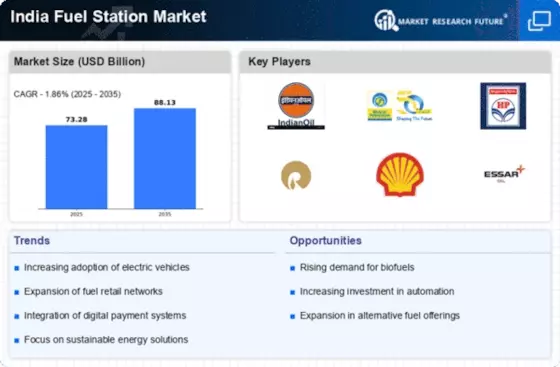
India Fuel Station Market Infographic
Purchase Options

India Fuel Station Market Summary

As per analysis, the India Fuel Station Market is projected to grow from USD 71.94 Billion in 2024 to USD 88.13 Billion by 2035, exhibiting a compound annual growth rate (CAGR) of 1.86% during the forecast period (2025 - 2035).

Key Market Trends & Highlights

The India Fuel Station Market is evolving with a focus on sustainability and technological integration.

  • The petrol segment remains the largest in the market, driven by consistent consumer demand.
  • The diesel segment is experiencing rapid growth, reflecting the increasing use of commercial vehicles.
  • Full service stations dominate the market, although self service stations are gaining traction among cost-conscious consumers.
  • Rising fuel demand and government initiatives for cleaner fuels are key drivers shaping the market landscape.

Market Size & Forecast

2024 Market Size 71.94 (USD Billion)
2035 Market Size 88.13 (USD Billion)
CAGR (2025 - 2035) 1.86%

Major Players

Indian Oil Corporation (IN), Bharat Petroleum Corporation (IN), Hindustan Petroleum Corporation (IN), Reliance Industries Limited (IN), Shell India Markets Private Limited (IN), Essar Oil Limited (IN), Total Oil India Private Limited (IN), GAIL (India) Limited (IN)

Our Impact
Enabled $4.3B Revenue Impact for Fortune 500 and Leading Multinationals
Partnering with 2000+ Global Organizations Each Year
30K+ Citations by Top-Tier Firms in the Industry

India Fuel Station Market Trends

The India Fuel Station Market is currently experiencing a transformative phase, driven by a combination of technological advancements and evolving consumer preferences. The increasing adoption of electric vehicles is prompting fuel stations to adapt their offerings, potentially leading to the integration of charging infrastructure alongside traditional fuel services. This shift may not only enhance customer convenience but also align with the government's push towards sustainable energy solutions. Furthermore, the rise of digital payment systems is reshaping transaction methods at fuel stations, making them more efficient and user-friendly. As consumers increasingly seek seamless experiences, fuel stations are likely to invest in technology that streamlines operations and enhances customer engagement. In addition to technological changes, regulatory frameworks are also influencing the India Fuel Station Market. The government's initiatives aimed at promoting cleaner fuels and reducing emissions could lead to a gradual transition towards alternative energy sources. This regulatory environment may encourage fuel station operators to diversify their fuel offerings, potentially including biofuels and compressed natural gas. As the market evolves, stakeholders must remain vigilant to adapt to these changes, ensuring they meet both consumer demands and regulatory requirements. Overall, the India Fuel Station Market appears poised for significant evolution, driven by innovation and a commitment to sustainability.

Integration of Electric Vehicle Charging Stations

The emergence of electric vehicles is prompting fuel stations to consider the installation of charging infrastructure. This trend may enhance customer convenience and align with national sustainability goals.

Adoption of Digital Payment Solutions

The increasing use of digital payment methods is transforming transaction processes at fuel stations. This shift could lead to more efficient operations and improved customer experiences.

Regulatory Push for Cleaner Fuels

Government initiatives aimed at promoting cleaner fuels may encourage fuel stations to diversify their offerings. This trend could include the introduction of biofuels and compressed natural gas.

India Fuel Station Market Drivers

Rising Fuel Demand in India

The India Fuel Station Market is experiencing a notable increase in fuel demand, driven by the country's rapid urbanization and economic growth. As more people migrate to urban areas, the need for transportation fuels rises significantly. According to government data, India's fuel consumption has been projected to grow at a compound annual growth rate of approximately 3.5% over the next decade. This growth is further fueled by the expanding middle class, which is likely to increase vehicle ownership. Consequently, fuel stations are becoming essential infrastructure to meet this rising demand. The government has also been investing in road infrastructure, which enhances accessibility to fuel stations, thereby supporting the growth of the India Fuel Station Market.

Government Initiatives and Policies

The India Fuel Station Market is significantly influenced by various government initiatives aimed at enhancing fuel accessibility and promoting cleaner energy sources. The government's push for the Pradhan Mantri Ujjwala Yojana, which aims to provide LPG connections to women from below-poverty-line households, has increased the demand for fuel stations offering LPG services. Additionally, the introduction of the National Biofuel Policy aims to promote biofuels, which could lead to the establishment of more fuel stations catering to alternative fuels. These policies not only support the growth of the India Fuel Station Market but also align with the country's commitment to reducing carbon emissions and transitioning towards sustainable energy solutions.

Growing Focus on Customer Experience

The India Fuel Station Market is increasingly prioritizing customer experience as a key driver of growth. Fuel stations are evolving into convenience hubs, offering a range of services beyond fuel, such as food, beverages, and vehicle maintenance. This trend is supported by changing consumer preferences, where customers seek more than just fuel; they desire a comprehensive service experience. According to Industry expert's, fuel stations that provide additional amenities see a 20% increase in foot traffic. This focus on enhancing customer experience is likely to drive loyalty and repeat business, thereby contributing to the overall growth of the India Fuel Station Market. As competition intensifies, fuel stations that adapt to these changing consumer expectations may gain a competitive edge.

Expansion of Electric Vehicle Infrastructure

The India Fuel Station Market is poised for transformation with the expansion of electric vehicle (EV) infrastructure. As the government aims to increase the adoption of electric vehicles, the establishment of EV charging stations at fuel stations is becoming a strategic focus. The Faster Adoption and Manufacturing of Hybrid and Electric Vehicles (FAME) scheme is encouraging investments in EV infrastructure, which could lead to a significant increase in the number of charging stations across the country. This shift not only caters to the growing demand for electric vehicles but also positions traditional fuel stations as multi-faceted service providers. The integration of EV charging facilities may enhance the competitiveness of the India Fuel Station Market in the evolving automotive landscape.

Technological Advancements in Fuel Retailing

Technological advancements are reshaping the India Fuel Station Market, enhancing operational efficiency and customer experience. The integration of automation and digital technologies in fuel retailing is becoming increasingly prevalent. For instance, the adoption of mobile applications for fuel payments and loyalty programs is gaining traction among consumers. Furthermore, the implementation of advanced inventory management systems allows fuel stations to optimize their supply chains and reduce operational costs. According to recent data, around 30% of fuel stations in urban areas have adopted digital payment solutions, indicating a shift towards a more tech-savvy market. These advancements are likely to attract more customers and improve profitability within the India Fuel Station Market.


Market Segment Insights

By Fuel Type: Petrol (Largest) vs. Diesel (Fastest-Growing)

In the India Fuel Station Market, petrol leads in market share, owing to its widespread use in personal vehicles and motorcycles. This segment captures a significant portion of the overall fuel consumption, making it the preferred choice for consumers. Diesel, while traditionally associated with commercial transport, is gaining traction among individual consumers, further accelerating its market presence.

Petrol (Dominant) vs. Diesel (Emerging)

Petrol remains the dominant fuel type in India due to its extensive network of distribution and favorable consumer perception for usage in various vehicles. Its appeal is bolstered by a growing number of fuel stations catering to its demand. On the other hand, diesel, often considered as an emerging option, is witnessing rapid growth driven by increasing adoption in personal vehicles and favorable government policies encouraging cleaner transportation fuels. This shift reflects a diversification in consumer preferences towards diesel, positioning it as a significant player in the market.

By Service Type: Full Service (Largest) vs. Self Service (Fastest-Growing)

In the India Fuel Station Market, the distribution of service types shows a distinctive preference among consumers. Full Service stands out as the most widely utilized option, appealing to customers seeking convenience and a personalized experience. In contrast, Self Service is gaining traction, especially among the younger demographic who value independence and quick transactions. Automated Service, while present, is still in its infancy compared to these two dominant models, catering to tech-savvy users looking for efficiency. Growth trends in the service type segment are reflective of changing consumer preferences and technological advancements. Full Service maintains a robust position, yet Self Service is capturing an increasing share due to its cost-effectiveness and the rise of digital payment solutions. Facilitated by the expansion of fuel station networks and the convenience afforded by smartphone applications, Self Service is poised for significant growth, reshaping the competitive landscape of the market.

Full Service (Dominant) vs. Self Service (Emerging)

In the India Fuel Station Market, Full Service is characterized by personalized customer interactions and traditional fuel dispensing methods. This service type remains dominant due to its appeal to customers who prioritize convenience and a hands-off experience, particularly in urban areas. Conversely, Self Service is emerging as a preferred choice for cost-conscious consumers who appreciate the speed and autonomy it offers. This segment is rapidly evolving with technological advancements, making fuel purchasing more accessible and faster. The competitive dynamics between these two segments highlight a shift in consumer behavior, with Self Service growing in popularity, particularly among younger, tech-savvy individuals looking for efficient fuel buying options.

By Customer Type: Individual Consumers (Largest) vs. Commercial Fleets (Fastest-Growing)

In the India Fuel Station Market, the customer type segment is primarily dominated by individual consumers, who contribute significantly to overall fuel consumption. This demographic includes private car owners and daily commuters, representing a substantial share of the market. Meanwhile, the commercial fleets segment is rapidly gaining traction, driven by logistic companies and transportation services that require consistent fuel supply for vehicle operations.

Individual Consumers (Dominant) vs. Commercial Fleets (Emerging)

Individual consumers constitute the dominant force in the fuel station market, characterized by a wide range of fuel needs for personal vehicles, and demonstrate strong brand loyalty towards established fuel retailers. This segment benefits from the growing number of vehicle owners and the rise in disposable income, leading to increased fuel consumption. Conversely, commercial fleets are emerging as a vital segment due to the surge in demand for logistics and transport services within urban areas. As businesses prioritize efficiency, fuel stations catering specifically to fleets are adapting their services and offerings, including loyalty programs and bulk purchasing options, positioning themselves for rapid growth.

By Payment Method: Cash (Largest) vs. Mobile Payment (Fastest-Growing)

In the India Fuel Station Market, the payment method segment is diverse, comprising major methods such as Cash, Credit Card, Mobile Payment, and Loyalty Programs. Cash remains the largest payment method due to its widespread acceptance and the preference for immediate, processed transactions. Following cash, credit cards hold a significant position, offering convenience for customers who prefer cashless transactions. Mobile payments are rapidly gaining traction among tech-savvy consumers, while loyalty programs create opportunities for customer retention by promoting repeat purchases.

Cash (Dominant) vs. Mobile Payment (Emerging)

Cash continues to dominate the India fuel station payment landscape, largely because it is inherently simple and accessible to a wide demographic. Although digital payment methods are on the rise, many consumers in rural and semi-urban areas prefer cash due to limited access to banking infrastructure. In contrast, mobile payments are emerging as a preferred choice for urban users, especially younger consumers who favor the convenience and speed of transactions through apps and wallets. This growth is fueled by increased smartphone penetration and push from fuel retailers to adopt digital payment solutions. Both payment methods reflect consumer preferences, but the dynamics are shifting towards digital options, heralding a significant transformation in payment behavior.

Get more detailed insights about India Fuel Station Market

Regional Insights

North America : Stable Market Dynamics

The North American fuel station market is characterized by stable growth driven by increasing fuel demand and advancements in technology. Regulatory support for cleaner fuels and infrastructure development are key catalysts. The U.S. holds the largest market share at approximately 70%, followed by Canada at around 20%. This growth is further supported by the rising trend of electric vehicle charging stations, which are becoming integrated into traditional fuel stations. Leading players in this region include major oil companies such as ExxonMobil and Chevron, alongside emerging players focusing on renewable energy solutions. The competitive landscape is evolving, with companies investing in technology to enhance customer experience and operational efficiency. The presence of established brands ensures a robust market, while new entrants are challenging traditional models by offering innovative services.

Europe : Regulatory-Driven Market

The European fuel station market is significantly influenced by stringent environmental regulations and a shift towards sustainable energy. The largest market, Germany, holds about 30% of the share, followed by France at 25%. The European Union's Green Deal and various national policies are driving the transition to alternative fuels, which is reshaping the market landscape. This regulatory environment is fostering innovation and investment in cleaner technologies. Key players in Europe include Shell, BP, and Total, which are adapting their strategies to align with sustainability goals. The competitive landscape is marked by a mix of traditional fuel providers and new entrants focusing on electric vehicle charging infrastructure. This shift is not only enhancing service offerings but also attracting investments aimed at future-proofing the market against evolving consumer preferences.

Asia-Pacific : Emerging Market Potential

The Asia-Pacific fuel station market is witnessing rapid growth, driven by increasing urbanization and rising vehicle ownership. India and China are the largest markets, with India holding approximately 40% of the regional share, followed closely by China at 35%. Government initiatives to enhance fuel supply infrastructure and promote cleaner fuels are significant growth drivers. The region is also seeing a surge in demand for alternative fuel stations, including electric vehicle charging points. In this competitive landscape, key players such as Indian Oil Corporation and Reliance Industries are leading the charge, supported by local and international investments. The presence of established companies is complemented by new entrants focusing on innovative fuel solutions. This dynamic environment is fostering competition and driving advancements in service delivery, positioning the region for sustained growth in the coming years.

Middle East and Africa : Resource-Rich Opportunities

The Middle East and Africa fuel station market is characterized by abundant natural resources and a growing demand for fuel. The largest market, Saudi Arabia, holds about 50% of the regional share, followed by South Africa at 15%. The region's growth is driven by increasing energy consumption and government investments in infrastructure development. Regulatory frameworks are evolving to support diversification into renewable energy sources, which is reshaping the market dynamics. Key players in this region include Saudi Aramco and Total, which dominate the market with extensive networks of fuel stations. The competitive landscape is marked by a mix of established companies and new entrants focusing on innovative fuel solutions. This environment is fostering partnerships and collaborations aimed at enhancing service delivery and expanding market reach, positioning the region for future growth.

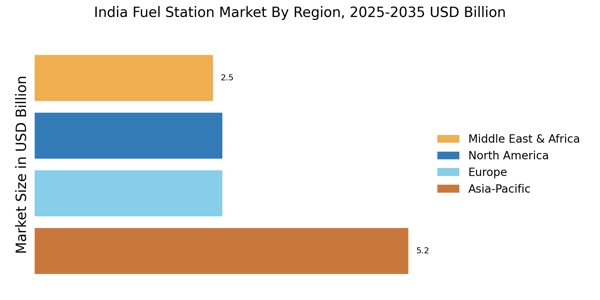
India Fuel Station Market Regional Image

Key Players and Competitive Insights

The Fuel Station Market in India is characterized by a competitive landscape that is both dynamic and multifaceted. Key growth drivers include the increasing demand for fuel due to rising vehicle ownership, urbanization, and the government's push towards infrastructure development. Major players such as Indian Oil Corporation (IN), Bharat Petroleum Corporation (IN), and Reliance Industries Limited (IN) are strategically positioned to leverage these trends. Indian Oil Corporation (IN) focuses on expanding its network of fuel stations while investing in alternative energy solutions, thereby enhancing its market presence. Bharat Petroleum Corporation (IN) emphasizes digital transformation and customer engagement, which appears to be a critical factor in maintaining its competitive edge. Reliance Industries Limited (IN) is actively pursuing partnerships to enhance its supply chain efficiency, indicating a trend towards collaborative strategies in the market.

The business tactics employed by these companies often involve localizing manufacturing and optimizing supply chains to reduce costs and improve service delivery. The market structure is moderately fragmented, with several players vying for market share. However, the collective influence of these key players shapes the competitive environment, as they engage in strategic initiatives that drive innovation and operational efficiency.

In December 2025, Indian Oil Corporation (IN) announced the launch of a new initiative aimed at enhancing its electric vehicle (EV) charging infrastructure across its fuel stations. This strategic move is significant as it aligns with the global shift towards sustainable energy solutions and positions the company as a leader in the transition to cleaner fuels. The expansion of EV charging facilities is likely to attract a new customer base, thereby increasing foot traffic at their stations.

In November 2025, Bharat Petroleum Corporation (IN) unveiled a digital platform designed to streamline fuel purchasing and enhance customer experience. This initiative reflects the company's commitment to digitalization, which is becoming increasingly vital in the competitive landscape. By offering a seamless digital experience, Bharat Petroleum Corporation (IN) aims to foster customer loyalty and differentiate itself from competitors.

In October 2025, Reliance Industries Limited (IN) entered into a strategic partnership with a leading technology firm to develop AI-driven solutions for fuel management and distribution. This collaboration is poised to enhance operational efficiency and reduce costs, thereby providing a competitive advantage in a market that is becoming more reliant on technology. The integration of AI into their operations may also lead to improved customer service and satisfaction.

As of January 2026, current competitive trends in the Fuel Station Market are increasingly defined by digitalization, sustainability, and the integration of advanced technologies such as AI. Strategic alliances are shaping the landscape, enabling companies to pool resources and expertise to address emerging challenges. The shift from price-based competition to a focus on innovation, technology, and supply chain reliability is evident. Companies that can effectively differentiate themselves through these avenues are likely to thrive in the evolving market.

Key Companies in the India Fuel Station Market include

Industry Developments

In February 2023, Indian Oil Corporation Limited (IOCL), a state-owned refiners and oil marketer company, made an announcement that in the financial year 2023, the company intends to invest USD 25.44 in the state of West Bengal. The company's objective hinged upon the Investor to expand the investment to establish and enhance the infrastructure towards greener retail fuels. By the end of 2022, the green auto fuel will be available in 275 retail outlets across the country, but this figure is expected to increase to more than 1,000 by the end of 2024.

Further, PSUs enjoy the availability of more fuel pricing control due to the presence of government policies steering them. This enables them to offer competitive prices and stabilize the ex-fuel prices and thus offer stability to the consumers.

As per a report published in 2024, Nayara Energy, a private oil refinery is seeking to grow its retail gasoline and diesel network expanding business avenues in India targeting to increase its present retail fuel stations from the current 6,400 by 50% approximately by 2030. The company made a net profit of Rs 9,592 crore on an operational revenue of Rs 1.37 trillion in FY23 posted earlier, and also aims to be a bigger player in the downstream petroleum value chain by branching out in the petrochemical sector, audience was told by Chief Financial Officer, Rajani Kesari to Arunima Bharadwaj.

Nayara will focus on the refining margins with the country's second-largest single-location oil refinery, irrespective of any volatility in global crude oil prices, she says.

Future Outlook

India Fuel Station Market Future Outlook

The India Fuel Station Market is projected to grow at 1.86% CAGR from 2025 to 2035, driven by urbanization, increasing vehicle ownership, and technological advancements.

New opportunities lie in:

  • Expansion of electric vehicle charging infrastructure at fuel stations.
  • Integration of loyalty programs to enhance customer retention.
  • Development of alternative fuel options, such as biofuels and hydrogen.

By 2035, the market is expected to evolve significantly, adapting to new energy trends and consumer demands.

Market Segmentation

India Fuel Station Market Fuel Type Outlook

  • Petrol
  • Diesel
  • Compressed Natural Gas
  • Liquefied Petroleum Gas

India Fuel Station Market Service Type Outlook

  • Full Service
  • Self Service
  • Automated Service

India Fuel Station Market Customer Type Outlook

  • Individual Consumers
  • Commercial Fleets
  • Government Agencies
  • Transport Services

India Fuel Station Market Payment Method Outlook

  • Cash
  • Credit Card
  • Mobile Payment
  • Loyalty Programs

Report Scope

MARKET SIZE 202471.94(USD Billion)
MARKET SIZE 202573.42(USD Billion)
MARKET SIZE 203588.13(USD Billion)
COMPOUND ANNUAL GROWTH RATE (CAGR)1.86% (2024 - 2035)
REPORT COVERAGERevenue Forecast, Competitive Landscape, Growth Factors, and Trends
BASE YEAR2024
Market Forecast Period2025 - 2035
Historical Data2019 - 2024
Market Forecast UnitsUSD Billion
Key Companies ProfiledIndian Oil Corporation (IN), Bharat Petroleum Corporation (IN), Hindustan Petroleum Corporation (IN), Reliance Industries Limited (IN), Shell India Markets Private Limited (IN), Essar Oil Limited (IN), Total Oil India Private Limited (IN), GAIL (India) Limited (IN)
Segments CoveredFuel Type, Service Type, Customer Type, Payment Method
Key Market OpportunitiesExpansion of electric vehicle charging infrastructure in the India Fuel Station Market presents significant growth potential.
Key Market DynamicsRising demand for electric vehicle charging infrastructure is reshaping the competitive landscape of India's fuel station market.
Countries CoveredIndia
Leave a Comment

FAQs

What is the current valuation of the India Fuel Station Market?

The India Fuel Station Market was valued at 71.94 USD Billion in 2024.

What is the projected market size for the India Fuel Station Market by 2035?

The market is projected to reach 88.13 USD Billion by 2035.

What is the expected CAGR for the India Fuel Station Market during the forecast period?

The expected CAGR for the market from 2025 to 2035 is 1.86%.

Which companies are the key players in the India Fuel Station Market?

Key players include Indian Oil Corporation, Bharat Petroleum Corporation, Hindustan Petroleum Corporation, and Reliance Industries Limited.

What are the main fuel types in the India Fuel Station Market?

The main fuel types include Petrol, Diesel, Compressed Natural Gas, and Liquefied Petroleum Gas.

How does the market segment by service type look?

The market segments by service type include Full Service, Self Service, and Automated Service.

What customer types are served in the India Fuel Station Market?

The market serves Individual Consumers, Commercial Fleets, Government Agencies, and Transport Services.

What payment methods are commonly used in the India Fuel Station Market?

Common payment methods include Cash, Credit Card, Mobile Payment, and Loyalty Programs.

What was the valuation of Petrol in the market in 2024?

In 2024, the valuation of Petrol was 30.0 USD Billion.

What is the projected valuation for Diesel by 2035?

The projected valuation for Diesel is expected to reach 30.0 USD Billion by 2035.

Download Free Sample

Kindly complete the form below to receive a free sample of this Report

Compare Licence

×
Features License Type
Single User Multiuser License Enterprise User
Price $4,950 $5,950 $7,250
Maximum User Access Limit 1 User Upto 10 Users Unrestricted Access Throughout the Organization
Free Customization
Direct Access to Analyst
Deliverable Format
Platform Access
Discount on Next Purchase 10% 15% 15%
Printable Versions