Request Free Sample ×

Kindly complete the form below to receive a free sample of this Report

* Please use a valid business email

Leading companies partner with us for data-driven Insights

clients tt-cursor
Hero Background

Truck Rental Market

ID: MRFR/AT/6355-HCR
188 Pages
Shubham Munde
Last Updated: April 06, 2026

Truck Rental Market Research Report Information By Truck Type (Heavy Commercial Vehicle, and Light Commercial Vehicle), By Lease Type (Finance Lease, and Full-Service Lease), And By Region (North America, Europe, Asia-Pacific, And Rest Of The World) - Growth & Industry Forecast to 2035

Share:
Download PDF ×

We do not share your information with anyone. However, we may send you emails based on your report interest from time to time. You may contact us at any time to opt-out.

Truck Rental Market Infographic
Purchase Options

Truck Rental Market Summary

As per Market Research Future analysis, the Truck Rental Market Size was estimated at 131.31 USD Billion in 2024. The Truck Rental industry is projected to grow from 144.86 USD Billion in 2025 to 386.89 USD Billion by 2035, exhibiting a compound annual growth rate (CAGR) of 10.32% during the forecast period 2025 - 2035

Key Market Trends & Highlights

The Truck Rental Market is experiencing a dynamic shift driven by technological advancements and evolving consumer preferences.

  • Technological integration is reshaping operational efficiencies in the Truck Rental Market, particularly in North America.
  • Sustainability initiatives are gaining traction, influencing rental practices and fleet management in the Asia-Pacific region.
  • Urbanization is driving demand for flexibility in rental options, especially within the Light Commercial Vehicle segment.
  • E-commerce growth and infrastructure development are key market drivers, propelling the Heavy Commercial Vehicle and Finance Lease segments.

Market Size & Forecast

2024 Market Size 131.31 (USD Billion)
2035 Market Size 386.89 (USD Billion)
CAGR (2025 - 2035) 10.32%

Major Players

U-Haul (US), Penske (US), Budget Truck Rental (US), Enterprise Truck Rental (US), Ryder (US), Hertz (US), Avis (US), Sixt (DE), Europcar (FR)

Our Impact
Enabled $4.3B Revenue Impact for Fortune 500 and Leading Multinationals
Partnering with 2000+ Global Organizations Each Year
30K+ Citations by Top-Tier Firms in the Industry

Truck Rental Market Trends

The Truck Rental Market is currently experiencing a dynamic evolution, driven by various factors that influence consumer behavior and industry practices. The increasing demand for flexible transportation solutions appears to be a primary catalyst, as businesses and individuals seek alternatives to ownership. within the broader truck rental and leasing market. This shift is likely influenced by the growing trend of urbanization, which necessitates efficient logistics and mobility options across segments such as the dump truck rental market and bucket truck rental market.

Additionally, advancements in technology, such as mobile applications for booking and fleet management, seem to enhance customer experience and operational efficiency. As a result, companies in the truck rental marketare adapting their strategies to meet these changing needs, potentially leading to a more competitive landscape. Moreover, sustainability concerns are becoming increasingly prominent within the truck rental and leasing market.. Companies are exploring eco-friendly options, such as electric and hybrid vehicles particularly in the medium heavy duty truck rental leasing market,, to align with global efforts toward reducing carbon footprints.

This focus on sustainability may not only attract environmentally conscious consumers but also comply with evolving regulations aimed at promoting greener practices. Overall, the Truck Rental Market appears poised for growth, with trends indicating a shift towards more innovative, flexible, and sustainable solutions that cater to diverse customer requirements.

Technological Integration

The integration of advanced technologies is reshaping the Truck Rental Market. Companies are increasingly adopting digital platforms for seamless booking and fleet management, enhancing user experience. This trend suggests a shift towards automation and data analytics, which may improve operational efficiency and customer satisfaction.

Sustainability Initiatives

Sustainability is becoming a focal point in the Truck Rental Market. Firms are exploring eco-friendly vehicle options, such as electric and hybrid trucks, to meet consumer demand for greener alternatives. This trend indicates a broader commitment to environmental responsibility and compliance with regulatory standards.

Urbanization and Demand for Flexibility

The ongoing trend of urbanization is driving demand for flexible transportation solutions within the Truck Rental Market. As cities expand, businesses and individuals are increasingly seeking rental options that provide convenience and adaptability. This shift may lead to a re-evaluation of traditional ownership models.

Truck Rental Market Drivers

E-commerce Growth

The rise of e-commerce has substantially influenced the Truck Rental Market. As online shopping continues to expand, businesses require efficient logistics solutions to meet consumer demands. This trend has led to an increased need for rental trucks to facilitate last-mile deliveries. In 2025, the e-commerce sector is projected to account for a significant portion of retail sales, driving demand for flexible transportation options. Companies are increasingly opting for truck rentals to manage fluctuating delivery volumes without the burden of owning a fleet. This shift not only enhances operational efficiency but also allows businesses to adapt to changing market conditions. Consequently, the Truck Rental Market is likely to experience robust growth as e-commerce continues to reshape logistics and transportation needs.

Rising Urbanization

The trend of rising urbanization is significantly impacting the Truck Rental Market. As more people migrate to urban areas, the demand for transportation services increases. Urban centers often face challenges such as traffic congestion and limited parking, making truck rentals an attractive option for businesses. In 2025, urban populations are projected to grow, leading to heightened demand for flexible logistics solutions. Companies are likely to utilize rental trucks to navigate urban environments efficiently, allowing them to meet customer needs without the constraints of owning a fleet. This shift suggests that the Truck Rental Market will continue to thrive as urbanization drives the need for adaptable transportation options.

Environmental Regulations

Increasing environmental regulations are shaping the Truck Rental Market. Governments worldwide are implementing stricter emissions standards and promoting sustainable practices. As a result, rental companies are investing in eco-friendly vehicles to comply with these regulations and attract environmentally conscious customers. In 2025, the demand for green transportation solutions is expected to rise, encouraging businesses to consider truck rentals as a viable option. This trend indicates that the Truck Rental Market may experience growth as companies seek to align with sustainability goals while maintaining operational efficiency. The emphasis on environmental responsibility is likely to influence rental choices, driving the adoption of cleaner technologies.

Infrastructure Development

Ongoing infrastructure development projects are a key driver of the Truck Rental Market. Governments and private entities are investing heavily in transportation networks, including roads, bridges, and ports. This investment creates a demand for rental trucks to support construction activities and the movement of materials. In 2025, the construction sector is expected to witness substantial growth, further fueling the need for truck rentals. As projects expand, companies often prefer renting trucks to manage costs and maintain flexibility. This trend indicates that the Truck Rental Market will benefit from increased activity in infrastructure development, as businesses seek reliable transportation solutions to support their operations.

Technological Advancements

Technological advancements are revolutionizing the Truck Rental Market. Innovations such as telematics, GPS tracking, and mobile applications are enhancing the efficiency and convenience of truck rentals. In 2025, the integration of technology is expected to streamline operations, allowing customers to manage rentals more effectively. These advancements not only improve fleet management but also enhance customer experience by providing real-time data and insights. As businesses increasingly rely on technology to optimize logistics, the Truck Rental Market is likely to benefit from these developments. The adoption of advanced technologies may lead to increased demand for rental services, as companies seek to leverage these tools for competitive advantage.

Market Segment Insights

By Truck Type: Heavy Commercial Vehicle (Largest) vs. Light Commercial Vehicle (Fastest-Growing)

The truck rental market showcases a diverse segmentation, with Heavy Commercial Vehicles (HCV) occupying the largest market share. These vehicles are primarily utilized for long-haul logistics and large-scale transportation needs, contributing significantly to revenue in the rental sector. Conversely, Light Commercial Vehicles (LCV) are gaining momentum, appealing to small businesses and individual entrepreneurs due to their cost-effectiveness and versatility. This growing preference reflects a shift in consumer demand towards more flexible rental solutions.

Truck Type: Heavy Commercial Vehicle (Dominant) vs. Light Commercial Vehicle (Emerging)

Heavy Commercial Vehicles (HCV) represent the backbone of the truck rental market, characterized by their capacity for transporting goods over long distances and their robust durability. These trucks are often favored for their efficiency in meeting high-volume transportation demands in industries such as construction and logistics. On the other hand, Light Commercial Vehicles (LCV) are emerging as a significant segment, as they provide optimal solutions for urban deliveries and small-scale operations. The adaptability and lower operational costs of LCVs make them attractive to a growing number of SMEs, showcasing a trend towards diversification in rental services.

By Lease Type: Finance Lease (Largest) vs. Full-Service Lease (Fastest-Growing)

In the Truck Rental Market, the lease type segment shows distinct variations in market share, with Finance Lease taking precedence due to its traditional appeal among businesses seeking long-term vehicle access without ownership. On the other hand, Full-Service Lease is gaining traction as companies increasingly prefer flexible solutions that encompass maintenance and support, thus providing a hassle-free experience. This dynamic distribution reflects shifting preferences in fleet management and operational efficiency.

Lease Type: Finance Lease (Dominant) vs. Full-Service Lease (Emerging)

Finance Lease is characterized by its long-term commitment and appealing tax advantages, making it a dominant choice among businesses with consistent truck requirements. This lease type offers a lower upfront cost and allows companies to keep vehicle fleets up-to-date without the burden of ownership, thus improving cash flow. In contrast, Full-Service Lease has emerged as an attractive option for businesses looking for flexibility and simplicity. This lease type provides comprehensive maintenance packages, insurance, and support services, appealing to those who prioritize operational ease and want to mitigate risks associated with fleet maintenance and downtime.

Get more detailed insights about Truck Rental Market

Regional Insights

North America : Dominant Market Leader

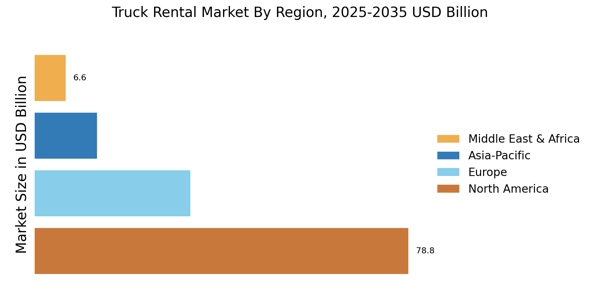
The North American truck rental market is primarily driven by the booming e-commerce sector and increasing demand for logistics services. The region holds the largest market share, accounting for approximately 60% of the global market. Regulatory support for transportation infrastructure and environmental standards further catalyzes growth. The rise in urbanization and relocation trends also contribute significantly to demand, making it a vibrant market for truck rentals. Leading the market are the United States and Canada, with the U.S. being the largest contributor. Key players such as U-Haul, Penske, and Ryder dominate the landscape, offering a wide range of services. The competitive environment is characterized by a mix of established companies and emerging players, all vying for market share. The presence of major rental companies ensures a robust supply chain and customer service, enhancing overall market dynamics.

Europe : Emerging Market Dynamics

The European truck rental market is experiencing significant growth, driven by increasing logistics demands and a shift towards sustainable transportation solutions. The region is the second largest market, holding approximately 25% of the global share. Regulatory frameworks promoting eco-friendly practices and investments in transportation infrastructure are key growth catalysts. The rise in cross-border trade and e-commerce is also fueling demand for truck rentals across various countries. Germany, France, and the UK are leading countries in this market, with a competitive landscape featuring major players like Sixt and Europcar. The presence of these companies enhances service offerings and customer reach. Additionally, the market is witnessing a trend towards digitalization, with companies investing in technology to streamline operations and improve customer experience. This competitive environment is expected to foster innovation and growth in the coming years.

Asia-Pacific : Rapidly Growing Market

The Asia-Pacific truck rental market is rapidly expanding, driven by urbanization, increasing logistics needs, and a growing middle class. This region is witnessing a surge in demand, holding approximately 10% of the global market share. Government initiatives aimed at improving transportation infrastructure and logistics efficiency are significant growth drivers. The rise in e-commerce and the need for last-mile delivery solutions are also contributing to the market's expansion. Countries like China, India, and Australia are at the forefront of this growth, with a competitive landscape that includes both local and international players. Companies are increasingly focusing on fleet modernization and customer service enhancements to capture market share. The presence of key players, along with the entry of new firms, is intensifying competition, leading to innovative service offerings and improved operational efficiencies.

Middle East and Africa : Untapped Market Potential

The Middle East and Africa truck rental market is characterized by untapped potential and emerging growth opportunities. The region is witnessing a gradual increase in market share, currently estimated at around 5% of the global market. Key growth drivers include urbanization, infrastructure development, and rising logistics demands. Government investments in transportation and trade facilitation are also pivotal in shaping the market landscape, creating a conducive environment for growth. Leading countries in this region include South Africa, UAE, and Saudi Arabia, where the competitive landscape is evolving. Local players are increasingly entering the market, while established international companies are expanding their presence. The focus on improving service quality and operational efficiency is driving competition, leading to innovative solutions tailored to regional needs. This dynamic environment presents significant opportunities for growth and investment in the truck rental sector.

Truck Rental Market Regional Image

Key Players and Competitive Insights

Major market players are spending a lot of money on R&D to increase their product lines, which will help the Truck Rental Market grow even more. Market participants are also taking a range of strategic initiatives to grow their worldwide footprint, with key market developments such as new product launches, contractual agreements, mergers and acquisitions, increased investments, and collaboration with other organizations. Competitors in the Truck Rental industry must offer cost-effective items to expand and survive in an increasingly competitive and rising market environment.
One of the primary business strategies adopted by manufacturers in the global Truck Rental industry to benefit environment and expand the market sector is to manufacture locally to reduce operating costs. In recent years, Truck Rental industry has provided trucks according to the clients requirement. The Truck Rental Market major player such as Big truck OEMs such as Volvo, Volkswagen (Scania), Daimler, MAN, UD, Hino, PACCAR (Peterbilt), Isuzu, and Iveco, and others are working to expand the market demand by investing in research and development activities.
A French automobile rental company is called Europcar Mobility Group. Europe, North America, Western Asia, and Africa are all served by Europcar's 140 operational nations. Green Mobility Holding, S.A., a partnership of the Volkswagen Group, Attestor, and Pon Holdings, has owned Europcar since July 2022. The Europcar recreational rental sub-brand is Keddy.
In January Europcar approved financial restructuring plan, Europcar has confirmed its financial restructuring plan due to the impact of COVID-19 on its business.
Under the new plan, the company's creditors are expected to significantly reduce the company's rental car debt in exchange for equity and control of the company.
Also, Advantage Rent a Car is a privately held American car rental company headquartered in USA. The company expanded by purchasing several different car rental companies. In 1984, the various car rental brands were consolidated under the name Advantage Rent a Car.  Advantage Car and Truck Rentals Limited offers hourly, daily, weekly and monthly truck rental services for personal or business purposes. Through its unified segment, the Company provides truck and car rental services in Canada.

Key Companies in the Truck Rental Market include

Industry Developments

January 2023: Hertz, vehicle rental companies around the globe, and AAA, one of North America's membership organizations serving over 56 million U.S. members, extended their exclusive, 45-year relationship with the signing of a new five-year agreement. It provides AAA members with a comprehensive suite of car rental benefits, discounted rates, and other exclusive perks.

February 2022: Hertz Corporation partnered with Ufodrive to provide one of the largest electric vehicle rental fleet in North America and to develop its EV fleet globally.

Penske Truck Leasing introduced groundbreaking AI technology to the sector in April 2024. This platform will revolutionize how fleet operators manage and monitor fleet performance in real-time. The developed Catalyst AI marks a significant departure from traditional industry practices where fleet managers were equipped with only post-mortem analysis by harnessing real-world analytics.

Real-Time Pricing and Availability of Moving Trucks was the premise online service Flexters was built around, and in February 2024, Great Motion, a rental software solutions company, assisted Flexters by entering into a partnership with us. The goal of the partnership is to facilitate the global short-term truck rental reservation system, making it easier for sellers to market their fleets and buyers to locate trucks that satisfy their requirements.

German auto manufacturer Mercedes Benz made headlines in February 2024 when it announced its foray into the Brazilian truck leasing market, suggesting that the company is ready to seize new opportunities. It was able to capitalize on the fundamental changes brought about by the crisis and the market-oriented approach that the company developed, which was to take advantage of the high prices of new vehicles which increases the need for rental and leasing services.

In borrowing New Zealand’s rockets and brandishing Hertz’s extensive vast fleet and logistic skills wherein in the month of July 2023, NHR Group forged a joint venture, NHR Group expects this collaboration to bring in a wider array of vehicles consisting of cargo vans and trucks which will aid in catering to the range of needs required by many organizations ameliorating the handiness of use for entities and businesses that are in dire need of transport supplements.

Acquiring advertising space in the truck rental ecosystem being a name known to everyone, Big Truck Rental Market has, in an event which transpired in July of 2022, launched their fleet rental program and shared its expectation that acquisition of such assets without hefty maintenance fees as well as without service interruptions will provide accessibility to organizations in need.

Aiming to furnish the needs of both individual and corporate clients, Mahindra Finance, the financial level of the group Mahindra, started functioning a new service for leasing vehicles on a subscription basis in November 2021.

Future Outlook

Truck Rental Market Future Outlook

The Truck Rental Market is poised for growth at 10.32% CAGR from 2025 to 2035, driven by urbanization, e-commerce expansion, and technological advancements.

New opportunities lie in:

  • Integration of telematics for real-time fleet management Expansion of electric truck rental options Development of subscription-based rental models for businesses

By 2035, the Truck Rental Market is expected to achieve robust growth and enhanced service offerings.

Market Segmentation

Truck Rental Market Lease Type Outlook

  • Finance Lease
  • Full-Service Lease

Truck Rental Market Truck Type Outlook

  • Heavy Commercial Vehicle
  • Light Commercial Vehicle

Report Scope

MARKET SIZE 2024 131.31(USD Billion)
MARKET SIZE 2025 144.86(USD Billion)
MARKET SIZE 2035 386.89(USD Billion)
COMPOUND ANNUAL GROWTH RATE (CAGR) 10.32% (2025 - 2035)
REPORT COVERAGE Revenue Forecast, Competitive Landscape, Growth Factors, and Trends
BASE YEAR 2024
Market Forecast Period 2025 - 2035
Historical Data 2019 - 2024
Market Forecast Units USD Billion
Key Companies Profiled U-Haul (US), Penske (US), Budget Truck Rental (US), Enterprise Truck Rental (US), Ryder (US), Hertz (US), Avis (US), Sixt (DE), Europcar (FR)
Segments Covered Truck Type, Lease Type, Region
Key Market Opportunities Integration of advanced telematics and automation enhances efficiency in the Truck Rental Market.
Key Market Dynamics Rising demand for sustainable transportation solutions drives innovation in the truck rental sector.
Countries Covered North America, Europe, APAC, South America, MEA

Market Highlights

FAQs

What is the current valuation of the Truck Rental Market in 2024?

The Truck Rental Market was valued at 131.31 USD Billion in 2024.

What is the projected market valuation for the Truck Rental Market by 2035?

The market is projected to reach 386.89 USD Billion by 2035.

What is the expected CAGR for the Truck Rental Market during the forecast period 2025 - 2035?

The expected CAGR for the Truck Rental Market during 2025 - 2035 is 10.32%.

Which companies are considered key players in the Truck Rental Market?

Key players in the Truck Rental Market include U-Haul, Penske, Budget Truck Rental, Enterprise Truck Rental, Ryder, Hertz, Avis, Sixt, and Europcar.

How are the Truck Rental Market segments categorized?

The Truck Rental Market segments are categorized by Truck Type and Lease Type.

What was the valuation for Heavy Commercial Vehicles in 2024?

The valuation for Heavy Commercial Vehicles was 66.52 USD Billion in 2024.

What is the projected valuation for Light Commercial Vehicles by 2035?

The projected valuation for Light Commercial Vehicles is 189.83 USD Billion by 2035.

What are the financial lease and full-service lease valuations in the Truck Rental Market?

In 2024, the financial lease valuation was 66.52 USD Billion, while the full-service lease valuation was 64.79 USD Billion.

How does the Truck Rental Market's growth compare between Heavy and Light Commercial Vehicles?

The Truck Rental Market indicates a higher projected growth for Heavy Commercial Vehicles compared to Light Commercial Vehicles during 2025 - 2035.

What trends are influencing the Truck Rental Market's growth in the coming years?

Trends such as increased demand for logistics and transportation services are likely to influence the Truck Rental Market's growth positively.
Author
Author
Author Profile
Shubham Munde LinkedIn
Team Lead - Research
Shubham brings over 7 years of expertise in Market Intelligence and Strategic Consulting, with a strong focus on the Automotive, Aerospace, and Defense sectors. Backed by a solid foundation in semiconductors, electronics, and software, he has successfully delivered high-impact syndicated and custom research on a global scale. His core strengths include market sizing, forecasting, competitive intelligence, consumer insights, and supply chain mapping. Widely recognized for developing scalable growth strategies, Shubham empowers clients to navigate complex markets and achieve a lasting competitive edge. Trusted by start-ups and Fortune 500 companies alike, he consistently converts challenges into strategic opportunities that drive sustainable growth.
Co-Author
Co-Author Profile
Sejal Akre LinkedIn
Senior Research Analyst
She has over 5 years of rich experience, in market research and consulting providing valuable market insights to client. Hands on expertise in management consulting, and extensive knowledge in domain including ICT, Automotive & Transportation and Aerospace & Defense. She is skilled in Go-to market strategy, industry analysis, market sizing, in depth company profiling, competitive intelligence & benchmarking and value chain amongst others.
Leave a Comment

Research Approach

Secondary Research

The secondary research process involved comprehensive analysis of transportation regulatory databases, industry publications, fleet management reports, and authoritative transportation organizations. Key sources included the US Department of Transportation (DOT), Federal Motor Carrier Safety Administration (FMCSA), American Trucking Associations (ATA), Bureau of Transportation Statistics (BTS), European Automobile Manufacturers Association (ACEA), International Road Transport Union (IRU), National Highway Traffic Safety Administration (NHTSA), US Census Bureau Vehicle Inventory and Use Survey, Statistics Canada, Eurostat Transport Database, Organization for Economic Co-operation and Development (OECD) Transport Statistics, International Transport Forum (ITF), and national transport ministry reports from key markets.

Market landscape research for light commercial vehicles, medium-duty trucks, heavy-duty trucks, and specialist rental categories, as well as data on commercial vehicle registrations, fleet utilization, regulatory compliance needs, and industry trends were gathered from these sources.

Additional authoritative sources included Equipment Leasing and Finance Association (ELFA), American Rental Association (ARA), Commercial Vehicle Rental and Leasing Association (CVRLA), International Franchise Association (IFA) for rental franchise data, National Association of Fleet Administrators (NAFA), and Transportation Research Board (TRB) publications.

Primary Research

To gather both qualitative and quantitative information, the primary research process involved interviewing players from both the supply and demand sides. From the supply side, we heard from commercial vehicle manufacturers, fleet leasing providers, truck rental businesses, and regional rental directors as well as VPs of fleet operations and commercial sales. Logistics directors, fleet managers, procurement leads from e-commerce organizations, construction firms, retail distributors, and small to medium enterprises (SMEs) using rental services made up the demand-side sources. Market segmentation, fleet growth timetables, rental acceptance trends, pricing strategies, and the dynamics of contract vs. spot rentals were all validated by primary research.

Primary Respondent Breakdown:

By Designation: C-level Primaries (32%), Director Level (30%), Others (38%)

By Region: North America (38%), Europe (25%), Asia-Pacific (28%), Rest of World (9%)

Market Size Estimation

Global market valuation was derived through revenue mapping and fleet utilization analysis. The methodology included:

Identification of 50+ key rental providers across North America, Europe, Asia-Pacific, and Latin America

Service mapping across light commercial vehicle rental, medium-duty truck rental, heavy-duty truck rental, and specialized equipment categories

Analysis of reported and modeled annual revenues specific to truck rental and leasing portfolios

Coverage of rental providers representing 65-70% of global market share in 2024

Extrapolation using bottom-up (fleet size × utilization rate × daily/weekly rates by country) and top-down (rental provider revenue validation) approaches to derive segment-specific valuations

Key Adjustments Made:

Modified all percentage allocations in the Primary Respondent Breakdown categories

Adjusted revenue thresholds for company tiers to reflect truck rental industry scale

Replaced medical/aesthetic sources with transportation and logistics authorities

Tailored market estimation methodology to fleet-based rather than procedure-based metrics

Download Free Sample

Kindly complete the form below to receive a free sample of this Report

Compare Licence

×
Features License Type
Single User Multiuser License Enterprise User
Price $4,950 $5,950 $7,250
Maximum User Access Limit 1 User Upto 10 Users Unrestricted Access Throughout the Organization
Free Customization
Direct Access to Analyst
Deliverable Format
Platform Access
Discount on Next Purchase 10% 15% 15%
Printable Versions