×
Hero Background
English
Chinese
French
Japanese
Korean
German
Spanish

Transgenic Animals Market Trends

ID: MRFR/LS/4018-HCR
110 Pages
Kinjoll Dey
October 2025

Transgenic Animals Market Research Report by Products (Gene Gun, Microinjection), Techniques (DNA Microinjection), Consumables (Probes), Application (Monoclonal Abs), Transgenic Animals (Mice) End User (Biotech Industries) - Forecast till 2035

Share:
Download PDF ×

We do not share your information with anyone. However, we may send you emails based on your report interest from time to time. You may contact us at any time to opt-out.

Transgenic Animals Market Infographic
Purchase Options

Market Trends

Key Emerging Trends in the Transgenic Animals Market

The Transgenic animals market is experiencing transformative trends fueled by advancements in genetic engineering and biotechnology. Transgenic animals, genetically changed to explicit, specific trends or proteins, have applications in studies, drug improvement, and agriculture. This review outlines key market trends shaping the panorama of the Transgenic animals market. A prominent trend in the transgenic animal market is the increasing function of transgenic animals in biomedical studies. These genetically modified organisms serve as valuable models for studying human sicknesses, allowing researchers to gain insights into disorder mechanisms and check potential treatment plans. The increasing demand for strong animal trends is driving growth in this phase. There is a terrific rise in the demand for custom-designed transgenic animal models tailored to the needs of particular studies. Researchers and pharmaceutical corporations are searching for genetically changed animals with specific genetic alterations, enabling extra focused and applicable studies. Ethical concerns and animal welfare have come to be vital elements influencing market tendencies. There is a heightened consciousness of the moral implications of genetic modification, leading to improved scrutiny and regulations. The market is responding by adopting stringent ethical requirements and promoting transparency in research related to transgenic animals. The use of transgenic animals in drug discovery and improvement is experiencing a surge. Pharmaceutical corporations rely on these trends to evaluate drug protection, efficacy, and ability facet effects. This trend is driven by the need for extra reliable preclinical records, which, in the end, decreases the time and expenses related to bringing new capsules to the market. The Transgenic animal market is diversifying with a developing cognizance of agricultural packages. Genetically modified animals play a role in enhancing farm animal trends, enhancing ailment resistance, and increasing agricultural productiveness. This trend aligns with worldwide efforts to deal with meal safety challenges and optimize livestock farming practices. The regulatory landscape is evolving in reaction to the growing use of transgenic animals. Regulatory governments are developing suggestions and requirements to ensure the ethical use of genetically modified organisms. Standardization within the creation and use of transgenic models is turning into crucial to meet regulatory necessities and gain acclaim for study tasks. Efforts are underway to expand the worldwide market for transgenic animals and make genetically modified trends easier. This includes projects to switch eras, knowledge, and resources to areas in which there may be a developing demand for utilizing transgenic animals for studies and agricultural packages. Expanding accessibility contributes to the democratization of genetic engineering technologies. The future outlook for the Transgenic animals market includes an extended recognition of therapeutic packages. Genetically modified animals keep promise for generating biopharmaceuticals, producing tissues for transplantation, and serving as dwelling bioreactors.


Author
Kinjoll Dey
Research Analyst Level I

He is an extremely curious individual currently working in Healthcare and Medical Devices Domain. Kinjoll is comfortably versed in data centric research backed by healthcare educational background. He leverages extensive data mining and analytics tools such as Primary and Secondary Research, Statistical Analysis, Machine Learning, Data Modelling. His key role also involves Technical Sales Support, Client Interaction and Project management within the Healthcare team. Lastly, he showcases extensive affinity towards learning new skills and remain fascinated in implementing them.

Leave a Comment

FAQs

What is the current valuation of the Transgenic Animals Market?

The Transgenic Animals Market was valued at 3.56 USD Billion in 2024.

What is the projected market size for the Transgenic Animals Market by 2035?

The market is projected to reach 10.66 USD Billion by 2035.

What is the expected CAGR for the Transgenic Animals Market during the forecast period?

The expected CAGR for the market from 2025 to 2035 is 10.48%.

Which companies are considered key players in the Transgenic Animals Market?

Key players include Heska Corporation, Genus plc, and Novartis AG, among others.

What are the primary applications of transgenic animals in the market?

Applications include recombinant human proteins, monoclonal antibodies, and xenotransplantation.

Market Summary

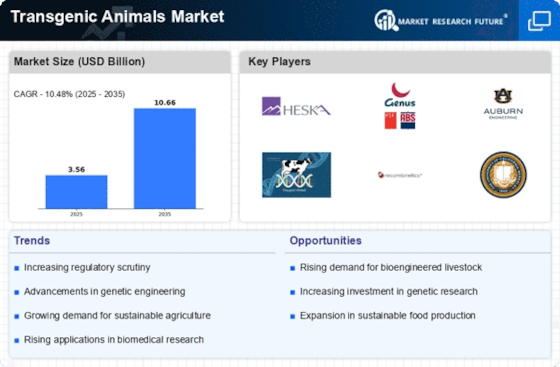
As per MRFR analysis, the Transgenic Animals Market Size was estimated at 3.56 USD Billion in 2024. The Transgenic Animals industry is projected to grow from 3.933 USD Billion in 2025 to 10.66 USD Billion by 2035, exhibiting a compound annual growth rate (CAGR) of 10.48 during the forecast period 2025 - 2035.

Key Market Trends & Highlights

The Transgenic Animals Market is poised for substantial growth driven by technological advancements and increasing applications in various sectors.

  • Advancements in genetic engineering are significantly shaping the transgenic animals market, particularly in North America, which remains the largest market.
  • The Asia-Pacific region is emerging as the fastest-growing area, reflecting a rising interest in sustainable agricultural practices.
  • Microinjections continue to dominate as the largest segment, while electroporators are gaining traction as the fastest-growing method for gene transfer.
  • Rising demand for biopharmaceuticals and regulatory support for biotechnology are key drivers propelling market expansion.

Market Size & Forecast

2024 Market Size 3.56 (USD Billion)
2035 Market Size 10.66 (USD Billion)
CAGR (2025 - 2035) 10.48%
Largest Regional Market Share in 2024 America

Major Players

<p>Heska Corporation (US), Genus plc (GB), Auburn University (US), Transgenic Animal Production (US), Recombinetics, Inc. (US), University of California (US), Horizon Discovery Group plc (GB), Kymab Limited (GB), Novartis AG (CH)</p>

Market Trends

The Transgenic Animals Market is currently experiencing a notable evolution, driven by advancements in genetic engineering and biotechnology. This sector encompasses a variety of applications, including agriculture, pharmaceuticals, and research. The increasing demand for genetically modified organisms, particularly in livestock, suggests a shift towards enhanced productivity and disease resistance. Furthermore, the growing interest in personalized medicine and the development of transgenic models for human diseases indicate a promising future for this market. As regulatory frameworks evolve, the potential for innovation within the Transgenic Animals Market appears to expand, fostering collaboration between academia and industry. In addition, ethical considerations surrounding the use of transgenic animals are becoming more prominent. Stakeholders are increasingly aware of the need for responsible practices and transparency in genetic modifications. This awareness may lead to the establishment of stricter guidelines and standards, which could influence market dynamics. Overall, the Transgenic Animals Market seems poised for growth, with ongoing research and development efforts likely to drive new applications and technologies in the coming years.

Advancements in Genetic Engineering

Recent innovations in genetic modification techniques are transforming the Transgenic Animals Market. Techniques such as CRISPR and other genome editing tools are enabling more precise alterations, which may enhance the efficiency and effectiveness of transgenic applications. This trend indicates a shift towards more targeted approaches in creating genetically modified organisms.

Increased Focus on Animal Welfare

There is a growing emphasis on ethical considerations and animal welfare within the Transgenic Animals Market. Stakeholders are increasingly advocating for responsible practices in genetic modifications, which may lead to the development of guidelines that prioritize the well-being of transgenic animals. This trend reflects a broader societal concern regarding the treatment of genetically altered organisms.

Expansion of Applications in Pharmaceuticals

The use of transgenic animals in pharmaceutical development is gaining traction. These animals are being utilized as models for human diseases, which could facilitate drug discovery and testing processes. This trend suggests a potential for significant advancements in medical research, as transgenic models may provide more accurate representations of human conditions.

Transgenic Animals Market Market Drivers

Regulatory Support for Biotechnology

Regulatory support for biotechnology is emerging as a key driver for the Transgenic Animals Market. Governments and regulatory bodies are increasingly recognizing the potential benefits of transgenic technologies in addressing global challenges such as food security and disease management. Initiatives aimed at streamlining the approval processes for genetically modified organisms are likely to encourage research and development in this field. For example, regulatory frameworks that facilitate the safe use of transgenic animals in agriculture and pharmaceuticals can enhance public acceptance and foster innovation. As regulatory environments become more favorable, the Transgenic Animals Market may experience accelerated growth, attracting investments and encouraging the development of new products and applications.

Rising Demand for Biopharmaceuticals

The increasing demand for biopharmaceuticals is a pivotal driver for the Transgenic Animals Market. As the healthcare sector evolves, there is a notable shift towards biologics, which are often produced using transgenic animals. These animals can be engineered to produce complex proteins and antibodies that are essential for therapeutic applications. The market for biopharmaceuticals is projected to reach approximately USD 500 billion by 2025, indicating a robust growth trajectory. This surge in demand is likely to propel the utilization of transgenic animals, as they offer a reliable and efficient means of producing high-quality biological products. Consequently, the Transgenic Animals Market is expected to witness significant expansion, driven by the need for innovative solutions in drug development and production.

Growing Interest in Sustainable Agriculture

The growing interest in sustainable agriculture is significantly influencing the Transgenic Animals Market. As consumers become more environmentally conscious, there is a rising demand for agricultural practices that minimize environmental impact. Transgenic animals can play a crucial role in this transition by providing enhanced traits such as improved feed efficiency and reduced greenhouse gas emissions. For instance, transgenic livestock can be engineered to utilize feed more effectively, thereby reducing waste and resource consumption. This shift towards sustainability is expected to drive the adoption of transgenic technologies in agriculture, leading to a more resilient food system. Consequently, the Transgenic Animals Market is poised for growth as stakeholders seek innovative solutions to meet the challenges of food security and environmental sustainability.

Increased Investment in Research and Development

Increased investment in research and development is a significant driver for the Transgenic Animals Market. As the potential applications of transgenic animals expand, both public and private sectors are allocating substantial resources to explore innovative solutions. This investment is crucial for advancing genetic engineering techniques and developing new transgenic species that can meet specific market needs. For instance, funding for research projects focused on disease-resistant animals or those with enhanced nutritional profiles is on the rise. Such initiatives not only contribute to scientific knowledge but also pave the way for commercial applications that can benefit various industries. The influx of capital into the Transgenic Animals Market is likely to stimulate growth and foster a dynamic environment for innovation.

Technological Advancements in Genetic Engineering

Technological advancements in genetic engineering are transforming the landscape of the Transgenic Animals Market. Innovations such as CRISPR-Cas9 and other gene-editing technologies have enhanced the precision and efficiency of creating transgenic animals. These advancements allow for the development of animals with specific traits, which can be utilized in various sectors, including agriculture and pharmaceuticals. The ability to produce animals that are disease-resistant or have improved growth rates can lead to increased productivity and sustainability in livestock farming. As these technologies continue to evolve, they are likely to drive further investment and research in the Transgenic Animals Market, fostering a more competitive environment and expanding the range of applications for transgenic animals.

Market Segment Insights

Transgenic Animals Market Type Insights 

Transgenic Animals Market Technology Insights

Get more detailed insights about Transgenic Animals Market Research Report – Forecast till 2035

Regional Insights

North America : Innovation and Research Hub

North America dominates the transgenic animals market, accounting for approximately 45% of the global share. The region benefits from robust research institutions, significant funding for biotechnology, and favorable regulatory frameworks that encourage innovation. The increasing demand for genetically modified animals for agricultural and pharmaceutical applications further drives market growth. Regulatory bodies like the USDA and FDA play crucial roles in shaping the landscape, ensuring safety and efficacy in transgenic animal production. The United States is the largest market, followed by Canada, which is emerging as a significant player. Key companies such as Heska Corporation, Genus plc, and various universities are at the forefront of research and development. The competitive landscape is characterized by collaborations between academia and industry, fostering advancements in genetic engineering and transgenic technologies. This synergy enhances the region's position as a leader in the transgenic animals market.

Europe : Regulatory Framework and Innovation

Europe is a significant player in the transgenic animals market, holding approximately 30% of the global share. The region's growth is driven by stringent regulations that ensure the safety and ethical considerations of transgenic animals. The European Food Safety Authority (EFSA) plays a pivotal role in assessing the risks associated with genetically modified organisms, which influences market dynamics. The increasing focus on sustainable agriculture and animal welfare further propels demand for transgenic solutions. Leading countries in Europe include the United Kingdom, Germany, and Switzerland, where key players like Genus plc and Novartis AG are actively involved in research and development. The competitive landscape is marked by collaborations between biotech firms and research institutions, enhancing innovation in transgenic technologies. The presence of strong regulatory bodies ensures that the market operates within a framework that prioritizes safety and ethical standards, fostering consumer trust and acceptance.

Asia-Pacific : Emerging Market with Potential

Asia-Pacific is an emerging powerhouse in the transgenic animals market, accounting for approximately 20% of the global share. The region's growth is fueled by increasing investments in biotechnology, rising demand for food security, and advancements in genetic engineering technologies. Countries like China and India are leading the charge, with supportive government policies aimed at enhancing agricultural productivity through transgenic solutions. The regulatory environment is evolving, with efforts to establish frameworks that balance innovation and safety. China is the largest market in the region, followed by India, where significant research initiatives are underway. The competitive landscape features a mix of local and international players, with collaborations between universities and biotech firms driving innovation. The presence of key players like Recombinetics, Inc. and various research institutions enhances the region's capabilities in transgenic animal production, positioning it for future growth in the global market.

Middle East and Africa : Resource-Rich with Growth Potential

The Middle East and Africa region is gradually emerging in the transgenic animals market, holding about 5% of the global share. The growth is primarily driven by increasing agricultural challenges, food security concerns, and the need for innovative solutions to enhance livestock productivity. Countries like South Africa and Egypt are beginning to explore transgenic technologies, supported by government initiatives aimed at improving agricultural practices. The regulatory landscape is still developing, with efforts to establish guidelines for the safe use of transgenic animals. South Africa is the leading market in the region, with a growing interest in biotechnology and transgenic research. The competitive landscape is characterized by collaborations between local universities and international biotech firms, fostering knowledge transfer and innovation. As awareness of the benefits of transgenic animals increases, the region is poised for growth, with potential for significant advancements in agricultural productivity and food security.

Key Companies in the Transgenic Animals Market market include

Industry Developments

    • In 2020, a famous manufacturer Merck Animal Health agreed with Automamaziono VX Inc., discovered a subcutaneous chick development technology. This technology will be used for combining Merck Animal Health’s Innovax vaccines which are used for protection against infectious diseases.
    • In 2019, Boehringer Ingelheim put forward the largest biotechnology for the discovery of veterinary vaccines in France. Here demand increased along with the rise in growth in poultry consumption.
    • In April 2020, Heska Corporation made a partnership with Scil Animal Care emerge and carried out new veterinary projects.
    • In June 2020, Chanelle Pharma Group discovered the Spot-On treatment which protects cats and dogs against some of the parasites.

Future Outlook

Transgenic Animals Market Future Outlook

<p>The Transgenic Animals Market is projected to grow at a 10.48% CAGR from 2024 to 2035, driven by advancements in genetic engineering, increasing demand for biopharmaceuticals, and enhanced agricultural productivity.</p>

New opportunities lie in:

  • <p>Development of genetically modified livestock for disease resistance</p>
  • <p>Expansion of transgenic animal models for drug testing</p>
  • <p>Investment in precision breeding technologies for enhanced traits</p>

<p>By 2035, the Transgenic Animals Market is expected to achieve substantial growth and innovation.</p>

Market Segmentation

Transgenic Animals Market Type Outlook

  • OCR gene gun
  • microinjections
  • electroporator

Transgenic Animals Market End-Users Outlook

  • biotechnological industry
  • research organizations
  • academic institutes

Transgenic Animals Market Techniques Outlook

  • retro-virus-mediated transfer of gene
  • embryonic stem cell-mediated transfer of gene
  • microinjection of DNA

Transgenic Animals Market Applications Outlook

  • recombinant human proteins
  • monoclonal antibodies
  • xenotransplantation

Report Scope

MARKET SIZE 20243.56(USD Billion)
MARKET SIZE 20253.933(USD Billion)
MARKET SIZE 203510.66(USD Billion)
COMPOUND ANNUAL GROWTH RATE (CAGR)10.48% (2024 - 2035)
REPORT COVERAGERevenue Forecast, Competitive Landscape, Growth Factors, and Trends
BASE YEAR2024
Market Forecast Period2025 - 2035
Historical Data2019 - 2024
Market Forecast UnitsUSD Billion
Key Companies ProfiledMarket analysis in progress
Segments CoveredMarket segmentation analysis in progress
Key Market OpportunitiesAdvancements in gene editing technologies enhance potential applications in the Transgenic Animals Market.
Key Market DynamicsRising regulatory scrutiny and technological advancements drive innovation in the transgenic animals market.
Countries CoveredNorth America, Europe, APAC, South America, MEA

FAQs

What is the current valuation of the Transgenic Animals Market?

The Transgenic Animals Market was valued at 3.56 USD Billion in 2024.

What is the projected market size for the Transgenic Animals Market by 2035?

The market is projected to reach 10.66 USD Billion by 2035.

What is the expected CAGR for the Transgenic Animals Market during the forecast period?

The expected CAGR for the market from 2025 to 2035 is 10.48%.

Which companies are considered key players in the Transgenic Animals Market?

Key players include Heska Corporation, Genus plc, and Novartis AG, among others.

What are the primary applications of transgenic animals in the market?

Applications include recombinant human proteins, monoclonal antibodies, and xenotransplantation.

  1. SECTION I: EXECUTIVE SUMMARY AND KEY HIGHLIGHTS
    1. EXECUTIVE SUMMARY
      1. Market Overview
      2. Key Findings
      3. Market Segmentation
      4. Competitive Landscape
      5. Challenges and Opportunities
      6. Future Outlook
  2. SECTION II: SCOPING, METHODOLOGY AND MARKET STRUCTURE
    1. MARKET INTRODUCTION
      1. Definition
      2. Scope of the study
    2. RESEARCH METHODOLOGY
      1. Overview
      2. Data Mining
      3. Secondary Research
      4. Primary Research
      5. Forecasting Model
      6. Market Size Estimation
      7. Data Triangulation
      8. Validation
  3. SECTION III: QUALITATIVE ANALYSIS
    1. MARKET DYNAMICS
      1. Overview
      2. Drivers
      3. Restraints
      4. Opportunities
    2. MARKET FACTOR ANALYSIS
      1. Value chain Analysis
      2. Porter's Five Forces Analysis
      3. COVID-19 Impact Analysis
  4. SECTION IV: QUANTITATIVE ANALYSIS
    1. Healthcare, BY Type (USD Billion)
      1. OCR gene gun
      2. microinjections
      3. electroporator
    2. Healthcare, BY Techniques (USD Billion)
      1. retro-virus-mediated transfer of gene
      2. embryonic stem cell-mediated transfer of gene
      3. microinjection of DNA
    3. Healthcare, BY Applications (USD Billion)
      1. recombinant human proteins
      2. monoclonal antibodies
      3. xenotransplantation
    4. Healthcare, BY Model Organisms (USD Billion)
    5. Healthcare, BY End-Users (USD Billion)
      1. biotechnological industry
      2. research organizations
      3. academic institutes
    6. Healthcare, BY Region (USD Billion)
      1. North America
      2. Europe
      3. APAC
      4. South America
      5. MEA
  5. SECTION V: COMPETITIVE ANALYSIS
    1. Competitive Landscape
      1. Overview
      2. Competitive Analysis
      3. Market share Analysis
      4. Major Growth Strategy in the Healthcare
      5. Competitive Benchmarking
      6. Leading Players in Terms of Number of Developments in the Healthcare
      7. Key developments and growth strategies
      8. Major Players Financial Matrix
    2. Company Profiles
      1. Heska Corporation (US)
      2. Genus plc (GB)
      3. Auburn University (US)
      4. Transgenic Animal Production (US)
      5. Recombinetics, Inc. (US)
      6. University of California (US)
      7. Horizon Discovery Group plc (GB)
      8. Kymab Limited (GB)
      9. Novartis AG (CH)
    3. Appendix
      1. References
      2. Related Reports
  6. LIST OF FIGURES
    1. MARKET SYNOPSIS
    2. NORTH AMERICA MARKET ANALYSIS
    3. US MARKET ANALYSIS BY TYPE
    4. US MARKET ANALYSIS BY TECHNIQUES
    5. US MARKET ANALYSIS BY APPLICATIONS
    6. US MARKET ANALYSIS BY MODEL ORGANISMS
    7. US MARKET ANALYSIS BY END-USERS
    8. CANADA MARKET ANALYSIS BY TYPE
    9. CANADA MARKET ANALYSIS BY TECHNIQUES
    10. CANADA MARKET ANALYSIS BY APPLICATIONS
    11. CANADA MARKET ANALYSIS BY MODEL ORGANISMS
    12. CANADA MARKET ANALYSIS BY END-USERS
    13. EUROPE MARKET ANALYSIS
    14. GERMANY MARKET ANALYSIS BY TYPE
    15. GERMANY MARKET ANALYSIS BY TECHNIQUES
    16. GERMANY MARKET ANALYSIS BY APPLICATIONS
    17. GERMANY MARKET ANALYSIS BY MODEL ORGANISMS
    18. GERMANY MARKET ANALYSIS BY END-USERS
    19. UK MARKET ANALYSIS BY TYPE
    20. UK MARKET ANALYSIS BY TECHNIQUES
    21. UK MARKET ANALYSIS BY APPLICATIONS
    22. UK MARKET ANALYSIS BY MODEL ORGANISMS
    23. UK MARKET ANALYSIS BY END-USERS
    24. FRANCE MARKET ANALYSIS BY TYPE
    25. FRANCE MARKET ANALYSIS BY TECHNIQUES
    26. FRANCE MARKET ANALYSIS BY APPLICATIONS
    27. FRANCE MARKET ANALYSIS BY MODEL ORGANISMS
    28. FRANCE MARKET ANALYSIS BY END-USERS
    29. RUSSIA MARKET ANALYSIS BY TYPE
    30. RUSSIA MARKET ANALYSIS BY TECHNIQUES
    31. RUSSIA MARKET ANALYSIS BY APPLICATIONS
    32. RUSSIA MARKET ANALYSIS BY MODEL ORGANISMS
    33. RUSSIA MARKET ANALYSIS BY END-USERS
    34. ITALY MARKET ANALYSIS BY TYPE
    35. ITALY MARKET ANALYSIS BY TECHNIQUES
    36. ITALY MARKET ANALYSIS BY APPLICATIONS
    37. ITALY MARKET ANALYSIS BY MODEL ORGANISMS
    38. ITALY MARKET ANALYSIS BY END-USERS
    39. SPAIN MARKET ANALYSIS BY TYPE
    40. SPAIN MARKET ANALYSIS BY TECHNIQUES
    41. SPAIN MARKET ANALYSIS BY APPLICATIONS
    42. SPAIN MARKET ANALYSIS BY MODEL ORGANISMS
    43. SPAIN MARKET ANALYSIS BY END-USERS
    44. REST OF EUROPE MARKET ANALYSIS BY TYPE
    45. REST OF EUROPE MARKET ANALYSIS BY TECHNIQUES
    46. REST OF EUROPE MARKET ANALYSIS BY APPLICATIONS
    47. REST OF EUROPE MARKET ANALYSIS BY MODEL ORGANISMS
    48. REST OF EUROPE MARKET ANALYSIS BY END-USERS
    49. APAC MARKET ANALYSIS
    50. CHINA MARKET ANALYSIS BY TYPE
    51. CHINA MARKET ANALYSIS BY TECHNIQUES
    52. CHINA MARKET ANALYSIS BY APPLICATIONS
    53. CHINA MARKET ANALYSIS BY MODEL ORGANISMS
    54. CHINA MARKET ANALYSIS BY END-USERS
    55. INDIA MARKET ANALYSIS BY TYPE
    56. INDIA MARKET ANALYSIS BY TECHNIQUES
    57. INDIA MARKET ANALYSIS BY APPLICATIONS
    58. INDIA MARKET ANALYSIS BY MODEL ORGANISMS
    59. INDIA MARKET ANALYSIS BY END-USERS
    60. JAPAN MARKET ANALYSIS BY TYPE
    61. JAPAN MARKET ANALYSIS BY TECHNIQUES
    62. JAPAN MARKET ANALYSIS BY APPLICATIONS
    63. JAPAN MARKET ANALYSIS BY MODEL ORGANISMS
    64. JAPAN MARKET ANALYSIS BY END-USERS
    65. SOUTH KOREA MARKET ANALYSIS BY TYPE
    66. SOUTH KOREA MARKET ANALYSIS BY TECHNIQUES
    67. SOUTH KOREA MARKET ANALYSIS BY APPLICATIONS
    68. SOUTH KOREA MARKET ANALYSIS BY MODEL ORGANISMS
    69. SOUTH KOREA MARKET ANALYSIS BY END-USERS
    70. MALAYSIA MARKET ANALYSIS BY TYPE
    71. MALAYSIA MARKET ANALYSIS BY TECHNIQUES
    72. MALAYSIA MARKET ANALYSIS BY APPLICATIONS
    73. MALAYSIA MARKET ANALYSIS BY MODEL ORGANISMS
    74. MALAYSIA MARKET ANALYSIS BY END-USERS
    75. THAILAND MARKET ANALYSIS BY TYPE
    76. THAILAND MARKET ANALYSIS BY TECHNIQUES
    77. THAILAND MARKET ANALYSIS BY APPLICATIONS
    78. THAILAND MARKET ANALYSIS BY MODEL ORGANISMS
    79. THAILAND MARKET ANALYSIS BY END-USERS
    80. INDONESIA MARKET ANALYSIS BY TYPE
    81. INDONESIA MARKET ANALYSIS BY TECHNIQUES
    82. INDONESIA MARKET ANALYSIS BY APPLICATIONS
    83. INDONESIA MARKET ANALYSIS BY MODEL ORGANISMS
    84. INDONESIA MARKET ANALYSIS BY END-USERS
    85. REST OF APAC MARKET ANALYSIS BY TYPE
    86. REST OF APAC MARKET ANALYSIS BY TECHNIQUES
    87. REST OF APAC MARKET ANALYSIS BY APPLICATIONS
    88. REST OF APAC MARKET ANALYSIS BY MODEL ORGANISMS
    89. REST OF APAC MARKET ANALYSIS BY END-USERS
    90. SOUTH AMERICA MARKET ANALYSIS
    91. BRAZIL MARKET ANALYSIS BY TYPE
    92. BRAZIL MARKET ANALYSIS BY TECHNIQUES
    93. BRAZIL MARKET ANALYSIS BY APPLICATIONS
    94. BRAZIL MARKET ANALYSIS BY MODEL ORGANISMS
    95. BRAZIL MARKET ANALYSIS BY END-USERS
    96. MEXICO MARKET ANALYSIS BY TYPE
    97. MEXICO MARKET ANALYSIS BY TECHNIQUES
    98. MEXICO MARKET ANALYSIS BY APPLICATIONS
    99. MEXICO MARKET ANALYSIS BY MODEL ORGANISMS
    100. MEXICO MARKET ANALYSIS BY END-USERS
    101. ARGENTINA MARKET ANALYSIS BY TYPE
    102. ARGENTINA MARKET ANALYSIS BY TECHNIQUES
    103. ARGENTINA MARKET ANALYSIS BY APPLICATIONS
    104. ARGENTINA MARKET ANALYSIS BY MODEL ORGANISMS
    105. ARGENTINA MARKET ANALYSIS BY END-USERS
    106. REST OF SOUTH AMERICA MARKET ANALYSIS BY TYPE
    107. REST OF SOUTH AMERICA MARKET ANALYSIS BY TECHNIQUES
    108. REST OF SOUTH AMERICA MARKET ANALYSIS BY APPLICATIONS
    109. REST OF SOUTH AMERICA MARKET ANALYSIS BY MODEL ORGANISMS
    110. REST OF SOUTH AMERICA MARKET ANALYSIS BY END-USERS
    111. MEA MARKET ANALYSIS
    112. GCC COUNTRIES MARKET ANALYSIS BY TYPE
    113. GCC COUNTRIES MARKET ANALYSIS BY TECHNIQUES
    114. GCC COUNTRIES MARKET ANALYSIS BY APPLICATIONS
    115. GCC COUNTRIES MARKET ANALYSIS BY MODEL ORGANISMS
    116. GCC COUNTRIES MARKET ANALYSIS BY END-USERS
    117. SOUTH AFRICA MARKET ANALYSIS BY TYPE
    118. SOUTH AFRICA MARKET ANALYSIS BY TECHNIQUES
    119. SOUTH AFRICA MARKET ANALYSIS BY APPLICATIONS
    120. SOUTH AFRICA MARKET ANALYSIS BY MODEL ORGANISMS
    121. SOUTH AFRICA MARKET ANALYSIS BY END-USERS
    122. REST OF MEA MARKET ANALYSIS BY TYPE
    123. REST OF MEA MARKET ANALYSIS BY TECHNIQUES
    124. REST OF MEA MARKET ANALYSIS BY APPLICATIONS
    125. REST OF MEA MARKET ANALYSIS BY MODEL ORGANISMS
    126. REST OF MEA MARKET ANALYSIS BY END-USERS
    127. KEY BUYING CRITERIA OF HEALTHCARE
    128. RESEARCH PROCESS OF MRFR
    129. DRO ANALYSIS OF HEALTHCARE
    130. DRIVERS IMPACT ANALYSIS: HEALTHCARE
    131. RESTRAINTS IMPACT ANALYSIS: HEALTHCARE
    132. SUPPLY / VALUE CHAIN: HEALTHCARE
    133. HEALTHCARE, BY TYPE, 2024 (% SHARE)
    134. HEALTHCARE, BY TYPE, 2024 TO 2035 (USD Billion)
    135. HEALTHCARE, BY TECHNIQUES, 2024 (% SHARE)
    136. HEALTHCARE, BY TECHNIQUES, 2024 TO 2035 (USD Billion)
    137. HEALTHCARE, BY APPLICATIONS, 2024 (% SHARE)
    138. HEALTHCARE, BY APPLICATIONS, 2024 TO 2035 (USD Billion)
    139. HEALTHCARE, BY MODEL ORGANISMS, 2024 (% SHARE)
    140. HEALTHCARE, BY MODEL ORGANISMS, 2024 TO 2035 (USD Billion)
    141. HEALTHCARE, BY END-USERS, 2024 (% SHARE)
    142. HEALTHCARE, BY END-USERS, 2024 TO 2035 (USD Billion)
    143. BENCHMARKING OF MAJOR COMPETITORS
  7. LIST OF TABLES
    1. LIST OF ASSUMPTIONS
    2. North America MARKET SIZE ESTIMATES; FORECAST
      1. BY TYPE, 2025-2035 (USD Billion)
      2. BY TECHNIQUES, 2025-2035 (USD Billion)
      3. BY APPLICATIONS, 2025-2035 (USD Billion)
      4. BY MODEL ORGANISMS, 2025-2035 (USD Billion)
      5. BY END-USERS, 2025-2035 (USD Billion)
    3. US MARKET SIZE ESTIMATES; FORECAST
      1. BY TYPE, 2025-2035 (USD Billion)
      2. BY TECHNIQUES, 2025-2035 (USD Billion)
      3. BY APPLICATIONS, 2025-2035 (USD Billion)
      4. BY MODEL ORGANISMS, 2025-2035 (USD Billion)
      5. BY END-USERS, 2025-2035 (USD Billion)
    4. Canada MARKET SIZE ESTIMATES; FORECAST
      1. BY TYPE, 2025-2035 (USD Billion)
      2. BY TECHNIQUES, 2025-2035 (USD Billion)
      3. BY APPLICATIONS, 2025-2035 (USD Billion)
      4. BY MODEL ORGANISMS, 2025-2035 (USD Billion)
      5. BY END-USERS, 2025-2035 (USD Billion)
    5. Europe MARKET SIZE ESTIMATES; FORECAST
      1. BY TYPE, 2025-2035 (USD Billion)
      2. BY TECHNIQUES, 2025-2035 (USD Billion)
      3. BY APPLICATIONS, 2025-2035 (USD Billion)
      4. BY MODEL ORGANISMS, 2025-2035 (USD Billion)
      5. BY END-USERS, 2025-2035 (USD Billion)
    6. Germany MARKET SIZE ESTIMATES; FORECAST
      1. BY TYPE, 2025-2035 (USD Billion)
      2. BY TECHNIQUES, 2025-2035 (USD Billion)
      3. BY APPLICATIONS, 2025-2035 (USD Billion)
      4. BY MODEL ORGANISMS, 2025-2035 (USD Billion)
      5. BY END-USERS, 2025-2035 (USD Billion)
    7. UK MARKET SIZE ESTIMATES; FORECAST
      1. BY TYPE, 2025-2035 (USD Billion)
      2. BY TECHNIQUES, 2025-2035 (USD Billion)
      3. BY APPLICATIONS, 2025-2035 (USD Billion)
      4. BY MODEL ORGANISMS, 2025-2035 (USD Billion)
      5. BY END-USERS, 2025-2035 (USD Billion)
    8. France MARKET SIZE ESTIMATES; FORECAST
      1. BY TYPE, 2025-2035 (USD Billion)
      2. BY TECHNIQUES, 2025-2035 (USD Billion)
      3. BY APPLICATIONS, 2025-2035 (USD Billion)
      4. BY MODEL ORGANISMS, 2025-2035 (USD Billion)
      5. BY END-USERS, 2025-2035 (USD Billion)
    9. Russia MARKET SIZE ESTIMATES; FORECAST
      1. BY TYPE, 2025-2035 (USD Billion)
      2. BY TECHNIQUES, 2025-2035 (USD Billion)
      3. BY APPLICATIONS, 2025-2035 (USD Billion)
      4. BY MODEL ORGANISMS, 2025-2035 (USD Billion)
      5. BY END-USERS, 2025-2035 (USD Billion)
    10. Italy MARKET SIZE ESTIMATES; FORECAST
      1. BY TYPE, 2025-2035 (USD Billion)
      2. BY TECHNIQUES, 2025-2035 (USD Billion)
      3. BY APPLICATIONS, 2025-2035 (USD Billion)
      4. BY MODEL ORGANISMS, 2025-2035 (USD Billion)
      5. BY END-USERS, 2025-2035 (USD Billion)
    11. Spain MARKET SIZE ESTIMATES; FORECAST
      1. BY TYPE, 2025-2035 (USD Billion)
      2. BY TECHNIQUES, 2025-2035 (USD Billion)
      3. BY APPLICATIONS, 2025-2035 (USD Billion)
      4. BY MODEL ORGANISMS, 2025-2035 (USD Billion)
      5. BY END-USERS, 2025-2035 (USD Billion)
    12. Rest of Europe MARKET SIZE ESTIMATES; FORECAST
      1. BY TYPE, 2025-2035 (USD Billion)
      2. BY TECHNIQUES, 2025-2035 (USD Billion)
      3. BY APPLICATIONS, 2025-2035 (USD Billion)
      4. BY MODEL ORGANISMS, 2025-2035 (USD Billion)
      5. BY END-USERS, 2025-2035 (USD Billion)
    13. APAC MARKET SIZE ESTIMATES; FORECAST
      1. BY TYPE, 2025-2035 (USD Billion)
      2. BY TECHNIQUES, 2025-2035 (USD Billion)
      3. BY APPLICATIONS, 2025-2035 (USD Billion)
      4. BY MODEL ORGANISMS, 2025-2035 (USD Billion)
      5. BY END-USERS, 2025-2035 (USD Billion)
    14. China MARKET SIZE ESTIMATES; FORECAST
      1. BY TYPE, 2025-2035 (USD Billion)
      2. BY TECHNIQUES, 2025-2035 (USD Billion)
      3. BY APPLICATIONS, 2025-2035 (USD Billion)
      4. BY MODEL ORGANISMS, 2025-2035 (USD Billion)
      5. BY END-USERS, 2025-2035 (USD Billion)
    15. India MARKET SIZE ESTIMATES; FORECAST
      1. BY TYPE, 2025-2035 (USD Billion)
      2. BY TECHNIQUES, 2025-2035 (USD Billion)
      3. BY APPLICATIONS, 2025-2035 (USD Billion)
      4. BY MODEL ORGANISMS, 2025-2035 (USD Billion)
      5. BY END-USERS, 2025-2035 (USD Billion)
    16. Japan MARKET SIZE ESTIMATES; FORECAST
      1. BY TYPE, 2025-2035 (USD Billion)
      2. BY TECHNIQUES, 2025-2035 (USD Billion)
      3. BY APPLICATIONS, 2025-2035 (USD Billion)
      4. BY MODEL ORGANISMS, 2025-2035 (USD Billion)
      5. BY END-USERS, 2025-2035 (USD Billion)
    17. South Korea MARKET SIZE ESTIMATES; FORECAST
      1. BY TYPE, 2025-2035 (USD Billion)
      2. BY TECHNIQUES, 2025-2035 (USD Billion)
      3. BY APPLICATIONS, 2025-2035 (USD Billion)
      4. BY MODEL ORGANISMS, 2025-2035 (USD Billion)
      5. BY END-USERS, 2025-2035 (USD Billion)
    18. Malaysia MARKET SIZE ESTIMATES; FORECAST
      1. BY TYPE, 2025-2035 (USD Billion)
      2. BY TECHNIQUES, 2025-2035 (USD Billion)
      3. BY APPLICATIONS, 2025-2035 (USD Billion)
      4. BY MODEL ORGANISMS, 2025-2035 (USD Billion)
      5. BY END-USERS, 2025-2035 (USD Billion)
    19. Thailand MARKET SIZE ESTIMATES; FORECAST
      1. BY TYPE, 2025-2035 (USD Billion)
      2. BY TECHNIQUES, 2025-2035 (USD Billion)
      3. BY APPLICATIONS, 2025-2035 (USD Billion)
      4. BY MODEL ORGANISMS, 2025-2035 (USD Billion)
      5. BY END-USERS, 2025-2035 (USD Billion)
    20. Indonesia MARKET SIZE ESTIMATES; FORECAST
      1. BY TYPE, 2025-2035 (USD Billion)
      2. BY TECHNIQUES, 2025-2035 (USD Billion)
      3. BY APPLICATIONS, 2025-2035 (USD Billion)
      4. BY MODEL ORGANISMS, 2025-2035 (USD Billion)
      5. BY END-USERS, 2025-2035 (USD Billion)
    21. Rest of APAC MARKET SIZE ESTIMATES; FORECAST
      1. BY TYPE, 2025-2035 (USD Billion)
      2. BY TECHNIQUES, 2025-2035 (USD Billion)
      3. BY APPLICATIONS, 2025-2035 (USD Billion)
      4. BY MODEL ORGANISMS, 2025-2035 (USD Billion)
      5. BY END-USERS, 2025-2035 (USD Billion)
    22. South America MARKET SIZE ESTIMATES; FORECAST
      1. BY TYPE, 2025-2035 (USD Billion)
      2. BY TECHNIQUES, 2025-2035 (USD Billion)
      3. BY APPLICATIONS, 2025-2035 (USD Billion)
      4. BY MODEL ORGANISMS, 2025-2035 (USD Billion)
      5. BY END-USERS, 2025-2035 (USD Billion)
    23. Brazil MARKET SIZE ESTIMATES; FORECAST
      1. BY TYPE, 2025-2035 (USD Billion)
      2. BY TECHNIQUES, 2025-2035 (USD Billion)
      3. BY APPLICATIONS, 2025-2035 (USD Billion)
      4. BY MODEL ORGANISMS, 2025-2035 (USD Billion)
      5. BY END-USERS, 2025-2035 (USD Billion)
    24. Mexico MARKET SIZE ESTIMATES; FORECAST
      1. BY TYPE, 2025-2035 (USD Billion)
      2. BY TECHNIQUES, 2025-2035 (USD Billion)
      3. BY APPLICATIONS, 2025-2035 (USD Billion)
      4. BY MODEL ORGANISMS, 2025-2035 (USD Billion)
      5. BY END-USERS, 2025-2035 (USD Billion)
    25. Argentina MARKET SIZE ESTIMATES; FORECAST
      1. BY TYPE, 2025-2035 (USD Billion)
      2. BY TECHNIQUES, 2025-2035 (USD Billion)
      3. BY APPLICATIONS, 2025-2035 (USD Billion)
      4. BY MODEL ORGANISMS, 2025-2035 (USD Billion)
      5. BY END-USERS, 2025-2035 (USD Billion)
    26. Rest of South America MARKET SIZE ESTIMATES; FORECAST
      1. BY TYPE, 2025-2035 (USD Billion)
      2. BY TECHNIQUES, 2025-2035 (USD Billion)
      3. BY APPLICATIONS, 2025-2035 (USD Billion)
      4. BY MODEL ORGANISMS, 2025-2035 (USD Billion)
      5. BY END-USERS, 2025-2035 (USD Billion)
    27. MEA MARKET SIZE ESTIMATES; FORECAST
      1. BY TYPE, 2025-2035 (USD Billion)
      2. BY TECHNIQUES, 2025-2035 (USD Billion)
      3. BY APPLICATIONS, 2025-2035 (USD Billion)
      4. BY MODEL ORGANISMS, 2025-2035 (USD Billion)
      5. BY END-USERS, 2025-2035 (USD Billion)
    28. GCC Countries MARKET SIZE ESTIMATES; FORECAST
      1. BY TYPE, 2025-2035 (USD Billion)
      2. BY TECHNIQUES, 2025-2035 (USD Billion)
      3. BY APPLICATIONS, 2025-2035 (USD Billion)
      4. BY MODEL ORGANISMS, 2025-2035 (USD Billion)
      5. BY END-USERS, 2025-2035 (USD Billion)
    29. South Africa MARKET SIZE ESTIMATES; FORECAST
      1. BY TYPE, 2025-2035 (USD Billion)
      2. BY TECHNIQUES, 2025-2035 (USD Billion)
      3. BY APPLICATIONS, 2025-2035 (USD Billion)
      4. BY MODEL ORGANISMS, 2025-2035 (USD Billion)
      5. BY END-USERS, 2025-2035 (USD Billion)
    30. Rest of MEA MARKET SIZE ESTIMATES; FORECAST
      1. BY TYPE, 2025-2035 (USD Billion)
      2. BY TECHNIQUES, 2025-2035 (USD Billion)
      3. BY APPLICATIONS, 2025-2035 (USD Billion)
      4. BY MODEL ORGANISMS, 2025-2035 (USD Billion)
      5. BY END-USERS, 2025-2035 (USD Billion)
    31. PRODUCT LAUNCH/PRODUCT DEVELOPMENT/APPROVAL
    32. ACQUISITION/PARTNERSHIP

Transgenic Animals Market Segmentation

Market Segmentation Overview

  • Detailed segmentation data will be available in the full report
  • Comprehensive analysis by multiple parameters
  • Regional and country-level breakdowns
  • Market size forecasts by segment
Infographic

Free Sample Request

Kindly complete the form below to receive a free sample of this Report

Get Free Sample

Customer Strories

Compare Licence

×
Features License Type
Single User Multiuser License Enterprise User
Price $4,950 $5,950 $7,250
Maximum User Access Limit 1 User Upto 10 Users Unrestricted Access Throughout the Organization
Free Customization
Direct Access to Analyst
Deliverable Format
Platform Access
Discount on Next Purchase 10% 15% 15%
Printable Versions