×
Request Free Sample ×

Kindly complete the form below to receive a free sample of this Report

* Please use a valid business email

Leading companies partner with us for data-driven Insights

clients tt-cursor
Hero Background

Teleultrasound System Market

ID: MRFR/HC/40785-HCR
200 Pages
Rahul Gotadki
October 2025

Teleultrasound System Market Research Report By Technology (Portable Teleultrasound Systems, Compact Teleultrasound Systems, Handheld Teleultrasound Systems), By Application (Cardiology, Obstetrics and Gynecology, Emergency Medicine, Abdominal Imaging), By End Use (Hospitals, Clinics, Home Care, Research and Academia), By Components (Transducers, Ultrasound Consoles, Software, Display) and By Regional (North America, Europe, South America, Asia Pacific, Middle East and Africa) - Growth & Industry Forecast 2025 To 2035

Share:
Download PDF ×

We do not share your information with anyone. However, we may send you emails based on your report interest from time to time. You may contact us at any time to opt-out.

Teleultrasound System Market Infographic
×
Teleultrasound System Market Infographic Full View
Purchase Options

Teleultrasound System Market Summary

As per Market Research Future analysis, the Teleultrasound System Market Size was estimated at 3.67 USD Billion in 2024. The Teleultrasound industry is projected to grow from 3.931 USD Billion in 2025 to 7.813 USD Billion by 2035, exhibiting a compound annual growth rate (CAGR) of 7.11% during the forecast period 2025 - 2035

Key Market Trends & Highlights

The Teleultrasound System Market is experiencing robust growth driven by technological advancements and increasing demand for remote healthcare solutions.

  • North America remains the largest market for teleultrasound systems, driven by advanced healthcare infrastructure.
  • Asia-Pacific is identified as the fastest-growing region, reflecting a surge in telehealth adoption and innovation.
  • Portable teleultrasound systems dominate the market, while handheld systems are emerging rapidly due to their convenience and accessibility.
  • Key market drivers include technological advancements in teleultrasound systems and the rising demand for remote healthcare solutions, particularly in cardiology and obstetrics.

Market Size & Forecast

2024 Market Size 3.67 (USD Billion)
2035 Market Size 7.813 (USD Billion)
CAGR (2025 - 2035) 7.11%

Major Players

GE Healthcare (US), Philips (NL), Siemens Healthineers (DE), Canon Medical Systems (JP), Fujifilm (JP), Mindray (CN), Samsung Medison (KR), Hitachi Medical Systems (JP), Esaote (IT)

Teleultrasound System Market Trends

The Teleultrasound System Market is currently experiencing a transformative phase, driven by advancements in technology and increasing demand for remote healthcare solutions. The integration of telecommunication technologies with ultrasound imaging is enabling healthcare providers to deliver diagnostic services in real-time, regardless of geographical barriers. This shift is particularly relevant in rural and underserved areas, where access to specialized medical care remains limited. As healthcare systems evolve, the emphasis on patient-centered care and the need for efficient resource utilization are propelling the adoption of teleultrasound systems. Furthermore, the growing awareness of the benefits of early diagnosis and monitoring is likely to enhance the market's growth trajectory. In addition to technological advancements, regulatory support and favorable reimbursement policies are contributing to the expansion of the Teleultrasound System Market. Governments and health organizations are increasingly recognizing the potential of telehealth solutions to improve healthcare delivery and outcomes. This recognition is fostering an environment conducive to innovation and investment in teleultrasound technologies. As the market continues to mature, collaboration among stakeholders, including technology developers, healthcare providers, and policymakers, will be crucial in addressing challenges and maximizing the benefits of teleultrasound systems for patients and providers alike.

Technological Advancements

The Teleultrasound System Market is witnessing rapid technological innovations, particularly in imaging quality and connectivity. Enhanced imaging capabilities are enabling clearer and more accurate diagnostics, while improved connectivity options facilitate seamless data transmission between patients and healthcare providers.

Increased Demand for Remote Healthcare

There is a growing demand for remote healthcare solutions, particularly in rural and underserved regions. Teleultrasound systems are becoming essential tools for healthcare providers to deliver timely and effective care, thereby addressing the challenges of accessibility and convenience.

Regulatory Support and Reimbursement Policies

Supportive regulatory frameworks and favorable reimbursement policies are playing a pivotal role in the expansion of the Teleultrasound System Market. Governments are increasingly recognizing the value of telehealth solutions, which encourages investment and innovation in this sector.

Teleultrasound System Market Drivers

Growing Awareness of Preventive Healthcare

The Teleultrasound System Market is also being driven by a growing awareness of preventive healthcare among patients and providers alike. As individuals become more proactive about their health, the demand for diagnostic tools that facilitate early detection of medical conditions is increasing. Teleultrasound systems play a crucial role in this preventive approach, allowing for timely assessments and interventions. Market analysis indicates that the preventive healthcare market is expanding, with a projected growth rate of approximately 8% annually. This trend underscores the importance of teleultrasound systems in promoting health and wellness, thereby contributing to the overall growth of the Teleultrasound System Market.

Regulatory Support and Reimbursement Policies

The Teleultrasound System Market benefits from favorable regulatory support and reimbursement policies that encourage the adoption of telehealth technologies. Governments and health organizations are increasingly recognizing the importance of teleultrasound systems in improving healthcare access and outcomes. For instance, reimbursement policies that cover teleultrasound services are becoming more common, which incentivizes healthcare providers to invest in these technologies. This regulatory environment is conducive to market growth, as it reduces financial barriers for both providers and patients. Recent reports indicate that regions with supportive reimbursement frameworks are experiencing faster adoption rates of teleultrasound systems, thereby enhancing the overall Teleultrasound System Market.

Increased Demand for Remote Healthcare Solutions

The Teleultrasound System Market is witnessing a notable increase in demand for remote healthcare solutions. As healthcare providers seek to expand their reach, teleultrasound systems offer a viable solution for delivering care to patients in remote or underserved areas. This demand is further fueled by the growing emphasis on patient-centered care and the need for timely diagnostics. Market data suggests that the telehealth sector, which includes teleultrasound, is expected to grow significantly, with estimates indicating a potential market size exceeding 250 billion dollars by 2027. This growth reflects a broader trend towards integrating technology in healthcare, thereby propelling the Teleultrasound System Market to new heights.

Rising Geriatric Population and Chronic Diseases

The Teleultrasound System Market is significantly influenced by the rising geriatric population and the prevalence of chronic diseases. As the global population ages, there is an increasing need for effective diagnostic tools that can cater to the unique healthcare needs of older adults. Teleultrasound systems provide a convenient and efficient means of monitoring chronic conditions, which are more prevalent in this demographic. Data indicates that the number of individuals aged 65 and older is expected to double by 2050, leading to a corresponding rise in demand for healthcare services. This demographic shift is likely to propel the Teleultrasound System Market, as healthcare providers seek innovative solutions to manage the health of aging populations.

Technological Advancements in Teleultrasound Systems

The Teleultrasound System Market is experiencing a surge in technological advancements that enhance diagnostic capabilities. Innovations such as portable ultrasound devices and cloud-based imaging solutions are becoming increasingly prevalent. These advancements facilitate real-time imaging and remote consultations, which are crucial in various medical settings. The integration of artificial intelligence in ultrasound systems is also noteworthy, as it aids in image analysis and interpretation, potentially improving diagnostic accuracy. According to recent data, the market for portable ultrasound devices is projected to grow at a compound annual growth rate of over 10% in the coming years. This trend indicates a shift towards more accessible and efficient healthcare solutions, thereby driving the Teleultrasound System Market forward.


Market Segment Insights

By Technology: Portable Teleultrasound Systems (Largest) vs. Handheld Teleultrasound Systems (Fastest-Growing)

In the Teleultrasound System Market, the Portable Teleultrasound Systems segment dominates with the largest market share, providing flexibility and advanced imaging capabilities. This type offers significant benefits for various healthcare settings, particularly in emergency and rural healthcare. In contrast, the Handheld Teleultrasound Systems segment is gaining rapid acceptance, driven by the demand for streamlined and cost-effective diagnostic solutions. Its compact design and ease of use make it favorable among practitioners looking for portable options. Growth trends in this segment are notably influenced by technological advancements and the increasing prevalence of point-of-care ultrasound applications. Factors such as rising healthcare costs, the need for early diagnosis, and the expanding geriatric population further accelerate the adoption of both Portable and Handheld systems. As innovative features and enhanced functionality are introduced, the market is witnessing a robust trajectory of growth with more healthcare facilities integrating these technologies.

Technology: Portable Teleultrasound Systems (Dominant) vs. Handheld Teleultrasound Systems (Emerging)

The Portable Teleultrasound Systems have established themselves as the dominant technology in the Teleultrasound market due to their extensive application in various medical settings. These systems provide high-quality imaging and are particularly valuable in emergency medicine, allowing timely diagnostic decisions. On the other hand, Handheld Teleultrasound Systems are emerging as a vital option for healthcare providers seeking flexibility without compromising image quality. Their compact size enables convenient usage across diverse medical environments, including primary care and remote locations. This segment's growth is spurred by an increasing emphasis on mobile health solutions, making them a significant player in modern diagnostic approaches.

By Application: Cardiology (Largest) vs. Obstetrics and Gynecology (Fastest-Growing)

In the Teleultrasound System Market, cardiology applications hold a substantial market share, primarily due to the rising prevalence of heart diseases and advancements in ultrasound technology. The demand for non-invasive diagnostics in cardiology is driving sales, making it the most prominent application segment. Obstetrics and Gynecology, on the other hand, is witnessing a rapid increase in market share as more women seek comprehensive prenatal care and advancements in imaging technologies enhance safety and accuracy in diagnosis.

Obstetrics and Gynecology (Dominant) vs. Emergency Medicine (Emerging)

In the Teleultrasound System Market, Obstetrics and Gynecology applications are increasingly recognized as a dominant segment due to the growing emphasis on maternal and fetal health. The integration of innovative ultrasound technologies tailored for prenatal care enhances diagnostic accuracy and patient outcomes. In contrast, Emergency Medicine is emerging as a significant segment, driven by the need for rapid and precise imaging in critical situations. The ability to quickly assess conditions such as trauma or internal bleeding using portable ultrasound systems is boosting its adoption. Both segments reflect the evolving landscape of ultrasound applications, focusing on enhancing patient care through advanced technologies.

By End Use: Hospitals (Largest) vs. Clinics (Fastest-Growing)

The Teleultrasound System Market is predominantly driven by the hospital segment, which holds the largest market share due to its extensive usage of advanced imaging technologies for diagnostics and therapeutic procedures. Hospitals benefit from economies of scale, enabling them to invest in the latest teleultrasound systems, enhancing patient care. Conversely, clinics are emerging as the fastest-growing segment, capitalizing on the rising demand for point-of-care ultrasound solutions in outpatient settings. This trend reflects a shift towards more accessible healthcare services, where clinics play a pivotal role in delivering specialized care in a cost-effective manner.

Hospitals (Dominant) vs. Clinics (Emerging)

Hospitals are the dominant players in the Teleultrasound System Market, offering a wide range of services that leverage cutting-edge ultrasound technology for comprehensive patient management. These facilities typically have substantial budgets for procurement, allowing for the integration of sophisticated teleultrasound systems into their operations, leading to improved diagnostic accuracy and patient outcomes. On the other hand, clinics, which are considered an emerging segment, are rapidly adopting portable and user-friendly ultrasound systems tailored for immediate patient assessment. This shift is driven by the need for quicker diagnostics in non-hospital settings, allowing healthcare practitioners to provide timely interventions and improve patient access to essential diagnostic services.

By Components: Transducers (Largest) vs. Ultrasound Consoles (Fastest-Growing)

In the Teleultrasound System Market, the component segment showcases a diverse distribution among transducers, ultrasound consoles, software, and display systems. Transducers hold the largest share due to their critical role in image acquisition and diagnostic accuracy, accounting for a significant portion of the market. Meanwhile, ultrasound consoles, which house advanced processing capabilities, are experiencing rapid growth as they integrate new technologies to enhance user experience and diagnostic efficiency.

Transducers (Dominant) vs. Ultrasound Consoles (Emerging)

Transducers are the backbone of teleultrasound systems, delivering high-quality imaging crucial for accurate diagnoses. As the dominant component, they encompass various types, including linear and phased array transducers, designed for specific applications. Meanwhile, ultrasound consoles are emerging rapidly, driven by technological advancements such as artificial intelligence and cloud connectivity, facilitating remote diagnostics and telemedicine. These consoles provide powerful processing capabilities, enhancing imaging quality and workflow efficiency. As these two components evolve, they significantly influence the overall performance and usability of teleultrasound systems.

Get more detailed insights about Teleultrasound System Market

Regional Insights

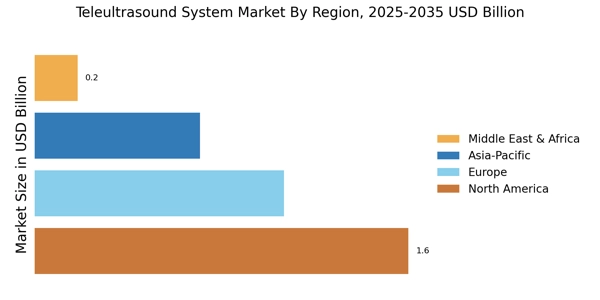
The Teleultrasound System Market demonstrates robust growth across various regions, reflecting increasing demand for advanced imaging solutions. In 2024, the market is valued at 3.67 USD Billion, with North America occupying a leading position at 1.4 USD Billion, making it a significant player in the industry due to its technological advancements and high healthcare expenditure. Europe follows with a valuation of 1.1 USD Billion, supported by a well-established healthcare infrastructure and an emphasis on innovative medical technologies. The APAC region, valued at 0.9 USD Billion, shows considerable potential for growth, driven by expanding healthcare access and investments in medical technologies.

South America and MEA are valued at 0.2 USD Billion and 0.07 USD Billion, respectively, indicating emerging markets with opportunities for expansion, although they currently hold lesser market shares. Overall, the North American and European markets dominate due to their technological capabilities and better healthcare systems, while APAC's growth aligns with the rising demand for ultrasound services in emerging economies. The Teleultrasound System Market statistics reflect a growing trend driven by advancements in telemedicine and remote patient monitoring aimed at improving healthcare delivery worldwide.

Teleultrasound System Market Regional Image

Key Players and Competitive Insights

The Teleultrasound System Market is characterized by rapid advancements in technology and increasing demand for remote medical services. This market has witnessed significant growth fueled by the rising prevalence of chronic diseases and the necessity for timely diagnosis. Teleultrasound systems allow healthcare providers to deliver ultrasound services remotely, enhancing access to care in both urban and rural settings. The competitive landscape of this market is shaped by a mix of established companies and emerging players, all vying for market share through innovation and strategic partnerships.

The integration of artificial intelligence and cloud-based solutions is also driving competition as firms strive to improve the accuracy and efficiency of teleultrasound services while also decreasing costs. GE Healthcare stands out in the Teleultrasound System Market by leveraging its extensive experience in medical imaging and diagnostic technologies. The company has developed a robust portfolio of teleultrasound solutions that are well-regarded for their reliability and advanced features. GE Healthcare's commitment to innovation is evidenced by its significant investment in research and development, enabling the company to introduce cutting-edge technologies that enhance image quality and user experience.

Furthermore, their established network of healthcare professionals and institutions enables GE Healthcare to maintain a significant market presence. By focusing on developing user-friendly applications and strengthening its telehealth capabilities, GE Healthcare continues to solidify its position as a leader in the teleultrasound arena. Philips Healthcare similarly plays a critical role in shaping the Teleultrasound System Market through its innovative product offerings. Philips Healthcare is known for its advanced healthcare solutions that prioritize patient outcomes and clinician efficiencies. The company's teleultrasound systems seamlessly integrate with other Philips healthcare technologies, offering a comprehensive approach to patient monitoring and diagnosis.

With a focus on enhancing image clarity and operational efficiency, Philips Healthcare invests heavily in technology to ensure that its teleultrasound solutions meet the evolving needs of healthcare providers. The ability to provide real-time data and a collaborative platform for medical professionals positions Philips Healthcare competitively in the market, allowing it to effectively address a wide range of healthcare settings, from hospitals to remote clinics.

Key Companies in the Teleultrasound System Market include

Industry Developments

The Teleultrasound System Market is experiencing notable advancements, driven by technological innovations and rising demand for remote healthcare solutions. Recently, GE Healthcare and Philips Healthcare have intensified their focus on expanding teleultrasound capabilities, integrating AI technologies to enhance diagnostic accuracy and efficiency. Hitachi Medical Corporation and Fujifilm Holdings Corporation are also making strides, with increased investments in mobile ultrasound systems designed for point-of-care applications. The market valuations of companies like Siemens Healthineers and Mindray have seen significant growth due to increased market exposure and enhanced product portfolios.

Additionally, mergers and acquisitions are shaping the landscape, with companies pursuing strategic partnerships to broaden their access to advanced imaging technologies. B. Braun Melsungen AG and Canon Medical Systems are exploring opportunities to strengthen their market foothold with initiatives aimed at innovation and enhancing service delivery. As these companies navigate the evolving healthcare environment, the overall market dynamics are positively impacted, reflecting a robust trend towards telehealth and remote patient monitoring, addressing the growing needs of healthcare providers and patients alike in a post-pandemic world.

Future Outlook

Teleultrasound System Market Future Outlook

The Teleultrasound System Market is projected to grow at a 7.11% CAGR from 2024 to 2035, driven by technological advancements, increasing demand for remote diagnostics, and enhanced healthcare accessibility.

New opportunities lie in:

  • Development of portable teleultrasound devices for remote areas
  • Integration of AI for real-time diagnostic support
  • Partnerships with telehealth platforms for expanded service offerings

By 2035, the Teleultrasound System Market is expected to be robust, reflecting substantial growth and innovation.

Market Segmentation

Teleultrasound System Market End Use Outlook

  • Hospitals
  • Clinics
  • Home Care
  • Research and Academia

Teleultrasound System Market Components Outlook

  • Transducers
  • Ultrasound Consoles
  • Software
  • Display

Teleultrasound System Market Technology Outlook

  • Portable Teleultrasound Systems
  • Compact Teleultrasound Systems
  • Handheld Teleultrasound Systems

Teleultrasound System Market Application Outlook

  • Cardiology
  • Obstetrics and Gynecology
  • Emergency Medicine
  • Abdominal Imaging

Report Scope

MARKET SIZE 2024 3.67(USD Billion)
MARKET SIZE 2025 3.931(USD Billion)
MARKET SIZE 2035 7.813(USD Billion)
COMPOUND ANNUAL GROWTH RATE (CAGR) 7.11% (2024 - 2035)
REPORT COVERAGE Revenue Forecast, Competitive Landscape, Growth Factors, and Trends
BASE YEAR 2024
Market Forecast Period 2025 - 2035
Historical Data 2019 - 2024
Market Forecast Units USD Billion
Key Companies Profiled GE Healthcare (US), Philips (NL), Siemens Healthineers (DE), Canon Medical Systems (JP), Fujifilm (JP), Mindray (CN), Samsung Medison (KR), Hitachi Medical Systems (JP), Esaote (IT)
Segments Covered Technology, Application, End Use, Components, Regional
Key Market Opportunities Integration of artificial intelligence enhances diagnostic accuracy in the Teleultrasound System Market.
Key Market Dynamics Technological advancements and regulatory changes drive the adoption of teleultrasound systems in healthcare settings.
Countries Covered North America, Europe, APAC, South America, MEA

Leave a Comment

FAQs

What is the projected market valuation of the Teleultrasound System Market by 2035?

The Teleultrasound System Market is projected to reach approximately 7.813 USD Billion by 2035.

What was the market valuation of the Teleultrasound System Market in 2024?

In 2024, the Teleultrasound System Market was valued at 3.67 USD Billion.

What is the expected CAGR for the Teleultrasound System Market during the forecast period 2025 - 2035?

The expected CAGR for the Teleultrasound System Market during the forecast period 2025 - 2035 is 7.11%.

Which companies are considered key players in the Teleultrasound System Market?

Key players in the Teleultrasound System Market include GE Healthcare, Philips, Siemens Healthineers, and Canon Medical Systems.

What are the projected revenues for Portable Teleultrasound Systems by 2035?

The revenues for Portable Teleultrasound Systems are projected to reach 2.5 USD Billion by 2035.

How much is the Compact Teleultrasound Systems segment expected to generate by 2035?

The Compact Teleultrasound Systems segment is expected to generate approximately 2.8 USD Billion by 2035.

What is the anticipated revenue for the Obstetrics and Gynecology application by 2035?

The Obstetrics and Gynecology application is anticipated to generate around 2.5 USD Billion by 2035.

What revenue is expected from the Hospitals end-use segment by 2035?

The Hospitals end-use segment is expected to generate about 3.2 USD Billion by 2035.

What is the projected revenue for Ultrasound Consoles by 2035?

The projected revenue for Ultrasound Consoles is expected to reach 2.5 USD Billion by 2035.

How does the revenue for Emergency Medicine applications compare to other segments by 2035?

By 2035, the revenue for Emergency Medicine applications is projected to be 1.8 USD Billion, indicating a robust growth trajectory.

Download Free Sample

Kindly complete the form below to receive a free sample of this Report

Compare Licence

×
Features License Type
Single User Multiuser License Enterprise User
Price $4,950 $5,950 $7,250
Maximum User Access Limit 1 User Upto 10 Users Unrestricted Access Throughout the Organization
Free Customization
Direct Access to Analyst
Deliverable Format
Platform Access
Discount on Next Purchase 10% 15% 15%
Printable Versions