Request Free Sample ×

Kindly complete the form below to receive a free sample of this Report

* Please use a valid business email

Leading companies partner with us for data-driven Insights

clients tt-cursor
Hero Background
English
Chinese
French
Japanese
Korean
German
Spanish

Synchronous Motor Market Trends

ID: MRFR/EnP/6846-HCR
111 Pages
Chitranshi Jaiswal
Last Updated: April 06, 2026

Synchronous Motor Market Research Report Information By Mount Type (Horizontal Mounting Synchronous Motor, and Vertical Mounting Synchronous Motor), By Voltage Class (Medium Voltage, and Low Voltage), By Application (Compressors, Pumps, Fans, Extruders, Mixers, and Others), By End User (Oil & Gas, Chemicals & Petrochemicals, Mining, Metals, and Others) and By Region (North America, Europe, Asia-Pacific, and Rest of the World) – Market Forecast Till 2035

Share:
Download PDF ×

We do not share your information with anyone. However, we may send you emails based on your report interest from time to time. You may contact us at any time to opt-out.

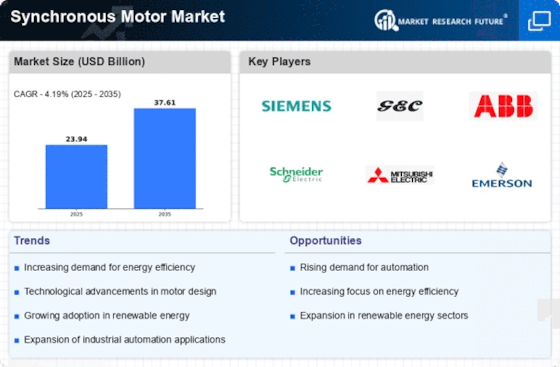
Synchronous Motor Market Infographic
Purchase Options

Market Trends

Key Emerging Trends in the Synchronous Motor Market

In the dynamic realm of the Synchronous Motor market, companies employ diverse strategies to gain and fortify their market share. Positioning strategies are pivotal in shaping a brand's identity and attracting potential customers. One prevalent tactic involves differentiation, where companies emphasize unique features or technological advancements in their synchronous motors. For instance, some businesses focus on motors with higher efficiency, better power factor correction, or advanced control systems, aiming to set themselves apart by offering superior performance compared to competitors.

Furthermore, cost leadership is a significant strategy where companies aim to become the most cost-effective option in the market. This might involve optimizing manufacturing processes, sourcing materials efficiently, or negotiating favorable supplier contracts to offer competitive pricing without compromising on quality. By positioning themselves as the most economical choice while maintaining high standards, these companies target price-conscious segments and expand their consumer base.

Another pivotal approach is niche targeting, where companies concentrate on specific segments within the synchronous motor market. Instead of catering to the broader market, they focus on serving specialized customer needs. For instance, a company might specialize in synchronous motors designed explicitly for industrial automation, renewable energy applications, or specific machinery. This focused strategy allows them to become experts in their niche, catering precisely to unique requirements and solidifying their position within that specialized market segment.

Moreover, customer-centric strategies prioritize exceptional customer service, after-sales support, and customization options. By understanding and addressing individual customer needs, these companies build a loyal customer base and generate positive word-of-mouth referrals, significantly impacting their market share. Providing tailored solutions and ensuring a seamless customer experience can differentiate a company and foster lasting relationships with clients.

Collaborations and partnerships also play a pivotal role in market share positioning within the synchronous motor industry. Companies may form alliances with other industry players or technology providers to enhance their product offerings. For instance, a motor manufacturer might collaborate with automation software developers to create integrated solutions that offer added value to customers. Such partnerships not only improve product capabilities but also expand market reach through shared networks and combined expertise.

Continual innovation and staying ahead in technological advancements are vital strategies for companies in the synchronous motor market. Investing in research and development to introduce new features, improve efficiency, and stay updated with emerging trends is crucial. By consistently offering innovative solutions, these companies attract early adopters and maintain a competitive edge, thereby solidifying their market share.

In summary, the market share positioning strategies in the Synchronous Motor market are diverse and multifaceted. Companies employ a mix of differentiation, cost leadership, niche targeting, customer-centric approaches, collaborations, and innovation to carve their space in this competitive landscape. Understanding consumer needs, leveraging unique strengths, and adapting to market dynamics are essential for businesses aiming not only to capture market share but also to sustain and grow their presence in this rapidly evolving industry.


Author
Author Profile
Chitranshi Jaiswal
Team Lead - Research

Chitranshi is a Team Leader in the Chemicals & Materials (CnM) and Energy & Power (EnP) domains, with 6+ years of experience in market research. She leads and mentors teams to deliver cross-domain projects that equip clients with actionable insights and growth strategies. She is skilled in market estimation, forecasting, competitive benchmarking, and both primary & secondary research, enabling her to turn complex data into decision-ready insights. An engineer and MBA professional, she combines technical expertise with strategic acumen to solve dynamic market challenges. Chitranshi has successfully managed projects that support market entry, investment planning, and competitive positioning, while building strong client relationships. Certified in Advanced Excel & Power BI she leverages data-driven approaches to ensure accuracy, clarity, and impactful outcomes.

Leave a Comment

FAQs

What is the projected market valuation of the Synchronous Motor Market by 2035?

<p>The projected market valuation for the Synchronous Motor Market by 2035 is 37.61 USD Billion.</p>

What was the market valuation of the Synchronous Motor Market in 2024?

<p>The overall market valuation of the Synchronous Motor Market in 2024 was 23.94 USD Billion.</p>

What is the expected CAGR for the Synchronous Motor Market during the forecast period 2025 - 2035?

<p>The expected CAGR for the Synchronous Motor Market during the forecast period 2025 - 2035 is 4.19%.</p>

Which companies are considered key players in the Synchronous Motor Market?

<p>Key players in the Synchronous Motor Market include Siemens AG, General Electric Company, ABB Ltd, Schneider Electric SE, and Mitsubishi Electric Corporation.</p>

What are the two main types of mounting for synchronous motors and their market values?

<p>The two main types of mounting for synchronous motors are Horizontal Mounting, valued at 10.0 to 15.0 USD Billion, and Vertical Mounting, valued at 13.94 to 22.61 USD Billion.</p>

How does the market for low voltage synchronous motors compare to medium voltage motors?

<p>The market for low voltage synchronous motors ranges from 13.94 to 22.61 USD Billion, whereas medium voltage motors range from 10.0 to 15.0 USD Billion.</p>

What applications are driving the demand for synchronous motors?

Applications driving demand include Pumps, valued at 5.39 to 8.56 USD Billion, and Compressors, valued at 3.59 to 5.73 USD Billion.

Which end-user sectors are most prominent in the Synchronous Motor Market?

Prominent end-user sectors include Oil &amp; Gas, valued at 4.79 to 7.56 USD Billion, and Chemicals &amp; Petrochemicals, valued at 5.12 to 8.05 USD Billion.

What is the market value range for fans used in synchronous motor applications?

The market value range for fans used in synchronous motor applications is between 4.79 and 7.53 USD Billion.

What potential growth opportunities exist in the Synchronous Motor Market?

Potential growth opportunities in the Synchronous Motor Market may arise from increasing demand in sectors like Mining and Metals, with valuations ranging from 3.59 to 5.63 USD Billion and 4.79 to 7.56 USD Billion, respectively.

Market Summary

As per Market Research Future analysis, the Synchronous Motor Market Size was estimated at 23.94 USD Billion in 2024. The Synchronous Motor industry is projected to grow from 24.94 USD Billion in 2025 to 37.61 USD Billion by 2035, exhibiting a compound annual growth rate (CAGR) of 4.19% during the forecast period 2025 - 2035

Key Market Trends & Highlights

The Synchronous Motor Market is poised for growth driven by technological advancements and sustainability initiatives.

  • Technological advancements in motor design are enhancing efficiency and performance across various applications. The shift towards automation in industries is propelling the demand for synchronous motors, particularly in North America. Horizontal mounting synchronous motors remain the largest segment, while low voltage motors are experiencing the fastest growth in the market. Rising demand for energy efficiency and government regulations are key drivers influencing the expansion of the synchronous motor market.

Market Size & Forecast

2024 Market Size 23.94 (USD Billion)
2035 Market Size 37.61 (USD Billion)
CAGR (2025 - 2035) 4.19%
Largest Regional Market Share in 2024 North America

Major Players

Siemens AG (DE), General Electric Company (US), <a href="https://new.abb.com/motors-generators/synchronous-motors">ABB Ltd</a> (CH), Schneider Electric SE (FR), Mitsubishi Electric Corporation (JP), Emerson Electric Co. (US), Toshiba Corporation (JP), Rockwell Automation, Inc. (US), <a href="https://www.nidec.com/en/nidec-industrial/product/search/category/B100/M116/S101/NASI-SynchronousMotors/">Nidec Corporation</a> (JP)

Market Trends

The Synchronous Motor Market is currently experiencing a transformative phase characterized by advancements in technology and increasing demand for energy-efficient solutions. As industries strive to enhance operational efficiency, synchronous motors are gaining traction due to their ability to maintain a constant speed under varying loads. This reliability, coupled with their lower energy consumption compared to traditional motors, positions them favorably in sectors such as manufacturing, renewable energy, and transportation. Furthermore, the growing emphasis on sustainability and reducing carbon footprints is likely to drive the adoption of synchronous motors, as they align with global initiatives aimed at promoting cleaner energy sources. In addition to technological advancements, the Synchronous Motor Market is witnessing a shift towards automation and smart technologies. The integration of Internet of Things (IoT) capabilities into motor systems allows for real-time monitoring and predictive maintenance, thereby enhancing performance and reducing downtime. This trend is particularly relevant in industrial applications where operational continuity is paramount. Moreover, the increasing investment in infrastructure development across various regions is expected to further bolster the market, as synchronous motors play a crucial role in powering essential machinery and equipment. Overall, the Synchronous Motor Market appears poised for growth, driven by innovation and a commitment to sustainable practices.

Technological Advancements

The Synchronous Motor Market is influenced by rapid technological innovations that enhance motor efficiency and performance. Developments in materials and design methodologies contribute to improved energy efficiency, making these motors more appealing to various industries.

Shift Towards Automation

There is a noticeable trend towards automation within the Synchronous Motor Market, as industries increasingly adopt smart technologies. The integration of IoT capabilities allows for enhanced monitoring and maintenance, optimizing operational efficiency.

Sustainability Initiatives

Growing environmental concerns are prompting industries to adopt more sustainable practices. The Synchronous Motor Market is benefiting from this shift, as these motors offer lower energy consumption and align with global sustainability goals.

Synchronous Motor Market Market Drivers

Industrial Automation and Robotics

The Synchronous Motor Market is significantly influenced by the ongoing trend of industrial automation and robotics. As manufacturers seek to enhance productivity and reduce labor costs, the adoption of automated systems is accelerating. Synchronous motors play a crucial role in these systems, providing precise control and high efficiency for various applications, including conveyor systems and robotic arms. The market for industrial automation is expected to grow substantially, with estimates suggesting a compound annual growth rate of around 10% over the next few years. This growth indicates a rising demand for synchronous motors, as they are integral to the performance of automated machinery. Consequently, the Synchronous Motor Market is likely to thrive as industries increasingly embrace automation.

Rising Demand for Energy Efficiency

The Synchronous Motor Market is experiencing a notable increase in demand for energy-efficient solutions. As industries strive to reduce operational costs and minimize environmental impact, synchronous motors, known for their high efficiency and reliability, are becoming increasingly popular. According to recent data, synchronous motors can achieve efficiency levels exceeding 95%, which is significantly higher than that of traditional induction motors. This efficiency translates into lower energy consumption and reduced greenhouse gas emissions, aligning with global sustainability goals. Furthermore, the push for energy-efficient technologies is supported by various government initiatives aimed at promoting cleaner energy sources. As a result, the Synchronous Motor Market is likely to witness substantial growth driven by this demand for energy efficiency.

Expansion of Renewable Energy Sources

The Synchronous Motor Market is poised for growth due to the expansion of renewable energy sources. As countries invest in wind, solar, and hydroelectric power, the need for reliable and efficient motor systems becomes paramount. Synchronous motors are particularly well-suited for applications in renewable energy generation, such as wind turbines, where they can provide precise speed control and high torque. The integration of synchronous motors in these systems enhances overall performance and reliability. Recent statistics indicate that the renewable energy sector is projected to grow at a compound annual growth rate of over 8% in the coming years. This trend suggests that the Synchronous Motor Market will benefit from the increasing adoption of renewable technologies, further driving market expansion.

Government Regulations and Incentives

The Synchronous Motor Market is significantly shaped by government regulations and incentives aimed at promoting energy efficiency and reducing emissions. Many governments are implementing stringent regulations that require industries to adopt more efficient technologies, including synchronous motors. These regulations often come with financial incentives, such as tax breaks or grants, to encourage businesses to invest in energy-efficient solutions. Recent policy changes in several regions indicate a strong commitment to reducing carbon footprints, which further supports the adoption of synchronous motors. As industries comply with these regulations, the demand for synchronous motors is likely to rise, thereby driving growth in the Synchronous Motor Market.

Technological Innovations in Motor Design

The Synchronous Motor Market is benefiting from continuous technological innovations in motor design. Advances in materials, control systems, and manufacturing processes are enhancing the performance and capabilities of synchronous motors. For instance, the development of high-temperature superconductors is enabling the creation of more compact and efficient motors. Additionally, improvements in digital control technologies allow for better integration with smart grid systems and IoT applications. These innovations not only improve the efficiency and reliability of synchronous motors but also expand their applicability across various sectors, including manufacturing, transportation, and energy. As these technologies evolve, the Synchronous Motor Market is expected to experience increased demand driven by the need for advanced motor solutions.

Market Segment Insights

By Mount Type: Horizontal Mounting Synchronous Motor (Largest) vs. Vertical Mounting Synchronous Motor (Fastest-Growing)

<p>In the Synchronous Motor Market, the horizontal mounting synchronous motor holds the largest share, favored for its robust performance and adaptability in various industrial applications. This segment benefits from widespread usage in heavy machinery and manufacturing processes, reinforcing its dominant market position. In contrast, the vertical mounting synchronous motor is emerging with notable growth potential, particularly in applications involving limited space and upward drive. As industries evolve, this segment is gaining traction due to its innovative design and operational advantages.</p>

<p>Mount Type: Horizontal (Dominant) vs. Vertical (Emerging)</p>

<p>The horizontal mounting synchronous motor is characterized by its widespread applicability and reliability, making it the preferred choice in many traditional industrial settings. It excels in scenarios requiring high torque and efficiency, establishing a strong foothold in the market. Meanwhile, the vertical mounting synchronous motor presents a promising alternative, particularly in compact environments where vertical space is abundant. Its design allows for easier integration into specialized systems, attracting new investments and interest from manufacturers aiming to optimize their operations. This contrast in positioning illustrates the dynamic nature of the Synchronous Motor Market, with the horizontal type leading in volume and the vertical type rapidly gaining interest among tech-savvy enterprises.</p>

By Voltage Class: Medium Voltage (Largest) vs. Low Voltage (Fastest-Growing)

<p>In the Synchronous Motor Market, the segment distribution highlights that Medium Voltage motors hold the largest share, attributed to their extensive application in industrial processes and their efficiency in handling substantial power demands. Meanwhile, Low Voltage motors, though smaller in current market share, are rapidly gaining traction due to their versatility and cost-effectiveness in smaller-scale applications, driving demand especially in the renewable energy sector.</p>

<p>Voltage Class: Medium Voltage (Dominant) vs. Low Voltage (Emerging)</p>

<p>Medium Voltage synchronous motors dominate the market due to their capability to deliver high performance in heavy-duty applications. They are preferred in industries such as mining, oil and gas, and manufacturing where efficiency and reliability are crucial. On the other hand, Low Voltage synchronous motors are emerging as a popular choice for commercial applications and residential buildings because of their flexibility and ease of integration with advanced control technologies. This adaptability, combined with the growing emphasis on energy efficiency, positions Low Voltage motors for significant future growth.</p>

By Application: Compressors (Largest) vs. Pumps (Fastest-Growing)

<p>In the Synchronous Motor Market, compressors represent the largest application segment, significantly outpacing others in market share. The robust demand for compressors in various industries, including refrigeration and air conditioning, has solidified their dominant position. On the other hand, pumps are witnessing substantial growth and are considered the fastest-growing segment, driven by increasing applications in water and wastewater management, oil and gas, and chemical processing industries. The growth of the pumps segment can be attributed to technological advancements that enhance efficiency and reduce operational costs. Additionally, strict environmental regulations prompting industries to adopt more energy-efficient pumping solutions contribute to this trend. As industries increasingly recognize the capabilities of synchronous motors in optimizing performance and reducing energy consumption, the demand for both compressors and pumps is set to rise significantly.</p>

<p>Compressors: Synchronous Motors (Dominant) vs. Pumps (Emerging)</p>

<p>Compressors are an established application within the Synchronous Motor Market, primarily used in refrigeration and HVAC systems due to their efficiency and reliability. They play a crucial role in maintaining energy consumption levels and operationally supporting energy-intensive processes. On the other hand, pumps, particularly those powered by synchronous motors, are gaining momentum as an emerging application. Their increasing adoption is fueled by the need for high-efficiency solutions in sectors like water management and industrial applications. While compressors maintain their dominance due to solid existing infrastructure, pumps are carving out a compelling niche in the market by leveraging innovations that improve energy efficiency and operational capabilities.</p>

By End User: Oil & Gas (Largest) vs. Chemicals & Petrochemicals (Fastest-Growing)

<p>The 'Synchronous Motor Market' exhibits a diverse set of end users, prominently featuring the oil and gas sector, which commands the largest share, owing to its extensive applications in extraction and processing activities. This sector leverages synchronous motors for their efficiency and reliability, contributing significantly to overall market revenues. Following closely, the chemicals and petrochemicals segment is witnessing remarkable growth, driven by the increasing demand for industrial automation and energy-efficient solutions, making it a key player in the market.</p>

<p>Oil & Gas (Dominant) vs. Chemicals & Petrochemicals (Emerging)</p>

<p>The oil and gas sector remains the dominant end user of synchronous motors, utilizing these systems for various applications such as pumping and gas compression. Synchronous motors in this sector are preferred for their ability to maintain high efficiency and excellent performance under varying loads. On the other hand, the chemicals and petrochemicals segment is emerging rapidly, driven by innovations in process automation and the need for energy efficiency. This segment is increasingly adopting synchronous motors for their operational advantages and lower environmental impact, thus enhancing their market presence.</p>

Get more detailed insights about Synchronous Motor Market Research Report - Global Forecast till 2035

Regional Insights

North America : Innovation and Demand Surge

North America is witnessing significant growth in the synchronous motor market, driven by advancements in technology and increasing demand for energy-efficient solutions. The region holds approximately 40% of the global market share, making it the largest market. Regulatory support for renewable energy and industrial automation is further propelling this growth, with a focus on reducing carbon emissions and enhancing operational efficiency. The United States and Canada are the leading countries in this region, with major players like General Electric and Siemens driving innovation. The competitive landscape is characterized by a mix of established companies and emerging startups, all vying for market share. The presence of key players ensures a robust supply chain and continuous advancements in synchronous motor technology, catering to various industrial applications.

Europe : Sustainability and Innovation Focus

Europe is rapidly evolving as a key player in the synchronous motor market, driven by stringent environmental regulations and a strong push towards sustainable energy solutions. The region accounts for approximately 30% of the global market share, making it the second-largest market. Initiatives like the European Green Deal are catalyzing investments in energy-efficient technologies, including synchronous motors, to meet climate goals and enhance energy security. Leading countries such as Germany, France, and the UK are at the forefront of this transition, with major companies like ABB and Schneider Electric leading the charge. The competitive landscape is marked by innovation and collaboration among industry players, focusing on developing advanced motor technologies. The presence of robust regulatory frameworks supports the growth of the market, ensuring compliance with environmental standards and promoting sustainable practices.

Asia-Pacific : Emerging Markets and Growth Potential

The Asia-Pacific region is emerging as a powerhouse in the synchronous motor market, fueled by rapid industrialization and urbanization. This region holds approximately 25% of the global market share, driven by increasing demand from manufacturing and infrastructure sectors. Government initiatives promoting energy efficiency and technological advancements are key growth drivers, making this region a focal point for investments in synchronous motor technology. Countries like China, Japan, and India are leading the charge, with significant contributions from companies such as Mitsubishi Electric and Toshiba. The competitive landscape is dynamic, with both local and international players striving to capture market share. The presence of key manufacturers and a growing emphasis on automation and smart technologies are expected to further enhance the market's growth trajectory in the coming years.

Middle East and Africa : Resource-Rich and Growing Demand

The Middle East and Africa region is witnessing a gradual but steady growth in the synchronous motor market, driven by increasing investments in infrastructure and industrial projects. This region holds approximately 5% of the global market share, with a focus on enhancing energy efficiency and reliability in various applications. Government initiatives aimed at diversifying economies and reducing reliance on oil are catalyzing the demand for advanced motor technologies. Countries like South Africa and the UAE are leading the market, with a growing presence of international players. The competitive landscape is characterized by a mix of established companies and new entrants, all aiming to capitalize on the region's potential. The emphasis on renewable energy projects and industrial automation is expected to drive further growth in the synchronous motor market, making it an attractive area for investment.

Key Players and Competitive Insights

Leading market players are investing heavily in research and development in order to expand their product lines, which will help the Synchronous Motor Market, grow even more. Market participants are also undertaking a variety of strategic activities to expand their footprint, with important market developments including new product launches, contractual agreements, mergers and acquisitions, higher investments, and collaboration with other organizations. To expand and survive in a more competitive and rising market climate, Synchronous Motorindustry must offer cost-effective items.
Manufacturing locally to minimize operational costs is one of the key business tactics used by manufacturers in the Synchronous Motor industry to benefit clients and increase the market sector. In recent years, the Synchronous Motor industry has offered some of the most significant advantages to motor industry. Major players in the Synchronous Motor Market, including ABB, Siemens, General Electric, Rockwell Automation Inc., Toshiba Corporation, WEG SA, Hitachi Ltd, and Bosch Group, and others, are attempting to increase market demand by investing in research and development operations.
ABB Ltd. is a multinational Swedish-Swiss corporation with its headquarters in Zürich, Switzerland. ASEA was created in 1988 when Allmanna Svenska Elektriska Aktiebolaget (ASEA) of Sweden and Brown, Boveri & Cie of Switzerland merged. A later abbreviation for Brown Boveri was ABB. Both companies were significant electrical equipment manufacturers when they were founded in the late 1800s, a business in which ABB is still engaged. Since then, the business has also expanded into robotics and automation technology. The Electrification division of ABB provides products and services from substation to outlet.
Customers consist of a vast array of industrial and utility enterprises, as well as commercial and residential structures. The company has significant exposure to a number of swiftly expanding markets, such as renewable, e-mobility, data centers, and smart buildings. In 2020, ABB announced that it had reached an agreement to sell its solar inverter division to the Italian manufacturer Fimer. All of ABB's production and research and development facilities in Finland, Italy, and India, as well as 800 employees in 26 countries, are included in the transaction.
Siemens is the largest industrial manufacturer in Europe and the largest German multinational conglomerate. It is headquartered in Munich and has a number of overseas branches.
 Digital Industries, Smart Infrastructure, Mobility, Healthcare, and Financial Services are the company's key divisions. The company is a prominent manufacturer of medical diagnostic equipment; its medical healthcare division, which generates approximately 12 percent of the company's total revenues, is its second-most profitable division after the industrial automation division. In 2022, Siemens and Swedish electric industrial vehicle manufacturer Volta Trucks announced a strategic partnership to deliver and scale eMobility infrastructure for charging to facilitate the transition to fleet electrification.

Key Companies in the Synchronous Motor Market include

Industry Developments

May 2020: ZCL Group developed a YRKK series high voltage wrapping type slip ring induction motor for industrial consumers in Russia. Our company manufactures this series of high voltage slip ring induction motors in accordance with international slide ring motor standards and the specific customization needs of our customers.

July 2019: Hyundai has introduced the Kona, an electric SUV, to the Indian market. A permanent-magnetic synchronous motor that generates approximately 395 Nm of torque is utilized by the vehicle. Companies engaged in the production of electric vehicles prioritize the use of synchronous motors to deliver outstanding efficiency and performance.

April 2019: Tesla recently unveiled a new motor technology for its Model S lineup that is anticipated to increase range by 10%. The motor technology is referred to as a synchronous motor with a permanent magnet or synchronous reluctance motor.

December 2023

The board of directors of Bondada Engineering has authorized the acquisition of a 60% stake in Atpole Technologies (ATPOLE) for Rs 2.19 crore in cash.

ATPOLE is an industry-leading producer of torque controllers and motors for industrial, defense, and two- and three-wheeled vehicles. In addition to sophisticated torque controllers, they specialize in the design, development, and manufacturing of brushless dc (bldc) and permanent magnet synchronous motors (pmsm). As of November 2023, its revenue amounted to Rs 15.08 lakh.

Given that Atpole Controllers is a prominent manufacturer of sophisticated torque motors and acquisitions for EV 2&3 Wheelers, Drones, Defense, and Industrial application motors, the acquisition will aid the company's foray into the renewable energy sector. After this, the Company intends to significantly expand its presence in the extant BLDC motor business segment by leveraging its energy businesses to provide services to all electric vehicle manufacturing companies.

By completing this acquisition, the organization would advance its renewable energy objectives and promote energy conservation.

60% of the paid-up share capital of ATPOLE will be acquired by the company in the form of 30,000 equity shares for a total financial consideration of Rs 2.19 crore.

The completion period may extend to a maximum of ten days from the date of this disclosure, according to the company.

Bondada Engineering operates as an infrastructure firm specializing in operations and maintenance (O&M) and engineering, procurement, and construction (EPC) for clients in India's solar energy and telecommunications sectors.

In H1 FY24, the consolidated net profit of the company amounted to Rs 14.69 crore, a significant increase from the Rs 4.35 crore recorded in H1 FY23. H1 FY24 net sales increased by 152.8% year-over-year to Rs 295.72 crore.

Friday, December 29, 2023, saw the scrip close at Rs 397.25, a 5% increase.

Future Outlook

Synchronous Motor Market Future Outlook

The Synchronous Motor Market is projected to grow at a 4.19% CAGR from 2025 to 2035, driven by advancements in energy efficiency, automation, and renewable energy integration.

New opportunities lie in:

  • Development of high-efficiency synchronous motors for renewable energy applications.
  • Expansion into emerging markets with tailored motor solutions.
  • Investment in smart motor technologies for enhanced automation and control.

By 2035, the Synchronous Motor Market is expected to achieve robust growth and innovation.

Market Segmentation

Synchronous Motor Market End User Outlook

  • Oil & Gas
  • Chemicals & Petrochemicals
  • Mining
  • Metals
  • Others

Synchronous Motor Market Mount Type Outlook

  • Horizontal Mounting Synchronous Motor
  • Vertical Mounting Synchronous Motor

Synchronous Motor Market Application Outlook

  • Compressors
  • Pumps
  • Fans
  • Extruders
  • Mixers
  • Others

Synchronous Motor Market Voltage Class Outlook

  • Medium Voltage
  • Low Voltage

Report Scope

MARKET SIZE 2024 23.94(USD Billion)
MARKET SIZE 2025 24.94(USD Billion)
MARKET SIZE 2035 37.61(USD Billion)
COMPOUND ANNUAL GROWTH RATE (CAGR) 4.19% (2025 - 2035)
REPORT COVERAGE Revenue Forecast, Competitive Landscape, Growth Factors, and Trends
BASE YEAR 2024
Market Forecast Period 2025 - 2035
Historical Data 2019 - 2024
Market Forecast Units USD Billion
Key Companies Profiled Siemens AG (DE), General Electric Company (US), ABB Ltd (CH), Schneider Electric SE (FR), Mitsubishi Electric Corporation (JP), Emerson Electric Co. (US), Toshiba Corporation (JP), Rockwell Automation, Inc. (US), Nidec Corporation (JP)
Segments Covered Mount Type, Voltage Class, Application, End User, Region
Key Market Opportunities Integration of advanced automation technologies enhances efficiency in the Synchronous Motor Market.
Key Market Dynamics Rising demand for energy-efficient solutions drives innovation and competition in the synchronous motor market.
Countries Covered North America, Europe, APAC, South America, MEA

FAQs

What is the projected market valuation of the Synchronous Motor Market by 2035?

<p>The projected market valuation for the Synchronous Motor Market by 2035 is 37.61 USD Billion.</p>

What was the market valuation of the Synchronous Motor Market in 2024?

<p>The overall market valuation of the Synchronous Motor Market in 2024 was 23.94 USD Billion.</p>

What is the expected CAGR for the Synchronous Motor Market during the forecast period 2025 - 2035?

<p>The expected CAGR for the Synchronous Motor Market during the forecast period 2025 - 2035 is 4.19%.</p>

Which companies are considered key players in the Synchronous Motor Market?

<p>Key players in the Synchronous Motor Market include Siemens AG, General Electric Company, ABB Ltd, Schneider Electric SE, and Mitsubishi Electric Corporation.</p>

What are the two main types of mounting for synchronous motors and their market values?

<p>The two main types of mounting for synchronous motors are Horizontal Mounting, valued at 10.0 to 15.0 USD Billion, and Vertical Mounting, valued at 13.94 to 22.61 USD Billion.</p>

How does the market for low voltage synchronous motors compare to medium voltage motors?

<p>The market for low voltage synchronous motors ranges from 13.94 to 22.61 USD Billion, whereas medium voltage motors range from 10.0 to 15.0 USD Billion.</p>

What applications are driving the demand for synchronous motors?

Applications driving demand include Pumps, valued at 5.39 to 8.56 USD Billion, and Compressors, valued at 3.59 to 5.73 USD Billion.

Which end-user sectors are most prominent in the Synchronous Motor Market?

Prominent end-user sectors include Oil &amp; Gas, valued at 4.79 to 7.56 USD Billion, and Chemicals &amp; Petrochemicals, valued at 5.12 to 8.05 USD Billion.

What is the market value range for fans used in synchronous motor applications?

The market value range for fans used in synchronous motor applications is between 4.79 and 7.53 USD Billion.

What potential growth opportunities exist in the Synchronous Motor Market?

Potential growth opportunities in the Synchronous Motor Market may arise from increasing demand in sectors like Mining and Metals, with valuations ranging from 3.59 to 5.63 USD Billion and 4.79 to 7.56 USD Billion, respectively.

  1. SECTION I: EXECUTIVE SUMMARY AND KEY HIGHLIGHTS
    1. | 1.1 EXECUTIVE SUMMARY
    2. | | 1.1.1 Market Overview
    3. | | 1.1.2 Key Findings
    4. | | 1.1.3 Market Segmentation
    5. | | 1.1.4 Competitive Landscape
    6. | | 1.1.5 Challenges and Opportunities
    7. | | 1.1.6 Future Outlook
  2. SECTION II: SCOPING, METHODOLOGY AND MARKET STRUCTURE
    1. | 2.1 MARKET INTRODUCTION
    2. | | 2.1.1 Definition
    3. | | 2.1.2 Scope of the study
    4. | | | 2.1.2.1 Research Objective
    5. | | | 2.1.2.2 Assumption
    6. | | | 2.1.2.3 Limitations
    7. | 2.2 RESEARCH METHODOLOGY
    8. | | 2.2.1 Overview
    9. | | 2.2.2 Data Mining
    10. | | 2.2.3 Secondary Research
    11. | | 2.2.4 Primary Research
    12. | | | 2.2.4.1 Primary Interviews and Information Gathering Process
    13. | | | 2.2.4.2 Breakdown of Primary Respondents
    14. | | 2.2.5 Forecasting Model
    15. | | 2.2.6 Market Size Estimation
    16. | | | 2.2.6.1 Bottom-Up Approach
    17. | | | 2.2.6.2 Top-Down Approach
    18. | | 2.2.7 Data Triangulation
    19. | | 2.2.8 Validation
  3. SECTION III: QUALITATIVE ANALYSIS
    1. | 3.1 MARKET DYNAMICS
    2. | | 3.1.1 Overview
    3. | | 3.1.2 Drivers
    4. | | 3.1.3 Restraints
    5. | | 3.1.4 Opportunities
    6. | 3.2 MARKET FACTOR ANALYSIS
    7. | | 3.2.1 Value chain Analysis
    8. | | 3.2.2 Porter's Five Forces Analysis
    9. | | | 3.2.2.1 Bargaining Power of Suppliers
    10. | | | 3.2.2.2 Bargaining Power of Buyers
    11. | | | 3.2.2.3 Threat of New Entrants
    12. | | | 3.2.2.4 Threat of Substitutes
    13. | | | 3.2.2.5 Intensity of Rivalry
    14. | | 3.2.3 COVID-19 Impact Analysis
    15. | | | 3.2.3.1 Market Impact Analysis
    16. | | | 3.2.3.2 Regional Impact
    17. | | | 3.2.3.3 Opportunity and Threat Analysis
  4. SECTION IV: QUANTITATIVE ANALYSIS
    1. | 4.1 Energy & Power, BY Mount Type (USD Billion)
    2. | | 4.1.1 Horizontal Mounting Synchronous Motor
    3. | | 4.1.2 Vertical Mounting Synchronous Motor
    4. | 4.2 Energy & Power, BY Voltage Class (USD Billion)
    5. | | 4.2.1 Medium Voltage
    6. | | 4.2.2 Low Voltage
    7. | 4.3 Energy & Power, BY Application (USD Billion)
    8. | | 4.3.1 Compressors
    9. | | 4.3.2 Pumps
    10. | | 4.3.3 Fans
    11. | | 4.3.4 Extruders
    12. | | 4.3.5 Mixers
    13. | | 4.3.6 Others
    14. | 4.4 Energy & Power, BY End User (USD Billion)
    15. | | 4.4.1 Oil & Gas
    16. | | 4.4.2 Chemicals & Petrochemicals
    17. | | 4.4.3 Mining
    18. | | 4.4.4 Metals
    19. | | 4.4.5 Others
    20. | 4.5 Energy & Power, BY Region (USD Billion)
    21. | | 4.5.1 North America
    22. | | | 4.5.1.1 US
    23. | | | 4.5.1.2 Canada
    24. | | 4.5.2 Europe
    25. | | | 4.5.2.1 Germany
    26. | | | 4.5.2.2 UK
    27. | | | 4.5.2.3 France
    28. | | | 4.5.2.4 Russia
    29. | | | 4.5.2.5 Italy
    30. | | | 4.5.2.6 Spain
    31. | | | 4.5.2.7 Rest of Europe
    32. | | 4.5.3 APAC
    33. | | | 4.5.3.1 China
    34. | | | 4.5.3.2 India
    35. | | | 4.5.3.3 Japan
    36. | | | 4.5.3.4 South Korea
    37. | | | 4.5.3.5 Malaysia
    38. | | | 4.5.3.6 Thailand
    39. | | | 4.5.3.7 Indonesia
    40. | | | 4.5.3.8 Rest of APAC
    41. | | 4.5.4 South America
    42. | | | 4.5.4.1 Brazil
    43. | | | 4.5.4.2 Mexico
    44. | | | 4.5.4.3 Argentina
    45. | | | 4.5.4.4 Rest of South America
    46. | | 4.5.5 MEA
    47. | | | 4.5.5.1 GCC Countries
    48. | | | 4.5.5.2 South Africa
    49. | | | 4.5.5.3 Rest of MEA
  5. SECTION V: COMPETITIVE ANALYSIS
    1. | 5.1 Competitive Landscape
    2. | | 5.1.1 Overview
    3. | | 5.1.2 Competitive Analysis
    4. | | 5.1.3 Market share Analysis
    5. | | 5.1.4 Major Growth Strategy in the Energy & Power
    6. | | 5.1.5 Competitive Benchmarking
    7. | | 5.1.6 Leading Players in Terms of Number of Developments in the Energy & Power
    8. | | 5.1.7 Key developments and growth strategies
    9. | | | 5.1.7.1 New Product Launch/Service Deployment
    10. | | | 5.1.7.2 Merger & Acquisitions
    11. | | | 5.1.7.3 Joint Ventures
    12. | | 5.1.8 Major Players Financial Matrix
    13. | | | 5.1.8.1 Sales and Operating Income
    14. | | | 5.1.8.2 Major Players R&D Expenditure. 2023
    15. | 5.2 Company Profiles
    16. | | 5.2.1 Siemens AG (DE)
    17. | | | 5.2.1.1 Financial Overview
    18. | | | 5.2.1.2 Products Offered
    19. | | | 5.2.1.3 Key Developments
    20. | | | 5.2.1.4 SWOT Analysis
    21. | | | 5.2.1.5 Key Strategies
    22. | | 5.2.2 General Electric Company (US)
    23. | | | 5.2.2.1 Financial Overview
    24. | | | 5.2.2.2 Products Offered
    25. | | | 5.2.2.3 Key Developments
    26. | | | 5.2.2.4 SWOT Analysis
    27. | | | 5.2.2.5 Key Strategies
    28. | | 5.2.3 ABB Ltd (CH)
    29. | | | 5.2.3.1 Financial Overview
    30. | | | 5.2.3.2 Products Offered
    31. | | | 5.2.3.3 Key Developments
    32. | | | 5.2.3.4 SWOT Analysis
    33. | | | 5.2.3.5 Key Strategies
    34. | | 5.2.4 Schneider Electric SE (FR)
    35. | | | 5.2.4.1 Financial Overview
    36. | | | 5.2.4.2 Products Offered
    37. | | | 5.2.4.3 Key Developments
    38. | | | 5.2.4.4 SWOT Analysis
    39. | | | 5.2.4.5 Key Strategies
    40. | | 5.2.5 Mitsubishi Electric Corporation (JP)
    41. | | | 5.2.5.1 Financial Overview
    42. | | | 5.2.5.2 Products Offered
    43. | | | 5.2.5.3 Key Developments
    44. | | | 5.2.5.4 SWOT Analysis
    45. | | | 5.2.5.5 Key Strategies
    46. | | 5.2.6 Emerson Electric Co. (US)
    47. | | | 5.2.6.1 Financial Overview
    48. | | | 5.2.6.2 Products Offered
    49. | | | 5.2.6.3 Key Developments
    50. | | | 5.2.6.4 SWOT Analysis
    51. | | | 5.2.6.5 Key Strategies
    52. | | 5.2.7 Toshiba Corporation (JP)
    53. | | | 5.2.7.1 Financial Overview
    54. | | | 5.2.7.2 Products Offered
    55. | | | 5.2.7.3 Key Developments
    56. | | | 5.2.7.4 SWOT Analysis
    57. | | | 5.2.7.5 Key Strategies
    58. | | 5.2.8 Rockwell Automation, Inc. (US)
    59. | | | 5.2.8.1 Financial Overview
    60. | | | 5.2.8.2 Products Offered
    61. | | | 5.2.8.3 Key Developments
    62. | | | 5.2.8.4 SWOT Analysis
    63. | | | 5.2.8.5 Key Strategies
    64. | | 5.2.9 Nidec Corporation (JP)
    65. | | | 5.2.9.1 Financial Overview
    66. | | | 5.2.9.2 Products Offered
    67. | | | 5.2.9.3 Key Developments
    68. | | | 5.2.9.4 SWOT Analysis
    69. | | | 5.2.9.5 Key Strategies
    70. | 5.3 Appendix
    71. | | 5.3.1 References
    72. | | 5.3.2 Related Reports
  6. LIST OF FIGURES
    1. | 6.1 MARKET SYNOPSIS
    2. | 6.2 NORTH AMERICA MARKET ANALYSIS
    3. | 6.3 US MARKET ANALYSIS BY MOUNT TYPE
    4. | 6.4 US MARKET ANALYSIS BY VOLTAGE CLASS
    5. | 6.5 US MARKET ANALYSIS BY APPLICATION
    6. | 6.6 US MARKET ANALYSIS BY END USER
    7. | 6.7 CANADA MARKET ANALYSIS BY MOUNT TYPE
    8. | 6.8 CANADA MARKET ANALYSIS BY VOLTAGE CLASS
    9. | 6.9 CANADA MARKET ANALYSIS BY APPLICATION
    10. | 6.10 CANADA MARKET ANALYSIS BY END USER
    11. | 6.11 EUROPE MARKET ANALYSIS
    12. | 6.12 GERMANY MARKET ANALYSIS BY MOUNT TYPE
    13. | 6.13 GERMANY MARKET ANALYSIS BY VOLTAGE CLASS
    14. | 6.14 GERMANY MARKET ANALYSIS BY APPLICATION
    15. | 6.15 GERMANY MARKET ANALYSIS BY END USER
    16. | 6.16 UK MARKET ANALYSIS BY MOUNT TYPE
    17. | 6.17 UK MARKET ANALYSIS BY VOLTAGE CLASS
    18. | 6.18 UK MARKET ANALYSIS BY APPLICATION
    19. | 6.19 UK MARKET ANALYSIS BY END USER
    20. | 6.20 FRANCE MARKET ANALYSIS BY MOUNT TYPE
    21. | 6.21 FRANCE MARKET ANALYSIS BY VOLTAGE CLASS
    22. | 6.22 FRANCE MARKET ANALYSIS BY APPLICATION
    23. | 6.23 FRANCE MARKET ANALYSIS BY END USER
    24. | 6.24 RUSSIA MARKET ANALYSIS BY MOUNT TYPE
    25. | 6.25 RUSSIA MARKET ANALYSIS BY VOLTAGE CLASS
    26. | 6.26 RUSSIA MARKET ANALYSIS BY APPLICATION
    27. | 6.27 RUSSIA MARKET ANALYSIS BY END USER
    28. | 6.28 ITALY MARKET ANALYSIS BY MOUNT TYPE
    29. | 6.29 ITALY MARKET ANALYSIS BY VOLTAGE CLASS
    30. | 6.30 ITALY MARKET ANALYSIS BY APPLICATION
    31. | 6.31 ITALY MARKET ANALYSIS BY END USER
    32. | 6.32 SPAIN MARKET ANALYSIS BY MOUNT TYPE
    33. | 6.33 SPAIN MARKET ANALYSIS BY VOLTAGE CLASS
    34. | 6.34 SPAIN MARKET ANALYSIS BY APPLICATION
    35. | 6.35 SPAIN MARKET ANALYSIS BY END USER
    36. | 6.36 REST OF EUROPE MARKET ANALYSIS BY MOUNT TYPE
    37. | 6.37 REST OF EUROPE MARKET ANALYSIS BY VOLTAGE CLASS
    38. | 6.38 REST OF EUROPE MARKET ANALYSIS BY APPLICATION
    39. | 6.39 REST OF EUROPE MARKET ANALYSIS BY END USER
    40. | 6.40 APAC MARKET ANALYSIS
    41. | 6.41 CHINA MARKET ANALYSIS BY MOUNT TYPE
    42. | 6.42 CHINA MARKET ANALYSIS BY VOLTAGE CLASS
    43. | 6.43 CHINA MARKET ANALYSIS BY APPLICATION
    44. | 6.44 CHINA MARKET ANALYSIS BY END USER
    45. | 6.45 INDIA MARKET ANALYSIS BY MOUNT TYPE
    46. | 6.46 INDIA MARKET ANALYSIS BY VOLTAGE CLASS
    47. | 6.47 INDIA MARKET ANALYSIS BY APPLICATION
    48. | 6.48 INDIA MARKET ANALYSIS BY END USER
    49. | 6.49 JAPAN MARKET ANALYSIS BY MOUNT TYPE
    50. | 6.50 JAPAN MARKET ANALYSIS BY VOLTAGE CLASS
    51. | 6.51 JAPAN MARKET ANALYSIS BY APPLICATION
    52. | 6.52 JAPAN MARKET ANALYSIS BY END USER
    53. | 6.53 SOUTH KOREA MARKET ANALYSIS BY MOUNT TYPE
    54. | 6.54 SOUTH KOREA MARKET ANALYSIS BY VOLTAGE CLASS
    55. | 6.55 SOUTH KOREA MARKET ANALYSIS BY APPLICATION
    56. | 6.56 SOUTH KOREA MARKET ANALYSIS BY END USER
    57. | 6.57 MALAYSIA MARKET ANALYSIS BY MOUNT TYPE
    58. | 6.58 MALAYSIA MARKET ANALYSIS BY VOLTAGE CLASS
    59. | 6.59 MALAYSIA MARKET ANALYSIS BY APPLICATION
    60. | 6.60 MALAYSIA MARKET ANALYSIS BY END USER
    61. | 6.61 THAILAND MARKET ANALYSIS BY MOUNT TYPE
    62. | 6.62 THAILAND MARKET ANALYSIS BY VOLTAGE CLASS
    63. | 6.63 THAILAND MARKET ANALYSIS BY APPLICATION
    64. | 6.64 THAILAND MARKET ANALYSIS BY END USER
    65. | 6.65 INDONESIA MARKET ANALYSIS BY MOUNT TYPE
    66. | 6.66 INDONESIA MARKET ANALYSIS BY VOLTAGE CLASS
    67. | 6.67 INDONESIA MARKET ANALYSIS BY APPLICATION
    68. | 6.68 INDONESIA MARKET ANALYSIS BY END USER
    69. | 6.69 REST OF APAC MARKET ANALYSIS BY MOUNT TYPE
    70. | 6.70 REST OF APAC MARKET ANALYSIS BY VOLTAGE CLASS
    71. | 6.71 REST OF APAC MARKET ANALYSIS BY APPLICATION
    72. | 6.72 REST OF APAC MARKET ANALYSIS BY END USER
    73. | 6.73 SOUTH AMERICA MARKET ANALYSIS
    74. | 6.74 BRAZIL MARKET ANALYSIS BY MOUNT TYPE
    75. | 6.75 BRAZIL MARKET ANALYSIS BY VOLTAGE CLASS
    76. | 6.76 BRAZIL MARKET ANALYSIS BY APPLICATION
    77. | 6.77 BRAZIL MARKET ANALYSIS BY END USER
    78. | 6.78 MEXICO MARKET ANALYSIS BY MOUNT TYPE
    79. | 6.79 MEXICO MARKET ANALYSIS BY VOLTAGE CLASS
    80. | 6.80 MEXICO MARKET ANALYSIS BY APPLICATION
    81. | 6.81 MEXICO MARKET ANALYSIS BY END USER
    82. | 6.82 ARGENTINA MARKET ANALYSIS BY MOUNT TYPE
    83. | 6.83 ARGENTINA MARKET ANALYSIS BY VOLTAGE CLASS
    84. | 6.84 ARGENTINA MARKET ANALYSIS BY APPLICATION
    85. | 6.85 ARGENTINA MARKET ANALYSIS BY END USER
    86. | 6.86 REST OF SOUTH AMERICA MARKET ANALYSIS BY MOUNT TYPE
    87. | 6.87 REST OF SOUTH AMERICA MARKET ANALYSIS BY VOLTAGE CLASS
    88. | 6.88 REST OF SOUTH AMERICA MARKET ANALYSIS BY APPLICATION
    89. | 6.89 REST OF SOUTH AMERICA MARKET ANALYSIS BY END USER
    90. | 6.90 MEA MARKET ANALYSIS
    91. | 6.91 GCC COUNTRIES MARKET ANALYSIS BY MOUNT TYPE
    92. | 6.92 GCC COUNTRIES MARKET ANALYSIS BY VOLTAGE CLASS
    93. | 6.93 GCC COUNTRIES MARKET ANALYSIS BY APPLICATION
    94. | 6.94 GCC COUNTRIES MARKET ANALYSIS BY END USER
    95. | 6.95 SOUTH AFRICA MARKET ANALYSIS BY MOUNT TYPE
    96. | 6.96 SOUTH AFRICA MARKET ANALYSIS BY VOLTAGE CLASS
    97. | 6.97 SOUTH AFRICA MARKET ANALYSIS BY APPLICATION
    98. | 6.98 SOUTH AFRICA MARKET ANALYSIS BY END USER
    99. | 6.99 REST OF MEA MARKET ANALYSIS BY MOUNT TYPE
    100. | 6.100 REST OF MEA MARKET ANALYSIS BY VOLTAGE CLASS
    101. | 6.101 REST OF MEA MARKET ANALYSIS BY APPLICATION
    102. | 6.102 REST OF MEA MARKET ANALYSIS BY END USER
    103. | 6.103 KEY BUYING CRITERIA OF ENERGY & POWER
    104. | 6.104 RESEARCH PROCESS OF MRFR
    105. | 6.105 DRO ANALYSIS OF ENERGY & POWER
    106. | 6.106 DRIVERS IMPACT ANALYSIS: ENERGY & POWER
    107. | 6.107 RESTRAINTS IMPACT ANALYSIS: ENERGY & POWER
    108. | 6.108 SUPPLY / VALUE CHAIN: ENERGY & POWER
    109. | 6.109 ENERGY & POWER, BY MOUNT TYPE, 2024 (% SHARE)
    110. | 6.110 ENERGY & POWER, BY MOUNT TYPE, 2024 TO 2035 (USD Billion)
    111. | 6.111 ENERGY & POWER, BY VOLTAGE CLASS, 2024 (% SHARE)
    112. | 6.112 ENERGY & POWER, BY VOLTAGE CLASS, 2024 TO 2035 (USD Billion)
    113. | 6.113 ENERGY & POWER, BY APPLICATION, 2024 (% SHARE)
    114. | 6.114 ENERGY & POWER, BY APPLICATION, 2024 TO 2035 (USD Billion)
    115. | 6.115 ENERGY & POWER, BY END USER, 2024 (% SHARE)
    116. | 6.116 ENERGY & POWER, BY END USER, 2024 TO 2035 (USD Billion)
    117. | 6.117 BENCHMARKING OF MAJOR COMPETITORS
  7. LIST OF TABLES
    1. | 7.1 LIST OF ASSUMPTIONS
    2. | | 7.1.1
    3. | 7.2 North America MARKET SIZE ESTIMATES; FORECAST
    4. | | 7.2.1 BY MOUNT TYPE, 2025-2035 (USD Billion)
    5. | | 7.2.2 BY VOLTAGE CLASS, 2025-2035 (USD Billion)
    6. | | 7.2.3 BY APPLICATION, 2025-2035 (USD Billion)
    7. | | 7.2.4 BY END USER, 2025-2035 (USD Billion)
    8. | 7.3 US MARKET SIZE ESTIMATES; FORECAST
    9. | | 7.3.1 BY MOUNT TYPE, 2025-2035 (USD Billion)
    10. | | 7.3.2 BY VOLTAGE CLASS, 2025-2035 (USD Billion)
    11. | | 7.3.3 BY APPLICATION, 2025-2035 (USD Billion)
    12. | | 7.3.4 BY END USER, 2025-2035 (USD Billion)
    13. | 7.4 Canada MARKET SIZE ESTIMATES; FORECAST
    14. | | 7.4.1 BY MOUNT TYPE, 2025-2035 (USD Billion)
    15. | | 7.4.2 BY VOLTAGE CLASS, 2025-2035 (USD Billion)
    16. | | 7.4.3 BY APPLICATION, 2025-2035 (USD Billion)
    17. | | 7.4.4 BY END USER, 2025-2035 (USD Billion)
    18. | 7.5 Europe MARKET SIZE ESTIMATES; FORECAST
    19. | | 7.5.1 BY MOUNT TYPE, 2025-2035 (USD Billion)
    20. | | 7.5.2 BY VOLTAGE CLASS, 2025-2035 (USD Billion)
    21. | | 7.5.3 BY APPLICATION, 2025-2035 (USD Billion)
    22. | | 7.5.4 BY END USER, 2025-2035 (USD Billion)
    23. | 7.6 Germany MARKET SIZE ESTIMATES; FORECAST
    24. | | 7.6.1 BY MOUNT TYPE, 2025-2035 (USD Billion)
    25. | | 7.6.2 BY VOLTAGE CLASS, 2025-2035 (USD Billion)
    26. | | 7.6.3 BY APPLICATION, 2025-2035 (USD Billion)
    27. | | 7.6.4 BY END USER, 2025-2035 (USD Billion)
    28. | 7.7 UK MARKET SIZE ESTIMATES; FORECAST
    29. | | 7.7.1 BY MOUNT TYPE, 2025-2035 (USD Billion)
    30. | | 7.7.2 BY VOLTAGE CLASS, 2025-2035 (USD Billion)
    31. | | 7.7.3 BY APPLICATION, 2025-2035 (USD Billion)
    32. | | 7.7.4 BY END USER, 2025-2035 (USD Billion)
    33. | 7.8 France MARKET SIZE ESTIMATES; FORECAST
    34. | | 7.8.1 BY MOUNT TYPE, 2025-2035 (USD Billion)
    35. | | 7.8.2 BY VOLTAGE CLASS, 2025-2035 (USD Billion)
    36. | | 7.8.3 BY APPLICATION, 2025-2035 (USD Billion)
    37. | | 7.8.4 BY END USER, 2025-2035 (USD Billion)
    38. | 7.9 Russia MARKET SIZE ESTIMATES; FORECAST
    39. | | 7.9.1 BY MOUNT TYPE, 2025-2035 (USD Billion)
    40. | | 7.9.2 BY VOLTAGE CLASS, 2025-2035 (USD Billion)
    41. | | 7.9.3 BY APPLICATION, 2025-2035 (USD Billion)
    42. | | 7.9.4 BY END USER, 2025-2035 (USD Billion)
    43. | 7.10 Italy MARKET SIZE ESTIMATES; FORECAST
    44. | | 7.10.1 BY MOUNT TYPE, 2025-2035 (USD Billion)
    45. | | 7.10.2 BY VOLTAGE CLASS, 2025-2035 (USD Billion)
    46. | | 7.10.3 BY APPLICATION, 2025-2035 (USD Billion)
    47. | | 7.10.4 BY END USER, 2025-2035 (USD Billion)
    48. | 7.11 Spain MARKET SIZE ESTIMATES; FORECAST
    49. | | 7.11.1 BY MOUNT TYPE, 2025-2035 (USD Billion)
    50. | | 7.11.2 BY VOLTAGE CLASS, 2025-2035 (USD Billion)
    51. | | 7.11.3 BY APPLICATION, 2025-2035 (USD Billion)
    52. | | 7.11.4 BY END USER, 2025-2035 (USD Billion)
    53. | 7.12 Rest of Europe MARKET SIZE ESTIMATES; FORECAST
    54. | | 7.12.1 BY MOUNT TYPE, 2025-2035 (USD Billion)
    55. | | 7.12.2 BY VOLTAGE CLASS, 2025-2035 (USD Billion)
    56. | | 7.12.3 BY APPLICATION, 2025-2035 (USD Billion)
    57. | | 7.12.4 BY END USER, 2025-2035 (USD Billion)
    58. | 7.13 APAC MARKET SIZE ESTIMATES; FORECAST
    59. | | 7.13.1 BY MOUNT TYPE, 2025-2035 (USD Billion)
    60. | | 7.13.2 BY VOLTAGE CLASS, 2025-2035 (USD Billion)
    61. | | 7.13.3 BY APPLICATION, 2025-2035 (USD Billion)
    62. | | 7.13.4 BY END USER, 2025-2035 (USD Billion)
    63. | 7.14 China MARKET SIZE ESTIMATES; FORECAST
    64. | | 7.14.1 BY MOUNT TYPE, 2025-2035 (USD Billion)
    65. | | 7.14.2 BY VOLTAGE CLASS, 2025-2035 (USD Billion)
    66. | | 7.14.3 BY APPLICATION, 2025-2035 (USD Billion)
    67. | | 7.14.4 BY END USER, 2025-2035 (USD Billion)
    68. | 7.15 India MARKET SIZE ESTIMATES; FORECAST
    69. | | 7.15.1 BY MOUNT TYPE, 2025-2035 (USD Billion)
    70. | | 7.15.2 BY VOLTAGE CLASS, 2025-2035 (USD Billion)
    71. | | 7.15.3 BY APPLICATION, 2025-2035 (USD Billion)
    72. | | 7.15.4 BY END USER, 2025-2035 (USD Billion)
    73. | 7.16 Japan MARKET SIZE ESTIMATES; FORECAST
    74. | | 7.16.1 BY MOUNT TYPE, 2025-2035 (USD Billion)
    75. | | 7.16.2 BY VOLTAGE CLASS, 2025-2035 (USD Billion)
    76. | | 7.16.3 BY APPLICATION, 2025-2035 (USD Billion)
    77. | | 7.16.4 BY END USER, 2025-2035 (USD Billion)
    78. | 7.17 South Korea MARKET SIZE ESTIMATES; FORECAST
    79. | | 7.17.1 BY MOUNT TYPE, 2025-2035 (USD Billion)
    80. | | 7.17.2 BY VOLTAGE CLASS, 2025-2035 (USD Billion)
    81. | | 7.17.3 BY APPLICATION, 2025-2035 (USD Billion)
    82. | | 7.17.4 BY END USER, 2025-2035 (USD Billion)
    83. | 7.18 Malaysia MARKET SIZE ESTIMATES; FORECAST
    84. | | 7.18.1 BY MOUNT TYPE, 2025-2035 (USD Billion)
    85. | | 7.18.2 BY VOLTAGE CLASS, 2025-2035 (USD Billion)
    86. | | 7.18.3 BY APPLICATION, 2025-2035 (USD Billion)
    87. | | 7.18.4 BY END USER, 2025-2035 (USD Billion)
    88. | 7.19 Thailand MARKET SIZE ESTIMATES; FORECAST
    89. | | 7.19.1 BY MOUNT TYPE, 2025-2035 (USD Billion)
    90. | | 7.19.2 BY VOLTAGE CLASS, 2025-2035 (USD Billion)
    91. | | 7.19.3 BY APPLICATION, 2025-2035 (USD Billion)
    92. | | 7.19.4 BY END USER, 2025-2035 (USD Billion)
    93. | 7.20 Indonesia MARKET SIZE ESTIMATES; FORECAST
    94. | | 7.20.1 BY MOUNT TYPE, 2025-2035 (USD Billion)
    95. | | 7.20.2 BY VOLTAGE CLASS, 2025-2035 (USD Billion)
    96. | | 7.20.3 BY APPLICATION, 2025-2035 (USD Billion)
    97. | | 7.20.4 BY END USER, 2025-2035 (USD Billion)
    98. | 7.21 Rest of APAC MARKET SIZE ESTIMATES; FORECAST
    99. | | 7.21.1 BY MOUNT TYPE, 2025-2035 (USD Billion)
    100. | | 7.21.2 BY VOLTAGE CLASS, 2025-2035 (USD Billion)
    101. | | 7.21.3 BY APPLICATION, 2025-2035 (USD Billion)
    102. | | 7.21.4 BY END USER, 2025-2035 (USD Billion)
    103. | 7.22 South America MARKET SIZE ESTIMATES; FORECAST
    104. | | 7.22.1 BY MOUNT TYPE, 2025-2035 (USD Billion)
    105. | | 7.22.2 BY VOLTAGE CLASS, 2025-2035 (USD Billion)
    106. | | 7.22.3 BY APPLICATION, 2025-2035 (USD Billion)
    107. | | 7.22.4 BY END USER, 2025-2035 (USD Billion)
    108. | 7.23 Brazil MARKET SIZE ESTIMATES; FORECAST
    109. | | 7.23.1 BY MOUNT TYPE, 2025-2035 (USD Billion)
    110. | | 7.23.2 BY VOLTAGE CLASS, 2025-2035 (USD Billion)
    111. | | 7.23.3 BY APPLICATION, 2025-2035 (USD Billion)
    112. | | 7.23.4 BY END USER, 2025-2035 (USD Billion)
    113. | 7.24 Mexico MARKET SIZE ESTIMATES; FORECAST
    114. | | 7.24.1 BY MOUNT TYPE, 2025-2035 (USD Billion)
    115. | | 7.24.2 BY VOLTAGE CLASS, 2025-2035 (USD Billion)
    116. | | 7.24.3 BY APPLICATION, 2025-2035 (USD Billion)
    117. | | 7.24.4 BY END USER, 2025-2035 (USD Billion)
    118. | 7.25 Argentina MARKET SIZE ESTIMATES; FORECAST
    119. | | 7.25.1 BY MOUNT TYPE, 2025-2035 (USD Billion)
    120. | | 7.25.2 BY VOLTAGE CLASS, 2025-2035 (USD Billion)
    121. | | 7.25.3 BY APPLICATION, 2025-2035 (USD Billion)
    122. | | 7.25.4 BY END USER, 2025-2035 (USD Billion)
    123. | 7.26 Rest of South America MARKET SIZE ESTIMATES; FORECAST
    124. | | 7.26.1 BY MOUNT TYPE, 2025-2035 (USD Billion)
    125. | | 7.26.2 BY VOLTAGE CLASS, 2025-2035 (USD Billion)
    126. | | 7.26.3 BY APPLICATION, 2025-2035 (USD Billion)
    127. | | 7.26.4 BY END USER, 2025-2035 (USD Billion)
    128. | 7.27 MEA MARKET SIZE ESTIMATES; FORECAST
    129. | | 7.27.1 BY MOUNT TYPE, 2025-2035 (USD Billion)
    130. | | 7.27.2 BY VOLTAGE CLASS, 2025-2035 (USD Billion)
    131. | | 7.27.3 BY APPLICATION, 2025-2035 (USD Billion)
    132. | | 7.27.4 BY END USER, 2025-2035 (USD Billion)
    133. | 7.28 GCC Countries MARKET SIZE ESTIMATES; FORECAST
    134. | | 7.28.1 BY MOUNT TYPE, 2025-2035 (USD Billion)
    135. | | 7.28.2 BY VOLTAGE CLASS, 2025-2035 (USD Billion)
    136. | | 7.28.3 BY APPLICATION, 2025-2035 (USD Billion)
    137. | | 7.28.4 BY END USER, 2025-2035 (USD Billion)
    138. | 7.29 South Africa MARKET SIZE ESTIMATES; FORECAST
    139. | | 7.29.1 BY MOUNT TYPE, 2025-2035 (USD Billion)
    140. | | 7.29.2 BY VOLTAGE CLASS, 2025-2035 (USD Billion)
    141. | | 7.29.3 BY APPLICATION, 2025-2035 (USD Billion)
    142. | | 7.29.4 BY END USER, 2025-2035 (USD Billion)
    143. | 7.30 Rest of MEA MARKET SIZE ESTIMATES; FORECAST
    144. | | 7.30.1 BY MOUNT TYPE, 2025-2035 (USD Billion)
    145. | | 7.30.2 BY VOLTAGE CLASS, 2025-2035 (USD Billion)
    146. | | 7.30.3 BY APPLICATION, 2025-2035 (USD Billion)
    147. | | 7.30.4 BY END USER, 2025-2035 (USD Billion)
    148. | 7.31 PRODUCT LAUNCH/PRODUCT DEVELOPMENT/APPROVAL
    149. | | 7.31.1
    150. | 7.32 ACQUISITION/PARTNERSHIP
    151. | | 7.32.1

Energy & Power Market Segmentation

Energy & Power By Mount Type (USD Billion, 2025-2035)

  • Horizontal Mounting Synchronous Motor
  • Vertical Mounting Synchronous Motor

Energy & Power By Voltage Class (USD Billion, 2025-2035)

  • Medium Voltage
  • Low Voltage

Energy & Power By Application (USD Billion, 2025-2035)

  • Compressors
  • Pumps
  • Fans
  • Extruders
  • Mixers
  • Others

Energy & Power By End User (USD Billion, 2025-2035)

  • Oil & Gas
  • Chemicals & Petrochemicals
  • Mining
  • Metals
  • Others
Infographic

Free Sample Request

Kindly complete the form below to receive a free sample of this Report

Get Free Sample

Customer Strories

Compare Licence

×
Features License Type
Single User Multiuser License Enterprise User
Price $4,950 $5,950 $7,250
Maximum User Access Limit 1 User Upto 10 Users Unrestricted Access Throughout the Organization
Free Customization
Direct Access to Analyst
Deliverable Format
Platform Access
Discount on Next Purchase 10% 15% 15%
Printable Versions