Request Free Sample ×

Kindly complete the form below to receive a free sample of this Report

* Please use a valid business email

Leading companies partner with us for data-driven Insights

clients tt-cursor
Hero Background
English
Chinese
French
Japanese
Korean
German
Spanish

Sugar Free Gummies Market Size

ID: MRFR/CG/7041-HCR
111 Pages
Snehal Singh
March 2026

Sugar-Free Gummies Market Size, Share, Industry Trend & Analysis Research Report Information By Type (Gummy Bears, Gummy Worms, Gummy Cherries, Gummy Rings and Others), By End-User (Children and Adults), By Distribution Channel (Store-Based And Non-Store-Based) And By Region (North America, Europe, Asia-Pacific, And Rest Of The World) – Forecast Till 2035

Share:
Download PDF ×

We do not share your information with anyone. However, we may send you emails based on your report interest from time to time. You may contact us at any time to opt-out.

Sugar Free Gummies Market Infographic
Purchase Options

Sugar Free Gummies Size

Sugar Free Gummies Market Growth Projections and Opportunities

The dynamics and growth of the Sugar-Free Gummies market are influenced by a wide range of key variables. One significant factor is the global worry about health and heartiness that is developing. As visitors become more health-conscious, there is less demand for healthy substitutes for traditional desserts. This desire is satisfied by sugar-free gummies, which provide a guilt-free pleasure for those attempting to reduce their sugar intake. The growing awareness of the problems associated with ingesting excessive amounts of sugar has propelled the growth of the sugar-free gummies industry. Also, because diabetes and rotundity are becoming more common, there has been a noticeable shift in consumer preferences toward low-sugar and sugar-free options. People with dietary restrictions or health issues who need to watch how much sugar they consume are always looking for substitutes that will let them enjoy sweets without putting their health at risk. Due to this need, sugar-free gummies, which contain little to no sugar, have become more and more popular, contributing to the expansion of the sector. Health and lifestyle decisions also have a big impact on the sugar-free gummies industry. People are straining to find snacks that complement their health goals as mindful eating and balanced nutrition become increasingly essential. Sugar-free gummies provide a satisfying and easy choice for those who enjoy sweets without going overboard in terms of calories and sugar content. Market growth is driven by this conformance to ultramodern living choices. Additionally, certain advancements in the food industry have tremendously supported the development of sugar-free decorating gummies. Thanks to developments in sweeteners and product design, manufacturers can now create sugar-free gummies that feel and taste a lot like traditional candies. This enhancement in sensory qualities makes sugar-free solutions more appealing, drawing in a wider customer base and promoting market expansion. Affordable and disposable money are two economic factors that affect how widely available sugar-free candies are. A growing number of customers are prepared to spend money on items that support health and well-being as economies expand and disposable incomes rise. To appeal to a wide range of customer demographics, producers frequently have to achieve a balance between quality and price, with affordability remaining a crucial factor. Regulations play a big role in the market for sugar-free candy. Establishing customer confidence requires strict adherence to quality standards and labeling rules. Ensuring that sugar replacements and other substances are accurately and transparently labeled empowers customers to make well-informed purchasing decisions. Adherence to health and safety protocols enhances the legitimacy of sugar-free gum products in the marketplace. Marketing techniques are essential for shaping customer attitudes and driving market expansion. Good branding, marketing, and promotion strategies may raise the awareness of and demand for sugar-free gummies. Through a variety of marketing methods, highlighting the sugar-free choices' natural components, exquisite flavor, and health advantages can influence customer preferences and propel market development.

Sugar Free Gummies Market Size Graph
Author
Snehal Singh
Assistant Manager - Research

High acumen in analyzing complex macro & micro markets with more than 6 years of work experience in the field of market research. By implementing her analytical skills in forecasting and estimation into market research reports, she has expertise in Packaging, Construction, and Equipment domains. She handles a team size of 20-25 resources and ensures smooth running of the projects, associated marketing activities, and client servicing.

Leave a Comment

FAQs

What is the projected market valuation for the Global Sugar-Free Gummies Market in 2035?

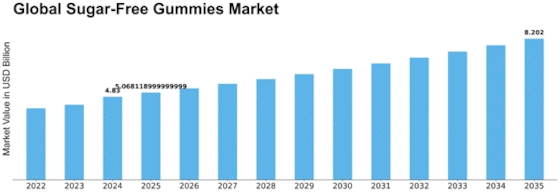
<p>The projected market valuation for the Global Sugar-Free Gummies Market in 2035 is 8.202 USD Billion.</p>

What was the market valuation for the Global Sugar-Free Gummies Market in 2024?

<p>The market valuation for the Global Sugar-Free Gummies Market in 2024 was 4.83 USD Billion.</p>

What is the expected CAGR for the Global Sugar-Free Gummies Market during the forecast period 2025 - 2035?

<p>The expected CAGR for the Global Sugar-Free Gummies Market during the forecast period 2025 - 2035 is 4.93%.</p>

Which companies are considered key players in the Global Sugar-Free Gummies Market?

<p>Key players in the Global Sugar-Free Gummies Market include Haribo, Nestle, Mondelez International, and The Hershey Company.</p>

What are the projected revenues for Gummy Bears in the Global Sugar-Free Gummies Market by 2035?

<p>The projected revenues for Gummy Bears in the Global Sugar-Free Gummies Market are expected to reach 2.5 USD Billion by 2035.</p>

How do the revenues for Adults compare to those for Children in the Global Sugar-Free Gummies Market?

<p>By 2035, the revenues for Adults are projected to be 5.7 USD Billion, compared to 2.5 USD Billion for Children.</p>

What is the expected revenue growth for Non-Store-Based distribution channels by 2035?

The expected revenue for Non-Store-Based distribution channels is projected to grow to 3.202 USD Billion by 2035.

What segment of the Global Sugar-Free Gummies Market had the highest valuation in 2024?

In 2024, the segment with the highest valuation was Adults, generating 3.33 USD Billion.

What is the projected revenue for Gummy Worms in the Global Sugar-Free Gummies Market by 2035?

The projected revenue for Gummy Worms in the Global Sugar-Free Gummies Market is expected to reach 2.0 USD Billion by 2035.

How does the revenue for Store-Based distribution channels compare to Non-Store-Based channels in 2035?

By 2035, Store-Based distribution channels are projected to generate 5.0 USD Billion, surpassing Non-Store-Based channels at 3.202 USD Billion.

Market Summary

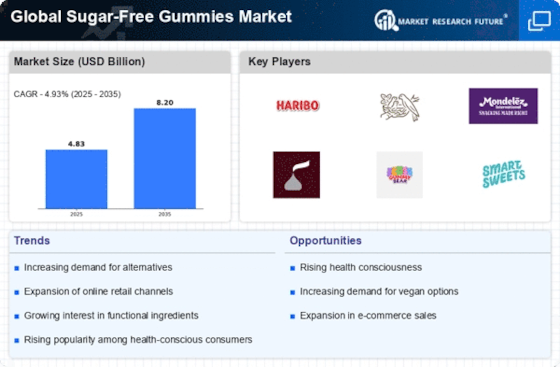
As per Market Research Future analysis, the Global Sugar-Free Gummies Market Size was estimated at 4.83 USD Billion in 2024. The sugar-free gummies industry is projected to grow from 5.068 USD Billion in 2025 to 8.202 USD Billion by 2035, exhibiting a compound annual growth rate (CAGR) of 4.93% during the forecast period 2025 - 2035

Key Market Trends & Highlights

The Global Sugar-Free Gummies Market is experiencing robust growth driven by health trends and innovative flavors.

  • North America remains the largest market for sugar-free gummies, reflecting a strong consumer preference for healthier snacks.
  • The Asia-Pacific region is emerging as the fastest-growing market, driven by increasing health consciousness among consumers.
  • Gummy Bears dominate the market as the largest segment, while Gummy Worms are witnessing rapid growth in popularity.
  • Health consciousness and flavor innovation are key drivers propelling the market forward, particularly among children and adult consumers.

Market Size & Forecast

2024 Market Size 4.83 (USD Billion)
2035 Market Size 8.202 (USD Billion)
CAGR (2025 - 2035) 4.93%
Largest Regional Market Share in 2024 North America

Major Players

Haribo (DE), Nestle (CH), Mondelez International (US), The Hershey Company (US), Gummy Bear (US), SmartSweets (CA), Yummy Earth (US), Berkley (US), Sugarfina (US)

Market Trends

The Global Sugar-Free Gummies Market is currently experiencing a notable transformation, driven by evolving consumer preferences and a growing awareness of health and wellness. As individuals increasingly seek alternatives to traditional sugary snacks, the demand for sugar-free options has surged. This shift is not merely a trend but appears to be a fundamental change in dietary habits, with consumers gravitating towards products that align with their health goals. The market is characterized by a diverse range of flavors and formulations, catering to various dietary needs, including vegan and gluten-free options. Manufacturers are responding to this demand by innovating and expanding their product lines, which may enhance their competitive edge in this dynamic landscape. Moreover, the Global Sugar-Free Gummies Market seems to be influenced by broader trends in the food industry, such as the rise of clean label products and the increasing popularity of functional foods. Consumers are not only looking for indulgent treats but also for products that offer additional health benefits, such as vitamins and minerals. This dual focus on enjoyment and health is likely to shape the future of the market, as brands strive to meet the expectations of a more discerning consumer base. As the market continues to evolve, it may present opportunities for new entrants and established players alike to innovate and capture the attention of health-conscious consumers.

Health Consciousness

There is a growing trend towards health consciousness among consumers, leading to increased demand for sugar-free alternatives. This shift reflects a broader societal movement towards healthier eating habits, where individuals prioritize their well-being and seek products that support their health goals.

Flavor Innovation

The Global Sugar-Free Gummies Market is witnessing a surge in flavor innovation, as manufacturers experiment with unique and exotic flavors to attract consumers. This trend not only enhances the appeal of sugar-free gummies but also encourages trial and repeat purchases.

Functional Ingredients

The incorporation of functional ingredients into sugar-free gummies is becoming more prevalent. Consumers are increasingly interested in products that offer additional health benefits, such as added vitamins, minerals, or probiotics, which may enhance the overall value proposition of these snacks.

Sugar Free Gummies Market Market Drivers

E-commerce Growth

The rapid growth of e-commerce is significantly impacting the sugar-free gummies market. With more consumers turning to online shopping for convenience and variety, the Global Sugar-Free Gummies Market is witnessing an increase in online sales channels. This shift is supported by data indicating that e-commerce sales in the food and beverage sector are expected to grow by over 20% in the coming years. As a result, manufacturers are enhancing their online presence and investing in digital marketing strategies to reach a broader audience. This trend not only facilitates easier access to sugar-free gummies but also allows for greater consumer engagement and feedback, ultimately driving market growth.

Flavor Innovation

Flavor innovation plays a crucial role in driving the sugar-free gummies market. As consumers become more adventurous in their taste preferences, manufacturers are compelled to develop unique and appealing flavors that can compete with traditional sugary options. The Global Sugar-Free Gummies Market is currently experiencing a surge in demand for exotic and novel flavors, which not only attract new customers but also retain existing ones. This trend is supported by market data indicating that flavor variety can significantly influence purchasing decisions, with consumers often willing to pay a premium for innovative taste experiences. Consequently, companies are investing in research and development to create flavor profiles that resonate with diverse consumer segments, thereby enhancing their market presence.

Health Consciousness

The increasing awareness regarding health and wellness among consumers appears to be a primary driver for the sugar-free gummies market. As individuals become more health-conscious, they actively seek alternatives to traditional sugary snacks. This trend is reflected in the rising demand for sugar-free products, which is projected to grow at a compound annual growth rate of approximately 5.5% over the next five years. The Global Sugar-Free Gummies Market is witnessing a shift as consumers prioritize products that align with their health goals, such as weight management and reduced sugar intake. This heightened focus on health is likely to encourage manufacturers to innovate and expand their sugar-free offerings, catering to a broader audience that includes diabetics and those following low-carb diets.

Functional Ingredients

The incorporation of functional ingredients into sugar-free gummies is emerging as a significant driver in the market. Consumers are increasingly seeking products that offer health benefits beyond basic nutrition, such as vitamins, minerals, and probiotics. The Global Sugar-Free Gummies Market is adapting to this demand by integrating these functional components into their formulations, thereby appealing to health-oriented consumers. Market analysis suggests that products enriched with functional ingredients are likely to capture a larger share of the market, as they provide added value and differentiate themselves from standard offerings. This trend not only enhances the appeal of sugar-free gummies but also aligns with the growing consumer preference for multifunctional snacks that contribute to overall well-being.

Convenience and Portability

The convenience and portability of sugar-free gummies are increasingly influencing consumer choices in the market. As lifestyles become busier, individuals are seeking snacks that are easy to carry and consume on the go. The Global Sugar-Free Gummies Market is benefiting from this trend, as gummies offer a practical solution for those looking for quick, guilt-free snacks. This demand for convenience is reflected in market data, which indicates that portable snack options are gaining traction, particularly among younger demographics. Manufacturers are responding by packaging sugar-free gummies in single-serving formats, making them more accessible and appealing to consumers who prioritize convenience in their dietary choices.

Market Segment Insights

By Type: Gummy Bears (Largest) vs. Gummy Worms (Fastest-Growing)

<p>In the Global Sugar-Free Gummies Market, the segment distribution showcases Gummy Bears as the largest share holder, resonating well with health-conscious consumers who prefer classic candy tastes without sugar. Gummy Worms, while smaller in share, are rapidly gaining traction, particularly among younger demographics and those seeking fun, flavorful alternatives. The variety in flavors and textures across the segment adds to Gummy Bears' strong market presence while Gummy Worms capitalize on novelty and versatility.</p>

<p>Gummy Bears: Dominant vs. Gummy Worms: Emerging</p>

<p>Gummy Bears stand out in the sugar-free segment as the dominant choice, appealing to those who favor familiar flavors and textures. Their longstanding popularity among various age groups solidifies their market position, making them a versatile option for retailers. On the other hand, Gummy Worms are seen as an emerging player, gaining momentum due to innovative flavors and creative marketing strategies targeting younger consumers. This segment capitalizes on the trend of fun, playful snacks that cater to dietary preferences, positioning Gummy Worms as an exciting choice for those exploring sugar-free options.</p>

By End-User: Children (Largest) vs. Adults (Fastest-Growing)

<p>In the Global Sugar-Free Gummies Market, the distribution among end-user segments showcases Children as the largest demographic, capturing a significant portion of market share. This segment thrives on the appeal of gummy supplements infused with attractive flavors and the promise of a healthier alternative to traditional candies. On the other hand, Adults are emerging as a prominent consumer group, increasingly engaging with sugar-free products as health consciousness rises among this demographic. As more adults seek alternatives to sugary snacks, the demand for sugar-free gummies is witnessing a substantial uptick.</p>

<p>Children: Dominant vs. Adults: Emerging</p>

<p>The Children segment dominates the Global Sugar-Free Gummies Market owing to its robust marketing strategies and the alignment with parental preferences for healthier snacks. This segment benefits from colorful branding and nutritional content aimed at appealing to both kids and parents. Conversely, the Adults segment is classified as emerging, driven by a trend towards healthier lifestyles and the growing awareness of sugar-related health issues. Adults are increasingly seeking convenient, guilt-free snacking options, leading to heightened product innovations to cater to their tastes and dietary restrictions. Both segments exhibit distinct characteristics; however, together they are fostering significant growth in the sugar-free gummy landscape.</p>

By Distribution Channel: Store-Based (Largest) vs. Non-Store-Based (Fastest-Growing)

<p>In the Global Sugar-Free Gummies Market, the distribution channel segment reveals a notable market share distribution, with Store-Based channels taking the lead as the largest contributor. These outlets, including supermarkets and health food stores, provide consumers with direct access to sugar-free gummies, allowing for impulse purchases and brand exploration. In contrast, Non-Store-Based channels, comprising e-commerce platforms and direct-to-consumer sales, are emerging rapidly, with an increasing share of the market as consumers embrace online shopping for convenience and variety. Growth trends in the distribution channel reveal a shift in consumer behaviors and preferences. While Store-Based channels remain prominent due to their established presence and trust, Non-Store-Based channels are growing at a faster pace. This growth is driven by the rising influence of e-commerce, advancements in digital marketing, and changing shopping habits, whereby consumers are seeking health products online, often influenced by social media and online reviews.</p>

<p>Distribution Channel: Store-Based (Dominant) vs. Non-Store-Based (Emerging)</p>

<p>The Store-Based distribution channel stands as the dominant player in the Global Sugar-Free Gummies Market, characterized by its strong physical presence in retail environments that appeal to consumers seeking immediate access to products. Supermarkets and specialty health stores play a crucial role in providing visibility and credibility to sugar-free gummies, catering to health-conscious shoppers. Conversely, the Non-Store-Based channel is emerging rapidly, favored for its convenience and broader selection. As e-commerce platforms gain traction, brands are investing in online strategies to engage consumers directly. This channel is particularly attractive to younger demographics who value convenience, competitive pricing, and the ability to explore a variety of options that may not be available in traditional retail settings.</p>

Get more detailed insights about Sugar-Free Gummies Market Research Report - Forecast till 2035

Regional Insights

North America : Health-Conscious Consumer Base

North America is the largest market for sugar-free gummies, holding approximately 45% of the global market share. The growth is driven by increasing health consciousness among consumers, rising demand for low-calorie snacks, and favorable regulatory frameworks promoting sugar alternatives. The region's robust distribution channels and innovative product offerings further enhance market growth. The United States is the leading country in this market, followed by Canada. Major players like Haribo, Mondelez International, and The Hershey Company dominate the competitive landscape. The presence of these key players, along with a growing trend towards healthier snacking options, positions North America as a pivotal region in the sugar-free gummies market.

Europe : Emerging Market with Innovation

Europe is witnessing significant growth in the sugar-free gummies market, accounting for approximately 30% of the global share. The demand is fueled by increasing awareness of health issues related to sugar consumption and a shift towards healthier lifestyles. Regulatory support for sugar alternatives and clean label products is also a catalyst for market expansion in this region. Germany and the United Kingdom are the leading countries in this market, with a competitive landscape featuring key players like Nestle and Haribo. The presence of innovative products and a growing trend towards vegan and organic options are shaping the market dynamics. The European market is characterized by a diverse range of flavors and formulations, appealing to a broad consumer base.

Asia-Pacific : Rapid Growth and Expansion

Asia-Pacific is rapidly emerging as a significant player in the sugar-free gummies market, holding about 20% of the global market share. The growth is driven by increasing disposable incomes, urbanization, and a rising trend towards health and wellness. Regulatory initiatives promoting healthier food options are also contributing to market expansion in this region. China and Japan are the leading countries in this market, with a competitive landscape that includes both local and international brands. The presence of key players like SmartSweets and Yummy Earth is notable, as they cater to the growing demand for sugar-free and healthier snack options. The region's diverse consumer preferences are driving innovation and product development in the sugar-free gummies segment.

Middle East and Africa : Untapped Market Potential

The Middle East and Africa represent an untapped market for sugar-free gummies, accounting for approximately 5% of the global market share. The growth potential is significant, driven by increasing health awareness and a shift towards healthier eating habits. Regulatory frameworks are gradually evolving to support the introduction of sugar-free products, which is expected to catalyze market growth in the coming years. Countries like South Africa and the UAE are leading the market in this region, with a competitive landscape that is still developing. The presence of local and international brands is increasing, and consumer interest in sugar-free options is on the rise. As health trends continue to gain traction, the Middle East and Africa are poised for substantial growth in the sugar-free gummies market.

Key Players and Competitive Insights

The Global Sugar-Free Gummies Market is currently characterized by a dynamic competitive landscape, driven by increasing consumer demand for healthier alternatives to traditional confectionery. Key players are actively engaging in innovative product development, strategic partnerships, and regional expansions to capture market share. Companies such as Haribo (DE), Nestle (CH), and SmartSweets (CA) are at the forefront, leveraging their brand equity and distribution networks to enhance their market presence. Haribo, for instance, has focused on expanding its sugar-free product line, while Nestle has been investing in digital transformation to better connect with health-conscious consumers. These strategies collectively contribute to a competitive environment that is increasingly focused on health and wellness, as well as consumer engagement.In terms of business tactics, companies are localizing manufacturing and optimizing supply chains to enhance efficiency and reduce costs. The market structure appears moderately fragmented, with several players vying for dominance. However, the collective influence of major companies like Mondelez International (US) and The Hershey Company (US) is notable, as they continue to innovate and adapt to changing consumer preferences. This competitive structure allows for a diverse range of products, catering to various dietary needs and preferences, which is essential in a market that is rapidly evolving.

In August Mondelez International (US) announced the launch of a new line of sugar-free gummies aimed at children, incorporating natural flavors and colors. This strategic move is significant as it not only targets a growing demographic concerned with health but also aligns with the company's broader commitment to sustainability and responsible sourcing. By focusing on children, Mondelez is likely to capture a segment of the market that is increasingly influenced by parental purchasing decisions, thereby enhancing its competitive positioning.

In September The Hershey Company (US) unveiled a partnership with a leading health and wellness influencer to promote its new sugar-free gummy range. This collaboration is indicative of a broader trend where companies are leveraging social media and influencer marketing to reach health-conscious consumers. The strategic importance of this partnership lies in its potential to enhance brand visibility and credibility, particularly among younger demographics who are more likely to engage with influencer content.

In July SmartSweets (CA) expanded its distribution channels by entering into a partnership with a major online retailer, significantly increasing its market reach. This move is crucial as it allows SmartSweets to tap into the growing e-commerce segment, which has become increasingly vital for consumer goods. By enhancing accessibility, SmartSweets is likely to strengthen its competitive edge in the sugar-free gummies market, appealing to consumers who prioritize convenience and health.

As of October current competitive trends in the Global Sugar-Free Gummies Market are heavily influenced by digitalization, sustainability, and the integration of artificial intelligence in product development and marketing strategies. Strategic alliances are becoming increasingly important, as companies seek to enhance their innovation capabilities and market reach. Looking ahead, it appears that competitive differentiation will evolve from traditional price-based competition to a focus on innovation, technology, and supply chain reliability. This shift suggests that companies that prioritize these areas will likely emerge as leaders in the market.

Key Companies in the Sugar Free Gummies Market include

Industry Developments

February 2024- UPSA has joined forces with British startup Rem3dy Health, the sole owner of the Nourished brand, to introduce the latest range of food supplements: the UPSA x Nourished 7-in-1 gummies. With this partnership, the French Lab, a long-standing player in everyday health products, is making an entrance into a rapidly expanding but already busy market for protective wellness solutions. On the other hand, UPSA focuses on transforming the market thanks to its pharmaceutical knowledge and Rem3dy Health's patented 3D printing technology, which helps preserve the actives and provides brilliant organoleptic qualities.

UPSA is Already present in the food supplements market with vitamin C and focuses on transforming this dynamic, fast-changing segment into a sustainable growth driver. The managing director of UPSA France, Anthony Lallier, who is in charge of UPSA Global portfolio development, said that the market of food supplements in the form of gummies has experienced double-digit growth in France for nearly five years. In the pharmaceutical channel, the prime distribution network for these products, growth was accomplished by +15% in 2022 in comparison with the previous year.

At present, 50% of food supplements across the US are provided in the form of gummies. To set its foot in the market, the Southwestern French laboratory has announced an acquisition of a stake in the British startup Rem3dy Health, which invented the first gummies using a patented 3D printing technology. The main goal is to provide a thorough vision of wellness with an attractive range without negotiating pharmaceutical quality or efficacy. Anthony Lallier said that 3D printing technology makes it possible to distinguish the actives without heating or mixing them. Their quality is thus not altered over time.

They are well-preserved, and the distinct layers take part in the organoleptic pleasure.

March 2023: Prebiotics, probiotics, and postbiotics are all combined into one gummy by Goli Nutrition Inc. In addition to promoting immunological health, these candies promote a balanced gut microbiota.

April 2022: Wellblends, a full line of scientifically curated health products, was introduced by Nature as a way to maintain a wellness cycle of immune health, stress management, and sleep.

Future Outlook

Sugar Free Gummies Market Future Outlook

The Global Sugar-Free Gummies Market is projected to grow at a 4.93% CAGR from 2025 to 2035, driven by health trends, innovation, and increasing consumer demand for low-sugar alternatives.

New opportunities lie in:

  • Expansion into e-commerce platforms for direct consumer sales.
  • Development of innovative flavors targeting niche markets.
  • Partnerships with health-focused retailers to enhance distribution channels.

By 2035, the market is expected to solidify its position as a leader in the confectionery sector.

Market Segmentation

Sugar Free Gummies Market Type Outlook

  • Gummy Bears
  • Gummy Worms
  • Gummy Cherries
  • Gummy Rings
  • Others

Sugar Free Gummies Market End-User Outlook

  • Children
  • Adults

Sugar Free Gummies Market Distribution Channel Outlook

  • Store-Based
  • Non-Store-Based

Report Scope

MARKET SIZE 2024 4.83(USD Billion)
MARKET SIZE 2025 5.068(USD Billion)
MARKET SIZE 2035 8.202(USD Billion)
COMPOUND ANNUAL GROWTH RATE (CAGR) 4.93% (2025 - 2035)
REPORT COVERAGE Revenue Forecast, Competitive Landscape, Growth Factors, and Trends
BASE YEAR 2024
Market Forecast Period 2025 - 2035
Historical Data 2019 - 2024
Market Forecast Units USD Billion
Key Companies Profiled Haribo (DE), Nestle (CH), Mondelez International (US), The Hershey Company (US), Gummy Bear (US), SmartSweets (CA), Yummy Earth (US), Berkley (US), Sugarfina (US)
Segments Covered Type, End-User, Distribution Channel, Region
Key Market Opportunities Rising consumer demand for healthier snacks drives innovation in the Global Sugar-Free Gummies Market.
Key Market Dynamics Rising consumer demand for healthier snacks drives innovation and competition in the sugar-free gummies sector.
Countries Covered North America, Europe, APAC, South America, MEA

FAQs

What is the projected market valuation for the Global Sugar-Free Gummies Market in 2035?

<p>The projected market valuation for the Global Sugar-Free Gummies Market in 2035 is 8.202 USD Billion.</p>

What was the market valuation for the Global Sugar-Free Gummies Market in 2024?

<p>The market valuation for the Global Sugar-Free Gummies Market in 2024 was 4.83 USD Billion.</p>

What is the expected CAGR for the Global Sugar-Free Gummies Market during the forecast period 2025 - 2035?

<p>The expected CAGR for the Global Sugar-Free Gummies Market during the forecast period 2025 - 2035 is 4.93%.</p>

Which companies are considered key players in the Global Sugar-Free Gummies Market?

<p>Key players in the Global Sugar-Free Gummies Market include Haribo, Nestle, Mondelez International, and The Hershey Company.</p>

What are the projected revenues for Gummy Bears in the Global Sugar-Free Gummies Market by 2035?

<p>The projected revenues for Gummy Bears in the Global Sugar-Free Gummies Market are expected to reach 2.5 USD Billion by 2035.</p>

How do the revenues for Adults compare to those for Children in the Global Sugar-Free Gummies Market?

<p>By 2035, the revenues for Adults are projected to be 5.7 USD Billion, compared to 2.5 USD Billion for Children.</p>

What is the expected revenue growth for Non-Store-Based distribution channels by 2035?

The expected revenue for Non-Store-Based distribution channels is projected to grow to 3.202 USD Billion by 2035.

What segment of the Global Sugar-Free Gummies Market had the highest valuation in 2024?

In 2024, the segment with the highest valuation was Adults, generating 3.33 USD Billion.

What is the projected revenue for Gummy Worms in the Global Sugar-Free Gummies Market by 2035?

The projected revenue for Gummy Worms in the Global Sugar-Free Gummies Market is expected to reach 2.0 USD Billion by 2035.

How does the revenue for Store-Based distribution channels compare to Non-Store-Based channels in 2035?

By 2035, Store-Based distribution channels are projected to generate 5.0 USD Billion, surpassing Non-Store-Based channels at 3.202 USD Billion.

  1. SECTION I: EXECUTIVE SUMMARY AND KEY HIGHLIGHTS
    1. | 1.1 EXECUTIVE SUMMARY
    2. | | 1.1.1 Market Overview
    3. | | 1.1.2 Key Findings
    4. | | 1.1.3 Market Segmentation
    5. | | 1.1.4 Competitive Landscape
    6. | | 1.1.5 Challenges and Opportunities
    7. | | 1.1.6 Future Outlook
  2. SECTION II: SCOPING, METHODOLOGY AND MARKET STRUCTURE
    1. | 2.1 MARKET INTRODUCTION
    2. | | 2.1.1 Definition
    3. | | 2.1.2 Scope of the study
    4. | | | 2.1.2.1 Research Objective
    5. | | | 2.1.2.2 Assumption
    6. | | | 2.1.2.3 Limitations
    7. | 2.2 RESEARCH METHODOLOGY
    8. | | 2.2.1 Overview
    9. | | 2.2.2 Data Mining
    10. | | 2.2.3 Secondary Research
    11. | | 2.2.4 Primary Research
    12. | | | 2.2.4.1 Primary Interviews and Information Gathering Process
    13. | | | 2.2.4.2 Breakdown of Primary Respondents
    14. | | 2.2.5 Forecasting Model
    15. | | 2.2.6 Market Size Estimation
    16. | | | 2.2.6.1 Bottom-Up Approach
    17. | | | 2.2.6.2 Top-Down Approach
    18. | | 2.2.7 Data Triangulation
    19. | | 2.2.8 Validation
  3. SECTION III: QUALITATIVE ANALYSIS
    1. | 3.1 MARKET DYNAMICS
    2. | | 3.1.1 Overview
    3. | | 3.1.2 Drivers
    4. | | 3.1.3 Restraints
    5. | | 3.1.4 Opportunities
    6. | 3.2 MARKET FACTOR ANALYSIS
    7. | | 3.2.1 Value chain Analysis
    8. | | 3.2.2 Porter's Five Forces Analysis
    9. | | | 3.2.2.1 Bargaining Power of Suppliers
    10. | | | 3.2.2.2 Bargaining Power of Buyers
    11. | | | 3.2.2.3 Threat of New Entrants
    12. | | | 3.2.2.4 Threat of Substitutes
    13. | | | 3.2.2.5 Intensity of Rivalry
    14. | | 3.2.3 COVID-19 Impact Analysis
    15. | | | 3.2.3.1 Market Impact Analysis
    16. | | | 3.2.3.2 Regional Impact
    17. | | | 3.2.3.3 Opportunity and Threat Analysis
  4. SECTION IV: QUANTITATIVE ANALYSIS
    1. | 4.1 Food, Beverages & Nutrition, BY Type (USD Billion)
    2. | | 4.1.1 Gummy Bears
    3. | | 4.1.2 Gummy Worms
    4. | | 4.1.3 Gummy Cherries
    5. | | 4.1.4 Gummy Rings
    6. | | 4.1.5 Others
    7. | 4.2 Food, Beverages & Nutrition, BY End-User (USD Billion)
    8. | | 4.2.1 Children
    9. | | 4.2.2 Adults
    10. | 4.3 Food, Beverages & Nutrition, BY Distribution Channel (USD Billion)
    11. | | 4.3.1 Store-Based
    12. | | 4.3.2 Non-Store-Based
    13. | 4.4 Food, Beverages & Nutrition, BY Region (USD Billion)
    14. | | 4.4.1 North America
    15. | | | 4.4.1.1 US
    16. | | | 4.4.1.2 Canada
    17. | | 4.4.2 Europe
    18. | | | 4.4.2.1 Germany
    19. | | | 4.4.2.2 UK
    20. | | | 4.4.2.3 France
    21. | | | 4.4.2.4 Russia
    22. | | | 4.4.2.5 Italy
    23. | | | 4.4.2.6 Spain
    24. | | | 4.4.2.7 Rest of Europe
    25. | | 4.4.3 APAC
    26. | | | 4.4.3.1 China
    27. | | | 4.4.3.2 India
    28. | | | 4.4.3.3 Japan
    29. | | | 4.4.3.4 South Korea
    30. | | | 4.4.3.5 Malaysia
    31. | | | 4.4.3.6 Thailand
    32. | | | 4.4.3.7 Indonesia
    33. | | | 4.4.3.8 Rest of APAC
    34. | | 4.4.4 South America
    35. | | | 4.4.4.1 Brazil
    36. | | | 4.4.4.2 Mexico
    37. | | | 4.4.4.3 Argentina
    38. | | | 4.4.4.4 Rest of South America
    39. | | 4.4.5 MEA
    40. | | | 4.4.5.1 GCC Countries
    41. | | | 4.4.5.2 South Africa
    42. | | | 4.4.5.3 Rest of MEA
  5. SECTION V: COMPETITIVE ANALYSIS
    1. | 5.1 Competitive Landscape
    2. | | 5.1.1 Overview
    3. | | 5.1.2 Competitive Analysis
    4. | | 5.1.3 Market share Analysis
    5. | | 5.1.4 Major Growth Strategy in the Food, Beverages & Nutrition
    6. | | 5.1.5 Competitive Benchmarking
    7. | | 5.1.6 Leading Players in Terms of Number of Developments in the Food, Beverages & Nutrition
    8. | | 5.1.7 Key developments and growth strategies
    9. | | | 5.1.7.1 New Product Launch/Service Deployment
    10. | | | 5.1.7.2 Merger & Acquisitions
    11. | | | 5.1.7.3 Joint Ventures
    12. | | 5.1.8 Major Players Financial Matrix
    13. | | | 5.1.8.1 Sales and Operating Income
    14. | | | 5.1.8.2 Major Players R&D Expenditure. 2023
    15. | 5.2 Company Profiles
    16. | | 5.2.1 Haribo (DE)
    17. | | | 5.2.1.1 Financial Overview
    18. | | | 5.2.1.2 Products Offered
    19. | | | 5.2.1.3 Key Developments
    20. | | | 5.2.1.4 SWOT Analysis
    21. | | | 5.2.1.5 Key Strategies
    22. | | 5.2.2 Nestle (CH)
    23. | | | 5.2.2.1 Financial Overview
    24. | | | 5.2.2.2 Products Offered
    25. | | | 5.2.2.3 Key Developments
    26. | | | 5.2.2.4 SWOT Analysis
    27. | | | 5.2.2.5 Key Strategies
    28. | | 5.2.3 Mondelez International (US)
    29. | | | 5.2.3.1 Financial Overview
    30. | | | 5.2.3.2 Products Offered
    31. | | | 5.2.3.3 Key Developments
    32. | | | 5.2.3.4 SWOT Analysis
    33. | | | 5.2.3.5 Key Strategies
    34. | | 5.2.4 The Hershey Company (US)
    35. | | | 5.2.4.1 Financial Overview
    36. | | | 5.2.4.2 Products Offered
    37. | | | 5.2.4.3 Key Developments
    38. | | | 5.2.4.4 SWOT Analysis
    39. | | | 5.2.4.5 Key Strategies
    40. | | 5.2.5 Gummy Bear (US)
    41. | | | 5.2.5.1 Financial Overview
    42. | | | 5.2.5.2 Products Offered
    43. | | | 5.2.5.3 Key Developments
    44. | | | 5.2.5.4 SWOT Analysis
    45. | | | 5.2.5.5 Key Strategies
    46. | | 5.2.6 SmartSweets (CA)
    47. | | | 5.2.6.1 Financial Overview
    48. | | | 5.2.6.2 Products Offered
    49. | | | 5.2.6.3 Key Developments
    50. | | | 5.2.6.4 SWOT Analysis
    51. | | | 5.2.6.5 Key Strategies
    52. | | 5.2.7 Yummy Earth (US)
    53. | | | 5.2.7.1 Financial Overview
    54. | | | 5.2.7.2 Products Offered
    55. | | | 5.2.7.3 Key Developments
    56. | | | 5.2.7.4 SWOT Analysis
    57. | | | 5.2.7.5 Key Strategies
    58. | | 5.2.8 Berkley (US)
    59. | | | 5.2.8.1 Financial Overview
    60. | | | 5.2.8.2 Products Offered
    61. | | | 5.2.8.3 Key Developments
    62. | | | 5.2.8.4 SWOT Analysis
    63. | | | 5.2.8.5 Key Strategies
    64. | | 5.2.9 Sugarfina (US)
    65. | | | 5.2.9.1 Financial Overview
    66. | | | 5.2.9.2 Products Offered
    67. | | | 5.2.9.3 Key Developments
    68. | | | 5.2.9.4 SWOT Analysis
    69. | | | 5.2.9.5 Key Strategies
    70. | 5.3 Appendix
    71. | | 5.3.1 References
    72. | | 5.3.2 Related Reports
  6. LIST OF FIGURES
    1. | 6.1 MARKET SYNOPSIS
    2. | 6.2 NORTH AMERICA MARKET ANALYSIS
    3. | 6.3 US MARKET ANALYSIS BY TYPE
    4. | 6.4 US MARKET ANALYSIS BY END-USER
    5. | 6.5 US MARKET ANALYSIS BY DISTRIBUTION CHANNEL
    6. | 6.6 CANADA MARKET ANALYSIS BY TYPE
    7. | 6.7 CANADA MARKET ANALYSIS BY END-USER
    8. | 6.8 CANADA MARKET ANALYSIS BY DISTRIBUTION CHANNEL
    9. | 6.9 EUROPE MARKET ANALYSIS
    10. | 6.10 GERMANY MARKET ANALYSIS BY TYPE
    11. | 6.11 GERMANY MARKET ANALYSIS BY END-USER
    12. | 6.12 GERMANY MARKET ANALYSIS BY DISTRIBUTION CHANNEL
    13. | 6.13 UK MARKET ANALYSIS BY TYPE
    14. | 6.14 UK MARKET ANALYSIS BY END-USER
    15. | 6.15 UK MARKET ANALYSIS BY DISTRIBUTION CHANNEL
    16. | 6.16 FRANCE MARKET ANALYSIS BY TYPE
    17. | 6.17 FRANCE MARKET ANALYSIS BY END-USER
    18. | 6.18 FRANCE MARKET ANALYSIS BY DISTRIBUTION CHANNEL
    19. | 6.19 RUSSIA MARKET ANALYSIS BY TYPE
    20. | 6.20 RUSSIA MARKET ANALYSIS BY END-USER
    21. | 6.21 RUSSIA MARKET ANALYSIS BY DISTRIBUTION CHANNEL
    22. | 6.22 ITALY MARKET ANALYSIS BY TYPE
    23. | 6.23 ITALY MARKET ANALYSIS BY END-USER
    24. | 6.24 ITALY MARKET ANALYSIS BY DISTRIBUTION CHANNEL
    25. | 6.25 SPAIN MARKET ANALYSIS BY TYPE
    26. | 6.26 SPAIN MARKET ANALYSIS BY END-USER
    27. | 6.27 SPAIN MARKET ANALYSIS BY DISTRIBUTION CHANNEL
    28. | 6.28 REST OF EUROPE MARKET ANALYSIS BY TYPE
    29. | 6.29 REST OF EUROPE MARKET ANALYSIS BY END-USER
    30. | 6.30 REST OF EUROPE MARKET ANALYSIS BY DISTRIBUTION CHANNEL
    31. | 6.31 APAC MARKET ANALYSIS
    32. | 6.32 CHINA MARKET ANALYSIS BY TYPE
    33. | 6.33 CHINA MARKET ANALYSIS BY END-USER
    34. | 6.34 CHINA MARKET ANALYSIS BY DISTRIBUTION CHANNEL
    35. | 6.35 INDIA MARKET ANALYSIS BY TYPE
    36. | 6.36 INDIA MARKET ANALYSIS BY END-USER
    37. | 6.37 INDIA MARKET ANALYSIS BY DISTRIBUTION CHANNEL
    38. | 6.38 JAPAN MARKET ANALYSIS BY TYPE
    39. | 6.39 JAPAN MARKET ANALYSIS BY END-USER
    40. | 6.40 JAPAN MARKET ANALYSIS BY DISTRIBUTION CHANNEL
    41. | 6.41 SOUTH KOREA MARKET ANALYSIS BY TYPE
    42. | 6.42 SOUTH KOREA MARKET ANALYSIS BY END-USER
    43. | 6.43 SOUTH KOREA MARKET ANALYSIS BY DISTRIBUTION CHANNEL
    44. | 6.44 MALAYSIA MARKET ANALYSIS BY TYPE
    45. | 6.45 MALAYSIA MARKET ANALYSIS BY END-USER
    46. | 6.46 MALAYSIA MARKET ANALYSIS BY DISTRIBUTION CHANNEL
    47. | 6.47 THAILAND MARKET ANALYSIS BY TYPE
    48. | 6.48 THAILAND MARKET ANALYSIS BY END-USER
    49. | 6.49 THAILAND MARKET ANALYSIS BY DISTRIBUTION CHANNEL
    50. | 6.50 INDONESIA MARKET ANALYSIS BY TYPE
    51. | 6.51 INDONESIA MARKET ANALYSIS BY END-USER
    52. | 6.52 INDONESIA MARKET ANALYSIS BY DISTRIBUTION CHANNEL
    53. | 6.53 REST OF APAC MARKET ANALYSIS BY TYPE
    54. | 6.54 REST OF APAC MARKET ANALYSIS BY END-USER
    55. | 6.55 REST OF APAC MARKET ANALYSIS BY DISTRIBUTION CHANNEL
    56. | 6.56 SOUTH AMERICA MARKET ANALYSIS
    57. | 6.57 BRAZIL MARKET ANALYSIS BY TYPE
    58. | 6.58 BRAZIL MARKET ANALYSIS BY END-USER
    59. | 6.59 BRAZIL MARKET ANALYSIS BY DISTRIBUTION CHANNEL
    60. | 6.60 MEXICO MARKET ANALYSIS BY TYPE
    61. | 6.61 MEXICO MARKET ANALYSIS BY END-USER
    62. | 6.62 MEXICO MARKET ANALYSIS BY DISTRIBUTION CHANNEL
    63. | 6.63 ARGENTINA MARKET ANALYSIS BY TYPE
    64. | 6.64 ARGENTINA MARKET ANALYSIS BY END-USER
    65. | 6.65 ARGENTINA MARKET ANALYSIS BY DISTRIBUTION CHANNEL
    66. | 6.66 REST OF SOUTH AMERICA MARKET ANALYSIS BY TYPE
    67. | 6.67 REST OF SOUTH AMERICA MARKET ANALYSIS BY END-USER
    68. | 6.68 REST OF SOUTH AMERICA MARKET ANALYSIS BY DISTRIBUTION CHANNEL
    69. | 6.69 MEA MARKET ANALYSIS
    70. | 6.70 GCC COUNTRIES MARKET ANALYSIS BY TYPE
    71. | 6.71 GCC COUNTRIES MARKET ANALYSIS BY END-USER
    72. | 6.72 GCC COUNTRIES MARKET ANALYSIS BY DISTRIBUTION CHANNEL
    73. | 6.73 SOUTH AFRICA MARKET ANALYSIS BY TYPE
    74. | 6.74 SOUTH AFRICA MARKET ANALYSIS BY END-USER
    75. | 6.75 SOUTH AFRICA MARKET ANALYSIS BY DISTRIBUTION CHANNEL
    76. | 6.76 REST OF MEA MARKET ANALYSIS BY TYPE
    77. | 6.77 REST OF MEA MARKET ANALYSIS BY END-USER
    78. | 6.78 REST OF MEA MARKET ANALYSIS BY DISTRIBUTION CHANNEL
    79. | 6.79 KEY BUYING CRITERIA OF FOOD, BEVERAGES & NUTRITION
    80. | 6.80 RESEARCH PROCESS OF MRFR
    81. | 6.81 DRO ANALYSIS OF FOOD, BEVERAGES & NUTRITION
    82. | 6.82 DRIVERS IMPACT ANALYSIS: FOOD, BEVERAGES & NUTRITION
    83. | 6.83 RESTRAINTS IMPACT ANALYSIS: FOOD, BEVERAGES & NUTRITION
    84. | 6.84 SUPPLY / VALUE CHAIN: FOOD, BEVERAGES & NUTRITION
    85. | 6.85 FOOD, BEVERAGES & NUTRITION, BY TYPE, 2024 (% SHARE)
    86. | 6.86 FOOD, BEVERAGES & NUTRITION, BY TYPE, 2024 TO 2035 (USD Billion)
    87. | 6.87 FOOD, BEVERAGES & NUTRITION, BY END-USER, 2024 (% SHARE)
    88. | 6.88 FOOD, BEVERAGES & NUTRITION, BY END-USER, 2024 TO 2035 (USD Billion)
    89. | 6.89 FOOD, BEVERAGES & NUTRITION, BY DISTRIBUTION CHANNEL, 2024 (% SHARE)
    90. | 6.90 FOOD, BEVERAGES & NUTRITION, BY DISTRIBUTION CHANNEL, 2024 TO 2035 (USD Billion)
    91. | 6.91 BENCHMARKING OF MAJOR COMPETITORS
  7. LIST OF TABLES
    1. | 7.1 LIST OF ASSUMPTIONS
    2. | | 7.1.1
    3. | 7.2 North America MARKET SIZE ESTIMATES; FORECAST
    4. | | 7.2.1 BY TYPE, 2025-2035 (USD Billion)
    5. | | 7.2.2 BY END-USER, 2025-2035 (USD Billion)
    6. | | 7.2.3 BY DISTRIBUTION CHANNEL, 2025-2035 (USD Billion)
    7. | 7.3 US MARKET SIZE ESTIMATES; FORECAST
    8. | | 7.3.1 BY TYPE, 2025-2035 (USD Billion)
    9. | | 7.3.2 BY END-USER, 2025-2035 (USD Billion)
    10. | | 7.3.3 BY DISTRIBUTION CHANNEL, 2025-2035 (USD Billion)
    11. | 7.4 Canada MARKET SIZE ESTIMATES; FORECAST
    12. | | 7.4.1 BY TYPE, 2025-2035 (USD Billion)
    13. | | 7.4.2 BY END-USER, 2025-2035 (USD Billion)
    14. | | 7.4.3 BY DISTRIBUTION CHANNEL, 2025-2035 (USD Billion)
    15. | 7.5 Europe MARKET SIZE ESTIMATES; FORECAST
    16. | | 7.5.1 BY TYPE, 2025-2035 (USD Billion)
    17. | | 7.5.2 BY END-USER, 2025-2035 (USD Billion)
    18. | | 7.5.3 BY DISTRIBUTION CHANNEL, 2025-2035 (USD Billion)
    19. | 7.6 Germany MARKET SIZE ESTIMATES; FORECAST
    20. | | 7.6.1 BY TYPE, 2025-2035 (USD Billion)
    21. | | 7.6.2 BY END-USER, 2025-2035 (USD Billion)
    22. | | 7.6.3 BY DISTRIBUTION CHANNEL, 2025-2035 (USD Billion)
    23. | 7.7 UK MARKET SIZE ESTIMATES; FORECAST
    24. | | 7.7.1 BY TYPE, 2025-2035 (USD Billion)
    25. | | 7.7.2 BY END-USER, 2025-2035 (USD Billion)
    26. | | 7.7.3 BY DISTRIBUTION CHANNEL, 2025-2035 (USD Billion)
    27. | 7.8 France MARKET SIZE ESTIMATES; FORECAST
    28. | | 7.8.1 BY TYPE, 2025-2035 (USD Billion)
    29. | | 7.8.2 BY END-USER, 2025-2035 (USD Billion)
    30. | | 7.8.3 BY DISTRIBUTION CHANNEL, 2025-2035 (USD Billion)
    31. | 7.9 Russia MARKET SIZE ESTIMATES; FORECAST
    32. | | 7.9.1 BY TYPE, 2025-2035 (USD Billion)
    33. | | 7.9.2 BY END-USER, 2025-2035 (USD Billion)
    34. | | 7.9.3 BY DISTRIBUTION CHANNEL, 2025-2035 (USD Billion)
    35. | 7.10 Italy MARKET SIZE ESTIMATES; FORECAST
    36. | | 7.10.1 BY TYPE, 2025-2035 (USD Billion)
    37. | | 7.10.2 BY END-USER, 2025-2035 (USD Billion)
    38. | | 7.10.3 BY DISTRIBUTION CHANNEL, 2025-2035 (USD Billion)
    39. | 7.11 Spain MARKET SIZE ESTIMATES; FORECAST
    40. | | 7.11.1 BY TYPE, 2025-2035 (USD Billion)
    41. | | 7.11.2 BY END-USER, 2025-2035 (USD Billion)
    42. | | 7.11.3 BY DISTRIBUTION CHANNEL, 2025-2035 (USD Billion)
    43. | 7.12 Rest of Europe MARKET SIZE ESTIMATES; FORECAST
    44. | | 7.12.1 BY TYPE, 2025-2035 (USD Billion)
    45. | | 7.12.2 BY END-USER, 2025-2035 (USD Billion)
    46. | | 7.12.3 BY DISTRIBUTION CHANNEL, 2025-2035 (USD Billion)
    47. | 7.13 APAC MARKET SIZE ESTIMATES; FORECAST
    48. | | 7.13.1 BY TYPE, 2025-2035 (USD Billion)
    49. | | 7.13.2 BY END-USER, 2025-2035 (USD Billion)
    50. | | 7.13.3 BY DISTRIBUTION CHANNEL, 2025-2035 (USD Billion)
    51. | 7.14 China MARKET SIZE ESTIMATES; FORECAST
    52. | | 7.14.1 BY TYPE, 2025-2035 (USD Billion)
    53. | | 7.14.2 BY END-USER, 2025-2035 (USD Billion)
    54. | | 7.14.3 BY DISTRIBUTION CHANNEL, 2025-2035 (USD Billion)
    55. | 7.15 India MARKET SIZE ESTIMATES; FORECAST
    56. | | 7.15.1 BY TYPE, 2025-2035 (USD Billion)
    57. | | 7.15.2 BY END-USER, 2025-2035 (USD Billion)
    58. | | 7.15.3 BY DISTRIBUTION CHANNEL, 2025-2035 (USD Billion)
    59. | 7.16 Japan MARKET SIZE ESTIMATES; FORECAST
    60. | | 7.16.1 BY TYPE, 2025-2035 (USD Billion)
    61. | | 7.16.2 BY END-USER, 2025-2035 (USD Billion)
    62. | | 7.16.3 BY DISTRIBUTION CHANNEL, 2025-2035 (USD Billion)
    63. | 7.17 South Korea MARKET SIZE ESTIMATES; FORECAST
    64. | | 7.17.1 BY TYPE, 2025-2035 (USD Billion)
    65. | | 7.17.2 BY END-USER, 2025-2035 (USD Billion)
    66. | | 7.17.3 BY DISTRIBUTION CHANNEL, 2025-2035 (USD Billion)
    67. | 7.18 Malaysia MARKET SIZE ESTIMATES; FORECAST
    68. | | 7.18.1 BY TYPE, 2025-2035 (USD Billion)
    69. | | 7.18.2 BY END-USER, 2025-2035 (USD Billion)
    70. | | 7.18.3 BY DISTRIBUTION CHANNEL, 2025-2035 (USD Billion)
    71. | 7.19 Thailand MARKET SIZE ESTIMATES; FORECAST
    72. | | 7.19.1 BY TYPE, 2025-2035 (USD Billion)
    73. | | 7.19.2 BY END-USER, 2025-2035 (USD Billion)
    74. | | 7.19.3 BY DISTRIBUTION CHANNEL, 2025-2035 (USD Billion)
    75. | 7.20 Indonesia MARKET SIZE ESTIMATES; FORECAST
    76. | | 7.20.1 BY TYPE, 2025-2035 (USD Billion)
    77. | | 7.20.2 BY END-USER, 2025-2035 (USD Billion)
    78. | | 7.20.3 BY DISTRIBUTION CHANNEL, 2025-2035 (USD Billion)
    79. | 7.21 Rest of APAC MARKET SIZE ESTIMATES; FORECAST
    80. | | 7.21.1 BY TYPE, 2025-2035 (USD Billion)
    81. | | 7.21.2 BY END-USER, 2025-2035 (USD Billion)
    82. | | 7.21.3 BY DISTRIBUTION CHANNEL, 2025-2035 (USD Billion)
    83. | 7.22 South America MARKET SIZE ESTIMATES; FORECAST
    84. | | 7.22.1 BY TYPE, 2025-2035 (USD Billion)
    85. | | 7.22.2 BY END-USER, 2025-2035 (USD Billion)
    86. | | 7.22.3 BY DISTRIBUTION CHANNEL, 2025-2035 (USD Billion)
    87. | 7.23 Brazil MARKET SIZE ESTIMATES; FORECAST
    88. | | 7.23.1 BY TYPE, 2025-2035 (USD Billion)
    89. | | 7.23.2 BY END-USER, 2025-2035 (USD Billion)
    90. | | 7.23.3 BY DISTRIBUTION CHANNEL, 2025-2035 (USD Billion)
    91. | 7.24 Mexico MARKET SIZE ESTIMATES; FORECAST
    92. | | 7.24.1 BY TYPE, 2025-2035 (USD Billion)
    93. | | 7.24.2 BY END-USER, 2025-2035 (USD Billion)
    94. | | 7.24.3 BY DISTRIBUTION CHANNEL, 2025-2035 (USD Billion)
    95. | 7.25 Argentina MARKET SIZE ESTIMATES; FORECAST
    96. | | 7.25.1 BY TYPE, 2025-2035 (USD Billion)
    97. | | 7.25.2 BY END-USER, 2025-2035 (USD Billion)
    98. | | 7.25.3 BY DISTRIBUTION CHANNEL, 2025-2035 (USD Billion)
    99. | 7.26 Rest of South America MARKET SIZE ESTIMATES; FORECAST
    100. | | 7.26.1 BY TYPE, 2025-2035 (USD Billion)
    101. | | 7.26.2 BY END-USER, 2025-2035 (USD Billion)
    102. | | 7.26.3 BY DISTRIBUTION CHANNEL, 2025-2035 (USD Billion)
    103. | 7.27 MEA MARKET SIZE ESTIMATES; FORECAST
    104. | | 7.27.1 BY TYPE, 2025-2035 (USD Billion)
    105. | | 7.27.2 BY END-USER, 2025-2035 (USD Billion)
    106. | | 7.27.3 BY DISTRIBUTION CHANNEL, 2025-2035 (USD Billion)
    107. | 7.28 GCC Countries MARKET SIZE ESTIMATES; FORECAST
    108. | | 7.28.1 BY TYPE, 2025-2035 (USD Billion)
    109. | | 7.28.2 BY END-USER, 2025-2035 (USD Billion)
    110. | | 7.28.3 BY DISTRIBUTION CHANNEL, 2025-2035 (USD Billion)
    111. | 7.29 South Africa MARKET SIZE ESTIMATES; FORECAST
    112. | | 7.29.1 BY TYPE, 2025-2035 (USD Billion)
    113. | | 7.29.2 BY END-USER, 2025-2035 (USD Billion)
    114. | | 7.29.3 BY DISTRIBUTION CHANNEL, 2025-2035 (USD Billion)
    115. | 7.30 Rest of MEA MARKET SIZE ESTIMATES; FORECAST
    116. | | 7.30.1 BY TYPE, 2025-2035 (USD Billion)
    117. | | 7.30.2 BY END-USER, 2025-2035 (USD Billion)
    118. | | 7.30.3 BY DISTRIBUTION CHANNEL, 2025-2035 (USD Billion)
    119. | 7.31 PRODUCT LAUNCH/PRODUCT DEVELOPMENT/APPROVAL
    120. | | 7.31.1
    121. | 7.32 ACQUISITION/PARTNERSHIP
    122. | | 7.32.1

Food, Beverages & Nutrition Market Segmentation

Food, Beverages & Nutrition By Type (USD Billion, 2025-2035)

  • Gummy Bears
  • Gummy Worms
  • Gummy Cherries
  • Gummy Rings
  • Others

Food, Beverages & Nutrition By End-User (USD Billion, 2025-2035)

  • Children
  • Adults

Food, Beverages & Nutrition By Distribution Channel (USD Billion, 2025-2035)

  • Store-Based
  • Non-Store-Based
Infographic

Free Sample Request

Kindly complete the form below to receive a free sample of this Report

Get Free Sample

Customer Strories

Compare Licence

×
Features License Type
Single User Multiuser License Enterprise User
Price $4,950 $5,950 $7,250
Maximum User Access Limit 1 User Upto 10 Users Unrestricted Access Throughout the Organization
Free Customization
Direct Access to Analyst
Deliverable Format
Platform Access
Discount on Next Purchase 10% 15% 15%
Printable Versions