Request Free Sample ×

Kindly complete the form below to receive a free sample of this Report

* Please use a valid business email

Leading companies partner with us for data-driven Insights

clients tt-cursor
Hero Background
English
Chinese
French
Japanese
Korean
German
Spanish

Submarine Payload Market Share

ID: MRFR/AD/4550-HCR
100 Pages
Shubham Munde
April 2026

Submarine Payload Market Size, Share, Industry Trend & Analysis Research Report Information by Submarine Type (Nuclear Powered Attack, AIP, Diesel Electric, Ballistic Missile), Payload (Sensors, Electronic Support Measures, Armaments), Application (Military, Marine, Environmental Monitoring, Detection of Oil Resources, Others) & Region (North America, Asia-Pacific, Europe, the Middle East & Africa, and Latin America) - Forecast till 2035

Share:
Download PDF ×

We do not share your information with anyone. However, we may send you emails based on your report interest from time to time. You may contact us at any time to opt-out.

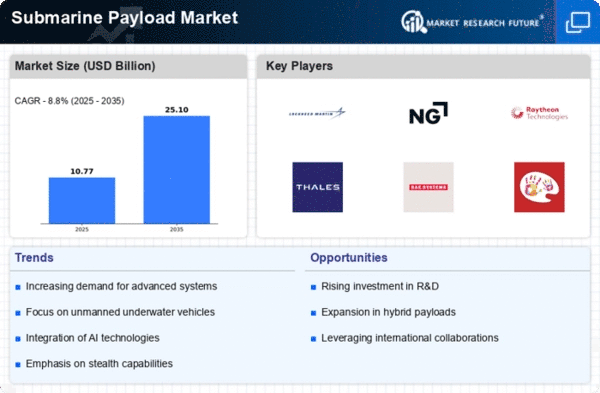
Submarine Payload Market Infographic
Purchase Options

Market Share

Submarine Payload Market Share Analysis

The Submarine Payload market is experiencing several notable trends that underscore the evolution of undersea warfare capabilities and the continuous pursuit of technological advancements. One significant trend is the increasing emphasis on autonomous underwater vehicles (AUVs) as integral components of submarine payloads. AUVs, equipped with advanced sensors and communication systems, are employed for a range of missions, including reconnaissance, surveillance, and mine countermeasures. The trend towards integrating sophisticated AUVs into submarine payloads reflects the broader shift towards unmanned systems, enhancing the versatility and operational reach of submarines.

Advancements in sensor technologies represent a key trend in the Submarine Payload market. The demand for high-performance sensors, such as advanced sonar systems and electro-optical sensors, is growing as navies seek to enhance the detection capabilities of submarines. These sensors contribute to improved situational awareness, enabling submarines to operate more effectively in diverse and challenging undersea environments. The trend towards sensor innovation aligns with the overarching goal of achieving superiority in undersea warfare.

The integration of artificial intelligence (AI) and machine learning (ML) capabilities is another prominent trend in the Submarine Payload market. As the volume of sensor data collected by submarines increases, AI and ML algorithms are employed to analyze and interpret this information rapidly. This trend enhances the submarines' ability to process complex data sets, make real-time decisions, and optimize mission outcomes. The incorporation of smart technologies into submarine payloads reflects a broader trend in defense applications towards leveraging the power of AI for enhanced operational effectiveness.

The trend towards modular and adaptable submarine payloads is gaining prominence. Navies are seeking payload systems that can be easily reconfigured to accommodate diverse mission requirements. Modular payloads allow for flexibility, enabling submarines to carry different types of sensors, munitions, or unmanned systems based on the specific demands of a mission. This trend aligns with the need for submarines to fulfill a range of roles, from intelligence gathering to anti-submarine warfare, within a single operational deployment.

The development of multi-mission submarine payloads is becoming a prevalent trend. Rather than focusing on specialized payloads for specific roles, manufacturers are designing systems that can perform a variety of missions. Multi-mission payloads enhance the submarines' versatility, allowing them to adapt to dynamic operational scenarios. This trend aligns with the evolving nature of naval operations, where submarines are expected to address a spectrum of threats and challenges.

Underwater communication technologies are experiencing a notable trend in the Submarine Payload market. With the increasing need for submarines to operate collaboratively and share critical information in real-time, advanced underwater communication systems are being integrated into submarine payloads. This trend facilitates improved coordination among submarines, surface vessels, and other elements of naval forces, enhancing the overall effectiveness of undersea operations.

The trend towards enhanced stealth and survivability features in submarine payloads is a critical aspect of market developments. As anti-submarine warfare capabilities advance, submarines are incorporating stealth technologies to reduce their acoustic signatures and increase their survivability. Submarine payloads are designed with features that mitigate the risk of detection, contributing to the overall trend of enhancing the stealth characteristics of undersea platforms.

The Submarine Payload market is witnessing a trend towards international collaborations and partnerships. As the development of advanced submarine payloads requires substantial investment and expertise, nations are increasingly engaging in joint ventures and collaborative efforts. International partnerships facilitate the sharing of technological know-how, research and development resources, and the creation of interoperable systems that can be employed by allied navies. This collaborative trend reflects a recognition of the shared challenges and opportunities in undersea warfare.

The trend towards eco-friendly and sustainable technologies is emerging in the Submarine Payload market. Manufacturers are exploring environmentally conscious materials and manufacturing processes to align with global efforts towards sustainability. This trend reflects an awareness of the environmental impact of defense technologies and a commitment to developing submarine payloads that minimize ecological consequences.

Author
Author Profile
Shubham Munde
Team Lead - Research

Shubham brings over 7 years of expertise in Market Intelligence and Strategic Consulting, with a strong focus on the Automotive, Aerospace, and Defense sectors. Backed by a solid foundation in semiconductors, electronics, and software, he has successfully delivered high-impact syndicated and custom research on a global scale. His core strengths include market sizing, forecasting, competitive intelligence, consumer insights, and supply chain mapping. Widely recognized for developing scalable growth strategies, Shubham empowers clients to navigate complex markets and achieve a lasting competitive edge. Trusted by start-ups and Fortune 500 companies alike, he consistently converts challenges into strategic opportunities that drive sustainable growth.

Leave a Comment

FAQs

What is the projected market valuation of the Submarine Payload Market by 2035?

<p>The Submarine Payload Market is projected to reach a valuation of 25.1 USD Billion by 2035.</p>

What was the market valuation of the Submarine Payload Market in 2024?

In 2024, the Submarine Payload Market was valued at 9.9 USD Billion.

What is the expected CAGR for the Submarine Payload Market during the forecast period 2025 - 2035?

The expected CAGR for the Submarine Payload Market during the forecast period 2025 - 2035 is 8.8%.

Which application segment is projected to have the highest valuation by 2035?

The Payload Delivery application segment is projected to reach 8.1 USD Billion by 2035.

What are the key players in the Submarine Payload Market?

Key players in the Submarine Payload Market include Lockheed Martin, Northrop Grumman, Raytheon Technologies, and Thales Group.

How does the Military end-use segment compare to others in terms of valuation?

The Military end-use segment is projected to reach 8.5 USD Billion by 2035, making it the highest among all end-use categories.

What is the projected valuation for the Anti-Submarine Warfare application segment by 2035?

The Anti-Submarine Warfare application segment is projected to reach 6.0 USD Billion by 2035.

Which payload type is expected to have the highest growth in the Submarine Payload Market?

The Weapons payload type is expected to grow significantly, reaching 8.0 USD Billion by 2035.

What is the projected valuation for the Environmental Monitoring end-use segment by 2035?

The Environmental Monitoring end-use segment is projected to reach 2.5 USD Billion by 2035.

How does the projected growth of the Submarine Payload Market reflect on its strategic importance?

The projected growth to 25.1 USD Billion by 2035 indicates the strategic importance of submarine payloads in defense and research applications.

Market Summary

As per MRFR analysis, the Submarine Payload Market Size was estimated at 9.9 USD Billion in 2024. The Submarine Payload industry is projected to grow from 10.8 USD Billion in 2025 to 25.1 USD Billion by 2035, exhibiting a compound annual growth rate (CAGR) of 8.8% during the forecast period 2025 - 2035.

Key Market Trends & Highlights

The Submarine Payload Market is poised for substantial growth driven by technological advancements and increasing geopolitical tensions.

  • Technological advancements are reshaping the capabilities of submarine payload systems, enhancing operational effectiveness.
  • North America remains the largest market, while the Asia-Pacific region is emerging as the fastest-growing area for submarine payloads.
  • The surveillance segment dominates the market, whereas the anti-submarine warfare segment is experiencing rapid growth.
  • Rising defense budgets and a heightened focus on maritime security are key drivers propelling market expansion.

Market Size & Forecast

2024 Market Size 9.9 (USD Billion)
2035 Market Size 25.1 (USD Billion)
CAGR (2025 - 2035) 8.8%
Largest Regional Market Share in 2024 North America

Major Players

Lockheed Martin (US), Northrop Grumman (US), Raytheon Technologies (US), Thales Group (FR), BAE Systems (GB), Leonardo (IT), General Dynamics (US), Kongsberg Gruppen (NO), Saab AB (SE)

Market Trends

defense

Submarine Payload Market Market Drivers

Market Growth Projections

The Global Submarine Payload Market Industry is projected to experience substantial growth over the next decade. With an estimated market value of 3.78 USD Billion in 2024, the industry is expected to reach approximately 6.06 USD Billion by 2035. This growth trajectory indicates a compound annual growth rate (CAGR) of 4.38% from 2025 to 2035. The increasing focus on advanced submarine capabilities, coupled with rising defense budgets and geopolitical tensions, is likely to sustain this upward trend. As nations continue to invest in their naval forces, the demand for innovative submarine payload solutions will remain a key driver of market expansion.

Increasing Defense Budgets

The Global Submarine Payload Market Industry is experiencing growth driven by rising defense budgets across various nations. Countries are prioritizing naval capabilities, leading to increased investments in submarine technology and payload systems. For instance, nations like the United States and China are significantly enhancing their naval fleets, which includes advanced submarines equipped with sophisticated payloads. This trend is expected to contribute to the market's expansion, with projections indicating a market value of 3.78 USD Billion in 2024. As defense budgets continue to rise, the demand for advanced submarine payloads is likely to increase, further propelling the market forward.

Growing Demand for ISR Capabilities

The demand for Intelligence, Surveillance, and Reconnaissance (ISR) capabilities is driving the Global Submarine Payload Market Industry. Submarines equipped with advanced ISR payloads are essential for gathering critical intelligence in contested environments. The ability to operate undetected while collecting data provides a strategic advantage in military operations. Countries are increasingly recognizing the importance of ISR capabilities, leading to investments in submarine payload systems that enhance these functionalities. As the need for effective ISR solutions grows, the market is expected to expand, reflecting the evolving nature of modern warfare and the strategic importance of submarines.

Emerging Markets and Naval Expansion

Emerging markets are contributing to the growth of the Global Submarine Payload Market Industry. Nations in Asia, the Middle East, and Africa are expanding their naval capabilities, often through the acquisition of submarines and associated payload systems. For instance, countries like India and Brazil are investing in submarine programs to enhance their maritime security and deterrence capabilities. This trend is likely to create new opportunities for manufacturers and suppliers in the submarine payload sector. As these emerging markets continue to develop their naval forces, the demand for advanced submarine payloads is expected to rise, further driving market growth.

Geopolitical Tensions and Maritime Security

Geopolitical tensions are a significant driver of the Global Submarine Payload Market Industry. As nations face increasing threats from rival states and non-state actors, the need for enhanced maritime security becomes paramount. Submarines, equipped with advanced payloads, serve as a deterrent and a strategic asset in maintaining national security. For instance, the South China Sea disputes have prompted countries in the region to bolster their naval capabilities, including submarine fleets. This heightened focus on maritime security is likely to sustain demand for submarine payloads, contributing to the market's growth trajectory in the coming years.

Technological Advancements in Payload Systems

Technological advancements play a crucial role in shaping the Global Submarine Payload Market Industry. Innovations in sensor technology, weapon systems, and communication capabilities are enhancing the effectiveness of submarine payloads. For example, the integration of unmanned underwater vehicles (UUVs) and advanced torpedoes is revolutionizing submarine operations. These advancements not only improve operational efficiency but also increase the strategic value of submarines in modern warfare. As these technologies continue to evolve, the market is projected to grow, with an anticipated value of 6.06 USD Billion by 2035, indicating a robust CAGR of 4.38% from 2025 to 2035.

Market Segment Insights

By Application: Surveillance (Largest) vs. Anti-Submarine Warfare (Fastest-Growing)

In the Submarine Payload Market, the largest segment is Surveillance, which holds a significant market share due to its essential role in maritime security and intelligence gathering. This segment benefits from advancements in technology, enabling more sophisticated payload systems that enhance the effectiveness of submarines. Following closely is Anti-Submarine Warfare, which is rapidly gaining traction as military forces focus on countering emerging underwater threats. As nations prioritize naval capabilities, this sector is vital for maintaining strategic advantages.

Surveillance (Dominant) vs. Reconnaissance (Emerging)

Surveillance is positioned as the dominant application within the Submarine Payload Market, offering critical capabilities such as real-time data collection and analysis for naval operations. Its established role in intelligence and maritime security ensures consistent demand, driving innovation in sensor technologies and data processing systems. Conversely, Reconnaissance is an emerging segment that is gaining importance as military strategies evolve. Equipped with advanced imaging and reconnaissance tools, submarines are increasingly tasked with covert operations and detailed reconnaissance missions, reflecting a shift towards multi-role capabilities in undersea warfare. Both applications showcase a blend of technological advancements and strategic importance in modern naval engagements.

By Payload Type: Sensors (Largest) vs. Weapons (Fastest-Growing)

<p>The Submarine Payload Market is primarily dominated by the Sensors segment, which accounts for the largest share of the overall market. This segment includes various types of sensors used for surveillance, detection, and reconnaissance. Following closely is the Weapons segment, which has seen significant interest and development over the years, reflecting a crucial aspect of modern naval warfare. Other segments, such as Communication Systems, Electronic Warfare Systems, and Support Equipment, also contribute to the market but remain smaller in comparison to these two.</p>

<p>Sensors (Dominant) vs. Weapons (Emerging)</p>

<p>The Sensors segment plays a dominant role in the Submarine Payload Market due to its critical role in enhancing situational awareness and operational effectiveness. This category includes sonar systems, imaging sensors, and other advanced technological components. In contrast, the Weapons segment is emerging rapidly, driven by innovations in missile technology and torpedoes designed for stealth and efficiency. While Sensors continue to provide a baseline for underwater capabilities, the evolution of the Weapons segment is fueled by geopolitical tensions and the need for advanced offensive capabilities, positioning it as a key driver of future market growth.</p>

By End Use: Military (Largest) vs. Research (Fastest-Growing)

In the Submarine Payload Market, the distribution among the various end-use segments is quite distinct. The military sector holds the largest share, driven by global defense budgets and increasing military spendings. This segment is crucial, as submarines equipped with advanced payloads enhance naval capabilities and strategic deterrence. On the other hand, the research segment, while smaller, is identified as the fastest-growing due to a surge in underwater exploration activities and environmental studies, highlighting the need for advanced technology in this realm. The growth trends in the Submarine Payload Market are largely shaped by technological advancements and the evolving nature of threats. The military segment continues to innovate with payloads that enhance surveillance and combat effectiveness. In contrast, the research segment benefits from growing environmental concerns and the pursuit of sustainable oceanographic studies, pushing for more sophisticated payloads that can operate in diverse underwater settings. Furthermore, initiatives for better environmental monitoring and disaster response are propelling commercial and search and rescue applications, presenting new opportunities within the market.

Military (Dominant) vs. Research (Emerging)

The military segment of the Submarine Payload Market is characterized by its dominance, as it encompasses a wide array of payload types designed to support strategic operations and enhance national security. Military payloads include advanced weaponry, surveillance systems, and reconnaissance technology, which are crucial for maintaining tactical advantages in underwater warfare. This segment benefits from substantial governmental investments and technological innovations aimed at improving operational effectiveness. Conversely, the research segment, while emerging, is rapidly gaining traction due to increased focus on deep-sea exploration and marine science. Research payloads are typically designed for environmental monitoring, seismic studies, and scientific data collection, indicating a shift towards greater scientific collaboration and the addressing of climate change impacts. Together, these segments showcase the multifaceted applications of submarine payloads in both defense and research areas.

Get more detailed insights about Submarine Payload Market Research Report - Global Forecast till 2035

Regional Insights

North America : Market Leader in Submarine Payloads

North America continues to lead the Submarine Payload Market, holding a significant share of 5.94 billion in 2024. The region's growth is driven by increasing defense budgets, technological advancements, and a focus on enhancing naval capabilities. Regulatory support for modernization and procurement of advanced systems further fuels demand, ensuring a robust market environment. The United States is the primary player, with key companies like Lockheed Martin, Northrop Grumman, and Raytheon Technologies dominating the landscape. The competitive environment is characterized by innovation and strategic partnerships, ensuring that North America remains at the forefront of submarine payload development. The presence of advanced research facilities and a skilled workforce further strengthens the region's position.

Europe : Emerging Market with Growth Potential

Europe's Submarine Payload Market is valued at 2.45 billion, reflecting a growing emphasis on maritime security and defense capabilities. The region is witnessing increased investments in submarine technology, driven by geopolitical tensions and the need for enhanced naval deterrence. Regulatory frameworks are evolving to support modernization efforts, creating a favorable environment for market growth. Leading countries such as France, the UK, and Germany are at the forefront, with companies like Thales Group and BAE Systems playing pivotal roles. The competitive landscape is marked by collaborations and joint ventures aimed at developing advanced payload systems. As European nations prioritize defense spending, the market is expected to expand, attracting new players and innovations.

Asia-Pacific : Growing Demand for Naval Capabilities

The Asia-Pacific region, with a market size of 1.8 billion, is rapidly emerging as a significant player in the Submarine Payload Market. The growth is driven by increasing defense expenditures, regional tensions, and a focus on enhancing maritime security. Countries are investing in advanced submarine technologies, supported by favorable government policies and international collaborations. Key players in this region include countries like China, India, and Japan, with companies such as Kongsberg Gruppen and Saab AB contributing to the competitive landscape. The market is characterized by a mix of domestic and international players, fostering innovation and technological advancements. As nations prioritize naval capabilities, the demand for sophisticated submarine payloads is expected to rise significantly.

Middle East and Africa : Emerging Market with Strategic Focus

The Middle East and Africa region, valued at 0.71 billion, is gradually developing its Submarine Payload Market, driven by increasing security concerns and the need for enhanced naval capabilities. Governments are recognizing the importance of modernizing their defense infrastructure, leading to strategic investments in submarine technologies. Regulatory initiatives are being introduced to support this growth, creating a conducive environment for market expansion. Countries like South Africa and Egypt are leading the charge, with a focus on acquiring advanced defense systems. The competitive landscape is still evolving, with both local and international players vying for market share. As regional tensions persist, the demand for submarine payloads is expected to grow, attracting investments and fostering technological advancements.

Key Players and Competitive Insights

The Submarine Payload Market is characterized by a dynamic competitive landscape, driven by technological advancements and increasing defense budgets across various nations. Key players such as Lockheed Martin (US), Northrop Grumman (US), and Thales Group (FR) are at the forefront, focusing on innovation and strategic partnerships to enhance their market positions. Lockheed Martin (US) emphasizes the integration of advanced technologies into its payload systems, while Northrop Grumman (US) is known for its robust R&D initiatives aimed at developing next-generation underwater capabilities. Thales Group (FR) leverages its expertise in sensor technology to provide cutting-edge solutions, thereby shaping a competitive environment that prioritizes technological superiority and operational efficiency.In terms of business tactics, companies are increasingly localizing manufacturing to reduce costs and enhance supply chain resilience. The market appears moderately fragmented, with a mix of established players and emerging firms vying for market share. The collective influence of these key players fosters a competitive structure that encourages innovation and collaboration, particularly in areas such as digital transformation and sustainability.

In November Lockheed Martin (US) announced a partnership with a leading technology firm to develop AI-driven payload systems aimed at enhancing operational efficiency and decision-making capabilities. This strategic move underscores Lockheed Martin's commitment to integrating advanced technologies into its offerings, potentially positioning the company as a leader in the next wave of submarine payload innovations. The collaboration is expected to yield significant advancements in autonomous underwater operations, which could redefine operational paradigms in naval warfare.

In October Northrop Grumman (US) secured a contract with the U.S. Navy to supply advanced payload systems for its next-generation submarines. This contract not only reinforces Northrop Grumman's position in the market but also highlights the growing demand for sophisticated underwater capabilities. The strategic importance of this contract lies in its potential to enhance the U.S. Navy's operational readiness and technological edge, thereby influencing the broader competitive landscape.

In September Thales Group (FR) unveiled a new line of underwater sensors designed to improve situational awareness for submarine operations. This launch reflects Thales's strategic focus on innovation and its commitment to providing state-of-the-art solutions that meet the evolving needs of naval forces. The introduction of these sensors is likely to enhance the effectiveness of submarine payloads, thereby contributing to Thales's competitive differentiation in the market.

As of December current trends in the Submarine Payload Market indicate a strong emphasis on digitalization, sustainability, and AI integration. Strategic alliances are increasingly shaping the competitive landscape, as companies recognize the need for collaboration to drive innovation. The shift from price-based competition to a focus on technological advancement and supply chain reliability is evident, suggesting that future competitive differentiation will hinge on the ability to innovate and adapt to changing market demands.

Key Companies in the Submarine Payload Market include

Industry Developments

Lockheed Martin:

    • In October 2023, Lockheed Martin delivered the first production AN/SQQ-89(V)15 advanced combat system (ACS) to the U.S. Navy for integration onto the Virginia-class submarine USS Arkansas (SSN 803). The AN/SQQ-89(V)15 is an integrated sonar and combat management system that provides submarines with enhanced situational awareness and targeting capabilities.

Raytheon Technologies:

    • In December 2023, Raytheon Technologies successfully completed the first land-based test launch of its next-generation Common Missile Defense System (CMDS) interceptor. The CMDS is designed to intercept ballistic missiles in the exoatmospheric phase of flight.

Key Players

The key players in the global submarine payload market are BAE Systems (U.K), General Dynamics (U.S.), Lockheed Martin Corporation (U.S.), Northrop Grumman Corporation (U.S.), DSME Co. Ltd. (South Korea), Raytheon (U.S.), Thales (France), Fincantieri (Italy), Huntington Ingalls Industries (U.S.), and Kawasaki Heavy Industries (Japan).

Research Methodology

The market values and forecasts are derived using MRFR research methodology, which includes secondary research, primary interviews, data triangulation, and validation from an in-house data repository and statistical modeling tools.

    • Secondary Research

In this process, data is collected from various secondary sources, including annual reports, SEC filings, journals, government associations, aerospace & defense magazines, white papers, corporate presentations, company websites, and paid databases.

    • Primary Research

In this process, both the demand- and supply-side parties are interviewed to extract facts and insights into the market forecast, production, trends, and projected market growth. Industry stakeholders such as CEOs, VPs, directors, and marketing executives across the value chain are approached to obtain key information.

Key Insights

    • Market Sizing, Forecast, and Analysis: Detailed coverage of the market segment and sub-segments

    • Regional/Country Trends and Forecast: Detailed analysis of the market in North America, Asia-Pacific, Europe, the Middle East & Africa, and Latin America, along with key countries in each region

    • Market Dynamics Intelligence: Market drivers, opportunities, trends, restraints, Porter’s five forces, supply chain, and value chain analysis

    • Technology Trends, Regulatory Landscape, and Patent Analysis Outlook

    • Competitive Intelligence: Market share analysis, financial analysis, product benchmarking, and strategic developments including joint ventures, product launches, and mergers & acquisitions

    • Regional attractiveness and related growth opportunities

Report Customization

MRFR offers report customization to valued customers. Below are the options available for customization:

    • Company Profiles

In-depth profiling of additional market players (3 to 4 companies)

    • Country-Level Analysis

Detailed analysis of a country-level market and related segments as per the report scope (subject to data availability)

Intended Audience

    • Naval authorities

    • Naval component manufacturers

    • Component providers

    • Regulatory bodies

    • Government authorities

    • Research institutes

    • Regulatory bodies

Future Outlook

Submarine Payload Market Future Outlook

The Submarine Payload Market is projected to grow at an 8.8% CAGR from 2025 to 2035, driven by advancements in technology, increasing defense budgets, and rising maritime security concerns.

New opportunities lie in:

  • Development of advanced autonomous payload systems for enhanced operational efficiency.
  • Integration of AI-driven analytics for real-time threat assessment and decision-making.
  • Expansion of modular payload solutions to cater to diverse mission requirements.

By 2035, the Submarine Payload Market is expected to achieve substantial growth, reflecting evolving defense strategies.

Market Segmentation

Submarine Payload Market End Use Outlook

  • Military
  • Research
  • Commercial
  • Environmental Monitoring
  • Search and Rescue

Submarine Payload Market Application Outlook

  • Surveillance
  • Reconnaissance
  • Anti-Submarine Warfare
  • Mine Countermeasures
  • Special Operations

Submarine Payload Market Payload Type Outlook

  • Weapons
  • Sensors
  • Communication Systems
  • Electronic Warfare Systems
  • Support Equipment

Report Scope

MARKET SIZE 2024 9.9(USD Billion)
MARKET SIZE 2025 10.8(USD Billion)
MARKET SIZE 2035 25.1(USD Billion)
COMPOUND ANNUAL GROWTH RATE (CAGR) 8.8% (2025 - 2035)
REPORT COVERAGE Revenue Forecast, Competitive Landscape, Growth Factors, and Trends
BASE YEAR 2024
Market Forecast Period 2025 - 2035
Historical Data 2019 - 2024
Market Forecast Units USD Billion
Key Companies Profiled Lockheed Martin (US), Northrop Grumman (US), Raytheon Technologies (US), Thales Group (FR), BAE Systems (GB), Leonardo (IT), General Dynamics (US), Kongsberg Gruppen (NO), Saab AB (SE)
Segments Covered Application, Payload Type, End Use
Key Market Opportunities Integration of advanced sensor technologies enhances operational capabilities in the Submarine Payload Market.
Key Market Dynamics Technological advancements drive innovation in submarine payload systems, enhancing operational capabilities and competitive positioning.
Countries Covered North America, Europe, APAC, South America, MEA

FAQs

What is the projected market valuation of the Submarine Payload Market by 2035?

<p>The Submarine Payload Market is projected to reach a valuation of 25.1 USD Billion by 2035.</p>

What was the market valuation of the Submarine Payload Market in 2024?

In 2024, the Submarine Payload Market was valued at 9.9 USD Billion.

What is the expected CAGR for the Submarine Payload Market during the forecast period 2025 - 2035?

The expected CAGR for the Submarine Payload Market during the forecast period 2025 - 2035 is 8.8%.

Which application segment is projected to have the highest valuation by 2035?

The Payload Delivery application segment is projected to reach 8.1 USD Billion by 2035.

What are the key players in the Submarine Payload Market?

Key players in the Submarine Payload Market include Lockheed Martin, Northrop Grumman, Raytheon Technologies, and Thales Group.

How does the Military end-use segment compare to others in terms of valuation?

The Military end-use segment is projected to reach 8.5 USD Billion by 2035, making it the highest among all end-use categories.

What is the projected valuation for the Anti-Submarine Warfare application segment by 2035?

The Anti-Submarine Warfare application segment is projected to reach 6.0 USD Billion by 2035.

Which payload type is expected to have the highest growth in the Submarine Payload Market?

The Weapons payload type is expected to grow significantly, reaching 8.0 USD Billion by 2035.

What is the projected valuation for the Environmental Monitoring end-use segment by 2035?

The Environmental Monitoring end-use segment is projected to reach 2.5 USD Billion by 2035.

How does the projected growth of the Submarine Payload Market reflect on its strategic importance?

The projected growth to 25.1 USD Billion by 2035 indicates the strategic importance of submarine payloads in defense and research applications.

  1. SECTION I: EXECUTIVE SUMMARY AND KEY HIGHLIGHTS
    1. | 1.1 EXECUTIVE SUMMARY
    2. | | 1.1.1 Market Overview
    3. | | 1.1.2 Key Findings
    4. | | 1.1.3 Market Segmentation
    5. | | 1.1.4 Competitive Landscape
    6. | | 1.1.5 Challenges and Opportunities
    7. | | 1.1.6 Future Outlook
  2. SECTION II: SCOPING, METHODOLOGY AND MARKET STRUCTURE
    1. | 2.1 MARKET INTRODUCTION
    2. | | 2.1.1 Definition
    3. | | 2.1.2 Scope of the study
    4. | | | 2.1.2.1 Research Objective
    5. | | | 2.1.2.2 Assumption
    6. | | | 2.1.2.3 Limitations
    7. | 2.2 RESEARCH METHODOLOGY
    8. | | 2.2.1 Overview
    9. | | 2.2.2 Data Mining
    10. | | 2.2.3 Secondary Research
    11. | | 2.2.4 Primary Research
    12. | | | 2.2.4.1 Primary Interviews and Information Gathering Process
    13. | | | 2.2.4.2 Breakdown of Primary Respondents
    14. | | 2.2.5 Forecasting Model
    15. | | 2.2.6 Market Size Estimation
    16. | | | 2.2.6.1 Bottom-Up Approach
    17. | | | 2.2.6.2 Top-Down Approach
    18. | | 2.2.7 Data Triangulation
    19. | | 2.2.8 Validation
  3. SECTION III: QUALITATIVE ANALYSIS
    1. | 3.1 MARKET DYNAMICS
    2. | | 3.1.1 Overview
    3. | | 3.1.2 Drivers
    4. | | 3.1.3 Restraints
    5. | | 3.1.4 Opportunities
    6. | 3.2 MARKET FACTOR ANALYSIS
    7. | | 3.2.1 Value chain Analysis
    8. | | 3.2.2 Porter's Five Forces Analysis
    9. | | | 3.2.2.1 Bargaining Power of Suppliers
    10. | | | 3.2.2.2 Bargaining Power of Buyers
    11. | | | 3.2.2.3 Threat of New Entrants
    12. | | | 3.2.2.4 Threat of Substitutes
    13. | | | 3.2.2.5 Intensity of Rivalry
    14. | | 3.2.3 COVID-19 Impact Analysis
    15. | | | 3.2.3.1 Market Impact Analysis
    16. | | | 3.2.3.2 Regional Impact
    17. | | | 3.2.3.3 Opportunity and Threat Analysis
  4. SECTION IV: QUANTITATIVE ANALYSIS
    1. | 4.1 Aerospace & Defense, BY Application (USD Billion)
    2. | | 4.1.1 Surveillance
    3. | | 4.1.2 Reconnaissance
    4. | | 4.1.3 Mine Countermeasures
    5. | | 4.1.4 Anti-Submarine Warfare
    6. | | 4.1.5 Payload Delivery
    7. | 4.2 Aerospace & Defense, BY Payload Type (USD Billion)
    8. | | 4.2.1 Sensors
    9. | | 4.2.2 Weapons
    10. | | 4.2.3 Communication Systems
    11. | | 4.2.4 Electronic Warfare Systems
    12. | | 4.2.5 Support Equipment
    13. | 4.3 Aerospace & Defense, BY End Use (USD Billion)
    14. | | 4.3.1 Military
    15. | | 4.3.2 Research
    16. | | 4.3.3 Commercial
    17. | | 4.3.4 Environmental Monitoring
    18. | | 4.3.5 Search and Rescue
    19. | 4.4 Aerospace & Defense, BY Region (USD Billion)
    20. | | 4.4.1 North America
    21. | | | 4.4.1.1 US
    22. | | | 4.4.1.2 Canada
    23. | | 4.4.2 Europe
    24. | | | 4.4.2.1 Germany
    25. | | | 4.4.2.2 UK
    26. | | | 4.4.2.3 France
    27. | | | 4.4.2.4 Russia
    28. | | | 4.4.2.5 Italy
    29. | | | 4.4.2.6 Spain
    30. | | | 4.4.2.7 Rest of Europe
    31. | | 4.4.3 APAC
    32. | | | 4.4.3.1 China
    33. | | | 4.4.3.2 India
    34. | | | 4.4.3.3 Japan
    35. | | | 4.4.3.4 South Korea
    36. | | | 4.4.3.5 Malaysia
    37. | | | 4.4.3.6 Thailand
    38. | | | 4.4.3.7 Indonesia
    39. | | | 4.4.3.8 Rest of APAC
    40. | | 4.4.4 South America
    41. | | | 4.4.4.1 Brazil
    42. | | | 4.4.4.2 Mexico
    43. | | | 4.4.4.3 Argentina
    44. | | | 4.4.4.4 Rest of South America
    45. | | 4.4.5 MEA
    46. | | | 4.4.5.1 GCC Countries
    47. | | | 4.4.5.2 South Africa
    48. | | | 4.4.5.3 Rest of MEA
  5. SECTION V: COMPETITIVE ANALYSIS
    1. | 5.1 Competitive Landscape
    2. | | 5.1.1 Overview
    3. | | 5.1.2 Competitive Analysis
    4. | | 5.1.3 Market share Analysis
    5. | | 5.1.4 Major Growth Strategy in the Aerospace & Defense
    6. | | 5.1.5 Competitive Benchmarking
    7. | | 5.1.6 Leading Players in Terms of Number of Developments in the Aerospace & Defense
    8. | | 5.1.7 Key developments and growth strategies
    9. | | | 5.1.7.1 New Product Launch/Service Deployment
    10. | | | 5.1.7.2 Merger & Acquisitions
    11. | | | 5.1.7.3 Joint Ventures
    12. | | 5.1.8 Major Players Financial Matrix
    13. | | | 5.1.8.1 Sales and Operating Income
    14. | | | 5.1.8.2 Major Players R&D Expenditure. 2023
    15. | 5.2 Company Profiles
    16. | | 5.2.1 Lockheed Martin (US)
    17. | | | 5.2.1.1 Financial Overview
    18. | | | 5.2.1.2 Products Offered
    19. | | | 5.2.1.3 Key Developments
    20. | | | 5.2.1.4 SWOT Analysis
    21. | | | 5.2.1.5 Key Strategies
    22. | | 5.2.2 Northrop Grumman (US)
    23. | | | 5.2.2.1 Financial Overview
    24. | | | 5.2.2.2 Products Offered
    25. | | | 5.2.2.3 Key Developments
    26. | | | 5.2.2.4 SWOT Analysis
    27. | | | 5.2.2.5 Key Strategies
    28. | | 5.2.3 Raytheon Technologies (US)
    29. | | | 5.2.3.1 Financial Overview
    30. | | | 5.2.3.2 Products Offered
    31. | | | 5.2.3.3 Key Developments
    32. | | | 5.2.3.4 SWOT Analysis
    33. | | | 5.2.3.5 Key Strategies
    34. | | 5.2.4 Thales Group (FR)
    35. | | | 5.2.4.1 Financial Overview
    36. | | | 5.2.4.2 Products Offered
    37. | | | 5.2.4.3 Key Developments
    38. | | | 5.2.4.4 SWOT Analysis
    39. | | | 5.2.4.5 Key Strategies
    40. | | 5.2.5 BAE Systems (GB)
    41. | | | 5.2.5.1 Financial Overview
    42. | | | 5.2.5.2 Products Offered
    43. | | | 5.2.5.3 Key Developments
    44. | | | 5.2.5.4 SWOT Analysis
    45. | | | 5.2.5.5 Key Strategies
    46. | | 5.2.6 Leonardo (IT)
    47. | | | 5.2.6.1 Financial Overview
    48. | | | 5.2.6.2 Products Offered
    49. | | | 5.2.6.3 Key Developments
    50. | | | 5.2.6.4 SWOT Analysis
    51. | | | 5.2.6.5 Key Strategies
    52. | | 5.2.7 General Dynamics (US)
    53. | | | 5.2.7.1 Financial Overview
    54. | | | 5.2.7.2 Products Offered
    55. | | | 5.2.7.3 Key Developments
    56. | | | 5.2.7.4 SWOT Analysis
    57. | | | 5.2.7.5 Key Strategies
    58. | | 5.2.8 Kongsberg Gruppen (NO)
    59. | | | 5.2.8.1 Financial Overview
    60. | | | 5.2.8.2 Products Offered
    61. | | | 5.2.8.3 Key Developments
    62. | | | 5.2.8.4 SWOT Analysis
    63. | | | 5.2.8.5 Key Strategies
    64. | | 5.2.9 Saab AB (SE)
    65. | | | 5.2.9.1 Financial Overview
    66. | | | 5.2.9.2 Products Offered
    67. | | | 5.2.9.3 Key Developments
    68. | | | 5.2.9.4 SWOT Analysis
    69. | | | 5.2.9.5 Key Strategies
    70. | 5.3 Appendix
    71. | | 5.3.1 References
    72. | | 5.3.2 Related Reports
  6. LIST OF FIGURES
    1. | 6.1 MARKET SYNOPSIS
    2. | 6.2 NORTH AMERICA MARKET ANALYSIS
    3. | 6.3 US MARKET ANALYSIS BY APPLICATION
    4. | 6.4 US MARKET ANALYSIS BY PAYLOAD TYPE
    5. | 6.5 US MARKET ANALYSIS BY END USE
    6. | 6.6 CANADA MARKET ANALYSIS BY APPLICATION
    7. | 6.7 CANADA MARKET ANALYSIS BY PAYLOAD TYPE
    8. | 6.8 CANADA MARKET ANALYSIS BY END USE
    9. | 6.9 EUROPE MARKET ANALYSIS
    10. | 6.10 GERMANY MARKET ANALYSIS BY APPLICATION
    11. | 6.11 GERMANY MARKET ANALYSIS BY PAYLOAD TYPE
    12. | 6.12 GERMANY MARKET ANALYSIS BY END USE
    13. | 6.13 UK MARKET ANALYSIS BY APPLICATION
    14. | 6.14 UK MARKET ANALYSIS BY PAYLOAD TYPE
    15. | 6.15 UK MARKET ANALYSIS BY END USE
    16. | 6.16 FRANCE MARKET ANALYSIS BY APPLICATION
    17. | 6.17 FRANCE MARKET ANALYSIS BY PAYLOAD TYPE
    18. | 6.18 FRANCE MARKET ANALYSIS BY END USE
    19. | 6.19 RUSSIA MARKET ANALYSIS BY APPLICATION
    20. | 6.20 RUSSIA MARKET ANALYSIS BY PAYLOAD TYPE
    21. | 6.21 RUSSIA MARKET ANALYSIS BY END USE
    22. | 6.22 ITALY MARKET ANALYSIS BY APPLICATION
    23. | 6.23 ITALY MARKET ANALYSIS BY PAYLOAD TYPE
    24. | 6.24 ITALY MARKET ANALYSIS BY END USE
    25. | 6.25 SPAIN MARKET ANALYSIS BY APPLICATION
    26. | 6.26 SPAIN MARKET ANALYSIS BY PAYLOAD TYPE
    27. | 6.27 SPAIN MARKET ANALYSIS BY END USE
    28. | 6.28 REST OF EUROPE MARKET ANALYSIS BY APPLICATION
    29. | 6.29 REST OF EUROPE MARKET ANALYSIS BY PAYLOAD TYPE
    30. | 6.30 REST OF EUROPE MARKET ANALYSIS BY END USE
    31. | 6.31 APAC MARKET ANALYSIS
    32. | 6.32 CHINA MARKET ANALYSIS BY APPLICATION
    33. | 6.33 CHINA MARKET ANALYSIS BY PAYLOAD TYPE
    34. | 6.34 CHINA MARKET ANALYSIS BY END USE
    35. | 6.35 INDIA MARKET ANALYSIS BY APPLICATION
    36. | 6.36 INDIA MARKET ANALYSIS BY PAYLOAD TYPE
    37. | 6.37 INDIA MARKET ANALYSIS BY END USE
    38. | 6.38 JAPAN MARKET ANALYSIS BY APPLICATION
    39. | 6.39 JAPAN MARKET ANALYSIS BY PAYLOAD TYPE
    40. | 6.40 JAPAN MARKET ANALYSIS BY END USE
    41. | 6.41 SOUTH KOREA MARKET ANALYSIS BY APPLICATION
    42. | 6.42 SOUTH KOREA MARKET ANALYSIS BY PAYLOAD TYPE
    43. | 6.43 SOUTH KOREA MARKET ANALYSIS BY END USE
    44. | 6.44 MALAYSIA MARKET ANALYSIS BY APPLICATION
    45. | 6.45 MALAYSIA MARKET ANALYSIS BY PAYLOAD TYPE
    46. | 6.46 MALAYSIA MARKET ANALYSIS BY END USE
    47. | 6.47 THAILAND MARKET ANALYSIS BY APPLICATION
    48. | 6.48 THAILAND MARKET ANALYSIS BY PAYLOAD TYPE
    49. | 6.49 THAILAND MARKET ANALYSIS BY END USE
    50. | 6.50 INDONESIA MARKET ANALYSIS BY APPLICATION
    51. | 6.51 INDONESIA MARKET ANALYSIS BY PAYLOAD TYPE
    52. | 6.52 INDONESIA MARKET ANALYSIS BY END USE
    53. | 6.53 REST OF APAC MARKET ANALYSIS BY APPLICATION
    54. | 6.54 REST OF APAC MARKET ANALYSIS BY PAYLOAD TYPE
    55. | 6.55 REST OF APAC MARKET ANALYSIS BY END USE
    56. | 6.56 SOUTH AMERICA MARKET ANALYSIS
    57. | 6.57 BRAZIL MARKET ANALYSIS BY APPLICATION
    58. | 6.58 BRAZIL MARKET ANALYSIS BY PAYLOAD TYPE
    59. | 6.59 BRAZIL MARKET ANALYSIS BY END USE
    60. | 6.60 MEXICO MARKET ANALYSIS BY APPLICATION
    61. | 6.61 MEXICO MARKET ANALYSIS BY PAYLOAD TYPE
    62. | 6.62 MEXICO MARKET ANALYSIS BY END USE
    63. | 6.63 ARGENTINA MARKET ANALYSIS BY APPLICATION
    64. | 6.64 ARGENTINA MARKET ANALYSIS BY PAYLOAD TYPE
    65. | 6.65 ARGENTINA MARKET ANALYSIS BY END USE
    66. | 6.66 REST OF SOUTH AMERICA MARKET ANALYSIS BY APPLICATION
    67. | 6.67 REST OF SOUTH AMERICA MARKET ANALYSIS BY PAYLOAD TYPE
    68. | 6.68 REST OF SOUTH AMERICA MARKET ANALYSIS BY END USE
    69. | 6.69 MEA MARKET ANALYSIS
    70. | 6.70 GCC COUNTRIES MARKET ANALYSIS BY APPLICATION
    71. | 6.71 GCC COUNTRIES MARKET ANALYSIS BY PAYLOAD TYPE
    72. | 6.72 GCC COUNTRIES MARKET ANALYSIS BY END USE
    73. | 6.73 SOUTH AFRICA MARKET ANALYSIS BY APPLICATION
    74. | 6.74 SOUTH AFRICA MARKET ANALYSIS BY PAYLOAD TYPE
    75. | 6.75 SOUTH AFRICA MARKET ANALYSIS BY END USE
    76. | 6.76 REST OF MEA MARKET ANALYSIS BY APPLICATION
    77. | 6.77 REST OF MEA MARKET ANALYSIS BY PAYLOAD TYPE
    78. | 6.78 REST OF MEA MARKET ANALYSIS BY END USE
    79. | 6.79 KEY BUYING CRITERIA OF AEROSPACE & DEFENSE
    80. | 6.80 RESEARCH PROCESS OF MRFR
    81. | 6.81 DRO ANALYSIS OF AEROSPACE & DEFENSE
    82. | 6.82 DRIVERS IMPACT ANALYSIS: AEROSPACE & DEFENSE
    83. | 6.83 RESTRAINTS IMPACT ANALYSIS: AEROSPACE & DEFENSE
    84. | 6.84 SUPPLY / VALUE CHAIN: AEROSPACE & DEFENSE
    85. | 6.85 AEROSPACE & DEFENSE, BY APPLICATION, 2024 (% SHARE)
    86. | 6.86 AEROSPACE & DEFENSE, BY APPLICATION, 2024 TO 2035 (USD Billion)
    87. | 6.87 AEROSPACE & DEFENSE, BY PAYLOAD TYPE, 2024 (% SHARE)
    88. | 6.88 AEROSPACE & DEFENSE, BY PAYLOAD TYPE, 2024 TO 2035 (USD Billion)
    89. | 6.89 AEROSPACE & DEFENSE, BY END USE, 2024 (% SHARE)
    90. | 6.90 AEROSPACE & DEFENSE, BY END USE, 2024 TO 2035 (USD Billion)
    91. | 6.91 BENCHMARKING OF MAJOR COMPETITORS
  7. LIST OF TABLES
    1. | 7.1 LIST OF ASSUMPTIONS
    2. | | 7.1.1
    3. | 7.2 North America MARKET SIZE ESTIMATES; FORECAST
    4. | | 7.2.1 BY APPLICATION, 2025-2035 (USD Billion)
    5. | | 7.2.2 BY PAYLOAD TYPE, 2025-2035 (USD Billion)
    6. | | 7.2.3 BY END USE, 2025-2035 (USD Billion)
    7. | 7.3 US MARKET SIZE ESTIMATES; FORECAST
    8. | | 7.3.1 BY APPLICATION, 2025-2035 (USD Billion)
    9. | | 7.3.2 BY PAYLOAD TYPE, 2025-2035 (USD Billion)
    10. | | 7.3.3 BY END USE, 2025-2035 (USD Billion)
    11. | 7.4 Canada MARKET SIZE ESTIMATES; FORECAST
    12. | | 7.4.1 BY APPLICATION, 2025-2035 (USD Billion)
    13. | | 7.4.2 BY PAYLOAD TYPE, 2025-2035 (USD Billion)
    14. | | 7.4.3 BY END USE, 2025-2035 (USD Billion)
    15. | 7.5 Europe MARKET SIZE ESTIMATES; FORECAST
    16. | | 7.5.1 BY APPLICATION, 2025-2035 (USD Billion)
    17. | | 7.5.2 BY PAYLOAD TYPE, 2025-2035 (USD Billion)
    18. | | 7.5.3 BY END USE, 2025-2035 (USD Billion)
    19. | 7.6 Germany MARKET SIZE ESTIMATES; FORECAST
    20. | | 7.6.1 BY APPLICATION, 2025-2035 (USD Billion)
    21. | | 7.6.2 BY PAYLOAD TYPE, 2025-2035 (USD Billion)
    22. | | 7.6.3 BY END USE, 2025-2035 (USD Billion)
    23. | 7.7 UK MARKET SIZE ESTIMATES; FORECAST
    24. | | 7.7.1 BY APPLICATION, 2025-2035 (USD Billion)
    25. | | 7.7.2 BY PAYLOAD TYPE, 2025-2035 (USD Billion)
    26. | | 7.7.3 BY END USE, 2025-2035 (USD Billion)
    27. | 7.8 France MARKET SIZE ESTIMATES; FORECAST
    28. | | 7.8.1 BY APPLICATION, 2025-2035 (USD Billion)
    29. | | 7.8.2 BY PAYLOAD TYPE, 2025-2035 (USD Billion)
    30. | | 7.8.3 BY END USE, 2025-2035 (USD Billion)
    31. | 7.9 Russia MARKET SIZE ESTIMATES; FORECAST
    32. | | 7.9.1 BY APPLICATION, 2025-2035 (USD Billion)
    33. | | 7.9.2 BY PAYLOAD TYPE, 2025-2035 (USD Billion)
    34. | | 7.9.3 BY END USE, 2025-2035 (USD Billion)
    35. | 7.10 Italy MARKET SIZE ESTIMATES; FORECAST
    36. | | 7.10.1 BY APPLICATION, 2025-2035 (USD Billion)
    37. | | 7.10.2 BY PAYLOAD TYPE, 2025-2035 (USD Billion)
    38. | | 7.10.3 BY END USE, 2025-2035 (USD Billion)
    39. | 7.11 Spain MARKET SIZE ESTIMATES; FORECAST
    40. | | 7.11.1 BY APPLICATION, 2025-2035 (USD Billion)
    41. | | 7.11.2 BY PAYLOAD TYPE, 2025-2035 (USD Billion)
    42. | | 7.11.3 BY END USE, 2025-2035 (USD Billion)
    43. | 7.12 Rest of Europe MARKET SIZE ESTIMATES; FORECAST
    44. | | 7.12.1 BY APPLICATION, 2025-2035 (USD Billion)
    45. | | 7.12.2 BY PAYLOAD TYPE, 2025-2035 (USD Billion)
    46. | | 7.12.3 BY END USE, 2025-2035 (USD Billion)
    47. | 7.13 APAC MARKET SIZE ESTIMATES; FORECAST
    48. | | 7.13.1 BY APPLICATION, 2025-2035 (USD Billion)
    49. | | 7.13.2 BY PAYLOAD TYPE, 2025-2035 (USD Billion)
    50. | | 7.13.3 BY END USE, 2025-2035 (USD Billion)
    51. | 7.14 China MARKET SIZE ESTIMATES; FORECAST
    52. | | 7.14.1 BY APPLICATION, 2025-2035 (USD Billion)
    53. | | 7.14.2 BY PAYLOAD TYPE, 2025-2035 (USD Billion)
    54. | | 7.14.3 BY END USE, 2025-2035 (USD Billion)
    55. | 7.15 India MARKET SIZE ESTIMATES; FORECAST
    56. | | 7.15.1 BY APPLICATION, 2025-2035 (USD Billion)
    57. | | 7.15.2 BY PAYLOAD TYPE, 2025-2035 (USD Billion)
    58. | | 7.15.3 BY END USE, 2025-2035 (USD Billion)
    59. | 7.16 Japan MARKET SIZE ESTIMATES; FORECAST
    60. | | 7.16.1 BY APPLICATION, 2025-2035 (USD Billion)
    61. | | 7.16.2 BY PAYLOAD TYPE, 2025-2035 (USD Billion)
    62. | | 7.16.3 BY END USE, 2025-2035 (USD Billion)
    63. | 7.17 South Korea MARKET SIZE ESTIMATES; FORECAST
    64. | | 7.17.1 BY APPLICATION, 2025-2035 (USD Billion)
    65. | | 7.17.2 BY PAYLOAD TYPE, 2025-2035 (USD Billion)
    66. | | 7.17.3 BY END USE, 2025-2035 (USD Billion)
    67. | 7.18 Malaysia MARKET SIZE ESTIMATES; FORECAST
    68. | | 7.18.1 BY APPLICATION, 2025-2035 (USD Billion)
    69. | | 7.18.2 BY PAYLOAD TYPE, 2025-2035 (USD Billion)
    70. | | 7.18.3 BY END USE, 2025-2035 (USD Billion)
    71. | 7.19 Thailand MARKET SIZE ESTIMATES; FORECAST
    72. | | 7.19.1 BY APPLICATION, 2025-2035 (USD Billion)
    73. | | 7.19.2 BY PAYLOAD TYPE, 2025-2035 (USD Billion)
    74. | | 7.19.3 BY END USE, 2025-2035 (USD Billion)
    75. | 7.20 Indonesia MARKET SIZE ESTIMATES; FORECAST
    76. | | 7.20.1 BY APPLICATION, 2025-2035 (USD Billion)
    77. | | 7.20.2 BY PAYLOAD TYPE, 2025-2035 (USD Billion)
    78. | | 7.20.3 BY END USE, 2025-2035 (USD Billion)
    79. | 7.21 Rest of APAC MARKET SIZE ESTIMATES; FORECAST
    80. | | 7.21.1 BY APPLICATION, 2025-2035 (USD Billion)
    81. | | 7.21.2 BY PAYLOAD TYPE, 2025-2035 (USD Billion)
    82. | | 7.21.3 BY END USE, 2025-2035 (USD Billion)
    83. | 7.22 South America MARKET SIZE ESTIMATES; FORECAST
    84. | | 7.22.1 BY APPLICATION, 2025-2035 (USD Billion)
    85. | | 7.22.2 BY PAYLOAD TYPE, 2025-2035 (USD Billion)
    86. | | 7.22.3 BY END USE, 2025-2035 (USD Billion)
    87. | 7.23 Brazil MARKET SIZE ESTIMATES; FORECAST
    88. | | 7.23.1 BY APPLICATION, 2025-2035 (USD Billion)
    89. | | 7.23.2 BY PAYLOAD TYPE, 2025-2035 (USD Billion)
    90. | | 7.23.3 BY END USE, 2025-2035 (USD Billion)
    91. | 7.24 Mexico MARKET SIZE ESTIMATES; FORECAST
    92. | | 7.24.1 BY APPLICATION, 2025-2035 (USD Billion)
    93. | | 7.24.2 BY PAYLOAD TYPE, 2025-2035 (USD Billion)
    94. | | 7.24.3 BY END USE, 2025-2035 (USD Billion)
    95. | 7.25 Argentina MARKET SIZE ESTIMATES; FORECAST
    96. | | 7.25.1 BY APPLICATION, 2025-2035 (USD Billion)
    97. | | 7.25.2 BY PAYLOAD TYPE, 2025-2035 (USD Billion)
    98. | | 7.25.3 BY END USE, 2025-2035 (USD Billion)
    99. | 7.26 Rest of South America MARKET SIZE ESTIMATES; FORECAST
    100. | | 7.26.1 BY APPLICATION, 2025-2035 (USD Billion)
    101. | | 7.26.2 BY PAYLOAD TYPE, 2025-2035 (USD Billion)
    102. | | 7.26.3 BY END USE, 2025-2035 (USD Billion)
    103. | 7.27 MEA MARKET SIZE ESTIMATES; FORECAST
    104. | | 7.27.1 BY APPLICATION, 2025-2035 (USD Billion)
    105. | | 7.27.2 BY PAYLOAD TYPE, 2025-2035 (USD Billion)
    106. | | 7.27.3 BY END USE, 2025-2035 (USD Billion)
    107. | 7.28 GCC Countries MARKET SIZE ESTIMATES; FORECAST
    108. | | 7.28.1 BY APPLICATION, 2025-2035 (USD Billion)
    109. | | 7.28.2 BY PAYLOAD TYPE, 2025-2035 (USD Billion)
    110. | | 7.28.3 BY END USE, 2025-2035 (USD Billion)
    111. | 7.29 South Africa MARKET SIZE ESTIMATES; FORECAST
    112. | | 7.29.1 BY APPLICATION, 2025-2035 (USD Billion)
    113. | | 7.29.2 BY PAYLOAD TYPE, 2025-2035 (USD Billion)
    114. | | 7.29.3 BY END USE, 2025-2035 (USD Billion)
    115. | 7.30 Rest of MEA MARKET SIZE ESTIMATES; FORECAST
    116. | | 7.30.1 BY APPLICATION, 2025-2035 (USD Billion)
    117. | | 7.30.2 BY PAYLOAD TYPE, 2025-2035 (USD Billion)
    118. | | 7.30.3 BY END USE, 2025-2035 (USD Billion)
    119. | 7.31 PRODUCT LAUNCH/PRODUCT DEVELOPMENT/APPROVAL
    120. | | 7.31.1
    121. | 7.32 ACQUISITION/PARTNERSHIP
    122. | | 7.32.1

Aerospace & Defense Market Segmentation

Aerospace & Defense By Application (USD Billion, 2025-2035)

  • Surveillance
  • Reconnaissance
  • Mine Countermeasures
  • Anti-Submarine Warfare
  • Payload Delivery

Aerospace & Defense By Payload Type (USD Billion, 2025-2035)

  • Sensors
  • Weapons
  • Communication Systems
  • Electronic Warfare Systems
  • Support Equipment

Aerospace & Defense By End Use (USD Billion, 2025-2035)

  • Military
  • Research
  • Commercial
  • Environmental Monitoring
  • Search and Rescue
Infographic

Free Sample Request

Kindly complete the form below to receive a free sample of this Report

Get Free Sample

Customer Strories

Compare Licence

×
Features License Type
Single User Multiuser License Enterprise User
Price $4,950 $5,950 $7,250
Maximum User Access Limit 1 User Upto 10 Users Unrestricted Access Throughout the Organization
Free Customization
Direct Access to Analyst
Deliverable Format
Platform Access
Discount on Next Purchase 10% 15% 15%
Printable Versions
%>