×
Request Free Sample ×

Kindly complete the form below to receive a free sample of this Report

* Please use a valid business email

Leading companies partner with us for data-driven Insights

clients tt-cursor
Hero Background

Concrete Fiber Market

ID: MRFR/CnM/1553-HCR
135 Pages
Anshula Mandaokar
October 2025

Concrete Fiber Market Research Report by Type (Synthetic Fiber, Steel Fiber, Natural Fiber, Glass Fiber, Basalt Fiber and others), End-Use Industry (Building & Construction, Mining & Tunnel, Industrial Flooring, Transport and others), Region (North America, Europe, Asia Pacific, Latin America and Middle East & Africa) - Global Forecast till 2035

Share:
Download PDF ×

We do not share your information with anyone. However, we may send you emails based on your report interest from time to time. You may contact us at any time to opt-out.

Concrete Fiber Market Infographic
Purchase Options

Concrete Fiber Market Summary

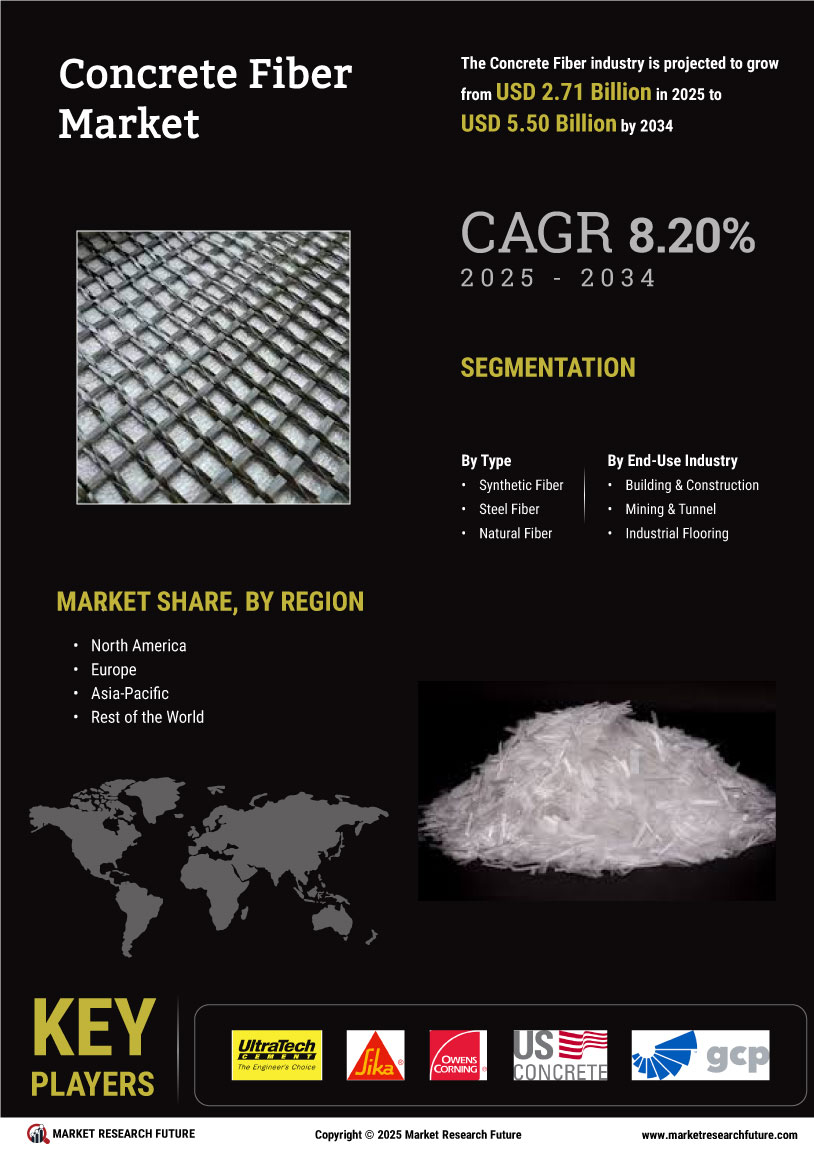
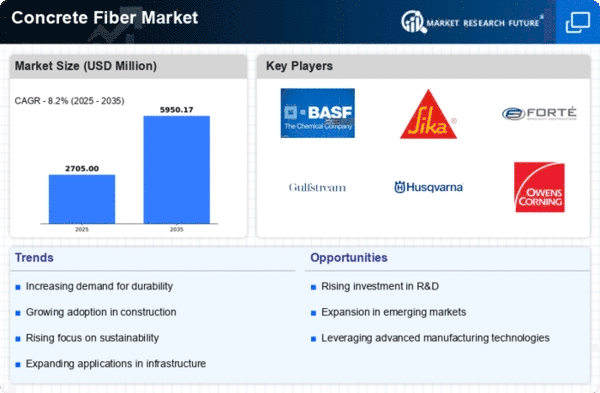
As per MRFR analysis, the Concrete Fiber Market Size was estimated at 2500.0 USD Million in 2024. The Concrete Fiber industry is projected to grow from 2705.05 in 2025 to 5950.17 by 2035, exhibiting a compound annual growth rate (CAGR) of 8.2 during the forecast period 2025 - 2035.

Key Market Trends & Highlights

The Concrete Fiber Market is experiencing robust growth driven by sustainability and technological advancements.

  • North America remains the largest market for concrete fibers, driven by increasing demand in construction and industrial flooring applications.
  • Asia-Pacific is recognized as the fastest-growing region, with a surge in infrastructure projects and urbanization.
  • The industrial flooring segment holds the largest share, while the shotcrete segment is witnessing rapid growth due to its diverse applications.
  • Key market drivers include sustainability initiatives and regulatory support, which are propelling the adoption of concrete fibers across various sectors.

Market Size & Forecast

2024 Market Size 2500.0 (USD Million)
2035 Market Size 5950.17 (USD Million)
CAGR (2025 - 2035) 8.2%

Major Players

BASF SE (DE), Sika AG (CH), Forte Fibers (US), Gulfstream Aerospace Corporation (US), Nycon Corporation (US), Propex Global (US), Hussain Fiber (IN), HPC (IN), Fibercon International (US)

Concrete Fiber Market Trends

The Concrete Fiber Market is currently experiencing a notable transformation, driven by advancements in technology and increasing demand for durable construction materials. As urbanization accelerates globally, the need for robust infrastructure has intensified, prompting stakeholders to explore innovative solutions. Concrete fibers, which enhance the tensile strength and durability of concrete, are gaining traction among builders and contractors. This shift is further supported by the growing awareness of sustainability, as concrete fibers can contribute to reducing the overall carbon footprint of construction projects. Moreover, the Concrete Fiber Market is witnessing a diversification of applications, extending beyond traditional uses in pavements and slabs to more specialized areas such as precast concrete products and shotcrete applications. This expansion indicates a broader acceptance of concrete fibers in various construction sectors, including residential, commercial, and industrial projects. As the market evolves, it appears that the integration of advanced materials and techniques will continue to shape the future landscape of concrete construction, potentially leading to enhanced performance and longevity of structures.

Sustainability Initiatives

The Concrete Fiber Market is increasingly influenced by sustainability initiatives, as stakeholders seek to minimize environmental impact. The incorporation of recycled materials in concrete fibers is becoming more prevalent, aligning with global efforts to promote eco-friendly construction practices. This trend not only addresses environmental concerns but also enhances the market's appeal to environmentally conscious consumers.

Technological Advancements

Technological advancements are playing a crucial role in the evolution of the Concrete Fiber Market. Innovations in fiber production and application techniques are enhancing the performance characteristics of concrete. These developments may lead to improved durability, reduced maintenance costs, and greater efficiency in construction processes, thereby attracting more industry players.

Diverse Applications

The range of applications for concrete fibers is expanding, reflecting a growing recognition of their benefits across various sectors. Beyond traditional uses, concrete fibers are increasingly utilized in specialized applications such as industrial flooring, tunnel linings, and shotcrete for slope stabilization. This diversification suggests a robust future for the Concrete Fiber Market as it adapts to meet the needs of different construction projects.

Concrete Fiber Market Drivers

Rising Demand for Durable Construction Materials

The Global Concrete Fiber Market Industry experiences a notable increase in demand for durable construction materials. This trend is driven by the growing need for infrastructure that can withstand extreme weather conditions and heavy loads. Concrete fibers enhance the tensile strength and durability of concrete, making it an attractive option for construction projects. As urbanization continues to rise, the market is projected to reach 2.5 USD Billion in 2024, reflecting a shift towards more resilient building materials. The emphasis on longevity in construction aligns with the increasing investments in infrastructure development globally.

Market Segment Insights

By Application: Industrial Flooring (Largest) vs. Shotcrete (Fastest-Growing)

In the Concrete Fiber Market, the application segment distribution reveals that Industrial Flooring holds the largest share, driven by increasing demand in construction and manufacturing sectors. Its superior durability and enhanced performance characteristics make it a preferred choice for various industrial applications. Following closely, Shotcrete is identified as the fastest-growing segment, experiencing a surge in popularity due to its efficiency in construction and renovation projects, particularly in tunneling and slope stabilization.

Industrial Flooring (Dominant) vs. Shotcrete (Emerging)

Industrial Flooring represents the dominant application, characterized by its robust performance in heavy-load environments. This segment benefits from the growth of industrial construction, where concrete fibers enhance overall strength and longevity, reducing maintenance costs. In contrast, Shotcrete is an emerging application gaining traction, known for its versatility and rapid application process. Its quick-setting properties and ability to conform to complex shapes make it ideal for various construction projects, including swimming pools and underground works. Overall, both segments illustrate the diverse applications of concrete fibers in modern construction.

By End Use: Construction (Largest) vs. Transportation (Fastest-Growing)

The Concrete Fiber Market exhibits varied distribution among its end-use segments, with construction holding the largest share. This segment benefits from increased investments in infrastructure development, leading to a surge in demand for high-performance concrete. Transportation follows closely, as advancements in material technologies drive a rising adoption of concrete fibers in road and bridge applications, showcasing significant potential for growth. The mining sector utilizes concrete fibers to enhance the durability and longevity of underground structures, though it remains comparatively smaller. Meanwhile, oil and gas along with marine applications are emerging, with niche demands fueled by specific project requirements.

Construction: Dominant vs. Transportation: Emerging

The construction segment of the Concrete Fiber Market is characterized by its extensive application in residential, commercial, and infrastructural projects. With increasing urbanization and a global push for durable materials, concrete fibers enhance the structural integrity and durability of concrete, making it the preferred choice in large-scale construction. On the other hand, the transportation sector is rapidly emerging, driven by the need for stronger pavements and bridges that can withstand heavy loads. Innovations in fiber technology are being integrated into asphalt and concrete, enhancing performance and requiring lower maintenance. While construction remains dominant, transportation is gaining traction as more projects recognize the advantages that concrete fibers bring to infrastructure resilience.

By Fiber Type: Steel Fiber (Largest) vs. Synthetic Fiber (Fastest-Growing)

In the Concrete Fiber Market, Steel Fiber dominates with the largest share, attributed to its high tensile strength and enhancing concrete performance. Synthetic Fiber follows as a significant player but is rapidly gaining traction due to its lightweight properties and resistance to environmental factors, showcasing a growing preference among contractors looking for efficiency and cost-effectiveness. The diversity in fiber options allows customers to optimize concrete mixtures tailored to specific applications, fostering competitive dynamics in the market. Moreover, the growth trends in the Fiber Type segment highlight an increasing demand for high-performance materials driven by infrastructure development and stringent quality standards. The focus on sustainable construction practices is propelling interest in synthetic and natural fibers, which are perceived to offer environmentally friendly alternatives to traditional options. As the construction industry continues to evolve, the adoption of advanced materials, particularly synthetic fibers, emerges as a key trend influencing future market dynamics.

Steel Fiber (Dominant) vs. Synthetic Fiber (Emerging)

Steel fiber has established itself as a dominant force in the Concrete Fiber Market due to its exceptional load-bearing capabilities, making it preferable for heavy-duty applications. Its advantages in improving crack resistance and durability position it as a staple in commercial and industrial projects. Conversely, the emerging segment of synthetic fiber is gaining popularity due to its versatility, lower cost, and ease of integration into various concrete applications. While it lacks the high strength of steel fiber, synthetic fiber is ideal for residential projects and light to medium-duty applications, providing a strong alternative where weight and material properties are considered. Both fibers are critical in shaping future trends, responding to the growing need for diverse construction solutions.

By Form: Monofilament (Largest) vs. Multifilament (Fastest-Growing)

In the Concrete Fiber Market, the segment distribution reveals that Monofilament fibers currently hold the largest market share due to their widespread usage in various concrete applications. Their unique characteristics, such as high tensile strength and ease of mixing, make them a preferred choice among manufacturers. In contrast, Multifilament fibers are gaining traction as they offer enhanced crack resistance and flexibility, appealing to emerging markets demanding more durable concrete solutions. The growth trends for this segment indicate a strong shift towards the adoption of Multifilament fibers, recognized for their ability to improve the performance of concrete. Factors driving this growth include increasing infrastructure projects, a rising emphasis on sustainability, and the need for more resilient construction materials. The drive towards advanced building techniques and the integration of innovative materials further fuel the demand for these fibers in the market.

Monofilament (Dominant) vs. Chopped Fiber (Emerging)

Monofilament fibers are dominant in the Concrete Fiber Market, known for their superior mechanical properties and widespread acceptance in diverse applications. They are typically made from single strands, enabling them to effectively enhance the durability and structural integrity of concrete. On the other hand, Chopped fibers, characterized by their short lengths and high dispersibility, are emerging as a favorable choice for applications demanding quick set times and reduced labor costs. While Monofilament fibers lead in overall market share, Chopped fibers are attracting attention for their cost-efficiency and ability to provide immediate reinforcement in fresh concrete mixes. The evolving preferences of construction professionals, alongside new application techniques, position these fibers as a competitive alternative.

Get more detailed insights about Concrete Fiber Market

Regional Insights

North America : Market Leader in Innovation

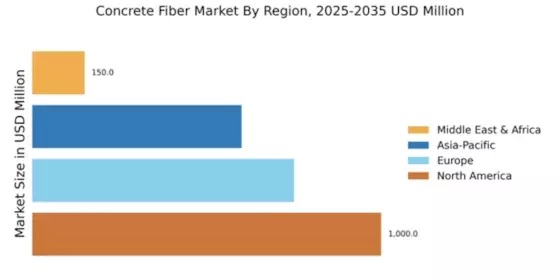
North America is poised to maintain its leadership in the concrete fiber market, holding a significant share of 1000.0 in 2025. The region's growth is driven by increasing infrastructure investments, stringent regulations promoting sustainable construction, and a rising demand for high-performance materials. The adoption of advanced technologies in construction is further propelling market expansion, making it a hub for innovation in concrete solutions. The United States stands out as the leading country, with major players like BASF SE, Sika AG, and Forte Fibers driving competition. The presence of established companies fosters a robust supply chain, ensuring high-quality products. Additionally, the region benefits from a skilled workforce and advanced research facilities, enhancing its competitive edge in the global market.

Europe : Emerging Market with Growth Potential

Europe is witnessing a growing demand for concrete fibers, with a market size of 750.0 projected for 2025. The region's growth is fueled by increasing construction activities, particularly in green building initiatives, and regulatory frameworks that encourage the use of sustainable materials. The European Union's commitment to reducing carbon emissions is also a significant driver, pushing for innovative solutions in construction. Leading countries such as Germany, France, and the UK are at the forefront of this market, with key players like Sika AG and Propex Global enhancing competition. The presence of stringent regulations ensures high-quality standards, while ongoing research and development initiatives are paving the way for new product innovations. This competitive landscape positions Europe as a promising market for concrete fibers.

Asia-Pacific : Rapid Growth in Emerging Economies

Asia-Pacific is emerging as a significant player in the concrete fiber market, with a projected size of 600.0 by 2025. The region's growth is driven by rapid urbanization, increasing infrastructure projects, and a rising demand for durable construction materials. Government initiatives aimed at enhancing infrastructure are also contributing to market expansion, making it a focal point for investment in construction technologies. Countries like China and India are leading the charge, with a growing number of local and international players entering the market. Companies such as Hussain Fiber and HPC are gaining traction, contributing to a competitive landscape. The region's diverse market dynamics and increasing investments in construction technology are expected to further boost the demand for concrete fibers in the coming years.

Middle East and Africa : Emerging Market with Untapped Potential

The Middle East and Africa region is gradually emerging in the concrete fiber market, with a size of 150.0 anticipated for 2025. The growth is primarily driven by increasing construction activities, particularly in the Gulf Cooperation Council (GCC) countries, where infrastructure development is a priority. Additionally, the region's focus on sustainable construction practices is creating demand for innovative materials like concrete fibers. Countries such as the UAE and South Africa are leading the market, with a growing number of local manufacturers entering the space. The competitive landscape is evolving, with companies like Fibercon International making strides. As the region continues to invest in infrastructure and construction, the demand for concrete fibers is expected to rise significantly, presenting numerous opportunities for growth.

Key Players and Competitive Insights

The Concrete Fiber Market is currently characterized by a dynamic competitive landscape, driven by increasing demand for durable construction materials and the growing emphasis on sustainability. Key players such as BASF SE (DE), Sika AG (CH), and Fibercon International (US) are strategically positioning themselves through innovation and regional expansion. For instance, BASF SE (DE) has focused on enhancing its product portfolio with advanced fiber technologies, while Sika AG (CH) has been expanding its global footprint through strategic acquisitions, thereby shaping a competitive environment that prioritizes technological advancement and market reach.

In terms of business tactics, companies are increasingly localizing manufacturing to reduce lead times and optimize supply chains. The market structure appears moderately fragmented, with several players vying for market share. However, the collective influence of major companies like Propex Global (US) and Gulfstream Aerospace Corporation (US) is notable, as they leverage their extensive networks to enhance distribution and customer engagement.

In November 2025, Sika AG (CH) announced the acquisition of a regional concrete fiber manufacturer, which is expected to bolster its production capabilities and expand its market presence in Europe. This strategic move underscores Sika's commitment to enhancing its operational efficiency and product offerings, potentially allowing it to capture a larger share of the market. The acquisition aligns with the broader trend of consolidation within the industry, as companies seek to strengthen their competitive positions.

In October 2025, Fibercon International (US) launched a new line of eco-friendly concrete fibers aimed at reducing the carbon footprint of construction projects. This initiative not only reflects the growing demand for sustainable building materials but also positions Fibercon as a leader in innovation within the market. The introduction of these products may attract environmentally conscious clients and enhance the company's reputation in a competitive landscape increasingly focused on sustainability.

Moreover, in September 2025, BASF SE (DE) unveiled a digital platform designed to streamline the ordering process for concrete fibers, enhancing customer experience and operational efficiency. This digital transformation initiative indicates a shift towards integrating technology into traditional manufacturing processes, which could provide BASF with a competitive edge in terms of responsiveness and service delivery.

As of December 2025, current trends in the Concrete Fiber Market indicate a strong focus on digitalization, sustainability, and the integration of AI technologies. Strategic alliances are becoming increasingly important, as companies collaborate to enhance their product offerings and market reach. The competitive differentiation is likely to evolve from traditional price-based competition to a focus on innovation, technology, and supply chain reliability, suggesting that companies that invest in these areas may secure a more favorable position in the market.

Key Companies in the Concrete Fiber Market market include

Industry Developments

February 2022: Şişecam, the Turkish glass developer has acquired Refel, the Italian firm that is one of the most reputed developers of refractory materials in the world. These materials are largely utilized in constructing glass melting furnaces.

With this acquisition, Şişecam intends to alleviate any risk associated with disruptions to the supply chain, which in turn will ensure smooth refractory supply processes all the while realizing more funding in the glass field. Şişecam is an affluent player in segments covering every basic area of glass including glass fiber, flat glass, glass packaging, glassware, chromium and soda compounds, in industries like mining, automotive, recycling and energy.

February 2022: Skanska along with Tarmac is looking for ways to deal with climate change using advanced low-carbon concrete. TARMAC is supplying a low-carbon basalt-fiber-reinforced concrete to try on a temporary haul road used by construction vehicles, which will be part of the National Highways’ M42 Junction 6 improvement plan. This trial will be led by Skanska partnering with the National Composites Centre, with funding by National Highways.

March 2024: Sika Group, a leading manufacturer of concrete fibers, unveiled a new eco-friendly product line crafted from recycled materials. These innovative fibers are engineered to enhance the durability and sustainability of construction projects, reflecting the industry's increasing emphasis on environmentally-friendly building solutions.

Future Outlook

Concrete Fiber Market Future Outlook

The Concrete Fiber Market is projected to grow at an 8.2% CAGR from 2024 to 2035, driven by increasing demand for durable construction materials and infrastructure development.

New opportunities lie in:

  • Development of high-performance synthetic fibers for specialized applications.
  • Expansion into emerging markets with tailored product offerings.
  • Investment in automated mixing and dispensing technologies for efficiency.

By 2035, the Concrete Fiber Market is expected to achieve substantial growth, reflecting evolving construction needs.

Market Segmentation

Concrete Fiber Market Form Outlook

  • Monofilament
  • Multifilament
  • Chopped Fiber
  • Continuous Fiber

Concrete Fiber Market End Use Outlook

  • Construction
  • Transportation
  • Mining
  • Oil and Gas
  • Marine

Concrete Fiber Market Fiber Type Outlook

  • Steel Fiber
  • Synthetic Fiber
  • Glass Fiber
  • Natural Fiber

Concrete Fiber Market Application Outlook

  • Industrial Flooring
  • Pavements
  • Precast Products
  • Shotcrete
  • Reinforced Concrete

Report Scope

MARKET SIZE 20242500.0(USD Million)
MARKET SIZE 20252705.05(USD Million)
MARKET SIZE 20355950.17(USD Million)
COMPOUND ANNUAL GROWTH RATE (CAGR)8.2% (2024 - 2035)
REPORT COVERAGERevenue Forecast, Competitive Landscape, Growth Factors, and Trends
BASE YEAR2024
Market Forecast Period2025 - 2035
Historical Data2019 - 2024
Market Forecast UnitsUSD Million
Key Companies ProfiledBASF SE (DE), Sika AG (CH), Forte Fibers (US), Gulfstream Aerospace Corporation (US), Nycon Corporation (US), Propex Global (US), Hussain Fiber (IN), HPC (IN), Fibercon International (US)
Segments CoveredApplication, End Use, Fiber Type, Form
Key Market OpportunitiesIntegration of advanced materials enhances durability and sustainability in the Concrete Fiber Market.
Key Market DynamicsRising demand for durable construction materials drives innovation and competition in the concrete fiber market.
Countries CoveredNorth America, Europe, APAC, South America, MEA

Market Highlights

Author
Anshula Mandaokar
Team Lead - Research

Anshula Mandaokar holds an academic degree in Chemical Engineering and has been contributing to the field for more than 5 years. She has expertise in Market Research and Business Consulting and serves as a Team Lead for a reputed Market Research firm under the Chemicals and Materials domain spectrum. She has worked on multiple projects, generating explicit results in a quick turnaround time. Her understanding of data interpretation justifies her role as a leader.

Leave a Comment

FAQs

How big is the Concrete Fiber Market?

The Concrete Fiber Market size was USD 2.5 billion in 2024

What are the key players of concrete fibers market?

BASF SE of Germany, Nyon, The Euclid Chemical Company, Owens Corning of United States, Sika AG of Switzerland, Bosfa, Propex Operating Company LLC of United States, ABC Polymer Industries LLC of United States, Helix Steel Dow, and GCP Applied Technologies Inc and many more.

Which is the dominant region for growth rate?

Asia-Pacific region is expected to project at a high USD during the market forecast period.

What is the impact of COVID on the growth of the market?

COVID has affected public health largely and its long-term effects will serve the industry with huge losses.

What are the advantages of technology?

Technology has helped to lessen the post-construction repairment expenses which help in improving the infrastructure. These fibers act as microfibre and are helpful in primary reinforcement and are able for replacing the traditional fibers.

What is the importance of fibrillated fibers?

These fibrillated fibers have an extended number of strands

On what basis are the concrete fibers divided?

These fibers are categorized based on structural designs, long and short-chain fibers. Synthetic fibers are divided into two types especially myofibrillar and fibrillated fiber.

How is the concrete market divided based on end-users?

Based on the end-user industry, the market is segmented based on industrial and commercial segments which cover 30% of the overall cooling fiber market share. The rise in industrial facilities along the Asia-Pacific region rises the growth for using high-quality products. They are used widely in airports, offices, and mining purposes. Urbanization in the Asia-Pacific region steers up the demand for carrying out residential construction in these regions.

Download Free Sample

Kindly complete the form below to receive a free sample of this Report

Compare Licence

×
Features License Type
Single User Multiuser License Enterprise User
Price $4,950 $5,950 $7,250
Maximum User Access Limit 1 User Upto 10 Users Unrestricted Access Throughout the Organization
Free Customization
Direct Access to Analyst
Deliverable Format
Platform Access
Discount on Next Purchase 10% 15% 15%
Printable Versions