×
Request Free Sample ×

Kindly complete the form below to receive a free sample of this Report

* Please use a valid business email

Leading companies partner with us for data-driven Insights

clients tt-cursor
Hero Background
English
Chinese
French
Japanese
Korean
German
Spanish

Smart Home Appliances Market Analysis

ID: MRFR/SEM/2502-HCR
200 Pages
Shubham Munde
February 2026

Smart Home Appliances Market Size, Share and Research Report: By Product (Refrigerator, Dishwasher, Washing Machine, Air Conditioner), By Technology (Wi-Fi, ZigBee, Bluetooth, Cellular Technology, Radio Frequency Identification), By Distribution Channel (Offline, Online) and By Regional (North America, Europe, South America, Asia Pacific, Middle East and Africa) - Industry Forecast Till 2035

Share:
Download PDF ×

We do not share your information with anyone. However, we may send you emails based on your report interest from time to time. You may contact us at any time to opt-out.

Smart Home Appliances Market Infographic
Purchase Options

Market Analysis

In-depth Analysis of Smart Home Appliances Market Industry Landscape

Customers are now interested in staying connected. Smart technologies are increasingly being adopted to make homes more efficient, which has meant booming sales of smart home appliances. New technologies, changing customer tastes, and the rise of eco-friendly and energy-efficient trends are just a few of the things that are making the global market stronger. Smart home gadgets is getting smarter in line with the rise in technical advances. A market can now work with the help of new tools. Artificial intelligence, machine learning, and the Internet of Things make it possible for smart devices to talk to each other and change based on what the user wants. Devices that can connect to Wi-Fi have taken the place of basic tools like dryers, freezers, and heaters. These systems can change based on what is needed and keep track of how they are used. When it comes to smart home gear, what the customer wants is important. People have a desire to buy smart products that are simple to use, secure, and energy-efficient as they learn more about them. Smart home solutions are getting more popular because they let you use your phone or a voice-activated helper to handle and watch your machines from away. Nowadays, this skill comes in handy. How well a product works with other smart gadgets and platforms affects what people buy. Their homes become more connected as a result. Now, two of the most important things that affect the market for smart home devices are protecting the environment and saving energy. People around the world are more likely to spend money on goods that use less energy and hurt the environment as these issues become more important. The laws and rules made by the government can have a big impact on the growth of the market for smart home appliances. Policies that encourage the installation of smart home technology in recently built homes, standards for connectivity, and incentives for goods that use less energy all help the industry grow and become more standardized. Home automation can help people stay safe, live better, and save them money on their energy bills. This is known by governments everywhere in the world. Even though business is going well, people are still worried about protection and privacy. As smart home products become more connected, there is a greater chance of illegal entry and data breaches. To calm people down, manufacturers need to put in place strong security measures and let people know how important it is to protect their connected gadgets.


Author
Shubham Munde
Team Lead - Research

Shubham brings over 7 years of expertise in Market Intelligence and Strategic Consulting, with a strong focus on the Automotive, Aerospace, and Defense sectors. Backed by a solid foundation in semiconductors, electronics, and software, he has successfully delivered high-impact syndicated and custom research on a global scale. His core strengths include market sizing, forecasting, competitive intelligence, consumer insights, and supply chain mapping. Widely recognized for developing scalable growth strategies, Shubham empowers clients to navigate complex markets and achieve a lasting competitive edge. Trusted by start-ups and Fortune 500 companies alike, he consistently converts challenges into strategic opportunities that drive sustainable growth.

Leave a Comment

FAQs

What is the projected market valuation of the Smart Home Appliances Market by 2035?

<p>The Smart Home Appliances Market is projected to reach a valuation of 200.93 USD Billion by 2035.</p>

What was the market valuation of the Smart Home Appliances Market in 2024?

<p>In 2024, the Smart Home Appliances Market was valued at 39.52 USD Billion.</p>

What is the expected CAGR for the Smart Home Appliances Market during the forecast period 2025 - 2035?

<p>The expected CAGR for the Smart Home Appliances Market during the forecast period 2025 - 2035 is 15.93%.</p>

Which product segment had the highest valuation in the Smart Home Appliances Market?

<p>The Air Conditioner segment had the highest valuation, ranging from 14.52 to 75.93 USD Billion.</p>

What are the key technologies driving the Smart Home Appliances Market?

<p>Key technologies include Wi-Fi, ZigBee, and Bluetooth, with Wi-Fi valued between 15.0 and 75.0 USD Billion.</p>

How does the online distribution channel compare to offline in the Smart Home Appliances Market?

<p>The offline distribution channel had a valuation of 23.81 to 118.83 USD Billion, surpassing the online channel's 15.71 to 82.1 USD Billion.</p>

Who are the leading companies in the Smart Home Appliances Market?

<p>Leading companies include Amazon, Samsung, Google, Apple, LG Electronics, Philips, Honeywell, Bosch, and Xiaomi.</p>

What is the valuation range for the Dishwasher segment in the Smart Home Appliances Market?

<p>The Dishwasher segment is valued between 7.0 and 35.0 USD Billion.</p>

What is the valuation range for the Washing Machine segment in the Smart Home Appliances Market?

<p>The Washing Machine segment is valued between 8.0 and 40.0 USD Billion.</p>

What is the valuation range for the ZigBee technology in the Smart Home Appliances Market?

<p>The ZigBee technology segment is valued between 8.0 and 40.0 USD Billion.</p>

Market Summary

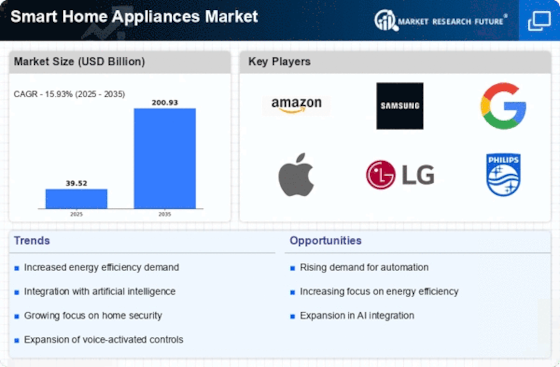
As per Market Research Future analysis, the Smart Home Appliances Market was estimated at 39.52 USD Billion in 2024. The Smart Home Appliances industry is projected to grow from 45.82 USD Billion in 2025 to 200.93 USD Billion by 2035, exhibiting a compound annual growth rate (CAGR) of 15.93% during the forecast period 2025 - 2035

Key Market Trends & Highlights

The Smart Home Appliances Market is experiencing robust growth driven by technological advancements and evolving consumer preferences.

  • The integration of Artificial Intelligence is transforming user experiences in smart home appliances across North America. Energy efficiency remains a focal point, with consumers increasingly seeking appliances that reduce energy consumption in the Asia-Pacific region. Enhanced connectivity and interoperability are becoming essential features, particularly in the refrigerator segment, which is the largest in the market. Rising consumer demand for convenience and growing awareness of energy efficiency are key drivers propelling the market forward.

Market Size & Forecast

2024 Market Size 39.52 (USD Billion)
2035 Market Size 200.93 (USD Billion)
CAGR (2025 - 2035) 15.93%
Largest Regional Market Share in 2024 North America

Major Players

Amazon (US), Samsung (KR), Google (US), Apple (US), LG Electronics (KR), Philips (NL), <a href="https://www.honeywell.com/us/en">Honeywell</a> (US), Bosch (DE), Xiaomi (CN).These companies are key contributors to the smart appliances market and play a major role in shaping appliance industry trends through innovation and ecosystem development.

Market Trends

The Smart Home Appliances Market is currently experiencing a transformative phase, characterized by rapid technological advancements and increasing consumer interest in home automation. This market encompasses a wide array of devices designed to enhance convenience, security, and energy efficiency within residential settings. As consumers become more aware of the benefits associated with smart home appliance technologies, the demand for interconnected appliances is likely to rise. Furthermore, the integration of artificial intelligence and machine learning into these smart home appliances appears to be a driving force, enabling them to learn user preferences and adapt accordingly. In addition to technological innovations, sustainability concerns are influencing purchasing decisions across the home appliances market. Consumers are increasingly seeking energy-efficient appliances that not only reduce utility costs but also minimize environmental impact. This trend aligns with broader appliance industry trends and suggests a shift towards eco-friendly products. Overall, the Smart Home Appliances Market is poised for growth, driven by advancements in technology and a growing emphasis on sustainability, indicating a promising future for both consumers and manufacturers within the home appliance industry.

Integration of Artificial Intelligence

The incorporation of artificial intelligence into smart home appliances is becoming more prevalent. This trend allows devices to learn from user behavior, enhancing their functionality and personalization. As a result, appliances can offer tailored experiences, making them more appealing to consumers.

Focus on Energy Efficiency

There is a noticeable shift towards energy-efficient smart home appliances within the smart appliances market. Consumers are increasingly prioritizing products that not only save energy but also contribute to lower utility bills, reinforcing long-term appliance industry trends. This trend is likely to encourage manufacturers to innovate and develop more sustainable solutions.

Enhanced Connectivity and Interoperability

The demand for seamless connectivity among various connected home appliances is growing. Consumers prefer smart home appliances that can easily communicate with one another, creating a cohesive smart home ecosystem. This trend suggests that manufacturers may need to focus on developing interoperable products that enhance user experience.

Smart Home Appliances Market Market Drivers

Integration of Voice Assistants

The integration of voice assistants into smart home appliances is transforming the Smart Home Appliances Market. Voice-activated technology allows users to control their devices hands-free, enhancing convenience and accessibility. Popular voice assistants, such as Amazon Alexa and Google Assistant, are increasingly being embedded in various appliances, from smart speakers to kitchen gadgets. This trend is indicative of a broader shift towards more intuitive user interfaces, which are expected to dominate the market. As consumers become more accustomed to voice-controlled technology, the demand for compatible smart appliances is likely to rise, further propelling growth within the Smart Home Appliances Market.

Increased Focus on Home Security

The heightened focus on home security is a significant driver for the Smart Home Appliances Market. As concerns about safety and security grow, consumers are increasingly investing in smart security systems, including cameras, alarms, and smart locks. These devices not only provide real-time monitoring but also offer remote access and control, enhancing peace of mind for homeowners. The market for smart security appliances is projected to expand rapidly, with estimates suggesting a growth rate of over 15% annually. This trend underscores the importance of security in the smart home ecosystem, prompting manufacturers to innovate and integrate advanced security features into their product offerings within the Smart Home Appliances Market.

Technological Advancements in IoT

Technological advancements in the Internet of Things (IoT) play a pivotal role in shaping the Smart Home Appliances Market. The integration of IoT technology enables appliances to communicate with each other and with users, creating a seamless and interconnected home environment. For instance, smart thermostats can learn user preferences and adjust settings automatically, leading to enhanced energy efficiency. The proliferation of IoT devices is expected to reach billions in the next few years, indicating a robust growth trajectory for the Smart Home Appliances Market. This interconnectedness not only improves functionality but also enhances the overall user experience, making smart appliances more appealing to consumers.

Growing Awareness of Energy Efficiency

The increasing awareness of energy efficiency significantly influences the Smart Home Appliances Market. Consumers are becoming more conscious of their energy consumption and its environmental impact, leading to a preference for energy-efficient appliances. Many smart devices now come equipped with energy monitoring features, allowing users to track and optimize their energy usage. Data suggests that energy-efficient appliances can reduce energy consumption by up to 30%, making them an attractive option for eco-conscious consumers. This trend not only aligns with The Smart Home Appliances Industry, as manufacturers strive to create products that meet these evolving consumer expectations.

Rising Consumer Demand for Convenience

The Smart Home Appliances Market experiences a notable surge in consumer demand for convenience-driven solutions. As lifestyles become increasingly hectic, consumers seek appliances that simplify daily tasks. This trend is reflected in the growing popularity of smart kitchen devices, such as automated cooking systems and smart refrigerators, which offer features like remote monitoring and recipe suggestions. According to recent data, the demand for smart appliances is projected to grow at a compound annual growth rate of over 20% in the coming years. This shift towards convenience not only enhances user experience but also drives innovation within the Smart Home Appliances Market, prompting manufacturers to develop more intuitive and user-friendly products.

Market Segment Insights

By Product: Refrigerator (Largest) vs. Air Conditioner (Fastest-Growing)

In the Smart Home Appliances Market, the product segment showcases a diverse range of smart household appliances. Refrigerators hold the largest share due to their essential role in modern households and rising demand for connected home appliances. Dishwashers and washing machines follow, catering to convenience-centric consumers who prioritize automation. Air conditioners, although smaller in market share, indicate a growing trend towards automation and energy efficiency, aligning with consumer preferences for smart climate control solutions.

Refrigerator (Dominant) vs. Air Conditioner (Emerging)

Refrigerators have firmly established themselves as the dominant product in the smart home appliances market, characterized by increasing integration of advanced technology such as IoT connectivity. They appeal to a broad consumer base looking for functionality combined with modern design. In contrast, air conditioners are emerging rapidly as smart home appliances offering intelligent climate control. These units are increasingly equipped with smart features that allow for remote control and programming, appealing particularly to tech-savvy customers looking for comfort and energy savings.

By Technology: Wi-Fi (Largest) vs. ZigBee (Fastest-Growing)

In the Smart Home Appliances Market, the technology segment showcases a diverse array of connectivity options. In the Smart Home Appliances Market, Wi-Fi remains the dominant connectivity technology supporting connected home appliances, while ZigBee is emerging due to its low power consumption and alignment with evolving appliance industry trends. Other technologies like Bluetooth and Cellular Technology also contribute to the market, but they occupy niche segments compared to the dominant players. Looking towards the future, growth in the technology segment is being driven by advancements in smart home integration and the increasing demand for connected devices. Consumers are seeking seamless connectivity across multiple platforms, catalyzing a shift towards a more interoperable ecosystem. ZigBee is expected to rapidly gain traction due to its energy-efficient solutions and enhanced inter-device communication, while Wi-Fi continues to evolve, supporting increasing bandwidth requirements for smart appliances.

Technology: Wi-Fi (Dominant) vs. ZigBee (Emerging)

Wi-Fi stands out as the dominant technology in the Smart Home Appliances Market, primarily due to its extensive range and user-friendly integration with existing home networks. This technology supports high data rates and offers robust connectivity, making it ideal for bandwidth-heavy applications like video streaming and smart home security systems. On the other hand, ZigBee is emerging as a strong contender, especially in environments where low power consumption is crucial. Designed specifically for short-range communication and automation, ZigBee is favored in smart lighting and sensor applications, allowing devices to form mesh networks that enhance reliability and coverage. As consumer preferences shift towards energy-efficient and interconnected solutions, both technologies are likely to coexist, catering to differing needs in the smart home environment.

By Distribution Channel: Online (Largest) vs. Offline (Fastest-Growing)

The Smart Home Appliances Market shows a distinct shift toward online platforms, particularly for purchasing smart home appliances and smart household appliances, driven by convenience and product comparison features. Online sales have emerged as the predominant channel, driven by the increasing preference for e-commerce due to its convenience and competitive pricing. Consumers are opting for online channels for purchasing smart devices, benefiting from various promotions and customer reviews that assist in decision-making. Meanwhile, offline sales, although smaller in share, have been witnessing robust growth, particularly in physical retail stores that offer experiential shopping opportunities, allowing consumers to see and interact with products before purchase.

Distribution Channels: Online (Dominant) vs. Offline (Emerging)

In the Smart Home Appliances Market, the online distribution channel stands as the dominant force, leveraging the growing trend of digital shopping and consumer reliance on technology for efficient purchase processes. It offers extensive product ranges, competitive pricing, and the convenience of home delivery. Conversely, the offline channel is emerging at a rapid pace, appealing particularly to consumers who value personal interaction and immediate access to products. Retailers enhancing their in-store experience, such as through product demonstrations or expert consultations, are driving this growth. This combination of factors makes offline sales a vital and rapidly developing segment within the broader market.

Get more detailed insights about Smart Home Appliances Market Research Report - Global Forecast 2035

Regional Insights

North America : Tech-Driven Market Growth

North America leads the smart home appliances market, driven by strong consumer adoption of connected home appliances and innovation by major players influencing global appliance industry trends. The growth is driven by increasing consumer demand for convenience, energy efficiency, and home automation. Regulatory support for energy-efficient appliances further fuels this trend, with initiatives aimed at reducing carbon footprints and promoting sustainable living. The U.S. and Canada are the primary contributors to this market, showcasing a robust adoption rate of smart technologies. The competitive landscape in North America is dominated by key players such as Amazon, Google, and Apple, who are continuously innovating to enhance user experience. The presence of advanced infrastructure and high disposable income allows consumers to invest in smart home technologies. Additionally, partnerships between tech companies and home appliance manufacturers are fostering a diverse range of products, making smart home solutions more accessible to a broader audience.

Europe : Sustainable Living Focus

Europe is the second-largest market for smart home appliances, accounting for around 30% of the global market share. Europe continues to expand its presence in the home appliances market, with strong emphasis on sustainability and adoption of smart home appliances aligned with regulatory frameworks. The European Union's Green Deal and various national initiatives encourage the adoption of smart technologies, making homes more energy-efficient and environmentally friendly. Countries like Germany and the UK are leading this transformation, with increasing consumer awareness driving demand for smart solutions. Leading countries in Europe include Germany, the UK, and France, where major players like Bosch and Philips are actively innovating. The competitive landscape is characterized by a mix of established brands and emerging startups, all vying for market share. The presence of a tech-savvy population and a strong emphasis on sustainability further enhance the market's growth potential, making Europe a key player in the smart home appliances sector.

Asia-Pacific : Emerging Market Potential

Asia-Pacific is witnessing rapid growth in the smart home appliances market, holding approximately 25% of the global share. Asia-Pacific is witnessing rapid growth in the smart appliances market, fueled by urbanization, rising disposable income, and increasing demand for smart household appliances. Countries like China and India are at the forefront, with government initiatives promoting digital transformation and smart city projects. The demand for energy-efficient and automated solutions is also a significant catalyst for market expansion in this region. China is the largest market in Asia-Pacific, with major players like Xiaomi and LG Electronics leading the charge. The competitive landscape is evolving, with both local and international brands competing for market share. The increasing penetration of the internet and mobile devices is facilitating the adoption of smart home technologies, making them more accessible to a wider audience. As consumers become more tech-savvy, the demand for innovative smart home solutions is expected to surge.

Middle East and Africa : Untapped Market Opportunities

The Middle East and Africa region is emerging as a potential market for smart home appliances, currently holding about 5% of the global share. The Middle East and Africa region presents growth opportunities within the smart home appliances market, supported by smart city initiatives and digital transformation efforts. Countries like the UAE and South Africa are leading the way, with government initiatives aimed at promoting smart city developments and digital transformation. The demand for energy-efficient solutions is also gaining traction, supported by regulatory frameworks encouraging sustainable living. In this region, the competitive landscape is still developing, with both local and international players exploring opportunities. Companies are increasingly focusing on educating consumers about the benefits of smart home technologies. The presence of key players like Honeywell and Samsung is helping to drive awareness and adoption, paving the way for future growth in the smart home appliances market.

Key Players and Competitive Insights

The Smart Home Appliances Market is currently characterized by a dynamic competitive landscape, driven by rapid technological advancements and evolving consumer preferences. Key players such as Amazon (US), Samsung (KR), and Google (US) are at the forefront, each adopting distinct strategies to enhance their market positioning. Amazon (US) continues to leverage its extensive ecosystem, integrating smart home devices with its voice assistant, Alexa, thereby fostering a seamless user experience. Samsung (KR) emphasizes innovation through its SmartThings platform, which connects various devices, while Google (US) focuses on enhancing its Nest product line, aiming to create a more interconnected home environment. Collectively, these strategies not only intensify competition but also push the boundaries of what smart home technology can achieve. In terms of business tactics, companies are increasingly localizing manufacturing and optimizing supply chains to enhance efficiency and reduce costs. The market structure appears moderately fragmented, with a mix of established players and emerging startups. This fragmentation allows for diverse offerings, yet the influence of major companies remains substantial, as they set trends and standards that smaller entities often follow. In August 2025, Amazon (US) announced the launch of a new line of energy-efficient smart appliances, which aligns with the growing consumer demand for sustainability. This strategic move not only positions Amazon as a leader in eco-friendly technology but also reflects a broader industry trend towards energy conservation. By integrating smart technology with energy efficiency, Amazon is likely to attract environmentally conscious consumers, thereby enhancing its market share. In September 2025, Samsung (KR) unveiled its latest AI-driven washing machine, which utilizes machine learning to optimize washing cycles based on user habits. This innovation underscores Samsung's commitment to integrating artificial intelligence into its product offerings, potentially setting a new standard for user convenience and efficiency in the smart home sector. Such advancements may also serve to differentiate Samsung from competitors, as consumers increasingly seek products that offer personalized experiences. In October 2025, Google (US) expanded its partnership with various home security companies to enhance the capabilities of its Nest security systems. This strategic alliance is indicative of a trend towards collaboration in the industry, where companies recognize the value of integrating their technologies to provide comprehensive solutions. By enhancing its product ecosystem through partnerships, Google is likely to strengthen its competitive position in the smart home market. As of October 2025, the competitive trends in the Smart Home Appliances Market are increasingly defined by digitalization, sustainability, and the integration of artificial intelligence. Strategic alliances are becoming more prevalent, as companies seek to combine their strengths to deliver innovative solutions. Looking ahead, it appears that competitive differentiation will evolve from traditional price-based competition to a focus on innovation, technological advancement, and supply chain reliability, thereby reshaping the market landscape.

Key Companies in the Smart Home Appliances Market include

Industry Developments

Recent changes in the Smart Home Appliances Market have been driven by advancements in AI, IoT, and rising consumer interest in smart home appliances. Manufacturers are expanding portfolios of connected home appliances, further strengthening the home appliance industry outlook. Smart kitchen and laundry products from companies like GE Appliances, Samsung Electronics, and LG Electronics are leading the way in this change. Samsung said in June 2023 that it would make more appliances that work with SmartThings. The company stressed that these appliances would be easy to use and save energy. Honeywell keeps coming up with new ideas for smart HVAC systems that let you control the temperature in your home.

Xiaomi and LG have also made refrigerators that can keep track of what's inside and diagnose problems.

Amazon isn't a direct manufacturer, but it strengthened its role in the smart home ecosystem by releasing new Alexa-enabled devices in September 2023. This made it easier to control appliances with your voice. At the same time, reports said that Whirlpool was looking into partnerships with smart home tech companies in the middle of 2023, which was in line with trends in the industry as a whole. The outlook for the market is still good, and prices are expected to rise a lot until 2026.

Future Outlook

Smart Home Appliances Market Future Outlook

The Smart Home Appliances Market is projected to grow at a 15.93% CAGR from 2025 to 2035, driven by technological advancements, increased consumer demand, and energy efficiency trends.

New opportunities lie in:

  • <p>Integration of AI-driven home automation systems Expansion of subscription-based appliance services Development of energy-efficient smart appliances for sustainability</p>

By 2035, the market is expected to be robust, reflecting substantial growth and innovation.

Market Segmentation

Smart Home Appliances Market Product Outlook

  • Refrigerator
  • Dishwasher
  • Washing Machine
  • Air Conditioner

Smart Home Appliances Market Technology Outlook

  • Wi-Fi
  • ZigBee
  • Bluetooth
  • Cellular Technology
  • Radio Frequency Identification

Smart Home Appliances Market Distribution Channel Outlook

  • Offline
  • Online

Report Scope

MARKET SIZE 2024 39.52(USD Billion)
MARKET SIZE 2025 45.82(USD Billion)
MARKET SIZE 2035 200.93(USD Billion)
COMPOUND ANNUAL GROWTH RATE (CAGR) 15.93% (2025 - 2035)
REPORT COVERAGE Revenue Forecast, Competitive Landscape, Growth Factors, and Trends
BASE YEAR 2024
Market Forecast Period 2025 - 2035
Historical Data 2019 - 2024
Market Forecast Units USD Billion
Key Companies Profiled Amazon (US), Samsung (KR), Google (US), Apple (US), LG Electronics (KR), Philips (NL), Honeywell (US), Bosch (DE), Xiaomi (CN)
Segments Covered Product, Technology, Distribution Channel, Regional
Key Market Opportunities Integration of artificial intelligence enhances user experience in the Smart Home Appliances Market.
Key Market Dynamics Rising consumer demand for energy-efficient smart home appliances drives innovation and competitive dynamics in the market.
Countries Covered North America, Europe, APAC, South America, MEA

FAQs

What is the projected market valuation of the Smart Home Appliances Market by 2035?

<p>The Smart Home Appliances Market is projected to reach a valuation of 200.93 USD Billion by 2035.</p>

What was the market valuation of the Smart Home Appliances Market in 2024?

<p>In 2024, the Smart Home Appliances Market was valued at 39.52 USD Billion.</p>

What is the expected CAGR for the Smart Home Appliances Market during the forecast period 2025 - 2035?

<p>The expected CAGR for the Smart Home Appliances Market during the forecast period 2025 - 2035 is 15.93%.</p>

Which product segment had the highest valuation in the Smart Home Appliances Market?

<p>The Air Conditioner segment had the highest valuation, ranging from 14.52 to 75.93 USD Billion.</p>

What are the key technologies driving the Smart Home Appliances Market?

<p>Key technologies include Wi-Fi, ZigBee, and Bluetooth, with Wi-Fi valued between 15.0 and 75.0 USD Billion.</p>

How does the online distribution channel compare to offline in the Smart Home Appliances Market?

<p>The offline distribution channel had a valuation of 23.81 to 118.83 USD Billion, surpassing the online channel's 15.71 to 82.1 USD Billion.</p>

Who are the leading companies in the Smart Home Appliances Market?

<p>Leading companies include Amazon, Samsung, Google, Apple, LG Electronics, Philips, Honeywell, Bosch, and Xiaomi.</p>

What is the valuation range for the Dishwasher segment in the Smart Home Appliances Market?

<p>The Dishwasher segment is valued between 7.0 and 35.0 USD Billion.</p>

What is the valuation range for the Washing Machine segment in the Smart Home Appliances Market?

<p>The Washing Machine segment is valued between 8.0 and 40.0 USD Billion.</p>

What is the valuation range for the ZigBee technology in the Smart Home Appliances Market?

<p>The ZigBee technology segment is valued between 8.0 and 40.0 USD Billion.</p>

  1. SECTION I: EXECUTIVE SUMMARY AND KEY HIGHLIGHTS
    1. | 1.1 EXECUTIVE SUMMARY
    2. | | 1.1.1 Market Overview
    3. | | 1.1.2 Key Findings
    4. | | 1.1.3 Market Segmentation
    5. | | 1.1.4 Competitive Landscape
    6. | | 1.1.5 Challenges and Opportunities
    7. | | 1.1.6 Future Outlook
  2. SECTION II: SCOPING, METHODOLOGY AND MARKET STRUCTURE
    1. | 2.1 MARKET INTRODUCTION
    2. | | 2.1.1 Definition
    3. | | 2.1.2 Scope of the study
    4. | | | 2.1.2.1 Research Objective
    5. | | | 2.1.2.2 Assumption
    6. | | | 2.1.2.3 Limitations
    7. | 2.2 RESEARCH METHODOLOGY
    8. | | 2.2.1 Overview
    9. | | 2.2.2 Data Mining
    10. | | 2.2.3 Secondary Research
    11. | | 2.2.4 Primary Research
    12. | | | 2.2.4.1 Primary Interviews and Information Gathering Process
    13. | | | 2.2.4.2 Breakdown of Primary Respondents
    14. | | 2.2.5 Forecasting Model
    15. | | 2.2.6 Market Size Estimation
    16. | | | 2.2.6.1 Bottom-Up Approach
    17. | | | 2.2.6.2 Top-Down Approach
    18. | | 2.2.7 Data Triangulation
    19. | | 2.2.8 Validation
  3. SECTION III: QUALITATIVE ANALYSIS
    1. | 3.1 MARKET DYNAMICS
    2. | | 3.1.1 Overview
    3. | | 3.1.2 Drivers
    4. | | 3.1.3 Restraints
    5. | | 3.1.4 Opportunities
    6. | 3.2 MARKET FACTOR ANALYSIS
    7. | | 3.2.1 Value chain Analysis
    8. | | 3.2.2 Porter's Five Forces Analysis
    9. | | | 3.2.2.1 Bargaining Power of Suppliers
    10. | | | 3.2.2.2 Bargaining Power of Buyers
    11. | | | 3.2.2.3 Threat of New Entrants
    12. | | | 3.2.2.4 Threat of Substitutes
    13. | | | 3.2.2.5 Intensity of Rivalry
    14. | | 3.2.3 COVID-19 Impact Analysis
    15. | | | 3.2.3.1 Market Impact Analysis
    16. | | | 3.2.3.2 Regional Impact
    17. | | | 3.2.3.3 Opportunity and Threat Analysis
  4. SECTION IV: QUANTITATIVE ANALYSIS
    1. | 4.1 Semiconductor & Electronics, BY Product (USD Billion)
    2. | | 4.1.1 Refrigerator
    3. | | 4.1.2 Dishwasher
    4. | | 4.1.3 Washing Machine
    5. | | 4.1.4 Air Conditioner
    6. | 4.2 Semiconductor & Electronics, BY Technology (USD Billion)
    7. | | 4.2.1 Wi-Fi
    8. | | 4.2.2 ZigBee
    9. | | 4.2.3 Bluetooth
    10. | | 4.2.4 Cellular Technology
    11. | | 4.2.5 Radio Frequency Identification
    12. | 4.3 Semiconductor & Electronics, BY Distribution Channel (USD Billion)
    13. | | 4.3.1 Offline
    14. | | 4.3.2 Online
    15. | 4.4 Semiconductor & Electronics, BY Region (USD Billion)
    16. | | 4.4.1 North America
    17. | | | 4.4.1.1 US
    18. | | | 4.4.1.2 Canada
    19. | | 4.4.2 Europe
    20. | | | 4.4.2.1 Germany
    21. | | | 4.4.2.2 UK
    22. | | | 4.4.2.3 France
    23. | | | 4.4.2.4 Russia
    24. | | | 4.4.2.5 Italy
    25. | | | 4.4.2.6 Spain
    26. | | | 4.4.2.7 Rest of Europe
    27. | | 4.4.3 APAC
    28. | | | 4.4.3.1 China
    29. | | | 4.4.3.2 India
    30. | | | 4.4.3.3 Japan
    31. | | | 4.4.3.4 South Korea
    32. | | | 4.4.3.5 Malaysia
    33. | | | 4.4.3.6 Thailand
    34. | | | 4.4.3.7 Indonesia
    35. | | | 4.4.3.8 Rest of APAC
    36. | | 4.4.4 South America
    37. | | | 4.4.4.1 Brazil
    38. | | | 4.4.4.2 Mexico
    39. | | | 4.4.4.3 Argentina
    40. | | | 4.4.4.4 Rest of South America
    41. | | 4.4.5 MEA
    42. | | | 4.4.5.1 GCC Countries
    43. | | | 4.4.5.2 South Africa
    44. | | | 4.4.5.3 Rest of MEA
  5. SECTION V: COMPETITIVE ANALYSIS
    1. | 5.1 Competitive Landscape
    2. | | 5.1.1 Overview
    3. | | 5.1.2 Competitive Analysis
    4. | | 5.1.3 Market share Analysis
    5. | | 5.1.4 Major Growth Strategy in the Semiconductor & Electronics
    6. | | 5.1.5 Competitive Benchmarking
    7. | | 5.1.6 Leading Players in Terms of Number of Developments in the Semiconductor & Electronics
    8. | | 5.1.7 Key developments and growth strategies
    9. | | | 5.1.7.1 New Product Launch/Service Deployment
    10. | | | 5.1.7.2 Merger & Acquisitions
    11. | | | 5.1.7.3 Joint Ventures
    12. | | 5.1.8 Major Players Financial Matrix
    13. | | | 5.1.8.1 Sales and Operating Income
    14. | | | 5.1.8.2 Major Players R&D Expenditure. 2023
    15. | 5.2 Company Profiles
    16. | | 5.2.1 Amazon (US)
    17. | | | 5.2.1.1 Financial Overview
    18. | | | 5.2.1.2 Products Offered
    19. | | | 5.2.1.3 Key Developments
    20. | | | 5.2.1.4 SWOT Analysis
    21. | | | 5.2.1.5 Key Strategies
    22. | | 5.2.2 Samsung (KR)
    23. | | | 5.2.2.1 Financial Overview
    24. | | | 5.2.2.2 Products Offered
    25. | | | 5.2.2.3 Key Developments
    26. | | | 5.2.2.4 SWOT Analysis
    27. | | | 5.2.2.5 Key Strategies
    28. | | 5.2.3 Google (US)
    29. | | | 5.2.3.1 Financial Overview
    30. | | | 5.2.3.2 Products Offered
    31. | | | 5.2.3.3 Key Developments
    32. | | | 5.2.3.4 SWOT Analysis
    33. | | | 5.2.3.5 Key Strategies
    34. | | 5.2.4 Apple (US)
    35. | | | 5.2.4.1 Financial Overview
    36. | | | 5.2.4.2 Products Offered
    37. | | | 5.2.4.3 Key Developments
    38. | | | 5.2.4.4 SWOT Analysis
    39. | | | 5.2.4.5 Key Strategies
    40. | | 5.2.5 LG Electronics (KR)
    41. | | | 5.2.5.1 Financial Overview
    42. | | | 5.2.5.2 Products Offered
    43. | | | 5.2.5.3 Key Developments
    44. | | | 5.2.5.4 SWOT Analysis
    45. | | | 5.2.5.5 Key Strategies
    46. | | 5.2.6 Philips (NL)
    47. | | | 5.2.6.1 Financial Overview
    48. | | | 5.2.6.2 Products Offered
    49. | | | 5.2.6.3 Key Developments
    50. | | | 5.2.6.4 SWOT Analysis
    51. | | | 5.2.6.5 Key Strategies
    52. | | 5.2.7 Honeywell (US)
    53. | | | 5.2.7.1 Financial Overview
    54. | | | 5.2.7.2 Products Offered
    55. | | | 5.2.7.3 Key Developments
    56. | | | 5.2.7.4 SWOT Analysis
    57. | | | 5.2.7.5 Key Strategies
    58. | | 5.2.8 Bosch (DE)
    59. | | | 5.2.8.1 Financial Overview
    60. | | | 5.2.8.2 Products Offered
    61. | | | 5.2.8.3 Key Developments
    62. | | | 5.2.8.4 SWOT Analysis
    63. | | | 5.2.8.5 Key Strategies
    64. | | 5.2.9 Xiaomi (CN)
    65. | | | 5.2.9.1 Financial Overview
    66. | | | 5.2.9.2 Products Offered
    67. | | | 5.2.9.3 Key Developments
    68. | | | 5.2.9.4 SWOT Analysis
    69. | | | 5.2.9.5 Key Strategies
    70. | 5.3 Appendix
    71. | | 5.3.1 References
    72. | | 5.3.2 Related Reports
  6. LIST OF FIGURES
    1. | 6.1 MARKET SYNOPSIS
    2. | 6.2 NORTH AMERICA MARKET ANALYSIS
    3. | 6.3 US MARKET ANALYSIS BY PRODUCT
    4. | 6.4 US MARKET ANALYSIS BY TECHNOLOGY
    5. | 6.5 US MARKET ANALYSIS BY DISTRIBUTION CHANNEL
    6. | 6.6 CANADA MARKET ANALYSIS BY PRODUCT
    7. | 6.7 CANADA MARKET ANALYSIS BY TECHNOLOGY
    8. | 6.8 CANADA MARKET ANALYSIS BY DISTRIBUTION CHANNEL
    9. | 6.9 EUROPE MARKET ANALYSIS
    10. | 6.10 GERMANY MARKET ANALYSIS BY PRODUCT
    11. | 6.11 GERMANY MARKET ANALYSIS BY TECHNOLOGY
    12. | 6.12 GERMANY MARKET ANALYSIS BY DISTRIBUTION CHANNEL
    13. | 6.13 UK MARKET ANALYSIS BY PRODUCT
    14. | 6.14 UK MARKET ANALYSIS BY TECHNOLOGY
    15. | 6.15 UK MARKET ANALYSIS BY DISTRIBUTION CHANNEL
    16. | 6.16 FRANCE MARKET ANALYSIS BY PRODUCT
    17. | 6.17 FRANCE MARKET ANALYSIS BY TECHNOLOGY
    18. | 6.18 FRANCE MARKET ANALYSIS BY DISTRIBUTION CHANNEL
    19. | 6.19 RUSSIA MARKET ANALYSIS BY PRODUCT
    20. | 6.20 RUSSIA MARKET ANALYSIS BY TECHNOLOGY
    21. | 6.21 RUSSIA MARKET ANALYSIS BY DISTRIBUTION CHANNEL
    22. | 6.22 ITALY MARKET ANALYSIS BY PRODUCT
    23. | 6.23 ITALY MARKET ANALYSIS BY TECHNOLOGY
    24. | 6.24 ITALY MARKET ANALYSIS BY DISTRIBUTION CHANNEL
    25. | 6.25 SPAIN MARKET ANALYSIS BY PRODUCT
    26. | 6.26 SPAIN MARKET ANALYSIS BY TECHNOLOGY
    27. | 6.27 SPAIN MARKET ANALYSIS BY DISTRIBUTION CHANNEL
    28. | 6.28 REST OF EUROPE MARKET ANALYSIS BY PRODUCT
    29. | 6.29 REST OF EUROPE MARKET ANALYSIS BY TECHNOLOGY
    30. | 6.30 REST OF EUROPE MARKET ANALYSIS BY DISTRIBUTION CHANNEL
    31. | 6.31 APAC MARKET ANALYSIS
    32. | 6.32 CHINA MARKET ANALYSIS BY PRODUCT
    33. | 6.33 CHINA MARKET ANALYSIS BY TECHNOLOGY
    34. | 6.34 CHINA MARKET ANALYSIS BY DISTRIBUTION CHANNEL
    35. | 6.35 INDIA MARKET ANALYSIS BY PRODUCT
    36. | 6.36 INDIA MARKET ANALYSIS BY TECHNOLOGY
    37. | 6.37 INDIA MARKET ANALYSIS BY DISTRIBUTION CHANNEL
    38. | 6.38 JAPAN MARKET ANALYSIS BY PRODUCT
    39. | 6.39 JAPAN MARKET ANALYSIS BY TECHNOLOGY
    40. | 6.40 JAPAN MARKET ANALYSIS BY DISTRIBUTION CHANNEL
    41. | 6.41 SOUTH KOREA MARKET ANALYSIS BY PRODUCT
    42. | 6.42 SOUTH KOREA MARKET ANALYSIS BY TECHNOLOGY
    43. | 6.43 SOUTH KOREA MARKET ANALYSIS BY DISTRIBUTION CHANNEL
    44. | 6.44 MALAYSIA MARKET ANALYSIS BY PRODUCT
    45. | 6.45 MALAYSIA MARKET ANALYSIS BY TECHNOLOGY
    46. | 6.46 MALAYSIA MARKET ANALYSIS BY DISTRIBUTION CHANNEL
    47. | 6.47 THAILAND MARKET ANALYSIS BY PRODUCT
    48. | 6.48 THAILAND MARKET ANALYSIS BY TECHNOLOGY
    49. | 6.49 THAILAND MARKET ANALYSIS BY DISTRIBUTION CHANNEL
    50. | 6.50 INDONESIA MARKET ANALYSIS BY PRODUCT
    51. | 6.51 INDONESIA MARKET ANALYSIS BY TECHNOLOGY
    52. | 6.52 INDONESIA MARKET ANALYSIS BY DISTRIBUTION CHANNEL
    53. | 6.53 REST OF APAC MARKET ANALYSIS BY PRODUCT
    54. | 6.54 REST OF APAC MARKET ANALYSIS BY TECHNOLOGY
    55. | 6.55 REST OF APAC MARKET ANALYSIS BY DISTRIBUTION CHANNEL
    56. | 6.56 SOUTH AMERICA MARKET ANALYSIS
    57. | 6.57 BRAZIL MARKET ANALYSIS BY PRODUCT
    58. | 6.58 BRAZIL MARKET ANALYSIS BY TECHNOLOGY
    59. | 6.59 BRAZIL MARKET ANALYSIS BY DISTRIBUTION CHANNEL
    60. | 6.60 MEXICO MARKET ANALYSIS BY PRODUCT
    61. | 6.61 MEXICO MARKET ANALYSIS BY TECHNOLOGY
    62. | 6.62 MEXICO MARKET ANALYSIS BY DISTRIBUTION CHANNEL
    63. | 6.63 ARGENTINA MARKET ANALYSIS BY PRODUCT
    64. | 6.64 ARGENTINA MARKET ANALYSIS BY TECHNOLOGY
    65. | 6.65 ARGENTINA MARKET ANALYSIS BY DISTRIBUTION CHANNEL
    66. | 6.66 REST OF SOUTH AMERICA MARKET ANALYSIS BY PRODUCT
    67. | 6.67 REST OF SOUTH AMERICA MARKET ANALYSIS BY TECHNOLOGY
    68. | 6.68 REST OF SOUTH AMERICA MARKET ANALYSIS BY DISTRIBUTION CHANNEL
    69. | 6.69 MEA MARKET ANALYSIS
    70. | 6.70 GCC COUNTRIES MARKET ANALYSIS BY PRODUCT
    71. | 6.71 GCC COUNTRIES MARKET ANALYSIS BY TECHNOLOGY
    72. | 6.72 GCC COUNTRIES MARKET ANALYSIS BY DISTRIBUTION CHANNEL
    73. | 6.73 SOUTH AFRICA MARKET ANALYSIS BY PRODUCT
    74. | 6.74 SOUTH AFRICA MARKET ANALYSIS BY TECHNOLOGY
    75. | 6.75 SOUTH AFRICA MARKET ANALYSIS BY DISTRIBUTION CHANNEL
    76. | 6.76 REST OF MEA MARKET ANALYSIS BY PRODUCT
    77. | 6.77 REST OF MEA MARKET ANALYSIS BY TECHNOLOGY
    78. | 6.78 REST OF MEA MARKET ANALYSIS BY DISTRIBUTION CHANNEL
    79. | 6.79 KEY BUYING CRITERIA OF SEMICONDUCTOR & ELECTRONICS
    80. | 6.80 RESEARCH PROCESS OF MRFR
    81. | 6.81 DRO ANALYSIS OF SEMICONDUCTOR & ELECTRONICS
    82. | 6.82 DRIVERS IMPACT ANALYSIS: SEMICONDUCTOR & ELECTRONICS
    83. | 6.83 RESTRAINTS IMPACT ANALYSIS: SEMICONDUCTOR & ELECTRONICS
    84. | 6.84 SUPPLY / VALUE CHAIN: SEMICONDUCTOR & ELECTRONICS
    85. | 6.85 SEMICONDUCTOR & ELECTRONICS, BY PRODUCT, 2024 (% SHARE)
    86. | 6.86 SEMICONDUCTOR & ELECTRONICS, BY PRODUCT, 2024 TO 2035 (USD Billion)
    87. | 6.87 SEMICONDUCTOR & ELECTRONICS, BY TECHNOLOGY, 2024 (% SHARE)
    88. | 6.88 SEMICONDUCTOR & ELECTRONICS, BY TECHNOLOGY, 2024 TO 2035 (USD Billion)
    89. | 6.89 SEMICONDUCTOR & ELECTRONICS, BY DISTRIBUTION CHANNEL, 2024 (% SHARE)
    90. | 6.90 SEMICONDUCTOR & ELECTRONICS, BY DISTRIBUTION CHANNEL, 2024 TO 2035 (USD Billion)
    91. | 6.91 BENCHMARKING OF MAJOR COMPETITORS
  7. LIST OF TABLES
    1. | 7.1 LIST OF ASSUMPTIONS
    2. | | 7.1.1
    3. | 7.2 North America MARKET SIZE ESTIMATES; FORECAST
    4. | | 7.2.1 BY PRODUCT, 2025-2035 (USD Billion)
    5. | | 7.2.2 BY TECHNOLOGY, 2025-2035 (USD Billion)
    6. | | 7.2.3 BY DISTRIBUTION CHANNEL, 2025-2035 (USD Billion)
    7. | 7.3 US MARKET SIZE ESTIMATES; FORECAST
    8. | | 7.3.1 BY PRODUCT, 2025-2035 (USD Billion)
    9. | | 7.3.2 BY TECHNOLOGY, 2025-2035 (USD Billion)
    10. | | 7.3.3 BY DISTRIBUTION CHANNEL, 2025-2035 (USD Billion)
    11. | 7.4 Canada MARKET SIZE ESTIMATES; FORECAST
    12. | | 7.4.1 BY PRODUCT, 2025-2035 (USD Billion)
    13. | | 7.4.2 BY TECHNOLOGY, 2025-2035 (USD Billion)
    14. | | 7.4.3 BY DISTRIBUTION CHANNEL, 2025-2035 (USD Billion)
    15. | 7.5 Europe MARKET SIZE ESTIMATES; FORECAST
    16. | | 7.5.1 BY PRODUCT, 2025-2035 (USD Billion)
    17. | | 7.5.2 BY TECHNOLOGY, 2025-2035 (USD Billion)
    18. | | 7.5.3 BY DISTRIBUTION CHANNEL, 2025-2035 (USD Billion)
    19. | 7.6 Germany MARKET SIZE ESTIMATES; FORECAST
    20. | | 7.6.1 BY PRODUCT, 2025-2035 (USD Billion)
    21. | | 7.6.2 BY TECHNOLOGY, 2025-2035 (USD Billion)
    22. | | 7.6.3 BY DISTRIBUTION CHANNEL, 2025-2035 (USD Billion)
    23. | 7.7 UK MARKET SIZE ESTIMATES; FORECAST
    24. | | 7.7.1 BY PRODUCT, 2025-2035 (USD Billion)
    25. | | 7.7.2 BY TECHNOLOGY, 2025-2035 (USD Billion)
    26. | | 7.7.3 BY DISTRIBUTION CHANNEL, 2025-2035 (USD Billion)
    27. | 7.8 France MARKET SIZE ESTIMATES; FORECAST
    28. | | 7.8.1 BY PRODUCT, 2025-2035 (USD Billion)
    29. | | 7.8.2 BY TECHNOLOGY, 2025-2035 (USD Billion)
    30. | | 7.8.3 BY DISTRIBUTION CHANNEL, 2025-2035 (USD Billion)
    31. | 7.9 Russia MARKET SIZE ESTIMATES; FORECAST
    32. | | 7.9.1 BY PRODUCT, 2025-2035 (USD Billion)
    33. | | 7.9.2 BY TECHNOLOGY, 2025-2035 (USD Billion)
    34. | | 7.9.3 BY DISTRIBUTION CHANNEL, 2025-2035 (USD Billion)
    35. | 7.10 Italy MARKET SIZE ESTIMATES; FORECAST
    36. | | 7.10.1 BY PRODUCT, 2025-2035 (USD Billion)
    37. | | 7.10.2 BY TECHNOLOGY, 2025-2035 (USD Billion)
    38. | | 7.10.3 BY DISTRIBUTION CHANNEL, 2025-2035 (USD Billion)
    39. | 7.11 Spain MARKET SIZE ESTIMATES; FORECAST
    40. | | 7.11.1 BY PRODUCT, 2025-2035 (USD Billion)
    41. | | 7.11.2 BY TECHNOLOGY, 2025-2035 (USD Billion)
    42. | | 7.11.3 BY DISTRIBUTION CHANNEL, 2025-2035 (USD Billion)
    43. | 7.12 Rest of Europe MARKET SIZE ESTIMATES; FORECAST
    44. | | 7.12.1 BY PRODUCT, 2025-2035 (USD Billion)
    45. | | 7.12.2 BY TECHNOLOGY, 2025-2035 (USD Billion)
    46. | | 7.12.3 BY DISTRIBUTION CHANNEL, 2025-2035 (USD Billion)
    47. | 7.13 APAC MARKET SIZE ESTIMATES; FORECAST
    48. | | 7.13.1 BY PRODUCT, 2025-2035 (USD Billion)
    49. | | 7.13.2 BY TECHNOLOGY, 2025-2035 (USD Billion)
    50. | | 7.13.3 BY DISTRIBUTION CHANNEL, 2025-2035 (USD Billion)
    51. | 7.14 China MARKET SIZE ESTIMATES; FORECAST
    52. | | 7.14.1 BY PRODUCT, 2025-2035 (USD Billion)
    53. | | 7.14.2 BY TECHNOLOGY, 2025-2035 (USD Billion)
    54. | | 7.14.3 BY DISTRIBUTION CHANNEL, 2025-2035 (USD Billion)
    55. | 7.15 India MARKET SIZE ESTIMATES; FORECAST
    56. | | 7.15.1 BY PRODUCT, 2025-2035 (USD Billion)
    57. | | 7.15.2 BY TECHNOLOGY, 2025-2035 (USD Billion)
    58. | | 7.15.3 BY DISTRIBUTION CHANNEL, 2025-2035 (USD Billion)
    59. | 7.16 Japan MARKET SIZE ESTIMATES; FORECAST
    60. | | 7.16.1 BY PRODUCT, 2025-2035 (USD Billion)
    61. | | 7.16.2 BY TECHNOLOGY, 2025-2035 (USD Billion)
    62. | | 7.16.3 BY DISTRIBUTION CHANNEL, 2025-2035 (USD Billion)
    63. | 7.17 South Korea MARKET SIZE ESTIMATES; FORECAST
    64. | | 7.17.1 BY PRODUCT, 2025-2035 (USD Billion)
    65. | | 7.17.2 BY TECHNOLOGY, 2025-2035 (USD Billion)
    66. | | 7.17.3 BY DISTRIBUTION CHANNEL, 2025-2035 (USD Billion)
    67. | 7.18 Malaysia MARKET SIZE ESTIMATES; FORECAST
    68. | | 7.18.1 BY PRODUCT, 2025-2035 (USD Billion)
    69. | | 7.18.2 BY TECHNOLOGY, 2025-2035 (USD Billion)
    70. | | 7.18.3 BY DISTRIBUTION CHANNEL, 2025-2035 (USD Billion)
    71. | 7.19 Thailand MARKET SIZE ESTIMATES; FORECAST
    72. | | 7.19.1 BY PRODUCT, 2025-2035 (USD Billion)
    73. | | 7.19.2 BY TECHNOLOGY, 2025-2035 (USD Billion)
    74. | | 7.19.3 BY DISTRIBUTION CHANNEL, 2025-2035 (USD Billion)
    75. | 7.20 Indonesia MARKET SIZE ESTIMATES; FORECAST
    76. | | 7.20.1 BY PRODUCT, 2025-2035 (USD Billion)
    77. | | 7.20.2 BY TECHNOLOGY, 2025-2035 (USD Billion)
    78. | | 7.20.3 BY DISTRIBUTION CHANNEL, 2025-2035 (USD Billion)
    79. | 7.21 Rest of APAC MARKET SIZE ESTIMATES; FORECAST
    80. | | 7.21.1 BY PRODUCT, 2025-2035 (USD Billion)
    81. | | 7.21.2 BY TECHNOLOGY, 2025-2035 (USD Billion)
    82. | | 7.21.3 BY DISTRIBUTION CHANNEL, 2025-2035 (USD Billion)
    83. | 7.22 South America MARKET SIZE ESTIMATES; FORECAST
    84. | | 7.22.1 BY PRODUCT, 2025-2035 (USD Billion)
    85. | | 7.22.2 BY TECHNOLOGY, 2025-2035 (USD Billion)
    86. | | 7.22.3 BY DISTRIBUTION CHANNEL, 2025-2035 (USD Billion)
    87. | 7.23 Brazil MARKET SIZE ESTIMATES; FORECAST
    88. | | 7.23.1 BY PRODUCT, 2025-2035 (USD Billion)
    89. | | 7.23.2 BY TECHNOLOGY, 2025-2035 (USD Billion)
    90. | | 7.23.3 BY DISTRIBUTION CHANNEL, 2025-2035 (USD Billion)
    91. | 7.24 Mexico MARKET SIZE ESTIMATES; FORECAST
    92. | | 7.24.1 BY PRODUCT, 2025-2035 (USD Billion)
    93. | | 7.24.2 BY TECHNOLOGY, 2025-2035 (USD Billion)
    94. | | 7.24.3 BY DISTRIBUTION CHANNEL, 2025-2035 (USD Billion)
    95. | 7.25 Argentina MARKET SIZE ESTIMATES; FORECAST
    96. | | 7.25.1 BY PRODUCT, 2025-2035 (USD Billion)
    97. | | 7.25.2 BY TECHNOLOGY, 2025-2035 (USD Billion)
    98. | | 7.25.3 BY DISTRIBUTION CHANNEL, 2025-2035 (USD Billion)
    99. | 7.26 Rest of South America MARKET SIZE ESTIMATES; FORECAST
    100. | | 7.26.1 BY PRODUCT, 2025-2035 (USD Billion)
    101. | | 7.26.2 BY TECHNOLOGY, 2025-2035 (USD Billion)
    102. | | 7.26.3 BY DISTRIBUTION CHANNEL, 2025-2035 (USD Billion)
    103. | 7.27 MEA MARKET SIZE ESTIMATES; FORECAST
    104. | | 7.27.1 BY PRODUCT, 2025-2035 (USD Billion)
    105. | | 7.27.2 BY TECHNOLOGY, 2025-2035 (USD Billion)
    106. | | 7.27.3 BY DISTRIBUTION CHANNEL, 2025-2035 (USD Billion)
    107. | 7.28 GCC Countries MARKET SIZE ESTIMATES; FORECAST
    108. | | 7.28.1 BY PRODUCT, 2025-2035 (USD Billion)
    109. | | 7.28.2 BY TECHNOLOGY, 2025-2035 (USD Billion)
    110. | | 7.28.3 BY DISTRIBUTION CHANNEL, 2025-2035 (USD Billion)
    111. | 7.29 South Africa MARKET SIZE ESTIMATES; FORECAST
    112. | | 7.29.1 BY PRODUCT, 2025-2035 (USD Billion)
    113. | | 7.29.2 BY TECHNOLOGY, 2025-2035 (USD Billion)
    114. | | 7.29.3 BY DISTRIBUTION CHANNEL, 2025-2035 (USD Billion)
    115. | 7.30 Rest of MEA MARKET SIZE ESTIMATES; FORECAST
    116. | | 7.30.1 BY PRODUCT, 2025-2035 (USD Billion)
    117. | | 7.30.2 BY TECHNOLOGY, 2025-2035 (USD Billion)
    118. | | 7.30.3 BY DISTRIBUTION CHANNEL, 2025-2035 (USD Billion)
    119. | 7.31 PRODUCT LAUNCH/PRODUCT DEVELOPMENT/APPROVAL
    120. | | 7.31.1
    121. | 7.32 ACQUISITION/PARTNERSHIP
    122. | | 7.32.1

Semiconductor & Electronics Market Segmentation

Semiconductor & Electronics By Product (USD Billion, 2025-2035)

  • Refrigerator
  • Dishwasher
  • Washing Machine
  • Air Conditioner

Semiconductor & Electronics By Technology (USD Billion, 2025-2035)

  • Wi-Fi
  • ZigBee
  • Bluetooth
  • Cellular Technology
  • Radio Frequency Identification

Semiconductor & Electronics By Distribution Channel (USD Billion, 2025-2035)

  • Offline
  • Online
Infographic

Free Sample Request

Kindly complete the form below to receive a free sample of this Report

Get Free Sample

Customer Strories

Compare Licence

×
Features License Type
Single User Multiuser License Enterprise User
Price $4,950 $5,950 $7,250
Maximum User Access Limit 1 User Upto 10 Users Unrestricted Access Throughout the Organization
Free Customization
Direct Access to Analyst
Deliverable Format
Platform Access
Discount on Next Purchase 10% 15% 15%
Printable Versions