
Request Free Sample ×

Kindly complete the form below to receive a free sample of this Report

* Please use a valid business email

Leading companies partner with us for data-driven Insights

clients tt-cursor
Hero Background
English
Chinese
French
Japanese
Korean
German
Spanish

Small Arms Market Analysis

ID: MRFR/AD/5736-CR
158 Pages
Shubham Munde
November 2023

Small Arms Market Size, Share, Industry Trend & Analysis Research Report Information By Type (Handguns {Pistols and Revolvers}, Shortguns, Machine Guns, Rifles & Others), By Barrel (Rifled-Bore and Smooth-Bore), By Operation (Self-Loading Firearm {Automatic Firearm and Semi-Automatic Firearm} and Manually-Operated Firearm), By End User(Armed Forces, Law Enforcement, Sporting & Hunting Civilian Self-Defense) And By Region (North America, Europe, Asia-Pacific, Middle East & Africa and South Ameria) – Forecast Till 2035

Share:
Download PDF ×

We do not share your information with anyone. However, we may send you emails based on your report interest from time to time. You may contact us at any time to opt-out.

Small Arms Market Infographic
Purchase Options

Market Analysis

Small Arms market (Global, 2024)

Introduction

The small arms market is a lively and varied one. It plays a key role in the world’s defence and in civilian applications. There are a wide variety of handguns, rifles, shotguns and sub-machine guns, each of which is adapted to a particular requirement or to a particular type of use. Various factors influence the small arms market, including technological progress, changes in legislation and changing market requirements. As tensions continue to mount and security issues become more pressing, the demand for reliable and effective small arms continues to evolve, which is why manufacturers are constantly innovating and adapting their products. The growing interest in personal protection and in sporting shooting has also widened the market, which has resulted in an increase in product variety and in the possibility of personalising weapons. The small arms market is a very complex one and it is essential for those who want to make the most of emerging opportunities to understand its complexities.

PESTLE Analysis

Political
In 2024, the political situation relating to the small arms market was largely influenced by international relations and domestic politics. For example, the U.S. government spent about $1.5 billion on arms control and regulation, which demonstrated its commitment to controlling the proliferation of small arms both at home and abroad. In addition, export controls were tightened in many countries. For example, the European Union had adopted stricter regulations requiring its member states to report arms exports of more than 1 million euros. This meant that the small arms market was increasingly subject to controls.
Economic
The small arms market in 2024 will be affected by the budgets of the military and the public. The world's defense budget will reach $ 2.1 trillion in 2024, with a significant increase in the defense budgets of Asian-Pacific countries, which will spend about $500 billion. This growth will lead to a demand for small arms to modernize the armed forces. The public market for small arms is also growing. The American firearms industry will be worth about $29 billion in 2024, with strong consumer demand for self-defense and shooting sports.
Social
The attitude of the public to firearms is changing, especially in regions with high rates of gun violence. In 2024, a majority of Americans (60%) favors stricter gun control, reflecting a growing concern about gun safety and incidents. This change in public opinion has a direct influence on legislation and may also lead to changes in the market for small arms, as manufacturers must adapt to the new demands of the consumers in terms of safety and responsible ownership. In addition, the growing popularity of shooting and hunting among sportsmen will also lead to a steady increase in the demand for small arms among enthusiasts.
Technological
In 2024, the small arms market is influenced by technical progress. Biometric lock and smart sight are common features of the smart gun, and the market for smart gun technology may reach 500 million by the end of 2024. The advanced production methods such as 3D printing make it possible to produce small guns more efficiently and cost less, and some manufacturers have a reduction of more than 30 percent in production time due to this innovation. This technical progress will change the small arms market.
Legal
In 2024, the regulations governing the small arms market are becoming increasingly complex. In the United States, the Bureau of Alcohol, Tobacco, Firearms, and Explosives reported that over 400 new state laws relating to firearms were passed in 2023, and many of these laws were still influencing the market in 2024. International treaties such as the Arms Trade Treaty are imposing stricter controls on arms exports, with countries required to report all transfers over a million dollars. In such a legal environment, it is incumbent upon manufacturers to ensure compliance and adapt their business practices accordingly.
Environmental
In the year 2024, the armaments market is increasingly influenced by the requirements of the environment, especially with regard to the use of materials. In order to meet these requirements, some manufacturers are investing in eco-friendly materials and processes, with a projected budget of $200 million for sustainable manufacturing over the next year. The industry is under pressure to reduce its carbon footprint; the production of small arms is estimated to account for about 2% of the total industrial emissions in the United States. Furthermore, the disposal of small arms and ammunition is becoming a critical issue, and governments and NGOs are calling for responsible disposal and recycling practices to reduce the impact on the environment.

Porter's Five Forces

Threat of New Entrants
The market for small arms is characterized by high entry barriers in the form of regulatory requirements, high investment costs, and brand loyalty. However, the emergence of new technologies and the emergence of niche markets can encourage new entrants, which can result in a moderate threat.
Bargaining Power of Suppliers
“The market for small arms has a wide range of suppliers for raw materials and parts, which limits their bargaining power. Suppliers also have long-term relationships with many manufacturers, which reduces the influence of any one supplier.
Bargaining Power of Buyers
The buyers in the small arms market, both public institutions and private consumers, have considerable bargaining power because of the availability of several alternative suppliers and the ease with which they can change suppliers. This power is augmented by the increasing demand for specialized and individualized products.
Threat of Substitutes
Amid the alternatives to conventional small arms—such as nonlethal weapons and advanced technological solutions—firearms continue to command a steady demand, based on their unique capabilities and dependability. However, the growing interest in alternatives may pose a modest threat to the market.
Competitive Rivalry
The market for small arms is characterized by a high degree of competition between the established firms and by the participation of many companies. There is a strong rivalry between the firms, which is mainly based on innovation, price policy, and marketing efforts.

SWOT Analysis

Strengths

  • Established demand from military and law enforcement agencies.
  • Technological advancements improving product performance and safety.
  • Strong brand loyalty among consumers and organizations.
  • Diverse product range catering to various segments and needs.

Weaknesses

  • High regulatory scrutiny and compliance costs.
  • Negative public perception and stigma associated with firearms.
  • Vulnerability to supply chain disruptions.
  • Limited market growth in regions with strict gun control laws.

Opportunities

  • Emerging markets showing increased interest in defense spending.
  • Growing demand for non-lethal weapons and personal defense products.
  • Potential for innovation in smart firearms and integrated technology.
  • Collaborations with tech firms for enhanced product offerings.

Threats

  • Increasing anti-gun legislation and advocacy movements.
  • Economic downturns affecting consumer spending on firearms.
  • Competition from alternative security solutions and technologies.
  • Geopolitical tensions impacting international trade and exports.

Summary

In 2024 the market for small arms will be characterized by a strong demand from military and law enforcement agencies, supported by technological developments. However, it will also be subject to regulatory restrictions and public scrutiny. Opportunities lie in the growth of emerging markets and the development of new products. Threats come from the gun control movement and from the economic situation. The strategic focus on innovation and market expansion, especially in non-lethal products, could help to overcome these challenges.


Author
Author Profile
Shubham Munde
Team Lead - Research

Shubham brings over 7 years of expertise in Market Intelligence and Strategic Consulting, with a strong focus on the Automotive, Aerospace, and Defense sectors. Backed by a solid foundation in semiconductors, electronics, and software, he has successfully delivered high-impact syndicated and custom research on a global scale. His core strengths include market sizing, forecasting, competitive intelligence, consumer insights, and supply chain mapping. Widely recognized for developing scalable growth strategies, Shubham empowers clients to navigate complex markets and achieve a lasting competitive edge. Trusted by start-ups and Fortune 500 companies alike, he consistently converts challenges into strategic opportunities that drive sustainable growth.

Leave a Comment

FAQs

What is the current valuation of the Small Arms Market as of 2025?

<p>The Small Arms Market is valued at approximately 10057.69 USD Million in 2024.</p>

What is the projected market valuation for the Small Arms Market in 2035?

<p>The market is projected to reach a valuation of 18163.18 USD Million by 2035.</p>

What is the expected CAGR for the Small Arms Market during the forecast period 2025 - 2035?

<p>The expected CAGR for the Small Arms Market during the forecast period 2025 - 2035 is 5.52%.</p>

Which companies are considered key players in the Small Arms Market?

<p>Key players in the Small Arms Market include Lockheed Martin, Northrop Grumman, General Dynamics, and BAE Systems.</p>

How does the Small Arms Market segment by application?

The market segments by application into Military, Law Enforcement, and Civilian, with valuations ranging from 4000.0 to 8000.0 USD Million for Military.

What are the different types of small arms in the market?

The market categorizes small arms into Handguns, Rifles, Shotguns, and Submachine Guns, with Handguns valued between 2500.0 and 4500.0 USD Million.

What is the market valuation for small arms by caliber?

By caliber, the Small Arms Market is valued between 4000.0 and 7000.0 USD Million for Small Caliber arms.

What materials are commonly used in the production of small arms?

The market includes materials such as Steel, Aluminum, and Polymer, with Steel valued between 3000.0 and 5500.0 USD Million.

What operational mechanisms are present in the Small Arms Market?

The market features operational mechanisms including Manual, Semi-Automatic, and Automatic, with Semi-Automatic arms valued between 4000.0 and 7000.0 USD Million.

How does the Small Arms Market's growth compare across different segments?

The growth across segments appears varied, with Military and Law Enforcement applications showing substantial valuations compared to Civilian applications.

Market Summary

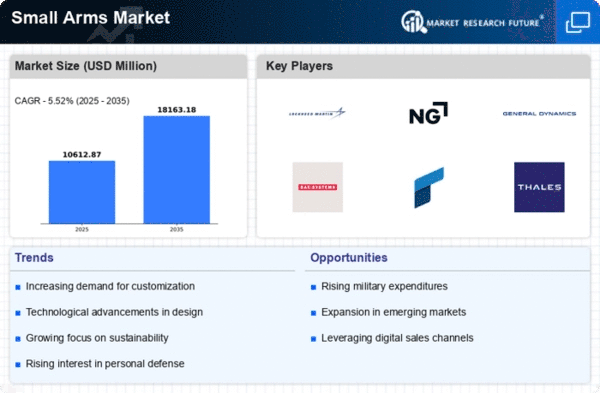
As per MRFR analysis, the Small Arms Market Size was estimated at 10057.69 USD Million in 2024. The Small Arms industry is projected to grow from 10612.9 in 2025 to 18163.18 by 2035, exhibiting a compound annual growth rate (CAGR) of 5.52% during the forecast period 2025 - 2035.

Key Market Trends & Highlights

The Small Arms Market is experiencing a dynamic shift driven by technological advancements and evolving consumer preferences.

  • Technological advancements are reshaping the Small Arms Market, enhancing performance and user experience. Customization and personalization are increasingly sought after, particularly in the civilian segment, reflecting changing consumer demands. North America remains the largest market, while the Asia-Pacific region is emerging as the fastest-growing area for small arms. Rising defense budgets and geopolitical tensions are significant drivers propelling growth in both military and civilian segments.

Market Size & Forecast

2024 Market Size 10057.69 (USD Million)
2035 Market Size 18163.18 (USD Million)
CAGR (2025 - 2035) 5.52%
Largest Regional Market Share in 2024 North America

Major Players

Lockheed Martin (US), Northrop Grumman (US), General Dynamics (US), BAE Systems (GB), Rheinmetall (DE), Thales Group (FR), FN Herstal (BE), SIG Sauer (DE), Beretta (IT)

Market Trends

The Small Arms Market is currently experiencing a dynamic evolution, influenced by various factors including geopolitical tensions, technological advancements, and changing consumer preferences shaping the global small arms market. The demand for small arms is driven by both military and civilian sectors, with an increasing focus on personal safety and security. As nations continue to modernize their defense capabilities, the procurement of advanced small arms systems appears to be a priority. Furthermore, the rise of non-state actors and asymmetric warfare has led to a heightened emphasis on lightweight and versatile weaponry, which could reshape the competitive landscape and influence small arms market share distribution.

In addition, the Small Arms Market is witnessing a shift towards more sustainable and responsible practices within the small arms market ecosystem. Manufacturers are increasingly adopting environmentally friendly production methods and materials, responding to growing concerns about the ecological impact of weapon manufacturing. This trend may also be influenced by regulatory changes and public sentiment, which seem to favor transparency and accountability in the arms industry. As the market continues to evolve, stakeholders must navigate these complexities while remaining attuned to emerging opportunities and challenges affecting overall small arms market share.

Technological Advancements

The Small Arms Market is seeing rapid innovation, with manufacturers integrating cutting-edge technologies such as smart targeting systems and modular designs, strengthening competitive positioning in the small arms market. These advancements enhance the functionality and adaptability of small arms, catering to diverse operational needs.

Increased Focus on Personal Security

There is a noticeable rise in consumer interest in personal defense products, driven by concerns over safety and crime rates, supporting expansion of the global small arms market. This trend is prompting manufacturers to develop compact and user-friendly firearms for civilian markets.

Sustainability Initiatives

The Small Arms Market is gradually shifting towards sustainable practices, reflecting broader trends shaping the small arms market landscape. This movement reflects a broader societal demand for responsible manufacturing in the defense sector.

Small Arms Market Market Drivers

Civilian Demand for Firearms

The Global Small Arms Industry is also influenced by the rising civilian demand for firearms. Factors such as personal safety concerns, hunting, and sport shooting contribute to this trend. In many countries, there is a growing acceptance of firearm ownership, leading to increased sales of small arms to civilians. For instance, the number of registered firearms in the United States has reached over 400 million, reflecting a robust civilian market. This demand is expected to sustain the growth of the industry, as manufacturers adapt their offerings to meet the needs of civilian customers.

Rising Global Defense Budgets

The Global Small Arms Industry is experiencing growth driven by increasing defense budgets across various nations. Countries are prioritizing military modernization and enhancing their defense capabilities, leading to a surge in demand for small arms. For instance, the global defense spending is projected to reach approximately 2.1 trillion USD in 2024, with a significant portion allocated to small arms procurement. This trend indicates a robust market environment, as governments seek to bolster their military readiness in response to evolving security threats. As a result, the Global Small Arms Industry is anticipated to grow to 10.1 USD Billion in 2024.

Regulatory Changes and Policies

Regulatory changes and policies play a significant role in shaping the Global Small Arms Industry. Governments are continuously revising their firearms regulations, which can either facilitate or hinder market growth. For example, some countries are implementing stricter controls on firearm sales, while others are easing restrictions to promote civilian ownership. These regulatory environments can create opportunities for manufacturers to expand their market presence or adapt their strategies accordingly. As such, understanding the regulatory landscape is crucial for stakeholders in the Global Small Arms Industry.

Escalating Geopolitical Tensions

Geopolitical tensions are a critical driver of the Global Small Arms Industry. Ongoing conflicts and territorial disputes in regions such as Eastern Europe and the Middle East have heightened the demand for small arms. Nations are increasingly investing in their military capabilities to address perceived threats, which in turn fuels the small arms market. For example, the conflict in Ukraine has prompted neighboring countries to enhance their military arsenals. This environment of uncertainty is likely to sustain the market's growth trajectory, with projections indicating an increase to 18.1 USD Billion by 2035.

Technological Advancements in Small Arms

Technological advancements are reshaping the Global Small Arms Industry, leading to the development of more efficient and effective weaponry. Innovations such as smart ammunition, modular weapon systems, and enhanced targeting technologies are becoming increasingly prevalent. These advancements not only improve the operational capabilities of small arms but also attract investment from defense contractors and governments alike. As a result, the market is poised for growth, with a projected compound annual growth rate of 5.5% from 2025 to 2035. This trend underscores the importance of technological innovation in driving market dynamics.

Market Segment Insights

By Application: Military (Largest) vs. Civilian (Fastest-Growing)

In the Small Arms Market, the application segments include Military, Law Enforcement, and Civilian. Among these, the Military segment currently holds the largest market share, largely driven by government spending, military modernization programs, and international defense collaborations contributing to overall small arms market share. The Law Enforcement segment follows, with stable demand fueled by crime rates and public safety initiatives, while the Civilian segment has seen significant growth as more individuals seek self-defense options, sporting activities, and recreational shooting opportunities.

Military (Dominant) vs. Civilian (Emerging)

The Military segment is characterized by its extensive procurement processes and high-volume contracts, reinforcing its dominance within the small arms market. This segment remains dominant due to ongoing geopolitical tensions and the need for enhanced defense capabilities. In contrast, the Civilian segment is emerging rapidly, driven by rising awareness of personal safety, increased participation in shooting sports, and the liberalization of gun laws in various regions. This segment is increasingly appealing to manufacturers, who are developing new products tailored to civilian needs, thus expanding their market reach.

By Type: Handguns (Largest) vs. Rifles (Fastest-Growing)

The Small Arms Market exhibits a diverse segmentation, but the handgun segment clearly leads, holding the largest market share among small arms products and influencing overall small arms market share. This dominance can be attributed to their extensive use in personal defense, law enforcement, and recreational shooting, making them a staple in the firearms market. Conversely, rifles, while currently smaller than handguns, are quickly gaining popularity, particularly among sport shooters and hunters, thus contributing to their status as the fastest-growing segment.

Handguns (Dominant) vs. Rifles (Emerging)

Handguns are favored for their compact design and versatility, appealing to a wide range of consumers and strengthening growth in the small arms market. Their popularity is supported by a vast availability of options and accessories, allowing users to customize their firearms. Meanwhile, rifles are emerging as a strong segment, driven by increased interest in hunting and shooting sports. Advances in technology have led to the development of lightweight, modular rifles that enhance user experience and performance, drawing in new enthusiasts and ensuring steady growth in this segment.

By Caliber: Small Caliber (Largest) vs. Large Caliber (Fastest-Growing)

The Small Arms Market exhibits diverse calibers, with Small Caliber weapons commanding the largest share contributing to global small arms market share. This segment caters primarily to military and civilian needs, driven by a broad range of applications such as training, personal defense, and sports shooting. In contrast, Large Caliber firearms, while smaller in market share, are increasingly recognized for their advancements in technology and performance in defense sectors, leading to a surge in demand. Growth trends reveal that while Small Caliber remains strong due its established market presence, the Large Caliber segment is witnessing significant momentum. The rising focus on advanced military capabilities, increasing defense budgets, and the need for effective weaponry in combat situations are propelling the Large Caliber market. Additionally, the appeal of superior performance and precision is driving innovation and interest among consumers, establishing it as a key area for growth.

Small Caliber (Dominant) vs. Large Caliber (Emerging)

The small caliber segment plays a pivotal role in the Small Arms Market, widely recognized for its dominance in terms of sales volume and usage across various sectors. This segment encompasses <a href="https://www.marketresearchfuture.com/reports/ammunition-market-21389" target="_blank" rel="noopener">ammunition</a> used in pistols and submachine guns, appealing to both civilian and professional users. On the other hand, the large caliber segment is noted for its emerging position, driven by advancements in technology and a surge in military acquisitions. Its applications in heavy machine guns and artillery systems are accelerating interest, making it a focal point for defense contracts and innovations that enhance firepower.

By Material: Steel (Largest) vs. Polymer (Fastest-Growing)

The Small Arms Market exhibits a diverse material segment, with steel being the largest component. It holds significant market share due to its durability and strength, making it a preferred choice for manufacturers of firearms and ammunition. In contrast, polymer materials have emerged as a fast-growing alternative, appealing to both manufacturers and consumers looking for lightweight and corrosion-resistant options. As the market evolves, the distribution of shares indicates a shift towards innovative materials that enhance the functionality and usability of small arms.

Steel (Dominant) vs. Polymer (Emerging)

Steel remains the dominant material in the small arms market, prized for its robustness and efficiency in handling high-impact forces. It serves as the primary material for many firearm components, offering a reliable performance under various conditions. Meanwhile, polymer has emerged as an innovative substitute, especially among modern firearm designs. It is favored for its lightweight nature, which contributes to ease of use and portability. As manufacturers increasingly focus on reducing weight without compromising performance, polymer's role in both the production and design of firearms is expected to accelerate, appealing to a wider range of users, including military, law enforcement, and recreational shooters.

By Operation Mechanism: Semi-Automatic (Largest) vs. Automatic (Fastest-Growing)

The Small Arms Market is characterized by distinct operation mechanisms, with semi-automatic firearms commanding the largest market share. This popularity is driven by their ability to balance ease of use and fire rate, making them a preferred choice for both civilian and law enforcement applications. In contrast, manual firearms, while still relevant, have seen a gradual decline in market presence due to their slower operation and reloading processes compared to their semi-automatic counterparts. Growth trends indicate that automatic firearms are emerging as the fastest-growing segment, propelled by advancements in technology and increased demand from military and special forces operations. The rise in global security concerns and modernization of armed forces have led to a greater emphasis on automatic weapons, positioning them as essential tools in contemporary combat and tactical scenarios.

Semi-Automatic (Dominant) vs. Automatic (Emerging)

Semi-automatic firearms dominate the Small Arms Market due to their versatility and user-friendly nature. They allow for rapid firing without the need for manual reloading after each shot, appealing to both recreational shooters and law enforcement agencies. These features enhance their operational efficiency, making them ideal for self-defense and competitive shooting. On the other hand, automatic firearms are rapidly emerging, driven by increased military spending and a focus on advanced weaponry. These firearms are designed for sustained fire and flexibility in tactical applications, making them crucial for modern warfare. Their growing adoption by special operations forces showcases their value in intense combat situations, thus highlighting a significant trend towards enhanced firepower and reliability.

Get more detailed insights about Small Arms Market Research Report – Global Forecast till 2035

Regional Insights

North America : Market Leader in Small Arms

North America continues to lead the small arms market, holding a significant share of 5028.85 million in 2024, strengthening its dominance in the global small arms market and overall small arms market share. The region's growth is driven by increasing defense budgets, technological advancements, and a strong focus on homeland security. Regulatory support from government agencies further catalyzes market expansion, ensuring compliance with safety and operational standards. The demand for advanced weaponry and personal defense systems is also on the rise, reflecting a robust market outlook. The competitive landscape in North America is characterized by the presence of major players such as Lockheed Martin, Northrop Grumman, and General Dynamics. These companies are at the forefront of innovation, developing cutting-edge small arms technologies. The U.S. remains the leading country, with a well-established defense infrastructure and a commitment to maintaining military superiority. This environment fosters collaboration between government and industry, enhancing the region's market position.

Europe : Emerging Market with Growth Potential

Europe's small arms market is projected to grow, with a market size of 3051.54 million in 2024. Europe's small arms market is projected to grow, supported by modernization initiatives expanding the small arms market. Regulatory frameworks are evolving to enhance safety and interoperability among member states, which is crucial for market growth. The demand for both military and civilian small arms is expected to rise, supported by government initiatives and partnerships. Leading countries in Europe include Germany, the UK, and France, where companies like Rheinmetall and BAE Systems are key players. The competitive landscape is marked by innovation and collaboration among manufacturers, ensuring compliance with stringent regulations. The European market is characterized by a mix of established firms and emerging players, all striving to meet the growing demand for advanced small arms solutions.

Asia-Pacific : Growing Demand in Emerging Markets

The Asia-Pacific region is witnessing a burgeoning small arms market, valued at 1743.08 million in 2024. The Asia-Pacific region is witnessing a burgeoning small arms market driven by rising investments contributing to global small arms market share. Governments are investing in modernizing their armed forces, which is driving demand for advanced small arms. Regulatory frameworks are also being developed to ensure compliance with international standards, further supporting market growth. Key players in the Asia-Pacific market include local manufacturers and international firms looking to expand their footprint. Countries like India, China, and Japan are leading the charge, with significant investments in defense capabilities. The competitive landscape is dynamic, with a mix of established companies and new entrants striving to capture market share. This region's potential for growth is substantial, making it a focal point for small arms manufacturers.

Middle East and Africa : Emerging Market with Unique Challenges

The Middle East and Africa small arms market, valued at approximately 507.69 million, is characterized by unique challenges and opportunities. The region faces ongoing security threats, prompting governments to invest in military capabilities. This demand is further supported by international partnerships and arms trade agreements, which are crucial for enhancing local defense industries. Leading countries include South Africa and the UAE, where local manufacturers are increasingly collaborating with international firms to boost production capabilities. The competitive landscape is marked by a mix of established players and emerging companies, all striving to meet the growing demand for small arms. This environment presents significant opportunities for innovation and market expansion.

Key Players and Competitive Insights

The Small Arms Market is characterized by a dynamic competitive landscape, driven by technological advancements, geopolitical tensions, and evolving defense strategies. Key players such as Lockheed Martin (US), Rheinmetall (DE), and SIG Sauer (DE) are at the forefront, each adopting distinct strategies to enhance their market positioning. Lockheed Martin (US) focuses on innovation and digital transformation, investing heavily in R&D to develop next-generation weaponry. Rheinmetall (DE) emphasizes regional expansion, particularly in Europe, to capitalize on increasing defense budgets. Meanwhile, SIG Sauer (DE) is leveraging partnerships with military organizations to tailor its offerings, thereby enhancing its competitive edge.The market structure appears moderately fragmented, with a mix of established players and emerging companies. Key tactics such as localizing manufacturing and optimizing supply chains are prevalent among major firms, allowing them to respond swiftly to market demands and geopolitical shifts. The collective influence of these players shapes a competitive environment where agility and responsiveness are paramount.
In November Lockheed Martin (US) announced a strategic partnership with a leading tech firm to integrate AI capabilities into its small arms systems. This move is likely to enhance operational efficiency and improve targeting accuracy, reflecting a broader trend towards the incorporation of advanced technologies in defense applications. Such innovations may redefine operational paradigms within the market.
In October Rheinmetall (DE) secured a significant contract with a European nation for the supply of advanced small arms, marking a pivotal expansion in its portfolio. This contract not only underscores Rheinmetall's commitment to meeting the growing demand for modernized defense solutions but also positions the company as a key player in the European defense landscape, potentially influencing regional security dynamics.
In September SIG Sauer (DE) launched a new line of modular firearms designed for versatility in various combat scenarios. This product introduction aligns with the increasing demand for adaptable weaponry among military forces, suggesting that SIG Sauer is strategically positioning itself to capture a larger market share by addressing specific operational needs of its clients.
As of December the Small Arms Market is witnessing trends such as digitalization, sustainability, and AI integration, which are reshaping competitive dynamics. Strategic alliances are becoming increasingly vital, enabling companies to pool resources and expertise to innovate more effectively. The competitive differentiation is likely to evolve from traditional price-based competition towards a focus on technological innovation, supply chain reliability, and sustainability, indicating a transformative shift in how companies approach market challenges.

Key Companies in the Small Arms Market include

Industry Developments

Homeland Security

Future Outlook

Small Arms Market Future Outlook

The Small Arms Market is projected to grow at a 5.52% CAGR from 2025 to 2035, driven by increasing defense budgets, rising civilian demand, and technological advancements.

New opportunities lie in:

  • <p>Development of smart firearms with integrated safety features. Expansion into emerging markets with tailored product offerings. Investment in advanced manufacturing technologies for cost reduction.</p>

By 2035, the Small Arms Market is expected to achieve robust growth, reflecting evolving consumer and defense sector needs.

Market Segmentation

Small Arms Market Type Outlook

  • Handguns
  • Rifles
  • Shotguns
  • Submachine Guns

Small Arms Market Caliber Outlook

  • Small Caliber
  • Medium Caliber
  • Large Caliber

Small Arms Market Material Outlook

  • Steel
  • Aluminum
  • Polymer
  • Composite

Small Arms Market Application Outlook

  • Military
  • Law Enforcement
  • Civilian

Small Arms Market Operation Mechanism Outlook

  • Manual
  • Semi-Automatic
  • Automatic

Report Scope

MARKET SIZE 2024 10057.69(USD Million)
MARKET SIZE 2025 10612.9(USD Million)
MARKET SIZE 2035 18163.18(USD Million)
COMPOUND ANNUAL GROWTH RATE (CAGR) 5.52% (2025 - 2035)
REPORT COVERAGE Revenue Forecast, Competitive Landscape, Growth Factors, and Trends
BASE YEAR 2024
Market Forecast Period 2025 - 2035
Historical Data 2019 - 2024
Market Forecast Units USD Million
Key Companies Profiled Lockheed Martin (US), Northrop Grumman (US), General Dynamics (US), BAE Systems (GB), Rheinmetall (DE), Thales Group (FR), FN Herstal (BE), SIG Sauer (DE), Beretta (IT)
Segments Covered Application, Type, Caliber, Material, Operation Mechanism
Key Market Opportunities Integration of advanced technologies in the Small Arms Market enhances operational efficiency and user safety.
Key Market Dynamics Evolving regulatory frameworks and technological advancements reshape competitive dynamics in the Small Arms Market.
Countries Covered North America, Europe, APAC, South America, MEA

FAQs

What is the current valuation of the Small Arms Market as of 2025?

<p>The Small Arms Market is valued at approximately 10057.69 USD Million in 2024.</p>

What is the projected market valuation for the Small Arms Market in 2035?

<p>The market is projected to reach a valuation of 18163.18 USD Million by 2035.</p>

What is the expected CAGR for the Small Arms Market during the forecast period 2025 - 2035?

<p>The expected CAGR for the Small Arms Market during the forecast period 2025 - 2035 is 5.52%.</p>

Which companies are considered key players in the Small Arms Market?

<p>Key players in the Small Arms Market include Lockheed Martin, Northrop Grumman, General Dynamics, and BAE Systems.</p>

How does the Small Arms Market segment by application?

The market segments by application into Military, Law Enforcement, and Civilian, with valuations ranging from 4000.0 to 8000.0 USD Million for Military.

What are the different types of small arms in the market?

The market categorizes small arms into Handguns, Rifles, Shotguns, and Submachine Guns, with Handguns valued between 2500.0 and 4500.0 USD Million.

What is the market valuation for small arms by caliber?

By caliber, the Small Arms Market is valued between 4000.0 and 7000.0 USD Million for Small Caliber arms.

What materials are commonly used in the production of small arms?

The market includes materials such as Steel, Aluminum, and Polymer, with Steel valued between 3000.0 and 5500.0 USD Million.

What operational mechanisms are present in the Small Arms Market?

The market features operational mechanisms including Manual, Semi-Automatic, and Automatic, with Semi-Automatic arms valued between 4000.0 and 7000.0 USD Million.

How does the Small Arms Market's growth compare across different segments?

The growth across segments appears varied, with Military and Law Enforcement applications showing substantial valuations compared to Civilian applications.

  1. SECTION I: EXECUTIVE SUMMARY AND KEY HIGHLIGHTS
    1. | 1.1 EXECUTIVE SUMMARY
    2. | | 1.1.1 Market Overview
    3. | | 1.1.2 Key Findings
    4. | | 1.1.3 Market Segmentation
    5. | | 1.1.4 Competitive Landscape
    6. | | 1.1.5 Challenges and Opportunities
    7. | | 1.1.6 Future Outlook
  2. SECTION II: SCOPING, METHODOLOGY AND MARKET STRUCTURE
    1. | 2.1 MARKET INTRODUCTION
    2. | | 2.1.1 Definition
    3. | | 2.1.2 Scope of the study
    4. | | | 2.1.2.1 Research Objective
    5. | | | 2.1.2.2 Assumption
    6. | | | 2.1.2.3 Limitations
    7. | 2.2 RESEARCH METHODOLOGY
    8. | | 2.2.1 Overview
    9. | | 2.2.2 Data Mining
    10. | | 2.2.3 Secondary Research
    11. | | 2.2.4 Primary Research
    12. | | | 2.2.4.1 Primary Interviews and Information Gathering Process
    13. | | | 2.2.4.2 Breakdown of Primary Respondents
    14. | | 2.2.5 Forecasting Model
    15. | | 2.2.6 Market Size Estimation
    16. | | | 2.2.6.1 Bottom-Up Approach
    17. | | | 2.2.6.2 Top-Down Approach
    18. | | 2.2.7 Data Triangulation
    19. | | 2.2.8 Validation
  3. SECTION III: QUALITATIVE ANALYSIS
    1. | 3.1 MARKET DYNAMICS
    2. | | 3.1.1 Overview
    3. | | 3.1.2 Drivers
    4. | | 3.1.3 Restraints
    5. | | 3.1.4 Opportunities
    6. | 3.2 MARKET FACTOR ANALYSIS
    7. | | 3.2.1 Value chain Analysis
    8. | | 3.2.2 Porter's Five Forces Analysis
    9. | | | 3.2.2.1 Bargaining Power of Suppliers
    10. | | | 3.2.2.2 Bargaining Power of Buyers
    11. | | | 3.2.2.3 Threat of New Entrants
    12. | | | 3.2.2.4 Threat of Substitutes
    13. | | | 3.2.2.5 Intensity of Rivalry
    14. | | 3.2.3 COVID-19 Impact Analysis
    15. | | | 3.2.3.1 Market Impact Analysis
    16. | | | 3.2.3.2 Regional Impact
    17. | | | 3.2.3.3 Opportunity and Threat Analysis
  4. SECTION IV: QUANTITATIVE ANALYSIS
    1. | 4.1 Aerospace & Defense, BY Application (USD Million)
    2. | | 4.1.1 Military
    3. | | 4.1.2 Law Enforcement
    4. | | 4.1.3 Civilian
    5. | 4.2 Aerospace & Defense, BY Type (USD Million)
    6. | | 4.2.1 Handguns
    7. | | 4.2.2 Rifles
    8. | | 4.2.3 Shotguns
    9. | | 4.2.4 Submachine Guns
    10. | 4.3 Aerospace & Defense, BY Caliber (USD Million)
    11. | | 4.3.1 Small Caliber
    12. | | 4.3.2 Medium Caliber
    13. | | 4.3.3 Large Caliber
    14. | 4.4 Aerospace & Defense, BY Material (USD Million)
    15. | | 4.4.1 Steel
    16. | | 4.4.2 Aluminum
    17. | | 4.4.3 Polymer
    18. | | 4.4.4 Composite
    19. | 4.5 Aerospace & Defense, BY Operation Mechanism (USD Million)
    20. | | 4.5.1 Manual
    21. | | 4.5.2 Semi-Automatic
    22. | | 4.5.3 Automatic
    23. | 4.6 Aerospace & Defense, BY Region (USD Million)
    24. | | 4.6.1 North America
    25. | | | 4.6.1.1 US
    26. | | | 4.6.1.2 Canada
    27. | | 4.6.2 Europe
    28. | | | 4.6.2.1 Germany
    29. | | | 4.6.2.2 UK
    30. | | | 4.6.2.3 France
    31. | | | 4.6.2.4 Russia
    32. | | | 4.6.2.5 Italy
    33. | | | 4.6.2.6 Spain
    34. | | | 4.6.2.7 Rest of Europe
    35. | | 4.6.3 APAC
    36. | | | 4.6.3.1 China
    37. | | | 4.6.3.2 India
    38. | | | 4.6.3.3 Japan
    39. | | | 4.6.3.4 South Korea
    40. | | | 4.6.3.5 Malaysia
    41. | | | 4.6.3.6 Thailand
    42. | | | 4.6.3.7 Indonesia
    43. | | | 4.6.3.8 Rest of APAC
    44. | | 4.6.4 South America
    45. | | | 4.6.4.1 Brazil
    46. | | | 4.6.4.2 Mexico
    47. | | | 4.6.4.3 Argentina
    48. | | | 4.6.4.4 Rest of South America
    49. | | 4.6.5 MEA
    50. | | | 4.6.5.1 GCC Countries
    51. | | | 4.6.5.2 South Africa
    52. | | | 4.6.5.3 Rest of MEA
  5. SECTION V: COMPETITIVE ANALYSIS
    1. | 5.1 Competitive Landscape
    2. | | 5.1.1 Overview
    3. | | 5.1.2 Competitive Analysis
    4. | | 5.1.3 Market share Analysis
    5. | | 5.1.4 Major Growth Strategy in the Aerospace & Defense
    6. | | 5.1.5 Competitive Benchmarking
    7. | | 5.1.6 Leading Players in Terms of Number of Developments in the Aerospace & Defense
    8. | | 5.1.7 Key developments and growth strategies
    9. | | | 5.1.7.1 New Product Launch/Service Deployment
    10. | | | 5.1.7.2 Merger & Acquisitions
    11. | | | 5.1.7.3 Joint Ventures
    12. | | 5.1.8 Major Players Financial Matrix
    13. | | | 5.1.8.1 Sales and Operating Income
    14. | | | 5.1.8.2 Major Players R&D Expenditure. 2023
    15. | 5.2 Company Profiles
    16. | | 5.2.1 Lockheed Martin (US)
    17. | | | 5.2.1.1 Financial Overview
    18. | | | 5.2.1.2 Products Offered
    19. | | | 5.2.1.3 Key Developments
    20. | | | 5.2.1.4 SWOT Analysis
    21. | | | 5.2.1.5 Key Strategies
    22. | | 5.2.2 Northrop Grumman (US)
    23. | | | 5.2.2.1 Financial Overview
    24. | | | 5.2.2.2 Products Offered
    25. | | | 5.2.2.3 Key Developments
    26. | | | 5.2.2.4 SWOT Analysis
    27. | | | 5.2.2.5 Key Strategies
    28. | | 5.2.3 General Dynamics (US)
    29. | | | 5.2.3.1 Financial Overview
    30. | | | 5.2.3.2 Products Offered
    31. | | | 5.2.3.3 Key Developments
    32. | | | 5.2.3.4 SWOT Analysis
    33. | | | 5.2.3.5 Key Strategies
    34. | | 5.2.4 BAE Systems (GB)
    35. | | | 5.2.4.1 Financial Overview
    36. | | | 5.2.4.2 Products Offered
    37. | | | 5.2.4.3 Key Developments
    38. | | | 5.2.4.4 SWOT Analysis
    39. | | | 5.2.4.5 Key Strategies
    40. | | 5.2.5 Rheinmetall (DE)
    41. | | | 5.2.5.1 Financial Overview
    42. | | | 5.2.5.2 Products Offered
    43. | | | 5.2.5.3 Key Developments
    44. | | | 5.2.5.4 SWOT Analysis
    45. | | | 5.2.5.5 Key Strategies
    46. | | 5.2.6 Thales Group (FR)
    47. | | | 5.2.6.1 Financial Overview
    48. | | | 5.2.6.2 Products Offered
    49. | | | 5.2.6.3 Key Developments
    50. | | | 5.2.6.4 SWOT Analysis
    51. | | | 5.2.6.5 Key Strategies
    52. | | 5.2.7 FN Herstal (BE)
    53. | | | 5.2.7.1 Financial Overview
    54. | | | 5.2.7.2 Products Offered
    55. | | | 5.2.7.3 Key Developments
    56. | | | 5.2.7.4 SWOT Analysis
    57. | | | 5.2.7.5 Key Strategies
    58. | | 5.2.8 SIG Sauer (DE)
    59. | | | 5.2.8.1 Financial Overview
    60. | | | 5.2.8.2 Products Offered
    61. | | | 5.2.8.3 Key Developments
    62. | | | 5.2.8.4 SWOT Analysis
    63. | | | 5.2.8.5 Key Strategies
    64. | | 5.2.9 Beretta (IT)
    65. | | | 5.2.9.1 Financial Overview
    66. | | | 5.2.9.2 Products Offered
    67. | | | 5.2.9.3 Key Developments
    68. | | | 5.2.9.4 SWOT Analysis
    69. | | | 5.2.9.5 Key Strategies
    70. | 5.3 Appendix
    71. | | 5.3.1 References
    72. | | 5.3.2 Related Reports
  6. LIST OF FIGURES
    1. | 6.1 MARKET SYNOPSIS
    2. | 6.2 NORTH AMERICA MARKET ANALYSIS
    3. | 6.3 US MARKET ANALYSIS BY APPLICATION
    4. | 6.4 US MARKET ANALYSIS BY TYPE
    5. | 6.5 US MARKET ANALYSIS BY CALIBER
    6. | 6.6 US MARKET ANALYSIS BY MATERIAL
    7. | 6.7 US MARKET ANALYSIS BY OPERATION MECHANISM
    8. | 6.8 CANADA MARKET ANALYSIS BY APPLICATION
    9. | 6.9 CANADA MARKET ANALYSIS BY TYPE
    10. | 6.10 CANADA MARKET ANALYSIS BY CALIBER
    11. | 6.11 CANADA MARKET ANALYSIS BY MATERIAL
    12. | 6.12 CANADA MARKET ANALYSIS BY OPERATION MECHANISM
    13. | 6.13 EUROPE MARKET ANALYSIS
    14. | 6.14 GERMANY MARKET ANALYSIS BY APPLICATION
    15. | 6.15 GERMANY MARKET ANALYSIS BY TYPE
    16. | 6.16 GERMANY MARKET ANALYSIS BY CALIBER
    17. | 6.17 GERMANY MARKET ANALYSIS BY MATERIAL
    18. | 6.18 GERMANY MARKET ANALYSIS BY OPERATION MECHANISM
    19. | 6.19 UK MARKET ANALYSIS BY APPLICATION
    20. | 6.20 UK MARKET ANALYSIS BY TYPE
    21. | 6.21 UK MARKET ANALYSIS BY CALIBER
    22. | 6.22 UK MARKET ANALYSIS BY MATERIAL
    23. | 6.23 UK MARKET ANALYSIS BY OPERATION MECHANISM
    24. | 6.24 FRANCE MARKET ANALYSIS BY APPLICATION
    25. | 6.25 FRANCE MARKET ANALYSIS BY TYPE
    26. | 6.26 FRANCE MARKET ANALYSIS BY CALIBER
    27. | 6.27 FRANCE MARKET ANALYSIS BY MATERIAL
    28. | 6.28 FRANCE MARKET ANALYSIS BY OPERATION MECHANISM
    29. | 6.29 RUSSIA MARKET ANALYSIS BY APPLICATION
    30. | 6.30 RUSSIA MARKET ANALYSIS BY TYPE
    31. | 6.31 RUSSIA MARKET ANALYSIS BY CALIBER
    32. | 6.32 RUSSIA MARKET ANALYSIS BY MATERIAL
    33. | 6.33 RUSSIA MARKET ANALYSIS BY OPERATION MECHANISM
    34. | 6.34 ITALY MARKET ANALYSIS BY APPLICATION
    35. | 6.35 ITALY MARKET ANALYSIS BY TYPE
    36. | 6.36 ITALY MARKET ANALYSIS BY CALIBER
    37. | 6.37 ITALY MARKET ANALYSIS BY MATERIAL
    38. | 6.38 ITALY MARKET ANALYSIS BY OPERATION MECHANISM
    39. | 6.39 SPAIN MARKET ANALYSIS BY APPLICATION
    40. | 6.40 SPAIN MARKET ANALYSIS BY TYPE
    41. | 6.41 SPAIN MARKET ANALYSIS BY CALIBER
    42. | 6.42 SPAIN MARKET ANALYSIS BY MATERIAL
    43. | 6.43 SPAIN MARKET ANALYSIS BY OPERATION MECHANISM
    44. | 6.44 REST OF EUROPE MARKET ANALYSIS BY APPLICATION
    45. | 6.45 REST OF EUROPE MARKET ANALYSIS BY TYPE
    46. | 6.46 REST OF EUROPE MARKET ANALYSIS BY CALIBER
    47. | 6.47 REST OF EUROPE MARKET ANALYSIS BY MATERIAL
    48. | 6.48 REST OF EUROPE MARKET ANALYSIS BY OPERATION MECHANISM
    49. | 6.49 APAC MARKET ANALYSIS
    50. | 6.50 CHINA MARKET ANALYSIS BY APPLICATION
    51. | 6.51 CHINA MARKET ANALYSIS BY TYPE
    52. | 6.52 CHINA MARKET ANALYSIS BY CALIBER
    53. | 6.53 CHINA MARKET ANALYSIS BY MATERIAL
    54. | 6.54 CHINA MARKET ANALYSIS BY OPERATION MECHANISM
    55. | 6.55 INDIA MARKET ANALYSIS BY APPLICATION
    56. | 6.56 INDIA MARKET ANALYSIS BY TYPE
    57. | 6.57 INDIA MARKET ANALYSIS BY CALIBER
    58. | 6.58 INDIA MARKET ANALYSIS BY MATERIAL
    59. | 6.59 INDIA MARKET ANALYSIS BY OPERATION MECHANISM
    60. | 6.60 JAPAN MARKET ANALYSIS BY APPLICATION
    61. | 6.61 JAPAN MARKET ANALYSIS BY TYPE
    62. | 6.62 JAPAN MARKET ANALYSIS BY CALIBER
    63. | 6.63 JAPAN MARKET ANALYSIS BY MATERIAL
    64. | 6.64 JAPAN MARKET ANALYSIS BY OPERATION MECHANISM
    65. | 6.65 SOUTH KOREA MARKET ANALYSIS BY APPLICATION
    66. | 6.66 SOUTH KOREA MARKET ANALYSIS BY TYPE
    67. | 6.67 SOUTH KOREA MARKET ANALYSIS BY CALIBER
    68. | 6.68 SOUTH KOREA MARKET ANALYSIS BY MATERIAL
    69. | 6.69 SOUTH KOREA MARKET ANALYSIS BY OPERATION MECHANISM
    70. | 6.70 MALAYSIA MARKET ANALYSIS BY APPLICATION
    71. | 6.71 MALAYSIA MARKET ANALYSIS BY TYPE
    72. | 6.72 MALAYSIA MARKET ANALYSIS BY CALIBER
    73. | 6.73 MALAYSIA MARKET ANALYSIS BY MATERIAL
    74. | 6.74 MALAYSIA MARKET ANALYSIS BY OPERATION MECHANISM
    75. | 6.75 THAILAND MARKET ANALYSIS BY APPLICATION
    76. | 6.76 THAILAND MARKET ANALYSIS BY TYPE
    77. | 6.77 THAILAND MARKET ANALYSIS BY CALIBER
    78. | 6.78 THAILAND MARKET ANALYSIS BY MATERIAL
    79. | 6.79 THAILAND MARKET ANALYSIS BY OPERATION MECHANISM
    80. | 6.80 INDONESIA MARKET ANALYSIS BY APPLICATION
    81. | 6.81 INDONESIA MARKET ANALYSIS BY TYPE
    82. | 6.82 INDONESIA MARKET ANALYSIS BY CALIBER
    83. | 6.83 INDONESIA MARKET ANALYSIS BY MATERIAL
    84. | 6.84 INDONESIA MARKET ANALYSIS BY OPERATION MECHANISM
    85. | 6.85 REST OF APAC MARKET ANALYSIS BY APPLICATION
    86. | 6.86 REST OF APAC MARKET ANALYSIS BY TYPE
    87. | 6.87 REST OF APAC MARKET ANALYSIS BY CALIBER
    88. | 6.88 REST OF APAC MARKET ANALYSIS BY MATERIAL
    89. | 6.89 REST OF APAC MARKET ANALYSIS BY OPERATION MECHANISM
    90. | 6.90 SOUTH AMERICA MARKET ANALYSIS
    91. | 6.91 BRAZIL MARKET ANALYSIS BY APPLICATION
    92. | 6.92 BRAZIL MARKET ANALYSIS BY TYPE
    93. | 6.93 BRAZIL MARKET ANALYSIS BY CALIBER
    94. | 6.94 BRAZIL MARKET ANALYSIS BY MATERIAL
    95. | 6.95 BRAZIL MARKET ANALYSIS BY OPERATION MECHANISM
    96. | 6.96 MEXICO MARKET ANALYSIS BY APPLICATION
    97. | 6.97 MEXICO MARKET ANALYSIS BY TYPE
    98. | 6.98 MEXICO MARKET ANALYSIS BY CALIBER
    99. | 6.99 MEXICO MARKET ANALYSIS BY MATERIAL
    100. | 6.100 MEXICO MARKET ANALYSIS BY OPERATION MECHANISM
    101. | 6.101 ARGENTINA MARKET ANALYSIS BY APPLICATION
    102. | 6.102 ARGENTINA MARKET ANALYSIS BY TYPE
    103. | 6.103 ARGENTINA MARKET ANALYSIS BY CALIBER
    104. | 6.104 ARGENTINA MARKET ANALYSIS BY MATERIAL
    105. | 6.105 ARGENTINA MARKET ANALYSIS BY OPERATION MECHANISM
    106. | 6.106 REST OF SOUTH AMERICA MARKET ANALYSIS BY APPLICATION
    107. | 6.107 REST OF SOUTH AMERICA MARKET ANALYSIS BY TYPE
    108. | 6.108 REST OF SOUTH AMERICA MARKET ANALYSIS BY CALIBER
    109. | 6.109 REST OF SOUTH AMERICA MARKET ANALYSIS BY MATERIAL
    110. | 6.110 REST OF SOUTH AMERICA MARKET ANALYSIS BY OPERATION MECHANISM
    111. | 6.111 MEA MARKET ANALYSIS
    112. | 6.112 GCC COUNTRIES MARKET ANALYSIS BY APPLICATION
    113. | 6.113 GCC COUNTRIES MARKET ANALYSIS BY TYPE
    114. | 6.114 GCC COUNTRIES MARKET ANALYSIS BY CALIBER
    115. | 6.115 GCC COUNTRIES MARKET ANALYSIS BY MATERIAL
    116. | 6.116 GCC COUNTRIES MARKET ANALYSIS BY OPERATION MECHANISM
    117. | 6.117 SOUTH AFRICA MARKET ANALYSIS BY APPLICATION
    118. | 6.118 SOUTH AFRICA MARKET ANALYSIS BY TYPE
    119. | 6.119 SOUTH AFRICA MARKET ANALYSIS BY CALIBER
    120. | 6.120 SOUTH AFRICA MARKET ANALYSIS BY MATERIAL
    121. | 6.121 SOUTH AFRICA MARKET ANALYSIS BY OPERATION MECHANISM
    122. | 6.122 REST OF MEA MARKET ANALYSIS BY APPLICATION
    123. | 6.123 REST OF MEA MARKET ANALYSIS BY TYPE
    124. | 6.124 REST OF MEA MARKET ANALYSIS BY CALIBER
    125. | 6.125 REST OF MEA MARKET ANALYSIS BY MATERIAL
    126. | 6.126 REST OF MEA MARKET ANALYSIS BY OPERATION MECHANISM
    127. | 6.127 KEY BUYING CRITERIA OF AEROSPACE & DEFENSE
    128. | 6.128 RESEARCH PROCESS OF MRFR
    129. | 6.129 DRO ANALYSIS OF AEROSPACE & DEFENSE
    130. | 6.130 DRIVERS IMPACT ANALYSIS: AEROSPACE & DEFENSE
    131. | 6.131 RESTRAINTS IMPACT ANALYSIS: AEROSPACE & DEFENSE
    132. | 6.132 SUPPLY / VALUE CHAIN: AEROSPACE & DEFENSE
    133. | 6.133 AEROSPACE & DEFENSE, BY APPLICATION, 2024 (% SHARE)
    134. | 6.134 AEROSPACE & DEFENSE, BY APPLICATION, 2024 TO 2035 (USD Million)
    135. | 6.135 AEROSPACE & DEFENSE, BY TYPE, 2024 (% SHARE)
    136. | 6.136 AEROSPACE & DEFENSE, BY TYPE, 2024 TO 2035 (USD Million)
    137. | 6.137 AEROSPACE & DEFENSE, BY CALIBER, 2024 (% SHARE)
    138. | 6.138 AEROSPACE & DEFENSE, BY CALIBER, 2024 TO 2035 (USD Million)
    139. | 6.139 AEROSPACE & DEFENSE, BY MATERIAL, 2024 (% SHARE)
    140. | 6.140 AEROSPACE & DEFENSE, BY MATERIAL, 2024 TO 2035 (USD Million)
    141. | 6.141 AEROSPACE & DEFENSE, BY OPERATION MECHANISM, 2024 (% SHARE)
    142. | 6.142 AEROSPACE & DEFENSE, BY OPERATION MECHANISM, 2024 TO 2035 (USD Million)
    143. | 6.143 BENCHMARKING OF MAJOR COMPETITORS
  7. LIST OF TABLES
    1. | 7.1 LIST OF ASSUMPTIONS
    2. | | 7.1.1
    3. | 7.2 North America MARKET SIZE ESTIMATES; FORECAST
    4. | | 7.2.1 BY APPLICATION, 2025-2035 (USD Million)
    5. | | 7.2.2 BY TYPE, 2025-2035 (USD Million)
    6. | | 7.2.3 BY CALIBER, 2025-2035 (USD Million)
    7. | | 7.2.4 BY MATERIAL, 2025-2035 (USD Million)
    8. | | 7.2.5 BY OPERATION MECHANISM, 2025-2035 (USD Million)
    9. | 7.3 US MARKET SIZE ESTIMATES; FORECAST
    10. | | 7.3.1 BY APPLICATION, 2025-2035 (USD Million)
    11. | | 7.3.2 BY TYPE, 2025-2035 (USD Million)
    12. | | 7.3.3 BY CALIBER, 2025-2035 (USD Million)
    13. | | 7.3.4 BY MATERIAL, 2025-2035 (USD Million)
    14. | | 7.3.5 BY OPERATION MECHANISM, 2025-2035 (USD Million)
    15. | 7.4 Canada MARKET SIZE ESTIMATES; FORECAST
    16. | | 7.4.1 BY APPLICATION, 2025-2035 (USD Million)
    17. | | 7.4.2 BY TYPE, 2025-2035 (USD Million)
    18. | | 7.4.3 BY CALIBER, 2025-2035 (USD Million)
    19. | | 7.4.4 BY MATERIAL, 2025-2035 (USD Million)
    20. | | 7.4.5 BY OPERATION MECHANISM, 2025-2035 (USD Million)
    21. | 7.5 Europe MARKET SIZE ESTIMATES; FORECAST
    22. | | 7.5.1 BY APPLICATION, 2025-2035 (USD Million)
    23. | | 7.5.2 BY TYPE, 2025-2035 (USD Million)
    24. | | 7.5.3 BY CALIBER, 2025-2035 (USD Million)
    25. | | 7.5.4 BY MATERIAL, 2025-2035 (USD Million)
    26. | | 7.5.5 BY OPERATION MECHANISM, 2025-2035 (USD Million)
    27. | 7.6 Germany MARKET SIZE ESTIMATES; FORECAST
    28. | | 7.6.1 BY APPLICATION, 2025-2035 (USD Million)
    29. | | 7.6.2 BY TYPE, 2025-2035 (USD Million)
    30. | | 7.6.3 BY CALIBER, 2025-2035 (USD Million)
    31. | | 7.6.4 BY MATERIAL, 2025-2035 (USD Million)
    32. | | 7.6.5 BY OPERATION MECHANISM, 2025-2035 (USD Million)
    33. | 7.7 UK MARKET SIZE ESTIMATES; FORECAST
    34. | | 7.7.1 BY APPLICATION, 2025-2035 (USD Million)
    35. | | 7.7.2 BY TYPE, 2025-2035 (USD Million)
    36. | | 7.7.3 BY CALIBER, 2025-2035 (USD Million)
    37. | | 7.7.4 BY MATERIAL, 2025-2035 (USD Million)
    38. | | 7.7.5 BY OPERATION MECHANISM, 2025-2035 (USD Million)
    39. | 7.8 France MARKET SIZE ESTIMATES; FORECAST
    40. | | 7.8.1 BY APPLICATION, 2025-2035 (USD Million)
    41. | | 7.8.2 BY TYPE, 2025-2035 (USD Million)
    42. | | 7.8.3 BY CALIBER, 2025-2035 (USD Million)
    43. | | 7.8.4 BY MATERIAL, 2025-2035 (USD Million)
    44. | | 7.8.5 BY OPERATION MECHANISM, 2025-2035 (USD Million)
    45. | 7.9 Russia MARKET SIZE ESTIMATES; FORECAST
    46. | | 7.9.1 BY APPLICATION, 2025-2035 (USD Million)
    47. | | 7.9.2 BY TYPE, 2025-2035 (USD Million)
    48. | | 7.9.3 BY CALIBER, 2025-2035 (USD Million)
    49. | | 7.9.4 BY MATERIAL, 2025-2035 (USD Million)
    50. | | 7.9.5 BY OPERATION MECHANISM, 2025-2035 (USD Million)
    51. | 7.10 Italy MARKET SIZE ESTIMATES; FORECAST
    52. | | 7.10.1 BY APPLICATION, 2025-2035 (USD Million)
    53. | | 7.10.2 BY TYPE, 2025-2035 (USD Million)
    54. | | 7.10.3 BY CALIBER, 2025-2035 (USD Million)
    55. | | 7.10.4 BY MATERIAL, 2025-2035 (USD Million)
    56. | | 7.10.5 BY OPERATION MECHANISM, 2025-2035 (USD Million)
    57. | 7.11 Spain MARKET SIZE ESTIMATES; FORECAST
    58. | | 7.11.1 BY APPLICATION, 2025-2035 (USD Million)
    59. | | 7.11.2 BY TYPE, 2025-2035 (USD Million)
    60. | | 7.11.3 BY CALIBER, 2025-2035 (USD Million)
    61. | | 7.11.4 BY MATERIAL, 2025-2035 (USD Million)
    62. | | 7.11.5 BY OPERATION MECHANISM, 2025-2035 (USD Million)
    63. | 7.12 Rest of Europe MARKET SIZE ESTIMATES; FORECAST
    64. | | 7.12.1 BY APPLICATION, 2025-2035 (USD Million)
    65. | | 7.12.2 BY TYPE, 2025-2035 (USD Million)
    66. | | 7.12.3 BY CALIBER, 2025-2035 (USD Million)
    67. | | 7.12.4 BY MATERIAL, 2025-2035 (USD Million)
    68. | | 7.12.5 BY OPERATION MECHANISM, 2025-2035 (USD Million)
    69. | 7.13 APAC MARKET SIZE ESTIMATES; FORECAST
    70. | | 7.13.1 BY APPLICATION, 2025-2035 (USD Million)
    71. | | 7.13.2 BY TYPE, 2025-2035 (USD Million)
    72. | | 7.13.3 BY CALIBER, 2025-2035 (USD Million)
    73. | | 7.13.4 BY MATERIAL, 2025-2035 (USD Million)
    74. | | 7.13.5 BY OPERATION MECHANISM, 2025-2035 (USD Million)
    75. | 7.14 China MARKET SIZE ESTIMATES; FORECAST
    76. | | 7.14.1 BY APPLICATION, 2025-2035 (USD Million)
    77. | | 7.14.2 BY TYPE, 2025-2035 (USD Million)
    78. | | 7.14.3 BY CALIBER, 2025-2035 (USD Million)
    79. | | 7.14.4 BY MATERIAL, 2025-2035 (USD Million)
    80. | | 7.14.5 BY OPERATION MECHANISM, 2025-2035 (USD Million)
    81. | 7.15 India MARKET SIZE ESTIMATES; FORECAST
    82. | | 7.15.1 BY APPLICATION, 2025-2035 (USD Million)
    83. | | 7.15.2 BY TYPE, 2025-2035 (USD Million)
    84. | | 7.15.3 BY CALIBER, 2025-2035 (USD Million)
    85. | | 7.15.4 BY MATERIAL, 2025-2035 (USD Million)
    86. | | 7.15.5 BY OPERATION MECHANISM, 2025-2035 (USD Million)
    87. | 7.16 Japan MARKET SIZE ESTIMATES; FORECAST
    88. | | 7.16.1 BY APPLICATION, 2025-2035 (USD Million)
    89. | | 7.16.2 BY TYPE, 2025-2035 (USD Million)
    90. | | 7.16.3 BY CALIBER, 2025-2035 (USD Million)
    91. | | 7.16.4 BY MATERIAL, 2025-2035 (USD Million)
    92. | | 7.16.5 BY OPERATION MECHANISM, 2025-2035 (USD Million)
    93. | 7.17 South Korea MARKET SIZE ESTIMATES; FORECAST
    94. | | 7.17.1 BY APPLICATION, 2025-2035 (USD Million)
    95. | | 7.17.2 BY TYPE, 2025-2035 (USD Million)
    96. | | 7.17.3 BY CALIBER, 2025-2035 (USD Million)
    97. | | 7.17.4 BY MATERIAL, 2025-2035 (USD Million)
    98. | | 7.17.5 BY OPERATION MECHANISM, 2025-2035 (USD Million)
    99. | 7.18 Malaysia MARKET SIZE ESTIMATES; FORECAST
    100. | | 7.18.1 BY APPLICATION, 2025-2035 (USD Million)
    101. | | 7.18.2 BY TYPE, 2025-2035 (USD Million)
    102. | | 7.18.3 BY CALIBER, 2025-2035 (USD Million)
    103. | | 7.18.4 BY MATERIAL, 2025-2035 (USD Million)
    104. | | 7.18.5 BY OPERATION MECHANISM, 2025-2035 (USD Million)
    105. | 7.19 Thailand MARKET SIZE ESTIMATES; FORECAST
    106. | | 7.19.1 BY APPLICATION, 2025-2035 (USD Million)
    107. | | 7.19.2 BY TYPE, 2025-2035 (USD Million)
    108. | | 7.19.3 BY CALIBER, 2025-2035 (USD Million)
    109. | | 7.19.4 BY MATERIAL, 2025-2035 (USD Million)
    110. | | 7.19.5 BY OPERATION MECHANISM, 2025-2035 (USD Million)
    111. | 7.20 Indonesia MARKET SIZE ESTIMATES; FORECAST
    112. | | 7.20.1 BY APPLICATION, 2025-2035 (USD Million)
    113. | | 7.20.2 BY TYPE, 2025-2035 (USD Million)
    114. | | 7.20.3 BY CALIBER, 2025-2035 (USD Million)
    115. | | 7.20.4 BY MATERIAL, 2025-2035 (USD Million)
    116. | | 7.20.5 BY OPERATION MECHANISM, 2025-2035 (USD Million)
    117. | 7.21 Rest of APAC MARKET SIZE ESTIMATES; FORECAST
    118. | | 7.21.1 BY APPLICATION, 2025-2035 (USD Million)
    119. | | 7.21.2 BY TYPE, 2025-2035 (USD Million)
    120. | | 7.21.3 BY CALIBER, 2025-2035 (USD Million)
    121. | | 7.21.4 BY MATERIAL, 2025-2035 (USD Million)
    122. | | 7.21.5 BY OPERATION MECHANISM, 2025-2035 (USD Million)
    123. | 7.22 South America MARKET SIZE ESTIMATES; FORECAST
    124. | | 7.22.1 BY APPLICATION, 2025-2035 (USD Million)
    125. | | 7.22.2 BY TYPE, 2025-2035 (USD Million)
    126. | | 7.22.3 BY CALIBER, 2025-2035 (USD Million)
    127. | | 7.22.4 BY MATERIAL, 2025-2035 (USD Million)
    128. | | 7.22.5 BY OPERATION MECHANISM, 2025-2035 (USD Million)
    129. | 7.23 Brazil MARKET SIZE ESTIMATES; FORECAST
    130. | | 7.23.1 BY APPLICATION, 2025-2035 (USD Million)
    131. | | 7.23.2 BY TYPE, 2025-2035 (USD Million)
    132. | | 7.23.3 BY CALIBER, 2025-2035 (USD Million)
    133. | | 7.23.4 BY MATERIAL, 2025-2035 (USD Million)
    134. | | 7.23.5 BY OPERATION MECHANISM, 2025-2035 (USD Million)
    135. | 7.24 Mexico MARKET SIZE ESTIMATES; FORECAST
    136. | | 7.24.1 BY APPLICATION, 2025-2035 (USD Million)
    137. | | 7.24.2 BY TYPE, 2025-2035 (USD Million)
    138. | | 7.24.3 BY CALIBER, 2025-2035 (USD Million)
    139. | | 7.24.4 BY MATERIAL, 2025-2035 (USD Million)
    140. | | 7.24.5 BY OPERATION MECHANISM, 2025-2035 (USD Million)
    141. | 7.25 Argentina MARKET SIZE ESTIMATES; FORECAST
    142. | | 7.25.1 BY APPLICATION, 2025-2035 (USD Million)
    143. | | 7.25.2 BY TYPE, 2025-2035 (USD Million)
    144. | | 7.25.3 BY CALIBER, 2025-2035 (USD Million)
    145. | | 7.25.4 BY MATERIAL, 2025-2035 (USD Million)
    146. | | 7.25.5 BY OPERATION MECHANISM, 2025-2035 (USD Million)
    147. | 7.26 Rest of South America MARKET SIZE ESTIMATES; FORECAST
    148. | | 7.26.1 BY APPLICATION, 2025-2035 (USD Million)
    149. | | 7.26.2 BY TYPE, 2025-2035 (USD Million)
    150. | | 7.26.3 BY CALIBER, 2025-2035 (USD Million)
    151. | | 7.26.4 BY MATERIAL, 2025-2035 (USD Million)
    152. | | 7.26.5 BY OPERATION MECHANISM, 2025-2035 (USD Million)
    153. | 7.27 MEA MARKET SIZE ESTIMATES; FORECAST
    154. | | 7.27.1 BY APPLICATION, 2025-2035 (USD Million)
    155. | | 7.27.2 BY TYPE, 2025-2035 (USD Million)
    156. | | 7.27.3 BY CALIBER, 2025-2035 (USD Million)
    157. | | 7.27.4 BY MATERIAL, 2025-2035 (USD Million)
    158. | | 7.27.5 BY OPERATION MECHANISM, 2025-2035 (USD Million)
    159. | 7.28 GCC Countries MARKET SIZE ESTIMATES; FORECAST
    160. | | 7.28.1 BY APPLICATION, 2025-2035 (USD Million)
    161. | | 7.28.2 BY TYPE, 2025-2035 (USD Million)
    162. | | 7.28.3 BY CALIBER, 2025-2035 (USD Million)
    163. | | 7.28.4 BY MATERIAL, 2025-2035 (USD Million)
    164. | | 7.28.5 BY OPERATION MECHANISM, 2025-2035 (USD Million)
    165. | 7.29 South Africa MARKET SIZE ESTIMATES; FORECAST
    166. | | 7.29.1 BY APPLICATION, 2025-2035 (USD Million)
    167. | | 7.29.2 BY TYPE, 2025-2035 (USD Million)
    168. | | 7.29.3 BY CALIBER, 2025-2035 (USD Million)
    169. | | 7.29.4 BY MATERIAL, 2025-2035 (USD Million)
    170. | | 7.29.5 BY OPERATION MECHANISM, 2025-2035 (USD Million)
    171. | 7.30 Rest of MEA MARKET SIZE ESTIMATES; FORECAST
    172. | | 7.30.1 BY APPLICATION, 2025-2035 (USD Million)
    173. | | 7.30.2 BY TYPE, 2025-2035 (USD Million)
    174. | | 7.30.3 BY CALIBER, 2025-2035 (USD Million)
    175. | | 7.30.4 BY MATERIAL, 2025-2035 (USD Million)
    176. | | 7.30.5 BY OPERATION MECHANISM, 2025-2035 (USD Million)
    177. | 7.31 PRODUCT LAUNCH/PRODUCT DEVELOPMENT/APPROVAL
    178. | | 7.31.1
    179. | 7.32 ACQUISITION/PARTNERSHIP
    180. | | 7.32.1

Aerospace & Defense Market Segmentation

Aerospace & Defense By Application (USD Million, 2025-2035)

  • Military
  • Law Enforcement
  • Civilian

Aerospace & Defense By Type (USD Million, 2025-2035)

  • Handguns
  • Rifles
  • Shotguns
  • Submachine Guns

Aerospace & Defense By Caliber (USD Million, 2025-2035)

  • Small Caliber
  • Medium Caliber
  • Large Caliber

Aerospace & Defense By Material (USD Million, 2025-2035)

  • Steel
  • Aluminum
  • Polymer
  • Composite

Aerospace & Defense By Operation Mechanism (USD Million, 2025-2035)

  • Manual
  • Semi-Automatic
  • Automatic
Infographic

Free Sample Request

Kindly complete the form below to receive a free sample of this Report

Get Free Sample

Customer Strories

Compare Licence

×
Features License Type
Single User Multiuser License Enterprise User
Price $4,950 $5,950 $7,250
Maximum User Access Limit 1 User Upto 10 Users Unrestricted Access Throughout the Organization
Free Customization
Direct Access to Analyst
Deliverable Format
Platform Access
Discount on Next Purchase 10% 15% 15%
Printable Versions