Request Free Sample ×

Kindly complete the form below to receive a free sample of this Report

* Please use a valid business email

Leading companies partner with us for data-driven Insights

clients tt-cursor
Hero Background
English
Chinese
French
Japanese
Korean
German
Spanish

Shale Gas Market Trends

ID: MRFR/EnP/10258-HCR
128 Pages
Priya Nagrale
March 2026

Shale Gas Market Size, Share & Growth Analysis Report By Application (Power Generation, Heating, Chemical Feedstock, Transportation, Industrial Processes), By End Use (Residential, Commercial, Industrial, Utilities), By Method of Extraction (Hydraulic Fracturing, Horizontal Drilling, Vertical Drilling, Combination Techniques), By Market Player Type (Independent Producers, Major Oil and Gas Companies, Service Providers, Government Entities) and By Regional (North America, Europe, South America, Asia Pacific, Middle East and Africa) - Trends & Industry Forecast to 2035

Share:
Download PDF ×

We do not share your information with anyone. However, we may send you emails based on your report interest from time to time. You may contact us at any time to opt-out.

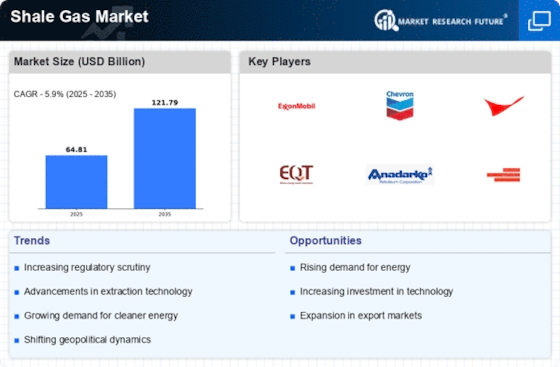
Shale Gas Market Infographic
Purchase Options

Market Trends

Key Emerging Trends in the Shale Gas Market

In the past year, the shale gas business has gone through a lot of changes. One important change is that shale gas output is steadily rising around the world. Shale gas has become popular in the energy business as a way to get energy from different sources and depend less on fossil fuels. The US is still the world leader in shale gas production, thanks to new technologies that have helped them get to huge supplies. But the market is becoming less unified as other regions, like Asia and Europe, put more money into shale gas research and investment. The economy and the environment are two things that have helped the shale gas business grow. Petroleum and natural gas prices must stay stable for shale gas projects to work. Changes in the cost of energy on the market over the last year have had an impact on spending and output levels. Shale gas has stayed a good and competitive energy source, even though the market has changed. This proves how strong the company is. New technological advances are always putting shale gas mining methods to the test. In the past few years, technology for digging, well finishing, and characterizing reservoirs has all gotten better. These improvements raise output while lowering the damage that shale gas activities do to the earth. Geopolitical factors can have an effect on market trends. This could have an effect on the world shale gas business because of energy security and unstable governments. When foreign politics and ties change, it can make the market unclear, which can affect how people spend and make things. Consequently, the shale gas business takes place in a multilayered global setting where revisions in laws and connections can have a substantial impact on the way the market functions. There will be changes in the future of the field because of worries about the economy, the environment, new technologies, and violent politics. Shallow gas might become more important in the energy mix as the world looks for better and cleaner energy sources.

Author
Author Profile
Priya Nagrale
Senior Research Analyst

With an experience of over five years in market research industry (Chemicals & Materials domain), I gather and analyze market data from diverse sources to produce results, which are then presented back to a client. Also, provide recommendations based on the findings. As a Senior Research Analyst, I perform quality checks (QC) for market estimations, QC for reports, and handle queries and work extensively on client customizations. Also, handle the responsibilities of client proposals, report planning, report finalization, and execution

Leave a Comment

FAQs

What is the current valuation of the shale gas market as of 2024?

<p>The shale gas market was valued at 170.0 USD Billion in 2024.</p>

What is the projected market valuation for the shale gas sector in 2035?

<p>The projected valuation for the shale gas market in 2035 is 250.0 USD Billion.</p>

What is the expected CAGR for the shale gas market during the forecast period 2025 - 2035?

<p>The expected CAGR for the shale gas market during the forecast period 2025 - 2035 is 3.57%.</p>

Which companies are considered key players in the shale gas market?

<p>Key players in the shale gas market include ExxonMobil, Chevron, ConocoPhillips, EQT Corporation, Pioneer Natural Resources, Devon Energy, Range Resources, Cabot Oil & Gas, and Anadarko Petroleum.</p>

What are the primary applications of shale gas and their respective market values?

<p>The primary applications of shale gas include Power Generation (60.0 - 90.0 USD Billion), Industrial Heating (40.0 - 60.0 USD Billion), Residential Heating (30.0 - 50.0 USD Billion), and Chemical Feedstock (40.0 - 50.0 USD Billion).</p>

How does the end-use segment of the shale gas market break down?

<p>The end-use segment includes Electricity Generation (60.0 - 90.0 USD Billion), Manufacturing (40.0 - 70.0 USD Billion), Transportation (30.0 - 50.0 USD Billion), and Residential (40.0 - 40.0 USD Billion).</p>

What technologies are driving the shale gas market, and what are their valuations?

<p>Technologies driving the shale gas market include Hydraulic Fracturing (60.0 - 90.0 USD Billion), Horizontal Drilling (40.0 - 60.0 USD Billion), Well Completion (30.0 - 50.0 USD Billion), and Production Optimization (40.0 - 50.0 USD Billion).</p>

What sources contribute to the shale gas market, and what are their respective values?

<p>Sources contributing to the shale gas market include Natural Gas Wells (70.0 - 100.0 USD Billion), Associated Gas (40.0 - 60.0 USD Billion), Coalbed Methane (30.0 - 50.0 USD Billion), and Tight Gas (30.0 - 40.0 USD Billion).</p>

How does the shale gas market's growth potential appear in comparison to other energy sectors?

<p>The shale gas market's growth potential appears robust, with a projected increase to 250.0 USD Billion by 2035, indicating a strong demand for natural gas.</p>

What factors may influence the future growth of the shale gas market?

<p>Factors influencing the future growth of the shale gas market may include technological advancements, regulatory changes, and shifts in energy consumption patterns.</p>

Market Summary

As per Market Research Future analysis, the Shale Gas Market Size was estimated at 64.81 USD Billion in 2024. The Shale Gas industry is projected to grow from 68.64 USD Billion in 2025 to 121.79 USD Billion by 2035, exhibiting a compound annual growth rate (CAGR) of 5% during the forecast period 2025 - 2035

Key Market Trends & Highlights

The Shale Gas Market is poised for growth driven by technological advancements and rising energy demand.

  • North America remains the largest market for shale gas, primarily due to its established infrastructure and technological expertise. Asia-Pacific is emerging as the fastest-growing region, fueled by increasing energy needs and investments in shale gas exploration. The power generation segment continues to dominate the market, while the chemical feedstock segment is experiencing rapid growth. Rising energy demand and technological innovations are key drivers propelling the shale gas market forward.

Market Size & Forecast

2024 Market Size 64.81 (USD Billion)
2035 Market Size 121.79 (USD Billion)
CAGR (2025 - 2035) 5.9%
Largest Regional Market Share in 2024 North America

Major Players

<a href="https://corporate.exxonmobil.com/who-we-are/our-global-organization/business-divisions/upstream/unconventional">ExxonMobil</a> (US), Chevron (US), ConocoPhillips (US), EQT Corporation (US), Anadarko Petroleum (US), <a href="https://www.devonenergy.com/news/2009/Devon-Energy-Announces-Successful-Haynesville-Shale-Well-in-San-Augustine-County-Texas">Devon Energy</a> (US), Range Resources (US), Cabot Oil &amp; Gas (US), Pioneer Natural Resources (US)

Market Trends

The Shale Gas Market is currently experiencing a transformative phase characterized by evolving technologies and shifting regulatory landscapes. Innovations in extraction methods, particularly hydraulic fracturing and horizontal drilling, have enhanced the efficiency of gas recovery from shale formations. This has led to increased production levels, which in turn influences global energy dynamics. Furthermore, the growing emphasis on cleaner energy sources is prompting a reevaluation of shale gas's role in the energy mix, as it is often viewed as a bridge fuel towards more sustainable alternatives. In addition to technological advancements, geopolitical factors are also shaping the Shale Gas Market. Countries rich in shale resources are exploring ways to leverage these assets for energy independence and economic growth. However, environmental concerns and public opposition to fracking practices remain significant challenges. As the market evolves, stakeholders must navigate these complexities while seeking to balance economic benefits with environmental stewardship. The future of the Shale Gas Market appears to hinge on the ability to innovate responsibly and adapt to changing societal expectations.

Technological Advancements

Recent innovations in extraction techniques are revolutionizing the Shale Gas Market. Enhanced methods such as advanced hydraulic fracturing and improved drilling technologies are increasing recovery rates and reducing operational costs. These advancements not only boost production but also contribute to more efficient resource management.

Regulatory Changes

The Shale Gas Market is influenced by evolving regulations aimed at addressing environmental concerns. Governments are implementing stricter guidelines to ensure sustainable practices in extraction and production. This regulatory landscape is likely to shape investment strategies and operational practices within the industry.

Market Dynamics and Geopolitical Factors

Geopolitical considerations are playing a crucial role in the Shale Gas Market. Nations with abundant shale resources are seeking to enhance energy security and reduce dependence on imports. This drive for energy independence may lead to increased exploration and production activities, impacting global supply chains.

Shale Gas Market Market Drivers

Rising Energy Demand

The Shale Gas Market is experiencing a surge in energy demand, driven by industrial growth and urbanization. As economies expand, the need for reliable and affordable energy sources becomes paramount. Shale gas, with its abundant reserves, offers a viable solution to meet this increasing demand. In 2025, the demand for natural gas is projected to rise by approximately 3.5% annually, indicating a robust market for shale gas. This trend is further supported by the transition towards cleaner energy sources, as shale gas emits fewer greenhouse gases compared to coal. Consequently, the Shale Gas Market is poised to benefit from this shift, as more countries seek to diversify their energy portfolios and reduce carbon footprints.

Geopolitical Influences

Geopolitical factors significantly impact the Shale Gas Market, as energy security becomes a focal point for many nations. Countries rich in shale gas reserves are strategically positioned to influence global energy dynamics. The ongoing shifts in trade policies and international relations can create both opportunities and challenges for the industry. For instance, nations seeking to reduce dependence on imported energy may invest heavily in domestic shale gas production. In 2025, it is expected that geopolitical tensions will continue to shape energy strategies, with countries prioritizing energy independence. This trend could lead to increased investments in the Shale Gas Market, as nations strive to secure their energy futures.

Investment Opportunities

The Shale Gas Market presents numerous investment opportunities, attracting both domestic and foreign investors. As the demand for natural gas rises, the potential for lucrative returns on investment becomes apparent. In 2025, the market is projected to grow at a compound annual growth rate of approximately 4%, driven by increasing consumption and technological advancements. Investors are particularly interested in regions with established shale formations, where production costs are lower and infrastructure is already in place. Furthermore, the ongoing development of new technologies may enhance profitability, making the Shale Gas Market an appealing prospect for investment. This influx of capital could further stimulate growth and innovation within the sector.

Technological Innovations

Technological advancements play a crucial role in the Shale Gas Market, enhancing extraction and production efficiency. Innovations such as hydraulic fracturing and horizontal drilling have revolutionized the way shale gas is harvested, significantly reducing costs and increasing output. In recent years, the average production per well has seen a notable increase, with some regions reporting up to 50% higher yields due to improved techniques. These advancements not only make shale gas more economically viable but also attract investments into the sector. As technology continues to evolve, the Shale Gas Market is likely to witness further enhancements in production capabilities, thereby solidifying its position in the energy landscape.

Environmental Considerations

The Shale Gas Market is increasingly influenced by environmental considerations, as stakeholders seek to balance energy needs with ecological impacts. The shift towards cleaner energy sources has prompted a reevaluation of shale gas's role in the energy mix. While shale gas is often touted for its lower emissions compared to coal, concerns regarding water usage and potential contamination persist. Regulatory bodies are now focusing on establishing stringent guidelines to mitigate these risks. In 2025, it is anticipated that the industry will adopt more sustainable practices, such as water recycling and reduced flaring, to address environmental concerns. This proactive approach may enhance the public perception of the Shale Gas Market, fostering greater acceptance and support.

Market Segment Insights

By Application: Power Generation (Largest) vs. Chemical Feedstock (Fastest-Growing)

The application segment of the shale gas market is characterized by its diverse usage, with <a href="https://www.marketresearchfuture.com/reports/power-generation-equipment-market-28763">power generation</a> holding the largest share amongst various applications. This sector benefits from the growing shift toward cleaner energy sources, where shale gas serves as a viable alternative to coal. Following power generation, the chemical feedstock segment also holds significant share, owing to its utilization in producing various chemicals essential for industrial processes.

Power Generation (Dominant) vs. Chemical Feedstock (Emerging)

Power generation is a dominant force in the shale gas market, leveraging advancements in gas turbine technology and infrastructure improvements to effectively utilize natural gas for electricity generation. The inherent efficiency and lower emissions of gas-fired plants position power generation at the forefront of the energy transition. Conversely, the emerging chemical feedstock segment is gaining traction due to its critical role in supplying inputs for petrochemicals and fertilizers. The increasing demand for these products, driven by global population growth and urbanization, positions chemical feedstock as a vital component of the shale gas market, spurring investments and innovation in this sector.

By End Use: Electricity Generation (Largest) vs. Manufacturing (Fastest-Growing)

<p>In the shale gas market, the end-use segment is primarily dominated by electricity generation, which accounts for a substantial portion of consumption. This is largely due to the increasing reliance on natural gas for power generation, driven by the need for cleaner energy sources. Manufacturing also plays a significant role, utilizing shale gas as a critical feedstock for various industrial processes, although its market share is growing at a faster pace compared to electricity generation.</p>

<p>Electricity Generation (Dominant) vs. Manufacturing (Emerging)</p>

<p>Electricity generation stands as the dominant end use in the shale gas market, leveraging the fuel's abundant availability and cost-effectiveness to provide a cleaner alternative to coal. Utilities are increasingly integrating shale gas into their energy portfolios, attracted by its lower emissions. In contrast, manufacturing is an emerging segment, driven by the rising demand for petrochemical products and materials derived from shale gas. As industries aim to enhance efficiency and sustainability, the shift towards shale gas is accelerating, positioning it as a vital resource for industrial growth.</p>

By Technology: Hydraulic Fracturing (Largest) vs. Horizontal Drilling (Fastest-Growing)

<p>In the shale gas market, the Technology segment is primarily dominated by Hydraulic Fracturing, which holds a substantial share due to its critical role in enhancing the extraction of natural gas from shale formations. Horizontal Drilling follows closely as a vital technique, allowing for increased reservoir contact and improved efficiency. Well Completion and Production Optimization also contribute meaningfully to the overall segment, though they represent smaller portions of the market share. Understanding these dynamics is essential for stakeholders seeking to capitalize on the strengths of each technology.</p>

<p>Technology: Hydraulic Fracturing (Dominant) vs. Horizontal Drilling (Emerging)</p>

<p>Hydraulic Fracturing continues to assert its dominance in the shale gas market by facilitating effective extraction processes, significantly increasing yield from wells. Its established methodology and widespread implementation underscore its importance to producers. On the other hand, Horizontal Drilling is emerging as a critical practice enabling operators to access previously unreachable gas reserves, thereby driving faster growth in this segment. This method enhances productivity and reduces surface disruption, making it attractive in a landscape that increasingly values sustainability and efficiency. The evolution of technology in this segment reflects a broader trend towards innovation, aimed at optimizing production and addressing the nuanced challenges of shale gas extraction.</p>

By Source: Natural Gas Wells (Largest) vs. Associated Gas (Fastest-Growing)

<p>In the shale gas market, Natural Gas Wells lead the segment with a substantial market share due to their established infrastructure and extraction techniques. Following this, Associated Gas and Coalbed Methane have been gaining attention for their potential contributions, with Associated Gas particularly notable for its extraction from oil fields. Tight Gas, while crucial, holds a smaller share relative to these leaders, emphasizing the diversity in shale gas sources and their respective contributions to the market.</p>

<p>Natural Gas Wells (Dominant) vs. Associated Gas (Emerging)</p>

<p>Natural Gas Wells are the cornerstone of the shale gas market, benefiting from long-standing extraction methods and a well-developed pipeline system, making them the dominant source. In contrast, Associated Gas has emerged as a vital resource due to its rapid growth, driven by advancements in extraction technologies and the increased exploration of oil fields where it is found. Both sources exhibit unique characteristics, with Natural Gas Wells offering reliability and efficiency, while Associated Gas is gaining traction for its potential in optimizing production and enhancing market supply.</p>

Get more detailed insights about Shale Gas Market Research Report - Forecast till 2035

Regional Insights

North America : Shale Gas Market Powerhouse

North America remains the largest market for shale gas, accounting for approximately 75% of global production. The region's growth is driven by technological advancements in hydraulic fracturing and horizontal drilling, alongside favorable regulatory frameworks that encourage investment. The U.S. leads this market, followed by Canada, which holds about 15% of the market share. The increasing demand for cleaner energy sources and the push for energy independence further bolster this sector. The competitive landscape is dominated by major players such as ExxonMobil, Chevron, and ConocoPhillips, which have established significant operations across key shale formations like the Permian Basin and Marcellus Shale. These companies are continuously investing in innovative technologies to enhance extraction efficiency and reduce environmental impact. The presence of a robust infrastructure and skilled workforce further supports the region's leading position in the shale gas market.

Europe : Emerging Shale Gas Market

Europe's shale gas market is gradually emerging, with countries like Poland and the UK showing significant potential. The region's market share is currently around 5%, but this is expected to grow as regulatory frameworks evolve to support exploration and production. The European Union's commitment to energy diversification and reducing reliance on imports serves as a catalyst for shale gas development. However, environmental concerns and public opposition pose challenges to rapid expansion. Leading countries in this sector include Poland, which has made strides in exploration, and the UK, where the government is exploring regulatory reforms to facilitate shale gas extraction. The competitive landscape is still developing, with several smaller companies and partnerships forming to navigate the regulatory environment. The presence of major oil and gas companies is also increasing as they seek to capitalize on the region's untapped resources.

Asia-Pacific : Growing Interest in Shale Gas Market

The Asia-Pacific region is witnessing a growing interest in shale gas, with countries like China and Australia leading the charge. Currently, the market share is approximately 10%, driven by the need for energy security and cleaner fuel alternatives. China's significant shale reserves and ongoing investments in extraction technologies are pivotal for future growth. Regulatory support is gradually improving, although challenges remain in terms of environmental regulations and public acceptance. China is the largest player in the region, with substantial investments in shale gas exploration, while Australia is also making strides in developing its shale resources. The competitive landscape includes both local and international companies, with key players looking to establish a foothold in this emerging market. The region's potential for shale gas development is significant, but it requires careful navigation of regulatory and environmental hurdles to realize its full potential.

Middle East and Africa : Untapped Shale Gas Market Resources

The Middle East and Africa region holds untapped shale gas resources, with countries like South Africa and Algeria showing promise. Currently, the market share is around 5%, but this is expected to increase as exploration efforts intensify. The region's energy diversification strategies and the need for sustainable energy sources are driving interest in shale gas development. However, regulatory frameworks are still in the early stages, which may hinder rapid growth. South Africa is emerging as a key player, with ongoing efforts to develop its shale gas potential, while Algeria is exploring its vast reserves. The competitive landscape is characterized by a mix of local and international companies looking to invest in exploration and production. The presence of established oil and gas firms can facilitate the development of infrastructure and technology needed to harness these resources effectively.

Key Players and Competitive Insights

The Shale Gas Market is currently characterized by a dynamic competitive landscape, driven by a confluence of technological advancements, regulatory shifts, and evolving consumer demands. Major players such as ExxonMobil (US), Chevron (US), and EQT Corporation (US) are strategically positioning themselves to capitalize on these growth drivers. ExxonMobil (US) has been focusing on enhancing its operational efficiency through digital transformation initiatives, while Chevron (US) emphasizes sustainable practices and carbon capture technologies. EQT Corporation (US), on the other hand, is concentrating on expanding its production capabilities in the Appalachian Basin, which is pivotal for its growth strategy. Collectively, these strategies not only enhance their competitive edge but also shape the overall market dynamics, fostering a landscape where innovation and sustainability are paramount. In terms of business tactics, companies are increasingly localizing their operations and optimizing supply chains to mitigate risks and enhance responsiveness to market fluctuations. The Shale Gas Market appears moderately fragmented, with a mix of large integrated companies and smaller independent operators. This structure allows for a diverse range of competitive strategies, where key players leverage their strengths to influence market trends and consumer preferences. In August 2025, ExxonMobil (US) announced a significant investment in a new digital platform aimed at optimizing its shale gas production processes. This initiative is expected to enhance operational efficiencies and reduce costs, thereby positioning ExxonMobil (US) as a leader in the digital transformation of the energy sector. The strategic importance of this move lies in its potential to streamline operations and improve decision-making through data analytics, which could yield substantial competitive advantages in the long run. Similarly, in September 2025, Chevron (US) unveiled a partnership with a leading technology firm to develop advanced carbon capture and storage solutions. This collaboration underscores Chevron's (US) commitment to sustainability and its proactive approach to addressing environmental concerns associated with shale gas extraction. The strategic implications of this partnership are profound, as it not only enhances Chevron's (US) sustainability profile but also positions the company favorably in a market increasingly driven by environmental considerations. In October 2025, EQT Corporation (US) launched a new initiative aimed at increasing its production capacity by 20% over the next two years, focusing on the Marcellus Shale region. This ambitious plan reflects EQT's (US) intent to solidify its market position and respond to the growing demand for natural gas. The strategic significance of this expansion is twofold: it not only aims to meet rising energy needs but also enhances EQT's (US) competitive stance against other major players in the region. As of October 2025, the Shale Gas Market is witnessing a shift towards digitalization, sustainability, and the integration of artificial intelligence in operational processes. Strategic alliances are increasingly shaping the competitive landscape, enabling companies to pool resources and expertise to tackle complex challenges. Looking ahead, competitive differentiation is likely to evolve from traditional price-based competition to a focus on innovation, technological advancements, and supply chain reliability. This transition suggests that companies that prioritize these elements will be better positioned to thrive in an increasingly competitive and environmentally conscious market.

Key Companies in the Shale Gas Market include

Industry Developments

The Shale Gas Market has seen significant developments recently, notably impacted by fluctuating energy prices and evolving policies surrounding energy independence. Companies such as ConocoPhillips and Devon Energy have reported increased production levels as a response to a surge in worldwide energy demand.

In 2025, ExxonMobil implemented sophisticated drilling technologies to enhance the efficiency of shale gas extraction and reduce operational costs by approximately 12%, all while simultaneously minimizing its environmental impact.

Aiming to reduce emissions by 15% through the implementation of healthier technologies and enhanced processes, Chevron initiated a 2025 initiative that concentrated on sustainable shale gas production.

In 2025, Range Resources leveraged sensor technology to optimize operations and reduce disruption by approximately 10% by implementing a real-time monitoring system for wells.

In 2025, Antero Resources implemented a novel water-treatment solution to improve the recycling of hydraulic fracturing water, resulting in a 20% increase in reuse efficiency.

Future Outlook

Shale Gas Market Future Outlook

The Shale Gas Market size is projected to grow at a 5.9% CAGR from 2024 to 2035, driven by technological advancements, increasing energy demand, and environmental considerations. The future of the Shale Gas Market is robust, fueled by the global shift toward natural gas as a critical transition fuel. Growth in the market is driven by surging LNG exports, rising energy demand from data centers, and advanced drilling techniques that optimize production efficiency.

New opportunities lie in:

  • <p>Investment in advanced hydraulic fracturing technologies Development of integrated supply chain solutions Expansion into emerging markets with untapped shale reserves</p>

By 2035, the Shale Gas Market is expected to solidify its position as a key energy source globally.

Market Segmentation

Shale Gas Market End Use Outlook

  • Residential
  • Commercial
  • Industrial
  • Utilities

Shale Gas Market Application Outlook

  • Power Generation
  • Heating
  • Chemical Feedstock
  • Transportation
  • Industrial Processes

Shale Gas Market Player Type Outlook

  • Independent Producers
  • Major Oil and Gas Companies
  • Service Providers
  • Government Entities

Shale Gas Market Method of Extraction Outlook

  • Hydraulic Fracturing
  • Horizontal Drilling
  • Vertical Drilling
  • Combination Techniques

Report Scope

MARKET SIZE 2024 64.81(USD Billion)
MARKET SIZE 2025 68.64(USD Billion)
MARKET SIZE 2035 121.79(USD Billion)
COMPOUND ANNUAL GROWTH RATE (CAGR) 5.9% (2025 - 2035)
REPORT COVERAGE Revenue Forecast, Competitive Landscape, Growth Factors, and Trends
BASE YEAR 2024
Market Forecast Period 2025 - 2035
Historical Data 2019 - 2024
Market Forecast Units USD Billion
Key Companies Profiled ExxonMobil (US), Chevron (US), ConocoPhillips (US), EQT Corporation (US), Anadarko Petroleum (US), Devon Energy (US), Range Resources (US), Cabot Oil & Gas (US), Pioneer Natural Resources (US)
Segments Covered Application, End Use, Method of Extraction, Market Player Type, Regional
Key Market Opportunities Advancements in extraction technologies enhance efficiency in the Shale Gas Market.
Key Market Dynamics Technological advancements in extraction methods are reshaping competitive dynamics within the Shale Gas Market.
Countries Covered North America, Europe, APAC, South America, MEA

FAQs

What is the current valuation of the shale gas market as of 2024?

<p>The shale gas market was valued at 170.0 USD Billion in 2024.</p>

What is the projected market valuation for the shale gas sector in 2035?

<p>The projected valuation for the shale gas market in 2035 is 250.0 USD Billion.</p>

What is the expected CAGR for the shale gas market during the forecast period 2025 - 2035?

<p>The expected CAGR for the shale gas market during the forecast period 2025 - 2035 is 3.57%.</p>

Which companies are considered key players in the shale gas market?

<p>Key players in the shale gas market include ExxonMobil, Chevron, ConocoPhillips, EQT Corporation, Pioneer Natural Resources, Devon Energy, Range Resources, Cabot Oil & Gas, and Anadarko Petroleum.</p>

What are the primary applications of shale gas and their respective market values?

<p>The primary applications of shale gas include Power Generation (60.0 - 90.0 USD Billion), Industrial Heating (40.0 - 60.0 USD Billion), Residential Heating (30.0 - 50.0 USD Billion), and Chemical Feedstock (40.0 - 50.0 USD Billion).</p>

How does the end-use segment of the shale gas market break down?

<p>The end-use segment includes Electricity Generation (60.0 - 90.0 USD Billion), Manufacturing (40.0 - 70.0 USD Billion), Transportation (30.0 - 50.0 USD Billion), and Residential (40.0 - 40.0 USD Billion).</p>

What technologies are driving the shale gas market, and what are their valuations?

<p>Technologies driving the shale gas market include Hydraulic Fracturing (60.0 - 90.0 USD Billion), Horizontal Drilling (40.0 - 60.0 USD Billion), Well Completion (30.0 - 50.0 USD Billion), and Production Optimization (40.0 - 50.0 USD Billion).</p>

What sources contribute to the shale gas market, and what are their respective values?

<p>Sources contributing to the shale gas market include Natural Gas Wells (70.0 - 100.0 USD Billion), Associated Gas (40.0 - 60.0 USD Billion), Coalbed Methane (30.0 - 50.0 USD Billion), and Tight Gas (30.0 - 40.0 USD Billion).</p>

How does the shale gas market's growth potential appear in comparison to other energy sectors?

<p>The shale gas market's growth potential appears robust, with a projected increase to 250.0 USD Billion by 2035, indicating a strong demand for natural gas.</p>

What factors may influence the future growth of the shale gas market?

<p>Factors influencing the future growth of the shale gas market may include technological advancements, regulatory changes, and shifts in energy consumption patterns.</p>

  1. SECTION I: EXECUTIVE SUMMARY AND KEY HIGHLIGHTS
    1. | 1.1 EXECUTIVE SUMMARY
    2. | | 1.1.1 Market Overview
    3. | | 1.1.2 Key Findings
    4. | | 1.1.3 Market Segmentation
    5. | | 1.1.4 Competitive Landscape
    6. | | 1.1.5 Challenges and Opportunities
    7. | | 1.1.6 Future Outlook
  2. SECTION II: SCOPING, METHODOLOGY AND MARKET STRUCTURE
    1. | 2.1 MARKET INTRODUCTION
    2. | | 2.1.1 Definition
    3. | | 2.1.2 Scope of the study
    4. | | | 2.1.2.1 Research Objective
    5. | | | 2.1.2.2 Assumption
    6. | | | 2.1.2.3 Limitations
    7. | 2.2 RESEARCH METHODOLOGY
    8. | | 2.2.1 Overview
    9. | | 2.2.2 Data Mining
    10. | | 2.2.3 Secondary Research
    11. | | 2.2.4 Primary Research
    12. | | | 2.2.4.1 Primary Interviews and Information Gathering Process
    13. | | | 2.2.4.2 Breakdown of Primary Respondents
    14. | | 2.2.5 Forecasting Model
    15. | | 2.2.6 Market Size Estimation
    16. | | | 2.2.6.1 Bottom-Up Approach
    17. | | | 2.2.6.2 Top-Down Approach
    18. | | 2.2.7 Data Triangulation
    19. | | 2.2.8 Validation
  3. SECTION III: QUALITATIVE ANALYSIS
    1. | 3.1 MARKET DYNAMICS
    2. | | 3.1.1 Overview
    3. | | 3.1.2 Drivers
    4. | | 3.1.3 Restraints
    5. | | 3.1.4 Opportunities
    6. | 3.2 MARKET FACTOR ANALYSIS
    7. | | 3.2.1 Value chain Analysis
    8. | | 3.2.2 Porter's Five Forces Analysis
    9. | | | 3.2.2.1 Bargaining Power of Suppliers
    10. | | | 3.2.2.2 Bargaining Power of Buyers
    11. | | | 3.2.2.3 Threat of New Entrants
    12. | | | 3.2.2.4 Threat of Substitutes
    13. | | | 3.2.2.5 Intensity of Rivalry
    14. | | 3.2.3 COVID-19 Impact Analysis
    15. | | | 3.2.3.1 Market Impact Analysis
    16. | | | 3.2.3.2 Regional Impact
    17. | | | 3.2.3.3 Opportunity and Threat Analysis
  4. SECTION IV: QUANTITATIVE ANALYSIS
    1. | 4.1 Energy & Power, BY Application (USD Billion)
    2. | | 4.1.1 Power Generation
    3. | | 4.1.2 Industrial Heating
    4. | | 4.1.3 Residential Heating
    5. | | 4.1.4 Chemical Feedstock
    6. | 4.2 Energy & Power, BY End Use (USD Billion)
    7. | | 4.2.1 Electricity Generation
    8. | | 4.2.2 Manufacturing
    9. | | 4.2.3 Transportation
    10. | | 4.2.4 Residential
    11. | 4.3 Energy & Power, BY Technology (USD Billion)
    12. | | 4.3.1 Hydraulic Fracturing
    13. | | 4.3.2 Horizontal Drilling
    14. | | 4.3.3 Well Completion
    15. | | 4.3.4 Production Optimization
    16. | 4.4 Energy & Power, BY Source (USD Billion)
    17. | | 4.4.1 Natural Gas Wells
    18. | | 4.4.2 Associated Gas
    19. | | 4.4.3 Coalbed Methane
    20. | | 4.4.4 Tight Gas
    21. | 4.5 Energy & Power, BY Region (USD Billion)
    22. | | 4.5.1 North America
    23. | | | 4.5.1.1 US
    24. | | | 4.5.1.2 Canada
    25. | | 4.5.2 Europe
    26. | | | 4.5.2.1 Germany
    27. | | | 4.5.2.2 UK
    28. | | | 4.5.2.3 France
    29. | | | 4.5.2.4 Russia
    30. | | | 4.5.2.5 Italy
    31. | | | 4.5.2.6 Spain
    32. | | | 4.5.2.7 Rest of Europe
    33. | | 4.5.3 APAC
    34. | | | 4.5.3.1 China
    35. | | | 4.5.3.2 India
    36. | | | 4.5.3.3 Japan
    37. | | | 4.5.3.4 South Korea
    38. | | | 4.5.3.5 Malaysia
    39. | | | 4.5.3.6 Thailand
    40. | | | 4.5.3.7 Indonesia
    41. | | | 4.5.3.8 Rest of APAC
    42. | | 4.5.4 South America
    43. | | | 4.5.4.1 Brazil
    44. | | | 4.5.4.2 Mexico
    45. | | | 4.5.4.3 Argentina
    46. | | | 4.5.4.4 Rest of South America
    47. | | 4.5.5 MEA
    48. | | | 4.5.5.1 GCC Countries
    49. | | | 4.5.5.2 South Africa
    50. | | | 4.5.5.3 Rest of MEA
  5. SECTION V: COMPETITIVE ANALYSIS
    1. | 5.1 Competitive Landscape
    2. | | 5.1.1 Overview
    3. | | 5.1.2 Competitive Analysis
    4. | | 5.1.3 Market share Analysis
    5. | | 5.1.4 Major Growth Strategy in the Energy & Power
    6. | | 5.1.5 Competitive Benchmarking
    7. | | 5.1.6 Leading Players in Terms of Number of Developments in the Energy & Power
    8. | | 5.1.7 Key developments and growth strategies
    9. | | | 5.1.7.1 New Product Launch/Service Deployment
    10. | | | 5.1.7.2 Merger & Acquisitions
    11. | | | 5.1.7.3 Joint Ventures
    12. | | 5.1.8 Major Players Financial Matrix
    13. | | | 5.1.8.1 Sales and Operating Income
    14. | | | 5.1.8.2 Major Players R&D Expenditure. 2023
    15. | 5.2 Company Profiles
    16. | | 5.2.1 ExxonMobil (US)
    17. | | | 5.2.1.1 Financial Overview
    18. | | | 5.2.1.2 Products Offered
    19. | | | 5.2.1.3 Key Developments
    20. | | | 5.2.1.4 SWOT Analysis
    21. | | | 5.2.1.5 Key Strategies
    22. | | 5.2.2 Chevron (US)
    23. | | | 5.2.2.1 Financial Overview
    24. | | | 5.2.2.2 Products Offered
    25. | | | 5.2.2.3 Key Developments
    26. | | | 5.2.2.4 SWOT Analysis
    27. | | | 5.2.2.5 Key Strategies
    28. | | 5.2.3 ConocoPhillips (US)
    29. | | | 5.2.3.1 Financial Overview
    30. | | | 5.2.3.2 Products Offered
    31. | | | 5.2.3.3 Key Developments
    32. | | | 5.2.3.4 SWOT Analysis
    33. | | | 5.2.3.5 Key Strategies
    34. | | 5.2.4 EQT Corporation (US)
    35. | | | 5.2.4.1 Financial Overview
    36. | | | 5.2.4.2 Products Offered
    37. | | | 5.2.4.3 Key Developments
    38. | | | 5.2.4.4 SWOT Analysis
    39. | | | 5.2.4.5 Key Strategies
    40. | | 5.2.5 Pioneer Natural Resources (US)
    41. | | | 5.2.5.1 Financial Overview
    42. | | | 5.2.5.2 Products Offered
    43. | | | 5.2.5.3 Key Developments
    44. | | | 5.2.5.4 SWOT Analysis
    45. | | | 5.2.5.5 Key Strategies
    46. | | 5.2.6 Devon Energy (US)
    47. | | | 5.2.6.1 Financial Overview
    48. | | | 5.2.6.2 Products Offered
    49. | | | 5.2.6.3 Key Developments
    50. | | | 5.2.6.4 SWOT Analysis
    51. | | | 5.2.6.5 Key Strategies
    52. | | 5.2.7 Range Resources (US)
    53. | | | 5.2.7.1 Financial Overview
    54. | | | 5.2.7.2 Products Offered
    55. | | | 5.2.7.3 Key Developments
    56. | | | 5.2.7.4 SWOT Analysis
    57. | | | 5.2.7.5 Key Strategies
    58. | | 5.2.8 Cabot Oil & Gas (US)
    59. | | | 5.2.8.1 Financial Overview
    60. | | | 5.2.8.2 Products Offered
    61. | | | 5.2.8.3 Key Developments
    62. | | | 5.2.8.4 SWOT Analysis
    63. | | | 5.2.8.5 Key Strategies
    64. | | 5.2.9 Anadarko Petroleum (US)
    65. | | | 5.2.9.1 Financial Overview
    66. | | | 5.2.9.2 Products Offered
    67. | | | 5.2.9.3 Key Developments
    68. | | | 5.2.9.4 SWOT Analysis
    69. | | | 5.2.9.5 Key Strategies
    70. | 5.3 Appendix
    71. | | 5.3.1 References
    72. | | 5.3.2 Related Reports
  6. LIST OF FIGURES
    1. | 6.1 MARKET SYNOPSIS
    2. | 6.2 NORTH AMERICA MARKET ANALYSIS
    3. | 6.3 US MARKET ANALYSIS BY APPLICATION
    4. | 6.4 US MARKET ANALYSIS BY END USE
    5. | 6.5 US MARKET ANALYSIS BY TECHNOLOGY
    6. | 6.6 US MARKET ANALYSIS BY SOURCE
    7. | 6.7 CANADA MARKET ANALYSIS BY APPLICATION
    8. | 6.8 CANADA MARKET ANALYSIS BY END USE
    9. | 6.9 CANADA MARKET ANALYSIS BY TECHNOLOGY
    10. | 6.10 CANADA MARKET ANALYSIS BY SOURCE
    11. | 6.11 EUROPE MARKET ANALYSIS
    12. | 6.12 GERMANY MARKET ANALYSIS BY APPLICATION
    13. | 6.13 GERMANY MARKET ANALYSIS BY END USE
    14. | 6.14 GERMANY MARKET ANALYSIS BY TECHNOLOGY
    15. | 6.15 GERMANY MARKET ANALYSIS BY SOURCE
    16. | 6.16 UK MARKET ANALYSIS BY APPLICATION
    17. | 6.17 UK MARKET ANALYSIS BY END USE
    18. | 6.18 UK MARKET ANALYSIS BY TECHNOLOGY
    19. | 6.19 UK MARKET ANALYSIS BY SOURCE
    20. | 6.20 FRANCE MARKET ANALYSIS BY APPLICATION
    21. | 6.21 FRANCE MARKET ANALYSIS BY END USE
    22. | 6.22 FRANCE MARKET ANALYSIS BY TECHNOLOGY
    23. | 6.23 FRANCE MARKET ANALYSIS BY SOURCE
    24. | 6.24 RUSSIA MARKET ANALYSIS BY APPLICATION
    25. | 6.25 RUSSIA MARKET ANALYSIS BY END USE
    26. | 6.26 RUSSIA MARKET ANALYSIS BY TECHNOLOGY
    27. | 6.27 RUSSIA MARKET ANALYSIS BY SOURCE
    28. | 6.28 ITALY MARKET ANALYSIS BY APPLICATION
    29. | 6.29 ITALY MARKET ANALYSIS BY END USE
    30. | 6.30 ITALY MARKET ANALYSIS BY TECHNOLOGY
    31. | 6.31 ITALY MARKET ANALYSIS BY SOURCE
    32. | 6.32 SPAIN MARKET ANALYSIS BY APPLICATION
    33. | 6.33 SPAIN MARKET ANALYSIS BY END USE
    34. | 6.34 SPAIN MARKET ANALYSIS BY TECHNOLOGY
    35. | 6.35 SPAIN MARKET ANALYSIS BY SOURCE
    36. | 6.36 REST OF EUROPE MARKET ANALYSIS BY APPLICATION
    37. | 6.37 REST OF EUROPE MARKET ANALYSIS BY END USE
    38. | 6.38 REST OF EUROPE MARKET ANALYSIS BY TECHNOLOGY
    39. | 6.39 REST OF EUROPE MARKET ANALYSIS BY SOURCE
    40. | 6.40 APAC MARKET ANALYSIS
    41. | 6.41 CHINA MARKET ANALYSIS BY APPLICATION
    42. | 6.42 CHINA MARKET ANALYSIS BY END USE
    43. | 6.43 CHINA MARKET ANALYSIS BY TECHNOLOGY
    44. | 6.44 CHINA MARKET ANALYSIS BY SOURCE
    45. | 6.45 INDIA MARKET ANALYSIS BY APPLICATION
    46. | 6.46 INDIA MARKET ANALYSIS BY END USE
    47. | 6.47 INDIA MARKET ANALYSIS BY TECHNOLOGY
    48. | 6.48 INDIA MARKET ANALYSIS BY SOURCE
    49. | 6.49 JAPAN MARKET ANALYSIS BY APPLICATION
    50. | 6.50 JAPAN MARKET ANALYSIS BY END USE
    51. | 6.51 JAPAN MARKET ANALYSIS BY TECHNOLOGY
    52. | 6.52 JAPAN MARKET ANALYSIS BY SOURCE
    53. | 6.53 SOUTH KOREA MARKET ANALYSIS BY APPLICATION
    54. | 6.54 SOUTH KOREA MARKET ANALYSIS BY END USE
    55. | 6.55 SOUTH KOREA MARKET ANALYSIS BY TECHNOLOGY
    56. | 6.56 SOUTH KOREA MARKET ANALYSIS BY SOURCE
    57. | 6.57 MALAYSIA MARKET ANALYSIS BY APPLICATION
    58. | 6.58 MALAYSIA MARKET ANALYSIS BY END USE
    59. | 6.59 MALAYSIA MARKET ANALYSIS BY TECHNOLOGY
    60. | 6.60 MALAYSIA MARKET ANALYSIS BY SOURCE
    61. | 6.61 THAILAND MARKET ANALYSIS BY APPLICATION
    62. | 6.62 THAILAND MARKET ANALYSIS BY END USE
    63. | 6.63 THAILAND MARKET ANALYSIS BY TECHNOLOGY
    64. | 6.64 THAILAND MARKET ANALYSIS BY SOURCE
    65. | 6.65 INDONESIA MARKET ANALYSIS BY APPLICATION
    66. | 6.66 INDONESIA MARKET ANALYSIS BY END USE
    67. | 6.67 INDONESIA MARKET ANALYSIS BY TECHNOLOGY
    68. | 6.68 INDONESIA MARKET ANALYSIS BY SOURCE
    69. | 6.69 REST OF APAC MARKET ANALYSIS BY APPLICATION
    70. | 6.70 REST OF APAC MARKET ANALYSIS BY END USE
    71. | 6.71 REST OF APAC MARKET ANALYSIS BY TECHNOLOGY
    72. | 6.72 REST OF APAC MARKET ANALYSIS BY SOURCE
    73. | 6.73 SOUTH AMERICA MARKET ANALYSIS
    74. | 6.74 BRAZIL MARKET ANALYSIS BY APPLICATION
    75. | 6.75 BRAZIL MARKET ANALYSIS BY END USE
    76. | 6.76 BRAZIL MARKET ANALYSIS BY TECHNOLOGY
    77. | 6.77 BRAZIL MARKET ANALYSIS BY SOURCE
    78. | 6.78 MEXICO MARKET ANALYSIS BY APPLICATION
    79. | 6.79 MEXICO MARKET ANALYSIS BY END USE
    80. | 6.80 MEXICO MARKET ANALYSIS BY TECHNOLOGY
    81. | 6.81 MEXICO MARKET ANALYSIS BY SOURCE
    82. | 6.82 ARGENTINA MARKET ANALYSIS BY APPLICATION
    83. | 6.83 ARGENTINA MARKET ANALYSIS BY END USE
    84. | 6.84 ARGENTINA MARKET ANALYSIS BY TECHNOLOGY
    85. | 6.85 ARGENTINA MARKET ANALYSIS BY SOURCE
    86. | 6.86 REST OF SOUTH AMERICA MARKET ANALYSIS BY APPLICATION
    87. | 6.87 REST OF SOUTH AMERICA MARKET ANALYSIS BY END USE
    88. | 6.88 REST OF SOUTH AMERICA MARKET ANALYSIS BY TECHNOLOGY
    89. | 6.89 REST OF SOUTH AMERICA MARKET ANALYSIS BY SOURCE
    90. | 6.90 MEA MARKET ANALYSIS
    91. | 6.91 GCC COUNTRIES MARKET ANALYSIS BY APPLICATION
    92. | 6.92 GCC COUNTRIES MARKET ANALYSIS BY END USE
    93. | 6.93 GCC COUNTRIES MARKET ANALYSIS BY TECHNOLOGY
    94. | 6.94 GCC COUNTRIES MARKET ANALYSIS BY SOURCE
    95. | 6.95 SOUTH AFRICA MARKET ANALYSIS BY APPLICATION
    96. | 6.96 SOUTH AFRICA MARKET ANALYSIS BY END USE
    97. | 6.97 SOUTH AFRICA MARKET ANALYSIS BY TECHNOLOGY
    98. | 6.98 SOUTH AFRICA MARKET ANALYSIS BY SOURCE
    99. | 6.99 REST OF MEA MARKET ANALYSIS BY APPLICATION
    100. | 6.100 REST OF MEA MARKET ANALYSIS BY END USE
    101. | 6.101 REST OF MEA MARKET ANALYSIS BY TECHNOLOGY
    102. | 6.102 REST OF MEA MARKET ANALYSIS BY SOURCE
    103. | 6.103 KEY BUYING CRITERIA OF ENERGY & POWER
    104. | 6.104 RESEARCH PROCESS OF MRFR
    105. | 6.105 DRO ANALYSIS OF ENERGY & POWER
    106. | 6.106 DRIVERS IMPACT ANALYSIS: ENERGY & POWER
    107. | 6.107 RESTRAINTS IMPACT ANALYSIS: ENERGY & POWER
    108. | 6.108 SUPPLY / VALUE CHAIN: ENERGY & POWER
    109. | 6.109 ENERGY & POWER, BY APPLICATION, 2024 (% SHARE)
    110. | 6.110 ENERGY & POWER, BY APPLICATION, 2024 TO 2035 (USD Billion)
    111. | 6.111 ENERGY & POWER, BY END USE, 2024 (% SHARE)
    112. | 6.112 ENERGY & POWER, BY END USE, 2024 TO 2035 (USD Billion)
    113. | 6.113 ENERGY & POWER, BY TECHNOLOGY, 2024 (% SHARE)
    114. | 6.114 ENERGY & POWER, BY TECHNOLOGY, 2024 TO 2035 (USD Billion)
    115. | 6.115 ENERGY & POWER, BY SOURCE, 2024 (% SHARE)
    116. | 6.116 ENERGY & POWER, BY SOURCE, 2024 TO 2035 (USD Billion)
    117. | 6.117 BENCHMARKING OF MAJOR COMPETITORS
  7. LIST OF TABLES
    1. | 7.1 LIST OF ASSUMPTIONS
    2. | | 7.1.1
    3. | 7.2 North America MARKET SIZE ESTIMATES; FORECAST
    4. | | 7.2.1 BY APPLICATION, 2025-2035 (USD Billion)
    5. | | 7.2.2 BY END USE, 2025-2035 (USD Billion)
    6. | | 7.2.3 BY TECHNOLOGY, 2025-2035 (USD Billion)
    7. | | 7.2.4 BY SOURCE, 2025-2035 (USD Billion)
    8. | 7.3 US MARKET SIZE ESTIMATES; FORECAST
    9. | | 7.3.1 BY APPLICATION, 2025-2035 (USD Billion)
    10. | | 7.3.2 BY END USE, 2025-2035 (USD Billion)
    11. | | 7.3.3 BY TECHNOLOGY, 2025-2035 (USD Billion)
    12. | | 7.3.4 BY SOURCE, 2025-2035 (USD Billion)
    13. | 7.4 Canada MARKET SIZE ESTIMATES; FORECAST
    14. | | 7.4.1 BY APPLICATION, 2025-2035 (USD Billion)
    15. | | 7.4.2 BY END USE, 2025-2035 (USD Billion)
    16. | | 7.4.3 BY TECHNOLOGY, 2025-2035 (USD Billion)
    17. | | 7.4.4 BY SOURCE, 2025-2035 (USD Billion)
    18. | 7.5 Europe MARKET SIZE ESTIMATES; FORECAST
    19. | | 7.5.1 BY APPLICATION, 2025-2035 (USD Billion)
    20. | | 7.5.2 BY END USE, 2025-2035 (USD Billion)
    21. | | 7.5.3 BY TECHNOLOGY, 2025-2035 (USD Billion)
    22. | | 7.5.4 BY SOURCE, 2025-2035 (USD Billion)
    23. | 7.6 Germany MARKET SIZE ESTIMATES; FORECAST
    24. | | 7.6.1 BY APPLICATION, 2025-2035 (USD Billion)
    25. | | 7.6.2 BY END USE, 2025-2035 (USD Billion)
    26. | | 7.6.3 BY TECHNOLOGY, 2025-2035 (USD Billion)
    27. | | 7.6.4 BY SOURCE, 2025-2035 (USD Billion)
    28. | 7.7 UK MARKET SIZE ESTIMATES; FORECAST
    29. | | 7.7.1 BY APPLICATION, 2025-2035 (USD Billion)
    30. | | 7.7.2 BY END USE, 2025-2035 (USD Billion)
    31. | | 7.7.3 BY TECHNOLOGY, 2025-2035 (USD Billion)
    32. | | 7.7.4 BY SOURCE, 2025-2035 (USD Billion)
    33. | 7.8 France MARKET SIZE ESTIMATES; FORECAST
    34. | | 7.8.1 BY APPLICATION, 2025-2035 (USD Billion)
    35. | | 7.8.2 BY END USE, 2025-2035 (USD Billion)
    36. | | 7.8.3 BY TECHNOLOGY, 2025-2035 (USD Billion)
    37. | | 7.8.4 BY SOURCE, 2025-2035 (USD Billion)
    38. | 7.9 Russia MARKET SIZE ESTIMATES; FORECAST
    39. | | 7.9.1 BY APPLICATION, 2025-2035 (USD Billion)
    40. | | 7.9.2 BY END USE, 2025-2035 (USD Billion)
    41. | | 7.9.3 BY TECHNOLOGY, 2025-2035 (USD Billion)
    42. | | 7.9.4 BY SOURCE, 2025-2035 (USD Billion)
    43. | 7.10 Italy MARKET SIZE ESTIMATES; FORECAST
    44. | | 7.10.1 BY APPLICATION, 2025-2035 (USD Billion)
    45. | | 7.10.2 BY END USE, 2025-2035 (USD Billion)
    46. | | 7.10.3 BY TECHNOLOGY, 2025-2035 (USD Billion)
    47. | | 7.10.4 BY SOURCE, 2025-2035 (USD Billion)
    48. | 7.11 Spain MARKET SIZE ESTIMATES; FORECAST
    49. | | 7.11.1 BY APPLICATION, 2025-2035 (USD Billion)
    50. | | 7.11.2 BY END USE, 2025-2035 (USD Billion)
    51. | | 7.11.3 BY TECHNOLOGY, 2025-2035 (USD Billion)
    52. | | 7.11.4 BY SOURCE, 2025-2035 (USD Billion)
    53. | 7.12 Rest of Europe MARKET SIZE ESTIMATES; FORECAST
    54. | | 7.12.1 BY APPLICATION, 2025-2035 (USD Billion)
    55. | | 7.12.2 BY END USE, 2025-2035 (USD Billion)
    56. | | 7.12.3 BY TECHNOLOGY, 2025-2035 (USD Billion)
    57. | | 7.12.4 BY SOURCE, 2025-2035 (USD Billion)
    58. | 7.13 APAC MARKET SIZE ESTIMATES; FORECAST
    59. | | 7.13.1 BY APPLICATION, 2025-2035 (USD Billion)
    60. | | 7.13.2 BY END USE, 2025-2035 (USD Billion)
    61. | | 7.13.3 BY TECHNOLOGY, 2025-2035 (USD Billion)
    62. | | 7.13.4 BY SOURCE, 2025-2035 (USD Billion)
    63. | 7.14 China MARKET SIZE ESTIMATES; FORECAST
    64. | | 7.14.1 BY APPLICATION, 2025-2035 (USD Billion)
    65. | | 7.14.2 BY END USE, 2025-2035 (USD Billion)
    66. | | 7.14.3 BY TECHNOLOGY, 2025-2035 (USD Billion)
    67. | | 7.14.4 BY SOURCE, 2025-2035 (USD Billion)
    68. | 7.15 India MARKET SIZE ESTIMATES; FORECAST
    69. | | 7.15.1 BY APPLICATION, 2025-2035 (USD Billion)
    70. | | 7.15.2 BY END USE, 2025-2035 (USD Billion)
    71. | | 7.15.3 BY TECHNOLOGY, 2025-2035 (USD Billion)
    72. | | 7.15.4 BY SOURCE, 2025-2035 (USD Billion)
    73. | 7.16 Japan MARKET SIZE ESTIMATES; FORECAST
    74. | | 7.16.1 BY APPLICATION, 2025-2035 (USD Billion)
    75. | | 7.16.2 BY END USE, 2025-2035 (USD Billion)
    76. | | 7.16.3 BY TECHNOLOGY, 2025-2035 (USD Billion)
    77. | | 7.16.4 BY SOURCE, 2025-2035 (USD Billion)
    78. | 7.17 South Korea MARKET SIZE ESTIMATES; FORECAST
    79. | | 7.17.1 BY APPLICATION, 2025-2035 (USD Billion)
    80. | | 7.17.2 BY END USE, 2025-2035 (USD Billion)
    81. | | 7.17.3 BY TECHNOLOGY, 2025-2035 (USD Billion)
    82. | | 7.17.4 BY SOURCE, 2025-2035 (USD Billion)
    83. | 7.18 Malaysia MARKET SIZE ESTIMATES; FORECAST
    84. | | 7.18.1 BY APPLICATION, 2025-2035 (USD Billion)
    85. | | 7.18.2 BY END USE, 2025-2035 (USD Billion)
    86. | | 7.18.3 BY TECHNOLOGY, 2025-2035 (USD Billion)
    87. | | 7.18.4 BY SOURCE, 2025-2035 (USD Billion)
    88. | 7.19 Thailand MARKET SIZE ESTIMATES; FORECAST
    89. | | 7.19.1 BY APPLICATION, 2025-2035 (USD Billion)
    90. | | 7.19.2 BY END USE, 2025-2035 (USD Billion)
    91. | | 7.19.3 BY TECHNOLOGY, 2025-2035 (USD Billion)
    92. | | 7.19.4 BY SOURCE, 2025-2035 (USD Billion)
    93. | 7.20 Indonesia MARKET SIZE ESTIMATES; FORECAST
    94. | | 7.20.1 BY APPLICATION, 2025-2035 (USD Billion)
    95. | | 7.20.2 BY END USE, 2025-2035 (USD Billion)
    96. | | 7.20.3 BY TECHNOLOGY, 2025-2035 (USD Billion)
    97. | | 7.20.4 BY SOURCE, 2025-2035 (USD Billion)
    98. | 7.21 Rest of APAC MARKET SIZE ESTIMATES; FORECAST
    99. | | 7.21.1 BY APPLICATION, 2025-2035 (USD Billion)
    100. | | 7.21.2 BY END USE, 2025-2035 (USD Billion)
    101. | | 7.21.3 BY TECHNOLOGY, 2025-2035 (USD Billion)
    102. | | 7.21.4 BY SOURCE, 2025-2035 (USD Billion)
    103. | 7.22 South America MARKET SIZE ESTIMATES; FORECAST
    104. | | 7.22.1 BY APPLICATION, 2025-2035 (USD Billion)
    105. | | 7.22.2 BY END USE, 2025-2035 (USD Billion)
    106. | | 7.22.3 BY TECHNOLOGY, 2025-2035 (USD Billion)
    107. | | 7.22.4 BY SOURCE, 2025-2035 (USD Billion)
    108. | 7.23 Brazil MARKET SIZE ESTIMATES; FORECAST
    109. | | 7.23.1 BY APPLICATION, 2025-2035 (USD Billion)
    110. | | 7.23.2 BY END USE, 2025-2035 (USD Billion)
    111. | | 7.23.3 BY TECHNOLOGY, 2025-2035 (USD Billion)
    112. | | 7.23.4 BY SOURCE, 2025-2035 (USD Billion)
    113. | 7.24 Mexico MARKET SIZE ESTIMATES; FORECAST
    114. | | 7.24.1 BY APPLICATION, 2025-2035 (USD Billion)
    115. | | 7.24.2 BY END USE, 2025-2035 (USD Billion)
    116. | | 7.24.3 BY TECHNOLOGY, 2025-2035 (USD Billion)
    117. | | 7.24.4 BY SOURCE, 2025-2035 (USD Billion)
    118. | 7.25 Argentina MARKET SIZE ESTIMATES; FORECAST
    119. | | 7.25.1 BY APPLICATION, 2025-2035 (USD Billion)
    120. | | 7.25.2 BY END USE, 2025-2035 (USD Billion)
    121. | | 7.25.3 BY TECHNOLOGY, 2025-2035 (USD Billion)
    122. | | 7.25.4 BY SOURCE, 2025-2035 (USD Billion)
    123. | 7.26 Rest of South America MARKET SIZE ESTIMATES; FORECAST
    124. | | 7.26.1 BY APPLICATION, 2025-2035 (USD Billion)
    125. | | 7.26.2 BY END USE, 2025-2035 (USD Billion)
    126. | | 7.26.3 BY TECHNOLOGY, 2025-2035 (USD Billion)
    127. | | 7.26.4 BY SOURCE, 2025-2035 (USD Billion)
    128. | 7.27 MEA MARKET SIZE ESTIMATES; FORECAST
    129. | | 7.27.1 BY APPLICATION, 2025-2035 (USD Billion)
    130. | | 7.27.2 BY END USE, 2025-2035 (USD Billion)
    131. | | 7.27.3 BY TECHNOLOGY, 2025-2035 (USD Billion)
    132. | | 7.27.4 BY SOURCE, 2025-2035 (USD Billion)
    133. | 7.28 GCC Countries MARKET SIZE ESTIMATES; FORECAST
    134. | | 7.28.1 BY APPLICATION, 2025-2035 (USD Billion)
    135. | | 7.28.2 BY END USE, 2025-2035 (USD Billion)
    136. | | 7.28.3 BY TECHNOLOGY, 2025-2035 (USD Billion)
    137. | | 7.28.4 BY SOURCE, 2025-2035 (USD Billion)
    138. | 7.29 South Africa MARKET SIZE ESTIMATES; FORECAST
    139. | | 7.29.1 BY APPLICATION, 2025-2035 (USD Billion)
    140. | | 7.29.2 BY END USE, 2025-2035 (USD Billion)
    141. | | 7.29.3 BY TECHNOLOGY, 2025-2035 (USD Billion)
    142. | | 7.29.4 BY SOURCE, 2025-2035 (USD Billion)
    143. | 7.30 Rest of MEA MARKET SIZE ESTIMATES; FORECAST
    144. | | 7.30.1 BY APPLICATION, 2025-2035 (USD Billion)
    145. | | 7.30.2 BY END USE, 2025-2035 (USD Billion)
    146. | | 7.30.3 BY TECHNOLOGY, 2025-2035 (USD Billion)
    147. | | 7.30.4 BY SOURCE, 2025-2035 (USD Billion)
    148. | 7.31 PRODUCT LAUNCH/PRODUCT DEVELOPMENT/APPROVAL
    149. | | 7.31.1
    150. | 7.32 ACQUISITION/PARTNERSHIP
    151. | | 7.32.1

Energy & Power Market Segmentation

Energy & Power By Application (USD Billion, 2025-2035)

  • Power Generation
  • Industrial Heating
  • Residential Heating
  • Chemical Feedstock

Energy & Power By End Use (USD Billion, 2025-2035)

  • Electricity Generation
  • Manufacturing
  • Transportation
  • Residential

Energy & Power By Technology (USD Billion, 2025-2035)

  • Hydraulic Fracturing
  • Horizontal Drilling
  • Well Completion
  • Production Optimization

Energy & Power By Source (USD Billion, 2025-2035)

  • Natural Gas Wells
  • Associated Gas
  • Coalbed Methane
  • Tight Gas
Infographic

Free Sample Request

Kindly complete the form below to receive a free sample of this Report

Get Free Sample

Customer Strories

Compare Licence

×
Features License Type
Single User Multiuser License Enterprise User
Price $4,950 $5,950 $7,250
Maximum User Access Limit 1 User Upto 10 Users Unrestricted Access Throughout the Organization
Free Customization
Direct Access to Analyst
Deliverable Format
Platform Access
Discount on Next Purchase 10% 15% 15%
Printable Versions