North America : Market Leader in Self Defense
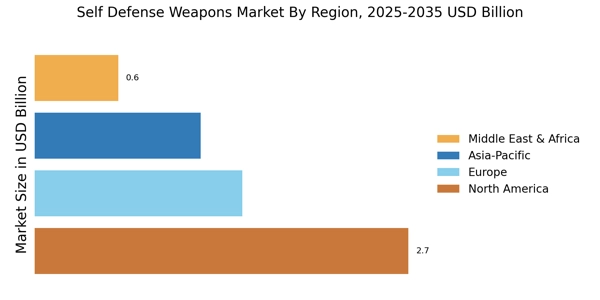
North America is the largest market for self-defense weapons, accounting for approximately 45% of the global market share. The region's growth is driven by increasing concerns over personal safety, rising crime rates, and a growing acceptance of self-defense tools. Regulatory support for responsible ownership and use of self-defense weapons further fuels demand. The U.S. is the primary contributor, followed by Canada, which holds about 10% of the market share.
The competitive landscape in North America is robust, featuring key players such as Smith & Wesson, Taser International, and Mace Security International. These companies benefit from strong brand recognition and extensive distribution networks. The presence of various state laws regulating self-defense weapons also shapes market dynamics, encouraging innovation and product diversification to meet consumer needs.
Europe : Emerging Market for Self Defense
Europe is witnessing a growing interest in self-defense weapons, holding approximately 25% of the global market share. Factors such as rising crime rates, increased awareness of personal safety, and changing regulations are driving this growth. Countries like Germany and the UK are at the forefront, with Germany accounting for about 12% of the market. Regulatory frameworks are evolving to accommodate self-defense products, enhancing consumer confidence and market potential.
Leading countries in Europe include Germany, the UK, and France, with a competitive landscape featuring both local and international players. Companies like Cold Steel and Boker USA are gaining traction, supported by a growing online retail presence. The market is characterized by a mix of traditional and innovative self-defense products, catering to diverse consumer preferences and legal requirements.
Asia-Pacific : Rapid Growth in Self Defense
Asia-Pacific is emerging as a significant player in the self-defense weapons market, currently holding about 20% of the global share. The region's growth is driven by increasing urbanization, rising crime rates, and a growing awareness of personal safety. Countries like Japan and Australia are leading the market, with Japan accounting for approximately 8% of the share. Regulatory frameworks are gradually adapting to accommodate self-defense products, fostering a more favorable environment for market expansion.
The competitive landscape in Asia-Pacific is diverse, with both domestic and international brands vying for market share. Key players include local manufacturers and global brands, such as PepperBall Technologies and Defense Technology. The market is characterized by a growing demand for non-lethal self-defense options, reflecting consumer preferences for safety and compliance with local regulations. Online retail channels are also gaining popularity, enhancing accessibility for consumers.
Middle East and Africa : Developing Market for Self Defense
The Middle East and Africa region is gradually developing its self-defense weapons market, currently holding about 10% of the global share. Factors such as rising crime rates, political instability, and increasing awareness of personal safety are driving demand. Countries like South Africa and the UAE are leading the market, with South Africa accounting for approximately 5% of the share. Regulatory frameworks are still evolving, but there is a growing acceptance of self-defense products among consumers.
In this region, the competitive landscape is characterized by a mix of local and international players. Companies like Kershaw Knives and Spyderco are gaining traction, supported by increasing online sales channels. The market is witnessing a shift towards non-lethal self-defense options, reflecting consumer preferences for safety and compliance with local laws. As awareness of personal safety continues to grow, the demand for self-defense weapons is expected to rise significantly.





 Noah Malgeri
Co-Founder

 Peter Groot koerkamp
Account and Business Manager

 Younghwan Choi
Senior Retail Manager

 Mark Irwin
Management Consultant

 Akif Moroglu
Strategy & Business Development Director

 Guilherme Gomes Martins
Product Management Director

 Joseph Aguayo
Sales Operations & Pricing Manager

 La Terria Dodd
Program Support Specialist

 Rob Kooiker
Group Product Manager HVAC & Fire Protection GMA



