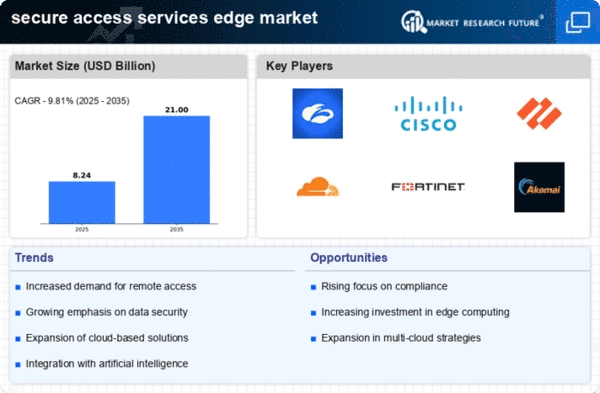
The secure access services edge market is currently characterized by a dynamic competitive landscape, driven by the increasing demand for secure and efficient network access solutions. Key players are focusing on innovation, strategic partnerships, and regional expansion to enhance their market presence. Companies such as Zscaler (US), Cisco (US), and Palo Alto Networks (US) are at the forefront, leveraging their technological expertise to deliver comprehensive security solutions. Zscaler (US) emphasizes cloud-native security, while Cisco (US) integrates its extensive networking capabilities with security features. Palo Alto Networks (US) is known for its advanced threat detection and response capabilities, collectively shaping a competitive environment that prioritizes security and user experience.
The market structure appears moderately fragmented, with several players vying for market share. Key business tactics include localizing services to meet regional compliance requirements and optimizing supply chains to enhance service delivery. The collective influence of these major players fosters a competitive atmosphere where innovation and customer-centric solutions are paramount. As companies strive to differentiate themselves, the focus on tailored offerings and localized support becomes increasingly critical.
In November 2025, Zscaler (US) announced a strategic partnership with a leading telecommunications provider to enhance its secure access services. This collaboration aims to integrate Zscaler's cloud security solutions with the telecom provider's network infrastructure, thereby expanding their reach and improving service delivery. The strategic importance of this partnership lies in its potential to offer customers a seamless and secure experience, reinforcing Zscaler's position as a leader in the market.
In October 2025, Cisco (US) unveiled its latest security platform, which incorporates AI-driven analytics to enhance threat detection capabilities. This launch reflects Cisco's commitment to innovation and its strategy to leverage artificial intelligence in security solutions. The introduction of this platform is significant as it positions Cisco to better address the evolving threat landscape, thereby attracting a broader customer base seeking advanced security measures.
In September 2025, Palo Alto Networks (US) completed the acquisition of a cybersecurity startup specializing in zero-trust architecture. This acquisition is indicative of Palo Alto's strategy to bolster its portfolio with cutting-edge technologies that align with current security trends. The integration of zero-trust principles into its offerings is likely to enhance Palo Alto's competitive edge, as organizations increasingly adopt this model to secure their networks.
As of December 2025, current trends in the secure access services edge market include a pronounced shift towards digitalization, sustainability, and the integration of AI technologies. Strategic alliances are becoming increasingly vital, as companies recognize the need to collaborate to enhance their service offerings and address complex security challenges. Looking ahead, competitive differentiation is expected to evolve, with a greater emphasis on innovation and technology rather than price-based competition. The reliability of supply chains and the ability to deliver cutting-edge solutions will likely become the new benchmarks for success in this rapidly changing landscape.























Leave a Comment