
Request Free Sample ×

Kindly complete the form below to receive a free sample of this Report

* Please use a valid business email

Leading companies partner with us for data-driven Insights

clients tt-cursor
Hero Background
English
Chinese
French
Japanese
Korean
German
Spanish

Satellite Propulsion System Market Share

ID: MRFR/AD/3188-HCR
100 Pages
Shubham Munde
April 2026

Satellite Propulsion System Market Size, Share, Industry Trend & Analysis Research Report: Information By Propulsion Type (Cold Gas Propulsion, Pulsed Plasma Thrusters, Green Liquid Propulsion, Water Electrolyzed, Hydrazine Micro Electrospray Propulsion, Iodine Hall Propulsion, Solar Sail Propulsion, and Ambipolar Thruster), And By Region (North America, Europe, Asia-Pacific, And Rest Of The World) – Forecast Till 2035

Share:
Download PDF ×

We do not share your information with anyone. However, we may send you emails based on your report interest from time to time. You may contact us at any time to opt-out.

Satellite Propulsion System Market Infographic
Purchase Options

Market Share

Satellite Propulsion System Market Share Analysis

The Satellite Propulsion System Market is witnessing several notable trends that are reshaping the landscape of space propulsion technologies. One prominent trend is the growing adoption of electric propulsion systems. Electric propulsion, including ion and Hall-effect thrusters, is gaining traction in the satellite industry due to its efficiency in terms of specific impulse and fuel consumption. This trend reflects a shift towards propulsion systems that enable longer operational lifetimes and increased payload capacities. As satellites take on more sophisticated missions, electric propulsion systems contribute to market trends by offering a reliable and fuel-efficient means of achieving orbital maneuvers and maintaining precise orbits.

Miniaturization and the rise of small satellites are significant trends influencing the Satellite Propulsion System Market. The industry is experiencing an increased demand for propulsion systems tailored to the specific requirements of small satellites, including CubeSats and nanosatellites. This trend is driven by the advantages of cost-effectiveness and flexibility associated with small satellite deployments. Market trends indicate a surge in the development of compact and lightweight propulsion solutions that cater to the unique constraints of small satellites, facilitating their deployment in various space missions.

Reusable propulsion systems are emerging as a noteworthy trend in the Satellite Propulsion System Market. The space industry is exploring reusable technologies to reduce launch costs and enhance sustainability. Reusable propulsion systems, designed for multiple missions or stages, contribute to market trends by aligning with the broader industry goals of cost-effectiveness and environmental responsibility. This trend reflects the increasing focus on developing propulsion systems that support reusability and contribute to the optimization of space launch operations.

Advancements in green propulsion technologies represent a key trend in the Satellite Propulsion System Market. As environmental concerns become more prominent, the industry is witnessing a shift towards developing propulsion systems with reduced environmental impact. Green propulsion systems, including those based on non-toxic propellants and propellantless technologies, are gaining attention. This trend aligns with the growing emphasis on sustainable space practices and the development of eco-friendly solutions that address the ecological aspects of space exploration.

The trend towards in-space manufacturing and assembly is influencing the Satellite Propulsion System Market. As the space industry envisions more ambitious missions and larger satellite constellations, there is a growing need for in-space assembly capabilities. Propulsion systems play a critical role in in-space maneuvering and rendezvous operations. Market trends indicate a focus on developing propulsion systems that support in-space manufacturing initiatives, enabling the construction of large structures or satellite clusters beyond Earth's atmosphere.

Increasing collaboration between space agencies and private companies is a noteworthy trend in the Satellite Propulsion System Market. Space exploration is becoming more collaborative, with partnerships between governmental space agencies and private entities driving innovation and resource sharing. This trend influences market dynamics by fostering joint research and development efforts for advanced propulsion technologies. Collaborative ventures contribute to market trends by bringing together diverse expertise and resources, accelerating the development of cutting-edge propulsion systems for a variety of space missions.

The integration of artificial intelligence (AI) and autonomous capabilities into satellite propulsion systems is a progressive trend. AI-driven propulsion systems offer the potential for autonomous decision-making, precise orbital adjustments, and adaptive mission planning. This trend aligns with the broader industry goals of enhancing satellite autonomy, reducing dependence on ground control, and improving responsiveness to dynamic space environments. Market trends indicate a growing interest in the development of intelligent propulsion systems that can operate with a higher degree of autonomy, contributing to the efficiency and effectiveness of satellite missions.

Interplanetary exploration and the demand for deep-space propulsion systems are emerging trends in the Satellite Propulsion System Market. As space agencies and private companies express interest in exploring beyond Earth's orbit, there is a need for propulsion systems capable of navigating the complexities of interplanetary travel. Trends in deep-space propulsion systems include the development of high-thrust engines and advanced propulsion concepts to support missions to the Moon, Mars, and beyond. This trend reflects the industry's aspirations for interplanetary exploration and the evolving requirements of ambitious space missions.


Author
Author Profile
Shubham Munde
Team Lead - Research

Shubham brings over 7 years of expertise in Market Intelligence and Strategic Consulting, with a strong focus on the Automotive, Aerospace, and Defense sectors. Backed by a solid foundation in semiconductors, electronics, and software, he has successfully delivered high-impact syndicated and custom research on a global scale. His core strengths include market sizing, forecasting, competitive intelligence, consumer insights, and supply chain mapping. Widely recognized for developing scalable growth strategies, Shubham empowers clients to navigate complex markets and achieve a lasting competitive edge. Trusted by start-ups and Fortune 500 companies alike, he consistently converts challenges into strategic opportunities that drive sustainable growth.

Leave a Comment

FAQs

What is the current valuation of the Satellite Propulsion System Market?

<p>The Satellite Propulsion System Market was valued at 11.5 USD Billion in 2024.</p>

What is the projected market valuation for the Satellite Propulsion System Market by 2035?

<p>The market is projected to reach 34.15 USD Billion by 2035.</p>

What is the expected CAGR for the Satellite Propulsion System Market during the forecast period 2025 - 2035?

<p>The expected CAGR for the market during 2025 - 2035 is 10.4%.</p>

Which companies are considered key players in the Satellite Propulsion System Market?

<p>Key players include Aerojet Rocketdyne, Northrop Grumman, Airbus Defence and Space, Boeing, and Thales Alenia Space.</p>

What propulsion types are included in the Satellite Propulsion System Market segments?

<p>The market segments include Cold Gas Propulsion, Pulsed Plasma Thrusters, Green Liquid Propulsion, and others.</p>

What was the valuation of Cold Gas Propulsion in 2024?

Cold Gas Propulsion was valued at 1.15 USD Billion in 2024.

What is the projected valuation for Green Liquid Propulsion by 2035?

Green Liquid Propulsion is projected to reach 6.0 USD Billion by 2035.

How does the valuation of Pulsed Plasma Thrusters compare to other propulsion types?

Pulsed Plasma Thrusters had a valuation of 1.5 USD Billion in 2024, indicating strong market interest.

What is the expected growth trajectory for Iodine Hall Propulsion in the coming years?

Iodine Hall Propulsion is projected to grow from 1.3 USD Billion in 2024 to 3.9 USD Billion by 2035.

What role do companies like Rocket Lab and Maxar Technologies play in the market?

Companies like Rocket Lab and Maxar Technologies contribute to innovation and competition within the Satellite Propulsion System Market.

Market Summary

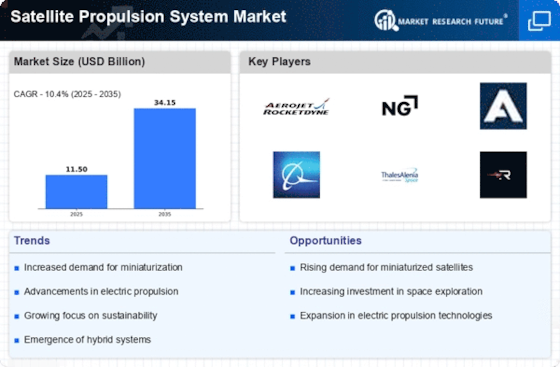
As per Market Research Future analysis, the Satellite Propulsion System Market Size was estimated at 11.5 USD Billion in 2024. The Satellite Propulsion System industry is projected to grow from 12.7 USD Billion in 2025 to 34.15 USD Billion by 2035, exhibiting a compound annual growth rate (CAGR) of 10.4% during the forecast period 2025 - 2035

Key Market Trends & Highlights

The Satellite Propulsion System Market is poised for substantial growth driven by technological advancements and increasing demand for satellite services.

  • The emergence of electric propulsion systems is reshaping the landscape of satellite propulsion technologies. North America remains the largest market, while the Asia-Pacific region is recognized as the fastest-growing area for satellite propulsion systems. Cold gas propulsion continues to dominate the market, whereas green liquid propulsion is rapidly gaining traction as a preferred choice. Advancements in propulsion technologies and increasing demand for satellite services are key drivers propelling market expansion.

Market Size & Forecast

2024 Market Size 11.5 (USD Billion)
2035 Market Size 34.15 (USD Billion)
CAGR (2025 - 2035) 10.4%
Largest Regional Market Share in 2024 North America

Major Players

Aerojet Rocketdyne (US), Northrop Grumman (US), Airbus Defence and Space (GB), Boeing (US), <a href="https://www.boeing.co.in/#news">Thales Alenia Space</a> (FR), Rocket Lab (NZ), Mitsubishi Heavy Industries (JP), Sierra Nevada Corporation (US), Maxar Technologies (CA)

Market Trends

The Satellite Propulsion System Market is currently experiencing a transformative phase, driven by advancements in technology and increasing demand for satellite applications. The integration of innovative propulsion technologies, such as electric and hybrid systems, appears to enhance efficiency and reduce operational costs. Furthermore, the growing emphasis on sustainability within the aerospace sector suggests a shift towards greener propulsion solutions, which may attract investment and foster new developments. As nations and private entities continue to expand their satellite capabilities, the market is likely to witness a surge in research and development activities aimed at optimizing propulsion systems for various missions. In addition, the rise of small satellite constellations is reshaping the landscape of the Satellite Propulsion System Market. These smaller, more agile satellites require propulsion systems that are compact yet powerful, indicating a potential shift in design and engineering approaches. The increasing collaboration between government agencies and private companies could further stimulate innovation, leading to the emergence of novel propulsion technologies tailored for specific applications. Overall, the Satellite Propulsion System Market is poised for growth, driven by technological advancements and evolving market demands, which may redefine the future of satellite operations and exploration.

Emergence of Electric Propulsion Systems

The Satellite Propulsion System Market is witnessing a notable trend towards the adoption of electric propulsion systems. These systems offer enhanced efficiency and longer operational lifespans, making them increasingly attractive for various satellite missions. As the industry seeks to optimize performance while minimizing costs, electric propulsion appears to be a viable solution.

Focus on Sustainable Solutions

There is a growing emphasis on sustainability within the Satellite Propulsion System Market. Stakeholders are increasingly prioritizing environmentally friendly propulsion technologies that reduce emissions and energy consumption. This trend indicates a broader commitment to sustainable practices in aerospace, potentially influencing future developments.

Rise of Small Satellite Constellations

The proliferation of small satellite constellations is reshaping the Satellite Propulsion System Market. These compact satellites require specialized propulsion systems that are both efficient and lightweight. This trend suggests a shift in engineering approaches, as manufacturers adapt to the unique demands of small satellite operations.

Satellite Propulsion System Market Market Drivers

Emergence of Commercial Space Ventures

The emergence of commercial space ventures is reshaping the Satellite Propulsion System Market. Private companies are increasingly entering the space sector, driven by the potential for profit and innovation. This trend has led to a surge in satellite launches, with commercial entities accounting for a significant portion of the market. The rise of small satellite constellations, particularly for applications such as Internet of Things (IoT) connectivity and Earth observation, is creating new opportunities for propulsion system manufacturers. As these companies seek to optimize costs and enhance satellite capabilities, the demand for advanced propulsion technologies is expected to rise. This dynamic environment is likely to foster competition and innovation within the Satellite Propulsion System Market, as companies strive to differentiate their offerings and capture market share.

Advancements in Propulsion Technologies

The Satellite Propulsion System Market is experiencing a notable transformation due to advancements in propulsion technologies. Innovations such as ion thrusters and electric propulsion systems are gaining traction, offering enhanced efficiency and reduced fuel consumption. These technologies enable satellites to achieve longer operational lifespans and greater maneuverability in orbit. As a result, the market is projected to grow at a compound annual growth rate of approximately 10% over the next five years. This growth is driven by the increasing demand for high-performance satellites that can support various applications, including telecommunications, Earth observation, and scientific research. The integration of cutting-edge propulsion systems is likely to redefine operational capabilities, making them a focal point for manufacturers and service providers in the Satellite Propulsion System Market.

Government Investments in Space Programs

Government investments in space programs are playing a crucial role in shaping the Satellite Propulsion System Market. Various nations are increasing their budgets for space exploration and satellite deployment, recognizing the strategic importance of space capabilities. For instance, the United States has allocated significant funding for NASA and other space agencies, which directly impacts the demand for advanced propulsion systems. This trend is mirrored in other countries, where national security and technological leadership drive investments in satellite technologies. As governments prioritize space initiatives, the Satellite Propulsion System Market is likely to benefit from increased contracts and collaborations with private sector players. This influx of funding is expected to accelerate research and development efforts, leading to innovative propulsion solutions that meet the evolving needs of the space sector.

Increasing Demand for Satellite Services

The Satellite Propulsion System Market is significantly influenced by the rising demand for satellite services across various sectors. As industries such as telecommunications, broadcasting, and remote sensing expand, the need for reliable and efficient satellite systems becomes paramount. The market for satellite services is expected to reach USD 300 billion by 2026, indicating a robust growth trajectory. This surge in demand necessitates advanced propulsion systems that can support the deployment and maintenance of a growing number of satellites in orbit. Consequently, manufacturers are focusing on developing propulsion solutions that enhance satellite performance and reduce operational costs. The interplay between service demand and propulsion technology development is likely to shape the future landscape of the Satellite Propulsion System Market.

Focus on Miniaturization of Satellite Systems

The focus on miniaturization of satellite systems is a key driver in the Satellite Propulsion System Market. As satellites become smaller and lighter, the propulsion systems must also adapt to meet these new requirements. Miniaturized propulsion technologies, such as microthrusters, are being developed to provide efficient thrust while occupying minimal space. This trend is particularly relevant for small satellite applications, where weight and size constraints are critical. The market for small satellites is projected to grow significantly, with estimates suggesting that over 10,000 small satellites could be launched by 2030. This proliferation of small satellites necessitates innovative propulsion solutions that can support their unique operational needs. Consequently, the Satellite Propulsion System Market is likely to witness a surge in demand for compact and efficient propulsion systems that align with the miniaturization trend.

Market Segment Insights

By Propulsion Type: Cold Gas Propulsion (Largest) vs. Green Liquid Propulsion (Fastest-Growing)

The Satellite Propulsion System Market reflects a diverse landscape of propulsion technologies, with Cold Gas Propulsion leading as the dominant choice among developers due to its simplicity and reliability. This propulsion type benefits from its well-established technology and cost-effectiveness, capturing a significant share of the market. In contrast, Green Liquid Propulsion emerges as the fastest-growing segment, appealing to companies prioritizing eco-friendly solutions amid the increasing pressure for sustainable space operations. Other segments, though valuable, hold smaller shares in this competitive arena.

Propulsion Type: Cold Gas Propulsion (Dominant) vs. Green Liquid Propulsion (Emerging)

Cold Gas Propulsion is characterized by its use of inert gases, making it a low-risk option for satellite maneuvers. Its straightforward mechanism and minimal maintenance make it a preferred solution for many satellites, especially those deployed in low Earth orbit. On the other hand, Green Liquid Propulsion, utilizing non-toxic propellants, is gaining traction as the space industry shifts toward more sustainable practices. The unique position of Green Liquid Propulsion caters to a growing segment of environmentally conscious satellite manufacturers, aiming to reduce the ecological footprint of space missions while also seeking high-performance standards. The ongoing innovations in both technologies reflect their defined roles in the future of satellite propulsion.

Get more detailed insights about Satellite Propulsion System Market Research Report - Forecast till 2035

Regional Insights

North America : Innovation and Leadership Hub

North America leads the Satellite Propulsion System Market, holding approximately 45% of the global share. The region's growth is driven by advancements in technology, increased government spending on space exploration, and a surge in commercial satellite launches. Regulatory support from agencies like NASA and the FAA further catalyzes market expansion, fostering innovation and collaboration among key players. The United States is the largest market, with significant contributions from companies such as Aerojet Rocketdyne, Northrop Grumman, and Boeing. Canada also plays a vital role, with Maxar Technologies leading in satellite services. The competitive landscape is characterized by a mix of established firms and emerging startups, all vying for a share in this rapidly evolving sector.

Europe : Growing Space Economy

Europe is witnessing a significant rise in the Satellite Propulsion System Market, accounting for about 30% of the global share. The growth is fueled by increasing investments in space technology, collaborative projects like the European Space Agency's initiatives, and a focus on sustainable propulsion solutions. Regulatory frameworks are evolving to support innovation and ensure safety in satellite operations, enhancing market attractiveness. Leading countries include France, Germany, and the UK, with key players such as Airbus Defence and Space and Thales Alenia Space driving advancements. The competitive landscape is marked by strong partnerships and a focus on research and development, positioning Europe as a formidable player in the global market. The region's commitment to sustainability is also shaping future propulsion technologies.

Asia-Pacific : Rapidly Expanding Market

Asia-Pacific is emerging as a significant player in the Satellite Propulsion System Market, holding approximately 20% of the global share. The region's growth is driven by increasing satellite launches, government initiatives to enhance space capabilities, and a growing demand for communication and earth observation satellites. Countries like India and Japan are at the forefront, supported by favorable regulatory environments that encourage investment in space technologies. India, with its ambitious space program, and Japan, known for its technological advancements, are leading the charge. Key players like Mitsubishi Heavy Industries and Rocket Lab are making substantial contributions to the market. The competitive landscape is characterized by a mix of government agencies and private companies, all striving to enhance their capabilities in satellite propulsion systems.

Middle East and Africa : Emerging Space Initiatives

The Middle East and Africa region is gradually developing its Satellite Propulsion System Market, currently holding about 5% of the global share. Growth is driven by increasing investments in space programs, particularly in countries like the UAE and South Africa, which are focusing on satellite technology for communication and research. Regulatory frameworks are being established to support the burgeoning space industry, fostering a conducive environment for innovation. The UAE is leading the charge with its ambitious Mars mission and satellite projects, while South Africa is enhancing its capabilities through partnerships and collaborations. The competitive landscape is still in its infancy, with emerging players and government initiatives paving the way for future growth in satellite propulsion technologies. The region's potential is significant as it seeks to establish a foothold in The Satellite Propulsion System Market.

Key Players and Competitive Insights

The Satellite Propulsion System Market is currently characterized by a dynamic competitive landscape, driven by technological advancements and increasing demand for satellite capabilities. Key players such as Aerojet Rocketdyne (US), Northrop Grumman (US), and Airbus Defence and Space (GB) are at the forefront, each adopting distinct strategies to enhance their market positioning. Aerojet Rocketdyne (US) focuses on innovation in propulsion technologies, particularly in electric propulsion systems, which are gaining traction due to their efficiency and reduced environmental impact. Northrop Grumman (US) emphasizes strategic partnerships and acquisitions to bolster its capabilities, while Airbus Defence and Space (GB) is investing heavily in digital transformation to streamline operations and improve satellite performance. Collectively, these strategies contribute to a competitive environment that is increasingly centered on technological superiority and operational efficiency.
In terms of business tactics, companies are localizing manufacturing and optimizing supply chains to enhance responsiveness to market demands. The market structure appears moderately fragmented, with several players vying for market share, yet dominated by a few key firms that wield considerable influence. This competitive structure fosters innovation, as companies strive to differentiate themselves through advanced technologies and improved service offerings.
In August 2025, Aerojet Rocketdyne (US) announced a partnership with a leading space agency to develop next-generation propulsion systems aimed at deep space exploration. This collaboration is strategically significant as it positions Aerojet Rocketdyne at the cutting edge of propulsion technology, potentially opening new avenues for revenue and enhancing its reputation as a leader in the sector. Similarly, in July 2025, Northrop Grumman (US) completed the acquisition of a small aerospace firm specializing in satellite propulsion, which is expected to enhance its technological capabilities and expand its product offerings in the satellite market.
In September 2025, Airbus Defence and Space (GB) launched a new initiative focused on sustainable propulsion technologies, aiming to reduce the carbon footprint of satellite launches. This initiative not only aligns with global sustainability goals but also reflects a growing trend among aerospace companies to prioritize environmentally friendly solutions, thereby enhancing their competitive edge in a market increasingly influenced by regulatory pressures and consumer preferences.
As of October 2025, the competitive trends in the Satellite Propulsion System Market are heavily influenced by digitalization, sustainability, and the integration of artificial intelligence. Strategic alliances are becoming more prevalent, as companies recognize the value of collaboration in driving innovation and enhancing operational efficiencies. Looking ahead, it is likely that competitive differentiation will increasingly pivot from traditional price-based competition to a focus on technological innovation, reliability in supply chains, and the ability to meet sustainability targets. This shift underscores the importance of adaptability and forward-thinking strategies in navigating the evolving landscape of the satellite propulsion market.

Key Companies in the Satellite Propulsion System Market include

Industry Developments

  • Q2 2025: Moog Inc. introduces compact electric propulsion thruster for small satellite constellations Moog Inc. launched a new compact electric propulsion thruster designed for CubeSats and nanosats, improving efficiency by 20% and enabling modular integration for small satellite constellations.
  • Q2 2025: Blue Origin successfully tests next-generation BE-3U vacuum engine for lunar landers Blue Origin completed a successful test of its BE-3U vacuum engine, featuring a variable-thrust system optimized for NASA’s Artemis lunar lander program.
  • Q2 2025: Sitael S.p.A. unveils Hall-effect propulsion system at SpaceTech Asia Expo Sitael S.p.A. introduced a new Hall-effect propulsion system for interplanetary micro-missions, offering high thrust density with low fuel consumption.
  • Q2 2025: IHI Corporation completes in-orbit testing of hybrid chemical-electric propulsion system IHI Corporation successfully completed in-orbit testing of its hybrid chemical-electric propulsion system aboard a Japanese government satellite, demonstrating seamless mode-switching for extended mission control.

Future Outlook

Satellite Propulsion System Market Future Outlook

The Satellite Propulsion System Market is projected to grow at a 10.4% CAGR from 2025 to 2035, driven by advancements in satellite technology and increasing demand for space exploration.

New opportunities lie in:

  • Development of hybrid propulsion systems for enhanced efficiency
  • Expansion into emerging markets with tailored propulsion solutions
  • Investment in R&amp;D for eco-friendly propulsion technologies

By 2035, the market is expected to be robust, reflecting substantial growth and innovation.

Market Segmentation

Satellite Propulsion System Market Propulsion Type Outlook

  • Cold Gas Propulsion
  • Pulsed Plasma Thrusters
  • Green Liquid Propulsion
  • Water Electrolyzed
  • Hydrazine Micro Electrospray Propulsion
  • Iodine Hall Propulsion
  • Solar Sail Propulsion
  • Ambipolar Thruster

Report Scope

MARKET SIZE 2024 11.5(USD Billion)
MARKET SIZE 2025 12.7(USD Billion)
MARKET SIZE 2035 34.15(USD Billion)
COMPOUND ANNUAL GROWTH RATE (CAGR) 10.4% (2025 - 2035)
REPORT COVERAGE Revenue Forecast, Competitive Landscape, Growth Factors, and Trends
BASE YEAR 2024
Market Forecast Period 2025 - 2035
Historical Data 2019 - 2024
Market Forecast Units USD Billion
Key Companies Profiled Aerojet Rocketdyne (US), Northrop Grumman (US), Airbus Defence and Space (GB), Boeing (US), Thales Alenia Space (FR), Rocket Lab (NZ), Mitsubishi Heavy Industries (JP), Sierra Nevada Corporation (US), Maxar Technologies (CA)
Segments Covered Propulsion Type, Region
Key Market Opportunities Advancements in electric propulsion technologies enhance efficiency in the Satellite Propulsion System Market.
Key Market Dynamics Technological advancements in propulsion systems drive competition and innovation within the satellite propulsion sector.
Countries Covered North America, Europe, APAC, South America, MEA

FAQs

What is the current valuation of the Satellite Propulsion System Market?

<p>The Satellite Propulsion System Market was valued at 11.5 USD Billion in 2024.</p>

What is the projected market valuation for the Satellite Propulsion System Market by 2035?

<p>The market is projected to reach 34.15 USD Billion by 2035.</p>

What is the expected CAGR for the Satellite Propulsion System Market during the forecast period 2025 - 2035?

<p>The expected CAGR for the market during 2025 - 2035 is 10.4%.</p>

Which companies are considered key players in the Satellite Propulsion System Market?

<p>Key players include Aerojet Rocketdyne, Northrop Grumman, Airbus Defence and Space, Boeing, and Thales Alenia Space.</p>

What propulsion types are included in the Satellite Propulsion System Market segments?

<p>The market segments include Cold Gas Propulsion, Pulsed Plasma Thrusters, Green Liquid Propulsion, and others.</p>

What was the valuation of Cold Gas Propulsion in 2024?

Cold Gas Propulsion was valued at 1.15 USD Billion in 2024.

What is the projected valuation for Green Liquid Propulsion by 2035?

Green Liquid Propulsion is projected to reach 6.0 USD Billion by 2035.

How does the valuation of Pulsed Plasma Thrusters compare to other propulsion types?

Pulsed Plasma Thrusters had a valuation of 1.5 USD Billion in 2024, indicating strong market interest.

What is the expected growth trajectory for Iodine Hall Propulsion in the coming years?

Iodine Hall Propulsion is projected to grow from 1.3 USD Billion in 2024 to 3.9 USD Billion by 2035.

What role do companies like Rocket Lab and Maxar Technologies play in the market?

Companies like Rocket Lab and Maxar Technologies contribute to innovation and competition within the Satellite Propulsion System Market.

  1. SECTION I: EXECUTIVE SUMMARY AND KEY HIGHLIGHTS
    1. | 1.1 EXECUTIVE SUMMARY
    2. | | 1.1.1 Market Overview
    3. | | 1.1.2 Key Findings
    4. | | 1.1.3 Market Segmentation
    5. | | 1.1.4 Competitive Landscape
    6. | | 1.1.5 Challenges and Opportunities
    7. | | 1.1.6 Future Outlook
  2. SECTION II: SCOPING, METHODOLOGY AND MARKET STRUCTURE
    1. | 2.1 MARKET INTRODUCTION
    2. | | 2.1.1 Definition
    3. | | 2.1.2 Scope of the study
    4. | | | 2.1.2.1 Research Objective
    5. | | | 2.1.2.2 Assumption
    6. | | | 2.1.2.3 Limitations
    7. | 2.2 RESEARCH METHODOLOGY
    8. | | 2.2.1 Overview
    9. | | 2.2.2 Data Mining
    10. | | 2.2.3 Secondary Research
    11. | | 2.2.4 Primary Research
    12. | | | 2.2.4.1 Primary Interviews and Information Gathering Process
    13. | | | 2.2.4.2 Breakdown of Primary Respondents
    14. | | 2.2.5 Forecasting Model
    15. | | 2.2.6 Market Size Estimation
    16. | | | 2.2.6.1 Bottom-Up Approach
    17. | | | 2.2.6.2 Top-Down Approach
    18. | | 2.2.7 Data Triangulation
    19. | | 2.2.8 Validation
  3. SECTION III: QUALITATIVE ANALYSIS
    1. | 3.1 MARKET DYNAMICS
    2. | | 3.1.1 Overview
    3. | | 3.1.2 Drivers
    4. | | 3.1.3 Restraints
    5. | | 3.1.4 Opportunities
    6. | 3.2 MARKET FACTOR ANALYSIS
    7. | | 3.2.1 Value chain Analysis
    8. | | 3.2.2 Porter's Five Forces Analysis
    9. | | | 3.2.2.1 Bargaining Power of Suppliers
    10. | | | 3.2.2.2 Bargaining Power of Buyers
    11. | | | 3.2.2.3 Threat of New Entrants
    12. | | | 3.2.2.4 Threat of Substitutes
    13. | | | 3.2.2.5 Intensity of Rivalry
    14. | | 3.2.3 COVID-19 Impact Analysis
    15. | | | 3.2.3.1 Market Impact Analysis
    16. | | | 3.2.3.2 Regional Impact
    17. | | | 3.2.3.3 Opportunity and Threat Analysis
  4. SECTION IV: QUANTITATIVE ANALYSIS
    1. | 4.1 Aerospace & Defense, BY Propulsion Type (USD Billion)
    2. | | 4.1.1 Cold Gas Propulsion
    3. | | 4.1.2 Pulsed Plasma Thrusters
    4. | | 4.1.3 Green Liquid Propulsion
    5. | | 4.1.4 Water Electrolyzed
    6. | | 4.1.5 Hydrazine Micro Electrospray Propulsion
    7. | | 4.1.6 Iodine Hall Propulsion
    8. | | 4.1.7 Solar Sail Propulsion
    9. | | 4.1.8 Ambipolar Thruster
    10. | 4.2 Aerospace & Defense, BY Region (USD Billion)
    11. | | 4.2.1 North America
    12. | | | 4.2.1.1 US
    13. | | | 4.2.1.2 Canada
    14. | | 4.2.2 Europe
    15. | | | 4.2.2.1 Germany
    16. | | | 4.2.2.2 UK
    17. | | | 4.2.2.3 France
    18. | | | 4.2.2.4 Russia
    19. | | | 4.2.2.5 Italy
    20. | | | 4.2.2.6 Spain
    21. | | | 4.2.2.7 Rest of Europe
    22. | | 4.2.3 APAC
    23. | | | 4.2.3.1 China
    24. | | | 4.2.3.2 India
    25. | | | 4.2.3.3 Japan
    26. | | | 4.2.3.4 South Korea
    27. | | | 4.2.3.5 Malaysia
    28. | | | 4.2.3.6 Thailand
    29. | | | 4.2.3.7 Indonesia
    30. | | | 4.2.3.8 Rest of APAC
    31. | | 4.2.4 South America
    32. | | | 4.2.4.1 Brazil
    33. | | | 4.2.4.2 Mexico
    34. | | | 4.2.4.3 Argentina
    35. | | | 4.2.4.4 Rest of South America
    36. | | 4.2.5 MEA
    37. | | | 4.2.5.1 GCC Countries
    38. | | | 4.2.5.2 South Africa
    39. | | | 4.2.5.3 Rest of MEA
  5. SECTION V: COMPETITIVE ANALYSIS
    1. | 5.1 Competitive Landscape
    2. | | 5.1.1 Overview
    3. | | 5.1.2 Competitive Analysis
    4. | | 5.1.3 Market share Analysis
    5. | | 5.1.4 Major Growth Strategy in the Aerospace & Defense
    6. | | 5.1.5 Competitive Benchmarking
    7. | | 5.1.6 Leading Players in Terms of Number of Developments in the Aerospace & Defense
    8. | | 5.1.7 Key developments and growth strategies
    9. | | | 5.1.7.1 New Product Launch/Service Deployment
    10. | | | 5.1.7.2 Merger & Acquisitions
    11. | | | 5.1.7.3 Joint Ventures
    12. | | 5.1.8 Major Players Financial Matrix
    13. | | | 5.1.8.1 Sales and Operating Income
    14. | | | 5.1.8.2 Major Players R&D Expenditure. 2023
    15. | 5.2 Company Profiles
    16. | | 5.2.1 Aerojet Rocketdyne (US)
    17. | | | 5.2.1.1 Financial Overview
    18. | | | 5.2.1.2 Products Offered
    19. | | | 5.2.1.3 Key Developments
    20. | | | 5.2.1.4 SWOT Analysis
    21. | | | 5.2.1.5 Key Strategies
    22. | | 5.2.2 Northrop Grumman (US)
    23. | | | 5.2.2.1 Financial Overview
    24. | | | 5.2.2.2 Products Offered
    25. | | | 5.2.2.3 Key Developments
    26. | | | 5.2.2.4 SWOT Analysis
    27. | | | 5.2.2.5 Key Strategies
    28. | | 5.2.3 Airbus Defence and Space (GB)
    29. | | | 5.2.3.1 Financial Overview
    30. | | | 5.2.3.2 Products Offered
    31. | | | 5.2.3.3 Key Developments
    32. | | | 5.2.3.4 SWOT Analysis
    33. | | | 5.2.3.5 Key Strategies
    34. | | 5.2.4 Boeing (US)
    35. | | | 5.2.4.1 Financial Overview
    36. | | | 5.2.4.2 Products Offered
    37. | | | 5.2.4.3 Key Developments
    38. | | | 5.2.4.4 SWOT Analysis
    39. | | | 5.2.4.5 Key Strategies
    40. | | 5.2.5 Thales Alenia Space (FR)
    41. | | | 5.2.5.1 Financial Overview
    42. | | | 5.2.5.2 Products Offered
    43. | | | 5.2.5.3 Key Developments
    44. | | | 5.2.5.4 SWOT Analysis
    45. | | | 5.2.5.5 Key Strategies
    46. | | 5.2.6 Rocket Lab (NZ)
    47. | | | 5.2.6.1 Financial Overview
    48. | | | 5.2.6.2 Products Offered
    49. | | | 5.2.6.3 Key Developments
    50. | | | 5.2.6.4 SWOT Analysis
    51. | | | 5.2.6.5 Key Strategies
    52. | | 5.2.7 Mitsubishi Heavy Industries (JP)
    53. | | | 5.2.7.1 Financial Overview
    54. | | | 5.2.7.2 Products Offered
    55. | | | 5.2.7.3 Key Developments
    56. | | | 5.2.7.4 SWOT Analysis
    57. | | | 5.2.7.5 Key Strategies
    58. | | 5.2.8 Sierra Nevada Corporation (US)
    59. | | | 5.2.8.1 Financial Overview
    60. | | | 5.2.8.2 Products Offered
    61. | | | 5.2.8.3 Key Developments
    62. | | | 5.2.8.4 SWOT Analysis
    63. | | | 5.2.8.5 Key Strategies
    64. | | 5.2.9 Maxar Technologies (CA)
    65. | | | 5.2.9.1 Financial Overview
    66. | | | 5.2.9.2 Products Offered
    67. | | | 5.2.9.3 Key Developments
    68. | | | 5.2.9.4 SWOT Analysis
    69. | | | 5.2.9.5 Key Strategies
    70. | 5.3 Appendix
    71. | | 5.3.1 References
    72. | | 5.3.2 Related Reports
  6. LIST OF FIGURES
    1. | 6.1 MARKET SYNOPSIS
    2. | 6.2 NORTH AMERICA MARKET ANALYSIS
    3. | 6.3 US MARKET ANALYSIS BY PROPULSION TYPE
    4. | 6.4 CANADA MARKET ANALYSIS BY PROPULSION TYPE
    5. | 6.5 EUROPE MARKET ANALYSIS
    6. | 6.6 GERMANY MARKET ANALYSIS BY PROPULSION TYPE
    7. | 6.7 UK MARKET ANALYSIS BY PROPULSION TYPE
    8. | 6.8 FRANCE MARKET ANALYSIS BY PROPULSION TYPE
    9. | 6.9 RUSSIA MARKET ANALYSIS BY PROPULSION TYPE
    10. | 6.10 ITALY MARKET ANALYSIS BY PROPULSION TYPE
    11. | 6.11 SPAIN MARKET ANALYSIS BY PROPULSION TYPE
    12. | 6.12 REST OF EUROPE MARKET ANALYSIS BY PROPULSION TYPE
    13. | 6.13 APAC MARKET ANALYSIS
    14. | 6.14 CHINA MARKET ANALYSIS BY PROPULSION TYPE
    15. | 6.15 INDIA MARKET ANALYSIS BY PROPULSION TYPE
    16. | 6.16 JAPAN MARKET ANALYSIS BY PROPULSION TYPE
    17. | 6.17 SOUTH KOREA MARKET ANALYSIS BY PROPULSION TYPE
    18. | 6.18 MALAYSIA MARKET ANALYSIS BY PROPULSION TYPE
    19. | 6.19 THAILAND MARKET ANALYSIS BY PROPULSION TYPE
    20. | 6.20 INDONESIA MARKET ANALYSIS BY PROPULSION TYPE
    21. | 6.21 REST OF APAC MARKET ANALYSIS BY PROPULSION TYPE
    22. | 6.22 SOUTH AMERICA MARKET ANALYSIS
    23. | 6.23 BRAZIL MARKET ANALYSIS BY PROPULSION TYPE
    24. | 6.24 MEXICO MARKET ANALYSIS BY PROPULSION TYPE
    25. | 6.25 ARGENTINA MARKET ANALYSIS BY PROPULSION TYPE
    26. | 6.26 REST OF SOUTH AMERICA MARKET ANALYSIS BY PROPULSION TYPE
    27. | 6.27 MEA MARKET ANALYSIS
    28. | 6.28 GCC COUNTRIES MARKET ANALYSIS BY PROPULSION TYPE
    29. | 6.29 SOUTH AFRICA MARKET ANALYSIS BY PROPULSION TYPE
    30. | 6.30 REST OF MEA MARKET ANALYSIS BY PROPULSION TYPE
    31. | 6.31 KEY BUYING CRITERIA OF AEROSPACE & DEFENSE
    32. | 6.32 RESEARCH PROCESS OF MRFR
    33. | 6.33 DRO ANALYSIS OF AEROSPACE & DEFENSE
    34. | 6.34 DRIVERS IMPACT ANALYSIS: AEROSPACE & DEFENSE
    35. | 6.35 RESTRAINTS IMPACT ANALYSIS: AEROSPACE & DEFENSE
    36. | 6.36 SUPPLY / VALUE CHAIN: AEROSPACE & DEFENSE
    37. | 6.37 AEROSPACE & DEFENSE, BY PROPULSION TYPE, 2024 (% SHARE)
    38. | 6.38 AEROSPACE & DEFENSE, BY PROPULSION TYPE, 2024 TO 2035 (USD Billion)
    39. | 6.39 BENCHMARKING OF MAJOR COMPETITORS
  7. LIST OF TABLES
    1. | 7.1 LIST OF ASSUMPTIONS
    2. | | 7.1.1
    3. | 7.2 North America MARKET SIZE ESTIMATES; FORECAST
    4. | | 7.2.1 BY PROPULSION TYPE, 2025-2035 (USD Billion)
    5. | 7.3 US MARKET SIZE ESTIMATES; FORECAST
    6. | | 7.3.1 BY PROPULSION TYPE, 2025-2035 (USD Billion)
    7. | 7.4 Canada MARKET SIZE ESTIMATES; FORECAST
    8. | | 7.4.1 BY PROPULSION TYPE, 2025-2035 (USD Billion)
    9. | 7.5 Europe MARKET SIZE ESTIMATES; FORECAST
    10. | | 7.5.1 BY PROPULSION TYPE, 2025-2035 (USD Billion)
    11. | 7.6 Germany MARKET SIZE ESTIMATES; FORECAST
    12. | | 7.6.1 BY PROPULSION TYPE, 2025-2035 (USD Billion)
    13. | 7.7 UK MARKET SIZE ESTIMATES; FORECAST
    14. | | 7.7.1 BY PROPULSION TYPE, 2025-2035 (USD Billion)
    15. | 7.8 France MARKET SIZE ESTIMATES; FORECAST
    16. | | 7.8.1 BY PROPULSION TYPE, 2025-2035 (USD Billion)
    17. | 7.9 Russia MARKET SIZE ESTIMATES; FORECAST
    18. | | 7.9.1 BY PROPULSION TYPE, 2025-2035 (USD Billion)
    19. | 7.10 Italy MARKET SIZE ESTIMATES; FORECAST
    20. | | 7.10.1 BY PROPULSION TYPE, 2025-2035 (USD Billion)
    21. | 7.11 Spain MARKET SIZE ESTIMATES; FORECAST
    22. | | 7.11.1 BY PROPULSION TYPE, 2025-2035 (USD Billion)
    23. | 7.12 Rest of Europe MARKET SIZE ESTIMATES; FORECAST
    24. | | 7.12.1 BY PROPULSION TYPE, 2025-2035 (USD Billion)
    25. | 7.13 APAC MARKET SIZE ESTIMATES; FORECAST
    26. | | 7.13.1 BY PROPULSION TYPE, 2025-2035 (USD Billion)
    27. | 7.14 China MARKET SIZE ESTIMATES; FORECAST
    28. | | 7.14.1 BY PROPULSION TYPE, 2025-2035 (USD Billion)
    29. | 7.15 India MARKET SIZE ESTIMATES; FORECAST
    30. | | 7.15.1 BY PROPULSION TYPE, 2025-2035 (USD Billion)
    31. | 7.16 Japan MARKET SIZE ESTIMATES; FORECAST
    32. | | 7.16.1 BY PROPULSION TYPE, 2025-2035 (USD Billion)
    33. | 7.17 South Korea MARKET SIZE ESTIMATES; FORECAST
    34. | | 7.17.1 BY PROPULSION TYPE, 2025-2035 (USD Billion)
    35. | 7.18 Malaysia MARKET SIZE ESTIMATES; FORECAST
    36. | | 7.18.1 BY PROPULSION TYPE, 2025-2035 (USD Billion)
    37. | 7.19 Thailand MARKET SIZE ESTIMATES; FORECAST
    38. | | 7.19.1 BY PROPULSION TYPE, 2025-2035 (USD Billion)
    39. | 7.20 Indonesia MARKET SIZE ESTIMATES; FORECAST
    40. | | 7.20.1 BY PROPULSION TYPE, 2025-2035 (USD Billion)
    41. | 7.21 Rest of APAC MARKET SIZE ESTIMATES; FORECAST
    42. | | 7.21.1 BY PROPULSION TYPE, 2025-2035 (USD Billion)
    43. | 7.22 South America MARKET SIZE ESTIMATES; FORECAST
    44. | | 7.22.1 BY PROPULSION TYPE, 2025-2035 (USD Billion)
    45. | 7.23 Brazil MARKET SIZE ESTIMATES; FORECAST
    46. | | 7.23.1 BY PROPULSION TYPE, 2025-2035 (USD Billion)
    47. | 7.24 Mexico MARKET SIZE ESTIMATES; FORECAST
    48. | | 7.24.1 BY PROPULSION TYPE, 2025-2035 (USD Billion)
    49. | 7.25 Argentina MARKET SIZE ESTIMATES; FORECAST
    50. | | 7.25.1 BY PROPULSION TYPE, 2025-2035 (USD Billion)
    51. | 7.26 Rest of South America MARKET SIZE ESTIMATES; FORECAST
    52. | | 7.26.1 BY PROPULSION TYPE, 2025-2035 (USD Billion)
    53. | 7.27 MEA MARKET SIZE ESTIMATES; FORECAST
    54. | | 7.27.1 BY PROPULSION TYPE, 2025-2035 (USD Billion)
    55. | 7.28 GCC Countries MARKET SIZE ESTIMATES; FORECAST
    56. | | 7.28.1 BY PROPULSION TYPE, 2025-2035 (USD Billion)
    57. | 7.29 South Africa MARKET SIZE ESTIMATES; FORECAST
    58. | | 7.29.1 BY PROPULSION TYPE, 2025-2035 (USD Billion)
    59. | 7.30 Rest of MEA MARKET SIZE ESTIMATES; FORECAST
    60. | | 7.30.1 BY PROPULSION TYPE, 2025-2035 (USD Billion)
    61. | 7.31 PRODUCT LAUNCH/PRODUCT DEVELOPMENT/APPROVAL
    62. | | 7.31.1
    63. | 7.32 ACQUISITION/PARTNERSHIP
    64. | | 7.32.1

Aerospace & Defense Market Segmentation

Aerospace & Defense By Propulsion Type (USD Billion, 2025-2035)

  • Cold Gas Propulsion
  • Pulsed Plasma Thrusters
  • Green Liquid Propulsion
  • Water Electrolyzed
  • Hydrazine Micro Electrospray Propulsion
  • Iodine Hall Propulsion
  • Solar Sail Propulsion
  • Ambipolar Thruster
Infographic

Free Sample Request

Kindly complete the form below to receive a free sample of this Report

Get Free Sample

Customer Strories

Compare Licence

×
Features License Type
Single User Multiuser License Enterprise User
Price $4,950 $5,950 $7,250
Maximum User Access Limit 1 User Upto 10 Users Unrestricted Access Throughout the Organization
Free Customization
Direct Access to Analyst
Deliverable Format
Platform Access
Discount on Next Purchase 10% 15% 15%
Printable Versions
%>