×
Request Free Sample ×

Kindly complete the form below to receive a free sample of this Report

* Please use a valid business email

Leading companies partner with us for data-driven Insights

clients tt-cursor
Hero Background

retail-automation-market

ID: MRFR/ICT/65926-CR
200 Pages
MRFR Team
December 2025

Share:
Download PDF ×

We do not share your information with anyone. However, we may send you emails based on your report interest from time to time. You may contact us at any time to opt-out.

retail-automation-market Infographic
Purchase Options

retail-automation-market Summary

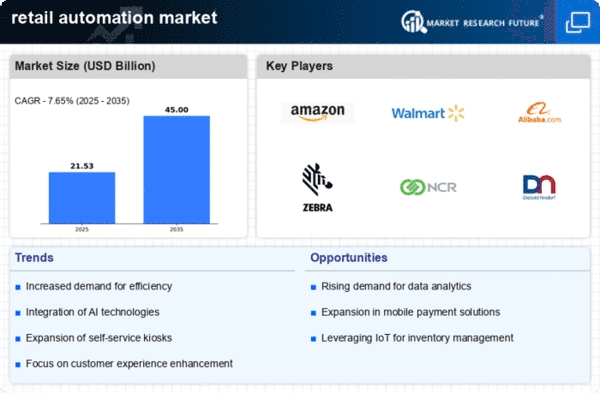
As per MRFR analysis, the retail automation market was estimated at 20.0 USD Billion in 2024. The retail automation industry is projected to grow from 21.53 USD Billion in 2025 to 45.0 USD Billion by 2035, exhibiting a compound annual growth rate (CAGR) of 7.65 during the forecast period 2025 - 2035.

Key Market Trends & Highlights

The retail automation market is experiencing robust growth driven by technological advancements and evolving consumer preferences.

  • The integration of Artificial Intelligence is transforming retail operations, enhancing customer experiences and operational efficiency.
  • Robotics is increasingly being adopted in retail, particularly in logistics and customer service, indicating a shift towards automation.
  • Omnichannel strategies are gaining traction, as retailers seek to provide seamless shopping experiences across various platforms.
  • The demand for efficiency and consumer preference for contactless solutions are major drivers propelling the growth of the retail automation market, particularly in North America and Asia-Pacific.

Market Size & Forecast

2024 Market Size 20.0 (USD Billion)
2035 Market Size 45.0 (USD Billion)
CAGR (2025 - 2035) 7.65%

Major Players

Amazon (US), Walmart (US), Alibaba (CN), Zebra Technologies (US), NCR Corporation (US), Diebold Nixdorf (US), Toshiba (JP), Honeywell (US), Samsung (KR), Panasonic (JP)

retail-automation-market Trends

The retail automation market is currently experiencing a transformative phase, driven by advancements in technology and changing consumer expectations. Retailers are increasingly adopting automated solutions to enhance operational efficiency, reduce costs, and improve customer experiences. This shift is characterized by the integration of artificial intelligence, robotics, and data analytics into various retail processes. As a result, businesses are able to streamline inventory management, optimize supply chains, and personalize marketing strategies. The growing emphasis on sustainability and contactless transactions further propels the demand for automation in retail settings. Moreover, the retail automation market appears to be influenced by the rising trend of omnichannel retailing. Retailers are seeking to create seamless shopping experiences across physical and digital platforms. This necessitates the implementation of automated systems that can manage inventory in real-time and provide insights into consumer behavior. Additionally, the increasing focus on enhancing customer engagement through personalized services suggests that automation will play a crucial role in shaping the future of retail. As technology continues to evolve, the retail automation market is likely to expand, offering innovative solutions that cater to the dynamic needs of consumers and businesses alike.

Integration of Artificial Intelligence

The incorporation of artificial intelligence in retail automation is reshaping how businesses operate. AI technologies enable retailers to analyze vast amounts of data, leading to improved decision-making and enhanced customer interactions. This trend suggests a shift towards more personalized shopping experiences, as AI can tailor recommendations based on individual preferences.

Rise of Robotics in Retail

Robotics is becoming increasingly prevalent in the retail automation market, with applications ranging from inventory management to customer service. Automated systems can efficiently handle repetitive tasks, allowing human employees to focus on more complex responsibilities. This trend indicates a potential increase in productivity and operational efficiency.

Emphasis on Omnichannel Strategies

The retail landscape is evolving towards omnichannel strategies, where businesses aim to provide a cohesive shopping experience across various platforms. Automation plays a vital role in achieving this goal by ensuring real-time inventory visibility and seamless integration of online and offline channels. This trend highlights the necessity for retailers to adapt to changing consumer behaviors.

Market Segment Insights

By Application: Point of Sale (Largest) vs. Inventory Management (Fastest-Growing)

The retail automation market's application segment is primarily driven by Point of Sale (POS) systems, which hold the largest market share due to their critical role in facilitating transactions and enhancing customer experiences. In addition to POS, Inventory Management has emerged as a key player, gaining significant traction as retailers seek to optimize stock levels and reduce operational costs through advanced automation technologies.

Point of Sale (Dominant) vs. Inventory Management (Emerging)

The Point of Sale segment plays a dominant role in the retail automation landscape, providing businesses with enhanced customer checkout experiences and robust data analysis capabilities. POS systems are integral to revenue generation and operational efficiency, allowing retailers to streamline sales processes. Conversely, Inventory Management is an emerging segment, rapidly gaining popularity as retailers increasingly understand the importance of having real-time visibility into their stock levels. This trend is driven by the need for efficient supply chain operations and the adoption of technologies like RFID and IoT, which facilitate better accuracy and efficiency in inventory control.

By Technology: Artificial Intelligence (Largest) vs. Robotics (Fastest-Growing)

In the retail automation market, the 'Technology' segment has a diverse array of components, with Artificial Intelligence (AI) leading the way as the largest contributor to market share. This dominance is largely due to AI's ability to enable personalized customer experiences, efficient inventory management, and predictive analytics. Following AI, Robotics has emerged significantly, catering to operational efficiency and labor cost reduction, thereby capturing substantial attention from retailers venturing into automation. Optimized inventory handling and improved checkout processes are fueling the interest in robotics, which has established a solid foothold within the sector.

Technology: AI (Dominant) vs. Robotics (Emerging)

The dominance of Artificial Intelligence in the retail automation market is attributed to its capability for data analysis, customer interaction, and process optimization. Retailers leverage AI technology for enhancing customer service through chatbots, personalized recommendations, and compliance processes. On the other hand, Robotics is viewed as an emerging segment, making waves with innovations in automated fulfillment centers and in-store assistance. Robotics focuses on performing repetitive tasks with precision, complementing the efficiency brought by AI. As retailers explore more automation solutions, AI remains at the forefront, while robotics is rapidly evolving, showcasing significant potential for growth in handling logistics and operational tasks.

By End Use: Supermarkets (Largest) vs. E-commerce (Fastest-Growing)

In the retail automation market, the end use segment is primarily dominated by supermarkets, which capture a significant portion of market share due to their extensive operational needs. Supermarkets utilize various automated solutions to streamline operations, enhance customer experience, and manage inventory efficiently. Following closely, e-commerce platforms are rapidly gaining traction, driven by the increasing trend of online shopping and the need for automated processes to handle logistics and customer relations effectively. Growth trends in the retail automation sector are primarily influenced by technological advancements and changing consumer behaviors. Supermarkets continue to invest in automation solutions to remain competitive, especially in the wake of rising operational costs and a more tech-savvy customer base. Conversely, e-commerce is experiencing the fastest growth, fueled by the surge in online shopping and the demand for seamless, efficient delivery systems. Automation technologies such as AI, machine learning, and robotics are becoming essential tools to support growth in both segments.

Supermarkets (Dominant) vs. Specialty Retailers (Emerging)

The distinction between supermarkets and specialty retailers in the retail automation market is quite pronounced. Supermarkets, as the dominant player, leverage large-scale automation solutions to enhance customer interaction and streamline supply chain management. They often implement self-checkout systems, inventory management software, and data analytics, fostering a more efficient shopping experience. In contrast, specialty retailers, with their niche focus, are considered an emerging segment. These retailers adopt automation technology to enrich customer engagement and personalize shopping experiences, often utilizing smaller-scale automation solutions that address specific needs. As specialty retailers expand their market presence, they are increasingly recognizing the importance of automation in sustaining competitive advantage and adapting to consumer preferences.

Get more detailed insights about retail-automation-market

Regional Insights

North America : Market Leader in Automation

North America continues to lead the retail automation market, holding a significant share of 10.0 in 2025. The growth is driven by increasing consumer demand for seamless shopping experiences and the adoption of advanced technologies like AI and IoT. Regulatory support for automation technologies further fuels this trend, as businesses seek to enhance operational efficiency and customer engagement. The competitive landscape is robust, with key players such as Amazon, Walmart, and Zebra Technologies dominating the market. The U.S. is at the forefront, leveraging its technological advancements and consumer base to drive innovation. Companies are investing heavily in automation solutions, ensuring they remain competitive in a rapidly evolving retail environment.

Europe : Emerging Automation Hub

Europe is witnessing a surge in retail automation, with a market size of 5.0 in 2025. The region benefits from a strong regulatory framework that encourages innovation and investment in automation technologies. Factors such as increasing labor costs and the demand for enhanced customer experiences are driving the adoption of automated solutions across various retail sectors. Leading countries like Germany, the UK, and France are at the forefront of this transformation, with significant investments from major players like Alibaba and NCR Corporation. The competitive landscape is characterized by a mix of established companies and innovative startups, all vying to capture market share in this dynamic environment.

Asia-Pacific : Rapidly Growing Market

The Asia-Pacific region is rapidly emerging as a key player in the retail automation market, with a size of 4.0 in 2025. The growth is fueled by rising consumer expectations for convenience and efficiency, alongside government initiatives promoting digitalization. Countries like China and Japan are leading the charge, with significant investments in automation technologies to streamline operations and improve customer service. China, home to giants like Alibaba, is particularly influential, driving innovation and adoption of retail automation solutions. The competitive landscape is vibrant, with both local and international players striving to capture market share. As the region continues to evolve, the focus on automation is expected to intensify, reshaping the retail landscape.

Middle East and Africa : Emerging Market Potential

The Middle East and Africa region, with a market size of 1.0 in 2025, presents significant growth opportunities in retail automation. The demand for automated solutions is rising, driven by urbanization and a growing middle class seeking enhanced shopping experiences. Regulatory frameworks are gradually evolving to support technological advancements, paving the way for increased investment in automation. Countries like the UAE and South Africa are leading the way, with key players beginning to establish a presence in the market. The competitive landscape is still developing, but there is a clear trend towards adopting automation technologies to improve efficiency and customer satisfaction. As the market matures, more players are expected to enter, further driving growth.

Key Players and Competitive Insights

The retail automation market is currently characterized by a dynamic competitive landscape, driven by technological advancements and evolving consumer expectations. Key players such as Amazon (US), Walmart (US), and Alibaba (CN) are at the forefront, each adopting distinct strategies to enhance their operational efficiencies and customer engagement. Amazon (US) continues to innovate with its automated fulfillment centers, leveraging robotics and AI to streamline logistics. Meanwhile, Walmart (US) focuses on integrating advanced point-of-sale systems and self-checkout technologies to improve the in-store experience. Alibaba (CN) emphasizes its digital ecosystem, enhancing its supply chain capabilities through automation and data analytics, thereby positioning itself as a leader in e-commerce and retail technology.

In terms of business tactics, companies are increasingly localizing manufacturing and optimizing supply chains to respond swiftly to market demands. The competitive structure of the retail automation market appears moderately fragmented, with a mix of established giants and emerging players. This fragmentation allows for diverse strategies, as companies leverage their unique strengths to capture market share. The collective influence of these key players shapes a landscape where innovation and operational excellence are paramount.

In November 2025, Amazon (US) announced the expansion of its automated delivery network, introducing drone delivery services in select urban areas. This strategic move is likely to enhance delivery speed and efficiency, catering to the growing demand for rapid fulfillment. By integrating drone technology, Amazon (US) not only reinforces its competitive edge but also sets a precedent for future logistics solutions in the retail sector.

In October 2025, Walmart (US) unveiled its partnership with a leading AI firm to develop predictive analytics tools for inventory management. This collaboration aims to reduce stockouts and optimize product availability, which is crucial for maintaining customer satisfaction. The strategic importance of this initiative lies in its potential to enhance operational efficiency and reduce costs, thereby solidifying Walmart's position in the retail automation market.

In September 2025, Alibaba (CN) launched a new suite of automated retail solutions designed for small and medium-sized enterprises (SMEs). This initiative is significant as it democratizes access to advanced retail technologies, enabling SMEs to compete more effectively. By focusing on this segment, Alibaba (CN) not only expands its market reach but also fosters innovation across the retail landscape.

As of December 2025, current trends in the retail automation market include a pronounced shift towards digitalization, sustainability, and AI integration. Strategic alliances are increasingly shaping the competitive environment, as companies collaborate to enhance technological capabilities and market reach. Looking ahead, competitive differentiation is expected to evolve, with a greater emphasis on innovation and technology rather than solely on price. The focus on supply chain reliability and customer-centric solutions will likely define the future trajectory of the retail automation market.


Key Companies in the retail-automation-market market include

Future Outlook

retail-automation-market Future Outlook

The retail automation market is projected to grow at a 7.65% CAGR from 2024 to 2035, driven by technological advancements, increased efficiency, and evolving consumer preferences.

New opportunities lie in:

  • Integration of AI-driven inventory management systems
  • Expansion of automated checkout solutions in urban areas
  • Development of personalized shopping experiences through data analytics

By 2035, the retail automation market is expected to be robust, reflecting substantial growth and innovation.

Market Segmentation

retail-automation-market End Use Outlook

  • Supermarkets
  • Department Stores
  • Convenience Stores
  • E-commerce
  • Specialty Retailers

retail-automation-market Technology Outlook

  • Artificial Intelligence
  • Internet of Things
  • Robotics
  • Cloud Computing
  • Blockchain

retail-automation-market Application Outlook

  • Point of Sale
  • Inventory Management
  • Customer Engagement
  • Supply Chain Management
  • Workforce Management

Report Scope

MARKET SIZE 202420.0(USD Billion)
MARKET SIZE 202521.53(USD Billion)
MARKET SIZE 203545.0(USD Billion)
COMPOUND ANNUAL GROWTH RATE (CAGR)7.65% (2024 - 2035)
REPORT COVERAGERevenue Forecast, Competitive Landscape, Growth Factors, and Trends
BASE YEAR2024
Market Forecast Period2025 - 2035
Historical Data2019 - 2024
Market Forecast UnitsUSD Billion
Key Companies ProfiledAmazon (US), Walmart (US), Alibaba (CN), Zebra Technologies (US), NCR Corporation (US), Diebold Nixdorf (US), Toshiba (JP), Honeywell (US), Samsung (KR), Panasonic (JP)
Segments CoveredApplication, Technology, End Use
Key Market OpportunitiesIntegration of artificial intelligence and machine learning enhances efficiency in the retail automation market.

Key Market DynamicsRising technological advancements drive competitive forces and reshape consumer behavior in the retail automation market.

Countries CoveredNorth America, Europe, APAC, South America, MEA

Leave a Comment

Download Free Sample

Kindly complete the form below to receive a free sample of this Report

Compare Licence

×
Features License Type
Single User Multiuser License Enterprise User
Price $4,950 $5,950 $7,250
Maximum User Access Limit 1 User Upto 10 Users Unrestricted Access Throughout the Organization
Free Customization
Direct Access to Analyst
Deliverable Format
Platform Access
Discount on Next Purchase 10% 15% 15%
Printable Versions