Request Free Sample ×

Kindly complete the form below to receive a free sample of this Report

* Please use a valid business email

Leading companies partner with us for data-driven Insights

clients tt-cursor
Hero Background
English
Chinese
French
Japanese
Korean
German
Spanish

Quantum Computing Market Share

ID: MRFR/ICT/1943-CR
200 Pages
Aarti Dhapte
July 2025

Quantum Computing Market Size, Share and Trends Analysis Research Report By Application (Cryptography, Drug Discovery, Optimization Problems, Financial Modeling, Machine Learning), By Component (Hardware, Software, Services), By End Use (Academic, Government, Enterprise), By Technology (Superconducting Qubits, Trapped Ions, Topological Qubits, Photonic Quantum Computing) and By Regional (North America, Europe, South America, Asia Pacific, Middle East and Africa) - Forecast to 2035

Share:
Download PDF ×

We do not share your information with anyone. However, we may send you emails based on your report interest from time to time. You may contact us at any time to opt-out.

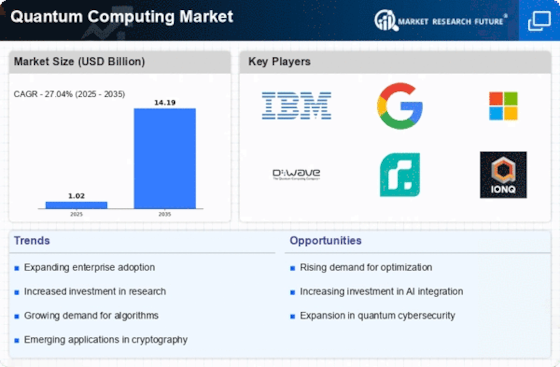
Quantum Computing Market Infographic
Purchase Options

Market Share

Quantum Computing Market Share Analysis

With technology constantly changing, the market for quantum computing has emerged as a hub for competitiveness and innovation. In this fast-paced industry, market share positioning strategies are critical to a company's success. Different strategies are used by the businesses when they join the Quantum Computing space in order to establish a market share and carve out a niche. Differentiation through technical innovation is one such tactic.

By creating state-of-the-art quantum computing systems with unparalleled performance and capabilities, businesses aim to set themselves apart. By focusing on attracting clients that value cutting-edge features and functionality, this strategy hopes to gain a portion of the market that rewards innovation. To keep ahead of the competition, businesses essentially participate in a technical arms race, continuously pushing the limits of quantum computing capabilities. A different tactic is cost leadership, in which businesses strive to offer quantum computing products at a reduced price without sacrificing quality. A portion of the market that places a high value on affordability and cost-effectiveness finds this strategy appealing.

Through the implementation of effective production processes, resource optimization, and operational streamlining, businesses may establish themselves as cost leaders, so obtaining a competitive advantage and a greater market share. Within the Quantum Computing business, collaboration and strategic alliances constitute a third way to market share positioning. Owing to the intricacy and uniqueness of quantum technologies, businesses frequently collaborate with academic institutions, research centers, and other industry players. These partnerships enable the sharing of resources, the exchange of expertise, and quicker development cycles.

Through collaborative innovation and the pooling of resources and experience, businesses may establish themselves as leaders in certain sectors or applications related to quantum computing and increase their market share. Additionally, one of the most important components of positioning strategies that work in the Quantum Computing industry is market segmentation. Businesses examine the varied requirements of their intended clientele and customize their products to efficiently cater to particular market niches. Customizing quantum computing systems enables businesses to target certain niche markets and gain a greater presence in those specialized sectors, such as finance, healthcare, or logistics.

Author
Author Profile
Aarti Dhapte
AVP - Research

A consulting professional focused on helping businesses navigate complex markets through structured research and strategic insights. I partner with clients to solve high-impact business problems across market entry strategy, competitive intelligence, and opportunity assessment. Over the course of my experience, I have led and contributed to 100+ market research and consulting engagements, delivering insights across multiple industries and geographies, and supporting strategic decisions linked to $500M+ market opportunities. My core expertise lies in building robust market sizing, forecasting, and commercial models (top-down and bottom-up), alongside deep-dive competitive and industry analysis. I have played a key role in shaping go-to-market strategies, investment cases, and growth roadmaps, enabling clients to make confident, data-backed decisions in dynamic markets.

Leave a Comment

FAQs

What is the projected market valuation of the Quantum Computing Market by 2035?

The Quantum Computing Market is projected to reach a valuation of 14.19 USD Billion by 2035.

What was the market valuation of the Quantum Computing Market in 2024?

In 2024, the Quantum Computing Market had a valuation of 1.02 USD Billion.

What is the expected CAGR for the Quantum Computing Market from 2025 to 2035?

The expected CAGR for the Quantum Computing Market during the forecast period 2025 - 2035 is 27.04%. 

Which application segment is anticipated to have the highest valuation by 2035?

By 2035, the Machine Learning application segment is anticipated to reach a valuation of 4.39 USD Billion.

What are the key components driving the Quantum Computing Market?

The key components driving the market include Hardware, Software, and Services, with Hardware projected to reach 5.5 USD Billion by 2035.

Which end-use segment is expected to dominate the Quantum Computing Market?

The Enterprise end-use segment is expected to dominate, with a projected valuation of 7.69 USD Billion by 2035.

What technologies are being utilized in the Quantum Computing Market?

Technologies such as Superconducting Qubits and Trapped Ions are being utilized, with Superconducting Qubits projected to reach 5.5 USD Billion by 2035.

Who are the leading players in the Quantum Computing Market?

Leading players in the Quantum Computing Market include IBM, Google, Microsoft, and D-Wave Systems, among others.

What is the projected growth of the Drug Discovery segment by 2035?

The Drug Discovery segment is projected to grow to 2.8 USD Billion by 2035.

How does the Quantum Computing Market's growth compare to other technology sectors?

The Quantum Computing Market's growth, with a projected CAGR of 27.04%, suggests a robust expansion compared to many other technology sectors.

Market Summary

Quantum Computing Market - Quick Answer
 
The global Quantum Computing market was valued at USD 1.02 billion in 2024 and is projected to grow from USD 1.296 billion in 2025 to USD 14.19 billion by 2035, at a CAGR of 27.04% (2025–2035). Growth is driven by advances in superconducting qubit and trapped-ion hardware, rising government investment in national quantum programmes, growing demand for quantum-as-a-service (QaaS), breakthroughs in quantum error correction, and expanding adoption across BFSI, healthcare, and defence for optimization, simulation, and cryptography workloads. North America is the largest market; Asia-Pacific is the fastest-growing region.
 
Source: Market Research Future (MRFR)
 

USD 14.19 Billion by 2035 27.04% CAGR (2025–2035) North America - Largest
Projected Market Value Fastest-Evolving Deep Tech Sector Asia-Pacific - Fastest Growing
 
Published by: Market Research Future (MRFR)   |   Last Updated: March 2026   |   Forecast Period: 2025–2035   |   Base Year: 2024

Key Market Trends & Highlights

The Quantum Computing Market is poised for substantial growth driven by technological advancements and increasing applications across various sectors.

  • North America remains the largest market for quantum computing, showcasing robust investment in research and development. Asia-Pacific is emerging as the fastest-growing region, with a surge in quantum startups and educational initiatives. The cryptography segment leads the market, while drug discovery is rapidly gaining traction as a key application area. Rising demand for advanced computing solutions and government initiatives are significant drivers propelling market expansion.

Market Size & Forecast

2024 Market Value $1.02B
2035 Market Value $14.19B
CAGR (2025 - 2035) 27.04%
Largest Regional Market Share in 2024 North America

Major Players

The Quantum Computing market is defined by nine pioneering global companies like <strong>IBM (US), Google (US), Honeywell/Quantinuum (US), Alibaba (CN), Microsoft (US), D-Wave Systems (CA), Rigetti Computing (US), IonQ (US), and Xanadu (CA)</strong> spanning superconducting, trapped-ion, quantum annealing, photonic, and topological qubit hardware platforms alongside cloud quantum access services.

Market Trends

The Quantum Computing Market is currently experiencing a transformative phase characterized by rapid advancements in technology and increasing interest from various sectors. Organizations are exploring the potential of quantum computing to solve complex problems that classical computers struggle with. This interest is driven by the promise of enhanced computational power, which could revolutionize fields such as cryptography, drug discovery, and optimization problems. As a result, investments in research and development are surging, with both public and private entities recognizing the strategic importance of quantum technologies. Moreover, collaborations between academia and industry are becoming more prevalent, fostering innovation and accelerating the development of practical applications. Governments are also playing a crucial role by establishing initiatives aimed at promoting quantum research and education. This collaborative environment is likely to yield breakthroughs that could redefine computational capabilities. As the Quantum Computing Market evolves, it appears poised to attract a diverse range of stakeholders, from startups to established tech giants, all eager to harness the potential of this cutting-edge technology. Quantum computing market size is expanding rapidly, driven by technological innovation and rising enterprise investments. Latest forecasts anticipate substantial growth through 2025–2035 across hardware, software, and services segments, reflecting robust demand for high-performance computing solutions. To define quantum computing, it is a computing paradigm that leverages quantum mechanical principles such as superposition and entanglement to perform complex computations. Quantum computation enables the execution of complex algorithms that are infeasible for classical computing systems. Quantum calculations allow high-speed processing of large datasets for optimization and molecular simulation. Quantum processing is emerging as a critical capability for next-generation high-performance computing applications.

Increased Investment in Quantum Startups

There is a noticeable trend of heightened investment in quantum startups, as venture capitalists and corporate investors seek to capitalize on emerging technologies. This influx of funding is likely to accelerate innovation and bring new solutions to market more rapidly. A quantum computing system typically integrates quantum hardware, control electronics, and specialized software frameworks. The advantages of quantum computing include exponential speed-ups in optimization, cryptography, and complex system simulation. Quantum computing investing is accelerating as venture capital and government funding support long-term technology development. The future of quantum computing is expected to be defined by scalable fault-tolerant systems and broader commercial adoption.

Expansion of Quantum Applications

The range of applications for quantum computing is broadening, with industries such as finance, healthcare, and logistics exploring how quantum solutions can enhance their operations. This expansion suggests a growing recognition of the technology's potential to address complex challenges.

Focus on Quantum Education and Workforce Development

As the demand for quantum expertise rises, educational institutions are increasingly offering specialized programs to train the next generation of quantum scientists and engineers. This focus on education indicates a commitment to building a skilled workforce capable of advancing the field.

Quantum Computing Market Market Drivers

Advancements in Quantum Hardware

Advancements in quantum hardware are a pivotal driver for the Quantum Computing Market. Innovations in qubit design, error correction techniques, and cooling technologies are enhancing the performance and scalability of quantum systems. Companies are actively developing superconducting qubits, trapped ions, and topological qubits, each offering unique advantages for different applications. The race to build more stable and reliable quantum computers is intensifying, with several firms reporting breakthroughs in qubit coherence times and gate fidelities. As hardware capabilities improve, the potential applications of quantum computing expand, attracting interest from various sectors. This ongoing evolution in quantum hardware is likely to catalyze further investment and research, solidifying the industry's growth.

Government Initiatives and Funding

Government initiatives play a crucial role in propelling the Quantum Computing Market forward. Various nations are investing heavily in quantum research and development, recognizing its potential to revolutionize technology and maintain competitive advantages. For instance, funding programs aimed at fostering public-private partnerships are becoming increasingly common. These initiatives not only provide financial support but also facilitate collaboration among academia, industry, and government entities. In recent years, several countries have announced multi-billion dollar investments in quantum technology, which are expected to accelerate advancements and commercialization efforts. Such government backing is likely to enhance the overall ecosystem, driving innovation and attracting talent to the quantum computing sector.

Emergence of Quantum-as-a-Service Models

The emergence of Quantum-as-a-Service (QaaS) models is transforming the Quantum Computing Market by making quantum technologies more accessible. These models allow businesses to leverage quantum computing resources without the need for substantial upfront investments in hardware. Cloud-based quantum computing platforms are being developed by leading technology firms, enabling organizations to experiment with quantum algorithms and applications on a pay-per-use basis. This democratization of quantum computing is expected to accelerate adoption across various industries, including healthcare, finance, and logistics. As more companies recognize the potential of quantum solutions, the QaaS model is likely to drive significant growth in the market, fostering innovation and collaboration.

Growing Interest in Quantum Cryptography

The Quantum Computing Market is witnessing a growing interest in quantum cryptography, which offers unprecedented security features. As cyber threats become more sophisticated, organizations are seeking robust solutions to protect sensitive data. Quantum cryptography leverages the principles of quantum mechanics to create secure communication channels that are theoretically immune to eavesdropping. This has led to increased investments in quantum key distribution technologies, which are gaining traction among financial institutions and government agencies. The market for quantum cryptography is expected to expand significantly, with projections indicating a potential market size of over 1 billion dollars by 2027. This trend underscores the importance of quantum technologies in enhancing cybersecurity measures.

Rising Demand for Advanced Computing Solutions

The Quantum Computing Market is experiencing a notable surge in demand for advanced computing solutions. As traditional computing systems struggle to handle complex problems, industries such as finance, pharmaceuticals, and logistics are increasingly turning to quantum computing for its unparalleled processing capabilities. This shift is driven by the need for faster data analysis and optimization, which quantum computers can provide. According to recent estimates, the quantum computing market is projected to reach a valuation of approximately 65 billion dollars by 2030, indicating a robust growth trajectory. The ability of quantum systems to solve problems that are currently intractable for classical computers positions them as a vital tool for innovation across various sectors.

Market Segment Insights

By Application: Cryptography (Largest) vs. Drug Discovery (Fastest-Growing)

In the Quantum Computing Market, Cryptography is currently the largest segment, capturing significant market share through its application in enhancing security measures. This segment's development leverages the unique attributes of quantum mechanics to create cryptographic systems that are nearly unbreakable. Following closely, Drug Discovery is emerging as a fast-growing segment due to its potential in revolutionizing the pharmaceutical industry by enabling the simulation of molecular interactions and significantly accelerating the drug development process.

Cryptography: Dominant vs. Drug Discovery: Emerging

Cryptography stands out as the dominant application in the Quantum Computing Market, thanks to its critical capacity to secure digital information against evolving cyber threats. Utilizing quantum algorithms, this segment offers unparalleled opportunities for creating advanced cryptographic protocols that institutional and governmental entities seek. In contrast, Drug Discovery represents an emerging frontier, capturing attention for its capability to drastically shorten the timeline from initial drug research to market-ready products. By harnessing quantum simulations, pharmaceutical companies can optimize molecular designs and predict interactions more precisely, leading to a prospective breakthrough in treating complex diseases. Together, these segments illustrate the transformative power of quantum technology.

By Component: Hardware (Largest) vs. Software (Fastest-Growing)

In the Quantum Computing Market, the component segment showcases a diverse range of offerings, primarily divided into hardware, software, and services. Hardware, encompassing quantum processors and quantum chips, holds the largest market share due to the critical role it plays in quantum computing infrastructure. In contrast, software solutions, which include programming languages and quantum algorithms, represent the fastest-growing segment, driven by the increasing demand for efficient quantum applications.

Hardware (Dominant) vs. Software (Emerging)

Hardware remains the dominant force in the Quantum Computing Market, representing a substantial portion of the segment with its advanced quantum processors and related technologies. These components are essential for the execution of quantum algorithms, making them indispensable in building quantum computers. Meanwhile, software is swiftly emerging as a vital component, fueled by a growing ecosystem of developers and researchers focused on optimizing quantum applications. This emerging software landscape is characterized by innovative tools and frameworks that enable efficient programming for quantum systems, enhancing the overall capacity and functionality of quantum computers.

By End Use: Academic (Largest) vs. Enterprise (Fastest-Growing)

The Quantum Computing Market is seeing a diverse distribution of market share among its end-use segments. The academic sector currently holds the largest share, leveraging its extensive research initiatives and collaborations with technology firms. Educational institutions are investing in quantum technologies for research and development, thus driving innovations and applications in the field. In contrast, enterprises are rapidly catching up, capitalizing on quantum computing's potential to transform operations across various industries, including finance and healthcare.

End Use: Academic (Dominant) vs. Enterprise (Emerging)

The academic segment in the Quantum Computing Market is characterized by its extensive research programs and collaborations with industry players, leading to groundbreaking advancements. Universities and research institutions are at the forefront of exploring quantum algorithms and computing capabilities, making significant contributions to both theoretical and applied research. Meanwhile, the enterprise segment is emerging as a significant player, with businesses actively exploring quantum solutions for optimization, security, and data analysis. Enterprises are drawn to the technology for its potential to solve complex problems that traditional computing cannot handle, thereby positioning themselves as future leaders in innovation.

By Technology: Superconducting Qubits (Largest) vs. Trapped Ions (Fastest-Growing)

In the quantum computing market, superconducting qubits dominate, representing the largest share, largely due to their robustness and existing technological infrastructure. In contrast, trapped ions are gaining traction, rapidly increasing their market share as advancements in their associated technologies improve their performance and scalability. Both technologies are essential to the evolution of quantum computing, yet they cater to different applications and research focuses, highlighting a dynamic competitive landscape. The growth trends in the quantum computing segment are primarily driven by increased research funding, demand for advanced computational power, and the advancement of algorithms that utilize qubits efficiently. Superconducting qubits benefit from established industry players and significant investments, while trapped ions are experiencing faster growth due to their scalability and precision. As both segments evolve, they represent unique opportunities and challenges in the quest for practical, deployed quantum systems.

Technology: Superconducting Qubits (Dominant) vs. Trapped Ions (Emerging)

Superconducting qubits are at the forefront of quantum technology, leveraging the principles of superconductivity to achieve qubit operations at ultra-low temperatures. Their dominance in the market is driven by significant investment from leading tech companies, as well as their successful integration into existing quantum architectures. They are known for their relatively low error rates and compatibility with standard semiconductor fabrication techniques. Conversely, trapped ions represent an emerging technology characterized by their use of individual ions confined using electromagnetic fields. This technology offers impressive coherence times and high-fidelity gates, making it a strong contender for specific quantum computing tasks. As research progresses, trapped ions are poised to capitalize on their growing applications in areas such as quantum simulations and secure communication.

Get more detailed insights about Quantum Computing Market Research Report - Global Forecast till 2035

Regional Insights

North America : Innovation Hub for Quantum Tech

North America is the largest market for quantum computing, holding approximately 45% of the global share. The region benefits from significant investments in research and development, driven by government initiatives and private sector innovation. The U.S. government has launched various programs to support quantum technology, enhancing demand and regulatory support for advancements in this field. The competitive landscape is dominated by key players such as IBM, Google, and Microsoft, all based in the U.S. Canada also plays a crucial role with companies like D-Wave Systems and Xanadu. The presence of these industry leaders fosters a robust ecosystem, encouraging collaboration and innovation, which further propels market growth.

Europe : Emerging Powerhouse in Quantum

Europe is rapidly emerging as a significant player in the quantum computing market, holding around 25% of the global share. The European Union has launched initiatives like the Quantum Flagship program, which aims to boost research and innovation in quantum technologies. This regulatory support is crucial for fostering collaboration among member states and enhancing the region's competitive edge in the global market. Leading countries include Germany, France, and the Netherlands, which are home to several research institutions and startups focused on quantum technologies. The presence of companies like IBM and D-Wave Systems in Europe further enriches the competitive landscape, driving innovation and attracting investments in quantum computing.

Asia-Pacific : Rapid Growth and Investment

Asia-Pacific is witnessing rapid growth in the quantum computing market, accounting for approximately 20% of the global share. Countries like China and Japan are leading the charge, with substantial government funding and initiatives aimed at advancing quantum research. China's focus on becoming a global leader in quantum technology is a significant driver of demand in the region, supported by various regulatory frameworks that encourage innovation. China is home to major players like Alibaba and several research institutions dedicated to quantum computing. Japan also contributes with its strong technological base and companies like Fujitsu. The competitive landscape is characterized by a mix of established firms and emerging startups, fostering a dynamic environment for growth and collaboration.

Middle East and Africa : Emerging Frontier for Quantum Tech

The Middle East and Africa region is in the nascent stages of developing its quantum computing market, currently holding about 10% of the global share. Countries like the UAE are investing in technology and innovation, with initiatives aimed at fostering research in quantum computing. Regulatory frameworks are being established to support this emerging sector, which is expected to grow significantly in the coming years as awareness and investment increase. Leading countries in this region include the UAE and South Africa, where government-backed initiatives are promoting research and development in quantum technologies. The competitive landscape is still developing, with a focus on building partnerships between academia and industry to drive innovation and growth in the quantum sector.

Key Players and Competitive Insights

Quantum computing market leaders are currently characterized by a dynamic competitive landscape, driven by rapid technological advancements and increasing investments in research and development. Leaders in quantum computing include IBM, Google, Microsoft, and emerging specialist firms. Quantum computing leaders are shaping the market through continuous innovation in hardware and algorithms. Leading quantum computing companies are expanding their platforms to support enterprise and government use cases. Quantum computer companies are increasingly collaborating with cloud providers to commercialize quantum services.
Major players such as IBM (US), Google (US), and Microsoft (US) are at the forefront, each adopting distinct strategies to enhance their market positioning. IBM (US) emphasizes innovation through its Quantum System One, focusing on hybrid quantum-classical computing solutions, while Google (US) leverages its expertise in artificial intelligence to optimize quantum algorithms. Microsoft (US) is pursuing a unique approach by integrating quantum computing with its Azure cloud platform, thereby facilitating broader accessibility and application of quantum technologies. Collectively, these strategies not only enhance their competitive edge but also contribute to a more robust and interconnected market environment.
In terms of business tactics, companies are increasingly localizing manufacturing and optimizing supply chains to enhance operational efficiency. The Quantum Computing Market appears moderately fragmented, with a mix of established players and emerging startups. This structure allows for diverse innovation pathways, as smaller firms often introduce niche technologies that challenge the status quo. The collective influence of key players, however, remains substantial, as they set industry standards and drive collaborative initiatives that shape market dynamics.
In September 2025, IBM (US) announced a strategic partnership with a leading automotive manufacturer to develop quantum algorithms aimed at optimizing supply chain logistics. This collaboration underscores IBM's commitment to applying quantum computing solutions in real-world scenarios, potentially revolutionizing how industries manage complex logistical challenges. The partnership not only enhances IBM's market presence but also illustrates the growing trend of cross-industry collaborations in the quantum space.
In August 2025, Google (US) unveiled its latest quantum processor, which reportedly achieves unprecedented qubit coherence times. This advancement is pivotal, as it may significantly enhance the performance of quantum algorithms, thereby accelerating the practical applications of quantum computing. By pushing the boundaries of quantum hardware, Google positions itself as a leader in the race for quantum supremacy, potentially attracting further investment and partnerships.
In July 2025, Microsoft (US) expanded its Azure Quantum platform by integrating new tools for developers, aimed at simplifying the process of building quantum applications. This move reflects Microsoft's strategy to democratize access to quantum computing, fostering a broader ecosystem of developers and researchers. By lowering the barriers to entry, Microsoft not only enhances its competitive positioning but also stimulates innovation across various sectors.
As of October 2025, the competitive trends in the Quantum Computing Market are increasingly defined by digitalization, sustainability, and the integration of artificial intelligence. Strategic alliances are becoming more prevalent, as companies recognize the value of collaboration in navigating the complexities of quantum technology. Looking ahead, competitive differentiation is likely to evolve, shifting from traditional price-based competition to a focus on innovation, technological advancements, and supply chain reliability. This transition may redefine how companies engage with the market, emphasizing the importance of strategic foresight and adaptability in a rapidly changing landscape.

Key Companies in the Quantum Computing Market include

Industry Developments

There have been some big changes in the Quantum Computing Market lately among the biggest companies. In August 2023, Google said that qubit coherence and error correction had gotten a lot better on the way to making quantum systems that can handle faults. IBM set up a Quantum System One at its campus in Bromont, Quebec, on September 22, 2023. Since June 2022, Microsoft has added IonQ's trapped-ion systems to Azure Quantum, which has made its hardware collection bigger.

Instead of merging with an analytics company, D-Wave has focused on corporate resilience by raising money through equity and installing its first Advantage quantum system on-site.

Different estimates put the quantum computing market at USD 65 billion by 2027, but other estimates, which include quantum sensing and communications, put it at USD 97 billion by 2035. Overall, the industry is growing quickly, thanks to breakthroughs in error correction, hardware deployments, and more businesses getting involved. This is a transformative time for quantum technology.

Future Outlook

Quantum Computing Market Future Outlook

The Quantum Computing Market is projected to grow at a 27.04% CAGR from 2025 to 2035, driven by advancements in <a title="algorithms" href="https://www.marketresearchfuture.com/reports/algorithm-trading-market-8016" target="_blank" rel="noopener">algorithms</a>, hardware, and increasing demand for complex problem-solving capabilities.

New opportunities lie in:

  • <p>Development of quantum-as-a-service platforms for businesses Investment in <a title="quantum cryptography" href="https://www.marketresearchfuture.com/reports/quantum-cryptography-market-4836" target="_blank" rel="noopener">quantum cryptography</a> solutions for data security Partnerships with academic institutions for research and talent acquisition</p>

By 2035, the Quantum Computing Market is expected to be a pivotal industry, driving innovation and economic growth.

Market Segmentation

Quantum Computing Market End Use Outlook

  • Academic
  • Government
  • Enterprise

Quantum Computing Market Component Outlook

  • Hardware
  • Software
  • Services

Quantum Computing Market Technology Outlook

  • Superconducting Qubits
  • Trapped Ions
  • Topological Qubits
  • Photonic Quantum Computing

Quantum Computing Market Application Outlook

  • Cryptography
  • Drug Discovery
  • Optimization Problems
  • Financial Modeling
  • Machine Learning

Report Scope

MARKET SIZE 2024 1.02(USD Billion)
MARKET SIZE 2025 1.296(USD Billion)
MARKET SIZE 2035 14.19(USD Billion)
COMPOUND ANNUAL GROWTH RATE (CAGR) 27.04% (2025 - 2035)
REPORT COVERAGE Revenue Forecast, Competitive Landscape, Growth Factors, and Trends
BASE YEAR 2024
Market Forecast Period 2025 - 2035
Historical Data 2019 - 2024
Market Forecast Units USD Billion
Key Companies Profiled IBM (US), Google (US), Microsoft (US), D-Wave Systems (CA), Rigetti Computing (US), IonQ (US), Honeywell (US), Alibaba (CN), Xanadu (CA)
Segments Covered Application, Component, End Use, Technology, Regional
Key Market Opportunities Advancements in quantum algorithms drive demand for innovative applications in the Quantum Computing Market.
Key Market Dynamics Intensifying competition drives rapid technological advancements and strategic partnerships in the Quantum Computing Market.
Countries Covered North America, Europe, APAC, South America, MEA

FAQs

What is the projected market valuation of the Quantum Computing Market by 2035?

The Quantum Computing Market is projected to reach a valuation of 14.19 USD Billion by 2035.

What was the market valuation of the Quantum Computing Market in 2024?

In 2024, the Quantum Computing Market had a valuation of 1.02 USD Billion.

What is the expected CAGR for the Quantum Computing Market from 2025 to 2035?

The expected CAGR for the Quantum Computing Market during the forecast period 2025 - 2035 is 27.04%. 

Which application segment is anticipated to have the highest valuation by 2035?

By 2035, the Machine Learning application segment is anticipated to reach a valuation of 4.39 USD Billion.

What are the key components driving the Quantum Computing Market?

The key components driving the market include Hardware, Software, and Services, with Hardware projected to reach 5.5 USD Billion by 2035.

Which end-use segment is expected to dominate the Quantum Computing Market?

The Enterprise end-use segment is expected to dominate, with a projected valuation of 7.69 USD Billion by 2035.

What technologies are being utilized in the Quantum Computing Market?

Technologies such as Superconducting Qubits and Trapped Ions are being utilized, with Superconducting Qubits projected to reach 5.5 USD Billion by 2035.

Who are the leading players in the Quantum Computing Market?

Leading players in the Quantum Computing Market include IBM, Google, Microsoft, and D-Wave Systems, among others.

What is the projected growth of the Drug Discovery segment by 2035?

The Drug Discovery segment is projected to grow to 2.8 USD Billion by 2035.

How does the Quantum Computing Market's growth compare to other technology sectors?

The Quantum Computing Market's growth, with a projected CAGR of 27.04%, suggests a robust expansion compared to many other technology sectors.

  1. SECTION I: EXECUTIVE SUMMARY AND KEY HIGHLIGHTS
    1. | 1.1 EXECUTIVE SUMMARY
    2. | | 1.1.1 Market Overview
    3. | | 1.1.2 Key Findings
    4. | | 1.1.3 Market Segmentation
    5. | | 1.1.4 Competitive Landscape
    6. | | 1.1.5 Challenges and Opportunities
    7. | | 1.1.6 Future Outlook
  2. SECTION II: SCOPING, METHODOLOGY AND MARKET STRUCTURE
    1. | 2.1 MARKET INTRODUCTION
    2. | | 2.1.1 Definition
    3. | | 2.1.2 Scope of the study
    4. | | | 2.1.2.1 Research Objective
    5. | | | 2.1.2.2 Assumption
    6. | | | 2.1.2.3 Limitations
    7. | 2.2 RESEARCH METHODOLOGY
    8. | | 2.2.1 Overview
    9. | | 2.2.2 Data Mining
    10. | | 2.2.3 Secondary Research
    11. | | 2.2.4 Primary Research
    12. | | | 2.2.4.1 Primary Interviews and Information Gathering Process
    13. | | | 2.2.4.2 Breakdown of Primary Respondents
    14. | | 2.2.5 Forecasting Model
    15. | | 2.2.6 Market Size Estimation
    16. | | | 2.2.6.1 Bottom-Up Approach
    17. | | | 2.2.6.2 Top-Down Approach
    18. | | 2.2.7 Data Triangulation
    19. | | 2.2.8 Validation
  3. SECTION III: QUALITATIVE ANALYSIS
    1. | 3.1 MARKET DYNAMICS
    2. | | 3.1.1 Overview
    3. | | 3.1.2 Drivers
    4. | | 3.1.3 Restraints
    5. | | 3.1.4 Opportunities
    6. | 3.2 MARKET FACTOR ANALYSIS
    7. | | 3.2.1 Value chain Analysis
    8. | | 3.2.2 Porter's Five Forces Analysis
    9. | | | 3.2.2.1 Bargaining Power of Suppliers
    10. | | | 3.2.2.2 Bargaining Power of Buyers
    11. | | | 3.2.2.3 Threat of New Entrants
    12. | | | 3.2.2.4 Threat of Substitutes
    13. | | | 3.2.2.5 Intensity of Rivalry
    14. | | 3.2.3 COVID-19 Impact Analysis
    15. | | | 3.2.3.1 Market Impact Analysis
    16. | | | 3.2.3.2 Regional Impact
    17. | | | 3.2.3.3 Opportunity and Threat Analysis
  4. SECTION IV: QUANTITATIVE ANALYSIS
    1. | 4.1 Information and Communications Technology, BY Application (USD Billion)
    2. | | 4.1.1 Cryptography
    3. | | 4.1.2 Drug Discovery
    4. | | 4.1.3 Optimization Problems
    5. | | 4.1.4 Financial Modeling
    6. | | 4.1.5 Machine Learning
    7. | 4.2 Information and Communications Technology, BY Component (USD Billion)
    8. | | 4.2.1 Hardware
    9. | | 4.2.2 Software
    10. | | 4.2.3 Services
    11. | 4.3 Information and Communications Technology, BY End Use (USD Billion)
    12. | | 4.3.1 Academic
    13. | | 4.3.2 Government
    14. | | 4.3.3 Enterprise
    15. | 4.4 Information and Communications Technology, BY Technology (USD Billion)
    16. | | 4.4.1 Superconducting Qubits
    17. | | 4.4.2 Trapped Ions
    18. | | 4.4.3 Topological Qubits
    19. | | 4.4.4 Photonic Quantum Computing
    20. | 4.5 Information and Communications Technology, BY Region (USD Billion)
    21. | | 4.5.1 North America
    22. | | | 4.5.1.1 US
    23. | | | 4.5.1.2 Canada
    24. | | 4.5.2 Europe
    25. | | | 4.5.2.1 Germany
    26. | | | 4.5.2.2 UK
    27. | | | 4.5.2.3 France
    28. | | | 4.5.2.4 Russia
    29. | | | 4.5.2.5 Italy
    30. | | | 4.5.2.6 Spain
    31. | | | 4.5.2.7 Rest of Europe
    32. | | 4.5.3 APAC
    33. | | | 4.5.3.1 China
    34. | | | 4.5.3.2 India
    35. | | | 4.5.3.3 Japan
    36. | | | 4.5.3.4 South Korea
    37. | | | 4.5.3.5 Malaysia
    38. | | | 4.5.3.6 Thailand
    39. | | | 4.5.3.7 Indonesia
    40. | | | 4.5.3.8 Rest of APAC
    41. | | 4.5.4 South America
    42. | | | 4.5.4.1 Brazil
    43. | | | 4.5.4.2 Mexico
    44. | | | 4.5.4.3 Argentina
    45. | | | 4.5.4.4 Rest of South America
    46. | | 4.5.5 MEA
    47. | | | 4.5.5.1 GCC Countries
    48. | | | 4.5.5.2 South Africa
    49. | | | 4.5.5.3 Rest of MEA
  5. SECTION V: COMPETITIVE ANALYSIS
    1. | 5.1 Competitive Landscape
    2. | | 5.1.1 Overview
    3. | | 5.1.2 Competitive Analysis
    4. | | 5.1.3 Market share Analysis
    5. | | 5.1.4 Major Growth Strategy in the Information and Communications Technology
    6. | | 5.1.5 Competitive Benchmarking
    7. | | 5.1.6 Leading Players in Terms of Number of Developments in the Information and Communications Technology
    8. | | 5.1.7 Key developments and growth strategies
    9. | | | 5.1.7.1 New Product Launch/Service Deployment
    10. | | | 5.1.7.2 Merger & Acquisitions
    11. | | | 5.1.7.3 Joint Ventures
    12. | | 5.1.8 Major Players Financial Matrix
    13. | | | 5.1.8.1 Sales and Operating Income
    14. | | | 5.1.8.2 Major Players R&D Expenditure. 2023
    15. | 5.2 Company Profiles
    16. | | 5.2.1 IBM (US)
    17. | | | 5.2.1.1 Financial Overview
    18. | | | 5.2.1.2 Products Offered
    19. | | | 5.2.1.3 Key Developments
    20. | | | 5.2.1.4 SWOT Analysis
    21. | | | 5.2.1.5 Key Strategies
    22. | | 5.2.2 Google (US)
    23. | | | 5.2.2.1 Financial Overview
    24. | | | 5.2.2.2 Products Offered
    25. | | | 5.2.2.3 Key Developments
    26. | | | 5.2.2.4 SWOT Analysis
    27. | | | 5.2.2.5 Key Strategies
    28. | | 5.2.3 Microsoft (US)
    29. | | | 5.2.3.1 Financial Overview
    30. | | | 5.2.3.2 Products Offered
    31. | | | 5.2.3.3 Key Developments
    32. | | | 5.2.3.4 SWOT Analysis
    33. | | | 5.2.3.5 Key Strategies
    34. | | 5.2.4 D-Wave Systems (CA)
    35. | | | 5.2.4.1 Financial Overview
    36. | | | 5.2.4.2 Products Offered
    37. | | | 5.2.4.3 Key Developments
    38. | | | 5.2.4.4 SWOT Analysis
    39. | | | 5.2.4.5 Key Strategies
    40. | | 5.2.5 Rigetti Computing (US)
    41. | | | 5.2.5.1 Financial Overview
    42. | | | 5.2.5.2 Products Offered
    43. | | | 5.2.5.3 Key Developments
    44. | | | 5.2.5.4 SWOT Analysis
    45. | | | 5.2.5.5 Key Strategies
    46. | | 5.2.6 IonQ (US)
    47. | | | 5.2.6.1 Financial Overview
    48. | | | 5.2.6.2 Products Offered
    49. | | | 5.2.6.3 Key Developments
    50. | | | 5.2.6.4 SWOT Analysis
    51. | | | 5.2.6.5 Key Strategies
    52. | | 5.2.7 Honeywell (US)
    53. | | | 5.2.7.1 Financial Overview
    54. | | | 5.2.7.2 Products Offered
    55. | | | 5.2.7.3 Key Developments
    56. | | | 5.2.7.4 SWOT Analysis
    57. | | | 5.2.7.5 Key Strategies
    58. | | 5.2.8 Alibaba (CN)
    59. | | | 5.2.8.1 Financial Overview
    60. | | | 5.2.8.2 Products Offered
    61. | | | 5.2.8.3 Key Developments
    62. | | | 5.2.8.4 SWOT Analysis
    63. | | | 5.2.8.5 Key Strategies
    64. | | 5.2.9 Xanadu (CA)
    65. | | | 5.2.9.1 Financial Overview
    66. | | | 5.2.9.2 Products Offered
    67. | | | 5.2.9.3 Key Developments
    68. | | | 5.2.9.4 SWOT Analysis
    69. | | | 5.2.9.5 Key Strategies
    70. | 5.3 Appendix
    71. | | 5.3.1 References
    72. | | 5.3.2 Related Reports
  6. LIST OF FIGURES
    1. | 6.1 MARKET SYNOPSIS
    2. | 6.2 NORTH AMERICA MARKET ANALYSIS
    3. | 6.3 US MARKET ANALYSIS BY APPLICATION
    4. | 6.4 US MARKET ANALYSIS BY COMPONENT
    5. | 6.5 US MARKET ANALYSIS BY END USE
    6. | 6.6 US MARKET ANALYSIS BY TECHNOLOGY
    7. | 6.7 CANADA MARKET ANALYSIS BY APPLICATION
    8. | 6.8 CANADA MARKET ANALYSIS BY COMPONENT
    9. | 6.9 CANADA MARKET ANALYSIS BY END USE
    10. | 6.10 CANADA MARKET ANALYSIS BY TECHNOLOGY
    11. | 6.11 EUROPE MARKET ANALYSIS
    12. | 6.12 GERMANY MARKET ANALYSIS BY APPLICATION
    13. | 6.13 GERMANY MARKET ANALYSIS BY COMPONENT
    14. | 6.14 GERMANY MARKET ANALYSIS BY END USE
    15. | 6.15 GERMANY MARKET ANALYSIS BY TECHNOLOGY
    16. | 6.16 UK MARKET ANALYSIS BY APPLICATION
    17. | 6.17 UK MARKET ANALYSIS BY COMPONENT
    18. | 6.18 UK MARKET ANALYSIS BY END USE
    19. | 6.19 UK MARKET ANALYSIS BY TECHNOLOGY
    20. | 6.20 FRANCE MARKET ANALYSIS BY APPLICATION
    21. | 6.21 FRANCE MARKET ANALYSIS BY COMPONENT
    22. | 6.22 FRANCE MARKET ANALYSIS BY END USE
    23. | 6.23 FRANCE MARKET ANALYSIS BY TECHNOLOGY
    24. | 6.24 RUSSIA MARKET ANALYSIS BY APPLICATION
    25. | 6.25 RUSSIA MARKET ANALYSIS BY COMPONENT
    26. | 6.26 RUSSIA MARKET ANALYSIS BY END USE
    27. | 6.27 RUSSIA MARKET ANALYSIS BY TECHNOLOGY
    28. | 6.28 ITALY MARKET ANALYSIS BY APPLICATION
    29. | 6.29 ITALY MARKET ANALYSIS BY COMPONENT
    30. | 6.30 ITALY MARKET ANALYSIS BY END USE
    31. | 6.31 ITALY MARKET ANALYSIS BY TECHNOLOGY
    32. | 6.32 SPAIN MARKET ANALYSIS BY APPLICATION
    33. | 6.33 SPAIN MARKET ANALYSIS BY COMPONENT
    34. | 6.34 SPAIN MARKET ANALYSIS BY END USE
    35. | 6.35 SPAIN MARKET ANALYSIS BY TECHNOLOGY
    36. | 6.36 REST OF EUROPE MARKET ANALYSIS BY APPLICATION
    37. | 6.37 REST OF EUROPE MARKET ANALYSIS BY COMPONENT
    38. | 6.38 REST OF EUROPE MARKET ANALYSIS BY END USE
    39. | 6.39 REST OF EUROPE MARKET ANALYSIS BY TECHNOLOGY
    40. | 6.40 APAC MARKET ANALYSIS
    41. | 6.41 CHINA MARKET ANALYSIS BY APPLICATION
    42. | 6.42 CHINA MARKET ANALYSIS BY COMPONENT
    43. | 6.43 CHINA MARKET ANALYSIS BY END USE
    44. | 6.44 CHINA MARKET ANALYSIS BY TECHNOLOGY
    45. | 6.45 INDIA MARKET ANALYSIS BY APPLICATION
    46. | 6.46 INDIA MARKET ANALYSIS BY COMPONENT
    47. | 6.47 INDIA MARKET ANALYSIS BY END USE
    48. | 6.48 INDIA MARKET ANALYSIS BY TECHNOLOGY
    49. | 6.49 JAPAN MARKET ANALYSIS BY APPLICATION
    50. | 6.50 JAPAN MARKET ANALYSIS BY COMPONENT
    51. | 6.51 JAPAN MARKET ANALYSIS BY END USE
    52. | 6.52 JAPAN MARKET ANALYSIS BY TECHNOLOGY
    53. | 6.53 SOUTH KOREA MARKET ANALYSIS BY APPLICATION
    54. | 6.54 SOUTH KOREA MARKET ANALYSIS BY COMPONENT
    55. | 6.55 SOUTH KOREA MARKET ANALYSIS BY END USE
    56. | 6.56 SOUTH KOREA MARKET ANALYSIS BY TECHNOLOGY
    57. | 6.57 MALAYSIA MARKET ANALYSIS BY APPLICATION
    58. | 6.58 MALAYSIA MARKET ANALYSIS BY COMPONENT
    59. | 6.59 MALAYSIA MARKET ANALYSIS BY END USE
    60. | 6.60 MALAYSIA MARKET ANALYSIS BY TECHNOLOGY
    61. | 6.61 THAILAND MARKET ANALYSIS BY APPLICATION
    62. | 6.62 THAILAND MARKET ANALYSIS BY COMPONENT
    63. | 6.63 THAILAND MARKET ANALYSIS BY END USE
    64. | 6.64 THAILAND MARKET ANALYSIS BY TECHNOLOGY
    65. | 6.65 INDONESIA MARKET ANALYSIS BY APPLICATION
    66. | 6.66 INDONESIA MARKET ANALYSIS BY COMPONENT
    67. | 6.67 INDONESIA MARKET ANALYSIS BY END USE
    68. | 6.68 INDONESIA MARKET ANALYSIS BY TECHNOLOGY
    69. | 6.69 REST OF APAC MARKET ANALYSIS BY APPLICATION
    70. | 6.70 REST OF APAC MARKET ANALYSIS BY COMPONENT
    71. | 6.71 REST OF APAC MARKET ANALYSIS BY END USE
    72. | 6.72 REST OF APAC MARKET ANALYSIS BY TECHNOLOGY
    73. | 6.73 SOUTH AMERICA MARKET ANALYSIS
    74. | 6.74 BRAZIL MARKET ANALYSIS BY APPLICATION
    75. | 6.75 BRAZIL MARKET ANALYSIS BY COMPONENT
    76. | 6.76 BRAZIL MARKET ANALYSIS BY END USE
    77. | 6.77 BRAZIL MARKET ANALYSIS BY TECHNOLOGY
    78. | 6.78 MEXICO MARKET ANALYSIS BY APPLICATION
    79. | 6.79 MEXICO MARKET ANALYSIS BY COMPONENT
    80. | 6.80 MEXICO MARKET ANALYSIS BY END USE
    81. | 6.81 MEXICO MARKET ANALYSIS BY TECHNOLOGY
    82. | 6.82 ARGENTINA MARKET ANALYSIS BY APPLICATION
    83. | 6.83 ARGENTINA MARKET ANALYSIS BY COMPONENT
    84. | 6.84 ARGENTINA MARKET ANALYSIS BY END USE
    85. | 6.85 ARGENTINA MARKET ANALYSIS BY TECHNOLOGY
    86. | 6.86 REST OF SOUTH AMERICA MARKET ANALYSIS BY APPLICATION
    87. | 6.87 REST OF SOUTH AMERICA MARKET ANALYSIS BY COMPONENT
    88. | 6.88 REST OF SOUTH AMERICA MARKET ANALYSIS BY END USE
    89. | 6.89 REST OF SOUTH AMERICA MARKET ANALYSIS BY TECHNOLOGY
    90. | 6.90 MEA MARKET ANALYSIS
    91. | 6.91 GCC COUNTRIES MARKET ANALYSIS BY APPLICATION
    92. | 6.92 GCC COUNTRIES MARKET ANALYSIS BY COMPONENT
    93. | 6.93 GCC COUNTRIES MARKET ANALYSIS BY END USE
    94. | 6.94 GCC COUNTRIES MARKET ANALYSIS BY TECHNOLOGY
    95. | 6.95 SOUTH AFRICA MARKET ANALYSIS BY APPLICATION
    96. | 6.96 SOUTH AFRICA MARKET ANALYSIS BY COMPONENT
    97. | 6.97 SOUTH AFRICA MARKET ANALYSIS BY END USE
    98. | 6.98 SOUTH AFRICA MARKET ANALYSIS BY TECHNOLOGY
    99. | 6.99 REST OF MEA MARKET ANALYSIS BY APPLICATION
    100. | 6.100 REST OF MEA MARKET ANALYSIS BY COMPONENT
    101. | 6.101 REST OF MEA MARKET ANALYSIS BY END USE
    102. | 6.102 REST OF MEA MARKET ANALYSIS BY TECHNOLOGY
    103. | 6.103 KEY BUYING CRITERIA OF INFORMATION AND COMMUNICATIONS TECHNOLOGY
    104. | 6.104 RESEARCH PROCESS OF MRFR
    105. | 6.105 DRO ANALYSIS OF INFORMATION AND COMMUNICATIONS TECHNOLOGY
    106. | 6.106 DRIVERS IMPACT ANALYSIS: INFORMATION AND COMMUNICATIONS TECHNOLOGY
    107. | 6.107 RESTRAINTS IMPACT ANALYSIS: INFORMATION AND COMMUNICATIONS TECHNOLOGY
    108. | 6.108 SUPPLY / VALUE CHAIN: INFORMATION AND COMMUNICATIONS TECHNOLOGY
    109. | 6.109 INFORMATION AND COMMUNICATIONS TECHNOLOGY, BY APPLICATION, 2024 (% SHARE)
    110. | 6.110 INFORMATION AND COMMUNICATIONS TECHNOLOGY, BY APPLICATION, 2024 TO 2035 (USD Billion)
    111. | 6.111 INFORMATION AND COMMUNICATIONS TECHNOLOGY, BY COMPONENT, 2024 (% SHARE)
    112. | 6.112 INFORMATION AND COMMUNICATIONS TECHNOLOGY, BY COMPONENT, 2024 TO 2035 (USD Billion)
    113. | 6.113 INFORMATION AND COMMUNICATIONS TECHNOLOGY, BY END USE, 2024 (% SHARE)
    114. | 6.114 INFORMATION AND COMMUNICATIONS TECHNOLOGY, BY END USE, 2024 TO 2035 (USD Billion)
    115. | 6.115 INFORMATION AND COMMUNICATIONS TECHNOLOGY, BY TECHNOLOGY, 2024 (% SHARE)
    116. | 6.116 INFORMATION AND COMMUNICATIONS TECHNOLOGY, BY TECHNOLOGY, 2024 TO 2035 (USD Billion)
    117. | 6.117 BENCHMARKING OF MAJOR COMPETITORS
  7. LIST OF TABLES
    1. | 7.1 LIST OF ASSUMPTIONS
    2. | | 7.1.1
    3. | 7.2 North America MARKET SIZE ESTIMATES; FORECAST
    4. | | 7.2.1 BY APPLICATION, 2025-2035 (USD Billion)
    5. | | 7.2.2 BY COMPONENT, 2025-2035 (USD Billion)
    6. | | 7.2.3 BY END USE, 2025-2035 (USD Billion)
    7. | | 7.2.4 BY TECHNOLOGY, 2025-2035 (USD Billion)
    8. | 7.3 US MARKET SIZE ESTIMATES; FORECAST
    9. | | 7.3.1 BY APPLICATION, 2025-2035 (USD Billion)
    10. | | 7.3.2 BY COMPONENT, 2025-2035 (USD Billion)
    11. | | 7.3.3 BY END USE, 2025-2035 (USD Billion)
    12. | | 7.3.4 BY TECHNOLOGY, 2025-2035 (USD Billion)
    13. | 7.4 Canada MARKET SIZE ESTIMATES; FORECAST
    14. | | 7.4.1 BY APPLICATION, 2025-2035 (USD Billion)
    15. | | 7.4.2 BY COMPONENT, 2025-2035 (USD Billion)
    16. | | 7.4.3 BY END USE, 2025-2035 (USD Billion)
    17. | | 7.4.4 BY TECHNOLOGY, 2025-2035 (USD Billion)
    18. | 7.5 Europe MARKET SIZE ESTIMATES; FORECAST
    19. | | 7.5.1 BY APPLICATION, 2025-2035 (USD Billion)
    20. | | 7.5.2 BY COMPONENT, 2025-2035 (USD Billion)
    21. | | 7.5.3 BY END USE, 2025-2035 (USD Billion)
    22. | | 7.5.4 BY TECHNOLOGY, 2025-2035 (USD Billion)
    23. | 7.6 Germany MARKET SIZE ESTIMATES; FORECAST
    24. | | 7.6.1 BY APPLICATION, 2025-2035 (USD Billion)
    25. | | 7.6.2 BY COMPONENT, 2025-2035 (USD Billion)
    26. | | 7.6.3 BY END USE, 2025-2035 (USD Billion)
    27. | | 7.6.4 BY TECHNOLOGY, 2025-2035 (USD Billion)
    28. | 7.7 UK MARKET SIZE ESTIMATES; FORECAST
    29. | | 7.7.1 BY APPLICATION, 2025-2035 (USD Billion)
    30. | | 7.7.2 BY COMPONENT, 2025-2035 (USD Billion)
    31. | | 7.7.3 BY END USE, 2025-2035 (USD Billion)
    32. | | 7.7.4 BY TECHNOLOGY, 2025-2035 (USD Billion)
    33. | 7.8 France MARKET SIZE ESTIMATES; FORECAST
    34. | | 7.8.1 BY APPLICATION, 2025-2035 (USD Billion)
    35. | | 7.8.2 BY COMPONENT, 2025-2035 (USD Billion)
    36. | | 7.8.3 BY END USE, 2025-2035 (USD Billion)
    37. | | 7.8.4 BY TECHNOLOGY, 2025-2035 (USD Billion)
    38. | 7.9 Russia MARKET SIZE ESTIMATES; FORECAST
    39. | | 7.9.1 BY APPLICATION, 2025-2035 (USD Billion)
    40. | | 7.9.2 BY COMPONENT, 2025-2035 (USD Billion)
    41. | | 7.9.3 BY END USE, 2025-2035 (USD Billion)
    42. | | 7.9.4 BY TECHNOLOGY, 2025-2035 (USD Billion)
    43. | 7.10 Italy MARKET SIZE ESTIMATES; FORECAST
    44. | | 7.10.1 BY APPLICATION, 2025-2035 (USD Billion)
    45. | | 7.10.2 BY COMPONENT, 2025-2035 (USD Billion)
    46. | | 7.10.3 BY END USE, 2025-2035 (USD Billion)
    47. | | 7.10.4 BY TECHNOLOGY, 2025-2035 (USD Billion)
    48. | 7.11 Spain MARKET SIZE ESTIMATES; FORECAST
    49. | | 7.11.1 BY APPLICATION, 2025-2035 (USD Billion)
    50. | | 7.11.2 BY COMPONENT, 2025-2035 (USD Billion)
    51. | | 7.11.3 BY END USE, 2025-2035 (USD Billion)
    52. | | 7.11.4 BY TECHNOLOGY, 2025-2035 (USD Billion)
    53. | 7.12 Rest of Europe MARKET SIZE ESTIMATES; FORECAST
    54. | | 7.12.1 BY APPLICATION, 2025-2035 (USD Billion)
    55. | | 7.12.2 BY COMPONENT, 2025-2035 (USD Billion)
    56. | | 7.12.3 BY END USE, 2025-2035 (USD Billion)
    57. | | 7.12.4 BY TECHNOLOGY, 2025-2035 (USD Billion)
    58. | 7.13 APAC MARKET SIZE ESTIMATES; FORECAST
    59. | | 7.13.1 BY APPLICATION, 2025-2035 (USD Billion)
    60. | | 7.13.2 BY COMPONENT, 2025-2035 (USD Billion)
    61. | | 7.13.3 BY END USE, 2025-2035 (USD Billion)
    62. | | 7.13.4 BY TECHNOLOGY, 2025-2035 (USD Billion)
    63. | 7.14 China MARKET SIZE ESTIMATES; FORECAST
    64. | | 7.14.1 BY APPLICATION, 2025-2035 (USD Billion)
    65. | | 7.14.2 BY COMPONENT, 2025-2035 (USD Billion)
    66. | | 7.14.3 BY END USE, 2025-2035 (USD Billion)
    67. | | 7.14.4 BY TECHNOLOGY, 2025-2035 (USD Billion)
    68. | 7.15 India MARKET SIZE ESTIMATES; FORECAST
    69. | | 7.15.1 BY APPLICATION, 2025-2035 (USD Billion)
    70. | | 7.15.2 BY COMPONENT, 2025-2035 (USD Billion)
    71. | | 7.15.3 BY END USE, 2025-2035 (USD Billion)
    72. | | 7.15.4 BY TECHNOLOGY, 2025-2035 (USD Billion)
    73. | 7.16 Japan MARKET SIZE ESTIMATES; FORECAST
    74. | | 7.16.1 BY APPLICATION, 2025-2035 (USD Billion)
    75. | | 7.16.2 BY COMPONENT, 2025-2035 (USD Billion)
    76. | | 7.16.3 BY END USE, 2025-2035 (USD Billion)
    77. | | 7.16.4 BY TECHNOLOGY, 2025-2035 (USD Billion)
    78. | 7.17 South Korea MARKET SIZE ESTIMATES; FORECAST
    79. | | 7.17.1 BY APPLICATION, 2025-2035 (USD Billion)
    80. | | 7.17.2 BY COMPONENT, 2025-2035 (USD Billion)
    81. | | 7.17.3 BY END USE, 2025-2035 (USD Billion)
    82. | | 7.17.4 BY TECHNOLOGY, 2025-2035 (USD Billion)
    83. | 7.18 Malaysia MARKET SIZE ESTIMATES; FORECAST
    84. | | 7.18.1 BY APPLICATION, 2025-2035 (USD Billion)
    85. | | 7.18.2 BY COMPONENT, 2025-2035 (USD Billion)
    86. | | 7.18.3 BY END USE, 2025-2035 (USD Billion)
    87. | | 7.18.4 BY TECHNOLOGY, 2025-2035 (USD Billion)
    88. | 7.19 Thailand MARKET SIZE ESTIMATES; FORECAST
    89. | | 7.19.1 BY APPLICATION, 2025-2035 (USD Billion)
    90. | | 7.19.2 BY COMPONENT, 2025-2035 (USD Billion)
    91. | | 7.19.3 BY END USE, 2025-2035 (USD Billion)
    92. | | 7.19.4 BY TECHNOLOGY, 2025-2035 (USD Billion)
    93. | 7.20 Indonesia MARKET SIZE ESTIMATES; FORECAST
    94. | | 7.20.1 BY APPLICATION, 2025-2035 (USD Billion)
    95. | | 7.20.2 BY COMPONENT, 2025-2035 (USD Billion)
    96. | | 7.20.3 BY END USE, 2025-2035 (USD Billion)
    97. | | 7.20.4 BY TECHNOLOGY, 2025-2035 (USD Billion)
    98. | 7.21 Rest of APAC MARKET SIZE ESTIMATES; FORECAST
    99. | | 7.21.1 BY APPLICATION, 2025-2035 (USD Billion)
    100. | | 7.21.2 BY COMPONENT, 2025-2035 (USD Billion)
    101. | | 7.21.3 BY END USE, 2025-2035 (USD Billion)
    102. | | 7.21.4 BY TECHNOLOGY, 2025-2035 (USD Billion)
    103. | 7.22 South America MARKET SIZE ESTIMATES; FORECAST
    104. | | 7.22.1 BY APPLICATION, 2025-2035 (USD Billion)
    105. | | 7.22.2 BY COMPONENT, 2025-2035 (USD Billion)
    106. | | 7.22.3 BY END USE, 2025-2035 (USD Billion)
    107. | | 7.22.4 BY TECHNOLOGY, 2025-2035 (USD Billion)
    108. | 7.23 Brazil MARKET SIZE ESTIMATES; FORECAST
    109. | | 7.23.1 BY APPLICATION, 2025-2035 (USD Billion)
    110. | | 7.23.2 BY COMPONENT, 2025-2035 (USD Billion)
    111. | | 7.23.3 BY END USE, 2025-2035 (USD Billion)
    112. | | 7.23.4 BY TECHNOLOGY, 2025-2035 (USD Billion)
    113. | 7.24 Mexico MARKET SIZE ESTIMATES; FORECAST
    114. | | 7.24.1 BY APPLICATION, 2025-2035 (USD Billion)
    115. | | 7.24.2 BY COMPONENT, 2025-2035 (USD Billion)
    116. | | 7.24.3 BY END USE, 2025-2035 (USD Billion)
    117. | | 7.24.4 BY TECHNOLOGY, 2025-2035 (USD Billion)
    118. | 7.25 Argentina MARKET SIZE ESTIMATES; FORECAST
    119. | | 7.25.1 BY APPLICATION, 2025-2035 (USD Billion)
    120. | | 7.25.2 BY COMPONENT, 2025-2035 (USD Billion)
    121. | | 7.25.3 BY END USE, 2025-2035 (USD Billion)
    122. | | 7.25.4 BY TECHNOLOGY, 2025-2035 (USD Billion)
    123. | 7.26 Rest of South America MARKET SIZE ESTIMATES; FORECAST
    124. | | 7.26.1 BY APPLICATION, 2025-2035 (USD Billion)
    125. | | 7.26.2 BY COMPONENT, 2025-2035 (USD Billion)
    126. | | 7.26.3 BY END USE, 2025-2035 (USD Billion)
    127. | | 7.26.4 BY TECHNOLOGY, 2025-2035 (USD Billion)
    128. | 7.27 MEA MARKET SIZE ESTIMATES; FORECAST
    129. | | 7.27.1 BY APPLICATION, 2025-2035 (USD Billion)
    130. | | 7.27.2 BY COMPONENT, 2025-2035 (USD Billion)
    131. | | 7.27.3 BY END USE, 2025-2035 (USD Billion)
    132. | | 7.27.4 BY TECHNOLOGY, 2025-2035 (USD Billion)
    133. | 7.28 GCC Countries MARKET SIZE ESTIMATES; FORECAST
    134. | | 7.28.1 BY APPLICATION, 2025-2035 (USD Billion)
    135. | | 7.28.2 BY COMPONENT, 2025-2035 (USD Billion)
    136. | | 7.28.3 BY END USE, 2025-2035 (USD Billion)
    137. | | 7.28.4 BY TECHNOLOGY, 2025-2035 (USD Billion)
    138. | 7.29 South Africa MARKET SIZE ESTIMATES; FORECAST
    139. | | 7.29.1 BY APPLICATION, 2025-2035 (USD Billion)
    140. | | 7.29.2 BY COMPONENT, 2025-2035 (USD Billion)
    141. | | 7.29.3 BY END USE, 2025-2035 (USD Billion)
    142. | | 7.29.4 BY TECHNOLOGY, 2025-2035 (USD Billion)
    143. | 7.30 Rest of MEA MARKET SIZE ESTIMATES; FORECAST
    144. | | 7.30.1 BY APPLICATION, 2025-2035 (USD Billion)
    145. | | 7.30.2 BY COMPONENT, 2025-2035 (USD Billion)
    146. | | 7.30.3 BY END USE, 2025-2035 (USD Billion)
    147. | | 7.30.4 BY TECHNOLOGY, 2025-2035 (USD Billion)
    148. | 7.31 PRODUCT LAUNCH/PRODUCT DEVELOPMENT/APPROVAL
    149. | | 7.31.1
    150. | 7.32 ACQUISITION/PARTNERSHIP
    151. | | 7.32.1

Information and Communications Technology Market Segmentation

Information and Communications Technology By Application (USD Billion, 2025-2035)

  • Cryptography
  • Drug Discovery
  • Optimization Problems
  • Financial Modeling
  • Machine Learning

Information and Communications Technology By Component (USD Billion, 2025-2035)

  • Hardware
  • Software
  • Services

Information and Communications Technology By End Use (USD Billion, 2025-2035)

  • Academic
  • Government
  • Enterprise

Information and Communications Technology By Technology (USD Billion, 2025-2035)

  • Superconducting Qubits
  • Trapped Ions
  • Topological Qubits
  • Photonic Quantum Computing
Infographic

Free Sample Request

Kindly complete the form below to receive a free sample of this Report

Get Free Sample

Customer Strories

Compare Licence

×
Features License Type
Single User Multiuser License Enterprise User
Price $4,950 $5,950 $7,250
Maximum User Access Limit 1 User Upto 10 Users Unrestricted Access Throughout the Organization
Free Customization
Direct Access to Analyst
Deliverable Format
Platform Access
Discount on Next Purchase 10% 15% 15%
Printable Versions