Request Free Sample ×

Kindly complete the form below to receive a free sample of this Report

* Please use a valid business email

Leading companies partner with us for data-driven Insights

clients tt-cursor
Hero Background
English
Chinese
French
Japanese
Korean
German
Spanish

Quantum Communication Market Analysis

ID: MRFR/ICT/10719-HCR
128 Pages
Ankit Gupta
December 2024

Quantum Communication Market Size, Share and Trends Analysis Research Report Information By Product Type (Hardware, Service), By Application (National Defense, Aerospace, Finance, Other), And By Region (North America, Europe, Asia-Pacific, And Rest Of The World) – Market Forecast Till 2035.

Share:
Download PDF ×

We do not share your information with anyone. However, we may send you emails based on your report interest from time to time. You may contact us at any time to opt-out.

Quantum Communication Market Infographic
Purchase Options

Market Analysis

In-depth Analysis of Quantum Communication Market Industry Landscape

Quantum-safe communication protocols are needed because powerful quantum computers might break encryption schemes. Quantum communication, which uses quantum mechanics to secure information sharing, is a vital answer to quantum computing's security problems.

Another major driver of the Quantum Communication Market is industry awareness of secure communication. Finance, healthcare, government, and defense manage highly sensitive data. Quantum communication uses quantum entanglement and quantum key distribution to transfer data securely. Quantum communication offers absolute security, making it appealing to enterprises needing strong eavesdropping and cyber protection.

Growing data integrity and authenticity concerns are pushing quantum communication usage. In an age of data manipulation and cyberattacks, data integrity and authenticity are crucial. Quantum communication protocols detect unwanted data interceptions and changes, giving data security beyond cryptography. This data integrity focus makes quantum communication a vital tool for protecting crucial information in numerous areas.

Global digitalization and linked gadgets drive Quantum Communication industry dynamics. Traditional communication routes become more vulnerable to cyberattacks as the number of connected devices rises. Quantum communication is a future-proof approach for protecting communication networks in the IoT and digital age. Quantum communication's secure device-to-device linkages make it important to the digital world.

Market growth is driven by government spending in quantum communication research and development. Quantum communication is crucial to national security, hence governments worldwide are investing in quantum research and infrastructure. Development of quantum communication networks and deployment of quantum satellites for secure worldwide communication show a national commitment to quantum technology.

Quantum communication technology integration into existing communication infrastructure drives industry development. To secure data transfer, quantum key distribution (QKD) systems can be linked with classical communication networks. This hybrid strategy lets enterprises gradually embrace quantum communication systems without overhauling infrastructure. Quantum communication is compatible with classical systems, making the switch to quantum-safe communication easy.

Advances in quantum technology and component downsizing help commercialize quantum communication systems. Quantum repeaters, memory, and transceivers that are smaller and more scalable make quantum communication more viable. This quantum technological advancement lowers the hurdles to quantum communication solutions for businesses and organizations.

As significant companies emerge and industry stakeholders and research institutes collaborate, the Quantum Communication Market becomes competitive. Companies are investing in quantum communication R&D and commercialization, growing the market. Quantum technology, communication, and government organizations collaborate to innovate and deploy quantum communication solutions globally.


Author
Author Profile
Ankit Gupta
Team Lead - Research

Ankit Gupta is a seasoned market intelligence and strategic research professional with over six plus years of experience in the ICT and Semiconductor industries. With academic roots in Telecom, Marketing, and Electronics, he blends technical insight with business strategy. Ankit has led 200+ projects, including work for Fortune 500 clients like Microsoft and Rio Tinto, covering market sizing, tech forecasting, and go-to-market strategies. Known for bridging engineering and enterprise decision-making, his insights support growth, innovation, and investment planning across diverse technology markets.

Leave a Comment

FAQs

What is the current valuation of the Quantum Communication Market?

<p>The Quantum Communication Market was valued at 1.06 USD Billion in 2024.</p>

What is the projected market valuation for 2035?

<p>The market is projected to reach 17.94 USD Billion by 2035.</p>

What is the expected CAGR for the Quantum Communication Market from 2025 to 2035?

<p>The expected CAGR during the forecast period 2025 - 2035 is 29.32%.</p>

Which companies are leading the Quantum Communication Market?

<p>Key players include IBM, Google, Microsoft, Alibaba, Toshiba, ID Quantique, MagiQ Technologies, Quantum Xchange, and Qubitekk.</p>

What are the main product types in the Quantum Communication Market?

<p>The primary product types are Hardware, valued at 10.77 USD Billion, and Services, valued at 7.17 USD Billion.</p>

How does the Quantum Communication Market perform in the national defense sector?

<p>In the national defense sector, the market was valued at 4.25 USD Billion in 2024.</p>

What is the market valuation for the finance application segment?

The finance application segment was valued at 5.0 USD Billion in 2024.

What is the valuation of the aerospace application segment in the Quantum Communication Market?

The aerospace application segment was valued at 2.5 USD Billion in 2024.

How does the 'Other' application segment contribute to the market?

The 'Other' application segment contributed 6.19 USD Billion to the market in 2024.

What is the projected growth trend for the Quantum Communication Market?

The market is expected to experience substantial growth, reaching nearly 18 USD Billion by 2035.

Market Summary

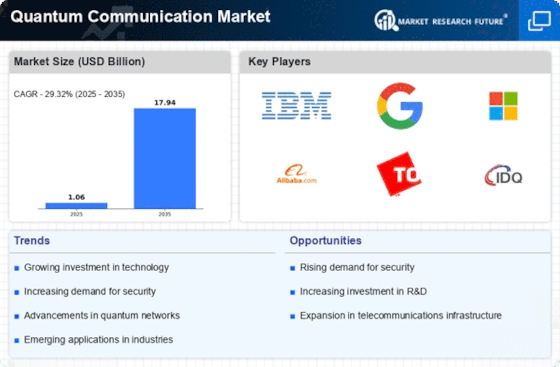
As per Market Research Future analysis, the Quantum Communication Market Size was estimated at 1.06 USD Billion in 2024. The Quantum Communication industry is projected to grow from 1.371 USD Billion in 2025 to 17.94 USD Billion by 2035, exhibiting a compound annual growth rate (CAGR) of 29.32% during the forecast period 2025 - 2035

Key Market Trends & Highlights

The Quantum Communication Market is poised for substantial growth driven by advancements in technology and increasing demand for secure communication solutions.

  • North America remains the largest market for quantum communication, driven by significant investments in research and development. Asia-Pacific is emerging as the fastest-growing region, with a surge in collaborative initiatives between academia and industry. The hardware segment continues to dominate the market, while the service segment is experiencing rapid growth due to rising demand for integrated solutions. Key market drivers include the rising demand for secure communication and government initiatives that support advancements in quantum technology.

Market Size & Forecast

2024 Market Size 1.06 (USD Billion)
2035 Market Size 17.94 (USD Billion)
CAGR (2025 - 2035) 29.32%
Largest Regional Market Share in 2024 North America

Major Players

<a title="IBM" href="https://www.ibm.com/think/topics/quantum-computingIBM" target="_blank" rel="noopener">IBM</a> (US), Google (US), <a title="Microsoft" href="https://azure.microsoft.com/en-in/resources/cloud-computing-dictionary/what-is-quantum-computing" target="_blank" rel="noopener">Microsoft</a> (US), Alibaba (CN), Toshiba (JP), ID Quantique (CH), MagiQ Technologies (US), Quantum Xchange (US), Qubitekk (US)

Market Trends

The Quantum Communication Market is currently experiencing a transformative phase, driven by advancements in quantum technologies and an increasing emphasis on secure communication methods. As organizations and governments recognize the vulnerabilities associated with classical communication systems, there is a growing demand for quantum-based solutions that promise enhanced security through principles of quantum mechanics. This shift is not merely a trend but appears to be a fundamental change in how information is transmitted and protected. The integration of quantum key distribution and entanglement-based communication systems is becoming more prevalent, suggesting a robust future for this market. Moreover, the landscape of the Quantum Communication Market is evolving with the emergence of new players and collaborations among established technology firms and research institutions. These partnerships are likely to accelerate innovation and facilitate the development of practical applications. As the market matures, it seems poised to attract significant investment, which could further enhance research and development efforts. The potential for quantum communication to revolutionize sectors such as finance, healthcare, and national security underscores its importance in the modern technological ecosystem.

Increased Focus on Cybersecurity

The Quantum Communication Market is witnessing a heightened emphasis on cybersecurity solutions. As cyber threats become more sophisticated, organizations are seeking advanced methods to safeguard sensitive information. Quantum communication offers unique advantages, such as unbreakable encryption, which appeals to sectors requiring stringent security measures.

Collaborative Research Initiatives

There is a noticeable trend towards collaborative research initiatives within the Quantum Communication Market. Partnerships between academic institutions and industry leaders are fostering innovation and accelerating the development of quantum technologies. These collaborations are likely to yield breakthroughs that enhance the practicality of quantum communication systems.

Expansion of Commercial Applications

The Quantum Communication Market is gradually expanding its reach into commercial applications. Industries such as finance, telecommunications, and healthcare are exploring the integration of quantum communication technologies to improve data security and operational efficiency. This trend indicates a growing recognition of the potential benefits that quantum solutions can offer.

Quantum Communication Market Market Drivers

Advancements in Quantum Technology

Technological advancements are significantly influencing the Quantum Communication Market. Innovations in quantum computing, photonics, and materials science are paving the way for more efficient and practical quantum communication systems. For example, the development of integrated photonic circuits is enhancing the scalability and reliability of quantum communication networks. As these technologies mature, they are expected to lower costs and improve performance, making quantum communication more accessible to a broader range of industries. The market is projected to grow at a compound annual growth rate of 25% over the next five years, driven by these advancements. This growth indicates a strong potential for quantum communication to become a mainstream solution for secure data transmission.

Government Initiatives and Funding

Government initiatives play a crucial role in the advancement of the Quantum Communication Market. Various countries are investing heavily in quantum technologies, recognizing their strategic importance for national security and economic competitiveness. For instance, funding programs aimed at fostering research and development in quantum communication are being established, which may lead to breakthroughs in technology and applications. In 2025, it is estimated that government funding for quantum research could exceed USD 2 billion, reflecting a commitment to enhancing national capabilities in this field. Such initiatives not only stimulate innovation but also encourage collaboration between academia and industry, thereby accelerating the commercialization of quantum communication technologies.

Rising Demand for Secure Communication

The Quantum Communication Market is experiencing a notable surge in demand for secure communication solutions. As cyber threats become increasingly sophisticated, organizations are seeking advanced technologies to safeguard sensitive information. Quantum communication, with its inherent ability to provide unbreakable encryption through quantum key distribution, appears to be a viable solution. According to recent estimates, the market for quantum encryption technologies is projected to reach USD 1.5 billion by 2026, indicating a robust growth trajectory. This demand is driven by sectors such as finance, healthcare, and government, where data security is paramount. The increasing awareness of quantum communication's potential to revolutionize secure communications is likely to propel further investments and innovations within the Quantum Communication Market.

Emerging Applications in Various Sectors

The Quantum Communication Market is expanding as new applications emerge across various sectors. Industries such as telecommunications, finance, and defense are increasingly recognizing the potential of quantum communication for enhancing security and efficiency. For instance, telecommunications companies are exploring quantum key distribution to secure their networks against eavesdropping. In finance, quantum communication is being considered for secure transactions and data sharing. The defense sector is also investing in quantum technologies to protect sensitive information. As these applications gain traction, the market is expected to witness substantial growth, with projections indicating a market size of USD 3 billion by 2030. This diversification of applications is likely to drive further interest and investment in the Quantum Communication Market.

Increasing Collaboration Between Industry and Academia

The Quantum Communication Market is witnessing a surge in collaboration between industry players and academic institutions. This synergy is fostering innovation and accelerating the development of quantum communication technologies. Universities and research centers are partnering with technology companies to explore new applications and enhance existing solutions. Such collaborations often lead to the establishment of research consortia, which pool resources and expertise to tackle complex challenges in quantum communication. As a result, the market is likely to benefit from a steady influx of new ideas and technologies. This collaborative approach is expected to drive the growth of the Quantum Communication Market, as it enables faster commercialization of research outcomes.

Market Segment Insights

By Product Type: Hardware (Largest) vs. Service (Fastest-Growing)

In the Quantum Communication Market, the Product Type segment is primarily divided into Hardware and Service offerings. Hardware remains the largest contributor to the market share, driven by the increasing demand for quantum computers and devices. The robustness and reliability of quantum hardware have established it as a cornerstone in this market, accounting for a significant portion of the industry revenues. On the other hand, Service is emerging rapidly, reflecting a shift in business models towards cloud-based quantum services and consulting, creating an opportunity for growth in the service sector.

Product Type: Hardware (Dominant) vs. Service (Emerging)

Hardware in the Quantum Communication Market is characterized by advanced components such as quantum processors and secure communication systems that utilize quantum key distribution. This segment benefits from significant investments in research and development, as companies strive to innovate and improve efficiency. On the other hand, the Service segment, which includes quantum-as-a-service platforms and advisory services, is gaining momentum as organizations increasingly seek to integrate quantum technologies without heavy upfront investments. The growth of cloud computing and the need for specialized expertise are propelling the demand for services, making it a crucial aspect of the Quantum Communication Market ecosystem.

By Application: National Defense (Largest) vs. Aerospace (Fastest-Growing)

The Quantum Communication Market is witnessing a significant distribution of market share across various application segments. National Defense holds the largest share due to increasing investments in secure communication technologies to protect critical defense infrastructure. This segment focuses on enhancing the safety and confidentiality of information exchanged between government and military entities, thus commanding a substantial portion of the overall market. Conversely, the Aerospace sector, though smaller at present, is emerging rapidly as organizations recognize the potential of quantum technology to revolutionize communications in satellite and aircraft systems, maximizing efficiency and security in operations. The growth trends within these application segments are driven by distinct factors. National Defense continues to expand its portfolio to incorporate cutting-edge quantum solutions, spurred by geopolitical tensions requiring more secure communication methods. On the other hand, Aerospace is poised for explosive growth, fueled by the increasing demand for advanced technology that can support complex logistics and real-time data transmission in air travel. As these industries evolve, the intersection of quantum technology with traditional practices presents significant opportunities for innovation and development, ultimately shaping the future of communication in these key applications.

National Defense: Dominant vs. Aerospace: Emerging

The National Defense application in the Quantum Communication Market stands as a dominant force, leveraging advanced quantum technologies to secure communications at the highest levels. This sector prioritizes confidentiality, integrity, and availability in its communication frameworks, often leading to substantial advancements in cryptography and secure networks. It plays a crucial role in national security, with governments investing heavily in quantum enhancements to thwart cyber threats and espionage. Conversely, the Aerospace sector is characterized as emerging in this dynamic landscape, driven by the need for secure and reliable communication systems that can manage the complexities of modern air travel. The integration of quantum communication holds the potential to enhance satellite communications, thereby improving connectivity and operational safety across the aerospace industry. As both segments evolve, their distinct characteristics and strategies will significantly influence the trajectory of the Quantum Communication Market.

Get more detailed insights about Quantum Communication Market Research Report – Forecast till 2035

Regional Insights

North America : Innovation and Leadership Hub

North America is the largest market for quantum communication, holding approximately 45% of the global share. The region's growth is driven by significant investments in research and development, a robust technology infrastructure, and supportive government policies. The increasing demand for secure communication solutions, particularly in sectors like finance and defense, further propels market expansion. Regulatory frameworks are evolving to support quantum technologies, enhancing the region's competitive edge. The United States leads the market, with key players like IBM, Google, and Microsoft spearheading advancements in quantum technologies. The competitive landscape is characterized by a mix of established tech giants and innovative startups, fostering a dynamic environment for growth. Collaboration between academia and industry is also prominent, facilitating the development of cutting-edge solutions. The presence of major players ensures a continuous influx of innovation and investment in the sector.

Europe : Emerging Quantum Powerhouse

Europe is rapidly emerging as a significant player in the quantum communication market, holding around 30% of the global share. The region benefits from strong governmental support and funding initiatives aimed at fostering innovation in quantum technologies. The European Union's Quantum Flagship program is a key regulatory catalyst, promoting collaboration among member states and enhancing research capabilities. This supportive environment is driving demand for quantum communication solutions across various sectors, including telecommunications and cybersecurity. Leading countries in Europe include Germany, France, and the Netherlands, which are home to several key players like ID Quantique and Toshiba. The competitive landscape is marked by a mix of established companies and innovative startups, all vying for a share of the growing market. The region's focus on research and development, coupled with strategic partnerships, positions it well for future growth in quantum communication technologies. The commitment to advancing quantum capabilities is evident in various national strategies and initiatives.

Asia-Pacific : Rapid Growth and Adoption

Asia-Pacific is witnessing rapid growth in the quantum communication market, accounting for approximately 20% of the global share. The region's expansion is fueled by increasing investments in technology infrastructure and a growing emphasis on cybersecurity. Countries like China and Japan are at the forefront, with significant government backing for quantum research initiatives. The demand for secure communication solutions in sectors such as finance and telecommunications is driving market growth, supported by favorable regulatory environments. China is leading the charge in quantum communication, with major investments from companies like Alibaba and a strong focus on developing quantum networks. Japan also plays a crucial role, with companies like Toshiba contributing to advancements in the field. The competitive landscape is characterized by a mix of established firms and emerging startups, all striving to capitalize on the growing demand for quantum technologies. Collaborative efforts between governments and private sectors are enhancing the region's capabilities in quantum communication.

Middle East and Africa : Emerging Frontier for Innovation

The Middle East and Africa are emerging as a frontier for quantum communication, holding about 5% of the global market share. The region is beginning to recognize the importance of quantum technologies, driven by increasing investments in digital infrastructure and a growing focus on cybersecurity. Governments are starting to implement policies that encourage research and development in quantum communication, although the market is still in its nascent stages compared to other regions. The potential for growth is significant as awareness and demand for secure communication solutions rise. Countries like South Africa and the UAE are taking steps to establish themselves in the quantum landscape, with initiatives aimed at fostering innovation and attracting investment. The competitive landscape is still developing, with a few key players beginning to emerge. Collaborative efforts between governments, academic institutions, and private sectors are essential for building a robust quantum ecosystem in the region. As the market matures, it is expected to attract more global players and investments.

Key Players and Competitive Insights

The Quantum Communication Market is currently characterized by a dynamic competitive landscape, driven by rapid technological advancements and increasing demand for secure communication solutions. Emerging startups such as Quantum Mart are beginning to enter the Quantum Communication Market, offering innovative solutions in quantum key distribution and secure communication services, particularly targeting SMEs and niche industry applications.  Key players such as IBM (US), Google (US), and Alibaba (CN) are at the forefront, each adopting distinct strategies to enhance their market positioning. IBM (US) focuses on innovation through its quantum computing initiatives, aiming to integrate quantum communication with its existing cloud services. Google (US), on the other hand, emphasizes partnerships and collaborations, particularly in developing quantum networks that leverage its extensive infrastructure. Alibaba (CN) is strategically expanding its footprint in Asia, investing in regional partnerships to bolster its quantum communication capabilities, thereby enhancing its competitive edge in the global market. In terms of business tactics, companies are increasingly localizing manufacturing and optimizing supply chains to enhance operational efficiency. The Quantum Communication Market appears moderately fragmented, with a mix of established players and emerging startups. This structure allows for a diverse range of innovations and competitive strategies, as companies vie for market share and technological leadership. In August 2025, IBM (US) announced the launch of its new quantum communication platform, which integrates advanced encryption techniques to secure data transmission. This strategic move is significant as it positions IBM as a leader in providing secure quantum communication solutions, catering to industries that require high levels of data protection, such as finance and healthcare. The platform's introduction is likely to attract new clients seeking cutting-edge security measures, thereby enhancing IBM's market presence. In September 2025, Google (US) unveiled a partnership with a leading telecommunications provider to develop a quantum-secure communication network. This collaboration is pivotal, as it not only expands Google's reach into the telecommunications sector but also demonstrates its commitment to advancing quantum technologies. By leveraging its existing infrastructure, Google aims to create a robust network that could redefine secure communications, potentially setting new industry standards. In July 2025, Alibaba (CN) launched a quantum key distribution service aimed at enhancing cybersecurity for businesses in Asia. This initiative reflects Alibaba's strategic focus on regional expansion and its commitment to providing innovative solutions tailored to local markets. The service is expected to strengthen Alibaba's position in the Asian market, where demand for secure communication solutions is rapidly growing, thus enhancing its competitive advantage. As of October 2025, the competitive trends in the Quantum Communication Market are increasingly influenced by digitalization, sustainability, and the integration of artificial intelligence. Strategic alliances are becoming more prevalent, as companies recognize the need for collaboration to drive innovation and enhance technological capabilities. Looking ahead, competitive differentiation is likely to evolve, shifting from traditional price-based competition to a focus on innovation, technological advancements, and supply chain reliability. This transition underscores the importance of developing unique value propositions that resonate with clients seeking secure and efficient communication solutions.

Key Companies in the Quantum Communication Market include

Industry Developments

  • Q2 2025: Quantum Industry Sees Big Bets And Bigger Deals in Early 2025 Quantum technology investment in the first five months of 2025 reached nearly three-quarters of 2024’s total, with a shift toward fewer but significantly larger and more strategic funding rounds, indicating increased commercial maturity in the sector.

Future Outlook

Quantum Communication Market Future Outlook

The Quantum Communication Market is projected to grow at a 29.32% CAGR from 2025 to 2035, driven by advancements in secure communication technologies and increasing demand for data security.

New opportunities lie in:

  • <p>Development of quantum key distribution systems for financial institutions. Integration of quantum communication in IoT devices for enhanced security. Establishment of global quantum communication networks for government and defense applications.</p>

By 2035, the Quantum Communication Market is expected to be a cornerstone of secure communication technologies.

Market Segmentation

Quantum Communication Market Application Outlook

  • National Defense
  • Aerospace
  • Finance
  • Other

Quantum Communication Market Product Type Outlook

  • Hardware
  • Service

Report Scope

MARKET SIZE 2024 1.06(USD Billion)
MARKET SIZE 2025 1.371(USD Billion)
MARKET SIZE 2035 17.94(USD Billion)
COMPOUND ANNUAL GROWTH RATE (CAGR) 29.32% (2025 - 2035)
REPORT COVERAGE Revenue Forecast, Competitive Landscape, Growth Factors, and Trends
BASE YEAR 2024
Market Forecast Period 2025 - 2035
Historical Data 2019 - 2024
Market Forecast Units USD Billion
Key Companies Profiled IBM (US), Google (US), Microsoft (US), Alibaba (CN), Toshiba (JP), ID Quantique (CH), MagiQ Technologies (US), Quantum Xchange (US), Qubitekk (US)
Segments Covered Product Type, Application, Region
Key Market Opportunities Advancements in quantum key distribution technology enhance secure communication across various sectors.
Key Market Dynamics Rising demand for secure communication drives innovation and competition in the Quantum Communication Market.
Countries Covered North America, Europe, APAC, South America, MEA

FAQs

What is the current valuation of the Quantum Communication Market?

<p>The Quantum Communication Market was valued at 1.06 USD Billion in 2024.</p>

What is the projected market valuation for 2035?

<p>The market is projected to reach 17.94 USD Billion by 2035.</p>

What is the expected CAGR for the Quantum Communication Market from 2025 to 2035?

<p>The expected CAGR during the forecast period 2025 - 2035 is 29.32%.</p>

Which companies are leading the Quantum Communication Market?

<p>Key players include IBM, Google, Microsoft, Alibaba, Toshiba, ID Quantique, MagiQ Technologies, Quantum Xchange, and Qubitekk.</p>

What are the main product types in the Quantum Communication Market?

<p>The primary product types are Hardware, valued at 10.77 USD Billion, and Services, valued at 7.17 USD Billion.</p>

How does the Quantum Communication Market perform in the national defense sector?

<p>In the national defense sector, the market was valued at 4.25 USD Billion in 2024.</p>

What is the market valuation for the finance application segment?

The finance application segment was valued at 5.0 USD Billion in 2024.

What is the valuation of the aerospace application segment in the Quantum Communication Market?

The aerospace application segment was valued at 2.5 USD Billion in 2024.

How does the 'Other' application segment contribute to the market?

The 'Other' application segment contributed 6.19 USD Billion to the market in 2024.

What is the projected growth trend for the Quantum Communication Market?

The market is expected to experience substantial growth, reaching nearly 18 USD Billion by 2035.

  1. SECTION I: EXECUTIVE SUMMARY AND KEY HIGHLIGHTS
    1. | 1.1 EXECUTIVE SUMMARY
    2. | | 1.1.1 Market Overview
    3. | | 1.1.2 Key Findings
    4. | | 1.1.3 Market Segmentation
    5. | | 1.1.4 Competitive Landscape
    6. | | 1.1.5 Challenges and Opportunities
    7. | | 1.1.6 Future Outlook
  2. SECTION II: SCOPING, METHODOLOGY AND MARKET STRUCTURE
    1. | 2.1 MARKET INTRODUCTION
    2. | | 2.1.1 Definition
    3. | | 2.1.2 Scope of the study
    4. | | | 2.1.2.1 Research Objective
    5. | | | 2.1.2.2 Assumption
    6. | | | 2.1.2.3 Limitations
    7. | 2.2 RESEARCH METHODOLOGY
    8. | | 2.2.1 Overview
    9. | | 2.2.2 Data Mining
    10. | | 2.2.3 Secondary Research
    11. | | 2.2.4 Primary Research
    12. | | | 2.2.4.1 Primary Interviews and Information Gathering Process
    13. | | | 2.2.4.2 Breakdown of Primary Respondents
    14. | | 2.2.5 Forecasting Model
    15. | | 2.2.6 Market Size Estimation
    16. | | | 2.2.6.1 Bottom-Up Approach
    17. | | | 2.2.6.2 Top-Down Approach
    18. | | 2.2.7 Data Triangulation
    19. | | 2.2.8 Validation
  3. SECTION III: QUALITATIVE ANALYSIS
    1. | 3.1 MARKET DYNAMICS
    2. | | 3.1.1 Overview
    3. | | 3.1.2 Drivers
    4. | | 3.1.3 Restraints
    5. | | 3.1.4 Opportunities
    6. | 3.2 MARKET FACTOR ANALYSIS
    7. | | 3.2.1 Value chain Analysis
    8. | | 3.2.2 Porter's Five Forces Analysis
    9. | | | 3.2.2.1 Bargaining Power of Suppliers
    10. | | | 3.2.2.2 Bargaining Power of Buyers
    11. | | | 3.2.2.3 Threat of New Entrants
    12. | | | 3.2.2.4 Threat of Substitutes
    13. | | | 3.2.2.5 Intensity of Rivalry
    14. | | 3.2.3 COVID-19 Impact Analysis
    15. | | | 3.2.3.1 Market Impact Analysis
    16. | | | 3.2.3.2 Regional Impact
    17. | | | 3.2.3.3 Opportunity and Threat Analysis
  4. SECTION IV: QUANTITATIVE ANALYSIS
    1. | 4.1 Information and Communications Technology, BY Product Type (USD Billion)
    2. | | 4.1.1 Hardware
    3. | | 4.1.2 Service
    4. | 4.2 Information and Communications Technology, BY Application (USD Billion)
    5. | | 4.2.1 National Defense
    6. | | 4.2.2 Aerospace
    7. | | 4.2.3 Finance
    8. | | 4.2.4 Other
    9. | 4.3 Information and Communications Technology, BY Region (USD Billion)
    10. | | 4.3.1 North America
    11. | | | 4.3.1.1 US
    12. | | | 4.3.1.2 Canada
    13. | | 4.3.2 Europe
    14. | | | 4.3.2.1 Germany
    15. | | | 4.3.2.2 UK
    16. | | | 4.3.2.3 France
    17. | | | 4.3.2.4 Russia
    18. | | | 4.3.2.5 Italy
    19. | | | 4.3.2.6 Spain
    20. | | | 4.3.2.7 Rest of Europe
    21. | | 4.3.3 APAC
    22. | | | 4.3.3.1 China
    23. | | | 4.3.3.2 India
    24. | | | 4.3.3.3 Japan
    25. | | | 4.3.3.4 South Korea
    26. | | | 4.3.3.5 Malaysia
    27. | | | 4.3.3.6 Thailand
    28. | | | 4.3.3.7 Indonesia
    29. | | | 4.3.3.8 Rest of APAC
    30. | | 4.3.4 South America
    31. | | | 4.3.4.1 Brazil
    32. | | | 4.3.4.2 Mexico
    33. | | | 4.3.4.3 Argentina
    34. | | | 4.3.4.4 Rest of South America
    35. | | 4.3.5 MEA
    36. | | | 4.3.5.1 GCC Countries
    37. | | | 4.3.5.2 South Africa
    38. | | | 4.3.5.3 Rest of MEA
  5. SECTION V: COMPETITIVE ANALYSIS
    1. | 5.1 Competitive Landscape
    2. | | 5.1.1 Overview
    3. | | 5.1.2 Competitive Analysis
    4. | | 5.1.3 Market share Analysis
    5. | | 5.1.4 Major Growth Strategy in the Information and Communications Technology
    6. | | 5.1.5 Competitive Benchmarking
    7. | | 5.1.6 Leading Players in Terms of Number of Developments in the Information and Communications Technology
    8. | | 5.1.7 Key developments and growth strategies
    9. | | | 5.1.7.1 New Product Launch/Service Deployment
    10. | | | 5.1.7.2 Merger & Acquisitions
    11. | | | 5.1.7.3 Joint Ventures
    12. | | 5.1.8 Major Players Financial Matrix
    13. | | | 5.1.8.1 Sales and Operating Income
    14. | | | 5.1.8.2 Major Players R&D Expenditure. 2023
    15. | 5.2 Company Profiles
    16. | | 5.2.1 IBM (US)
    17. | | | 5.2.1.1 Financial Overview
    18. | | | 5.2.1.2 Products Offered
    19. | | | 5.2.1.3 Key Developments
    20. | | | 5.2.1.4 SWOT Analysis
    21. | | | 5.2.1.5 Key Strategies
    22. | | 5.2.2 Google (US)
    23. | | | 5.2.2.1 Financial Overview
    24. | | | 5.2.2.2 Products Offered
    25. | | | 5.2.2.3 Key Developments
    26. | | | 5.2.2.4 SWOT Analysis
    27. | | | 5.2.2.5 Key Strategies
    28. | | 5.2.3 Microsoft (US)
    29. | | | 5.2.3.1 Financial Overview
    30. | | | 5.2.3.2 Products Offered
    31. | | | 5.2.3.3 Key Developments
    32. | | | 5.2.3.4 SWOT Analysis
    33. | | | 5.2.3.5 Key Strategies
    34. | | 5.2.4 Alibaba (CN)
    35. | | | 5.2.4.1 Financial Overview
    36. | | | 5.2.4.2 Products Offered
    37. | | | 5.2.4.3 Key Developments
    38. | | | 5.2.4.4 SWOT Analysis
    39. | | | 5.2.4.5 Key Strategies
    40. | | 5.2.5 Toshiba (JP)
    41. | | | 5.2.5.1 Financial Overview
    42. | | | 5.2.5.2 Products Offered
    43. | | | 5.2.5.3 Key Developments
    44. | | | 5.2.5.4 SWOT Analysis
    45. | | | 5.2.5.5 Key Strategies
    46. | | 5.2.6 ID Quantique (CH)
    47. | | | 5.2.6.1 Financial Overview
    48. | | | 5.2.6.2 Products Offered
    49. | | | 5.2.6.3 Key Developments
    50. | | | 5.2.6.4 SWOT Analysis
    51. | | | 5.2.6.5 Key Strategies
    52. | | 5.2.7 MagiQ Technologies (US)
    53. | | | 5.2.7.1 Financial Overview
    54. | | | 5.2.7.2 Products Offered
    55. | | | 5.2.7.3 Key Developments
    56. | | | 5.2.7.4 SWOT Analysis
    57. | | | 5.2.7.5 Key Strategies
    58. | | 5.2.8 Quantum Xchange (US)
    59. | | | 5.2.8.1 Financial Overview
    60. | | | 5.2.8.2 Products Offered
    61. | | | 5.2.8.3 Key Developments
    62. | | | 5.2.8.4 SWOT Analysis
    63. | | | 5.2.8.5 Key Strategies
    64. | | 5.2.9 Qubitekk (US)
    65. | | | 5.2.9.1 Financial Overview
    66. | | | 5.2.9.2 Products Offered
    67. | | | 5.2.9.3 Key Developments
    68. | | | 5.2.9.4 SWOT Analysis
    69. | | | 5.2.9.5 Key Strategies
    70. | 5.3 Appendix
    71. | | 5.3.1 References
    72. | | 5.3.2 Related Reports
  6. LIST OF FIGURES
    1. | 6.1 MARKET SYNOPSIS
    2. | 6.2 NORTH AMERICA MARKET ANALYSIS
    3. | 6.3 US MARKET ANALYSIS BY PRODUCT TYPE
    4. | 6.4 US MARKET ANALYSIS BY APPLICATION
    5. | 6.5 CANADA MARKET ANALYSIS BY PRODUCT TYPE
    6. | 6.6 CANADA MARKET ANALYSIS BY APPLICATION
    7. | 6.7 EUROPE MARKET ANALYSIS
    8. | 6.8 GERMANY MARKET ANALYSIS BY PRODUCT TYPE
    9. | 6.9 GERMANY MARKET ANALYSIS BY APPLICATION
    10. | 6.10 UK MARKET ANALYSIS BY PRODUCT TYPE
    11. | 6.11 UK MARKET ANALYSIS BY APPLICATION
    12. | 6.12 FRANCE MARKET ANALYSIS BY PRODUCT TYPE
    13. | 6.13 FRANCE MARKET ANALYSIS BY APPLICATION
    14. | 6.14 RUSSIA MARKET ANALYSIS BY PRODUCT TYPE
    15. | 6.15 RUSSIA MARKET ANALYSIS BY APPLICATION
    16. | 6.16 ITALY MARKET ANALYSIS BY PRODUCT TYPE
    17. | 6.17 ITALY MARKET ANALYSIS BY APPLICATION
    18. | 6.18 SPAIN MARKET ANALYSIS BY PRODUCT TYPE
    19. | 6.19 SPAIN MARKET ANALYSIS BY APPLICATION
    20. | 6.20 REST OF EUROPE MARKET ANALYSIS BY PRODUCT TYPE
    21. | 6.21 REST OF EUROPE MARKET ANALYSIS BY APPLICATION
    22. | 6.22 APAC MARKET ANALYSIS
    23. | 6.23 CHINA MARKET ANALYSIS BY PRODUCT TYPE
    24. | 6.24 CHINA MARKET ANALYSIS BY APPLICATION
    25. | 6.25 INDIA MARKET ANALYSIS BY PRODUCT TYPE
    26. | 6.26 INDIA MARKET ANALYSIS BY APPLICATION
    27. | 6.27 JAPAN MARKET ANALYSIS BY PRODUCT TYPE
    28. | 6.28 JAPAN MARKET ANALYSIS BY APPLICATION
    29. | 6.29 SOUTH KOREA MARKET ANALYSIS BY PRODUCT TYPE
    30. | 6.30 SOUTH KOREA MARKET ANALYSIS BY APPLICATION
    31. | 6.31 MALAYSIA MARKET ANALYSIS BY PRODUCT TYPE
    32. | 6.32 MALAYSIA MARKET ANALYSIS BY APPLICATION
    33. | 6.33 THAILAND MARKET ANALYSIS BY PRODUCT TYPE
    34. | 6.34 THAILAND MARKET ANALYSIS BY APPLICATION
    35. | 6.35 INDONESIA MARKET ANALYSIS BY PRODUCT TYPE
    36. | 6.36 INDONESIA MARKET ANALYSIS BY APPLICATION
    37. | 6.37 REST OF APAC MARKET ANALYSIS BY PRODUCT TYPE
    38. | 6.38 REST OF APAC MARKET ANALYSIS BY APPLICATION
    39. | 6.39 SOUTH AMERICA MARKET ANALYSIS
    40. | 6.40 BRAZIL MARKET ANALYSIS BY PRODUCT TYPE
    41. | 6.41 BRAZIL MARKET ANALYSIS BY APPLICATION
    42. | 6.42 MEXICO MARKET ANALYSIS BY PRODUCT TYPE
    43. | 6.43 MEXICO MARKET ANALYSIS BY APPLICATION
    44. | 6.44 ARGENTINA MARKET ANALYSIS BY PRODUCT TYPE
    45. | 6.45 ARGENTINA MARKET ANALYSIS BY APPLICATION
    46. | 6.46 REST OF SOUTH AMERICA MARKET ANALYSIS BY PRODUCT TYPE
    47. | 6.47 REST OF SOUTH AMERICA MARKET ANALYSIS BY APPLICATION
    48. | 6.48 MEA MARKET ANALYSIS
    49. | 6.49 GCC COUNTRIES MARKET ANALYSIS BY PRODUCT TYPE
    50. | 6.50 GCC COUNTRIES MARKET ANALYSIS BY APPLICATION
    51. | 6.51 SOUTH AFRICA MARKET ANALYSIS BY PRODUCT TYPE
    52. | 6.52 SOUTH AFRICA MARKET ANALYSIS BY APPLICATION
    53. | 6.53 REST OF MEA MARKET ANALYSIS BY PRODUCT TYPE
    54. | 6.54 REST OF MEA MARKET ANALYSIS BY APPLICATION
    55. | 6.55 KEY BUYING CRITERIA OF INFORMATION AND COMMUNICATIONS TECHNOLOGY
    56. | 6.56 RESEARCH PROCESS OF MRFR
    57. | 6.57 DRO ANALYSIS OF INFORMATION AND COMMUNICATIONS TECHNOLOGY
    58. | 6.58 DRIVERS IMPACT ANALYSIS: INFORMATION AND COMMUNICATIONS TECHNOLOGY
    59. | 6.59 RESTRAINTS IMPACT ANALYSIS: INFORMATION AND COMMUNICATIONS TECHNOLOGY
    60. | 6.60 SUPPLY / VALUE CHAIN: INFORMATION AND COMMUNICATIONS TECHNOLOGY
    61. | 6.61 INFORMATION AND COMMUNICATIONS TECHNOLOGY, BY PRODUCT TYPE, 2024 (% SHARE)
    62. | 6.62 INFORMATION AND COMMUNICATIONS TECHNOLOGY, BY PRODUCT TYPE, 2024 TO 2035 (USD Billion)
    63. | 6.63 INFORMATION AND COMMUNICATIONS TECHNOLOGY, BY APPLICATION, 2024 (% SHARE)
    64. | 6.64 INFORMATION AND COMMUNICATIONS TECHNOLOGY, BY APPLICATION, 2024 TO 2035 (USD Billion)
    65. | 6.65 BENCHMARKING OF MAJOR COMPETITORS
  7. LIST OF TABLES
    1. | 7.1 LIST OF ASSUMPTIONS
    2. | | 7.1.1
    3. | 7.2 North America MARKET SIZE ESTIMATES; FORECAST
    4. | | 7.2.1 BY PRODUCT TYPE, 2025-2035 (USD Billion)
    5. | | 7.2.2 BY APPLICATION, 2025-2035 (USD Billion)
    6. | 7.3 US MARKET SIZE ESTIMATES; FORECAST
    7. | | 7.3.1 BY PRODUCT TYPE, 2025-2035 (USD Billion)
    8. | | 7.3.2 BY APPLICATION, 2025-2035 (USD Billion)
    9. | 7.4 Canada MARKET SIZE ESTIMATES; FORECAST
    10. | | 7.4.1 BY PRODUCT TYPE, 2025-2035 (USD Billion)
    11. | | 7.4.2 BY APPLICATION, 2025-2035 (USD Billion)
    12. | 7.5 Europe MARKET SIZE ESTIMATES; FORECAST
    13. | | 7.5.1 BY PRODUCT TYPE, 2025-2035 (USD Billion)
    14. | | 7.5.2 BY APPLICATION, 2025-2035 (USD Billion)
    15. | 7.6 Germany MARKET SIZE ESTIMATES; FORECAST
    16. | | 7.6.1 BY PRODUCT TYPE, 2025-2035 (USD Billion)
    17. | | 7.6.2 BY APPLICATION, 2025-2035 (USD Billion)
    18. | 7.7 UK MARKET SIZE ESTIMATES; FORECAST
    19. | | 7.7.1 BY PRODUCT TYPE, 2025-2035 (USD Billion)
    20. | | 7.7.2 BY APPLICATION, 2025-2035 (USD Billion)
    21. | 7.8 France MARKET SIZE ESTIMATES; FORECAST
    22. | | 7.8.1 BY PRODUCT TYPE, 2025-2035 (USD Billion)
    23. | | 7.8.2 BY APPLICATION, 2025-2035 (USD Billion)
    24. | 7.9 Russia MARKET SIZE ESTIMATES; FORECAST
    25. | | 7.9.1 BY PRODUCT TYPE, 2025-2035 (USD Billion)
    26. | | 7.9.2 BY APPLICATION, 2025-2035 (USD Billion)
    27. | 7.10 Italy MARKET SIZE ESTIMATES; FORECAST
    28. | | 7.10.1 BY PRODUCT TYPE, 2025-2035 (USD Billion)
    29. | | 7.10.2 BY APPLICATION, 2025-2035 (USD Billion)
    30. | 7.11 Spain MARKET SIZE ESTIMATES; FORECAST
    31. | | 7.11.1 BY PRODUCT TYPE, 2025-2035 (USD Billion)
    32. | | 7.11.2 BY APPLICATION, 2025-2035 (USD Billion)
    33. | 7.12 Rest of Europe MARKET SIZE ESTIMATES; FORECAST
    34. | | 7.12.1 BY PRODUCT TYPE, 2025-2035 (USD Billion)
    35. | | 7.12.2 BY APPLICATION, 2025-2035 (USD Billion)
    36. | 7.13 APAC MARKET SIZE ESTIMATES; FORECAST
    37. | | 7.13.1 BY PRODUCT TYPE, 2025-2035 (USD Billion)
    38. | | 7.13.2 BY APPLICATION, 2025-2035 (USD Billion)
    39. | 7.14 China MARKET SIZE ESTIMATES; FORECAST
    40. | | 7.14.1 BY PRODUCT TYPE, 2025-2035 (USD Billion)
    41. | | 7.14.2 BY APPLICATION, 2025-2035 (USD Billion)
    42. | 7.15 India MARKET SIZE ESTIMATES; FORECAST
    43. | | 7.15.1 BY PRODUCT TYPE, 2025-2035 (USD Billion)
    44. | | 7.15.2 BY APPLICATION, 2025-2035 (USD Billion)
    45. | 7.16 Japan MARKET SIZE ESTIMATES; FORECAST
    46. | | 7.16.1 BY PRODUCT TYPE, 2025-2035 (USD Billion)
    47. | | 7.16.2 BY APPLICATION, 2025-2035 (USD Billion)
    48. | 7.17 South Korea MARKET SIZE ESTIMATES; FORECAST
    49. | | 7.17.1 BY PRODUCT TYPE, 2025-2035 (USD Billion)
    50. | | 7.17.2 BY APPLICATION, 2025-2035 (USD Billion)
    51. | 7.18 Malaysia MARKET SIZE ESTIMATES; FORECAST
    52. | | 7.18.1 BY PRODUCT TYPE, 2025-2035 (USD Billion)
    53. | | 7.18.2 BY APPLICATION, 2025-2035 (USD Billion)
    54. | 7.19 Thailand MARKET SIZE ESTIMATES; FORECAST
    55. | | 7.19.1 BY PRODUCT TYPE, 2025-2035 (USD Billion)
    56. | | 7.19.2 BY APPLICATION, 2025-2035 (USD Billion)
    57. | 7.20 Indonesia MARKET SIZE ESTIMATES; FORECAST
    58. | | 7.20.1 BY PRODUCT TYPE, 2025-2035 (USD Billion)
    59. | | 7.20.2 BY APPLICATION, 2025-2035 (USD Billion)
    60. | 7.21 Rest of APAC MARKET SIZE ESTIMATES; FORECAST
    61. | | 7.21.1 BY PRODUCT TYPE, 2025-2035 (USD Billion)
    62. | | 7.21.2 BY APPLICATION, 2025-2035 (USD Billion)
    63. | 7.22 South America MARKET SIZE ESTIMATES; FORECAST
    64. | | 7.22.1 BY PRODUCT TYPE, 2025-2035 (USD Billion)
    65. | | 7.22.2 BY APPLICATION, 2025-2035 (USD Billion)
    66. | 7.23 Brazil MARKET SIZE ESTIMATES; FORECAST
    67. | | 7.23.1 BY PRODUCT TYPE, 2025-2035 (USD Billion)
    68. | | 7.23.2 BY APPLICATION, 2025-2035 (USD Billion)
    69. | 7.24 Mexico MARKET SIZE ESTIMATES; FORECAST
    70. | | 7.24.1 BY PRODUCT TYPE, 2025-2035 (USD Billion)
    71. | | 7.24.2 BY APPLICATION, 2025-2035 (USD Billion)
    72. | 7.25 Argentina MARKET SIZE ESTIMATES; FORECAST
    73. | | 7.25.1 BY PRODUCT TYPE, 2025-2035 (USD Billion)
    74. | | 7.25.2 BY APPLICATION, 2025-2035 (USD Billion)
    75. | 7.26 Rest of South America MARKET SIZE ESTIMATES; FORECAST
    76. | | 7.26.1 BY PRODUCT TYPE, 2025-2035 (USD Billion)
    77. | | 7.26.2 BY APPLICATION, 2025-2035 (USD Billion)
    78. | 7.27 MEA MARKET SIZE ESTIMATES; FORECAST
    79. | | 7.27.1 BY PRODUCT TYPE, 2025-2035 (USD Billion)
    80. | | 7.27.2 BY APPLICATION, 2025-2035 (USD Billion)
    81. | 7.28 GCC Countries MARKET SIZE ESTIMATES; FORECAST
    82. | | 7.28.1 BY PRODUCT TYPE, 2025-2035 (USD Billion)
    83. | | 7.28.2 BY APPLICATION, 2025-2035 (USD Billion)
    84. | 7.29 South Africa MARKET SIZE ESTIMATES; FORECAST
    85. | | 7.29.1 BY PRODUCT TYPE, 2025-2035 (USD Billion)
    86. | | 7.29.2 BY APPLICATION, 2025-2035 (USD Billion)
    87. | 7.30 Rest of MEA MARKET SIZE ESTIMATES; FORECAST
    88. | | 7.30.1 BY PRODUCT TYPE, 2025-2035 (USD Billion)
    89. | | 7.30.2 BY APPLICATION, 2025-2035 (USD Billion)
    90. | 7.31 PRODUCT LAUNCH/PRODUCT DEVELOPMENT/APPROVAL
    91. | | 7.31.1
    92. | 7.32 ACQUISITION/PARTNERSHIP
    93. | | 7.32.1

Information and Communications Technology Market Segmentation

Information and Communications Technology By Product Type (USD Billion, 2025-2035)

  • Hardware
  • Service

Information and Communications Technology By Application (USD Billion, 2025-2035)

  • National Defense
  • Aerospace
  • Finance
  • Other
Infographic

Free Sample Request

Kindly complete the form below to receive a free sample of this Report

Get Free Sample

Customer Strories

Compare Licence

×
Features License Type
Single User Multiuser License Enterprise User
Price $4,950 $5,950 $7,250
Maximum User Access Limit 1 User Upto 10 Users Unrestricted Access Throughout the Organization
Free Customization
Direct Access to Analyst
Deliverable Format
Platform Access
Discount on Next Purchase 10% 15% 15%
Printable Versions