
×
  • Cat-intel
  • MedIntelliX
  • Resources
  • About Us
  • Hero Background
    English
    Chinese
    French
    Japanese
    Korean
    German
    Spanish

    Push Rod Sensor Market Trends

    ID: MRFR/SEM/10885-HCR
    128 Pages
    Aarti Dhapte
    October 2025

    Push Rod Sensor Market Research Report Information By Product Type (Optical Sensor, Inductive Sensor, Capacitive Sensor, and Other), By Application (Automobile Industry, Aerospace, Machine Made, Medical Industry, and Other) And By Region (North America, Europe, Asia-Pacific, And Rest Of The World) –Industry Size, Share and Forecast Till 2035

    Share:
    Download PDF ×

    We do not share your information with anyone. However, we may send you emails based on your report interest from time to time. You may contact us at any time to opt-out.

    Push Rod Sensor Market Infographic
    Purchase Options

    Market Trends

    Key Emerging Trends in the Push Rod Sensor Market

    The Push Rod Sensor Market is witnessing several notable trends that are shaping its landscape and influencing the trajectory of the industry. One significant trend is the increasing adoption of push rod sensors in the automotive sector, driven by the surge in electric vehicle (EV) production and the growing emphasis on vehicle efficiency. Push rod sensors play a crucial role in monitoring and optimizing engine performance, making them essential components in both traditional and electric vehicles. As the automotive industry continues to transition towards cleaner and more sustainable technologies, the demand for push rod sensors is expected to escalate.

    Another prominent trend is the integration of advanced technologies in push rod sensors. As the broader field of sensors evolves, push rod sensors are incorporating features such as wireless connectivity, Internet of Things (IoT) capabilities, and smart sensor functionalities. These advancements enable real-time data monitoring, remote diagnostics, and enhanced control, providing industries with more comprehensive insights into mechanical systems. The integration of such technologies is not only increasing the efficiency of push rod sensors but also expanding their applicability across diverse sectors.

    The market is also witnessing a growing focus on miniaturization and lightweight design in push rod sensors. Industries are increasingly demanding sensors that are compact, lightweight, and versatile, allowing for seamless integration into various applications. Miniaturized push rod sensors are particularly valuable in industries where space constraints are a concern, such as in medical devices, aerospace, and robotics. This trend aligns with the broader industry push towards more efficient and compact sensor solutions.

    Moreover, there is a notable trend towards customization and application-specific solutions in the push rod sensor market. Companies are recognizing the diverse needs of different industries and are tailoring their products to meet specific requirements. Customized push rod sensors find applications in areas such as healthcare, where precision is paramount, and in industrial automation, where adaptability to specific processes is crucial. This trend is reflective of the industry's commitment to providing solutions that address the unique challenges faced by different sectors.

    Environmental sustainability is emerging as a significant trend in the push rod sensor market. With a growing emphasis on corporate responsibility and eco-friendly practices, manufacturers are exploring ways to make push rod sensors more environmentally sustainable. This includes using materials with lower environmental impact, improving energy efficiency in sensor manufacturing, and developing sensors that contribute to overall energy conservation in end-use applications. As businesses increasingly prioritize sustainability, this trend is expected to gain further momentum.

    The push rod sensor market is also witnessing a trend towards enhanced reliability and durability. Industries, especially those in sectors such as aerospace, manufacturing, and automotive, are demanding sensors that can withstand harsh operating conditions and provide long-term reliability. Manufacturers are responding by incorporating robust materials, advanced coatings, and durable designs in push rod sensors to ensure they meet the stringent requirements of demanding applications.

    Lastly, the market is experiencing a shift towards a more comprehensive approach to sensor solutions. Companies are offering integrated sensor systems that combine push rod sensors with other types of sensors or technologies to provide a holistic solution for specific applications. This trend is driven by the increasing need for multi-sensor systems that can offer a broader range of data and insights for more complex and sophisticated processes.


    Author
    Aarti Dhapte
    Team Lead - Research

    She holds an experience of about 6+ years in Market Research and Business Consulting, working under the spectrum of Information Communication Technology, Telecommunications and Semiconductor domains. Aarti conceptualizes and implements a scalable business strategy and provides strategic leadership to the clients. Her expertise lies in market estimation, competitive intelligence, pipeline analysis, customer assessment, etc.

    Leave a Comment

    FAQs

    How big is the market for Push Rod Sensors?

    In 2024, the market for Push Rod Sensors was estimated to be worth USD 1.28 billion.

    What is the market growth rate for push rod sensors?

    During the forecast period, 2025 to 2035, the global market is anticipated to expand at a CAGR of 0.00%.

    Which geographical area accounted for the biggest market share for Push Rod Sensors?

    North America held the majority of the global market.

    Who are the leading companies in the market for push rod sensors?

    Dynisco, ConSenses GmbH, Inelta Sensorsysteme, TDS Precision Products, MEGATRON, Nanjing Xiju Electronic Technology Limited, and others are the major market participants.

    Which Product Type dominated the Market for Push Rod Sensors?

    In 2022, the optical sensor segment dominated the market.

    Which applications accounted for the biggest market share in the market for push rod sensors?

    The largest market share in the world was held by the automobile industry.

    Market Summary

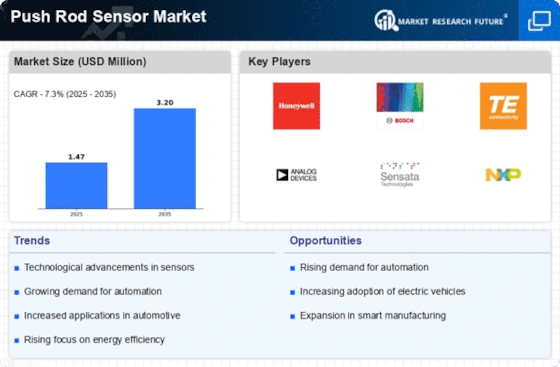
    The Global Push Rod Sensor Market is projected to grow from 1.47 USD Billion in 2024 to 0.00 USD Billion by 2035, reflecting a robust growth trajectory.

    Key Market Trends & Highlights

    Push Rod Sensor Key Trends and Highlights

    • The market is expected to witness a compound annual growth rate (CAGR) of 7.42% from 2025 to 2035.
    • By 2035, the market valuation is anticipated to reach 3.09 USD Billion, indicating substantial growth opportunities.
    • in 2024, the market is valued at 1.47 USD Billion, laying a strong foundation for future expansion.
    • Growing adoption of advanced automotive technologies due to increasing demand for vehicle safety features is a major market driver.

    Market Size & Forecast

    2024 Market Size 1.47 (USD Million)
    2035 Market Size 0.00 (USD Million)
    CAGR (2025-2035) 0.00%
    Largest Regional Market Share in 2024 latin_america)

    Major Players

    Dynisco, ConSenses GmbH, Inelta Sensorsysteme, TDS Precision Products, MEGATRON, Nanjing Xiju Electronic Technology Limited, Positek, Althen, PM Instrumentation, WayCon Positionsmesstechnik, Eddylab

    Market Trends

    Increasing urbanization is driving the market growth

    Market CAGR for push rod sensor is being driven by the increasing urbanization. Motion must be transmitted from the camshaft lobe to the valve using a push rod. It is essential to the design of engines and necessary for them to function. It is crucial to the reliability and efficiency of engines. Push rod serves as both a valve opener and an entrance for lubricating oil delivery to the cylinder head via the valve lifter. Although some older engines have adjustable push rods as a means of adjusting valve clearance, the majority of push rods have a fixed length.

    Additionally, It is anticipated that demand for passenger vehicles and two-wheelers will increase globally due to expanding urbanization and rising middle-class purchasing power. The demand for automobile push rods is anticipated to increase as a result of this issue. In addition, the demand for commercial vehicles has increased due to the expanding e-commerce and logistics sectors. Over the course of the forecast period, this increased demand is anticipated to fuel the expansion of the automotive push rods market. Because OHC engines are more fuel-efficient, automakers are incorporating them into their automobiles.

    In the near future, it's anticipated that this element will help the market grow.

    Additionally, strict laws and regulations concerning fuel emissions that have been established by governments of various nations across the world are another factor that has increased the sale and manufacturing of new cars, which is positively anticipated to support the expansion of the automotive push rod market. Another factor anticipated to fuel the expansion of the automobile push rods market is the rising demand for hybrid engines due to their excellent fuel efficiency. The demand for electric vehicles is growing in response to growing environmental safety concerns.

    Additionally, the promotion of electro mobility by the governments of numerous nations has had a negative impact on the sales of automobiles using IC engines. The market for automotive push rods is anticipated to see growth restraints over the forecast period due to the increased demand for electric automobiles.

    For instance, Over 85% of the world's population, according to the World Bank, resides in South America, the Middle East, or Asia Pacific. As consumer purchasing power continues to grow, more businesses are extending their production and marketing operations into these nations. Thus, result in driving the Push Rod Sensor market revenue.

    Push Rod Sensor Market Market Drivers

    Industrial Automation

    The Global Push Rod Sensor Market Industry is benefiting from the rise of industrial automation, which emphasizes efficiency and precision in manufacturing processes. Push rod sensors are integral to automated systems, providing critical feedback for machine operation and control. As industries adopt automation technologies to enhance productivity, the demand for reliable and accurate sensors is expected to grow. This trend aligns with the broader movement towards smart manufacturing, where data-driven decision-making is paramount. Consequently, the market is poised for substantial growth, with projections indicating a market size of 1.41 USD Billion in 2024.

    Growing Automotive Sector

    The Global Push Rod Sensor Market Industry is closely linked to the burgeoning automotive sector, which is witnessing a shift towards more sophisticated vehicle technologies. As manufacturers strive to enhance vehicle performance and safety, the demand for push rod sensors is likely to increase. These sensors play a crucial role in engine management systems, contributing to fuel efficiency and emissions reduction. The automotive industry's expansion is projected to drive the market's growth, with an anticipated compound annual growth rate of 7.42% from 2025 to 2035, reflecting the increasing reliance on advanced sensor technologies.

    Market Growth Projections

    The Global Push Rod Sensor Market Industry is projected to experience substantial growth over the coming years. With a market size anticipated to reach 1.41 USD Billion in 2024 and potentially expand to 3.09 USD Billion by 2035, the industry is on a promising trajectory. This growth is underpinned by various factors, including technological advancements, the rise of industrial automation, and increasing demand for smart devices. The compound annual growth rate of 7.42% from 2025 to 2035 reflects the industry's resilience and adaptability in meeting the evolving needs of diverse sectors.

    Technological Advancements

    The Global Push Rod Sensor Market Industry is experiencing a surge in demand due to rapid technological advancements. Innovations in sensor technology, such as improved accuracy and miniaturization, enhance the functionality of push rod sensors across various applications. For instance, the integration of IoT capabilities allows for real-time monitoring and data collection, which is increasingly sought after in automotive and industrial sectors. This trend is expected to contribute significantly to the market's growth, with projections indicating a market size of 1.41 USD Billion in 2024, potentially reaching 3.09 USD Billion by 2035.

    Rising Demand for Smart Devices

    The Global Push Rod Sensor Market Industry is influenced by the increasing demand for smart devices across various sectors. As consumers and industries alike seek enhanced functionality and connectivity, push rod sensors are becoming essential components in smart applications. These sensors facilitate the seamless integration of devices, enabling features such as remote monitoring and automation. The proliferation of smart technologies is likely to bolster the market, as manufacturers invest in advanced sensor solutions to meet evolving consumer expectations. This trend may contribute to a significant market expansion, with forecasts suggesting a growth trajectory towards 3.09 USD Billion by 2035.

    Regulatory Compliance and Environmental Concerns

    The Global Push Rod Sensor Market Industry is also shaped by stringent regulatory compliance and growing environmental concerns. Governments worldwide are implementing regulations aimed at reducing emissions and improving energy efficiency, which necessitates the use of advanced sensor technologies. Push rod sensors are pivotal in monitoring and controlling emissions in automotive and industrial applications, thereby aiding compliance with environmental standards. As industries adapt to these regulations, the demand for push rod sensors is expected to rise, further propelling market growth. This regulatory landscape is likely to support a compound annual growth rate of 7.42% from 2025 to 2035.

    Market Segment Insights

    Push Rod Sensor Product Type Insights

    The Push Rod Sensor Market segmentation, based on Product Type includes Optical Sensor, Inductive Sensor, Capacitive Sensor, and Other. The optical sensor segment dominated the market. Chemical sensors that properly detect the output signal include optical sensors, which have numerous uses because to their accuracy. Numerous applications use optical sensors, and the detector used varies depending on the application.

    Push Rod Sensor Applications Insights

    The Push Rod Sensor Market segmentation, based on Applications, includes Automobile Industry, Aerospace, Machine Made, Medical Industry, and Other. The automobile industry category generated the most income. The demand for electric vehicles is rising as environmental safety concerns grow. Additionally, the promotion of electro mobility by the governments of various nations has hurt sales of cars using IC engines. Thus, over the course of the forecast period, the market for automotive push rods is anticipated to be constrained by the increased demand for electric vehicles.

    Source: Primary Research, Secondary Research, MRFR Database and Analyst Review

    Get more detailed insights about Push Rod Sensor Market Research Report – Forecast till 2035

    Regional Insights

    By region, the study provides the market insights into North America, Europe, Asia-Pacific and Rest of the World. The North American Push Rod Sensor market area will dominate this market, due to rising demand for premium and fast cars in the United States and Canada.

    Further, the major countries studied in the market report are The US, German, France, the UK, Canada, Italy, Spain, India, Australia, South Korea, China, Japan, and Brazil.

    Figure 2: Push Rod Sensor Market SHARE BY REGION 2022 (USD Billion)

    Push Rod Sensor Market SHARE BY REGION 2022

    Source: Primary Research, Secondary Research, MRFR Database and Analyst Review

    Europe Push Rod Sensor market represents the second-largest market share due to the several vehicle manufactures in the area. Further, the German Push Rod Sensor market held a dominant market share, and the UK Push Rod Sensor market was the European region's fastest-growing market.

    The Asia-Pacific Push Rod Sensor Market is anticipated to see the fastest CAGR between 2023 and 2032. This is due to the expansion of the automobile sector in emerging Asia-Pacific nations like China and India. Moreover, China’s Push Rod Sensor market held a dominant market share, and the Indian Push Rod Sensor market was the Asia-Pacific region's fastest-growing market.

    Key Players and Competitive Insights

    Leading market players are putting a lot of money on R&D to increase the range of their goods, which will spur the Push Rod Sensor market to expand even further. Additionally, market participants are engaging in a range of strategic initiatives to increase their worldwide reach, with important market developments such as the introduction of new products, contracts, mergers and acquisitions, increased investments, and cooperation with other businesses. To grow and endure in a market that is becoming more competitive, Push Rod Sensor industry must provide reasonably priced goods.

    One of the main business strategies employed by manufacturers is to produce locally to reduce operational expenses in the global Push Rod Sensor industry to develop market sector and provide benefits to customers. In recent years, the Push Rod Sensor industry has provided the automotive industry with some of the most important benefits. Major players in the Push Rod Sensor market, including Dynisco, ConSenses GmbH, Inelta Sensorsysteme, TDS Precision Products, MEGATRON, Nanjing Xiju Electronic Technology Limited., and others, invest in operations for research and development in an effort to improve market demand.

    Viatran is an industry leader in pressure and level sensors that are made for reliable and precise measurement for all pressure ranges and most temperatures. These sensors are used in industries like oil and gas, manufacturing of steel, food and medical supplies, injection molding, die casting, and chemical production. Their products are renowned for withstanding the roughest and most inhospitable conditions. Additionally, Viatran is dedicated to providing its customers with tried-and-true products, quick service and support, and innovative technology that dramatically increases the productivity of their production processes.

    Starting in 2022, upfront and milestone-related R&D expenditures connected to agreements for collaboration and licensing made before a research product receives regulatory approval are no longer included in reported adjusted financial measures.

    ConSense GmbH is a top provider of software for process and quality management. ConSense GmbH develops software for cross-industry, comprehensive process management, and quality management. Their solutions satisfy a wide range of needs, from GxP-compliant systems to QM systems that are in line with DIN EN ISO 9001 and may map too many other standards, because they are user-friendly, flexible, and expandable. Whether their client is a small, medium-sized, or large global firm, they offer a solution that is uniquely created for every type of organization.

    The 4th ConSense ScientificAward was given to Vivien Sohn in April 2022 for her remarkable thesis, "Introducing a holistic process management scheme aiming at future viability and competitive advantages using the example of HÜBSCHER Holzbau AG," which she submitted to IUBH Internationale Hochschule GmbH.

    Key Companies in the Push Rod Sensor Market market include

    Industry Developments

    May 2021: BD SENSORS GmbH has launched the DS5 electrical pressure switch to increase operating safety in mobile construction machines including cranes, excavators, and harvesters.

    March 2020: ABB built a distribution plant in Arizona to boost its presence in the western US. Every electrical product that the company offers is sold at the center.

    September 2020: Sensata Technologies, Inc. introduced hermetic pressure sensors with mid- and high-pressure ranges for industrial applications. Leading-edge micro silicon strain gauge technology is used to construct the sensor. The sensor has various distinctive qualities, including high accuracy, burst strength, and shock and vibration performance, making it a dependable and robust alternative for clients with demanding measurement requirements.

    Future Outlook

    Push Rod Sensor Market Future Outlook

    The Push Rod Sensor Market is projected to grow at a 7.30% CAGR from 2025 to 2035, driven by advancements in automotive technology and increasing demand for precision measurement.

    New opportunities lie in:

    • Develop smart push rod sensors integrating IoT for real-time monitoring.
    • Expand product lines to cater to electric vehicle manufacturers.
    • Invest in R&D for enhanced durability and performance in extreme conditions.

    By 2035, the Push Rod Sensor Market is expected to achieve substantial growth, reflecting evolving technological demands.

    Market Segmentation

    Push Rod Sensor Regional Outlook

    North America
    • US
    • Canada

    Push Rod Sensor Applications Outlook

    • Automobile Industry
    • Aerospace
    • Machine Made
    • Medical Industry
    • Other

    Push Rod Sensor Product Type Outlook

    • Optical Sensor
    • Inductive Sensor
    • Capacitive Sensor
    • Other

    Report Scope

    Report Attribute/Metric Details
    Market Size 2035 USD 2.5 Billion
    Compound Annual Growth Rate (CAGR) 0.00% (2025 - 2035)
    Base Year 2024
    Market Forecast Period 2025 - 2035
    Historical Data 2018- 2022
    Market Forecast Units Value (USD Billion)
    Report Coverage Revenue Forecast, Market Competitive Landscape, Growth Factors, and Trends
    Segments Covered Product Type, Applications, and Region
    Geographies Covered North America, Europe, AsiaPacific, and the Rest of the World
    Countries Covered The US, German, France, UK, Canada, Italy, Spain, India, Australia, South Korea, China, Japan, and Brazil
    Key Companies Profiled Dynisco, ConSenses GmbH, Inelta Sensorsysteme, TDS Precision Products, MEGATRON, Nanjing Xiju Electronic Technology Limited,
    Key Market Opportunities Rising urbanization and middle-class consumers' expanding purchasing power
    Key Market Dynamics There is a growing market for electric automobiles.
    Market Size 2024 1.47 (Value (USD Billion))
    Market Size 2025 1.58 (Value (USD Billion))

    FAQs

    How big is the market for Push Rod Sensors?

    In 2024, the market for Push Rod Sensors was estimated to be worth USD 1.28 billion.

    What is the market growth rate for push rod sensors?

    During the forecast period, 2025 to 2035, the global market is anticipated to expand at a CAGR of 0.00%.

    Which geographical area accounted for the biggest market share for Push Rod Sensors?

    North America held the majority of the global market.

    Who are the leading companies in the market for push rod sensors?

    Dynisco, ConSenses GmbH, Inelta Sensorsysteme, TDS Precision Products, MEGATRON, Nanjing Xiju Electronic Technology Limited, and others are the major market participants.

    Which Product Type dominated the Market for Push Rod Sensors?

    In 2022, the optical sensor segment dominated the market.

    Which applications accounted for the biggest market share in the market for push rod sensors?

    The largest market share in the world was held by the automobile industry.

    1. SECTION I: EXECUTIVE SUMMARY AND KEY HIGHLIGHTS
      1. | 1.1 EXECUTIVE SUMMARY
      2. | | 1.1.1 Market Overview
      3. | | 1.1.2 Key Findings
      4. | | 1.1.3 Market Segmentation
      5. | | 1.1.4 Competitive Landscape
      6. | | 1.1.5 Challenges and Opportunities
      7. | | 1.1.6 Future Outlook
    2. SECTION II: SCOPING, METHODOLOGY AND MARKET STRUCTURE
      1. | 2.1 MARKET INTRODUCTION
      2. | | 2.1.1 Definition
      3. | | 2.1.2 Scope of the study
      4. | | | 2.1.2.1 Research Objective
      5. | | | 2.1.2.2 Assumption
      6. | | | 2.1.2.3 Limitations
      7. | 2.2 RESEARCH METHODOLOGY
      8. | | 2.2.1 Overview
      9. | | 2.2.2 Data Mining
      10. | | 2.2.3 Secondary Research
      11. | | 2.2.4 Primary Research
      12. | | | 2.2.4.1 Primary Interviews and Information Gathering Process
      13. | | | 2.2.4.2 Breakdown of Primary Respondents
      14. | | 2.2.5 Forecasting Model
      15. | | 2.2.6 Market Size Estimation
      16. | | | 2.2.6.1 Bottom-Up Approach
      17. | | | 2.2.6.2 Top-Down Approach
      18. | | 2.2.7 Data Triangulation
      19. | | 2.2.8 Validation
    3. SECTION III: QUALITATIVE ANALYSIS
      1. | 3.1 MARKET DYNAMICS
      2. | | 3.1.1 Overview
      3. | | 3.1.2 Drivers
      4. | | 3.1.3 Restraints
      5. | | 3.1.4 Opportunities
      6. | 3.2 MARKET FACTOR ANALYSIS
      7. | | 3.2.1 Value chain Analysis
      8. | | 3.2.2 Porter's Five Forces Analysis
      9. | | | 3.2.2.1 Bargaining Power of Suppliers
      10. | | | 3.2.2.2 Bargaining Power of Buyers
      11. | | | 3.2.2.3 Threat of New Entrants
      12. | | | 3.2.2.4 Threat of Substitutes
      13. | | | 3.2.2.5 Intensity of Rivalry
      14. | | 3.2.3 COVID-19 Impact Analysis
      15. | | | 3.2.3.1 Market Impact Analysis
      16. | | | 3.2.3.2 Regional Impact
      17. | | | 3.2.3.3 Opportunity and Threat Analysis
    4. SECTION IV: QUANTITATIVE ANALYSIS
      1. | 4.1 Semiconductor & Electronics, BY Type (USD Million)
      2. | | 4.1.1 Optical Sensor
      3. | | 4.1.2 Inductive Sensor
      4. | | 4.1.3 Capacitive Sensor
      5. | | 4.1.4 Other
      6. | 4.2 Semiconductor & Electronics, BY Applications (USD Million)
      7. | | 4.2.1 Automobile Industry
      8. | | 4.2.2 Aerospace
      9. | | 4.2.3 Machine Made
      10. | | 4.2.4 Medical Industry
      11. | | 4.2.5 Other
      12. | 4.3 Semiconductor & Electronics, BY Region (USD Million)
      13. | | 4.3.1 North America
      14. | | | 4.3.1.1 US
      15. | | | 4.3.1.2 Canada
      16. | | 4.3.2 Europe
      17. | | | 4.3.2.1 Germany
      18. | | | 4.3.2.2 UK
      19. | | | 4.3.2.3 France
      20. | | | 4.3.2.4 Russia
      21. | | | 4.3.2.5 Italy
      22. | | | 4.3.2.6 Spain
      23. | | | 4.3.2.7 Rest of Europe
      24. | | 4.3.3 APAC
      25. | | | 4.3.3.1 China
      26. | | | 4.3.3.2 India
      27. | | | 4.3.3.3 Japan
      28. | | | 4.3.3.4 South Korea
      29. | | | 4.3.3.5 Malaysia
      30. | | | 4.3.3.6 Thailand
      31. | | | 4.3.3.7 Indonesia
      32. | | | 4.3.3.8 Rest of APAC
      33. | | 4.3.4 South America
      34. | | | 4.3.4.1 Brazil
      35. | | | 4.3.4.2 Mexico
      36. | | | 4.3.4.3 Argentina
      37. | | | 4.3.4.4 Rest of South America
      38. | | 4.3.5 MEA
      39. | | | 4.3.5.1 GCC Countries
      40. | | | 4.3.5.2 South Africa
      41. | | | 4.3.5.3 Rest of MEA
    5. SECTION V: COMPETITIVE ANALYSIS
      1. | 5.1 Competitive Landscape
      2. | | 5.1.1 Overview
      3. | | 5.1.2 Competitive Analysis
      4. | | 5.1.3 Market share Analysis
      5. | | 5.1.4 Major Growth Strategy in the Semiconductor & Electronics
      6. | | 5.1.5 Competitive Benchmarking
      7. | | 5.1.6 Leading Players in Terms of Number of Developments in the Semiconductor & Electronics
      8. | | 5.1.7 Key developments and growth strategies
      9. | | | 5.1.7.1 New Product Launch/Service Deployment
      10. | | | 5.1.7.2 Merger & Acquisitions
      11. | | | 5.1.7.3 Joint Ventures
      12. | | 5.1.8 Major Players Financial Matrix
      13. | | | 5.1.8.1 Sales and Operating Income
      14. | | | 5.1.8.2 Major Players R&D Expenditure. 2023
      15. | 5.2 Company Profiles
      16. | | 5.2.1 Honeywell (US)
      17. | | | 5.2.1.1 Financial Overview
      18. | | | 5.2.1.2 Products Offered
      19. | | | 5.2.1.3 Key Developments
      20. | | | 5.2.1.4 SWOT Analysis
      21. | | | 5.2.1.5 Key Strategies
      22. | | 5.2.2 Bosch (DE)
      23. | | | 5.2.2.1 Financial Overview
      24. | | | 5.2.2.2 Products Offered
      25. | | | 5.2.2.3 Key Developments
      26. | | | 5.2.2.4 SWOT Analysis
      27. | | | 5.2.2.5 Key Strategies
      28. | | 5.2.3 TE Connectivity (US)
      29. | | | 5.2.3.1 Financial Overview
      30. | | | 5.2.3.2 Products Offered
      31. | | | 5.2.3.3 Key Developments
      32. | | | 5.2.3.4 SWOT Analysis
      33. | | | 5.2.3.5 Key Strategies
      34. | | 5.2.4 Analog Devices (US)
      35. | | | 5.2.4.1 Financial Overview
      36. | | | 5.2.4.2 Products Offered
      37. | | | 5.2.4.3 Key Developments
      38. | | | 5.2.4.4 SWOT Analysis
      39. | | | 5.2.4.5 Key Strategies
      40. | | 5.2.5 Sensata Technologies (US)
      41. | | | 5.2.5.1 Financial Overview
      42. | | | 5.2.5.2 Products Offered
      43. | | | 5.2.5.3 Key Developments
      44. | | | 5.2.5.4 SWOT Analysis
      45. | | | 5.2.5.5 Key Strategies
      46. | | 5.2.6 NXP Semiconductors (NL)
      47. | | | 5.2.6.1 Financial Overview
      48. | | | 5.2.6.2 Products Offered
      49. | | | 5.2.6.3 Key Developments
      50. | | | 5.2.6.4 SWOT Analysis
      51. | | | 5.2.6.5 Key Strategies
      52. | | 5.2.7 Infineon Technologies (DE)
      53. | | | 5.2.7.1 Financial Overview
      54. | | | 5.2.7.2 Products Offered
      55. | | | 5.2.7.3 Key Developments
      56. | | | 5.2.7.4 SWOT Analysis
      57. | | | 5.2.7.5 Key Strategies
      58. | | 5.2.8 STMicroelectronics (CH)
      59. | | | 5.2.8.1 Financial Overview
      60. | | | 5.2.8.2 Products Offered
      61. | | | 5.2.8.3 Key Developments
      62. | | | 5.2.8.4 SWOT Analysis
      63. | | | 5.2.8.5 Key Strategies
      64. | 5.3 Appendix
      65. | | 5.3.1 References
      66. | | 5.3.2 Related Reports
    6. LIST OF FIGURES
      1. | 6.1 MARKET SYNOPSIS
      2. | 6.2 NORTH AMERICA MARKET ANALYSIS
      3. | 6.3 US MARKET ANALYSIS BY TYPE
      4. | 6.4 US MARKET ANALYSIS BY APPLICATIONS
      5. | 6.5 CANADA MARKET ANALYSIS BY TYPE
      6. | 6.6 CANADA MARKET ANALYSIS BY APPLICATIONS
      7. | 6.7 EUROPE MARKET ANALYSIS
      8. | 6.8 GERMANY MARKET ANALYSIS BY TYPE
      9. | 6.9 GERMANY MARKET ANALYSIS BY APPLICATIONS
      10. | 6.10 UK MARKET ANALYSIS BY TYPE
      11. | 6.11 UK MARKET ANALYSIS BY APPLICATIONS
      12. | 6.12 FRANCE MARKET ANALYSIS BY TYPE
      13. | 6.13 FRANCE MARKET ANALYSIS BY APPLICATIONS
      14. | 6.14 RUSSIA MARKET ANALYSIS BY TYPE
      15. | 6.15 RUSSIA MARKET ANALYSIS BY APPLICATIONS
      16. | 6.16 ITALY MARKET ANALYSIS BY TYPE
      17. | 6.17 ITALY MARKET ANALYSIS BY APPLICATIONS
      18. | 6.18 SPAIN MARKET ANALYSIS BY TYPE
      19. | 6.19 SPAIN MARKET ANALYSIS BY APPLICATIONS
      20. | 6.20 REST OF EUROPE MARKET ANALYSIS BY TYPE
      21. | 6.21 REST OF EUROPE MARKET ANALYSIS BY APPLICATIONS
      22. | 6.22 APAC MARKET ANALYSIS
      23. | 6.23 CHINA MARKET ANALYSIS BY TYPE
      24. | 6.24 CHINA MARKET ANALYSIS BY APPLICATIONS
      25. | 6.25 INDIA MARKET ANALYSIS BY TYPE
      26. | 6.26 INDIA MARKET ANALYSIS BY APPLICATIONS
      27. | 6.27 JAPAN MARKET ANALYSIS BY TYPE
      28. | 6.28 JAPAN MARKET ANALYSIS BY APPLICATIONS
      29. | 6.29 SOUTH KOREA MARKET ANALYSIS BY TYPE
      30. | 6.30 SOUTH KOREA MARKET ANALYSIS BY APPLICATIONS
      31. | 6.31 MALAYSIA MARKET ANALYSIS BY TYPE
      32. | 6.32 MALAYSIA MARKET ANALYSIS BY APPLICATIONS
      33. | 6.33 THAILAND MARKET ANALYSIS BY TYPE
      34. | 6.34 THAILAND MARKET ANALYSIS BY APPLICATIONS
      35. | 6.35 INDONESIA MARKET ANALYSIS BY TYPE
      36. | 6.36 INDONESIA MARKET ANALYSIS BY APPLICATIONS
      37. | 6.37 REST OF APAC MARKET ANALYSIS BY TYPE
      38. | 6.38 REST OF APAC MARKET ANALYSIS BY APPLICATIONS
      39. | 6.39 SOUTH AMERICA MARKET ANALYSIS
      40. | 6.40 BRAZIL MARKET ANALYSIS BY TYPE
      41. | 6.41 BRAZIL MARKET ANALYSIS BY APPLICATIONS
      42. | 6.42 MEXICO MARKET ANALYSIS BY TYPE
      43. | 6.43 MEXICO MARKET ANALYSIS BY APPLICATIONS
      44. | 6.44 ARGENTINA MARKET ANALYSIS BY TYPE
      45. | 6.45 ARGENTINA MARKET ANALYSIS BY APPLICATIONS
      46. | 6.46 REST OF SOUTH AMERICA MARKET ANALYSIS BY TYPE
      47. | 6.47 REST OF SOUTH AMERICA MARKET ANALYSIS BY APPLICATIONS
      48. | 6.48 MEA MARKET ANALYSIS
      49. | 6.49 GCC COUNTRIES MARKET ANALYSIS BY TYPE
      50. | 6.50 GCC COUNTRIES MARKET ANALYSIS BY APPLICATIONS
      51. | 6.51 SOUTH AFRICA MARKET ANALYSIS BY TYPE
      52. | 6.52 SOUTH AFRICA MARKET ANALYSIS BY APPLICATIONS
      53. | 6.53 REST OF MEA MARKET ANALYSIS BY TYPE
      54. | 6.54 REST OF MEA MARKET ANALYSIS BY APPLICATIONS
      55. | 6.55 KEY BUYING CRITERIA OF SEMICONDUCTOR & ELECTRONICS
      56. | 6.56 RESEARCH PROCESS OF MRFR
      57. | 6.57 DRO ANALYSIS OF SEMICONDUCTOR & ELECTRONICS
      58. | 6.58 DRIVERS IMPACT ANALYSIS: SEMICONDUCTOR & ELECTRONICS
      59. | 6.59 RESTRAINTS IMPACT ANALYSIS: SEMICONDUCTOR & ELECTRONICS
      60. | 6.60 SUPPLY / VALUE CHAIN: SEMICONDUCTOR & ELECTRONICS
      61. | 6.61 SEMICONDUCTOR & ELECTRONICS, BY TYPE, 2024 (% SHARE)
      62. | 6.62 SEMICONDUCTOR & ELECTRONICS, BY TYPE, 2024 TO 2035 (USD Million)
      63. | 6.63 SEMICONDUCTOR & ELECTRONICS, BY APPLICATIONS, 2024 (% SHARE)
      64. | 6.64 SEMICONDUCTOR & ELECTRONICS, BY APPLICATIONS, 2024 TO 2035 (USD Million)
      65. | 6.65 BENCHMARKING OF MAJOR COMPETITORS
    7. LIST OF TABLES
      1. | 7.1 LIST OF ASSUMPTIONS
      2. | | 7.1.1
      3. | 7.2 North America MARKET SIZE ESTIMATES; FORECAST
      4. | | 7.2.1 BY TYPE, 2025-2035 (USD Million)
      5. | | 7.2.2 BY APPLICATIONS, 2025-2035 (USD Million)
      6. | 7.3 US MARKET SIZE ESTIMATES; FORECAST
      7. | | 7.3.1 BY TYPE, 2025-2035 (USD Million)
      8. | | 7.3.2 BY APPLICATIONS, 2025-2035 (USD Million)
      9. | 7.4 Canada MARKET SIZE ESTIMATES; FORECAST
      10. | | 7.4.1 BY TYPE, 2025-2035 (USD Million)
      11. | | 7.4.2 BY APPLICATIONS, 2025-2035 (USD Million)
      12. | 7.5 Europe MARKET SIZE ESTIMATES; FORECAST
      13. | | 7.5.1 BY TYPE, 2025-2035 (USD Million)
      14. | | 7.5.2 BY APPLICATIONS, 2025-2035 (USD Million)
      15. | 7.6 Germany MARKET SIZE ESTIMATES; FORECAST
      16. | | 7.6.1 BY TYPE, 2025-2035 (USD Million)
      17. | | 7.6.2 BY APPLICATIONS, 2025-2035 (USD Million)
      18. | 7.7 UK MARKET SIZE ESTIMATES; FORECAST
      19. | | 7.7.1 BY TYPE, 2025-2035 (USD Million)
      20. | | 7.7.2 BY APPLICATIONS, 2025-2035 (USD Million)
      21. | 7.8 France MARKET SIZE ESTIMATES; FORECAST
      22. | | 7.8.1 BY TYPE, 2025-2035 (USD Million)
      23. | | 7.8.2 BY APPLICATIONS, 2025-2035 (USD Million)
      24. | 7.9 Russia MARKET SIZE ESTIMATES; FORECAST
      25. | | 7.9.1 BY TYPE, 2025-2035 (USD Million)
      26. | | 7.9.2 BY APPLICATIONS, 2025-2035 (USD Million)
      27. | 7.10 Italy MARKET SIZE ESTIMATES; FORECAST
      28. | | 7.10.1 BY TYPE, 2025-2035 (USD Million)
      29. | | 7.10.2 BY APPLICATIONS, 2025-2035 (USD Million)
      30. | 7.11 Spain MARKET SIZE ESTIMATES; FORECAST
      31. | | 7.11.1 BY TYPE, 2025-2035 (USD Million)
      32. | | 7.11.2 BY APPLICATIONS, 2025-2035 (USD Million)
      33. | 7.12 Rest of Europe MARKET SIZE ESTIMATES; FORECAST
      34. | | 7.12.1 BY TYPE, 2025-2035 (USD Million)
      35. | | 7.12.2 BY APPLICATIONS, 2025-2035 (USD Million)
      36. | 7.13 APAC MARKET SIZE ESTIMATES; FORECAST
      37. | | 7.13.1 BY TYPE, 2025-2035 (USD Million)
      38. | | 7.13.2 BY APPLICATIONS, 2025-2035 (USD Million)
      39. | 7.14 China MARKET SIZE ESTIMATES; FORECAST
      40. | | 7.14.1 BY TYPE, 2025-2035 (USD Million)
      41. | | 7.14.2 BY APPLICATIONS, 2025-2035 (USD Million)
      42. | 7.15 India MARKET SIZE ESTIMATES; FORECAST
      43. | | 7.15.1 BY TYPE, 2025-2035 (USD Million)
      44. | | 7.15.2 BY APPLICATIONS, 2025-2035 (USD Million)
      45. | 7.16 Japan MARKET SIZE ESTIMATES; FORECAST
      46. | | 7.16.1 BY TYPE, 2025-2035 (USD Million)
      47. | | 7.16.2 BY APPLICATIONS, 2025-2035 (USD Million)
      48. | 7.17 South Korea MARKET SIZE ESTIMATES; FORECAST
      49. | | 7.17.1 BY TYPE, 2025-2035 (USD Million)
      50. | | 7.17.2 BY APPLICATIONS, 2025-2035 (USD Million)
      51. | 7.18 Malaysia MARKET SIZE ESTIMATES; FORECAST
      52. | | 7.18.1 BY TYPE, 2025-2035 (USD Million)
      53. | | 7.18.2 BY APPLICATIONS, 2025-2035 (USD Million)
      54. | 7.19 Thailand MARKET SIZE ESTIMATES; FORECAST
      55. | | 7.19.1 BY TYPE, 2025-2035 (USD Million)
      56. | | 7.19.2 BY APPLICATIONS, 2025-2035 (USD Million)
      57. | 7.20 Indonesia MARKET SIZE ESTIMATES; FORECAST
      58. | | 7.20.1 BY TYPE, 2025-2035 (USD Million)
      59. | | 7.20.2 BY APPLICATIONS, 2025-2035 (USD Million)
      60. | 7.21 Rest of APAC MARKET SIZE ESTIMATES; FORECAST
      61. | | 7.21.1 BY TYPE, 2025-2035 (USD Million)
      62. | | 7.21.2 BY APPLICATIONS, 2025-2035 (USD Million)
      63. | 7.22 South America MARKET SIZE ESTIMATES; FORECAST
      64. | | 7.22.1 BY TYPE, 2025-2035 (USD Million)
      65. | | 7.22.2 BY APPLICATIONS, 2025-2035 (USD Million)
      66. | 7.23 Brazil MARKET SIZE ESTIMATES; FORECAST
      67. | | 7.23.1 BY TYPE, 2025-2035 (USD Million)
      68. | | 7.23.2 BY APPLICATIONS, 2025-2035 (USD Million)
      69. | 7.24 Mexico MARKET SIZE ESTIMATES; FORECAST
      70. | | 7.24.1 BY TYPE, 2025-2035 (USD Million)
      71. | | 7.24.2 BY APPLICATIONS, 2025-2035 (USD Million)
      72. | 7.25 Argentina MARKET SIZE ESTIMATES; FORECAST
      73. | | 7.25.1 BY TYPE, 2025-2035 (USD Million)
      74. | | 7.25.2 BY APPLICATIONS, 2025-2035 (USD Million)
      75. | 7.26 Rest of South America MARKET SIZE ESTIMATES; FORECAST
      76. | | 7.26.1 BY TYPE, 2025-2035 (USD Million)
      77. | | 7.26.2 BY APPLICATIONS, 2025-2035 (USD Million)
      78. | 7.27 MEA MARKET SIZE ESTIMATES; FORECAST
      79. | | 7.27.1 BY TYPE, 2025-2035 (USD Million)
      80. | | 7.27.2 BY APPLICATIONS, 2025-2035 (USD Million)
      81. | 7.28 GCC Countries MARKET SIZE ESTIMATES; FORECAST
      82. | | 7.28.1 BY TYPE, 2025-2035 (USD Million)
      83. | | 7.28.2 BY APPLICATIONS, 2025-2035 (USD Million)
      84. | 7.29 South Africa MARKET SIZE ESTIMATES; FORECAST
      85. | | 7.29.1 BY TYPE, 2025-2035 (USD Million)
      86. | | 7.29.2 BY APPLICATIONS, 2025-2035 (USD Million)
      87. | 7.30 Rest of MEA MARKET SIZE ESTIMATES; FORECAST
      88. | | 7.30.1 BY TYPE, 2025-2035 (USD Million)
      89. | | 7.30.2 BY APPLICATIONS, 2025-2035 (USD Million)
      90. | 7.31 PRODUCT LAUNCH/PRODUCT DEVELOPMENT/APPROVAL
      91. | | 7.31.1
      92. | 7.32 ACQUISITION/PARTNERSHIP
      93. | | 7.32.1


    Push Rod Sensor Market Segmentation

    Push Rod Sensor Product Type Outlook (USD Billion, 2018-2032)

    • Optical Sensor
    • Inductive Sensor
    • Capacitive Sensor
    • Other

    Push Rod Sensor Application Outlook (USD Billion, 2018-2032)

    • Automobile Industry
    • Aerospace
    • Machine Made
    • Medical Industry
    • Other

    Push Rod Sensor Regional Outlook (USD Billion, 2018-2032)

    • North America Outlook (USD Billion, 2018-2032)

      • North America Push Rod Sensor by Product Type
        • Optical Sensor
        • Inductive Sensor
        • Capacitive Sensor
        • Other
      • North America Push Rod Sensor by Application
        • Automobile Industry
        • Aerospace
        • Machine Made
        • Medical Industry
        • Other
      • US Outlook (USD Billion, 2018-2032)

      • US Push Rod Sensor by Product Type
        • Optical Sensor
        • Inductive Sensor
        • Capacitive Sensor
        • Other
      • US Push Rod Sensor by Application
        • Automobile Industry
        • Aerospace
        • Machine Made
        • Medical Industry
        • Other
      • CANADA Outlook (USD Billion, 2018-2032)

      • CANADA Push Rod Sensor by Product Type
        • Optical Sensor
        • Inductive Sensor
        • Capacitive Sensor
        • Other
      • CANADA Push Rod Sensor by Application
        • Automobile Industry
        • Aerospace
        • Machine Made
        • Medical Industry
        • Other
    • Europe Outlook (USD Billion, 2018-2032)

      • Europe Push Rod Sensor by Product Type
        • Optical Sensor
        • Inductive Sensor
        • Capacitive Sensor
        • Other
      • Europe Push Rod Sensor by Application
        • Automobile Industry
        • Aerospace
        • Machine Made
        • Medical Industry
        • Other
      • Germany Outlook (USD Billion, 2018-2032)

      • Germany Push Rod Sensor by Product Type
        • Optical Sensor
        • Inductive Sensor
        • Capacitive Sensor
        • Other
      • Germany Push Rod Sensor by Application
        • Automobile Industry
        • Aerospace
        • Machine Made
        • Medical Industry
        • Other
      • France Outlook (USD Billion, 2018-2032)

      • France Push Rod Sensor by Product Type
        • Optical Sensor
        • Inductive Sensor
        • Capacitive Sensor
        • Other
      • France Push Rod Sensor by Application
        • Automobile Industry
        • Aerospace
        • Machine Made
        • Medical Industry
        • Other
      • UK Outlook (USD Billion, 2018-2032)

      • UK Push Rod Sensor by Product Type
        • Optical Sensor
        • Inductive Sensor
        • Capacitive Sensor
        • Other
      • UK Push Rod Sensor by Application
        • Automobile Industry
        • Aerospace
        • Machine Made
        • Medical Industry
        • Other
      • ITALY Outlook (USD Billion, 2018-2032)

      • ITALY Push Rod Sensor by Product Type
        • Optical Sensor
        • Inductive Sensor
        • Capacitive Sensor
        • Other
      • ITALY Push Rod Sensor by Application
        • Automobile Industry
        • Aerospace
        • Machine Made
        • Medical Industry
        • Other
      • SPAIN Outlook (USD Billion, 2018-2032)

      • Spain Push Rod Sensor by Product Type
        • Optical Sensor
        • Inductive Sensor
        • Capacitive Sensor
        • Other
      • Spain Push Rod Sensor by Application
        • Automobile Industry
        • Aerospace
        • Machine Made
        • Medical Industry
        • Other
      • Rest Of Europe Outlook (USD Billion, 2018-2032)

      • Rest Of Europe Push Rod Sensor by Product Type
        • Optical Sensor
        • Inductive Sensor
        • Capacitive Sensor
        • Other
      • REST OF EUROPE Push Rod Sensor by Application
        • Automobile Industry
        • Aerospace
        • Machine Made
        • Medical Industry
        • Other
    • Asia-Pacific Outlook (USD Billion, 2018-2032)

      • Asia-Pacific Push Rod Sensor by Product Type
        • Optical Sensor
        • Inductive Sensor
        • Capacitive Sensor
        • Other
      • Asia-Pacific Push Rod Sensor by Application
        • Automobile Industry
        • Aerospace
        • Machine Made
        • Medical Industry
        • Other
      • China Outlook (USD Billion, 2018-2032)

      • China Push Rod Sensor by Product Type
        • Optical Sensor
        • Inductive Sensor
        • Capacitive Sensor
        • Other
      • China Push Rod Sensor by Application
        • Automobile Industry
        • Aerospace
        • Machine Made
        • Medical Industry
        • Other
      • Japan Outlook (USD Billion, 2018-2032)

      • Japan Push Rod Sensor by Product Type
        • Optical Sensor
        • Inductive Sensor
        • Capacitive Sensor
        • Other
      • Japan Push Rod Sensor by Application
        • Automobile Industry
        • Aerospace
        • Machine Made
        • Medical Industry
        • Other
      • India Outlook (USD Billion, 2018-2032)

      • India Push Rod Sensor by Product Type
        • Optical Sensor
        • Inductive Sensor
        • Capacitive Sensor
        • Other
      • India Push Rod Sensor by Application
        • Automobile Industry
        • Aerospace
        • Machine Made
        • Medical Industry
        • Other
      • Australia Outlook (USD Billion, 2018-2032)

      • Australia Push Rod Sensor by Product Type
        • Optical Sensor
        • Inductive Sensor
        • Capacitive Sensor
        • Other
      • Australia Push Rod Sensor by Application
        • Automobile Industry
        • Aerospace
        • Machine Made
        • Medical Industry
        • Other
      • Rest of Asia-Pacific Outlook (USD Billion, 2018-2032)

      • Rest of Asia-Pacific Push Rod Sensor by Product Type
        • Optical Sensor
        • Inductive Sensor
        • Capacitive Sensor
        • Other
      • Rest of Asia-Pacific Push Rod Sensor by Application
        • Automobile Industry
        • Aerospace
        • Machine Made
        • Medical Industry
        • Other
    • Rest of the World Outlook (USD Billion, 2018-2032)

      • Rest of the World Push Rod Sensor by Product Type
        • Optical Sensor
        • Inductive Sensor
        • Capacitive Sensor
        • Other
      • Rest of the World Push Rod Sensor by Application
        • Automobile Industry
        • Aerospace
        • Machine Made
        • Medical Industry
        • Other
      • Middle East Outlook (USD Billion, 2018-2032)

      • Middle East Push Rod Sensor by Product Type
        • Optical Sensor
        • Inductive Sensor
        • Capacitive Sensor
        • Other
      • Middle East Push Rod Sensor by Application
        • Automobile Industry
        • Aerospace
        • Machine Made
        • Medical Industry
        • Other
      • Africa Outlook (USD Billion, 2018-2032)

      • Africa Push Rod Sensor by Product Type
        • Optical Sensor
        • Inductive Sensor
        • Capacitive Sensor
        • Other
      • Africa Push Rod Sensor by Application
        • Automobile Industry
        • Aerospace
        • Machine Made
        • Medical Industry
        • Other
      • Latin America Outlook (USD Billion, 2018-2032)

      • Latin America Push Rod Sensor by Product Type
        • Optical Sensor
        • Inductive Sensor
        • Capacitive Sensor
        • Other
      • Latin America Push Rod Sensor by Application
        • Automobile Industry
        • Aerospace
        • Machine Made
        • Medical Industry
        • Other
    Infographic

    Free Sample Request

    Kindly complete the form below to receive a free sample of this Report

    Get Free Sample

    Customer Strories

    “I am very pleased with how market segments have been defined in a relevant way for my purposes (such as "Portable Freezers & refrigerators" and "last-mile"). In general the report is well structured. Thanks very much for your efforts.”

    Victoria Milne

    Founder
    Case Study
    Chemicals and Materials

    Compare Licence

    ×
    Features License Type
    Single User Multiuser License Enterprise User
    Price $4,950 $5,950 $7,250
    Maximum User Access Limit 1 User Upto 10 Users Unrestricted Access Throughout the Organization
    Free Customization
    Direct Access to Analyst
    Deliverable Format
    Platform Access
    Discount on Next Purchase 10% 15% 15%
    Printable Versions