
Request Free Sample ×

Kindly complete the form below to receive a free sample of this Report

* Please use a valid business email

Leading companies partner with us for data-driven Insights

clients tt-cursor
Hero Background
English
Chinese
French
Japanese
Korean
German
Spanish

Push Rod Sensor Market Analysis

ID: MRFR/SEM/10885-HCR
128 Pages
Aarti Dhapte
December 2024

Push Rod Sensor Market Size, Share and Research Report By Product Type (Optical Sensor, Inductive Sensor, Capacitive Sensor, and Other), By Application (Automobile Industry, Aerospace, Machine Made, Medical Industry, and Other) And By Region (North America, Europe, Asia-Pacific, And Rest Of The World) –Industry Forecast Till 2035

Share:
Download PDF ×

We do not share your information with anyone. However, we may send you emails based on your report interest from time to time. You may contact us at any time to opt-out.

Push Rod Sensor Market Infographic
Purchase Options

Market Analysis

In-depth Analysis of Push Rod Sensor Market Industry Landscape

The dynamics of the Push Rod Sensor Market are shaped by a variety of factors that collectively influence its growth, trends, and overall trajectory. One of the key driving forces is the increasing demand for automation across various industries. As businesses strive to enhance efficiency and precision in their operations, the need for reliable sensors, such as push rod sensors, has grown significantly. These sensors play a crucial role in monitoring and controlling mechanical movements, making them indispensable in applications ranging from automotive systems to industrial machinery.

Technological advancements are also pivotal market dynamics. The continuous evolution of sensor technologies contributes to the improved performance and capabilities of push rod sensors. Manufacturers are investing in research and development to create sensors that offer higher accuracy, increased sensitivity, and enhanced durability. This technological progress not only addresses the current needs of industries but also opens up new possibilities for the application of push rod sensors in emerging sectors.

The automotive industry plays a central role in shaping the market dynamics of push rod sensors. With the rising trend of electric vehicles (EVs) and the ongoing emphasis on fuel efficiency, the demand for sensors that can precisely monitor engine components and movements has surged. Push rod sensors, with their ability to provide real-time feedback on mechanical systems, contribute to the efficiency and safety of both traditional and electric vehicles. As the automotive landscape continues to evolve, the push rod sensor market is likely to witness sustained growth.

Market dynamics are also influenced by regulatory frameworks and environmental considerations. Governments worldwide are implementing stringent regulations to reduce emissions and improve energy efficiency. Push rod sensors, by monitoring and optimizing mechanical processes, contribute to the development of cleaner and more sustainable technologies. As environmental consciousness becomes more prominent, the push rod sensor market is expected to align with the global push towards greener and more eco-friendly solutions.

Global economic conditions significantly impact the push rod sensor market dynamics. Economic stability and growth create a conducive environment for increased investments in infrastructure, manufacturing, and automotive sectors, leading to a higher demand for push rod sensors. Conversely, economic downturns can result in a temporary slowdown in industrial activities, affecting the market dynamics as companies adjust their strategies in response to economic uncertainties.

Competition within the market is another crucial dynamic. The presence of multiple players vying for market share fosters a competitive landscape. Companies are constantly innovating and adopting strategic approaches such as mergers, acquisitions, and partnerships to gain a competitive edge. This dynamic environment encourages continuous improvement in push rod sensor technology and enhances the overall market competitiveness.

Consumer preferences and the overall trend towards digitalization also contribute to the market dynamics. As industries embrace digital transformation, the demand for advanced sensors increases. Push rod sensors, with their ability to provide accurate and real-time data, are well-positioned to meet the evolving needs of modern industries. Companies that align their products with the digitalization trend are likely to capitalize on this dynamic market shift.


Author
Author Profile
Aarti Dhapte
AVP - Research

A consulting professional focused on helping businesses navigate complex markets through structured research and strategic insights. I partner with clients to solve high-impact business problems across market entry strategy, competitive intelligence, and opportunity assessment. Over the course of my experience, I have led and contributed to 100+ market research and consulting engagements, delivering insights across multiple industries and geographies, and supporting strategic decisions linked to $500M+ market opportunities. My core expertise lies in building robust market sizing, forecasting, and commercial models (top-down and bottom-up), alongside deep-dive competitive and industry analysis. I have played a key role in shaping go-to-market strategies, investment cases, and growth roadmaps, enabling clients to make confident, data-backed decisions in dynamic markets.

Leave a Comment

FAQs

What is the projected market valuation for the Push Rod Sensor Market in 2035?

<p>The projected market valuation for the Push Rod Sensor Market in 2035 is 3.199 USD Million.</p>

What was the overall market valuation for the Push Rod Sensor Market in 2024?

<p>The overall market valuation for the Push Rod Sensor Market in 2024 was 1.474 USD Million.</p>

What is the expected CAGR for the Push Rod Sensor Market during the forecast period 2025 - 2035?

<p>The expected CAGR for the Push Rod Sensor Market during the forecast period 2025 - 2035 is 7.3%.</p>

Which companies are considered key players in the Push Rod Sensor Market?

<p>Key players in the Push Rod Sensor Market include Honeywell, Bosch, TE Connectivity, Analog Devices, Sensata Technologies, NXP Semiconductors, Infineon Technologies, and STMicroelectronics.</p>

What are the main types of sensors in the Push Rod Sensor Market and their valuations?

<p>The main types of sensors include Optical Sensors and Inductive Sensors, each valued at approximately 0.442 to 0.979 USD Million.</p>

How does the automobile industry contribute to the Push Rod Sensor Market?

<p>The automobile industry contributes significantly, with a valuation ranging from 0.74 to 1.6 USD Million.</p>

What is the valuation range for capacitive sensors in the Push Rod Sensor Market?

<p>The valuation range for capacitive sensors in the Push Rod Sensor Market is between 0.295 and 0.661 USD Million.</p>

What applications are driving growth in the Push Rod Sensor Market?

<p>Key applications driving growth include the automobile industry, aerospace, and medical industry, with respective valuations of 0.74 to 1.6 USD Million, 0.25 to 0.5 USD Million, and 0.15 to 0.35 USD Million.</p>

What is the valuation range for the aerospace application in the Push Rod Sensor Market?

<p>The valuation range for the aerospace application in the Push Rod Sensor Market is between 0.25 and 0.5 USD Million.</p>

What are the projected trends for the Push Rod Sensor Market in the coming years?

<p>The Push Rod Sensor Market is expected to experience robust growth, potentially reaching 3.199 USD Million by 2035.</p>

Market Summary

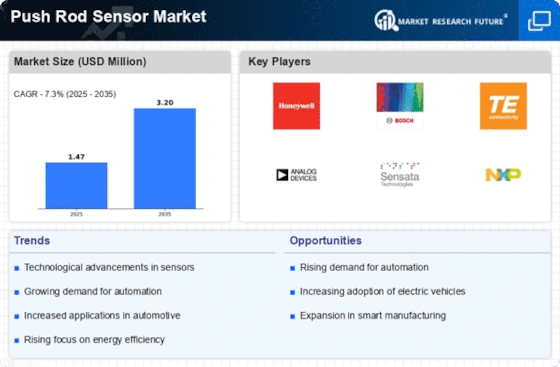
As per Market Research Future analysis, the Push Rod Sensor Market Size was estimated at 1.474 USD Million in 2024. The Push Rod Sensor industry is projected to grow from USD 1.581 Million in 2025 to USD 3.199 Million by 2035, exhibiting a compound annual growth rate (CAGR) of 7.3% during the forecast period 2025 - 2035

Key Market Trends & Highlights

The Push Rod Sensor Market is poised for substantial growth driven by technological advancements and increasing demand across various sectors.

  • Technological advancements are enhancing the capabilities and applications of push rod sensors, particularly in the automotive sector. North America remains the largest market for push rod sensors, while the Asia-Pacific region is experiencing the fastest growth due to rising industrial automation. The optical sensor segment dominates the market, whereas the inductive sensor segment is rapidly gaining traction as industries seek innovative solutions. Key market drivers include the growing demand in the automotive sector and the rising adoption of automation in manufacturing, which are shaping the future of push rod sensors.

Market Size & Forecast

2024 Market Size 1.474 (USD Million)
2035 Market Size 3.199 (USD Million)
CAGR (2025 - 2035) 7.3%
Largest Regional Market Share in 2024 North America

Major Players

Honeywell (US), Bosch (DE), TE Connectivity (US), Analog Devices (US), Sensata Technologies (US), NXP Semiconductors (NL), Infineon Technologies (DE), STMicroelectronics (CH)

Market Trends

The Push Rod Sensor Market is currently experiencing a notable evolution, driven by advancements in technology and increasing demand for precision in various applications. This market encompasses sensors that monitor the position and movement of push rods, which are integral components in numerous mechanical systems. The growing emphasis on automation and smart technologies across industries such as automotive, aerospace, and manufacturing is propelling the adoption of these sensors. As organizations seek to enhance operational efficiency and reduce downtime, the integration of push rod sensors into their systems appears to be a strategic move. Moreover, the Push Rod Sensor Market is likely to benefit from the rising trend of electric vehicles and the need for sophisticated monitoring systems. The shift towards sustainable energy solutions is prompting manufacturers to innovate and develop sensors that can withstand the unique challenges posed by electric drivetrains. This evolution suggests a promising future for the market, as it adapts to meet the demands of modern engineering and design. The ongoing research and development efforts in sensor technology may further enhance the capabilities and applications of push rod sensors, potentially leading to new market opportunities.

Technological Advancements

The Push Rod Sensor Market is witnessing rapid technological advancements, particularly in sensor design and functionality. Innovations such as miniaturization and enhanced sensitivity are enabling more precise measurements and improved performance in various applications. This trend indicates a shift towards smarter sensors that can integrate seamlessly with digital systems, enhancing data collection and analysis.

Growing Demand in Automotive Sector

The automotive sector is increasingly adopting push rod sensors to improve vehicle performance and safety. As manufacturers focus on developing more efficient and reliable vehicles, the integration of these sensors is becoming essential. This trend suggests a robust growth potential for the Push Rod Sensor Market, driven by the need for advanced monitoring systems in modern vehicles.

Sustainability and Electric Vehicles

The rise of electric vehicles is influencing the Push Rod Sensor Market, as manufacturers seek to create sensors that can operate effectively in electric drivetrains. This trend highlights the market's adaptability to changing industry needs, as sustainability becomes a priority. The demand for sensors that can withstand the unique conditions of electric vehicles may lead to innovative solutions and expanded market opportunities.

Push Rod Sensor Market Market Drivers

Growing Demand in Automotive Sector

The automotive sector is a primary driver of the Push Rod Sensor Market, as these sensors are integral to modern vehicle systems. With the increasing complexity of automotive designs, the need for reliable and precise sensors has never been more critical. The market is expected to witness a significant uptick, with estimates suggesting that automotive applications could account for over 40% of the total push rod sensor market by 2026. This growth is fueled by the rising demand for advanced driver-assistance systems (ADAS) and the integration of sensors in electric vehicles. As manufacturers strive to enhance vehicle safety and performance, the push rod sensor market is poised to benefit substantially from these trends.

Emergence of Smart Manufacturing Practices

The emergence of smart manufacturing practices is significantly influencing the Push Rod Sensor Market. As industries transition towards Industry 4.0, the integration of smart sensors becomes vital for data collection and analysis. Push rod sensors are increasingly utilized in smart factories to monitor equipment health and optimize production processes. This shift is expected to drive market growth, with projections indicating that smart manufacturing could account for a substantial share of the push rod sensor market by 2027. The ability to collect real-time data allows manufacturers to make informed decisions, thereby enhancing productivity and reducing downtime. As such, the push rod sensor market is likely to see increased investments in smart technologies.

Focus on Energy Efficiency and Sustainability

The growing emphasis on energy efficiency and sustainability is another key driver for the Push Rod Sensor Market. As industries and consumers alike become more environmentally conscious, the demand for energy-efficient solutions is rising. Push rod sensors contribute to this trend by enabling precise control of machinery and processes, thereby reducing energy consumption. The market is witnessing a shift towards sensors that not only meet performance standards but also align with sustainability goals. Estimates suggest that the demand for energy-efficient sensors could increase by 15% over the next few years, reflecting a broader commitment to sustainable practices. This focus on sustainability is likely to enhance the appeal of push rod sensors across various sectors.

Rising Adoption of Automation in Manufacturing

The Push Rod Sensor Market is also being propelled by the increasing adoption of automation in manufacturing processes. As industries seek to enhance efficiency and reduce operational costs, the integration of advanced sensors becomes essential. Push rod sensors play a crucial role in monitoring and controlling machinery, ensuring optimal performance. The manufacturing sector is projected to invest heavily in automation technologies, with estimates indicating a growth rate of around 8% annually. This trend is likely to create a substantial demand for push rod sensors, as they provide critical feedback for automated systems. Consequently, manufacturers are expected to prioritize the incorporation of these sensors to maintain competitive advantages.

Technological Advancements in Sensor Technology

The Push Rod Sensor Market is experiencing a surge in technological advancements that enhance sensor performance and reliability. Innovations such as miniaturization, improved signal processing, and integration with IoT technologies are driving the market forward. For instance, the introduction of smart sensors that can communicate data in real-time is likely to increase their adoption across various applications. The market for push rod sensors is projected to grow at a compound annual growth rate of approximately 6.5% over the next five years, indicating a robust demand for advanced sensor solutions. These advancements not only improve the accuracy of measurements but also reduce maintenance costs, making them more appealing to manufacturers and end-users alike.

Market Segment Insights

By Type: Optical Sensor (Largest) vs. Inductive Sensor (Fastest-Growing)

<p>In the Push Rod Sensor Market, the segmentation by type reveals that Optical Sensors hold the largest market share due to their precision and reliability in detecting positions, which is critical in various industrial applications. Following this, Inductive Sensors are gaining traction, appealing to sectors that prioritize durability and non-contact measurement methods. Capacitive Sensors and Other categories have comparatively smaller shares but continue to contribute to the overall market diversity.</p>

<p>Optical Sensor (Dominant) vs. Inductive Sensor (Emerging)</p>

<p>Optical Sensors are recognized for their advanced technology, providing high accuracy and excellent response times which make them a preferred choice in automotive and automation sectors. They dominate the market due to their effectiveness in measuring linear and angular positions. On the other hand, Inductive Sensors, while emerging, are attracting attention due to their ability to operate in harsh environments without direct contact, which reduces wear and tear. This characteristic enables them to become increasingly favored in industries that require robust sensing solutions, thus showing rapid growth potential.</p>

By Applications: Automobile Industry (Largest) vs. Aerospace (Fastest-Growing)

The Push Rod Sensor Market distributes its share prominently among the major applications, with the Automobile Industry holding the largest stake. This segment burgeons due to the increasing demand for advanced automotive technologies, such as electric vehicles and autonomous driving systems that require precise sensors. Following closely, the Aerospace sector is rapidly gaining ground, driven by innovations in aircraft systems and the need for more efficient sensor technologies to monitor engine performance and aircraft conditions.

Aerospace (Dominant) vs. Medical Industry (Emerging)

In the Push Rod Sensor Market, the Aerospace application is prominent due to its evolving demand for sophisticated monitoring solutions that enhance aircraft safety and performance. Aircraft manufacturers are increasingly integrating these sensors into engine systems, which aids in real-time monitoring and operational efficiency. In contrast, the Medical Industry, while emerging, is exploring sensors for diagnostics and therapeutic devices. As healthcare innovates towards precision medicine and minimally invasive procedures, the integration of advanced sensor technologies is gradually being adopted, indicating a promising yet developing market position compared to the established aerospace sector.

Get more detailed insights about Push Rod Sensor Market Research Report – Forecast till 2035

Regional Insights

North America : Innovation and Demand Surge

North America is the largest market for push rod sensors, accounting for approximately 45% of the global market share. The region's growth is driven by the increasing demand for advanced automotive technologies and stringent regulatory standards aimed at enhancing vehicle safety and efficiency. The presence of major automotive manufacturers and a robust supply chain further catalyze market expansion. The United States and Canada are the leading countries in this region, with the U.S. holding a significant share due to its advanced automotive sector. Key players like Honeywell, TE Connectivity, and Analog Devices are actively investing in R&D to innovate and meet the growing demand. The competitive landscape is characterized by collaborations and partnerships among industry leaders to enhance product offerings and market reach.

Europe : Regulatory-Driven Market Growth

Europe is the second-largest market for push rod sensors, holding around 30% of the global market share. The region's growth is significantly influenced by stringent environmental regulations and a shift towards electric vehicles, which require advanced sensor technologies. Countries like Germany and France are at the forefront, driving demand through innovation and sustainability initiatives. Germany is the leading country in Europe, home to major automotive manufacturers and suppliers. The competitive landscape is marked by the presence of key players such as Bosch and Infineon Technologies, who are focusing on developing cutting-edge sensor solutions. The European market is characterized by a strong emphasis on quality and compliance with regulatory standards, fostering a competitive environment that encourages innovation.

Asia-Pacific : Emerging Market Potential

Asia-Pacific is witnessing rapid growth in the push rod sensor market, accounting for approximately 20% of the global share. The region's expansion is fueled by increasing automotive production, rising disposable incomes, and a growing focus on vehicle safety and performance. Countries like China and India are leading this growth, supported by government initiatives to enhance automotive technology. China is the largest market in the region, with a booming automotive sector that demands advanced sensor technologies. The competitive landscape includes key players like NXP Semiconductors and STMicroelectronics, who are investing in local partnerships to strengthen their market presence. The region is characterized by a mix of established companies and emerging startups, fostering innovation and competition in the sensor market.

Middle East and Africa : Untapped Market Opportunities

The Middle East and Africa region is gradually emerging in the push rod sensor market, holding about 5% of the global share. The growth is driven by increasing automotive sales and a rising focus on safety regulations. Countries like South Africa and the UAE are beginning to adopt advanced automotive technologies, creating opportunities for sensor manufacturers. South Africa is the leading country in this region, with a growing automotive industry that is attracting investments. The competitive landscape is still developing, with opportunities for both local and international players to establish a foothold. Key players are exploring partnerships and collaborations to tap into this emerging market, which is characterized by a demand for cost-effective and reliable sensor solutions.

Key Players and Competitive Insights

Leading market players are putting a lot of money on R&D to increase the range of their goods, which will spur the Push Rod Sensor Market to expand even further. Additionally, market participants are engaging in a range of strategic initiatives to increase their worldwide reach, with important market developments such as the introduction of new products, contracts, mergers and acquisitions, increased investments, and cooperation with other businesses. To grow and endure in a market that is becoming more competitive, Push Rod Sensor industry must provide reasonably priced goods.
One of the main business strategies employed by manufacturers is to produce locally to reduce operational expenses in the global Push Rod Sensor industry to develop market sector and provide benefits to customers. In recent years, the Push Rod Sensor industry has provided the automotive industry with some of the most important benefits. Major players in the Push Rod Sensor Market, including Dynisco, ConSenses GmbH, Inelta Sensorsysteme, TDS Precision Products, MEGATRON, Nanjing Xiju Electronic Technology Limited., and others, invest in operations for research and development in an effort to improve market demand.
Viatran is an industry leader in pressure and level sensors that are made for reliable and precise measurement for all pressure ranges and most temperatures. These sensors are used in industries like oil and gas, manufacturing of steel, food and medical supplies, injection molding, die casting, and chemical production. Their products are renowned for withstanding the roughest and most inhospitable conditions. Additionally, Viatran is dedicated to providing its customers with tried-and-true products, quick service and support, and innovative technology that dramatically increases the productivity of their production processes.
Starting in 2022, upfront and milestone-related R&D expenditures connected to agreements for collaboration and licensing made before a research product receives regulatory approval are no longer included in reported adjusted financial measures.
ConSense GmbH is a top provider of software for process and quality management. ConSense GmbH develops software for cross-industry, comprehensive process management, and quality management. Their solutions satisfy a wide range of needs, from GxP-compliant systems to QM systems that are in line with DIN EN ISO 9001 and may map too many other standards, because they are user-friendly, flexible, and expandable. Whether their client is a small, medium-sized, or large global firm, they offer a solution that is uniquely created for every type of organization.
The 4th ConSense ScientificAward was given to Vivien Sohn in April 2022 for her remarkable thesis, "Introducing a holistic process management scheme aiming at future viability and competitive advantages using the example of HÜBSCHER Holzbau AG," which she submitted to IUBH Internationale Hochschule GmbH.

Key Companies in the Push Rod Sensor Market include

Industry Developments

May 2021: BD SENSORS GmbH has launched the DS5 electrical pressure switch to increase operating safety in mobile construction machines including cranes, excavators, and harvesters.

March 2020: ABB built a distribution plant in Arizona to boost its presence in the western US. Every electrical product that the company offers is sold at the center.

September 2020: Sensata Technologies, Inc. introduced hermetic pressure sensors with mid- and high-pressure ranges for industrial applications. Leading-edge micro silicon strain gauge technology is used to construct the sensor. The sensor has various distinctive qualities, including high accuracy, burst strength, and shock and vibration performance, making it a dependable and robust alternative for clients with demanding measurement requirements.

Future Outlook

Push Rod Sensor Market Future Outlook

The Push Rod Sensor Market is projected to grow at a 7.3% CAGR from 2025 to 2035, driven by advancements in automotive technology, increasing demand for automation, and enhanced sensor capabilities.

New opportunities lie in:

  • Development of integrated sensor solutions for electric vehicles
  • Expansion into emerging markets with tailored sensor products
  • Partnerships with automotive manufacturers for customized sensor applications

By 2035, the Push Rod Sensor Market is expected to achieve robust growth and innovation.

Market Segmentation

Push Rod Sensor Market Type Outlook

  • Optical Sensor
  • Inductive Sensor
  • Capacitive Sensor
  • Other

Push Rod Sensor Market Applications Outlook

  • Automobile Industry
  • Aerospace
  • Machine Made
  • Medical Industry
  • Other

Report Scope

MARKET SIZE 2024 1.474(USD Million)
MARKET SIZE 2025 1.581(USD Million)
MARKET SIZE 2035 3.199(USD Million)
COMPOUND ANNUAL GROWTH RATE (CAGR) 7.3% (2025 - 2035)
REPORT COVERAGE Revenue Forecast, Competitive Landscape, Growth Factors, and Trends
BASE YEAR 2024
Market Forecast Period 2025 - 2035
Historical Data 2019 - 2024
Market Forecast Units USD Million
Key Companies Profiled Honeywell (US), Bosch (DE), TE Connectivity (US), Analog Devices (US), Sensata Technologies (US), NXP Semiconductors (NL), Infineon Technologies (DE), STMicroelectronics (CH)
Segments Covered Product Type, Application, Region
Key Market Opportunities Integration of advanced materials enhances performance and durability in the Push Rod Sensor Market.
Key Market Dynamics Rising demand for precision engineering in automotive applications drives innovation in push rod sensor technology.
Countries Covered North America, Europe, APAC, South America, MEA

FAQs

What is the projected market valuation for the Push Rod Sensor Market in 2035?

<p>The projected market valuation for the Push Rod Sensor Market in 2035 is 3.199 USD Million.</p>

What was the overall market valuation for the Push Rod Sensor Market in 2024?

<p>The overall market valuation for the Push Rod Sensor Market in 2024 was 1.474 USD Million.</p>

What is the expected CAGR for the Push Rod Sensor Market during the forecast period 2025 - 2035?

<p>The expected CAGR for the Push Rod Sensor Market during the forecast period 2025 - 2035 is 7.3%.</p>

Which companies are considered key players in the Push Rod Sensor Market?

<p>Key players in the Push Rod Sensor Market include Honeywell, Bosch, TE Connectivity, Analog Devices, Sensata Technologies, NXP Semiconductors, Infineon Technologies, and STMicroelectronics.</p>

What are the main types of sensors in the Push Rod Sensor Market and their valuations?

<p>The main types of sensors include Optical Sensors and Inductive Sensors, each valued at approximately 0.442 to 0.979 USD Million.</p>

How does the automobile industry contribute to the Push Rod Sensor Market?

<p>The automobile industry contributes significantly, with a valuation ranging from 0.74 to 1.6 USD Million.</p>

What is the valuation range for capacitive sensors in the Push Rod Sensor Market?

<p>The valuation range for capacitive sensors in the Push Rod Sensor Market is between 0.295 and 0.661 USD Million.</p>

What applications are driving growth in the Push Rod Sensor Market?

<p>Key applications driving growth include the automobile industry, aerospace, and medical industry, with respective valuations of 0.74 to 1.6 USD Million, 0.25 to 0.5 USD Million, and 0.15 to 0.35 USD Million.</p>

What is the valuation range for the aerospace application in the Push Rod Sensor Market?

<p>The valuation range for the aerospace application in the Push Rod Sensor Market is between 0.25 and 0.5 USD Million.</p>

What are the projected trends for the Push Rod Sensor Market in the coming years?

<p>The Push Rod Sensor Market is expected to experience robust growth, potentially reaching 3.199 USD Million by 2035.</p>

  1. SECTION I: EXECUTIVE SUMMARY AND KEY HIGHLIGHTS
    1. | 1.1 EXECUTIVE SUMMARY
    2. | | 1.1.1 Market Overview
    3. | | 1.1.2 Key Findings
    4. | | 1.1.3 Market Segmentation
    5. | | 1.1.4 Competitive Landscape
    6. | | 1.1.5 Challenges and Opportunities
    7. | | 1.1.6 Future Outlook
  2. SECTION II: SCOPING, METHODOLOGY AND MARKET STRUCTURE
    1. | 2.1 MARKET INTRODUCTION
    2. | | 2.1.1 Definition
    3. | | 2.1.2 Scope of the study
    4. | | | 2.1.2.1 Research Objective
    5. | | | 2.1.2.2 Assumption
    6. | | | 2.1.2.3 Limitations
    7. | 2.2 RESEARCH METHODOLOGY
    8. | | 2.2.1 Overview
    9. | | 2.2.2 Data Mining
    10. | | 2.2.3 Secondary Research
    11. | | 2.2.4 Primary Research
    12. | | | 2.2.4.1 Primary Interviews and Information Gathering Process
    13. | | | 2.2.4.2 Breakdown of Primary Respondents
    14. | | 2.2.5 Forecasting Model
    15. | | 2.2.6 Market Size Estimation
    16. | | | 2.2.6.1 Bottom-Up Approach
    17. | | | 2.2.6.2 Top-Down Approach
    18. | | 2.2.7 Data Triangulation
    19. | | 2.2.8 Validation
  3. SECTION III: QUALITATIVE ANALYSIS
    1. | 3.1 MARKET DYNAMICS
    2. | | 3.1.1 Overview
    3. | | 3.1.2 Drivers
    4. | | 3.1.3 Restraints
    5. | | 3.1.4 Opportunities
    6. | 3.2 MARKET FACTOR ANALYSIS
    7. | | 3.2.1 Value chain Analysis
    8. | | 3.2.2 Porter's Five Forces Analysis
    9. | | | 3.2.2.1 Bargaining Power of Suppliers
    10. | | | 3.2.2.2 Bargaining Power of Buyers
    11. | | | 3.2.2.3 Threat of New Entrants
    12. | | | 3.2.2.4 Threat of Substitutes
    13. | | | 3.2.2.5 Intensity of Rivalry
    14. | | 3.2.3 COVID-19 Impact Analysis
    15. | | | 3.2.3.1 Market Impact Analysis
    16. | | | 3.2.3.2 Regional Impact
    17. | | | 3.2.3.3 Opportunity and Threat Analysis
  4. SECTION IV: QUANTITATIVE ANALYSIS
    1. | 4.1 Semiconductor & Electronics, BY Type (USD Million)
    2. | | 4.1.1 Optical Sensor
    3. | | 4.1.2 Inductive Sensor
    4. | | 4.1.3 Capacitive Sensor
    5. | | 4.1.4 Other
    6. | 4.2 Semiconductor & Electronics, BY Applications (USD Million)
    7. | | 4.2.1 Automobile Industry
    8. | | 4.2.2 Aerospace
    9. | | 4.2.3 Machine Made
    10. | | 4.2.4 Medical Industry
    11. | | 4.2.5 Other
    12. | 4.3 Semiconductor & Electronics, BY Region (USD Million)
    13. | | 4.3.1 North America
    14. | | | 4.3.1.1 US
    15. | | | 4.3.1.2 Canada
    16. | | 4.3.2 Europe
    17. | | | 4.3.2.1 Germany
    18. | | | 4.3.2.2 UK
    19. | | | 4.3.2.3 France
    20. | | | 4.3.2.4 Russia
    21. | | | 4.3.2.5 Italy
    22. | | | 4.3.2.6 Spain
    23. | | | 4.3.2.7 Rest of Europe
    24. | | 4.3.3 APAC
    25. | | | 4.3.3.1 China
    26. | | | 4.3.3.2 India
    27. | | | 4.3.3.3 Japan
    28. | | | 4.3.3.4 South Korea
    29. | | | 4.3.3.5 Malaysia
    30. | | | 4.3.3.6 Thailand
    31. | | | 4.3.3.7 Indonesia
    32. | | | 4.3.3.8 Rest of APAC
    33. | | 4.3.4 South America
    34. | | | 4.3.4.1 Brazil
    35. | | | 4.3.4.2 Mexico
    36. | | | 4.3.4.3 Argentina
    37. | | | 4.3.4.4 Rest of South America
    38. | | 4.3.5 MEA
    39. | | | 4.3.5.1 GCC Countries
    40. | | | 4.3.5.2 South Africa
    41. | | | 4.3.5.3 Rest of MEA
  5. SECTION V: COMPETITIVE ANALYSIS
    1. | 5.1 Competitive Landscape
    2. | | 5.1.1 Overview
    3. | | 5.1.2 Competitive Analysis
    4. | | 5.1.3 Market share Analysis
    5. | | 5.1.4 Major Growth Strategy in the Semiconductor & Electronics
    6. | | 5.1.5 Competitive Benchmarking
    7. | | 5.1.6 Leading Players in Terms of Number of Developments in the Semiconductor & Electronics
    8. | | 5.1.7 Key developments and growth strategies
    9. | | | 5.1.7.1 New Product Launch/Service Deployment
    10. | | | 5.1.7.2 Merger & Acquisitions
    11. | | | 5.1.7.3 Joint Ventures
    12. | | 5.1.8 Major Players Financial Matrix
    13. | | | 5.1.8.1 Sales and Operating Income
    14. | | | 5.1.8.2 Major Players R&D Expenditure. 2023
    15. | 5.2 Company Profiles
    16. | | 5.2.1 Honeywell (US)
    17. | | | 5.2.1.1 Financial Overview
    18. | | | 5.2.1.2 Products Offered
    19. | | | 5.2.1.3 Key Developments
    20. | | | 5.2.1.4 SWOT Analysis
    21. | | | 5.2.1.5 Key Strategies
    22. | | 5.2.2 Bosch (DE)
    23. | | | 5.2.2.1 Financial Overview
    24. | | | 5.2.2.2 Products Offered
    25. | | | 5.2.2.3 Key Developments
    26. | | | 5.2.2.4 SWOT Analysis
    27. | | | 5.2.2.5 Key Strategies
    28. | | 5.2.3 TE Connectivity (US)
    29. | | | 5.2.3.1 Financial Overview
    30. | | | 5.2.3.2 Products Offered
    31. | | | 5.2.3.3 Key Developments
    32. | | | 5.2.3.4 SWOT Analysis
    33. | | | 5.2.3.5 Key Strategies
    34. | | 5.2.4 Analog Devices (US)
    35. | | | 5.2.4.1 Financial Overview
    36. | | | 5.2.4.2 Products Offered
    37. | | | 5.2.4.3 Key Developments
    38. | | | 5.2.4.4 SWOT Analysis
    39. | | | 5.2.4.5 Key Strategies
    40. | | 5.2.5 Sensata Technologies (US)
    41. | | | 5.2.5.1 Financial Overview
    42. | | | 5.2.5.2 Products Offered
    43. | | | 5.2.5.3 Key Developments
    44. | | | 5.2.5.4 SWOT Analysis
    45. | | | 5.2.5.5 Key Strategies
    46. | | 5.2.6 NXP Semiconductors (NL)
    47. | | | 5.2.6.1 Financial Overview
    48. | | | 5.2.6.2 Products Offered
    49. | | | 5.2.6.3 Key Developments
    50. | | | 5.2.6.4 SWOT Analysis
    51. | | | 5.2.6.5 Key Strategies
    52. | | 5.2.7 Infineon Technologies (DE)
    53. | | | 5.2.7.1 Financial Overview
    54. | | | 5.2.7.2 Products Offered
    55. | | | 5.2.7.3 Key Developments
    56. | | | 5.2.7.4 SWOT Analysis
    57. | | | 5.2.7.5 Key Strategies
    58. | | 5.2.8 STMicroelectronics (CH)
    59. | | | 5.2.8.1 Financial Overview
    60. | | | 5.2.8.2 Products Offered
    61. | | | 5.2.8.3 Key Developments
    62. | | | 5.2.8.4 SWOT Analysis
    63. | | | 5.2.8.5 Key Strategies
    64. | 5.3 Appendix
    65. | | 5.3.1 References
    66. | | 5.3.2 Related Reports
  6. LIST OF FIGURES
    1. | 6.1 MARKET SYNOPSIS
    2. | 6.2 NORTH AMERICA MARKET ANALYSIS
    3. | 6.3 US MARKET ANALYSIS BY TYPE
    4. | 6.4 US MARKET ANALYSIS BY APPLICATIONS
    5. | 6.5 CANADA MARKET ANALYSIS BY TYPE
    6. | 6.6 CANADA MARKET ANALYSIS BY APPLICATIONS
    7. | 6.7 EUROPE MARKET ANALYSIS
    8. | 6.8 GERMANY MARKET ANALYSIS BY TYPE
    9. | 6.9 GERMANY MARKET ANALYSIS BY APPLICATIONS
    10. | 6.10 UK MARKET ANALYSIS BY TYPE
    11. | 6.11 UK MARKET ANALYSIS BY APPLICATIONS
    12. | 6.12 FRANCE MARKET ANALYSIS BY TYPE
    13. | 6.13 FRANCE MARKET ANALYSIS BY APPLICATIONS
    14. | 6.14 RUSSIA MARKET ANALYSIS BY TYPE
    15. | 6.15 RUSSIA MARKET ANALYSIS BY APPLICATIONS
    16. | 6.16 ITALY MARKET ANALYSIS BY TYPE
    17. | 6.17 ITALY MARKET ANALYSIS BY APPLICATIONS
    18. | 6.18 SPAIN MARKET ANALYSIS BY TYPE
    19. | 6.19 SPAIN MARKET ANALYSIS BY APPLICATIONS
    20. | 6.20 REST OF EUROPE MARKET ANALYSIS BY TYPE
    21. | 6.21 REST OF EUROPE MARKET ANALYSIS BY APPLICATIONS
    22. | 6.22 APAC MARKET ANALYSIS
    23. | 6.23 CHINA MARKET ANALYSIS BY TYPE
    24. | 6.24 CHINA MARKET ANALYSIS BY APPLICATIONS
    25. | 6.25 INDIA MARKET ANALYSIS BY TYPE
    26. | 6.26 INDIA MARKET ANALYSIS BY APPLICATIONS
    27. | 6.27 JAPAN MARKET ANALYSIS BY TYPE
    28. | 6.28 JAPAN MARKET ANALYSIS BY APPLICATIONS
    29. | 6.29 SOUTH KOREA MARKET ANALYSIS BY TYPE
    30. | 6.30 SOUTH KOREA MARKET ANALYSIS BY APPLICATIONS
    31. | 6.31 MALAYSIA MARKET ANALYSIS BY TYPE
    32. | 6.32 MALAYSIA MARKET ANALYSIS BY APPLICATIONS
    33. | 6.33 THAILAND MARKET ANALYSIS BY TYPE
    34. | 6.34 THAILAND MARKET ANALYSIS BY APPLICATIONS
    35. | 6.35 INDONESIA MARKET ANALYSIS BY TYPE
    36. | 6.36 INDONESIA MARKET ANALYSIS BY APPLICATIONS
    37. | 6.37 REST OF APAC MARKET ANALYSIS BY TYPE
    38. | 6.38 REST OF APAC MARKET ANALYSIS BY APPLICATIONS
    39. | 6.39 SOUTH AMERICA MARKET ANALYSIS
    40. | 6.40 BRAZIL MARKET ANALYSIS BY TYPE
    41. | 6.41 BRAZIL MARKET ANALYSIS BY APPLICATIONS
    42. | 6.42 MEXICO MARKET ANALYSIS BY TYPE
    43. | 6.43 MEXICO MARKET ANALYSIS BY APPLICATIONS
    44. | 6.44 ARGENTINA MARKET ANALYSIS BY TYPE
    45. | 6.45 ARGENTINA MARKET ANALYSIS BY APPLICATIONS
    46. | 6.46 REST OF SOUTH AMERICA MARKET ANALYSIS BY TYPE
    47. | 6.47 REST OF SOUTH AMERICA MARKET ANALYSIS BY APPLICATIONS
    48. | 6.48 MEA MARKET ANALYSIS
    49. | 6.49 GCC COUNTRIES MARKET ANALYSIS BY TYPE
    50. | 6.50 GCC COUNTRIES MARKET ANALYSIS BY APPLICATIONS
    51. | 6.51 SOUTH AFRICA MARKET ANALYSIS BY TYPE
    52. | 6.52 SOUTH AFRICA MARKET ANALYSIS BY APPLICATIONS
    53. | 6.53 REST OF MEA MARKET ANALYSIS BY TYPE
    54. | 6.54 REST OF MEA MARKET ANALYSIS BY APPLICATIONS
    55. | 6.55 KEY BUYING CRITERIA OF SEMICONDUCTOR & ELECTRONICS
    56. | 6.56 RESEARCH PROCESS OF MRFR
    57. | 6.57 DRO ANALYSIS OF SEMICONDUCTOR & ELECTRONICS
    58. | 6.58 DRIVERS IMPACT ANALYSIS: SEMICONDUCTOR & ELECTRONICS
    59. | 6.59 RESTRAINTS IMPACT ANALYSIS: SEMICONDUCTOR & ELECTRONICS
    60. | 6.60 SUPPLY / VALUE CHAIN: SEMICONDUCTOR & ELECTRONICS
    61. | 6.61 SEMICONDUCTOR & ELECTRONICS, BY TYPE, 2024 (% SHARE)
    62. | 6.62 SEMICONDUCTOR & ELECTRONICS, BY TYPE, 2024 TO 2035 (USD Million)
    63. | 6.63 SEMICONDUCTOR & ELECTRONICS, BY APPLICATIONS, 2024 (% SHARE)
    64. | 6.64 SEMICONDUCTOR & ELECTRONICS, BY APPLICATIONS, 2024 TO 2035 (USD Million)
    65. | 6.65 BENCHMARKING OF MAJOR COMPETITORS
  7. LIST OF TABLES
    1. | 7.1 LIST OF ASSUMPTIONS
    2. | | 7.1.1
    3. | 7.2 North America MARKET SIZE ESTIMATES; FORECAST
    4. | | 7.2.1 BY TYPE, 2025-2035 (USD Million)
    5. | | 7.2.2 BY APPLICATIONS, 2025-2035 (USD Million)
    6. | 7.3 US MARKET SIZE ESTIMATES; FORECAST
    7. | | 7.3.1 BY TYPE, 2025-2035 (USD Million)
    8. | | 7.3.2 BY APPLICATIONS, 2025-2035 (USD Million)
    9. | 7.4 Canada MARKET SIZE ESTIMATES; FORECAST
    10. | | 7.4.1 BY TYPE, 2025-2035 (USD Million)
    11. | | 7.4.2 BY APPLICATIONS, 2025-2035 (USD Million)
    12. | 7.5 Europe MARKET SIZE ESTIMATES; FORECAST
    13. | | 7.5.1 BY TYPE, 2025-2035 (USD Million)
    14. | | 7.5.2 BY APPLICATIONS, 2025-2035 (USD Million)
    15. | 7.6 Germany MARKET SIZE ESTIMATES; FORECAST
    16. | | 7.6.1 BY TYPE, 2025-2035 (USD Million)
    17. | | 7.6.2 BY APPLICATIONS, 2025-2035 (USD Million)
    18. | 7.7 UK MARKET SIZE ESTIMATES; FORECAST
    19. | | 7.7.1 BY TYPE, 2025-2035 (USD Million)
    20. | | 7.7.2 BY APPLICATIONS, 2025-2035 (USD Million)
    21. | 7.8 France MARKET SIZE ESTIMATES; FORECAST
    22. | | 7.8.1 BY TYPE, 2025-2035 (USD Million)
    23. | | 7.8.2 BY APPLICATIONS, 2025-2035 (USD Million)
    24. | 7.9 Russia MARKET SIZE ESTIMATES; FORECAST
    25. | | 7.9.1 BY TYPE, 2025-2035 (USD Million)
    26. | | 7.9.2 BY APPLICATIONS, 2025-2035 (USD Million)
    27. | 7.10 Italy MARKET SIZE ESTIMATES; FORECAST
    28. | | 7.10.1 BY TYPE, 2025-2035 (USD Million)
    29. | | 7.10.2 BY APPLICATIONS, 2025-2035 (USD Million)
    30. | 7.11 Spain MARKET SIZE ESTIMATES; FORECAST
    31. | | 7.11.1 BY TYPE, 2025-2035 (USD Million)
    32. | | 7.11.2 BY APPLICATIONS, 2025-2035 (USD Million)
    33. | 7.12 Rest of Europe MARKET SIZE ESTIMATES; FORECAST
    34. | | 7.12.1 BY TYPE, 2025-2035 (USD Million)
    35. | | 7.12.2 BY APPLICATIONS, 2025-2035 (USD Million)
    36. | 7.13 APAC MARKET SIZE ESTIMATES; FORECAST
    37. | | 7.13.1 BY TYPE, 2025-2035 (USD Million)
    38. | | 7.13.2 BY APPLICATIONS, 2025-2035 (USD Million)
    39. | 7.14 China MARKET SIZE ESTIMATES; FORECAST
    40. | | 7.14.1 BY TYPE, 2025-2035 (USD Million)
    41. | | 7.14.2 BY APPLICATIONS, 2025-2035 (USD Million)
    42. | 7.15 India MARKET SIZE ESTIMATES; FORECAST
    43. | | 7.15.1 BY TYPE, 2025-2035 (USD Million)
    44. | | 7.15.2 BY APPLICATIONS, 2025-2035 (USD Million)
    45. | 7.16 Japan MARKET SIZE ESTIMATES; FORECAST
    46. | | 7.16.1 BY TYPE, 2025-2035 (USD Million)
    47. | | 7.16.2 BY APPLICATIONS, 2025-2035 (USD Million)
    48. | 7.17 South Korea MARKET SIZE ESTIMATES; FORECAST
    49. | | 7.17.1 BY TYPE, 2025-2035 (USD Million)
    50. | | 7.17.2 BY APPLICATIONS, 2025-2035 (USD Million)
    51. | 7.18 Malaysia MARKET SIZE ESTIMATES; FORECAST
    52. | | 7.18.1 BY TYPE, 2025-2035 (USD Million)
    53. | | 7.18.2 BY APPLICATIONS, 2025-2035 (USD Million)
    54. | 7.19 Thailand MARKET SIZE ESTIMATES; FORECAST
    55. | | 7.19.1 BY TYPE, 2025-2035 (USD Million)
    56. | | 7.19.2 BY APPLICATIONS, 2025-2035 (USD Million)
    57. | 7.20 Indonesia MARKET SIZE ESTIMATES; FORECAST
    58. | | 7.20.1 BY TYPE, 2025-2035 (USD Million)
    59. | | 7.20.2 BY APPLICATIONS, 2025-2035 (USD Million)
    60. | 7.21 Rest of APAC MARKET SIZE ESTIMATES; FORECAST
    61. | | 7.21.1 BY TYPE, 2025-2035 (USD Million)
    62. | | 7.21.2 BY APPLICATIONS, 2025-2035 (USD Million)
    63. | 7.22 South America MARKET SIZE ESTIMATES; FORECAST
    64. | | 7.22.1 BY TYPE, 2025-2035 (USD Million)
    65. | | 7.22.2 BY APPLICATIONS, 2025-2035 (USD Million)
    66. | 7.23 Brazil MARKET SIZE ESTIMATES; FORECAST
    67. | | 7.23.1 BY TYPE, 2025-2035 (USD Million)
    68. | | 7.23.2 BY APPLICATIONS, 2025-2035 (USD Million)
    69. | 7.24 Mexico MARKET SIZE ESTIMATES; FORECAST
    70. | | 7.24.1 BY TYPE, 2025-2035 (USD Million)
    71. | | 7.24.2 BY APPLICATIONS, 2025-2035 (USD Million)
    72. | 7.25 Argentina MARKET SIZE ESTIMATES; FORECAST
    73. | | 7.25.1 BY TYPE, 2025-2035 (USD Million)
    74. | | 7.25.2 BY APPLICATIONS, 2025-2035 (USD Million)
    75. | 7.26 Rest of South America MARKET SIZE ESTIMATES; FORECAST
    76. | | 7.26.1 BY TYPE, 2025-2035 (USD Million)
    77. | | 7.26.2 BY APPLICATIONS, 2025-2035 (USD Million)
    78. | 7.27 MEA MARKET SIZE ESTIMATES; FORECAST
    79. | | 7.27.1 BY TYPE, 2025-2035 (USD Million)
    80. | | 7.27.2 BY APPLICATIONS, 2025-2035 (USD Million)
    81. | 7.28 GCC Countries MARKET SIZE ESTIMATES; FORECAST
    82. | | 7.28.1 BY TYPE, 2025-2035 (USD Million)
    83. | | 7.28.2 BY APPLICATIONS, 2025-2035 (USD Million)
    84. | 7.29 South Africa MARKET SIZE ESTIMATES; FORECAST
    85. | | 7.29.1 BY TYPE, 2025-2035 (USD Million)
    86. | | 7.29.2 BY APPLICATIONS, 2025-2035 (USD Million)
    87. | 7.30 Rest of MEA MARKET SIZE ESTIMATES; FORECAST
    88. | | 7.30.1 BY TYPE, 2025-2035 (USD Million)
    89. | | 7.30.2 BY APPLICATIONS, 2025-2035 (USD Million)
    90. | 7.31 PRODUCT LAUNCH/PRODUCT DEVELOPMENT/APPROVAL
    91. | | 7.31.1
    92. | 7.32 ACQUISITION/PARTNERSHIP
    93. | | 7.32.1

Semiconductor & Electronics Market Segmentation

Semiconductor & Electronics By Type (USD Million, 2025-2035)

  • Optical Sensor
  • Inductive Sensor
  • Capacitive Sensor
  • Other

Semiconductor & Electronics By Applications (USD Million, 2025-2035)

  • Automobile Industry
  • Aerospace
  • Machine Made
  • Medical Industry
  • Other
Infographic

Free Sample Request

Kindly complete the form below to receive a free sample of this Report

Get Free Sample

Customer Strories

Compare Licence

×
Features License Type
Single User Multiuser License Enterprise User
Price $4,950 $5,950 $7,250
Maximum User Access Limit 1 User Upto 10 Users Unrestricted Access Throughout the Organization
Free Customization
Direct Access to Analyst
Deliverable Format
Platform Access
Discount on Next Purchase 10% 15% 15%
Printable Versions