Request Free Sample ×

Kindly complete the form below to receive a free sample of this Report

* Please use a valid business email

Leading companies partner with us for data-driven Insights

clients tt-cursor
Hero Background
English
Chinese
French
Japanese
Korean
German
Spanish

Public Transport Market Size

ID: MRFR/AT/7205-CR
195 Pages
Triveni Bhoyar
January 2025

Public Transport Market Research Report Information by Mobility (Bus, Tram, Train, Car Sharing, and Others), By Propulsion (Diesel, Gasoline, Electric, and Others) By Ownership Type (Private Owned, and Public Owned) By End Use (Intracity, Intercity, and Others) and By Region (North America, Europe, Asia-Pacific, Middle East and Africa, South America) - Growth & Industry Forecast to 2035

Share:
Download PDF ×

We do not share your information with anyone. However, we may send you emails based on your report interest from time to time. You may contact us at any time to opt-out.

Public Transport Market Infographic
Purchase Options

Public Transport Size

Public Transport Market Growth Projections and Opportunities

The Organic Electronics Market is shaped by a confluence of factors that collectively influence its growth and development. One key driver is the increasing demand for flexible and lightweight electronic devices with improved energy efficiency. The organic electronics which are based upon carbon-based materials and polymers provide a great deal of flexibility in comparison to the use of traditional tipical semiconductors. This need is especially noticeable in applications like flexible displays, electronic paper and wearables where organic material properties allow the manufacture of bendy or conformable microelectronic elements.

Technology development is basic to the constant progress of Organic Electronics Market. Research and development in the fields of materials science and manufacturing technologies constantly lead to enhanced performance, stability, reproducibilityof organic electronic devices. Improvement in the organic semiconductors, conductive polymers and inkjet printing techniques paves a way for affordable flexible electronics that finds myriads of application.

The focus on sustainability and environment-friendly technologies plays a vital role in Organic Electronics Market. Organic materials for electronic parts are relatively more friendly to the environment and provide for a cheap mass production procedure. With environmental issues being integrated into consumer choices and corporate practices; the organic electronics adoption becomes consistent with overall trend of green technologies in environment.

The advent of the Internet of Things (IoT) and increasing demand for connected, smart devices further contribute to Organic Electronics Market growth. Organic sensors and thin-film transistors are essential for IoT applications, as they allow infiltrating intelligence into objects that people use every day. Organic electronics being light and flexible are also easy to implement because it can be incorporated with smart functionalities in different kinds of materials or surface.

The Organic Electronics Market is fueled by healthcare applications like biosensors and medical wearable devices. The interaction of organic materials with biological systems can be programmed to create sensors for monitoring vital parameters, detecting biomarkers and enabling point-of care diagnostics. The biocompatibility of organic materials makes them good for use in personalized healthcare and medical wearables.

The adoption of organic electronics is driven by the automotive industry. Flexible displays, OLED lighting and organic photovoltaics are used in automotive interiors, POL systems as well energy harvesting sectors. Innovative designs and functionalities across modern automobiles are made possible due to the lightweight yet customizable nature of organic electronics, reflecting the drive for high-tech applications in this industry.

The scalability and cost-effectiveness of organic electronics manufacturing influences the market dynamics. Costs associated with industrial production are also reduced due to roll-to-roll printing processes and solution based deposition methods that enable mass manufacturing of organic electronic elements. The scalability of manufacturing processes is a key factor driving the market's growth, making organic electronics more accessible for a wide range of applications.

Public Transport Market Size Graph
Author
Author Profile
Triveni Bhoyar
Senior Research Analyst

Triveni Bhoyar has over 5 years of experience in the market research industry, specializing in the Automotive and Aerospace & Defense sectors. She has contributed to 200+ reports, including numerous custom projects for leading global companies, delivering solutions to complex business challenges. Renowned for her ability to generate valuable insights, Triveni excels in addressing unique market dynamics with precision and depth. Her expertise spans market sizing, competitive intelligence, and trend analysis, enabling clients to craft data-driven growth strategies. With strong analytical rigor and a client-centric approach, she plays a pivotal role in driving impactful, strategic decision-making.

Leave a Comment

FAQs

What is the projected market valuation of The Global Public Transport by 2035?

<p>The projected market valuation for The Global Public Transport by 2035 is 1394.98 USD Million.</p>

What was the overall market valuation of The Global Public Transport in 2024?

<p>The overall market valuation of The Global Public Transport in 2024 was 345.75 USD Million.</p>

What is the expected CAGR for The Global Public Transport during the forecast period 2025 - 2035?

<p>The expected CAGR for The Global Public Transport during the forecast period 2025 - 2035 is 13.52%.</p>

Which segments are included in the Mobility category of The Global Public Transport?

<p>The Mobility category includes segments such as Bus, Tram, Train, Car Sharing, and Others.</p>

What are the projected valuations for the Electric propulsion segment by 2035?

<p>The projected valuation for the Electric propulsion segment is expected to reach 600.0 USD Million by 2035.</p>

How does the valuation of Public Owned transport compare to Private Owned transport in 2035?

By 2035, the valuation of Public Owned transport is projected to be 838.98 USD Million, compared to 556.0 USD Million for Private Owned transport.

What are the key players in The Global Public Transport?

Key players in The Global Public Transport include Deutsche Bahn, Transport for London, MTR Corporation, SNCF, Amtrak, Metro de Madrid, Tokyo Metro, TransLink, and Singapore Mass Rapid Transit.

What is the projected valuation for the Intracity segment by 2035?

The projected valuation for the Intracity segment is expected to reach 552.0 USD Million by 2035.

What is the expected growth trend for the Train segment in The Global Public Transport?

The Train segment is projected to grow significantly, with valuations expected to reach 400.0 USD Million by 2035.

How does the valuation of the Others segment in Mobility compare to its valuation in 2024?

The valuation of the Others segment in Mobility is expected to increase from 85.75 USD Million in 2024 to 354.98 USD Million by 2035.

Market Summary

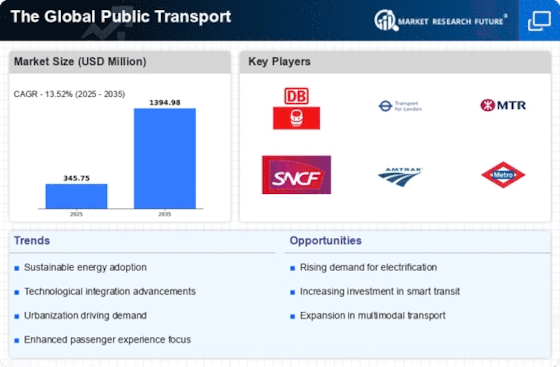
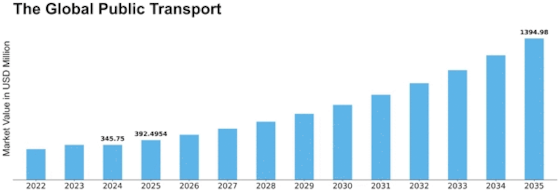
As per Market Research Future analysis, The Global Public Transport Market Size was estimated at 345.75 USD Million in 2024. The public transport industry is projected to grow from 392.5 USD Million in 2025 to 1394.98 USD Million by 2035, exhibiting a compound annual growth rate (CAGR) of 13.5% during the forecast period 2025 - 2035

Key Market Trends & Highlights

The Global Public Transport Market is experiencing a transformative shift towards sustainability and technological integration.

  • North America remains the largest market for public transport, driven by established infrastructure and high demand. Asia-Pacific is emerging as the fastest-growing region, propelled by rapid urbanization and increasing population density. The bus segment continues to dominate the market, while car sharing is rapidly gaining traction among urban consumers. Key market drivers include urbanization and government initiatives aimed at enhancing public transport systems and promoting sustainability.

Market Size & Forecast

2024 Market Size 345.75 (USD Million)
2035 Market Size 1394.98 (USD Million)
CAGR (2025 - 2035) 13.52%
Largest Regional Market Share in 2024 Asia Pacific

Major Players

<a href="https://int.bahn.de/en/offers/tickets-for-local-transport">Deutsche Bahn</a> (DE), Transport for London (GB), MTR Corporation (HK), SNCF (FR), Amtrak (US), Metro de Madrid (ES), Tokyo Metro (JP), <a href="https://translink.com.au/travel-with-us/benefits-of-public-transport">TransLink</a> (CA), Singapore Mass Rapid Transit (SG)

Market Trends

The Global Public Transport Market is currently experiencing a transformative phase, driven by various factors that influence urban mobility. As cities expand and populations grow, the demand for efficient and sustainable transportation solutions intensifies. This market appears to be shifting towards more integrated systems that combine traditional public transport with innovative technologies. The rise of smart city initiatives and the increasing focus on reducing carbon footprints suggest that public transport is evolving to meet modern needs. Furthermore, the emphasis on accessibility and inclusivity indicates a broader understanding of the diverse requirements of urban populations. In addition, The Global Public Transport Market is likely to witness advancements in digitalization and automation. Technologies such as real-time tracking, mobile ticketing, and data analytics are becoming integral to enhancing user experience and operational efficiency. This trend may lead to improved service reliability and customer satisfaction. Moreover, partnerships between public and private sectors could emerge as a strategy to foster innovation and investment in infrastructure. Overall, the landscape of public transport is poised for significant changes that could redefine urban mobility in the coming years.

Integration of Technology

The Global Public Transport Market is increasingly integrating advanced technologies to enhance operational efficiency and user experience. Innovations such as mobile applications for ticketing and real-time tracking systems are becoming commonplace, allowing passengers to plan their journeys more effectively. This trend indicates a shift towards a more user-centric approach, where technology plays a crucial role in streamlining services.

Sustainability Initiatives

There is a growing emphasis on sustainability within The Global Public Transport Market, as stakeholders recognize the importance of reducing environmental impact. Many cities are investing in electric and hybrid vehicles, as well as infrastructure that supports eco-friendly transport options. This focus on sustainability not only addresses climate concerns but also aligns with the expectations of environmentally conscious consumers.

Enhanced Accessibility

The Global Public Transport Market is increasingly prioritizing accessibility for all users, including those with disabilities and the elderly. Efforts to improve infrastructure, such as low-floor buses and accessible stations, reflect a commitment to inclusivity. This trend suggests a broader recognition of the diverse needs of urban populations, aiming to create a more equitable transport system.

Public Transport Market Market Drivers

Technological Advancements

Technological advancements are significantly influencing The Global Public Transport Industry. Innovations such as real-time tracking, mobile ticketing, and contactless payment systems are enhancing the overall user experience. The adoption of smart technologies is enabling transport operators to optimize routes, reduce operational costs, and improve service reliability. For example, the implementation of Internet of Things (IoT) devices in public transport vehicles allows for better monitoring and management of fleets. Additionally, data analytics is being utilized to understand commuter patterns and preferences, leading to more tailored services. The global market for smart transportation is expected to reach USD 220 billion by 2025, indicating a robust growth trajectory. As technology continues to evolve, it is likely to drive further innovations in public transport, making it more efficient and user-friendly.

Changing Consumer Preferences

Changing consumer preferences are reshaping The Global Public Transport Industry. As urban populations become more environmentally conscious, there is a noticeable shift towards public transport over private vehicle ownership. Many individuals are prioritizing convenience, cost-effectiveness, and sustainability when choosing their mode of transport. Recent surveys indicate that a significant percentage of commuters prefer public transport due to its affordability and reduced environmental impact. Additionally, the rise of shared mobility services, such as ride-sharing and bike-sharing, complements traditional public transport systems, offering more flexible options for consumers. This trend suggests that public transport operators may need to adapt their services to meet evolving consumer demands. By enhancing service quality and integrating with shared mobility solutions, public transport can remain competitive and relevant in an ever-changing market.

Government Initiatives and Funding

Government initiatives and funding play a crucial role in shaping The Global Public Transport Industry. Many governments are recognizing the importance of sustainable transport solutions and are allocating substantial budgets to improve public transport infrastructure. For instance, investments in rail systems, bus rapid transit, and electric vehicle fleets are becoming commonplace. In recent years, several countries have announced multi-billion dollar funding packages aimed at modernizing public transport networks. These initiatives not only enhance service quality but also promote economic growth by creating jobs and stimulating local economies. Furthermore, public-private partnerships are emerging as a viable strategy to leverage additional resources and expertise, thereby accelerating the development of efficient public transport systems. This trend indicates a strong commitment from governments to prioritize public transport as a key component of urban planning.

Urbanization and Population Growth

The rapid urbanization and population growth are pivotal drivers in The Global Public Transport Industry. As more individuals migrate to urban areas, the demand for efficient public transport systems escalates. According to recent data, urban areas are projected to house approximately 68% of the global population by 2050. This demographic shift necessitates the expansion and enhancement of public transport networks to accommodate the increasing number of commuters. Cities are investing in infrastructure to support mass transit systems, which not only alleviates traffic congestion but also reduces environmental impact. The integration of various transport modes, such as buses, trams, and subways, is becoming essential to create a seamless travel experience. Consequently, urbanization is likely to drive innovations and investments in the public transport sector.

Environmental Concerns and Sustainability

Environmental concerns and sustainability are increasingly becoming central themes in The Global Public Transport Industry. With growing awareness of climate change and pollution, there is a pressing need for cleaner transport solutions. Many cities are transitioning to electric and hybrid buses, which significantly reduce greenhouse gas emissions compared to traditional diesel vehicles. According to recent studies, public transport can reduce per capita carbon emissions by up to 45%. This shift towards sustainable transport not only addresses environmental issues but also aligns with global sustainability goals. Furthermore, the integration of renewable energy sources into public transport systems is gaining traction, enhancing energy efficiency. As cities strive to meet sustainability targets, investments in green public transport solutions are likely to increase, shaping the future landscape of the industry.

Market Segment Insights

By Mobility: Bus (Largest) vs. Car Sharing (Fastest-Growing)

<p>The Global Public Transport has distinct segments, with buses holding the largest share due to their widespread usage and established infrastructure. Buses account for a significant portion of public transport, benefiting from government supports and initiatives aimed at increasing public transport accessibility. In contrast, car sharing services have emerged as a notable contender, attracting attention for their convenience and efficiency in urban settings. In recent years, the public transport landscape has evolved, with car sharing witnessing rapid growth, significantly influenced by rising environmental awareness and changing consumer preferences towards shared mobility. Technological advancements and the integration of digital platforms have further accelerated the adoption of car sharing, positioning it as a critical element in the overall public transport ecosystem.</p>

<p>Bus (Dominant) vs. Car Sharing (Emerging)</p>

<p>Buses, as the dominant mode of public transport, are characterized by their extensive network coverage and ability to transport large numbers of passengers economically. They operate on fixed routes and schedules, providing reliable service in both urban and suburban areas. The substantial investment in electric and hybrid buses enhances their appeal, aligning with global efforts to reduce carbon emissions. Conversely, car sharing represents an emerging trend in mobility, attracting urban dwellers who prefer flexibility and convenience. It allows users to rent vehicles on-demand, reducing the need for personal car ownership and maximizing vehicle utilization. This segment capitalizes on technological developments, as apps and platforms streamline user experiences, making it an attractive option for millennials and environmentally-conscious consumers.</p>

By Propulsion: Diesel (Largest) vs. Electric (Fastest-Growing)

<p>In The Global Public Transport, the propulsion segment is characterized by a diverse landscape, with Diesel taking the lead as the largest share contributor among all propulsion types. Following Diesel, Gasoline holds a steady position, while Electric vehicles are rapidly increasing their presence due to shifting consumer preferences towards sustainability. The Others category, encompassing alternative fuels and hybrid systems, caters to niche requirements and continues to grow in response to specific regional demands.</p>

<p>Diesel (Dominant) vs. Electric (Emerging)</p>

<p>Diesel remains the dominant propulsion type in The Global Public Transport, largely due to its established infrastructure and cost-effectiveness. It is favored for long-haul services and heavy-duty vehicles that operate under rigorous schedules. However, Electric is emerging quickly, driven by technological advancements and stricter emissions regulations. Electric propulsion offers benefits such as lower operating costs, reduced noise pollution, and zero tailpipe emissions, appealing to urban transit authorities. As cities look to enhance air quality and reduce greenhouse gas emissions, the shift towards Electric, supported by government incentives and charging infrastructure development, positions it as a key player in the future of public transportation.</p>

By Ownership Type: Public Owned (Largest) vs. Private Owned (Fastest-Growing)

<p>In The Global Public Transport, the ownership type is a crucial determinant of service provision and infrastructure development. Public Owned transport services dominate the market, capturing a significant share due to government investments and public demand for accessible transit options. Private Owned services, though smaller in market share, are gaining traction as they offer flexibility and innovative solutions tailored to urban mobility challenges, increasingly appealing to younger demographics seeking convenience and efficiency.</p>

<p>Ownership Type: Public Owned (Dominant) vs. Private Owned (Emerging)</p>

<p>Public Owned transport systems are characterized by their extensive networks and reliable service standards, typically funded and operated by government entities. This ownership type ensures affordability and equitable access for all community members, thus maintaining a significant market presence. In contrast, Private Owned transport services are marked by agility and responsiveness to market needs, often incorporating technological advancements and customer-driven models. As urban areas become more congested, these private services are emerging as a vital complement to public transit systems, representing a shift in user preference towards more personalized and efficient transport solutions.</p>

By End Use: Intracity (Largest) vs. Intercity (Fastest-Growing)

<p>The Global Public Transport is predominantly driven by the intracity segment, which holds the largest share of the market. This segment benefits from the expanding urban population and the increasing demand for efficient commuting solutions within cities. Urbanization and government initiatives aimed at fostering public transport usage further bolster this segment's dominance. On the other hand, the intercity segment is emerging as the fastest-growing part of the market, driven by greater connectivity needs and improvements in intercity transport infrastructure. As more people venture beyond city limits for work or leisure, this segment is expected to see significant growth.</p>

<p>Intracity (Dominant) vs. Intercity (Emerging)</p>

<p>The intracity public transport segment is characterized by its extensive networks, including buses, trams, and metro systems, which cater to daily commuters in urban settings. It plays a crucial role in reducing traffic congestion and lowering environmental impact by promoting the use of public transport over private vehicles. In contrast, the intercity segment is gaining momentum, particularly with advancements in high-speed rail and intercity bus services that enhance travel convenience and reduce journey times. These segments are both vital for a comprehensive public transport strategy, but they cater to different travel needs and demographics.</p>

Public Transport Market End-Use Insights

Based on the End-Use, the Public Transport Market segmentation is Intracity, Intercity, and Others. Intracity dominated the market in 2023. Intercity public transport is a type of transport that is used to transport people within a city or metropolitan region is called intra-city or urban or local public transportation.

This segment mainly includes transportation like buses, tram, metro rail, local train, ferries and in some cases it may also include ridesharing covers taxis or ride hailing like services. The primary objectives of intra-city public transport are to offer affordable means of transport to the people within a city in order to transport people from residential areas to places of work, schools, hospitals, theatres and other social facilities.

Get more detailed insights about Public Transport Market Research Report - Global Forecast till 2035

Regional Insights

North America : Innovative Transit Solutions

North America is witnessing a significant transformation in its public transport sector, driven by increasing urbanization and a push for sustainable solutions. The United States holds the largest market share at approximately 60%, followed by Canada at around 25%. Regulatory initiatives aimed at reducing carbon emissions and enhancing public transport infrastructure are key growth drivers. Federal funding and state-level incentives are catalyzing investments in electric buses and rail systems. Leading countries in this region include the United States and Canada, with major players like Amtrak and TransLink spearheading advancements. The competitive landscape is characterized by a mix of public and private entities, focusing on improving service efficiency and customer experience. Innovations in technology, such as real-time tracking and mobile ticketing, are enhancing user engagement and operational efficiency.

Europe : Sustainable Urban Mobility

Europe is at the forefront of sustainable public transport solutions, with a strong emphasis on reducing emissions and enhancing urban mobility. The region's largest market is Germany, holding approximately 30% of the market share, followed closely by France at around 25%. The European Union's Green Deal and various national policies are driving investments in electric and hybrid public transport systems, fostering a shift towards greener alternatives. Key players in this market include Deutsche Bahn and SNCF, which are leading the charge in innovation and service expansion. Countries like the UK and Spain are also significant contributors, with Transport for London and Metro de Madrid enhancing their networks. The competitive landscape is marked by collaborations between public transport authorities and private companies, focusing on integrated transport solutions and improved passenger experiences.

Asia-Pacific : Rapid Urbanization Challenges

Asia-Pacific is experiencing rapid urbanization, leading to increased demand for efficient public transport systems. China dominates the market with a share of approximately 40%, followed by Japan at around 20%. Government initiatives aimed at expanding metro and bus networks are crucial in addressing urban congestion and pollution. Investments in smart transport technologies are also gaining traction, supported by regulatory frameworks promoting sustainable practices. Leading countries include China, Japan, and India, with key players like MTR Corporation and Tokyo Metro driving innovation. The competitive landscape is evolving, with a mix of state-owned enterprises and private companies focusing on enhancing service quality and operational efficiency. The region is also witnessing a rise in public-private partnerships aimed at improving infrastructure and service delivery.

Middle East and Africa : Emerging Transport Solutions

The Middle East and Africa region is witnessing a gradual transformation in public transport, driven by urbanization and economic diversification efforts. The largest market is South Africa, holding approximately 30% of the market share, followed by the UAE at around 20%. Government initiatives aimed at enhancing public transport infrastructure, such as the Dubai Metro expansion, are key growth drivers in this region, supported by investments in sustainable transport solutions. Leading countries include South Africa and the UAE, with key players like TransLink and various local operators enhancing service offerings. The competitive landscape is characterized by a mix of public and private investments, focusing on improving connectivity and service efficiency. The region is also exploring innovative transport solutions, including ride-sharing and electric buses, to meet growing urban mobility demands.

Key Players and Competitive Insights

The Global Public Transport is characterized by a dynamic competitive landscape, driven by increasing urbanization, environmental concerns, and technological advancements. Major players such as Deutsche Bahn (Germany), Transport for London (UK), and MTR Corporation (Hong Kong) are strategically positioning themselves to leverage these growth drivers. Deutsche Bahn (Germany) focuses on enhancing its digital infrastructure, aiming to improve operational efficiency and customer experience. Meanwhile, Transport for London (UK) emphasizes sustainability through its commitment to reducing carbon emissions, which aligns with global environmental goals. MTR Corporation (Hong Kong) is investing in smart transport solutions, indicating a shift towards integrating technology into public transport systems. Collectively, these strategies not only enhance their competitive edge but also contribute to a more sustainable and efficient public transport ecosystem. In terms of business tactics, companies are increasingly localizing their operations and optimizing supply chains to enhance service delivery. The market appears moderately fragmented, with a mix of public and private entities competing for market share. The collective influence of key players is significant, as they set benchmarks for service quality and operational standards, thereby shaping the overall market structure. In August 2025, Deutsche Bahn (Germany) announced a partnership with a leading tech firm to develop an AI-driven predictive maintenance system for its trains. This strategic move is likely to enhance operational reliability and reduce downtime, thereby improving customer satisfaction. The integration of AI into maintenance processes could serve as a model for other operators in the industry, potentially setting a new standard for efficiency. In September 2025, Transport for London (UK) launched an initiative to expand its electric bus fleet, aiming to achieve a fully electric public transport system by 2030. This initiative not only underscores the company's commitment to sustainability but also positions it as a leader in the transition towards greener public transport solutions. The expansion of electric buses is expected to attract environmentally conscious commuters, thereby increasing ridership and revenue. In October 2025, MTR Corporation (Hong Kong) unveiled a new smart ticketing system that utilizes contactless technology to streamline the passenger experience. This innovation is anticipated to enhance user convenience and operational efficiency, reflecting a broader trend towards digitalization in public transport. By adopting such technologies, MTR Corporation (Hong Kong) is likely to improve customer engagement and operational performance, setting a precedent for other operators in the region. As of October 2025, the competitive trends in The Global Public Transport are increasingly defined by digitalization, sustainability, and the integration of artificial intelligence. Strategic alliances among key players are shaping the landscape, fostering innovation and collaboration. The shift from price-based competition to a focus on technological advancement and supply chain reliability is evident, suggesting that future competitive differentiation will hinge on the ability to innovate and adapt to changing consumer expectations.

Key Companies in the Public Transport Market include

Industry Developments

  • In September 2024, Transport for London (TfL) has announced the launch of a new e-bike scheme aimed at enhancing sustainable transport options across the city. This initiative is part of TfL's ongoing efforts to promote greener travel and reduce congestion on public transport.
  • In August 2024, MTR Corporation has announced enhanced train services with more frequent trips on the East Rail Line, Tseung Kwan O Line, and Tuen Ma Line during various periods. This improvement aims to provide better connectivity and convenience for passengers.

Future Outlook

Public Transport Market Future Outlook

The Global Public Transport Market is poised for growth at a 13.52% CAGR from 2025 to 2035, driven by urbanization, technological advancements, and sustainability initiatives.

New opportunities lie in:

  • <p>Integration of smart ticketing systems for seamless travel experiences. Development of electric and hybrid vehicle fleets to reduce emissions. Expansion of real-time data analytics for improved operational efficiency.</p>

By 2035, the market is expected to be robust, reflecting substantial advancements and increased investment.

Market Segmentation

Public Transport Market End Use Outlook

  • Intracity
  • Intercity
  • Others

Public Transport Market Mobility Outlook

  • Bus
  • Tram
  • Train
  • Car Sharing
  • Others

Public Transport Market Propulsion Outlook

  • Diesel
  • Gasoline
  • Electric
  • Others

Public Transport Market Ownership Type Outlook

  • Private Owned
  • Public Owned

Report Scope

MARKET SIZE 2024 345.75(USD Million)
MARKET SIZE 2025 392.5(USD Million)
MARKET SIZE 2035 1394.98(USD Million)
COMPOUND ANNUAL GROWTH RATE (CAGR) 13.52% (2025 - 2035)
REPORT COVERAGE Revenue Forecast, Competitive Landscape, Growth Factors, and Trends
BASE YEAR 2024
Market Forecast Period 2025 - 2035
Historical Data 2019 - 2024
Market Forecast Units USD Million
Key Companies Profiled Deutsche Bahn (DE), Transport for London (GB), MTR Corporation (HK), SNCF (FR), Amtrak (US), Metro de Madrid (ES), Tokyo Metro (JP), TransLink (CA), Singapore Mass Rapid Transit (SG)
Segments Covered Mobility, Propulsion, Ownership Type, End Use, Region
Key Market Opportunities Integration of smart technologies enhances efficiency and user experience in The Global Public Transport.
Key Market Dynamics Rising demand for sustainable transport solutions drives innovation and regulatory changes in public transportation systems.
Countries Covered North America, Europe, APAC, South America, MEA

FAQs

What is the projected market valuation of The Global Public Transport by 2035?

<p>The projected market valuation for The Global Public Transport by 2035 is 1394.98 USD Million.</p>

What was the overall market valuation of The Global Public Transport in 2024?

<p>The overall market valuation of The Global Public Transport in 2024 was 345.75 USD Million.</p>

What is the expected CAGR for The Global Public Transport during the forecast period 2025 - 2035?

<p>The expected CAGR for The Global Public Transport during the forecast period 2025 - 2035 is 13.52%.</p>

Which segments are included in the Mobility category of The Global Public Transport?

<p>The Mobility category includes segments such as Bus, Tram, Train, Car Sharing, and Others.</p>

What are the projected valuations for the Electric propulsion segment by 2035?

<p>The projected valuation for the Electric propulsion segment is expected to reach 600.0 USD Million by 2035.</p>

How does the valuation of Public Owned transport compare to Private Owned transport in 2035?

By 2035, the valuation of Public Owned transport is projected to be 838.98 USD Million, compared to 556.0 USD Million for Private Owned transport.

What are the key players in The Global Public Transport?

Key players in The Global Public Transport include Deutsche Bahn, Transport for London, MTR Corporation, SNCF, Amtrak, Metro de Madrid, Tokyo Metro, TransLink, and Singapore Mass Rapid Transit.

What is the projected valuation for the Intracity segment by 2035?

The projected valuation for the Intracity segment is expected to reach 552.0 USD Million by 2035.

What is the expected growth trend for the Train segment in The Global Public Transport?

The Train segment is projected to grow significantly, with valuations expected to reach 400.0 USD Million by 2035.

How does the valuation of the Others segment in Mobility compare to its valuation in 2024?

The valuation of the Others segment in Mobility is expected to increase from 85.75 USD Million in 2024 to 354.98 USD Million by 2035.

  1. SECTION I: EXECUTIVE SUMMARY AND KEY HIGHLIGHTS
    1. | 1.1 EXECUTIVE SUMMARY
    2. | | 1.1.1 Market Overview
    3. | | 1.1.2 Key Findings
    4. | | 1.1.3 Market Segmentation
    5. | | 1.1.4 Competitive Landscape
    6. | | 1.1.5 Challenges and Opportunities
    7. | | 1.1.6 Future Outlook
  2. SECTION II: SCOPING, METHODOLOGY AND MARKET STRUCTURE
    1. | 2.1 MARKET INTRODUCTION
    2. | | 2.1.1 Definition
    3. | | 2.1.2 Scope of the study
    4. | | | 2.1.2.1 Research Objective
    5. | | | 2.1.2.2 Assumption
    6. | | | 2.1.2.3 Limitations
    7. | 2.2 RESEARCH METHODOLOGY
    8. | | 2.2.1 Overview
    9. | | 2.2.2 Data Mining
    10. | | 2.2.3 Secondary Research
    11. | | 2.2.4 Primary Research
    12. | | | 2.2.4.1 Primary Interviews and Information Gathering Process
    13. | | | 2.2.4.2 Breakdown of Primary Respondents
    14. | | 2.2.5 Forecasting Model
    15. | | 2.2.6 Market Size Estimation
    16. | | | 2.2.6.1 Bottom-Up Approach
    17. | | | 2.2.6.2 Top-Down Approach
    18. | | 2.2.7 Data Triangulation
    19. | | 2.2.8 Validation
  3. SECTION III: QUALITATIVE ANALYSIS
    1. | 3.1 MARKET DYNAMICS
    2. | | 3.1.1 Overview
    3. | | 3.1.2 Drivers
    4. | | 3.1.3 Restraints
    5. | | 3.1.4 Opportunities
    6. | 3.2 MARKET FACTOR ANALYSIS
    7. | | 3.2.1 Value chain Analysis
    8. | | 3.2.2 Porter's Five Forces Analysis
    9. | | | 3.2.2.1 Bargaining Power of Suppliers
    10. | | | 3.2.2.2 Bargaining Power of Buyers
    11. | | | 3.2.2.3 Threat of New Entrants
    12. | | | 3.2.2.4 Threat of Substitutes
    13. | | | 3.2.2.5 Intensity of Rivalry
    14. | | 3.2.3 COVID-19 Impact Analysis
    15. | | | 3.2.3.1 Market Impact Analysis
    16. | | | 3.2.3.2 Regional Impact
    17. | | | 3.2.3.3 Opportunity and Threat Analysis
  4. SECTION IV: QUANTITATIVE ANALYSIS
    1. | 4.1 Automobile, BY Mobility (USD Million)
    2. | | 4.1.1 Bus
    3. | | 4.1.2 Tram
    4. | | 4.1.3 Train
    5. | | 4.1.4 Car Sharing
    6. | | 4.1.5 Others
    7. | 4.2 Automobile, BY Propulsion (USD Million)
    8. | | 4.2.1 Diesel
    9. | | 4.2.2 Gasoline
    10. | | 4.2.3 Electric
    11. | | 4.2.4 Others
    12. | 4.3 Automobile, BY Ownership Type (USD Million)
    13. | | 4.3.1 Private Owned
    14. | | 4.3.2 Public Owned
    15. | 4.4 Automobile, BY End Use (USD Million)
    16. | | 4.4.1 Intracity
    17. | | 4.4.2 Intercity
    18. | | 4.4.3 Others
    19. | 4.5 Automobile, BY Region (USD Million)
    20. | | 4.5.1 North America
    21. | | | 4.5.1.1 US
    22. | | | 4.5.1.2 Canada
    23. | | 4.5.2 Europe
    24. | | | 4.5.2.1 Germany
    25. | | | 4.5.2.2 UK
    26. | | | 4.5.2.3 France
    27. | | | 4.5.2.4 Russia
    28. | | | 4.5.2.5 Italy
    29. | | | 4.5.2.6 Spain
    30. | | | 4.5.2.7 Rest of Europe
    31. | | 4.5.3 APAC
    32. | | | 4.5.3.1 China
    33. | | | 4.5.3.2 India
    34. | | | 4.5.3.3 Japan
    35. | | | 4.5.3.4 South Korea
    36. | | | 4.5.3.5 Malaysia
    37. | | | 4.5.3.6 Thailand
    38. | | | 4.5.3.7 Indonesia
    39. | | | 4.5.3.8 Rest of APAC
    40. | | 4.5.4 South America
    41. | | | 4.5.4.1 Brazil
    42. | | | 4.5.4.2 Mexico
    43. | | | 4.5.4.3 Argentina
    44. | | | 4.5.4.4 Rest of South America
    45. | | 4.5.5 MEA
    46. | | | 4.5.5.1 GCC Countries
    47. | | | 4.5.5.2 South Africa
    48. | | | 4.5.5.3 Rest of MEA
  5. SECTION V: COMPETITIVE ANALYSIS
    1. | 5.1 Competitive Landscape
    2. | | 5.1.1 Overview
    3. | | 5.1.2 Competitive Analysis
    4. | | 5.1.3 Market share Analysis
    5. | | 5.1.4 Major Growth Strategy in the Automobile
    6. | | 5.1.5 Competitive Benchmarking
    7. | | 5.1.6 Leading Players in Terms of Number of Developments in the Automobile
    8. | | 5.1.7 Key developments and growth strategies
    9. | | | 5.1.7.1 New Product Launch/Service Deployment
    10. | | | 5.1.7.2 Merger & Acquisitions
    11. | | | 5.1.7.3 Joint Ventures
    12. | | 5.1.8 Major Players Financial Matrix
    13. | | | 5.1.8.1 Sales and Operating Income
    14. | | | 5.1.8.2 Major Players R&D Expenditure. 2023
    15. | 5.2 Company Profiles
    16. | | 5.2.1 Deutsche Bahn (DE)
    17. | | | 5.2.1.1 Financial Overview
    18. | | | 5.2.1.2 Products Offered
    19. | | | 5.2.1.3 Key Developments
    20. | | | 5.2.1.4 SWOT Analysis
    21. | | | 5.2.1.5 Key Strategies
    22. | | 5.2.2 Transport for London (GB)
    23. | | | 5.2.2.1 Financial Overview
    24. | | | 5.2.2.2 Products Offered
    25. | | | 5.2.2.3 Key Developments
    26. | | | 5.2.2.4 SWOT Analysis
    27. | | | 5.2.2.5 Key Strategies
    28. | | 5.2.3 MTR Corporation (HK)
    29. | | | 5.2.3.1 Financial Overview
    30. | | | 5.2.3.2 Products Offered
    31. | | | 5.2.3.3 Key Developments
    32. | | | 5.2.3.4 SWOT Analysis
    33. | | | 5.2.3.5 Key Strategies
    34. | | 5.2.4 SNCF (FR)
    35. | | | 5.2.4.1 Financial Overview
    36. | | | 5.2.4.2 Products Offered
    37. | | | 5.2.4.3 Key Developments
    38. | | | 5.2.4.4 SWOT Analysis
    39. | | | 5.2.4.5 Key Strategies
    40. | | 5.2.5 Amtrak (US)
    41. | | | 5.2.5.1 Financial Overview
    42. | | | 5.2.5.2 Products Offered
    43. | | | 5.2.5.3 Key Developments
    44. | | | 5.2.5.4 SWOT Analysis
    45. | | | 5.2.5.5 Key Strategies
    46. | | 5.2.6 Metro de Madrid (ES)
    47. | | | 5.2.6.1 Financial Overview
    48. | | | 5.2.6.2 Products Offered
    49. | | | 5.2.6.3 Key Developments
    50. | | | 5.2.6.4 SWOT Analysis
    51. | | | 5.2.6.5 Key Strategies
    52. | | 5.2.7 Tokyo Metro (JP)
    53. | | | 5.2.7.1 Financial Overview
    54. | | | 5.2.7.2 Products Offered
    55. | | | 5.2.7.3 Key Developments
    56. | | | 5.2.7.4 SWOT Analysis
    57. | | | 5.2.7.5 Key Strategies
    58. | | 5.2.8 TransLink (CA)
    59. | | | 5.2.8.1 Financial Overview
    60. | | | 5.2.8.2 Products Offered
    61. | | | 5.2.8.3 Key Developments
    62. | | | 5.2.8.4 SWOT Analysis
    63. | | | 5.2.8.5 Key Strategies
    64. | | 5.2.9 Singapore Mass Rapid Transit (SG)
    65. | | | 5.2.9.1 Financial Overview
    66. | | | 5.2.9.2 Products Offered
    67. | | | 5.2.9.3 Key Developments
    68. | | | 5.2.9.4 SWOT Analysis
    69. | | | 5.2.9.5 Key Strategies
    70. | 5.3 Appendix
    71. | | 5.3.1 References
    72. | | 5.3.2 Related Reports
  6. LIST OF FIGURES
    1. | 6.1 MARKET SYNOPSIS
    2. | 6.2 NORTH AMERICA MARKET ANALYSIS
    3. | 6.3 US MARKET ANALYSIS BY MOBILITY
    4. | 6.4 US MARKET ANALYSIS BY PROPULSION
    5. | 6.5 US MARKET ANALYSIS BY OWNERSHIP TYPE
    6. | 6.6 US MARKET ANALYSIS BY END USE
    7. | 6.7 CANADA MARKET ANALYSIS BY MOBILITY
    8. | 6.8 CANADA MARKET ANALYSIS BY PROPULSION
    9. | 6.9 CANADA MARKET ANALYSIS BY OWNERSHIP TYPE
    10. | 6.10 CANADA MARKET ANALYSIS BY END USE
    11. | 6.11 EUROPE MARKET ANALYSIS
    12. | 6.12 GERMANY MARKET ANALYSIS BY MOBILITY
    13. | 6.13 GERMANY MARKET ANALYSIS BY PROPULSION
    14. | 6.14 GERMANY MARKET ANALYSIS BY OWNERSHIP TYPE
    15. | 6.15 GERMANY MARKET ANALYSIS BY END USE
    16. | 6.16 UK MARKET ANALYSIS BY MOBILITY
    17. | 6.17 UK MARKET ANALYSIS BY PROPULSION
    18. | 6.18 UK MARKET ANALYSIS BY OWNERSHIP TYPE
    19. | 6.19 UK MARKET ANALYSIS BY END USE
    20. | 6.20 FRANCE MARKET ANALYSIS BY MOBILITY
    21. | 6.21 FRANCE MARKET ANALYSIS BY PROPULSION
    22. | 6.22 FRANCE MARKET ANALYSIS BY OWNERSHIP TYPE
    23. | 6.23 FRANCE MARKET ANALYSIS BY END USE
    24. | 6.24 RUSSIA MARKET ANALYSIS BY MOBILITY
    25. | 6.25 RUSSIA MARKET ANALYSIS BY PROPULSION
    26. | 6.26 RUSSIA MARKET ANALYSIS BY OWNERSHIP TYPE
    27. | 6.27 RUSSIA MARKET ANALYSIS BY END USE
    28. | 6.28 ITALY MARKET ANALYSIS BY MOBILITY
    29. | 6.29 ITALY MARKET ANALYSIS BY PROPULSION
    30. | 6.30 ITALY MARKET ANALYSIS BY OWNERSHIP TYPE
    31. | 6.31 ITALY MARKET ANALYSIS BY END USE
    32. | 6.32 SPAIN MARKET ANALYSIS BY MOBILITY
    33. | 6.33 SPAIN MARKET ANALYSIS BY PROPULSION
    34. | 6.34 SPAIN MARKET ANALYSIS BY OWNERSHIP TYPE
    35. | 6.35 SPAIN MARKET ANALYSIS BY END USE
    36. | 6.36 REST OF EUROPE MARKET ANALYSIS BY MOBILITY
    37. | 6.37 REST OF EUROPE MARKET ANALYSIS BY PROPULSION
    38. | 6.38 REST OF EUROPE MARKET ANALYSIS BY OWNERSHIP TYPE
    39. | 6.39 REST OF EUROPE MARKET ANALYSIS BY END USE
    40. | 6.40 APAC MARKET ANALYSIS
    41. | 6.41 CHINA MARKET ANALYSIS BY MOBILITY
    42. | 6.42 CHINA MARKET ANALYSIS BY PROPULSION
    43. | 6.43 CHINA MARKET ANALYSIS BY OWNERSHIP TYPE
    44. | 6.44 CHINA MARKET ANALYSIS BY END USE
    45. | 6.45 INDIA MARKET ANALYSIS BY MOBILITY
    46. | 6.46 INDIA MARKET ANALYSIS BY PROPULSION
    47. | 6.47 INDIA MARKET ANALYSIS BY OWNERSHIP TYPE
    48. | 6.48 INDIA MARKET ANALYSIS BY END USE
    49. | 6.49 JAPAN MARKET ANALYSIS BY MOBILITY
    50. | 6.50 JAPAN MARKET ANALYSIS BY PROPULSION
    51. | 6.51 JAPAN MARKET ANALYSIS BY OWNERSHIP TYPE
    52. | 6.52 JAPAN MARKET ANALYSIS BY END USE
    53. | 6.53 SOUTH KOREA MARKET ANALYSIS BY MOBILITY
    54. | 6.54 SOUTH KOREA MARKET ANALYSIS BY PROPULSION
    55. | 6.55 SOUTH KOREA MARKET ANALYSIS BY OWNERSHIP TYPE
    56. | 6.56 SOUTH KOREA MARKET ANALYSIS BY END USE
    57. | 6.57 MALAYSIA MARKET ANALYSIS BY MOBILITY
    58. | 6.58 MALAYSIA MARKET ANALYSIS BY PROPULSION
    59. | 6.59 MALAYSIA MARKET ANALYSIS BY OWNERSHIP TYPE
    60. | 6.60 MALAYSIA MARKET ANALYSIS BY END USE
    61. | 6.61 THAILAND MARKET ANALYSIS BY MOBILITY
    62. | 6.62 THAILAND MARKET ANALYSIS BY PROPULSION
    63. | 6.63 THAILAND MARKET ANALYSIS BY OWNERSHIP TYPE
    64. | 6.64 THAILAND MARKET ANALYSIS BY END USE
    65. | 6.65 INDONESIA MARKET ANALYSIS BY MOBILITY
    66. | 6.66 INDONESIA MARKET ANALYSIS BY PROPULSION
    67. | 6.67 INDONESIA MARKET ANALYSIS BY OWNERSHIP TYPE
    68. | 6.68 INDONESIA MARKET ANALYSIS BY END USE
    69. | 6.69 REST OF APAC MARKET ANALYSIS BY MOBILITY
    70. | 6.70 REST OF APAC MARKET ANALYSIS BY PROPULSION
    71. | 6.71 REST OF APAC MARKET ANALYSIS BY OWNERSHIP TYPE
    72. | 6.72 REST OF APAC MARKET ANALYSIS BY END USE
    73. | 6.73 SOUTH AMERICA MARKET ANALYSIS
    74. | 6.74 BRAZIL MARKET ANALYSIS BY MOBILITY
    75. | 6.75 BRAZIL MARKET ANALYSIS BY PROPULSION
    76. | 6.76 BRAZIL MARKET ANALYSIS BY OWNERSHIP TYPE
    77. | 6.77 BRAZIL MARKET ANALYSIS BY END USE
    78. | 6.78 MEXICO MARKET ANALYSIS BY MOBILITY
    79. | 6.79 MEXICO MARKET ANALYSIS BY PROPULSION
    80. | 6.80 MEXICO MARKET ANALYSIS BY OWNERSHIP TYPE
    81. | 6.81 MEXICO MARKET ANALYSIS BY END USE
    82. | 6.82 ARGENTINA MARKET ANALYSIS BY MOBILITY
    83. | 6.83 ARGENTINA MARKET ANALYSIS BY PROPULSION
    84. | 6.84 ARGENTINA MARKET ANALYSIS BY OWNERSHIP TYPE
    85. | 6.85 ARGENTINA MARKET ANALYSIS BY END USE
    86. | 6.86 REST OF SOUTH AMERICA MARKET ANALYSIS BY MOBILITY
    87. | 6.87 REST OF SOUTH AMERICA MARKET ANALYSIS BY PROPULSION
    88. | 6.88 REST OF SOUTH AMERICA MARKET ANALYSIS BY OWNERSHIP TYPE
    89. | 6.89 REST OF SOUTH AMERICA MARKET ANALYSIS BY END USE
    90. | 6.90 MEA MARKET ANALYSIS
    91. | 6.91 GCC COUNTRIES MARKET ANALYSIS BY MOBILITY
    92. | 6.92 GCC COUNTRIES MARKET ANALYSIS BY PROPULSION
    93. | 6.93 GCC COUNTRIES MARKET ANALYSIS BY OWNERSHIP TYPE
    94. | 6.94 GCC COUNTRIES MARKET ANALYSIS BY END USE
    95. | 6.95 SOUTH AFRICA MARKET ANALYSIS BY MOBILITY
    96. | 6.96 SOUTH AFRICA MARKET ANALYSIS BY PROPULSION
    97. | 6.97 SOUTH AFRICA MARKET ANALYSIS BY OWNERSHIP TYPE
    98. | 6.98 SOUTH AFRICA MARKET ANALYSIS BY END USE
    99. | 6.99 REST OF MEA MARKET ANALYSIS BY MOBILITY
    100. | 6.100 REST OF MEA MARKET ANALYSIS BY PROPULSION
    101. | 6.101 REST OF MEA MARKET ANALYSIS BY OWNERSHIP TYPE
    102. | 6.102 REST OF MEA MARKET ANALYSIS BY END USE
    103. | 6.103 KEY BUYING CRITERIA OF AUTOMOBILE
    104. | 6.104 RESEARCH PROCESS OF MRFR
    105. | 6.105 DRO ANALYSIS OF AUTOMOBILE
    106. | 6.106 DRIVERS IMPACT ANALYSIS: AUTOMOBILE
    107. | 6.107 RESTRAINTS IMPACT ANALYSIS: AUTOMOBILE
    108. | 6.108 SUPPLY / VALUE CHAIN: AUTOMOBILE
    109. | 6.109 AUTOMOBILE, BY MOBILITY, 2024 (% SHARE)
    110. | 6.110 AUTOMOBILE, BY MOBILITY, 2024 TO 2035 (USD Million)
    111. | 6.111 AUTOMOBILE, BY PROPULSION, 2024 (% SHARE)
    112. | 6.112 AUTOMOBILE, BY PROPULSION, 2024 TO 2035 (USD Million)
    113. | 6.113 AUTOMOBILE, BY OWNERSHIP TYPE, 2024 (% SHARE)
    114. | 6.114 AUTOMOBILE, BY OWNERSHIP TYPE, 2024 TO 2035 (USD Million)
    115. | 6.115 AUTOMOBILE, BY END USE, 2024 (% SHARE)
    116. | 6.116 AUTOMOBILE, BY END USE, 2024 TO 2035 (USD Million)
    117. | 6.117 BENCHMARKING OF MAJOR COMPETITORS
  7. LIST OF TABLES
    1. | 7.1 LIST OF ASSUMPTIONS
    2. | | 7.1.1
    3. | 7.2 North America MARKET SIZE ESTIMATES; FORECAST
    4. | | 7.2.1 BY MOBILITY, 2025-2035 (USD Million)
    5. | | 7.2.2 BY PROPULSION, 2025-2035 (USD Million)
    6. | | 7.2.3 BY OWNERSHIP TYPE, 2025-2035 (USD Million)
    7. | | 7.2.4 BY END USE, 2025-2035 (USD Million)
    8. | 7.3 US MARKET SIZE ESTIMATES; FORECAST
    9. | | 7.3.1 BY MOBILITY, 2025-2035 (USD Million)
    10. | | 7.3.2 BY PROPULSION, 2025-2035 (USD Million)
    11. | | 7.3.3 BY OWNERSHIP TYPE, 2025-2035 (USD Million)
    12. | | 7.3.4 BY END USE, 2025-2035 (USD Million)
    13. | 7.4 Canada MARKET SIZE ESTIMATES; FORECAST
    14. | | 7.4.1 BY MOBILITY, 2025-2035 (USD Million)
    15. | | 7.4.2 BY PROPULSION, 2025-2035 (USD Million)
    16. | | 7.4.3 BY OWNERSHIP TYPE, 2025-2035 (USD Million)
    17. | | 7.4.4 BY END USE, 2025-2035 (USD Million)
    18. | 7.5 Europe MARKET SIZE ESTIMATES; FORECAST
    19. | | 7.5.1 BY MOBILITY, 2025-2035 (USD Million)
    20. | | 7.5.2 BY PROPULSION, 2025-2035 (USD Million)
    21. | | 7.5.3 BY OWNERSHIP TYPE, 2025-2035 (USD Million)
    22. | | 7.5.4 BY END USE, 2025-2035 (USD Million)
    23. | 7.6 Germany MARKET SIZE ESTIMATES; FORECAST
    24. | | 7.6.1 BY MOBILITY, 2025-2035 (USD Million)
    25. | | 7.6.2 BY PROPULSION, 2025-2035 (USD Million)
    26. | | 7.6.3 BY OWNERSHIP TYPE, 2025-2035 (USD Million)
    27. | | 7.6.4 BY END USE, 2025-2035 (USD Million)
    28. | 7.7 UK MARKET SIZE ESTIMATES; FORECAST
    29. | | 7.7.1 BY MOBILITY, 2025-2035 (USD Million)
    30. | | 7.7.2 BY PROPULSION, 2025-2035 (USD Million)
    31. | | 7.7.3 BY OWNERSHIP TYPE, 2025-2035 (USD Million)
    32. | | 7.7.4 BY END USE, 2025-2035 (USD Million)
    33. | 7.8 France MARKET SIZE ESTIMATES; FORECAST
    34. | | 7.8.1 BY MOBILITY, 2025-2035 (USD Million)
    35. | | 7.8.2 BY PROPULSION, 2025-2035 (USD Million)
    36. | | 7.8.3 BY OWNERSHIP TYPE, 2025-2035 (USD Million)
    37. | | 7.8.4 BY END USE, 2025-2035 (USD Million)
    38. | 7.9 Russia MARKET SIZE ESTIMATES; FORECAST
    39. | | 7.9.1 BY MOBILITY, 2025-2035 (USD Million)
    40. | | 7.9.2 BY PROPULSION, 2025-2035 (USD Million)
    41. | | 7.9.3 BY OWNERSHIP TYPE, 2025-2035 (USD Million)
    42. | | 7.9.4 BY END USE, 2025-2035 (USD Million)
    43. | 7.10 Italy MARKET SIZE ESTIMATES; FORECAST
    44. | | 7.10.1 BY MOBILITY, 2025-2035 (USD Million)
    45. | | 7.10.2 BY PROPULSION, 2025-2035 (USD Million)
    46. | | 7.10.3 BY OWNERSHIP TYPE, 2025-2035 (USD Million)
    47. | | 7.10.4 BY END USE, 2025-2035 (USD Million)
    48. | 7.11 Spain MARKET SIZE ESTIMATES; FORECAST
    49. | | 7.11.1 BY MOBILITY, 2025-2035 (USD Million)
    50. | | 7.11.2 BY PROPULSION, 2025-2035 (USD Million)
    51. | | 7.11.3 BY OWNERSHIP TYPE, 2025-2035 (USD Million)
    52. | | 7.11.4 BY END USE, 2025-2035 (USD Million)
    53. | 7.12 Rest of Europe MARKET SIZE ESTIMATES; FORECAST
    54. | | 7.12.1 BY MOBILITY, 2025-2035 (USD Million)
    55. | | 7.12.2 BY PROPULSION, 2025-2035 (USD Million)
    56. | | 7.12.3 BY OWNERSHIP TYPE, 2025-2035 (USD Million)
    57. | | 7.12.4 BY END USE, 2025-2035 (USD Million)
    58. | 7.13 APAC MARKET SIZE ESTIMATES; FORECAST
    59. | | 7.13.1 BY MOBILITY, 2025-2035 (USD Million)
    60. | | 7.13.2 BY PROPULSION, 2025-2035 (USD Million)
    61. | | 7.13.3 BY OWNERSHIP TYPE, 2025-2035 (USD Million)
    62. | | 7.13.4 BY END USE, 2025-2035 (USD Million)
    63. | 7.14 China MARKET SIZE ESTIMATES; FORECAST
    64. | | 7.14.1 BY MOBILITY, 2025-2035 (USD Million)
    65. | | 7.14.2 BY PROPULSION, 2025-2035 (USD Million)
    66. | | 7.14.3 BY OWNERSHIP TYPE, 2025-2035 (USD Million)
    67. | | 7.14.4 BY END USE, 2025-2035 (USD Million)
    68. | 7.15 India MARKET SIZE ESTIMATES; FORECAST
    69. | | 7.15.1 BY MOBILITY, 2025-2035 (USD Million)
    70. | | 7.15.2 BY PROPULSION, 2025-2035 (USD Million)
    71. | | 7.15.3 BY OWNERSHIP TYPE, 2025-2035 (USD Million)
    72. | | 7.15.4 BY END USE, 2025-2035 (USD Million)
    73. | 7.16 Japan MARKET SIZE ESTIMATES; FORECAST
    74. | | 7.16.1 BY MOBILITY, 2025-2035 (USD Million)
    75. | | 7.16.2 BY PROPULSION, 2025-2035 (USD Million)
    76. | | 7.16.3 BY OWNERSHIP TYPE, 2025-2035 (USD Million)
    77. | | 7.16.4 BY END USE, 2025-2035 (USD Million)
    78. | 7.17 South Korea MARKET SIZE ESTIMATES; FORECAST
    79. | | 7.17.1 BY MOBILITY, 2025-2035 (USD Million)
    80. | | 7.17.2 BY PROPULSION, 2025-2035 (USD Million)
    81. | | 7.17.3 BY OWNERSHIP TYPE, 2025-2035 (USD Million)
    82. | | 7.17.4 BY END USE, 2025-2035 (USD Million)
    83. | 7.18 Malaysia MARKET SIZE ESTIMATES; FORECAST
    84. | | 7.18.1 BY MOBILITY, 2025-2035 (USD Million)
    85. | | 7.18.2 BY PROPULSION, 2025-2035 (USD Million)
    86. | | 7.18.3 BY OWNERSHIP TYPE, 2025-2035 (USD Million)
    87. | | 7.18.4 BY END USE, 2025-2035 (USD Million)
    88. | 7.19 Thailand MARKET SIZE ESTIMATES; FORECAST
    89. | | 7.19.1 BY MOBILITY, 2025-2035 (USD Million)
    90. | | 7.19.2 BY PROPULSION, 2025-2035 (USD Million)
    91. | | 7.19.3 BY OWNERSHIP TYPE, 2025-2035 (USD Million)
    92. | | 7.19.4 BY END USE, 2025-2035 (USD Million)
    93. | 7.20 Indonesia MARKET SIZE ESTIMATES; FORECAST
    94. | | 7.20.1 BY MOBILITY, 2025-2035 (USD Million)
    95. | | 7.20.2 BY PROPULSION, 2025-2035 (USD Million)
    96. | | 7.20.3 BY OWNERSHIP TYPE, 2025-2035 (USD Million)
    97. | | 7.20.4 BY END USE, 2025-2035 (USD Million)
    98. | 7.21 Rest of APAC MARKET SIZE ESTIMATES; FORECAST
    99. | | 7.21.1 BY MOBILITY, 2025-2035 (USD Million)
    100. | | 7.21.2 BY PROPULSION, 2025-2035 (USD Million)
    101. | | 7.21.3 BY OWNERSHIP TYPE, 2025-2035 (USD Million)
    102. | | 7.21.4 BY END USE, 2025-2035 (USD Million)
    103. | 7.22 South America MARKET SIZE ESTIMATES; FORECAST
    104. | | 7.22.1 BY MOBILITY, 2025-2035 (USD Million)
    105. | | 7.22.2 BY PROPULSION, 2025-2035 (USD Million)
    106. | | 7.22.3 BY OWNERSHIP TYPE, 2025-2035 (USD Million)
    107. | | 7.22.4 BY END USE, 2025-2035 (USD Million)
    108. | 7.23 Brazil MARKET SIZE ESTIMATES; FORECAST
    109. | | 7.23.1 BY MOBILITY, 2025-2035 (USD Million)
    110. | | 7.23.2 BY PROPULSION, 2025-2035 (USD Million)
    111. | | 7.23.3 BY OWNERSHIP TYPE, 2025-2035 (USD Million)
    112. | | 7.23.4 BY END USE, 2025-2035 (USD Million)
    113. | 7.24 Mexico MARKET SIZE ESTIMATES; FORECAST
    114. | | 7.24.1 BY MOBILITY, 2025-2035 (USD Million)
    115. | | 7.24.2 BY PROPULSION, 2025-2035 (USD Million)
    116. | | 7.24.3 BY OWNERSHIP TYPE, 2025-2035 (USD Million)
    117. | | 7.24.4 BY END USE, 2025-2035 (USD Million)
    118. | 7.25 Argentina MARKET SIZE ESTIMATES; FORECAST
    119. | | 7.25.1 BY MOBILITY, 2025-2035 (USD Million)
    120. | | 7.25.2 BY PROPULSION, 2025-2035 (USD Million)
    121. | | 7.25.3 BY OWNERSHIP TYPE, 2025-2035 (USD Million)
    122. | | 7.25.4 BY END USE, 2025-2035 (USD Million)
    123. | 7.26 Rest of South America MARKET SIZE ESTIMATES; FORECAST
    124. | | 7.26.1 BY MOBILITY, 2025-2035 (USD Million)
    125. | | 7.26.2 BY PROPULSION, 2025-2035 (USD Million)
    126. | | 7.26.3 BY OWNERSHIP TYPE, 2025-2035 (USD Million)
    127. | | 7.26.4 BY END USE, 2025-2035 (USD Million)
    128. | 7.27 MEA MARKET SIZE ESTIMATES; FORECAST
    129. | | 7.27.1 BY MOBILITY, 2025-2035 (USD Million)
    130. | | 7.27.2 BY PROPULSION, 2025-2035 (USD Million)
    131. | | 7.27.3 BY OWNERSHIP TYPE, 2025-2035 (USD Million)
    132. | | 7.27.4 BY END USE, 2025-2035 (USD Million)
    133. | 7.28 GCC Countries MARKET SIZE ESTIMATES; FORECAST
    134. | | 7.28.1 BY MOBILITY, 2025-2035 (USD Million)
    135. | | 7.28.2 BY PROPULSION, 2025-2035 (USD Million)
    136. | | 7.28.3 BY OWNERSHIP TYPE, 2025-2035 (USD Million)
    137. | | 7.28.4 BY END USE, 2025-2035 (USD Million)
    138. | 7.29 South Africa MARKET SIZE ESTIMATES; FORECAST
    139. | | 7.29.1 BY MOBILITY, 2025-2035 (USD Million)
    140. | | 7.29.2 BY PROPULSION, 2025-2035 (USD Million)
    141. | | 7.29.3 BY OWNERSHIP TYPE, 2025-2035 (USD Million)
    142. | | 7.29.4 BY END USE, 2025-2035 (USD Million)
    143. | 7.30 Rest of MEA MARKET SIZE ESTIMATES; FORECAST
    144. | | 7.30.1 BY MOBILITY, 2025-2035 (USD Million)
    145. | | 7.30.2 BY PROPULSION, 2025-2035 (USD Million)
    146. | | 7.30.3 BY OWNERSHIP TYPE, 2025-2035 (USD Million)
    147. | | 7.30.4 BY END USE, 2025-2035 (USD Million)
    148. | 7.31 PRODUCT LAUNCH/PRODUCT DEVELOPMENT/APPROVAL
    149. | | 7.31.1
    150. | 7.32 ACQUISITION/PARTNERSHIP
    151. | | 7.32.1

Automobile Market Segmentation

Automobile By Mobility (USD Million, 2025-2035)

  • Bus
  • Tram
  • Train
  • Car Sharing
  • Others

Automobile By Propulsion (USD Million, 2025-2035)

  • Diesel
  • Gasoline
  • Electric
  • Others

Automobile By Ownership Type (USD Million, 2025-2035)

  • Private Owned
  • Public Owned

Automobile By End Use (USD Million, 2025-2035)

  • Intracity
  • Intercity
  • Others
Infographic

Free Sample Request

Kindly complete the form below to receive a free sample of this Report

Get Free Sample

Customer Strories

Compare Licence

×
Features License Type
Single User Multiuser License Enterprise User
Price $4,950 $5,950 $7,250
Maximum User Access Limit 1 User Upto 10 Users Unrestricted Access Throughout the Organization
Free Customization
Direct Access to Analyst
Deliverable Format
Platform Access
Discount on Next Purchase 10% 15% 15%
Printable Versions