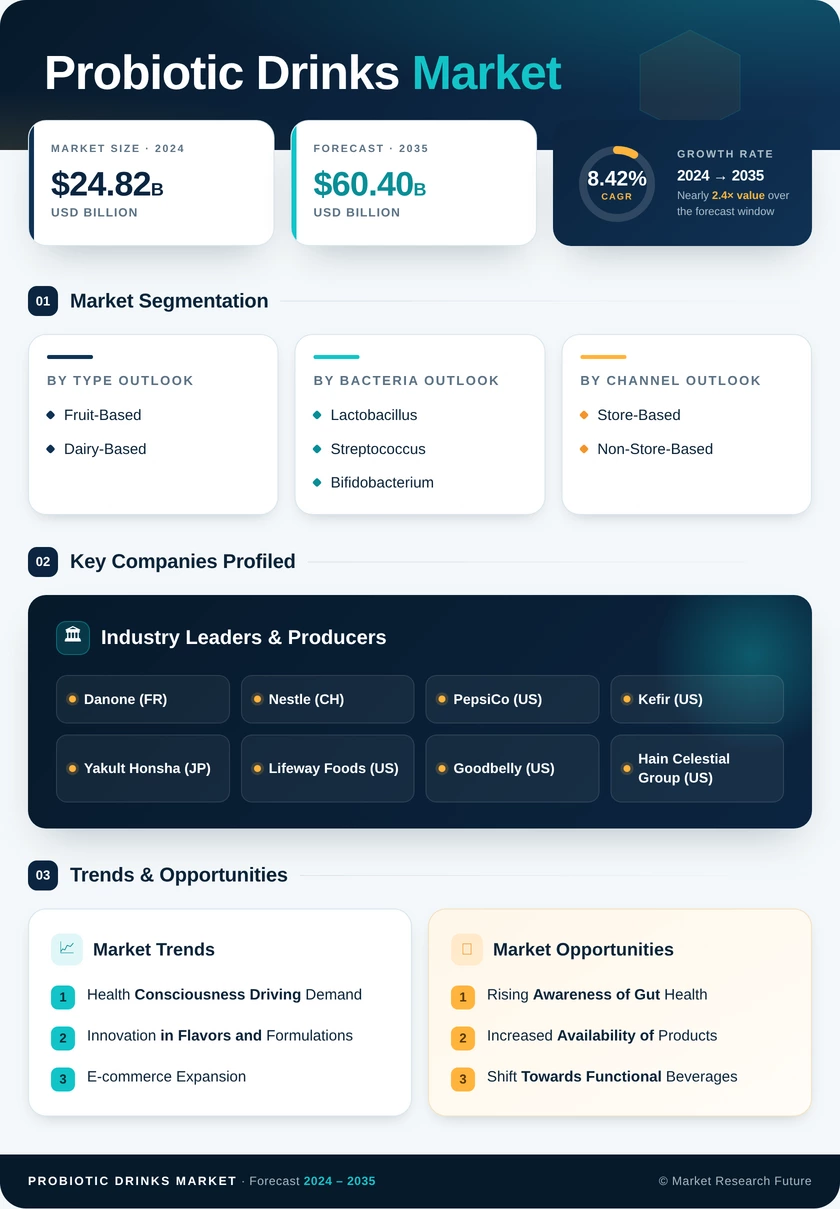
Segmentation Quick Reference
| Dimension | Sub-Segments | Dominant Segment | Fastest Growing Segment |
| By Product Type | Yogurt Drinks, Fermented Milk Drinks, Kombucha, Kefir, Probiotics Juices, Other Product Types | Yogurt Drinks (26.95% share, 2025) | Probiotics Juices (9.86% CAGR, 2026–2035) |
| By Flavor | Flavored, Unflavored | Flavored (63.06% share, 2025) | Unflavored (9.54% CAGR, 2026–2035) |
| By Packaging | Bottles, Cans, Tetra Packs, Others | Bottles (46.51% share, 2025) | Cans (9.64% CAGR, 2026–2035) |
| By Distribution Channel | On-Trade, Off-Trade | Off-Trade (78.5% share, 2025) | On-Trade (9.35% CAGR, 2026–2035) |
Market Segmentation Overview
By Product Type
| Sub-Segment | Key Trend |
| Yogurt Drinks | Fortification with vitamins and minerals to defend against private-label parity |
| Fermented Milk Drinks | Ambient lactic-acid formats scaling across China and Southeast Asia |
| Kombucha | Attracting strategic capital as a sparkling soft-drink substitute |
| Kefir | Positioned on multi-strain microbial diversity in North America |
| Probiotics Juices | Microencapsulation enabling culture survival in acidic matrices |
| Other Product Types | Water kefir, plant bases, and concentrated shot formats emerging |
Yogurt Drinks lead this dimension because refrigerated facings in France, Germany, Japan and South Korea were secured decades ago and turn over predictably; Danone and Yakult defend those slots through fortification rather than discounting. Probiotics Juices grow fastest, since removing dairy opens the roughly two-thirds of adults with reduced lactase persistence and appeals to fruit-forward palates in North America and urban Asia. The technical gate is culture viability at low pH, which is why encapsulation suppliers hold pricing power over juice formulators. Kefir sits between the two, gaining North American shelf space on microbial-diversity messaging.
By Flavor
| Sub-Segment | Key Trend |
| Flavored | Natural sweetener reformulation to manage sugar levies without taste loss |
| Unflavored | Clean-label positioning and culinary use driving premium natural-channel sales |
Flavored variants dominate because fermentation sourness is the main barrier to first purchase, and fruit, vanilla, and botanical masking converts triers into habitual buyers — Lifeway's mango-turmeric and blueberry-lavender launches were built precisely for that conversion. Unflavored grows faster off a smaller base among European and North American shoppers who read ingredient panels and use kefir in cooking. The unresolved tension is sugar: levies in more than 100 jurisdictions push flavored formulations toward stevia, monk fruit and allulose, which can suppress culture activity during fermentation.
By Packaging
| Sub-Segment | Key Trend |
| Bottles | PET dominates mass volume while glass carries premium and sustainability signalling |
| Cans | Aluminium recyclability above 70% aligning format choice with compliance reporting |
| Tetra Packs | Ambient cartons serving markets with limited cold-chain infrastructure |
| Others | Pouches and shot vials serving convenience and dosage-controlled occasions |
Bottles hold the largest share because filling lines are amortised and transparency signals freshness at shelf, with PET keeping packaging cost below USD 0.10 per unit on mass yogurt drink lines. Cans grow fastest, pulled by sparkling probiotic sodas and kombucha and reinforced by EU packaging rules that reward recyclable formats; the offsetting risk is culture loss during thermal seaming. Tetra Packs remain the practical choice across Asia-Pacific and the Middle East, where ambient distribution beats refrigerated economics.
By Distribution Channel
| Sub-Segment | Key Trend |
| On-Trade | Cafés, juice bars and hospitality adding fermented pours to wellness menus |
| Off-Trade | Supermarket refrigerated aisles carry volume while pharmacies capture margin |
Off-Trade carries the overwhelming majority of volume, with supermarkets and hypermarkets alone accounting for 51.90% of category revenue through refrigerated placement beside yogurt and milk; within the same channel, pharmacies and drug stores grow at roughly 8.76% and command prices around a third higher for identical culture counts. On-Trade expands fastest overall as foodservice operators add fermented pours, but its base is narrow, and its economics depend on chilled back-of-house capacity. Channel choice, not product formulation, increasingly determines gross margin.

 Noah Malgeri
Co-Founder
Noah Malgeri
Co-Founder

 Peter Groot koerkamp
Account and Business Manager
Peter Groot koerkamp
Account and Business Manager

 Younghwan Choi
Senior Retail Manager
Younghwan Choi
Senior Retail Manager

 Mark Irwin
Management Consultant
Mark Irwin
Management Consultant

 Akif Moroglu
Strategy & Business Development Director
Akif Moroglu
Strategy & Business Development Director

 Guilherme Gomes Martins
Product Management Director
Guilherme Gomes Martins
Product Management Director

 Joseph Aguayo
Sales Operations & Pricing Manager
Joseph Aguayo
Sales Operations & Pricing Manager

 La Terria Dodd
Program Support Specialist
La Terria Dodd
Program Support Specialist

 Rob Kooiker
Group Product Manager HVAC & Fire Protection GMA
Rob Kooiker
Group Product Manager HVAC & Fire Protection GMA