
Request Free Sample ×

Kindly complete the form below to receive a free sample of this Report

* Please use a valid business email

Leading companies partner with us for data-driven Insights

clients tt-cursor
Hero Background
English
Chinese
French
Japanese
Korean
German
Spanish

Pressure Switch Market Trends

ID: MRFR/Equip/5359-CR
128 Pages
Snehal Singh
July 2022

Pressure Switch Market Research Report Information Type (Electromechanical, Solid State), by Pressure Range (Below 100 Bar, 100 to 400 Bar, Above 400 Bar), Application (HVAC, Monitoring & Control, Safety & Alarm System, Hydraulics & Pneumatics), And by Region (North America, Europe, Asia-Pacific, And Rest Of The World) –Market Forecast Till 2035

Share:
Download PDF ×

We do not share your information with anyone. However, we may send you emails based on your report interest from time to time. You may contact us at any time to opt-out.

Pressure Switch Market Infographic
Purchase Options

Market Trends

Key Emerging Trends in the Pressure Switch Market

In the realm of HVAC (heating, ventilation, and air conditioning) systems, the crucial role played by pressure switches cannot be overstated. These protective devices, available in both high- and low-pressure variants, are instrumental in safeguarding HVAC systems, particularly compressors, from adverse conditions. Their multifaceted functionality includes protecting against high pressure and low refrigerant situations, controlling condenser fan cycling, and preventing the system from operating under unfavorable conditions such as clogged vents, dirty filters, or compromised condenser coils.

High-pressure switches act as sentinels, intervening when the pressure in the HVAC system reaches levels that could potentially harm the compressor. On the other hand, low-pressure switches come into play when the refrigerant levels drop below the optimal range, triggering a protective response to prevent damage to the system. Additionally, these switches contribute to the efficient operation of condenser fans, ensuring that they cycle appropriately to maintain optimal performance.

The market for HVAC pressure switches offers a diverse array of options, with variations based on the technology employed in the systems. The distinction between conventional and condensing technologies influences the design and configuration of pressure switches. For example, in a single-stage conventional system, a single hose connects the draft inducer fan to the pressure switch. In a single-stage condensing system, the pressure switch features two hoses. In a more complex two-stage system, two pressure switches may be employed, and a modulating system could incorporate three pressure switches. This diversity in configurations allows pressure switches to cater to the specific needs of various HVAC setups, ensuring a tailored approach to system protection and efficiency.

The proliferation of smart homes is a significant factor influencing the demand for advanced HVAC systems and, consequently, pressure switches. Smart homes leverage intelligent technologies to enhance energy efficiency, user comfort, and system control. Pressure switches play a vital role in this ecosystem, contributing to the seamless operation and protection of HVAC systems within smart homes. The integration of pressure switches in these smart environments ensures optimal performance, energy conservation, and enhanced longevity of HVAC components.

Reducing operating costs is a key consideration for both residential and commercial entities, and pressure switches contribute to achieving this objective in HVAC systems. By preventing the system from operating under conditions that could lead to inefficiency or damage, pressure switches play a pivotal role in minimizing maintenance costs and prolonging the lifespan of HVAC equipment. This cost-effectiveness, coupled with the demand for energy-efficient temperature control systems, further drives the adoption of pressure switches in the HVAC market.

Government initiatives and schemes aimed at incentivizing the replacement of outdated HVAC systems contribute to the growing demand for pressure switches. As governments worldwide prioritize energy efficiency and environmental sustainability, there is a concerted effort to encourage the adoption of modern, eco-friendly HVAC technologies. Pressure switches, with their role in enhancing system efficiency and preventing unnecessary wear and tear, align with the objectives of these initiatives, leading to increased adoption in both residential and commercial sectors.


Author
Author Profile
Snehal Singh
Manager - Research

High acumen in analyzing complex macro & micro markets with more than 6 years of work experience in the field of market research. By implementing her analytical skills in forecasting and estimation into market research reports, she has expertise in Packaging, Construction, and Equipment domains. She handles a team size of 20-25 resources and ensures smooth running of the projects, associated marketing activities, and client servicing.

Leave a Comment

FAQs

What is the projected market valuation of The Global Pressure Switch by 2035?

<p>The projected market valuation for The Global Pressure Switch is expected to reach 3.238 USD Billion by 2035.</p>

What was the market valuation of The Global Pressure Switch in 2024?

<p>The overall market valuation of The Global Pressure Switch was 2.07 USD Billion in 2024.</p>

What is the expected CAGR for The Global Pressure Switch during the forecast period 2025 - 2035?

<p>The expected CAGR for The Global Pressure Switch during the forecast period 2025 - 2035 is 4.15%.</p>

Which companies are considered key players in The Global Pressure Switch?

<p>Key players in The Global Pressure Switch include Honeywell, Emerson, Siemens, Schneider Electric, Parker Hannifin, Ashcroft, Wika, Barksdale, and Kobold.</p>

What are the main types of pressure switches in the market and their valuations?

<p>The main types of pressure switches are Electromechanical, valued at 1.88 USD Billion, and Solid State, valued at 1.35 USD Billion.</p>

How does the pressure range segment perform in The Global Pressure Switch?

<p>In the pressure range segment, 'Below 100 Bars' and '100 to 400 Bars' are projected to reach 1.25 USD Billion each, while 'Above 400 Bars' is expected to reach 0.69 USD Billion.</p>

What applications are driving growth in The Global Pressure Switch?

The applications driving growth include HVAC, projected to reach 1.25 USD Billion, and Monitoring &amp; Control, expected to reach 0.95 USD Billion.

What was the valuation of the Solid State pressure switch segment in 2024?

The Solid State pressure switch segment was valued at 0.83 USD Billion in 2024.

What is the expected growth trend for the Hydraulics & Pneumatics application segment?

The Hydraulics &amp; Pneumatics application segment is expected to grow to 0.3 USD Billion by 2035.

How does the performance of The Global Pressure Switch compare across different applications?

The performance varies, with HVAC leading at 1.25 USD Billion, followed by Monitoring &amp; Control at 0.95 USD Billion, indicating diverse application growth.

Market Summary

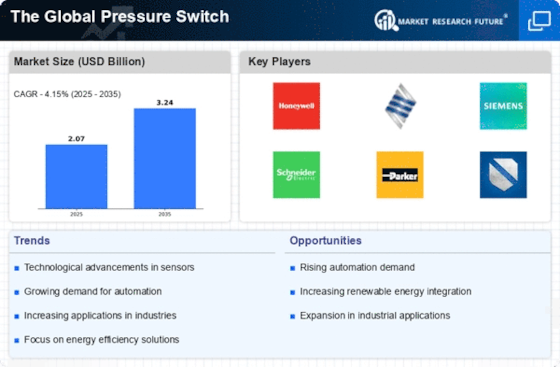
As per Market Research Future analysis, Pressure Switch Market Size was estimated at 2.07 USD Billion in 2024. The pressure switch industry is projected to grow from 2.156 USD Billion in 2025 to 3.238 USD Billion by 2035, exhibiting a compound annual growth rate (CAGR) of 4.15% during the forecast period 2025 - 2035

Key Market Trends & Highlights

The Global Pressure Switch Market is poised for substantial growth driven by technological advancements and increasing safety standards.

  • North America remains the largest market for pressure switches, driven by industrial automation and stringent safety regulations. The Asia-Pacific region is currently the fastest-growing market, fueled by rapid industrialization and a rising demand for energy-efficient solutions. Electromechanical pressure switches dominate the market, while solid state switches are emerging as the fastest-growing segment due to their reliability and compact design. Key market drivers include the rising demand in industrial automation and the growth in the renewable energy sector, which are significantly influencing market dynamics.

Market Size & Forecast

2024 Market Size 2.07 (USD Billion)
2035 Market Size 3.238 (USD Billion)
CAGR (2025 - 2035) 4.15%
Largest Regional Market Share in 2024 North America

Major Players

Honeywell (US), <a href="https://www.emerson.com/en-us/catalog/pressure-sensors?fetchFacets=true#facet:&amp;partsFacet:&amp;modelsFacet:&amp;facetLimit:&amp;searchTerm:&amp;partsSearchTerm:&amp;modelsSearchTerm:&amp;productBeginIndex:0&amp;partsBeginIndex:0&amp;modelsBeginIndex:0&amp;orderBy:&amp;partsOrderBy:&amp;modelsOrderBy:&amp;pageView:grid&amp;minPrice:&amp;maxPrice:&amp;pageSize:&amp;facetRange:&amp;">Emerson </a>(US), Siemens (DE), Schneider Electric (FR), Parker Hannifin (US), <a href="https://www.ashcroft.com/products/pressure/pressure-switches/">Ashcroft </a>(US), Wika (DE), Barksdale (US), Kobold (DE)

Market Trends

The Pressure Switch Market is currently experiencing a dynamic evolution, driven by advancements in technology and increasing demand across various industries. The integration of automation and smart technologies into pressure switch systems appears to enhance operational efficiency and reliability. This trend is particularly evident in sectors such as manufacturing, oil and gas, and HVAC, where precise pressure control is crucial. 

Furthermore, the growing emphasis on energy efficiency and sustainability is likely to propel the adoption of innovative pressure switch solutions that minimize energy consumption while maintaining performance standards. 

In addition, the market seems to be influenced by the rising need for safety and compliance with stringent regulations. Industries are increasingly prioritizing the implementation of pressure switches that not only meet regulatory requirements but also provide enhanced safety features. This shift indicates a broader awareness of the importance of risk management in industrial operations. 

As Pressure Switch Market continues to evolve, it may witness further innovations that cater to the specific needs of diverse applications, ultimately shaping the future landscape of pressure control technology.

Technological Advancements

The ongoing integration of advanced technologies into pressure switch systems is transforming Pressure Switch Market. Innovations such as IoT connectivity and smart sensors are enhancing the functionality and efficiency of these devices, allowing for real-time monitoring and data analysis.

Focus on Energy Efficiency

There is a growing trend towards energy-efficient solutions within Pressure Switch Market. Manufacturers are increasingly developing products that not only optimize performance but also reduce energy consumption, aligning with global sustainability goals.

Regulatory Compliance and Safety

The emphasis on safety and adherence to regulatory standards is shaping the Pressure Switch Market. Industries are prioritizing pressure switches that offer enhanced safety features and comply with stringent regulations, reflecting a commitment to risk management.

Pressure Switch Market Market Drivers

Expansion of HVAC Systems

The growing demand for heating, ventilation, and air conditioning (HVAC) systems is a crucial driver for the pressure switch market. As urbanization and population growth continue to rise, the need for efficient HVAC systems becomes increasingly important. Pressure switches are integral to HVAC systems, providing essential functions such as pressure monitoring and control. The HVAC market is projected to reach a valuation of over 200 billion USD by 2027, indicating a robust growth trajectory. This expansion is likely to bolster The Global Pressure Switch Industry, as manufacturers seek to incorporate advanced pressure switches into their HVAC solutions. The integration of pressure switches in HVAC systems not only enhances energy efficiency but also ensures optimal performance, thereby driving further demand in the market.

Growth in Renewable Energy Sector

The expansion of the renewable energy sector significantly influences the pressure switch market. As countries increasingly invest in renewable energy sources such as wind and solar, the need for efficient pressure management systems becomes critical. Pressure switches are essential in various applications, including hydraulic systems and pneumatic controls, which are prevalent in renewable energy installations. The market for pressure switches in this sector is anticipated to witness substantial growth, driven by the global push for sustainable energy solutions. According to recent estimates, the renewable energy market is expected to reach a valuation of over 2 trillion USD by 2030, creating a favorable environment for The Global Pressure Switch Industry. This growth not only highlights the importance of pressure switches in energy management but also underscores their role in supporting the transition to cleaner energy sources.

Increasing Focus on Safety Standards

The heightened emphasis on safety standards across various industries serves as a significant driver for the pressure switch market. Regulatory bodies are continuously updating safety regulations to mitigate risks associated with pressure systems. Pressure switches are critical components in ensuring compliance with these safety standards, as they provide essential monitoring and control functions. Industries such as oil and gas, chemicals, and food processing are particularly affected by stringent safety regulations, which necessitate the use of reliable pressure monitoring devices. The Global Pressure Switch Industry is expected to see growth as companies invest in pressure switches to meet compliance requirements and enhance operational safety. This trend not only reflects the importance of safety in industrial operations but also highlights the role of pressure switches in maintaining regulatory compliance.

Rising Demand in Industrial Automation

The increasing trend towards industrial automation is a pivotal driver for the pressure switch market. As industries strive for enhanced efficiency and productivity, the need for reliable pressure monitoring systems becomes paramount. In sectors such as manufacturing, oil and gas, and packaged water treatment, pressure switches play a crucial role in ensuring operational safety and efficiency. The market for pressure switches is projected to grow at a compound annual growth rate of approximately 5.2% from 2023 to 2030, reflecting the rising adoption of automation technologies. This growth is indicative of the broader shift towards smart manufacturing, where pressure switches are integral to process control and monitoring. Consequently, the demand for advanced pressure switch solutions is expected to surge, thereby propelling The Global Pressure Switch Industry forward.

Technological Innovations in Pressure Switch Design

Technological advancements in pressure switch design are reshaping the landscape of the pressure switch market. Innovations such as digital pressure switches and smart sensors are enhancing the functionality and reliability of these devices. These modern pressure switches offer improved accuracy, faster response times, and advanced diagnostic capabilities, which are increasingly demanded by industries. The integration of IoT technology into pressure switches allows for real-time monitoring and data analysis, further driving their adoption across various sectors. As industries seek to optimize their operations, The Global Pressure Switch Industry is likely to benefit from these technological innovations, with a projected increase in market share for smart pressure switches. This trend indicates a shift towards more sophisticated pressure management solutions that align with the needs of modern industrial applications.

Market Segment Insights

By Type: Electromechanical (Largest) vs. Solid State (Fastest-Growing)

<p>In The Global Pressure Switch, the segment share is largely dominated by electromechanical pressure switches. These devices cover a wide range of applications across industries such as automotive, HVAC, and industrial automation. Solid state pressure switches, while smaller in market share, are witnessing an increasing demand due to their enhanced reliability and durability in harsh environments. This differentiation between the two types reveals critical market dynamics and preferences among users.</p>

<p>Technology: Electromechanical (Dominant) vs. Solid State (Emerging)</p>

<p>Electromechanical pressure switches are recognized for their established reliability and versatility, making them the preferred choice in various industrial applications. They offer a proven track record and are used extensively in conventional systems where varying pressure thresholds must be monitored. In contrast, solid-state pressure switches are emerging rapidly in the market, benefiting from advancements in technology that allow for more compact designs and improved energy efficiency. Their ability to perform effectively in extreme conditions positions them favorably for growth, particularly in high-tech industries such as robotics and renewable energy, thereby changing the landscape of pressure monitoring solutions.</p>

By Pressure Range: Below 100 Bars (Largest) vs. Above 400 Bars (Fastest-Growing)

<p>In The Global Pressure Switch, the pressure range segment showcases a distinct distribution of market share among its categories. The 'Below 100 Bars' range stands out as the largest segment, attributed to its broad applicability across various industrial sectors such as HVAC and automation systems. This range's versatility in handling pressures in common applications has solidified its dominant position, catering to a wide array of consumer needs. Conversely, the 'Above 400 Bars' segment is identified as the fastest-growing category within the pressure range spectrum. This growth is primarily fueled by the rising demand in high-performance industries, particularly oil and gas, where robust pressure switches capable of withstanding extreme conditions are critical. As technological advancements continue to evolve, this segment is poised for rapid expansion, driven by innovations in manufacturing and heightened safety protocols.</p>

<p>Pressure Range: Below 100 Bars (Dominant) vs. Above 400 Bars (Emerging)</p>

<p>The 'Below 100 Bars' pressure range is characterized by its leading market presence, predominantly utilized in a variety of applications including residential, commercial, and industrial systems. Its ability to provide reliable and cost-effective solutions makes it a favored choice among manufacturers. This segment caters to essential services such as water supply systems and heating applications, ensuring consistent demand. On the other hand, the 'Above 400 Bars' range represents an emerging segment gaining traction due to stringent safety requirements and advancements in pressure testing for high-risk industries. These pressure switches are engineered for durability and precision, aligned with the needs of high-stakes environments, thereby appealing to a specialized consumer base seeking superior performance.</p>

By Application: HVAC (Largest) vs. Safety & Alarm Systems (Fastest-Growing)

<p>The Global Pressure Switch demonstrates a diverse application landscape, with HVAC holding the largest market share due to its integral role in climate control and energy efficiency across residential and commercial sectors. Monitoring & Control and Hydraulics & Pneumatics follow, as they are essential for industrial applications, while Safety & Alarm Systems is gaining momentum, witnessing increased adoption across various sectors.</p>

<p>Monitoring & Control (Dominant) vs. Hydraulics & Pneumatics (Emerging)</p>

<p>Monitoring & Control stands out in The Global Pressure Switch as a dominant segment due to its crucial role in maintaining operational effectiveness and safety in various applications, including manufacturing and process control. On the other hand, Hydraulics & Pneumatics is emerging as a vital segment driven by the growth of automated solutions in industries such as construction and transportation. While Monitoring & Control applications continue to evolve with technological advancements, Hydraulics & Pneumatics is experiencing rising demand for compact systems that enhance efficiency and reliability in fluid power applications.</p>

Get more detailed insights about Pressure Switch Market Research Report—Global Forecast till 2035

Regional Insights

North America : Market Leader in Innovation

North America is the largest market for pressure switches, accounting for approximately 40% of the global share. The region's growth is driven by increasing industrial automation, stringent safety regulations, and the rising demand for advanced pressure monitoring solutions. The U.S. leads this market, supported by a robust manufacturing sector and significant investments in technology. Canada follows as the second-largest market, contributing around 15% to the overall share, driven by its oil and gas industry. The competitive landscape in North America is characterized by the presence of major players such as Honeywell, Emerson, and Parker Hannifin. These companies are focusing on innovation and product development to meet the evolving needs of various industries, including oil and gas, HVAC, and manufacturing. The region's regulatory environment also encourages the adoption of advanced pressure switch technologies, further enhancing market growth.

Europe : Emerging Regulatory Frameworks

Europe is witnessing significant growth in the Pressure Switch Market size, holding approximately 30% of the global share. The region's demand is fueled by stringent environmental regulations and a shift towards automation in various sectors, including automotive and manufacturing. Germany stands out as the largest market, accounting for about 12% of the global share, while France and the UK follow closely, driven by their industrial sectors and energy efficiency initiatives. The competitive landscape in Europe is marked by key players like Siemens and Schneider Electric, who are investing in R&D to develop innovative solutions. The presence of regulatory bodies such as the European Union is pivotal in shaping market dynamics, ensuring compliance with safety and environmental standards. This regulatory framework not only drives demand but also encourages technological advancements in pressure switch applications.

Asia-Pacific : Rapid Industrialization and Growth

Asia-Pacific is rapidly emerging as a significant player in the Pressure Switch Market, contributing around 25% to the global share. The region's growth is primarily driven by rapid industrialization, urbanization, and increasing investments in infrastructure. China is the largest market, holding approximately 15% of the global share, followed by India, which is experiencing a surge in demand due to its expanding manufacturing sector and energy needs. The competitive landscape in Asia-Pacific is evolving, with both local and international players vying for market share. Companies like Wika and Kobold are establishing a strong presence, focusing on cost-effective solutions tailored to regional needs. The increasing adoption of automation and smart technologies in industries such as manufacturing and energy is expected to further boost the demand for pressure switches in this region.

Middle East and Africa : Resource-Rich Market Dynamics

The Middle East and Africa region is witnessing a growing demand for pressure switches, accounting for approximately 5% of the global market share. The growth is primarily driven by the oil and gas sector, which is a significant contributor to the region's economy. Countries like Saudi Arabia and the UAE are leading the market, with investments in energy infrastructure and a focus on enhancing operational efficiency in industrial applications. The competitive landscape in this region is characterized by a mix of local and international players. Companies are increasingly focusing on providing tailored solutions to meet the specific needs of the energy sector. The presence of regulatory bodies is also becoming more pronounced, as they aim to ensure safety and compliance in industrial operations, further driving the demand for advanced pressure switch technologies.

Key Players and Competitive Insights

Major players are strategically diversifying their product portfolios to capture a larger Pressure Switch market share within the rapidly growing automation and industrial safety sectors. Leading market players  are also investing heavily in research and Development (R&D) to scale up their manufacturing units and develop technologically advanced solutions, which will help the Fluid Control Devices market grow worldwide. Market participants are also undertaking various organic or inorganic strategic approaches to strengthen and expand their global footprint, with significant market developments including new Type portfolios, contractual deals, mergers and acquisitions, capital expenditure, higher investments, and strategic alliances with other organizations. Businesses are also coming up with marketing strategies such as digital marketing, social media influencing, and content marketing to increase their scope of profit earnings.

The Pressure Switch industry must offer cost-effective and sustainable options to survive in a highly fragmented and dynamic market climate. Manufacturing locally to minimize operational expenses and offer aftermarket services to customers is one of the critical business strategies organizations use in the global Pressure Switch industry to benefit customers and capture untapped market share and revenue. The Pressure Switch industry has recently offered significant advantages to the Industrial Automation & Equipment industry. Moreover, more industry participants are utilizing and adopting cutting-edge technology has grown substantially. Major players in the Pressure Switch Market, including Hitachi Power ABB Grids, Eaton, Parker Hannifin Corp, Barksdale Inc., BD|SENSORS GmbH, Tameson B.V, LEFOO, Emerson, Danfoss, SMC Corporation, Fox S.r.l., MAMCO, Nason, Applications Engineering Ltd., Suco, IFM, Baumer Group, Bosch Rexroth AG, Honeywell International Inc. are attempting to expand market share and demand by investing in R&D operations to produce sustainable and affordable solutions.

Eaton has been in the power management industry for almost a century. Electrical goods, electrical services and systems, airplanes, vehicles, and, most recently, eMobility are among the categories in which the firm works. Eaton's portfolio may be separated into two parts. Eaton stated in January 2022 that it had completed the purchase of Royal Power Options, a US-based manufacturer of high-precision electrical connection gear used in electric cars, energy management, and commercial and adaptability industries. ABB Ltd. is a multinational corporation that develops and distributes power and automation solutions. Electrification, Commercial Automation, Motion, Robots & Combinatorial Automation, and Corporation are its business divisions. The firm was established on January 5, 1988, & is based in Zurich, Switzerland. ABB will finalize the sale of 80.1% of its Power Grids division to Hitachi in July 2020. ABB concentrated on critical market developments; consumer needs like digitalization of transportation and business, automated production, electronic solutions, and greater productivity improvements due to the divestiture.

Key Companies in the Pressure Switch Market include

Industry Developments

November 2023

Leading manufacturer of high-performance lighting equipment, Streamlight® Inc., has released the ProTac® Rail Mount HL-X Pro gun-mounted light, which has an exceptional beam reach of 447 meters, 1,000 lumens, and 50,000 candelas. The new light comes with an inventive Jack-CapTM tail cap switch that allows users to choose between two different battery types and operates as a push-button or remote pressure switch.

With its robust integrated rail clamp, the lightweight, low-profile ProTac Rail Mount HL-X Pro is ideal for quickly and safely mounting to rifles, carbines, and submachine guns that meet MIL-STD 1913 (Picatinny) standards. It may also be used to connect to M-LOK or M-LOK-compatible rail systems by using the accompanying M-LOK® mount. Either one Streamlight rechargeable SL-B26® lithium-ion battery pack or two 3-volt CR123 lithium batteries are used to power it.

The 'whole package' is this latest addition to the ProTac family of weapon-mounted lights, said Ray Sharrah, president, and chief executive officer of Streamlight. With its 50,000 candela and extended beam reach, it not only performs as a high-lumen light but also casts more light on a distant object. This makes it an effective tactical weapon for first responders, law enforcement officers, and military personnel to use while conducting room clearing, search operations, and other maneuvers in low light.

Its unique tail cap switch, which has a connector for a remote pressure switch and a push-button switch, offers switch redundancy.  

With a one-handed, snap-on and tighten interface, the new light attaches on a wide variety of weapons safely and securely, allowing users to keep their hands away from the gun muzzle. The optional remote switch comes in momentary only and momentary/latching variants. The light's multi-function, push-button tail switch allows momentary and latching continuous operation. Both enable one-handed use of the light's strobe, continuous on, and momentary on modes.

Jan 2022: Eaton stated in January 2022 that it had completed the purchase of Royal Power Options, a US-based manufacturer of high-precision electrical connection gear used in electric cars, energy management, and commercial and adaptability industries.

October 2020: SMC Corporation will release its latest 3-Screen Monitor High-Precision Electronic Pressure Valve ZSE20(F)/ISE20 Series in October 2020. It adds additional features, including made-to-order choices and a simple fitting style to the pipe specs.

July 2020: ABB will finalize the sale of 80.1% of its Power Grids division to Hitachi in July 2020. ABB concentrated on critical market developments; consumer needs like digitalization of transportation and business, automated production, electronic solutions, and greater productivity improvements due to the divestiture.

Future Outlook

Pressure Switch Market Future Outlook

The Pressure Switches Market analysis reveals that it  projected to grow at 4.15% CAGR from 2024 to 2035, driven by industrial automation, energy efficiency, and technological advancements. The future outlook for the Pressure Switch Market remains highly positive as industries accelerate their transition toward advanced automation and Industry 4.0 standards. The growing demand for smart, IoT-enabled solutions is expected to redefine the Pressure Switch Market by enabling real-time monitoring and predictive maintenance. Furthermore, the Pressure Switch Market will likely benefit from the expansion of renewable energy infrastructure and more stringent global safety regulations.

New opportunities lie in:

  • <p>Integration of IoT technology for real-time monitoring solutions. Development of customized pressure switches for niche applications. Expansion into emerging markets with tailored product offerings.</p>

By 2035, the market is expected to achieve robust growth, reflecting evolving industrial needs.

Market Segmentation

Pressure Switch Market Type Outlook

  • Electromechanical
  • Solid State

Pressure Switch Market Application Outlook

  • HVAC
  • Monitoring & Control
  • Safety & Alarm Systems
  • Hydraulics & Pneumatics

Pressure Switch Market Pressure Range Outlook

  • Below 100 Bars
  • 100 to 400 Bars
  • Above 400 Bars

Report Scope

MARKET SIZE 2024 2.07(USD Billion)
MARKET SIZE 2025 2.156(USD Billion)
MARKET SIZE 2035 3.238(USD Billion)
COMPOUND ANNUAL GROWTH RATE (CAGR) 4.15% (2025 - 2035)
REPORT COVERAGE Revenue Forecast, Competitive Landscape, Growth Factors, and Trends
BASE YEAR 2024
Market Forecast Period 2025 - 2035
Historical Data 2019 - 2024
Market Forecast Units USD Billion
Key Companies Profiled Honeywell (US), Emerson (US), Siemens (DE), Schneider Electric (FR), Parker Hannifin (US), Ashcroft (US), Wika (DE), Barksdale (US), Kobold (DE)
Segments Covered Pressure Range, Region
Key Market Opportunities Integration of smart technologies enhances efficiency in The Global Pressure Switch.
Key Market Dynamics Rising demand for automation in industrial applications drives innovation and competition in the Pressure Switch Market.
Countries Covered North America, Europe, APAC, South America, MEA

FAQs

What is the projected market valuation of The Global Pressure Switch by 2035?

<p>The projected market valuation for The Global Pressure Switch is expected to reach 3.238 USD Billion by 2035.</p>

What was the market valuation of The Global Pressure Switch in 2024?

<p>The overall market valuation of The Global Pressure Switch was 2.07 USD Billion in 2024.</p>

What is the expected CAGR for The Global Pressure Switch during the forecast period 2025 - 2035?

<p>The expected CAGR for The Global Pressure Switch during the forecast period 2025 - 2035 is 4.15%.</p>

Which companies are considered key players in The Global Pressure Switch?

<p>Key players in The Global Pressure Switch include Honeywell, Emerson, Siemens, Schneider Electric, Parker Hannifin, Ashcroft, Wika, Barksdale, and Kobold.</p>

What are the main types of pressure switches in the market and their valuations?

<p>The main types of pressure switches are Electromechanical, valued at 1.88 USD Billion, and Solid State, valued at 1.35 USD Billion.</p>

How does the pressure range segment perform in The Global Pressure Switch?

<p>In the pressure range segment, 'Below 100 Bars' and '100 to 400 Bars' are projected to reach 1.25 USD Billion each, while 'Above 400 Bars' is expected to reach 0.69 USD Billion.</p>

What applications are driving growth in The Global Pressure Switch?

The applications driving growth include HVAC, projected to reach 1.25 USD Billion, and Monitoring &amp; Control, expected to reach 0.95 USD Billion.

What was the valuation of the Solid State pressure switch segment in 2024?

The Solid State pressure switch segment was valued at 0.83 USD Billion in 2024.

What is the expected growth trend for the Hydraulics & Pneumatics application segment?

The Hydraulics &amp; Pneumatics application segment is expected to grow to 0.3 USD Billion by 2035.

How does the performance of The Global Pressure Switch compare across different applications?

The performance varies, with HVAC leading at 1.25 USD Billion, followed by Monitoring &amp; Control at 0.95 USD Billion, indicating diverse application growth.

  1. SECTION I: EXECUTIVE SUMMARY AND KEY HIGHLIGHTS
    1. | 1.1 EXECUTIVE SUMMARY
    2. | | 1.1.1 Market Overview
    3. | | 1.1.2 Key Findings
    4. | | 1.1.3 Market Segmentation
    5. | | 1.1.4 Competitive Landscape
    6. | | 1.1.5 Challenges and Opportunities
    7. | | 1.1.6 Future Outlook
  2. SECTION II: SCOPING, METHODOLOGY AND MARKET STRUCTURE
    1. | 2.1 MARKET INTRODUCTION
    2. | | 2.1.1 Definition
    3. | | 2.1.2 Scope of the study
    4. | | | 2.1.2.1 Research Objective
    5. | | | 2.1.2.2 Assumption
    6. | | | 2.1.2.3 Limitations
    7. | 2.2 RESEARCH METHODOLOGY
    8. | | 2.2.1 Overview
    9. | | 2.2.2 Data Mining
    10. | | 2.2.3 Secondary Research
    11. | | 2.2.4 Primary Research
    12. | | | 2.2.4.1 Primary Interviews and Information Gathering Process
    13. | | | 2.2.4.2 Breakdown of Primary Respondents
    14. | | 2.2.5 Forecasting Model
    15. | | 2.2.6 Market Size Estimation
    16. | | | 2.2.6.1 Bottom-Up Approach
    17. | | | 2.2.6.2 Top-Down Approach
    18. | | 2.2.7 Data Triangulation
    19. | | 2.2.8 Validation
  3. SECTION III: QUALITATIVE ANALYSIS
    1. | 3.1 MARKET DYNAMICS
    2. | | 3.1.1 Overview
    3. | | 3.1.2 Drivers
    4. | | 3.1.3 Restraints
    5. | | 3.1.4 Opportunities
    6. | 3.2 MARKET FACTOR ANALYSIS
    7. | | 3.2.1 Value chain Analysis
    8. | | 3.2.2 Porter's Five Forces Analysis
    9. | | | 3.2.2.1 Bargaining Power of Suppliers
    10. | | | 3.2.2.2 Bargaining Power of Buyers
    11. | | | 3.2.2.3 Threat of New Entrants
    12. | | | 3.2.2.4 Threat of Substitutes
    13. | | | 3.2.2.5 Intensity of Rivalry
    14. | | 3.2.3 COVID-19 Impact Analysis
    15. | | | 3.2.3.1 Market Impact Analysis
    16. | | | 3.2.3.2 Regional Impact
    17. | | | 3.2.3.3 Opportunity and Threat Analysis
  4. SECTION IV: QUANTITATIVE ANALYSIS
    1. | 4.1 Construction, BY Type (USD Billion)
    2. | | 4.1.1 Electromechanical
    3. | | 4.1.2 Solid State
    4. | 4.2 Construction, BY Pressure Range (USD Billion)
    5. | | 4.2.1 Below 100 Bars
    6. | | 4.2.2 100 to 400 Bars
    7. | | 4.2.3 Above 400 Bars
    8. | 4.3 Construction, BY Application (USD Billion)
    9. | | 4.3.1 HVAC
    10. | | 4.3.2 Monitoring & Control
    11. | | 4.3.3 Safety & Alarm Systems
    12. | | 4.3.4 Hydraulics & Pneumatics
    13. | 4.4 Construction, BY Region (USD Billion)
    14. | | 4.4.1 North America
    15. | | | 4.4.1.1 US
    16. | | | 4.4.1.2 Canada
    17. | | 4.4.2 Europe
    18. | | | 4.4.2.1 Germany
    19. | | | 4.4.2.2 UK
    20. | | | 4.4.2.3 France
    21. | | | 4.4.2.4 Russia
    22. | | | 4.4.2.5 Italy
    23. | | | 4.4.2.6 Spain
    24. | | | 4.4.2.7 Rest of Europe
    25. | | 4.4.3 APAC
    26. | | | 4.4.3.1 China
    27. | | | 4.4.3.2 India
    28. | | | 4.4.3.3 Japan
    29. | | | 4.4.3.4 South Korea
    30. | | | 4.4.3.5 Malaysia
    31. | | | 4.4.3.6 Thailand
    32. | | | 4.4.3.7 Indonesia
    33. | | | 4.4.3.8 Rest of APAC
    34. | | 4.4.4 South America
    35. | | | 4.4.4.1 Brazil
    36. | | | 4.4.4.2 Mexico
    37. | | | 4.4.4.3 Argentina
    38. | | | 4.4.4.4 Rest of South America
    39. | | 4.4.5 MEA
    40. | | | 4.4.5.1 GCC Countries
    41. | | | 4.4.5.2 South Africa
    42. | | | 4.4.5.3 Rest of MEA
  5. SECTION V: COMPETITIVE ANALYSIS
    1. | 5.1 Competitive Landscape
    2. | | 5.1.1 Overview
    3. | | 5.1.2 Competitive Analysis
    4. | | 5.1.3 Market share Analysis
    5. | | 5.1.4 Major Growth Strategy in the Construction
    6. | | 5.1.5 Competitive Benchmarking
    7. | | 5.1.6 Leading Players in Terms of Number of Developments in the Construction
    8. | | 5.1.7 Key developments and growth strategies
    9. | | | 5.1.7.1 New Product Launch/Service Deployment
    10. | | | 5.1.7.2 Merger & Acquisitions
    11. | | | 5.1.7.3 Joint Ventures
    12. | | 5.1.8 Major Players Financial Matrix
    13. | | | 5.1.8.1 Sales and Operating Income
    14. | | | 5.1.8.2 Major Players R&D Expenditure. 2023
    15. | 5.2 Company Profiles
    16. | | 5.2.1 Honeywell (US)
    17. | | | 5.2.1.1 Financial Overview
    18. | | | 5.2.1.2 Products Offered
    19. | | | 5.2.1.3 Key Developments
    20. | | | 5.2.1.4 SWOT Analysis
    21. | | | 5.2.1.5 Key Strategies
    22. | | 5.2.2 Emerson (US)
    23. | | | 5.2.2.1 Financial Overview
    24. | | | 5.2.2.2 Products Offered
    25. | | | 5.2.2.3 Key Developments
    26. | | | 5.2.2.4 SWOT Analysis
    27. | | | 5.2.2.5 Key Strategies
    28. | | 5.2.3 Siemens (DE)
    29. | | | 5.2.3.1 Financial Overview
    30. | | | 5.2.3.2 Products Offered
    31. | | | 5.2.3.3 Key Developments
    32. | | | 5.2.3.4 SWOT Analysis
    33. | | | 5.2.3.5 Key Strategies
    34. | | 5.2.4 Schneider Electric (FR)
    35. | | | 5.2.4.1 Financial Overview
    36. | | | 5.2.4.2 Products Offered
    37. | | | 5.2.4.3 Key Developments
    38. | | | 5.2.4.4 SWOT Analysis
    39. | | | 5.2.4.5 Key Strategies
    40. | | 5.2.5 Parker Hannifin (US)
    41. | | | 5.2.5.1 Financial Overview
    42. | | | 5.2.5.2 Products Offered
    43. | | | 5.2.5.3 Key Developments
    44. | | | 5.2.5.4 SWOT Analysis
    45. | | | 5.2.5.5 Key Strategies
    46. | | 5.2.6 Ashcroft (US)
    47. | | | 5.2.6.1 Financial Overview
    48. | | | 5.2.6.2 Products Offered
    49. | | | 5.2.6.3 Key Developments
    50. | | | 5.2.6.4 SWOT Analysis
    51. | | | 5.2.6.5 Key Strategies
    52. | | 5.2.7 Wika (DE)
    53. | | | 5.2.7.1 Financial Overview
    54. | | | 5.2.7.2 Products Offered
    55. | | | 5.2.7.3 Key Developments
    56. | | | 5.2.7.4 SWOT Analysis
    57. | | | 5.2.7.5 Key Strategies
    58. | | 5.2.8 Barksdale (US)
    59. | | | 5.2.8.1 Financial Overview
    60. | | | 5.2.8.2 Products Offered
    61. | | | 5.2.8.3 Key Developments
    62. | | | 5.2.8.4 SWOT Analysis
    63. | | | 5.2.8.5 Key Strategies
    64. | | 5.2.9 Kobold (DE)
    65. | | | 5.2.9.1 Financial Overview
    66. | | | 5.2.9.2 Products Offered
    67. | | | 5.2.9.3 Key Developments
    68. | | | 5.2.9.4 SWOT Analysis
    69. | | | 5.2.9.5 Key Strategies
    70. | 5.3 Appendix
    71. | | 5.3.1 References
    72. | | 5.3.2 Related Reports
  6. LIST OF FIGURES
    1. | 6.1 MARKET SYNOPSIS
    2. | 6.2 NORTH AMERICA MARKET ANALYSIS
    3. | 6.3 US MARKET ANALYSIS BY TYPE
    4. | 6.4 US MARKET ANALYSIS BY PRESSURE RANGE
    5. | 6.5 US MARKET ANALYSIS BY APPLICATION
    6. | 6.6 CANADA MARKET ANALYSIS BY TYPE
    7. | 6.7 CANADA MARKET ANALYSIS BY PRESSURE RANGE
    8. | 6.8 CANADA MARKET ANALYSIS BY APPLICATION
    9. | 6.9 EUROPE MARKET ANALYSIS
    10. | 6.10 GERMANY MARKET ANALYSIS BY TYPE
    11. | 6.11 GERMANY MARKET ANALYSIS BY PRESSURE RANGE
    12. | 6.12 GERMANY MARKET ANALYSIS BY APPLICATION
    13. | 6.13 UK MARKET ANALYSIS BY TYPE
    14. | 6.14 UK MARKET ANALYSIS BY PRESSURE RANGE
    15. | 6.15 UK MARKET ANALYSIS BY APPLICATION
    16. | 6.16 FRANCE MARKET ANALYSIS BY TYPE
    17. | 6.17 FRANCE MARKET ANALYSIS BY PRESSURE RANGE
    18. | 6.18 FRANCE MARKET ANALYSIS BY APPLICATION
    19. | 6.19 RUSSIA MARKET ANALYSIS BY TYPE
    20. | 6.20 RUSSIA MARKET ANALYSIS BY PRESSURE RANGE
    21. | 6.21 RUSSIA MARKET ANALYSIS BY APPLICATION
    22. | 6.22 ITALY MARKET ANALYSIS BY TYPE
    23. | 6.23 ITALY MARKET ANALYSIS BY PRESSURE RANGE
    24. | 6.24 ITALY MARKET ANALYSIS BY APPLICATION
    25. | 6.25 SPAIN MARKET ANALYSIS BY TYPE
    26. | 6.26 SPAIN MARKET ANALYSIS BY PRESSURE RANGE
    27. | 6.27 SPAIN MARKET ANALYSIS BY APPLICATION
    28. | 6.28 REST OF EUROPE MARKET ANALYSIS BY TYPE
    29. | 6.29 REST OF EUROPE MARKET ANALYSIS BY PRESSURE RANGE
    30. | 6.30 REST OF EUROPE MARKET ANALYSIS BY APPLICATION
    31. | 6.31 APAC MARKET ANALYSIS
    32. | 6.32 CHINA MARKET ANALYSIS BY TYPE
    33. | 6.33 CHINA MARKET ANALYSIS BY PRESSURE RANGE
    34. | 6.34 CHINA MARKET ANALYSIS BY APPLICATION
    35. | 6.35 INDIA MARKET ANALYSIS BY TYPE
    36. | 6.36 INDIA MARKET ANALYSIS BY PRESSURE RANGE
    37. | 6.37 INDIA MARKET ANALYSIS BY APPLICATION
    38. | 6.38 JAPAN MARKET ANALYSIS BY TYPE
    39. | 6.39 JAPAN MARKET ANALYSIS BY PRESSURE RANGE
    40. | 6.40 JAPAN MARKET ANALYSIS BY APPLICATION
    41. | 6.41 SOUTH KOREA MARKET ANALYSIS BY TYPE
    42. | 6.42 SOUTH KOREA MARKET ANALYSIS BY PRESSURE RANGE
    43. | 6.43 SOUTH KOREA MARKET ANALYSIS BY APPLICATION
    44. | 6.44 MALAYSIA MARKET ANALYSIS BY TYPE
    45. | 6.45 MALAYSIA MARKET ANALYSIS BY PRESSURE RANGE
    46. | 6.46 MALAYSIA MARKET ANALYSIS BY APPLICATION
    47. | 6.47 THAILAND MARKET ANALYSIS BY TYPE
    48. | 6.48 THAILAND MARKET ANALYSIS BY PRESSURE RANGE
    49. | 6.49 THAILAND MARKET ANALYSIS BY APPLICATION
    50. | 6.50 INDONESIA MARKET ANALYSIS BY TYPE
    51. | 6.51 INDONESIA MARKET ANALYSIS BY PRESSURE RANGE
    52. | 6.52 INDONESIA MARKET ANALYSIS BY APPLICATION
    53. | 6.53 REST OF APAC MARKET ANALYSIS BY TYPE
    54. | 6.54 REST OF APAC MARKET ANALYSIS BY PRESSURE RANGE
    55. | 6.55 REST OF APAC MARKET ANALYSIS BY APPLICATION
    56. | 6.56 SOUTH AMERICA MARKET ANALYSIS
    57. | 6.57 BRAZIL MARKET ANALYSIS BY TYPE
    58. | 6.58 BRAZIL MARKET ANALYSIS BY PRESSURE RANGE
    59. | 6.59 BRAZIL MARKET ANALYSIS BY APPLICATION
    60. | 6.60 MEXICO MARKET ANALYSIS BY TYPE
    61. | 6.61 MEXICO MARKET ANALYSIS BY PRESSURE RANGE
    62. | 6.62 MEXICO MARKET ANALYSIS BY APPLICATION
    63. | 6.63 ARGENTINA MARKET ANALYSIS BY TYPE
    64. | 6.64 ARGENTINA MARKET ANALYSIS BY PRESSURE RANGE
    65. | 6.65 ARGENTINA MARKET ANALYSIS BY APPLICATION
    66. | 6.66 REST OF SOUTH AMERICA MARKET ANALYSIS BY TYPE
    67. | 6.67 REST OF SOUTH AMERICA MARKET ANALYSIS BY PRESSURE RANGE
    68. | 6.68 REST OF SOUTH AMERICA MARKET ANALYSIS BY APPLICATION
    69. | 6.69 MEA MARKET ANALYSIS
    70. | 6.70 GCC COUNTRIES MARKET ANALYSIS BY TYPE
    71. | 6.71 GCC COUNTRIES MARKET ANALYSIS BY PRESSURE RANGE
    72. | 6.72 GCC COUNTRIES MARKET ANALYSIS BY APPLICATION
    73. | 6.73 SOUTH AFRICA MARKET ANALYSIS BY TYPE
    74. | 6.74 SOUTH AFRICA MARKET ANALYSIS BY PRESSURE RANGE
    75. | 6.75 SOUTH AFRICA MARKET ANALYSIS BY APPLICATION
    76. | 6.76 REST OF MEA MARKET ANALYSIS BY TYPE
    77. | 6.77 REST OF MEA MARKET ANALYSIS BY PRESSURE RANGE
    78. | 6.78 REST OF MEA MARKET ANALYSIS BY APPLICATION
    79. | 6.79 KEY BUYING CRITERIA OF CONSTRUCTION
    80. | 6.80 RESEARCH PROCESS OF MRFR
    81. | 6.81 DRO ANALYSIS OF CONSTRUCTION
    82. | 6.82 DRIVERS IMPACT ANALYSIS: CONSTRUCTION
    83. | 6.83 RESTRAINTS IMPACT ANALYSIS: CONSTRUCTION
    84. | 6.84 SUPPLY / VALUE CHAIN: CONSTRUCTION
    85. | 6.85 CONSTRUCTION, BY TYPE, 2024 (% SHARE)
    86. | 6.86 CONSTRUCTION, BY TYPE, 2024 TO 2035 (USD Billion)
    87. | 6.87 CONSTRUCTION, BY PRESSURE RANGE, 2024 (% SHARE)
    88. | 6.88 CONSTRUCTION, BY PRESSURE RANGE, 2024 TO 2035 (USD Billion)
    89. | 6.89 CONSTRUCTION, BY APPLICATION, 2024 (% SHARE)
    90. | 6.90 CONSTRUCTION, BY APPLICATION, 2024 TO 2035 (USD Billion)
    91. | 6.91 BENCHMARKING OF MAJOR COMPETITORS
  7. LIST OF TABLES
    1. | 7.1 LIST OF ASSUMPTIONS
    2. | | 7.1.1
    3. | 7.2 North America MARKET SIZE ESTIMATES; FORECAST
    4. | | 7.2.1 BY TYPE, 2025-2035 (USD Billion)
    5. | | 7.2.2 BY PRESSURE RANGE, 2025-2035 (USD Billion)
    6. | | 7.2.3 BY APPLICATION, 2025-2035 (USD Billion)
    7. | 7.3 US MARKET SIZE ESTIMATES; FORECAST
    8. | | 7.3.1 BY TYPE, 2025-2035 (USD Billion)
    9. | | 7.3.2 BY PRESSURE RANGE, 2025-2035 (USD Billion)
    10. | | 7.3.3 BY APPLICATION, 2025-2035 (USD Billion)
    11. | 7.4 Canada MARKET SIZE ESTIMATES; FORECAST
    12. | | 7.4.1 BY TYPE, 2025-2035 (USD Billion)
    13. | | 7.4.2 BY PRESSURE RANGE, 2025-2035 (USD Billion)
    14. | | 7.4.3 BY APPLICATION, 2025-2035 (USD Billion)
    15. | 7.5 Europe MARKET SIZE ESTIMATES; FORECAST
    16. | | 7.5.1 BY TYPE, 2025-2035 (USD Billion)
    17. | | 7.5.2 BY PRESSURE RANGE, 2025-2035 (USD Billion)
    18. | | 7.5.3 BY APPLICATION, 2025-2035 (USD Billion)
    19. | 7.6 Germany MARKET SIZE ESTIMATES; FORECAST
    20. | | 7.6.1 BY TYPE, 2025-2035 (USD Billion)
    21. | | 7.6.2 BY PRESSURE RANGE, 2025-2035 (USD Billion)
    22. | | 7.6.3 BY APPLICATION, 2025-2035 (USD Billion)
    23. | 7.7 UK MARKET SIZE ESTIMATES; FORECAST
    24. | | 7.7.1 BY TYPE, 2025-2035 (USD Billion)
    25. | | 7.7.2 BY PRESSURE RANGE, 2025-2035 (USD Billion)
    26. | | 7.7.3 BY APPLICATION, 2025-2035 (USD Billion)
    27. | 7.8 France MARKET SIZE ESTIMATES; FORECAST
    28. | | 7.8.1 BY TYPE, 2025-2035 (USD Billion)
    29. | | 7.8.2 BY PRESSURE RANGE, 2025-2035 (USD Billion)
    30. | | 7.8.3 BY APPLICATION, 2025-2035 (USD Billion)
    31. | 7.9 Russia MARKET SIZE ESTIMATES; FORECAST
    32. | | 7.9.1 BY TYPE, 2025-2035 (USD Billion)
    33. | | 7.9.2 BY PRESSURE RANGE, 2025-2035 (USD Billion)
    34. | | 7.9.3 BY APPLICATION, 2025-2035 (USD Billion)
    35. | 7.10 Italy MARKET SIZE ESTIMATES; FORECAST
    36. | | 7.10.1 BY TYPE, 2025-2035 (USD Billion)
    37. | | 7.10.2 BY PRESSURE RANGE, 2025-2035 (USD Billion)
    38. | | 7.10.3 BY APPLICATION, 2025-2035 (USD Billion)
    39. | 7.11 Spain MARKET SIZE ESTIMATES; FORECAST
    40. | | 7.11.1 BY TYPE, 2025-2035 (USD Billion)
    41. | | 7.11.2 BY PRESSURE RANGE, 2025-2035 (USD Billion)
    42. | | 7.11.3 BY APPLICATION, 2025-2035 (USD Billion)
    43. | 7.12 Rest of Europe MARKET SIZE ESTIMATES; FORECAST
    44. | | 7.12.1 BY TYPE, 2025-2035 (USD Billion)
    45. | | 7.12.2 BY PRESSURE RANGE, 2025-2035 (USD Billion)
    46. | | 7.12.3 BY APPLICATION, 2025-2035 (USD Billion)
    47. | 7.13 APAC MARKET SIZE ESTIMATES; FORECAST
    48. | | 7.13.1 BY TYPE, 2025-2035 (USD Billion)
    49. | | 7.13.2 BY PRESSURE RANGE, 2025-2035 (USD Billion)
    50. | | 7.13.3 BY APPLICATION, 2025-2035 (USD Billion)
    51. | 7.14 China MARKET SIZE ESTIMATES; FORECAST
    52. | | 7.14.1 BY TYPE, 2025-2035 (USD Billion)
    53. | | 7.14.2 BY PRESSURE RANGE, 2025-2035 (USD Billion)
    54. | | 7.14.3 BY APPLICATION, 2025-2035 (USD Billion)
    55. | 7.15 India MARKET SIZE ESTIMATES; FORECAST
    56. | | 7.15.1 BY TYPE, 2025-2035 (USD Billion)
    57. | | 7.15.2 BY PRESSURE RANGE, 2025-2035 (USD Billion)
    58. | | 7.15.3 BY APPLICATION, 2025-2035 (USD Billion)
    59. | 7.16 Japan MARKET SIZE ESTIMATES; FORECAST
    60. | | 7.16.1 BY TYPE, 2025-2035 (USD Billion)
    61. | | 7.16.2 BY PRESSURE RANGE, 2025-2035 (USD Billion)
    62. | | 7.16.3 BY APPLICATION, 2025-2035 (USD Billion)
    63. | 7.17 South Korea MARKET SIZE ESTIMATES; FORECAST
    64. | | 7.17.1 BY TYPE, 2025-2035 (USD Billion)
    65. | | 7.17.2 BY PRESSURE RANGE, 2025-2035 (USD Billion)
    66. | | 7.17.3 BY APPLICATION, 2025-2035 (USD Billion)
    67. | 7.18 Malaysia MARKET SIZE ESTIMATES; FORECAST
    68. | | 7.18.1 BY TYPE, 2025-2035 (USD Billion)
    69. | | 7.18.2 BY PRESSURE RANGE, 2025-2035 (USD Billion)
    70. | | 7.18.3 BY APPLICATION, 2025-2035 (USD Billion)
    71. | 7.19 Thailand MARKET SIZE ESTIMATES; FORECAST
    72. | | 7.19.1 BY TYPE, 2025-2035 (USD Billion)
    73. | | 7.19.2 BY PRESSURE RANGE, 2025-2035 (USD Billion)
    74. | | 7.19.3 BY APPLICATION, 2025-2035 (USD Billion)
    75. | 7.20 Indonesia MARKET SIZE ESTIMATES; FORECAST
    76. | | 7.20.1 BY TYPE, 2025-2035 (USD Billion)
    77. | | 7.20.2 BY PRESSURE RANGE, 2025-2035 (USD Billion)
    78. | | 7.20.3 BY APPLICATION, 2025-2035 (USD Billion)
    79. | 7.21 Rest of APAC MARKET SIZE ESTIMATES; FORECAST
    80. | | 7.21.1 BY TYPE, 2025-2035 (USD Billion)
    81. | | 7.21.2 BY PRESSURE RANGE, 2025-2035 (USD Billion)
    82. | | 7.21.3 BY APPLICATION, 2025-2035 (USD Billion)
    83. | 7.22 South America MARKET SIZE ESTIMATES; FORECAST
    84. | | 7.22.1 BY TYPE, 2025-2035 (USD Billion)
    85. | | 7.22.2 BY PRESSURE RANGE, 2025-2035 (USD Billion)
    86. | | 7.22.3 BY APPLICATION, 2025-2035 (USD Billion)
    87. | 7.23 Brazil MARKET SIZE ESTIMATES; FORECAST
    88. | | 7.23.1 BY TYPE, 2025-2035 (USD Billion)
    89. | | 7.23.2 BY PRESSURE RANGE, 2025-2035 (USD Billion)
    90. | | 7.23.3 BY APPLICATION, 2025-2035 (USD Billion)
    91. | 7.24 Mexico MARKET SIZE ESTIMATES; FORECAST
    92. | | 7.24.1 BY TYPE, 2025-2035 (USD Billion)
    93. | | 7.24.2 BY PRESSURE RANGE, 2025-2035 (USD Billion)
    94. | | 7.24.3 BY APPLICATION, 2025-2035 (USD Billion)
    95. | 7.25 Argentina MARKET SIZE ESTIMATES; FORECAST
    96. | | 7.25.1 BY TYPE, 2025-2035 (USD Billion)
    97. | | 7.25.2 BY PRESSURE RANGE, 2025-2035 (USD Billion)
    98. | | 7.25.3 BY APPLICATION, 2025-2035 (USD Billion)
    99. | 7.26 Rest of South America MARKET SIZE ESTIMATES; FORECAST
    100. | | 7.26.1 BY TYPE, 2025-2035 (USD Billion)
    101. | | 7.26.2 BY PRESSURE RANGE, 2025-2035 (USD Billion)
    102. | | 7.26.3 BY APPLICATION, 2025-2035 (USD Billion)
    103. | 7.27 MEA MARKET SIZE ESTIMATES; FORECAST
    104. | | 7.27.1 BY TYPE, 2025-2035 (USD Billion)
    105. | | 7.27.2 BY PRESSURE RANGE, 2025-2035 (USD Billion)
    106. | | 7.27.3 BY APPLICATION, 2025-2035 (USD Billion)
    107. | 7.28 GCC Countries MARKET SIZE ESTIMATES; FORECAST
    108. | | 7.28.1 BY TYPE, 2025-2035 (USD Billion)
    109. | | 7.28.2 BY PRESSURE RANGE, 2025-2035 (USD Billion)
    110. | | 7.28.3 BY APPLICATION, 2025-2035 (USD Billion)
    111. | 7.29 South Africa MARKET SIZE ESTIMATES; FORECAST
    112. | | 7.29.1 BY TYPE, 2025-2035 (USD Billion)
    113. | | 7.29.2 BY PRESSURE RANGE, 2025-2035 (USD Billion)
    114. | | 7.29.3 BY APPLICATION, 2025-2035 (USD Billion)
    115. | 7.30 Rest of MEA MARKET SIZE ESTIMATES; FORECAST
    116. | | 7.30.1 BY TYPE, 2025-2035 (USD Billion)
    117. | | 7.30.2 BY PRESSURE RANGE, 2025-2035 (USD Billion)
    118. | | 7.30.3 BY APPLICATION, 2025-2035 (USD Billion)
    119. | 7.31 PRODUCT LAUNCH/PRODUCT DEVELOPMENT/APPROVAL
    120. | | 7.31.1
    121. | 7.32 ACQUISITION/PARTNERSHIP
    122. | | 7.32.1

Construction Market Segmentation

Construction By Type (USD Billion, 2025-2035)

  • Electromechanical
  • Solid State

Construction By Pressure Range (USD Billion, 2025-2035)

  • Below 100 Bars
  • 100 to 400 Bars
  • Above 400 Bars

Construction By Application (USD Billion, 2025-2035)

  • HVAC
  • Monitoring & Control
  • Safety & Alarm Systems
  • Hydraulics & Pneumatics
Infographic

Free Sample Request

Kindly complete the form below to receive a free sample of this Report

Get Free Sample

Customer Strories

Compare Licence

×
Features License Type
Single User Multiuser License Enterprise User
Price $4,950 $5,950 $7,250
Maximum User Access Limit 1 User Upto 10 Users Unrestricted Access Throughout the Organization
Free Customization
Direct Access to Analyst
Deliverable Format
Platform Access
Discount on Next Purchase 10% 15% 15%
Printable Versions