×
Request Free Sample ×

Kindly complete the form below to receive a free sample of this Report

* Please use a valid business email

Leading companies partner with us for data-driven Insights

clients tt-cursor
Hero Background
English
Chinese
French
Japanese
Korean
German
Spanish

Predictive Genetic Testing and Consumer Wellness Genomics Market Trends

ID: MRFR/LS/9360-HCR
120 Pages
Rahul Gotadki
October 2025

Predictive Genetic Testing & Consumer/Wellness Genomics Market Research Report Information by Test Type (Predictive Testing [Genetic Susceptibility Test, Predictive Diagnostic, and Population Screening], Consumer Genomics, and Wellness Genomics [Nutria Genetic, Skin & Metabolism Genetics, and Others], by Application (Breast & Ovarian Cancer, Cardiovascular Screening, Diabetic Screening & Monitoring, Colon Cancer, Parkinsonism/Alzheimer’s Disease, Urologic Screening/Prostate Cancer Screening, Orthopedic & Musculoskeletal, ... read more

Share:
Download PDF ×

We do not share your information with anyone. However, we may send you emails based on your report interest from time to time. You may contact us at any time to opt-out.

Predictive Genetic Testing and Consumer Wellness Genomics Market Infographic
×
Predictive Genetic Testing and Consumer Wellness Genomics Market Infographic Full View
Purchase Options

Market Trends

Key Emerging Trends in the Predictive Genetic Testing and Consumer Wellness Genomics Market

As genetic technology allows people to understand their genes, predictive genetic testing and consumer wellness genomics are growing. These patterns show the increased interest in customized healthcare and genetically-based well-being management. Direct-to-consumer genetic testing is growing, letting people get genetic information without healthcare middlemen. This movement democratizes genetic testing, allowing individuals to query at-home testing kit providers about ancestry, health, and wellbeing. Consumer wellness genomics goes beyond ancestry testing. Companies provide complete genetic insights on health, diet, exercise, and skincare. Demand for holistic genetic information to support individualized lifestyle decisions is rising. Predictive genetic testing is using AI. AI systems evaluate large genomic datasets to provide more precise and thorough genetic interpretations. Health risk forecasts and wellness suggestions are more accurate, improving genetic knowledge. Risk assessment for illness is becoming more important in predictive genetic testing. Consumers are increasingly interested in their genetic predispositions to common and unusual illnesses. Genetic findings informed this proactive illness prevention and early intervention movement. Pharmacogenomics is growing in consumer wellness genomics. Genetic testing helps doctors personalize drugs for maximum effectiveness and minimal negative effects. This trend advances genetically-based individualized therapy. Data security and privacy are becoming more important as genetic data becomes more accessible. The predictive genetic testing sector is taking strong precautions to protect customer genetic information from illegal access and comply with privacy laws. Genetic knowledge is a consumer wellness genomics market focus. Companies are investing in educational activities to better customers' comprehension of genetic information, including how to evaluate findings and make educated choices based on genetic insights. This movement educates people to appropriately manage their genetic data. Consumer genomics firms and healthcare providers are collaborating more. Genetic information should be integrated into healthcare management, as this trend shows. Consumer genomics firms engage with healthcare experts to integrate genetic findings into tailored healthcare regimens. Continuous innovation and research define the predictive genetic testing industry. Scientific advances expand consumer genetic test options. This guarantees customers have access to cutting-edge genetic information as genomics evolves.


Author
Rahul Gotadki
Assistant Manager

He holds an experience of about 7+ years in Market Research and Business Consulting, working under the spectrum of Life Sciences and Healthcare domains. Rahul conceptualizes and implements a scalable business strategy and provides strategic leadership to the clients. His expertise lies in market estimation, competitive intelligence, pipeline analysis, customer assessment, etc. In addition to the above, his other responsibility includes strategic tracking of high growth markets & advising clients on the potential areas of focus they could direct their business initiatives

Leave a Comment

FAQs

How Big is the Predictive Genetic Testing & Consumer/Wellness Genomics market?

The global predictive genetic testing & consumer/wellness genomics market size is expected to reach USD 5.4 billion by 2032 at 11.2% CAGR during the forecast period (2023 - 2032)

Who are the key competitors in the market of Predictive Genetic Testing & Consumer/Wellness Genomics?

23andMe, Inc. (California), Myriad Genetics, Inc. (US), F. Hoffmann-La Roche Ltd. (Switzerland), Abbott Laboratories (US), Genesis Genetics (US), Agilent Technologies (US), Thermo Fisher Scientific, Inc. (US), Bureau Gravimétrique International (China), Bio-Rad Laboratories Inc. (US), Illumina, Inc. (US), Counsyl, Inc. (California), ARUP Laboratories (US) are the key competitors in the market of Predictive Genetic Testing & Consumer/Wellness Genomics.

Which region is predicted to have the largest market share of Predictive Genetic Testing & Consumer/Wellness Genomics?

North America holds the largest share in the global market of Predictive Genetic Testing & Consumer/Wellness Genomics

What are the key factors driving the market of Predictive Genetic Testing & Consumer/Wellness Genomics?

Usage of predictive genetic testing & consumer/wellness genomics in various applications and Rising R&D initiatives for novel therapeutics are the key factors driving the market of Predictive Genetic Testing & Consumer/Wellness Genomics.

Which factors may act as market deterrents Predictive Genetic Testing & Consumer/Wellness Genomics?

High cost of genomic research instruments and Inadequate funding and lack of trained professionals may act as market deterrents Predictive Genetic Testing & Consumer/Wellness Genomics

Market Summary

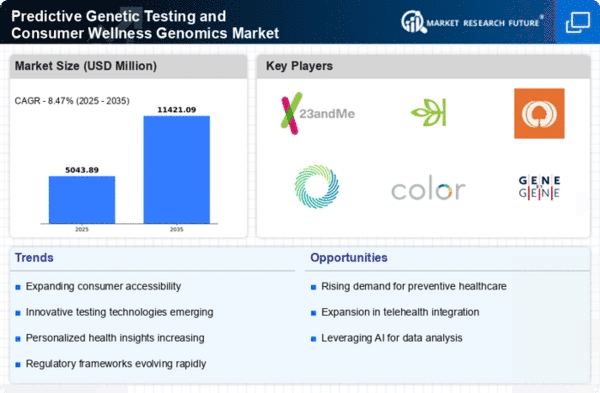
As per MRFR analysis, the Predictive Genetic Testing and Consumer Wellness Genomics Market was estimated at 4650.03 USD Million in 2024. The market is projected to grow from 5097.17 USD Million in 2025 to 11421.09 USD Million by 2035, exhibiting a compound annual growth rate (CAGR) of 8.47 during the forecast period 2025 - 2035.

Key Market Trends & Highlights

The Predictive Genetic Testing and Consumer Wellness Genomics Market is experiencing robust growth driven by technological advancements and increasing consumer engagement.

  • The market is witnessing a rise in personalized health solutions, catering to individual genetic profiles.
  • Technological integration is enhancing the accuracy and accessibility of genetic testing services.
  • Data privacy and security concerns are becoming paramount as consumers demand greater control over their genetic information.
  • Increasing consumer awareness and advancements in genetic technologies are driving the demand for disease risk assessment and direct-to-consumer testing, particularly in North America and the Asia-Pacific region.

Market Size & Forecast

2024 Market Size 4650.03 (USD Million)
2035 Market Size 11421.09 (USD Million)
CAGR (2025 - 2035) 8.47%
Largest Regional Market Share in 2024 North America

Major Players

<p>23andMe (US), Ancestry (US), MyHeritage (IL), Invitae (US), Color Genomics (US), Gene by Gene (US), Fulgent Genetics (US), Genetic Technologies (AU), Pathway Genomics (US)</p>

Market Trends

The Predictive Genetic Testing and Consumer Wellness Genomics Market is currently experiencing a notable evolution, driven by advancements in technology and increasing consumer awareness regarding health and wellness. This market encompasses a range of services that allow individuals to gain insights into their genetic predispositions, enabling proactive health management. As consumers become more health-conscious, the demand for personalized health solutions is rising, leading to a greater interest in genetic testing. Companies are responding by developing innovative products that cater to diverse consumer needs, from ancestry tracing to health risk assessments. Moreover, the integration of artificial intelligence and machine learning into genetic testing processes is enhancing the accuracy and efficiency of results. This technological progress not only improves the consumer experience but also fosters trust in the reliability of genetic information. As the market continues to expand, regulatory frameworks are evolving to ensure consumer protection and data privacy, which are critical for maintaining public confidence in genetic testing services. The future of the Predictive Genetic Testing and Consumer Wellness Genomics Market appears promising, with ongoing research and development likely to yield new opportunities for growth and innovation.

Rise of Personalized Health Solutions

There is a growing trend towards personalized health solutions within the Predictive Genetic Testing and Consumer Wellness Genomics Market. Consumers increasingly seek tailored health insights that align with their unique genetic profiles. This shift is prompting companies to develop more customized testing options, allowing individuals to make informed decisions about their health and wellness.

Technological Integration

The integration of advanced technologies, such as artificial intelligence and machine learning, is transforming the Predictive Genetic Testing and Consumer Wellness Genomics Market. These technologies enhance the accuracy of genetic analyses and streamline the testing process, thereby improving the overall consumer experience. As a result, consumers are more likely to trust and utilize these services.

Focus on Data Privacy and Security

As the Predictive Genetic Testing and Consumer Wellness Genomics Market expands, there is an increasing emphasis on data privacy and security. Consumers are becoming more aware of the importance of safeguarding their genetic information. Companies are therefore prioritizing robust data protection measures to build trust and ensure compliance with evolving regulatory standards.

Predictive Genetic Testing and Consumer Wellness Genomics Market Market Drivers

Market Segment Insights

By Application: Disease Risk Assessment (Largest) vs. Ancestry Testing (Fastest-Growing)

<p>The Predictive Genetic Testing and Consumer Wellness Genomics Market is segmented into various applications such as Disease Risk Assessment, Carrier Testing, Pharmacogenomics, Nutrigenomics, and Ancestry Testing. Among these, Disease Risk Assessment holds the largest share due to its pivotal role in preventive healthcare, allowing individuals to understand their genetic predispositions to certain health conditions. Ancestry Testing, although currently smaller in market share, is rapidly gaining traction as consumers increasingly seek to explore their roots and familial connections through genetic lineage testing.</p>

<p>Disease Risk Assessment (Dominant) vs. Ancestry Testing (Emerging)</p>

<p>Disease Risk Assessment is a dominant segment within the Predictive Genetic Testing market, providing critical insights into potential health risks based on genetic markers. This segment benefits significantly from healthcare providers and patients' focus on proactive health management. Conversely, Ancestry Testing is emerging as a popular choice among consumers interested in personal genealogy and heritage information. Its surge in demand is attributed to advancements in technology, making tests more accessible and cost-effective. The growing interest in familial connections among younger generations bolsters Ancestry Testing's position as a rapidly evolving segment, often driven by social media engagement and DNA sharing platforms.</p>

By End Use: Healthcare Providers (Largest) vs. Direct-to-Consumer (Fastest-Growing)

<p>The Predictive Genetic Testing and Consumer Wellness Genomics Market showcases diverse end-use segments. Healthcare Providers currently hold the largest share as they leverage genetic testing to enhance patient care, promoting precision medicine and personalized treatment plans. In contrast, the Direct-to-Consumer segment is rapidly gaining traction as consumers are increasingly inclined towards self-managed health solutions, promoting awareness and access to genetic insights. Growth trends in this segment are significantly influenced by the rise in health consciousness and technological advancements, enabling consumers and professionals alike. Healthcare Providers are adopting these technologies to expand service offerings, while Direct-to-Consumer pathways are benefiting from reduced costs and growing e-commerce platforms that facilitate easy access. This dynamic is fostering increased competition and innovation in the market, aligning with evolving consumer preferences and global health trends.</p>

<p>Healthcare Providers: Dominant vs. Direct-to-Consumer: Emerging</p>

<p>Healthcare Providers dominate the end use segment of the Predictive Genetic Testing and Consumer Wellness Genomics Market by integrating genetic testing into routine patient care. Their established relationships with patients enable them to utilize predictive genetics effectively, enhancing overall treatment outcomes and preventative strategies. On the other hand, the Direct-to-Consumer segment is emerging rapidly, facilitated by advancements in technology that empower consumers with genetic information for personal health decisions. This segment appeals to a growing demographic that prioritizes proactive health management, seeking convenience and accessibility via online platforms. Together, these two segments are shaping the future of the market, driven by the dual focus on personalized medicine and consumer empowerment.</p>

By Technology: Next Generation Sequencing (Largest) vs. PCR Technology (Fastest-Growing)

<p>In the Predictive Genetic Testing and Consumer Wellness Genomics Market, Next Generation Sequencing (NGS) holds the largest market share among various technologies, driven by its high throughput and cost-effectiveness. Microarray Technology and Sanger Sequencing follow, while Bioinformatics supports these techniques by managing and analyzing the massive data sets they generate. PCR Technology, known for its rapid processing capabilities, is increasingly gaining traction as an essential tool for genetic testing.</p>

<p>Technology: NGS (Dominant) vs. PCR (Emerging)</p>

<p>Next Generation Sequencing (NGS) is recognized as the dominant technology in predictive genetic testing, providing extensive genomic information with high accuracy, which is essential for comprehensive wellness assessments. In contrast, PCR Technology stands out as an emerging technique, notable for its speed and specificity in amplifying DNA sequences, making it indispensable for targeted testing. Both technologies cater to varying aspects of consumer wellness, with NGS focusing on large-scale sequencing and data analysis, while PCR addresses specific genetic tests reliably. The integration of bioinformatics is crucial in both cases, enhancing data interpretation and personalized health insights.</p>

By Sample Type: Blood Samples (Largest) vs. Saliva Samples (Fastest-Growing)

<p>In the Predictive Genetic Testing and Consumer Wellness Genomics Market, the distribution of sample types plays a crucial role in driving the industry's growth. Blood samples remain the largest segment, primarily due to their accuracy and reliability in genetic testing. Following closely are saliva samples, which have gained immense popularity owing to their convenience and non-invasive nature. Other sample types like tissue samples, buccal swabs, and urine samples also contribute to the market, albeit at a lesser scale, as they cater to specific testing requirements. The growth trends indicate a significant rise in the adoption of saliva samples as consumers seek less invasive options. This shift aligns with the industry's move towards personalized wellness genomics, driven by increasing consumer awareness and advancements in genetic technologies. The trend towards home-based testing solutions further boosts the demand for saliva tests, making it a favored choice for consumers. Meanwhile, blood samples continue to hold their value, especially in clinical and prenatal testing scenarios, securing their position as the dominant segment in the market.</p>

<p>Blood Samples (Dominant) vs. Saliva Samples (Emerging)</p>

<p>Blood samples are pivotal in the Predictive Genetic Testing and Consumer Wellness Genomics Market, offering the advantages of higher accuracy and a wider range of detectable genetic markers. This dominance is reinforced by their established use in clinical settings, particularly for prenatal and hereditary condition testing. However, their invasive nature has prompted a growing interest in alternative sample types. Conversely, saliva samples are emerging as a preferred choice for consumers seeking non-invasive testing solutions. Their ease of collection and the comfort they offer have intensified their adoption among direct-to-consumer genetic services. The accessibility and affordability of saliva samples make them particularly appealing in the consumer wellness sector, positioning them as a key competitor to traditional blood testing.</p>

By Test Type: Predictive Testing (Largest) vs. Newborn Screening (Fastest-Growing)

<p>The Predictive Genetic Testing and Consumer Wellness Genomics Market showcases diverse test types, with Predictive Testing holding the largest market share. This segment accounts for a significant portion of the market, as it enables individuals to understand their genetic predispositions to various health conditions. In contrast, segments like Newborn Screening are gaining traction, emphasizing early-stage genetic testing to identify potential health issues in infants. As awareness around genetic conditions increases, the demand for these testing methodologies rises.</p>

<p>Predictive Testing (Dominant) vs. Newborn Screening (Emerging)</p>

<p>Predictive Testing remains the dominant force in the Predictive Genetic Testing market, primarily due to its role in preemptive health management. This test type empowers individuals to make informed lifestyle choices by understanding their genetic vulnerabilities. Newborn Screening, however, is emerging rapidly as a crucial segment, recognizing the urgency of early diagnosis in preventing severe health complications. Parents increasingly prioritize these tests, propelled by advocacy for child health and wellness, thereby making this segment vital for future growth. Both types complement each other in providing holistic genetic insights.</p>

Get more detailed insights about Predictive Genetic Testing & Consumer/Wellness Genomics Market Research Report—Global Forecast till 2035

Regional Insights

North America : Market Leader in Innovation

North America continues to lead the Predictive Genetic Testing and Consumer Wellness Genomics Market, holding a significant market share of $2325.01M in 2025. The growth is driven by increasing consumer awareness, advancements in technology, and supportive regulatory frameworks. The demand for personalized health insights and preventive healthcare solutions is on the rise, further fueled by the integration of genetic testing in routine health assessments. The competitive landscape is robust, with key players like 23andMe, Ancestry, and Invitae dominating the market. The U.S. is the primary contributor, supported by a strong healthcare infrastructure and a high adoption rate of genetic testing services. The presence of innovative companies and ongoing research initiatives positions North America as a hub for advancements in genomics and personalized medicine.

Europe : Emerging Market with Growth Potential

Europe's Predictive Genetic Testing and Consumer Wellness Genomics Market is valued at $1150.0M in 2025, reflecting a growing interest in genetic testing among consumers. The market is driven by increasing health consciousness, regulatory support for genetic testing, and advancements in technology. Countries are implementing policies to promote genetic research and testing, enhancing accessibility and affordability for consumers. Leading countries in this region include Germany, the UK, and France, where significant investments in healthcare technology are being made. The competitive landscape features companies like MyHeritage and Color Genomics, which are expanding their services. The European market is characterized by a mix of established players and emerging startups, fostering innovation and collaboration in the genomics space.

Asia-Pacific : Rapidly Growing Market Segment

The Asia-Pacific region is witnessing a surge in the Predictive Genetic Testing and Consumer Wellness Genomics Market, valued at $850.0M in 2025. This growth is attributed to rising disposable incomes, increasing health awareness, and a growing population interested in preventive healthcare. Regulatory bodies are also beginning to recognize the importance of genetic testing, leading to more supportive policies and frameworks. Countries like Australia, Japan, and China are at the forefront of this market, with a growing number of companies entering the space. Key players such as Genetic Technologies and Fulgent Genetics are expanding their reach. The competitive landscape is evolving, with both local and international firms vying for market share, indicating a promising future for genetic testing in the region.

Middle East and Africa : Emerging Market with Unique Challenges

The Middle East and Africa region is gradually developing its Predictive Genetic Testing and Consumer Wellness Genomics Market, currently valued at $325.02M in 2025. The growth is driven by increasing awareness of genetic health issues and a rising demand for personalized healthcare solutions. However, challenges such as regulatory hurdles and limited access to advanced healthcare technologies persist, impacting market growth. Countries like South Africa and the UAE are leading the way in adopting genetic testing services. The competitive landscape is characterized by a mix of local and international players, with companies beginning to invest in the region. As awareness grows, the market is expected to expand, driven by both consumer demand and governmental support for healthcare initiatives.

Key Players and Competitive Insights

The Predictive Genetic Testing and Consumer Wellness Genomics Market is currently characterized by a dynamic competitive landscape, driven by technological advancements and increasing consumer awareness regarding health and wellness. Major players such as 23andMe (US), Ancestry (US), and Invitae (US) are at the forefront, each adopting distinct strategies to enhance their market positioning. 23andMe (US) focuses on innovation through its direct-to-consumer model, emphasizing user-friendly genetic testing kits that provide actionable health insights. Ancestry (US), on the other hand, leverages its extensive genealogical database to offer unique ancestry-related genetic testing, thereby creating a niche market. Invitae (US) is strategically positioned towards clinical applications, aiming to integrate genetic testing into routine healthcare, which reflects a broader trend towards personalized medicine. Collectively, these strategies contribute to a competitive environment that is increasingly centered on consumer engagement and technological integration.

In terms of business tactics, companies are increasingly localizing manufacturing and optimizing supply chains to enhance efficiency and reduce costs. The market structure appears moderately fragmented, with a mix of established players and emerging startups. This fragmentation allows for diverse offerings and innovation, although the collective influence of key players like 23andMe (US) and Ancestry (US) remains substantial, shaping market trends and consumer expectations.

In November 2025, 23andMe (US) announced a partnership with a leading health insurance provider to offer genetic testing as part of preventive health measures. This strategic move is likely to enhance accessibility to genetic testing, potentially increasing consumer adoption and reinforcing the company's position in the market. By integrating genetic insights into health insurance plans, 23andMe (US) not only broadens its customer base but also aligns itself with the growing trend of preventive healthcare.

In October 2025, Ancestry (US) launched a new feature that combines genetic testing with personalized health recommendations based on ancestry data. This initiative appears to deepen user engagement by providing tailored health insights, thereby enhancing the overall value proposition of its services. Such innovations may attract a broader audience, particularly those interested in both ancestry and health, further solidifying Ancestry's competitive edge.

In September 2025, Invitae (US) expanded its genetic testing portfolio by acquiring a smaller genomics company specializing in rare diseases. This acquisition seems to reflect Invitae's commitment to broadening its clinical applications and enhancing its service offerings. By integrating specialized tests for rare conditions, Invitae (US) positions itself as a comprehensive provider in the genetic testing landscape, catering to a wider range of consumer needs.

As of December 2025, current competitive trends in the market are heavily influenced by digitalization, sustainability, and the integration of artificial intelligence (AI) into testing processes. Strategic alliances among key players are shaping the landscape, fostering innovation and enhancing service delivery. Looking ahead, it appears that competitive differentiation will increasingly pivot from price-based strategies to a focus on innovation, technological advancements, and supply chain reliability. This shift suggests that companies that prioritize these elements may gain a significant advantage in the evolving market.

Key Companies in the Predictive Genetic Testing and Consumer Wellness Genomics Market include

Industry Developments

    • In June 2021, Bio-Rad Laboratories, Inc. (US), Bioaster (France), and Genetic Analysis (Norway) partnered to provide genetic metabolic disorders on the microbiome. This augments the growth of the predictive genetic testing & consumer/wellness genomics
    • In August 2020, Thermo Fischer Scientific introduced an Oncomine Myeloid Assay GX that enables users to identify biomarkers associated with myeloproliferative neoplasm by detecting over 600 fusion isotypes. This product has contributed to the market's expansion.
    • In July 2020, 23andMe, Inc (California) collaborated with the giant GlaxoSmithKline (UK) to provide a genetic database of approximately ten million populations searching for cancer information. This added value and further fuels the growth of the predictive genetic testing & consumer/wellness genomics
    • In February 2020, Bureau Gravimétrique International (China) signed an agreement with giant distributors in Brazil, Argentina, Peru, Ecuador, Colombia, and Mexico. The partnership paves the way for the company to extend its DNA sequencing and laboratory automation offerings in Latin America.
    • In June 2019, Thermo Fisher Scientific Inc. (US) entered into a global research collaboration with predictive laboratories to concentrate on women's infertility via genetic factors. It is taking advantage of the market's apex.

Future Outlook

Predictive Genetic Testing and Consumer Wellness Genomics Market Future Outlook

<p>The Predictive Genetic Testing and Consumer Wellness Genomics Market is projected to grow at an 8.47% CAGR from 2024 to 2035, driven by technological advancements and increasing consumer awareness.</p>

New opportunities lie in:

  • <p>Development of personalized wellness plans based on genetic insights.</p>
  • <p>Expansion of telehealth services integrating genetic testing.</p>
  • <p>Partnerships with fitness and nutrition apps for tailored recommendations.</p>

<p>By 2035, the market is expected to be robust, driven by innovation and consumer demand.</p>

Market Segmentation

Predictive Genetic Testing and Consumer Wellness Genomics Market End Use Outlook

  • Healthcare Providers
  • Research Institutions
  • Direct-to-Consumer
  • Pharmaceutical Companies
  • Wellness Centers

Predictive Genetic Testing and Consumer Wellness Genomics Market Test Type Outlook

  • Predictive Testing
  • Diagnostic Testing
  • Carrier Testing
  • Prenatal Testing
  • Newborn Screening

Predictive Genetic Testing and Consumer Wellness Genomics Market Technology Outlook

  • Next Generation Sequencing
  • Microarray Technology
  • Sanger Sequencing
  • PCR Technology
  • Bioinformatics

Predictive Genetic Testing and Consumer Wellness Genomics Market Application Outlook

  • Disease Risk Assessment
  • Carrier Testing
  • Pharmacogenomics
  • Nutrigenomics
  • Ancestry Testing

Predictive Genetic Testing and Consumer Wellness Genomics Market Sample Type Outlook

  • Blood Samples
  • Saliva Samples
  • Tissue Samples
  • Buccal Swabs
  • Urine Samples

Report Scope

MARKET SIZE 20244650.03(USD Million)
MARKET SIZE 20255097.17(USD Million)
MARKET SIZE 203511421.09(USD Million)
COMPOUND ANNUAL GROWTH RATE (CAGR)8.47% (2024 - 2035)
REPORT COVERAGERevenue Forecast, Competitive Landscape, Growth Factors, and Trends
BASE YEAR2024
Market Forecast Period2025 - 2035
Historical Data2019 - 2024
Market Forecast UnitsUSD Million
Key Companies Profiled23andMe (US), Ancestry (US), MyHeritage (IL), Invitae (US), Color Genomics (US), Gene by Gene (US), Fulgent Genetics (US), Genetic Technologies (AU), Pathway Genomics (US)
Segments CoveredApplication, End Use, Technology, Sample Type, Test Type
Key Market OpportunitiesIntegration of artificial intelligence in predictive genetic testing enhances personalized consumer wellness solutions.
Key Market DynamicsRising consumer demand for personalized health insights drives innovation and competition in predictive genetic testing and wellness genomics.
Countries CoveredNorth America, Europe, APAC, South America, MEA

FAQs

How Big is the Predictive Genetic Testing & Consumer/Wellness Genomics market?

The global predictive genetic testing &amp; consumer/wellness genomics market size is expected to reach USD 5.4 billion by 2032 at 11.2% CAGR during the forecast period (2023 - 2032)

Who are the key competitors in the market of Predictive Genetic Testing & Consumer/Wellness Genomics?

23andMe, Inc. (California), Myriad Genetics, Inc. (US), F. Hoffmann-La Roche Ltd. (Switzerland), Abbott Laboratories (US), Genesis Genetics (US), Agilent Technologies (US), Thermo Fisher Scientific, Inc. (US), Bureau Gravimétrique International (China), Bio-Rad Laboratories Inc. (US), Illumina, Inc. (US), Counsyl, Inc. (California), ARUP Laboratories (US) are the key competitors in the market of Predictive Genetic Testing &amp; Consumer/Wellness Genomics.

Which region is predicted to have the largest market share of Predictive Genetic Testing & Consumer/Wellness Genomics?

North America holds the largest share in the global market of Predictive Genetic Testing &amp; Consumer/Wellness Genomics

What are the key factors driving the market of Predictive Genetic Testing & Consumer/Wellness Genomics?

Usage of predictive genetic testing &amp; consumer/wellness genomics in various applications and Rising R&amp;D initiatives for novel therapeutics are the key factors driving the market of Predictive Genetic Testing &amp; Consumer/Wellness Genomics.

Which factors may act as market deterrents Predictive Genetic Testing & Consumer/Wellness Genomics?

High cost of genomic research instruments and Inadequate funding and lack of trained professionals may act as market deterrents Predictive Genetic Testing &amp; Consumer/Wellness Genomics

  1. SECTION I: EXECUTIVE SUMMARY AND KEY HIGHLIGHTS
    1. | 1.1 EXECUTIVE SUMMARY
  2. SECTION II: SCOPING, METHODOLOGY AND MARKET STRUCTURE
    1. | 2.1 MARKET INTRODUCTION
    2. | 2.2 RESEARCH METHODOLOGY
  3. SECTION III: QUALITATIVE ANALYSIS
    1. | 3.1 MARKET DYNAMICS
    2. | 3.2 MARKET FACTOR ANALYSIS
  4. SECTION IV: QUANTITATIVE ANALYSIS
    1. | 4.1 Healthcare, BY Application (USD Million)
    2. | 4.2 Healthcare, BY End Use (USD Million)
    3. | 4.3 Healthcare, BY Technology (USD Million)
    4. | 4.4 Healthcare, BY Sample Type (USD Million)
    5. | 4.5 Healthcare, BY Test Type (USD Million)
    6. | 4.6 Healthcare, BY Region (USD Million)
  5. SECTION V: COMPETITIVE ANALYSIS
    1. | 5.1 Competitive Landscape
    2. | 5.2 Company Profiles
    3. | 5.3 Appendix

Predictive Genetic Testing & Consumer/Wellness Genomics Market Segmentation

Market Segmentation Overview

  • Detailed segmentation data will be available in the full report
  • Comprehensive analysis by multiple parameters
  • Regional and country-level breakdowns
  • Market size forecasts by segment
Infographic

Free Sample Request

Kindly complete the form below to receive a free sample of this Report

Get Free Sample

Customer Strories

Compare Licence

×
Features License Type
Single User Multiuser License Enterprise User
Price $4,950 $5,950 $7,250
Maximum User Access Limit 1 User Upto 10 Users Unrestricted Access Throughout the Organization
Free Customization
Direct Access to Analyst
Deliverable Format
Platform Access
Discount on Next Purchase 10% 15% 15%
Printable Versions