North America : Market Leader in Innovation
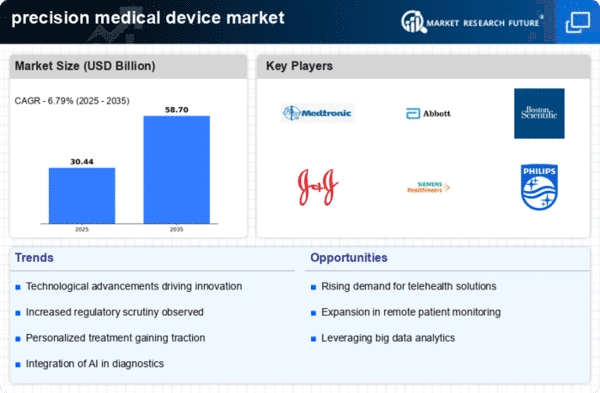
North America continues to lead the precision medical device market, holding a significant share of 14.25 in 2025. The region's growth is driven by advanced healthcare infrastructure, increasing demand for minimally invasive procedures, and a strong focus on R&D. Regulatory support from agencies like the FDA further catalyzes innovation, ensuring rapid approval of new technologies. The aging population and rising chronic diseases also contribute to market expansion.
The competitive landscape is robust, with key players such as Medtronic, Abbott Laboratories, and Boston Scientific dominating the market. The U.S. remains the largest contributor, supported by significant investments in healthcare technology. Companies are increasingly focusing on partnerships and acquisitions to enhance their product offerings and expand market reach. This dynamic environment positions North America as a hub for precision medical device advancements.
Europe : Emerging Regulatory Frameworks
Europe's precision medical device market is projected to reach 7.5 by 2025, driven by increasing healthcare expenditures and a growing emphasis on patient-centric solutions. The region is witnessing a shift towards innovative technologies, supported by regulatory frameworks like the EU Medical Device Regulation (MDR), which aims to enhance safety and efficacy. This regulatory environment encourages manufacturers to invest in advanced technologies, fostering market growth.
Leading countries such as Germany, France, and the UK are at the forefront of this market, with a strong presence of key players like Siemens Healthineers and Philips. The competitive landscape is characterized by a mix of established companies and emerging startups, focusing on cutting-edge solutions. The collaboration between public and private sectors is vital for driving innovation and ensuring compliance with stringent regulations, positioning Europe as a significant player in the global market.
Asia-Pacific : Rapid Growth and Adoption
The Asia-Pacific region is experiencing rapid growth in the precision medical device market, projected to reach 5.0 by 2025. Factors such as increasing healthcare access, rising disposable incomes, and a growing elderly population are driving demand. Additionally, government initiatives to improve healthcare infrastructure and promote medical technology innovation are significant catalysts for market expansion. The region's diverse healthcare needs also encourage the adoption of tailored medical solutions.
Countries like Japan, China, and India are leading the charge, with a mix of local and international players like Terumo Corporation and GE Healthcare. The competitive landscape is evolving, with companies focusing on strategic partnerships and technological advancements to capture market share. As the region continues to invest in healthcare, the precision medical device market is poised for substantial growth, reflecting the increasing importance of advanced medical technologies.
Middle East and Africa : Untapped Market Opportunities
The Middle East and Africa (MEA) region is gradually emerging in the precision medical device market, with a projected size of 2.75 by 2025. The growth is primarily driven by increasing healthcare investments, rising awareness of advanced medical technologies, and government initiatives aimed at improving healthcare access. The region's diverse demographics and rising prevalence of chronic diseases are also contributing to the demand for precision medical devices.
Countries like South Africa and the UAE are leading the market, with a growing presence of both local and international players. The competitive landscape is characterized by a mix of established companies and new entrants, focusing on innovative solutions tailored to regional needs. As healthcare systems evolve, the MEA region presents significant opportunities for growth in the precision medical device sector, attracting investments and fostering innovation.