Pre-engineered Buildings Market (2026 - 2035)

ID: MRFR/PCM/0796-CR 100 Pages Harshita Gorde Last Updated: November 23, 2026
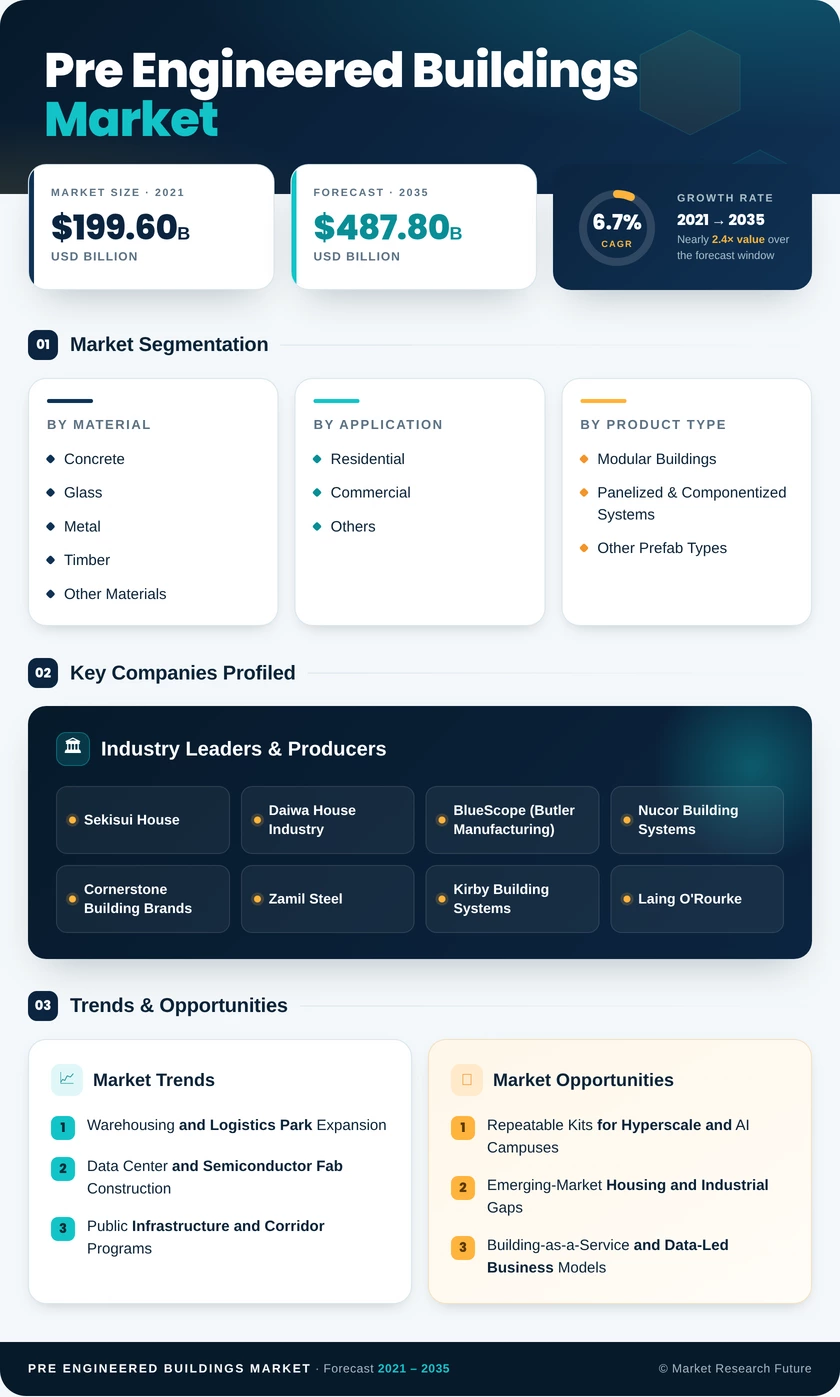
Pre-Engineered Buildings Market Research Report Information By Material (Concrete, Glass, Metal, Timber, and Other Materials (Composite and Sandwich Panels)), By Application (Residential, Commercial, and Others (Education, Healthcare, and Industrial Facilities)), By Product Type (Modular Buildings, Panelized and Componentized Systems, and Other Prefab Types (Bathroom Pods, Frame Kits, and Hybrid Systems)), And By Region (North America, Europe, Asia-Pacific, and Rest of the World) – Market Forecast Till 2035.
Pre-engineered Buildings Market
Market Size
Forecast Period2026-2035
CAGR (2026-2035)6.7%
2025 Market SizeUSD 255.0 Billion
2035 Market SizeUSD 487.8 Billion
Key Players
Sekisui House
Daiwa House Industry
BlueScope
Nucor Building Systems
Cornerstone Building Brands
Zamil Steel
Opportunities
  • Repeatable Kits for Hyperscale and AI Campuses
  • Emerging-Market Housing and Industrial Gaps
  • Building-as-a-Service and Data-Led Business Models
  1. 1 Market Summary | |
  2. 2 Key Report Takeaways | |
    1. 2.1 By Material | |
    2. 2.2 By Application | |
    3. 2.3 By Product Type | |
    4. 2.4 By Structure | |
    5. 2.5 By Region | |
  3. 3 Market Size and Forecast (2021–2035) | |
  4. 4 Driver Impact Analysis | |
    1. 4.1 Warehousing and Logistics Park Expansion | |
    2. 4.2 Data Center and Semiconductor Fab Construction | |
    3. 4.3 Public Infrastructure and Corridor Programs | |
    4. 4.4 Skilled-Labor Shortages and Schedule Pressure | |
    5. 4.5 Low-Embodied-Carbon Procurement Rules | |
    6. 4.6 Affordable and Social Housing Programs | |
  5. 5 Restraints Impact Analysis | |
    1. 5.1 Steel and Cement Price Volatility | |
    2. 5.2 High Factory Capital Intensity and Manufacturer Failures | |
    3. 5.3 Transport Limits for Volumetric Units | |
    4. 5.4 Fragmented Building Codes and Approvals | |
    5. 5.5 Lending and Insurance Hurdles | |
  6. 6 Opportunities | |
    1. 6.1 Repeatable Kits for Hyperscale and AI Campuses | |
    2. 6.2 Emerging-Market Housing and Industrial Gaps | |
    3. 6.3 Building-as-a-Service and Data-Led Business Models | |
    4. 6.4 Circular Design, Reuse and Vertical Extensions | |
    5. 6.5 Mass-Timber Hybrid Systems | |
  7. 7 Regional Market Share and Country-Level Analysis | |
    1. 7.1 North America | | |
      1. 7.1.1 US | | |
      2. 7.1.2 Canada | | |
      3. 7.1.3 Mexico | |
    2. 7.2 Europe | | |
      1. 7.2.1 Germany | | |
      2. 7.2.2 UK | | |
      3. 7.2.3 France | | |
      4. 7.2.4 Italy | | |
      5. 7.2.5 Spain | | |
      6. 7.2.6 Nordic Countries | | |
      7. 7.2.7 Russia | | |
      8. 7.2.8 Rest of Europe | |
    3. 7.3 Asia-Pacific | | |
      1. 7.3.1 China | | |
      2. 7.3.2 India | | |
      3. 7.3.3 Japan | | |
      4. 7.3.4 South Korea | | |
      5. 7.3.5 ASEAN | | |
      6. 7.3.6 Rest of Asia-Pacific | |
    4. 7.4 South America | | |
      1. 7.4.1 Brazil | | |
      2. 7.4.2 Argentina | | |
      3. 7.4.3 Rest of South America | |
    5. 7.5 Middle East and Africa | | |
      1. 7.5.1 Saudi Arabia | | |
      2. 7.5.2 UAE | | |
      3. 7.5.3 South Africa | | |
      4. 7.5.4 Egypt | | |
      5. 7.5.5 Rest of Middle East and Africa | |
  8. 8 Future Outlook (2026–2035) | |
    1. 8.1 Design Automation and Robotic Fabrication | |
    2. 8.2 Platform-Based Procurement | |
    3. 8.3 Decarbonization of Steel and Cement | |
    4. 8.4 Energy-Ready Envelopes | |
  9. 9 Segmentation Analysis | |
    1. 9.1 By Material | | |
      1. 9.1.1 Concrete | | |
      2. 9.1.2 Glass | | |
      3. 9.1.3 Metal | | |
      4. 9.1.4 Timber | | |
      5. 9.1.5 Other Materials | |
    2. 9.2 By Application | | |
      1. 9.2.1 Residential | | |
      2. 9.2.2 Commercial | | |
      3. 9.2.3 Others | |
    3. 9.3 By Product Type | | |
      1. 9.3.1 Modular Buildings | | |
      2. 9.3.2 Panelized & Componentized Systems | | |
      3. 9.3.3 Other Prefab Types | |
    4. 9.4 By Structure | | |
      1. 9.4.1 Single-Story | | |
      2. 9.4.2 Multi-Story | |
  10. 10 Competitive Landscape | |
    1. 10.1 Market Concentration Overview | |
    2. 10.2 Competitive Benchmarking | |
  11. 11 Recent News & Developments | |
  12. 12 Report Scope and Methodology | |
  13. 13 Detailed Sources and Citations | |
  14. 14 Frequently Asked Questions (FAQs) | | LIST OF TABLES | |
  15. TABLE 1 Market Summary Snapshot, 2025–2035 | |
  16. TABLE 2 Global Market Size and Forecast, by Revenue (USD Billion), 2021–2035 | |
  17. TABLE 3 Driver Impact Analysis | |
  18. TABLE 4 Restraints Impact Analysis | |
  19. TABLE 5 Regional Summary, 2025 | |
  20. TABLE 6 North America Market, by Country, 2025 | |
  21. TABLE 7 Europe Market, by Country, 2025 | |
  22. TABLE 8 Asia-Pacific Market, by Country, 2025 | |
  23. TABLE 9 South America Market, by Country, 2025 | |
  24. TABLE 10 Middle East and Africa Market, by Country, 2025 | |
  25. TABLE 11 Global Market, by Material, 2025 | |
  26. TABLE 12 Global Market, by Application, 2025 | |
  27. TABLE 13 Global Market, by Product Type, 2025 | |
  28. TABLE 14 Competitive Benchmarking Matrix | |
  29. TABLE 15 Report Scope and Methodology | |
  30. TABLE 16 Detailed Sources and Citations | |
  31. TABLE 17 Segmentation Quick Reference | | LIST OF FIGURES | |
  32. FIGURE 1 Market Dynamics Overview — Drivers, Restraints and Opportunities | |
  33. FIGURE 2 Industry Value Chain Analysis | |
  34. FIGURE 3 Porter's Five Forces Analysis | |
  35. FIGURE 4 Global Market Size Trend (USD Billion), 2021–2035 | |
  36. FIGURE 5 Market Share by Material, 2025 | |
  37. FIGURE 6 Market Share by Application, 2025 | |
  38. FIGURE 7 Market Share by Product Type, 2025 | |
  39. FIGURE 8 Regional Market Share, 2025 | |
  40. FIGURE 9 Regional Growth Comparison, 2026–2035 | |
  41. FIGURE 10 Competitive Landscape Positioning Map

Segmentation Quick Reference

DimensionSub-SegmentsDominant SegmentFastest Growing Segment
By MaterialConcrete, Glass, Metal, Timber, Other MaterialsConcrete (37.6% share)Timber (8.5% CAGR)
By ApplicationResidential, Commercial, OthersResidential (53.4% share)Commercial (8.6% CAGR)
By Product TypeModular Buildings, Panelized & Componentized Systems, Other Prefab TypesModular Buildings (8.9% CAGR)Modular Buildings (8.9% CAGR)
By RegionNorth America, Europe, Asia-Pacific, South America, Middle East and AfricaNorth America (33.8% share)Asia-Pacific (8.4% CAGR)

Market Segmentation Overview

By Material

Sub-SegmentKey Trend
ConcreteUltra-high-performance precast enabling thinner, lighter panels
GlassUnitized curtain-wall systems for commercial facades
MetalNon-combustible frames for data centers and hospitals
TimberCross-laminated panels approved for taller buildings
Other MaterialsFiber-reinforced and hybrid sandwich panels

Concrete leads the material mix because precast elements meet the fire and acoustic standards that institutional owners require. Timber grows fastest as the 2024 code update permits taller mass-timber structures and lenders reward lower embodied carbon. Metal remains the choice wherever non-combustible clear spans are mandatory.

By Application

Sub-SegmentKey Trend
ResidentialFactory-built homes scaling through public housing programs
CommercialRepeatable modules for data centers and cold storage
OthersStandard designs for schools, clinics and plant buildings

Residential leads on volume, supported by manufactured housing in North America and programs such as PMAY-Urban 2.0 in India. Commercial grows fastest because data center and cold-storage operators need capacity commissioned in weeks, and repeatable modules let them align construction with power availability.

By Product Type

Sub-SegmentKey Trend
Modular BuildingsFully fitted volumetric units with laser-checked tolerances
Panelized & Componentized SystemsFlat-packed cassettes for long-distance shipping
Other Prefab TypesBathroom pods and hybrid frame kits

Modular Buildings lead and grow fastest, since finished units cut on-site labor and bring forward occupancy for hotels, housing and healthcare. Panelized & Componentized Systems hold ground where shipping distance or crane access makes volumetric delivery uneconomic, and they travel more efficiently across borders.


Download PDF ×

We do not share your information with anyone. However, we may send you emails based on your report interest from time to time. You may contact us at any time to opt-out.