Request Free Sample ×

Kindly complete the form below to receive a free sample of this Report

* Please use a valid business email

Leading companies partner with us for data-driven Insights

clients tt-cursor
Hero Background
English
Chinese
French
Japanese
Korean
German
Spanish

Polyolefin Battery Separator Films Market Share

ID: MRFR/CnM/9954-CR
110 Pages
Garvit Vyas
Last Updated: April 06, 2026

Polyolefin Battery Separator Films Market Research Report Information by Material Type (Polyethylene, Polypropylene, Others), Battery Type (Li-ion, Lead Acid, Nickel-Cadmium, Nickel -Metal Hydride, Others), End-Use (Automotive, Consumer Electronics, Electric Power Storage), and by Region (North America, Europe, Asia Pacific, Latin America, Middle East, and Africa) Forecast Till 2035

Share:
Download PDF ×

We do not share your information with anyone. However, we may send you emails based on your report interest from time to time. You may contact us at any time to opt-out.

Polyolefin Battery Separator Films Market Infographic
Purchase Options

Market Share

Polyolefin Battery Separator Films Market Share Analysis

It has experienced a surge in demand, given its role as a key component of the growing electric vehicle (EV) and energy storage sectors. Many companies have realized that gaining competitive advantage involves positioning oneself well in terms of market share. One way is through product innovation to create differentiation among others, while another would be to attain cost leadership whereby firms concentrate on improving production processes through reducing manufacturing costs, thus achieving economies of scale. As such, companies can develop low-cost polyolefin battery separator films, which will still ensure effectiveness, enabling them to attract price-sensitive customers and potentially giving them a competitive edge. Thus, this approach calls for effective supply chain management supported by investments into technology as well as continuous improvement so as to balance between cost reduction and quality control which becomes more complex in a globalized market. Market segmentation is an indispensable strategy for companies in the polyolefin battery separator films market. Companies can enter niche markets and gain a competitive edge by identifying specific target markets and developing products to meet different applications. This approach requires understanding the diverse needs of customers within different industries, such as electric vehicles, consumer electronics, and renewable energy storage, so as to tailor product offerings accordingly. The polyolefin battery separator films market is moving towards cooperation and alliances among the major players involved. For instance, collaboration with manufacturing firms, research institutions, or technology providers helps to leverage complementary strengths, share resources, and solve the market challenges that exist collectively. Again, geographical expansion is another significant strategy in the polyolefin battery separator film segment. As global demand for electric cars rises alongside energy storage solutions, companies are looking forward to new markets to expand their operations. Establishing strongholds in emerging economies' regions or those with the potential for quick growth enables such firms to attract new opportunities and enlarge their presence in a given country or region. It may involve setting up production plants, distribution channels, or local arrangements to address unique regional specifications.

Author
Author Profile
Garvit Vyas
Vice President - Operations

Garvit Vyas is a Research Analyst with experience in working across multiple industry domains in the market research sector. Over the past four years, he has been actively involved in analyzing diverse markets, gathering industry insights, and contributing to the development of comprehensive research reports. His work includes studying market trends, evaluating competitive landscapes, and supporting data-driven business insights. In the early phase of his career, Garvit worked on cross-domain research projects, which helped him build a strong foundation in market analysis, data interpretation, and industry intelligence across various sectors. Later, he transitioned into the Quality Control (QC) function, where he focuses on reviewing and refining research reports and marketing collaterals to ensure accuracy, consistency, and high editorial standards. His responsibilities include validating research data, improving report structure, and maintaining the overall quality of published content. Garvit is committed to maintaining strong research integrity and delivering reliable insights that support informed business decision-making.

Leave a Comment

FAQs

What is the projected market valuation of the Polyolefin Battery Separator Films Market by 2035?

<p>The market is projected to reach a valuation of 10,317.81 USD Billion by 2035.</p>

What was the overall market valuation of the Polyolefin Battery Separator Films Market in 2024?

<p>In 2024, the overall market valuation was 2,676.77 USD Billion.</p>

What is the expected CAGR for the Polyolefin Battery Separator Films Market during the forecast period 2025 - 2035?

<p>The expected CAGR for the market during the forecast period is 13.05%.</p>

Which materials dominate the Polyolefin Battery Separator Films Market?

<p>Polyethylene and polypropylene are the dominant materials, with valuations of 4,000.0 USD Billion and 4,800.0 USD Billion, respectively.</p>

What are the key battery types utilizing Polyolefin Battery Separator Films?

<p>Key battery types include Li-ion, which is valued at 5,320.0 USD Billion, and Lead Acid, valued at 3,200.0 USD Billion.</p>

What end-use segments are driving the demand for Polyolefin Battery Separator Films?

<p>The automotive segment, including electric vehicles, is a major driver, with a valuation of 4,517.81 USD Billion.</p>

Who are the leading companies in the Polyolefin Battery Separator Films Market?

<p>Key players include Mitsubishi Chemical, Asahi Kasei, and Toray Industries, among others.</p>

What is the valuation of the Electric Power Storage segment in the Polyolefin Battery Separator Films Market?

<p>The Electric Power Storage segment is valued at 3,600.0 USD Billion.</p>

How does the valuation of Nickel-Cadmium batteries compare to other battery types?

<p>Nickel-Cadmium batteries have a valuation of 1,200.0 USD Billion, which is lower than Li-ion and Lead Acid batteries.</p>

What is the projected growth trend for the Polyolefin Battery Separator Films Market?

<p>The market is expected to experience robust growth, driven by increasing demand across various applications.</p>

Market Summary

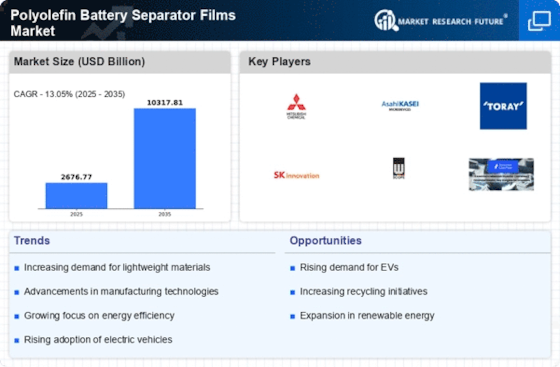
As per Market Research Future analysis, the The Polyolefin Battery Separator Films Market. Size was estimated at 2676.77 USD Billion in 2024. The Polyolefin Battery Separator Films industry is projected to grow from 3026.09 USD Billion in 2025 to 10317.81 USD Billion by 2035, exhibiting a compound annual growth rate (CAGR) of 13.05% during the forecast period 2025 - 2035

Key Market Trends & Highlights

The Polyolefin Battery Separator Films Market is poised for substantial growth driven by technological advancements and increasing demand across various sectors.

  • The market experiences rising demand for electric vehicles, particularly in North America, which is currently the largest market. Technological advancements in battery design are fostering innovation, especially in the Asia-Pacific region, recognized as the fastest-growing market. Sustainable manufacturing practices are becoming a focal point, influencing both production methods and consumer preferences. The increasing adoption of renewable energy storage and regulatory support for electric vehicle infrastructure are key drivers propelling market expansion.

Market Size & Forecast

2024 Market Size 2676.77 (USD Billion)
2035 Market Size 10317.81 (USD Billion)
CAGR (2025 - 2035) 13.05%
Largest Regional Market Share in 2024 Asia Pacific

Major Players

Mitsubishi Chemical (JP), Asahi Kasei (JP), Toray Industries (JP), SK Innovation (KR), W-Scope (JP), Cangzhou Mingzhu Plastic (CN), Zhejiang Sihua (CN), Shenzhen Ruitai (CN), Dongguan Sanyou (CN)

Market Trends

The Polyolefin Battery Separator Films Market is currently experiencing a notable transformation, driven by the increasing demand for advanced energy storage solutions. This market encompasses a variety of applications, particularly in electric vehicles and consumer electronics, where the need for efficient and reliable battery performance is paramount. As manufacturers strive to enhance the safety and longevity of batteries, the role of separator films becomes increasingly critical. These films serve as a barrier between the anode and cathode, preventing short circuits while allowing the flow of ions, thus ensuring optimal battery functionality. In recent years, the emphasis on sustainability and environmental considerations has also influenced the Polyolefin Battery Separator Films Market. Companies are exploring innovative materials and production methods that minimize ecological impact while maintaining high performance standards. This shift towards greener alternatives reflects a broader trend within the energy sector, where stakeholders are increasingly prioritizing eco-friendly solutions. As the market evolves, it appears poised for growth, with ongoing advancements in technology and materials likely to shape its future trajectory. The interplay between performance, safety, and sustainability will continue to define the competitive landscape of this market.

Rising Demand for Electric Vehicles

The growing popularity of electric vehicles is significantly influencing the Polyolefin Battery Separator Films Market. As more consumers and manufacturers prioritize sustainable transportation, the need for high-performance battery components, including separator films, is expected to increase. This trend suggests a shift towards more efficient energy storage solutions.

Technological Advancements in Battery Design

Innovations in battery technology are driving changes within the Polyolefin Battery Separator Films Market. Enhanced designs and materials are being developed to improve battery efficiency and safety. These advancements indicate a potential for increased performance and longevity of batteries, which could reshape market dynamics.

Focus on Sustainable Manufacturing Practices

There is a growing emphasis on sustainability within the Polyolefin Battery Separator Films Market. Manufacturers are increasingly adopting eco-friendly materials and processes to reduce environmental impact. This trend reflects a broader commitment to sustainability in the energy sector, potentially influencing consumer preferences and regulatory frameworks.

Polyolefin Battery Separator Films Market Market Drivers

Surge in Consumer Electronics Production

The proliferation of consumer electronics, such as smartphones, laptops, and tablets, has significantly influenced the Polyolefin Battery Separator Films Market. As these devices require compact and efficient batteries, the demand for advanced battery separators is on the rise. The consumer electronics market is expected to grow at a CAGR of 5% from 2023 to 2028, which could translate into increased demand for polyolefin battery separators. These films are essential for ensuring safety and performance in lithium-ion batteries, which are widely used in consumer electronics. Consequently, the growth in this sector is likely to drive the Polyolefin Battery Separator Films Market forward, as manufacturers seek to enhance battery performance and safety.

Increasing Adoption of Renewable Energy Storage

The transition towards renewable energy sources has led to a heightened demand for efficient energy storage solutions. Polyolefin Battery Separator Films Market plays a crucial role in enhancing the performance of batteries used in renewable energy systems. As energy storage becomes essential for balancing supply and demand, the need for high-quality battery separators is likely to grow. The market for energy storage systems is projected to reach USD 200 billion by 2026, indicating a robust growth trajectory. This trend suggests that the Polyolefin Battery Separator Films Market will benefit from the increasing investments in renewable energy projects, as these films are integral to the efficiency and longevity of energy storage solutions.

Technological Innovations in Battery Manufacturing

Advancements in battery technology are reshaping the landscape of the Polyolefin Battery Separator Films Market. Innovations such as solid-state batteries and enhanced lithium-ion technologies require high-performance separators to ensure optimal functionality. The Polyolefin Battery Separator Films Market is anticipated to reach USD 120 billion by 2025, with a substantial portion attributed to the demand for advanced separators. These innovations not only improve battery efficiency but also enhance safety, which is paramount in applications ranging from electric vehicles to consumer electronics. As manufacturers continue to invest in research and development, the Polyolefin Battery Separator Films Market is poised to benefit from these technological advancements, leading to improved product offerings and market expansion.

Growing Focus on Energy Efficiency and Sustainability

The increasing emphasis on energy efficiency and sustainable practices is influencing the Polyolefin Battery Separator Films Market. As industries and consumers alike prioritize sustainability, the demand for eco-friendly battery solutions is rising. Polyolefin battery separators are often favored for their recyclability and lower environmental impact compared to traditional materials. The market for sustainable battery technologies is expected to grow significantly, with projections indicating a potential increase of 15% annually through 2027. This trend suggests that manufacturers in the Polyolefin Battery Separator Films Market will need to adapt to changing consumer preferences and regulatory requirements, positioning themselves as leaders in sustainable battery solutions.

Regulatory Support for Electric Vehicle Infrastructure

Government initiatives aimed at promoting electric vehicles (EVs) are creating a favorable environment for the Polyolefin Battery Separator Films Market. Various countries are implementing policies to support EV adoption, including tax incentives and infrastructure development. The EV market is projected to grow at a CAGR of 22% through 2030, which suggests a substantial increase in demand for batteries and, consequently, battery separators. Polyolefin battery separators are essential for the performance and safety of EV batteries, making them a critical component in this rapidly expanding market. As regulatory frameworks continue to evolve, the Polyolefin Battery Separator Films Market is likely to experience significant growth driven by the increasing production of EVs.

Market Segment Insights

By Material: Polyethylene (Largest) vs. Polypropylene (Fastest-Growing)

<p>In the Polyolefin Battery Separator Films Market, the distribution of market share among the key materials reveals that Polyethylene holds the largest share, attributed to its extensive use in various battery applications due to its superior barrier properties and thermal stability. Conversely, Polypropylene is emerging as the fastest-growing segment, driven by advancements that enhance its mechanical properties and performance, making it an attractive choice for high-performance batteries. Other materials, while present, contribute significantly less to the overall market share, highlighting the dominance of these two compounds.</p>

<p>Material: Polyethylene (Dominant) vs. Polypropylene (Emerging)</p>

<p>Polyethylene has established itself as the dominant material in the Polyolefin Battery Separator Films Market due to its excellent chemical resistance and processing capabilities, which make it suitable for a wide range of battery types. It is favored for its ability to withstand demanding conditions, thus ensuring the longevity and efficiency of batteries. On the other hand, Polypropylene is recognized as an emerging material, gaining momentum thanks to its lightweight nature and new formulations that improve its performance. The climb in demand for electric vehicles and portable electronics has intensified interest in Polypropylene, as it offers a great balance of cost and performance, positioning it as a viable alternative in high-tech applications.</p>

By Battery Type: Li-ion (Largest) vs. Lead Acid (Fastest-Growing)

<p>The Polyolefin Battery Separator Films Market exhibits a notable distribution of market shares among various battery types. Li-ion batteries currently dominate the segment, largely due to their wide-ranging applications in consumer electronics and electric vehicles. Following Li-ion, Lead Acid batteries hold a significant portion of the market, although they are increasingly faced with competition from newer technology. Nickel-Cadmium and Nickel-Metal Hydride batteries account for a smaller share, reflecting more specialized uses within the industry. Thus, the Li-ion segment stands out as the principal contributor to the overall growth of the market. Growth trends in this segment indicate that the Li-ion battery continues to thrive thanks to advancements in technology and rising demand in electric mobility. Additionally, Lead Acid batteries are witnessing a resurgence in the automotive sector, driven by innovations that enhance their performance and reduce costs. The increasing focus on sustainability and eco-friendly solutions is further propelling the adoption of Nickel-Metal Hydride batteries, while Nickel-Cadmium remains niche but stable within specific applications that require reliability and efficiency.</p>

<p>Li-ion (Dominant) vs. Nickel-Cadmium (Emerging)</p>

<p>In the dynamic landscape of the Polyolefin Battery Separator Films Market, Li-ion batteries are positioned as the dominant force, thanks to their robust performance, lightweight design, and flexibility, making them the preferred choice for many modern applications, including electric vehicles and portable electronics. Their high energy density and long cycle life further enhance their appeal. Conversely, Nickel-Cadmium batteries, while considered an emerging segment, still exhibit certain advantages in longevity and reliability, particularly in high-drain applications such as power tools and emergency lighting. Despite facing competition from newer technologies, Nickel-Cadmium batteries retain a crucial niche due to their ability to perform well under challenging environmental conditions and their established infrastructure. The market dynamics between these two battery types underscore the ongoing shift towards lithium technologies while recognizing the enduring utility of Nickel-Cadmium solutions.</p>

By End-Use: Consumer Electronics (Largest) vs. Electric Power Storage (Fastest-Growing)

<p>The Polyolefin Battery Separator Films Market is witnessing a notable distribution of market share among its key end-use segments. Consumer Electronics dominate this segment due to the consistent demand for lightweight and efficient battery solutions in devices like smartphones, tablets, and laptops. Meanwhile, the Electric Power Storage segment is also significant as it caters to the growing need for renewable energy solutions and energy management systems, driven by the surge in energy storage applications. In terms of growth trends, the Consumer Electronics segment continues to be robust, fueled by technological advancements in portable devices, while Electric Power Storage is on an impressive upward trajectory, accelerated by global energy transition efforts. The automotive sector, particularly electric vehicles, is also growing, but at a more moderate pace compared to these other segments.</p>

<p>Consumer Electronics (Dominant) vs. Electric Power Storage (Emerging)</p>

<p>The Consumer Electronics segment is the dominant force in the Polyolefin Battery Separator Films Market due to its extensive application in portable devices, significantly influencing product development and market dynamics. The lightweight and high-performance requirements of smartphones and laptops push manufacturers towards advanced separator films that ensure safety and efficiency. Conversely, the Electric Power Storage segment is emerging as a crucial player as a result of increased investments in renewable energy technologies and the demand for energy storage solutions in both residential and commercial settings. This evolution aims at enhancing energy efficiency and meeting the criteria of sustainable living, thus paving the way for innovative separator films tailored to these growing applications.</p>

Get more detailed insights about Polyolefin Battery Separator Films Market Research Report—Global Forecast till 2035

Regional Insights

North America : Innovation and Sustainability Focus

North America is witnessing significant growth in the Polyolefin Battery Separator Films Market, driven by increasing demand for electric vehicles (EVs) and renewable energy storage solutions. The region holds approximately 35% of the global market share, making it the largest market. Regulatory support for clean energy initiatives and advancements in battery technology are key growth drivers, fostering innovation and sustainability in manufacturing processes. The United States and Canada are the leading countries in this sector, with major players like Mitsubishi Chemical and Asahi Kasei establishing strong footholds. The competitive landscape is characterized by ongoing research and development efforts, aimed at enhancing the performance and efficiency of battery separators. The presence of established manufacturers and a growing number of startups further enriches the market dynamics.

Europe : Regulatory Support and Innovation

Europe is emerging as a significant player in the Polyolefin Battery Separator Films Market, driven by stringent environmental regulations and a strong push towards sustainable energy solutions. The region accounts for approximately 30% of the global market share, making it the second-largest market. The European Union's Green Deal and various national policies are catalyzing investments in battery technology and manufacturing, promoting eco-friendly practices across the industry. Germany, France, and the Netherlands are at the forefront of this market, with key players like Toray Industries and SK Innovation leading the charge. The competitive landscape is marked by collaborations between manufacturers and research institutions, focusing on innovation and efficiency. The presence of a robust automotive industry further fuels demand for advanced battery technologies, positioning Europe as a hub for sustainable energy solutions.

Asia-Pacific : Emerging Market Potential

Asia-Pacific is rapidly becoming a powerhouse in the Polyolefin Battery Separator Films Market, driven by the increasing adoption of electric vehicles and advancements in battery technology. The region holds approximately 25% of the global market share, with countries like China and South Korea leading the charge. Government initiatives to promote electric mobility and renewable energy are key drivers of market growth, creating a favorable environment for manufacturers and investors alike. China is the largest market in the region, with companies like Cangzhou Mingzhu Plastic and Shenzhen Ruitai playing pivotal roles. South Korea also contributes significantly, with SK Innovation leading in innovation and production capabilities. The competitive landscape is characterized by a mix of established players and emerging startups, all vying for market share in this dynamic and rapidly evolving sector.

Middle East and Africa : Resource-Rich Opportunities

The Middle East and Africa region presents untapped opportunities in the Polyolefin Battery Separator Films Market, driven by increasing investments in renewable energy and electric vehicle infrastructure. The region currently holds about 10% of the global market share, with potential for significant growth as governments focus on diversifying their energy sources and reducing carbon emissions. Regulatory frameworks are gradually evolving to support sustainable practices, paving the way for market expansion. Countries like South Africa and the UAE are emerging as key players in this market, with local manufacturers beginning to establish their presence. The competitive landscape is still developing, with opportunities for both local and international companies to enter the market. As the demand for advanced battery technologies grows, the region is poised for substantial growth in the coming years.

Key Players and Competitive Insights

The Polyolefin Battery Separator Films Market is characterized by the presence of many regional and local vendors. The regional market is highly competitive, with all the players competing to gain a larger market share. The vendors compete based on cost, product quality, reliability, and aftermarket services. Therefore, vendors must provide cost-effective and efficient products to survive and succeed in a competitive market environment. Asahi Kasei Coporation, Celgard, ENTEK, LG Chem Ltd., SEMCORP Global, SK Innovations LTD., Sojo Electric Co., Toray, UBE Corporation, and Sumitomo Chemical Co. Ltd., are the major players in the market, competing in terms of variety of applications of Polyolefin Battery Separator Films Market and their components, as well as efficiency, reliability, affordability, and advanced technology. The primary focus of the players is to provide advanced products to aid in increasing adoption, which could help strengthen a country's growth with advanced products. Although global players dominate the market, a few regional and other local players with a limited market share also have a prominent presence. The major players would look to strengthen their global presence through mergers & acquisitions of local and regional players; they are expected to expand their presence and solutions in these countries during the forecast period. Therefore, vendors must develop new technologies to stay at par with emerging technology trends that could affect the competitiveness of their product lines in the market. SK Innovation plans to invest about USD 1 billion to build two more plants for lithium-ion battery separator films in Silesia, Poland. The separators, which SK makes from microporous polyolefin film or ceramic materials, block direct contact between anodes and cathodes within a battery cell. Two plants are already under construction. In total, SK says, the four plants will give it 1.54 billion m 2 per year of separator capacity in Poland by the end of 2023. Asahi Kasei would be increasing production capacity to 350 million m2/year for Hipore Li-ion battery (LIB) separator at its plant in Hyuga, Miyazaki, Japan by 2023.

Key Companies in the Polyolefin Battery Separator Films Market include

Industry Developments

August 2022: Celgard has entered into a strategic alliance agreement with American Battery Factory (ABF). Celgard and ABF will undertake joint research projects to commercialize state-of-the-art next generation products for reliable high-technology prismatic lithium iron phosphate (LFP) batteries in the U.S.

June 2022: LG Chem Ltd, Inc. & Toray Industries, Inc., announced the establishment of a joint venture in which Toray and LG Chem each hold a 50% interest, following the announcement on October 27, 2021 that Toray had concluded an agreement with LG Chem to form a battery separator film joint venture in Hungary.

Future Outlook

Polyolefin Battery Separator Films Market Future Outlook

The Polyolefin Battery Separator Films Market is projected to grow at a 13.05% CAGR from 2025 to 2035, driven by increasing demand for electric vehicles and advancements in battery technology.

New opportunities lie in:

  • <p>Expansion into emerging markets with tailored product offerings. Investment in R&amp;D for high-performance separator materials. Partnerships with EV manufacturers for integrated supply chain solutions.</p>

By 2035, the market is expected to achieve robust growth, solidifying its position in the energy storage sector.

Market Segmentation

Polyolefin Battery Separator Films Market End-Use Outlook

  • Consumer Electronics
  • Electric Power Storage
  • Automotive (Incl. EV)

Polyolefin Battery Separator Films Market Material Outlook

  • Polyethylene
  • Polypropylene
  • Others

Polyolefin Battery Separator Films Market Battery Type Outlook

  • Li-ion
  • Lead Acid
  • Nickel-Cadmium
  • Nickel-Metal Hydride
  • Others

Report Scope

MARKET SIZE 2024 2676.77(USD Billion)
MARKET SIZE 2025 3026.09(USD Billion)
MARKET SIZE 2035 10317.81(USD Billion)
COMPOUND ANNUAL GROWTH RATE (CAGR) 13.05% (2025 - 2035)
REPORT COVERAGE Revenue Forecast, Competitive Landscape, Growth Factors, and Trends
BASE YEAR 2024
Market Forecast Period 2025 - 2035
Historical Data 2019 - 2024
Market Forecast Units USD Billion
Key Companies Profiled Mitsubishi Chemical (JP), Asahi Kasei (JP), Toray Industries (JP), SK Innovation (KR), W-Scope (JP), Cangzhou Mingzhu Plastic (CN), Zhejiang Sihua (CN), Shenzhen Ruitai (CN), Dongguan Sanyou (CN)
Segments Covered Material Type, Region
Key Market Opportunities Advancements in electric vehicle technology drive demand for high-performance Polyolefin Battery Separator Films.
Key Market Dynamics Rising demand for electric vehicles drives innovation and competition in the Polyolefin Battery Separator Films market.
Countries Covered North America, Europe, APAC, South America, MEA

FAQs

What is the projected market valuation of the Polyolefin Battery Separator Films Market by 2035?

<p>The market is projected to reach a valuation of 10,317.81 USD Billion by 2035.</p>

What was the overall market valuation of the Polyolefin Battery Separator Films Market in 2024?

<p>In 2024, the overall market valuation was 2,676.77 USD Billion.</p>

What is the expected CAGR for the Polyolefin Battery Separator Films Market during the forecast period 2025 - 2035?

<p>The expected CAGR for the market during the forecast period is 13.05%.</p>

Which materials dominate the Polyolefin Battery Separator Films Market?

<p>Polyethylene and polypropylene are the dominant materials, with valuations of 4,000.0 USD Billion and 4,800.0 USD Billion, respectively.</p>

What are the key battery types utilizing Polyolefin Battery Separator Films?

<p>Key battery types include Li-ion, which is valued at 5,320.0 USD Billion, and Lead Acid, valued at 3,200.0 USD Billion.</p>

What end-use segments are driving the demand for Polyolefin Battery Separator Films?

<p>The automotive segment, including electric vehicles, is a major driver, with a valuation of 4,517.81 USD Billion.</p>

Who are the leading companies in the Polyolefin Battery Separator Films Market?

<p>Key players include Mitsubishi Chemical, Asahi Kasei, and Toray Industries, among others.</p>

What is the valuation of the Electric Power Storage segment in the Polyolefin Battery Separator Films Market?

<p>The Electric Power Storage segment is valued at 3,600.0 USD Billion.</p>

How does the valuation of Nickel-Cadmium batteries compare to other battery types?

<p>Nickel-Cadmium batteries have a valuation of 1,200.0 USD Billion, which is lower than Li-ion and Lead Acid batteries.</p>

What is the projected growth trend for the Polyolefin Battery Separator Films Market?

<p>The market is expected to experience robust growth, driven by increasing demand across various applications.</p>

  1. SECTION I: EXECUTIVE SUMMARY AND KEY HIGHLIGHTS
    1. | 1.1 EXECUTIVE SUMMARY
    2. | | 1.1.1 Market Overview
    3. | | 1.1.2 Key Findings
    4. | | 1.1.3 Market Segmentation
    5. | | 1.1.4 Competitive Landscape
    6. | | 1.1.5 Challenges and Opportunities
    7. | | 1.1.6 Future Outlook
  2. SECTION II: SCOPING, METHODOLOGY AND MARKET STRUCTURE
    1. | 2.1 MARKET INTRODUCTION
    2. | | 2.1.1 Definition
    3. | | 2.1.2 Scope of the study
    4. | | | 2.1.2.1 Research Objective
    5. | | | 2.1.2.2 Assumption
    6. | | | 2.1.2.3 Limitations
    7. | 2.2 RESEARCH METHODOLOGY
    8. | | 2.2.1 Overview
    9. | | 2.2.2 Data Mining
    10. | | 2.2.3 Secondary Research
    11. | | 2.2.4 Primary Research
    12. | | | 2.2.4.1 Primary Interviews and Information Gathering Process
    13. | | | 2.2.4.2 Breakdown of Primary Respondents
    14. | | 2.2.5 Forecasting Model
    15. | | 2.2.6 Market Size Estimation
    16. | | | 2.2.6.1 Bottom-Up Approach
    17. | | | 2.2.6.2 Top-Down Approach
    18. | | 2.2.7 Data Triangulation
    19. | | 2.2.8 Validation
  3. SECTION III: QUALITATIVE ANALYSIS
    1. | 3.1 MARKET DYNAMICS
    2. | | 3.1.1 Overview
    3. | | 3.1.2 Drivers
    4. | | 3.1.3 Restraints
    5. | | 3.1.4 Opportunities
    6. | 3.2 MARKET FACTOR ANALYSIS
    7. | | 3.2.1 Value chain Analysis
    8. | | 3.2.2 Porter's Five Forces Analysis
    9. | | | 3.2.2.1 Bargaining Power of Suppliers
    10. | | | 3.2.2.2 Bargaining Power of Buyers
    11. | | | 3.2.2.3 Threat of New Entrants
    12. | | | 3.2.2.4 Threat of Substitutes
    13. | | | 3.2.2.5 Intensity of Rivalry
    14. | | 3.2.3 COVID-19 Impact Analysis
    15. | | | 3.2.3.1 Market Impact Analysis
    16. | | | 3.2.3.2 Regional Impact
    17. | | | 3.2.3.3 Opportunity and Threat Analysis
  4. SECTION IV: QUANTITATIVE ANALYSIS
    1. | 4.1 Chemicals and Materials, BY Material (USD Billion)
    2. | | 4.1.1 Polyethylene
    3. | | 4.1.2 Polypropylene
    4. | | 4.1.3 Others
    5. | 4.2 Chemicals and Materials, BY Battery Type (USD Billion)
    6. | | 4.2.1 Li-ion
    7. | | 4.2.2 Lead Acid
    8. | | 4.2.3 Nickel-Cadmium
    9. | | 4.2.4 Nickel-Metal Hydride
    10. | | 4.2.5 Others
    11. | 4.3 Chemicals and Materials, BY End-Use (USD Billion)
    12. | | 4.3.1 Consumer Electronics
    13. | | 4.3.2 Electric Power Storage
    14. | | 4.3.3 Automotive (Incl. EV)
    15. | 4.4 Chemicals and Materials, BY Region (USD Billion)
    16. | | 4.4.1 North America
    17. | | | 4.4.1.1 US
    18. | | | 4.4.1.2 Canada
    19. | | 4.4.2 Europe
    20. | | | 4.4.2.1 Germany
    21. | | | 4.4.2.2 UK
    22. | | | 4.4.2.3 France
    23. | | | 4.4.2.4 Russia
    24. | | | 4.4.2.5 Italy
    25. | | | 4.4.2.6 Spain
    26. | | | 4.4.2.7 Rest of Europe
    27. | | 4.4.3 APAC
    28. | | | 4.4.3.1 China
    29. | | | 4.4.3.2 India
    30. | | | 4.4.3.3 Japan
    31. | | | 4.4.3.4 South Korea
    32. | | | 4.4.3.5 Malaysia
    33. | | | 4.4.3.6 Thailand
    34. | | | 4.4.3.7 Indonesia
    35. | | | 4.4.3.8 Rest of APAC
    36. | | 4.4.4 South America
    37. | | | 4.4.4.1 Brazil
    38. | | | 4.4.4.2 Mexico
    39. | | | 4.4.4.3 Argentina
    40. | | | 4.4.4.4 Rest of South America
    41. | | 4.4.5 MEA
    42. | | | 4.4.5.1 GCC Countries
    43. | | | 4.4.5.2 South Africa
    44. | | | 4.4.5.3 Rest of MEA
  5. SECTION V: COMPETITIVE ANALYSIS
    1. | 5.1 Competitive Landscape
    2. | | 5.1.1 Overview
    3. | | 5.1.2 Competitive Analysis
    4. | | 5.1.3 Market share Analysis
    5. | | 5.1.4 Major Growth Strategy in the Chemicals and Materials
    6. | | 5.1.5 Competitive Benchmarking
    7. | | 5.1.6 Leading Players in Terms of Number of Developments in the Chemicals and Materials
    8. | | 5.1.7 Key developments and growth strategies
    9. | | | 5.1.7.1 New Product Launch/Service Deployment
    10. | | | 5.1.7.2 Merger & Acquisitions
    11. | | | 5.1.7.3 Joint Ventures
    12. | | 5.1.8 Major Players Financial Matrix
    13. | | | 5.1.8.1 Sales and Operating Income
    14. | | | 5.1.8.2 Major Players R&D Expenditure. 2023
    15. | 5.2 Company Profiles
    16. | | 5.2.1 Mitsubishi Chemical (JP)
    17. | | | 5.2.1.1 Financial Overview
    18. | | | 5.2.1.2 Products Offered
    19. | | | 5.2.1.3 Key Developments
    20. | | | 5.2.1.4 SWOT Analysis
    21. | | | 5.2.1.5 Key Strategies
    22. | | 5.2.2 Asahi Kasei (JP)
    23. | | | 5.2.2.1 Financial Overview
    24. | | | 5.2.2.2 Products Offered
    25. | | | 5.2.2.3 Key Developments
    26. | | | 5.2.2.4 SWOT Analysis
    27. | | | 5.2.2.5 Key Strategies
    28. | | 5.2.3 Toray Industries (JP)
    29. | | | 5.2.3.1 Financial Overview
    30. | | | 5.2.3.2 Products Offered
    31. | | | 5.2.3.3 Key Developments
    32. | | | 5.2.3.4 SWOT Analysis
    33. | | | 5.2.3.5 Key Strategies
    34. | | 5.2.4 SK Innovation (KR)
    35. | | | 5.2.4.1 Financial Overview
    36. | | | 5.2.4.2 Products Offered
    37. | | | 5.2.4.3 Key Developments
    38. | | | 5.2.4.4 SWOT Analysis
    39. | | | 5.2.4.5 Key Strategies
    40. | | 5.2.5 W-Scope (JP)
    41. | | | 5.2.5.1 Financial Overview
    42. | | | 5.2.5.2 Products Offered
    43. | | | 5.2.5.3 Key Developments
    44. | | | 5.2.5.4 SWOT Analysis
    45. | | | 5.2.5.5 Key Strategies
    46. | | 5.2.6 Cangzhou Mingzhu Plastic (CN)
    47. | | | 5.2.6.1 Financial Overview
    48. | | | 5.2.6.2 Products Offered
    49. | | | 5.2.6.3 Key Developments
    50. | | | 5.2.6.4 SWOT Analysis
    51. | | | 5.2.6.5 Key Strategies
    52. | | 5.2.7 Zhejiang Sihua (CN)
    53. | | | 5.2.7.1 Financial Overview
    54. | | | 5.2.7.2 Products Offered
    55. | | | 5.2.7.3 Key Developments
    56. | | | 5.2.7.4 SWOT Analysis
    57. | | | 5.2.7.5 Key Strategies
    58. | | 5.2.8 Shenzhen Ruitai (CN)
    59. | | | 5.2.8.1 Financial Overview
    60. | | | 5.2.8.2 Products Offered
    61. | | | 5.2.8.3 Key Developments
    62. | | | 5.2.8.4 SWOT Analysis
    63. | | | 5.2.8.5 Key Strategies
    64. | | 5.2.9 Dongguan Sanyou (CN)
    65. | | | 5.2.9.1 Financial Overview
    66. | | | 5.2.9.2 Products Offered
    67. | | | 5.2.9.3 Key Developments
    68. | | | 5.2.9.4 SWOT Analysis
    69. | | | 5.2.9.5 Key Strategies
    70. | 5.3 Appendix
    71. | | 5.3.1 References
    72. | | 5.3.2 Related Reports
  6. LIST OF FIGURES
    1. | 6.1 MARKET SYNOPSIS
    2. | 6.2 NORTH AMERICA MARKET ANALYSIS
    3. | 6.3 US MARKET ANALYSIS BY MATERIAL
    4. | 6.4 US MARKET ANALYSIS BY BATTERY TYPE
    5. | 6.5 US MARKET ANALYSIS BY END-USE
    6. | 6.6 CANADA MARKET ANALYSIS BY MATERIAL
    7. | 6.7 CANADA MARKET ANALYSIS BY BATTERY TYPE
    8. | 6.8 CANADA MARKET ANALYSIS BY END-USE
    9. | 6.9 EUROPE MARKET ANALYSIS
    10. | 6.10 GERMANY MARKET ANALYSIS BY MATERIAL
    11. | 6.11 GERMANY MARKET ANALYSIS BY BATTERY TYPE
    12. | 6.12 GERMANY MARKET ANALYSIS BY END-USE
    13. | 6.13 UK MARKET ANALYSIS BY MATERIAL
    14. | 6.14 UK MARKET ANALYSIS BY BATTERY TYPE
    15. | 6.15 UK MARKET ANALYSIS BY END-USE
    16. | 6.16 FRANCE MARKET ANALYSIS BY MATERIAL
    17. | 6.17 FRANCE MARKET ANALYSIS BY BATTERY TYPE
    18. | 6.18 FRANCE MARKET ANALYSIS BY END-USE
    19. | 6.19 RUSSIA MARKET ANALYSIS BY MATERIAL
    20. | 6.20 RUSSIA MARKET ANALYSIS BY BATTERY TYPE
    21. | 6.21 RUSSIA MARKET ANALYSIS BY END-USE
    22. | 6.22 ITALY MARKET ANALYSIS BY MATERIAL
    23. | 6.23 ITALY MARKET ANALYSIS BY BATTERY TYPE
    24. | 6.24 ITALY MARKET ANALYSIS BY END-USE
    25. | 6.25 SPAIN MARKET ANALYSIS BY MATERIAL
    26. | 6.26 SPAIN MARKET ANALYSIS BY BATTERY TYPE
    27. | 6.27 SPAIN MARKET ANALYSIS BY END-USE
    28. | 6.28 REST OF EUROPE MARKET ANALYSIS BY MATERIAL
    29. | 6.29 REST OF EUROPE MARKET ANALYSIS BY BATTERY TYPE
    30. | 6.30 REST OF EUROPE MARKET ANALYSIS BY END-USE
    31. | 6.31 APAC MARKET ANALYSIS
    32. | 6.32 CHINA MARKET ANALYSIS BY MATERIAL
    33. | 6.33 CHINA MARKET ANALYSIS BY BATTERY TYPE
    34. | 6.34 CHINA MARKET ANALYSIS BY END-USE
    35. | 6.35 INDIA MARKET ANALYSIS BY MATERIAL
    36. | 6.36 INDIA MARKET ANALYSIS BY BATTERY TYPE
    37. | 6.37 INDIA MARKET ANALYSIS BY END-USE
    38. | 6.38 JAPAN MARKET ANALYSIS BY MATERIAL
    39. | 6.39 JAPAN MARKET ANALYSIS BY BATTERY TYPE
    40. | 6.40 JAPAN MARKET ANALYSIS BY END-USE
    41. | 6.41 SOUTH KOREA MARKET ANALYSIS BY MATERIAL
    42. | 6.42 SOUTH KOREA MARKET ANALYSIS BY BATTERY TYPE
    43. | 6.43 SOUTH KOREA MARKET ANALYSIS BY END-USE
    44. | 6.44 MALAYSIA MARKET ANALYSIS BY MATERIAL
    45. | 6.45 MALAYSIA MARKET ANALYSIS BY BATTERY TYPE
    46. | 6.46 MALAYSIA MARKET ANALYSIS BY END-USE
    47. | 6.47 THAILAND MARKET ANALYSIS BY MATERIAL
    48. | 6.48 THAILAND MARKET ANALYSIS BY BATTERY TYPE
    49. | 6.49 THAILAND MARKET ANALYSIS BY END-USE
    50. | 6.50 INDONESIA MARKET ANALYSIS BY MATERIAL
    51. | 6.51 INDONESIA MARKET ANALYSIS BY BATTERY TYPE
    52. | 6.52 INDONESIA MARKET ANALYSIS BY END-USE
    53. | 6.53 REST OF APAC MARKET ANALYSIS BY MATERIAL
    54. | 6.54 REST OF APAC MARKET ANALYSIS BY BATTERY TYPE
    55. | 6.55 REST OF APAC MARKET ANALYSIS BY END-USE
    56. | 6.56 SOUTH AMERICA MARKET ANALYSIS
    57. | 6.57 BRAZIL MARKET ANALYSIS BY MATERIAL
    58. | 6.58 BRAZIL MARKET ANALYSIS BY BATTERY TYPE
    59. | 6.59 BRAZIL MARKET ANALYSIS BY END-USE
    60. | 6.60 MEXICO MARKET ANALYSIS BY MATERIAL
    61. | 6.61 MEXICO MARKET ANALYSIS BY BATTERY TYPE
    62. | 6.62 MEXICO MARKET ANALYSIS BY END-USE
    63. | 6.63 ARGENTINA MARKET ANALYSIS BY MATERIAL
    64. | 6.64 ARGENTINA MARKET ANALYSIS BY BATTERY TYPE
    65. | 6.65 ARGENTINA MARKET ANALYSIS BY END-USE
    66. | 6.66 REST OF SOUTH AMERICA MARKET ANALYSIS BY MATERIAL
    67. | 6.67 REST OF SOUTH AMERICA MARKET ANALYSIS BY BATTERY TYPE
    68. | 6.68 REST OF SOUTH AMERICA MARKET ANALYSIS BY END-USE
    69. | 6.69 MEA MARKET ANALYSIS
    70. | 6.70 GCC COUNTRIES MARKET ANALYSIS BY MATERIAL
    71. | 6.71 GCC COUNTRIES MARKET ANALYSIS BY BATTERY TYPE
    72. | 6.72 GCC COUNTRIES MARKET ANALYSIS BY END-USE
    73. | 6.73 SOUTH AFRICA MARKET ANALYSIS BY MATERIAL
    74. | 6.74 SOUTH AFRICA MARKET ANALYSIS BY BATTERY TYPE
    75. | 6.75 SOUTH AFRICA MARKET ANALYSIS BY END-USE
    76. | 6.76 REST OF MEA MARKET ANALYSIS BY MATERIAL
    77. | 6.77 REST OF MEA MARKET ANALYSIS BY BATTERY TYPE
    78. | 6.78 REST OF MEA MARKET ANALYSIS BY END-USE
    79. | 6.79 KEY BUYING CRITERIA OF CHEMICALS AND MATERIALS
    80. | 6.80 RESEARCH PROCESS OF MRFR
    81. | 6.81 DRO ANALYSIS OF CHEMICALS AND MATERIALS
    82. | 6.82 DRIVERS IMPACT ANALYSIS: CHEMICALS AND MATERIALS
    83. | 6.83 RESTRAINTS IMPACT ANALYSIS: CHEMICALS AND MATERIALS
    84. | 6.84 SUPPLY / VALUE CHAIN: CHEMICALS AND MATERIALS
    85. | 6.85 CHEMICALS AND MATERIALS, BY MATERIAL, 2024 (% SHARE)
    86. | 6.86 CHEMICALS AND MATERIALS, BY MATERIAL, 2024 TO 2035 (USD Billion)
    87. | 6.87 CHEMICALS AND MATERIALS, BY BATTERY TYPE, 2024 (% SHARE)
    88. | 6.88 CHEMICALS AND MATERIALS, BY BATTERY TYPE, 2024 TO 2035 (USD Billion)
    89. | 6.89 CHEMICALS AND MATERIALS, BY END-USE, 2024 (% SHARE)
    90. | 6.90 CHEMICALS AND MATERIALS, BY END-USE, 2024 TO 2035 (USD Billion)
    91. | 6.91 BENCHMARKING OF MAJOR COMPETITORS
  7. LIST OF TABLES
    1. | 7.1 LIST OF ASSUMPTIONS
    2. | | 7.1.1
    3. | 7.2 North America MARKET SIZE ESTIMATES; FORECAST
    4. | | 7.2.1 BY MATERIAL, 2025-2035 (USD Billion)
    5. | | 7.2.2 BY BATTERY TYPE, 2025-2035 (USD Billion)
    6. | | 7.2.3 BY END-USE, 2025-2035 (USD Billion)
    7. | 7.3 US MARKET SIZE ESTIMATES; FORECAST
    8. | | 7.3.1 BY MATERIAL, 2025-2035 (USD Billion)
    9. | | 7.3.2 BY BATTERY TYPE, 2025-2035 (USD Billion)
    10. | | 7.3.3 BY END-USE, 2025-2035 (USD Billion)
    11. | 7.4 Canada MARKET SIZE ESTIMATES; FORECAST
    12. | | 7.4.1 BY MATERIAL, 2025-2035 (USD Billion)
    13. | | 7.4.2 BY BATTERY TYPE, 2025-2035 (USD Billion)
    14. | | 7.4.3 BY END-USE, 2025-2035 (USD Billion)
    15. | 7.5 Europe MARKET SIZE ESTIMATES; FORECAST
    16. | | 7.5.1 BY MATERIAL, 2025-2035 (USD Billion)
    17. | | 7.5.2 BY BATTERY TYPE, 2025-2035 (USD Billion)
    18. | | 7.5.3 BY END-USE, 2025-2035 (USD Billion)
    19. | 7.6 Germany MARKET SIZE ESTIMATES; FORECAST
    20. | | 7.6.1 BY MATERIAL, 2025-2035 (USD Billion)
    21. | | 7.6.2 BY BATTERY TYPE, 2025-2035 (USD Billion)
    22. | | 7.6.3 BY END-USE, 2025-2035 (USD Billion)
    23. | 7.7 UK MARKET SIZE ESTIMATES; FORECAST
    24. | | 7.7.1 BY MATERIAL, 2025-2035 (USD Billion)
    25. | | 7.7.2 BY BATTERY TYPE, 2025-2035 (USD Billion)
    26. | | 7.7.3 BY END-USE, 2025-2035 (USD Billion)
    27. | 7.8 France MARKET SIZE ESTIMATES; FORECAST
    28. | | 7.8.1 BY MATERIAL, 2025-2035 (USD Billion)
    29. | | 7.8.2 BY BATTERY TYPE, 2025-2035 (USD Billion)
    30. | | 7.8.3 BY END-USE, 2025-2035 (USD Billion)
    31. | 7.9 Russia MARKET SIZE ESTIMATES; FORECAST
    32. | | 7.9.1 BY MATERIAL, 2025-2035 (USD Billion)
    33. | | 7.9.2 BY BATTERY TYPE, 2025-2035 (USD Billion)
    34. | | 7.9.3 BY END-USE, 2025-2035 (USD Billion)
    35. | 7.10 Italy MARKET SIZE ESTIMATES; FORECAST
    36. | | 7.10.1 BY MATERIAL, 2025-2035 (USD Billion)
    37. | | 7.10.2 BY BATTERY TYPE, 2025-2035 (USD Billion)
    38. | | 7.10.3 BY END-USE, 2025-2035 (USD Billion)
    39. | 7.11 Spain MARKET SIZE ESTIMATES; FORECAST
    40. | | 7.11.1 BY MATERIAL, 2025-2035 (USD Billion)
    41. | | 7.11.2 BY BATTERY TYPE, 2025-2035 (USD Billion)
    42. | | 7.11.3 BY END-USE, 2025-2035 (USD Billion)
    43. | 7.12 Rest of Europe MARKET SIZE ESTIMATES; FORECAST
    44. | | 7.12.1 BY MATERIAL, 2025-2035 (USD Billion)
    45. | | 7.12.2 BY BATTERY TYPE, 2025-2035 (USD Billion)
    46. | | 7.12.3 BY END-USE, 2025-2035 (USD Billion)
    47. | 7.13 APAC MARKET SIZE ESTIMATES; FORECAST
    48. | | 7.13.1 BY MATERIAL, 2025-2035 (USD Billion)
    49. | | 7.13.2 BY BATTERY TYPE, 2025-2035 (USD Billion)
    50. | | 7.13.3 BY END-USE, 2025-2035 (USD Billion)
    51. | 7.14 China MARKET SIZE ESTIMATES; FORECAST
    52. | | 7.14.1 BY MATERIAL, 2025-2035 (USD Billion)
    53. | | 7.14.2 BY BATTERY TYPE, 2025-2035 (USD Billion)
    54. | | 7.14.3 BY END-USE, 2025-2035 (USD Billion)
    55. | 7.15 India MARKET SIZE ESTIMATES; FORECAST
    56. | | 7.15.1 BY MATERIAL, 2025-2035 (USD Billion)
    57. | | 7.15.2 BY BATTERY TYPE, 2025-2035 (USD Billion)
    58. | | 7.15.3 BY END-USE, 2025-2035 (USD Billion)
    59. | 7.16 Japan MARKET SIZE ESTIMATES; FORECAST
    60. | | 7.16.1 BY MATERIAL, 2025-2035 (USD Billion)
    61. | | 7.16.2 BY BATTERY TYPE, 2025-2035 (USD Billion)
    62. | | 7.16.3 BY END-USE, 2025-2035 (USD Billion)
    63. | 7.17 South Korea MARKET SIZE ESTIMATES; FORECAST
    64. | | 7.17.1 BY MATERIAL, 2025-2035 (USD Billion)
    65. | | 7.17.2 BY BATTERY TYPE, 2025-2035 (USD Billion)
    66. | | 7.17.3 BY END-USE, 2025-2035 (USD Billion)
    67. | 7.18 Malaysia MARKET SIZE ESTIMATES; FORECAST
    68. | | 7.18.1 BY MATERIAL, 2025-2035 (USD Billion)
    69. | | 7.18.2 BY BATTERY TYPE, 2025-2035 (USD Billion)
    70. | | 7.18.3 BY END-USE, 2025-2035 (USD Billion)
    71. | 7.19 Thailand MARKET SIZE ESTIMATES; FORECAST
    72. | | 7.19.1 BY MATERIAL, 2025-2035 (USD Billion)
    73. | | 7.19.2 BY BATTERY TYPE, 2025-2035 (USD Billion)
    74. | | 7.19.3 BY END-USE, 2025-2035 (USD Billion)
    75. | 7.20 Indonesia MARKET SIZE ESTIMATES; FORECAST
    76. | | 7.20.1 BY MATERIAL, 2025-2035 (USD Billion)
    77. | | 7.20.2 BY BATTERY TYPE, 2025-2035 (USD Billion)
    78. | | 7.20.3 BY END-USE, 2025-2035 (USD Billion)
    79. | 7.21 Rest of APAC MARKET SIZE ESTIMATES; FORECAST
    80. | | 7.21.1 BY MATERIAL, 2025-2035 (USD Billion)
    81. | | 7.21.2 BY BATTERY TYPE, 2025-2035 (USD Billion)
    82. | | 7.21.3 BY END-USE, 2025-2035 (USD Billion)
    83. | 7.22 South America MARKET SIZE ESTIMATES; FORECAST
    84. | | 7.22.1 BY MATERIAL, 2025-2035 (USD Billion)
    85. | | 7.22.2 BY BATTERY TYPE, 2025-2035 (USD Billion)
    86. | | 7.22.3 BY END-USE, 2025-2035 (USD Billion)
    87. | 7.23 Brazil MARKET SIZE ESTIMATES; FORECAST
    88. | | 7.23.1 BY MATERIAL, 2025-2035 (USD Billion)
    89. | | 7.23.2 BY BATTERY TYPE, 2025-2035 (USD Billion)
    90. | | 7.23.3 BY END-USE, 2025-2035 (USD Billion)
    91. | 7.24 Mexico MARKET SIZE ESTIMATES; FORECAST
    92. | | 7.24.1 BY MATERIAL, 2025-2035 (USD Billion)
    93. | | 7.24.2 BY BATTERY TYPE, 2025-2035 (USD Billion)
    94. | | 7.24.3 BY END-USE, 2025-2035 (USD Billion)
    95. | 7.25 Argentina MARKET SIZE ESTIMATES; FORECAST
    96. | | 7.25.1 BY MATERIAL, 2025-2035 (USD Billion)
    97. | | 7.25.2 BY BATTERY TYPE, 2025-2035 (USD Billion)
    98. | | 7.25.3 BY END-USE, 2025-2035 (USD Billion)
    99. | 7.26 Rest of South America MARKET SIZE ESTIMATES; FORECAST
    100. | | 7.26.1 BY MATERIAL, 2025-2035 (USD Billion)
    101. | | 7.26.2 BY BATTERY TYPE, 2025-2035 (USD Billion)
    102. | | 7.26.3 BY END-USE, 2025-2035 (USD Billion)
    103. | 7.27 MEA MARKET SIZE ESTIMATES; FORECAST
    104. | | 7.27.1 BY MATERIAL, 2025-2035 (USD Billion)
    105. | | 7.27.2 BY BATTERY TYPE, 2025-2035 (USD Billion)
    106. | | 7.27.3 BY END-USE, 2025-2035 (USD Billion)
    107. | 7.28 GCC Countries MARKET SIZE ESTIMATES; FORECAST
    108. | | 7.28.1 BY MATERIAL, 2025-2035 (USD Billion)
    109. | | 7.28.2 BY BATTERY TYPE, 2025-2035 (USD Billion)
    110. | | 7.28.3 BY END-USE, 2025-2035 (USD Billion)
    111. | 7.29 South Africa MARKET SIZE ESTIMATES; FORECAST
    112. | | 7.29.1 BY MATERIAL, 2025-2035 (USD Billion)
    113. | | 7.29.2 BY BATTERY TYPE, 2025-2035 (USD Billion)
    114. | | 7.29.3 BY END-USE, 2025-2035 (USD Billion)
    115. | 7.30 Rest of MEA MARKET SIZE ESTIMATES; FORECAST
    116. | | 7.30.1 BY MATERIAL, 2025-2035 (USD Billion)
    117. | | 7.30.2 BY BATTERY TYPE, 2025-2035 (USD Billion)
    118. | | 7.30.3 BY END-USE, 2025-2035 (USD Billion)
    119. | 7.31 PRODUCT LAUNCH/PRODUCT DEVELOPMENT/APPROVAL
    120. | | 7.31.1
    121. | 7.32 ACQUISITION/PARTNERSHIP
    122. | | 7.32.1

Chemicals and Materials Market Segmentation

Chemicals and Materials By Material (USD Billion, 2025-2035)

  • Polyethylene
  • Polypropylene
  • Others

Chemicals and Materials By Battery Type (USD Billion, 2025-2035)

  • Li-ion
  • Lead Acid
  • Nickel-Cadmium
  • Nickel-Metal Hydride
  • Others

Chemicals and Materials By End-Use (USD Billion, 2025-2035)

  • Consumer Electronics
  • Electric Power Storage
  • Automotive (Incl. EV)
Infographic

Free Sample Request

Kindly complete the form below to receive a free sample of this Report

Get Free Sample

Customer Strories

Compare Licence

×
Features License Type
Single User Multiuser License Enterprise User
Price $4,950 $5,950 $7,250
Maximum User Access Limit 1 User Upto 10 Users Unrestricted Access Throughout the Organization
Free Customization
Direct Access to Analyst
Deliverable Format
Platform Access
Discount on Next Purchase 10% 15% 15%
Printable Versions