Request Free Sample ×

Kindly complete the form below to receive a free sample of this Report

* Please use a valid business email

Leading companies partner with us for data-driven Insights

clients tt-cursor
Hero Background
English
Chinese
French
Japanese
Korean
German
Spanish

Phosphate Market Share

ID: MRFR/CnM/1389-CR
128 Pages
Priya Nagrale
July 2024

Phosphate Market Research Report Information By Type (Ammonium/Phosphoric Acid, Calcium, Potassium, Sodium, Others) By Application (Fertilizers, Detergents, Food & Beverages, Water Treatment Chemicals, Metal Treatment, Cosmetic & Personal Care, Pharmaceuticals, Others), and By Region (North America, Europe, Asia-Pacific, Latin America, Middle East & Africa)-Global Forecast to 2030

Share:
Download PDF ×

We do not share your information with anyone. However, we may send you emails based on your report interest from time to time. You may contact us at any time to opt-out.

Phosphate Market Infographic
Purchase Options

Market Share

Phosphate Market Share Analysis

In the powerful Phosphate Market, organizations utilize an assortment of pieces of the pie situating procedures to lay out serious areas of strength for an and satisfy the different needs of ventures going from farming to synthetic substances. These techniques are critical for exploring the serious scene and guaranteeing supported development. Here, we dive into key methodologies that organizations embrace to get an ideal piece of the pie in the phosphate area: Item Enhancement: Organizations separate themselves by offering a different scope of phosphate items, including diammonium phosphate (DAP), monoammonium phosphate (Guide), and triple superphosphate (TSP). Fostering a broad item portfolio permits organizations to take care of different businesses and applications, meeting the particular requirements of an assorted client base. Center around Top-notch Norms: For market positioning, adhering to stringent quality standards is essential. Organizations that reliably convey great phosphate items, meeting virtue and viability necessities, assemble trust and believability among clients. Confirmation of item quality is a key element impacting client reliability and piece of the pie development. Mechanical Advancement Underway: Embracing mechanical development in phosphate creation is an essential move. Production efficiency, cost savings, and alignment with sustainability objectives are all possible for businesses that make investments in advanced manufacturing processes, effective extraction methods, and environmental controls. Mechanical headway adds to seriousness in the developing business sector. Feasible and Eco-Accommodating Practices: With a rising accentuation on maintainability, organizations in the Phosphate Market focus on eco-accommodating practices. This incorporates executing mindful mining works on, lessening natural effects, and investigating phosphate reusing choices. Obligation to manageable practices lines up with worldwide ecological patterns and improves market seriousness. Vital Unions and Organizations: Framing vital coalitions and organizations is a cooperative way to deal with market situations. Organizations that work together with key partners, like mining organizations, merchants, and horticultural cooperatives, can upgrade their market reach and guarantee a consistent store network. These joint efforts add to a more extensive client base and expand piece of the pie. Worldwide Extension and Market Infiltration: Focusing on worldwide business sectors and decisively extending tasks is a development situated system. Organizations frequently investigate open doors in arising economies with expanding interest in phosphates. Companies can gain access to new markets, benefit from a variety of customer bases, and strengthen their overall market presence by expanding globally. Brand Building and Showcasing Drives: Building areas of strength for a thorough successful showcasing drives is essential. Advertising, online presence, and participation in industry events are examples of brand-building activities that businesses invest in. A deep-rooted brand conveys dependability and quality, impacting client discernments and decisions in the serious phosphate market. New Application Development and Research: Putting resources into innovative work (Research and development) for investigating new uses of phosphates is a groundbreaking technique. Organizations that effectively seek creative purposes, like in specialty synthetics or food added substances, can separate themselves on the lookout. Advancement adds to item broadening and expands market interest. Inventory network Improvement and Operations: Accomplishing proficiency in the store network and enhancing operations is basic for market situations. Reduced lead times, reduced costs, and a steady supply of phosphate products are all possible for businesses that streamline the extraction, processing, and distribution processes. Effective planned operations add to unwavering quality and seriousness on the lookout. Client Schooling and Specialized Help: Focusing on client instruction through educational drives and it is critical to offer specialized help. Organizations that offer assets on the appropriate use and advantages of phosphates, as well as responsive specialized help, improve client information and fulfillment. Positive client encounters add to rehash business and client faithfulness. Unofficial laws and Consistence: Remaining informed about unofficial laws and guaranteeing consistency is fundamental for market situations. Organizations that proactively address administrative necessities, like ecological guidelines or wellbeing conventions, show liability and entrust with clients. Consistence adds to a positive market picture. Consistent Observing of Market Patterns: Keeping up to date with market patterns through consistent checking is a proactive technique. Organizations that examine industry patterns, client inclinations, and arising applications can adjust their item contributions as needs be. Being receptive to showcase elements positions an organization as an industry chief and pioneer.


Author
Author Profile
Priya Nagrale
Senior Research Analyst

With an experience of over five years in market research industry (Chemicals & Materials domain), I gather and analyze market data from diverse sources to produce results, which are then presented back to a client. Also, provide recommendations based on the findings. As a Senior Research Analyst, I perform quality checks (QC) for market estimations, QC for reports, and handle queries and work extensively on client customizations. Also, handle the responsibilities of client proposals, report planning, report finalization, and execution

Leave a Comment

FAQs

What is the current valuation of the Phosphate Market as of 2024?

<p>The Phosphate Market was valued at approximately 54,811.45 USD Million in 2024.</p>

What is the projected market valuation for the Phosphate Market in 2035?

<p>The Phosphate Market is projected to reach approximately 83,314.89 USD Million by 2035.</p>

What is the expected CAGR for the Phosphate Market during the forecast period 2025 - 2035?

<p>The expected CAGR for the Phosphate Market during the forecast period 2025 - 2035 is 3.88%.</p>

Which companies are considered key players in the Phosphate Market?

<p>Key players in the Phosphate Market include Nutrien, OCP Group, PhosAgro, Mosaic Company, Yara International, CF Industries, ICL Group, K+S AG, and Saudi Arabian Mining Company.</p>

What are the main segments of the Phosphate Market by type?

<p>The main segments by type include Ammonium/Phosphoric Acid, Calcium, Potassium, Sodium, and Others.</p>

What was the valuation range for Ammonium/Phosphoric Acid in 2024?

<p>The valuation for Ammonium/Phosphoric Acid ranged from 20,000.0 to 30,000.0 USD Million in 2024.</p>

How does the Phosphate Market perform in the fertilizers application segment?

<p>In 2024, the fertilizers application segment was valued between 25,000.0 and 40,000.0 USD Million.</p>

What is the projected growth for the Calcium segment in the Phosphate Market?

<p>The Calcium segment is expected to grow from a valuation of 12,000.0 to 18,000.0 USD Million during the forecast period.</p>

What applications utilize phosphates in the market?

<p>Phosphates are utilized in various applications, including fertilizers, detergents, food & beverages, water treatment chemicals, and pharmaceuticals.</p>

What is the expected valuation for the Potassium segment in 2035?

<p>The Potassium segment is projected to reach a valuation between 8,000.0 and 12,000.0 USD Million by 2035.</p>

Market Summary

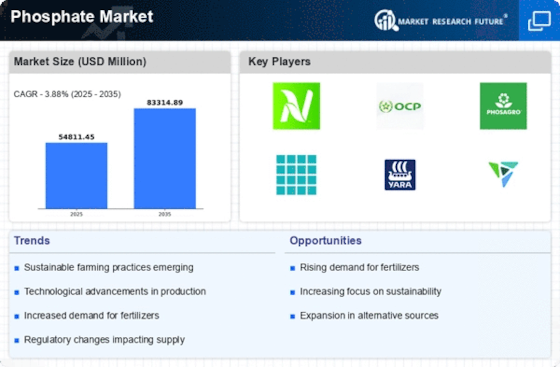
As per Market Research Future analysis, the Phosphate Market Size was estimated at 54811.45 USD Million in 2024. The Phosphate industry is projected to grow from USD 56938.14 Million in 2025 to USD 83314.89 Million by 2035, exhibiting a compound annual growth rate (CAGR) of 3.88% during the forecast period 2025 - 2035

Key Market Trends & Highlights

The phosphate market is experiencing a shift towards sustainability and technological innovation.

  • North America remains the largest market for phosphates, driven by robust agricultural practices. Asia-Pacific is emerging as the fastest-growing region, fueled by increasing agricultural demands and investments. The ammonium/phosphoric acid segment dominates the market, while the calcium segment is witnessing rapid growth. Rising demand for fertilizers and environmental regulations are key drivers influencing the phosphate market.

Market Size & Forecast

2024 Market Size 54811.45 (USD Million)
2035 Market Size 83314.89 (USD Million)
CAGR (2025 - 2035) 3.88%
Largest Regional Market Share in 2024 Asia Pacific

Major Players

Nutrien (CA), OCP Group (MA), PhosAgro (RU), Mosaic Company (US), Yara International (NO), CF Industries (US), ICL Group (IL), K+S AG (DE), Saudi Arabian Mining Company (SA)

Market Trends

The Phosphate Market is currently experiencing a dynamic phase characterized by evolving demand patterns and regulatory influences. The agricultural sector remains a primary driver, as the need for fertilizers continues to rise in response to global food security concerns. Additionally, environmental regulations are shaping production practices, pushing companies to adopt more sustainable methods. This shift not only addresses ecological impacts but also aligns with consumer preferences for environmentally friendly products. Furthermore, technological advancements in extraction and processing are enhancing efficiency, potentially leading to cost reductions and improved product quality. In the context of international trade, the Phosphate Market is influenced by geopolitical factors and trade agreements. Countries rich in phosphate reserves are strategically positioned to leverage their resources, which may lead to shifts in market dynamics. As nations seek to secure their agricultural supply chains, the competition for phosphate resources could intensify. Overall, the Phosphate Market appears poised for growth, driven by a combination of agricultural needs, sustainability initiatives, and technological innovations that may redefine its landscape in the coming years.

Sustainable Practices in Production

The Phosphate Market is witnessing a notable shift towards sustainable production methods. Companies are increasingly adopting practices that minimize environmental impact, such as reducing emissions and optimizing resource use. This trend is driven by both regulatory pressures and consumer demand for greener products, suggesting a long-term commitment to sustainability within the industry.

Technological Advancements

Innovations in extraction and processing technologies are transforming the Phosphate Market. Enhanced methods are improving efficiency and reducing costs, which may lead to increased competitiveness among producers. These advancements could also facilitate the development of higher-quality phosphate products, catering to the evolving needs of the agricultural sector.

Geopolitical Influences on Trade

The Phosphate Market is significantly affected by geopolitical factors, including trade agreements and resource availability. Countries with abundant phosphate reserves are likely to play a crucial role in shaping global supply chains. As nations prioritize food security, competition for phosphate resources may escalate, impacting pricing and availability in various regions.

Phosphate Market Market Drivers

Rising Demand for Fertilizers

The increasing The Phosphate Industry. Fertilizers, particularly those containing phosphates, are essential for enhancing crop yields. In 2023, the demand for phosphate fertilizers reached approximately 45 million metric tons, reflecting a steady growth trend. This demand is expected to continue as agricultural practices evolve to meet the needs of a growing population. The Phosphate Market is thus positioned to benefit from this trend, as farmers seek to optimize their production through the use of phosphate-based fertilizers. Furthermore, the shift towards sustainable agriculture practices may also bolster the demand for phosphate fertilizers, as they are integral to maintaining soil health and fertility.

Increasing Awareness of Soil Health

There is a growing awareness of the importance of soil health in agriculture, which is positively influencing the Phosphate Market. Farmers and agricultural stakeholders are recognizing that healthy soils are vital for sustainable crop production. In 2023, educational initiatives and research highlighted the role of phosphates in maintaining soil fertility and structure. This awareness is driving demand for phosphate fertilizers, as they are essential for replenishing nutrient-depleted soils. Moreover, the emphasis on regenerative agriculture practices is likely to further boost the Phosphate Market, as these practices often incorporate phosphate-based fertilizers to enhance soil health and productivity.

Geopolitical Factors Affecting Supply Chains

Geopolitical factors play a crucial role in shaping the Phosphate Market. Trade policies, tariffs, and international relations can significantly impact the supply chains of phosphate producers. For instance, in 2023, tensions in key phosphate-producing regions led to fluctuations in supply, affecting prices and availability. Countries that rely heavily on phosphate imports are particularly vulnerable to these geopolitical dynamics. As a result, there is a growing trend towards diversifying supply sources and investing in domestic production capabilities. This strategic shift may enhance the resilience of the Phosphate Market against geopolitical uncertainties, ensuring a more stable supply of phosphates for agricultural use.

Technological Innovations in Phosphate Extraction

Technological advancements in phosphate extraction and processing are reshaping the Phosphate Market. Innovations such as improved mining techniques and enhanced processing methods are leading to more efficient extraction of phosphates. For instance, the introduction of advanced flotation technologies has increased recovery rates, thereby reducing waste and improving overall productivity. In 2023, the efficiency of phosphate extraction processes improved by nearly 15%, which has significant implications for production costs and environmental impact. As these technologies continue to evolve, they are likely to attract investment and drive growth within the Phosphate Market, enabling producers to meet the rising demand for phosphate fertilizers more sustainably.

Environmental Regulations and Sustainability Initiatives

The Phosphate Market is increasingly influenced by environmental regulations and sustainability initiatives. Governments and organizations are implementing stricter regulations on phosphate mining and fertilizer application to mitigate environmental impacts, such as water pollution and soil degradation. In 2023, several countries introduced policies aimed at reducing phosphate runoff, which has prompted producers to adopt more sustainable practices. This shift not only aligns with The Phosphate Market opportunities for eco-friendly phosphate products. As the industry adapts to these regulations, it may lead to innovations in sustainable phosphate production methods, further shaping the landscape of the Phosphate Market.

Market Segment Insights

By Type: Ammonium/Phosphoric Acid (Largest) vs. Calcium (Fastest-Growing)

<p>In the phosphate market, the segment distribution shows Ammonium/Phosphoric Acid holding a significant share, aided by its wide application in fertilizers and industrial processes. Calcium phosphate follows as a considerable player, but its popularity is being challenged by alternatives, necessitating innovation to capture growing demand. Potassium, Sodium, and Others make up a smaller fraction but still contribute to the diversity of solutions available in the market.</p>

<p>Ammonium/Phosphoric Acid (Dominant) vs. Calcium (Emerging)</p>

<p><a href="https://www.marketresearchfuture.com/reports/ammonium-phosphate-market-5690" target="_blank" title="ammonium phosphate">Ammonium phosphate</a> is the leading type in the phosphate market, recognized for its high nutrient content and effectiveness in various applications, particularly in fertilizers. This dominance stems from its established supply chain and extensive use in agriculture. On the other hand, Calcium phosphate is gaining traction as an emerging type, with increasing interest in its role in sustainable agriculture and food production. Its ability to improve soil health and optimize nutrient delivery makes it an attractive alternative, driving innovation and market growth. As regulations around chemical fertilizers tighten, Calcium could see faster adoption.</p>

By Application: Fertilizers (Largest) vs. Detergents (Fastest-Growing)

<p>In the Phosphate Market, the application of fertilizers holds the largest market share, primarily driven by the growing demand for food production and sustainable agricultural practices. Fertilizers utilize phosphate to enhance crop yield and soil health, which is crucial in meeting the global food demand. Other notable applications include detergents and food & beverages, which collectively contribute to the market dynamics, but fertilizers remain the quintessential segment due to their fundamental role in agriculture.</p>

<p>Fertilizers (Dominant) vs. Detergents (Emerging)</p>

<p>Fertilizers are the dominant application in the phosphate market, representing a crucial element in enhancing agricultural productivity and food security. The ongoing need for higher crop yields and improved soil fertility drives this segment significantly. Conversely, detergents, labeled as an emerging application, are experiencing rapid growth due to increasing consumer awareness regarding hygiene and environmental concerns. This trend is prompting manufacturers to seek phosphate alternatives, although traditional phosphate detergents still play a vital role in the market. Both segments showcase distinct characteristics; while fertilizers lay the foundation for agricultural advancements, detergents are steadily gaining ground as consumer preferences evolve.</p>

Get more detailed insights about Phosphate Market Research Report—Global Forecast till 2035

Regional Insights

North America : Market Leader in Phosphate Market

North America is the largest market for phosphates, holding approximately 35% of the global share. The region's growth is driven by increasing agricultural demand, particularly in the U.S. and Canada, where crop yields are prioritized. Regulatory support for sustainable farming practices and environmental regulations are also significant catalysts for market expansion. The demand for phosphate fertilizers is expected to rise as farmers seek to enhance soil fertility and crop productivity. The U.S. is the leading country in this region, with major players like Nutrien and Mosaic Company dominating the landscape. Canada also plays a crucial role, with Nutrien being a key contributor to phosphate production. The competitive environment is characterized by innovation in fertilizer technology and a focus on sustainable practices, ensuring that North America remains at the forefront of the phosphate market.

Europe : Sustainable Practices in Focus

Europe is the second-largest market for phosphates, accounting for around 25% of the global share. The region's growth is significantly influenced by stringent environmental regulations and a strong emphasis on sustainable agricultural practices. The European Union's Green Deal and Farm to Fork strategy are pivotal in driving demand for eco-friendly phosphate solutions, as farmers are encouraged to adopt sustainable farming methods that enhance soil health and reduce chemical usage. Leading countries in Europe include Germany, France, and the Netherlands, where companies like K+S AG and Yara International are prominent. The competitive landscape is marked by a shift towards organic and bio-based fertilizers, aligning with the EU's sustainability goals. This transition is supported by various government initiatives aimed at reducing the environmental impact of agriculture, ensuring a robust market for phosphate products.

Asia-Pacific : Emerging Market Potential

Asia-Pacific is an emerging powerhouse in the phosphate market, holding approximately 20% of the global share. The region's growth is driven by increasing food production demands, particularly in countries like China and India, where population growth necessitates enhanced agricultural output. Government initiatives aimed at boosting fertilizer use efficiency and improving soil health are also key drivers of market expansion, alongside rising investments in agricultural technology. China is the largest market in this region, with significant contributions from local companies like PhosAgro and Yara International. India is also a major player, focusing on improving fertilizer accessibility for farmers. The competitive landscape is characterized by a mix of local and international players, with a growing emphasis on sustainable practices and innovations in phosphate production to meet the rising demand for food security.

Middle East and Africa : Resource-Rich Opportunities

The Middle East and Africa region is rich in phosphate resources, holding about 15% of the global market share. The growth in this region is primarily driven by the increasing demand for fertilizers to support agricultural development, particularly in countries like Morocco and South Africa. The region's vast natural resources and government initiatives aimed at enhancing agricultural productivity are significant catalysts for market growth, alongside investments in infrastructure and technology. Morocco is a leading player, with OCP Group being a major contributor to phosphate production. South Africa also plays a crucial role, with companies like Foskor leading the market. The competitive landscape is evolving, with a focus on sustainable practices and the development of value-added phosphate products to meet both local and international demand, ensuring the region's position in The Phosphate Market.

Key Players and Competitive Insights

The Phosphate is characterized by a complex interplay of competitive dynamics, driven by increasing agricultural demands and the necessity for sustainable practices. Major players such as Nutrien (CA), OCP Group (MA), and Mosaic Company (US) are strategically positioned to leverage their extensive resources and technological capabilities. Nutrien (CA) focuses on innovation in nutrient management solutions, while OCP Group (MA) emphasizes sustainable mining practices and regional expansion in Africa. Mosaic Company (US) is enhancing its operational efficiency through digital transformation initiatives. Collectively, these strategies not only enhance their market presence but also contribute to a competitive environment that is increasingly focused on sustainability and technological advancement. Key business tactics within the phosphate market include localizing manufacturing and optimizing supply chains to enhance responsiveness to regional demands. The market structure appears moderately fragmented, with several key players exerting significant influence. This fragmentation allows for a diverse range of products and services, yet the collective strength of major companies shapes pricing strategies and market accessibility, creating a competitive landscape that is both dynamic and challenging.
In August Nutrien (CA) announced a partnership with a leading agricultural technology firm to develop precision agriculture solutions aimed at optimizing phosphate use efficiency. This strategic move is likely to enhance Nutrien's product offerings and position it as a leader in sustainable agricultural practices, aligning with global trends towards environmental responsibility.
In September OCP Group (MA) launched a new initiative focused on enhancing phosphate fertilizer production through advanced mining technologies. This initiative not only aims to increase output but also to minimize environmental impact, reflecting OCP's commitment to sustainability. Such advancements may strengthen OCP's competitive edge in the market, particularly in regions where environmental regulations are becoming more stringent.
In July Mosaic Company (US) completed the acquisition of a smaller phosphate producer, which is expected to expand its market share and enhance its production capabilities. This acquisition is indicative of a broader trend where larger firms seek to consolidate their positions in the market, potentially leading to increased pricing power and improved economies of scale.
As of October the phosphate market is witnessing significant trends towards digitalization, sustainability, and the integration of artificial intelligence in production processes. Strategic alliances are increasingly shaping the competitive landscape, as companies collaborate to enhance innovation and operational efficiency. Looking ahead, it appears that competitive differentiation will evolve from traditional price-based competition to a focus on technological innovation, sustainability, and supply chain reliability, reflecting the changing priorities of consumers and regulatory bodies.

Key Companies in the Phosphate Market include

Industry Developments

In 2024 Nutrien introduced a new phosphate fertilizer with enhanced nutrient delivery and environmental benefits.

In 2023 The Mosaic Company released an advanced phosphate-based fertilizer aimed at increasing crop yields and reducing environmental impact.

March 2024: EuroChem, a global leader in the production of mineral fertilizers, celebrated the opening of its new phosphate fertilizer production facility in Serra do Salitre, State of Minas Gerais, Brazil. The new phosphate mine and plant complex, which represents a total project investment of nearly US$1 billion, was constructed in record-breaking time and will have an annual production capacity of 1 million tonnes of advanced phosphate fertilizers.

January 2023: OCP Group and India have entered into a strategic partnership to strengthen food security and confirm their common ambition for an innovative and sustainable agriculture.

Future Outlook

Phosphate Market Future Outlook

The Phosphate Market share is projected to grow at a 3.88% CAGR from 2025 to 2035, driven by increasing agricultural demand, technological advancements, and sustainable practices.

New opportunities lie in:

  • <p>Development of precision agriculture technologies for optimized phosphate use. Expansion into emerging markets with tailored phosphate solutions. Investment in eco-friendly phosphate recycling initiatives to enhance sustainability.</p>

By 2035, the Phosphate Market is expected to solidify its growth trajectory, driven by innovation and sustainability.

Market Segmentation

Phosphate Market Type Outlook

  • Ammonium/Phosphoric Acid
  • Calcium
  • Potassium
  • Sodium
  • Others

Phosphate Market Application Outlook

  • Fertilizers
  • Detergents
  • Food & Beverages
  • Water Treatment Chemicals
  • Metal Treatment
  • Cosmetic & Personal Care
  • Pharmaceuticals
  • Others

Report Scope

MARKET SIZE 2024 54811.45(USD Million)
MARKET SIZE 2025 56938.14(USD Million)
MARKET SIZE 2035 83314.89(USD Million)
COMPOUND ANNUAL GROWTH RATE (CAGR) 3.88% (2025 - 2035)
REPORT COVERAGE Revenue Forecast, Competitive Landscape, Growth Factors, and Trends
BASE YEAR 2024
Market Forecast Period 2025 - 2035
Historical Data 2019 - 2024
Market Forecast Units USD Million
Key Companies Profiled Nutrien (CA), OCP Group (MA), PhosAgro (RU), Mosaic Company (US), Yara International (NO), CF Industries (US), ICL Group (IL), K+S AG (DE), Saudi Arabian Mining Company (SA)
Segments Covered Type, Application, Region
Key Market Opportunities Adoption of sustainable agricultural practices driving demand for eco-friendly phosphate fertilizers.
Key Market Dynamics Rising demand for sustainable agriculture drives innovation and competition in the phosphate market.
Countries Covered North America, Europe, APAC, South America, MEA

FAQs

What is the current valuation of the Phosphate Market as of 2024?

<p>The Phosphate Market was valued at approximately 54,811.45 USD Million in 2024.</p>

What is the projected market valuation for the Phosphate Market in 2035?

<p>The Phosphate Market is projected to reach approximately 83,314.89 USD Million by 2035.</p>

What is the expected CAGR for the Phosphate Market during the forecast period 2025 - 2035?

<p>The expected CAGR for the Phosphate Market during the forecast period 2025 - 2035 is 3.88%.</p>

Which companies are considered key players in the Phosphate Market?

<p>Key players in the Phosphate Market include Nutrien, OCP Group, PhosAgro, Mosaic Company, Yara International, CF Industries, ICL Group, K+S AG, and Saudi Arabian Mining Company.</p>

What are the main segments of the Phosphate Market by type?

<p>The main segments by type include Ammonium/Phosphoric Acid, Calcium, Potassium, Sodium, and Others.</p>

What was the valuation range for Ammonium/Phosphoric Acid in 2024?

<p>The valuation for Ammonium/Phosphoric Acid ranged from 20,000.0 to 30,000.0 USD Million in 2024.</p>

How does the Phosphate Market perform in the fertilizers application segment?

<p>In 2024, the fertilizers application segment was valued between 25,000.0 and 40,000.0 USD Million.</p>

What is the projected growth for the Calcium segment in the Phosphate Market?

<p>The Calcium segment is expected to grow from a valuation of 12,000.0 to 18,000.0 USD Million during the forecast period.</p>

What applications utilize phosphates in the market?

<p>Phosphates are utilized in various applications, including fertilizers, detergents, food & beverages, water treatment chemicals, and pharmaceuticals.</p>

What is the expected valuation for the Potassium segment in 2035?

<p>The Potassium segment is projected to reach a valuation between 8,000.0 and 12,000.0 USD Million by 2035.</p>

  1. SECTION I: EXECUTIVE SUMMARY AND KEY HIGHLIGHTS
    1. | 1.1 EXECUTIVE SUMMARY
    2. | | 1.1.1 Market Overview
    3. | | 1.1.2 Key Findings
    4. | | 1.1.3 Market Segmentation
    5. | | 1.1.4 Competitive Landscape
    6. | | 1.1.5 Challenges and Opportunities
    7. | | 1.1.6 Future Outlook
  2. SECTION II: SCOPING, METHODOLOGY AND MARKET STRUCTURE
    1. | 2.1 MARKET INTRODUCTION
    2. | | 2.1.1 Definition
    3. | | 2.1.2 Scope of the study
    4. | | | 2.1.2.1 Research Objective
    5. | | | 2.1.2.2 Assumption
    6. | | | 2.1.2.3 Limitations
    7. | 2.2 RESEARCH METHODOLOGY
    8. | | 2.2.1 Overview
    9. | | 2.2.2 Data Mining
    10. | | 2.2.3 Secondary Research
    11. | | 2.2.4 Primary Research
    12. | | | 2.2.4.1 Primary Interviews and Information Gathering Process
    13. | | | 2.2.4.2 Breakdown of Primary Respondents
    14. | | 2.2.5 Forecasting Model
    15. | | 2.2.6 Market Size Estimation
    16. | | | 2.2.6.1 Bottom-Up Approach
    17. | | | 2.2.6.2 Top-Down Approach
    18. | | 2.2.7 Data Triangulation
    19. | | 2.2.8 Validation
  3. SECTION III: QUALITATIVE ANALYSIS
    1. | 3.1 MARKET DYNAMICS
    2. | | 3.1.1 Overview
    3. | | 3.1.2 Drivers
    4. | | 3.1.3 Restraints
    5. | | 3.1.4 Opportunities
    6. | 3.2 MARKET FACTOR ANALYSIS
    7. | | 3.2.1 Value chain Analysis
    8. | | 3.2.2 Porter's Five Forces Analysis
    9. | | | 3.2.2.1 Bargaining Power of Suppliers
    10. | | | 3.2.2.2 Bargaining Power of Buyers
    11. | | | 3.2.2.3 Threat of New Entrants
    12. | | | 3.2.2.4 Threat of Substitutes
    13. | | | 3.2.2.5 Intensity of Rivalry
    14. | | 3.2.3 COVID-19 Impact Analysis
    15. | | | 3.2.3.1 Market Impact Analysis
    16. | | | 3.2.3.2 Regional Impact
    17. | | | 3.2.3.3 Opportunity and Threat Analysis
  4. SECTION IV: QUANTITATIVE ANALYSIS
    1. | 4.1 Chemicals and Materials, BY Type (USD Million)
    2. | | 4.1.1 Ammonium/Phosphoric Acid
    3. | | 4.1.2 Calcium
    4. | | 4.1.3 Potassium
    5. | | 4.1.4 Sodium
    6. | | 4.1.5 Others
    7. | 4.2 Chemicals and Materials, BY Application (USD Million)
    8. | | 4.2.1 Fertilizers
    9. | | 4.2.2 Detergents
    10. | | 4.2.3 Food & Beverages
    11. | | 4.2.4 Water Treatment Chemicals
    12. | | 4.2.5 Metal Treatment
    13. | | 4.2.6 Cosmetic & Personal Care
    14. | | 4.2.7 Pharmaceuticals
    15. | | 4.2.8 Others
    16. | 4.3 Chemicals and Materials, BY Region (USD Million)
    17. | | 4.3.1 North America
    18. | | | 4.3.1.1 US
    19. | | | 4.3.1.2 Canada
    20. | | 4.3.2 Europe
    21. | | | 4.3.2.1 Germany
    22. | | | 4.3.2.2 UK
    23. | | | 4.3.2.3 France
    24. | | | 4.3.2.4 Russia
    25. | | | 4.3.2.5 Italy
    26. | | | 4.3.2.6 Spain
    27. | | | 4.3.2.7 Rest of Europe
    28. | | 4.3.3 APAC
    29. | | | 4.3.3.1 China
    30. | | | 4.3.3.2 India
    31. | | | 4.3.3.3 Japan
    32. | | | 4.3.3.4 South Korea
    33. | | | 4.3.3.5 Malaysia
    34. | | | 4.3.3.6 Thailand
    35. | | | 4.3.3.7 Indonesia
    36. | | | 4.3.3.8 Rest of APAC
    37. | | 4.3.4 South America
    38. | | | 4.3.4.1 Brazil
    39. | | | 4.3.4.2 Mexico
    40. | | | 4.3.4.3 Argentina
    41. | | | 4.3.4.4 Rest of South America
    42. | | 4.3.5 MEA
    43. | | | 4.3.5.1 GCC Countries
    44. | | | 4.3.5.2 South Africa
    45. | | | 4.3.5.3 Rest of MEA
  5. SECTION V: COMPETITIVE ANALYSIS
    1. | 5.1 Competitive Landscape
    2. | | 5.1.1 Overview
    3. | | 5.1.2 Competitive Analysis
    4. | | 5.1.3 Market share Analysis
    5. | | 5.1.4 Major Growth Strategy in the Chemicals and Materials
    6. | | 5.1.5 Competitive Benchmarking
    7. | | 5.1.6 Leading Players in Terms of Number of Developments in the Chemicals and Materials
    8. | | 5.1.7 Key developments and growth strategies
    9. | | | 5.1.7.1 New Product Launch/Service Deployment
    10. | | | 5.1.7.2 Merger & Acquisitions
    11. | | | 5.1.7.3 Joint Ventures
    12. | | 5.1.8 Major Players Financial Matrix
    13. | | | 5.1.8.1 Sales and Operating Income
    14. | | | 5.1.8.2 Major Players R&D Expenditure. 2023
    15. | 5.2 Company Profiles
    16. | | 5.2.1 Nutrien (CA)
    17. | | | 5.2.1.1 Financial Overview
    18. | | | 5.2.1.2 Products Offered
    19. | | | 5.2.1.3 Key Developments
    20. | | | 5.2.1.4 SWOT Analysis
    21. | | | 5.2.1.5 Key Strategies
    22. | | 5.2.2 OCP Group (MA)
    23. | | | 5.2.2.1 Financial Overview
    24. | | | 5.2.2.2 Products Offered
    25. | | | 5.2.2.3 Key Developments
    26. | | | 5.2.2.4 SWOT Analysis
    27. | | | 5.2.2.5 Key Strategies
    28. | | 5.2.3 PhosAgro (RU)
    29. | | | 5.2.3.1 Financial Overview
    30. | | | 5.2.3.2 Products Offered
    31. | | | 5.2.3.3 Key Developments
    32. | | | 5.2.3.4 SWOT Analysis
    33. | | | 5.2.3.5 Key Strategies
    34. | | 5.2.4 Mosaic Company (US)
    35. | | | 5.2.4.1 Financial Overview
    36. | | | 5.2.4.2 Products Offered
    37. | | | 5.2.4.3 Key Developments
    38. | | | 5.2.4.4 SWOT Analysis
    39. | | | 5.2.4.5 Key Strategies
    40. | | 5.2.5 Yara International (NO)
    41. | | | 5.2.5.1 Financial Overview
    42. | | | 5.2.5.2 Products Offered
    43. | | | 5.2.5.3 Key Developments
    44. | | | 5.2.5.4 SWOT Analysis
    45. | | | 5.2.5.5 Key Strategies
    46. | | 5.2.6 CF Industries (US)
    47. | | | 5.2.6.1 Financial Overview
    48. | | | 5.2.6.2 Products Offered
    49. | | | 5.2.6.3 Key Developments
    50. | | | 5.2.6.4 SWOT Analysis
    51. | | | 5.2.6.5 Key Strategies
    52. | | 5.2.7 ICL Group (IL)
    53. | | | 5.2.7.1 Financial Overview
    54. | | | 5.2.7.2 Products Offered
    55. | | | 5.2.7.3 Key Developments
    56. | | | 5.2.7.4 SWOT Analysis
    57. | | | 5.2.7.5 Key Strategies
    58. | | 5.2.8 K+S AG (DE)
    59. | | | 5.2.8.1 Financial Overview
    60. | | | 5.2.8.2 Products Offered
    61. | | | 5.2.8.3 Key Developments
    62. | | | 5.2.8.4 SWOT Analysis
    63. | | | 5.2.8.5 Key Strategies
    64. | | 5.2.9 Saudi Arabian Mining Company (SA)
    65. | | | 5.2.9.1 Financial Overview
    66. | | | 5.2.9.2 Products Offered
    67. | | | 5.2.9.3 Key Developments
    68. | | | 5.2.9.4 SWOT Analysis
    69. | | | 5.2.9.5 Key Strategies
    70. | 5.3 Appendix
    71. | | 5.3.1 References
    72. | | 5.3.2 Related Reports
  6. LIST OF FIGURES
    1. | 6.1 MARKET SYNOPSIS
    2. | 6.2 NORTH AMERICA MARKET ANALYSIS
    3. | 6.3 US MARKET ANALYSIS BY TYPE
    4. | 6.4 US MARKET ANALYSIS BY APPLICATION
    5. | 6.5 CANADA MARKET ANALYSIS BY TYPE
    6. | 6.6 CANADA MARKET ANALYSIS BY APPLICATION
    7. | 6.7 EUROPE MARKET ANALYSIS
    8. | 6.8 GERMANY MARKET ANALYSIS BY TYPE
    9. | 6.9 GERMANY MARKET ANALYSIS BY APPLICATION
    10. | 6.10 UK MARKET ANALYSIS BY TYPE
    11. | 6.11 UK MARKET ANALYSIS BY APPLICATION
    12. | 6.12 FRANCE MARKET ANALYSIS BY TYPE
    13. | 6.13 FRANCE MARKET ANALYSIS BY APPLICATION
    14. | 6.14 RUSSIA MARKET ANALYSIS BY TYPE
    15. | 6.15 RUSSIA MARKET ANALYSIS BY APPLICATION
    16. | 6.16 ITALY MARKET ANALYSIS BY TYPE
    17. | 6.17 ITALY MARKET ANALYSIS BY APPLICATION
    18. | 6.18 SPAIN MARKET ANALYSIS BY TYPE
    19. | 6.19 SPAIN MARKET ANALYSIS BY APPLICATION
    20. | 6.20 REST OF EUROPE MARKET ANALYSIS BY TYPE
    21. | 6.21 REST OF EUROPE MARKET ANALYSIS BY APPLICATION
    22. | 6.22 APAC MARKET ANALYSIS
    23. | 6.23 CHINA MARKET ANALYSIS BY TYPE
    24. | 6.24 CHINA MARKET ANALYSIS BY APPLICATION
    25. | 6.25 INDIA MARKET ANALYSIS BY TYPE
    26. | 6.26 INDIA MARKET ANALYSIS BY APPLICATION
    27. | 6.27 JAPAN MARKET ANALYSIS BY TYPE
    28. | 6.28 JAPAN MARKET ANALYSIS BY APPLICATION
    29. | 6.29 SOUTH KOREA MARKET ANALYSIS BY TYPE
    30. | 6.30 SOUTH KOREA MARKET ANALYSIS BY APPLICATION
    31. | 6.31 MALAYSIA MARKET ANALYSIS BY TYPE
    32. | 6.32 MALAYSIA MARKET ANALYSIS BY APPLICATION
    33. | 6.33 THAILAND MARKET ANALYSIS BY TYPE
    34. | 6.34 THAILAND MARKET ANALYSIS BY APPLICATION
    35. | 6.35 INDONESIA MARKET ANALYSIS BY TYPE
    36. | 6.36 INDONESIA MARKET ANALYSIS BY APPLICATION
    37. | 6.37 REST OF APAC MARKET ANALYSIS BY TYPE
    38. | 6.38 REST OF APAC MARKET ANALYSIS BY APPLICATION
    39. | 6.39 SOUTH AMERICA MARKET ANALYSIS
    40. | 6.40 BRAZIL MARKET ANALYSIS BY TYPE
    41. | 6.41 BRAZIL MARKET ANALYSIS BY APPLICATION
    42. | 6.42 MEXICO MARKET ANALYSIS BY TYPE
    43. | 6.43 MEXICO MARKET ANALYSIS BY APPLICATION
    44. | 6.44 ARGENTINA MARKET ANALYSIS BY TYPE
    45. | 6.45 ARGENTINA MARKET ANALYSIS BY APPLICATION
    46. | 6.46 REST OF SOUTH AMERICA MARKET ANALYSIS BY TYPE
    47. | 6.47 REST OF SOUTH AMERICA MARKET ANALYSIS BY APPLICATION
    48. | 6.48 MEA MARKET ANALYSIS
    49. | 6.49 GCC COUNTRIES MARKET ANALYSIS BY TYPE
    50. | 6.50 GCC COUNTRIES MARKET ANALYSIS BY APPLICATION
    51. | 6.51 SOUTH AFRICA MARKET ANALYSIS BY TYPE
    52. | 6.52 SOUTH AFRICA MARKET ANALYSIS BY APPLICATION
    53. | 6.53 REST OF MEA MARKET ANALYSIS BY TYPE
    54. | 6.54 REST OF MEA MARKET ANALYSIS BY APPLICATION
    55. | 6.55 KEY BUYING CRITERIA OF CHEMICALS AND MATERIALS
    56. | 6.56 RESEARCH PROCESS OF MRFR
    57. | 6.57 DRO ANALYSIS OF CHEMICALS AND MATERIALS
    58. | 6.58 DRIVERS IMPACT ANALYSIS: CHEMICALS AND MATERIALS
    59. | 6.59 RESTRAINTS IMPACT ANALYSIS: CHEMICALS AND MATERIALS
    60. | 6.60 SUPPLY / VALUE CHAIN: CHEMICALS AND MATERIALS
    61. | 6.61 CHEMICALS AND MATERIALS, BY TYPE, 2024 (% SHARE)
    62. | 6.62 CHEMICALS AND MATERIALS, BY TYPE, 2024 TO 2035 (USD Million)
    63. | 6.63 CHEMICALS AND MATERIALS, BY APPLICATION, 2024 (% SHARE)
    64. | 6.64 CHEMICALS AND MATERIALS, BY APPLICATION, 2024 TO 2035 (USD Million)
    65. | 6.65 BENCHMARKING OF MAJOR COMPETITORS
  7. LIST OF TABLES
    1. | 7.1 LIST OF ASSUMPTIONS
    2. | | 7.1.1
    3. | 7.2 North America MARKET SIZE ESTIMATES; FORECAST
    4. | | 7.2.1 BY TYPE, 2025-2035 (USD Million)
    5. | | 7.2.2 BY APPLICATION, 2025-2035 (USD Million)
    6. | 7.3 US MARKET SIZE ESTIMATES; FORECAST
    7. | | 7.3.1 BY TYPE, 2025-2035 (USD Million)
    8. | | 7.3.2 BY APPLICATION, 2025-2035 (USD Million)
    9. | 7.4 Canada MARKET SIZE ESTIMATES; FORECAST
    10. | | 7.4.1 BY TYPE, 2025-2035 (USD Million)
    11. | | 7.4.2 BY APPLICATION, 2025-2035 (USD Million)
    12. | 7.5 Europe MARKET SIZE ESTIMATES; FORECAST
    13. | | 7.5.1 BY TYPE, 2025-2035 (USD Million)
    14. | | 7.5.2 BY APPLICATION, 2025-2035 (USD Million)
    15. | 7.6 Germany MARKET SIZE ESTIMATES; FORECAST
    16. | | 7.6.1 BY TYPE, 2025-2035 (USD Million)
    17. | | 7.6.2 BY APPLICATION, 2025-2035 (USD Million)
    18. | 7.7 UK MARKET SIZE ESTIMATES; FORECAST
    19. | | 7.7.1 BY TYPE, 2025-2035 (USD Million)
    20. | | 7.7.2 BY APPLICATION, 2025-2035 (USD Million)
    21. | 7.8 France MARKET SIZE ESTIMATES; FORECAST
    22. | | 7.8.1 BY TYPE, 2025-2035 (USD Million)
    23. | | 7.8.2 BY APPLICATION, 2025-2035 (USD Million)
    24. | 7.9 Russia MARKET SIZE ESTIMATES; FORECAST
    25. | | 7.9.1 BY TYPE, 2025-2035 (USD Million)
    26. | | 7.9.2 BY APPLICATION, 2025-2035 (USD Million)
    27. | 7.10 Italy MARKET SIZE ESTIMATES; FORECAST
    28. | | 7.10.1 BY TYPE, 2025-2035 (USD Million)
    29. | | 7.10.2 BY APPLICATION, 2025-2035 (USD Million)
    30. | 7.11 Spain MARKET SIZE ESTIMATES; FORECAST
    31. | | 7.11.1 BY TYPE, 2025-2035 (USD Million)
    32. | | 7.11.2 BY APPLICATION, 2025-2035 (USD Million)
    33. | 7.12 Rest of Europe MARKET SIZE ESTIMATES; FORECAST
    34. | | 7.12.1 BY TYPE, 2025-2035 (USD Million)
    35. | | 7.12.2 BY APPLICATION, 2025-2035 (USD Million)
    36. | 7.13 APAC MARKET SIZE ESTIMATES; FORECAST
    37. | | 7.13.1 BY TYPE, 2025-2035 (USD Million)
    38. | | 7.13.2 BY APPLICATION, 2025-2035 (USD Million)
    39. | 7.14 China MARKET SIZE ESTIMATES; FORECAST
    40. | | 7.14.1 BY TYPE, 2025-2035 (USD Million)
    41. | | 7.14.2 BY APPLICATION, 2025-2035 (USD Million)
    42. | 7.15 India MARKET SIZE ESTIMATES; FORECAST
    43. | | 7.15.1 BY TYPE, 2025-2035 (USD Million)
    44. | | 7.15.2 BY APPLICATION, 2025-2035 (USD Million)
    45. | 7.16 Japan MARKET SIZE ESTIMATES; FORECAST
    46. | | 7.16.1 BY TYPE, 2025-2035 (USD Million)
    47. | | 7.16.2 BY APPLICATION, 2025-2035 (USD Million)
    48. | 7.17 South Korea MARKET SIZE ESTIMATES; FORECAST
    49. | | 7.17.1 BY TYPE, 2025-2035 (USD Million)
    50. | | 7.17.2 BY APPLICATION, 2025-2035 (USD Million)
    51. | 7.18 Malaysia MARKET SIZE ESTIMATES; FORECAST
    52. | | 7.18.1 BY TYPE, 2025-2035 (USD Million)
    53. | | 7.18.2 BY APPLICATION, 2025-2035 (USD Million)
    54. | 7.19 Thailand MARKET SIZE ESTIMATES; FORECAST
    55. | | 7.19.1 BY TYPE, 2025-2035 (USD Million)
    56. | | 7.19.2 BY APPLICATION, 2025-2035 (USD Million)
    57. | 7.20 Indonesia MARKET SIZE ESTIMATES; FORECAST
    58. | | 7.20.1 BY TYPE, 2025-2035 (USD Million)
    59. | | 7.20.2 BY APPLICATION, 2025-2035 (USD Million)
    60. | 7.21 Rest of APAC MARKET SIZE ESTIMATES; FORECAST
    61. | | 7.21.1 BY TYPE, 2025-2035 (USD Million)
    62. | | 7.21.2 BY APPLICATION, 2025-2035 (USD Million)
    63. | 7.22 South America MARKET SIZE ESTIMATES; FORECAST
    64. | | 7.22.1 BY TYPE, 2025-2035 (USD Million)
    65. | | 7.22.2 BY APPLICATION, 2025-2035 (USD Million)
    66. | 7.23 Brazil MARKET SIZE ESTIMATES; FORECAST
    67. | | 7.23.1 BY TYPE, 2025-2035 (USD Million)
    68. | | 7.23.2 BY APPLICATION, 2025-2035 (USD Million)
    69. | 7.24 Mexico MARKET SIZE ESTIMATES; FORECAST
    70. | | 7.24.1 BY TYPE, 2025-2035 (USD Million)
    71. | | 7.24.2 BY APPLICATION, 2025-2035 (USD Million)
    72. | 7.25 Argentina MARKET SIZE ESTIMATES; FORECAST
    73. | | 7.25.1 BY TYPE, 2025-2035 (USD Million)
    74. | | 7.25.2 BY APPLICATION, 2025-2035 (USD Million)
    75. | 7.26 Rest of South America MARKET SIZE ESTIMATES; FORECAST
    76. | | 7.26.1 BY TYPE, 2025-2035 (USD Million)
    77. | | 7.26.2 BY APPLICATION, 2025-2035 (USD Million)
    78. | 7.27 MEA MARKET SIZE ESTIMATES; FORECAST
    79. | | 7.27.1 BY TYPE, 2025-2035 (USD Million)
    80. | | 7.27.2 BY APPLICATION, 2025-2035 (USD Million)
    81. | 7.28 GCC Countries MARKET SIZE ESTIMATES; FORECAST
    82. | | 7.28.1 BY TYPE, 2025-2035 (USD Million)
    83. | | 7.28.2 BY APPLICATION, 2025-2035 (USD Million)
    84. | 7.29 South Africa MARKET SIZE ESTIMATES; FORECAST
    85. | | 7.29.1 BY TYPE, 2025-2035 (USD Million)
    86. | | 7.29.2 BY APPLICATION, 2025-2035 (USD Million)
    87. | 7.30 Rest of MEA MARKET SIZE ESTIMATES; FORECAST
    88. | | 7.30.1 BY TYPE, 2025-2035 (USD Million)
    89. | | 7.30.2 BY APPLICATION, 2025-2035 (USD Million)
    90. | 7.31 PRODUCT LAUNCH/PRODUCT DEVELOPMENT/APPROVAL
    91. | | 7.31.1
    92. | 7.32 ACQUISITION/PARTNERSHIP
    93. | | 7.32.1

Chemicals and Materials Market Segmentation

Chemicals and Materials By Type (USD Million, 2025-2035)

  • Ammonium/Phosphoric Acid
  • Calcium
  • Potassium
  • Sodium
  • Others

Chemicals and Materials By Application (USD Million, 2025-2035)

  • Fertilizers
  • Detergents
  • Food & Beverages
  • Water Treatment Chemicals
  • Metal Treatment
  • Cosmetic & Personal Care
  • Pharmaceuticals
  • Others
Infographic

Free Sample Request

Kindly complete the form below to receive a free sample of this Report

Get Free Sample

Customer Strories

Compare Licence

×
Features License Type
Single User Multiuser License Enterprise User
Price $4,950 $5,950 $7,250
Maximum User Access Limit 1 User Upto 10 Users Unrestricted Access Throughout the Organization
Free Customization
Direct Access to Analyst
Deliverable Format
Platform Access
Discount on Next Purchase 10% 15% 15%
Printable Versions