×
Request Free Sample ×

Kindly complete the form below to receive a free sample of this Report

* Please use a valid business email

Leading companies partner with us for data-driven Insights

clients tt-cursor
Hero Background
English
Chinese
French
Japanese
Korean
German
Spanish

Phenolic Antioxidant Market Analysis

ID: MRFR/CnM/2635-CR
111 Pages
Chitranshi Jaiswal
September 2017

Phenolic Antioxidant Market Research Report Information: by Source (Natural and Synthetic), By Application (Food, Plastics & Rubber, Pharmaceutical, Cosmetic, Fuel & Lubricant and Other), and by Region (Asia Pacific, Europe, North America, Latin America, and Middle East &Africa,) - Forecast till 2035

Share:
Download PDF ×

We do not share your information with anyone. However, we may send you emails based on your report interest from time to time. You may contact us at any time to opt-out.

Phenolic Antioxidant Market Infographic
×
Phenolic Antioxidant Market Infographic Full View
Purchase Options

Market Analysis

In-depth Analysis of Phenolic Antioxidant Market Industry Landscape

This section depicts various aspects like drivers behind demand, supply-side challenges, and overall trends that affect demand/supply dynamics for such chemicals as phenolic antioxidants (PA) within different industries, including polymers processing or lubrication production chain (economy). They extend the life expectancy of products by inhibiting oxidative rancidity, hence their use on materials such as plastics, lubricating oils, and polymers, among others. Global supply-demand equilibrium is highly expressed in the Phenolic Antioxidant market. Both global and domestic economic conditions are significant determinants regarding the demand for these antioxidants within different sectors. This implies that during the economic downturn, the usage of phenolic antioxidants may drop due to reduced industrial activities, while increased application in various industries arises from economic growth. The investment decisions, production volumes, and pricing strategies are all significantly affected by the health of the world economy. Environmentally-based considerations have increasingly impacted how dynamics in the Phenolic Antioxidant market develop. With more focus now placed on sustainability and other forms of ecological consciousness, there is a growing need for antioxidants that will have a minimal negative impact on the environment. Manufacturers have been under pressure to improve their ecological profiles by incorporating greener techniques for making phenolic antioxidants. The Phenolic Antioxidant Sector as Competitive Market Competition among phenolic antioxidant compounds is fierce because these agents play an important role in extending the life of different materials. To stand out, manufacturers should concentrate on product quality, cost-effectiveness, and innovation. Gaining Market Share through Differentiation Strategies: Specializing Concentric Circle Phenolic Antioxidant Formulations Continuous research & development (R&D) activities are mandatory for enterprises competing within this industry as they seek to meet ever-changing customer requirements and outdo rivals' products offered today. Geopolitics and trading policies give direction to how the Phenolic Antioxidant market moves. They can be affected by tariffs, import/export regulations, or even geopolitical tensions, which may influence the global supply chain, causing differences in the availability and pricing of phenolic antioxidants in different regions. Regulations and standards heavily influence the Phenolic Antioxidant market. Market acceptance requires manufacturers to adhere to safety standards, environmental requirements, and quality regulations, among others. Consumer preferences and trends also influence the dynamics of the phenolic antioxidants market. The demand for phenolic antioxidants might change quite significantly due to changes in consumer inherent needs that include issues such as health and safety concerns, sustainable sourcing practices, and other relevant industrial activities.

Author
Chitranshi Jaiswal
Research Analyst Level I

In her 3 years of experience in the market research field, she has handled critical cross-domain projects. She has an in-depth knowledge of market estimation & analysis, problem-solving, primary as well as secondary research, and team management.She holds an engineering degree and is an MBA professional from a well-known university, capable of evaluating the market and competitive conditions. An exceptional strategist with excellent communication skills and a passion for delivering cutting-edge & practical insights for the market. Proficient in multi-tasking, and can successfully deal with competing demands, while maintaining complete confidentiality. Generated business through active client and project development, networking, and high-quality responses. Her knowledge and skills have helped in making solid business decisions, securing funding from investors, and avoiding business failures.

Leave a Comment

FAQs

What is the valuation that the global phenolic antioxidant market is estimated to create over the review period?

The global phenolic antioxidant market is estimated to create a valuation of USD 1830.05 MN by 2025, registering 5.10% CAGR throughout the assessment period (2025-2035).

Which is the largest region in global phenolic antioxidant market?

Asia Pacific is the largest region in the global phenolic antioxidant market. The region is estimated to retain its leading position throughout the assessment period (2025-2035), holding the largest share.

What are the key driving forces behind the growth of the global phenolic antioxidant market?

Rising demand as an additive in plastic & rubber and fuel & lubricant manufacturing industry

Which is the largest segment in the global phenolic antioxidant market?

The sub segment – Food by applications is the largest segment in the in the global phenolic antioxidant market. The sub segment is projected to reach a valuation of USD significant by the end of 2035.

Who are the top players in the global phenolic antioxidant market?

BASF SE (Germany), DSM (Netherlands), Oxiris Chemicals S A (Spain), Chitec Technology Co., Ltd. (Taiwan), Sumitomo Chemical Company (Japan), Mayzo Inc. (US), Double Bond Chemical Ind., Co., Ltd. (Taiwan), Addivant (US), Emerald Performance Materials LLC (US), and Kumho Petrochemical Co., Ltd. (South Korea), are some of the leading players in the global phenolic antioxidant market.

Market Summary

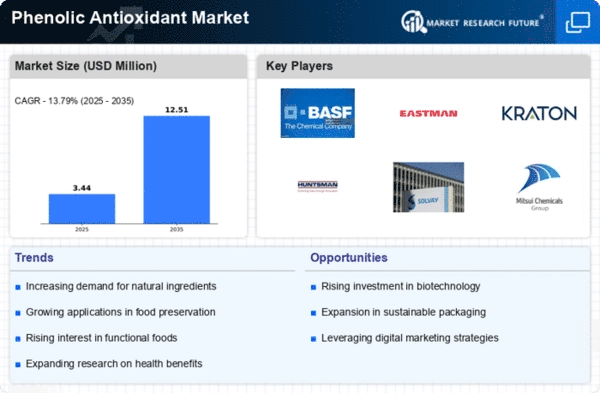
As per MRFR analysis, the Phenolic Antioxidant Market Size was estimated at 3.02 USD Million in 2024. The Phenolic Antioxidant industry is projected to grow from 3.44 in 2025 to 12.51 by 2035, exhibiting a compound annual growth rate (CAGR) of 13.79 during the forecast period 2025 - 2035.

Key Market Trends & Highlights

The Phenolic Antioxidant Market is experiencing robust growth driven by health consciousness and technological advancements.

  • The demand for natural ingredients is rising, particularly in North America, which remains the largest market for phenolic antioxidants.
  • Technological advancements in extraction methods are enhancing the efficiency and quality of phenolic compounds, especially in the Asia-Pacific region.
  • There is an increased focus on health benefits associated with phenolic antioxidants, influencing consumer choices in the food and beverage sector.
  • Rising awareness of antioxidant benefits and the expansion of the food and beverage sector are key drivers propelling market growth.

Market Size & Forecast

2024 Market Size 3.02 (USD Million)
2035 Market Size 12.51 (USD Million)
CAGR (2025 - 2035) 13.79%
Largest Regional Market Share in 2024 North America

Major Players

BASF SE (DE), Eastman Chemical Company (US), Kraton Corporation (US), Huntsman Corporation (US), Solvay S.A. (BE), Mitsui Chemicals, Inc. (JP), SABIC (SA), Addivant USA LLC (US)

Market Trends

The Phenolic Antioxidant Market is currently experiencing a notable evolution, driven by increasing consumer awareness regarding health and wellness. This market encompasses a diverse range of applications, including food preservation, cosmetics, and pharmaceuticals. The growing inclination towards natural and organic products has led to a heightened demand for phenolic antioxidants, which are recognized for their ability to combat oxidative stress and enhance product stability. As industries strive to meet consumer expectations, the integration of these antioxidants into formulations appears to be a strategic move to ensure product efficacy and longevity. Moreover, the Phenolic Antioxidant Market is likely to witness advancements in extraction and processing technologies, which may enhance the yield and purity of these compounds. This trend suggests a potential shift towards more sustainable practices, as manufacturers seek to optimize resource utilization while minimizing environmental impact. The ongoing research into the health benefits of phenolic compounds could further bolster market growth, as new applications emerge across various sectors. Overall, the Phenolic Antioxidant Market seems poised for continued expansion, reflecting broader trends in health consciousness and sustainability.

Rising Demand for Natural Ingredients

There is a growing preference for natural ingredients in various industries, particularly in food and cosmetics. Consumers are increasingly seeking products that contain natural phenolic antioxidants, which are perceived as safer and more effective compared to synthetic alternatives. This trend is likely to drive innovation and formulation changes across multiple sectors.

Technological Advancements in Extraction Methods

Recent developments in extraction technologies are enhancing the efficiency and quality of phenolic antioxidants. Techniques such as supercritical fluid extraction and enzymatic methods are gaining traction, potentially leading to higher yields and purer products. This evolution may support the market's growth by improving the availability of high-quality antioxidants.

Increased Focus on Health Benefits

The health benefits associated with phenolic antioxidants are becoming more widely recognized, prompting increased research and development efforts. As studies continue to unveil their potential in disease prevention and health promotion, the Phenolic Antioxidant Market may see expanded applications in dietary supplements and functional foods.

Phenolic Antioxidant Market Market Drivers

Rising Health Consciousness

The increasing awareness of health and wellness among consumers is driving the Global Phenolic Antioxidant Market Industry. As individuals become more informed about the benefits of antioxidants in combating oxidative stress and chronic diseases, the demand for phenolic antioxidants is likely to surge. This trend is particularly evident in the food and beverage sector, where manufacturers are incorporating these compounds into products to enhance nutritional value. The market is projected to reach 1250 USD Million in 2024, reflecting a growing consumer preference for natural and functional ingredients that promote health and longevity.

Growing Demand in Pharmaceuticals

The pharmaceutical sector is increasingly recognizing the potential of phenolic antioxidants, contributing to the growth of the Global Phenolic Antioxidant Market Industry. These compounds are being studied for their therapeutic properties, including anti-inflammatory and anticancer effects. As research continues to unveil the health benefits associated with phenolic antioxidants, pharmaceutical companies are likely to incorporate these ingredients into their formulations. This trend suggests a promising future for the market, with a compound annual growth rate (CAGR) of 7.43% anticipated from 2025 to 2035, reflecting the rising interest in natural compounds for health applications.

Expansion in Food and Beverage Applications

The Global Phenolic Antioxidant Market Industry is experiencing significant growth due to the expanding applications of phenolic antioxidants in the food and beverage sector. These compounds are utilized to prevent oxidation in various products, thereby extending shelf life and maintaining quality. For instance, the incorporation of phenolic antioxidants in oils and fats has become a common practice to enhance stability. As the global food industry continues to evolve, the market for phenolic antioxidants is expected to grow, with projections indicating a rise to 2750 USD Million by 2035, driven by the increasing demand for processed and packaged foods.

Regulatory Support for Natural Antioxidants

The Global Phenolic Antioxidant Market Industry is benefiting from favorable regulatory frameworks that promote the use of natural antioxidants in various applications. Governments and health organizations are increasingly endorsing the incorporation of natural compounds in food, cosmetics, and pharmaceuticals, recognizing their potential health benefits. This regulatory support encourages manufacturers to explore and invest in phenolic antioxidants, leading to a broader acceptance and integration of these ingredients in consumer products. As a result, the market is poised for growth, driven by the alignment of regulatory policies with consumer preferences for natural and safe ingredients.

Technological Advancements in Extraction Methods

Innovations in extraction technologies are playing a pivotal role in the Global Phenolic Antioxidant Market Industry. Advanced methods such as supercritical fluid extraction and enzymatic extraction are enhancing the efficiency and yield of phenolic compounds from natural sources. These improvements not only increase the availability of high-quality antioxidants but also reduce production costs, making them more accessible to manufacturers. As technology continues to advance, the market is likely to benefit from improved extraction techniques, which could further stimulate growth and innovation in product development.

Market Segment Insights

By Application: Food Preservation (Largest) vs. Pharmaceuticals (Fastest-Growing)

The application segment of the Phenolic Antioxidant Market is predominantly characterized by food preservation, which holds the largest share due to the increasing demand for natural preservatives in the food industry. Other notable applications include pharmaceuticals, cosmetics, plastics, and agriculture, each contributing to the overall growth of the market. The diverse usage of phenolic antioxidants across these sectors showcases their fundamental role in enhancing product stability and extending shelf life. In terms of growth trends, the pharmaceutical application segment is emerging as the fastest-growing due to the rising prevalence of chronic diseases and the consequent demand for functional food products rich in antioxidants. Additionally, the increasing awareness regarding health benefits associated with phenolic compounds is driving their adoption in cosmetics and agricultural applications. The emphasis on sustainability and the use of natural ingredients across industries is further propelling market growth in these sectors.

Food Preservation (Dominant) vs. Pharmaceuticals (Emerging)

The food preservation segment is dominant in the Phenolic Antioxidant Market, primarily due to the rising consumer preference for shelf-stable food products. This segment focuses on using phenolic antioxidants to inhibit rancidity and oxidative spoilage in various food items, which is crucial for maintaining food quality and safety. As a result, manufacturers prioritize the incorporation of these antioxidants to enhance the sensory properties and nutritional integrity of food products. On the other hand, pharmaceuticals represent an emerging segment characterized by increasing investments in research and development aimed at innovative drug formulations. Companies are exploring the health benefits of phenolic antioxidants, particularly in product categories aimed at preventing and managing diseases. This trend highlights the growing synergy between health-conscious consumers and the pharmaceutical industry's shift towards antioxidant-rich solutions.

By End Use: Food and Beverage (Largest) vs. Personal Care (Fastest-Growing)

In the Phenolic Antioxidant Market, the Food and Beverage segment holds the largest share, primarily driven by the increasing demand for food preservation and quality enhancement. This segment is key due to rising consumer awareness regarding food safety, contributing to a significant portion of market dynamics. On the other hand, Personal Care is emerging rapidly as consumers seek natural ingredients and sustainable products, elevating the demand for phenolic antioxidants in cosmetics and personal hygiene products. Growth trends suggest that while Food and Beverage remains dominant, the Personal Care sector is witnessing the fastest growth. Factors driving this growth include a shift towards natural and organic formulations, which necessitates the inclusion of antioxidants to stabilize products and prolong shelf life. Aging demographics and the associated demand for healthcare and beauty products further fuel this segment's expansion.

Food and Beverage: Dominant vs. Personal Care: Emerging

The Food and Beverage segment is characterized by its substantial reliance on phenolic antioxidants to enhance product longevity, flavor, and overall quality. This segment continually evolves to meet consumer preferences, emphasizing the need for safe food additives that can prevent oxidation and spoilage. Conversely, the Personal Care segment, often considered an emerging force in the market, is gaining momentum thanks to a growing inclination towards clean beauty and environmentally-friendly products. Here, phenolic antioxidants are critical in preventing product degradation, ensuring efficacy, and catering to a market increasingly concerned about ingredient sourcing and sustainability.

By Source: Natural (Largest) vs. Synthetic (Fastest-Growing)

In the Phenolic Antioxidant Market, the source segment is primarily divided among Natural, Synthetic, and Semi-Synthetic antioxidants. Currently, Natural antioxidants hold the largest market share, driven by rising consumer preferences for natural and organic products. Synthetic antioxidants, while having a smaller share, are quickly gaining traction due to their efficiency and cost-effectiveness, making them a notable contender in the market. Semi-Synthetic antioxidants occupy a critical space, combining benefits from both Natural and Synthetic sources to cater to specific consumer needs. As the market evolves, the growth trends reflect a significant shift towards Natural antioxidants, which are favored for their perceived health benefits. However, the Synthetic segment is projected to show the fastest growth, attributed to advancements in technology and formulation that enhance their applications in various industries. A growing awareness of the functional benefits provided by Phenolic Antioxidants further drives demand, leading to increased investments in product innovation and diversification in the market.

Natural (Dominant) vs. Synthetic (Emerging)

Natural antioxidants are characterized by their origin from plant sources and are preferred for their health benefits and natural properties. They play a dominant role in the Phenolic Antioxidant Market due to consumer inclination towards safer, organic products. This segment includes a variety of compounds known for their effectiveness in combating oxidative stress and are commonly used in food, cosmetics, and pharmaceuticals. On the other hand, Synthetic antioxidants are emerging as a vital segment, particularly in applications where cost and stability are essential. These compounds, often made through chemical processes, provide strong oxidative protection and are ideal for use in industrial applications. The growing focus on innovation is leading to the development of more efficient synthetic variants, which are expected to increase their market share.

By Form: Granular (Largest) vs. Powder (Fastest-Growing)

In the Phenolic Antioxidant Market, the form segment is primarily divided into three categories: Granular, Powder, and Liquid. Granular phenolic antioxidants hold the largest share, significantly driven by their high applicability in industrial applications such as rubber and plastics. This format’s ease of use and stable performance under varying temperatures contribute to its dominance. On the other hand, Powder form is rapidly gaining traction due to increasing demand for antioxidants in the food and beverage sector, emphasizing its utility and effectiveness in maintaining product stability and safety.

Granular (Dominant) vs. Powder (Emerging)

Granular phenolic antioxidants are known for their high thermal stability and ease of incorporation into various industrial processes, making them the dominant choice in many applications, including polymers and fuels. They provide long-lasting oxidative stability, essential for ensuring product longevity. In contrast, Powder form is emerging as a preferred alternative, particularly in sectors such as food and pharmaceuticals. Its versatility allows for easier formulation adjustments and precise dosing. Additionally, the rising trend towards natural and clean-label products is contributing to the increasing demand for powdered antioxidants, catering effectively to both consumer preferences and regulatory standards.

By Functionality: Antioxidant (Largest) vs. Preservative (Fastest-Growing)

In the Phenolic Antioxidant Market, the functionality segment is primarily dominated by the antioxidant category, which commands the largest share due to its extensive applications in various industries, including food, cosmetics, and pharmaceuticals. The preservatives segment, while smaller, is rapidly gaining traction as consumers increasingly demand products with extended shelf life and enhanced safety, leading to shifting priorities among manufacturers in product formulation and development.

Antioxidant (Dominant) vs. Preservative (Emerging)

Antioxidants in the Phenolic Antioxidant Market serve a vital role in preventing oxidative damage in products, ensuring quality and longevity. They are extensively used across multiple sectors, such as food and beverage, cosmetics, and pharmaceuticals, highlighting their dominant market position. Meanwhile, preservatives are emerging as essential additives due to a growing consumer awareness regarding product freshness and safety. This trend drives innovation in preservative formulations, leading to their accelerated growth as manufacturers strive to balance efficacy with clean-label demands, ensuring long-term relevance in the market.

Get more detailed insights about Phenolic Antioxidant Market Research Report - Forecast to 2035

Regional Insights

North America : Market Leader in Antioxidants

North America is poised to maintain its leadership in the Phenolic Antioxidant Market, holding a significant market share of 1.21 in 2024. The region's growth is driven by increasing demand from industries such as plastics, rubber, and food packaging, where phenolic antioxidants are essential for enhancing product longevity and stability. Regulatory support for sustainable practices further fuels market expansion, as companies seek to comply with environmental standards. The United States stands out as the primary market, with key players like BASF SE, Eastman Chemical Company, and Huntsman Corporation leading the charge. The competitive landscape is characterized by innovation and strategic partnerships, enabling these companies to enhance their product offerings. The presence of advanced manufacturing facilities and a robust supply chain further solidifies North America's position in the global market.

Europe : Emerging Market with Growth Potential

Europe's Phenolic Antioxidant Market is on an upward trajectory, with a market size of 0.91 in 2024. The region's growth is propelled by stringent regulations aimed at improving product safety and environmental sustainability. Industries such as automotive and food processing are increasingly adopting phenolic antioxidants to meet these regulatory requirements, driving demand across various sectors. The focus on eco-friendly products is also a significant catalyst for market growth. Leading countries in this region include Germany, France, and the UK, where major players like Solvay S.A. and BASF SE are actively expanding their market presence. The competitive landscape is marked by innovation and collaboration among companies to develop advanced antioxidant solutions. As the market evolves, regulatory bodies are emphasizing the importance of safety and efficacy in chemical products, shaping the future of the industry.

Asia-Pacific : Rapid Growth in Emerging Economies

The Asia-Pacific region is witnessing significant growth in the Phenolic Antioxidant Market, with a market size of 0.7 in 2024. This growth is primarily driven by the booming manufacturing sector, particularly in countries like China and India, where the demand for high-performance materials is on the rise. Additionally, increasing awareness of product quality and longevity is pushing industries to adopt phenolic antioxidants, further fueling market expansion. China leads the market, supported by a strong industrial base and the presence of key players like Mitsui Chemicals, Inc. and SABIC. The competitive landscape is characterized by rapid technological advancements and a focus on cost-effective solutions. As the region continues to industrialize, the demand for phenolic antioxidants is expected to grow, supported by favorable government policies and investments in research and development.

Middle East and Africa : Emerging Market with Untapped Potential

The Middle East and Africa (MEA) region is gradually emerging in the Phenolic Antioxidant Market, with a market size of 0.2 in 2024. The growth in this region is driven by increasing industrial activities and a rising demand for high-quality materials in sectors such as construction and automotive. Additionally, the region's focus on diversifying its economy away from oil dependency is encouraging investments in chemical manufacturing, including antioxidants. Countries like South Africa and the UAE are leading the charge, with a growing number of local and international players entering the market. The competitive landscape is evolving, with companies seeking to establish a foothold in this untapped market. As regulatory frameworks improve and infrastructure develops, the potential for growth in the phenolic antioxidant sector is significant, paving the way for future opportunities.

Key Players and Competitive Insights

The Phenolic Antioxidant Market is currently characterized by a dynamic competitive landscape, driven by increasing demand for high-performance materials across various industries, including plastics, rubber, and food preservation. Key players such as BASF SE (Germany), Eastman Chemical Company (US), and Huntsman Corporation (US) are strategically positioned to leverage their extensive research and development capabilities. These companies focus on innovation and sustainability, which are becoming critical differentiators in the market. Their collective strategies not only enhance their competitive edge but also contribute to shaping the overall market dynamics, as they respond to evolving consumer preferences and regulatory pressures.In terms of business tactics, companies are increasingly localizing manufacturing to reduce lead times and optimize supply chains. The market structure appears moderately fragmented, with several players vying for market share. However, the influence of major companies is substantial, as they often set industry standards and drive technological advancements. This competitive structure fosters an environment where innovation is paramount, compelling smaller players to adapt or collaborate to remain relevant.

In November BASF SE (Germany) announced the launch of a new line of bio-based phenolic antioxidants aimed at reducing environmental impact. This strategic move underscores the company's commitment to sustainability and positions it favorably in a market that increasingly values eco-friendly products. By investing in bio-based alternatives, BASF SE not only enhances its product portfolio but also aligns with global trends towards greener manufacturing practices.Similarly, in October 2025, Eastman Chemical Company (US) expanded its production capacity for phenolic antioxidants in response to rising demand from the automotive and electronics sectors. This expansion is indicative of Eastman's proactive approach to market opportunities, allowing the company to better serve its customers while reinforcing its market position. The increased capacity is expected to enhance supply chain reliability, a critical factor in maintaining competitive advantage.Moreover, in September 2025, Huntsman Corporation (US) entered into a strategic partnership with a leading technology firm to integrate AI-driven analytics into its production processes. This collaboration aims to optimize operational efficiency and reduce costs, reflecting a broader trend towards digital transformation in the industry. By harnessing AI, Huntsman Corporation is likely to improve its decision-making processes and enhance product quality, thereby solidifying its competitive stance.

As of December the competitive trends in the Phenolic Antioxidant Market are increasingly defined by digitalization, sustainability, and technological integration. Strategic alliances are becoming more prevalent, as companies recognize the value of collaboration in navigating complex market challenges. Looking ahead, it appears that competitive differentiation will evolve from traditional price-based competition to a focus on innovation, technology, and supply chain reliability. This shift suggests that companies that prioritize these aspects are likely to thrive in an increasingly competitive landscape.

Key Companies in the Phenolic Antioxidant Market include

Industry Developments

Future Outlook

Phenolic Antioxidant Market Future Outlook

The Phenolic Antioxidant Market is projected to grow at a 13.79% CAGR from 2025 to 2035, driven by increasing demand in food preservation, cosmetics, and pharmaceuticals.

New opportunities lie in:

  • Development of bio-based phenolic antioxidants for sustainable products.
  • Expansion into emerging markets with tailored formulations.
  • Strategic partnerships with food manufacturers for integrated antioxidant solutions.

By 2035, the market is expected to achieve robust growth, solidifying its position as a key player in various industries.

Market Segmentation

Phenolic Antioxidant Market Form Outlook

  • Powder
  • Liquid
  • Granular

Phenolic Antioxidant Market Source Outlook

  • Natural
  • Synthetic
  • Semi-Synthetic

Phenolic Antioxidant Market End Use Outlook

  • Food and Beverage
  • Personal Care
  • Healthcare
  • Agricultural Products
  • Industrial Applications

Phenolic Antioxidant Market Application Outlook

  • Food Preservation
  • Pharmaceuticals
  • Cosmetics
  • Plastics
  • Agriculture

Phenolic Antioxidant Market Functionality Outlook

  • Antioxidant
  • Preservative
  • Stabilizer
  • Color Retention

Report Scope

MARKET SIZE 20243.02(USD Million)
MARKET SIZE 20253.44(USD Million)
MARKET SIZE 203512.51(USD Million)
COMPOUND ANNUAL GROWTH RATE (CAGR)13.79% (2025 - 2035)
REPORT COVERAGERevenue Forecast, Competitive Landscape, Growth Factors, and Trends
BASE YEAR2024
Market Forecast Period2025 - 2035
Historical Data2019 - 2024
Market Forecast UnitsUSD Million
Key Companies ProfiledBASF SE (DE), Eastman Chemical Company (US), Kraton Corporation (US), Huntsman Corporation (US), Solvay S.A. (BE), Mitsui Chemicals, Inc. (JP), SABIC (SA), Addivant USA LLC (US)
Segments CoveredApplication, End Use, Source, Form, Functionality
Key Market OpportunitiesGrowing demand for natural preservatives in food and cosmetics drives Phenolic Antioxidant Market expansion.
Key Market DynamicsRising demand for natural phenolic antioxidants driven by consumer preference for clean label products and health benefits.
Countries CoveredNorth America, Europe, APAC, South America, MEA

FAQs

What is the valuation that the global phenolic antioxidant market is estimated to create over the review period?

The global phenolic antioxidant market is estimated to create a valuation of USD 1830.05 MN by 2025, registering 5.10% CAGR throughout the assessment period (2025-2035).

Which is the largest region in global phenolic antioxidant market?

Asia Pacific is the largest region in the global phenolic antioxidant market. The region is estimated to retain its leading position throughout the assessment period (2025-2035), holding the largest share.

What are the key driving forces behind the growth of the global phenolic antioxidant market?

Rising demand as an additive in plastic & rubber and fuel & lubricant manufacturing industry

Which is the largest segment in the global phenolic antioxidant market?

The sub segment – Food by applications is the largest segment in the in the global phenolic antioxidant market. The sub segment is projected to reach a valuation of USD significant by the end of 2035.

Who are the top players in the global phenolic antioxidant market?

BASF SE (Germany), DSM (Netherlands), Oxiris Chemicals S A (Spain), Chitec Technology Co., Ltd. (Taiwan), Sumitomo Chemical Company (Japan), Mayzo Inc. (US), Double Bond Chemical Ind., Co., Ltd. (Taiwan), Addivant (US), Emerald Performance Materials LLC (US), and Kumho Petrochemical Co., Ltd. (South Korea), are some of the leading players in the global phenolic antioxidant market.

  1. SECTION I: EXECUTIVE SUMMARY AND KEY HIGHLIGHTS
    1. | 1.1 EXECUTIVE SUMMARY
    2. | 1.1.1 Market Overview
    3. | 1.1.2 Key Findings
    4. | 1.1.3 Market Segmentation
    5. | 1.1.4 Competitive Landscape
    6. | 1.1.5 Challenges and Opportunities
    7. | 1.1.6 Future Outlook
  2. SECTION II: SCOPING, METHODOLOGY AND MARKET STRUCTURE
    1. | 2.1 MARKET INTRODUCTION
    2. | 2.1.1 Definition
    3. | 2.1.2 Scope of the study
    4. |-- 2.1.2.1 Research Objective
    5. |-- 2.1.2.2 Assumption
    6. |-- 2.1.2.3 Limitations
    7. | 2.2 RESEARCH METHODOLOGY
    8. | 2.2.1 Overview
    9. | 2.2.2 Data Mining
    10. | 2.2.3 Secondary Research
    11. | 2.2.4 Primary Research
    12. |-- 2.2.4.1 Primary Interviews and Information Gathering Process
    13. |-- 2.2.4.2 Breakdown of Primary Respondents
    14. | 2.2.5 Forecasting Model
    15. | 2.2.6 Market Size Estimation
    16. |-- 2.2.6.1 Bottom-Up Approach
    17. |-- 2.2.6.2 Top-Down Approach
    18. | 2.2.7 Data Triangulation
    19. | 2.2.8 Validation
  3. SECTION III: QUALITATIVE ANALYSIS
    1. | 3.1 MARKET DYNAMICS
    2. | 3.1.1 Overview
    3. | 3.1.2 Drivers
    4. | 3.1.3 Restraints
    5. | 3.1.4 Opportunities
    6. | 3.2 MARKET FACTOR ANALYSIS
    7. | 3.2.1 Value chain Analysis
    8. | 3.2.2 Porter's Five Forces Analysis
    9. |-- 3.2.2.1 Bargaining Power of Suppliers
    10. |-- 3.2.2.2 Bargaining Power of Buyers
    11. |-- 3.2.2.3 Threat of New Entrants
    12. |-- 3.2.2.4 Threat of Substitutes
    13. |-- 3.2.2.5 Intensity of Rivalry
    14. | 3.2.3 COVID-19 Impact Analysis
    15. |-- 3.2.3.1 Market Impact Analysis
    16. |-- 3.2.3.2 Regional Impact
    17. |-- 3.2.3.3 Opportunity and Threat Analysis
  4. SECTION IV: QUANTITATIVE ANALYSIS
    1. | 4.1 Chemicals and Materials, BY Application (USD Million)
    2. | 4.1.1 Food Preservation
    3. | 4.1.2 Pharmaceuticals
    4. | 4.1.3 Cosmetics
    5. | 4.1.4 Plastics
    6. | 4.1.5 Agriculture
    7. | 4.2 Chemicals and Materials, BY End Use (USD Million)
    8. | 4.2.1 Food and Beverage
    9. | 4.2.2 Personal Care
    10. | 4.2.3 Healthcare
    11. | 4.2.4 Agricultural Products
    12. | 4.2.5 Industrial Applications
    13. | 4.3 Chemicals and Materials, BY Source (USD Million)
    14. | 4.3.1 Natural
    15. | 4.3.2 Synthetic
    16. | 4.3.3 Semi-Synthetic
    17. | 4.4 Chemicals and Materials, BY Form (USD Million)
    18. | 4.4.1 Powder
    19. | 4.4.2 Liquid
    20. | 4.4.3 Granular
    21. | 4.5 Chemicals and Materials, BY Functionality (USD Million)
    22. | 4.5.1 Antioxidant
    23. | 4.5.2 Preservative
    24. | 4.5.3 Stabilizer
    25. | 4.5.4 Color Retention
    26. | 4.6 Chemicals and Materials, BY Region (USD Million)
    27. | 4.6.1 North America
    28. |-- 4.6.1.1 US
    29. |-- 4.6.1.2 Canada
    30. | 4.6.2 Europe
    31. |-- 4.6.2.1 Germany
    32. |-- 4.6.2.2 UK
    33. |-- 4.6.2.3 France
    34. |-- 4.6.2.4 Russia
    35. |-- 4.6.2.5 Italy
    36. |-- 4.6.2.6 Spain
    37. |-- 4.6.2.7 Rest of Europe
    38. | 4.6.3 APAC
    39. |-- 4.6.3.1 China
    40. |-- 4.6.3.2 India
    41. |-- 4.6.3.3 Japan
    42. |-- 4.6.3.4 South Korea
    43. |-- 4.6.3.5 Malaysia
    44. |-- 4.6.3.6 Thailand
    45. |-- 4.6.3.7 Indonesia
    46. |-- 4.6.3.8 Rest of APAC
    47. | 4.6.4 South America
    48. |-- 4.6.4.1 Brazil
    49. |-- 4.6.4.2 Mexico
    50. |-- 4.6.4.3 Argentina
    51. |-- 4.6.4.4 Rest of South America
    52. | 4.6.5 MEA
    53. |-- 4.6.5.1 GCC Countries
    54. |-- 4.6.5.2 South Africa
    55. |-- 4.6.5.3 Rest of MEA
  5. SECTION V: COMPETITIVE ANALYSIS
    1. | 5.1 Competitive Landscape
    2. | 5.1.1 Overview
    3. | 5.1.2 Competitive Analysis
    4. | 5.1.3 Market share Analysis
    5. | 5.1.4 Major Growth Strategy in the Chemicals and Materials
    6. | 5.1.5 Competitive Benchmarking
    7. | 5.1.6 Leading Players in Terms of Number of Developments in the Chemicals and Materials
    8. | 5.1.7 Key developments and growth strategies
    9. |-- 5.1.7.1 New Product Launch/Service Deployment
    10. |-- 5.1.7.2 Merger & Acquisitions
    11. |-- 5.1.7.3 Joint Ventures
    12. | 5.1.8 Major Players Financial Matrix
    13. |-- 5.1.8.1 Sales and Operating Income
    14. |-- 5.1.8.2 Major Players R&D Expenditure. 2023
    15. | 5.2 Company Profiles
    16. | 5.2.1 BASF SE (DE)
    17. |-- 5.2.1.1 Financial Overview
    18. |-- 5.2.1.2 Products Offered
    19. |-- 5.2.1.3 Key Developments
    20. |-- 5.2.1.4 SWOT Analysis
    21. |-- 5.2.1.5 Key Strategies
    22. | 5.2.2 Eastman Chemical Company (US)
    23. |-- 5.2.2.1 Financial Overview
    24. |-- 5.2.2.2 Products Offered
    25. |-- 5.2.2.3 Key Developments
    26. |-- 5.2.2.4 SWOT Analysis
    27. |-- 5.2.2.5 Key Strategies
    28. | 5.2.3 Kraton Corporation (US)
    29. |-- 5.2.3.1 Financial Overview
    30. |-- 5.2.3.2 Products Offered
    31. |-- 5.2.3.3 Key Developments
    32. |-- 5.2.3.4 SWOT Analysis
    33. |-- 5.2.3.5 Key Strategies
    34. | 5.2.4 Huntsman Corporation (US)
    35. |-- 5.2.4.1 Financial Overview
    36. |-- 5.2.4.2 Products Offered
    37. |-- 5.2.4.3 Key Developments
    38. |-- 5.2.4.4 SWOT Analysis
    39. |-- 5.2.4.5 Key Strategies
    40. | 5.2.5 Solvay S.A. (BE)
    41. |-- 5.2.5.1 Financial Overview
    42. |-- 5.2.5.2 Products Offered
    43. |-- 5.2.5.3 Key Developments
    44. |-- 5.2.5.4 SWOT Analysis
    45. |-- 5.2.5.5 Key Strategies
    46. | 5.2.6 Mitsui Chemicals, Inc. (JP)
    47. |-- 5.2.6.1 Financial Overview
    48. |-- 5.2.6.2 Products Offered
    49. |-- 5.2.6.3 Key Developments
    50. |-- 5.2.6.4 SWOT Analysis
    51. |-- 5.2.6.5 Key Strategies
    52. | 5.2.7 SABIC (SA)
    53. |-- 5.2.7.1 Financial Overview
    54. |-- 5.2.7.2 Products Offered
    55. |-- 5.2.7.3 Key Developments
    56. |-- 5.2.7.4 SWOT Analysis
    57. |-- 5.2.7.5 Key Strategies
    58. | 5.2.8 Addivant USA LLC (US)
    59. |-- 5.2.8.1 Financial Overview
    60. |-- 5.2.8.2 Products Offered
    61. |-- 5.2.8.3 Key Developments
    62. |-- 5.2.8.4 SWOT Analysis
    63. |-- 5.2.8.5 Key Strategies
    64. | 5.3 Appendix
    65. | 5.3.1 References
    66. | 5.3.2 Related Reports

Chemicals and Materials Market Segmentation

Chemicals and Materials By Application (USD Million, 2025-2035)

  • Food Preservation
  • Pharmaceuticals
  • Cosmetics
  • Plastics
  • Agriculture

Chemicals and Materials By End Use (USD Million, 2025-2035)

  • Food and Beverage
  • Personal Care
  • Healthcare
  • Agricultural Products
  • Industrial Applications

Chemicals and Materials By Source (USD Million, 2025-2035)

  • Natural
  • Synthetic
  • Semi-Synthetic

Chemicals and Materials By Form (USD Million, 2025-2035)

  • Powder
  • Liquid
  • Granular

Chemicals and Materials By Functionality (USD Million, 2025-2035)

  • Antioxidant
  • Preservative
  • Stabilizer
  • Color Retention
Infographic

Free Sample Request

Kindly complete the form below to receive a free sample of this Report

Get Free Sample

Customer Strories

Compare Licence

×
Features License Type
Single User Multiuser License Enterprise User
Price $4,950 $5,950 $7,250
Maximum User Access Limit 1 User Upto 10 Users Unrestricted Access Throughout the Organization
Free Customization
Direct Access to Analyst
Deliverable Format
Platform Access
Discount on Next Purchase 10% 15% 15%
Printable Versions