
Request Free Sample ×

Kindly complete the form below to receive a free sample of this Report

* Please use a valid business email

Leading companies partner with us for data-driven Insights

clients tt-cursor
Hero Background
English
Chinese
French
Japanese
Korean
German
Spanish

Pharmaceutical Logistics Market Share

ID: MRFR/PCM/10020-HCR
200 Pages
Varsha More
April 2026

Pharmaceutical Logistics Market Research Report By Service Type (Transportation, Warehousing, Distribution, Packaging), By Temperature Control (Ambient, Cold Chain, Controlled Room Temperature), By End User (Pharmaceutical Manufacturers, Healthcare Providers, Retail Pharmacies, Third-Party Logistics Providers), By Mode of Transport (Air Freight, Sea Freight, Land Transport) and By Regional (North America, Europe, South America, Asia Pacific, Middle East and Africa) - Forecast to 2035

Share:
Download PDF ×

We do not share your information with anyone. However, we may send you emails based on your report interest from time to time. You may contact us at any time to opt-out.

Pharmaceutical Logistics Market Infographic
Purchase Options

Market Share

Pharmaceutical Logistics Market Share Analysis

In the complex Pharmaceutical Logistics Market, organizations use market share positioning tactics to find their niche and get an edge. Strategic supply chain alliances are one such technique. Adoption of sophisticated technology and digital solutions is crucial to pharmaceutical logistics market share positioning. Pharmaceutical companies use blockchain, real time tracking, and temperature sensitive monitoring to protect medicines in transit. These technological advancements streamline logistics and reassure stakeholders about supply chain efficiency. Pharmaceutical products are time-sensitive and regulated, thus integrating cutting-edge technologies is crucial to market positioning.

Customization and flexibility in logistics solutions help organizations gain market share. The pharmaceutical sector has many goods with different transportation and storage needs. Logistics suppliers that can meet pharmaceutical makers' needs are competitive. This versatility helps organizations manage different product portfolios, from temperature-sensitive vaccinations to high-value biologics, increasing market share.

Another important aspect in pharmaceutical logistics market share is regulatory compliance. To protect product integrity and patient safety, pharmaceutical transportation and distribution are strictly regulated. Pharmaceutical producers and regulators trust companies with strong quality management systems and international standards. A logistics provider's regulatory compliance makes it a trusted partner.

Market share positioning also depends on a strong global network and geographical reach. Companies with substantial warehouses, distribution centers, and transportation services can provide worldwide pharmaceutical supply chain solutions. Logistics companies can increase market share by strategically placing facilities near pharmaceutical manufacturing and distribution hubs to assure fast, cost-effective delivery.

In pharmaceutical logistics, cost efficiency and optimization are crucial. Companies that offer reliable services at affordable prices will gain market share. Cost-effective pharmaceutical logistics involves optimizing warehouse operations, delivery routes, and waste reduction. Logistics providers can become preferred partners for pharmaceutical manufacturers seeking supply chain value by showing cost effectiveness.


Author
Author Profile
Varsha More
Senior Research Analyst

Experienced business professional with a demonstrated history of working in the CFnB industry. Skilled in market research, and market estimation. Strong professional with a Masters focused in marketing management.

Leave a Comment

FAQs

What is the current valuation of the pharmaceutical logistics market?

<p>The pharmaceutical logistics market was valued at 90.0 USD Billion in 2024.</p>

What is the projected market size for the pharmaceutical logistics market by 2035?

<p>The market is expected to reach 150.0 USD Billion by 2035.</p>

What is the expected CAGR for the pharmaceutical logistics market during the forecast period 2025 - 2035?

<p>The expected CAGR for the pharmaceutical logistics market is 4.75% during the forecast period 2025 - 2035.</p>

Which companies are considered key players in the pharmaceutical logistics market?

<p>Key players include UPS, DHL, FedEx, Kuehne + Nagel, and DB Schenker.</p>

What are the main segments of the pharmaceutical logistics market by application?

<p>The main segments by application include Cold Chain Logistics, Warehousing, Transportation, and Inventory Management.</p>

How much is the Cold Chain Logistics segment projected to be worth by 2035?

<p>The Cold Chain Logistics segment is projected to be valued between 30.0 and 50.0 USD Billion by 2035.</p>

What is the expected valuation of the Transportation segment by 2035?

<p>The Transportation segment is expected to be valued between 25.0 and 40.0 USD Billion by 2035.</p>

What are the key end-use segments in the pharmaceutical logistics market?

<p>Key end-use segments include Pharmaceutical Manufacturers, Contract Logistics Providers, Healthcare Institutions, and Retail Pharmacies.</p>

What is the projected value of the Third Party Logistics segment by 2035?

<p>The Third Party Logistics segment is projected to be valued between 45.0 and 75.0 USD Billion by 2035.</p>

What temperature control segments are present in the pharmaceutical logistics market?

<p>Temperature control segments include Ambient Temperature, Refrigerated Temperature, and Frozen Temperature.</p>

Market Summary

As per Market Research Future Analysis, the Global Pharmaceutical Logistics Market was valued at USD 100.96 Billion in 2024 and is projected to grow to USD 274.03 Billion by 2035, with a CAGR of approximately 4.16% from 2025 to 2035. The market is driven by the increasing demand for temperature-sensitive pharmaceuticals, advancements in technology, and the rapid expansion of biopharmaceuticals. Companies are investing in specialized logistics solutions to ensure compliance with stringent regulations and to enhance operational efficiency.

Key Market Trends & Highlights

The Global Pharmaceutical Logistics Market is experiencing significant transformation driven by key trends.

  • Transportation segment valued at USD 30.0 Billion in 2024, projected to reach USD 274.03 Billion by 2035.
  • Cold Chain logistics is crucial for the distribution of temperature-sensitive products, with 25% to 30% of pharmaceuticals requiring strict temperature controls.
  • North America leads the market with a valuation of USD 42.5 Billion in 2024, expected to grow to USD 65.0 Billion by 2035.
  • Approximately 75% of pharmaceutical companies are investing in advanced tracking systems to enhance logistics efficiency.

Market Size & Forecast

2024 Market Size USD 100.96 Billion
2035 Market Size USD 274.03 Billion
CAGR (2025-2035) 9.50%
Largest Regional Market Share in 2024 North America.

Major Players

Key players include DB Schenker, TNT Express, FedEx, DHL Supply Chain, and Kuehne + Nagel.

Market Trends

Significant trends are currently being observed in the Pharmaceutical Logistics Market, which is being driven by the demand for healthcare services and the necessity for efficient supply chain solutions. The increasing complexity of pharmaceutical products, particularly biologics and specialty medications, necessitates sophisticated logistics solutions for regulatory compliance and temperature-sensitive transport, which is a significant market driver.

The growth of the healthcare sector is also influenced by the expansion of e-commerce, as an increasing number of pharmaceutical companies are seeking dependable logistics partners for direct-to-consumer deliveries. In the logistics sector, there has been a recent trend toward digitization, as numerous companies have implemented automated systems and technologies, including blockchain and IoT, to improve the visibility and efficacy of their supply chains. This trend not only enhances inventory management but also mitigates the risk of errors, thereby guaranteeing that medications are delivered to patients in the appropriate condition and on time.

Moreover, pharmaceutical logistics is increasingly emphasizing sustainability, as organizations strive to mitigate their environmental footprint by implementing optimized transportation methods and eco-friendly packaging.

Additionally, there are opportunities in emerging markets, where the demand for healthcare is increasing. Logistics companies may consider establishing partnerships to improve their service offerings in these regions as governments worldwide continue to invest in healthcare infrastructure.

Additionally, the pharmaceutical industry is focused on adhering to rigorous temperature control standards in order to preserve the efficacy of its products. Consequently, the significance of cold chain logistics is on the rise. In general, the Pharmaceutical Logistics Market is on the brink of a transformation, which is being fueled by the development of technological advancements and the changing requirements of customers.

Pharmaceutical Logistics Market Market Drivers

E-commerce Growth

The growth of e-commerce is reshaping the pharmaceutical logistics market. With an increasing number of consumers opting for online purchases of medications and health products, logistics providers are compelled to adapt their strategies to meet this demand. The e-pharmacy sector is projected to grow at a CAGR of 15% over the next five years, indicating a substantial shift in consumer behavior. This trend necessitates the development of efficient last-mile delivery solutions and enhanced inventory management systems. As a result, logistics companies are investing in technology and infrastructure to streamline operations and ensure timely delivery of pharmaceutical products, thereby driving growth in the pharmaceutical logistics market.

Regulatory Compliance

Regulatory compliance remains a critical driver in the pharmaceutical logistics market. Stringent regulations imposed by health authorities necessitate that logistics providers adhere to specific standards for the storage and transportation of pharmaceutical products. Compliance with Good Distribution Practices (GDP) and other regulatory frameworks is essential to ensure product integrity and patient safety. The increasing complexity of regulations across different regions adds to the operational challenges faced by logistics providers. As a result, companies that invest in compliance management systems are likely to gain a competitive edge. The market for compliance solutions is expected to grow significantly, reflecting the ongoing need for adherence to regulatory standards in the pharmaceutical logistics market.

Focus on Sustainability

Sustainability is becoming an increasingly important driver in the pharmaceutical logistics market. As environmental concerns gain prominence, logistics providers are under pressure to adopt sustainable practices. This includes optimizing transportation routes to reduce carbon emissions and implementing eco-friendly packaging solutions. Companies that prioritize sustainability are likely to enhance their brand reputation and appeal to environmentally conscious consumers. According to recent studies, logistics companies that adopt sustainable practices can reduce operational costs by up to 20%. This focus on sustainability not only addresses regulatory pressures but also aligns with the growing demand for corporate social responsibility in the pharmaceutical logistics market.

Technological Advancements

The pharmaceutical logistics market is experiencing a notable transformation due to rapid technological advancements. Innovations such as automation, artificial intelligence, and blockchain are enhancing operational efficiency and transparency. For instance, the integration of AI in supply chain management allows for predictive analytics, which can optimize inventory levels and reduce waste. Furthermore, blockchain technology is being utilized to ensure traceability and security in the supply chain, addressing concerns related to counterfeit drugs. According to recent data, the adoption of these technologies is projected to increase operational efficiency by up to 30% in the pharmaceutical logistics market, thereby driving growth and improving service delivery.

Rising Demand for Biopharmaceuticals

The rising demand for biopharmaceuticals is significantly influencing the pharmaceutical logistics market. Biopharmaceuticals, which include biologics and biosimilars, require specialized handling and transportation due to their sensitivity to temperature and environmental conditions. The market for biopharmaceuticals is projected to reach USD 500 billion by 2026, necessitating robust logistics solutions that can accommodate these products. This surge in demand is prompting logistics providers to enhance their cold chain capabilities and invest in advanced tracking technologies. Consequently, the pharmaceutical logistics market is adapting to meet the unique requirements of biopharmaceuticals, thereby driving innovation and growth.

Market Segment Insights

By Application: Cold Chain Logistics (Largest) vs. Transportation (Fastest-Growing)

<p>Within the pharmaceutical logistics market, the application segment reveals a dynamic competition among various values. Cold Chain Logistics commands the largest share due to the stringent requirements for temperature-sensitive products, such as vaccines and biologics. This segment ensures that products are maintained at required temperatures throughout the transportation and storage phases, thus safeguarding their efficacy. In contrast, Transportation has been identified as the fastest-growing segment, driven by an increasing demand for efficient delivery systems and greater reliance on real-time tracking technologies.</p>

<p>Cold Chain Logistics (Dominant) vs. Inventory Management (Emerging)</p>

<p>Cold Chain Logistics stands as the dominant force in pharmaceutical logistics, primarily catering to the special requirements of temperature-controlled products. It encompasses specialized transportation and storage solutions that guarantee product integrity from manufacturer to patient. The sector leverages advanced refrigeration technologies and compliance with regulatory standards. On the other hand, Inventory Management is emerging as a key player in optimizing drug distribution. Its role is crucial for ensuring that pharmaceutical companies maintain adequate supply levels while minimizing wastage. As the industry continues to evolve, the emphasis on efficient inventory practices will become critical, making it an essential component of the logistics framework.</p>

By End Use: Healthcare Institutions (Largest) vs. Contract Logistics Providers (Fastest-Growing)

<p>The pharmaceutical logistics market is composed of several key end-use segments, each playing a crucial role in ensuring the efficient distribution of pharmaceutical products. Among these, Healthcare Institutions represent the largest share, as they require a consistent and reliable supply chain for the delivery of medications to patients. On the other hand, Contract Logistics Providers are rapidly gaining traction, driven by their ability to offer specialized services tailored to the pharmaceutical sector.</p>

<p>Healthcare Institutions (Dominant) vs. Contract Logistics Providers (Emerging)</p>

<p>Healthcare Institutions dominate the pharmaceutical logistics space, characterized by their extensive networks of hospitals, clinics, and care facilities that necessitate robust logistics solutions. These institutions often deal with high volumes of various pharmaceutical products, including vaccines, generics, and specialty drugs, requiring precise temperature-controlled transport and stringent compliance with regulatory standards. Conversely, Contract Logistics Providers are emerging as vital players, providing flexible and scalable logistics solutions designed to meet the evolving needs of pharmaceutical manufacturers. They have adapted quickly to changes in the market, employing advanced technologies and software to enhance supply chain visibility and efficiency.</p>

By Service Type: Transportation Services (Largest) vs. Packaging Services (Fastest-Growing)

<p>In the pharmaceutical logistics market, the service type segment is primarily dominated by Transportation Services, which account for the largest market share. This segment encompasses activities related to the shipping of pharmaceutical goods across various channels, including domestic and international shipping. Packaging Services, while not the largest, are rapidly gaining ground due to the increasing need for compliance with stringent regulations regarding the handling and transport of sensitive pharmaceutical products.</p>

<p>Transportation Services (Dominant) vs. Packaging Services (Emerging)</p>

<p>Transportation Services play a crucial role in the pharmaceutical logistics market as they ensure the efficient and safe delivery of drugs to various stakeholders, including healthcare providers and pharmacies. This service is characterized by well-established networks and protocols to maintain the integrity of pharmaceutical products during transit. In contrast, Packaging Services have emerged recently, driven by advancements in technology and the rising demand for innovative packaging solutions that not only protect pharmaceuticals but also enhance their shelf life. This includes temperature-controlled packaging and tamper-evident solutions, which are becoming increasingly important in the face of regulatory pressures.</p>

By Temperature Control: Refrigerated Temperature (Largest) vs. Frozen Temperature (Fastest-Growing)

<p>In the pharmaceutical logistics market, the temperature control segment is chiefly divided into three categories: ambient, refrigerated, and frozen temperature solutions. Refrigerated temperature logistics dominate this segment, accounting for the greatest market share due to the extensive requirements for temperature-sensitive pharmaceuticals such as vaccines and biologics. Ambient temperature solutions occupy a notable portion of the market as well, primarily catering to pharmaceuticals that do not necessitate stringent temperature controls.</p>

<p>Refrigerated Temperature (Dominant) vs. Frozen Temperature (Emerging)</p>

<p>Refrigerated temperature logistics play a pivotal role in the pharmaceutical sector, as they ensure the integrity of temperature-sensitive products throughout the supply chain. This segment is characterized by stringent compliance standards and advanced monitoring technologies that facilitate a secure logistics environment for pharmaceuticals demanding consistent refrigeration. Conversely, frozen temperature logistics, marked as an emerging segment, cater to an expanding range of products, such as gene therapies and advanced therapeutics. The rapid growth in this category is driven by increased investments in biotechnology and the rising prevalence of cold chain demand, reflecting a shift towards more innovative therapies that necessitate frozen storage solutions.</p>

By Logistics Model: Third Party Logistics (Largest) vs. Fourth Party Logistics (Fastest-Growing)

<p>In the pharmaceutical logistics market, Third Party Logistics (3PL) dominates the landscape, providing essential services like warehousing, distribution, and transportation. It accounts for a significant portion of the market share, reflecting its established presence and reliability for pharmaceutical companies seeking efficient supply chain solutions. In comparison, Fourth Party Logistics (4PL) is emerging with growing popularity, characterized by its integrated approach that combines advanced technology and logistics to manage a more complex supply chain effectively.</p>

<p>Third Party Logistics (Dominant) vs. Fourth Party Logistics (Emerging)</p>

<p>Third Party Logistics (3PL) plays a crucial role in the pharmaceutical sector by offering specialized services that cater to the unique needs of this industry, including temperature-controlled transportation and compliance with regulatory standards. It allows pharmaceutical companies to focus on their core activities while relying on 3PL providers for logistics efficiency. Meanwhile, Fourth Party Logistics (4PL) is revolutionizing the market by leveraging technology such as IoT and big data analytics, granting businesses greater visibility and control over their logistics operations. As the demand for end-to-end solutions in the pharmaceutical industry grows, 4PL is positioned as an emerging leader that facilitates agility and responsiveness in supply chain management.</p>

Get more detailed insights about Pharmaceutical Logistics Market Research Report—Global Forecast till 2035

Regional Insights

The Pharmaceutical Logistics Market is poised for growth, with significant revenue distribution across various regions. In 2024, North America accounts for a majority holding with a valuation of 38.0 USD billion, expected to rise to 60.0 USD billion by 2035, showcasing its dominant position due to advanced healthcare infrastructure and stringent regulatory frameworks.

Europe follows, valued at 28.0 USD billion in 2024 and projected to reach 45.0 USD billion by 2035, benefiting from a robust pharmaceutical industry and increasing demand for temperature-sensitive logistics.South America, while smaller, shows potential with a valuation of 6.5 USD Billion in 2024, growing to 10.5 USD Billion, as governments focus on improving healthcare access. The Asia Pacific region is expected to reach 18.0 USD Billion in 2024 and is expected to expand to 25.0 USD billion, driven by a surge in pharmaceutical production and evolving logistics capabilities.

Lastly, the Middle East and Africa, valued at 5.38 USD billion in 2024 and anticipated to grow to 9.0 USD billion, illustrate emerging opportunities, particularly through investments in healthcare facilities and infrastructure.Each region contributes uniquely to the Pharmaceutical Logistics Market landscape, reflecting varying growth drivers and challenges that present opportunities for stakeholders.

Key Players and Competitive Insights

The Pharmaceutical Logistics Market has evolved significantly amidst escalating demand for efficiency and compliance in the transportation and storage of pharmaceutical goods. This market is characterized by a highly regulated environment, driven by stringent safety standards and the need for temperature-sensitive logistics solutions. Competitive insights reveal that companies are investing in advanced technologies and innovative solutions to optimize their supply chains.
Key players are focusing on enhancing their distribution capabilities, expanding their global presence, and ensuring the timely delivery of pharmaceuticals while adhering to the required regulatory frameworks. Collaboration with stakeholders, including manufacturers and healthcare providers, plays a crucial role in shaping the competitive landscape as these firms strive to respond effectively to the growing complexity and globalization of the pharmaceutical supply chain.FedEx has carved out a formidable presence in the Pharmaceutical Logistics Market, leveraging its extensive network and advanced logistics solutions to cater to the specific needs of pharmaceutical clients.
The company excels in providing time-sensitive delivery options, ensuring that products are delivered within the requisite timeframes, which is essential for pharmaceuticals. FedEx offers specialized services that comply with strict regulatory requirements, including temperature-controlled transportation.
Furthermore, the company integrates cutting-edge technology to provide real-time tracking and visibility, enhancing customer confidence. The strong brand reputation and reliability associated with FedEx are significant strengths that distinguish it from competitors, as pharmaceutical companies seek partners that not only understand their logistics requirements but can also ensure safety and efficiency in every delivery.XPO Logistics holds a strong position in the Pharmaceutical Logistics Market, recognized for its comprehensive range of services designed specifically for the life sciences industry. The company's offerings include warehousing, transportation, and distribution solutions tailored to meet the unique needs of pharmaceuticals, biologics, and medical devices.
XPO Logistics excels in utilizing technology-driven solutions, including digital freight platforms and data analytics, that optimize routes and enhance inventory management.
Additionally, strategic mergers and acquisitions have enabled XPO Logistics to expand its geographic footprint and enhance its service capabilities across global markets. The company’s commitment to regulatory compliance and quality assurance further reinforces its reputation as a trusted logistics partner in the pharmaceutical sector. Overall, XPO Logistics stands out for its innovative approach to logistics management, helping companies navigate the complexities of global pharmaceutical supply chains with efficiency and reliability.

Key Companies in the Pharmaceutical Logistics Market include

Industry Developments

  • Q2 2024: UPS to acquire Canadian healthcare logistics firm Andlauer Healthcare for $1.6 billion UPS announced the acquisition of Andlauer Healthcare Group, a leading Canadian pharmaceutical logistics provider, for $1.6 billion to expand its healthcare logistics capabilities in North America.
  • Q2 2024: CEVA Logistics completes integration of Bolloré Logistics’ healthcare division CEVA Logistics finalized the integration of Bolloré Logistics’ healthcare division, strengthening its position in pharmaceutical logistics and expanding its global cold chain network.
  • Q2 2024: FedEx opens new cold chain facility in Singapore to support pharmaceutical logistics in Asia Pacific FedEx inaugurated a state-of-the-art cold chain facility in Singapore, enhancing its ability to handle temperature-sensitive pharmaceutical shipments across the Asia Pacific region.
  • Q1 2024: DHL Supply Chain opens new pharmaceutical logistics center in Madrid DHL Supply Chain launched a new logistics center in Madrid dedicated to pharmaceutical products, featuring advanced temperature-controlled storage and distribution capabilities.
  • Q2 2024: UPS Healthcare expands European footprint with new facility in Italy UPS Healthcare opened a new logistics facility in Italy, designed to support the growing demand for pharmaceutical distribution and cold chain logistics in Southern Europe.
  • Q1 2024: Cardinal Health launches new pharmaceutical distribution center in Texas Cardinal Health opened a new distribution center in Texas to enhance its pharmaceutical logistics network and improve delivery times for healthcare providers in the region.
  • Q2 2024: Kuehne+Nagel acquires majority stake in Chinese pharma logistics firm Kuehne+Nagel acquired a majority stake in a leading Chinese pharmaceutical logistics company, expanding its presence in the fast-growing Asia-Pacific healthcare logistics market.
  • Q1 2024: FedEx appoints new head of global healthcare logistics division FedEx named a new executive to lead its global healthcare logistics division, aiming to accelerate growth in pharmaceutical and medical supply chain services.
  • Q2 2024: McKesson signs multi-year pharmaceutical logistics contract with major US hospital network McKesson secured a multi-year contract to provide pharmaceutical logistics and distribution services to one of the largest hospital networks in the United States.
  • Q1 2024: UPS Healthcare launches new temperature-controlled packaging solution for biologics UPS Healthcare introduced a new packaging solution designed to maintain strict temperature controls for the transportation of biologic drugs and vaccines.
  • Q2 2024: CEVA Logistics wins contract to manage vaccine distribution for European government CEVA Logistics was awarded a contract to manage the distribution of vaccines for a European government, leveraging its specialized pharmaceutical logistics infrastructure.
  • Q1 2024: DHL partners with biotech firm to provide end-to-end clinical trial logistics DHL announced a partnership with a leading biotech company to deliver comprehensive logistics solutions for clinical trial materials, including temperature-sensitive pharmaceuticals.

Future Outlook

Pharmaceutical Logistics Market Future Outlook

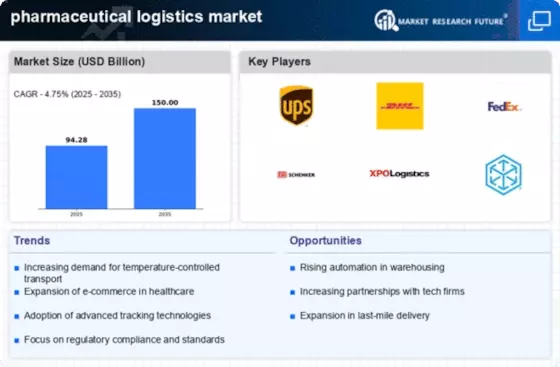
The pharmaceutical logistics market is projected to grow at a 4.75% CAGR from 2024 to 2035, driven by technological advancements, regulatory changes, and increasing demand for temperature-sensitive products.

New opportunities lie in:

  • Implementation of automated inventory management systems
  • Expansion of cold chain logistics capabilities
  • Development of blockchain-based supply chain transparency solutions

By 2035, the pharmaceutical logistics market is expected to be robust, driven by innovation and efficiency.

Market Segmentation

Pharmaceutical Logistics Market End User Outlook

  • Pharmaceutical Manufacturers
  • Healthcare Providers
  • Retail Pharmacies
  • Third-Party Logistics Providers

Pharmaceutical Logistics Market Service Type Outlook

  • Transportation
  • Warehousing
  • Distribution
  • Packaging

Pharmaceutical Logistics Market Mode of Transport Outlook

  • Air Freight
  • Sea Freight
  • Land Transport

Pharmaceutical Logistics Market Temperature Control Outlook

  • Ambient
  • Cold Chain
  • Controlled Room Temperature

Report Scope

Report Attribute/Metric Details
Market Size 2024 95.88(USD Billion)
Market Size 2035 274.03 (USD Billion)
Compound Annual Growth Rate (CAGR) 9.50% (2025 - 2035)
Report Coverage Revenue Forecast, Competitive Landscape, Growth Factors, and Trends
Base Year 2024
Market Forecast Period 2025 - 2035
Historical Data 2019 - 2024
Market Forecast Units USD Billion
Key Companies Profiled FedEx, XPO Logistics, Geodis, DHL, Tibbett Logistics, Lynden Incorporated, Kuehne + Nagel, DB Schenker, Panalpina, IDL Export Services, Agility, UPS, Cegelec, TNT Express
Segments Covered Service Type, Temperature Control, End User, Mode of Transport, Regional
Key Market Opportunities Cold chain logistics expansion, Digital supply chain integration, E-commerce growth for pharmaceuticals, Emerging markets access, Sustainable packaging solutions
Key Market Dynamics Regulatory compliance pressures, Technological advancements in tracking, increasing demand for temperature-sensitive products, growing need for supply chain transparency, and a Rise in e-commerce pharmaceutical sales
Countries Covered North America, Europe, APAC, South America, MEA
Market Size 2025 110.55 (USD Billion)

FAQs

What is the current valuation of the pharmaceutical logistics market?

<p>The pharmaceutical logistics market was valued at 90.0 USD Billion in 2024.</p>

What is the projected market size for the pharmaceutical logistics market by 2035?

<p>The market is expected to reach 150.0 USD Billion by 2035.</p>

What is the expected CAGR for the pharmaceutical logistics market during the forecast period 2025 - 2035?

<p>The expected CAGR for the pharmaceutical logistics market is 4.75% during the forecast period 2025 - 2035.</p>

Which companies are considered key players in the pharmaceutical logistics market?

<p>Key players include UPS, DHL, FedEx, Kuehne + Nagel, and DB Schenker.</p>

What are the main segments of the pharmaceutical logistics market by application?

<p>The main segments by application include Cold Chain Logistics, Warehousing, Transportation, and Inventory Management.</p>

How much is the Cold Chain Logistics segment projected to be worth by 2035?

<p>The Cold Chain Logistics segment is projected to be valued between 30.0 and 50.0 USD Billion by 2035.</p>

What is the expected valuation of the Transportation segment by 2035?

<p>The Transportation segment is expected to be valued between 25.0 and 40.0 USD Billion by 2035.</p>

What are the key end-use segments in the pharmaceutical logistics market?

<p>Key end-use segments include Pharmaceutical Manufacturers, Contract Logistics Providers, Healthcare Institutions, and Retail Pharmacies.</p>

What is the projected value of the Third Party Logistics segment by 2035?

<p>The Third Party Logistics segment is projected to be valued between 45.0 and 75.0 USD Billion by 2035.</p>

What temperature control segments are present in the pharmaceutical logistics market?

<p>Temperature control segments include Ambient Temperature, Refrigerated Temperature, and Frozen Temperature.</p>

  1. SECTION I: EXECUTIVE SUMMARY AND KEY HIGHLIGHTS
    1. | 1.1 EXECUTIVE SUMMARY
    2. | | 1.1.1 Market Overview
    3. | | 1.1.2 Key Findings
    4. | | 1.1.3 Market Segmentation
    5. | | 1.1.4 Competitive Landscape
    6. | | 1.1.5 Challenges and Opportunities
    7. | | 1.1.6 Future Outlook
  2. SECTION II: SCOPING, METHODOLOGY AND MARKET STRUCTURE
    1. | 2.1 MARKET INTRODUCTION
    2. | | 2.1.1 Definition
    3. | | 2.1.2 Scope of the study
    4. | | | 2.1.2.1 Research Objective
    5. | | | 2.1.2.2 Assumption
    6. | | | 2.1.2.3 Limitations
    7. | 2.2 RESEARCH METHODOLOGY
    8. | | 2.2.1 Overview
    9. | | 2.2.2 Data Mining
    10. | | 2.2.3 Secondary Research
    11. | | 2.2.4 Primary Research
    12. | | | 2.2.4.1 Primary Interviews and Information Gathering Process
    13. | | | 2.2.4.2 Breakdown of Primary Respondents
    14. | | 2.2.5 Forecasting Model
    15. | | 2.2.6 Market Size Estimation
    16. | | | 2.2.6.1 Bottom-Up Approach
    17. | | | 2.2.6.2 Top-Down Approach
    18. | | 2.2.7 Data Triangulation
    19. | | 2.2.8 Validation
  3. SECTION III: QUALITATIVE ANALYSIS
    1. | 3.1 MARKET DYNAMICS
    2. | | 3.1.1 Overview
    3. | | 3.1.2 Drivers
    4. | | 3.1.3 Restraints
    5. | | 3.1.4 Opportunities
    6. | 3.2 MARKET FACTOR ANALYSIS
    7. | | 3.2.1 Value chain Analysis
    8. | | 3.2.2 Porter's Five Forces Analysis
    9. | | | 3.2.2.1 Bargaining Power of Suppliers
    10. | | | 3.2.2.2 Bargaining Power of Buyers
    11. | | | 3.2.2.3 Threat of New Entrants
    12. | | | 3.2.2.4 Threat of Substitutes
    13. | | | 3.2.2.5 Intensity of Rivalry
    14. | | 3.2.3 COVID-19 Impact Analysis
    15. | | | 3.2.3.1 Market Impact Analysis
    16. | | | 3.2.3.2 Regional Impact
    17. | | | 3.2.3.3 Opportunity and Threat Analysis
  4. SECTION IV: QUANTITATIVE ANALYSIS
    1. | 4.1 Packaging & Transport, BY Application (USD Billion)
    2. | | 4.1.1 Cold Chain Logistics
    3. | | 4.1.2 Warehousing
    4. | | 4.1.3 Transportation
    5. | | 4.1.4 Inventory Management
    6. | 4.2 Packaging & Transport, BY End Use (USD Billion)
    7. | | 4.2.1 Pharmaceutical Manufacturers
    8. | | 4.2.2 Contract Logistics Providers
    9. | | 4.2.3 Healthcare Institutions
    10. | | 4.2.4 Retail Pharmacies
    11. | 4.3 Packaging & Transport, BY Service Type (USD Billion)
    12. | | 4.3.1 Transportation Services
    13. | | 4.3.2 Storage Services
    14. | | 4.3.3 Packaging Services
    15. | | 4.3.4 Distribution Services
    16. | 4.4 Packaging & Transport, BY Temperature Control (USD Billion)
    17. | | 4.4.1 Ambient Temperature
    18. | | 4.4.2 Refrigerated Temperature
    19. | | 4.4.3 Frozen Temperature
    20. | 4.5 Packaging & Transport, BY Logistics Model (USD Billion)
    21. | | 4.5.1 Third Party Logistics
    22. | | 4.5.2 Fourth Party Logistics
    23. | | 4.5.3 In-House Logistics
    24. | 4.6 Packaging & Transport, BY Region (USD Billion)
    25. | | 4.6.1 North America
    26. | | | 4.6.1.1 US
    27. | | | 4.6.1.2 Canada
    28. | | 4.6.2 Europe
    29. | | | 4.6.2.1 Germany
    30. | | | 4.6.2.2 UK
    31. | | | 4.6.2.3 France
    32. | | | 4.6.2.4 Russia
    33. | | | 4.6.2.5 Italy
    34. | | | 4.6.2.6 Spain
    35. | | | 4.6.2.7 Rest of Europe
    36. | | 4.6.3 APAC
    37. | | | 4.6.3.1 China
    38. | | | 4.6.3.2 India
    39. | | | 4.6.3.3 Japan
    40. | | | 4.6.3.4 South Korea
    41. | | | 4.6.3.5 Malaysia
    42. | | | 4.6.3.6 Thailand
    43. | | | 4.6.3.7 Indonesia
    44. | | | 4.6.3.8 Rest of APAC
    45. | | 4.6.4 South America
    46. | | | 4.6.4.1 Brazil
    47. | | | 4.6.4.2 Mexico
    48. | | | 4.6.4.3 Argentina
    49. | | | 4.6.4.4 Rest of South America
    50. | | 4.6.5 MEA
    51. | | | 4.6.5.1 GCC Countries
    52. | | | 4.6.5.2 South Africa
    53. | | | 4.6.5.3 Rest of MEA
  5. SECTION V: COMPETITIVE ANALYSIS
    1. | 5.1 Competitive Landscape
    2. | | 5.1.1 Overview
    3. | | 5.1.2 Competitive Analysis
    4. | | 5.1.3 Market share Analysis
    5. | | 5.1.4 Major Growth Strategy in the Packaging & Transport
    6. | | 5.1.5 Competitive Benchmarking
    7. | | 5.1.6 Leading Players in Terms of Number of Developments in the Packaging & Transport
    8. | | 5.1.7 Key developments and growth strategies
    9. | | | 5.1.7.1 New Product Launch/Service Deployment
    10. | | | 5.1.7.2 Merger & Acquisitions
    11. | | | 5.1.7.3 Joint Ventures
    12. | | 5.1.8 Major Players Financial Matrix
    13. | | | 5.1.8.1 Sales and Operating Income
    14. | | | 5.1.8.2 Major Players R&D Expenditure. 2023
    15. | 5.2 Company Profiles
    16. | | 5.2.1 UPS (US)
    17. | | | 5.2.1.1 Financial Overview
    18. | | | 5.2.1.2 Products Offered
    19. | | | 5.2.1.3 Key Developments
    20. | | | 5.2.1.4 SWOT Analysis
    21. | | | 5.2.1.5 Key Strategies
    22. | | 5.2.2 DHL (DE)
    23. | | | 5.2.2.1 Financial Overview
    24. | | | 5.2.2.2 Products Offered
    25. | | | 5.2.2.3 Key Developments
    26. | | | 5.2.2.4 SWOT Analysis
    27. | | | 5.2.2.5 Key Strategies
    28. | | 5.2.3 FedEx (US)
    29. | | | 5.2.3.1 Financial Overview
    30. | | | 5.2.3.2 Products Offered
    31. | | | 5.2.3.3 Key Developments
    32. | | | 5.2.3.4 SWOT Analysis
    33. | | | 5.2.3.5 Key Strategies
    34. | | 5.2.4 Kuehne + Nagel (CH)
    35. | | | 5.2.4.1 Financial Overview
    36. | | | 5.2.4.2 Products Offered
    37. | | | 5.2.4.3 Key Developments
    38. | | | 5.2.4.4 SWOT Analysis
    39. | | | 5.2.4.5 Key Strategies
    40. | | 5.2.5 DB Schenker (DE)
    41. | | | 5.2.5.1 Financial Overview
    42. | | | 5.2.5.2 Products Offered
    43. | | | 5.2.5.3 Key Developments
    44. | | | 5.2.5.4 SWOT Analysis
    45. | | | 5.2.5.5 Key Strategies
    46. | | 5.2.6 XPO Logistics (US)
    47. | | | 5.2.6.1 Financial Overview
    48. | | | 5.2.6.2 Products Offered
    49. | | | 5.2.6.3 Key Developments
    50. | | | 5.2.6.4 SWOT Analysis
    51. | | | 5.2.6.5 Key Strategies
    52. | | 5.2.7 C.H. Robinson (US)
    53. | | | 5.2.7.1 Financial Overview
    54. | | | 5.2.7.2 Products Offered
    55. | | | 5.2.7.3 Key Developments
    56. | | | 5.2.7.4 SWOT Analysis
    57. | | | 5.2.7.5 Key Strategies
    58. | | 5.2.8 Panalpina (CH)
    59. | | | 5.2.8.1 Financial Overview
    60. | | | 5.2.8.2 Products Offered
    61. | | | 5.2.8.3 Key Developments
    62. | | | 5.2.8.4 SWOT Analysis
    63. | | | 5.2.8.5 Key Strategies
    64. | | 5.2.9 Geodis (FR)
    65. | | | 5.2.9.1 Financial Overview
    66. | | | 5.2.9.2 Products Offered
    67. | | | 5.2.9.3 Key Developments
    68. | | | 5.2.9.4 SWOT Analysis
    69. | | | 5.2.9.5 Key Strategies
    70. | 5.3 Appendix
    71. | | 5.3.1 References
    72. | | 5.3.2 Related Reports
  6. LIST OF FIGURES
    1. | 6.1 MARKET SYNOPSIS
    2. | 6.2 NORTH AMERICA MARKET ANALYSIS
    3. | 6.3 US MARKET ANALYSIS BY APPLICATION
    4. | 6.4 US MARKET ANALYSIS BY END USE
    5. | 6.5 US MARKET ANALYSIS BY SERVICE TYPE
    6. | 6.6 US MARKET ANALYSIS BY TEMPERATURE CONTROL
    7. | 6.7 US MARKET ANALYSIS BY LOGISTICS MODEL
    8. | 6.8 CANADA MARKET ANALYSIS BY APPLICATION
    9. | 6.9 CANADA MARKET ANALYSIS BY END USE
    10. | 6.10 CANADA MARKET ANALYSIS BY SERVICE TYPE
    11. | 6.11 CANADA MARKET ANALYSIS BY TEMPERATURE CONTROL
    12. | 6.12 CANADA MARKET ANALYSIS BY LOGISTICS MODEL
    13. | 6.13 EUROPE MARKET ANALYSIS
    14. | 6.14 GERMANY MARKET ANALYSIS BY APPLICATION
    15. | 6.15 GERMANY MARKET ANALYSIS BY END USE
    16. | 6.16 GERMANY MARKET ANALYSIS BY SERVICE TYPE
    17. | 6.17 GERMANY MARKET ANALYSIS BY TEMPERATURE CONTROL
    18. | 6.18 GERMANY MARKET ANALYSIS BY LOGISTICS MODEL
    19. | 6.19 UK MARKET ANALYSIS BY APPLICATION
    20. | 6.20 UK MARKET ANALYSIS BY END USE
    21. | 6.21 UK MARKET ANALYSIS BY SERVICE TYPE
    22. | 6.22 UK MARKET ANALYSIS BY TEMPERATURE CONTROL
    23. | 6.23 UK MARKET ANALYSIS BY LOGISTICS MODEL
    24. | 6.24 FRANCE MARKET ANALYSIS BY APPLICATION
    25. | 6.25 FRANCE MARKET ANALYSIS BY END USE
    26. | 6.26 FRANCE MARKET ANALYSIS BY SERVICE TYPE
    27. | 6.27 FRANCE MARKET ANALYSIS BY TEMPERATURE CONTROL
    28. | 6.28 FRANCE MARKET ANALYSIS BY LOGISTICS MODEL
    29. | 6.29 RUSSIA MARKET ANALYSIS BY APPLICATION
    30. | 6.30 RUSSIA MARKET ANALYSIS BY END USE
    31. | 6.31 RUSSIA MARKET ANALYSIS BY SERVICE TYPE
    32. | 6.32 RUSSIA MARKET ANALYSIS BY TEMPERATURE CONTROL
    33. | 6.33 RUSSIA MARKET ANALYSIS BY LOGISTICS MODEL
    34. | 6.34 ITALY MARKET ANALYSIS BY APPLICATION
    35. | 6.35 ITALY MARKET ANALYSIS BY END USE
    36. | 6.36 ITALY MARKET ANALYSIS BY SERVICE TYPE
    37. | 6.37 ITALY MARKET ANALYSIS BY TEMPERATURE CONTROL
    38. | 6.38 ITALY MARKET ANALYSIS BY LOGISTICS MODEL
    39. | 6.39 SPAIN MARKET ANALYSIS BY APPLICATION
    40. | 6.40 SPAIN MARKET ANALYSIS BY END USE
    41. | 6.41 SPAIN MARKET ANALYSIS BY SERVICE TYPE
    42. | 6.42 SPAIN MARKET ANALYSIS BY TEMPERATURE CONTROL
    43. | 6.43 SPAIN MARKET ANALYSIS BY LOGISTICS MODEL
    44. | 6.44 REST OF EUROPE MARKET ANALYSIS BY APPLICATION
    45. | 6.45 REST OF EUROPE MARKET ANALYSIS BY END USE
    46. | 6.46 REST OF EUROPE MARKET ANALYSIS BY SERVICE TYPE
    47. | 6.47 REST OF EUROPE MARKET ANALYSIS BY TEMPERATURE CONTROL
    48. | 6.48 REST OF EUROPE MARKET ANALYSIS BY LOGISTICS MODEL
    49. | 6.49 APAC MARKET ANALYSIS
    50. | 6.50 CHINA MARKET ANALYSIS BY APPLICATION
    51. | 6.51 CHINA MARKET ANALYSIS BY END USE
    52. | 6.52 CHINA MARKET ANALYSIS BY SERVICE TYPE
    53. | 6.53 CHINA MARKET ANALYSIS BY TEMPERATURE CONTROL
    54. | 6.54 CHINA MARKET ANALYSIS BY LOGISTICS MODEL
    55. | 6.55 INDIA MARKET ANALYSIS BY APPLICATION
    56. | 6.56 INDIA MARKET ANALYSIS BY END USE
    57. | 6.57 INDIA MARKET ANALYSIS BY SERVICE TYPE
    58. | 6.58 INDIA MARKET ANALYSIS BY TEMPERATURE CONTROL
    59. | 6.59 INDIA MARKET ANALYSIS BY LOGISTICS MODEL
    60. | 6.60 JAPAN MARKET ANALYSIS BY APPLICATION
    61. | 6.61 JAPAN MARKET ANALYSIS BY END USE
    62. | 6.62 JAPAN MARKET ANALYSIS BY SERVICE TYPE
    63. | 6.63 JAPAN MARKET ANALYSIS BY TEMPERATURE CONTROL
    64. | 6.64 JAPAN MARKET ANALYSIS BY LOGISTICS MODEL
    65. | 6.65 SOUTH KOREA MARKET ANALYSIS BY APPLICATION
    66. | 6.66 SOUTH KOREA MARKET ANALYSIS BY END USE
    67. | 6.67 SOUTH KOREA MARKET ANALYSIS BY SERVICE TYPE
    68. | 6.68 SOUTH KOREA MARKET ANALYSIS BY TEMPERATURE CONTROL
    69. | 6.69 SOUTH KOREA MARKET ANALYSIS BY LOGISTICS MODEL
    70. | 6.70 MALAYSIA MARKET ANALYSIS BY APPLICATION
    71. | 6.71 MALAYSIA MARKET ANALYSIS BY END USE
    72. | 6.72 MALAYSIA MARKET ANALYSIS BY SERVICE TYPE
    73. | 6.73 MALAYSIA MARKET ANALYSIS BY TEMPERATURE CONTROL
    74. | 6.74 MALAYSIA MARKET ANALYSIS BY LOGISTICS MODEL
    75. | 6.75 THAILAND MARKET ANALYSIS BY APPLICATION
    76. | 6.76 THAILAND MARKET ANALYSIS BY END USE
    77. | 6.77 THAILAND MARKET ANALYSIS BY SERVICE TYPE
    78. | 6.78 THAILAND MARKET ANALYSIS BY TEMPERATURE CONTROL
    79. | 6.79 THAILAND MARKET ANALYSIS BY LOGISTICS MODEL
    80. | 6.80 INDONESIA MARKET ANALYSIS BY APPLICATION
    81. | 6.81 INDONESIA MARKET ANALYSIS BY END USE
    82. | 6.82 INDONESIA MARKET ANALYSIS BY SERVICE TYPE
    83. | 6.83 INDONESIA MARKET ANALYSIS BY TEMPERATURE CONTROL
    84. | 6.84 INDONESIA MARKET ANALYSIS BY LOGISTICS MODEL
    85. | 6.85 REST OF APAC MARKET ANALYSIS BY APPLICATION
    86. | 6.86 REST OF APAC MARKET ANALYSIS BY END USE
    87. | 6.87 REST OF APAC MARKET ANALYSIS BY SERVICE TYPE
    88. | 6.88 REST OF APAC MARKET ANALYSIS BY TEMPERATURE CONTROL
    89. | 6.89 REST OF APAC MARKET ANALYSIS BY LOGISTICS MODEL
    90. | 6.90 SOUTH AMERICA MARKET ANALYSIS
    91. | 6.91 BRAZIL MARKET ANALYSIS BY APPLICATION
    92. | 6.92 BRAZIL MARKET ANALYSIS BY END USE
    93. | 6.93 BRAZIL MARKET ANALYSIS BY SERVICE TYPE
    94. | 6.94 BRAZIL MARKET ANALYSIS BY TEMPERATURE CONTROL
    95. | 6.95 BRAZIL MARKET ANALYSIS BY LOGISTICS MODEL
    96. | 6.96 MEXICO MARKET ANALYSIS BY APPLICATION
    97. | 6.97 MEXICO MARKET ANALYSIS BY END USE
    98. | 6.98 MEXICO MARKET ANALYSIS BY SERVICE TYPE
    99. | 6.99 MEXICO MARKET ANALYSIS BY TEMPERATURE CONTROL
    100. | 6.100 MEXICO MARKET ANALYSIS BY LOGISTICS MODEL
    101. | 6.101 ARGENTINA MARKET ANALYSIS BY APPLICATION
    102. | 6.102 ARGENTINA MARKET ANALYSIS BY END USE
    103. | 6.103 ARGENTINA MARKET ANALYSIS BY SERVICE TYPE
    104. | 6.104 ARGENTINA MARKET ANALYSIS BY TEMPERATURE CONTROL
    105. | 6.105 ARGENTINA MARKET ANALYSIS BY LOGISTICS MODEL
    106. | 6.106 REST OF SOUTH AMERICA MARKET ANALYSIS BY APPLICATION
    107. | 6.107 REST OF SOUTH AMERICA MARKET ANALYSIS BY END USE
    108. | 6.108 REST OF SOUTH AMERICA MARKET ANALYSIS BY SERVICE TYPE
    109. | 6.109 REST OF SOUTH AMERICA MARKET ANALYSIS BY TEMPERATURE CONTROL
    110. | 6.110 REST OF SOUTH AMERICA MARKET ANALYSIS BY LOGISTICS MODEL
    111. | 6.111 MEA MARKET ANALYSIS
    112. | 6.112 GCC COUNTRIES MARKET ANALYSIS BY APPLICATION
    113. | 6.113 GCC COUNTRIES MARKET ANALYSIS BY END USE
    114. | 6.114 GCC COUNTRIES MARKET ANALYSIS BY SERVICE TYPE
    115. | 6.115 GCC COUNTRIES MARKET ANALYSIS BY TEMPERATURE CONTROL
    116. | 6.116 GCC COUNTRIES MARKET ANALYSIS BY LOGISTICS MODEL
    117. | 6.117 SOUTH AFRICA MARKET ANALYSIS BY APPLICATION
    118. | 6.118 SOUTH AFRICA MARKET ANALYSIS BY END USE
    119. | 6.119 SOUTH AFRICA MARKET ANALYSIS BY SERVICE TYPE
    120. | 6.120 SOUTH AFRICA MARKET ANALYSIS BY TEMPERATURE CONTROL
    121. | 6.121 SOUTH AFRICA MARKET ANALYSIS BY LOGISTICS MODEL
    122. | 6.122 REST OF MEA MARKET ANALYSIS BY APPLICATION
    123. | 6.123 REST OF MEA MARKET ANALYSIS BY END USE
    124. | 6.124 REST OF MEA MARKET ANALYSIS BY SERVICE TYPE
    125. | 6.125 REST OF MEA MARKET ANALYSIS BY TEMPERATURE CONTROL
    126. | 6.126 REST OF MEA MARKET ANALYSIS BY LOGISTICS MODEL
    127. | 6.127 KEY BUYING CRITERIA OF PACKAGING & TRANSPORT
    128. | 6.128 RESEARCH PROCESS OF MRFR
    129. | 6.129 DRO ANALYSIS OF PACKAGING & TRANSPORT
    130. | 6.130 DRIVERS IMPACT ANALYSIS: PACKAGING & TRANSPORT
    131. | 6.131 RESTRAINTS IMPACT ANALYSIS: PACKAGING & TRANSPORT
    132. | 6.132 SUPPLY / VALUE CHAIN: PACKAGING & TRANSPORT
    133. | 6.133 PACKAGING & TRANSPORT, BY APPLICATION, 2024 (% SHARE)
    134. | 6.134 PACKAGING & TRANSPORT, BY APPLICATION, 2024 TO 2035 (USD Billion)
    135. | 6.135 PACKAGING & TRANSPORT, BY END USE, 2024 (% SHARE)
    136. | 6.136 PACKAGING & TRANSPORT, BY END USE, 2024 TO 2035 (USD Billion)
    137. | 6.137 PACKAGING & TRANSPORT, BY SERVICE TYPE, 2024 (% SHARE)
    138. | 6.138 PACKAGING & TRANSPORT, BY SERVICE TYPE, 2024 TO 2035 (USD Billion)
    139. | 6.139 PACKAGING & TRANSPORT, BY TEMPERATURE CONTROL, 2024 (% SHARE)
    140. | 6.140 PACKAGING & TRANSPORT, BY TEMPERATURE CONTROL, 2024 TO 2035 (USD Billion)
    141. | 6.141 PACKAGING & TRANSPORT, BY LOGISTICS MODEL, 2024 (% SHARE)
    142. | 6.142 PACKAGING & TRANSPORT, BY LOGISTICS MODEL, 2024 TO 2035 (USD Billion)
    143. | 6.143 BENCHMARKING OF MAJOR COMPETITORS
  7. LIST OF TABLES
    1. | 7.1 LIST OF ASSUMPTIONS
    2. | | 7.1.1
    3. | 7.2 North America MARKET SIZE ESTIMATES; FORECAST
    4. | | 7.2.1 BY APPLICATION, 2025-2035 (USD Billion)
    5. | | 7.2.2 BY END USE, 2025-2035 (USD Billion)
    6. | | 7.2.3 BY SERVICE TYPE, 2025-2035 (USD Billion)
    7. | | 7.2.4 BY TEMPERATURE CONTROL, 2025-2035 (USD Billion)
    8. | | 7.2.5 BY LOGISTICS MODEL, 2025-2035 (USD Billion)
    9. | 7.3 US MARKET SIZE ESTIMATES; FORECAST
    10. | | 7.3.1 BY APPLICATION, 2025-2035 (USD Billion)
    11. | | 7.3.2 BY END USE, 2025-2035 (USD Billion)
    12. | | 7.3.3 BY SERVICE TYPE, 2025-2035 (USD Billion)
    13. | | 7.3.4 BY TEMPERATURE CONTROL, 2025-2035 (USD Billion)
    14. | | 7.3.5 BY LOGISTICS MODEL, 2025-2035 (USD Billion)
    15. | 7.4 Canada MARKET SIZE ESTIMATES; FORECAST
    16. | | 7.4.1 BY APPLICATION, 2025-2035 (USD Billion)
    17. | | 7.4.2 BY END USE, 2025-2035 (USD Billion)
    18. | | 7.4.3 BY SERVICE TYPE, 2025-2035 (USD Billion)
    19. | | 7.4.4 BY TEMPERATURE CONTROL, 2025-2035 (USD Billion)
    20. | | 7.4.5 BY LOGISTICS MODEL, 2025-2035 (USD Billion)
    21. | 7.5 Europe MARKET SIZE ESTIMATES; FORECAST
    22. | | 7.5.1 BY APPLICATION, 2025-2035 (USD Billion)
    23. | | 7.5.2 BY END USE, 2025-2035 (USD Billion)
    24. | | 7.5.3 BY SERVICE TYPE, 2025-2035 (USD Billion)
    25. | | 7.5.4 BY TEMPERATURE CONTROL, 2025-2035 (USD Billion)
    26. | | 7.5.5 BY LOGISTICS MODEL, 2025-2035 (USD Billion)
    27. | 7.6 Germany MARKET SIZE ESTIMATES; FORECAST
    28. | | 7.6.1 BY APPLICATION, 2025-2035 (USD Billion)
    29. | | 7.6.2 BY END USE, 2025-2035 (USD Billion)
    30. | | 7.6.3 BY SERVICE TYPE, 2025-2035 (USD Billion)
    31. | | 7.6.4 BY TEMPERATURE CONTROL, 2025-2035 (USD Billion)
    32. | | 7.6.5 BY LOGISTICS MODEL, 2025-2035 (USD Billion)
    33. | 7.7 UK MARKET SIZE ESTIMATES; FORECAST
    34. | | 7.7.1 BY APPLICATION, 2025-2035 (USD Billion)
    35. | | 7.7.2 BY END USE, 2025-2035 (USD Billion)
    36. | | 7.7.3 BY SERVICE TYPE, 2025-2035 (USD Billion)
    37. | | 7.7.4 BY TEMPERATURE CONTROL, 2025-2035 (USD Billion)
    38. | | 7.7.5 BY LOGISTICS MODEL, 2025-2035 (USD Billion)
    39. | 7.8 France MARKET SIZE ESTIMATES; FORECAST
    40. | | 7.8.1 BY APPLICATION, 2025-2035 (USD Billion)
    41. | | 7.8.2 BY END USE, 2025-2035 (USD Billion)
    42. | | 7.8.3 BY SERVICE TYPE, 2025-2035 (USD Billion)
    43. | | 7.8.4 BY TEMPERATURE CONTROL, 2025-2035 (USD Billion)
    44. | | 7.8.5 BY LOGISTICS MODEL, 2025-2035 (USD Billion)
    45. | 7.9 Russia MARKET SIZE ESTIMATES; FORECAST
    46. | | 7.9.1 BY APPLICATION, 2025-2035 (USD Billion)
    47. | | 7.9.2 BY END USE, 2025-2035 (USD Billion)
    48. | | 7.9.3 BY SERVICE TYPE, 2025-2035 (USD Billion)
    49. | | 7.9.4 BY TEMPERATURE CONTROL, 2025-2035 (USD Billion)
    50. | | 7.9.5 BY LOGISTICS MODEL, 2025-2035 (USD Billion)
    51. | 7.10 Italy MARKET SIZE ESTIMATES; FORECAST
    52. | | 7.10.1 BY APPLICATION, 2025-2035 (USD Billion)
    53. | | 7.10.2 BY END USE, 2025-2035 (USD Billion)
    54. | | 7.10.3 BY SERVICE TYPE, 2025-2035 (USD Billion)
    55. | | 7.10.4 BY TEMPERATURE CONTROL, 2025-2035 (USD Billion)
    56. | | 7.10.5 BY LOGISTICS MODEL, 2025-2035 (USD Billion)
    57. | 7.11 Spain MARKET SIZE ESTIMATES; FORECAST
    58. | | 7.11.1 BY APPLICATION, 2025-2035 (USD Billion)
    59. | | 7.11.2 BY END USE, 2025-2035 (USD Billion)
    60. | | 7.11.3 BY SERVICE TYPE, 2025-2035 (USD Billion)
    61. | | 7.11.4 BY TEMPERATURE CONTROL, 2025-2035 (USD Billion)
    62. | | 7.11.5 BY LOGISTICS MODEL, 2025-2035 (USD Billion)
    63. | 7.12 Rest of Europe MARKET SIZE ESTIMATES; FORECAST
    64. | | 7.12.1 BY APPLICATION, 2025-2035 (USD Billion)
    65. | | 7.12.2 BY END USE, 2025-2035 (USD Billion)
    66. | | 7.12.3 BY SERVICE TYPE, 2025-2035 (USD Billion)
    67. | | 7.12.4 BY TEMPERATURE CONTROL, 2025-2035 (USD Billion)
    68. | | 7.12.5 BY LOGISTICS MODEL, 2025-2035 (USD Billion)
    69. | 7.13 APAC MARKET SIZE ESTIMATES; FORECAST
    70. | | 7.13.1 BY APPLICATION, 2025-2035 (USD Billion)
    71. | | 7.13.2 BY END USE, 2025-2035 (USD Billion)
    72. | | 7.13.3 BY SERVICE TYPE, 2025-2035 (USD Billion)
    73. | | 7.13.4 BY TEMPERATURE CONTROL, 2025-2035 (USD Billion)
    74. | | 7.13.5 BY LOGISTICS MODEL, 2025-2035 (USD Billion)
    75. | 7.14 China MARKET SIZE ESTIMATES; FORECAST
    76. | | 7.14.1 BY APPLICATION, 2025-2035 (USD Billion)
    77. | | 7.14.2 BY END USE, 2025-2035 (USD Billion)
    78. | | 7.14.3 BY SERVICE TYPE, 2025-2035 (USD Billion)
    79. | | 7.14.4 BY TEMPERATURE CONTROL, 2025-2035 (USD Billion)
    80. | | 7.14.5 BY LOGISTICS MODEL, 2025-2035 (USD Billion)
    81. | 7.15 India MARKET SIZE ESTIMATES; FORECAST
    82. | | 7.15.1 BY APPLICATION, 2025-2035 (USD Billion)
    83. | | 7.15.2 BY END USE, 2025-2035 (USD Billion)
    84. | | 7.15.3 BY SERVICE TYPE, 2025-2035 (USD Billion)
    85. | | 7.15.4 BY TEMPERATURE CONTROL, 2025-2035 (USD Billion)
    86. | | 7.15.5 BY LOGISTICS MODEL, 2025-2035 (USD Billion)
    87. | 7.16 Japan MARKET SIZE ESTIMATES; FORECAST
    88. | | 7.16.1 BY APPLICATION, 2025-2035 (USD Billion)
    89. | | 7.16.2 BY END USE, 2025-2035 (USD Billion)
    90. | | 7.16.3 BY SERVICE TYPE, 2025-2035 (USD Billion)
    91. | | 7.16.4 BY TEMPERATURE CONTROL, 2025-2035 (USD Billion)
    92. | | 7.16.5 BY LOGISTICS MODEL, 2025-2035 (USD Billion)
    93. | 7.17 South Korea MARKET SIZE ESTIMATES; FORECAST
    94. | | 7.17.1 BY APPLICATION, 2025-2035 (USD Billion)
    95. | | 7.17.2 BY END USE, 2025-2035 (USD Billion)
    96. | | 7.17.3 BY SERVICE TYPE, 2025-2035 (USD Billion)
    97. | | 7.17.4 BY TEMPERATURE CONTROL, 2025-2035 (USD Billion)
    98. | | 7.17.5 BY LOGISTICS MODEL, 2025-2035 (USD Billion)
    99. | 7.18 Malaysia MARKET SIZE ESTIMATES; FORECAST
    100. | | 7.18.1 BY APPLICATION, 2025-2035 (USD Billion)
    101. | | 7.18.2 BY END USE, 2025-2035 (USD Billion)
    102. | | 7.18.3 BY SERVICE TYPE, 2025-2035 (USD Billion)
    103. | | 7.18.4 BY TEMPERATURE CONTROL, 2025-2035 (USD Billion)
    104. | | 7.18.5 BY LOGISTICS MODEL, 2025-2035 (USD Billion)
    105. | 7.19 Thailand MARKET SIZE ESTIMATES; FORECAST
    106. | | 7.19.1 BY APPLICATION, 2025-2035 (USD Billion)
    107. | | 7.19.2 BY END USE, 2025-2035 (USD Billion)
    108. | | 7.19.3 BY SERVICE TYPE, 2025-2035 (USD Billion)
    109. | | 7.19.4 BY TEMPERATURE CONTROL, 2025-2035 (USD Billion)
    110. | | 7.19.5 BY LOGISTICS MODEL, 2025-2035 (USD Billion)
    111. | 7.20 Indonesia MARKET SIZE ESTIMATES; FORECAST
    112. | | 7.20.1 BY APPLICATION, 2025-2035 (USD Billion)
    113. | | 7.20.2 BY END USE, 2025-2035 (USD Billion)
    114. | | 7.20.3 BY SERVICE TYPE, 2025-2035 (USD Billion)
    115. | | 7.20.4 BY TEMPERATURE CONTROL, 2025-2035 (USD Billion)
    116. | | 7.20.5 BY LOGISTICS MODEL, 2025-2035 (USD Billion)
    117. | 7.21 Rest of APAC MARKET SIZE ESTIMATES; FORECAST
    118. | | 7.21.1 BY APPLICATION, 2025-2035 (USD Billion)
    119. | | 7.21.2 BY END USE, 2025-2035 (USD Billion)
    120. | | 7.21.3 BY SERVICE TYPE, 2025-2035 (USD Billion)
    121. | | 7.21.4 BY TEMPERATURE CONTROL, 2025-2035 (USD Billion)
    122. | | 7.21.5 BY LOGISTICS MODEL, 2025-2035 (USD Billion)
    123. | 7.22 South America MARKET SIZE ESTIMATES; FORECAST
    124. | | 7.22.1 BY APPLICATION, 2025-2035 (USD Billion)
    125. | | 7.22.2 BY END USE, 2025-2035 (USD Billion)
    126. | | 7.22.3 BY SERVICE TYPE, 2025-2035 (USD Billion)
    127. | | 7.22.4 BY TEMPERATURE CONTROL, 2025-2035 (USD Billion)
    128. | | 7.22.5 BY LOGISTICS MODEL, 2025-2035 (USD Billion)
    129. | 7.23 Brazil MARKET SIZE ESTIMATES; FORECAST
    130. | | 7.23.1 BY APPLICATION, 2025-2035 (USD Billion)
    131. | | 7.23.2 BY END USE, 2025-2035 (USD Billion)
    132. | | 7.23.3 BY SERVICE TYPE, 2025-2035 (USD Billion)
    133. | | 7.23.4 BY TEMPERATURE CONTROL, 2025-2035 (USD Billion)
    134. | | 7.23.5 BY LOGISTICS MODEL, 2025-2035 (USD Billion)
    135. | 7.24 Mexico MARKET SIZE ESTIMATES; FORECAST
    136. | | 7.24.1 BY APPLICATION, 2025-2035 (USD Billion)
    137. | | 7.24.2 BY END USE, 2025-2035 (USD Billion)
    138. | | 7.24.3 BY SERVICE TYPE, 2025-2035 (USD Billion)
    139. | | 7.24.4 BY TEMPERATURE CONTROL, 2025-2035 (USD Billion)
    140. | | 7.24.5 BY LOGISTICS MODEL, 2025-2035 (USD Billion)
    141. | 7.25 Argentina MARKET SIZE ESTIMATES; FORECAST
    142. | | 7.25.1 BY APPLICATION, 2025-2035 (USD Billion)
    143. | | 7.25.2 BY END USE, 2025-2035 (USD Billion)
    144. | | 7.25.3 BY SERVICE TYPE, 2025-2035 (USD Billion)
    145. | | 7.25.4 BY TEMPERATURE CONTROL, 2025-2035 (USD Billion)
    146. | | 7.25.5 BY LOGISTICS MODEL, 2025-2035 (USD Billion)
    147. | 7.26 Rest of South America MARKET SIZE ESTIMATES; FORECAST
    148. | | 7.26.1 BY APPLICATION, 2025-2035 (USD Billion)
    149. | | 7.26.2 BY END USE, 2025-2035 (USD Billion)
    150. | | 7.26.3 BY SERVICE TYPE, 2025-2035 (USD Billion)
    151. | | 7.26.4 BY TEMPERATURE CONTROL, 2025-2035 (USD Billion)
    152. | | 7.26.5 BY LOGISTICS MODEL, 2025-2035 (USD Billion)
    153. | 7.27 MEA MARKET SIZE ESTIMATES; FORECAST
    154. | | 7.27.1 BY APPLICATION, 2025-2035 (USD Billion)
    155. | | 7.27.2 BY END USE, 2025-2035 (USD Billion)
    156. | | 7.27.3 BY SERVICE TYPE, 2025-2035 (USD Billion)
    157. | | 7.27.4 BY TEMPERATURE CONTROL, 2025-2035 (USD Billion)
    158. | | 7.27.5 BY LOGISTICS MODEL, 2025-2035 (USD Billion)
    159. | 7.28 GCC Countries MARKET SIZE ESTIMATES; FORECAST
    160. | | 7.28.1 BY APPLICATION, 2025-2035 (USD Billion)
    161. | | 7.28.2 BY END USE, 2025-2035 (USD Billion)
    162. | | 7.28.3 BY SERVICE TYPE, 2025-2035 (USD Billion)
    163. | | 7.28.4 BY TEMPERATURE CONTROL, 2025-2035 (USD Billion)
    164. | | 7.28.5 BY LOGISTICS MODEL, 2025-2035 (USD Billion)
    165. | 7.29 South Africa MARKET SIZE ESTIMATES; FORECAST
    166. | | 7.29.1 BY APPLICATION, 2025-2035 (USD Billion)
    167. | | 7.29.2 BY END USE, 2025-2035 (USD Billion)
    168. | | 7.29.3 BY SERVICE TYPE, 2025-2035 (USD Billion)
    169. | | 7.29.4 BY TEMPERATURE CONTROL, 2025-2035 (USD Billion)
    170. | | 7.29.5 BY LOGISTICS MODEL, 2025-2035 (USD Billion)
    171. | 7.30 Rest of MEA MARKET SIZE ESTIMATES; FORECAST
    172. | | 7.30.1 BY APPLICATION, 2025-2035 (USD Billion)
    173. | | 7.30.2 BY END USE, 2025-2035 (USD Billion)
    174. | | 7.30.3 BY SERVICE TYPE, 2025-2035 (USD Billion)
    175. | | 7.30.4 BY TEMPERATURE CONTROL, 2025-2035 (USD Billion)
    176. | | 7.30.5 BY LOGISTICS MODEL, 2025-2035 (USD Billion)
    177. | 7.31 PRODUCT LAUNCH/PRODUCT DEVELOPMENT/APPROVAL
    178. | | 7.31.1
    179. | 7.32 ACQUISITION/PARTNERSHIP
    180. | | 7.32.1

Packaging & Transport Market Segmentation

Packaging & Transport By Application (USD Billion, 2025-2035)

  • Cold Chain Logistics
  • Warehousing
  • Transportation
  • Inventory Management

Packaging & Transport By End Use (USD Billion, 2025-2035)

  • Pharmaceutical Manufacturers
  • Contract Logistics Providers
  • Healthcare Institutions
  • Retail Pharmacies

Packaging & Transport By Service Type (USD Billion, 2025-2035)

  • Transportation Services
  • Storage Services
  • Packaging Services
  • Distribution Services

Packaging & Transport By Temperature Control (USD Billion, 2025-2035)

  • Ambient Temperature
  • Refrigerated Temperature
  • Frozen Temperature

Packaging & Transport By Logistics Model (USD Billion, 2025-2035)

  • Third Party Logistics
  • Fourth Party Logistics
  • In-House Logistics
Infographic

Free Sample Request

Kindly complete the form below to receive a free sample of this Report

Get Free Sample

Customer Strories

Compare Licence

×
Features License Type
Single User Multiuser License Enterprise User
Price $4,950 $5,950 $7,250
Maximum User Access Limit 1 User Upto 10 Users Unrestricted Access Throughout the Organization
Free Customization
Direct Access to Analyst
Deliverable Format
Platform Access
Discount on Next Purchase 10% 15% 15%
Printable Versions
%>