×
Hero Background
English
Chinese
French
Japanese
Korean
German
Spanish

Percutaneous Coronary Intervention Market Analysis

ID: MRFR/MED/2288-CR
157 Pages
Rahul Gotadki
January 2024

Percutaneous Coronary Intervention Market Research Report Information by Product Type (Coronary Stents, Balloon Catheters, Coronary Guidewires, Guiding Catheters, Guiding Sheaths, Diagnostics Catheters, Crossing Catheters, Inflation Devices, Guidance Systems, Peripheral Thrombectomy System, Embolic Protection System, And Accessories), by Vascular Access (Radial and Femoral), by End User (Hospitals & Clinics, Ambulatory Surgical Centers, and Others), and by Region (North America, Europe, Asia-Pacific, and Rest of the World - Forecast till... read more

Share:
Download PDF ×

We do not share your information with anyone. However, we may send you emails based on your report interest from time to time. You may contact us at any time to opt-out.

Percutaneous Coronary Intervention Market Infographic
Purchase Options

Market Analysis

In-depth Analysis of Percutaneous Coronary Intervention Market Industry Landscape

Percutaneous coronary intervention (PCI) has emerged as a prevalent treatment for coronary artery disease on a global scale, with an annual performance of over two million procedures. Despite its widespread adoption, PCI is not without its constraints and limitations, necessitating ongoing research and innovation to enhance both its outcomes and safety. Several concerns associated with PCI include restenosis, which refers to the re-narrowing of the treated artery, stent thrombosis characterized by clot formation within the stent, bleeding complications, radiation exposure, and considerations related to cost-effectiveness. To address these challenges, continuous efforts are directed towards refining PCI techniques and introducing innovations that promise improved patient outcomes and prolonged efficacy.

Among the recent advancements in PCI techniques, bioresorbable vascular scaffolds (BVS) have garnered attention. These scaffolds gradually dissolve after the artery heals, presenting a promising solution to the issue of restenosis. Additionally, the integration of cutting-edge imaging technologies such as intravascular ultrasound (IVUS) and optical coherence tomography (OCT) has played a pivotal role in reinforcing precise decision-making and treatment planning during PCI procedures.

The evolution of PCI extends beyond these technical innovations, embracing the integration of robotics and telemedicine. These technologies are instrumental in making PCI treatments more accessible, especially for patients residing in rural areas. The integration of robotics enhances procedural precision and expands the reach of PCI expertise, while telemedicine facilitates remote consultations and interventions.

Over the past few decades, PCI has undergone significant transformations, witnessing the introduction of novel devices, procedures, and strategies that contribute to its enhanced efficacy and safety. The trajectory of PCI research remains dynamic, driven by the overarching goal of further improving patient outcomes and extending the accessibility of PCI procedures to a global patient population.

In conclusion, while PCI has established itself as a cornerstone in the treatment of coronary artery disease, the field continues to evolve. Ongoing research endeavors strive to overcome existing limitations, introducing innovations that not only address current challenges but also aim to make PCI procedures more universally accessible, ensuring that patients worldwide can benefit from the advancements in this crucial medical intervention.


Author
Rahul Gotadki
Assistant Manager

He holds an experience of about 7+ years in Market Research and Business Consulting, working under the spectrum of Life Sciences and Healthcare domains. Rahul conceptualizes and implements a scalable business strategy and provides strategic leadership to the clients. His expertise lies in market estimation, competitive intelligence, pipeline analysis, customer assessment, etc. In addition to the above, his other responsibility includes strategic tracking of high growth markets & advising clients on the potential areas of focus they could direct their business initiatives

Leave a Comment

FAQs

What is the projected growth of the Percutaneous Coronary Intervention market?

The Percutaneous Coronary Intervention market is the expected increase in total market value of 33.48 USD billion over a defined forecast period 2025–2035. It is driven by factors such as demand trends, technological advances, regulatory changes, and geographic expansion.

What is the size of the Percutaneous Coronary Intervention market?

Percutaneous Coronary Intervention market size was valued at approximately 11.7 billion USD in 2024. This figure will reach 33.48 billion USD covering all regions (America, Europe, Asia, MEA and ROW), focusing its segments / services / distribution channels till 2035.

What is the CAGR of the Percutaneous Coronary Intervention market?

Percutaneous Coronary Intervention market is expected to grow at a CAGR of 10.03% between 2025 and 2035.

How much will the Percutaneous Coronary Intervention market be worth by 2035?

Percutaneous Coronary Intervention market is expected to be worth of 33.48 billion USD, reflecting growth driven by usage, technology and global demands by the end of 2035.

How will the Percutaneous Coronary Intervention market perform over the next 10 years?

Over the next 10 years the Percutaneous Coronary Intervention market is expected to shift from usd billion 11.7 to 33.48 billion USD, led by adoption of advanced tech, demographic trends, regulatory approvals, with potential headwinds from 2025 to 2035.

How much is the percutaneous coronary intervention market?

The Percutaneous Coronary Intervention Market is anticipated to reach 20.53 Billion during the forecast period of 2024-2035.

Market Summary

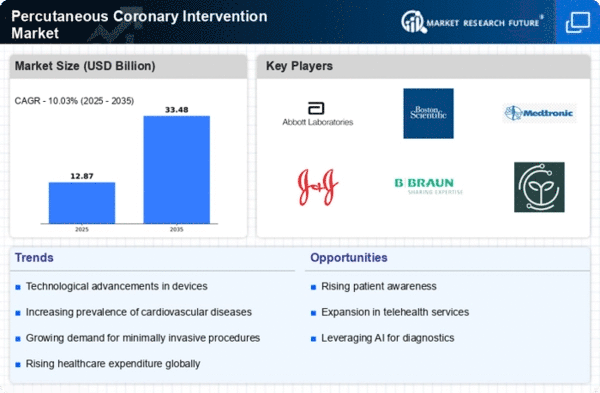
As per MRFR analysis, the Percutaneous Coronary Intervention Market Size was estimated at 11.7 USD Billion in 2024. The Percutaneous Coronary Intervention industry is projected to grow from 12.87 USD Billion in 2025 to 33.48 USD Billion by 2035, exhibiting a compound annual growth rate (CAGR) of 10.03 during the forecast period 2025 - 2035.

Key Market Trends & Highlights

The Percutaneous Coronary Intervention Market is poised for substantial growth driven by technological advancements and increasing healthcare demands.

  • Technological advancements in cardiac devices are enhancing the efficacy of percutaneous coronary interventions.
  • North America remains the largest market, while the Asia-Pacific region is emerging as the fastest-growing area for these procedures.
  • The coronary artery disease segment dominates the market, whereas the acute coronary syndrome segment is experiencing rapid growth.
  • Key market drivers include the increasing aging population and rising healthcare expenditure, which are fueling demand for innovative cardiac solutions.

Market Size & Forecast

2024 Market Size 11.7 (USD Billion)
2035 Market Size 33.48 (USD Billion)
CAGR (2025 - 2035) 10.03%
Largest Regional Market Share in 2024 North America

Major Players

<p>Abbott (US), Boston Scientific (US), Medtronic (US), Johnson & Johnson (US), B. Braun (DE), Terumo (JP), Cardinal Health (US), Siemens Healthineers (DE), Philips (NL)</p>

Market Trends

The Percutaneous Coronary Intervention Market is currently experiencing notable transformations driven by advancements in technology and an increasing prevalence of cardiovascular diseases. The integration of innovative devices and techniques is enhancing procedural efficacy and patient outcomes. Furthermore, the growing awareness regarding heart health is prompting more individuals to seek preventive measures and treatments, thereby expanding the market's reach. As healthcare systems evolve, the demand for minimally invasive procedures is likely to rise, reflecting a shift in patient preferences towards less invasive options that promise quicker recovery times and reduced hospital stays. In addition, the regulatory landscape is adapting to accommodate new technologies, which may facilitate faster approvals for novel devices and therapies. This dynamic environment suggests that stakeholders in the Percutaneous Coronary Intervention Market must remain agile and responsive to emerging trends. Collaboration between manufacturers, healthcare providers, and regulatory bodies appears essential for fostering innovation and ensuring that advancements translate into improved patient care. As the market continues to evolve, it is poised to play a crucial role in addressing the global burden of cardiovascular diseases, ultimately enhancing the quality of life for patients worldwide.

Technological Advancements

The ongoing evolution of technology in the Percutaneous Coronary Intervention Market is reshaping treatment methodologies. Innovations such as drug-eluting stents and advanced imaging techniques are enhancing procedural precision and effectiveness. These advancements not only improve patient outcomes but also contribute to the overall efficiency of healthcare delivery.

Rising Prevalence of Cardiovascular Diseases

The increasing incidence of cardiovascular diseases is a driving force behind the growth of the Percutaneous Coronary Intervention Market. As more individuals are diagnosed with heart-related conditions, the demand for effective treatment options is escalating. This trend underscores the necessity for healthcare systems to adapt and expand their offerings to meet patient needs.

Shift Towards Minimally Invasive Procedures

There is a discernible trend towards minimally invasive procedures within the Percutaneous Coronary Intervention Market. Patients are increasingly favoring options that promise reduced recovery times and lower risks associated with traditional surgical methods. This shift is prompting healthcare providers to enhance their capabilities in delivering such interventions.

Percutaneous Coronary Intervention Market Market Drivers

Market Growth Projections

The Global Percutaneous Coronary Intervention Market Industry is on a trajectory of substantial growth, with projections indicating a market size of 11.7 USD Billion in 2024 and an anticipated increase to 33.5 USD Billion by 2035. This growth reflects a compound annual growth rate of 10.03% from 2025 to 2035, driven by factors such as rising cardiovascular disease prevalence, technological advancements, and increased healthcare expenditure. These projections highlight the dynamic nature of the PCI market and its critical role in addressing global cardiovascular health challenges.

Growing Geriatric Population

The demographic shift towards an aging population is a crucial factor propelling the Global Percutaneous Coronary Intervention Market Industry. As individuals age, the risk of developing cardiovascular diseases escalates, necessitating more frequent interventions. By 2030, it is anticipated that the number of people aged 60 and older will surpass 1.4 billion globally, creating a substantial demand for PCI procedures. This demographic trend underscores the need for healthcare systems to adapt and expand their cardiovascular care capabilities, thereby driving market growth in the coming years.

Increased Healthcare Expenditure

Rising healthcare expenditure across various regions is a significant driver of the Global Percutaneous Coronary Intervention Market Industry. Governments and private sectors are investing more in healthcare infrastructure, particularly in cardiovascular care. This trend is evident in many countries where healthcare budgets are being allocated to advanced medical technologies and procedures. As a result, the market is poised for growth, with a projected compound annual growth rate of 10.03% from 2025 to 2035, reflecting the increasing prioritization of cardiovascular health in national health agendas.

Enhanced Awareness and Screening Programs

The growing awareness of cardiovascular health and the implementation of screening programs are pivotal in shaping the Global Percutaneous Coronary Intervention Market Industry. Public health initiatives aimed at educating populations about heart disease risk factors have led to earlier detection and treatment of cardiovascular conditions. This proactive approach not only improves patient outcomes but also drives demand for PCI procedures. As awareness continues to rise, the market is likely to experience sustained growth, further emphasizing the importance of preventive care in cardiovascular health.

Rising Prevalence of Cardiovascular Diseases

The increasing incidence of cardiovascular diseases globally serves as a primary driver for the Global Percutaneous Coronary Intervention Market Industry. With an estimated 17.9 million deaths attributed to cardiovascular conditions each year, the demand for effective treatment options is surging. Percutaneous coronary interventions, which include angioplasty and stenting, are becoming essential in managing these diseases. As healthcare systems adapt to this growing burden, the market is projected to reach 11.7 USD Billion in 2024, reflecting the urgent need for innovative solutions in cardiovascular care.

Technological Advancements in PCI Procedures

Technological innovations in percutaneous coronary interventions are significantly influencing the Global Percutaneous Coronary Intervention Market Industry. Advancements such as drug-eluting stents, bioresorbable stents, and improved imaging techniques enhance procedural outcomes and patient safety. These innovations not only improve the efficacy of interventions but also reduce recovery times, leading to increased patient throughput in healthcare facilities. As a result, the market is expected to expand, with projections indicating a growth to 33.5 USD Billion by 2035, driven by the continuous evolution of PCI technologies.

Market Segment Insights

By Application: Coronary Artery Disease (Largest) vs. Acute Coronary Syndrome (Fastest-Growing)

<p>In the Percutaneous Coronary Intervention Market, the application segment is prominently led by Coronary Artery Disease (CAD), which accounts for a substantial portion of market share. This is attributed to the increasing prevalence of CAD, bolstered by lifestyle factors such as unhealthy diet and lack of exercise. Acute Coronary Syndrome (ACS) follows, marking a rapid ascent due to a rise in emergency care demands and greater awareness about heart-related risks. Additionally, the emergence of innovative care pathways is enhancing treatment options in both these categories.</p>

<p>Coronary Artery Disease (Dominant) vs. Acute Coronary Syndrome (Emerging)</p>

<p>Coronary Artery Disease represents the dominant force within the application segment of the Percutaneous Coronary Intervention Market due to its high incidence and the extensive treatment protocols available. CAD treatments utilize cutting-edge technologies and methodologies, ensuring improved patient outcomes. On the other hand, Acute Coronary Syndrome is emerging rapidly as healthcare systems adapt to increased patient needs. This segment is benefiting from advancements in medical technologies and an increasing focus on acute care management and intervention techniques. Together, these two segments reflect a diverse landscape, with CAD established as foundational, while ACS grows at an impressive pace.</p>

By Device Type: Stents (Largest) vs. Balloon Catheters (Fastest-Growing)

<p>The Percutaneous Coronary Intervention (PCI) market is significantly influenced by various device types, among which stents hold the largest market share. Stents are extensively utilized due to their effectiveness in providing support to blocked arteries, ensuring improved blood flow. In contrast, balloon catheters are emerging as the fastest-growing segment, gaining traction among healthcare providers for their role in alleviating blockages during PCI procedures. The increasing adoption of innovative products in this category is driving their prominence.</p>

<p>Stents (Dominant) vs. Balloon Catheters (Emerging)</p>

<p>Stents are widely regarded as the dominant force in the PCI market due to their established efficacy and versatility, which positions them favorably for a broad range of patient needs. Their designs are rapidly evolving, integrating advanced materials and technology to enhance performance and patient outcomes. Conversely, balloon catheters are emerging as a pivotal tool, particularly for their ability to complement stents in procedures requiring pre-dilatation or post-dilatation. Their growth is fueled by advancements in the design that reduce complications and improve procedural efficiency, marking an essential shift within the industry.</p>

By End User: Hospitals (Largest) vs. Cardiac Catheterization Labs (Fastest-Growing)

<p>In the Percutaneous Coronary Intervention (PCI) market, hospitals represent the largest share in the end-user segment. They are pivotal due to their comprehensive resources, including advanced technology and specialized healthcare professionals. Cardiac catheterization labs, while holding a smaller market share, are rapidly gaining traction owing to their focused capabilities. The presence of such facilities in hospitals enhances the overall procedural success rates, attracting more patients who require PCI procedures. Seizing innovative technologies is essential for maintaining competitive advantage within this sector. The growth trends within the PCI market indicate an increasing preference for advanced procedural setups, evidenced by the rise of cardiac catheterization labs. These facilities are becoming crucial for outpatient procedures, contributing significantly to the overall efficiency and patient throughput. The push for minimally invasive procedures aligns with the healthcare industry's broader goal of improving patient outcomes while reducing recovery times. This trend is driving investments in catheterization labs, allowing them to flourish and capture the emerging market segment more effectively than traditional hospital settings.</p>

<p>Hospitals: Dominant vs. Cardiac Catheterization Labs: Emerging</p>

<p>Hospitals dominate the Percutaneous Coronary Intervention market primarily due to their extensive infrastructural capabilities and the breadth of services they offer. They provide an integrated care model that encompasses pre-operative assessments, procedural execution, and post-operative care, which enhances patient management. However, cardiac catheterization labs are emerging as significant players in this market due to their focused specialization in catheter-based interventions. These labs are designed for efficiency and patient-centricity, often yielding faster turnaround times for procedures. Their ability to cater to outpatient settings not only boosts their appeal among patients seeking quicker recovery paths but also supports the trend towards less invasive treatment options, thereby positioning them as an attractive alternative in the evolving landscape of cardiac care.</p>

By Procedure Type: Elective Procedures (Largest) vs. Emergency Procedures (Fastest-Growing)

<p>Within the Percutaneous Coronary Intervention (PCI) market, 'Elective Procedures' currently hold the largest market share due to their planned nature and lower risk compared to emergency situations. This segment is primarily driven by the increasing prevalence of coronary artery disease, leading to more patients opting for scheduled interventions instead of emergency care. In contrast, 'Emergency Procedures' account for a rapidly growing segment, reflecting the urgent need for care during acute cardiac events, which has gained significant traction in recent years.</p>

<p>Elective Procedures (Dominant) vs. Emergency Procedures (Emerging)</p>

<p>Elective Procedures are marked by planned interventions that allow for pre-operative assessments, resulting in higher patient satisfaction and lower complication rates. They are increasingly preferred by both patients and healthcare providers, as they facilitate better preparation and resource allocation. Conversely, Emergency Procedures, while crucial in acute scenarios, are characterized by their high-stress environments, requiring rapid decision-making and execution. This segment has been emerging swiftly due to the rise in cardiovascular emergencies, driven by lifestyle changes and increased awareness of cardiac health, fostering innovation in techniques and equipment to cater to urgent medical needs.</p>

By Technology: Drug-Eluting Stents (Largest) vs. Bioabsorbable Stents (Fastest-Growing)

<p>In the Percutaneous Coronary Intervention Market, Drug-Eluting Stents (DES) hold the largest share, gaining prominence due to their ability to prevent restenosis and improve patient outcomes. Following DES, Bare-Metal Stents (BMS) continue to be a reliable choice due to their availability and lower cost, while Bioabsorbable Stents are emerging, capturing interest for their innovative design aimed at promoting natural vessel healing. Together, these segments contribute to a dynamic landscape within the market.</p>

<p>Technology: Drug-Eluting Stents (Dominant) vs. Bioabsorbable Stents (Emerging)</p>

<p>Drug-Eluting Stents are at the forefront of the Percutaneous Coronary Intervention Market, favored for their drug-release mechanism that reduces the incidence of restenosis effectively, thus providing longer-term solutions for patients. On the other hand, Bioabsorbable Stents represent an innovative trend aimed at addressing limitations associated with traditional stents, such as maintaining optimal vessel function post-procedure. As these stents dissolve over time, they engage the body’s healing processes more naturally. While currently considered an emerging technology, their potential for faster adoption is fueled by advancements in materials science and increasing focus on personalized medicine.</p>

Get more detailed insights about Percutaneous Coronary Intervention Market Research Report — Global Forecast till 2035

Regional Insights

By Region, the study segments the market into North America, Europe, Asia-Pacific, and Rest of the World. The North America percutaneous coronary intervention market accounted for the largest market share in 2022. North America is further divided into the US and Canada. North America held the largest market share due to the increase in demand for minimally invasive procedures, increasing prevalence of cardiovascular diseases, and unhealthy lifestyle habits propelling regional market growth over the forecast period.

For instance, In the United States, heart disease is the leading cause of death for men, women, and people of most racial and ethnic groups. Cardiovascular disease claims one life every 33 seconds in the US. In 2021, approximately 695,000 people in the United States died from heart disease, accounting for one in every five deaths.

Further, the major countries will be study are US, Canada, Germany, France, UK, Italy, Spain, China, Japan, India, Australia, South Korea, and Brazil.

Figure 3: PERCUTANEOUS CORONARY INTERVENTION MARKET BY REGION 2023 & 2032 (USD Billion)

Europe percutaneous coronary intervention market accounted for the second-largest market share due to unhealthy lifestyle habits, increasing geriatric population, and extensive R&D activities. Furthermore, the Germany percutaneous coronary intervention market is attributed to hold the largest market share, and the France percutaneous coronary intervention market is projected be the fastest growing market in the Europe region.

The Asia-Pacific percutaneous coronary intervention market is expected to be the fastest growing from 2023 to 2032 due to rising income levels, an increase in the prevalence of cardiovascular diseases, and better healthcare infrastructure. Moreover, China percutaneous coronary intervention market accounted to hold the largest market share, and the India percutaneous coronary intervention market is projected to be the fastest growing market in the Asia-Pacific region.

Key Players and Competitive Insights

The Percutaneous Coronary Intervention Market is characterized by a dynamic competitive landscape, driven by technological advancements, increasing prevalence of cardiovascular diseases, and a growing aging population. Major players such as Abbott (US), Boston Scientific (US), and Medtronic (US) are strategically positioned to leverage innovation and expand their market presence. Abbott (US) focuses on enhancing its product portfolio through continuous innovation, particularly in drug-eluting stents and advanced imaging technologies. Meanwhile, Boston Scientific (US) emphasizes strategic partnerships and acquisitions to bolster its capabilities in minimally invasive procedures, thereby enhancing its competitive edge. Medtronic (US) adopts a multifaceted approach, integrating digital health solutions with its device offerings, which appears to resonate well with the current market demands for integrated healthcare solutions.

The market structure is moderately fragmented, with a mix of established players and emerging companies vying for market share. Key business tactics include localizing manufacturing to reduce costs and optimize supply chains, which is particularly relevant in the context of global supply chain disruptions. The collective influence of these key players shapes the competitive environment, as they continuously adapt to market needs and regulatory changes.

In November 2025, Abbott (US) announced the launch of its next-generation drug-eluting stent, which incorporates advanced polymer technology aimed at improving patient outcomes. This strategic move is significant as it not only enhances Abbott's product offerings but also positions the company to capture a larger share of the growing market for coronary interventions. The introduction of this innovative stent is expected to address the increasing demand for effective and safer treatment options in the field of interventional cardiology.

In October 2025, Boston Scientific (US) completed the acquisition of a leading digital health company, which specializes in remote patient monitoring solutions. This acquisition is pivotal as it aligns with the industry's shift towards digitalization and remote care, allowing Boston Scientific to integrate advanced monitoring capabilities into its existing product lines. This strategic action is likely to enhance patient engagement and improve clinical outcomes, thereby solidifying Boston Scientific's position in the market.

In September 2025, Medtronic (US) launched a new AI-driven analytics platform designed to optimize procedural workflows in catheterization labs. This initiative reflects Medtronic's commitment to integrating artificial intelligence into its operations, potentially leading to improved efficiency and better patient care. The platform's introduction is indicative of a broader trend towards the adoption of AI technologies in healthcare, which may redefine operational standards in the industry.

As of December 2025, current competitive trends are increasingly defined by digitalization, sustainability, and the integration of AI technologies. Strategic alliances among key players are shaping the landscape, fostering innovation and enhancing product offerings. The competitive differentiation is likely to evolve from traditional price-based competition to a focus on technological innovation, supply chain reliability, and the ability to deliver comprehensive healthcare solutions. This shift underscores the importance of adaptability and forward-thinking strategies in maintaining a competitive edge in the evolving market.

Key Companies in the Percutaneous Coronary Intervention Market market include

Industry Developments

  • In January 2023, MicroPort Scientific Corporation (China) received marketing approval for “MicroPort Coronary Balloon Catheters” in Peru. By this product approval company expand its business in Peru and support.
  • In August 2022, Medtronic (Ireland) launched the Onyx Frontier drug-eluting stent (DES) System. The Onyx Frontier DES offers a unique delivery mechanism, built upon the acute performance and clinical data of the Resolute Onyx drug-eluting stent.
  • In March 2022, MicroPort Scientific Corporation (China) received marketing approval from approval from Japan Pharmaceuticals and Medical Devices Agency (PMDA) for its product “Hyperflex”. The company can market its products in Japan and boost the revenue growth.

Future Outlook

Percutaneous Coronary Intervention Market Future Outlook

<p>The Percutaneous Coronary Intervention Market is projected to grow at a 10.03% CAGR from 2024 to 2035, driven by technological advancements, increasing prevalence of cardiovascular diseases, and rising healthcare expenditure.</p>

New opportunities lie in:

  • <p>Development of advanced biodegradable stents for improved patient outcomes.</p>
  • <p>Integration of AI-driven analytics for personalized treatment plans.</p>
  • <p>Expansion of telehealth services for remote patient monitoring and follow-up.</p>

<p>By 2035, the market is expected to achieve substantial growth, reflecting enhanced treatment options and increased accessibility.</p>

Market Segmentation

Percutaneous Coronary Intervention Market End User Outlook

  • Hospitals
  • Cardiac Catheterization Labs
  • Ambulatory Surgical Centers

Percutaneous Coronary Intervention Market Technology Outlook

  • Drug-Eluting Stents
  • Bare-Metal Stents
  • Bioabsorbable Stents

Percutaneous Coronary Intervention Market Application Outlook

  • Coronary Artery Disease
  • Acute Coronary Syndrome
  • Stable Angina
  • Unstable Angina

Percutaneous Coronary Intervention Market Device Type Outlook

  • Balloon Catheters
  • Stents
  • Guidewires
  • Sheaths

Percutaneous Coronary Intervention Market Procedure Type Outlook

  • Elective Procedures
  • Emergency Procedures
  • Diagnostic Procedures

Report Scope

MARKET SIZE 202411.7(USD Billion)
MARKET SIZE 202512.87(USD Billion)
MARKET SIZE 203533.48(USD Billion)
COMPOUND ANNUAL GROWTH RATE (CAGR)10.03% (2024 - 2035)
REPORT COVERAGERevenue Forecast, Competitive Landscape, Growth Factors, and Trends
BASE YEAR2024
Market Forecast Period2025 - 2035
Historical Data2019 - 2024
Market Forecast UnitsUSD Billion
Key Companies ProfiledAbbott (US), Boston Scientific (US), Medtronic (US), Johnson & Johnson (US), B. Braun (DE), Terumo (JP), Cardinal Health (US), Siemens Healthineers (DE), Philips (NL)
Segments CoveredApplication, Device Type, End User, Procedure Type, Technology
Key Market OpportunitiesIntegration of advanced imaging technologies enhances precision in the Percutaneous Coronary Intervention Market.
Key Market DynamicsTechnological advancements and regulatory changes drive competitive dynamics in the Percutaneous Coronary Intervention Market.
Countries CoveredNorth America, Europe, APAC, South America, MEA

FAQs

What is the projected growth of the Percutaneous Coronary Intervention market?

The Percutaneous Coronary Intervention market is the expected increase in total market value of 33.48 USD billion over a defined forecast period 2025–2035. It is driven by factors such as demand trends, technological advances, regulatory changes, and geographic expansion.

What is the size of the Percutaneous Coronary Intervention market?

Percutaneous Coronary Intervention market size was valued at approximately 11.7 billion USD in 2024. This figure will reach 33.48 billion USD covering all regions (America, Europe, Asia, MEA and ROW), focusing its segments / services / distribution channels till 2035.

What is the CAGR of the Percutaneous Coronary Intervention market?

Percutaneous Coronary Intervention market is expected to grow at a CAGR of 10.03% between 2025 and 2035.

How much will the Percutaneous Coronary Intervention market be worth by 2035?

Percutaneous Coronary Intervention market is expected to be worth of 33.48 billion USD, reflecting growth driven by usage, technology and global demands by the end of 2035.

How will the Percutaneous Coronary Intervention market perform over the next 10 years?

Over the next 10 years the Percutaneous Coronary Intervention market is expected to shift from usd billion 11.7 to 33.48 billion USD, led by adoption of advanced tech, demographic trends, regulatory approvals, with potential headwinds from 2025 to 2035.

How much is the percutaneous coronary intervention market?

The Percutaneous Coronary Intervention Market is anticipated to reach 20.53 Billion during the forecast period of 2024-2035.

  1. EXECUTIVE SUMMARY
    1. OVERVIEW
  2. MARKET INTRODUCTION
    1. DEFINITION
    2. SCOPE OF THE STUDY
    3. RESEARCH OBJECTIVE
    4. LIST OF ASSUMPTIONS & LIMITATIONS
  3. RESEARCH METHODOLOGY
    1. DATA MINING
    2. SECONDARY RESEARCH
    3. PRIMARY RESEARCH
      1. PRIMARY INTERVIEWS AND INFORMATION GATHERING PROCESS
      2. BREAKDOWN OF PRIMARY RESPONDENTS
    4. FORECASTING TECHNIQUES
    5. RESEARCH METHODOLOGY FOR MARKET SIZE ESTIMATION
      1. BOTTOM-UP APPROACH
      2. TOP-DOWN APPROACH
    6. DATA TRIANGULATION
    7. VALIDATION
  4. MARKET DYNAMICS
    1. OVERVIEW
    2. DRIVERS
      1. RISING PREVALENCE OF HEART DISEASES
      2. INCREASING PREFERENCE FOR MINIMALLY INVASIVE PROCEDURES
    3. RESTRAINTS
      1. RISK OF INFECTION
      2. COMPLICATIONS DURING CARDIAC CATHETERIZATION
    4. OPPORTUNITIES
      1. GROWING TECHNOLOGICAL ADVANCEMENTS
  5. MARKET FACTOR ANALYSIS
    1. VALUE CHAIN ANALYSIS
      1. R&D
      2. MANUFACTURING
      3. DISTRIBUTION AND SALES
      4. POST-SALES MONITORING
    2. PORTER’S FIVE FORCES MODEL
      1. THREAT OF NEW ENTRANTS
      2. BARGAINING POWER OF SUPPLIERS
      3. THREAT OF SUBSTITUTES
      4. BARGAINING POWER OF BUYERS
      5. INTENSITY OF RIVALRY
    3. IMPACT OF COVID-19 ON THE GLOBAL PERCUTANEOUS CORONARY INTERVENTION MARKET
      1. IMPACT ON SUPPLY CHAIN
      2. IMPACT ON KEY PLAYERS
      3. IMPACT ON DEMAND AND SUPPLY
    4. INSIGHTS: TECHNOLOGICAL ADVANCEMENT FOR PERCUTANEOUS CORONARY INTERVENTION PRODUCTS
  6. GLOBAL PERCUTANEOUS CORONARY INTERVENTION MARKET, BY PRODUCT TYPE
    1. OVERVIEW
      1. CORONARY STENTS
      2. BALLON CATHETERS
      3. CORONARY GUIDEWIRES
      4. GUIDING CATHETERS
      5. GUIDING SHEATHS
      6. DIAGNOSTIC CATHETERS
      7. CROSSING CATHETERS
      8. INFLATION DEVICE
      9. GUIDANCE SYSTEM
      10. PERIPHERAL THROMBECTOMY SYSTEM
      11. EMBOLIC PROTECTION SYSTEM
      12. ACCESSORIES
  7. GLOBAL PERCUTANEOUS CORONARY INTERVENTION MARKET, BY VASCULAR ACCESS
    1. OVERVIEW
      1. RADIAL
      2. FEMORAL
  8. GLOBAL PERCUTANEOUS CORONARY INTERVENTION MARKET, BY END USER
    1. OVERVIEW
      1. HOSPITALS & CLINICS
      2. AMBULATORY SURGICAL CENTERS
      3. OTHERS
  9. GLOBAL PERCUTANEOUS CORONARY INTERVENTION MARKET, BY REGION
    1. OVERVIEW
    2. NORTH AMERICA
      1. US
      2. CANADA
    3. EUROPE
      1. GERMANY
      2. FRANCE
      3. UK
      4. ITALY
      5. SPAIN
      6. SWITZERLAND
      7. NETHERLAND
      8. BELGIUM
      9. POLAND
      10. REST OF EUROPE
    4. ASIA-PACIFIC
      1. CHINA
      2. JAPAN
      3. INDIA
      4. AUSTRALIA
      5. SOUTH KOREA
      6. SINGAPORE
      7. THAILAND
      8. VIETNAM
      9. REST OF ASIA-PACIFIC
    5. REST OF THE WORLD
      1. AFRICA
      2. LATIN AMERICA
      3. MIDDLE EAST
  10. COMPETITIVE LANDSCAPE
    1. OVERVIEW
    2. COMPETITIVE BENCHMARKING
    3. MARKET SHARE ANALYSIS MAJOR PLAYER
      1. BOSTON SCIENTIFIC CORPORATION
      2. ABBOTT
      3. MEDTRONIC
      4. TERUMO CORPORATION
      5. MICROPORT SCIENTIFIC CORPORATION
    4. MAJOR GROWTH STRATEGY IN THE GLOBAL PERCUTANEOUS CORONARY INTERVENTION MARKET
    5. THE LEADING PLAYER IN TERMS OF THE NUMBER OF DEVELOPMENTS IN THE GLOBAL PERCUTANEOUS CORONARY INTERVENTION MARKET
    6. KEY DEVELOPMENT ANALYSIS
    7. KEY DEVELOPMENTS & GROWTH STRATEGIES
      1. PRODUCT LAUNCH / PRODUCT APPROVAL
      2. AGREEMENT
    8. MAJOR PLAYERS FINANCIAL
      1. SALES (USD MILLION), 2022
      2. RESEARCH & DEVELOPMENT EXPENDITURE (USD MILLION), 2022
  11. COMPANY PROFILES
    1. BOSTON SCIENTIFIC CORPORATION
      1. COMPANY OVERVIEW
      2. FINANCIAL OVERVIEW
      3. PRODUCTS OFFERED
      4. KEY DEVELOPMENTS
      5. SWOT ANALYSIS
      6. KEY STRATEGIES
    2. ABBOTT
      1. COMPANY OVERVIEW
      2. FINANCIAL OVERVIEW
      3. PRODUCTS OFFERED
      4. KEY DEVELOPMENTS
      5. SWOT ANALYSIS
      6. KEY STRATEGIES
    3. MEDTRONIC
      1. COMPANY OVERVIEWS
      2. FINANCIAL OVERVIEW
      3. PRODUCTS OFFERED
      4. KEY DEVELOPMENTS
      5. SWOT ANALYSIS
      6. KEY STRATEGIES
    4. COOK
      1. COMPANY OVERVIEW
      2. FINANCIAL OVERVIEW
      3. PRODUCTS OFFERED
      4. KEY DEVELOPMENTS
      5. KEY STRATEGIES
    5. MERIT MEDICAL SYSTEM
      1. COMPANY OVERVIEW
      2. FINANCIAL OVERVIEW
      3. PRODUCTS OFFERED
      4. KEY DEVELOPMENTS
      5. KEY STRATEGIES
    6. TERUMO CORPORATION
      1. COMPANY OVERVIEW
      2. FINANCIAL OVERVIEW
      3. PRODUCTS OFFERED
      4. KEY DEVELOPMENTS
      5. KEY DEVELOPMENTS
      6. KEY STRATEGIES
    7. APT MEDICAL INC
      1. COMPANY OVERVIEW
      2. FINANCIAL OVERVIEW
      3. PRODUCTS OFFERED
      4. KEY DEVELOPMENTS
      5. KEY STRATEGIES
    8. BECTON, DICKINSON, AND COMPANY
      1. COMPANY OVERVIEW
      2. FINANCIAL OVERVIEW
      3. PRODUCTS OFFERED
      4. KEY DEVELOPMENTS
      5. SWOT ANALYSIS
      6. KEY STRATEGIES
    9. B. BRAUN SE
      1. COMPANY OVERVIEW
      2. FINANCIAL OVERVIEW
      3. PRODUCTS OFFERED
      4. KEY DEVELOPMENTS
      5. SWOT ANALYSIS
      6. KEY STRATEGIES
    10. CARDINAL HEALTH
      1. COMPANY OVERVIEW
      2. FINANCIAL OVERVIEW
      3. PRODUCTS OFFERED
      4. KEY DEVELOPMENTS
      5. KEY STRATEGIES
    11. MERIL LIFE SCIENCES PVT. LTD
      1. COMPANY OVERVIEWS
      2. FINANCIAL OVERVIEW
      3. PRODUCTS OFFERED
      4. KEY DEVELOPMENTS
      5. KEY STRATEGIES
    12. PLS MINIMALLY INVASIVE INTERVENTIONAL MEDICAL CO., LTD
      1. COMPANY OVERVIEW
      2. FINANCIAL OVERVIEW
      3. PRODUCTS OFFERED
      4. KEY DEVELOPMENTS
      5. KEY STRATEGIES
    13. MICROPORT SCIENTIFIC CORPORATION
      1. COMPANY OVERVIEW
      2. FINANCIAL OVERVIEW
      3. PRODUCTS OFFERED
      4. KEY DEVELOPMENTS
      5. KEY STRATEGIES
    14. LEPU MEDICAL TECHNOLOGY CO., LTD
      1. COMPANY OVERVIEW
      2. FINANCIAL OVERVIEW
      3. PRODUCTS OFFERED
      4. KEY DEVELOPMENTS
      5. KEY STRATEGIES
  12. APPENDIX
    1. REFERENCES
    2. RELATED REPORTS
  13. LIST OF TABLES
  14. LIST OF ASSUMPTIONS & LIMITATIONS
  15. GLOBAL PERCUTANEOUS CORONARY INTERVENTION MARKET, BY PRODUCT TYPE, 2019–2032 (USD MILLION)
  16. GLOBAL PERCUTANEOUS CORONARY INTERVENTION MARKET, FOR CORONARY STENTS, BY REGION, 2019–2032 (USD MILLION)
  17. GLOBAL PERCUTANEOUS CORONARY INTERVENTION MARKET, FOR BALLON CATHETERS, BY REGION, 2019–2032 (USD MILLION)
  18. GLOBAL PERCUTANEOUS CORONARY INTERVENTION MARKET, FOR BALLON CATHETERS, BY TYPE, 2019–2032 (USD MILLION)
  19. GLOBAL PERCUTANEOUS CORONARY INTERVENTION MARKET, FOR CORONARY GUIDEWIRES, BY REGION, 2019–2032 (USD MILLION)
  20. GLOBAL PERCUTANEOUS CORONARY INTERVENTION MARKET, FOR GUIDING CATHETERS, BY REGION, 2019–2032 (USD MILLION)
  21. GLOBAL PERCUTANEOUS CORONARY INTERVENTION MARKET, FOR GUIDING SHEATHS, BY REGION, 2019–2032 (USD MILLION)
  22. GLOBAL PERCUTANEOUS CORONARY INTERVENTION MARKET, FOR DIAGNOSTICS CATHETERS, BY REGION, 2019–2032 (USD MILLION)
  23. GLOBAL PERCUTANEOUS CORONARY INTERVENTION MARKET, FOR CROSSING CATHETERS, BY REGION, 2019–2032 (USD MILLION)
  24. GLOBAL PERCUTANEOUS CORONARY INTERVENTION MARKET, FOR INFLATION DEVICE, BY REGION, 2019–2032 (USD MILLION)
  25. GLOBAL PERCUTANEOUS CORONARY INTERVENTION MARKET, FOR GUIDANCE SYSTEM, BY REGION, 2019–2032 (USD MILLION)
  26. GLOBAL PERCUTANEOUS CORONARY INTERVENTION MARKET, FOR PERIPHERAL THROMBECTOMY SYSTEM, BY REGION, 2019–2032 (USD MILLION)
  27. GLOBAL PERCUTANEOUS CORONARY INTERVENTION MARKET, FOR EMBOLIC PROTECTION SYSTEM, BY REGION, 2019–2032 (USD MILLION)
  28. GLOBAL PERCUTANEOUS CORONARY INTERVENTION MARKET, FOR ACCESSORIES, BY REGION, 2019–2032 (USD MILLION)
  29. GLOBAL PERCUTANEOUS CORONARY INTERVENTION MARKET, BY VASCULAR ACCESS, 2019–2032 (USD MILLION)
  30. GLOBAL PERCUTANEOUS CORONARY INTERVENTION MARKET, FOR RADIAL, BY REGION, 2019–2032 (USD MILLION)
  31. GLOBAL PERCUTANEOUS CORONARY INTERVENTION MARKET, FOR FEMORAL, BY REGION, 2019–2032 (USD MILLION)
  32. GLOBAL PERCUTANEOUS CORONARY INTERVENTION MARKET, BY END USER, 2019–2032 (USD MILLION)
  33. GLOBAL PERCUTANEOUS CORONARY INTERVENTION MARKET, FOR HOSPITALS & CLINICS, BY REGION, 2019–2032 (USD MILLION)
  34. GLOBAL PERCUTANEOUS CORONARY INTERVENTION MARKET, FOR AMBULATORY SURGICAL CENTERS, BY REGION, 2019–2032 (USD MILLION)
  35. GLOBAL PERCUTANEOUS CORONARY INTERVENTION MARKET, FOR OTHERS, BY REGION, 2019–2032 (USD MILLION)
  36. GLOBAL: PERCUTANEOUS CORONARY INTERVENTION MARKET, BY REGION, 2019–2032 (USD MILLION)
  37. NORTH AMERICA: PERCUTANEOUS CORONARY INTERVENTION MARKET, BY COUNTRY, 2019–2032 (USD MILLION)
  38. NORTH AMERICA: PERCUTANEOUS CORONARY INTERVENTION MARKET, BY PRODUCT TYPE, 2019–2032 (USD MILLION)
  39. NORTH AMERICA: PERCUTANEOUS CORONARY INTERVENTION MARKET, FOR BALLON CATHETERS, BY TYPE, 2019–2032 (USD MILLION)
  40. NORTH AMERICA: PERCUTANEOUS CORONARY INTERVENTION MARKET, BY VASCULAR ACCESS, 2019–2032 (USD MILLION)
  41. NORTH AMERICA: PERCUTANEOUS CORONARY INTERVENTION MARKET, BY END USER, 2019–2032 (USD MILLION)
  42. US: PERCUTANEOUS CORONARY INTERVENTION MARKET, BY PRODUCT TYPE, 2019–2032 (USD MILLION)
  43. US: PERCUTANEOUS CORONARY INTERVENTION MARKET, FOR BALLON CATHETERS, BY TYPE, 2019–2032 (USD MILLION)
  44. US: PERCUTANEOUS CORONARY INTERVENTION MARKET, BY VASCULAR ACCESS, 2019–2032 (USD MILLION)
  45. US: PERCUTANEOUS CORONARY INTERVENTION MARKET, BY END USER, 2019–2032 (USD MILLION)
  46. CANADA: PERCUTANEOUS CORONARY INTERVENTION MARKET, BY PRODUCT TYPE, 2019–2032 (USD MILLION)
  47. CANADA: PERCUTANEOUS CORONARY INTERVENTION MARKET, FOR BALLON CATHETERS, BY TYPE, 2019–2032 (USD MILLION)
  48. CANADA: PERCUTANEOUS CORONARY INTERVENTION MARKET, BY VASCULAR ACCESS, 2019–2032 (USD MILLION)
  49. CANADA: PERCUTANEOUS CORONARY INTERVENTION MARKET, BY END USER, 2019–2032 (USD MILLION)
  50. EUROPE: PERCUTANEOUS CORONARY INTERVENTION MARKET, BY COUNTRY, 2019–2032 (USD MILLION)
  51. EUROPE: PERCUTANEOUS CORONARY INTERVENTION MARKET, BY PRODUCT TYPE, 2019–2032 (USD MILLION)
  52. EUROPE: PERCUTANEOUS CORONARY INTERVENTION MARKET, FOR BALLON CATHETERS, BY TYPE, 2019–2032 (USD MILLION)
  53. EUROPE: PERCUTANEOUS CORONARY INTERVENTION MARKET, BY VASCULAR ACCESS, 2019–2032 (USD MILLION)
  54. EUROPE: PERCUTANEOUS CORONARY INTERVENTION MARKET, BY END USER, 2019–2032 (USD MILLION)
  55. GERMANY: PERCUTANEOUS CORONARY INTERVENTION MARKET, BY PRODUCT TYPE, 2019–2032 (USD MILLION)
  56. GERMANY: PERCUTANEOUS CORONARY INTERVENTION MARKET, FOR BALLON CATHETERS, BY TYPE, 2019–2032 (USD MILLION)
  57. GERMANY: PERCUTANEOUS CORONARY INTERVENTION MARKET, BY VASCULAR ACCESS, 2019–2032 (USD MILLION)
  58. GERMANY: PERCUTANEOUS CORONARY INTERVENTION MARKET, BY END USER, 2019–2032 (USD MILLION)
  59. FRANCE: PERCUTANEOUS CORONARY INTERVENTION MARKET, BY PRODUCT TYPE, 2019–2032 (USD MILLION)
  60. FRANCE: PERCUTANEOUS CORONARY INTERVENTION MARKET, FOR BALLON CATHETERS, BY TYPE, 2019–2032 (USD MILLION)
  61. FRANCE: PERCUTANEOUS CORONARY INTERVENTION MARKET, BY VASCULAR ACCESS, 2019–2032 (USD MILLION)
  62. FRANCE: PERCUTANEOUS CORONARY INTERVENTION MARKET, BY END USER, 2019–2032 (USD MILLION)
  63. UK: PERCUTANEOUS CORONARY INTERVENTION MARKET, BY PRODUCT TYPE, 2019–2032 (USD MILLION)
  64. UK: PERCUTANEOUS CORONARY INTERVENTION MARKET, FOR BALLON CATHETERS, BY TYPE, 2019–2032 (USD MILLION)
  65. UK: PERCUTANEOUS CORONARY INTERVENTION MARKET, BY VASCULAR ACCESS, 2019–2032 (USD MILLION)
  66. UK: PERCUTANEOUS CORONARY INTERVENTION MARKET, BY END USER, 2019–2032 (USD MILLION)
  67. ITALY: PERCUTANEOUS CORONARY INTERVENTION MARKET, BY PRODUCT TYPE, 2019–2032 (USD MILLION)
  68. ITALY: PERCUTANEOUS CORONARY INTERVENTION MARKET, FOR BALLON CATHETERS, BY TYPE, 2019–2032 (USD MILLION)
  69. ITALY: PERCUTANEOUS CORONARY INTERVENTION MARKET, BY VASCULAR ACCESS, 2019–2032 (USD MILLION)
  70. ITALY: PERCUTANEOUS CORONARY INTERVENTION MARKET, BY END USER, 2019–2032 (USD MILLION)
  71. SPAIN: PERCUTANEOUS CORONARY INTERVENTION MARKET, BY PRODUCT TYPE, 2019–2032 (USD MILLION)
  72. SPAIN: PERCUTANEOUS CORONARY INTERVENTION MARKET, FOR BALLON CATHETERS, BY TYPE, 2019–2032 (USD MILLION)
  73. SPAIN: PERCUTANEOUS CORONARY INTERVENTION MARKET, BY VASCULAR ACCESS, 2019–2032 (USD MILLION)
  74. SPAIN: PERCUTANEOUS CORONARY INTERVENTION MARKET, BY END USER, 2019–2032 (USD MILLION)
  75. SWITZERLAND: PERCUTANEOUS CORONARY INTERVENTION MARKET, BY PRODUCT TYPE, 2019–2032 (USD MILLION)
  76. SWITZERLAND: PERCUTANEOUS CORONARY INTERVENTION MARKET, FOR BALLON CATHETERS, BY TYPE, 2019–2032 (USD MILLION)
  77. SWITZERLAND: PERCUTANEOUS CORONARY INTERVENTION MARKET, BY VASCULAR ACCESS, 2019–2032 (USD MILLION)
  78. SWITZERLAND: PERCUTANEOUS CORONARY INTERVENTION MARKET, BY END USER, 2019–2032 (USD MILLION)
  79. NETHERLAND: PERCUTANEOUS CORONARY INTERVENTION MARKET, BY PRODUCT TYPE, 2019–2032 (USD MILLION)
  80. NETHERLAND: PERCUTANEOUS CORONARY INTERVENTION MARKET, FOR BALLON CATHETERS, BY TYPE, 2019–2032 (USD MILLION)
  81. NETHERLAND: PERCUTANEOUS CORONARY INTERVENTION MARKET, BY VASCULAR ACCESS, 2019–2032 (USD MILLION)
  82. NETHERLAN

Percutaneous Coronary Intervention Market Segmentation

Percutaneous Coronary Intervention Product Type Outlook (USD Million, 2019-2032)

  • Coronary Stents
  • Ballon Catheters
    • PCTA Balloon Catheters
    • Non-Slip Element & Scoring Balloon Catheters
    • Over-The-Wire Balloon Dilation Catheter
    • Fixed Wire Balloon Catheter
    • Drug Coated Balloon Catheters
    • Others
  • Coronary Guidewires
  • Guiding Catheters
  • Guiding Sheaths
  • Diagnostic Catheters
  • Crossing Catheters
  • Inflation Device
  • Guidance System
  • Peripheral Thrombectomy System
  • Embolic Protection System
  • Accessories

Percutaneous Coronary Intervention Vascular Access Outlook (USD Million, 2019-2032)

  • Radial
  • Femoral

Percutaneous Coronary Intervention End User Outlook (USD Million, 2019-2032)

  • Hospitals & Clinics
  • Ambulatory Surgical Centers
  • Others

Percutaneous Coronary Intervention Regional Outlook (USD Million, 2019-2032)

  • North America Outlook (USD Million, 2019-2032)
    • North America Percutaneous Coronary Intervention by Product Type
      • Coronary Stents
      • Ballon Catheters
        • PCTA Balloon Catheters
        • Non-Slip Element & Scoring Balloon Catheters
        • Over-The-Wire Balloon Dilation Catheter
        • Fixed Wire Balloon Catheter
        • Drug Coated Balloon Catheters
        • Others
      • Coronary Guidewires
      • Guiding Catheters
      • Guiding Sheaths
      • Diagnostic Catheters
      • Crossing Catheters
      • Inflation Device
      • Guidance System
      • Peripheral Thrombectomy System
      • Embolic Protection System
      • Accessories
    • North America Percutaneous Coronary Intervention by Vascular Access
      • Radial
      • Femoral
    • North America Percutaneous Coronary Intervention by End User
      • Hospitals & Clinics
      • Ambulatory Surgical Centers
      • Others
    • US Outlook (USD Million, 2019-2032)
    • US Percutaneous Coronary Intervention by Product Type
      • Coronary Stents
      • Ballon Catheters
        • PCTA Balloon Catheters
        • Non-Slip Element & Scoring Balloon Catheters
        • Over-The-Wire Balloon Dilation Catheter
        • Fixed Wire Balloon Catheter
        • Drug Coated Balloon Catheters
        • Others
      • Coronary Guidewires
      • Guiding Catheters
      • Guiding Sheaths
      • Diagnostic Catheters
      • Crossing Catheters
      • Inflation Device
      • Guidance System
      • Peripheral Thrombectomy System
      • Embolic Protection System
      • Accessories
    • US Percutaneous Coronary Intervention by Vascular Access
      • Radial
      • Femoral
    • US Percutaneous Coronary Intervention by End User
      • Hospitals & Clinics
      • Ambulatory Surgical Centers
      • Others
    • Europe Outlook (USD Million, 2019-2032)
      • Europe Percutaneous Coronary Intervention by Product Type
        • Coronary Stents
        • Ballon Catheters
          • PCTA Balloon Catheters
          • Non-Slip Element & Scoring Balloon Catheters
          • Over-The-Wire Balloon Dilation Catheter
          • Fixed Wire Balloon Catheter
          • Drug Coated Balloon Catheters
          • Others
        • Coronary Guidewires
        • Guiding Catheters
        • Guiding Sheaths
        • Diagnostic Catheters
        • Crossing Catheters
        • Inflation Device
        • Guidance System
        • Peripheral Thrombectomy System
        • Embolic Protection System
        • Accessories
      • Europe Percutaneous Coronary Intervention by Vascular Access
        • Radial
        • Femoral
      • Europe Percutaneous Coronary Intervention by End User
        • Hospitals & Clinics
        • Ambulatory Surgical Centers
        • Others
      • Germany Outlook (USD Million, 2019-2032)
      • Germany Percutaneous Coronary Intervention by Product Type
        • Coronary Stents
        • Ballon Catheters
          • PCTA Balloon Catheters
          • Non-Slip Element & Scoring Balloon Catheters
          • Over-The-Wire Balloon Dilation Catheter
          • Fixed Wire Balloon Catheter
          • Drug Coated Balloon Catheters
          • Others
        • Coronary Guidewires
        • Guiding Catheters
        • Guiding Sheaths
        • Diagnostic Catheters
        • Crossing Catheters
        • Inflation Device
        • Guidance System
        • Peripheral Thrombectomy System
        • Embolic Protection System
        • Accessories
      • Germany Percutaneous Coronary Intervention by Vascular Access
        • Radial
        • Femoral
      • Germany Percutaneous Coronary Intervention by End User
        • Hospitals & Clinics
        • Ambulatory Surgical Centers
        • Others
      • France Outlook (USD Million, 2019-2032)
      • France Percutaneous Coronary Intervention by Product Type
        • Coronary Stents
        • Ballon Catheters
          • PCTA Balloon Catheters
          • Non-Slip Element & Scoring Balloon Catheters
          • Over-The-Wire Balloon Dilation Catheter
          • Fixed Wire Balloon Catheter
          • Drug Coated Balloon Catheters
          • Others
        • Coronary Guidewires
        • Guiding Catheters
        • Guiding Sheaths
        • Diagnostic Catheters
        • Crossing Catheters
        • Inflation Device
        • Guidance System
        • Peripheral Thrombectomy System
        • Embolic Protection System
        • Accessories
      • France Percutaneous Coronary Intervention by Vascular Access
        • Radial
        • Femoral
      • France Percutaneous Coronary Intervention by End User
        • Hospitals & Clinics
        • Ambulatory Surgical Centers
        • Others
      • Italy Outlook (USD Million, 2019-2032)
      • Italy Percutaneous Coronary Intervention by Product Type
        • Coronary Stents
        • Ballon Catheters
          • PCTA Balloon Catheters
          • Non-Slip Element & Scoring Balloon Catheters
          • Over-The-Wire Balloon Dilation Catheter
          • Fixed Wire Balloon Catheter
          • Drug Coated Balloon Catheters
          • Others
        • Coronary Guidewires
        • Guiding Catheters
        • Guiding Sheaths
        • Diagnostic Catheters
        • Crossing Catheters
        • Inflation Device
        • Guidance System
        • Peripheral Thrombectomy System
        • Embolic Protection System
        • Accessories
      • Italy Percutaneous Coronary Intervention by Vascular Access
        • Radial
        • Femoral
      • Italy Percutaneous Coronary Intervention by End User
        • Hospitals & Clinics
        • Ambulatory Surgical Centers
        • Others
      • Spain Outlook (USD Million, 2019-2032)
      • Spain Percutaneous Coronary Intervention by Product Type
        • Coronary Stents
        • Ballon Catheters
          • PCTA Balloon Catheters
          • Non-Slip Element & Scoring Balloon Catheters
          • Over-The-Wire Balloon Dilation Catheter
          • Fixed Wire Balloon Catheter
          • Drug Coated Balloon Catheters
          • Others
        • Coronary Guidewires
        • Guiding Catheters
        • Guiding Sheaths
        • Diagnostic Catheters
        • Crossing Catheters
        • Inflation Device
        • Guidance System
        • Peripheral Thrombectomy System
        • Embolic Protection System
        • Accessories
      • Spain Percutaneous Coronary Intervention by Vascular Access
        • Radial
        • Femoral
      • Spain Percutaneous Coronary Intervention by End User
        • Hospitals & Clinics
        • Ambulatory Surgical Centers
        • Others
      • Rest of Europe Outlook (USD Million, 2019-2032)
      • Rest of Europe Percutaneous Coronary Intervention by Product Type
        • Coronary Stents
        • Ballon Catheters
          • PCTA Balloon Catheters
          • Non-Slip Element & Scoring Balloon Catheters
          • Over-The-Wire Balloon Dilation Catheter
          • Fixed Wire Balloon Catheter
          • Drug Coated Balloon Catheters
          • Others
        • Coronary Guidewires
        • Guiding Catheters
        • Guiding Sheaths
        • Diagnostic Catheters
        • Crossing Catheters
        • Inflation Device
        • Guidance System
        • Peripheral Thrombectomy System
        • Embolic Protection System
        • Accessories
      • Rest of Europe Percutaneous Coronary Intervention by Vascular Access
        • Radial
        • Femoral
      • Rest of Europe Percutaneous Coronary Intervention by End User
        • Hospitals & Clinics
        • Ambulatory Surgical Centers
        • Others
      • Asia-Pacific Outlook (USD Million, 2019-2032)
        • Asia-Pacific Percutaneous Coronary Intervention by Product Type
          • Coronary Stents
          • Ballon Catheters
            • PCTA Balloon Catheters
            • Non-Slip Element & Scoring Balloon Catheters
            • Over-The-Wire Balloon Dilation Catheter
            • Fixed Wire Balloon Catheter
            • Drug Coated Balloon Catheters
            • Others
          • Coronary Guidewires
          • Guiding Catheters
          • Guiding Sheaths
          • Diagnostic Catheters
          • Crossing Catheters
          • Inflation Device
          • Guidance System
          • Peripheral Thrombectomy System
          • Embolic Protection System
          • Accessories
        • Asia-Pacific Percutaneous Coronary Intervention by Vascular Access
          • Radial
          • Femoral
        • Asia-Pacific Percutaneous Coronary Intervention by End User
          • Hospitals & Clinics
          • Ambulatory Surgical Centers
          • Others
        • China Outlook (USD Million, 2019-2032)
        • China Percutaneous Coronary Intervention by Product Type
          • Coronary Stents
          • Ballon Catheters
            • PCTA Balloon Catheters
            • Non-Slip Element & Scoring Balloon Catheters
            • Over-The-Wire Balloon Dilation Catheter
            • Fixed Wire Balloon Catheter
            • Drug Coated Balloon Catheters
            • Others
          • Coronary Guidewires
          • Guiding Catheters
          • Guiding Sheaths
          • Diagnostic Catheters
          • Crossing Catheters
          • Inflation Device
          • Guidance System
          • Peripheral Thrombectomy System
          • Embolic Protection System
          • Accessories
        • China Percutaneous Coronary Intervention by Vascular Access
          • Radial
          • Femoral
        • China Percutaneous Coronary Intervention by End User
          • Hospitals & Clinics
          • Ambulatory Surgical Centers
          • Others
        • Japan Outlook (USD Million, 2019-2032)
        • Japan Percutaneous Coronary Intervention by Product Type
          • Coronary Stents
          • Ballon Catheters
            • PCTA Balloon Catheters
            • Non-Slip Element & Scoring Balloon Catheters
            • Over-The-Wire Balloon Dilation Catheter
            • Fixed Wire Balloon Catheter
            • Drug Coated Balloon Catheters
            • Others
          • Coronary Guidewires
          • Guiding Catheters
          • Guiding Sheaths
          • Diagnostic Catheters
          • Crossing Catheters
          • Inflation Device
          • Guidance System
          • Peripheral Thrombectomy System
          • Embolic Protection System
          • Accessories
        • Japan Percutaneous Coronary Intervention by Vascular Access
          • Radial
          • Femoral
        • Japan Percutaneous Coronary Intervention by End User
          • Hospitals & Clinics
          • Ambulatory Surgical Centers
          • Others
        • India Outlook (USD Million, 2019-2032)
        • India Percutaneous Coronary Intervention by Product Type
          • Coronary Stents
          • Ballon Catheters
            • PCTA Balloon Catheters
            • Non-Slip Element & Scoring Balloon Catheters
            • Over-The-Wire Balloon Dilation Catheter
            • Fixed Wire Balloon Catheter
            • Drug Coated Balloon Catheters
            • Others
          • Coronary Guidewires
          • Guiding Catheters
          • Guiding Sheaths
          • Diagnostic Catheters
          • Crossing Catheters
          • Inflation Device
          • Guidance System
          • Peripheral Thrombectomy System
          • Embolic Protection System
          • Accessories
        • India Percutaneous Coronary Intervention by Vascular Access
          • Radial
          • Femoral
        • India Percutaneous Coronary Intervention by End User
          • Hospitals & Clinics
          • Ambulatory Surgical Centers
          • Others
        • South Korea Outlook (USD Million, 2019-2032)
        • South Korea Percutaneous Coronary Intervention by Product Type
          • Coronary Stents
          • Ballon Catheters
            • PCTA Balloon Catheters
            • Non-Slip Element & Scoring Balloon Catheters
            • Over-The-Wire Balloon Dilation Catheter
            • Fixed Wire Balloon Catheter
            • Drug Coated Balloon Catheters
            • Others
          • Coronary Guidewires
          • Guiding Catheters
          • Guiding Sheaths
          • Diagnostic Catheters
          • Crossing Catheters
          • Inflation Device
          • Guidance System
          • Peripheral Thrombectomy System
          • Embolic Protection System
          • Accessories
        • South Korea Percutaneous Coronary Intervention by Vascular Access
          • Radial
          • Femoral
        • South Korea Percutaneous Coronary Intervention by End User
          • Hospitals & Clinics
          • Ambulatory Surgical Centers
          • Others
        • Australia Outlook (USD Million, 2019-2032)
        • Australia Percutaneous Coronary Intervention by Product Type
          • Coronary Stents
          • Ballon Catheters
            • PCTA Balloon Catheters
            • Non-Slip Element & Scoring Balloon Catheters
            • Over-The-Wire Balloon Dilation Catheter
            • Fixed Wire Balloon Catheter
            • Drug Coated Balloon Catheters
            • Others
          • Coronary Guidewires
          • Guiding Catheters
          • Guiding Sheaths
          • Diagnostic Catheters
          • Crossing Catheters
          • Inflation Device
          • Guidance System
          • Peripheral Thrombectomy System
          • Embolic Protection System
          • Accessories
        • Australia Percutaneous Coronary Intervention by Vascular Access
          • Radial
          • Femoral
        • Australia Percutaneous Coronary Intervention by End User
          • Hospitals & Clinics
          • Ambulatory Surgical Centers
          • Others
        • Rest of Asia-Pacific Outlook (USD Million, 2019-2032)
        • Rest of Asia-Pacific Percutaneous Coronary Intervention by Product Type
          • Coronary Stents
          • Ballon Catheters
            • PCTA Balloon Catheters
            • Non-Slip Element & Scoring Balloon Catheters
            • Over-The-Wire Balloon Dilation Catheter
            • Fixed Wire Balloon Catheter
            • Drug Coated Balloon Catheters
            • Others
          • Coronary Guidewires
          • Guiding Catheters
          • Guiding Sheaths
          • Diagnostic Catheters
          • Crossing Catheters
          • Inflation Device
          • Guidance System
          • Peripheral Thrombectomy System
          • Embolic Protection System
          • Accessories
        • Rest of Asia-pacific Percutaneous Coronary Intervention by Vascular Access
          • Radial
          • Femoral
        • Rest of Asia-Pacific Percutaneous Coronary Intervention by End User
          • Hospitals & Clinics
          • Ambulatory Surgical Centers
          • Others
        • Rest of the World Outlook (USD Million, 2019-2032)
          • Rest of the World Percutaneous Coronary Intervention by Product Type
            • Coronary Stents
            • Ballon Catheters
              • PCTA Balloon Catheters
              • Non-Slip Element & Scoring Balloon Catheters
              • Over-The-Wire Balloon Dilation Catheter
              • Fixed Wire Balloon Catheter
              • Drug Coated Balloon Catheters
              • Others
            • Coronary Guidewires
            • Guiding Catheters
            • Guiding Sheaths
            • Diagnostic Catheters
            • Crossing Catheters
            • Inflation Device
            • Guidance System
            • Peripheral Thrombectomy System
            • Embolic Protection System
            • Accessories
          • Rest of the World Percutaneous Coronary Intervention by Vascular Access
            • Radial
            • Femoral
          • Rest of the World Percutaneous Coronary Intervention by End User
            • Hospitals & Clinics
            • Ambulatory Surgical Centers
            • Others
          • Middle East Outlook (USD Million, 2019-2032)
          • Middle East Percutaneous Coronary Intervention by Product Type
            • Coronary Stents
            • Ballon Catheters
              • PCTA Balloon Catheters
              • Non-Slip Element & Scoring Balloon Catheters
              • Over-The-Wire Balloon Dilation Catheter
              • Fixed Wire Balloon Catheter
              • Drug Coated Balloon Catheters
              • Others
            • Coronary Guidewires
            • Guiding Catheters
            • Guiding Sheaths
            • Diagnostic Catheters
            • Crossing Catheters
            • Inflation Device
            • Guidance System
            • Peripheral Thrombectomy System
            • Embolic Protection System
            • Accessories
          • Middle East Percutaneous Coronary Intervention by Vascular Access
            • Radial
            • Femoral
          • Middle East Percutaneous Coronary Intervention by End User
            • Hospitals & Clinics
            • Ambulatory Surgical Centers
            • Others
          • Africa Outlook (USD Million, 2019-2032)
          • Africa Percutaneous Coronary Intervention by Product Type
            • Coronary Stents
            • Ballon Catheters
              • PCTA Balloon Catheters
              • Non-Slip Element & Scoring Balloon Catheters
              • Over-The-Wire Balloon Dilation Catheter
              • Fixed Wire Balloon Catheter
              • Drug Coated Balloon Catheters
              • Others
            • Coronary Guidewires
            • Guiding Catheters
            • Guiding Sheaths
            • Diagnostic Catheters
            • Crossing Catheters
            • Inflation Device
            • Guidance System
            • Peripheral Thrombectomy System
            • Embolic Protection System
            • Accessories
          • Africa Percutaneous Coronary Intervention by Vascular Access
            • Radial
            • Femoral
          • Africa Percutaneous Coronary Intervention by End User
            • Hospitals & Clinics
            • Ambulatory Surgical Centers
            • Others
          • Latin America Outlook (USD Million, 2019-2032)
          • Latin America Percutaneous Coronary Intervention by Product Type
            • Coronary Stents
            • Ballon Catheters
              • PCTA Balloon Catheters
              • Non-Slip Element & Scoring Balloon Catheters
              • Over-The-Wire Balloon Dilation Catheter
              • Fixed Wire Balloon Catheter
              • Drug Coated Balloon Catheters
              • Others
            • Coronary Guidewires
            • Guiding Catheters
            • Guiding Sheaths
            • Diagnostic Catheters
            • Crossing Catheters
            • Inflation Device
            • Guidance System
            • Peripheral Thrombectomy System
            • Embolic Protection System
            • Accessories
          • Latin America Percutaneous Coronary Intervention by Vascular Access
            • Radial
            • Femoral
          • Latin America Percutaneous Coronary Intervention by End User
            • Hospitals & Clinics
            • Ambulatory Surgical Centers
            • Others
Infographic

Free Sample Request

Kindly complete the form below to receive a free sample of this Report

Get Free Sample

Customer Strories

Compare Licence

×
Features License Type
Single User Multiuser License Enterprise User
Price $4,950 $5,950 $7,250
Maximum User Access Limit 1 User Upto 10 Users Unrestricted Access Throughout the Organization
Free Customization
Direct Access to Analyst
Deliverable Format
Platform Access
Discount on Next Purchase 10% 15% 15%
Printable Versions