×
Hero Background
English
Chinese
French
Japanese
Korean
German
Spanish

Pectinase Market Trends

ID: MRFR/HC/10654-HCR
128 Pages
Kinjoll Dey
October 2025

Pectinase Market Research Report Information By Type (Protopectinases, Polygalacturonases, Pectin lyases and Pectinesterase), By End-user (Food & Beverages, Textile, Aquaculture and Others) And By Region (North America, Europe, Asia-Pacific, And Rest Of The World) –Market Forecast Till 2035

Share:
Download PDF ×

We do not share your information with anyone. However, we may send you emails based on your report interest from time to time. You may contact us at any time to opt-out.

Pectinase Market Infographic
Purchase Options

Market Trends

Key Emerging Trends in the Pectinase Market

The Pectinase Market has been seeing significant trends showing its growth in the food and beverage industry due to increasing applications of pectinase enzymes. Pectinases are important enzymes for breaking down pectin, a complex polysaccharide found in plant cell walls, hence valuable in processes such as fruit juice extraction, wine production, and clarification of fruit-based products. During this period, several major factors have shaped the Pectinase Market demonstrating its versatility; demand for natural products and sustainability.

Increasingly adoption of these enzymes by Food & Beverages sector to boost juice and processed fruit products is one of the most crucial trends in the Pectinase Market. Pectin is broken down by these enzymes thus boosting efficiency of fruit juices extraction as well as improving final product clarity and flavor. The use of pectinases in fruit processing aligns with consumer preferences for natural foods that are minimally processed as well as an industry preference towards clean label ingredients and natural enzymatic solutions.

Technological advancements coupled with research on enzyme engineering have been driving efforts to improve innovation within the Pectinase Market. Therefore, manufacturers are working on more effective yet cost efficient pectinases that perform better even under different processing conditions. This trend aims at ensuring that industries are provided with superior enzymatic solutions necessary for improved production processes reducing resource consumption and becoming responsive to ever changing modern food and beverages manufacturing demands.

Further again, there’s a growing demand for enzyme formulations that suit specific applications or substrate needs in the Pectinase Market. Tailored pectinases developed based on different fruits types or processing conditions gives manufactures freedom for optimized enzymatic solutions. This market shift entails multifunctional enzyme blends addressing various aspects of fruit processing ranging from degradation of pectin to color stabilization or even flavor enhancement.

Moreover, this has given rise to environmentally friendly pectinase production practices through which sustainable pectinases are produced to extract value from agricultural by-products in the Pectinase Market. The conversion of fruit and vegetable waste has become a new area of application for pectinase enzymes thus fostering circular economy practices. Pectinases can be employed to convert waste streams into value added products, thereby supporting the wider sustainability objectives of reducing food wastage and enhancing resource efficiency.

In addition, non-food applications are growing rapidly in the Pectinase Market including textile, paper, biofuels among other sectors. For instance, pectinases are used for improving processing of textiles made out cotton while they also help in removing impurities during pulp manufacturing, therefore being useful for paper production as well. Further still, they contribute towards biomass conversion when producing biofuel illustrating their applicability across different industrial segments.

Different collaborations between enzyme manufacturers involved in the industry; research institutes and end users have been instrumental towards progress within the Pectinase Market. These partnerships help foster joint research initiatives, development of new enzyme formulations plus identification of previously unknown uses for pectinases. Such interactions boost knowledge transfer; expertise exchange as well as resource sharing amongst key players thereby ensuring that pectinase technologies keep on developing continuously.

There are still persistent challenges in the pectinase market despite these positive trends, such as standardization of enzyme assays, regulatory concerns and competition from other processing methods. These challenges are being mitigated through collective efforts by the industry to establish common measurement methods for enzymes’ work, adherence to legal requirements, as well as continuous research on possible uses of pectinases.


Author
Kinjoll Dey
Research Analyst Level I

He is an extremely curious individual currently working in Healthcare and Medical Devices Domain. Kinjoll is comfortably versed in data centric research backed by healthcare educational background. He leverages extensive data mining and analytics tools such as Primary and Secondary Research, Statistical Analysis, Machine Learning, Data Modelling. His key role also involves Technical Sales Support, Client Interaction and Project management within the Healthcare team. Lastly, he showcases extensive affinity towards learning new skills and remain fascinated in implementing them.

Leave a Comment

FAQs

What is the projected growth of the Pectinase market?

The Pectinase market is the expected increase in total market value of 78.02 USD billion over a defined forecast period 2025–2035. It is driven by factors such as demand trends, technological advances, regulatory changes, and geographic expansion.

What is the size of the Pectinase market?

Pectinase market size was valued at approximately 23.32 billion USD in 2024. This figure will reach 78.02 billion USD covering all regions (America, Europe, Asia, MEA and ROW), focusing its segments / services / distribution channels till 2035.

What is the CAGR of the Pectinase market?

Pectinase market is expected to grow at a CAGR of 11.6% between 2025 and 2035.

How much will the Pectinase market be worth by 2035?

Pectinase market is expected to be worth of 78.02 billion USD, reflecting growth driven by usage, technology and global demands by the end of 2035.

How will the Pectinase market perform over the next 10 years?

Over the next 10 years the Pectinase market is expected to shift from usd billion 23.32 to 78.02 billion USD, led by adoption of advanced tech, demographic trends, regulatory approvals, with potential headwinds from 2025 to 2035.

Which region held the largest market share in the Pectinase market?

North America had the largest share in the global market

Market Summary

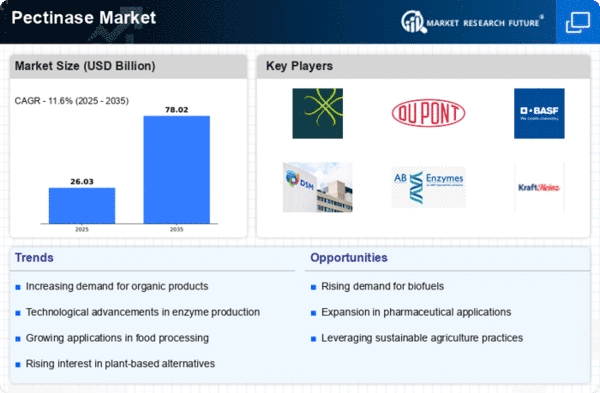
As per Market Research Future analysis, the Pectinase Market Size was estimated at 23.32 USD Billion in 2024. The Pectinase industry is projected to grow from USD 26.03 Billion in 2025 to USD 78.02 Billion by 2035, exhibiting a compound annual growth rate (CAGR) of 11.6% during the forecast period 2025 - 2035

Key Market Trends & Highlights

The Pectinase Market is experiencing robust growth driven by natural ingredient demand and technological advancements.

  • The North American region remains the largest market for pectinase, reflecting a strong preference for natural ingredients in food processing.
  • Asia-Pacific is identified as the fastest-growing region, with increasing investments in enzyme production technologies.
  • The food processing segment dominates the market, while the beverage production segment is rapidly expanding due to rising consumer interest in plant-based products.
  • Key market drivers include the increasing application of pectinase in the food and beverage industry and the growing awareness of health benefits associated with natural ingredients.

Market Size & Forecast

2024 Market Size 23.32 (USD Billion)
2035 Market Size 78.02 (USD Billion)
CAGR (2025 - 2035) 11.6%
Largest Regional Market Share in 2024 North America

Major Players

<p>Novozymes (DK), DuPont (US), BASF (DE), DSM (NL), AB Enzymes (DE), Kraft Heinz (US), Rohm and Haas (US), Amano Enzyme (JP), Biocatalysts (GB)</p>

Market Trends

The Pectinase Market is currently experiencing a notable transformation, driven by the increasing demand for natural food additives and the growing trend towards clean label products. As consumers become more health-conscious, there is a discernible shift towards ingredients that are perceived as natural and beneficial. This trend is further amplified by the food and beverage industry, which is actively seeking to enhance product quality and shelf life through the incorporation of pectinase. Additionally, the rise in fruit juice production and the need for efficient extraction processes are propelling the market forward, as pectinase plays a crucial role in optimizing yields and improving clarity in juice products. Moreover, the Pectinase Market is likely to witness advancements in enzyme technology, which may lead to the development of more efficient and specialized pectinase formulations. These innovations could cater to specific applications across various sectors, including food, textiles, and pharmaceuticals. The increasing focus on sustainability and eco-friendly practices is also influencing market dynamics, as manufacturers strive to reduce waste and enhance resource efficiency. Overall, the Pectinase Market appears poised for growth, driven by evolving consumer preferences and technological advancements that align with industry needs.

Rising Demand for Natural Ingredients

The Pectinase Market is witnessing a surge in demand for natural ingredients, as consumers increasingly prefer products that are free from artificial additives. This trend is particularly evident in the food and beverage sector, where manufacturers are reformulating products to meet consumer expectations for transparency and health benefits.

Technological Innovations in Enzyme Production

Advancements in enzyme production technologies are shaping the Pectinase Market. Innovations such as fermentation techniques and genetic engineering are enabling the development of more efficient pectinase variants, which can enhance processing efficiency and product quality across various applications.

Sustainability and Eco-Friendly Practices

The emphasis on sustainability is becoming a defining characteristic of the Pectinase Market. Companies are increasingly adopting eco-friendly practices, focusing on reducing environmental impact through responsible sourcing of raw materials and minimizing waste during production processes.

Pectinase Market Market Drivers

Market Growth Projections

The Global Pectinase Market Industry is projected to experience substantial growth over the next decade. With an anticipated market value of 78.0 USD Billion by 2035, the industry is set to expand significantly. This growth is underpinned by various factors, including the rising demand for pectinase in food processing, biofuels, and pharmaceuticals. The expected CAGR of 11.6% from 2025 to 2035 indicates a robust market trajectory, reflecting the increasing reliance on enzymatic solutions across multiple sectors.

Growth in the Biofuel Industry

The Global Pectinase Market Industry is also influenced by the expanding biofuel sector. Pectinase Market plays a crucial role in the production of bioethanol from agricultural waste, such as fruit peels and pomace. The enzymatic breakdown of pectin facilitates the fermentation process, thereby enhancing yield efficiency. As countries aim to reduce carbon emissions and transition to renewable energy sources, the demand for biofuels is likely to rise. This trend suggests a potential increase in pectinase utilization, contributing to the market's growth trajectory.

Increasing Awareness of Health Benefits

The Global Pectinase Market Industry benefits from the rising awareness of health benefits associated with pectinase consumption. Pectinase Market is known to aid digestion and improve gut health, leading to its incorporation into dietary supplements and functional foods. As consumers become more health-conscious, the demand for products containing pectinase is expected to rise. This trend is likely to contribute to the overall market growth, as manufacturers seek to capitalize on the health benefits associated with enzymatic products.

Expansion of the Pharmaceutical Industry

The Global Pectinase Market Industry is witnessing growth due to the expansion of the pharmaceutical sector. Pectinase Market is utilized in the formulation of various pharmaceutical products, including drug delivery systems and excipients. The increasing focus on developing innovative drug formulations that enhance bioavailability and therapeutic efficacy drives the demand for pectinase. As the pharmaceutical industry continues to evolve, the need for specialized enzymes like pectinase is likely to grow, further bolstering the market.

Rising Demand in Food and Beverage Sector

The Global Pectinase Market Industry experiences a surge in demand primarily driven by the food and beverage sector. Pectinase Market is widely utilized in fruit juice production, wine clarification, and the processing of jams and jellies. As consumer preferences shift towards natural and organic products, the need for pectinase to enhance extraction efficiency and improve product quality becomes increasingly apparent. In 2024, the market is projected to reach 23.3 USD Billion, reflecting the growing reliance on enzymatic processes to meet consumer expectations for high-quality, minimally processed foods.

Technological Advancements in Enzyme Production

Innovations in enzyme production technologies significantly impact the Global Pectinase Market Industry. Advances in fermentation processes and genetic engineering have led to the development of more efficient and cost-effective pectinase variants. These technological improvements not only enhance enzyme activity but also reduce production costs, making pectinase more accessible to various industries. As a result, the market is poised for substantial growth, with projections indicating a compound annual growth rate (CAGR) of 11.6% from 2025 to 2035, driven by these advancements.

Market Segment Insights

By Application: Food Processing (Largest) vs. Beverage Production (Fastest-Growing)

<p>In the Pectinase Market, the application segment is primarily divided into Food Processing, Beverage Production, Textile Industry, and Paper Industry. Among these, Food Processing holds the largest market share due to the increasing use of enzymes to improve texture and yield in products such as jams, jellies, and fruit purees. Beverage Production follows as a significant segment, driven by the demand for clarity and stability in fruit juices and wines, although it is growing at a faster rate than Food Processing.</p>

<p>Food Processing (Dominant) vs. Beverage Production (Emerging)</p>

<p>Food Processing remains the dominant application of pectinase, as manufacturers leverage its benefits for enhancing product quality and extending shelf-life in various food items. This segment is characterized by a steady demand, largely fueled by consumer preferences for natural and healthier food options. In contrast, the Beverage Production sector is emerging rapidly, showcasing innovative uses of pectinase to achieve clarity and enhance flavors in beverages, reflecting modern trends towards premium and artisanal drinks. The rapid expansion of this segment is influenced by changing consumer preferences and a growing interest in health-oriented products.</p>

By End Use: Fruit Juice (Largest) vs. Jam and Jelly (Fastest-Growing)

<p>The Pectinase Market is significantly influenced by its end-use applications, with the fruit juice segment capturing the largest share due to its widespread application in juice processing. This segment benefits from the growing demand for natural and pure juice products, which require high-quality extraction processes facilitated by pectinase enzymes. Following fruit juice, wine, jam, jelly, and sauces also contribute to the market but at comparatively lesser shares. The growth trends indicate that while fruit juice remains dominant, the jam and jelly segment is emerging rapidly. This surge is driven by changing consumer eating habits, an inclination towards homemade and artisanal jam products, and innovative product formulations. Additionally, as consumers seek healthier alternatives, this segment displays a promising trajectory in market growth and demand for pectinase enzymes.</p>

<p>Fruit Juice (Dominant) vs. Sauces (Emerging)</p>

<p>In the Pectinase Market, fruit juice stands as the dominant segment due to its critical role in juice clarification and yield improvement. This enduring prevalence is driven by the ongoing consumer preference for fresh and organic juices. Conversely, the sauces segment is marked as an emerging contender, fueled by the increasing trend towards homemade and gourmet sauces. As consumers become more adventurous with flavors and demand premium quality, the use of pectinase in sauce production is gaining traction. Both segments require high-quality pectinase to enhance texture and stability, yet they cater to evolving consumer preferences and culinary innovations.</p>

By Source: Plant-based (Largest) vs. Microbial (Fastest-Growing)

<p>In the Pectinase Market, the source segment is primarily dominated by plant-based pectinases, which have established a significant share due to their natural origins and broad acceptance in food applications. Microbial sources, while smaller in market share, are rapidly gaining traction as innovations in fermentation technology enhance their production efficiency, making them an appealing alternative for various industrial applications. Animal-based pectinases remain the least favored due to ethical concerns and stricter regulations regarding animal-derived products, resulting in a dwindling market presence.</p>

<p>Plant-based (Dominant) vs. Microbial (Emerging)</p>

<p>Plant-based pectinases are recognized for their extensive use in the food and beverage industry, particularly in juice clarification and fruit processing. Their dominance is fueled by consumer preferences for natural ingredients and clean-label products. On the other hand, microbial pectinases are emerging as a strong contender due to advancements in biotechnology that allow for engineered strains capable of efficient pectin degradation. These microbial enzymes provide competitive advantages in terms of consistency and cost-effectiveness, thus attracting investment and interest for their application in diverse sectors, including agriculture and waste management.</p>

By Formulation: Liquid Formulation (Largest) vs. Powder Formulation (Fastest-Growing)

<p>In the pectinase market, the formulation segment is categorized into three primary forms: liquid, powder, and granular. Among these, the liquid formulation holds the largest market share, propelled by its widespread applications in the food and beverage industry, where it improves juice extraction and processing efficiency. Conversely, the powder formulation is gaining traction, particularly in sectors such as baking and pharmaceutical due to its ease of formulation and stability. Granular forms occupy a smaller niche but serve specialized applications, ensuring a comprehensive distribution across various industry demands.</p>

<p>Liquid Formulation: Dominant vs. Powder Formulation: Emerging</p>

<p>Liquid formulation of pectinase is considered the dominant form in the market, primarily utilized for its effectiveness in improving yields in juice production and its ease of use in various food processes. Its liquid state allows for better solubility and faster action in enzymatic reactions. In contrast, the powder formulation, characterized by its stability and extended shelf life, is emerging as a strong alternative, particularly favored in sectors that require precise dosing and lower transportation costs. Its adaptability in applications ranging from baked goods to health supplements is driving growth, solidifying its position as a competitive segment in the pectinase landscape.</p>

By Functionality: Clarification (Largest) vs. Stabilization (Fastest-Growing)

<p>The pectinase market's functionality segment is primarily characterized by its three key components: clarification, stabilization, and depectinization. Among these, clarification holds the largest market share, being extensively utilized in juice production and winemaking, where it enhances clarity and quality. Stabilization, on the other hand, is gaining traction due to the growing demand for products with extended shelf life, showcasing significant growth potential within the segment. As consumer preferences lean towards clean-label and natural products, functionality-driven solutions are increasingly prioritized. Growth trends in the pectinase functionality segment are influenced by the rising industrial applications in food and beverage processing, primarily for improving product consistency and quality. The demand for plant-based and organic foods has bolstered the use of pectinase in clarification and stabilization processes. Furthermore, technological advancements and innovations in enzyme formulations are propelling growth, providing tailored solutions for different applications. These factors indicate a promising trajectory for stabilization as the fastest-growing segment, driven by evolving consumer demands.</p>

<p>Clarification (Dominant) vs. Depectinization (Emerging)</p>

<p>Clarification stands out as the dominant functionality within the pectinase market, primarily employed in the production of beverages where achieving optimal clarity is essential. This process not only enhances the visual appeal but also improves sensory attributes, making it a preferred choice among manufacturers. In contrast, depectinization serves as an emerging functionality, particularly in fruit processing, where the breakdown of pectin is necessary for improving yield and consistency. As the market shifts towards more natural and minimally processed foods, depectinization is gaining recognition for its role in enhancing product quality. Both functionalities serve distinct yet complementary roles in food processing, exemplifying the adaptive nature of the pectinase market.</p>

Get more detailed insights about Pectinase Market Research Report—Global Forecast till 2035

Regional Insights

North America : Market Leader in Pectinase

North America is poised to maintain its leadership in the pectinase market, holding a significant share of 9.8 in 2024. The region's growth is driven by increasing demand in the food and beverage sector, particularly in juice production and fruit processing. Regulatory support for enzyme applications in food safety and quality enhancement further fuels this growth. The trend towards natural and clean-label products is also a key driver, pushing manufacturers to adopt pectinase solutions. The competitive landscape in North America is robust, featuring key players such as Novozymes, DuPont, and BASF. These companies are investing heavily in R&D to innovate and improve enzyme efficiency. The U.S. stands out as the leading country, with a well-established infrastructure for enzyme production and distribution. The presence of major food and beverage companies also enhances market dynamics, ensuring a steady demand for pectinase products.

Europe : Innovation and Sustainability Focus

Europe's pectinase market is projected to grow significantly, with a market size of 7.0 in 2024. The region is characterized by a strong emphasis on sustainability and innovation, driven by stringent regulations on food quality and safety. The European Union's commitment to reducing food waste and promoting natural ingredients is a catalyst for the increased use of pectinase in various applications, including fruit juices and jams. This regulatory environment encourages manufacturers to adopt enzyme technologies that align with sustainability goals. Leading countries in Europe include Germany, France, and the UK, where the presence of major players like BASF and DSM enhances market competitiveness. The region is witnessing a surge in collaborations between enzyme producers and food manufacturers to develop tailored solutions. The focus on clean-label products and health-conscious consumer trends further supports the demand for pectinase, positioning Europe as a key player in the global market.

Asia-Pacific : Emerging Market Potential

Asia-Pacific is emerging as a significant player in the pectinase market, with a market size of 5.5 in 2024. The region's growth is driven by rising consumer demand for processed foods and beverages, particularly in countries like China and India. The increasing focus on food safety and quality, along with government initiatives to promote enzyme applications in food processing, are key factors contributing to market expansion. Additionally, the trend towards healthier food options is boosting the adoption of pectinase in various applications. China is the leading country in the region, with a rapidly growing food and beverage sector. The competitive landscape features both local and international players, including Amano Enzyme and Biocatalysts. The presence of a large population and changing dietary preferences are creating opportunities for pectinase manufacturers. As the market matures, investments in R&D and technology will be crucial for companies to maintain a competitive edge and meet evolving consumer needs.

Middle East and Africa : Untapped Market Opportunities

The Middle East and Africa region presents untapped opportunities in the pectinase market, with a market size of 1.02 in 2024. The growth in this region is primarily driven by increasing demand for processed foods and beverages, alongside a growing awareness of the benefits of enzyme applications in food production. Regulatory frameworks are gradually evolving to support the use of enzymes, which is expected to further stimulate market growth. The region's diverse culinary traditions also create unique opportunities for pectinase applications in various food products. Leading countries in this region include South Africa and the UAE, where the food and beverage industry is expanding rapidly. The competitive landscape is still developing, with opportunities for both local and international players to enter the market. As consumer preferences shift towards healthier and more natural food options, the demand for pectinase is likely to increase, paving the way for new entrants and innovations in the sector.

Key Players and Competitive Insights

The Pectinase Market is currently characterized by a dynamic competitive landscape, driven by increasing demand for natural food additives and the growing trend towards plant-based products. Key players such as Novozymes (DK), DuPont (US), and BASF (DE) are strategically positioned to leverage innovation and sustainability in their operations. Novozymes (DK) focuses on enzyme development that enhances food processing efficiency, while DuPont (US) emphasizes its commitment to sustainable practices through its enzyme solutions. BASF (DE) is also investing in research and development to create more effective pectinase products, indicating a collective shift towards environmentally friendly solutions that shape the competitive environment.

In terms of business tactics, companies are increasingly localizing manufacturing to reduce supply chain vulnerabilities and optimize logistics. The Pectinase Market appears moderately fragmented, with several key players exerting influence over their respective segments. This fragmentation allows for niche players to thrive, while larger companies consolidate their market share through strategic partnerships and acquisitions, thereby enhancing their operational capabilities.

In November 2025, DuPont (US) announced a partnership with a leading organic fruit processor to develop specialized pectinase solutions tailored for organic juice production. This collaboration is significant as it not only expands DuPont's product offerings but also aligns with the growing consumer preference for organic products, potentially increasing their market penetration in this segment.

In October 2025, Novozymes (DK) launched a new line of pectinase enzymes designed specifically for the wine industry, aimed at improving juice extraction and clarity. This strategic move highlights Novozymes' commitment to innovation and its ability to cater to specific industry needs, which may enhance its competitive edge in the beverage sector.

In September 2025, BASF (DE) unveiled a new sustainability initiative focused on reducing the carbon footprint of its enzyme production processes. This initiative not only reflects the company's dedication to environmental stewardship but also positions BASF as a leader in sustainable practices within the Pectinase Market, potentially attracting environmentally conscious consumers and businesses alike.

As of December 2025, the competitive trends in the Pectinase Market are increasingly defined by digitalization, sustainability, and the integration of AI technologies. Strategic alliances are becoming more prevalent, as companies recognize the value of collaboration in enhancing innovation and market reach. The competitive differentiation is likely to evolve from traditional price-based competition towards a focus on technological advancements, product innovation, and supply chain reliability, suggesting a transformative shift in how companies position themselves in the market.

Key Companies in the Pectinase Market market include

Industry Developments

October 2022: To promote new food ingredient developments in Japan and the Asia-Pacific region, Cargill reinforced its 50-year cooperation with Unitec Foods and Fuji Nihon Seito Corporation. Cargill and Unitec Foods have been working together since 1972 to grow their pectin business in the Japanese market. The new memorandum of understanding will fortify current business relationships by utilizing the expertise and assets of the three parties.

July 2022: A new Pectin Classic AS 519 was introduced by Herbstreith & Fox Corporate Group. It is employed in the production of gummy candy. They can work with challenging materials like acids or minerals without losing functionality.

Future Outlook

Pectinase Market Future Outlook

<p>The Pectinase Market is projected to grow at 11.6% CAGR from 2024 to 2035, driven by increasing demand in food processing, biofuels, and pharmaceuticals.</p>

New opportunities lie in:

  • <p>Development of customized pectinase formulations for niche applications.</p>
  • <p>Expansion into emerging markets with tailored marketing strategies.</p>
  • <p>Investment in R&D for innovative enzyme extraction technologies.</p>

<p>By 2035, the Pectinase Market is expected to achieve substantial growth, solidifying its position in various industries.</p>

Market Segmentation

Pectinase Market Source Outlook

  • Plant-based
  • Microbial
  • Animal-based

Pectinase Market End Use Outlook

  • Fruit Juice
  • Wine
  • Jam and Jelly
  • Sauces

Pectinase Market Application Outlook

  • Food Processing
  • Beverage Production
  • Textile Industry
  • Paper Industry

Pectinase Market Formulation Outlook

  • Liquid Formulation
  • Powder Formulation
  • Granular Formulation

Pectinase Market Functionality Outlook

  • Clarification
  • Stabilization
  • Depectinization

Report Scope

MARKET SIZE 202423.32(USD Billion)
MARKET SIZE 202526.03(USD Billion)
MARKET SIZE 203578.02(USD Billion)
COMPOUND ANNUAL GROWTH RATE (CAGR)11.6% (2024 - 2035)
REPORT COVERAGERevenue Forecast, Competitive Landscape, Growth Factors, and Trends
BASE YEAR2024
Market Forecast Period2025 - 2035
Historical Data2019 - 2024
Market Forecast UnitsUSD Billion
Key Companies ProfiledNovozymes (DK), DuPont (US), BASF (DE), DSM (NL), AB Enzymes (DE), Kraft Heinz (US), Rohm and Haas (US), Amano Enzyme (JP), Biocatalysts (GB)
Segments CoveredApplication, End Use, Source, Formulation, Functionality
Key Market OpportunitiesGrowing demand for plant-based products drives innovation in the Pectinase Market.
Key Market DynamicsRising demand for plant-based products drives innovation and competition in the pectinase market.
Countries CoveredNorth America, Europe, APAC, South America, MEA

FAQs

What is the projected growth of the Pectinase market?

The Pectinase market is the expected increase in total market value of 78.02 USD billion over a defined forecast period 2025–2035. It is driven by factors such as demand trends, technological advances, regulatory changes, and geographic expansion.

What is the size of the Pectinase market?

Pectinase market size was valued at approximately 23.32 billion USD in 2024. This figure will reach 78.02 billion USD covering all regions (America, Europe, Asia, MEA and ROW), focusing its segments / services / distribution channels till 2035.

What is the CAGR of the Pectinase market?

Pectinase market is expected to grow at a CAGR of 11.6% between 2025 and 2035.

How much will the Pectinase market be worth by 2035?

Pectinase market is expected to be worth of 78.02 billion USD, reflecting growth driven by usage, technology and global demands by the end of 2035.

How will the Pectinase market perform over the next 10 years?

Over the next 10 years the Pectinase market is expected to shift from usd billion 23.32 to 78.02 billion USD, led by adoption of advanced tech, demographic trends, regulatory approvals, with potential headwinds from 2025 to 2035.

Which region held the largest market share in the Pectinase market?

North America had the largest share in the global market

  1. EXECUTIVE SUMMARY
  2. MARKET INTRODUCTION
    1. Definition
    2. Scope of the Study
      1. Research Objective
      2. Assumptions
      3. Limitations
  3. RESEARCH METHODOLOGY
    1. Overview
    2. Data Mining
    3. Secondary Research
    4. Primary Research
      1. Primary Interviews
      2. Breakdown of Primary Respondents
    5. and Information Gathering Process
    6. Forecasting Modality
    7. Market Size Estimation
      1. Bottom-Up Approach
      2. Top-Down Approach
    8. Data Triangulation
    9. Validation
  4. MARKET DYNAMICS
    1. Overview
    2. Drivers
    3. Restraints
    4. Opportunities
  5. MARKET FACTOR ANALYSIS
    1. Value Chain Analysis
    2. Porter’s Five Forces Analysis
      1. Bargaining Power
      2. Threat of New Entrants
      3. Threat of Substitutes
      4. Intensity of Rivalry
    3. of Suppliers
    4. Bargaining Power of Buyers
    5. COVID-19 Impact Analysis
      1. Market Impact Analysis
      2. Regional Impact
      3. Opportunity and
    6. Threat Analysis
  6. GLOBAL PECTINASE MARKET, BY TYPE
    1. Overview
    2. Protopectinases
    3. Polygalacturonases
    4. Pectin lyases
    5. Pectinesterase
  7. GLOBAL PECTINASE MARKET, BY END-USER
    1. Overview
    2. Food & Beverages
    3. Textile
    4. Aquaculture
    5. Others
  8. GLOBAL PECTINASE MARKET,
    1. BY REGION
    2. Overview
    3. North America
    4. U.S.
    5. Canada
    6. Europe
    7. Germany
    8. France
    9. U.K
    10. Italy
    11. Spain
    12. Rest of Europe
    13. Asia-Pacific
    14. China
    15. India
    16. Japan
    17. South Korea
    18. Australia
    19. Rest of Asia-Pacific
    20. Rest of the World
    21. Middle East
    22. Africa
    23. Latin America
  9. COMPETITIVE LANDSCAPE
    1. Overview
    2. Competitive Analysis
    3. Market Share Analysis
    4. Major Growth Strategy in the Global Pectinase Market,
    5. Competitive Benchmarking
    6. Leading Players in Terms of Number of Developments
    7. in the Global Pectinase Market,
    8. Key developments and Growth Strategies
      1. New TYPE Launch/END-USER Deployment
      2. Merger & Acquisitions
      3. Joint Ventures
    9. Major Players Financial
      1. Major Players R&D Expenditure. 2022
    10. Matrix
    11. Sales & Operating Income, 2022
  10. COMPANY PROFILES
    1. Challenge Group
      1. Company Overview
      2. Financial Overview
      3. TYPE Offered
      4. Key Developments
      5. SWOT Analysis
      6. Key Strategies
    2. AB Enzymes
      1. Company Overview
      2. Financial Overview
      3. TYPE Offered
      4. Key Developments
      5. SWOT Analysis
      6. Key Strategies
    3. Jinyuan Biochemical
    4. Co Ltd
    5. Company Overview
    6. Financial Overview
    7. TYPE Offered
    8. Key Developments
    9. SWOT Analysis
    10. Key Strategies
    11. Sukahan Bio-Technology
    12. Company Overview
    13. Financial Overview
    14. TYPE Offered
    15. Key Developments
    16. SWOT Analysis
    17. Key Strategies
    18. Sunson
    19. Company Overview
    20. Financial Overview
    21. TYPE Offered
    22. Key Developments
    23. SWOT Analysis
    24. Key Strategies
    25. Shandong Longda
    26. Company Overview
    27. Financial Overview
    28. TYPE Offered
    29. Key Developments
    30. SWOT Analysis
    31. Key Strategies
    32. Verenium (BASF)
    33. Company Overview
    34. Financial Overview
    35. TYPE Offered
    36. Key Developments
    37. SWOT Analysis
    38. Key Strategies
    39. YSSH
    40. Company Overview
    41. Financial Overview
    42. TYPE Offered
    43. Key Developments
    44. SWOT Analysis
    45. Key Strategies
    46. AB Enzymes
    47. Company Overview
    48. Financial Overview
    49. TYPE Offered
    50. Key Developments
    51. SWOT Analysis
    52. Key Strategies
    53. Genencor
    54. Company Overview
    55. Financial Overview
    56. TYPE Offered
    57. Key Developments
    58. SWOT Analysis
    59. Key Strategies
    60. Koninklijke DSM N.V
    61. Company Overview
    62. Financial Overview
    63. TYPE Offered
    64. Key Developments
    65. SWOT Analysis
    66. Key Strategies
    67. Amano Enzyme
    68. Company Overview
    69. Financial Overview
    70. TYPE Offered
    71. Key Developments
    72. SWOT Analysis
    73. Key Strategies
    74. Youtell
    75. Company Overview
    76. Financial Overview
    77. TYPE Offered
    78. Key Developments
    79. SWOT Analysis
    80. Key Strategies
    81. Novozymes
    82. Company Overview
    83. Financial Overview
    84. TYPE Offered
    85. Key Developments
    86. SWOT Analysis
    87. Key Strategies
    88. APPENDIX
    89. References
    90. Related Reports
  11. LIST OF TABLES
  12. GLOBAL PECTINASE
    1. MARKET, SYNOPSIS, 2018-2032
  13. GLOBAL PECTINASE MARKET, ESTIMATES & FORECAST, 2018-2032
    1. (USD BILLION)
    2. TABLE
  14. GLOBAL PECTINASE MARKET, BY TYPE, 2018-2032 (USD BILLION)
  15. GLOBAL PECTINASE MARKET, BY END-USER, 2018-2032
    1. (USD BILLION)
    2. TABLE
  16. NORTH AMERICA PECTINASE MARKET, BY TYPE, 2018-2032 (USD BILLION)
  17. NORTH AMERICA PECTINASE
  18. MARKET, BY END-USER, 2018-2032 (USD BILLION)
  19. NORTH AMERICA PECTINASE MARKET, BY COUNTRY,
  20. U.S. PECTINASE MARKET, BY TYPE, 2018-2032 (USD BILLION)
  21. U.S. PECTINASE
  22. MARKET, BY END-USER, 2018-2032 (USD BILLION)
  23. CANADA PECTINASE MARKET, BY TYPE, 2018-2032
    1. (USD BILLION)
    2. TABLE
  24. CANADA PECTINASE MARKET, BY END-USER, 2018-2032 (USD BILLION)
  25. EUROPE PECTINASE MARKET,
    1. BY TYPE, 2018-2032 (USD BILLION)
  26. EUROPE PECTINASE MARKET, BY END-USER, 2018-2032 (USD BILLION)
  27. EUROPE PECTINASE
  28. MARKET, BY COUNTRY, 2018-2032 (USD BILLION)
  29. GERMANY PECTINASE MARKET, BY TYPE, 2018-2032
    1. (USD BILLION)
    2. TABLE
  30. GERMANY PECTINASE MARKET, BY END-USER, 2018-2032 (USD BILLION)
  31. FRANCE PECTINASE MARKET,
    1. BY TYPE, 2018-2032 (USD BILLION)
  32. FRANCE PECTINASE MARKET, BY END-USER, 2018-2032 (USD BILLION)
  33. ITALY PECTINASE
  34. MARKET, BY TYPE, 2018-2032 (USD BILLION)
  35. ITALY PECTINASE MARKET, BY END-USER, 2018-2032
    1. (USD BILLION)
    2. TABLE
  36. SPAIN PECTINASE MARKET, BY TYPE, 2018-2032 (USD BILLION)
  37. SPAIN PECTINASE MARKET, BY END-USER, 2018-2032
    1. (USD BILLION)
    2. TABLE
  38. U.K PECTINASE MARKET, BY TYPE, 2018-2032 (USD BILLION)
  39. U.K PECTINASE MARKET, BY END-USER, 2018-2032
    1. (USD BILLION)
    2. TABLE
  40. REST OF EUROPE PECTINASE MARKET, BY TYPE, 2018-2032 (USD BILLION)
  41. REST OF EUROPE PECTINASE
  42. MARKET, BY END-USER, 2018-2032 (USD BILLION)
  43. ASIA PACIFIC PECTINASE MARKET, BY TYPE,
  44. ASIA PACIFIC PECTINASE MARKET, BY END-USER, 2018-2032 (USD
    1. BILLION)
    2. TABLE
  45. ASIA PACIFIC PECTINASE MARKET, BY COUNTRY, 2018-2032 (USD BILLION)
  46. JAPAN PECTINASE
  47. MARKET, BY TYPE, 2018-2032 (USD BILLION)
  48. JAPAN PECTINASE MARKET, BY END-USER, 2018-2032
    1. (USD BILLION)
    2. TABLE
  49. CHINA PECTINASE MARKET, BY TYPE, 2018-2032 (USD BILLION)
  50. CHINA PECTINASE MARKET, BY END-USER, 2018-2032
    1. (USD BILLION)
    2. TABLE
  51. INDIA PECTINASE MARKET, BY TYPE, 2018-2032 (USD BILLION)
  52. INDIA PECTINASE MARKET, BY END-USER, 2018-2032
    1. (USD BILLION)
    2. TABLE
  53. AUSTRALIA PECTINASE MARKET, BY TYPE, 2018-2032 (USD BILLION)
  54. AUSTRALIA PECTINASE
  55. MARKET, BY END-USER, 2018-2032 (USD BILLION)
  56. SOUTH KOREA PECTINASE MARKET, BY TYPE, 2018-2032
    1. (USD BILLION)
    2. TABLE
  57. SOUTH KOREA PECTINASE MARKET, BY END-USER, 2018-2032 (USD BILLION)
  58. REST OF ASIA-PACIFIC
  59. PECTINASE MARKET, BY TYPE, 2018-2032 (USD BILLION)
  60. REST OF ASIA-PACIFIC PECTINASE MARKET, BY
    1. END-USER, 2018-2032 (USD BILLION)
  61. REST OF WORLD PECTINASE MARKET, BY TYPE, 2018-2032 (USD BILLION)
  62. REST OF WORLD
  63. PECTINASE MARKET, BY END-USER, 2018-2032 (USD BILLION)
  64. REST OF WORLD PECTINASE MARKET, BY COUNTRY,
  65. MIDDLE EAST PECTINASE MARKET, BY TYPE, 2018-2032 (USD BILLION)
  66. MIDDLE EAST
  67. PECTINASE MARKET, BY END-USER, 2018-2032 (USD BILLION)
  68. AFRICA PECTINASE MARKET, BY TYPE, 2018-2032
    1. (USD BILLION)
    2. TABLE
  69. AFRICA PECTINASE MARKET, BY END-USER, 2018-2032 (USD BILLION)
  70. LATIN AMERICA PECTINASE
  71. MARKET, BY TYPE, 2018-2032 (USD BILLION)
  72. LATIN AMERICA PECTINASE MARKET, BY END-USER, 2018-2032
    1. (USD BILLION)
  73. LIST OF FIGURES
  74. RESEARCH PROCESS
  75. MARKET STRUCTURE
  76. FOR THE GLOBAL PECTINASE MARKET
  77. MARKET DYNAMICS FOR THE GLOBAL PECTINASE MARKET
  78. GLOBAL PECTINASE
  79. MARKET, SHARE (%), BY TYPE, 2022
  80. GLOBAL PECTINASE MARKET, SHARE (%), BY END-USER, 2022
  81. GLOBAL PECTINASE
  82. MARKET, SHARE (%), BY REGION, 2022
  83. NORTH AMERICA: PECTINASE MARKET, SHARE (%), BY
    1. REGION, 2022
    2. FIGURE
  84. EUROPE: PECTINASE MARKET, SHARE (%), BY REGION, 2022
  85. ASIA-PACIFIC: PECTINASE MARKET, SHARE (%),
    1. BY REGION, 2022
    2. FIGURE
  86. REST OF THE WORLD: PECTINASE MARKET, SHARE (%), BY REGION, 2022
  87. GLOBAL PECTINASE MARKET:
    1. COMPANY SHARE ANALYSIS, 2022 (%)
  88. CHALLENGE GROUP: FINANCIAL OVERVIEW SNAPSHOT
  89. CHALLENGE GROUP: SWOT
    1. ANALYSIS
    2. FIGURE
  90. AB ENZYMES: FINANCIAL OVERVIEW SNAPSHOT
  91. AB ENZYMES: SWOT ANALYSIS
  92. JINYUAN BIOCHEMICAL
    1. CO LTD: FINANCIAL OVERVIEW SNAPSHOT
  93. JINYUAN BIOCHEMICAL CO LTD: SWOT ANALYSIS
  94. SUKAHAN BIO-TECHNOLOGY:
    1. FINANCIAL OVERVIEW SNAPSHOT
  95. SUKAHAN BIO-TECHNOLOGY: SWOT ANALYSIS
  96. SUNSON.: FINANCIAL OVERVIEW SNAPSHOT
  97. SUNSON.: SWOT
    1. ANALYSIS
    2. FIGURE
  98. SHANDONG LONGDA: FINANCIAL OVERVIEW SNAPSHOT
  99. SHANDONG LONGDA: SWOT ANALYSIS
  100. VERENIUM (BASF):
    1. FINANCIAL OVERVIEW SNAPSHOT
  101. VERENIUM (BASF): SWOT ANALYSIS
  102. YSSH: FINANCIAL OVERVIEW SNAPSHOT
  103. YSSH: SWOT
    1. ANALYSIS
    2. FIGURE
  104. AB ENZYMES: FINANCIAL OVERVIEW SNAPSHOT
  105. AB ENZYMES: SWOT ANALYSIS
  106. GENENCOR: FINANCIAL
    1. OVERVIEW SNAPSHOT
    2. FIGURE
  107. GENENCOR: SWOT ANALYSIS
  108. KONINKLIJKE DSM N.V: FINANCIAL OVERVIEW SNAPSHOT
  109. KONINKLIJKE
    1. DSM N.V: SWOT ANALYSIS
  110. AMANO ENZYME: FINANCIAL OVERVIEW SNAPSHOT
  111. AMANO ENZYME: SWOT
    1. ANALYSIS
    2. FIGURE
  112. YOUTELL: FINANCIAL OVERVIEW SNAPSHOT
  113. YOUTELL: SWOT ANALYSIS
  114. NOVOZYMES: FINANCIAL OVERVIEW SNAPSHOT
    1. FIGURE 39
    2. NOVOZYMES: SWOT ANALYSIS

Pectinase Market Segmentation

Pectinase Type Outlook (USD Billion, 2018-2032)

  • Protopectinases
  • Polygalacturonases
  • Pectin lyases
  • Pectinesterase

Pectinase End-user Outlook (USD Billion, 2018-2032)

  • Food & Beverages
  • Textile
  • Aquaculture
  • Others

Pectinase Regional Outlook (USD Billion, 2018-2032)

  • North America Outlook (USD Billion, 2018-2032)
    • Pectinase by Type
      • Protopectinases
      • Polygalacturonases
      • Pectin lyases
      • Pectinesterase
    • Pectinase by End-user
      • Food & Beverages
      • Textile
      • Aquaculture
      • Others
    • US Outlook (USD Billion, 2018-2032)
    • Pectinase by Type
      • Protopectinases
      • Polygalacturonases
      • Pectin lyases
      • Pectinesterase
    • Pectinase by End-user
      • Food & Beverages
      • Textile
      • Aquaculture
      • Others
    • Canada Outlook (USD Billion, 2018-2032)
    • Pectinase by Type
      • Protopectinases
      • Polygalacturonases
      • Pectin lyases
      • Pectinesterase
    • Pectinase by End-user
      • Food & Beverages
      • Textile
      • Aquaculture
      • Others
    • Europe Outlook (USD Billion, 2018-2032)
      • Pectinase by Type
        • Protopectinases
        • Polygalacturonases
        • Pectin lyases
        • Pectinesterase
      • Pectinase by End-user
        • Food & Beverages
        • Textile
        • Aquaculture
        • Others
      • Germany Outlook (USD Billion, 2018-2032)
      • Pectinase by Type
        • Protopectinases
        • Polygalacturonases
        • Pectin lyases
        • Pectinesterase
      • Pectinase by End-user
        • Food & Beverages
        • Textile
        • Aquaculture
        • Others
      • France Outlook (USD Billion, 2018-2032)
      • Pectinase by Type
        • Protopectinases
        • Polygalacturonases
        • Pectin lyases
        • Pectinesterase
      • Pectinase by End-user
        • Food & Beverages
        • Textile
        • Aquaculture
        • Others
      • UK Outlook (USD Billion, 2018-2032)
      • Pectinase by Type
        • Protopectinases
        • Polygalacturonases
        • Pectin lyases
        • Pectinesterase
      • Pectinase by End-user
        • Food & Beverages
        • Textile
        • Aquaculture
        • Others
      • Italy Outlook (USD Billion, 2018-2032)
      • Pectinase by Type
        • Protopectinases
        • Polygalacturonases
        • Pectin lyases
        • Pectinesterase
      • Pectinase by End-user
        • Food & Beverages
        • Textile
        • Aquaculture
        • Others
      • Spain Outlook (USD Billion, 2018-2032)
      • Pectinase by Type
        • Protopectinases
        • Polygalacturonases
        • Pectin lyases
        • Pectinesterase
      • Pectinase by End-user
        • Food & Beverages
        • Textile
        • Aquaculture
        • Others
      • Rest Of Europe Outlook (USD Billion, 2018-2032)
      • Pectinase by Type
        • Protopectinases
        • Polygalacturonases
        • Pectin lyases
        • Pectinesterase
      • Pectinase by End-user
        • Food & Beverages
        • Textile
        • Aquaculture
        • Others
      • Asia-Pacific Outlook (USD Billion, 2018-2032)
        • Pectinase by Type
          • Protopectinases
          • Polygalacturonases
          • Pectin lyases
          • Pectinesterase
        • Pectinase by End-user
          • Food & Beverages
          • Textile
          • Aquaculture
          • Others
        • China Outlook (USD Billion, 2018-2032)
        • Pectinase by Type
          • Protopectinases
          • Polygalacturonases
          • Pectin lyases
          • Pectinesterase
        • Pectinase by End-user
          • Food & Beverages
          • Textile
          • Aquaculture
          • Others
        • Japan Outlook (USD Billion, 2018-2032)
        • Pectinase by Type
          • Protopectinases
          • Polygalacturonases
          • Pectin lyases
          • Pectinesterase
        • Pectinase by End-user
          • Food & Beverages
          • Textile
          • Aquaculture
          • Others
        • India Outlook (USD Billion, 2018-2032)
        • Pectinase by Type
          • Protopectinases
          • Polygalacturonases
          • Pectin lyases
          • Pectinesterase
        • Pectinase by End-user
          • Food & Beverages
          • Textile
          • Aquaculture
          • Others
        • Australia Outlook (USD Billion, 2018-2032)
        • Pectinase by Type
          • Protopectinases
          • Polygalacturonases
          • Pectin lyases
          • Pectinesterase
        • Pectinase by End-user
          • Food & Beverages
          • Textile
          • Aquaculture
          • Others
        • Rest of Asia-Pacific Outlook (USD Billion, 2018-2032)
        • Pectinase by Type
          • Protopectinases
          • Polygalacturonases
          • Pectin lyases
          • Pectinesterase
        • Pectinase by End-user
          • Food & Beverages
          • Textile
          • Aquaculture
          • Others
        • Rest of the World Outlook (USD Billion, 2018-2032)
          • Pectinase by Type
            • Protopectinases
            • Polygalacturonases
            • Pectin lyases
            • Pectinesterase
          • Pectinase by End-user
            • Food & Beverages
            • Textile
            • Aquaculture
            • Others
          • Middle East Outlook (USD Billion, 2018-2032)
          • Pectinase by Type
            • Protopectinases
            • Polygalacturonases
            • Pectin lyases
            • Pectinesterase
          • Pectinase by End-user
            • Food & Beverages
            • Textile
            • Aquaculture
            • Others
          • Africa Outlook (USD Billion, 2018-2032)
          • Pectinase by Type
            • Protopectinases
            • Polygalacturonases
            • Pectin lyases
            • Pectinesterase
          • Pectinase by End-user
            • Food & Beverages
            • Textile
            • Aquaculture
            • Others
          • Latin America Outlook (USD Billion, 2018-2032)
          • Pectinase by Type
            • Protopectinases
            • Polygalacturonases
            • Pectin lyases
            • Pectinesterase
          • Pectinase by End-user
            • Food & Beverages
            • Textile
            • Aquaculture
            • Others
Infographic

Free Sample Request

Kindly complete the form below to receive a free sample of this Report

Get Free Sample

Customer Strories

Compare Licence

×
Features License Type
Single User Multiuser License Enterprise User
Price $4,950 $5,950 $7,250
Maximum User Access Limit 1 User Upto 10 Users Unrestricted Access Throughout the Organization
Free Customization
Direct Access to Analyst
Deliverable Format
Platform Access
Discount on Next Purchase 10% 15% 15%
Printable Versions