Request Free Sample ×

Kindly complete the form below to receive a free sample of this Report

* Please use a valid business email

Leading companies partner with us for data-driven Insights

clients tt-cursor
Hero Background
English
Chinese
French
Japanese
Korean
German
Spanish

Pectinase Market Size

ID: MRFR/HC/10654-HCR
128 Pages
Vikita Thakur
March 2026

Pectinase Market Research Report Information By Type (Protopectinases, Polygalacturonases, Pectin lyases and Pectinesterase), By End-user (Food & Beverages, Textile, Aquaculture and Others) And By Region (North America, Europe, Asia-Pacific, And Rest Of The World) –Market Forecast Till 2035

Share:
Download PDF ×

We do not share your information with anyone. However, we may send you emails based on your report interest from time to time. You may contact us at any time to opt-out.

Pectinase Market Infographic
Purchase Options

Pectinase Size

Pectinase Market Growth Projections and Opportunities

The Pectinase Market is a prominent player within the enzymes industry and concentrates on providing pectinases which are responsible for catalyzing breakdown of plant cell walls made up of complex polysaccharides called pectin. Pectinases have been applied in several industries including food and beverages, textile processing, and production of biofuels resulting in this market growing rapidly. There has been significant transformation within the market because of the versatile nature of pectinases which enhance product quality, favour extraction efficiency as well as reduce waste in many industrial operations. This market consists of different types of pectinase products such as microbial derived one from bacteria or fungi.

A key driver for the Pectinase Market is its important role in the food and beverages industry. During fruit and vegetable processing, pectinases help to extract juices or clarify drinks. These enzymes degrade plant tissue’s pectin thereby reducing its viscosity that helps improve overall quality of fruit juice, wine among other processed products. This market regularly introduces innovative formulations for spectrin so that food or beverage manufactures can effectively produce by making sure that their practices are efficient as well as sustainable.

Textile processing is another significant application area for pectinases. In textile mills, these enzymes remove impurities caused by pectins present in natural fibers like cotton lint and flax straw. Consequently, it enhances dyeability softness absorbency thus increasing technical qualities of end products created from fibres used earlier mentioned. The market directs its focus towards developing highly specific and stable enzyme molecules to support textile industries’ need for resource effective ecological technologies.

The Pectinase Market also plays an important role in biofuel manufacturing processes and biorefineries too. By breaking down plant matter into fermentable sugars such as ethanol through saccharification process using pectic enzymes, this allows them to be used as biofuels. As global need for renewable and sustainable sources of energy arises, this market has become an important source of enzymatic tools that are required to efficiently convert biomass. In order to make biofuel technologies more efficient and reduce dependency on fossil fuel there is a need to develop pectinase enzymes which are robust as well as cost effective.

There are some challenges facing the Pectinase Market such as regulatory barriers in different regions due to regulation on production and use of enzymes. Besides researchers and producers have concentrated their efforts on how they can stabilize and also render pectinase molecules effective when used under varied industrial conditions. Consequently, the market addresses these issues through heavy investments in R&D meant for property improvement, optimizing production process while adhering with regard to regulatory standards.

In terms of geography, the Pectinase Market has a wide presence across North America Europe and Asia-Pacific. This trend has been spurred by the rising demand for enzyme solutions in food processing besides growing concerns about sustainable production practices. With adoption of enzymatic technologies by industries in developing countries, this market will grow especially within Latin America as well as Middle East parts.
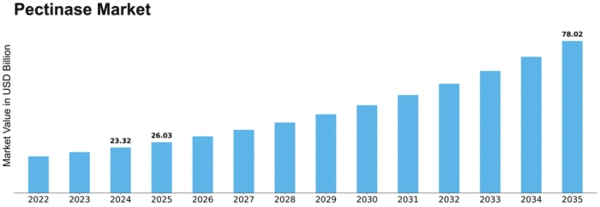
Pectinase Market Size Graph
Author
Author Profile
Vikita Thakur
Senior Research Analyst

She holds an experience of about 5+ years in market research and business consulting projects for sectors such as life sciences, medical devices, and healthcare IT. She possesses a robust background in data analysis, market estimation, competitive intelligence, pipeline analysis market trend identification, and consumer behavior insights. Her expertise lies in technical Sales support, client interaction and project management, designing and implementing market research studies, conducting competitive analysis, and synthesizing complex data into actionable recommendations that drive business growth.

Leave a Comment

FAQs

What is the current valuation of the Pectinase Market as of 2024?

<p>The Pectinase Market was valued at 23.32 USD Billion in 2024.</p>

What is the projected market size for the Pectinase Market in 2035?

<p>The market is projected to reach 78.02 USD Billion by 2035.</p>

What is the expected CAGR for the Pectinase Market during the forecast period 2025 - 2035?

<p>The expected CAGR for the Pectinase Market during 2025 - 2035 is 11.6%.</p>

Which companies are considered key players in the Pectinase Market?

<p>Key players in the Pectinase Market include Novozymes, DuPont, BASF, DSM, and AB Enzymes.</p>

How does the Food Processing segment perform in the Pectinase Market?

<p>The Food Processing segment was valued at 8.0 USD Billion in 2024 and is projected to grow to 27.0 USD Billion by 2035.</p>

What is the valuation of the Beverage Production segment in the Pectinase Market?

<p>The Beverage Production segment was valued at 6.0 USD Billion in 2024 and is expected to reach 20.0 USD Billion by 2035.</p>

What are the projected values for the Textile Industry segment in the Pectinase Market?

The Textile Industry segment was valued at 4.0 USD Billion in 2024 and is anticipated to grow to 14.0 USD Billion by 2035.

What is the expected growth for the Fruit Juice segment in the Pectinase Market?

The Fruit Juice segment was valued at 8.0 USD Billion in 2024 and is projected to increase to 27.0 USD Billion by 2035.

How does the Liquid Formulation segment compare to other formulations in the Pectinase Market?

The Liquid Formulation segment was valued at 8.0 USD Billion in 2024 and is expected to grow to 27.0 USD Billion by 2035.

What functionality segments are included in the Pectinase Market analysis?

The functionality segments include Clarification, Stabilization, and Depectinization, with Clarification valued at 8.0 USD Billion in 2024 and projected to reach 27.0 USD Billion by 2035.

Market Summary

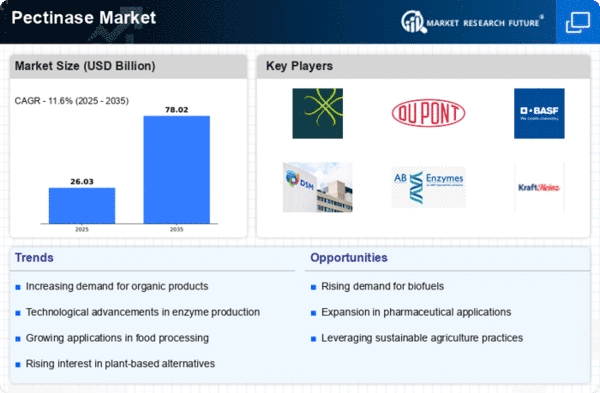
As per MRFR analysis, the Pectinase Market Size was estimated at 23.32 USD Billion in 2024. The Pectinase industry is projected to grow from 26.03 in 2025 to 78.02 by 2035, exhibiting a compound annual growth rate (CAGR) of 11.6% during the forecast period 2025 - 2035.

Key Market Trends & Highlights

The Pectinase Market is currently experiencing robust growth driven by evolving consumer preferences and technological advancements.

  • The demand for clean label products is rising, reflecting a shift towards transparency in food ingredients.
  • North America remains the largest market for pectinase, while Asia-Pacific is emerging as the fastest-growing region.
  • In the food processing segment, pectinase is predominantly utilized, whereas the beverage production segment is witnessing rapid growth.
  • Key market drivers include the increasing demand for natural ingredients and the expansion of the beverage industry.

Market Size & Forecast

2024 Market Size 23.32 (USD Billion)
2035 Market Size 78.02 (USD Billion)
CAGR (2025 - 2035) 11.6%
Largest Regional Market Share in 2024 North America

Major Players

Novozymes (DK), DuPont (US), BASF (DE), DSM (NL), AB Enzymes (DE), Kraft Heinz (US), Roche (CH), Amano Enzyme (JP), Biocatalysts (GB)

Market Trends

The Pectinase Market is currently experiencing a notable transformation, driven by the increasing demand for natural food additives and the growing trend towards healthier food options. This enzyme, primarily derived from fungi and bacteria, plays a crucial role in the food and beverage industry, particularly in fruit juice extraction and clarification processes. As consumers become more health-conscious, manufacturers are increasingly seeking pectinase solutions to enhance product quality while maintaining clean label standards. Furthermore, the rise in the production of organic foods appears to be propelling the demand for pectinase, as it aligns with the principles of natural ingredient sourcing and sustainability. In addition to the food sector, the Pectinase Market is witnessing expansion in the textile and paper industries, where these enzymes are utilized for various applications, including fabric processing and pulp treatment. The versatility of pectinase suggests that its applications may continue to broaden, potentially leading to new opportunities in emerging markets. As environmental concerns gain prominence, the shift towards eco-friendly enzyme solutions could further influence market dynamics. Overall, the Pectinase Market seems poised for growth, driven by innovation and a shift in consumer preferences towards natural and sustainable products.

Rising Demand for Clean Label Products

The trend towards clean label products is gaining momentum, as consumers increasingly prefer transparency in ingredient sourcing. This shift is prompting manufacturers to incorporate pectinase, which allows for the use of natural ingredients while enhancing product quality.

Expansion in Non-Food Applications

The Pectinase Market is diversifying beyond food applications, with notable growth in sectors such as textiles and paper. This expansion indicates a broader recognition of pectinase's utility in various industrial processes, potentially leading to increased market opportunities.

Focus on Sustainable Practices

Sustainability is becoming a central theme in the Pectinase Market, as companies seek eco-friendly solutions. The emphasis on environmentally responsible production methods is likely to drive innovation and attract consumers who prioritize sustainable products.

Pectinase Market Market Drivers

Market Growth Projections

The Global Pectinase Market Industry is projected to experience substantial growth over the next decade. With an anticipated market value of 78.0 USD Billion by 2035, the industry is set to expand significantly. This growth is underpinned by various factors, including the rising demand for pectinase in food processing, biofuels, and pharmaceuticals. The expected CAGR of 11.6% from 2025 to 2035 indicates a robust market trajectory, reflecting the increasing reliance on enzymatic solutions across multiple sectors.

Growth in the Biofuel Industry

The Global Pectinase Market Industry is also influenced by the expanding biofuel sector. Pectinase Market plays a crucial role in the production of bioethanol from agricultural waste, such as fruit peels and pomace. The enzymatic breakdown of pectin facilitates the fermentation process, thereby enhancing yield efficiency. As countries aim to reduce carbon emissions and transition to renewable energy sources, the demand for biofuels is likely to rise. This trend suggests a potential increase in pectinase utilization, contributing to the market's growth trajectory.

Increasing Awareness of Health Benefits

The Global Pectinase Market Industry benefits from the rising awareness of health benefits associated with pectinase consumption. Pectinase Market is known to aid digestion and improve gut health, leading to its incorporation into dietary supplements and functional foods. As consumers become more health-conscious, the demand for products containing pectinase is expected to rise. This trend is likely to contribute to the overall market growth, as manufacturers seek to capitalize on the health benefits associated with enzymatic products.

Expansion of the Pharmaceutical Industry

The Global Pectinase Market Industry is witnessing growth due to the expansion of the pharmaceutical sector. Pectinase Market is utilized in the formulation of various pharmaceutical products, including drug delivery systems and excipients. The increasing focus on developing innovative drug formulations that enhance bioavailability and therapeutic efficacy drives the demand for pectinase. As the pharmaceutical industry continues to evolve, the need for specialized enzymes like pectinase is likely to grow, further bolstering the market.

Rising Demand in Food and Beverage Sector

The Global Pectinase Market Industry experiences a surge in demand primarily driven by the food and beverage sector. Pectinase Market is widely utilized in fruit juice production, wine clarification, and the processing of jams and jellies. As consumer preferences shift towards natural and organic products, the need for pectinase to enhance extraction efficiency and improve product quality becomes increasingly apparent. In 2024, the market is projected to reach 23.3 USD Billion, reflecting the growing reliance on enzymatic processes to meet consumer expectations for high-quality, minimally processed foods.

Technological Advancements in Enzyme Production

Innovations in enzyme production technologies significantly impact the Global Pectinase Market Industry. Advances in fermentation processes and genetic engineering have led to the development of more efficient and cost-effective pectinase variants. These technological improvements not only enhance enzyme activity but also reduce production costs, making pectinase more accessible to various industries. As a result, the market is poised for substantial growth, with projections indicating a compound annual growth rate (CAGR) of 11.6% from 2025 to 2035, driven by these advancements.

Market Segment Insights

By Application: Food Processing (Largest) vs. Beverage Production (Fastest-Growing)

The Pectinase market exhibits a diverse application landscape, with Food Processing holding the largest market share. This segment, encompassing the use of pectinase in fruit juice extraction, jam manufacturing, and improving texture in various food products, significantly influences overall demand. In contrast, Beverage Production is emerging rapidly, driven by the necessity to enhance juice quality and flavor extraction, marking it as a critical area of growth. Growth trends indicate a robust increase in the Beverage Production segment, propelled by changing consumer preferences towards healthier and natural beverage options. The rising trend of clean labeling and the demand for beverages with higher quality and improved organoleptic properties are key drivers for pectinase adoption. As manufacturers seek to optimize production processes, these two segments are shaping the future landscape of the Pectinase market.

Food Processing: Dominant vs. Beverage Production: Emerging

Food Processing is characterized by its established dominance in the pectinase market, being crucial for processes such as juice extraction and fruit processing. This segment benefits from the long-standing demand for effective enzymes that enhance product quality and processing efficiency. On the other hand, the Beverage Production sector is witnessing emerging trends driven by consumer demands for quality, health, and sustainably derived products. This segment is increasingly adopting pectinase enzymes to improve extraction and clarification processes, meeting the needs of a more health-conscious audience. Both segments reflect distinct yet crucial roles, with Food Processing providing stability while Beverage Production captures the dynamic growth opportunities.

By End Use: Fruit Juice (Largest) vs. Jam and Jelly (Fastest-Growing)

<p>The Pectinase Market is significantly influenced by its end-use applications, with the fruit juice segment capturing the largest share due to its widespread application in juice processing. This segment benefits from the growing demand for natural and pure juice products, which require high-quality extraction processes facilitated by pectinase enzymes. Following fruit juice, wine, jam, jelly, and sauces also contribute to the market but at comparatively lesser shares. The growth trends indicate that while fruit juice remains dominant, the jam and jelly segment is emerging rapidly. This surge is driven by changing consumer eating habits, an inclination towards homemade and artisanal jam products, and innovative product formulations. Additionally, as consumers seek healthier alternatives, this segment displays a promising trajectory in market growth and demand for pectinase enzymes.</p>

<p>Fruit Juice (Dominant) vs. Sauces (Emerging)</p>

<p>In the Pectinase Market, fruit juice stands as the dominant segment due to its critical role in juice clarification and yield improvement. This enduring prevalence is driven by the ongoing consumer preference for fresh and organic juices. Conversely, the sauces segment is marked as an emerging contender, fueled by the increasing trend towards homemade and gourmet sauces. As consumers become more adventurous with flavors and demand premium quality, the use of pectinase in sauce production is gaining traction. Both segments require high-quality pectinase to enhance texture and stability, yet they cater to evolving consumer preferences and culinary innovations.</p>

By Source: Plant-based (Largest) vs. Microbial (Fastest-Growing)

The Pectinase market is diversifying with three main sources: plant-based, microbial, and animal-based enzymes. Among these, plant-based pectinases capture the largest share, largely due to their sustainable nature and widespread acceptance in various applications such as food and beverage processing. Microbial pectinases, however, are emerging rapidly, showcasing significant growth driven by advancements in biotechnology and increasing demand for eco-friendly products. Animal-based pectinases hold a smaller share, primarily utilized in niche markets.

Plant-based (Dominant) vs. Microbial (Emerging)

Plant-based pectinases dominate the market primarily due to their environmentally friendly profile and effectiveness in key applications like juice clarification and fruit processing. These enzymes are derived from various sources including fruits and vegetables, making them suitable for clean-label products. On the other hand, microbial pectinases are recognized as the emerging segment, gaining traction due to ongoing research aimed at enhancing their efficiency and broadening their applications. The utilization of microbial fermentation processes is creating innovative solutions, making these enzymes increasingly appealing to producers in the food and agricultural sectors.

By Formulation: Liquid Formulation (Largest) vs. Powder Formulation (Fastest-Growing)

<p>In the pectinase market, the formulation segment is categorized into three primary forms: liquid, powder, and granular. Among these, the liquid formulation holds the largest market share, propelled by its widespread applications in the food and beverage industry, where it improves juice extraction and processing efficiency. Conversely, the powder formulation is gaining traction, particularly in sectors such as baking and pharmaceutical due to its ease of formulation and stability. Granular forms occupy a smaller niche but serve specialized applications, ensuring a comprehensive distribution across various industry demands.</p>

<p>Liquid Formulation: Dominant vs. Powder Formulation: Emerging</p>

<p>Liquid formulation of pectinase is considered the dominant form in the market, primarily utilized for its effectiveness in improving yields in juice production and its ease of use in various food processes. Its liquid state allows for better solubility and faster action in enzymatic reactions. In contrast, the powder formulation, characterized by its stability and extended shelf life, is emerging as a strong alternative, particularly favored in sectors that require precise dosing and lower transportation costs. Its adaptability in applications ranging from baked goods to health supplements is driving growth, solidifying its position as a competitive segment in the pectinase landscape.</p>

By Functionality: Clarification (Largest) vs. Stabilization (Fastest-Growing)

In the Pectinase Market, the functionality segment is characterized by three key values: Clarification, Stabilization, and Depectinization. Clarification holds the largest market share due to its widespread application in juice and beverage industries where pectinase efficacy is crucial for achieving desired clarity and stability. Stabilization, while currently smaller in share, is rapidly gaining traction, driven by the increasing demand for stable and shelf-stable products in food and beverage sectors.

Clarification (Dominant) vs. Depectinization (Emerging)

Clarification is seen as the dominant force in the Pectinase Market, primarily used for enhancing the clarity of fruit juices and other beverages. Its widespread adoption stems from the need for aesthetic appeal in these products, influencing consumer purchasing decisions. In contrast, Depectinization is an emerging technology that focuses on breaking down pectin for better bioavailability in foods. As the food industry evolves to include more functional ingredients, Depectinization is poised for growth, appealing to health-conscious consumers and manufacturers looking for innovative solutions in product development.

Get more detailed insights about Pectinase Market Research Report—Global Forecast till 2035

Regional Insights

North America : Market Leader in Pectinase

North America is poised to maintain its leadership in the pectinase market, holding a significant share of 10.0 in 2025. The region's growth is driven by increasing demand in the food and beverage sector, particularly in juice production and fruit processing. Regulatory support for enzyme applications further catalyzes market expansion, as companies seek to enhance product quality and efficiency. The United States stands out as the leading country, with major players like DuPont and Novozymes driving innovation and competition. The presence of established firms and a robust supply chain contribute to a dynamic market landscape. As consumer preferences shift towards natural ingredients, the demand for pectinase is expected to rise, solidifying North America's position as a key player in the global market.

Europe : Innovation and Sustainability Focus

Europe's pectinase market is projected to reach 8.0 by 2025, driven by a strong emphasis on sustainability and innovation in food processing. The region's regulatory frameworks encourage the use of enzymes to improve product quality and reduce waste, aligning with the EU's Green Deal objectives. This regulatory support is crucial for fostering growth in the enzyme sector, particularly in organic food production. Germany and France are leading countries in this market, with companies like BASF and DSM at the forefront of enzyme development. The competitive landscape is characterized by a mix of established firms and emerging startups, all striving to meet the increasing demand for natural and clean-label products. The focus on research and development is expected to enhance the region's market position significantly.

Asia-Pacific : Emerging Market Potential

The Asia-Pacific region is witnessing a burgeoning pectinase market, projected to reach 4.0 by 2025. This growth is fueled by rising consumer demand for processed foods and beverages, particularly in countries like China and India. The increasing adoption of enzyme technology in food processing is supported by favorable government policies aimed at enhancing food safety and quality. China is the dominant player in this market, with significant investments in enzyme production and research. The competitive landscape features both local and international companies, including Amano Enzyme and Biocatalysts, striving to capture market share. As the region continues to urbanize and consumer preferences evolve, the demand for pectinase is expected to surge, presenting lucrative opportunities for stakeholders.

Middle East and Africa : Untapped Market Opportunities

The Middle East and Africa (MEA) region is gradually emerging in the pectinase market, with a market size of 1.32 projected for 2025. The growth is primarily driven by increasing food processing activities and a shift towards natural ingredients in food products. Regulatory initiatives aimed at improving food safety standards are also contributing to the market's expansion, creating a conducive environment for enzyme applications. Countries like South Africa and the UAE are leading the way in adopting enzyme technologies, with local firms and international players exploring opportunities in this untapped market. The competitive landscape is evolving, with a focus on innovation and sustainability. As awareness of the benefits of pectinase grows, the MEA region is expected to attract more investments and partnerships in the coming years.

Key Players and Competitive Insights

The Pectinase Market is currently characterized by a dynamic competitive landscape, driven by increasing demand for natural food additives and the growing trend towards plant-based products. Key players such as Novozymes (DK), DuPont (US), and BASF (DE) are strategically positioned to leverage their extensive research and development capabilities. Novozymes (DK) focuses on innovation in enzyme technology, aiming to enhance product efficiency and sustainability. Meanwhile, DuPont (US) emphasizes partnerships with food manufacturers to develop tailored enzyme solutions, thereby strengthening its market presence. BASF (DE) adopts a dual approach of expanding its product portfolio while optimizing its supply chain, which collectively shapes a competitive environment that is both collaborative and competitive.The market structure appears moderately fragmented, with several players vying for market share. Key business tactics include localizing manufacturing to reduce costs and enhance supply chain efficiency. This strategy not only mitigates risks associated with The Pectinase demands. The collective influence of these key players fosters a competitive atmosphere where innovation and operational efficiency are paramount.

In November Novozymes (DK) announced a partnership with a leading beverage manufacturer to develop a new line of pectinase enzymes specifically designed for fruit juice applications. This strategic move is likely to enhance Novozymes' product offerings and solidify its position as a leader in enzyme solutions for the beverage industry. The collaboration underscores the importance of innovation in meeting evolving consumer preferences for natural and healthier beverage options.

In October DuPont (US) launched a new pectinase product aimed at the bakery sector, which is expected to improve dough quality and shelf life. This introduction reflects DuPont's commitment to expanding its enzyme portfolio and catering to the specific needs of the bakery industry. By focusing on product differentiation, DuPont is likely to enhance its competitive edge in a market that increasingly values quality and performance.

In September BASF (DE) completed the acquisition of a regional enzyme manufacturer, which is anticipated to bolster its market presence in Europe. This acquisition not only expands BASF's product range but also enhances its distribution capabilities across the continent. Such strategic acquisitions are indicative of a trend where companies seek to consolidate their positions and expand their operational footprint in key markets.

As of December current competitive trends in the Pectinase Market include a pronounced shift towards digitalization, sustainability, and the integration of AI technologies in product development. Strategic alliances are increasingly shaping the landscape, allowing companies to pool resources and expertise. Looking ahead, competitive differentiation is likely to evolve from traditional price-based competition to a focus on innovation, technological advancements, and supply chain reliability. This shift suggests that companies that prioritize these aspects will be better positioned to thrive in an increasingly competitive environment.

Key Companies in the Pectinase Market include

Industry Developments

October 2022: To promote new food ingredient developments in Japan and the Asia-Pacific region, Cargill reinforced its 50-year cooperation with Unitec Foods and Fuji Nihon Seito Corporation. Cargill and Unitec Foods have been working together since 1972 to grow their pectin business in the Japanese market. The new memorandum of understanding will fortify current business relationships by utilizing the expertise and assets of the three parties.

July 2022: A new Pectin Classic AS 519 was introduced by Herbstreith & Fox Corporate Group. It is employed in the production of gummy candy. They can work with challenging materials like acids or minerals without losing functionality.

Future Outlook

Pectinase Market Future Outlook

The Pectinase Market is projected to grow at 11.6% CAGR from 2025 to 2035, driven by increasing demand in food processing, biofuels, and pharmaceuticals.

New opportunities lie in:

  • Development of enzyme blends for specific fruit processing applications.
  • Expansion into emerging markets with tailored pectinase solutions.
  • Investment in R&D for innovative pectinase formulations targeting health benefits.

By 2035, the Pectinase Market is expected to achieve substantial growth, reflecting evolving industry needs.

Market Segmentation

Pectinase Market Source Outlook

  • Plant-based
  • Microbial
  • Animal-based

Pectinase Market End Use Outlook

  • Fruit Juice
  • Wine
  • Jam and Jelly
  • Sauces

Pectinase Market Application Outlook

  • Food Processing
  • Beverage Production
  • Textile Industry
  • Paper Industry

Pectinase Market Formulation Outlook

  • Liquid
  • Powder
  • Granular

Pectinase Market Functionality Outlook

  • Clarification
  • Stabilization
  • Depectinization

Report Scope

MARKET SIZE 2024 23.32(USD Billion)
MARKET SIZE 2025 26.03(USD Billion)
MARKET SIZE 2035 78.02(USD Billion)
COMPOUND ANNUAL GROWTH RATE (CAGR) 11.6% (2025 - 2035)
REPORT COVERAGE Revenue Forecast, Competitive Landscape, Growth Factors, and Trends
BASE YEAR 2024
Market Forecast Period 2025 - 2035
Historical Data 2019 - 2024
Market Forecast Units USD Billion
Key Companies Profiled Novozymes (DK), DuPont (US), BASF (DE), DSM (NL), AB Enzymes (DE), Kraft Heinz (US), Roche (CH), Amano Enzyme (JP), Biocatalysts (GB)
Segments Covered Application, End Use, Source, Formulation, Functionality
Key Market Opportunities Growing demand for plant-based products drives innovation in the Pectinase Market.
Key Market Dynamics Rising demand for plant-based products drives innovation and competition in the pectinase market.
Countries Covered North America, Europe, APAC, South America, MEA

FAQs

What is the current valuation of the Pectinase Market as of 2024?

<p>The Pectinase Market was valued at 23.32 USD Billion in 2024.</p>

What is the projected market size for the Pectinase Market in 2035?

<p>The market is projected to reach 78.02 USD Billion by 2035.</p>

What is the expected CAGR for the Pectinase Market during the forecast period 2025 - 2035?

<p>The expected CAGR for the Pectinase Market during 2025 - 2035 is 11.6%.</p>

Which companies are considered key players in the Pectinase Market?

<p>Key players in the Pectinase Market include Novozymes, DuPont, BASF, DSM, and AB Enzymes.</p>

How does the Food Processing segment perform in the Pectinase Market?

<p>The Food Processing segment was valued at 8.0 USD Billion in 2024 and is projected to grow to 27.0 USD Billion by 2035.</p>

What is the valuation of the Beverage Production segment in the Pectinase Market?

<p>The Beverage Production segment was valued at 6.0 USD Billion in 2024 and is expected to reach 20.0 USD Billion by 2035.</p>

What are the projected values for the Textile Industry segment in the Pectinase Market?

The Textile Industry segment was valued at 4.0 USD Billion in 2024 and is anticipated to grow to 14.0 USD Billion by 2035.

What is the expected growth for the Fruit Juice segment in the Pectinase Market?

The Fruit Juice segment was valued at 8.0 USD Billion in 2024 and is projected to increase to 27.0 USD Billion by 2035.

How does the Liquid Formulation segment compare to other formulations in the Pectinase Market?

The Liquid Formulation segment was valued at 8.0 USD Billion in 2024 and is expected to grow to 27.0 USD Billion by 2035.

What functionality segments are included in the Pectinase Market analysis?

The functionality segments include Clarification, Stabilization, and Depectinization, with Clarification valued at 8.0 USD Billion in 2024 and projected to reach 27.0 USD Billion by 2035.

  1. SECTION I: EXECUTIVE SUMMARY AND KEY HIGHLIGHTS
    1. | 1.1 EXECUTIVE SUMMARY
    2. | | 1.1.1 Market Overview
    3. | | 1.1.2 Key Findings
    4. | | 1.1.3 Market Segmentation
    5. | | 1.1.4 Competitive Landscape
    6. | | 1.1.5 Challenges and Opportunities
    7. | | 1.1.6 Future Outlook
  2. SECTION II: SCOPING, METHODOLOGY AND MARKET STRUCTURE
    1. | 2.1 MARKET INTRODUCTION
    2. | | 2.1.1 Definition
    3. | | 2.1.2 Scope of the study
    4. | | | 2.1.2.1 Research Objective
    5. | | | 2.1.2.2 Assumption
    6. | | | 2.1.2.3 Limitations
    7. | 2.2 RESEARCH METHODOLOGY
    8. | | 2.2.1 Overview
    9. | | 2.2.2 Data Mining
    10. | | 2.2.3 Secondary Research
    11. | | 2.2.4 Primary Research
    12. | | | 2.2.4.1 Primary Interviews and Information Gathering Process
    13. | | | 2.2.4.2 Breakdown of Primary Respondents
    14. | | 2.2.5 Forecasting Model
    15. | | 2.2.6 Market Size Estimation
    16. | | | 2.2.6.1 Bottom-Up Approach
    17. | | | 2.2.6.2 Top-Down Approach
    18. | | 2.2.7 Data Triangulation
    19. | | 2.2.8 Validation
  3. SECTION III: QUALITATIVE ANALYSIS
    1. | 3.1 MARKET DYNAMICS
    2. | | 3.1.1 Overview
    3. | | 3.1.2 Drivers
    4. | | 3.1.3 Restraints
    5. | | 3.1.4 Opportunities
    6. | 3.2 MARKET FACTOR ANALYSIS
    7. | | 3.2.1 Value chain Analysis
    8. | | 3.2.2 Porter's Five Forces Analysis
    9. | | | 3.2.2.1 Bargaining Power of Suppliers
    10. | | | 3.2.2.2 Bargaining Power of Buyers
    11. | | | 3.2.2.3 Threat of New Entrants
    12. | | | 3.2.2.4 Threat of Substitutes
    13. | | | 3.2.2.5 Intensity of Rivalry
    14. | | 3.2.3 COVID-19 Impact Analysis
    15. | | | 3.2.3.1 Market Impact Analysis
    16. | | | 3.2.3.2 Regional Impact
    17. | | | 3.2.3.3 Opportunity and Threat Analysis
  4. SECTION IV: QUANTITATIVE ANALYSIS
    1. | 4.1 Healthcare, BY Application (USD Billion)
    2. | | 4.1.1 Food Processing
    3. | | 4.1.2 Beverage Production
    4. | | 4.1.3 Textile Industry
    5. | | 4.1.4 Paper Industry
    6. | 4.2 Healthcare, BY End Use (USD Billion)
    7. | | 4.2.1 Fruit Juice
    8. | | 4.2.2 Wine
    9. | | 4.2.3 Jam and Jelly
    10. | | 4.2.4 Sauces
    11. | 4.3 Healthcare, BY Source (USD Billion)
    12. | | 4.3.1 Plant-based
    13. | | 4.3.2 Microbial
    14. | | 4.3.3 Animal-based
    15. | 4.4 Healthcare, BY Formulation (USD Billion)
    16. | | 4.4.1 Liquid Formulation
    17. | | 4.4.2 Powder Formulation
    18. | | 4.4.3 Granular Formulation
    19. | 4.5 Healthcare, BY Functionality (USD Billion)
    20. | | 4.5.1 Clarification
    21. | | 4.5.2 Stabilization
    22. | | 4.5.3 Depectinization
    23. | 4.6 Healthcare, BY Region (USD Billion)
    24. | | 4.6.1 North America
    25. | | | 4.6.1.1 US
    26. | | | 4.6.1.2 Canada
    27. | | 4.6.2 Europe
    28. | | | 4.6.2.1 Germany
    29. | | | 4.6.2.2 UK
    30. | | | 4.6.2.3 France
    31. | | | 4.6.2.4 Russia
    32. | | | 4.6.2.5 Italy
    33. | | | 4.6.2.6 Spain
    34. | | | 4.6.2.7 Rest of Europe
    35. | | 4.6.3 APAC
    36. | | | 4.6.3.1 China
    37. | | | 4.6.3.2 India
    38. | | | 4.6.3.3 Japan
    39. | | | 4.6.3.4 South Korea
    40. | | | 4.6.3.5 Malaysia
    41. | | | 4.6.3.6 Thailand
    42. | | | 4.6.3.7 Indonesia
    43. | | | 4.6.3.8 Rest of APAC
    44. | | 4.6.4 South America
    45. | | | 4.6.4.1 Brazil
    46. | | | 4.6.4.2 Mexico
    47. | | | 4.6.4.3 Argentina
    48. | | | 4.6.4.4 Rest of South America
    49. | | 4.6.5 MEA
    50. | | | 4.6.5.1 GCC Countries
    51. | | | 4.6.5.2 South Africa
    52. | | | 4.6.5.3 Rest of MEA
  5. SECTION V: COMPETITIVE ANALYSIS
    1. | 5.1 Competitive Landscape
    2. | | 5.1.1 Overview
    3. | | 5.1.2 Competitive Analysis
    4. | | 5.1.3 Market share Analysis
    5. | | 5.1.4 Major Growth Strategy in the Healthcare
    6. | | 5.1.5 Competitive Benchmarking
    7. | | 5.1.6 Leading Players in Terms of Number of Developments in the Healthcare
    8. | | 5.1.7 Key developments and growth strategies
    9. | | | 5.1.7.1 New Product Launch/Service Deployment
    10. | | | 5.1.7.2 Merger & Acquisitions
    11. | | | 5.1.7.3 Joint Ventures
    12. | | 5.1.8 Major Players Financial Matrix
    13. | | | 5.1.8.1 Sales and Operating Income
    14. | | | 5.1.8.2 Major Players R&D Expenditure. 2023
    15. | 5.2 Company Profiles
    16. | | 5.2.1 Novozymes (DK)
    17. | | | 5.2.1.1 Financial Overview
    18. | | | 5.2.1.2 Products Offered
    19. | | | 5.2.1.3 Key Developments
    20. | | | 5.2.1.4 SWOT Analysis
    21. | | | 5.2.1.5 Key Strategies
    22. | | 5.2.2 DuPont (US)
    23. | | | 5.2.2.1 Financial Overview
    24. | | | 5.2.2.2 Products Offered
    25. | | | 5.2.2.3 Key Developments
    26. | | | 5.2.2.4 SWOT Analysis
    27. | | | 5.2.2.5 Key Strategies
    28. | | 5.2.3 BASF (DE)
    29. | | | 5.2.3.1 Financial Overview
    30. | | | 5.2.3.2 Products Offered
    31. | | | 5.2.3.3 Key Developments
    32. | | | 5.2.3.4 SWOT Analysis
    33. | | | 5.2.3.5 Key Strategies
    34. | | 5.2.4 DSM (NL)
    35. | | | 5.2.4.1 Financial Overview
    36. | | | 5.2.4.2 Products Offered
    37. | | | 5.2.4.3 Key Developments
    38. | | | 5.2.4.4 SWOT Analysis
    39. | | | 5.2.4.5 Key Strategies
    40. | | 5.2.5 AB Enzymes (DE)
    41. | | | 5.2.5.1 Financial Overview
    42. | | | 5.2.5.2 Products Offered
    43. | | | 5.2.5.3 Key Developments
    44. | | | 5.2.5.4 SWOT Analysis
    45. | | | 5.2.5.5 Key Strategies
    46. | | 5.2.6 Kraft Heinz (US)
    47. | | | 5.2.6.1 Financial Overview
    48. | | | 5.2.6.2 Products Offered
    49. | | | 5.2.6.3 Key Developments
    50. | | | 5.2.6.4 SWOT Analysis
    51. | | | 5.2.6.5 Key Strategies
    52. | | 5.2.7 Rohm and Haas (US)
    53. | | | 5.2.7.1 Financial Overview
    54. | | | 5.2.7.2 Products Offered
    55. | | | 5.2.7.3 Key Developments
    56. | | | 5.2.7.4 SWOT Analysis
    57. | | | 5.2.7.5 Key Strategies
    58. | | 5.2.8 Amano Enzyme (JP)
    59. | | | 5.2.8.1 Financial Overview
    60. | | | 5.2.8.2 Products Offered
    61. | | | 5.2.8.3 Key Developments
    62. | | | 5.2.8.4 SWOT Analysis
    63. | | | 5.2.8.5 Key Strategies
    64. | | 5.2.9 Biocatalysts (GB)
    65. | | | 5.2.9.1 Financial Overview
    66. | | | 5.2.9.2 Products Offered
    67. | | | 5.2.9.3 Key Developments
    68. | | | 5.2.9.4 SWOT Analysis
    69. | | | 5.2.9.5 Key Strategies
    70. | 5.3 Appendix
    71. | | 5.3.1 References
    72. | | 5.3.2 Related Reports
  6. LIST OF FIGURES
    1. | 6.1 MARKET SYNOPSIS
    2. | 6.2 NORTH AMERICA MARKET ANALYSIS
    3. | 6.3 US MARKET ANALYSIS BY APPLICATION
    4. | 6.4 US MARKET ANALYSIS BY END USE
    5. | 6.5 US MARKET ANALYSIS BY SOURCE
    6. | 6.6 US MARKET ANALYSIS BY FORMULATION
    7. | 6.7 US MARKET ANALYSIS BY FUNCTIONALITY
    8. | 6.8 CANADA MARKET ANALYSIS BY APPLICATION
    9. | 6.9 CANADA MARKET ANALYSIS BY END USE
    10. | 6.10 CANADA MARKET ANALYSIS BY SOURCE
    11. | 6.11 CANADA MARKET ANALYSIS BY FORMULATION
    12. | 6.12 CANADA MARKET ANALYSIS BY FUNCTIONALITY
    13. | 6.13 EUROPE MARKET ANALYSIS
    14. | 6.14 GERMANY MARKET ANALYSIS BY APPLICATION
    15. | 6.15 GERMANY MARKET ANALYSIS BY END USE
    16. | 6.16 GERMANY MARKET ANALYSIS BY SOURCE
    17. | 6.17 GERMANY MARKET ANALYSIS BY FORMULATION
    18. | 6.18 GERMANY MARKET ANALYSIS BY FUNCTIONALITY
    19. | 6.19 UK MARKET ANALYSIS BY APPLICATION
    20. | 6.20 UK MARKET ANALYSIS BY END USE
    21. | 6.21 UK MARKET ANALYSIS BY SOURCE
    22. | 6.22 UK MARKET ANALYSIS BY FORMULATION
    23. | 6.23 UK MARKET ANALYSIS BY FUNCTIONALITY
    24. | 6.24 FRANCE MARKET ANALYSIS BY APPLICATION
    25. | 6.25 FRANCE MARKET ANALYSIS BY END USE
    26. | 6.26 FRANCE MARKET ANALYSIS BY SOURCE
    27. | 6.27 FRANCE MARKET ANALYSIS BY FORMULATION
    28. | 6.28 FRANCE MARKET ANALYSIS BY FUNCTIONALITY
    29. | 6.29 RUSSIA MARKET ANALYSIS BY APPLICATION
    30. | 6.30 RUSSIA MARKET ANALYSIS BY END USE
    31. | 6.31 RUSSIA MARKET ANALYSIS BY SOURCE
    32. | 6.32 RUSSIA MARKET ANALYSIS BY FORMULATION
    33. | 6.33 RUSSIA MARKET ANALYSIS BY FUNCTIONALITY
    34. | 6.34 ITALY MARKET ANALYSIS BY APPLICATION
    35. | 6.35 ITALY MARKET ANALYSIS BY END USE
    36. | 6.36 ITALY MARKET ANALYSIS BY SOURCE
    37. | 6.37 ITALY MARKET ANALYSIS BY FORMULATION
    38. | 6.38 ITALY MARKET ANALYSIS BY FUNCTIONALITY
    39. | 6.39 SPAIN MARKET ANALYSIS BY APPLICATION
    40. | 6.40 SPAIN MARKET ANALYSIS BY END USE
    41. | 6.41 SPAIN MARKET ANALYSIS BY SOURCE
    42. | 6.42 SPAIN MARKET ANALYSIS BY FORMULATION
    43. | 6.43 SPAIN MARKET ANALYSIS BY FUNCTIONALITY
    44. | 6.44 REST OF EUROPE MARKET ANALYSIS BY APPLICATION
    45. | 6.45 REST OF EUROPE MARKET ANALYSIS BY END USE
    46. | 6.46 REST OF EUROPE MARKET ANALYSIS BY SOURCE
    47. | 6.47 REST OF EUROPE MARKET ANALYSIS BY FORMULATION
    48. | 6.48 REST OF EUROPE MARKET ANALYSIS BY FUNCTIONALITY
    49. | 6.49 APAC MARKET ANALYSIS
    50. | 6.50 CHINA MARKET ANALYSIS BY APPLICATION
    51. | 6.51 CHINA MARKET ANALYSIS BY END USE
    52. | 6.52 CHINA MARKET ANALYSIS BY SOURCE
    53. | 6.53 CHINA MARKET ANALYSIS BY FORMULATION
    54. | 6.54 CHINA MARKET ANALYSIS BY FUNCTIONALITY
    55. | 6.55 INDIA MARKET ANALYSIS BY APPLICATION
    56. | 6.56 INDIA MARKET ANALYSIS BY END USE
    57. | 6.57 INDIA MARKET ANALYSIS BY SOURCE
    58. | 6.58 INDIA MARKET ANALYSIS BY FORMULATION
    59. | 6.59 INDIA MARKET ANALYSIS BY FUNCTIONALITY
    60. | 6.60 JAPAN MARKET ANALYSIS BY APPLICATION
    61. | 6.61 JAPAN MARKET ANALYSIS BY END USE
    62. | 6.62 JAPAN MARKET ANALYSIS BY SOURCE
    63. | 6.63 JAPAN MARKET ANALYSIS BY FORMULATION
    64. | 6.64 JAPAN MARKET ANALYSIS BY FUNCTIONALITY
    65. | 6.65 SOUTH KOREA MARKET ANALYSIS BY APPLICATION
    66. | 6.66 SOUTH KOREA MARKET ANALYSIS BY END USE
    67. | 6.67 SOUTH KOREA MARKET ANALYSIS BY SOURCE
    68. | 6.68 SOUTH KOREA MARKET ANALYSIS BY FORMULATION
    69. | 6.69 SOUTH KOREA MARKET ANALYSIS BY FUNCTIONALITY
    70. | 6.70 MALAYSIA MARKET ANALYSIS BY APPLICATION
    71. | 6.71 MALAYSIA MARKET ANALYSIS BY END USE
    72. | 6.72 MALAYSIA MARKET ANALYSIS BY SOURCE
    73. | 6.73 MALAYSIA MARKET ANALYSIS BY FORMULATION
    74. | 6.74 MALAYSIA MARKET ANALYSIS BY FUNCTIONALITY
    75. | 6.75 THAILAND MARKET ANALYSIS BY APPLICATION
    76. | 6.76 THAILAND MARKET ANALYSIS BY END USE
    77. | 6.77 THAILAND MARKET ANALYSIS BY SOURCE
    78. | 6.78 THAILAND MARKET ANALYSIS BY FORMULATION
    79. | 6.79 THAILAND MARKET ANALYSIS BY FUNCTIONALITY
    80. | 6.80 INDONESIA MARKET ANALYSIS BY APPLICATION
    81. | 6.81 INDONESIA MARKET ANALYSIS BY END USE
    82. | 6.82 INDONESIA MARKET ANALYSIS BY SOURCE
    83. | 6.83 INDONESIA MARKET ANALYSIS BY FORMULATION
    84. | 6.84 INDONESIA MARKET ANALYSIS BY FUNCTIONALITY
    85. | 6.85 REST OF APAC MARKET ANALYSIS BY APPLICATION
    86. | 6.86 REST OF APAC MARKET ANALYSIS BY END USE
    87. | 6.87 REST OF APAC MARKET ANALYSIS BY SOURCE
    88. | 6.88 REST OF APAC MARKET ANALYSIS BY FORMULATION
    89. | 6.89 REST OF APAC MARKET ANALYSIS BY FUNCTIONALITY
    90. | 6.90 SOUTH AMERICA MARKET ANALYSIS
    91. | 6.91 BRAZIL MARKET ANALYSIS BY APPLICATION
    92. | 6.92 BRAZIL MARKET ANALYSIS BY END USE
    93. | 6.93 BRAZIL MARKET ANALYSIS BY SOURCE
    94. | 6.94 BRAZIL MARKET ANALYSIS BY FORMULATION
    95. | 6.95 BRAZIL MARKET ANALYSIS BY FUNCTIONALITY
    96. | 6.96 MEXICO MARKET ANALYSIS BY APPLICATION
    97. | 6.97 MEXICO MARKET ANALYSIS BY END USE
    98. | 6.98 MEXICO MARKET ANALYSIS BY SOURCE
    99. | 6.99 MEXICO MARKET ANALYSIS BY FORMULATION
    100. | 6.100 MEXICO MARKET ANALYSIS BY FUNCTIONALITY
    101. | 6.101 ARGENTINA MARKET ANALYSIS BY APPLICATION
    102. | 6.102 ARGENTINA MARKET ANALYSIS BY END USE
    103. | 6.103 ARGENTINA MARKET ANALYSIS BY SOURCE
    104. | 6.104 ARGENTINA MARKET ANALYSIS BY FORMULATION
    105. | 6.105 ARGENTINA MARKET ANALYSIS BY FUNCTIONALITY
    106. | 6.106 REST OF SOUTH AMERICA MARKET ANALYSIS BY APPLICATION
    107. | 6.107 REST OF SOUTH AMERICA MARKET ANALYSIS BY END USE
    108. | 6.108 REST OF SOUTH AMERICA MARKET ANALYSIS BY SOURCE
    109. | 6.109 REST OF SOUTH AMERICA MARKET ANALYSIS BY FORMULATION
    110. | 6.110 REST OF SOUTH AMERICA MARKET ANALYSIS BY FUNCTIONALITY
    111. | 6.111 MEA MARKET ANALYSIS
    112. | 6.112 GCC COUNTRIES MARKET ANALYSIS BY APPLICATION
    113. | 6.113 GCC COUNTRIES MARKET ANALYSIS BY END USE
    114. | 6.114 GCC COUNTRIES MARKET ANALYSIS BY SOURCE
    115. | 6.115 GCC COUNTRIES MARKET ANALYSIS BY FORMULATION
    116. | 6.116 GCC COUNTRIES MARKET ANALYSIS BY FUNCTIONALITY
    117. | 6.117 SOUTH AFRICA MARKET ANALYSIS BY APPLICATION
    118. | 6.118 SOUTH AFRICA MARKET ANALYSIS BY END USE
    119. | 6.119 SOUTH AFRICA MARKET ANALYSIS BY SOURCE
    120. | 6.120 SOUTH AFRICA MARKET ANALYSIS BY FORMULATION
    121. | 6.121 SOUTH AFRICA MARKET ANALYSIS BY FUNCTIONALITY
    122. | 6.122 REST OF MEA MARKET ANALYSIS BY APPLICATION
    123. | 6.123 REST OF MEA MARKET ANALYSIS BY END USE
    124. | 6.124 REST OF MEA MARKET ANALYSIS BY SOURCE
    125. | 6.125 REST OF MEA MARKET ANALYSIS BY FORMULATION
    126. | 6.126 REST OF MEA MARKET ANALYSIS BY FUNCTIONALITY
    127. | 6.127 KEY BUYING CRITERIA OF HEALTHCARE
    128. | 6.128 RESEARCH PROCESS OF MRFR
    129. | 6.129 DRO ANALYSIS OF HEALTHCARE
    130. | 6.130 DRIVERS IMPACT ANALYSIS: HEALTHCARE
    131. | 6.131 RESTRAINTS IMPACT ANALYSIS: HEALTHCARE
    132. | 6.132 SUPPLY / VALUE CHAIN: HEALTHCARE
    133. | 6.133 HEALTHCARE, BY APPLICATION, 2024 (% SHARE)
    134. | 6.134 HEALTHCARE, BY APPLICATION, 2024 TO 2035 (USD Billion)
    135. | 6.135 HEALTHCARE, BY END USE, 2024 (% SHARE)
    136. | 6.136 HEALTHCARE, BY END USE, 2024 TO 2035 (USD Billion)
    137. | 6.137 HEALTHCARE, BY SOURCE, 2024 (% SHARE)
    138. | 6.138 HEALTHCARE, BY SOURCE, 2024 TO 2035 (USD Billion)
    139. | 6.139 HEALTHCARE, BY FORMULATION, 2024 (% SHARE)
    140. | 6.140 HEALTHCARE, BY FORMULATION, 2024 TO 2035 (USD Billion)
    141. | 6.141 HEALTHCARE, BY FUNCTIONALITY, 2024 (% SHARE)
    142. | 6.142 HEALTHCARE, BY FUNCTIONALITY, 2024 TO 2035 (USD Billion)
    143. | 6.143 BENCHMARKING OF MAJOR COMPETITORS
  7. LIST OF TABLES
    1. | 7.1 LIST OF ASSUMPTIONS
    2. | | 7.1.1
    3. | 7.2 North America MARKET SIZE ESTIMATES; FORECAST
    4. | | 7.2.1 BY APPLICATION, 2025-2035 (USD Billion)
    5. | | 7.2.2 BY END USE, 2025-2035 (USD Billion)
    6. | | 7.2.3 BY SOURCE, 2025-2035 (USD Billion)
    7. | | 7.2.4 BY FORMULATION, 2025-2035 (USD Billion)
    8. | | 7.2.5 BY FUNCTIONALITY, 2025-2035 (USD Billion)
    9. | 7.3 US MARKET SIZE ESTIMATES; FORECAST
    10. | | 7.3.1 BY APPLICATION, 2025-2035 (USD Billion)
    11. | | 7.3.2 BY END USE, 2025-2035 (USD Billion)
    12. | | 7.3.3 BY SOURCE, 2025-2035 (USD Billion)
    13. | | 7.3.4 BY FORMULATION, 2025-2035 (USD Billion)
    14. | | 7.3.5 BY FUNCTIONALITY, 2025-2035 (USD Billion)
    15. | 7.4 Canada MARKET SIZE ESTIMATES; FORECAST
    16. | | 7.4.1 BY APPLICATION, 2025-2035 (USD Billion)
    17. | | 7.4.2 BY END USE, 2025-2035 (USD Billion)
    18. | | 7.4.3 BY SOURCE, 2025-2035 (USD Billion)
    19. | | 7.4.4 BY FORMULATION, 2025-2035 (USD Billion)
    20. | | 7.4.5 BY FUNCTIONALITY, 2025-2035 (USD Billion)
    21. | 7.5 Europe MARKET SIZE ESTIMATES; FORECAST
    22. | | 7.5.1 BY APPLICATION, 2025-2035 (USD Billion)
    23. | | 7.5.2 BY END USE, 2025-2035 (USD Billion)
    24. | | 7.5.3 BY SOURCE, 2025-2035 (USD Billion)
    25. | | 7.5.4 BY FORMULATION, 2025-2035 (USD Billion)
    26. | | 7.5.5 BY FUNCTIONALITY, 2025-2035 (USD Billion)
    27. | 7.6 Germany MARKET SIZE ESTIMATES; FORECAST
    28. | | 7.6.1 BY APPLICATION, 2025-2035 (USD Billion)
    29. | | 7.6.2 BY END USE, 2025-2035 (USD Billion)
    30. | | 7.6.3 BY SOURCE, 2025-2035 (USD Billion)
    31. | | 7.6.4 BY FORMULATION, 2025-2035 (USD Billion)
    32. | | 7.6.5 BY FUNCTIONALITY, 2025-2035 (USD Billion)
    33. | 7.7 UK MARKET SIZE ESTIMATES; FORECAST
    34. | | 7.7.1 BY APPLICATION, 2025-2035 (USD Billion)
    35. | | 7.7.2 BY END USE, 2025-2035 (USD Billion)
    36. | | 7.7.3 BY SOURCE, 2025-2035 (USD Billion)
    37. | | 7.7.4 BY FORMULATION, 2025-2035 (USD Billion)
    38. | | 7.7.5 BY FUNCTIONALITY, 2025-2035 (USD Billion)
    39. | 7.8 France MARKET SIZE ESTIMATES; FORECAST
    40. | | 7.8.1 BY APPLICATION, 2025-2035 (USD Billion)
    41. | | 7.8.2 BY END USE, 2025-2035 (USD Billion)
    42. | | 7.8.3 BY SOURCE, 2025-2035 (USD Billion)
    43. | | 7.8.4 BY FORMULATION, 2025-2035 (USD Billion)
    44. | | 7.8.5 BY FUNCTIONALITY, 2025-2035 (USD Billion)
    45. | 7.9 Russia MARKET SIZE ESTIMATES; FORECAST
    46. | | 7.9.1 BY APPLICATION, 2025-2035 (USD Billion)
    47. | | 7.9.2 BY END USE, 2025-2035 (USD Billion)
    48. | | 7.9.3 BY SOURCE, 2025-2035 (USD Billion)
    49. | | 7.9.4 BY FORMULATION, 2025-2035 (USD Billion)
    50. | | 7.9.5 BY FUNCTIONALITY, 2025-2035 (USD Billion)
    51. | 7.10 Italy MARKET SIZE ESTIMATES; FORECAST
    52. | | 7.10.1 BY APPLICATION, 2025-2035 (USD Billion)
    53. | | 7.10.2 BY END USE, 2025-2035 (USD Billion)
    54. | | 7.10.3 BY SOURCE, 2025-2035 (USD Billion)
    55. | | 7.10.4 BY FORMULATION, 2025-2035 (USD Billion)
    56. | | 7.10.5 BY FUNCTIONALITY, 2025-2035 (USD Billion)
    57. | 7.11 Spain MARKET SIZE ESTIMATES; FORECAST
    58. | | 7.11.1 BY APPLICATION, 2025-2035 (USD Billion)
    59. | | 7.11.2 BY END USE, 2025-2035 (USD Billion)
    60. | | 7.11.3 BY SOURCE, 2025-2035 (USD Billion)
    61. | | 7.11.4 BY FORMULATION, 2025-2035 (USD Billion)
    62. | | 7.11.5 BY FUNCTIONALITY, 2025-2035 (USD Billion)
    63. | 7.12 Rest of Europe MARKET SIZE ESTIMATES; FORECAST
    64. | | 7.12.1 BY APPLICATION, 2025-2035 (USD Billion)
    65. | | 7.12.2 BY END USE, 2025-2035 (USD Billion)
    66. | | 7.12.3 BY SOURCE, 2025-2035 (USD Billion)
    67. | | 7.12.4 BY FORMULATION, 2025-2035 (USD Billion)
    68. | | 7.12.5 BY FUNCTIONALITY, 2025-2035 (USD Billion)
    69. | 7.13 APAC MARKET SIZE ESTIMATES; FORECAST
    70. | | 7.13.1 BY APPLICATION, 2025-2035 (USD Billion)
    71. | | 7.13.2 BY END USE, 2025-2035 (USD Billion)
    72. | | 7.13.3 BY SOURCE, 2025-2035 (USD Billion)
    73. | | 7.13.4 BY FORMULATION, 2025-2035 (USD Billion)
    74. | | 7.13.5 BY FUNCTIONALITY, 2025-2035 (USD Billion)
    75. | 7.14 China MARKET SIZE ESTIMATES; FORECAST
    76. | | 7.14.1 BY APPLICATION, 2025-2035 (USD Billion)
    77. | | 7.14.2 BY END USE, 2025-2035 (USD Billion)
    78. | | 7.14.3 BY SOURCE, 2025-2035 (USD Billion)
    79. | | 7.14.4 BY FORMULATION, 2025-2035 (USD Billion)
    80. | | 7.14.5 BY FUNCTIONALITY, 2025-2035 (USD Billion)
    81. | 7.15 India MARKET SIZE ESTIMATES; FORECAST
    82. | | 7.15.1 BY APPLICATION, 2025-2035 (USD Billion)
    83. | | 7.15.2 BY END USE, 2025-2035 (USD Billion)
    84. | | 7.15.3 BY SOURCE, 2025-2035 (USD Billion)
    85. | | 7.15.4 BY FORMULATION, 2025-2035 (USD Billion)
    86. | | 7.15.5 BY FUNCTIONALITY, 2025-2035 (USD Billion)
    87. | 7.16 Japan MARKET SIZE ESTIMATES; FORECAST
    88. | | 7.16.1 BY APPLICATION, 2025-2035 (USD Billion)
    89. | | 7.16.2 BY END USE, 2025-2035 (USD Billion)
    90. | | 7.16.3 BY SOURCE, 2025-2035 (USD Billion)
    91. | | 7.16.4 BY FORMULATION, 2025-2035 (USD Billion)
    92. | | 7.16.5 BY FUNCTIONALITY, 2025-2035 (USD Billion)
    93. | 7.17 South Korea MARKET SIZE ESTIMATES; FORECAST
    94. | | 7.17.1 BY APPLICATION, 2025-2035 (USD Billion)
    95. | | 7.17.2 BY END USE, 2025-2035 (USD Billion)
    96. | | 7.17.3 BY SOURCE, 2025-2035 (USD Billion)
    97. | | 7.17.4 BY FORMULATION, 2025-2035 (USD Billion)
    98. | | 7.17.5 BY FUNCTIONALITY, 2025-2035 (USD Billion)
    99. | 7.18 Malaysia MARKET SIZE ESTIMATES; FORECAST
    100. | | 7.18.1 BY APPLICATION, 2025-2035 (USD Billion)
    101. | | 7.18.2 BY END USE, 2025-2035 (USD Billion)
    102. | | 7.18.3 BY SOURCE, 2025-2035 (USD Billion)
    103. | | 7.18.4 BY FORMULATION, 2025-2035 (USD Billion)
    104. | | 7.18.5 BY FUNCTIONALITY, 2025-2035 (USD Billion)
    105. | 7.19 Thailand MARKET SIZE ESTIMATES; FORECAST
    106. | | 7.19.1 BY APPLICATION, 2025-2035 (USD Billion)
    107. | | 7.19.2 BY END USE, 2025-2035 (USD Billion)
    108. | | 7.19.3 BY SOURCE, 2025-2035 (USD Billion)
    109. | | 7.19.4 BY FORMULATION, 2025-2035 (USD Billion)
    110. | | 7.19.5 BY FUNCTIONALITY, 2025-2035 (USD Billion)
    111. | 7.20 Indonesia MARKET SIZE ESTIMATES; FORECAST
    112. | | 7.20.1 BY APPLICATION, 2025-2035 (USD Billion)
    113. | | 7.20.2 BY END USE, 2025-2035 (USD Billion)
    114. | | 7.20.3 BY SOURCE, 2025-2035 (USD Billion)
    115. | | 7.20.4 BY FORMULATION, 2025-2035 (USD Billion)
    116. | | 7.20.5 BY FUNCTIONALITY, 2025-2035 (USD Billion)
    117. | 7.21 Rest of APAC MARKET SIZE ESTIMATES; FORECAST
    118. | | 7.21.1 BY APPLICATION, 2025-2035 (USD Billion)
    119. | | 7.21.2 BY END USE, 2025-2035 (USD Billion)
    120. | | 7.21.3 BY SOURCE, 2025-2035 (USD Billion)
    121. | | 7.21.4 BY FORMULATION, 2025-2035 (USD Billion)
    122. | | 7.21.5 BY FUNCTIONALITY, 2025-2035 (USD Billion)
    123. | 7.22 South America MARKET SIZE ESTIMATES; FORECAST
    124. | | 7.22.1 BY APPLICATION, 2025-2035 (USD Billion)
    125. | | 7.22.2 BY END USE, 2025-2035 (USD Billion)
    126. | | 7.22.3 BY SOURCE, 2025-2035 (USD Billion)
    127. | | 7.22.4 BY FORMULATION, 2025-2035 (USD Billion)
    128. | | 7.22.5 BY FUNCTIONALITY, 2025-2035 (USD Billion)
    129. | 7.23 Brazil MARKET SIZE ESTIMATES; FORECAST
    130. | | 7.23.1 BY APPLICATION, 2025-2035 (USD Billion)
    131. | | 7.23.2 BY END USE, 2025-2035 (USD Billion)
    132. | | 7.23.3 BY SOURCE, 2025-2035 (USD Billion)
    133. | | 7.23.4 BY FORMULATION, 2025-2035 (USD Billion)
    134. | | 7.23.5 BY FUNCTIONALITY, 2025-2035 (USD Billion)
    135. | 7.24 Mexico MARKET SIZE ESTIMATES; FORECAST
    136. | | 7.24.1 BY APPLICATION, 2025-2035 (USD Billion)
    137. | | 7.24.2 BY END USE, 2025-2035 (USD Billion)
    138. | | 7.24.3 BY SOURCE, 2025-2035 (USD Billion)
    139. | | 7.24.4 BY FORMULATION, 2025-2035 (USD Billion)
    140. | | 7.24.5 BY FUNCTIONALITY, 2025-2035 (USD Billion)
    141. | 7.25 Argentina MARKET SIZE ESTIMATES; FORECAST
    142. | | 7.25.1 BY APPLICATION, 2025-2035 (USD Billion)
    143. | | 7.25.2 BY END USE, 2025-2035 (USD Billion)
    144. | | 7.25.3 BY SOURCE, 2025-2035 (USD Billion)
    145. | | 7.25.4 BY FORMULATION, 2025-2035 (USD Billion)
    146. | | 7.25.5 BY FUNCTIONALITY, 2025-2035 (USD Billion)
    147. | 7.26 Rest of South America MARKET SIZE ESTIMATES; FORECAST
    148. | | 7.26.1 BY APPLICATION, 2025-2035 (USD Billion)
    149. | | 7.26.2 BY END USE, 2025-2035 (USD Billion)
    150. | | 7.26.3 BY SOURCE, 2025-2035 (USD Billion)
    151. | | 7.26.4 BY FORMULATION, 2025-2035 (USD Billion)
    152. | | 7.26.5 BY FUNCTIONALITY, 2025-2035 (USD Billion)
    153. | 7.27 MEA MARKET SIZE ESTIMATES; FORECAST
    154. | | 7.27.1 BY APPLICATION, 2025-2035 (USD Billion)
    155. | | 7.27.2 BY END USE, 2025-2035 (USD Billion)
    156. | | 7.27.3 BY SOURCE, 2025-2035 (USD Billion)
    157. | | 7.27.4 BY FORMULATION, 2025-2035 (USD Billion)
    158. | | 7.27.5 BY FUNCTIONALITY, 2025-2035 (USD Billion)
    159. | 7.28 GCC Countries MARKET SIZE ESTIMATES; FORECAST
    160. | | 7.28.1 BY APPLICATION, 2025-2035 (USD Billion)
    161. | | 7.28.2 BY END USE, 2025-2035 (USD Billion)
    162. | | 7.28.3 BY SOURCE, 2025-2035 (USD Billion)
    163. | | 7.28.4 BY FORMULATION, 2025-2035 (USD Billion)
    164. | | 7.28.5 BY FUNCTIONALITY, 2025-2035 (USD Billion)
    165. | 7.29 South Africa MARKET SIZE ESTIMATES; FORECAST
    166. | | 7.29.1 BY APPLICATION, 2025-2035 (USD Billion)
    167. | | 7.29.2 BY END USE, 2025-2035 (USD Billion)
    168. | | 7.29.3 BY SOURCE, 2025-2035 (USD Billion)
    169. | | 7.29.4 BY FORMULATION, 2025-2035 (USD Billion)
    170. | | 7.29.5 BY FUNCTIONALITY, 2025-2035 (USD Billion)
    171. | 7.30 Rest of MEA MARKET SIZE ESTIMATES; FORECAST
    172. | | 7.30.1 BY APPLICATION, 2025-2035 (USD Billion)
    173. | | 7.30.2 BY END USE, 2025-2035 (USD Billion)
    174. | | 7.30.3 BY SOURCE, 2025-2035 (USD Billion)
    175. | | 7.30.4 BY FORMULATION, 2025-2035 (USD Billion)
    176. | | 7.30.5 BY FUNCTIONALITY, 2025-2035 (USD Billion)
    177. | 7.31 PRODUCT LAUNCH/PRODUCT DEVELOPMENT/APPROVAL
    178. | | 7.31.1
    179. | 7.32 ACQUISITION/PARTNERSHIP
    180. | | 7.32.1

Healthcare Market Segmentation

Healthcare By Application (USD Billion, 2025-2035)

  • Food Processing
  • Beverage Production
  • Textile Industry
  • Paper Industry

Healthcare By End Use (USD Billion, 2025-2035)

  • Fruit Juice
  • Wine
  • Jam and Jelly
  • Sauces

Healthcare By Source (USD Billion, 2025-2035)

  • Plant-based
  • Microbial
  • Animal-based

Healthcare By Formulation (USD Billion, 2025-2035)

  • Liquid Formulation
  • Powder Formulation
  • Granular Formulation

Healthcare By Functionality (USD Billion, 2025-2035)

  • Clarification
  • Stabilization
  • Depectinization
Infographic

Free Sample Request

Kindly complete the form below to receive a free sample of this Report

Get Free Sample

Customer Strories

Compare Licence

×
Features License Type
Single User Multiuser License Enterprise User
Price $4,950 $5,950 $7,250
Maximum User Access Limit 1 User Upto 10 Users Unrestricted Access Throughout the Organization
Free Customization
Direct Access to Analyst
Deliverable Format
Platform Access
Discount on Next Purchase 10% 15% 15%
Printable Versions