
Request Free Sample ×

Kindly complete the form below to receive a free sample of this Report

* Please use a valid business email

Leading companies partner with us for data-driven Insights

clients tt-cursor
Hero Background
English
Chinese
French
Japanese
Korean
German
Spanish

Passenger to Freighter Market Share

ID: MRFR/AD/10817-HCR
128 Pages
Abbas Raut
March 2026

Passenger to Freighter Market Size, Share, Industry Trend & Analysis Research Report Information By Build Type (New Build And Refurbished), By Aircraft Model (Narrow Body, Wide Body, And Regional Jets), By Fitment (Slot/Retro Fitment, And Line Fitment), And By Region (North America, Europe, Asia-Pacific, And Rest Of The World) – Forecast Till 2035

Share:
Download PDF ×

We do not share your information with anyone. However, we may send you emails based on your report interest from time to time. You may contact us at any time to opt-out.

Passenger to Freighter Market Infographic
Purchase Options

Market Share

Passenger to Freighter Market Share Analysis

The Passenger-to-Freighter (P2F) market has been characterized by notable trends reflecting changes within the aviation industry and the growing need for cargo transport solutions. One major trend is an increase in demand for freighter conversions due to more efficient cargo plane models. This change is driven by retiring or replacing passenger aircraft with newer ones, leading to a new trend of converting retired aircraft into dedicated freighters. In addition, another important trend in the Passenger-to-Freighter market is a preference for narrow-body freighter conversions. Since the growth of e-commerce businesses, as well as express cargo services, are now increasingly happening in diverse and regional markets, smaller freighters are required to serve those markets. Narrow-body planes like Boeing 737 and Airbus A320 have thus become popular choices for conversion into freighters preferred by e-commerce giants and regional cargo operators within these markets. This illustrates how adaptable this sector can be in response to dynamic patterns of goods movement requiring more agile supply chain mechanisms. The conversion of next-gen aircraft is a major P2F market trend. As airlines transition to more fuel-efficient and environmentally friendly aircraft, there is increasing interest in converting these state-of-the-art platforms into freighters. This movement aligns with the industry's commitment to sustainability and the implementation of greener technologies. The growing attention on specialized freighter conversions is influencing the Passenger Freighter market. Operators are seeking customized solutions for specific cargo types, such as pharmaceuticals, perishables, and outsized freight. In addition, this trend shows that demand exists for tailor-made freighter configurations that can enhance diverse and delicate cargo transport with better quality due to aviation sector sophistication. Technology integration in the P2F market has become a very key trend focusing on enhancing aircraft efficiency, monitoring, and maintenance. Incorporating advanced avionics, connectivity solutions, or digital systems into freighters' conversion improves operational capabilities. Market trends also show that the Passenger Freighter market has a global outlook with increased demand from different regions. Growing e-commerce markets in Asia, Latin America, and Africa, particularly in their emerging economies, have resulted in the need for efficient and flexible cargo solutions. Consequently, there is an increased tendency to convert passenger planes into freighters, which is directed towards satisfying the unique needs of these rising economies, hence showing a more decentralized approach across P2F markets.


Author
Author Profile
Abbas Raut
Research Analyst

Abbas Raut is a Senior Research Analyst with 5+ years of experience delivering data-driven insights and strategic recommendations across the Automotive and Aerospace & Defense sectors. He specializes in emerging technologies, industry value chains, and global market dynamics shaping the future of mobility and defense. In automotive, Abbas has led studies on EVs, charging stations, BMS, superchargers, and more, guiding stakeholders through electrification and regulatory shifts. In Aerospace & Defense, he has analyzed markets for military electronics, drones, radars, and electronic warfare solutions, supporting procurement and investment strategies. With expertise in market sizing, forecasting, benchmarking, and technology adoption, Abbas is known for transforming complex datasets into actionable insights that drive strategy, innovation, and growth.

Leave a Comment

FAQs

What is the projected market valuation for the Passenger to Freighter Market in 2035?

<p>The projected market valuation for the Passenger to Freighter Market in 2035 is 9.036 USD Billion.</p>

What was the market valuation for the Passenger to Freighter Market in 2024?

<p>The market valuation for the Passenger to Freighter Market in 2024 was 2.783 USD Billion.</p>

What is the expected CAGR for the Passenger to Freighter Market from 2025 to 2035?

<p>The expected CAGR for the Passenger to Freighter Market during the forecast period 2025 - 2035 is 11.3%.</p>

Which companies are considered key players in the Passenger to Freighter Market?

<p>Key players in the Passenger to Freighter Market include Boeing, Airbus, Conversion Technologies International, and others.</p>

What are the main segments of the Passenger to Freighter Market?

<p>The main segments of the Passenger to Freighter Market include Build Type, Aircraft Model, and Fitment.</p>

What is the valuation range for the New Build segment in the Passenger to Freighter Market?

<p>The valuation range for the New Build segment in the Passenger to Freighter Market is between 1.5 and 5.0 USD Billion.</p>

How does the valuation of the Wide Body aircraft model segment compare to Narrow Body?

The valuation for the Wide Body aircraft model segment ranges from 1.045 to 3.36 USD Billion, compared to 0.835 to 2.688 USD Billion for Narrow Body.

What is the projected valuation for the Refurbished segment by 2035?

The projected valuation for the Refurbished segment by 2035 is expected to reach 4.036 USD Billion.

What is the valuation range for the Slot/Retro Fitment segment?

The valuation range for the Slot/Retro Fitment segment is between 1.3915 and 4.5185 USD Billion.

Which company is likely to lead the Passenger to Freighter Market in terms of innovation?

Boeing and Airbus are likely to lead the Passenger to Freighter Market in terms of innovation and technological advancements.

Market Summary

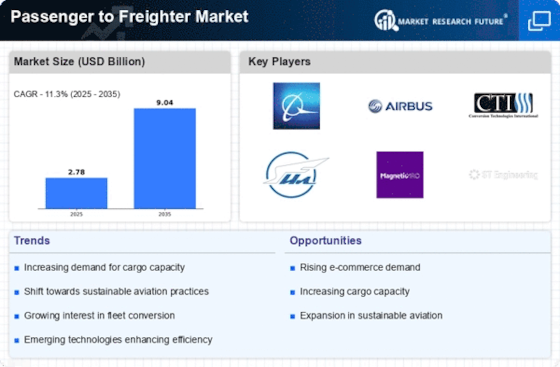
As per Market Research Future analysis, the Passenger to Freighter Market Size was estimated at 2.783 USD Billion in 2024. The Passenger to Freighter industry is projected to grow from 3.097 USD Billion in 2025 to 9.036 USD Billion by 2035, exhibiting a compound annual growth rate (CAGR) of 11.3% during the forecast period 2025 - 2035

Key Market Trends & Highlights

The Passenger to Freighter Market is poised for substantial growth driven by e-commerce and sustainability initiatives.

  • The North American market remains the largest, driven by robust e-commerce growth and air cargo demand.
  • Asia-Pacific is emerging as the fastest-growing region, reflecting increasing trade liberalization and economic recovery.
  • The new build segment dominates the market, while the refurbished segment is experiencing rapid growth due to cost-effectiveness.
  • Key market drivers include the expansion of e-commerce and stringent sustainability regulations, which are shaping conversion strategies.

Market Size & Forecast

2024 Market Size 2.783 (USD Billion)
2035 Market Size 9.036 (USD Billion)
CAGR (2025 - 2035) 11.3%
Largest Regional Market Share in 2024 North America

Major Players

Boeing (US), Airbus (FR), Conversion Technologies International (US), Ilyushin Finance Co. (RU), Magnetic MRO (EE), ST Engineering (SG), Aviation Capital Group (US), Korean Air (KR), Atlas Air Worldwide Holdings (US)

Market Trends

The Passenger to Freighter Market is currently experiencing a notable transformation, driven by various factors that influence the aviation and logistics sectors. The increasing demand for air cargo services, coupled with the need for efficient transportation solutions, has led to a growing interest in converting passenger aircraft into freighters. This trend appears to be fueled by the rising e-commerce sector, which necessitates rapid delivery options. Furthermore, airlines are recognizing the potential for additional revenue streams through the conversion of underutilized passenger aircraft, thereby optimizing their fleets. In addition, environmental considerations are becoming increasingly relevant in the Passenger to Freighter Market. The aviation industry is under pressure to reduce its carbon footprint, and converting existing aircraft may present a more sustainable alternative to manufacturing new freighters. This approach not only conserves resources but also aligns with global efforts to promote greener practices within the transportation sector. As the market evolves, stakeholders are likely to explore innovative solutions that enhance operational efficiency while addressing environmental concerns, indicating a dynamic future for the Passenger to Freighter Market.

E-commerce Growth

The expansion of the e-commerce sector is significantly impacting the Passenger to Freighter Market. As online shopping continues to rise, the demand for air freight services is increasing, prompting airlines to consider converting passenger aircraft to meet this need.

Sustainability Initiatives

Environmental sustainability is becoming a focal point for the aviation industry. The conversion of passenger aircraft into freighters is viewed as a more eco-friendly option, potentially reducing the carbon footprint associated with manufacturing new aircraft.

Fleet Optimization Strategies

Airlines are increasingly looking to optimize their fleets by converting underutilized passenger planes into freighters. This strategy not only generates additional revenue but also enhances operational efficiency, allowing airlines to adapt to changing market demands.

Passenger to Freighter Market Market Drivers

E-commerce Expansion

The rapid expansion of e-commerce has emerged as a pivotal driver for the Passenger to Freighter Market. As online shopping continues to gain traction, the demand for efficient cargo transport solutions has surged. In 2025, e-commerce sales are projected to reach approximately 6 trillion USD, necessitating a robust logistics framework. This growth compels airlines to convert passenger aircraft into freighters, thereby optimizing their fleets to meet the increasing demand for air freight services. The Passenger to Freighter Market is likely to benefit from this trend, as companies seek to enhance their delivery capabilities and reduce transit times. Furthermore, the shift towards direct-to-consumer shipping models amplifies the need for versatile cargo solutions, reinforcing the importance of passenger-to-freighter conversions in the logistics landscape.

Rising Demand for Air Cargo Services

The rising demand for air cargo services is a crucial driver for the Passenger to Freighter Market. As global trade continues to expand, the need for rapid and reliable transportation of goods has intensified. In 2025, air cargo volumes are anticipated to grow, driven by factors such as increased international trade and the need for just-in-time delivery. This trend compels airlines to adapt their operations, often leading to the conversion of passenger aircraft into freighters to accommodate the surge in cargo demand. The Passenger to Freighter Market is likely to experience heightened activity as airlines respond to this growing need, enhancing their capacity to transport goods efficiently. Additionally, the shift towards air freight for high-value and time-sensitive products further underscores the importance of converting passenger aircraft to meet market requirements.

Economic Recovery and Trade Liberalization

Economic recovery and trade liberalization are influencing the dynamics of the Passenger to Freighter Market. As economies rebound, there is a notable increase in trade activities, prompting airlines to expand their cargo capabilities. In 2025, the easing of trade barriers and the establishment of new trade agreements are expected to facilitate cross-border commerce, thereby boosting demand for air freight services. This environment encourages airlines to convert passenger aircraft into freighters, allowing them to capitalize on the growing market opportunities. The Passenger to Freighter Market is poised to benefit from this trend, as airlines seek to enhance their operational flexibility and respond to the evolving needs of international trade. The interplay between economic growth and trade liberalization may lead to a sustained increase in the conversion of passenger aircraft, further solidifying the industry's position.

Sustainability and Environmental Regulations

Sustainability initiatives and stringent environmental regulations are increasingly influencing the Passenger to Freighter Market. Airlines are under pressure to reduce their carbon footprints and comply with international standards aimed at minimizing environmental impact. The conversion of passenger aircraft to freighters is seen as a viable strategy to enhance fuel efficiency and reduce emissions. In 2025, the aviation sector is expected to face more rigorous regulations, prompting airlines to adopt greener practices. This shift not only aligns with The Passenger to Freighter Market that values eco-friendly operations. The Passenger to Freighter Market is thus likely to see a rise in demand for converted freighters that meet these evolving standards, as companies strive to balance profitability with environmental responsibility.

Technological Advancements in Aircraft Conversion

Technological advancements in aircraft conversion processes are significantly shaping the Passenger to Freighter Market. Innovations in engineering and design have streamlined the conversion of passenger aircraft into freighters, reducing both time and costs associated with these modifications. In 2025, the introduction of advanced materials and automated systems is expected to enhance the efficiency of conversion projects. This evolution not only accelerates the availability of converted freighters but also improves their operational capabilities. As airlines seek to modernize their fleets, the Passenger to Freighter Market stands to gain from these technological improvements, which may lead to increased adoption rates of converted aircraft. Furthermore, enhanced conversion technologies could potentially lower maintenance costs, making freighter operations more economically viable.

Market Segment Insights

By Build Type: New Build (Largest) vs. Refurbished (Fastest-Growing)

The Passenger to Freighter Market is seeing a notable distribution in the Build Type segment, with New Build aircraft accounting for the largest share. This segment appeals to operators seeking modern, efficient freighter designs tailored specifically for cargo operations. In contrast, the Refurbished category, which involves converting existing passenger aircraft into freighters, is rapidly gaining traction. This approach is attractive due to its cost-effectiveness and quicker turnaround times, offering an alternative for operators aiming to expand their fleets with lower capital expenditure.

New Build (Dominant) vs. Refurbished (Emerging)

The New Build segment in the Passenger to Freighter Market is characterized by state-of-the-art designs and enhanced fuel efficiency, making it the dominant force in the category. Airlines investing in New Builds benefit from advanced technologies and customized configurations that meet the latest cargo handling requirements. On the other hand, the Refurbished category is emerging as a popular alternative, appealing to budget-conscious operators who prefer to maximize the lifecycle of existing assets. Refurbished aircraft are often equipped with upgrades to meet modern operational standards, allowing for a blend of affordability and performance in expanding freight capacity.

By Aircraft Model: Wide Body (Largest) vs. Narrow Body (Fastest-Growing)

The Passenger to Freighter Market reveals a diverse landscape of aircraft models, where Wide Body models command a significant market share. They are favored for their larger capacity and operational efficiencies, positioning them as the leading choice among airlines transitioning to freighter operations. In contrast, Narrow Body aircraft are experiencing remarkable growth as they cater to a surging demand for regional and short-haul freight services, enabling airlines to optimize their fleets according to market needs.

Aircraft Models: Wide Body (Dominant) vs. Narrow Body (Emerging)

Wide Body aircraft dominate the Passenger to Freighter Market due to their versatility in handling large volumes of cargo, making them preferred for long-haul logistics. Their robust design, coupled with advanced payload capabilities, allows operators to maximize efficiency and profitability. On the other hand, Narrow Body aircraft are emerging as key players, driven by an increasing inclination towards e-commerce and expedited deliveries. Their smaller size offers operational flexibility and adaptability in urban environments, appealing to carriers seeking cost-effective solutions for regional freight needs. This dynamic presents both segments as essential contributors to the evolving landscape of the air cargo industry.

By Fitment: Slot/Retro Fitment (Largest) vs. Line Fitment (Fastest-Growing)

In the Passenger to Freighter Market, the fitment segment comprises two primary categories: Slot/Retro Fitment and Line Fitment. Slot/Retro Fitment is the largest segment, leveraging existing passenger aircraft by modifying them into freighters, thereby providing significant opportunities for operators to maximize their asset utilization. On the other hand, Line Fitment, which involves integrating freighter specifications during the manufacturing process, is seeing increased adoption, with market players recognizing the advantages of tailored designs for specific cargo needs. The growth trends within this segment largely hinge on the evolving dynamics of air freight demand and logistics solutions. Slot/Retro Fitment remains robust due to cost efficiency in repurposing retired passenger planes, while Line Fitment is emerging rapidly as manufacturers streamline processes to align with the surging demands for dedicated cargo aircraft. Furthermore, advancements in lightweight materials and aircraft technology are acting as key drivers supporting both segment categories, enhancing performance capabilities and operational efficiencies.

Slot/Retro Fitment (Dominant) vs. Line Fitment (Emerging)

Slot/Retro Fitment stands as the dominant player in the market, primarily focusing on converting existing passenger airliners into freighters. This approach allows airlines to tap into lucrative freight opportunities without the substantial costs associated with new aircraft procurement. Meanwhile, Line Fitment is emerging as a significant contender, designed for new aircraft that are purpose-built for freight transport. With airlines increasingly prioritizing operational efficiency and reliability, Line Fitment is gaining traction due to its ability to incorporate advanced technologies from the onset of aircraft production. Both segments are critical in meeting the demands of evolving logistics landscapes, with Slot/Retro Fitment offering immediate solutions and Line Fitment laying the groundwork for future growth.

Get more detailed insights about Passenger to Freighter Market  Research Report – Forecast till 2035

Regional Insights

North America : Market Leader in Conversion

North America is the largest market for passenger to freighter conversions, holding approximately 45% of the global market share. The region benefits from a robust aviation infrastructure, increasing demand for air cargo services, and favorable regulatory frameworks. The growth is driven by e-commerce expansion and the need for efficient logistics solutions, particularly in the U.S. and Canada, which are the top contributors to this market.

Europe : Innovative Conversion Solutions

Europe is the second-largest market, accounting for around 30% of The Passenger to Freighter Market. The region is characterized by stringent environmental regulations and a strong push towards sustainable aviation practices. Countries like Germany and France are leading the charge, with significant investments in conversion technologies and partnerships among key players to enhance operational efficiency.

Asia-Pacific : Rapid Growth and Demand

Asia-Pacific is witnessing rapid growth in the passenger to freighter market, driven by increasing air cargo demand and a surge in e-commerce activities. Countries like China and India are at the forefront, with significant investments in aviation infrastructure and conversion capabilities. The region is expected to capture around 20% of the global market share, with a competitive landscape featuring both local and international players.

Middle East and Africa : Strategic Logistics Hub

The Middle East and Africa region is emerging as a strategic hub for passenger to freighter conversions, holding about 5% of the global market share. The growth is fueled by the increasing demand for air cargo services and the region's strategic location for global trade routes. Countries like the UAE and South Africa are investing in aviation infrastructure to enhance their conversion capabilities and attract international players.

Key Players and Competitive Insights

Leading market players are investing heavily in research and development in order to expand their product lines, which will help the Passenger-to-fighter market grow even more. Market participants are also undertaking a variety of strategic activities to expand their footprint, with important market developments including new product launches, contractual agreements, mergers and acquisitions, higher investments, and collaboration with other organizations. To expand and survive in a more competitive and rising market climate, the Passenger Freighter industry must offer cost-effective items.Manufacturing locally to minimize operational costs is one of the key business tactics used by manufacturers in the Passenger Freighter industry to benefit clients and increase the market sector. In recent years, the Passenger to Freighter industry has offered some of the most significant advantages to passengers in freighter market.Major players in the Passenger Freighter market, including AerCap (Ireland), Aeronautical Engineers, Inc. (US), Airbus SE (Netherlands), Boeing Company (US), Bombardier, Inc. (Canada), Elbe Flugzeugwerke GmbH (Germany), Embraer SA (Brazil), HAECO Group (Hong Kong), Precision Aircrfat Solutions (US), ST Engineering (Singapore), and others, are attempting to increase market demand by investing in research and development operations.Israel Aerospace Industries (IAI) is the primary aerospace and aviation manufacturer in Israel, which creates aerial and astronautics systems for both military and commercial applications. IAI Creates, develops, manufactures, and maintains fighter jets, drones, civil aircraft, avionics, and space-based technologies.In order to sustain the plane of the Israel Defense Forces, Shimon Peres, the then-director general of the Ministry of Defense, spearheaded the founding of Israel Aerospace Industries in 1953 as Bedek Aviation Company.  Although engineering, aviation, and advanced electronics are IAI’s primary areas of focus, the company also produces military systems for land and sea troops/While some of these products are marketed to the international military as well, many of them are specifically designed for the Israel Defense Forces (IDF) requirements.

In February IAI declared its intention to partner with Sharp Technics to build a new facility at Incheon Airport in South Korea for the conversion of Boeing 777s in 2024. To develop a Passenger 2 Cargo (P2F) conversion site in South Korea, IAI Aviation Group, Incheon International Airport, and Sharp Technics signed a Memorandum of Agreement (MOA).Textron Aviation Inc. is the general aviation division of the conglomerate Textron. It was established in March 2014 as a result of the purchase of Beech Holdings, which included the Beechcraft and Hawker Aircraft businesses. Textron Aviation Inc., the Cessna, owned by Textron, is a part of the new business unit. Selling branded aircraft under the Beechcraft and Cessna, name is Textron Aviation. Textron Aviation continues to serve the current Hawker aircraft fleet through its service centers while no longer offering brand-new Hawker aircraft for sale.The corporation views the many lines of aircraft produced by Textron Aviation, such as the Cessna single-engine piston and turboprop aircraft and jets and the Beechcraft piston and turboprop aircraft, as complementary to one another rather than as rivals.

In March Textron Aviation reported that FedEx Express received the first Cessna SkyCourier twin utility turboprop. Cessna SkyCourier  is the first of 50 cargo planes that FedEx Express, a major worldwide logistics company, ordered as the Cessna SkyCourier’s first customer.

Key Companies in the Passenger to Freighter Market include

Industry Developments

For Instance, January 2022 Elbe Flugzeugwerke keeps expanding its capabilities. From the 19 conversions, it anticipates performing this year, by 2024, it will have increased its existing capacity to the point where it can produce roughly 60 converted aircraft annually-roughly 30 conversions of each the A330 and the new A321 narrow body. Additionally, it anticipates establishing production facilities for the A330 reconfiguration in both China and the USA.

For Instance, February 2022 Boeing and ST Engineering announced that they intended to build a unique 767-300 Boeing Converted Freighter (BCF) line at the factory in Guangzhou.

For Instance, November 2021 Emirates and IAI agreed to convert four 777-300 ER aircraft into freighters, citing the aircraft’s capacity to transport significant e-commerce as a deciding factor.

ST Engineering and Vaayu Group (Vaayu) announced in February 2022 that they had signed a lease agreement for leasing up to five Airbus A320 P2F aircrafts. Astral Aviation, based in Nairobi, Kenya, which is one of the fastest growing countries in the world, would be subleasing the first two among the five A320P2F aircrafts from Vaayu to act as a launch operator.

In February 2022, ST Engineering Company reported that it had entered into a contract with Vaayu Group (Vaayu), which would enable the leasing of not more than five Airbus A320 P2F. The first two planes among these five planes of A320P2F are going to be sub-leased to Astral Aviation, which is an all-cargo airline situated in Nairobi, Kenya, which is one of the fastest growing countries globally, thereby making it a launch operator.

Pradhan Air Express made its inaugural commercial cargo flight on October 2022 using their own plane. It was also the World’s first diverted cargo A320. The initial flights over Delhi International Airport- Mumbai International Airport- Delhi were carried out by Passenger-to-freighter conversion for A320-200 models. Flights from Delhi to Hanoi, Vietnam began on 9th October 2022.

In February 2022 ST Engineering and Vaayu Group (Vaayu) announced an agreement involving at least up to five Airbus A320 P2F planes. To work as launch operators Astral Aviation will get subleases for just two out of these five airplanes belonging to Vaayu which is an all-cargo airline based here at Nairobi Kenya having one of highest growth rates worldwide.

Raytheon Technologies released RAIVEN – this groundbreaking electro-optical perceptive capability allows faster and more accurate threat detection for pilots within April 2023. The simultaneous optical and spectral object identification features of RAIVEN, which no other device has ever had, operate within a single Electro-Optical/Infrared (EO/IR) system. In addition, RAIVEN’s “intelligent sensing” capability uses AI, hyperspectral imaging, and LiDAR to provide operators with five times greater resolution and range than traditional optical imaging. That increases platform survivability and gives warfighters the upper hand over near-peer threats.

In February 2022, Boeing, together with ST Engineering, announced their plans to build a unique line of 767-300 Boeing Converted Freighter (BCF) at the Guangzhou factory.

In November 2021, Emirates and IAI agreed to convert four 777-300 ER aircraft into freighters due to their huge e-commerce transporting capabilities.

Future Outlook

Passenger to Freighter Market Future Outlook

The Passenger to Freighter Market is projected to grow at 11.3% CAGR from 2025 to 2035, driven by increasing e-commerce demand, fleet modernization, and regulatory support.

New opportunities lie in:

  • Development of conversion kits for older aircraft models
  • Partnerships with logistics firms for integrated solutions
  • Investment in sustainable fuel technologies for freighters

By 2035, the market is expected to be robust, driven by innovation and strategic partnerships.

Market Segmentation

Passenger to Freighter Market Fitment Outlook

  • Slot/Retro Fitment
  • Line Fitment

Passenger to Freighter Market Build Type Outlook

  • New Build
  • Refurbished

Passenger to Freighter Market Aircraft Model Outlook

  • Narrow Body
  • Wide Body
  • Regional Jets

Report Scope

MARKET SIZE 2024 2.783(USD Billion)
MARKET SIZE 2025 3.097(USD Billion)
MARKET SIZE 2035 9.036(USD Billion)
COMPOUND ANNUAL GROWTH RATE (CAGR) 11.3% (2025 - 2035)
REPORT COVERAGE Revenue Forecast, Competitive Landscape, Growth Factors, and Trends
BASE YEAR 2024
Market Forecast Period 2025 - 2035
Historical Data 2019 - 2024
Market Forecast Units USD Billion
Key Companies Profiled Boeing (US), Airbus (FR), Conversion Technologies International (US), Ilyushin Finance Co. (RU), Magnetic MRO (EE), ST Engineering (SG), Aviation Capital Group (US), Korean Air (KR), Atlas Air Worldwide Holdings (US)
Segments Covered Build Type, Aircraft Model, Fitment, Region
Key Market Opportunities Adoption of advanced conversion technologies enhances efficiency in the Passenger to Freighter Market.
Key Market Dynamics Rising demand for cargo capacity drives conversion of passenger aircraft to freighters amid evolving supply chain dynamics.
Countries Covered North America, Europe, APAC, South America, MEA

FAQs

What is the projected market valuation for the Passenger to Freighter Market in 2035?

<p>The projected market valuation for the Passenger to Freighter Market in 2035 is 9.036 USD Billion.</p>

What was the market valuation for the Passenger to Freighter Market in 2024?

<p>The market valuation for the Passenger to Freighter Market in 2024 was 2.783 USD Billion.</p>

What is the expected CAGR for the Passenger to Freighter Market from 2025 to 2035?

<p>The expected CAGR for the Passenger to Freighter Market during the forecast period 2025 - 2035 is 11.3%.</p>

Which companies are considered key players in the Passenger to Freighter Market?

<p>Key players in the Passenger to Freighter Market include Boeing, Airbus, Conversion Technologies International, and others.</p>

What are the main segments of the Passenger to Freighter Market?

<p>The main segments of the Passenger to Freighter Market include Build Type, Aircraft Model, and Fitment.</p>

What is the valuation range for the New Build segment in the Passenger to Freighter Market?

<p>The valuation range for the New Build segment in the Passenger to Freighter Market is between 1.5 and 5.0 USD Billion.</p>

How does the valuation of the Wide Body aircraft model segment compare to Narrow Body?

The valuation for the Wide Body aircraft model segment ranges from 1.045 to 3.36 USD Billion, compared to 0.835 to 2.688 USD Billion for Narrow Body.

What is the projected valuation for the Refurbished segment by 2035?

The projected valuation for the Refurbished segment by 2035 is expected to reach 4.036 USD Billion.

What is the valuation range for the Slot/Retro Fitment segment?

The valuation range for the Slot/Retro Fitment segment is between 1.3915 and 4.5185 USD Billion.

Which company is likely to lead the Passenger to Freighter Market in terms of innovation?

Boeing and Airbus are likely to lead the Passenger to Freighter Market in terms of innovation and technological advancements.

  1. SECTION I: EXECUTIVE SUMMARY AND KEY HIGHLIGHTS
    1. | 1.1 EXECUTIVE SUMMARY
    2. | | 1.1.1 Market Overview
    3. | | 1.1.2 Key Findings
    4. | | 1.1.3 Market Segmentation
    5. | | 1.1.4 Competitive Landscape
    6. | | 1.1.5 Challenges and Opportunities
    7. | | 1.1.6 Future Outlook
  2. SECTION II: SCOPING, METHODOLOGY AND MARKET STRUCTURE
    1. | 2.1 MARKET INTRODUCTION
    2. | | 2.1.1 Definition
    3. | | 2.1.2 Scope of the study
    4. | | | 2.1.2.1 Research Objective
    5. | | | 2.1.2.2 Assumption
    6. | | | 2.1.2.3 Limitations
    7. | 2.2 RESEARCH METHODOLOGY
    8. | | 2.2.1 Overview
    9. | | 2.2.2 Data Mining
    10. | | 2.2.3 Secondary Research
    11. | | 2.2.4 Primary Research
    12. | | | 2.2.4.1 Primary Interviews and Information Gathering Process
    13. | | | 2.2.4.2 Breakdown of Primary Respondents
    14. | | 2.2.5 Forecasting Model
    15. | | 2.2.6 Market Size Estimation
    16. | | | 2.2.6.1 Bottom-Up Approach
    17. | | | 2.2.6.2 Top-Down Approach
    18. | | 2.2.7 Data Triangulation
    19. | | 2.2.8 Validation
  3. SECTION III: QUALITATIVE ANALYSIS
    1. | 3.1 MARKET DYNAMICS
    2. | | 3.1.1 Overview
    3. | | 3.1.2 Drivers
    4. | | 3.1.3 Restraints
    5. | | 3.1.4 Opportunities
    6. | 3.2 MARKET FACTOR ANALYSIS
    7. | | 3.2.1 Value chain Analysis
    8. | | 3.2.2 Porter's Five Forces Analysis
    9. | | | 3.2.2.1 Bargaining Power of Suppliers
    10. | | | 3.2.2.2 Bargaining Power of Buyers
    11. | | | 3.2.2.3 Threat of New Entrants
    12. | | | 3.2.2.4 Threat of Substitutes
    13. | | | 3.2.2.5 Intensity of Rivalry
    14. | | 3.2.3 COVID-19 Impact Analysis
    15. | | | 3.2.3.1 Market Impact Analysis
    16. | | | 3.2.3.2 Regional Impact
    17. | | | 3.2.3.3 Opportunity and Threat Analysis
  4. SECTION IV: QUANTITATIVE ANALYSIS
    1. | 4.1 Aerospace & Defense, BY Build Type (USD Billion)
    2. | | 4.1.1 New Build
    3. | | 4.1.2 Refurbished
    4. | 4.2 Aerospace & Defense, BY Aircraft Model (USD Billion)
    5. | | 4.2.1 Narrow Body
    6. | | 4.2.2 Wide Body
    7. | | 4.2.3 Regional Jets
    8. | 4.3 Aerospace & Defense, BY Fitment (USD Billion)
    9. | | 4.3.1 Slot/Retro Fitment
    10. | | 4.3.2 Line Fitment
    11. | 4.4 Aerospace & Defense, BY Region (USD Billion)
    12. | | 4.4.1 North America
    13. | | | 4.4.1.1 US
    14. | | | 4.4.1.2 Canada
    15. | | 4.4.2 Europe
    16. | | | 4.4.2.1 Germany
    17. | | | 4.4.2.2 UK
    18. | | | 4.4.2.3 France
    19. | | | 4.4.2.4 Russia
    20. | | | 4.4.2.5 Italy
    21. | | | 4.4.2.6 Spain
    22. | | | 4.4.2.7 Rest of Europe
    23. | | 4.4.3 APAC
    24. | | | 4.4.3.1 China
    25. | | | 4.4.3.2 India
    26. | | | 4.4.3.3 Japan
    27. | | | 4.4.3.4 South Korea
    28. | | | 4.4.3.5 Malaysia
    29. | | | 4.4.3.6 Thailand
    30. | | | 4.4.3.7 Indonesia
    31. | | | 4.4.3.8 Rest of APAC
    32. | | 4.4.4 South America
    33. | | | 4.4.4.1 Brazil
    34. | | | 4.4.4.2 Mexico
    35. | | | 4.4.4.3 Argentina
    36. | | | 4.4.4.4 Rest of South America
    37. | | 4.4.5 MEA
    38. | | | 4.4.5.1 GCC Countries
    39. | | | 4.4.5.2 South Africa
    40. | | | 4.4.5.3 Rest of MEA
  5. SECTION V: COMPETITIVE ANALYSIS
    1. | 5.1 Competitive Landscape
    2. | | 5.1.1 Overview
    3. | | 5.1.2 Competitive Analysis
    4. | | 5.1.3 Market share Analysis
    5. | | 5.1.4 Major Growth Strategy in the Aerospace & Defense
    6. | | 5.1.5 Competitive Benchmarking
    7. | | 5.1.6 Leading Players in Terms of Number of Developments in the Aerospace & Defense
    8. | | 5.1.7 Key developments and growth strategies
    9. | | | 5.1.7.1 New Product Launch/Service Deployment
    10. | | | 5.1.7.2 Merger & Acquisitions
    11. | | | 5.1.7.3 Joint Ventures
    12. | | 5.1.8 Major Players Financial Matrix
    13. | | | 5.1.8.1 Sales and Operating Income
    14. | | | 5.1.8.2 Major Players R&D Expenditure. 2023
    15. | 5.2 Company Profiles
    16. | | 5.2.1 Boeing (US)
    17. | | | 5.2.1.1 Financial Overview
    18. | | | 5.2.1.2 Products Offered
    19. | | | 5.2.1.3 Key Developments
    20. | | | 5.2.1.4 SWOT Analysis
    21. | | | 5.2.1.5 Key Strategies
    22. | | 5.2.2 Airbus (FR)
    23. | | | 5.2.2.1 Financial Overview
    24. | | | 5.2.2.2 Products Offered
    25. | | | 5.2.2.3 Key Developments
    26. | | | 5.2.2.4 SWOT Analysis
    27. | | | 5.2.2.5 Key Strategies
    28. | | 5.2.3 Conversion Technologies International (US)
    29. | | | 5.2.3.1 Financial Overview
    30. | | | 5.2.3.2 Products Offered
    31. | | | 5.2.3.3 Key Developments
    32. | | | 5.2.3.4 SWOT Analysis
    33. | | | 5.2.3.5 Key Strategies
    34. | | 5.2.4 Ilyushin Finance Co. (RU)
    35. | | | 5.2.4.1 Financial Overview
    36. | | | 5.2.4.2 Products Offered
    37. | | | 5.2.4.3 Key Developments
    38. | | | 5.2.4.4 SWOT Analysis
    39. | | | 5.2.4.5 Key Strategies
    40. | | 5.2.5 Magnetic MRO (EE)
    41. | | | 5.2.5.1 Financial Overview
    42. | | | 5.2.5.2 Products Offered
    43. | | | 5.2.5.3 Key Developments
    44. | | | 5.2.5.4 SWOT Analysis
    45. | | | 5.2.5.5 Key Strategies
    46. | | 5.2.6 ST Engineering (SG)
    47. | | | 5.2.6.1 Financial Overview
    48. | | | 5.2.6.2 Products Offered
    49. | | | 5.2.6.3 Key Developments
    50. | | | 5.2.6.4 SWOT Analysis
    51. | | | 5.2.6.5 Key Strategies
    52. | | 5.2.7 Aviation Capital Group (US)
    53. | | | 5.2.7.1 Financial Overview
    54. | | | 5.2.7.2 Products Offered
    55. | | | 5.2.7.3 Key Developments
    56. | | | 5.2.7.4 SWOT Analysis
    57. | | | 5.2.7.5 Key Strategies
    58. | | 5.2.8 Korean Air (KR)
    59. | | | 5.2.8.1 Financial Overview
    60. | | | 5.2.8.2 Products Offered
    61. | | | 5.2.8.3 Key Developments
    62. | | | 5.2.8.4 SWOT Analysis
    63. | | | 5.2.8.5 Key Strategies
    64. | | 5.2.9 Atlas Air Worldwide Holdings (US)
    65. | | | 5.2.9.1 Financial Overview
    66. | | | 5.2.9.2 Products Offered
    67. | | | 5.2.9.3 Key Developments
    68. | | | 5.2.9.4 SWOT Analysis
    69. | | | 5.2.9.5 Key Strategies
    70. | 5.3 Appendix
    71. | | 5.3.1 References
    72. | | 5.3.2 Related Reports
  6. LIST OF FIGURES
    1. | 6.1 MARKET SYNOPSIS
    2. | 6.2 NORTH AMERICA MARKET ANALYSIS
    3. | 6.3 US MARKET ANALYSIS BY BUILD TYPE
    4. | 6.4 US MARKET ANALYSIS BY AIRCRAFT MODEL
    5. | 6.5 US MARKET ANALYSIS BY FITMENT
    6. | 6.6 CANADA MARKET ANALYSIS BY BUILD TYPE
    7. | 6.7 CANADA MARKET ANALYSIS BY AIRCRAFT MODEL
    8. | 6.8 CANADA MARKET ANALYSIS BY FITMENT
    9. | 6.9 EUROPE MARKET ANALYSIS
    10. | 6.10 GERMANY MARKET ANALYSIS BY BUILD TYPE
    11. | 6.11 GERMANY MARKET ANALYSIS BY AIRCRAFT MODEL
    12. | 6.12 GERMANY MARKET ANALYSIS BY FITMENT
    13. | 6.13 UK MARKET ANALYSIS BY BUILD TYPE
    14. | 6.14 UK MARKET ANALYSIS BY AIRCRAFT MODEL
    15. | 6.15 UK MARKET ANALYSIS BY FITMENT
    16. | 6.16 FRANCE MARKET ANALYSIS BY BUILD TYPE
    17. | 6.17 FRANCE MARKET ANALYSIS BY AIRCRAFT MODEL
    18. | 6.18 FRANCE MARKET ANALYSIS BY FITMENT
    19. | 6.19 RUSSIA MARKET ANALYSIS BY BUILD TYPE
    20. | 6.20 RUSSIA MARKET ANALYSIS BY AIRCRAFT MODEL
    21. | 6.21 RUSSIA MARKET ANALYSIS BY FITMENT
    22. | 6.22 ITALY MARKET ANALYSIS BY BUILD TYPE
    23. | 6.23 ITALY MARKET ANALYSIS BY AIRCRAFT MODEL
    24. | 6.24 ITALY MARKET ANALYSIS BY FITMENT
    25. | 6.25 SPAIN MARKET ANALYSIS BY BUILD TYPE
    26. | 6.26 SPAIN MARKET ANALYSIS BY AIRCRAFT MODEL
    27. | 6.27 SPAIN MARKET ANALYSIS BY FITMENT
    28. | 6.28 REST OF EUROPE MARKET ANALYSIS BY BUILD TYPE
    29. | 6.29 REST OF EUROPE MARKET ANALYSIS BY AIRCRAFT MODEL
    30. | 6.30 REST OF EUROPE MARKET ANALYSIS BY FITMENT
    31. | 6.31 APAC MARKET ANALYSIS
    32. | 6.32 CHINA MARKET ANALYSIS BY BUILD TYPE
    33. | 6.33 CHINA MARKET ANALYSIS BY AIRCRAFT MODEL
    34. | 6.34 CHINA MARKET ANALYSIS BY FITMENT
    35. | 6.35 INDIA MARKET ANALYSIS BY BUILD TYPE
    36. | 6.36 INDIA MARKET ANALYSIS BY AIRCRAFT MODEL
    37. | 6.37 INDIA MARKET ANALYSIS BY FITMENT
    38. | 6.38 JAPAN MARKET ANALYSIS BY BUILD TYPE
    39. | 6.39 JAPAN MARKET ANALYSIS BY AIRCRAFT MODEL
    40. | 6.40 JAPAN MARKET ANALYSIS BY FITMENT
    41. | 6.41 SOUTH KOREA MARKET ANALYSIS BY BUILD TYPE
    42. | 6.42 SOUTH KOREA MARKET ANALYSIS BY AIRCRAFT MODEL
    43. | 6.43 SOUTH KOREA MARKET ANALYSIS BY FITMENT
    44. | 6.44 MALAYSIA MARKET ANALYSIS BY BUILD TYPE
    45. | 6.45 MALAYSIA MARKET ANALYSIS BY AIRCRAFT MODEL
    46. | 6.46 MALAYSIA MARKET ANALYSIS BY FITMENT
    47. | 6.47 THAILAND MARKET ANALYSIS BY BUILD TYPE
    48. | 6.48 THAILAND MARKET ANALYSIS BY AIRCRAFT MODEL
    49. | 6.49 THAILAND MARKET ANALYSIS BY FITMENT
    50. | 6.50 INDONESIA MARKET ANALYSIS BY BUILD TYPE
    51. | 6.51 INDONESIA MARKET ANALYSIS BY AIRCRAFT MODEL
    52. | 6.52 INDONESIA MARKET ANALYSIS BY FITMENT
    53. | 6.53 REST OF APAC MARKET ANALYSIS BY BUILD TYPE
    54. | 6.54 REST OF APAC MARKET ANALYSIS BY AIRCRAFT MODEL
    55. | 6.55 REST OF APAC MARKET ANALYSIS BY FITMENT
    56. | 6.56 SOUTH AMERICA MARKET ANALYSIS
    57. | 6.57 BRAZIL MARKET ANALYSIS BY BUILD TYPE
    58. | 6.58 BRAZIL MARKET ANALYSIS BY AIRCRAFT MODEL
    59. | 6.59 BRAZIL MARKET ANALYSIS BY FITMENT
    60. | 6.60 MEXICO MARKET ANALYSIS BY BUILD TYPE
    61. | 6.61 MEXICO MARKET ANALYSIS BY AIRCRAFT MODEL
    62. | 6.62 MEXICO MARKET ANALYSIS BY FITMENT
    63. | 6.63 ARGENTINA MARKET ANALYSIS BY BUILD TYPE
    64. | 6.64 ARGENTINA MARKET ANALYSIS BY AIRCRAFT MODEL
    65. | 6.65 ARGENTINA MARKET ANALYSIS BY FITMENT
    66. | 6.66 REST OF SOUTH AMERICA MARKET ANALYSIS BY BUILD TYPE
    67. | 6.67 REST OF SOUTH AMERICA MARKET ANALYSIS BY AIRCRAFT MODEL
    68. | 6.68 REST OF SOUTH AMERICA MARKET ANALYSIS BY FITMENT
    69. | 6.69 MEA MARKET ANALYSIS
    70. | 6.70 GCC COUNTRIES MARKET ANALYSIS BY BUILD TYPE
    71. | 6.71 GCC COUNTRIES MARKET ANALYSIS BY AIRCRAFT MODEL
    72. | 6.72 GCC COUNTRIES MARKET ANALYSIS BY FITMENT
    73. | 6.73 SOUTH AFRICA MARKET ANALYSIS BY BUILD TYPE
    74. | 6.74 SOUTH AFRICA MARKET ANALYSIS BY AIRCRAFT MODEL
    75. | 6.75 SOUTH AFRICA MARKET ANALYSIS BY FITMENT
    76. | 6.76 REST OF MEA MARKET ANALYSIS BY BUILD TYPE
    77. | 6.77 REST OF MEA MARKET ANALYSIS BY AIRCRAFT MODEL
    78. | 6.78 REST OF MEA MARKET ANALYSIS BY FITMENT
    79. | 6.79 KEY BUYING CRITERIA OF AEROSPACE & DEFENSE
    80. | 6.80 RESEARCH PROCESS OF MRFR
    81. | 6.81 DRO ANALYSIS OF AEROSPACE & DEFENSE
    82. | 6.82 DRIVERS IMPACT ANALYSIS: AEROSPACE & DEFENSE
    83. | 6.83 RESTRAINTS IMPACT ANALYSIS: AEROSPACE & DEFENSE
    84. | 6.84 SUPPLY / VALUE CHAIN: AEROSPACE & DEFENSE
    85. | 6.85 AEROSPACE & DEFENSE, BY BUILD TYPE, 2024 (% SHARE)
    86. | 6.86 AEROSPACE & DEFENSE, BY BUILD TYPE, 2024 TO 2035 (USD Billion)
    87. | 6.87 AEROSPACE & DEFENSE, BY AIRCRAFT MODEL, 2024 (% SHARE)
    88. | 6.88 AEROSPACE & DEFENSE, BY AIRCRAFT MODEL, 2024 TO 2035 (USD Billion)
    89. | 6.89 AEROSPACE & DEFENSE, BY FITMENT, 2024 (% SHARE)
    90. | 6.90 AEROSPACE & DEFENSE, BY FITMENT, 2024 TO 2035 (USD Billion)
    91. | 6.91 BENCHMARKING OF MAJOR COMPETITORS
  7. LIST OF TABLES
    1. | 7.1 LIST OF ASSUMPTIONS
    2. | | 7.1.1
    3. | 7.2 North America MARKET SIZE ESTIMATES; FORECAST
    4. | | 7.2.1 BY BUILD TYPE, 2025-2035 (USD Billion)
    5. | | 7.2.2 BY AIRCRAFT MODEL, 2025-2035 (USD Billion)
    6. | | 7.2.3 BY FITMENT, 2025-2035 (USD Billion)
    7. | 7.3 US MARKET SIZE ESTIMATES; FORECAST
    8. | | 7.3.1 BY BUILD TYPE, 2025-2035 (USD Billion)
    9. | | 7.3.2 BY AIRCRAFT MODEL, 2025-2035 (USD Billion)
    10. | | 7.3.3 BY FITMENT, 2025-2035 (USD Billion)
    11. | 7.4 Canada MARKET SIZE ESTIMATES; FORECAST
    12. | | 7.4.1 BY BUILD TYPE, 2025-2035 (USD Billion)
    13. | | 7.4.2 BY AIRCRAFT MODEL, 2025-2035 (USD Billion)
    14. | | 7.4.3 BY FITMENT, 2025-2035 (USD Billion)
    15. | 7.5 Europe MARKET SIZE ESTIMATES; FORECAST
    16. | | 7.5.1 BY BUILD TYPE, 2025-2035 (USD Billion)
    17. | | 7.5.2 BY AIRCRAFT MODEL, 2025-2035 (USD Billion)
    18. | | 7.5.3 BY FITMENT, 2025-2035 (USD Billion)
    19. | 7.6 Germany MARKET SIZE ESTIMATES; FORECAST
    20. | | 7.6.1 BY BUILD TYPE, 2025-2035 (USD Billion)
    21. | | 7.6.2 BY AIRCRAFT MODEL, 2025-2035 (USD Billion)
    22. | | 7.6.3 BY FITMENT, 2025-2035 (USD Billion)
    23. | 7.7 UK MARKET SIZE ESTIMATES; FORECAST
    24. | | 7.7.1 BY BUILD TYPE, 2025-2035 (USD Billion)
    25. | | 7.7.2 BY AIRCRAFT MODEL, 2025-2035 (USD Billion)
    26. | | 7.7.3 BY FITMENT, 2025-2035 (USD Billion)
    27. | 7.8 France MARKET SIZE ESTIMATES; FORECAST
    28. | | 7.8.1 BY BUILD TYPE, 2025-2035 (USD Billion)
    29. | | 7.8.2 BY AIRCRAFT MODEL, 2025-2035 (USD Billion)
    30. | | 7.8.3 BY FITMENT, 2025-2035 (USD Billion)
    31. | 7.9 Russia MARKET SIZE ESTIMATES; FORECAST
    32. | | 7.9.1 BY BUILD TYPE, 2025-2035 (USD Billion)
    33. | | 7.9.2 BY AIRCRAFT MODEL, 2025-2035 (USD Billion)
    34. | | 7.9.3 BY FITMENT, 2025-2035 (USD Billion)
    35. | 7.10 Italy MARKET SIZE ESTIMATES; FORECAST
    36. | | 7.10.1 BY BUILD TYPE, 2025-2035 (USD Billion)
    37. | | 7.10.2 BY AIRCRAFT MODEL, 2025-2035 (USD Billion)
    38. | | 7.10.3 BY FITMENT, 2025-2035 (USD Billion)
    39. | 7.11 Spain MARKET SIZE ESTIMATES; FORECAST
    40. | | 7.11.1 BY BUILD TYPE, 2025-2035 (USD Billion)
    41. | | 7.11.2 BY AIRCRAFT MODEL, 2025-2035 (USD Billion)
    42. | | 7.11.3 BY FITMENT, 2025-2035 (USD Billion)
    43. | 7.12 Rest of Europe MARKET SIZE ESTIMATES; FORECAST
    44. | | 7.12.1 BY BUILD TYPE, 2025-2035 (USD Billion)
    45. | | 7.12.2 BY AIRCRAFT MODEL, 2025-2035 (USD Billion)
    46. | | 7.12.3 BY FITMENT, 2025-2035 (USD Billion)
    47. | 7.13 APAC MARKET SIZE ESTIMATES; FORECAST
    48. | | 7.13.1 BY BUILD TYPE, 2025-2035 (USD Billion)
    49. | | 7.13.2 BY AIRCRAFT MODEL, 2025-2035 (USD Billion)
    50. | | 7.13.3 BY FITMENT, 2025-2035 (USD Billion)
    51. | 7.14 China MARKET SIZE ESTIMATES; FORECAST
    52. | | 7.14.1 BY BUILD TYPE, 2025-2035 (USD Billion)
    53. | | 7.14.2 BY AIRCRAFT MODEL, 2025-2035 (USD Billion)
    54. | | 7.14.3 BY FITMENT, 2025-2035 (USD Billion)
    55. | 7.15 India MARKET SIZE ESTIMATES; FORECAST
    56. | | 7.15.1 BY BUILD TYPE, 2025-2035 (USD Billion)
    57. | | 7.15.2 BY AIRCRAFT MODEL, 2025-2035 (USD Billion)
    58. | | 7.15.3 BY FITMENT, 2025-2035 (USD Billion)
    59. | 7.16 Japan MARKET SIZE ESTIMATES; FORECAST
    60. | | 7.16.1 BY BUILD TYPE, 2025-2035 (USD Billion)
    61. | | 7.16.2 BY AIRCRAFT MODEL, 2025-2035 (USD Billion)
    62. | | 7.16.3 BY FITMENT, 2025-2035 (USD Billion)
    63. | 7.17 South Korea MARKET SIZE ESTIMATES; FORECAST
    64. | | 7.17.1 BY BUILD TYPE, 2025-2035 (USD Billion)
    65. | | 7.17.2 BY AIRCRAFT MODEL, 2025-2035 (USD Billion)
    66. | | 7.17.3 BY FITMENT, 2025-2035 (USD Billion)
    67. | 7.18 Malaysia MARKET SIZE ESTIMATES; FORECAST
    68. | | 7.18.1 BY BUILD TYPE, 2025-2035 (USD Billion)
    69. | | 7.18.2 BY AIRCRAFT MODEL, 2025-2035 (USD Billion)
    70. | | 7.18.3 BY FITMENT, 2025-2035 (USD Billion)
    71. | 7.19 Thailand MARKET SIZE ESTIMATES; FORECAST
    72. | | 7.19.1 BY BUILD TYPE, 2025-2035 (USD Billion)
    73. | | 7.19.2 BY AIRCRAFT MODEL, 2025-2035 (USD Billion)
    74. | | 7.19.3 BY FITMENT, 2025-2035 (USD Billion)
    75. | 7.20 Indonesia MARKET SIZE ESTIMATES; FORECAST
    76. | | 7.20.1 BY BUILD TYPE, 2025-2035 (USD Billion)
    77. | | 7.20.2 BY AIRCRAFT MODEL, 2025-2035 (USD Billion)
    78. | | 7.20.3 BY FITMENT, 2025-2035 (USD Billion)
    79. | 7.21 Rest of APAC MARKET SIZE ESTIMATES; FORECAST
    80. | | 7.21.1 BY BUILD TYPE, 2025-2035 (USD Billion)
    81. | | 7.21.2 BY AIRCRAFT MODEL, 2025-2035 (USD Billion)
    82. | | 7.21.3 BY FITMENT, 2025-2035 (USD Billion)
    83. | 7.22 South America MARKET SIZE ESTIMATES; FORECAST
    84. | | 7.22.1 BY BUILD TYPE, 2025-2035 (USD Billion)
    85. | | 7.22.2 BY AIRCRAFT MODEL, 2025-2035 (USD Billion)
    86. | | 7.22.3 BY FITMENT, 2025-2035 (USD Billion)
    87. | 7.23 Brazil MARKET SIZE ESTIMATES; FORECAST
    88. | | 7.23.1 BY BUILD TYPE, 2025-2035 (USD Billion)
    89. | | 7.23.2 BY AIRCRAFT MODEL, 2025-2035 (USD Billion)
    90. | | 7.23.3 BY FITMENT, 2025-2035 (USD Billion)
    91. | 7.24 Mexico MARKET SIZE ESTIMATES; FORECAST
    92. | | 7.24.1 BY BUILD TYPE, 2025-2035 (USD Billion)
    93. | | 7.24.2 BY AIRCRAFT MODEL, 2025-2035 (USD Billion)
    94. | | 7.24.3 BY FITMENT, 2025-2035 (USD Billion)
    95. | 7.25 Argentina MARKET SIZE ESTIMATES; FORECAST
    96. | | 7.25.1 BY BUILD TYPE, 2025-2035 (USD Billion)
    97. | | 7.25.2 BY AIRCRAFT MODEL, 2025-2035 (USD Billion)
    98. | | 7.25.3 BY FITMENT, 2025-2035 (USD Billion)
    99. | 7.26 Rest of South America MARKET SIZE ESTIMATES; FORECAST
    100. | | 7.26.1 BY BUILD TYPE, 2025-2035 (USD Billion)
    101. | | 7.26.2 BY AIRCRAFT MODEL, 2025-2035 (USD Billion)
    102. | | 7.26.3 BY FITMENT, 2025-2035 (USD Billion)
    103. | 7.27 MEA MARKET SIZE ESTIMATES; FORECAST
    104. | | 7.27.1 BY BUILD TYPE, 2025-2035 (USD Billion)
    105. | | 7.27.2 BY AIRCRAFT MODEL, 2025-2035 (USD Billion)
    106. | | 7.27.3 BY FITMENT, 2025-2035 (USD Billion)
    107. | 7.28 GCC Countries MARKET SIZE ESTIMATES; FORECAST
    108. | | 7.28.1 BY BUILD TYPE, 2025-2035 (USD Billion)
    109. | | 7.28.2 BY AIRCRAFT MODEL, 2025-2035 (USD Billion)
    110. | | 7.28.3 BY FITMENT, 2025-2035 (USD Billion)
    111. | 7.29 South Africa MARKET SIZE ESTIMATES; FORECAST
    112. | | 7.29.1 BY BUILD TYPE, 2025-2035 (USD Billion)
    113. | | 7.29.2 BY AIRCRAFT MODEL, 2025-2035 (USD Billion)
    114. | | 7.29.3 BY FITMENT, 2025-2035 (USD Billion)
    115. | 7.30 Rest of MEA MARKET SIZE ESTIMATES; FORECAST
    116. | | 7.30.1 BY BUILD TYPE, 2025-2035 (USD Billion)
    117. | | 7.30.2 BY AIRCRAFT MODEL, 2025-2035 (USD Billion)
    118. | | 7.30.3 BY FITMENT, 2025-2035 (USD Billion)
    119. | 7.31 PRODUCT LAUNCH/PRODUCT DEVELOPMENT/APPROVAL
    120. | | 7.31.1
    121. | 7.32 ACQUISITION/PARTNERSHIP
    122. | | 7.32.1

Aerospace & Defense Market Segmentation

Aerospace & Defense By Build Type (USD Billion, 2025-2035)

  • New Build
  • Refurbished

Aerospace & Defense By Aircraft Model (USD Billion, 2025-2035)

  • Narrow Body
  • Wide Body
  • Regional Jets

Aerospace & Defense By Fitment (USD Billion, 2025-2035)

  • Slot/Retro Fitment
  • Line Fitment
Infographic

Free Sample Request

Kindly complete the form below to receive a free sample of this Report

Get Free Sample

Customer Strories

Compare Licence

×
Features License Type
Single User Multiuser License Enterprise User
Price $4,950 $5,950 $7,250
Maximum User Access Limit 1 User Upto 10 Users Unrestricted Access Throughout the Organization
Free Customization
Direct Access to Analyst
Deliverable Format
Platform Access
Discount on Next Purchase 10% 15% 15%
Printable Versions